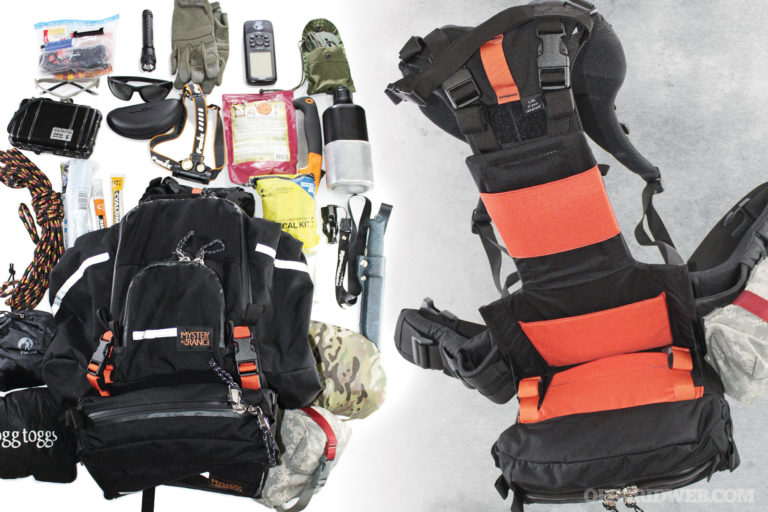
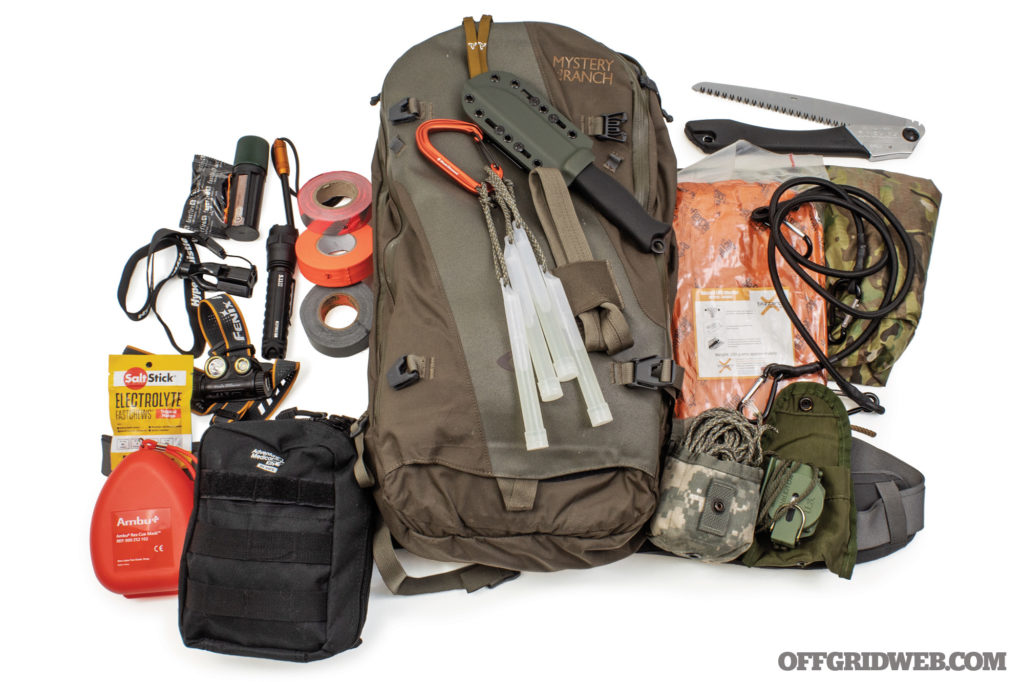
When disaster strikes having your bug out bag ready at a moments notice will ensure your safety and security in the hard days ahead – right?
The answer to this is not as simple as we think. Bug Out Bags are just one type of Go Bag and may not be ideal in all situations. It’s not just about having a good bag with reliable gear. It is about having the right bag and gear for the situation you are about to face!
A great wilderness bag may have little application in an urban setting. A fully stocked bug out bag may slow our movement when seconds matter. Choosing the appropriate bag and gear for the unique emergency you are facing is essential to improving your survival odds.
We know it can be difficult to plan for the unknown – that is why RECOIL OFFGRID has partnered with ARC to give you the tools and knowledge you need to get your kit dialed in.
Combining ARC’s expertise with the latest technological innovations has led to the creation of a powerful tool that will help you build the ideal Bug Out Bag, WUSH Bag, INCH Bag, or Get Home Bag for the emergency situations you are likely to face in the area you are living in or operating in.
This tool goes beyond providing a generic packing list – it takes emergency type, expected duration, climate, threat level, speed of egress, and much more into account while putting together your ideal kit packing list.
Your Custom Go Bag List is Just the Beginning
Having an ideal Go Bag for your unique needs is valuable, but having the knowledge and skill to use the tools in your Go Bag in a real emergency will give you the edge you need to not just survive but thrive!
RECOIL OFFGRID has curated topic specific content to provide you with recommendations on gear, teach you vital survival skills, provide advice to enhance your mindset, and offer guidance to keep in you in peak physical condition.
Expert Advice to Trust Your Life With
Every aspect of this program has been created by industry experts with the intention of removing gimmicks and fluff to provide sound recommendations based on real world experience.
American Reconstruction Concepts was founded by Michael Caughran a U.S. Air Force SERE Instructor that has survived in the world’s harshest environments and hostile locations. Today American Reconstruction Concepts trains civilians, law enforcement organizations, and military professionals the art and science survival, evasion, resistance, and evasion.
The RECOIL OFFGRID team has a diverse range of skills deriving from military experience, wilderness and urban survival expertise, firearms instruction, and more. OFFGRID’s rigorous standards for gear testing and article content ensure the readers are getting the best in equipment recommendations and up-to-date survival knowledge in each article.
Grab Your Bag, It’s Go Time!
Are you ready to take the first step to becoming more prepared to handle the uncertainty of a chaotic world? Click the links below to learn more about different types of Go Bags utilize ARC’s free tool to build your ideal Go Bag. Remember, one bag can’t handle every situation. Use ARC’s Go Bag building tool to help you put together Go Bag kits for different situations!
Familiarize yourself with different bag types, learn more on how to properly utilize your go bag resources and see our recommendations for bags and the gear that goes into them!
This year, The Department of War put out a document that addresses a generationally defining aspect of modern warfare. It is called the Counter-Small Unmanned Aircraft Systems Quick Reference Guide, produced by Joint Interagency Task Force 401, and it was cleared for open publication in August. It is a collection of intel and tactics surrounding the use of weaponized and military drones.
After reading all eighty-nine pages of it, one line in particular that stayed with me sits in the threat section: Small drones, it says, can be used by terrorists, criminal organizations, and lone actors inside the homeland. And that is not a forecast for some far off day in the future. Cartels already fly them across the southern border. Prisons already intercept them dropping contraband over the wire. Airports already log them fouling approach paths. The tool that redefined the fight in Ukraine costs a few hundred dollars and ships to a doorstep.
So the question is not whether civilians will ever stand under a hostile drone, it is whether we will know what to do when we are.
The military sorts drone missions into a handful of buckets, and every one of them has a civilian shadow. Reconnaissance drones watch and record, and they carry thermal optics that pick up body heat through the dark. Attack drones carry a warhead and fly themselves into a target, what the guide calls a “one-way attack.” Then come the swarms, clusters of aircraft that talk to each other and strike as a unit. The manual notes a typical swarm burns through five to twelve aircraft on a single objective.
The pattern to understand is the one you might be able to detect before it’s too late. A small reconnaissance drone finds a target and passes the coordinates. A first-person-view (FPV) drone, flown through goggles by an operator who may be a mile away, follows the data in and strikes. The guide calls this the “classic method.” It’s cheap, it’s repeatable, and it does not care whether the target wears a uniform. A single operator with two aircraft and a video feed can run the whole cycle from a tree line.
That accessibility is the shift upending how wars have been fought. For most of history, the ability to see a target from above and put a weapon on it belonged to states with air forces. It now belongs to anyone with a credit card and an afternoon of practice. The aforementioned guide exists because the people who fight for a living understand that better than the rest of us do.
A combat drone carry suspended munitions.
What Soldiers are Told to Do
Strip away the acronyms and the military’s individual survival guidance comes down to habits any of us can build.
The first is a scanning discipline they call, fittingly, the SCAN drill:
S: Seek Cover and Concealment C: Check Low Sky (the 5-meter check, horizon up to about 45 degrees, where a striking drone lives) A: Announce and Report (transition to the 25-meter check, push a SPOTREP) N: Now Scan High Sky (the 25-meter check, the deliberate sweep for a loitering reconnaissance platform)
It adapts the old roadside-bomb check every Global War on Terrorism (GWOT) veteran knows, the habit of clearing five meters around you and then twenty-five meters out, and points it at the sky. Seek cover and concealment, anything that could block your visual, and ideally, your infrared signature from an airborne scanning optic. Check the low sky first, horizon up to about forty-five degrees, because that is where a striking drone lives. Announce what you see. Then scan the high sky for the reconnaissance platform loitering above. The guide tells soldiers to look for anything out of the ordinary, a bird that does not move like a bird, an object hiding in the sun’s glare or riding a cloud line.
The second habit is the reaction itself. If a reconnaissance drone has spotted you, the manual says to assume a strike is coming and to move before it does. Three things break enemy targeting:
1) Dispersion, so one munition cannot catch a group. 2) Cover and concealment, with overhead cover rated the single best protection against a drone-dropped or drone-delivered weapon. 3) And movement that stays unpredictable, never a straight line, never the obvious route.
The third habit is the hardest to accept, and the most useful. When a drone is already diving, the guide is blunt about how little time you have. Get to cover. If there is no cover, get low, because getting low shrinks what blast and fragmentation can reach. Even a wall, a ditch, or the inside of a vehicle beats standing in the open. Your reaction needs to start treating the sky as terrain instead of scenery.
Drones can be used for surveillance purposes
The Line Civilians Cannot Cross
The internet is full of bad advice about it, so it’s best to be direct about this next part. You cannot legally shoot a drone down. You cannot jam it, spoof it, or take over its controls. Federal law treats a drone as an aircraft, and knocking one out of the sky can be charged the same way as sabotaging a manned plane under 18 U.S.C. 32. Jamming falls under a separate federal prohibition with no private-use exception.
What changed is who on the government side can act. The SAFER SKIES Act, signed in December 2025 and put into effect this July, extended drone-defeat authority to state, local, tribal, and territorial police for the first time, provided their agencies pass federal certification through the FBI’s training center. Private citizens, private security, and contractors were left out on purpose. The written authority expires at the end of 2031 unless Congress renews it.
In the United States, it is illegal for civilians to to shoot down drones.
The civilian toolkit splits cleanly along that line. On watching, you have room to operate. Passive detectors that sense a drone’s radio signature are legal to own, as are thermal optics, and any modern drone is required to broadcast its own identity and location on a Remote ID signal your phone can read with the right app (search for “drone remote ID scanner” in your app store). On acting against the aircraft itself, you have nothing legal, and the correct move is to become an excellent witness and hand the problem to the people who now carry the authority to solve it.
Learn to identify common drone types to make the most accurate report possible.
Becoming the Witness
The manual’s reporting format is built for a military radio net, but the bones of it work for a 911 call. Note your location. Note the drone’s direction and rough distance. Count them. Describe the airframe: quadcopter or fixed wing, the color, the lights and their pattern, whether it carries anything slung underneath, and what it is doing. A drone loitering over a crowd reads very differently than one transiting overhead, and that description is the difference between a report an officer can act on and a shrug on the other end of the line.
There is value in the pattern too, not only the single sighting. If the same aircraft works your neighborhood at the same hour, or circles the same building twice in a week, write it down and photograph it each time. One drone overhead is a curiosity, a schedule is intelligence, and it is the kind of thing that turns a vague complaint into an investigation. Police who now hold defeat authority still need a reason to use it, and a reason is built from good reporting.
One more thing from the guide, for the day one of these comes down on its own. Do not walk up to it. A downed drone can still be transmitting, and it can carry a payload that has not gone off. The military rule is to keep your distance, keep other people back, photograph it from where you stand, and let trained people handle the rest. That holds whether you are in a war zone or a grocery store parking lot.
Different types of Kamikaze attack drones.
The Uncomfortable Part
I spent over a decade as a Cavalry Scout learning to see before I was seen. The drone turns that training inside out, because the thing that sees you first can now also be the thing that kills you, and it can do both from a mile away for the price of a used laptop. The military is spending billions to answer that with radar towers and interceptor missiles. The rest of us do not get those resources.
What we do get is what soldiers had before any of the hardware existed. Awareness. Cover. The discipline to move when instinct says freeze. The drone did not invent the danger of being watched and hunted. It made that danger cheap, and it handed it to people who used to have no way to reach us. The response has not changed as much as you would expect. Look up. Build a plan for the sky the way you already have a plan for a fire or a flat tire. And know, before you ever need it, exactly who to call and exactly what to tell them.
The guide closes with a reminder that the drone threat will keep changing and that staying ahead of it takes staying informed. That part is not written only for soldiers. It is the one instruction in the whole document that every reader can follow starting today.
Military personnel monitoring reconnaissance date from a drone
There comes a point when duration of camp or maybe just age where sleeping on the ground stops being part of the trip and quickly becomes an impediment. Rocks, roots, uneven terrain — it all adds up, and no sleeping pad fully fixes it. That’s where something like the Helinox Tactical Cot One Convertible earns its place. It’s not about luxury. You’re not soft. It’s about getting off the ground and actually recovering for the next day.
At its core, this cot is built around a simple idea that is executed well. A lightweight frame, a tensioned fabric surface, and just enough elevation to separate you from whatever you’re parked on. The lever-lock system is what makes it work. Once it’s tensioned, the sleeping surface stays tight; no sagging, no hammocking effect, just a flat, supportive platform that feels closer to a real bed than most camp setups you’re likely to encounter.
What stands out is how compact it is for what it delivers. Packed down, it fits into a relatively small case, making it easy to toss in with the rest of your kit without having to reorganize your entire loadout. At around 5 pounds and with a DAC aluminum frame, it strikes a balance between durability and portability that works well for car camping, overlanding, or even more mobile setups where space still matters.
Setup takes a minute to learn and about 60 seconds to execute once you’ve done it in your living room a few times.
It’s not difficult, but it does require a bit of intention. This isn’t a fold-and-go camp chair, but that’s also why it’s still light weight. That said, once it’s up, it’s solid. Rated to handle real weight and built with reinforced hubs and materials, it’s the kind of piece you don’t worry about once you’re on it.
The Tactical version adds small touches that make sense in the field — subdued colors, a bit of integrated storage underneath, and a more utilitarian feel overall. Nothing about the Tactical Cot One Tactical is flashy, just functional upgrades that align with how it’s likely to be used.
The Cot One Convertible isn’t trying to compete with oversized camp beds or plush air mattresses. It’s designed for people who want better sleep without dragging half their house into the woods. For car camping, basecamp setups, or any trip where recovery matters, it earns its footprint the first night you use it.
In January 2026, the Bulletin of the Atomic Scientists moved the Doomsday Clock to 85 seconds to midnight, the closest humanity has been to catastrophe in the clock’s 79-year history. Nuclear war is not the only danger the Bulletin tracks, but it remains the oldest and most visceral one: a technology designed to end cities, deter enemies through terror, and, if mismanaged, escalate from battlefield use to civilizational catastrophe.
There are currently nine nuclear-armed states: the United States, Russia, the United Kingdom, France, China, Israel, India, Pakistan, and North Korea. But the arithmetic is lopsided. The United States and Russia still possess almost 90 percent of the world’s nuclear weapons, and the arms-control architecture built to manage that danger has been steadily eroding. The U.S. withdrew from the Iran nuclear deal in 2018, the Intermediate-Range Nuclear Forces Treaty in 2019, and the Open Skies Treaty in 2020.
Then, in February 2026, New START — the last legally binding nuclear arms-control agreement limiting U.S. and Russian strategic arsenals — expired. Meanwhile, North Korea continues to increase its nuclear stockpiles and test Intercontinental Ballistic Missiles (ICBMs) in violation of international law.
Unsurprisingly, these events have fed a renewed fear that nuclear weapons may no longer be relics of Cold War nightmares, but live instruments in a worsening geopolitical age.
That anxiety has helped fuel what social scientists have called a “Second Doom Boom,” a revival of disaster preparedness not seen since the Cold War. Recent research suggests that the “doomsday prepping” or disaster preparedness industry has boomed into a lucrative over $70 billion market in the U.S. The market for nuclear fallout shelters alone is predicted to top $175 million by 2030.
Americans are buying land, food storage, water filters, radios, weapons, medical kits, off-grid power systems, and, at the high end, underground bunkers. All of which begs the question: Can you really prepare for nuclear war?
Shelter (not necessarily a bunker) is your key consideration, and the first thing to understand is the difference between a blast shelter and a fallout shelter. A blast shelter is built to survive the pressure wave, heat, debris, and structural violence of a nearby detonation. Government facilities such as Raven Rock, Cheyenne Mountain, and Mount Weather, or private complexes like the Survival Condo in Kansas, are designed around that logic. But no shelter should be imagined as invincible.
Close enough to ground zero, especially with a modern high-yield weapon, heat, overpressure, ground shock, and literal melting rock make survival unlikely. A fallout shelter is different. It’s not meant to survive the center of the apocalypse. It’s meant to protect people farther away from radioactive debris carried downwind after the blast.
So, when thinking about nuclear shelter — weathering the storm, as it were — geography is everything. NUKEMAP, Alex Wellerstein’s web-based nuclear-weapons effects simulator, allows users to model blast, thermal radiation, prompt radiation, casualties, and fallout. If I use NUKEMAP to model a 5-megaton Chinese Dong Feng-5 ICBM detonating as a surface burst in downtown Los Angeles, the result is almost impossible to comprehend: estimated fatalities approach 1 million before fallout is even factored in.
Yet the map also shows the strange geography of nuclear survival. Neighborhoods inside the fireball, heavy-blast, and thermal-radiation rings are effectively gone, while areas only 30 minutes by car may sit outside the worst immediate effects. Add fallout, however, and the danger changes shape. With a 15-mph wind, dose-rate contours can extend hundreds of miles downwind, potentially reaching Arizona.
Backyard nuclear shelters under construction.
The grim reality is that you are unlikely to survive inside the severe blast or thermal zone. You cannot “prep” your way through ground zero. But if you’re outside the blast and thermal zones and inside the fallout plume, you have options. Survival becomes about getting behind mass, fast. Fallout is radioactive dust and grit, not invisible death gas, so the goal is to put as much dense material as possible between your body and whatever lands on the roof, street, balcony, yard, and vehicles outside.
In a single-family home, that means the basement, if you have one, or an interior room with no windows, if you do not. In an apartment building, it may mean the center of the structure, an underground parking level, a stairwell core, or a lower-floor interior hallway away from the roof and exterior walls. Standing at a window watching the cloud and thinking horrible thoughts is not going to help you. You need to get inside, bring pets in, remove contaminated outer clothing if you were outdoors, bag it, wash exposed skin and hair with soap and water (but not conditioner, which binds!), seal your location, and stay put.
Bunker complex in South Dakota.
The first 24 hours are the critical window, and the first 48 hours are better if you can manage it. Fallout radiation decays rapidly: a useful civil-defense rule of thumb is that after about seven hours, the dose rate has fallen by roughly 90 percent, after about 49 hours by about 99 percent, and after two weeks by about 99.9 percent. This is why two weeks became a kind of civil-defense magic number. It does not mean the outside world is safe. It means time is your shield. Waiting out the first two days to two weeks can be the difference between a lethal dose and a survivable one.
Steps You Can Actually Take
Your home shelter — not your detached garage, which you might not be able to get to — should be stocked for lockdown: several weeks of bottled water, ready-to-eat food, medications, first aid, sanitation supplies, trash bags, gloves, respirators, flashlights, batteries, power banks, a battery or hand-crank AM/FM/NOAA radio, and a way to receive official instructions without relying on the internet are crucial.
Printed manuals still matter. So does offline information: first-aid guides, repair books, water-treatment instructions, sanitation references, and even an offline AI doomsday laptop or reference library that can run without the internet may be crucial when cell service, power, and search engines have become a literal rather than metaphorical cloud.
A government nuclear bunker.
Plastic sheeting and duct tape can reduce drafts around windows, doors, vents, and fireplace dampers while the fallout plume is passing. However, creating negative pressure (by pumping air into the house to “expel” bad air is the wrong instinct, because it can pull contaminated air inward. Turn off HVAC systems, fans, swamp coolers, fresh-air intakes, bathroom exhaust fans, and anything else that draws outside air into the shelter.
Later, if authorities say the plume has passed, recirculating indoor air with fans may be safer than overheating. A portable gas generator is a bad option for sheltering because of carbon monoxide and exposure risks, so battery banks, solar generators charged in advance, and low-power radios are gold. Cell service may work in some places and fail completely in others. Treat phones as a bonus, not a plan — they very well may be bricked.
Potassium iodide is also not the magic pill many imagine. It only protects the thyroid from radioactive iodine. It does nothing for burns, gamma radiation, or most fallout hazards. If you’re forced to go outside through fallout, treat it like walking through poisonous dust: cover as much skin as possible, wear a tight-fitting mask or respirator, keep the trip short, avoid touching your face, and do not track dust back into the shelter.
When you return, remove outer clothing carefully, bag it, wash exposed skin and hair, and get back behind shielding. Survival still begins with time, distance, shielding, and decontamination. Medicine can help afterward, but it can’t reverse a lethal dose. It’s literally better to sit inside, starving for a few weeks, than to expose yourself to go collect food.
A house in Thailand built for fallout.
Put Your Fears in Perspective
If all of this feels terrifying to consider, that is because it is. During the Cold War, nuclear planners and ordinary citizens both took the possibility seriously. If people could not be evacuated from cities, they had to be “invacuated” into shelters, because a state without survivors could not rebuild. Herman Kahn, the RAND strategist once described as one of the “megadeath intellectuals,” argued that any state able to protect a high percentage of its urban population would be in a stronger position than one that could not. This was a hideous kind of logic, but it shaped American shelter thinking for decades.
The result was the first doom boom. Government pamphlets, civil-defense films, backyard shelter plans, and magazine spreads encouraged Americans to take responsibility for their own survival. Some dug into their yards. Some fled cities. Some built suburban bunkers and imagined resurrection. Others looked at the scale of the problem and gave in to despair. In a 1956 Gallup poll, only 29 percent of Americans thought their families were likely to survive an atomic war.
Long-term food supplies at the Survival Condo.
The nuclear threat has not vanished. The Doomsday Clock is only a symbol, but symbols matter when they remind us of real machines, real arsenals, and real decisions made by a small number of people. There is no consumer product that can make nuclear war safe. There is no bunker, pill, radio, rifle, filter, or food bucket that solves the larger problem.
But there are practical steps that can increase your odds at the margins: know whether you live near likely targets, understand the difference between a blast and fallout, identify the best shelter space in your home or building, store basic supplies, keep multiple ways to receive information, and talk through the plan before panic sets in.
And then comes the part preppers often forget: Nobody rebuilds alone. Bugging in is only the beginning. Eventually, you will have to rip down the plastic sheeting, open the door, and step back into a damaged world. The people who survive that world will not just be the ones with supplies. They will be the ones with neighbors, skills, trust, and a motivation to keep going.
Knives are among our oldest and frequently used tools. Not a day goes by that we don’t use one. Most of the knives we use have very specific purposes: chef knives, paring knives, butter knives, and utility knives dominate our daily life. Bushcraft knives, hunting knives, and field knives aid us outdoors. Some professionals utilize tactical and combat knives on a regular basis. With a wide range of design and functionality, most knives are designed for very specific purposes, but some are designed to perform a wide array of tasks and do it well. Custom knife maker Todd Hunt’s M18 is one of those knives.
The M18 is great single knife option for any wilderness kit.
Build Quality
The M18’s blade style is not something you commonly see. It bears some similarities to the Tracker design made famous by Tom Brown — though the M18 is far larger and packs several design elements not found on Tracker designs. The M18 is a monster of a blade coming in at an overall length of 16 inches with just over a 10-inch blade. Made from ¼-thick 01 tools steel, the M18 is built to take on every hard-use task you can throw at it. The blade itself has a forced patina, which will help reduce corrosion.
The M18 is available in both semi-custom and full-custom versions. The semi-custom version seen in this article has durable Micarta handle scales that provide excellent grip even when wet and can withstand the elements, extended sun exposure, and is resistant to most chemicals. Custom versions of the M18 often offer exotic wood handles that really make the M18 stand out.
The handle design itself was inspired by Ethan Becker’s KA-BAR, allowing for a comfortable full hand grip. There is enough room on the handle to choke up when doing detailed work or slide back when chopping. The blade guard is pronounced to prevent your hand from coming near the blade.
Sheaths for the M18 vary. This version has a thick leather belt sheath, while others may come with Kydex options. While the leather belt sheath is not designed for a snug fit, it provides a smooth easy draw that will keep the blade in place unless it’s held upside down. The M18 carries surprisingly comfortably on your belt despite its size and fits great in any midsized or large pack.
The M18’s thick blade stock combined with durable O1 steel ensures it can handle the most rigorous tasks.
Design Features
The M18 is more than a knife; it is a bladed multi-tool that is built for the serious outdoors craftsman, taking on the role of several traditional woodworking tools.
The size and weight make the M18 an ideal chopper and wood splitter, replacing the need to carry a stand-alone hatchet.
At nearly 2 pounds, the M18 is more than capable to felling sapling and small trees.
The curved portion toward the rear of the blade allows the M18 to be used as a drawknife to shave, shape, and carve wood.
The thick blade stock allows for heavy-duty wood batoning without concern of damaging the blade.
Despite the M18’s large size, it performs well in detailed work, and the front sharpened area makes a great chisel. Beyond woodworking, the M18 fills in several other outdoor knife and tool roles.
The cleaver-style blade makes the M18 an excellent option for camp meal prep or chopping large pieces of meat.
The rear tang of the blade has a textured strike face that can be used for hammering and other blunt striking tasks.
The thick blade stock and tough 01 steel allows for using the M18 as a pry tool.
The wide front edge can be used for digging tasks.
With several pinch points and jimping along the spine, detailed work in game processing is possible.
Final Thoughts
The M18 is a serious tool with a ton of versatility. If you need to head to the woods and plan on building a serious camp from nothing but what you would find in nature, the M18 is the tool you want to bring with you. Beyond its woodworking prowess, the M18 packs plenty of usable features to make it an excellent general camp knife and outdoor working tool.
The M18 is best suited for an experienced woodworker, bushcrafter, or outdoorsperson — but even if you don’t fall into one of these categories, you may want to be after a few minutes of using this beast of a knife.
Trinity is where it all started. At 5:29 a.m. on July 16, 1945, scientists of the Manhattan Project detonated the world’s first nuclear device atop a steel tower here, in the desolate basin the Spanish called the Jornada del Muerto, the “Journey of the Dead Man.” The blast vaporized the tower and fused the desert sand into a faintly radioactive green glass that came to be called trinitite, traces of which can still be seen at ground zero.
Today, a modest lava-rock obelisk marks the exact detonation point, reached by a quarter-mile walk, while a shuttle carries visitors two miles to the restored McDonald Ranch House, where the plutonium core was assembled. Ringed by the Oscura Mountains and miles of empty high desert, it is a place of enormous skies and sobering quiet, the birthplace of the atomic age preserved in open wilderness.
A lava-rock obelisk marks ground zero, where scientists detonated the world’s first nuclear device at 5:29 a.m. on July 16, 1945.
Survival Readiness
Trinity is far more accessible than a Pacific atoll, but it is still remote high desert and deserves respect. The site sits at altitude on an active military range with no shade and no reliable services nearby, so bring sun protection, layers, and plenty of water. The desert can be hot by midday and cold and windy in the early morning.
Radiation at ground zero is low, roughly 10 times background for a short visit, and the Army advises against pocketing trinitite, which is both mildly radioactive and illegal to remove. Cell service is unreliable across the basin, so don’t depend on it.
Two miles from ground zero, the restored McDonald Ranch House is where technicians assembled the bomb’s plutonium core the night before the test.
Getting There
Trinity opens to the public only twice a year, on the first Saturday of April and the third Saturday of October (October 17 in 2026), with no fee and no advance registration for the standard open house. All visitors enter through the Stallion Gate off U.S. Highway 380. From the west, exit I-25 at mile marker 139 near San Antonio, New Mexico, and head 12 miles east; from the east, take U.S. 380 west about 53 miles from Carrizozo.
A government-issued photo ID is required for everyone 18 and over, along with vehicle registration and proof of insurance. Crucially, do not trust GPS out here. It routinely misdirects drivers, so follow the posted directions and fill your tank in Socorro, Carrizozo, or Truth or Consequences before you go.
Open-house crowds tour the McDonald Ranch House, preserved much as it stood in the summer of 1945.
Local Perks
The journey pairs naturally with some of New Mexico’s best high-desert country. Nearby White Sands National Park offers surreal gypsum dunes worth a day of their own, while the Bosque del Apache National Wildlife Refuge draws huge flocks of sandhill cranes and snow geese in the cooler months. The towns of Socorro and San Antonio serve up classic New Mexican green-chile cooking, and the White Sands Missile Range Museum and missile park add depth to the history. For travelers chasing the
There’s a certain value in gear that simply works with no learning curve, no overthinking, just a straightforward solution to a common problem. The Plano GoNow 30L Camp Kit fits squarely into that category. Designed as an all-in-one camp kitchen and organization system, it’s built for those trips where convenience matters, but you still want a setup that feels thought out rather than thrown together. At its core, the GoNow is about efficiency. The 30-liter capacity provides enough space to consolidate essential cooking and camp items without becoming bulky or difficult to manage. Instead of digging through multiple bins and bags, everything goes into one organized system. Plano’s reputation for durable storage is evident here, with a rugged exterior that holds up well to the bumps and scrapes that come with vehicle-supported travel. It’s clearly intended for car camping, overlanding, or basecamp-style setups where reliability and accessibility take precedence over shaving weight.
What stands out most is the integrated approach. The kit typically includes core camp kitchen components such as cookware, utensils, and food-prep essentials neatly organized within the container. This not only streamlines packing but also reduces the chances of forgetting critical items. The interior layout keeps gear secure and easy to access, allowing you to set up and break down camp with minimal effort.
For those who value repeatable systems, this kind of organization goes a long way toward making trips smoother and more enjoyable. In the field, the GoNow shines in its simplicity. Setup is quick, and the structured storage means you’re not wasting time searching for the right tool when it’s time to cook. The compact footprint also makes it easy to stow in the back of a truck or SUV, earning its space without demanding special consideration. It’s not designed for ultralight travel, and that’s entirely the point. This is gear meant to enhance comfort and efficiency when mobility is supported by a vehicle.
If there’s a trade-off, it’s that preconfigured kits may include items you wouldn’t have selected individually. However, for many users, the convenience of a ready-to-go system outweighs that consideration, especially for quick trips or those just beginning to refine their camp setup.
The Plano GoNow 30L Camp Kit isn’t reinventing the camp kitchen. It’s about simplifying it. For anyone looking to streamline their gear and establish a dependable, repeatable system, it’s a practical addition that earns its place the moment dinner rolls around.
Nuclear War, a Last Stand in the Woods, and the Rifle a Son Inherits
Helmet, pack, and everything his father taught him.
My name is Johnny Williams. I’m 13.
Most of the time when I was with my dad, I was learning something. Being in the woods, how to work with people, how to be a better teammate. Sometimes it was football. Sometimes it was shooting. Sometimes it was just paying attention.
On the day it happened, my mom and my two older brothers had gone to see my grandparents on the other side of the state. It was just me and Dad. We were out cleaning up his shop. He wanted to turn it into an office and a place for us to hang out.
We were halfway through cleaning when it happened. A nuclear weapon detonated in Chicago. Our phones were getting emergency alerts. Then, the sirens started.
Dad didn’t say much. He just moved. He grabbed a helmet and a gas mask and threw them to me. “Put it on. Now.” I did it without asking questions. I could tell by the way he was moving that this was very serious, and we might be in trouble here. I’d never seen him like that before. We ran for the house. He told me to go straight to the basement.
We stayed in the basement for about a week. No word from my mom and brothers had us both really worried. We had water, food, board games, sleeping bags, everything we’d need if we had to stay down there for a while. Dad said that he’d not planned for the two weeks required to let the dangers of nuclear fallout settle. He had food for plenty more time hunkering down, but not water. We were rationing water as best we could. Water is more essential than food is and it takes a lot of room to store because you can’t compress it like you can food.
We’ve had tornadoes in our area every year for a long time, so we always had the basement prepared to be able to stay down there for a few days. On the eighth night we decided to head out to find more water, see what happened, and check on our neighbors. He grabbed a small bag with his dosimeter, night vision, thermal, radios, and extra batteries. He always kept it packed a certain way. Said it would protect everything from electrical damage. I never really understood how it worked. I just knew it mattered. He checked the dosimeter and said we didn’t have to wear masks outside. It was the first time all day I knew he was relieved. I couldn’t see him well in the dark, but I could tell from the sound of his voice. The night vision turned on.
The inheritance: an FDE Sons of Liberty M4 L89 chambered in 6mm Max, wearing a Burris XTR PS up top and a SilencerCo Scythe-Ti out front.
He picked up his rifle. It was my favorite one he owned. An FDE Sons of Liberty M4 L89 with a scope, suppressor, and sling. This was a special rifle for him. It’s chambered in 6mm Max. He talked a lot about how it was like the 12-gauge of AR-15 rifles. It will shoot bullet weights from the 50s up past 100 grains, out past 1,000 yards, and flatter than his .308. I always thought it looked cool. He put on his belt with his pistol like it was just another normal thing. I told him I wanted to go with him and that I didn’t want to be alone. Surprisingly enough, he didn’t tell me to stay here.
Dad didn’t say much after we left the house. He never did when he was thinking. The neighborhood looked different than it had just a week before. Some houses were dark. Others had candles glowing through the windows. Cars were parked in strange places, some with doors hanging open. Garbage cans had been tipped over. Somebody had ransacked the house on the corner. The front windows were gone, and a bunch of stuff was pulled into the yard. Nobody was outside. Dad said that wasn’t a good sign. “The good people stay hidden after dark,” he whispered.
“What about the bad ones?” I asked.
“They come looking.”
That was the last real conversation we had.
We checked two houses. The Underwoods were gone. Mrs. Cypher answered the door carrying a shotgun. I had known her my whole life. She looked 20 years older than she had a week before. She recognized Dad and relaxed just enough to lower the barrel.
“You shouldn’t be out,” Mrs. Cypher scolded.
Dad replied, “We’re checking on people.”
She looked at me and said, “Take care of your boy.” Dad nodded once, and we kept moving.
The “Iron Man optic.” Burris’ XTR PS floats a heads-up display inside the glass. Bubble level, angle compensation, and dialed range are in the same window as the target.
Instead of walking down the road, Dad cut behind a row of houses and into a strip of woods that connected several neighborhoods. We’d walked these trails for years looking for deer sheds and turkey feathers. I knew every bend.
Dad slowed. Then, he stopped. I almost bumped into him. Without looking back, he raised his fist next to his head. I stopped immediately.
His head turned slowly from left to right. He wasn’t looking at anything. He was listening. After almost a minute, he quietly said, “Something’s wrong.” I looked around and didn’t see anybody. He slowly reached back and touched my shoulder and said, “When I move, you stay right behind me.” I nodded. He took three more steps. A rifle cracked. The bullet smacked into a tree 20 yards ahead. “STOP!” cried a voice. Another called out from a different direction. “DROP YOUR WEAPONS!” Yet another, “HANDS UP!”
Dad didn’t even hesitate. He shoved me behind a big oak and told me to stay down. Another shot snapped over our heads. Dad looked once into the woods, then back toward the neighborhood.
I watched something change in his face. He understood. This wasn’t just one or two men. They’d planned this. There wasn’t a safe way out. He leaned down close enough that only I could hear him, “Listen to me.”
I looked at him.
“When I leave, you stay here.”
“No!” I cried.
“Johnny.”
Desperation filled my voice, “I can help!”
He grabbed the front of my jacket.
“No!” I pleaded.
His voice wasn’t loud. It was the calmest I’d ever heard him, “I need you to do exactly what I taught you.”
I couldn’t answer.
He squeezed my shoulder, “If you hear shooting, you stay here.”
“I don’t want to,” I said sadly.
“I know … if I don’t come back …,” He stopped himself. Then smiled just a little. “You already know what to do.”
No extra weight, nothing bolted on that hasn’t earned the ride, the L89 stayed lean on purpose.
Before I could say anything else, he pushed me down behind the log. Then, he stood up and ran. Not away from the shooting. Toward it. The first man stepped out from behind a shed. Dad fired once. The man disappeared. Another muzzle flash lit up a second-story window. Dad never stopped moving. He crossed 20 yards before another shot came from somewhere deeper in the neighborhood. Then another. Then another. Three directions. Maybe four. The woods exploded with noise. Dad kept moving deeper between the trees.
The voices followed him. “There!” shouted a man’s voice. “He’s running!” came the reply. “Go!”
Every one of them chased him. I stayed where I was. Every second felt wrong. Everything inside me wanted to run after him. Instead, I counted. One Mississippi. Two Mississippi. Just like he’d taught me when we hunted. When you’re scared, slow your breathing. Think. Don’t move because you’re afraid. Move because it’s the right time. The shooting lasted less than a minute. It felt like an hour.
Then … nothing. No voices. No gunfire. Only the wind. I waited. Five minutes. Maybe 10. I don’t know. Finally, I stood. The woods looked different now. Fresh branches covered the ground. Leaves had been torn from saplings by bullets. I found the first body lying beside a fallen tree. His rifle was still underneath him. Twenty yards farther was another. He’d never even gotten his magazine seated all the way. There was blood leading farther into the woods. Someone had survived. I kept following the broken branches. Then, I saw Dad.
He was sitting against a big maple tree. His rifle resting next to him. His pistol was at slide lock in his left hand. He looked like he was waiting for me. When I got close, I knew. I didn’t say anything. I just stood there.
The woods where he’d taught me to shoot, to track, where he’d taught me how to build a fire in the rain. This was where he made his last stand. Not because he wanted to die here. Because he knew they would follow him. And because every step he took deeper into those trees was one more step farther away from me. Even then, he was still teaching me how to survive.
I waited for him to move. He didn’t. I don’t know how long I stood there. It felt like a long time. Eventually, I knelt down. I didn’t touch him right away. I picked up his rifle first. It was heavier than I remembered. I checked the way he showed me. Made sure it was loaded. Made sure it worked. My hands were shaking, but I still did it right. Then, I just held onto it for a minute. I didn’t cry. I thought I would, but I didn’t. I just felt … empty. Dad always said tools don’t matter if you don’t know how to use them. Standing there, holding his rifle, I realized something else. Sometimes knowing how to use it is the easy part.
I stayed there longer than I should have. I didn’t want to leave him, but I knew I couldn’t stay.
Rifle at his side, pistol run to slide lock. The last stand was never about winning, it was about distance.
The rifle was one of his go-to setups. He loved this rifle because it was so versatile. Dad put suppressors on almost everything. He had a SilencerCo Scythe-Ti dedicated to the 6mm Max. He didn’t like swapping cans around to different guns. The optic was a Burris XTR PS. He called it his Iron Man optic. The scope had a heads-up display inside that showed a bubble level, an angle compensator, and the distance you dialed on the elevation knob. I know it did more, but I never got that far with it. His favorite sling was his Orion Design Group R.A.D. Slings are always somehow in the way. Adjustability and the speed of the R.A.D. were what made it my dad’s favorite. He kept it simple on purpose. No extra weight. Nothing hanging off it that didn’t need to be there.
He always said if you’re going to rely on something, you need to know how it works. Not just when everything’s perfect, but how it works when you’re tired, cold, and thinking about something else and especially when you’re scared. This one wasn’t complicated. I’d shot hundreds of rounds through this rifle and probably a couple thousand through his other ARs combined.
I remember him telling me once that a rifle like this isn’t about power. It’s about consistency. Putting rounds where they need to go. Every time. No guessing. This wasn’t just something he carried. This was something he trusted. And now it was mine. I didn’t stay there much longer. I knew I should have. I knew I was supposed to. But I couldn’t. Dad wouldn’t have wanted that. I looked back at him one more time before I turned away. I kept expecting to hear his voice. Telling me to take my time, to be careful.
But there was nothing. Just the wind.
Trails Johnny knew every bend of. Familiar ground isn’t the same as safe ground.
I made it back to the house and shut the door behind me. Everything felt different. The house didn’t feel like home anymore. It felt like a place I needed to leave. I went back down to the basement and sat for a while. I thought about my mom. My brothers. I tried to convince myself they were OK. That they’d come back. But deep down, I knew. If Dad didn’t make it back, they probably weren’t going to either. I didn’t cry. I wanted to. I just … couldn’t. It felt like there wasn’t anything left to come out. After a while, I stood up. I checked what we had left: water, food, batteries. I went through everything the way he showed me. Slow. One thing at a time. No rushing.
Before I left, I took one last look around. This place used to feel safe. Now it just felt small. I slung the rifle over my shoulder and adjusted it the way he taught me. Checked the mask. Checked my pockets. Everything had a place. Everything mattered now. I opened the door and stepped outside. I didn’t look back this time.
There’s a certain energy in a room full of people who’ve decided not to get caught off guard. I felt it the second I walked into The Hive, Sneakreaper Industries’ new San Jacinto headquarters, on opening day.
On Saturday, August 22, Sneakreaper Industries opened the doors of its new San Jacinto headquarters, and I drove out to see what Ed Calderon and his crew had put together. This isn’t a store, an it isn’t a gym or a studio either. It’s a gathering point for people who take self-reliance seriously, and it sits within easy reach of the millions of Southern Californians who’ve been looking for exactly this kind of place.
The store has everything you need to arm yourself and represent Sneakreaper Industries.
The concept behind the name is simple, and objectively great. Members of The Hive go out into the world like bees gathering pollen, collecting knowledge, skills, and hard-won wisdom, then bring it all back for the good of the collective. In a world that gets more chaotic by the month, that pooled experience is what raises everyone’s odds. You learn something. You carry it home. You share it, and the whole hive gets stronger.
Patches galore for sale at the merch store. And like snowflakes, no two on this wall are the same.
What Opening Day Looked Like
The grand opening ran two days, and the first was built for the public. The parking lot was ringed with like-minded vendors, OFFGRID among them, each set up under canopies with gear, tools, and know-how to share. Tacos Clandestino kept everybody fed. An ice cream cart handled the August heat, and Ed himself worked the crowd all day, ready to talk shop with anyone who walked up. The whole thing felt like a block party thrown by people who happen to be very good at keeping their heads when things go sideways.
Birds of a feather flock together, and everyone at The Hive vibes in the best way.
The vendors were there for more than a booth. Instead of paying a fee, each one donated an item, gift certificate, or service to a charity raffle, and the proceeds went to a chosen cause. That tells you something about the crowd this place pulls.
Even the vendors had a chance to train! Brandon Conde (left) of Conde Armory hones his Libre Knife Fighting skills against Jon Bahlatzis (right) of Kopis Designs. With beards this epic, it’s impossible to tell who would win in a real fight!
Walk inside and you find three things under one roof. A Sneakreaper merch store, a podcast recording studio, and a sparring gym. It’s a headquarters in the real sense, a place to buy the gear, tell the stories, and put in the reps.
The grand opening of The Hive was packed, and some participants had to train off of the sparring mats and on the store floor space.
Training is the Point
Good tacos and cool merch get you through the door. What keeps you coming back is the instruction. Ed’s rolling out his signature lineup, improvised weapons, Libre knife fighting, counter-custody and escapology, plus a stack of other courses built to give ordinary people real street smarts and genuine capability. If you know Ed Calderon’s work through Ed’s Manifesto or the Libre Fighting System, you already know the flavor. Grounded. Unglamorous. Relentlessly practical. The bare-bones approach is the entire philosophy.
Training kicked off with a primer to Libre Knife Fighting taught by retired World Champion and UFC veteran, Dave Velasquez. You can also train with Dave in San Jose, California at the Dark Horse Gym.
The energy carried into a second day. On Sunday, The Hive hosted a free Libre and combatives training event with several instructors sharing the mat, burgers and hot dogs off the grill at lunch, and hours of hands-on work and networking for anyone who stuck around. That’s the model in miniature. Show up, train, connect, take it home.
Training wasn’t just for dudes with glorious beards, men and women of all ages were present and having a great time.
How to Get In
The Hive is open now, and classes are getting scheduled. If any of this is sounding intriguing to you, go see the place in person. The headquarters sits at:
1073 Investor Pl San Jacinto, CA 92582
And the store, gym, and studio are all worth the walk-through. From there, dig into the class schedule, because Ed’s lineup is where the real value lives. Find a course, get on the mat, and start building the kind of capability you can’t buy off a shelf.
For everything else, head to sneakreaper-industries.com or to edsmanifesto.com to browse gear and learn more about what they’re building, then follow Sneakreaper and Ed’s Manifesto on social so you don’t miss the next class drop or event.
The Hive is up and running, and the collective is growing. The only question left is what you’ll bring back to it.
FAQ:
What is The Hive by Sneakreaper Industries?
The Hive is the new headquarters of Sneakreaper Industries in San Jacinto, California. It brings a merch store, a podcast recording studio, and a sparring gym under one roof, and it works as a training hub for Ed Calderon’s self-defense and survival courses.
Where is The Hive located?
The Hive sits at 1073 Investor Pl, San Jacinto, CA 92582. It’s about 45 minutes from Ontario International Airport and roughly 50 minutes from Palm Springs International Airport.
Who runs The Hive?
The Hive is headed by Ed Calderon, founder of Sneakreaper Industries and Ed’s Manifesto and a longtime instructor in the Libre Fighting System. His work centers on practical, real-world self-defense drawn from the threats he studied in Mexico.
What classes does The Hive offer?
The lineup covers improvised weapons, Libre knife fighting, counter-custody and escapology, and other courses built to give ordinary people street smarts and hands-on capability. New classes are getting scheduled now.
What is inside The Hive?
Inside you’ll find a Sneakreaper merch store, a podcast recording studio, and a sparring gym, all in one building designed for buying gear, recording, and training.
When did The Hive open?
The Hive held its grand opening on Saturday, August 22, 2026, with public hours from 10 AM to 6 PM, followed by a free Libre and combatives training event on Sunday, August 23.
Can I visit or join The Hive?
Yes. The Hive is open to anyone interested in self-reliance and self-defense. Stop by the San Jacinto headquarters, check the class schedule, and follow Sneakreaper Industries and Ed’s Manifesto online for upcoming events and course drops
Reiff Knives has been very busy this year, releasing updated versions of their existing line up of outdoor and survival fixed blades, relaunching the Vicon Tactical Field knife, and now adding the brand-new bird and trout style knife the Drake.
Bird and Trout Style Knives
The Drake is a departure from Reiff’s usual robust fixed blade style, but it is a welcome addition to their family of outdoor adventure knives. Bird and trout style knives are compact lightweight knives that were originally designed for hunters and anglers to process small game animals and fish. The compact nature of bird and trout style knives allow for detail-oriented work when processing small animals and fish, with the bonus of being easy to carry.
While bird and trout style knives, may have originally been designed for hunters and anglers these compact fixed blades make excellent utility knives both around camp and for everyday use.
Premium Materials
With the Drake, Reiff Knives combines all the best features of bird and trout style knives and combines it with the premium materials and top-notch American made production quality to create a functional compact fixed blade that proves useful to sportsman and everyday alike.
The Drake is made from premium CPM-Magancut steel providing best in class corrosion resistance and edge retention. For sportsman this means less time maintaining and cleaning their blade and more time getting out their and doing what they love. Everyday users get the same benefit unhindered by wet environments or cutting corrosive materials.
Like all knives in the Reiff Knives line up the Drake is available in a variety of Micarta or G10 materials. Both materials are known for durability, having exceptional impact and chemical resistance and will hold up well in the harshest environmental conditions while providing excellent grip retention.
The Drake’s sheath is made from durable kydex with a removeable belt attachment and adjustable retention allowing the user to customize how they carry the knife to suit their individual preferences.
Versatile Design
The Drake’s design packs in all the elements that make bird and trout style knives incredible functional and versatile while remaining light and compact.
The Drake’s drop point blade is just is .1-inch thick. The thin blade stock combined with a full flat grind makes the Drake ideal for slicing tasks. The blade is just shy of 2.8 inches long allowing for exceptional control in detailed work but provides more than enough cutting edge to tackle everyday tasks.
The handle is 4.3 inches long, allowing users to utilize multiple grip styles and maintain control when it matters most. The thin handle is easy to manipulate in the hand and provides a good grip on the tasks it was designed to do.
The Drake weighs 1.6 to 1.8 ounces depending on handle material making it lighter than many folding knives – making it a lightweight addition to your hunting or fishing kit and an easy to carry companion for everyday tasks.
A Worthy Companion
While the Drake isn’t a robust do all survival knife, it is a welcome addition to any outdoors kit. The lightweight design and compact size make it easy to carry and provides unparalleled versatility in detailed tasks that larger fixed blades simply can’t perform. For those looking for a lightweight utility oriented fixed blade the Drake is an excellent option for easy carry and legality in many jurisdictions.
The Drake will be available for purchase directly from Reiff Knives starting August 28, 2026
This article is based on ORNL-5040 (Corrected), “The KFM, A Homemade Yet Accurate and Dependable Fallout Meter,” by Cresson H. Kearny, Paul R. Barnes, Conrad V. Chester, and Margaret W. Cortner, published by Oak Ridge National Laboratory in January 1978. The full document, including scale-accurate patterns, is in the public domain and freely reproducible.
There’s a piece of survival gear so effective that Oak Ridge National Laboratory spent years testing it, proved it in the hands of untrained families, and then gave it away for free. It measures nuclear fallout radiation about as accurately as the $600 commercial instruments of its day. No batteries. No electronics. A shelf life measured in decades.
You can build one from an empty Pringles can, some aluminum foil, a strip of drywall, and a roll of Scotch tape. That’s the Kearny Fallout Meter, or KFM. Cresson Kearny and his team developed it at ORNL in the 1970s to solve a real problem: In a nuclear emergency, almost nobody would have a working radiation meter. Civil defense gear sat in storage in the cities. Radio broadcasts would report averages from miles away. The people who most needed to know the radiation level around their own shelter would be flying blind. The KFM fixes that. You can build one in an afternoon. I did, and I’ll pass along the places I stubbed my toe, so you don’t have to.
An hour at 400 degrees F drives the water out of gypsum and leaves anhydrite, a desiccant that drinks moisture the moment it cools. Without it, humidity bleeds the charge off the leaves before radiation ever gets a vote.
How It Works
The KFM is an electroscope, one of the oldest radiation-detection instruments there is. The concept is simple. Inside a sealed can, two tiny leaves of layered aluminum foil hang side by side from insulating threads. You charge those leaves with static electricity, the same charge you build rubbing a balloon on your hair. Because both leaves carry the same charge, they repel each other and spread apart. The bigger the charge, the wider the spread. When gamma radiation passes through the air in the can, it knocks electrons loose from air molecules. Those charged particles bleed the charge off the leaves, and the leaves drift back together. The faster they close, the higher the radiation level.
You read the meter by looking straight down through a clear cover at a millimeter scale. Measure the gap between the leaves before and after a timed exposure, subtract, and look up the result on a chart. That gives you the dose rate in roentgens per hour. No power, no calibration against a radiation source. Built to spec, the geometry and weight of the leaves set the calibration permanently.
Step 1 starts at the scrap pile. Peel the paper facing off half a square foot of drywall and break the core into pieces no bigger than half an inch. The most important component in the build is one you’d otherwise throw away.
Skip the Soup Can
The original instructions call for a standard 8-ounce steel can, about 29⁄16 inches inside diameter. Good luck. Cans have gotten bigger since 1978, and the scale patterns in the old report no longer line up with anything on a grocery shelf.
Here’s my fix: a single-serving Pringles can. The diameter lands close to the original spec, and the part that sold me is that the clear plastic lid is exactly the rigid, see-through cover the design needs. No stretching thin film over the top (Saran wrap is far too flimsy), no hunting for a scrap of Plexiglas or sacrificing a piece of Tupperware. The can’s foil-lined interior does the job of the metal wall, so you don’t need to line it with anything. One container solves two of the hardest sourcing problems in the build.
Where the Pringles can pays for itself. The rigid, clear lid takes the millimeter scale directly, zero centered over the point where the leaves touch. No film to stretch, no Plexiglas to scavenge.
What You Need
Most of this is already in your house. For the meter: • One single-serving Pringles can, emptied and wiped clean — lid included • About 2 square feet of standard aluminum foil. Regular, not heavy-duty • 6 inches of doorbell wire or any thin insulated wire • About 3 feet of the thinnest, clean thread you can work with. Fine twisted nylon or unwaxed nylon dental floss is ideal. (More on thread below — I learned this one the hard way.) • A piece of drywall (gypsum wallboard), about half a square foot, to bake into your drying agent • Tape: cloth duct or masking tape for assembly, plus a roll of Scotch Magic Transparent Tape for charging. A little Band-Aid tape or other thin, flexible tape for small joints. • A wooden pencil, a toothpick, and two strong rubber bands • Glue, if you have it. One-hour epoxy is best; model airplane cement works. • Nitrile or latex gloves
For charging: a roll of Scotch tape, wide packing tape, or a piece of hard plastic (ruler, draftsman’s triangle, Plexiglas, etc.) plus dry typing paper.
Tools: 12-inch ruler, scissors, a large sewing needle, a small sharp knife, a hammer, pliers, and a small nail you can sharpen to a point. You can also use a small drill bit instead of making holes with the hammer and nail.
Step 1: Make the Drying Agent
Start here. It takes the longest, and it’s the single most important part of the build. Don’t take my word for it. When I first assembled my meter, I tried charging the leaves before adding any drying agent. Nothing happened. Not a flicker. Then, I baked a batch of gypsum, dropped it in, gave it 15 minutes to pull the moisture out of the can, and tried again. The leaves snapped apart on the first pass. That’s how much this matters.
Here’s why: The foil leaves have to stay bone dry. Humidity conducts electricity and bleeds the charge off the leaves before radiation ever gets a shot at them. The fix is anhydrite, a desiccant you make by baking the gypsum out of drywall.
Cut a piece of drywall about 12 by 6 inches. Peel or soak off the paper facing. Break the white gypsum core into pieces no bigger than half an inch. Spread them one layer deep on a pan or a folded foil tray, and bake at your oven’s highest setting, 400 degrees F or higher for one hour. (No oven? Heat them in a pan over a flame until the pan glows dull red.)
The moment they come off the heat, the pieces are anhydrite and they drink moisture fast. Seal them in a Mason jar while still warm — every minute of air exposure costs you drying power. Never substitute calcium chloride; it’s corrosive and will eat the foil.
Step 2: Prep the Can
Wipe the can clean and dry it. You’re not lining or wrapping anything; the foil interior is your chamber wall. You need four small holes for the stop-threads: insulating threads strung across the inside of the can that keep the charged leaves from swinging into the wall and dumping their charge when the meter gets bumped. Place them symmetrically around the can, an inch or so below the top rim. Two holes opposite each other for one thread, two more at 90 degrees for the second. The old report includes exact-scale patterns, and they’ll get you close, but on a Pringles can I gave up on the wrap-around template and just eyeballed the placement. It’s forgiving.
Punch each hole with a sharpened nail or use a drill, bracing a stick or wooden handle inside the can so you don’t crush it. Make the holes barely big enough to pass a needle, then work the needle around to fold the sharp edges back. Run one clean thread through all four holes to form two crossing stop-threads. Tie tiny wooden toggles (3⁄8-inch slivers of wood) to the ends on the outside to lock the tension, and tape over the holes to seal out air. One rule runs through this whole build: Never touch the parts of any thread that live inside the can. Skin oil wrecks the thread’s insulating value and drains your charge.
Making the leaves, from raw foil to finished pair: standard-weight foil folded to eight plies, squared, traced from the pattern, cut, and hemmed for the suspension thread. This is where most first attempts die. Read all of Step 3 before you make the first cut.
Step 3: Make the Aluminum Foil Leaves
This is the fussy part, and it’s where most first attempts fail. Read it all before you touch the foil. You need two identical leaves, each eight plies of standard foil. Cut a piece about 4 by 8 inches. Fold in half to 4 by 4 (two-ply), again to 2 by 4 (four-ply), and again to 2 by 2 (eight-ply), lining up the edges exactly on that last fold so one corner comes out perfectly square. Flatten the stack with your fingers until it looks like a single sheet. Lay your leaf pattern on the foil with one corner on that square corner, trace it with a sharp pencil, and cut it out. Along the thread line at the top, fold the edge up to vertical, then back down into a flat hem. That hem is where the suspending thread rides.
Now the thread, and here’s where I’ll save you some grief. I used the innards of 550 paracord for mine and regretted it. Those little strands cling to each other and fight you the whole way. Use the thinnest thread you can manage. Fine twisted nylon or unwaxed dental floss. Thinner is always better here. Cut an 8.5-inch piece, lay it along the thread line, and secure it with tiny pieces of Band-Aid tape or a dab of epoxy on a toothpick. The thread should exit both upper corners. Do not touch the inch of thread on either side of the leaf. Repeat for leaf two.
Step 4: Install the Leaves
Hang each leaf inside the can by draping its thread across the rim to the opposite side. The hem side faces out toward the wall; the smooth sides of the two leaves face each other. Uncharged, the leaves should hang side by side and touching, upper and lower edges level. Look straight down: You want to see a single thin line, no gap, no curl. If they don’t look right, remake them. This is the part that decides whether the instrument works.
Tape the threads to the outside of the rim only — never inside. Then, make the “seat:” cut a 1-inch length of pencil and tape it to the side of the can, just below where the lid grips, with its top about ¾-inch below the can’s top. That’s your ruler rest for taking repeatable readings.
Several inches of doorbell wire with a right-angle bend and two adjustment threads, one bare, one flagged with tape. After charging, the wire parks up near the lid. That gap is what keeps the charge from leaking back out.
Step 5: Cover Scale and Charging Wire
This is where the Pringles can pays off. The lid is your cover, so there is no film to stretch, and no skirt to trim. Cut the paper millimeter scale from the pattern and tape it to the top of the lid, centered over the leaves and perpendicular to them, with the zero mark directly above the point where the leaves touch. This scale transferred to the lid with no trouble. (The dose-rate table won’t wrap a Pringles can cleanly the way it did the original. Just print it and tape it to the side or keep it next to the meter.)
Make the charging wire from your 6 inches of insulated wire: Strip both ends and put a small right-angle bend at the bottom. Tie two 2.5-inch adjustment threads to a point about 2 inches down from the top. One bare, one with a small sticky flag of tape. Punch a hole in the lid ½ inch from the rim, directly above the centerline between the leaves, and push the wire through until its bare lower end hangs about 1⁄16-inch above the leaves. Finally, drop your anhydrite in. A single layer on the bottom, no pieces stacked, none tall enough to touch the leaves. Snap on the lid. When you’re not using the meter, store it in an airtight jar with extra drying agent; humidity creeps through over time.
Charged, the leaves repel and spread. Though, in this frame, the charging wire hadn’t been parked yet, and it was already bleeding the charge off. The gap was visibly closing by the shutter click. Consider it a live demonstration of the rule: lift the wire after charging, or lose the reading.
Charging the Meter
Two methods. Tape is faster.
Tape method: Set the charging wire so its lower end sits about 1⁄16-inch above the leaves, held by the sticky adjustment thread. Pull a roll of Scotch Magic tape from its dispenser and hold it an inch or two from the meter. Quickly unroll 10 to 12 inches. Holding the unwound tape taut and perpendicular to the wire, slowly sweep both hands to the side, past the wire, over about 2 seconds. The static charge jumps a spark gap to the wire and runs down to the leaves. You may see or hear a faint spark, and the leaves spread. Aim for at least 15mm. After charging, lift the wire up via the adjustment threads so it parks near the underside of the lid. That gap keeps the charge from leaking back out. Don’t touch the wire.
Plastic-and-paper method: Fold about 20 sheets of dry paper into a 4-inch square. Pinch the outside firmly and rub a piece of Plexiglas or a plastic ruler briskly on the inside fold, keeping your fingers off the edges. Pass the charged end slowly past the wire, ¼ to ½ inch away. Repeat until the leaves spread. This method dies above about 85 percent humidity. The tape method holds to about 90 percent. Above that, you need a dry-bucket.
The Dry-Bucket
A dry-bucket is a large plastic-covered bucket with a cup of anhydrite in the bottom and two bag-lined hand holes you reach through without breaking the dry seal. It lets you charge the meter when outside humidity would otherwise stop you. It takes about an hour to build. The original ORNL report walks through it in full.
Reading and Using It
Set the meter on a flat surface. Stand a 12-inch ruler on the seat, touch your eyebrow to the top of it, and look straight down. Read where the lower edge of each leaf falls on the scale and add the two numbers — that’s your reading. Never read a leaf touching a stop-thread and never use a reading below 5mm.
To measure a dose rate: Charge the meter and record the reading. Expose it for one of the timed intervals in the table, then read it again. Subtract the after-reading from the before-reading, find that difference in the table, and read across to your exposure time. That’s your dose rate in roentgens per hour.
Example: Before exposure, 17mm. After a 1-minute exposure, 5mm. Difference of 12mm over one-minute equals 9.2 R/hr.
Outdoors, hold the meter about 3 feet off the ground. If the difference comes out under 2mm, recharge and use a longer interval. If the after-reading drops below 5mm, recharge and use a shorter one.
What the Numbers Mean
A few reference points from the ORNL guidance for a healthy adult with no prior significant exposure: • 6 R per day can be tolerated for up to two months without losing the ability to work. • 100 R in a week or less is unlikely to cause serious sickness. • 350 R in a few days is likely fatal when medical care isn’t available. • 600 R in a week or less is nearly certain to be fatal within weeks.
The encouraging part the researchers stressed: Fallout fades fast. A spot reading 2,000 R/hr an hour after a nearby nuclear disaster drops to roughly 200 R/hr seven hours later and under 20 R/hr within two days. A shelter with 2 to 3 feet of earth overhead can cut your exposure enough that most people in hard-hit areas could ride out the first two weeks and then step out into tolerable levels. The KFM is the tool that tells you when that window opens, and how long you can stand in it.
The completed instrument. Everything that calibrates it — leaf geometry, leaf weight, can diameter — is locked in at assembly, so there’s nothing to zero, drift, or die. Storage is an airtight jar with spare drying agent.
A Few Critical Reminders
Your drying agent is doing its job if the charged meter, sitting idle, loses no more than 1mm over 3 hours. More than that, swap the anhydrite.
Keep every thread clean and never touch the sections inside the can. Contaminated thread drains the charge and gives you garbage readings. Thinner thread beats thicker every time. Again, skip the paracord guts. Build one now, in calm conditions, and practice charging and reading it before you ever need it. Then, build a second. In ORNL’s field tests, the families who succeeded were the ones who practiced.