Home Blog Page 195

Self-Defense Kicking Drills and Common Mistakes

0

Warning! The content in this story is provided for illustrative purposes only and not meant to be construed as advice or instruction. Seek a reputable self-defense instructor first. Any use of the information contained in this article shall be solely at the reader’s risk. This publication and its contributors are not responsible for any potential injuries.
Editor’s Note: This article is a web-exclusive supplement to Conrad Bui’s article, Effective Kicks for When SHTF, featured in Issue 20 of our print magazine. To learn basic kicking techniques for self-defense in a life-and-death situation, start by checking out that article, then continue to the additional tips below.

Footwork Drills to Improve Your Kicking Skills

The godfather of modern mixed martial arts, Bruce Lee, advised, “Take things as they are. Punch when you have to punch, kick when you have to kick.” Sounds simple, but knowing how, when, and where to punch or kick only comes from proper training. To keep your combatives tools well oiled, here are four ways to train your kicks.

Solo Technique Practice
Above: Isolating the technique is the perfect approach to achieving proper form and for safety and effectiveness.

Benefit: Correct repetitions create proper form and are a good warm-up.
Equipment: Mirror to check your form.
How-to: Get in a comfortable stance and keep your hands up to protect your head. Start practicing the front, push, side, and back kicks in the air. Perform 10 repetitions of each kick with both legs.
Foot Note: With no partners and no stress, now is a good time to work on proper form. Check your form in the mirror. Breathe out with each kick, never kick to full joint extension (ouch!) and re-chamber the kicks.

Shadow (Kick) Boxing
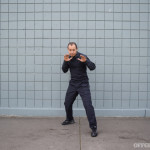
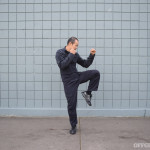
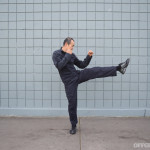
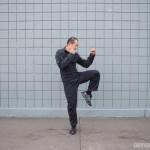
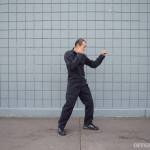
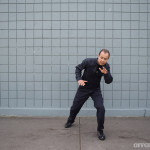
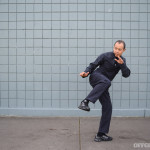
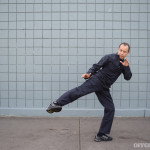
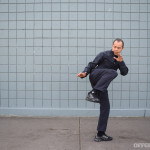
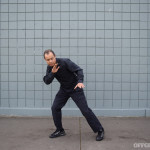
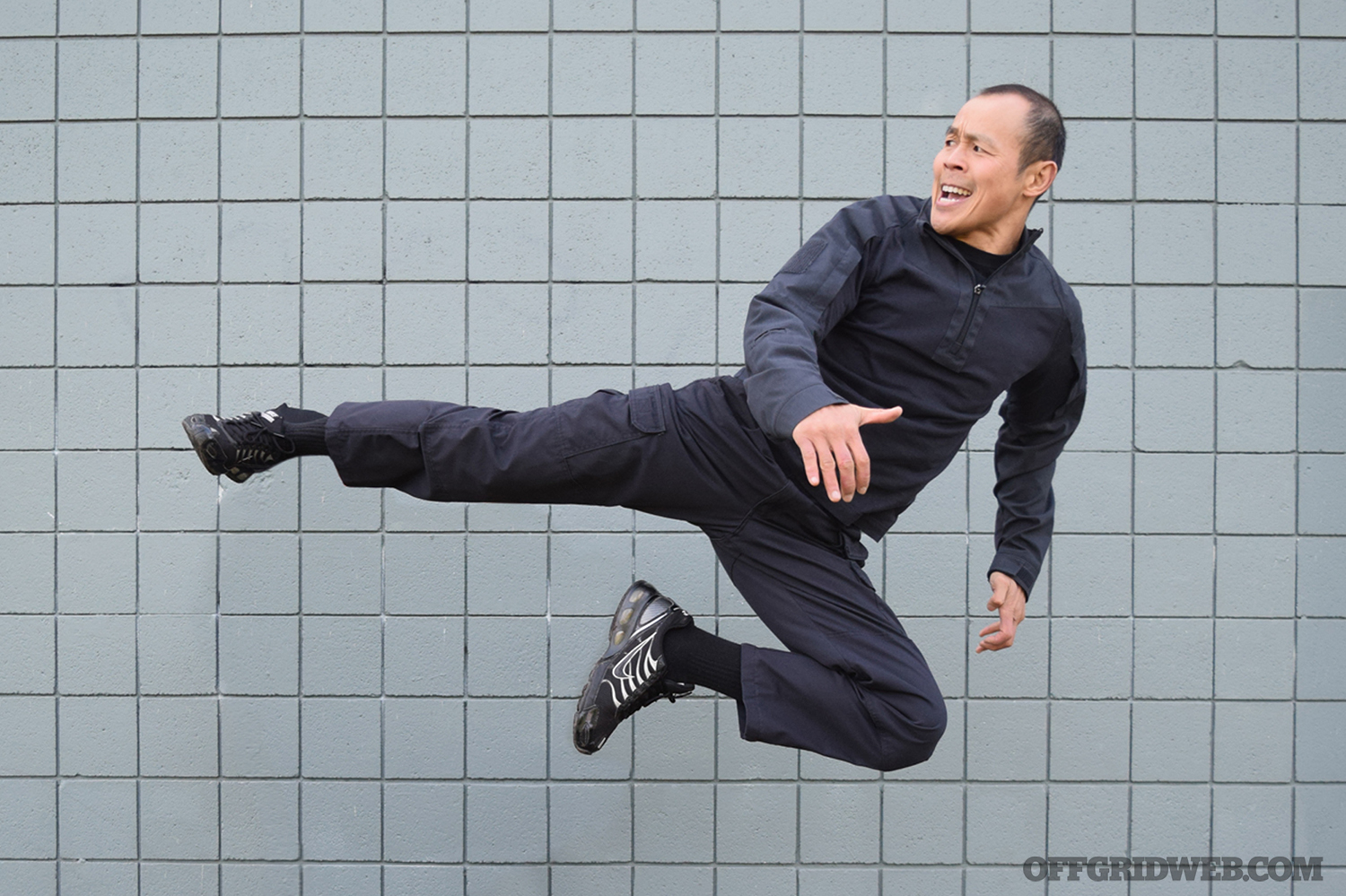
Above: A dance of the deadly kind. The author is shown here doing the shadow box shuffle.

Benefit: Adding footwork and focus will make your training more realistic. Cardiovascular benefit from this exercise is an added perk.
Equipment: Timer or stopwatch.
How-to: Stand in a fighting stance with your hands up, feet shoulder width apart and your dominant leg slightly back. Move forward, backward, and laterally, before and after performing a kick. Go for one three-minute round.
Foot Note: Use your imagination and focus on the targets described in this article. Make sure to cycle through all the kicks and use both legs. Make sure to breathe with every technique.

Heavy Bag
Benefit: Hitting a bag will develop power and a sense of distancing. Improving your cardio and letting off steam is also part of the package.
Equipment: Heavy bag and timer.
How-to: Stand in front of the bag and unleash the destruction of the end times for three minutes. Maintain proper form and keep the hands up.
Foot Note: Make sure to combine your kicks with the palm, elbow, and knee strikes. Add in your blocks and retreats, because most fights are not one-sided ass-whoopings. Three minutes on your timer, and you are good to go.

Situational Training
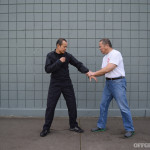
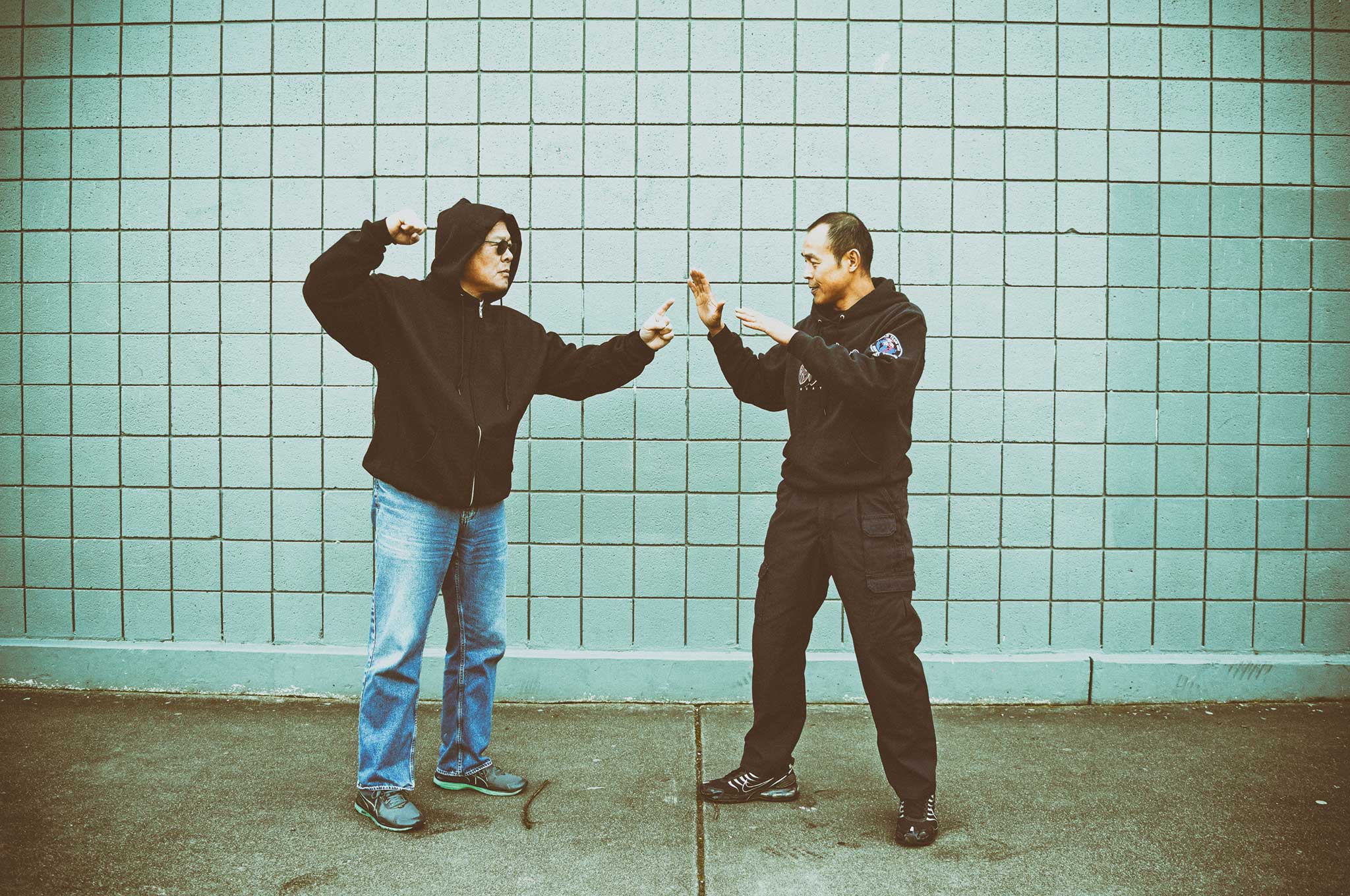
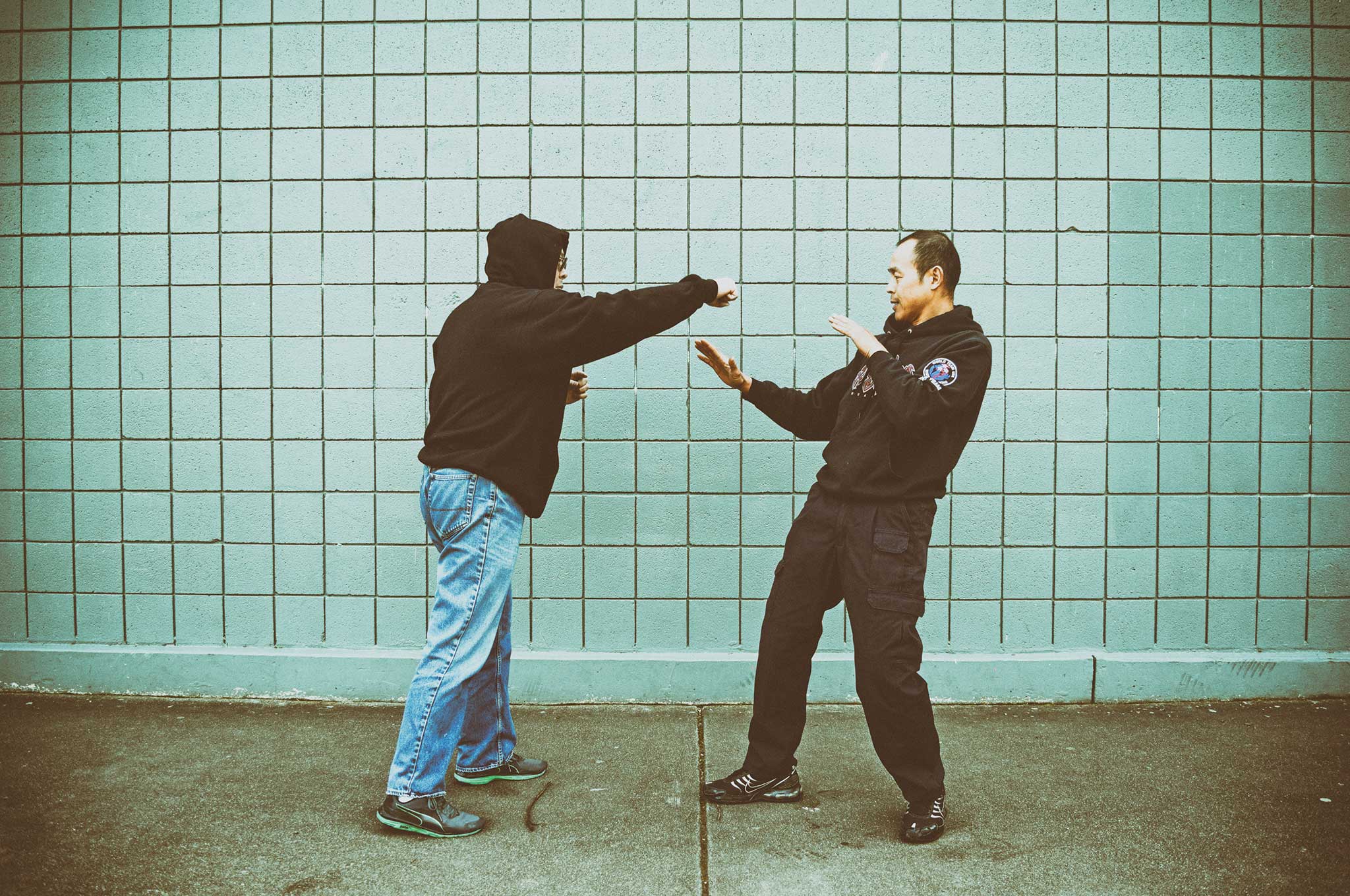
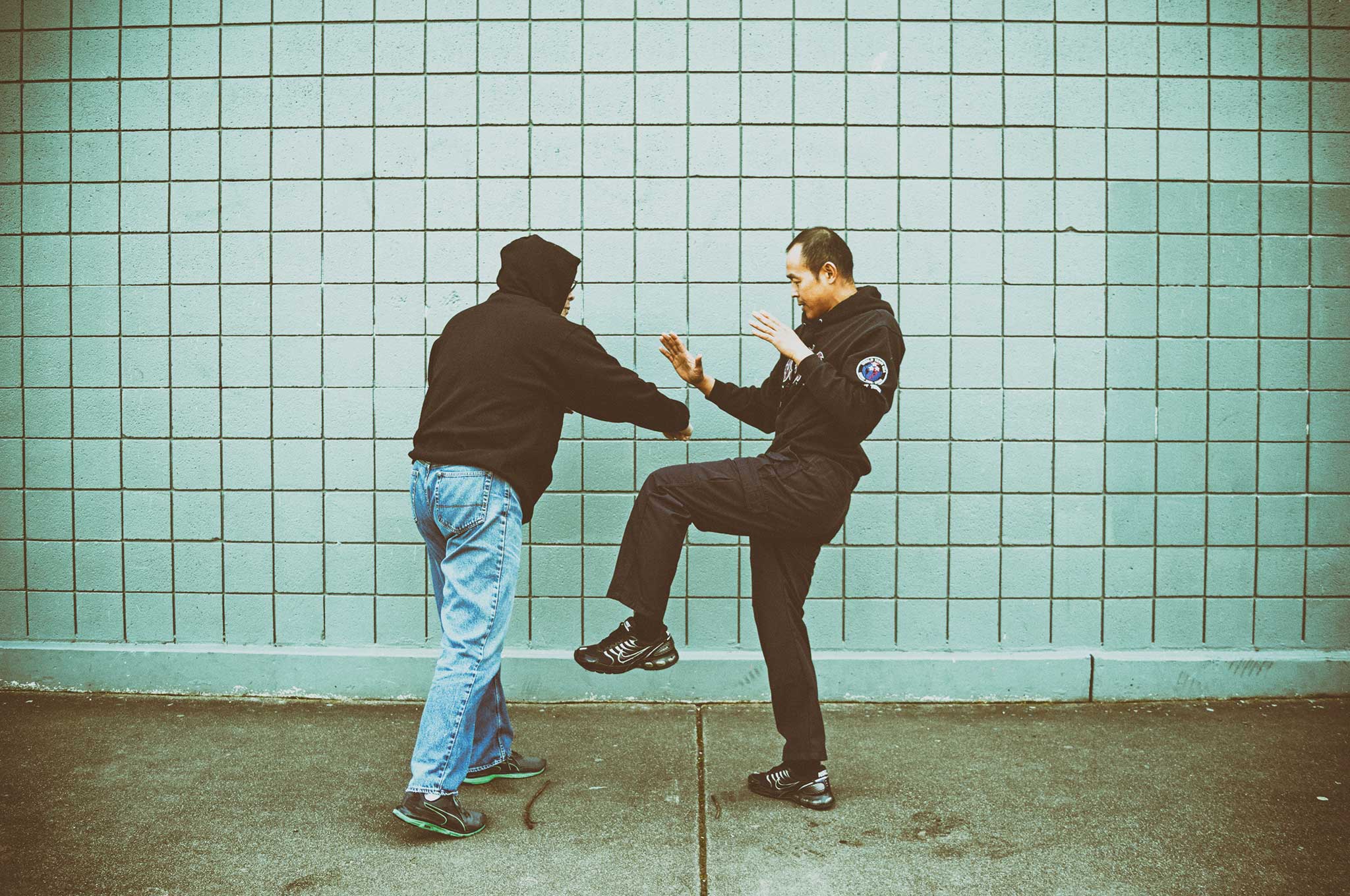
Above: Conrad Bui and Sherman Chin get together to safely work effective responses to common attacks.

Benefit: Partner training allows the practice of different attack scenarios and improves timing and accuracy.
Equipment: Groin cup, training weapons, eye protection (if working with weapons), and a buddy you trust.
How-to: Have your buddy slowly attack you with common unarmed attacks like a right haymaker or wrist and lapel grabs. Weapon-based attack scenarios will involve a knife, club, or firearm. A true prepper will be ready for any of these situations.
Foot Note: Use training weapons and start slow before increasing the speed of the attack and defense. Remember, safety first. Do reps of three and switch roles. The techniques described in this article make a great place to start, but it is no substitute for a qualified instructor.

Kicking Mistakes to Avoid
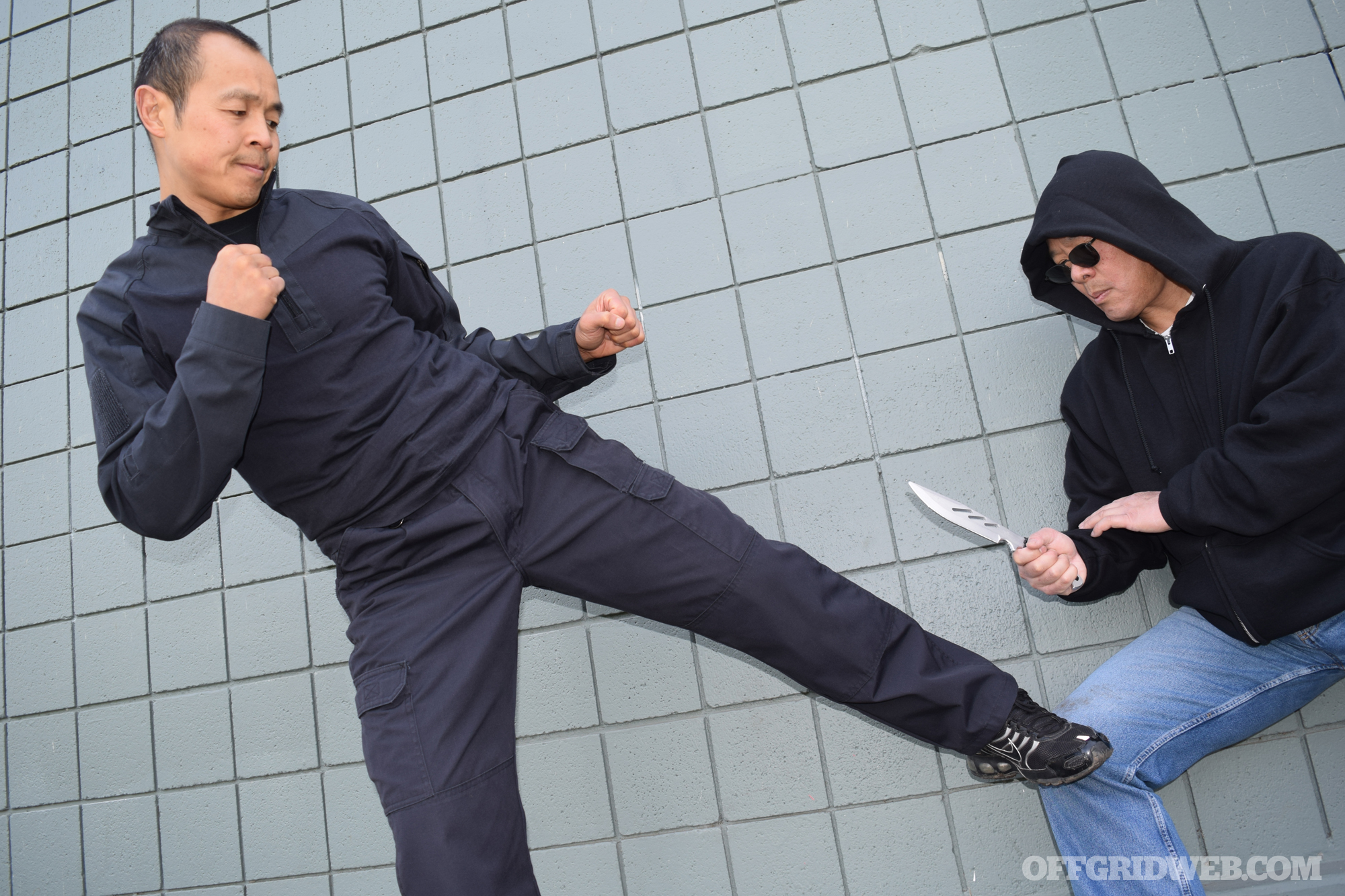
Opening Image (2).JPG

A well placed side kick can shatter a knee joint. A powerful front kick can burst open a door so you can free your daughter from your burning home. And a lightning fast front kick can crush testicles and fell even the biggest of thugs. Attacks using your legs are some of the most effective weapons you were born with. But they’re not foolproof. The following are common mistakes to avoid when attempting to use your lower extremities as weapons.
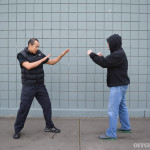
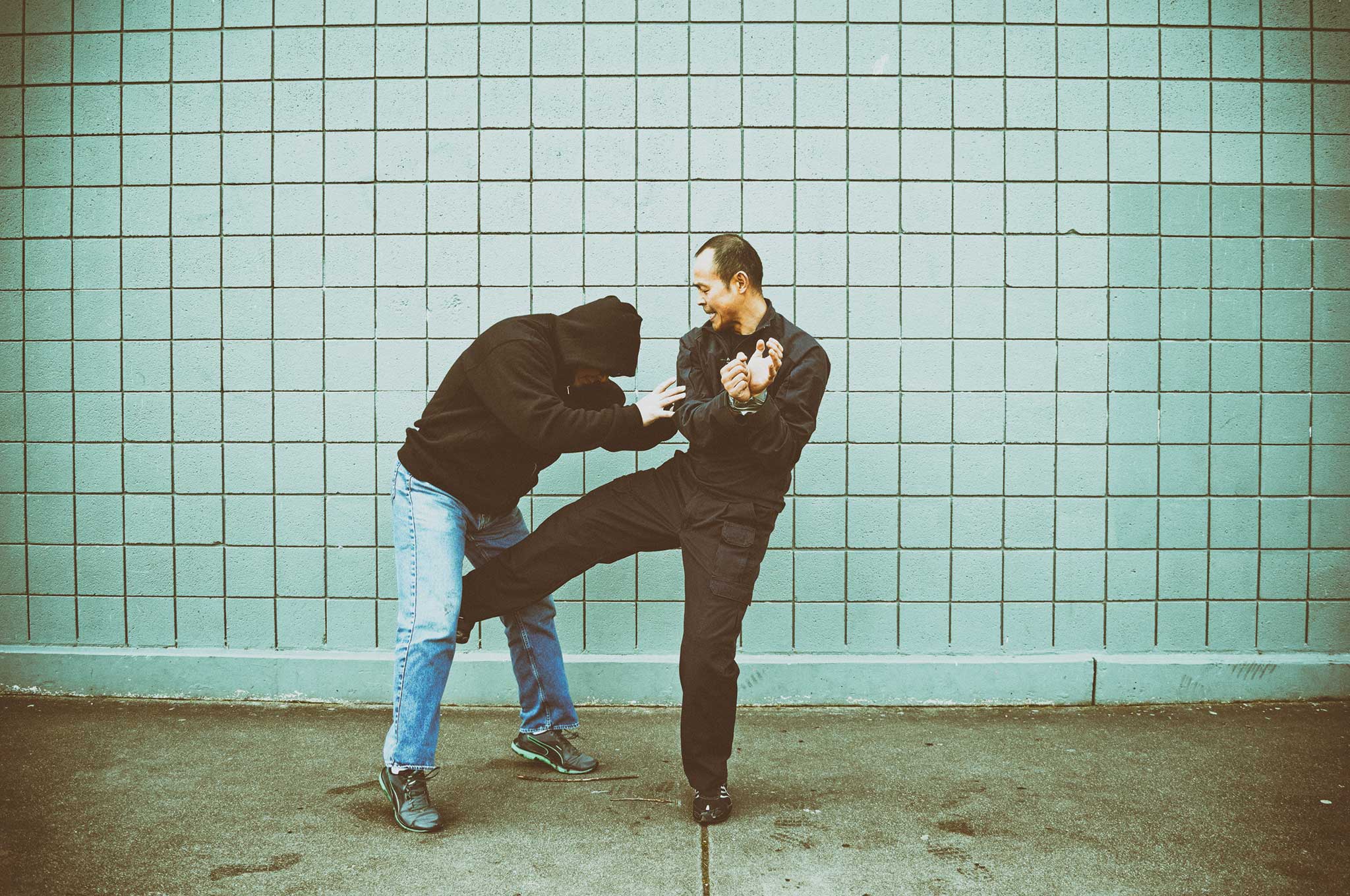
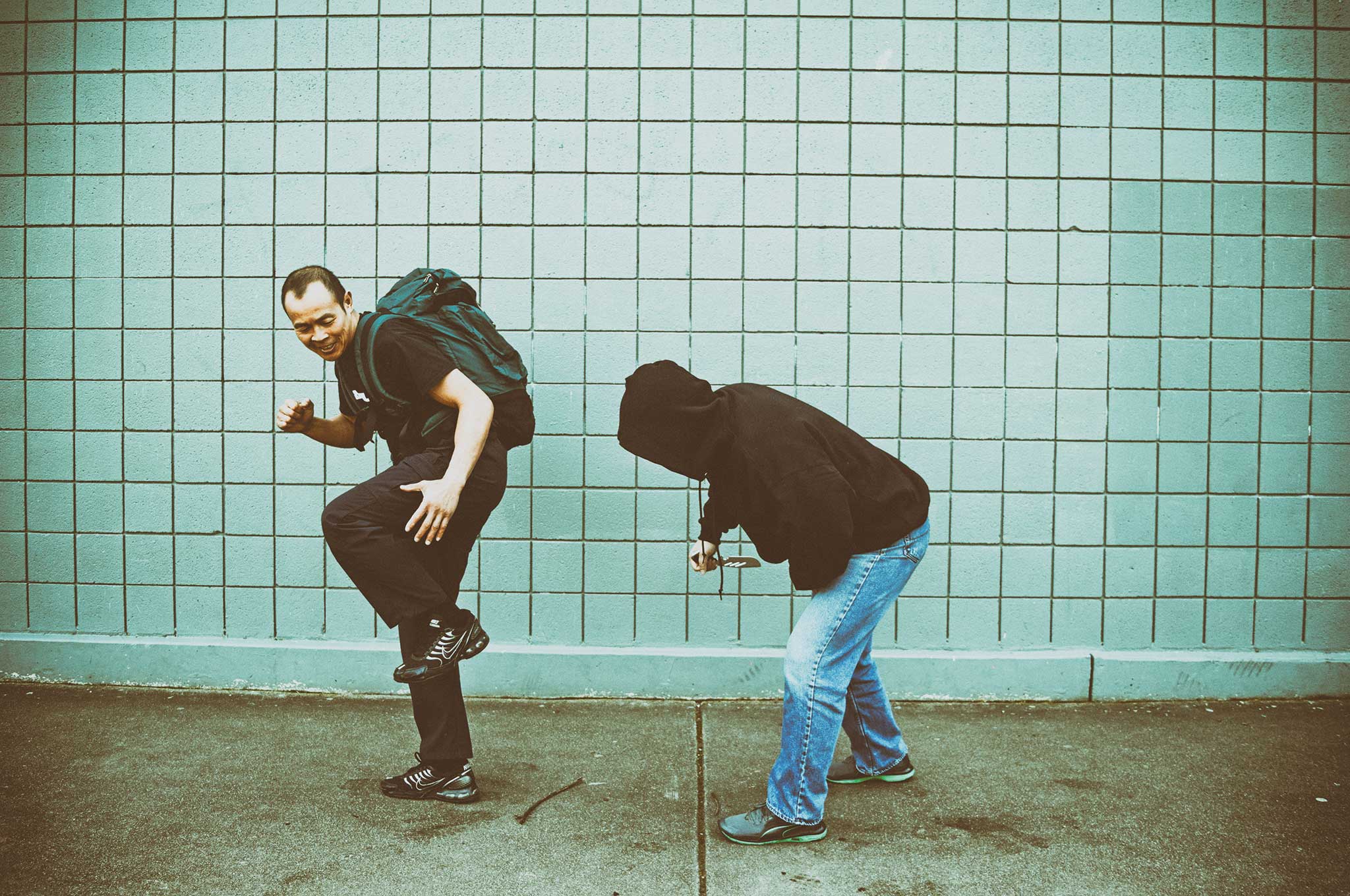
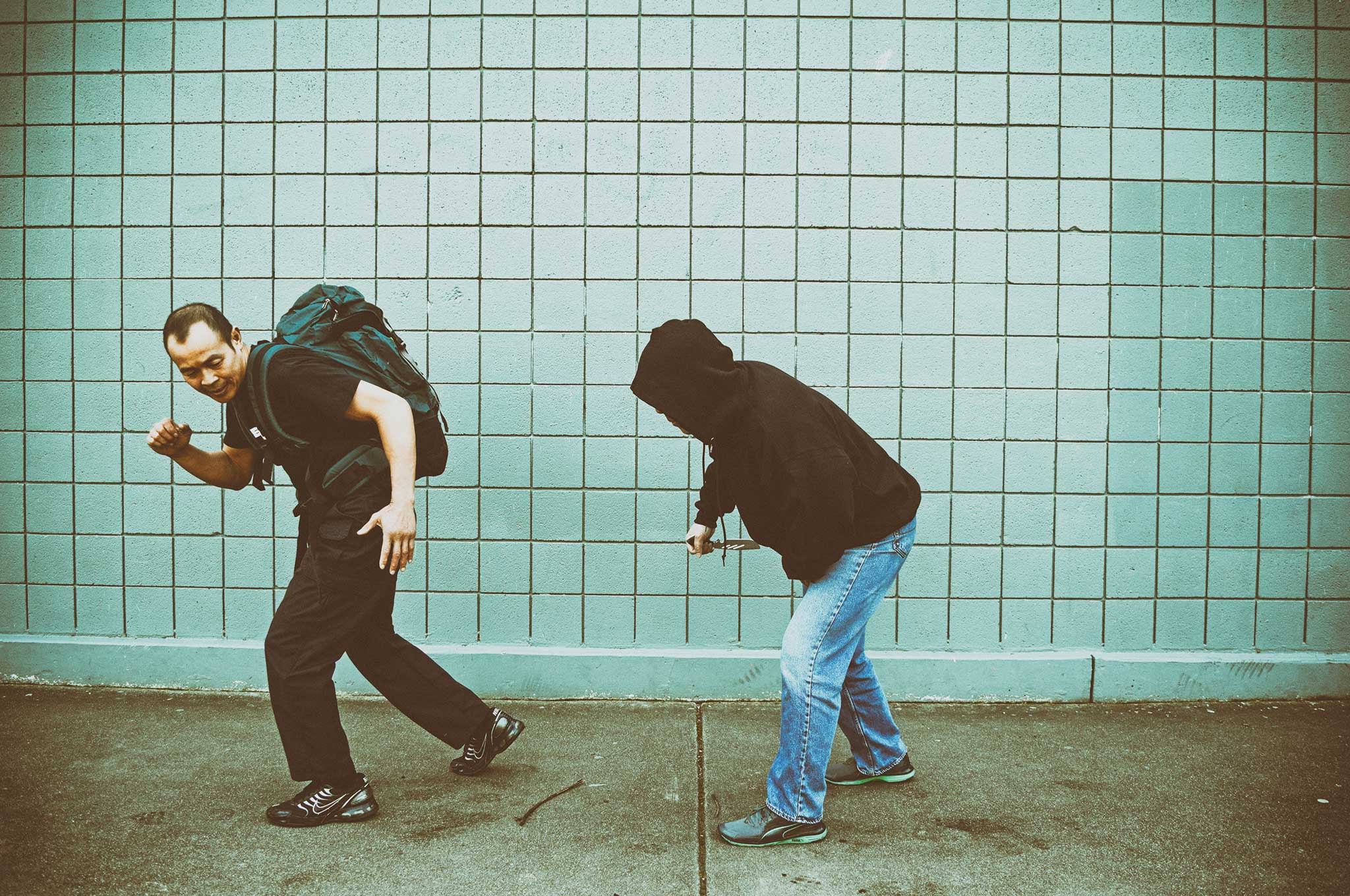
Above: Oh, crap. The author misses his target and makes a potentially fatal mistake of over-extending his kick. The injury is enough to cost him the fight, and possibly his life.

Joint Lock: Never completely lock the knee when kicking. Complete extension will damage the joint when practicing, and may rupture a ligament when executed with full force. To avoid injury, pull the strike back at about 10 degrees before complete lockout. Practicing strikes in the air, without the aid of a punching bag or pad, is the best way to prevent joint injury. (See “Solo Technique Practice” in the other sidebar titled, “Foot Work”).

Leg Only: Using body mass will increase the force of any strike. With a kick, bring your hip toward the trajectory of your strike. With both the front and push kicks, bring the hips forward. Side and back kicks will have your hips moving in those respective directions.
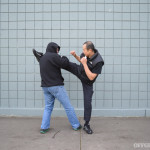
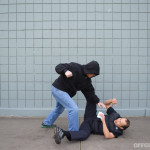
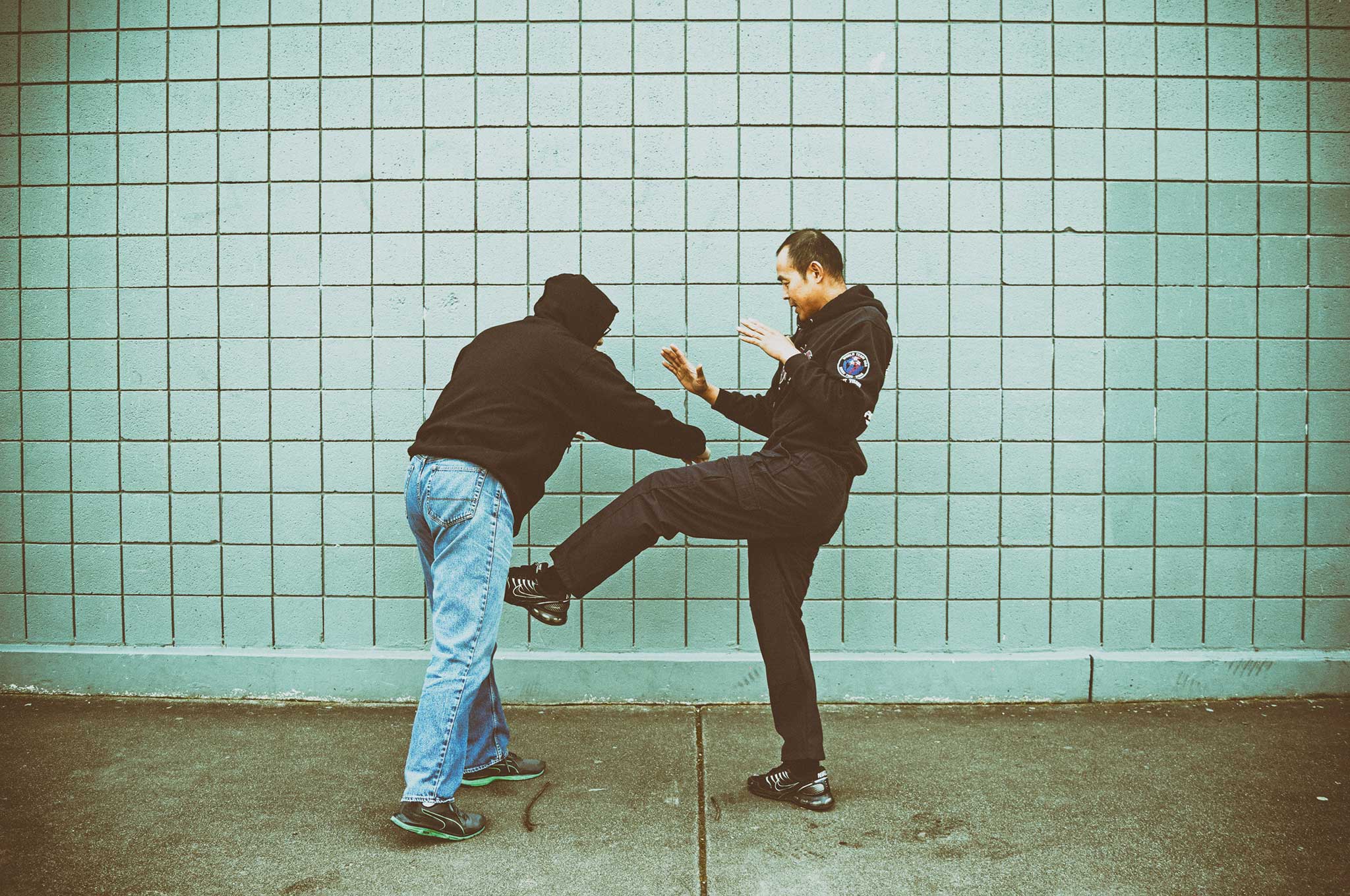
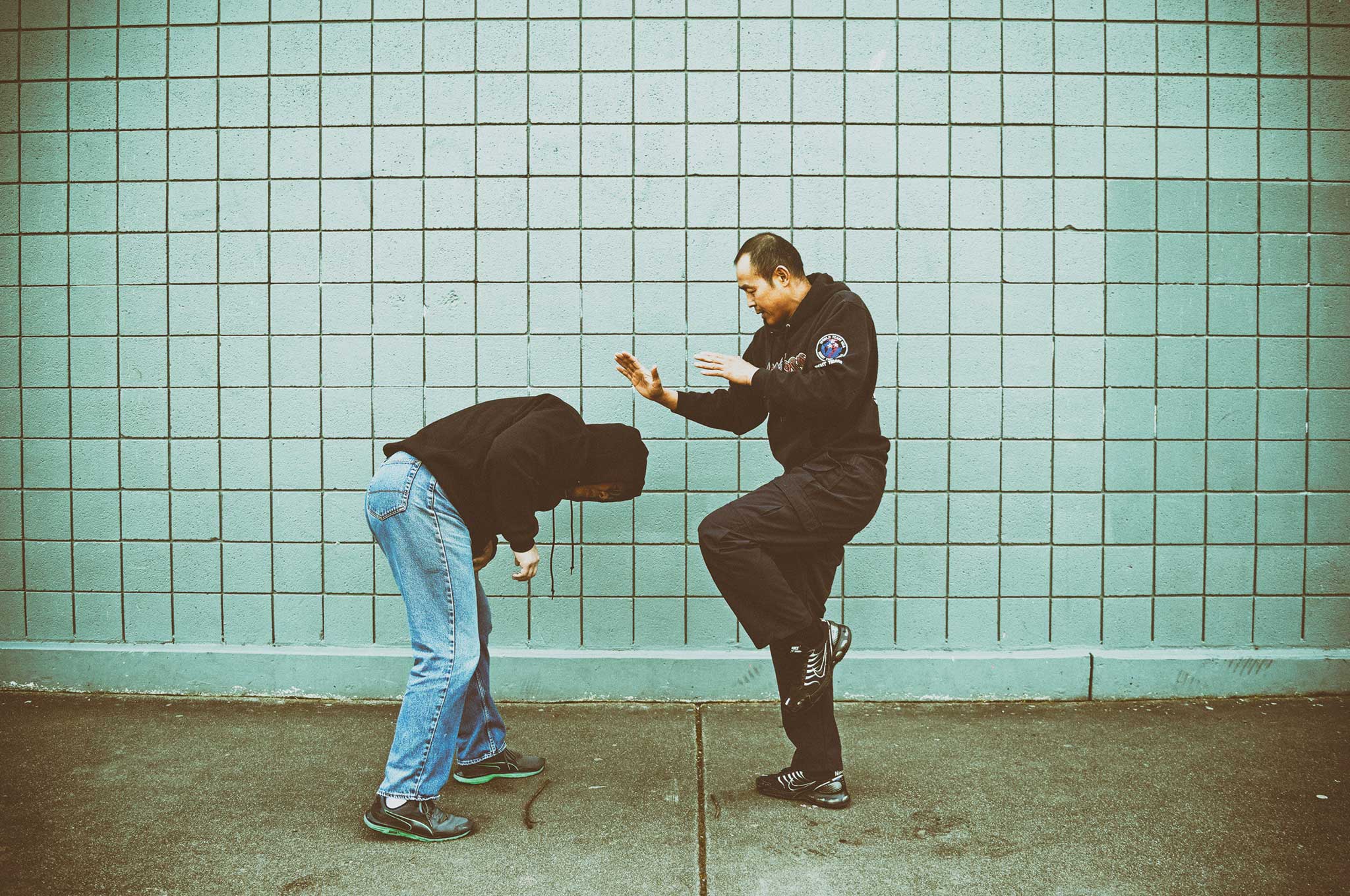
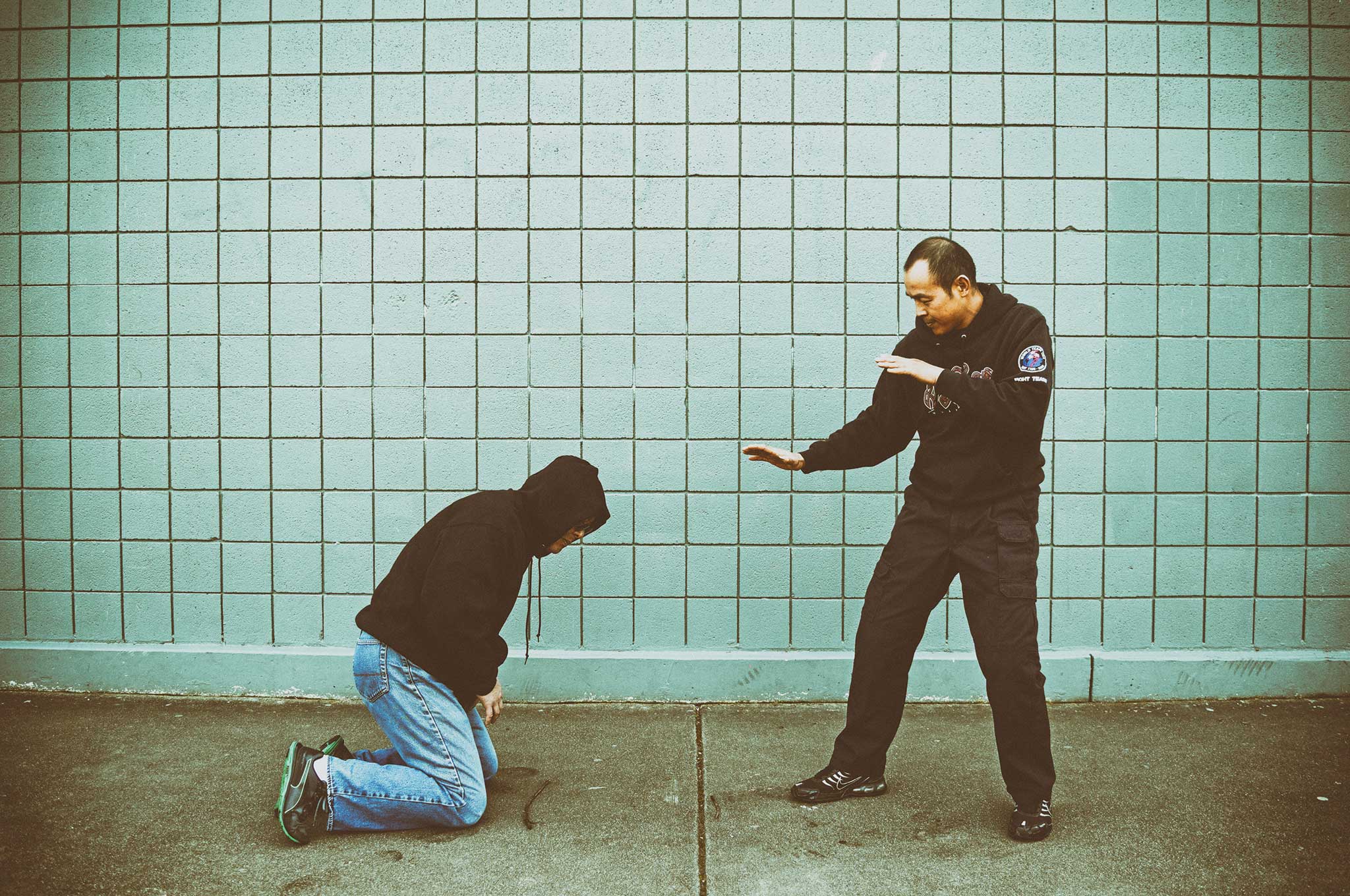
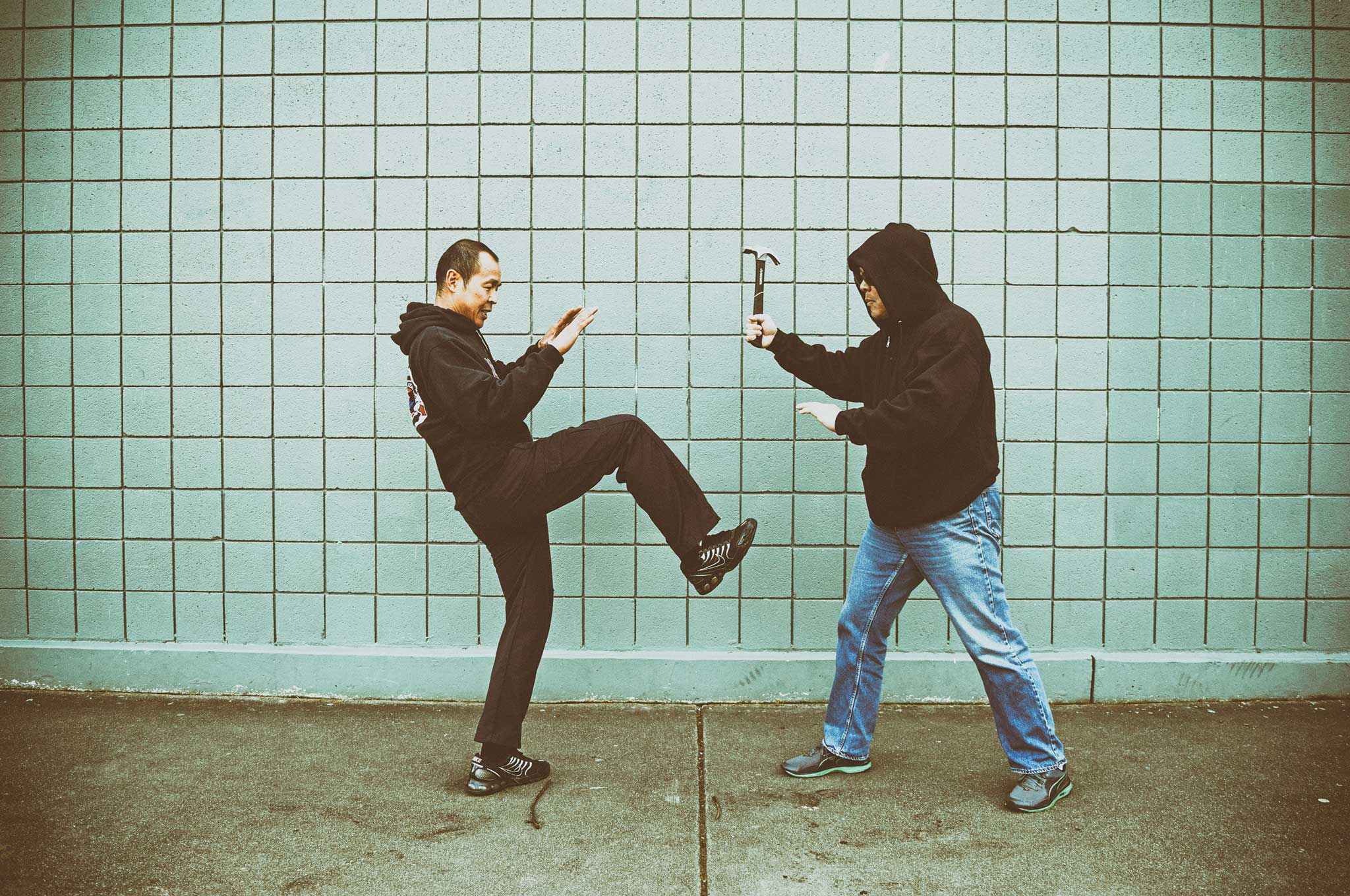
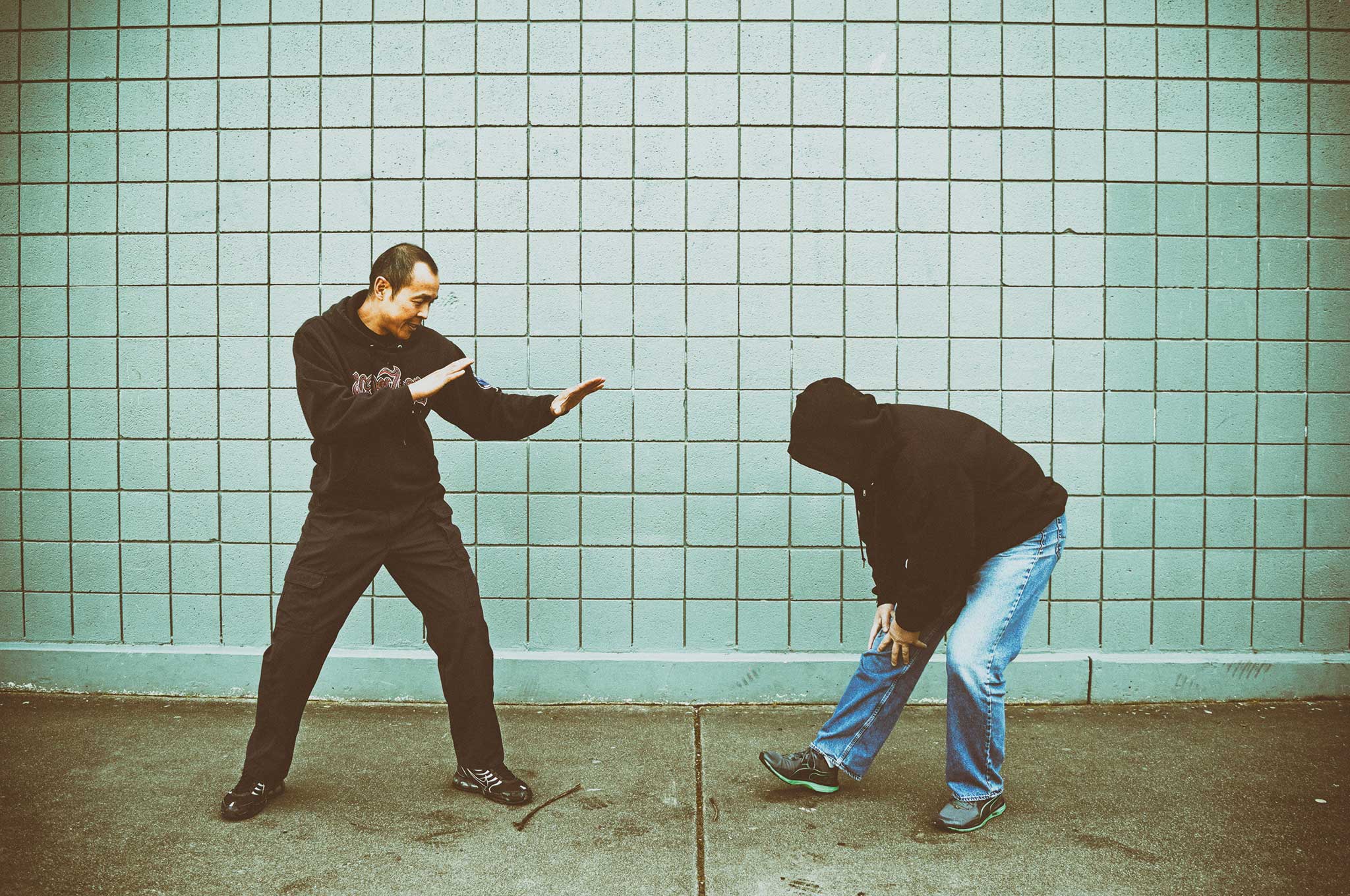
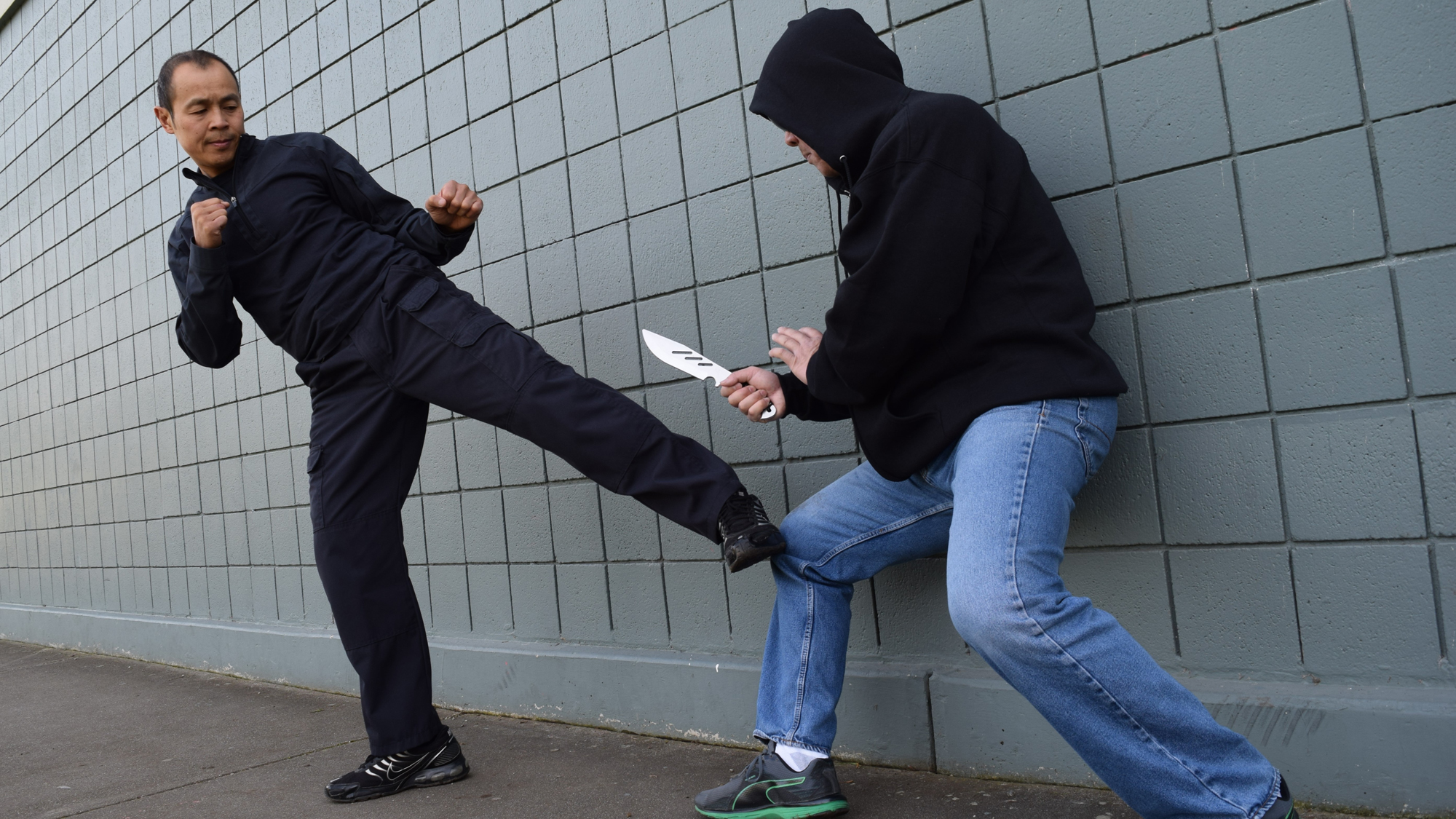
Above: Trying to cause major Van Damage with a head kick ends poorly here for Conrad Bui. He makes several mistakes: head hunting, no re-chambering, and no follow-up strikes. Sherman Chin survives the head strike, catches Bui’s leg, and throws him onto his back. Bui is now stationary and susceptible to stomps.

Head Hunting: Avoid high and fancy head kicks, even if you trained in Tae Kwon Do or Muay Thai since grade school. Head kicks are rarely required to end a confrontation. High kicks compromise your balance, and expose sensitive targets (ahem … guys) to your opponent. If you must go head hunting, use your palms and elbows. Save the kicks for low-line targets like the groin, knee, and shin.

Leave It Hanging: We get it. The meteoric extension of the kick is where all the flash and fireworks are. Bringing the leg back receives none of the press. But you must complete the kick by retracting the leg so you can kick again or simply run. Plus, the hoodlum will be less likely to grab your leg.

No Follow-Up: After retaliating with your kick, don’t just stand there admiring your handiwork. Be prepared to follow up with an eye jab, knee, elbow strike, or a mad dash to safety.
Stomp.JPG

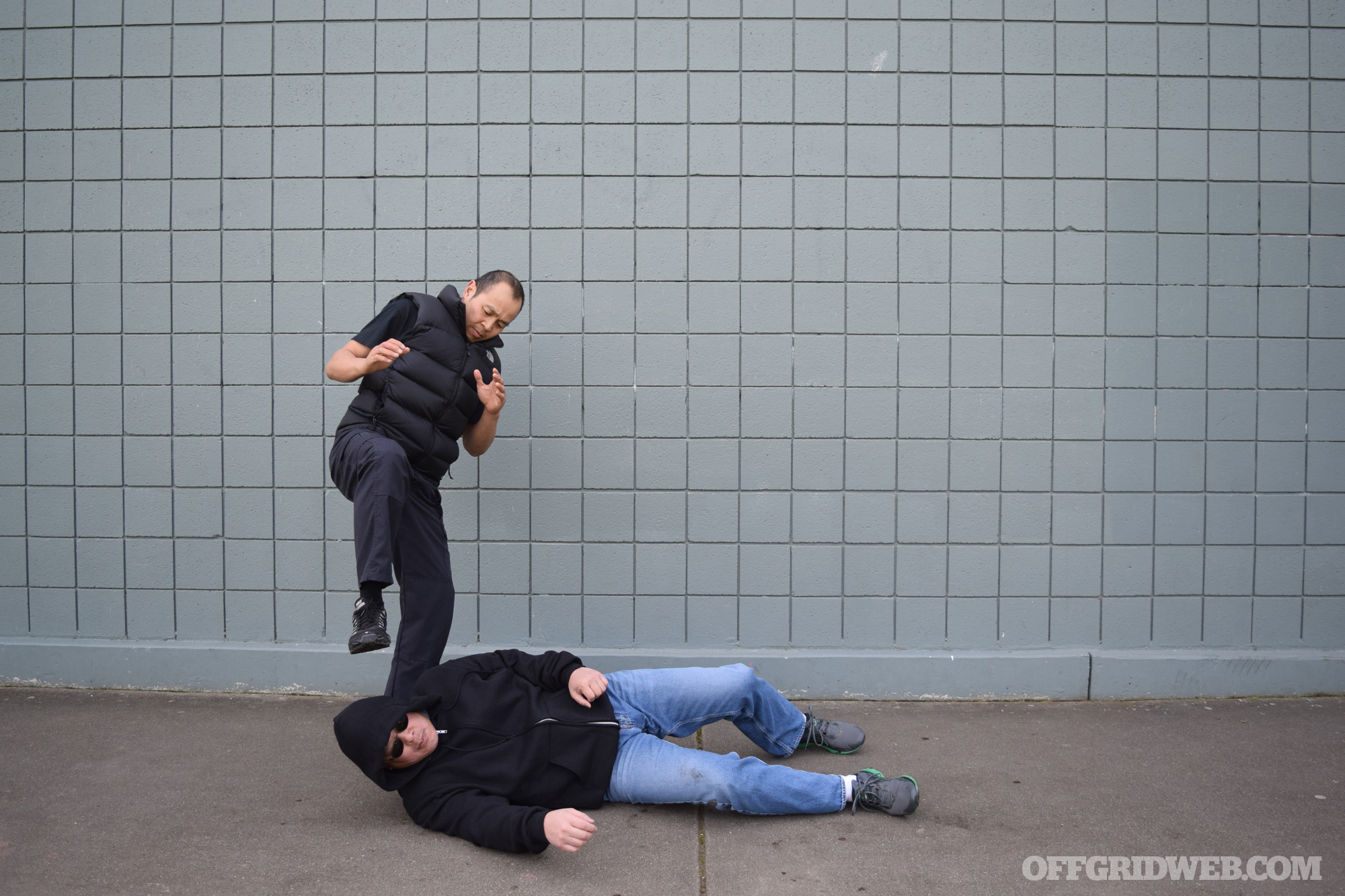
Above: The effectiveness of a head stomp aside, using this technique without justification could land you in a cell.

Head Stomp: When your attacker is on the ground in agony (possibly from the nasty groin shot you just administered), he’s no longer seen as a threat. Stomping on someone’s head may appear unreasonable to witnesses and subsequently the law. Using this deadly technique without cause can turn you from victim to assailant in a split second.

About the Author

Dr. Conrad Bui — a San Francisco-based doctor of chiropractic and frequent contributor to RECOIL OFFGRID — has been serving up kicks at karate tournaments since his youth. He later used them as a bar bouncer and continues to teach kicking techniques as a Muay Thai instructor at World Team USA. A self-proclaimed combatives junkie, he placed third in the featherweight brown-belt division of the 2016 World No-Gi Brazilian Jiu-Jitsu Championship. He is also a certified full instructor in Indonesian Kuntao Silat, Filipino Kali, and Bruce Lee’s Jeet Kune Do, as well as a fifth-degree black belt in Tae Kwon Do.
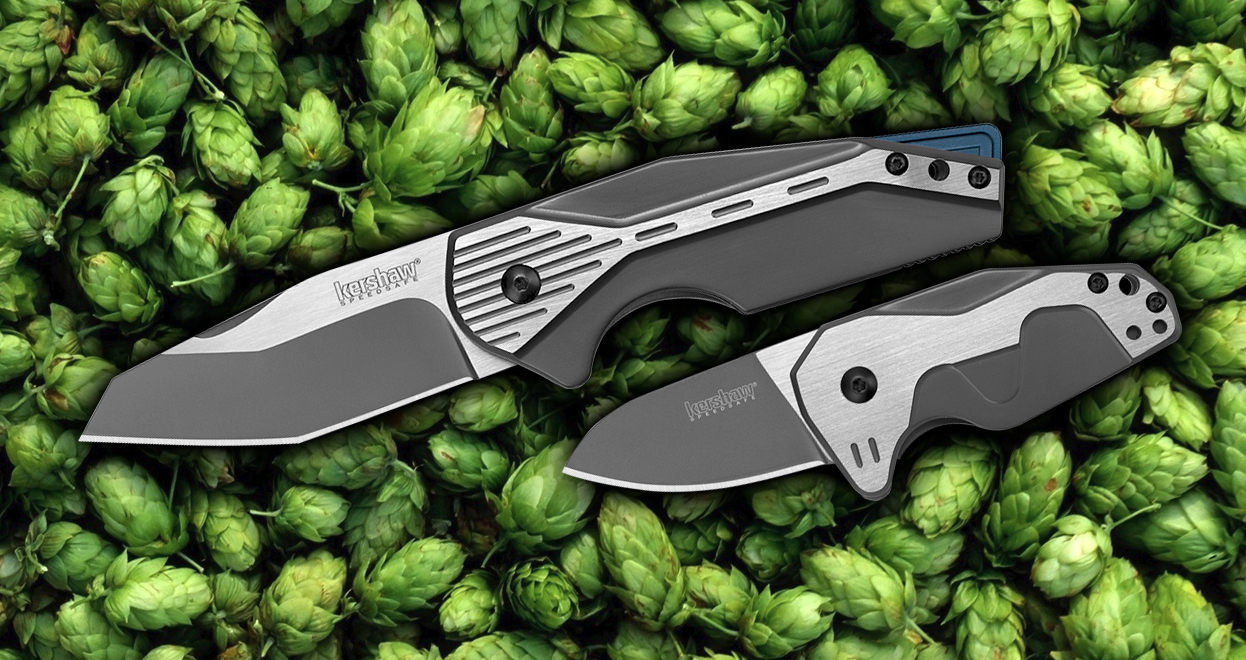

Kershaw Malt & Hops Folding Knives

0

There’s nothing quite like a frosty beverage at the end of a long day of trekking, or a tiring shift at the office. For this reason, it’s often useful to carry a bottle-opener as part of your EDC — but that can mean adding one more item to your already bulky keychain. If you’re looking to pare down the amount of gear you carry, this bottle-opener can be incorporated into another tool you already use each day.

Survival uses for alcohol beer wine liquor 9

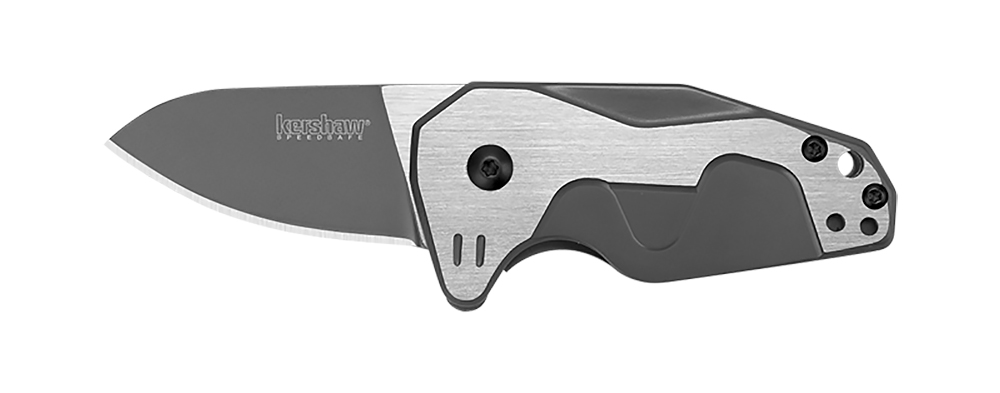
Kershaw has announced two new folding knives with integrated bottle openers, and names to match this theme. They’re called the Kershaw Malt and Kershaw Hops. These flippers were designed by Brazilian knifemaker Gustavo Cecchini of GTC Knives, the same man who penned the new eye-catching Zero Tolerance 0055 design.

Kershaw Malt Hops folding knife bottle opener speedsafe 2

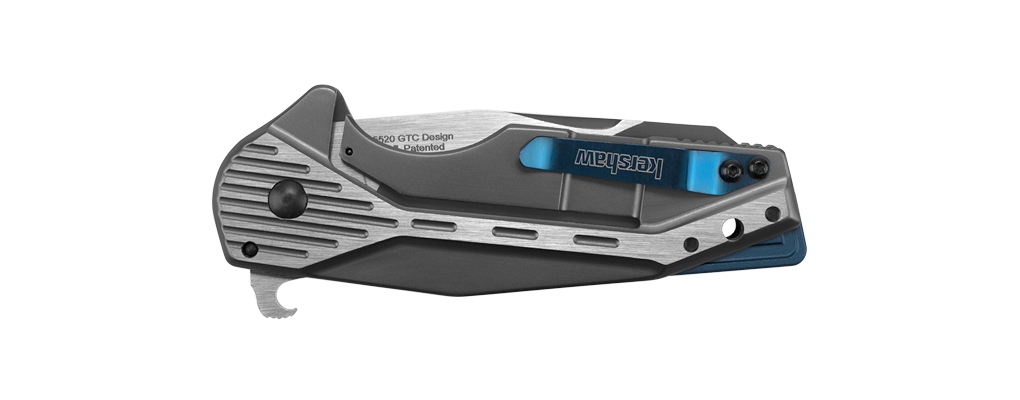
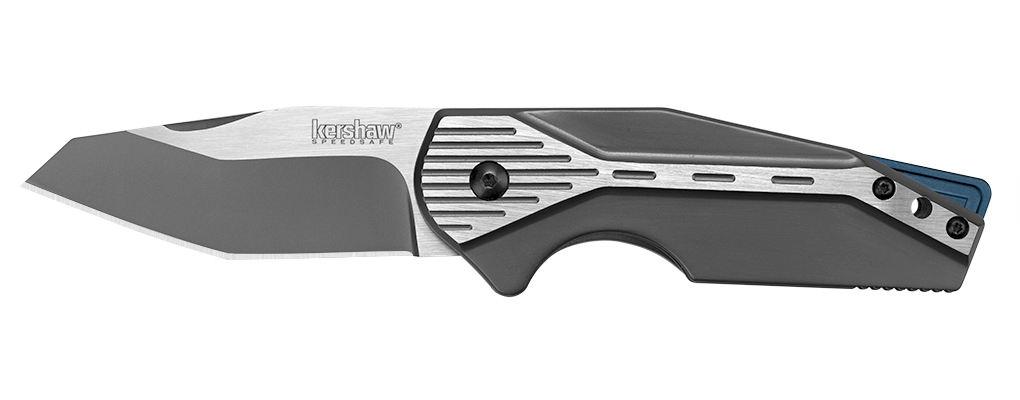
The Kershaw Malt is the larger of the two knives, with a 3-inch 8Cr13MoV blade and 7.1-inch overall length. It features Kershaw’s Speedsafe assisted-opening system, and a flipper lever that also forms a bottle-opening hook.

Kershaw Malt Hops folding knife bottle opener speedsafe 3

The stainless steel handles have a satin PVD coating with machined accents, a frame lock, and a single-position pocket clip and backspacer finished in metallic blue. MSRP for the Malt is $55.

Kershaw Malt Hops folding knife bottle opener speedsafe 5

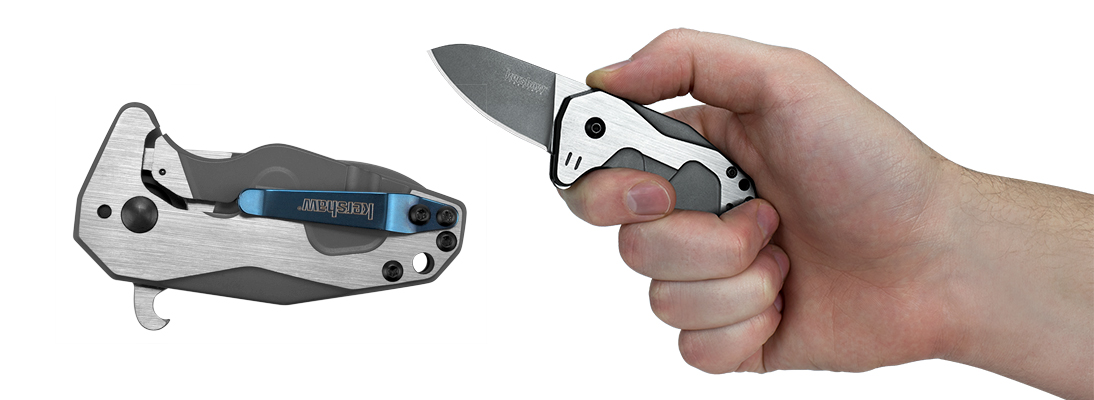
The smaller Kershaw Hops shares many of the same features as its larger counterpart: a bottle-opener Speedsafe flipper, two-tone stainless steel handle with frame lock, and an 8Cr13MoV blade. However, that blade is just 1.4 inches long, and overall length is 4.75 inches, making the Hops a much smaller knife. Also, its pocket clip is reversible for left- or right-handed tip-up carry.

Kershaw Malt Hops folding knife bottle opener speedsafe 6

The Hops is currently available for an MSRP of $40. To learn more about the new Kershaw Malt and Hops, visit Kershaw.KaiUSA.com.

Dirty Bombs

0

We have begun seeing more terrorist attacks perpetrated across the world, many of which take the form of explosives. From 2013’s Boston Marathon tragedy to this past summer’s assault on Istanbul Atatürk Airport in Turkey, a lingering fear many have about these incidents is that they could eventually take the form of a dirty bomb.

Just the name alone makes most people think that such an attack would turn a city into Chernobyl. Is there any validity to that sort of fear or are these devices more “weapons of mass disruption?” We went to the experts to separate security fact from science fiction.

Engineering

First, it’s important to understand the mechanics of such a device and how it differs from military-grade nuclear weapons, such as an atom bomb or intercontinental ballistic missile. These require a nuclear reaction to detonate. Just having radioactive material encased in a bomb doesn’t mean the epicenter and surrounding area will be leveled by a mushroom-cloud-type explosion.

The “good news” (if you could call it that) is that a dirty bomb requires very sophisticated materials, an activation sequence, and knowledge of nuclear physics that aren’t within the realm of most terrorist groups’ capabilities. The bomb would need to be large and could not fit in something the size of a briefcase.

Plus, the fragile nature of the device and amount of radiation it would emit makes discreet transportation even more complicated and potentially lethal for its couriers.

How Are They Built?

You might be wondering if we’re about to get into Anarchist Cookbook territory, but this information is more about the what than the how.

Low-grade radioactive materials — such as cobalt used in the medical industry — could potentially be used to construct a dirty bomb. One would have to accumulate a lot of these materials for their effects to be detrimental, so most injuries and fatalities would be caused by the explosion itself and not the radioactive debris released.

“There’s not much physics associated with a dirty bomb. It’s just a radioactive source of some kind that is dispersed with conventional explosives,” says Joel Cehn, a certified health physicist with the Health Physics Society. “The source might be radioactive iridium that is used in industrial radiography; it might be radioactive cesium that is used to sterilize items (and other uses). They are generally encapsulated in stainless steel to keep them from spilling. But they can be dispersed if blown up.”

After Effects

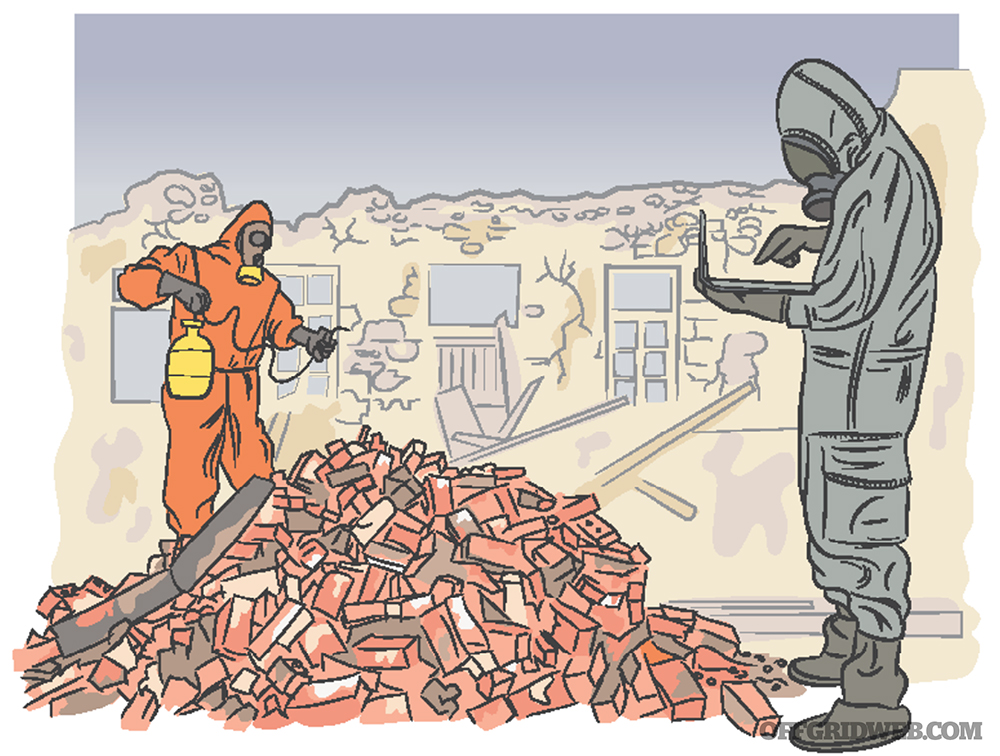
Because these materials would not cause a nuclear reaction when detonated, the affected area is much more contained. The contamination radius would depend on the amount of radioactive material and explosives used, as well as strength and direction of prevailing winds, but would likely not go beyond several city blocks. The Department of Health and Human Services (HHS) and the Centers for Disease Control and Prevention (CDC) both assert that the likelihood of contamination that requires immediate medical treatment would be localized to those close to the blast.

This also has a few caveats, however. Radioactive particles released could not only attach themselves to nearby structures and people, but possibly be carried away by wind and contaminate nearby open water bodies, food, or potentially be inhaled. It all depends on the size of the device.

Those concerned about possible radiation poisoning would need to be cognizant of related symptoms.
OFFGRID_Dirty_Bombs02

How Should You React?

If you were in the immediate vicinity of the blast but uninjured and the site is later determined to be radioactive, seek medical evaluation. Though, the Nuclear Regulatory Commission (NRC), the CDC, and the HHS all say that becoming sick from radiation is unlikely.

Others concerned about blast implications essentially have two choices: find shelter or leave the area. How will you know which is the better option? Listen to emergency broadcast reports and pay attention to where you are in relation to the blast. Is the wind blowing contaminants toward or away from you? It may take several days for authorities to understand the full implication of the blast and what kind of radiation was emitted.

Hunker Down: If you’re near a dirty bomb detonation, the CDC recommends you get inside, stay inside, and stay tuned for at least 24 hours. Turn off any outside ventilation. Close any windows, doors, and fireplace flues to limit exposure to dust or smoke plumes. Listen to reliable news sources as further developments are released.

Clothing can be removed by starting at the top of your head and rolling the clothing off you down to your feet. Roll them in a way you don’t re-expose yourself and store them in a sealed plastic garbage bag or container away from everyone. They may need to be examined later to determine exposure levels. Wash yourself in a cold shower to keep your pores from opening up. Gently shaving off any hair will also reduce any risk of particles remaining adhered to your skin.

Bug Out: If you’re not in the direction of prevailing winds but are worried about secondary explosions and want to minimize your exposure, the better course of action would be to get out of the area as quickly as possible.

“Time, distance, and shielding is key with respect to radiation exposure,” says Ron Johansen, a hazmat specialist for the Alameda County Fire Department and fire science technology instructor at Las Positas College. “Get upwind, uphill, and upstream. Radiation sickness is not contagious. You can carry particles, but not spread the health effects.”

Contamination

When talking about radiation contamination, the dose is the amount absorbed by the body at any one time.

“Think of radiation as a light bulb. When you have one that’s energized, it shines all the light off the blub,” says Shawn Smith, a non-destructive inspector and inventor for Boeing. “The particle itself doesn’t do anything, but you have all that light (radiation) that comes off the particle.” Getting away from the proverbial light source will help reduce the dose and dose rate, since some forms of radiation, such as gamma rays, can penetrate walls if levels are high enough.

There is a difference between radiation exposure and contamination. You can be exposed to radiation by getting an X-ray at the doctor, but that doesn’t mean you’ll suffer from contamination, as it’s a very low dose under controlled conditions. Certain types of radiation can penetrate the body, but contamination only occurs if particles become attached to someone’s clothing or hair, are ingested, or penetrate an open wound.

Conclusion

The history on dirty bombs has yet to be written since there are no known instances of their use. However, numerous reports have emerged in recent years of radioactive materials being stolen, some with success, while others were either intercepted by authorities or had fatal consequences to their smugglers.

We can certainly expect terrorists to actively continue searching for any weapons that further their cause, demoralize the public, and interrupt economic stability.

“It’s generally believed that a dirty bomb will cause mostly panic, and few, if any, serious radiation exposures,” Cehn says. “The radioactivity would be diluted in the explosion.”

It’s sage wisdom to prepare for nuclear-related incidents, both accidental and deliberate. Dirty bombs — despite related fear mongering — should not be a cause for a national emergency though. That’s exactly the domino effect of confusion that perpetrators are looking to achieve. Remain conscientious, prepared, and vigilant, but arm yourself with the knowledge that will prevent you from falling victim to an attack that is more psychological than anything else.

Further Reading:

OFFGRID_Dirty_Bombs03

Medication

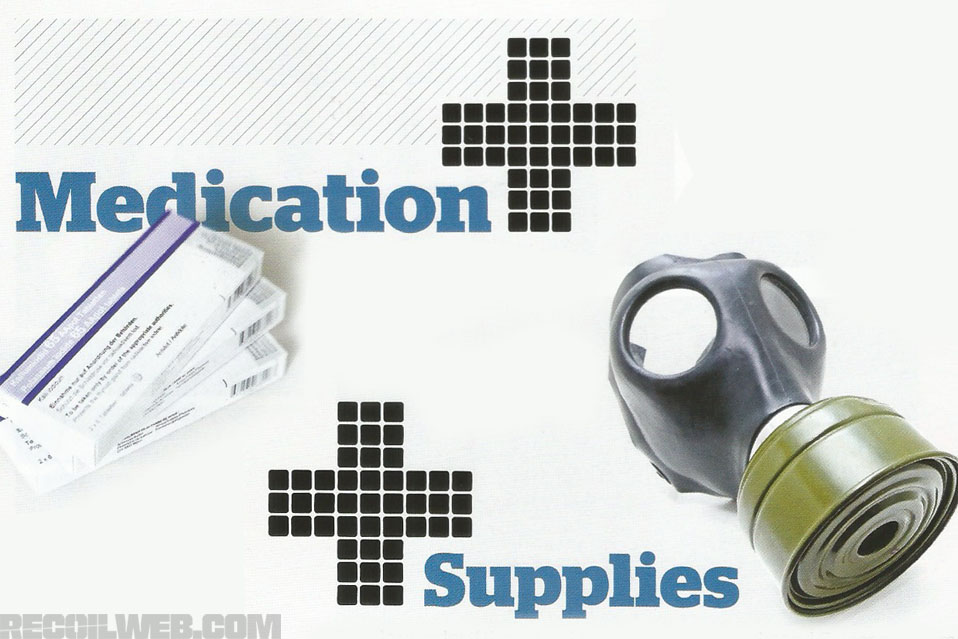
After the plant meltdown in Fukushima, Japan, the use of chemicals such as potassium iodide (KI) began getting media buzz. KI, Neupogen, Prussian blue, Diethylenetriamine pentaacetate, and other countermeasures may be administered after a nuclear incident where contamination is a concern. You should only take these chemicals at the advice of a medical professional or emergency management personnel, as there are side effects associated with all of them. It’s always recommended to stay in good health, remain hydrated, and practice good nutrition. These things all play a factor on how radiation affects you. Learn more at http://emergency.cdc.gov/radiation/countermeasures.asp

Supplies

People wonder if they should stock up on gas masks and Geiger counters in preparation for a radiological event. Geiger counters typically take a working knowledge of radiation measurements to know how to use them and aren’t practical for the average person. Items such as gas masks may provide some level of protection as well, but are not foolproof.
Radiation dosimeters or radiation-detecting watches act as monitors for radiation levels, are relatively inexpensive depending on their capabilities, and geared toward those who have a limited understanding of radiation. “RADstickers” are another form of cheap radiation measurements. The CDC also recommends an emergency radio that has National Oceanic and Atmospheric Administration weather radio capabilities.

More From Issue 16

Don’t miss essential survival insights—sign up for Recoil Offgrid’s free newsletter today.

Read articles from the next issue of Recoil Offgrid: Issue 17

Read articles from the previous issue of Recoil Offgrid: Issue 15

Check out our other publications on the web: Recoil | Gun Digest | Blade | RecoilTV | RECOILtv (YouTube)

Editor’s Note: This article has been modified from its original print version for the web.

Making Fishing Line & Hooks from Agave Plants

0

Fishing can be an excellent source of calories during a survival situation, so it’s wise to plan ahead and practice fishing with limited resources — especially if you live near a large body of water. This usually means including a small fishing kit in your bug-out bag, with hooks, line, sinkers, and maybe even some lures. But it’s also important to prepare to be unprepared, so to speak. What can you do if you’re stuck somewhere without any of these tools? You’ll need to improvise.

Agave plant fishing line hook food cordage 2

There are a few solutions for catching fish with natural materials, such as weaving a fish basket or spearfishing with a sharpened stick. However, if you find yourself in the southwestern United States, Mexico, Central or South America, there’s another resource that can come to your aid: the agave plant. Yes, they’re good for more than just tequila. These spiky succulent plant species are closely related to yucca, so it should be no surprise that they’re full of potential survival uses.

Agave plant fishing line hook food cordage 4

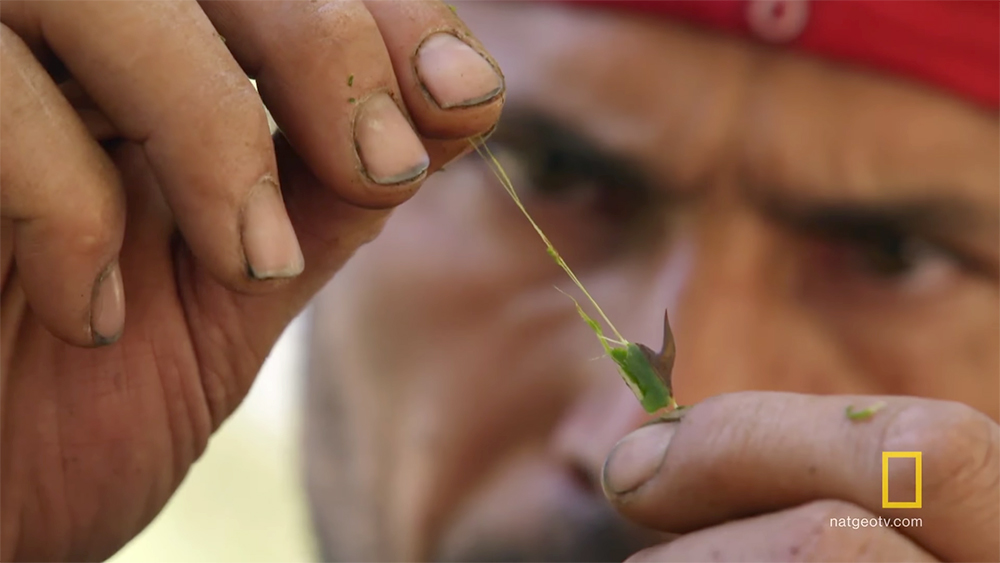
In the following video clip from the National Geographic TV show Primal Survivor, survivalist Hazen Audel gives a quick demonstration of how the Rarámuri native tribe of northwestern Mexico created fishing line and hooks from agave plants.

While we suspect that the limp fish shown at the end of this clip may be the result of some TV magic, there’s good information to be found here.

Much like the yucca plant, the hard spikes at the end of each leaf can be carefully sliced and pulled away from the plant, creating a needle and several strong fibrous threads. Another variety of the plant, black-tipped agave, can provide fish hooks. The spines on the perimeter of each leaf can be peeled away and bound to each other, creating a strong natural hook. Scrounge up some insects or animal guts for bait, and you’ll be well on your way to a fish dinner.

Agave plant fishing line hook food cordage 4

For more info and video clips from Primal Survivor, check the National Geographic Channel web site.

Magnetic Flashlight Buyer’s Guide

0

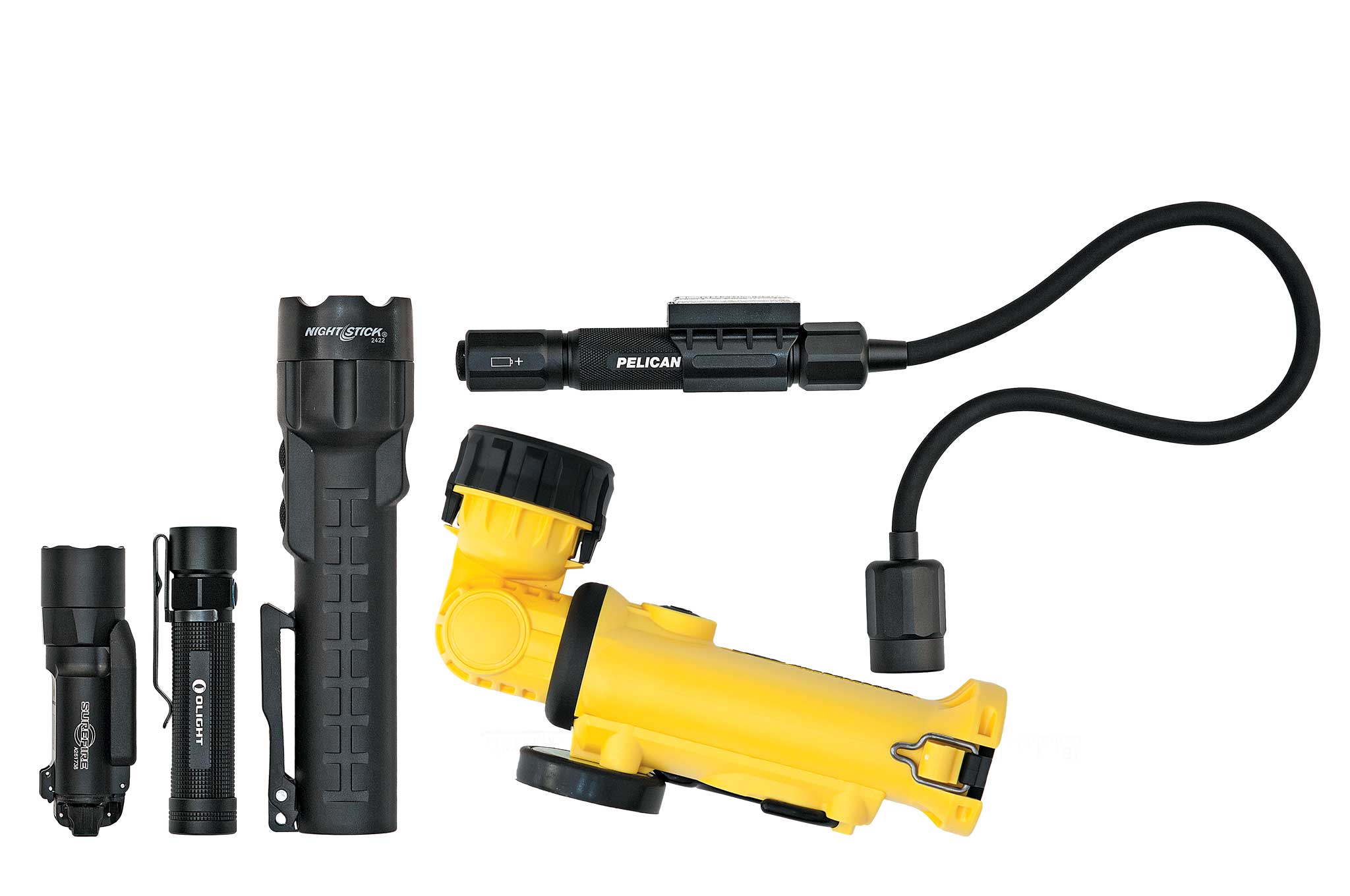
Accomplishing tasks one-handed is often challenging — hence the phrase “with one hand tied behind my back.” Whether you’re cleaning a gun, changing your truck’s oil, or preparing dinner, simple undertakings can become frustrating ordeals if you can’t use both hands. This reinforces the importance of hands-free lighting.

Without it, you may find yourself clenching the light in your teeth, balancing the light in a precarious position, or wishing you could grow a third hand that can hold the flashlight as you work.

In previous issues, we addressed three common forms of hands-free lights: headlamps (Issue 2), lanterns (Issue 6), and angle-head flashlights (Issue 15). In this issue, we focus on an often-overlooked fourth variety: magnetic lights. These magnetized flashlights can be indispensable in urban areas where metal surfaces abound. Snap one onto a toolbox, door frame, ceiling joist, handlebar, trunk lid, or the underside of a desk to quickly free up both of your hands. It’s easy to adjust and re-aim the light as you work, and in an emergency, you can detach it in a swift motion without fiddling with clips or straps.

Due to their many uses in and around vehicles, it’s common to find magnetic lights in auto parts stores. However, these lights aren’t restricted to automotive use. In fact, you might be surprised how often they come in handy during your daily routine.

[buyersguide title=”Magnetic Flashlights” ids=”9037, 9041, 9044, 9047, 9050″]

Mountainsmith Mountain Shelter LT

0

Lightweight camping and backpacking gear can be a great aid to survivalists, as contributor Andy Schrader mentioned in his story, Planning an Ultralight Bug-Out Bag. However, if you’ve ever spent time in an outdoor gear store, you’ll probably recall that ultralight gear is typically available in every neon color under the sun — but not more subdued shades. For recreational backpackers, that’s no big deal. But in a survival situation where concealment may be a concern, high-vis colors are not optimal.

Mountainsmith Mountain Shelter LT shelter tent trekking poles 3

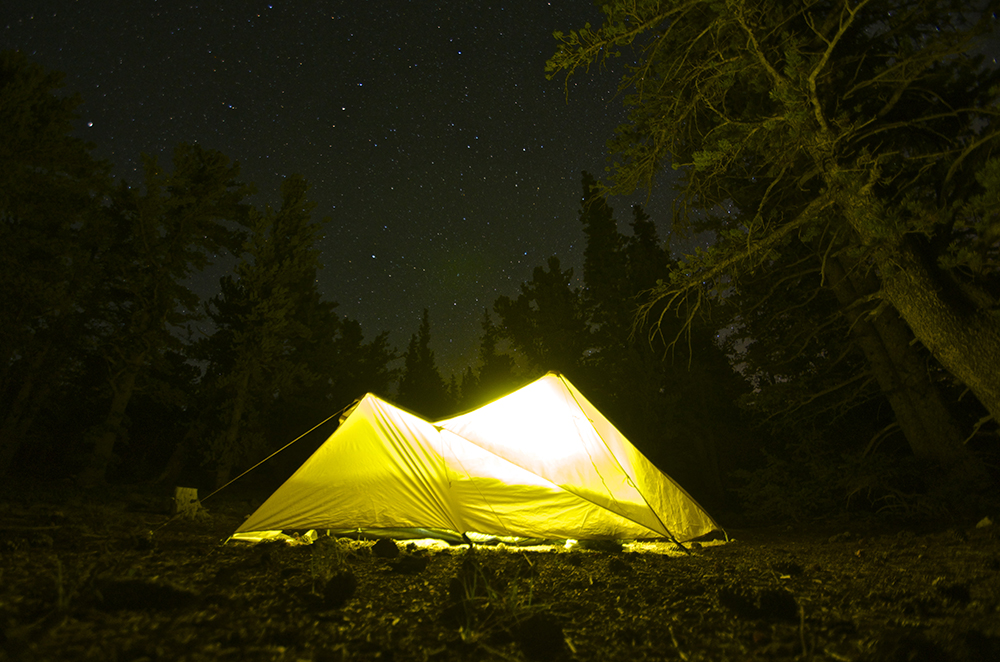
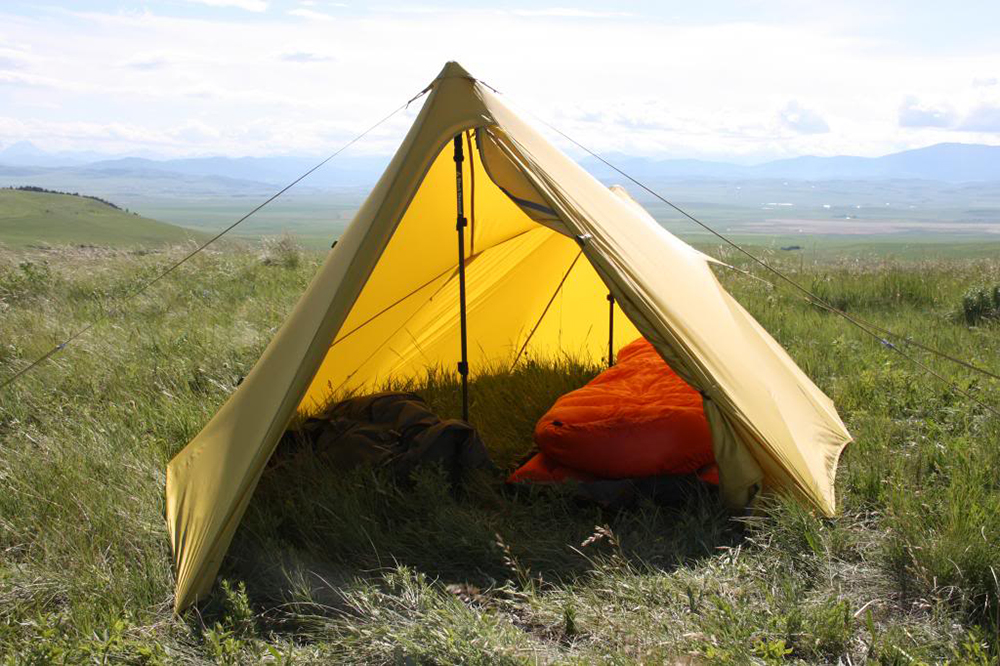
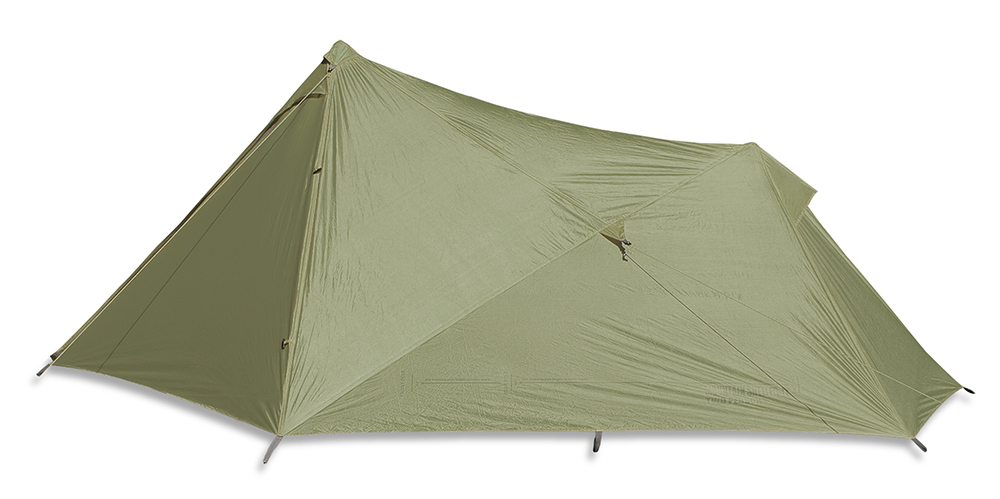
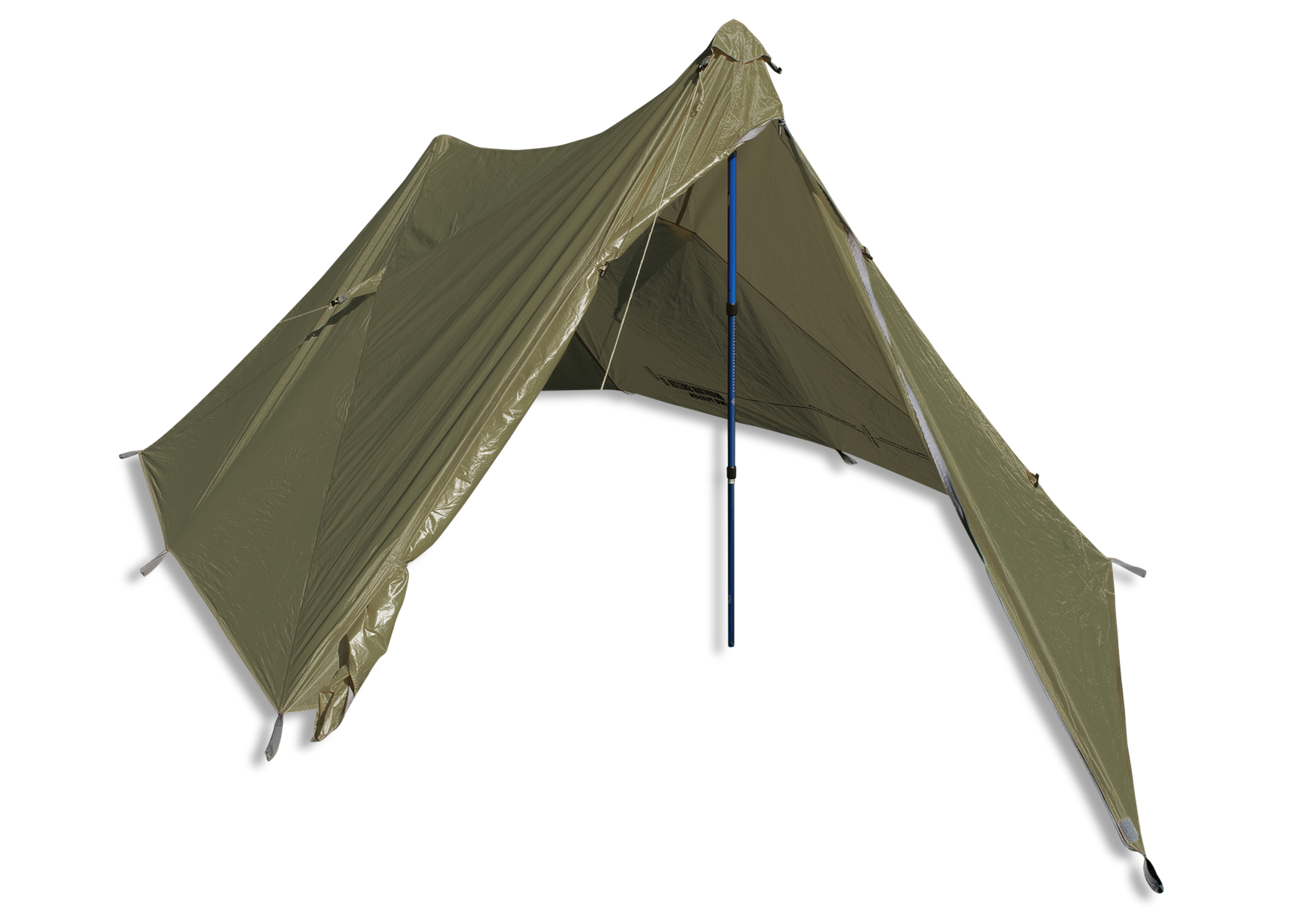
This is why we’re pleased to see that Mountainsmith has released its popular Mountain Shelter LT tarp in a new subdued color, Pinon Green. Until recently, this ultralight tarp was only offered in bright yellow, pictured above — great if you’re looking to be rescued, but not if you’re trying to stay unseen.

Mountainsmith Mountain Shelter LT shelter tent trekking poles 4

The Mountain Shelter LT weighs just 2 pounds fully packed, and is designed to set up with two lightweight trekking poles (or any 53-inch and 40-inch rigid poles). It’s made of 40-denier ripstop sil-nylon material, with a silicone coating on the exterior and a polyurethane layer inside to repel water. It includes 13 aluminum stakes, and a stuffsack with set-up instructions printed on it.

Setup is quick, with multiple guyout attachment points and reflective guylines — you can even rig it to trees for an overhead setup without trekking poles. The Mountain Shelter LT is large enough for two adults, and features a zippered front door and rear vent window. Total floor area is 54 square feet.

Mountainsmith Mountain Shelter LT shelter tent trekking poles 5

This shelter is available at an MSRP of $130. For more info on the Mountain Shelter LT, go to Mountainsmith.com.

Short Film: “The Birth of a Dugout Canoe” by Northmen

0

“The poetry of the earth is never dead.” – John Keats

As outdoor adventurers and survival-minded individuals, we often look at nature as an obstacle to overcome — after all, its merciless forces often seem intent on killing us, or at least making it tougher to survive comfortably. However, there’s also a beauty and elegance to our process of overcoming nature. Even with the simplest of hand tools as our only aid, humans have become very efficient at turning natural materials into tools for survival.

Northmen dugout canoe wood boat video 2

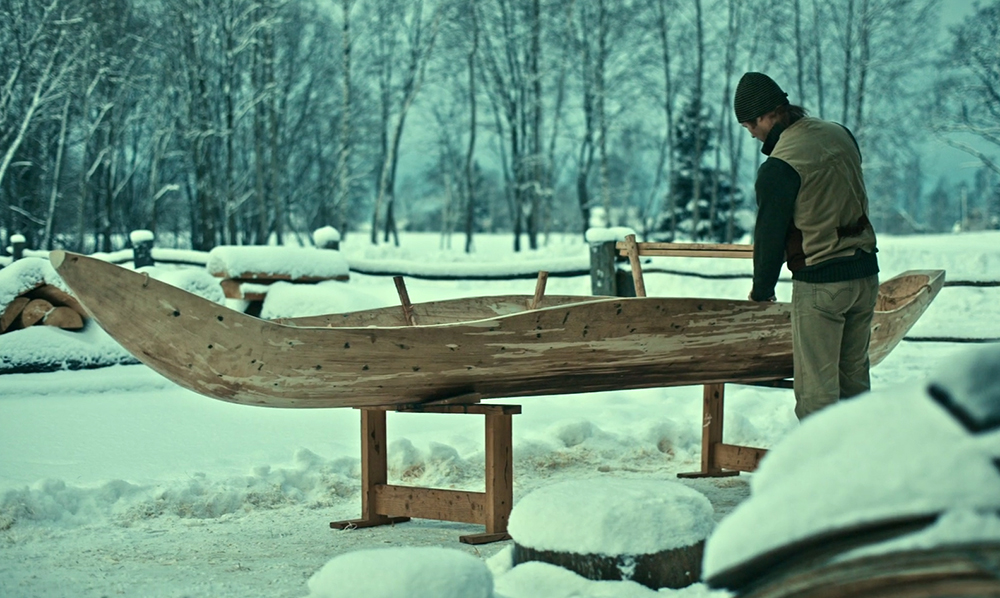
We’re really enjoying the recent uprising of short films which document traditional or so-called “primitive” craftsmanship. The Viking-era lime bast rope video we shared recently is a good example of this genre. Today, we stumbled upon a video from the Northmen Guild called The Birth of a Dugout Canoe, and it’s one of the best we’ve seen yet.

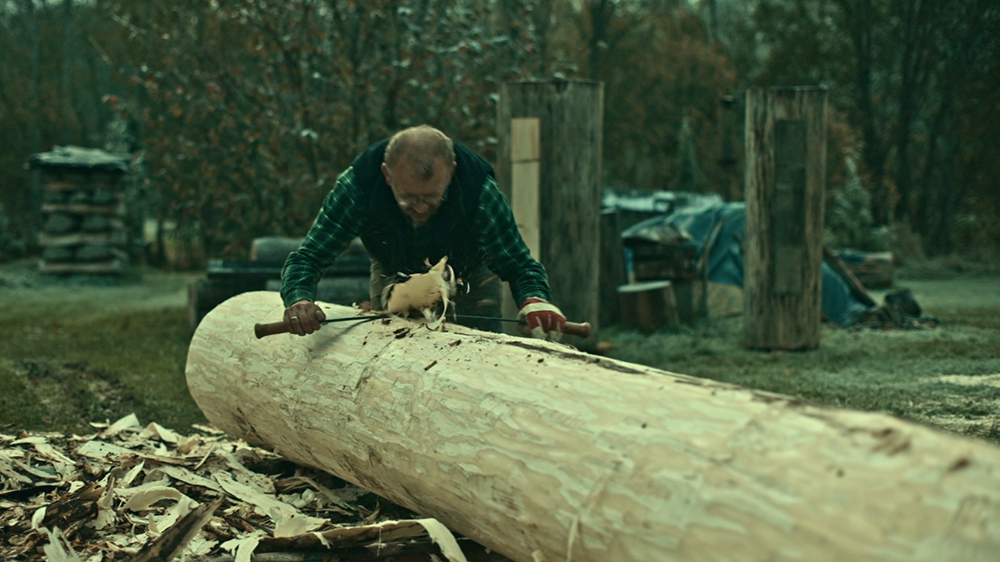
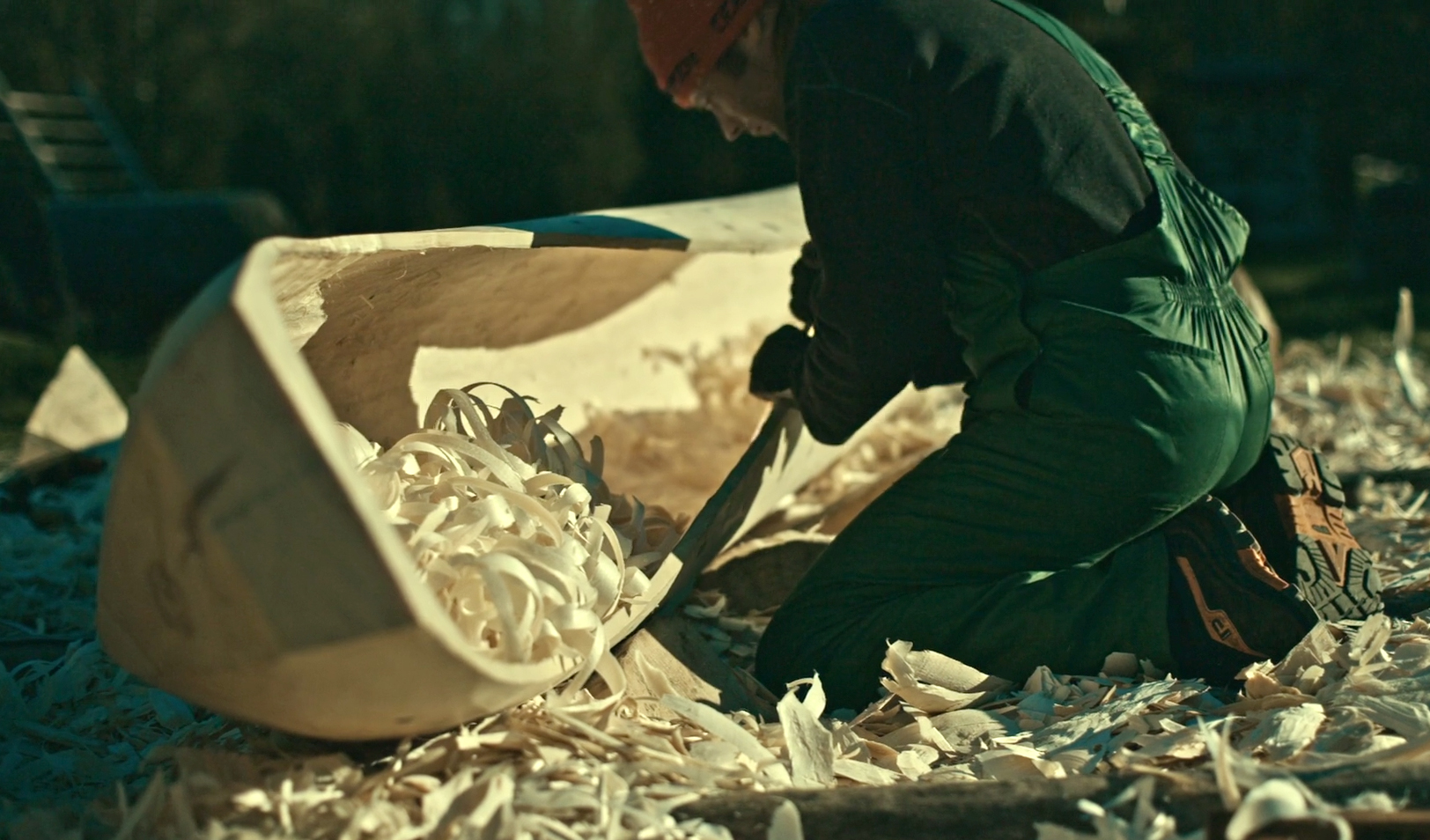
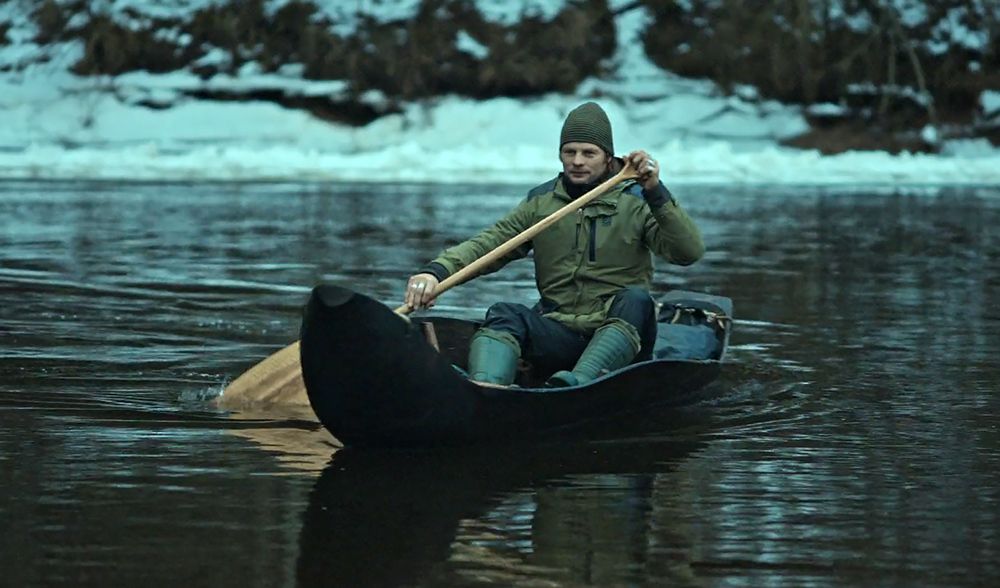
This 18-minute documentary is free of flashy graphics and patronizing narration, and simply follows along step-by-step as Latvian master woodworker Rihards Vidzickis builds a traditional dugout canoe. Pour yourself a beverage, kick back, and watch as his weathered hands transform a log into an expertly-crafted vessel:

It may seem like an incredible amount of effort to make a boat, but the level of care and attention to detail is awe-inspiring. It’s no wonder that it took decades for Rihards (Richard) to attain these woodworking skills. The video description states, “Richard’s father is also a wood worker and carpenter and has led his son into the beautiful world of working with wood. Richard has gone through all the traditional steps of becoming a master woodworker – starting from an apprentice, then journeyman and then receiving his Master degree in Latvian chamber of crafts.”

Northmen dugout canoe wood boat video 6
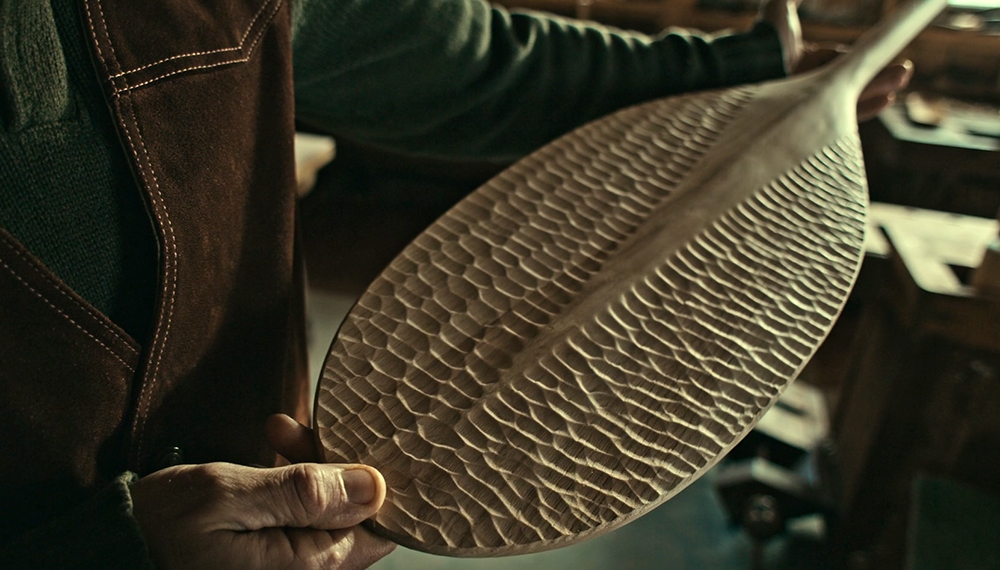
Even the paddle was masterfully hand-sculpted from local wood.

While lashing together a simple raft may suffice in a survival situation, we have tremendous respect for this rare breed of master craftsmen. It’s also cool to see organizations like the Northmen Guild supporting their livelihoods — if you want to buy some traditional products handmade by Rihards Vidzickis or other similarly-skilled individuals, you can do so at Northmen.com. For more videos like this one, check out the Northmen Vimeo channel.

Northmen dugout canoe wood boat video 7

Effective Kicks for When SHTF

0

Oh, the pain! If you’re a dude, you know what we’re talking about. The agony buckles your knees, sucks the breath out of your lungs, and makes you go more pigeon-toed than Marilyn Monroe in her white, blown skirt. For most guys, the first introduction to the anguish of testicle crushing comes in the form of a kick — intentional or otherwise.

And when someone says “kick,” one tends to think of either soccer or the martial arts. Mainstream entertainment has certainly played up the latter, from Jean Claude Van Damme’s trademark helicopter attack to any number of mixed martial arts (MMA) bouts ending with devastating head kicks.

But how effective are they in a life-and-death situation? How do you use them? And when should you use them? Read on to get a “leg up” on the topic.

effective-kicks-for-when-SHTF-advantages-1

Tied Up But Not Out: The author shows the advantages of kicking. Hands bound, keeping the attacker at bay, and the low risk of injury makes using your feet a no-brainer.

Effective Footwork

Martial arts (especially from Asia) often utilize the feet as weapons. Not only are some of these techniques aesthetically appealing, they can be downright deadly. In a dynamic critical incident, having more options will improve your chance of surviving. In extreme close-quarters combat situations, learning to use every appendage you were born with makes sense. Let’s explore why kicks are effective.

Look, Ma, No Hands: In certain situations, kicking may be your only viable weapon. Your hands might be bound. Your arms could be injured. Or maybe you’re carrying your child. You just never know when your hooves will come in handy.

Leg Strength: The muscles in your lower limbs are stronger and more powerful than the ones in your arms. Daily walking, running, and stair-climbing strengthen the legs. Stronger pistons will cause more damage and can even break down doors. Try that with your knuckles.

Increased Reach: In most violent situations, distance is your friend. Compared to your arms, the extra inches with your legs improve your odds of landing an effective blow. At the same time, your leg attack will keep distance between your vital organs and the attacking scoundrel.

Deceptive: The trajectory of the legs comes from below the visual field (especially if he or she is staring you down), reducing the likelihood of your opponent blocking or evading the strike.

Look, Ma, No Hands Part 2: Injuries of any kind suck, but will suck worse during the apocalypse. Considering the bones in the hands are small and delicate, punching can produce fractures. The constant physiologic stress (from the weight of the body) during walking and running creates higher density in the bones of the feet, especially the heel (aka calcaneus). This constant pounding makes the feet more durable, resilient, and less likely to break upon contact.

Sole Armor: Compared to our naked hands, our feet are usually surrounded by extra layers of shielding called footwear. Furthermore, hiking boots or steel-toed work shoes can “weaponize” our hooves, while at the same time creating that one-of-a-kind fashion statement.

Achilles’ Heel

Kicking can be a lifesaver, but it’s not the holy grail of combatives techniques. Dangling one leg in the air can leave you vulnerable in a number of ways.

Balancing Act: When performed incorrectly or on slippery or uneven terrain, booting someone can land you on your bottom. If you find yourself on the ground from a kick gone wrong, your mobility and options will be limited — severely. This risk/reward must be calculated before engaging.

Lack of Mobility: Movement is hampered with one leg stuck to the ground while the other is in the air. This is dangerous because movement is your friend during a violent encounter. That split second of standing on one leg will leave you vulnerable to being swarmed by multiple attackers.

Lumbering Log: Kicks are slow when compared to punches. If the kick is too slow or telegraphed, the bad guy can avoid it or, worse yet, grab your leg. Once your leg is captured, you’ll most likely find yourself landing on your butt, being hit in the gonads, or both.

Off Target: Legs are clumsier than hands and lack the fine motor skills of fingers. When kicking, missing the target is more likely compared to striking with the hands. Training to kick effectively requires time to perfect.

The best way to avoid these pitfalls is to learn from a reputable instructor then train. A lot. Proper training will improve efficiency, timing, power, and speed, as well as increasing your odds of landing any type of devastating blow.

Kick Starter

We certainly want to adhere to the KISS principle when it comes to leg attacks. There are dozens of kicks in the martial arts. All are effective at the right time in the right place. Alas, we cannot always pick the time or place, so focusing on a few effective kicks that can be used in a multitude of situations increases our odds of making the strike successful.

Here are four high-percentage kicks that can save your life:

Front Kick

This is the often the first kick you learn in many martial arts systems, and for good reason — the linear attack’s intuitive motion makes this a go-to move for many street encounters.

How: From a ready stance, raise a knee forward with your toes pointing down. Flick the leg forward, striking with the instep. Immediately retract your foot back and put it down (for stability and movement or for a second kick if needed). Re-chambering your kick quickly also makes grabbing your leg more difficult.

Target: With a fast and stealthy vertical trajectory, the groin makes an ideal candidate for this weapon.

When: Any time your opponent is in front of you, yet too far for a knee to the groin. A wrist or purse grab also offers another opening for a front kick to the ‘nads.

effective-kicks-for-when-SHTF-front-kick-01

effective-kicks-for-when-SHTF-front-kick-02

effective-kicks-for-when-SHTF-front-kick-03

effective-kicks-for-when-SHTF-front-kick-04

effective-kicks-for-when-SHTF-front-kick-05

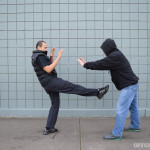
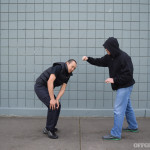
The big right haymaker is possibly the most common empty hand attack you will face. Conrad Bui gets his hands up and slips the punch, leaving the attacker off-balance. A quick kick to the groin is enough to stop the threat and allow Bui to make his escape.

Push Kick

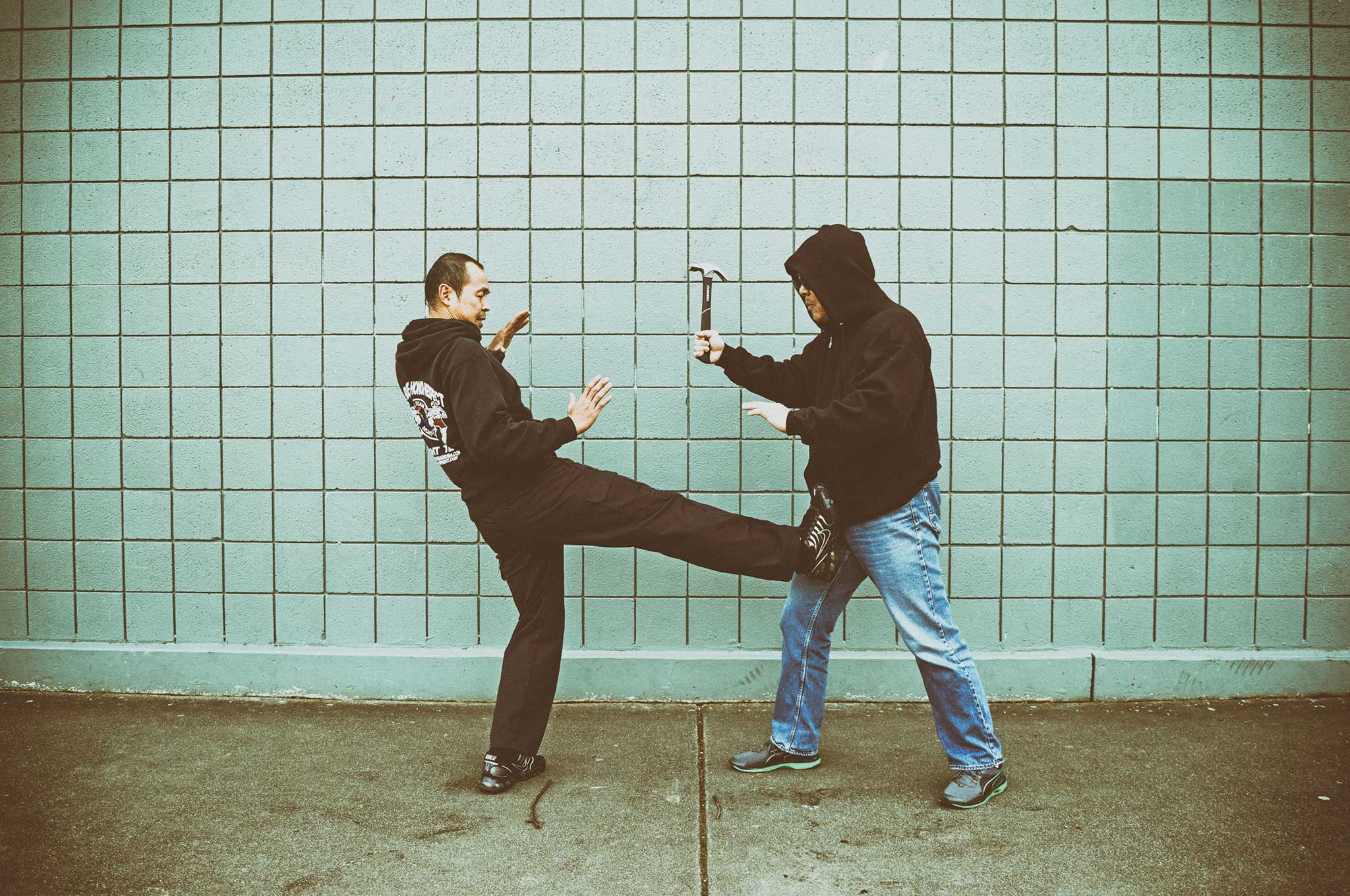
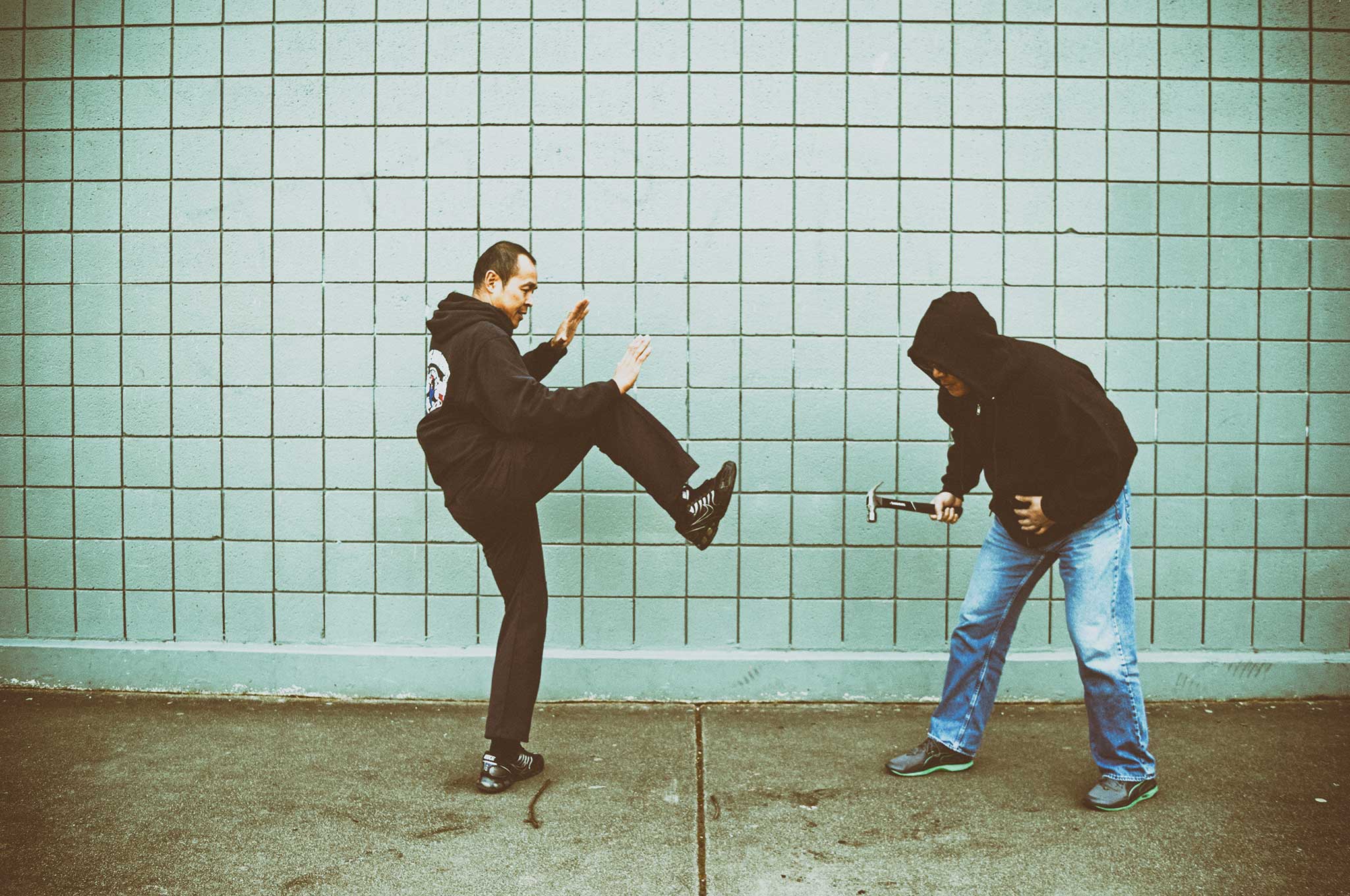
Fan of the TV show Cops? You’ve likely seen a police officer kick a door open with the push kick. This kick makes use of the strongest muscles, namely the glutes and quadriceps. If kicking in a door or stunning an attacker in their tracks is the goal, the push kick is your move.

How: From a ready stance, bring up your knee as close to your chest as possible. Pull your toes back and extend your leg explosively while thrusting your hip forward. The heel is the striking surface for this technique. Once the kick has reached full extension, quickly retract the leg so it can’t be grabbed easily, it’s ready to fire again, or it can be set down to run.

Targets: For maximum devastation, aim for the solar plexus, the groin, and knees. However, the power generated from this kick can make any target a good candidate.

When: Use the push kick whenever an attacker is straight in front of you. A push kick to the above targets can create enough distance for you to access a weapon or leave the scene. Strong and explosive push kicks to the knee can dislocate the knee joint.

effective-kicks-for-when-SHTF-push-kick-01

effective-kicks-for-when-SHTF-push-kick-02

effective-kicks-for-when-SHTF-push-kick-03

effective-kicks-for-when-SHTF-push-kick-04

effective-kicks-for-when-SHTF-push-kick-05

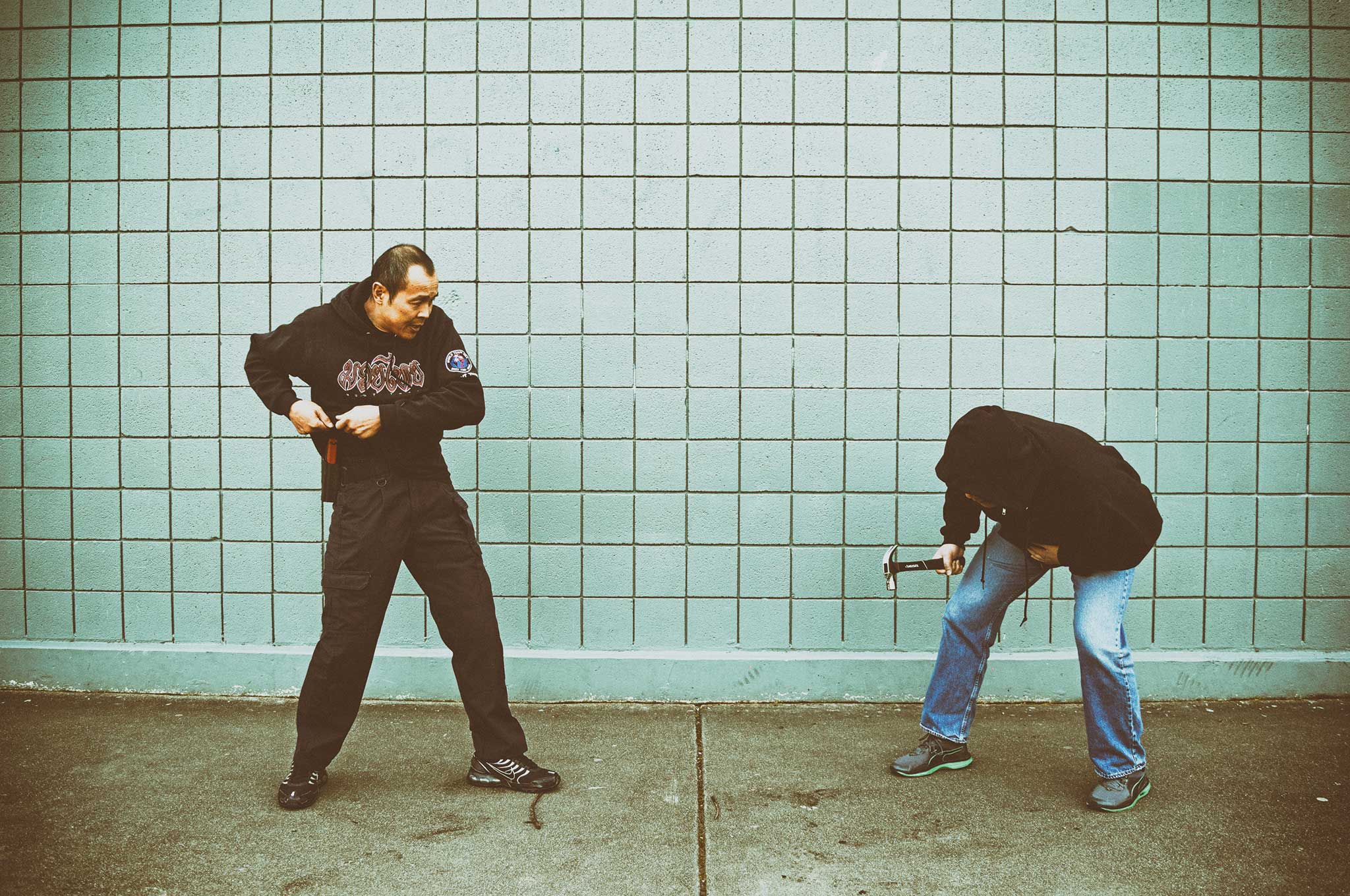
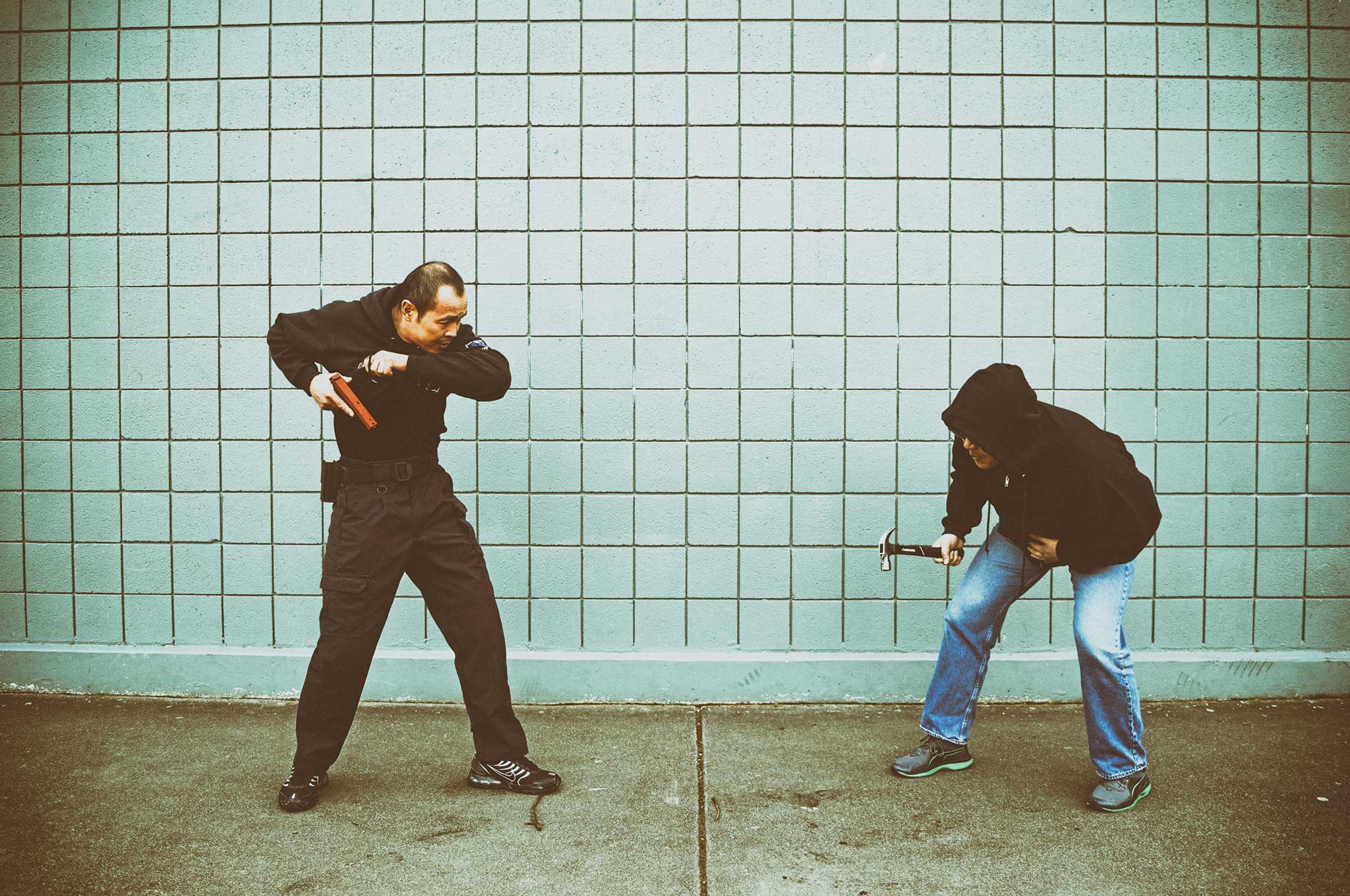
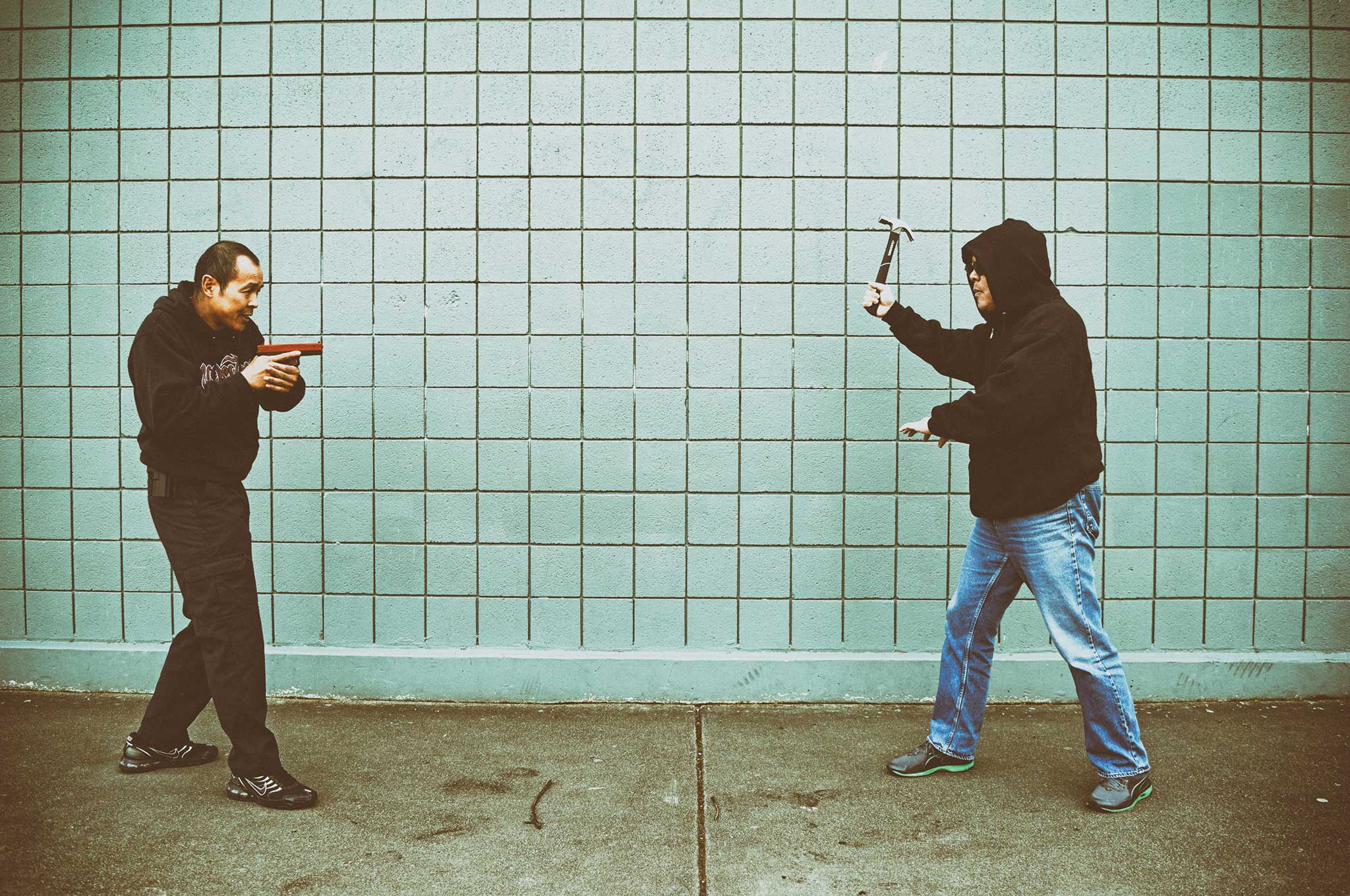
A hammer attack is no joke. Conrad Bui has no time to draw his firearm, so he must "fight to his weapon." The push kick finds its mark, knocking back his assailant, and giving Bui enough time to safely deploy his weapon.
A hammer attack is no joke. Conrad Bui has no time to draw his firearm, so he must “fight to his weapon.” The push kick finds its mark, knocking back his assailant, and giving Bui enough time to safely deploy his weapon.

Side Kick

Bruce Lee was a big fan of this kick, along with just about every other martial artist. MMA stars like Jon “Bones” Jones, Conor McGregor, and Holly Holm are also big proponents of this weapon. The reason? Side kicks reduces the risk of counterstrike by increasing reach and reducing your vulnerability (achieved by turning the body sideways).

How: Bring your knee up, pointing your foot slightly out to your side. The side kick shoots out like an arrow with your heel as the arrowhead and your shin as the shaft. Pull your toes back toward you to expose your heel. Once full extension is achieved, immediately re-chamber your leg.

Targets: A side kick delivered to the knee at any angle can cause devastating results. The groin, thigh, and shin will likewise yield positive outcomes.

When: Side kicks are best used when the target is to your side. The bad guy could have approached you from either side or you purposely angled laterally to provide a slimmer profile. Additionally, you may unleash this beast whenever someone tries to grab your wrist.

effective-kicks-for-when-SHTF-side-kick-01

effective-kicks-for-when-SHTF-side-kick-02

effective-kicks-for-when-SHTF-side-kick-03

effective-kicks-for-when-SHTF-side-kick-04

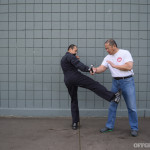
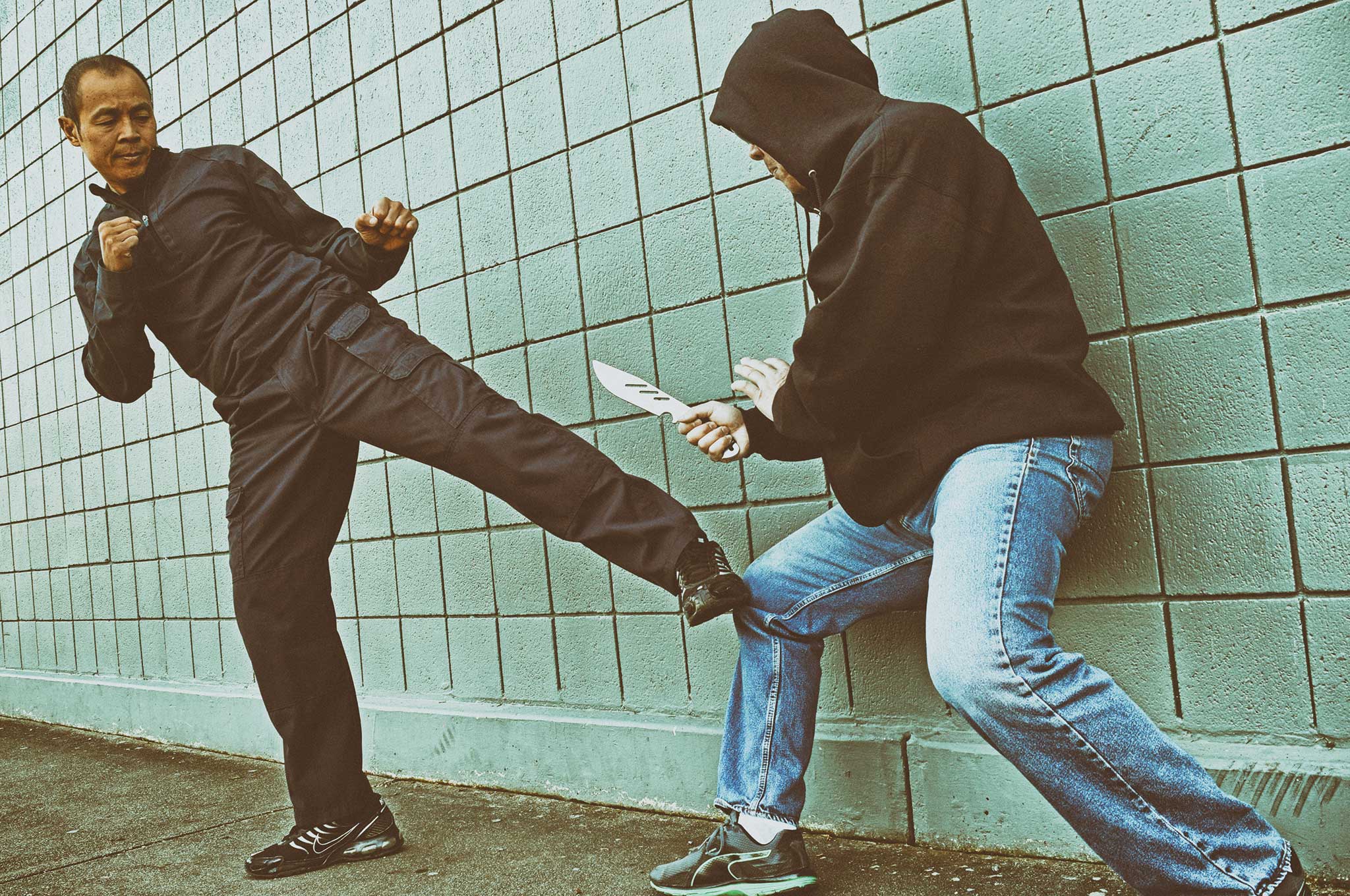
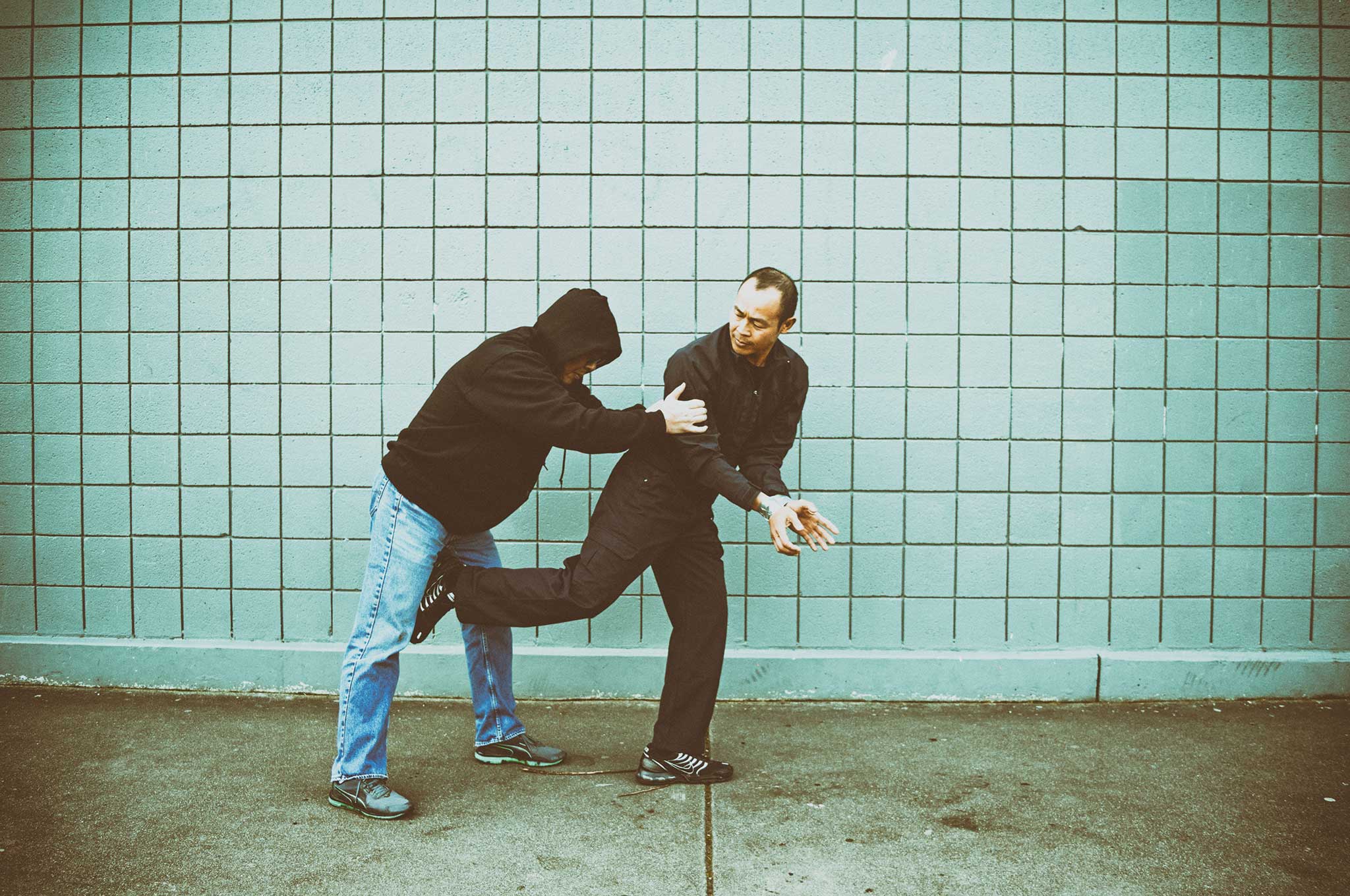
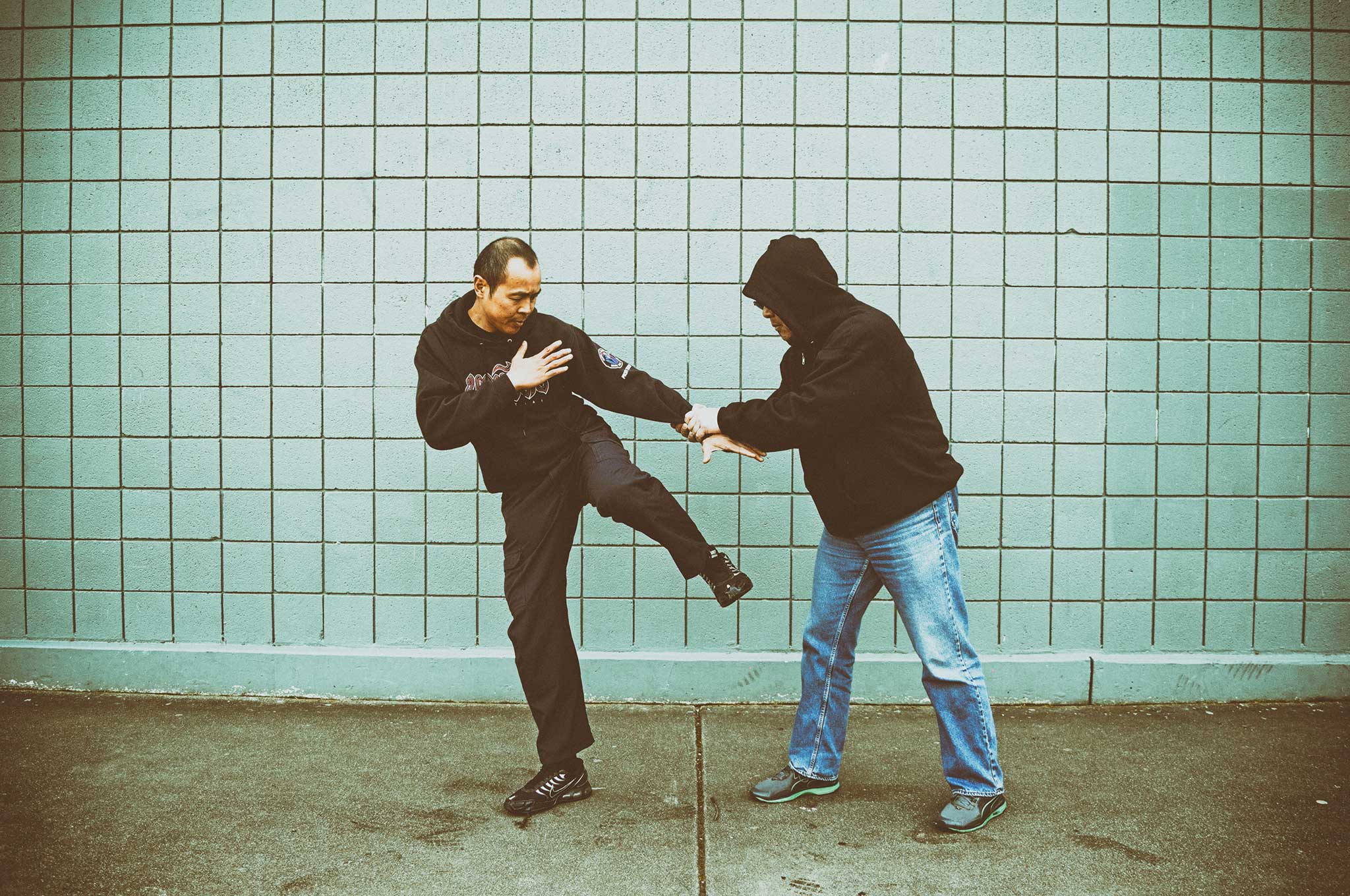
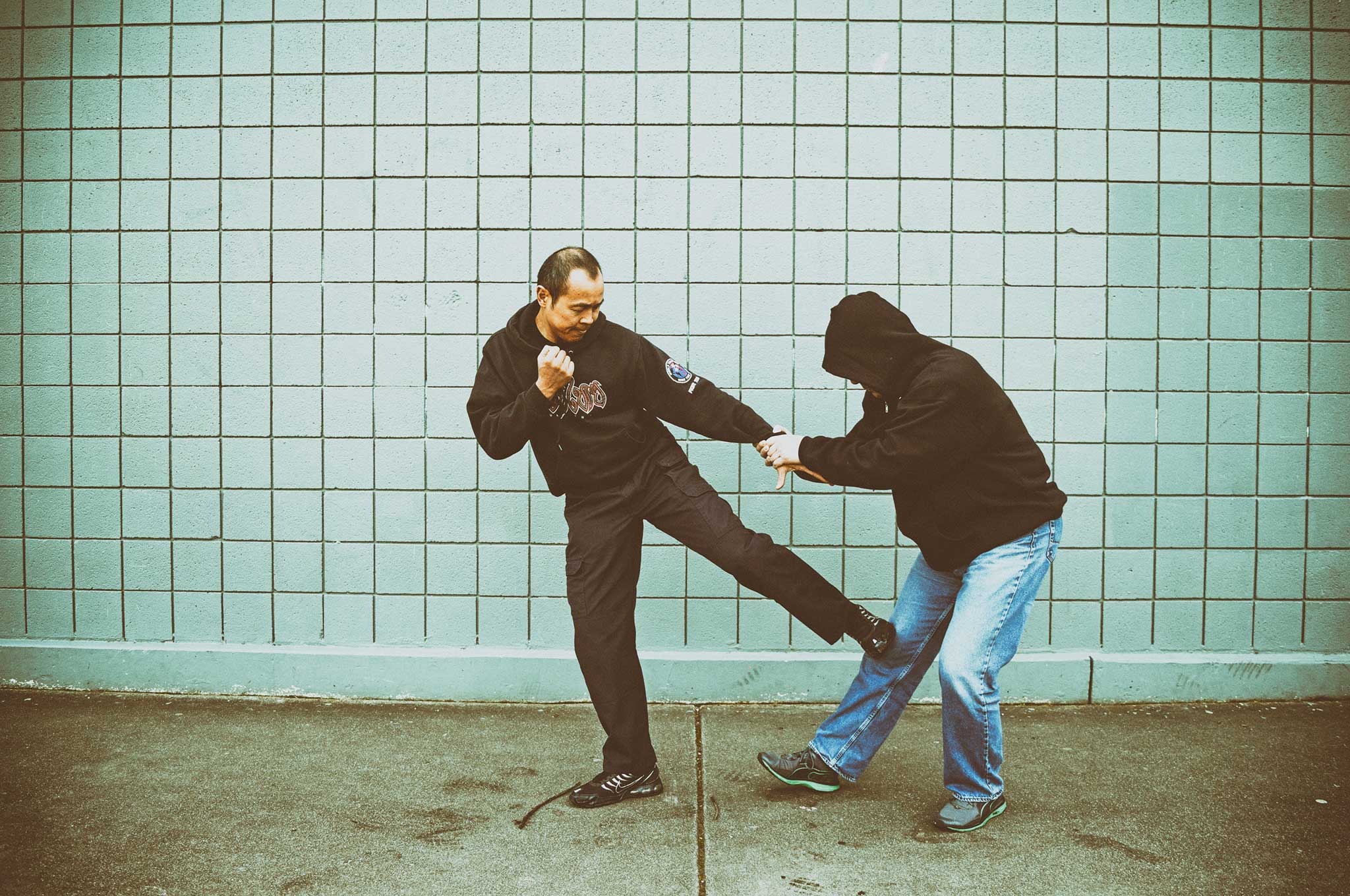
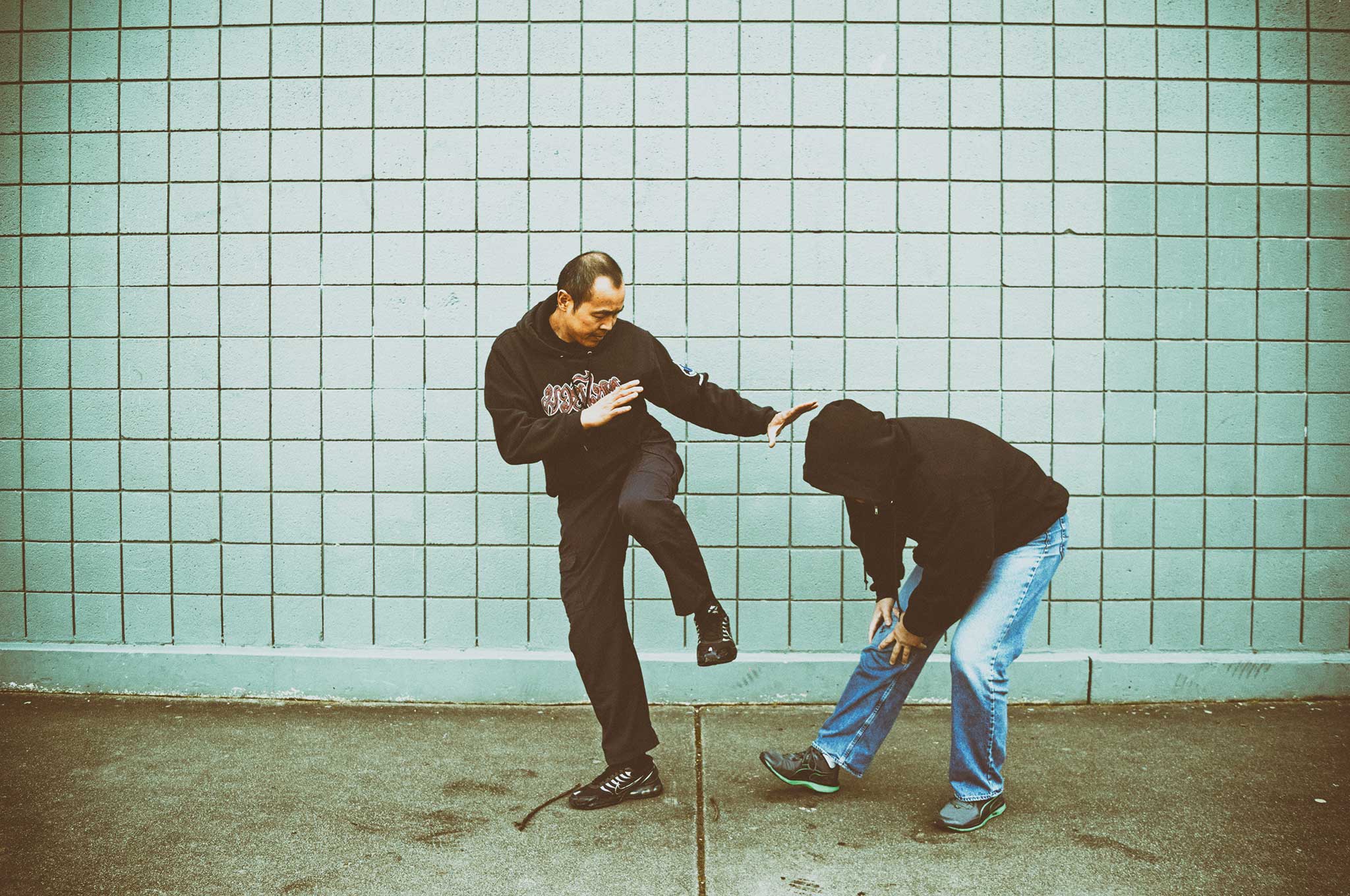
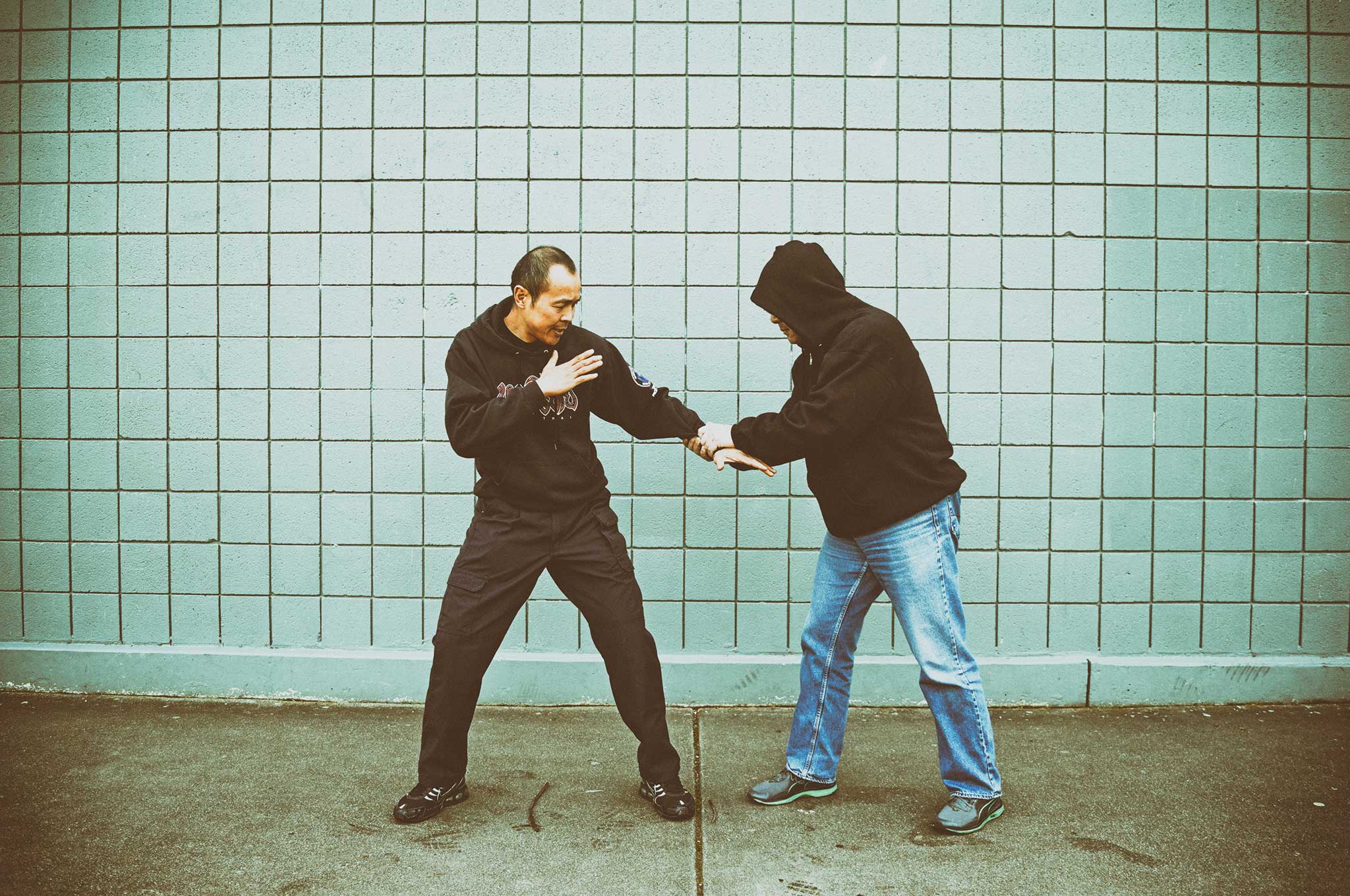
Sherman Chin grabs the author's wrist. Using the closest weapon to the closest target, Conrad Bui launches a side kick to Chin's knee. The damage forces him to keep his hands to himself.
Sherman Chin grabs the author’s wrist. Using the closest weapon to the closest target, Conrad Bui launches a side kick to Chin’s knee. The damage forces him to keep his hands to himself.

Back Kick

So far, we covered your front and sides. Now it’s now time to watch your six. The back kick is a destructive attack because it’s powered by your glutes and legs. Think of a horse or donkey, explosively kicking backward. (Who would like to be smacked by that?) This is the type of force that can be replicated with correct technique.

How: From a comfortable stance, look behind you to identify the threat and raise your knee up toward the front of your body. Aim your heel behind you and explosively extend your leg to the rear. Imagine the kick is an arrow, with your heel as the arrowhead and your shin as the shaft. Forcefully, fire the kick straight back, keeping your toes down and pulled back to expose your heel. Lean forward slightly for balance and immediately re-chamber your leg.

Targets: Although a well-executed kick will be a danger to anything in its path, targeting will yield better results. The groin, hip, thigh, knee, and shin are all acceptable shots.

When: The back kick is the strike of choice any time an identified threat is behind you. The bad guy may have snuck up on you or you may have made the choice to turn from the danger to run. Either way, back kicks have your six.

effective-kicks-for-when-SHTF-back-kick-01

effective-kicks-for-when-SHTF-back-kick-02

effective-kicks-for-when-SHTF-back-kick-03

effective-kicks-for-when-SHTF-back-kick-04

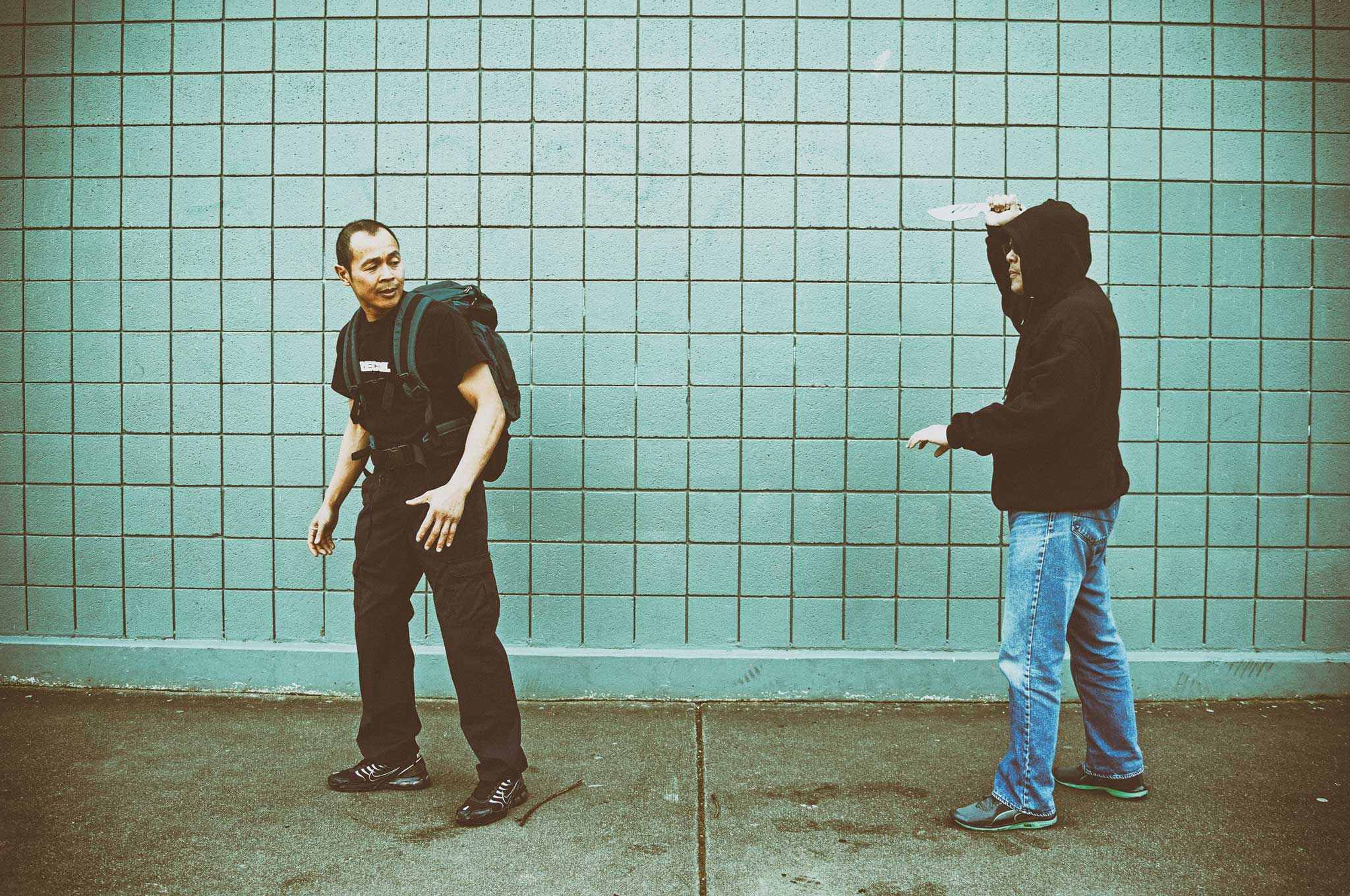
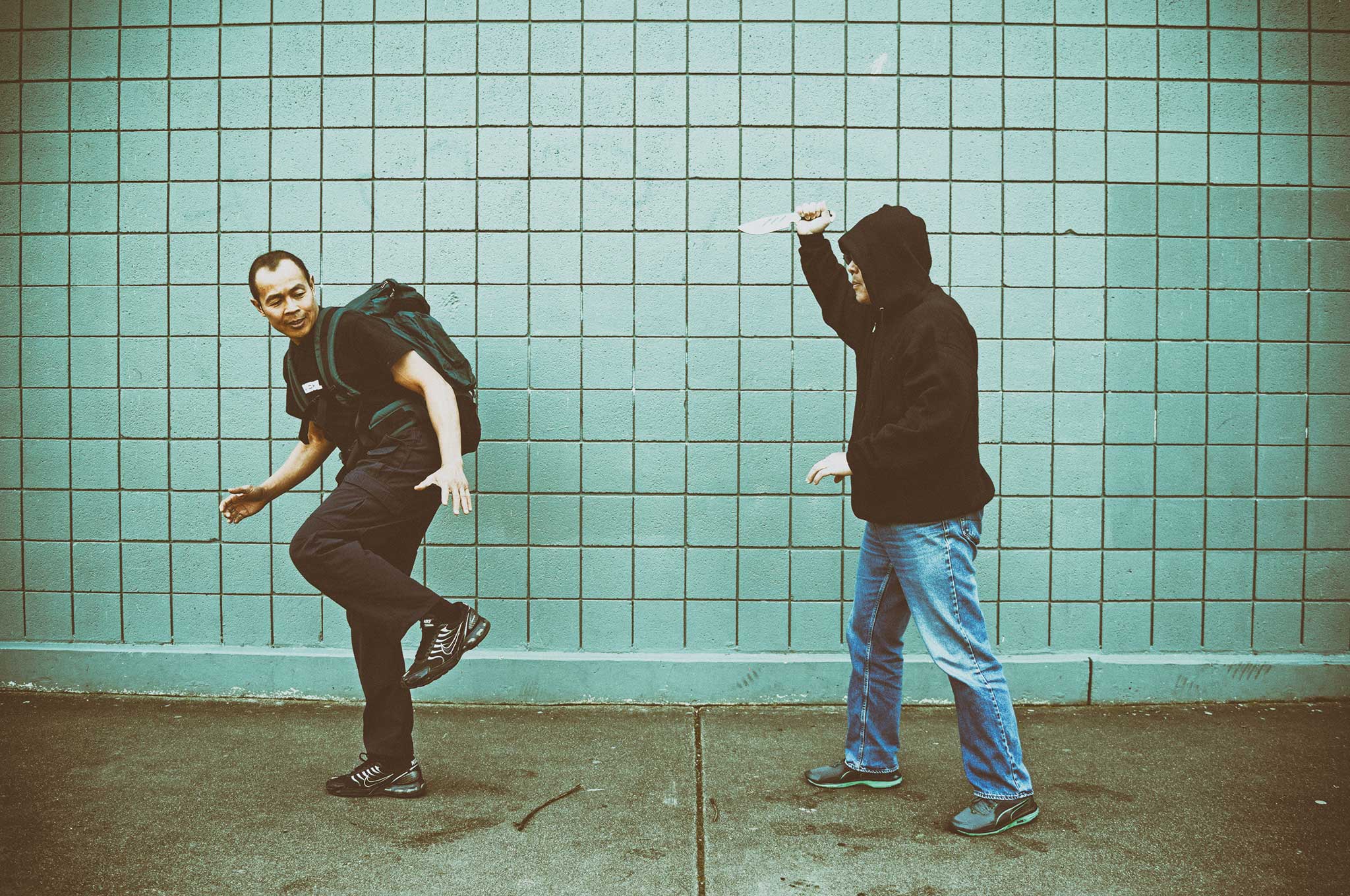
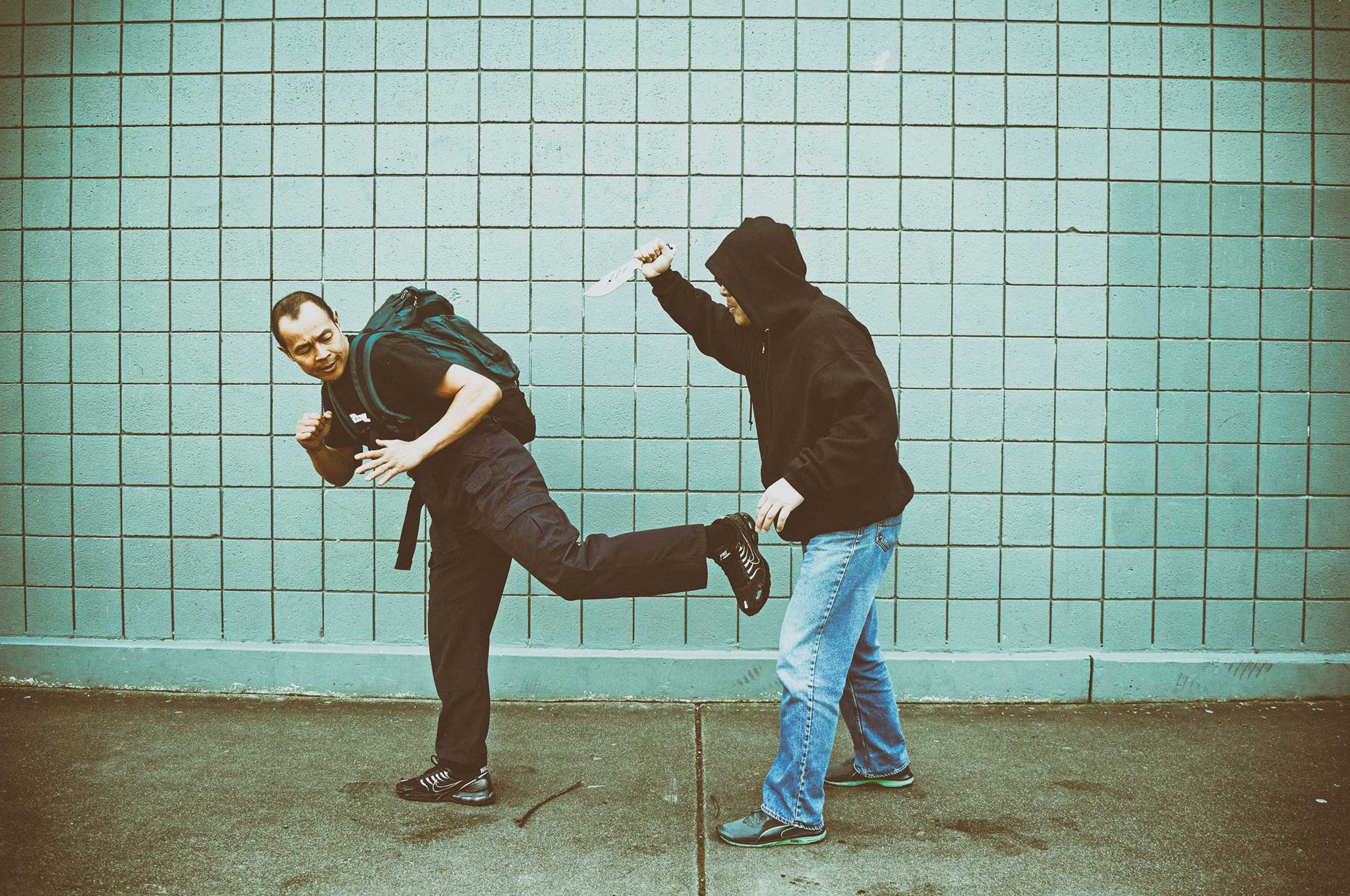
Sherman Chin attempts to sneak up and skewer Conrad Bui. But he hears him coming, checks his six, and quickly back kicks the goods. The proper re-chambering position leaves Bui in the perfect position for a mad dash to safety.

If the Shoe Fits

Hollywood and MMA matches have made kicks mainstream. Still, some combatives instructors shy away from teaching kicks. They claim kicks are vulnerable to counterstrikes or slips and falls. However, there are times when the only answer may be to give someone the boot. Training this oft-neglected combatives tool can improve your odds of prevailing a close encounter of the worst kind.

Anyone who doesn’t respect kicks has never been kicked properly. Just ask any dude about his first gut-churning crotch shot.

About the Author

Dr. Conrad Bui — a San Francisco-based doctor of chiropractic and frequent contributor to RECOIL OFFGRID — has been serving up kicks at karate tournaments since his youth. He later used them as a bar bouncer and continues to teach kicking techniques as a Muay Thai instructor at World Team USA. A self-proclaimed combatives junkie, he placed third in the featherweight brown-belt division of the 2016 World No-Gi Brazilian Jiu-Jitsu Championship. He is also a certified full instructor in Indonesian Kuntao Silat, Filipino Kali, and Bruce Lee’s Jeet Kune Do, as well as a fifth-degree black belt in Tae Kwon Do.
www.conradbui.com

Get a Leg Up Online

Did you get a kick out of this feature? We have more exclusive web content on kicks, combatives, and self-defense. To learn how to practice your kicking techniques safely and avoid some brutal mistakes in a life-and-death situation, go to www.offgridweb.com/survival/kicking-drills-mistakes.
New: SolSource Sport Portable Solar Cooker on Kickstarter

0

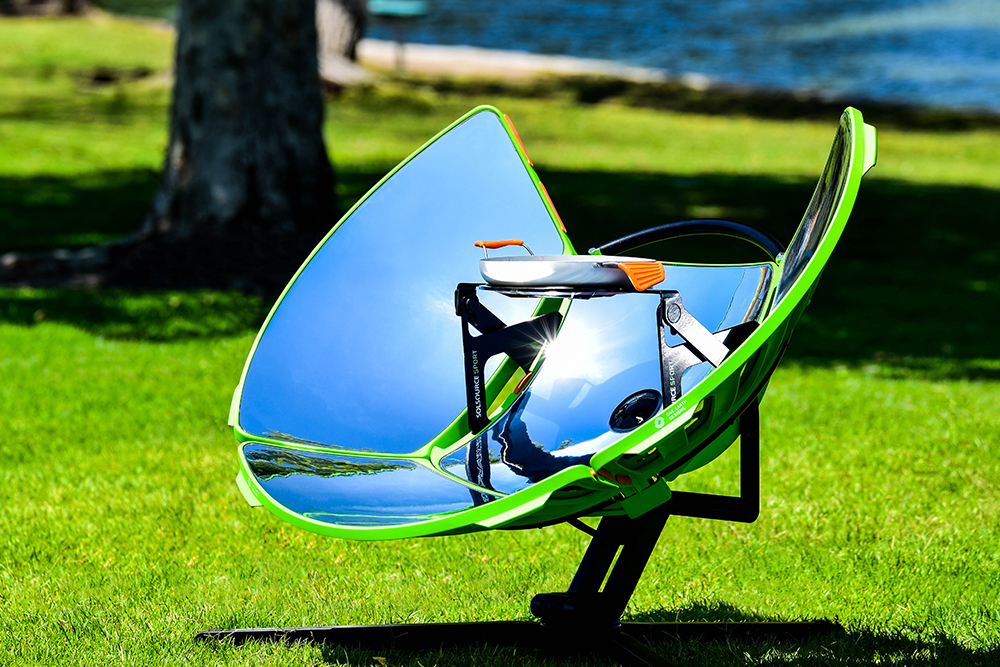
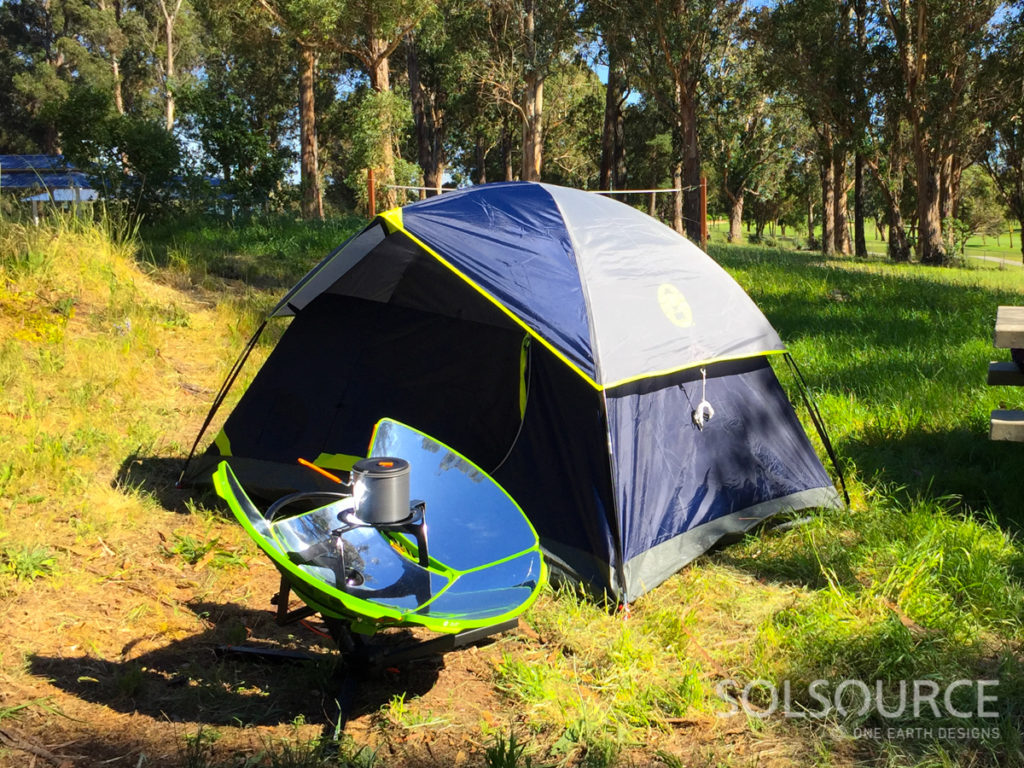
The idea of a solar stove has been around for a while now, but the new SolSource Sport appears to be one of the most polished examples we’ve seen yet (pun intended). Most other solar cooking devices use wrinkly, crinkly reflective fabric or foil, or they’re too enormous and fragile to lug around the backcountry. This led One Earth Designs to create the SolSource Sport, a solar stove designed to remain mobile, lightweight, and packable.

Earlier this week, the SolSource Sport launched on Kickstarter, and it exceeded its $20,000 funding goal in only a few hours. While we haven’t had a chance to get our hands on one of these stoves yet, the specs and features look pretty impressive.

SolSource sport solar cooker kickstarter food water 7

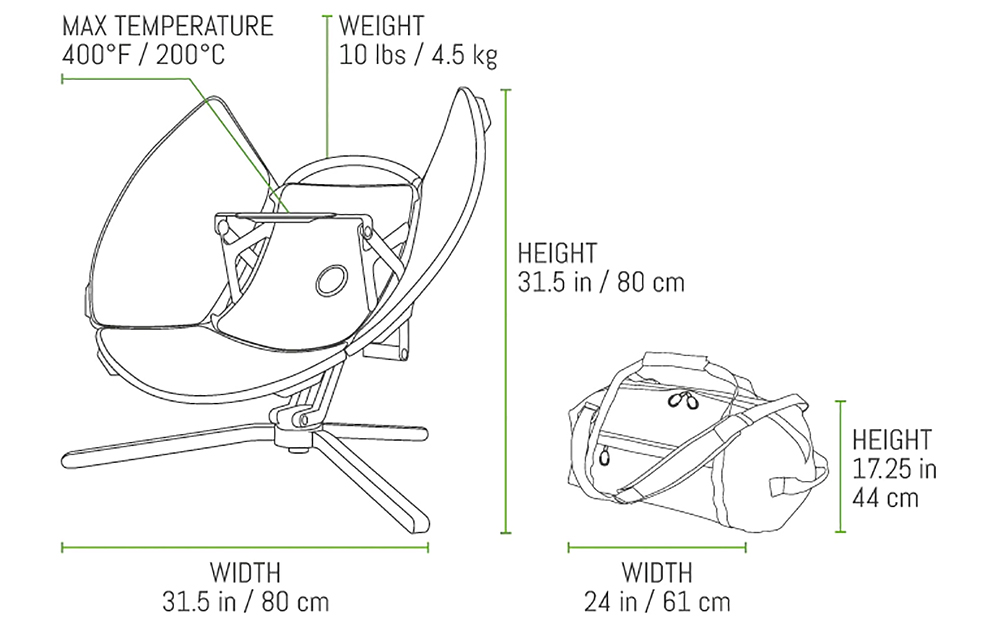
It weighs approximately 10 pounds, and packs into an included 2-foot by 1.4-foot duffel bag. Assembly (or disassembly) is said to take less than 3 minutes.

The stove reaches grilling temperatures in about 5 minutes on a clear sunny day, and will reach searing temperature in 10 minutes. It’s compatible with a wide range of cookware, and is said to be effective in partial sunlight (as long as you can see your shadow), temperatures as low as 30°F, and wind up to 30mph.

SolSource sport solar cooker kickstarter food water 3

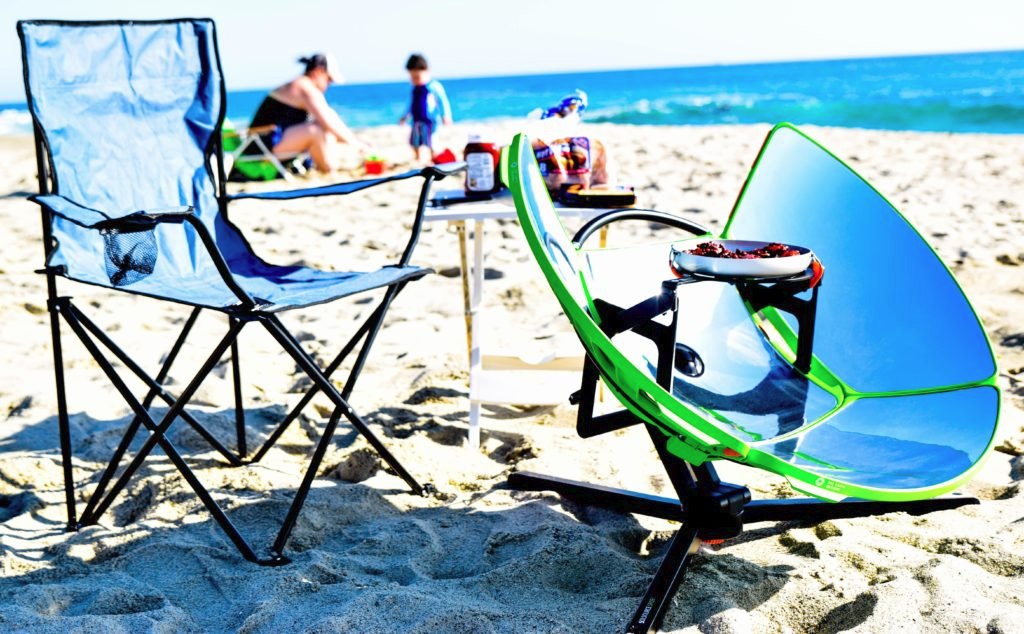
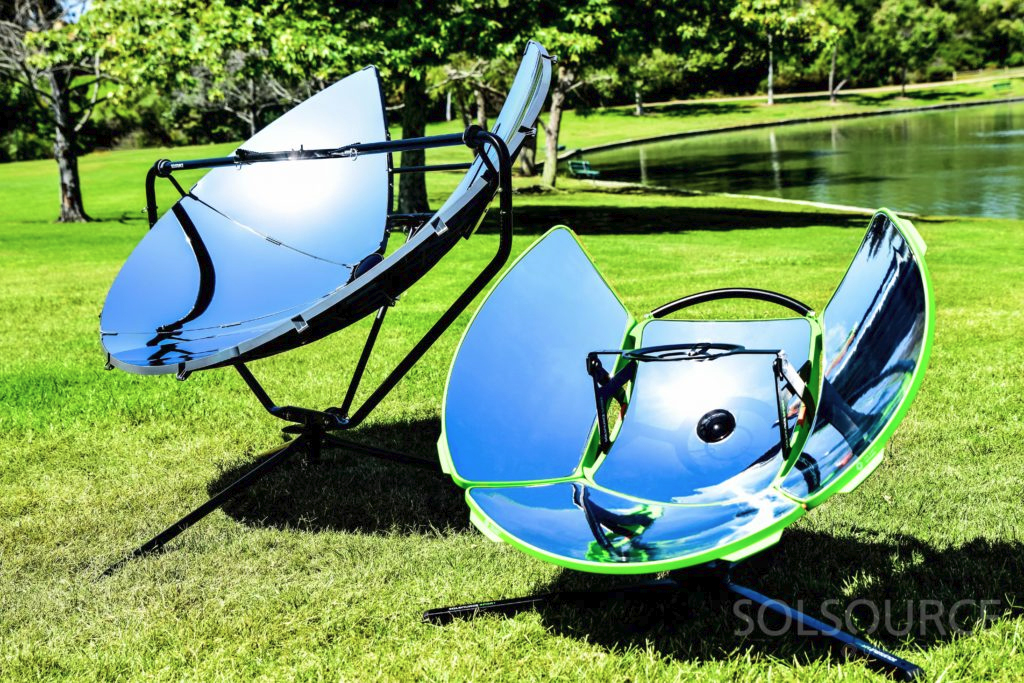
The SolSource Sport isn’t One Earth Designs’ first foray into solar cooking — the larger original SolSource (pictured above left) used a similar design, and has been proven effective as a cooking and water purification device in remote regions of Kenya and China. The Sport solar cooker scales the device down into a size that’s designed for camping, tailgating, or off-grid use.

SolSource sport solar cooker kickstarter food water 5

A limited number of early-bird Kickstarter backers can pre-order the SolSource Sport for discounted prices as low as $99, but the retail price is expected to be $329 (including carrying case and cover). For more information and specs, visit the company’s Kickstarter project.

Issue 20 Gear Up

0

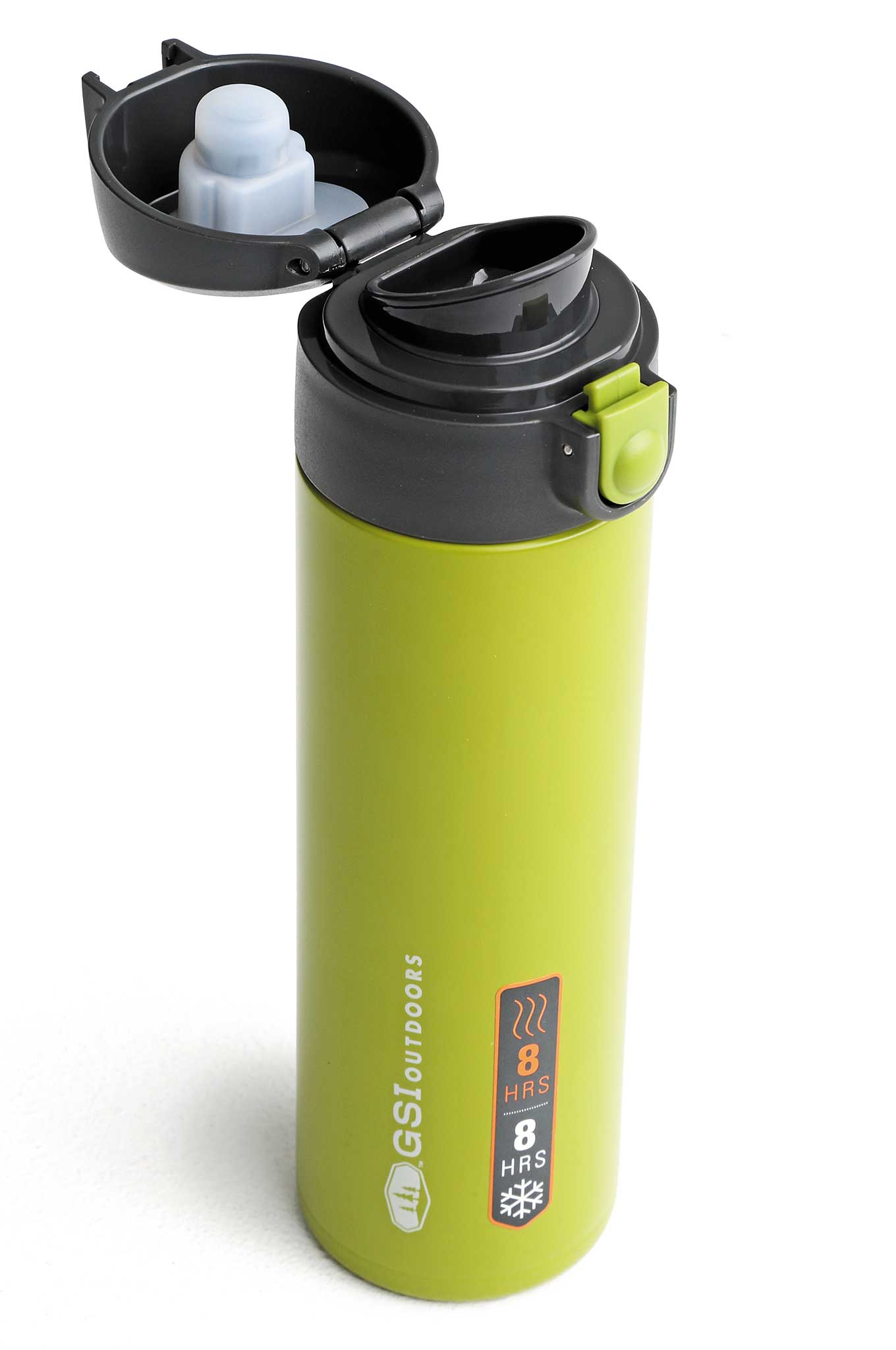
issue-20-gear-up-gsi-outdoors-glacier-tainless-microlite-500

MAKE & MODEL
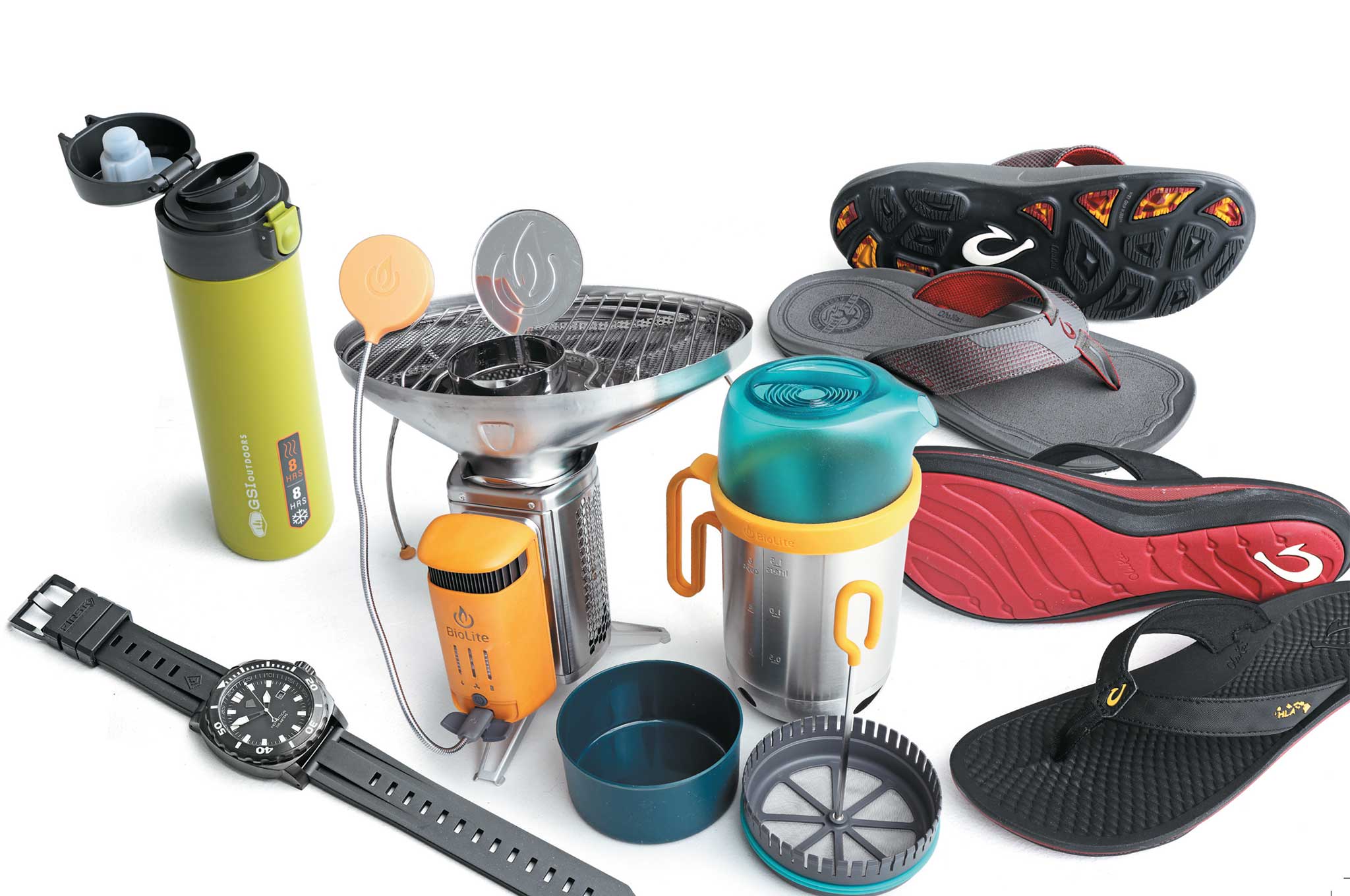
GSI Outdoors Glacier Stainless Microlite 500

DIMENSIONS
3 by 2.6 by 9.2 inches

MSRP
$26

URL
www.gsioutdoors.com

NOTES
Most outdoor enthusiasts own a vacuum-insulated water bottle because it can retain cold or heat for way longer than regular vessels. But many of these popular bottles feature lids that require two hands to operate. Enter the Glacier Stainless Microlite 500. This model has a flip-top cap that locks closed for transport but stays open with a simple push-button. The bottle’s moniker comes from its 500ml capacity (or 17 fluid ounces for those not fluent in metric), yet it’s a third lighter than conventional designs of the same capacity. How? Its 18/8 stainless steel body has 2mm-thin walls that remain durable, yet keep hot beverages hot for 8 hours and cold libations cold for 16 hours.

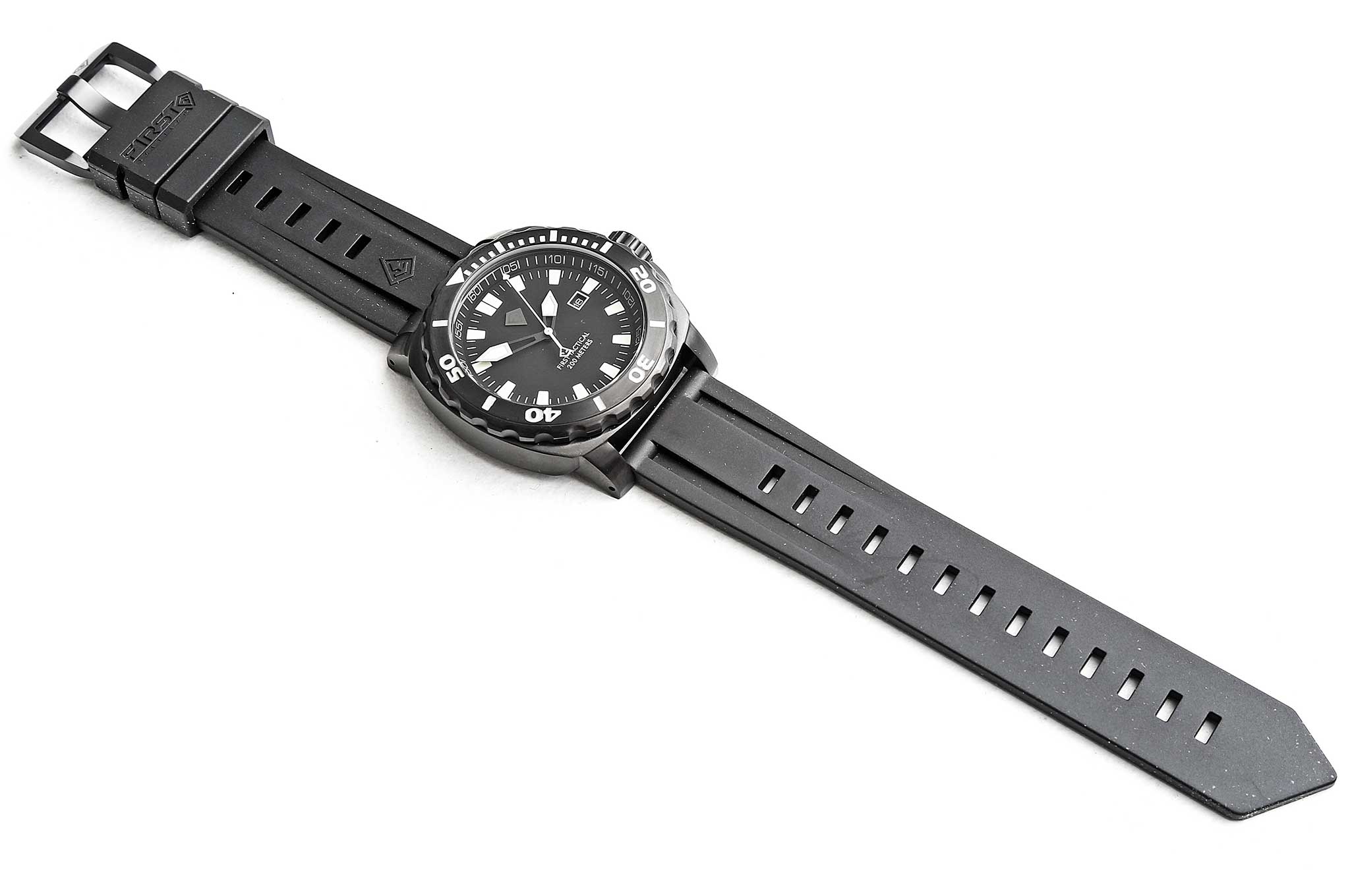
issue-20-gear-up-firsttactical-fathom-stainless-steel-dive-watch

MAKE & MODEL
First Tactical Fathom Stainless Steel Dive Watch

COLORS
Black, titanium

MSRP
$250

URL
www.firsttactical.com

NOTES
A dam bursts, a boat capSIZEs, a tropical storm makes landfall – emergencies can and do happen in and around water. The Fathom Stainless Steel Dive Watch should perform no matter how wet it gets. It’s waterproof up to 200 meters, thanks to pressurized construction and a screw-down crown. It features a durable polymer band with a ruler and Morse Code on the back. It has a tough stainless steel housing and bezel. Its three hands are coated with Super-LumiNova, a photoluminescent pigment that can glow for hours after a charge with sunbeams or artificial light. The Fathom will keep you on time, whether you need to make a rendezvous with your survival group or catch a screening of the Baywatch movie with your beach volleyball team.

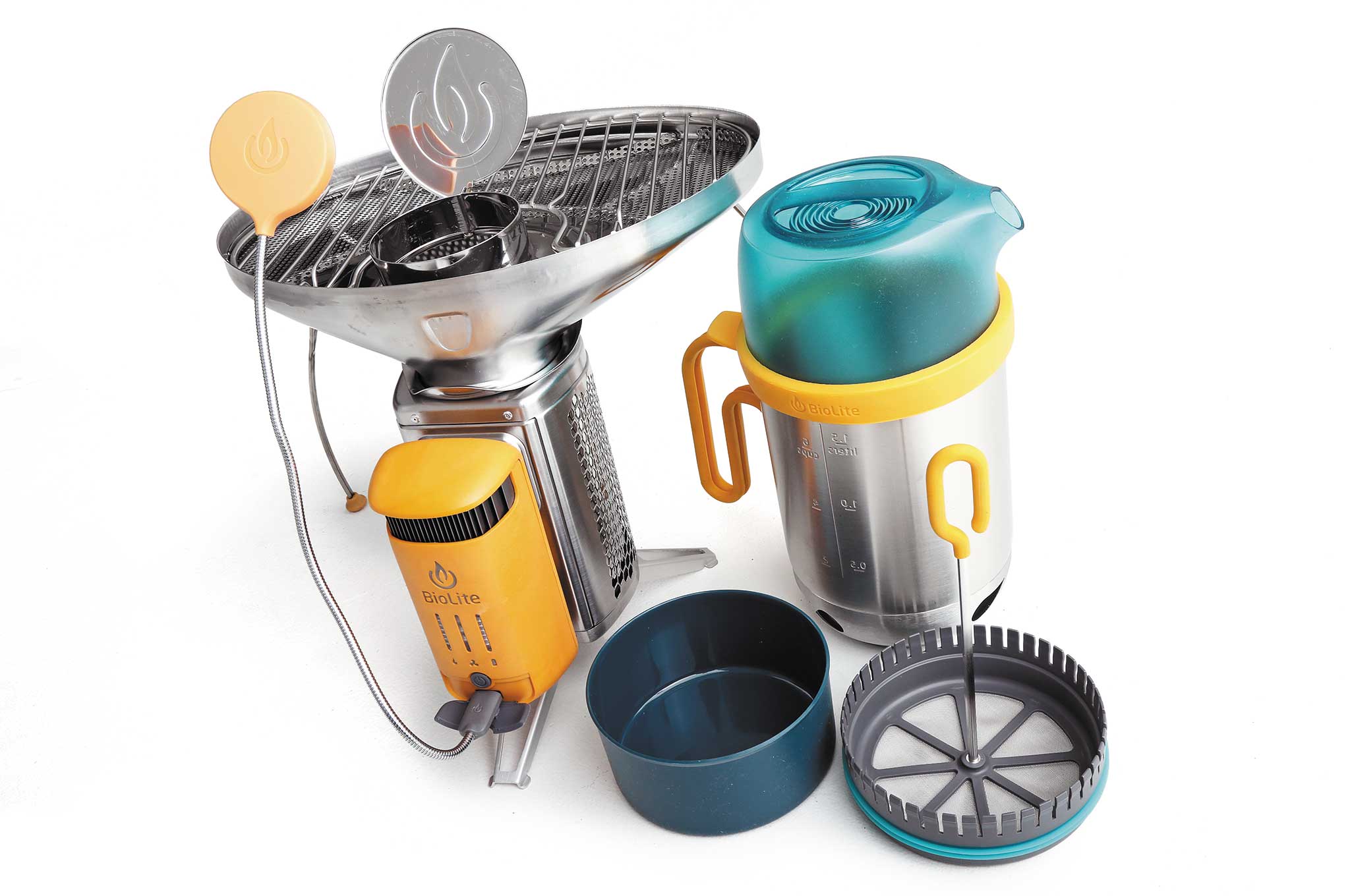
issue-20-gear-up-biolite-inc-campstove-2-bundle

MAKE & MODEL
BioLite Inc. CampStove 2 Bundle

WEIGHT
Approx. 5 pounds

MSRP
$200

URL
www.bioliteenergy.com

NOTES
The award-winning BioLite now offers its innovative products in convenient packages. The CampStove 2 Bundle includes the KettlePot (it cooks like a pot and pours like a kettle), the Portable Grill (with an intake lid that lets you add branches to the fire without disturbing the grill itself), and of course the CampStove 2. As the heart of this package, the CampStove 2 uses any biomass (twigs, pinecones, etc.) as fuel to cook while producing 3 watts to charge devices or to store in its 2,600-mAh battery. The CampStove 2 conveniently nests inside the KettlePot for storage and portability. There’s also the CoffeePress (sold separately for $15 and shown here with the bundle), which brews six cups of java at a time using a French press-style design.

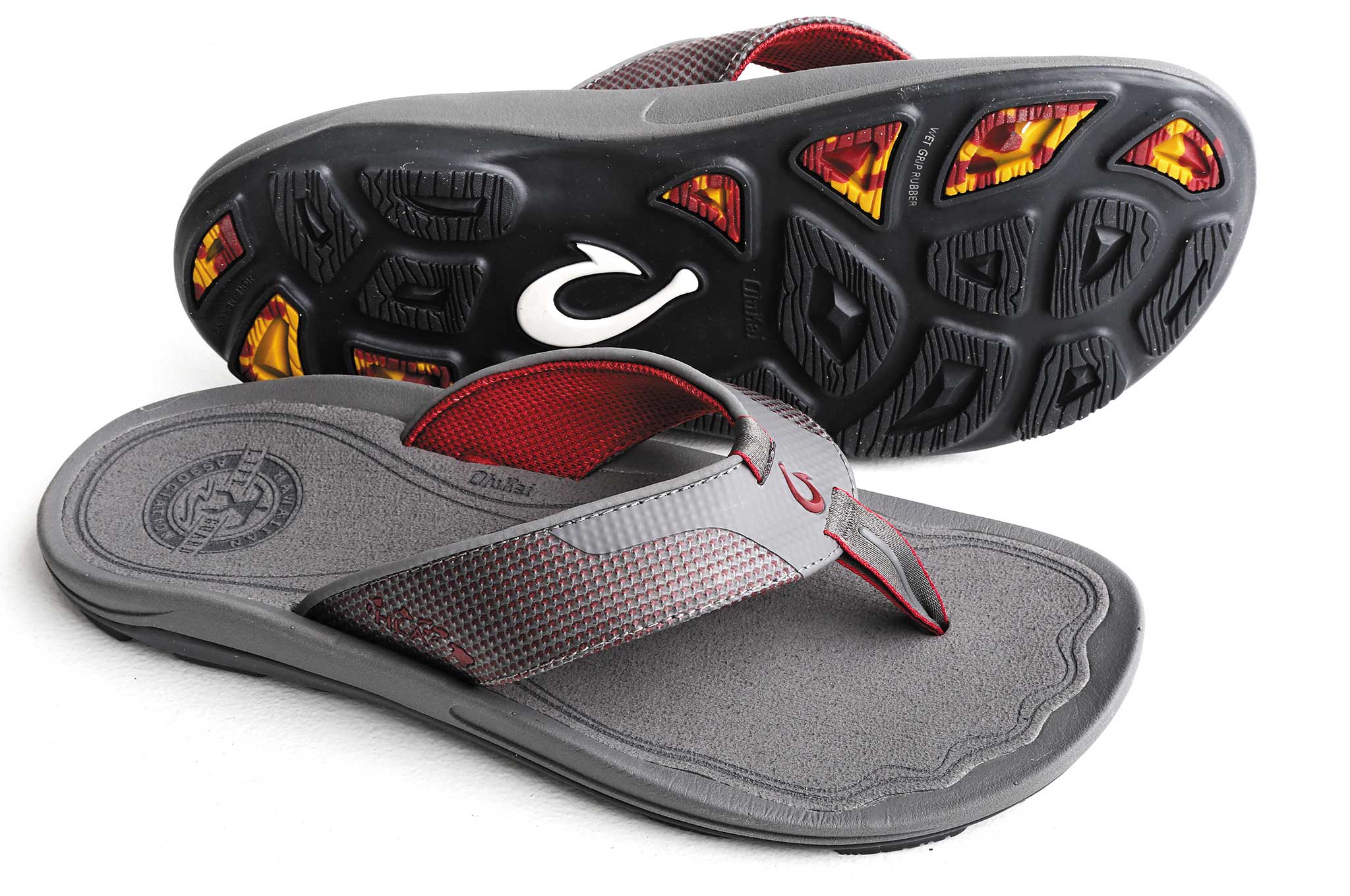
issue-20-gear-up-olukai-makolea

issue-20-gear-up-kiai-wahine

MAKE & MODEL
OluKai Makolea / Kia’i Wahine

MSRP
$80 / $70

URL
www.olukai.com

NOTES
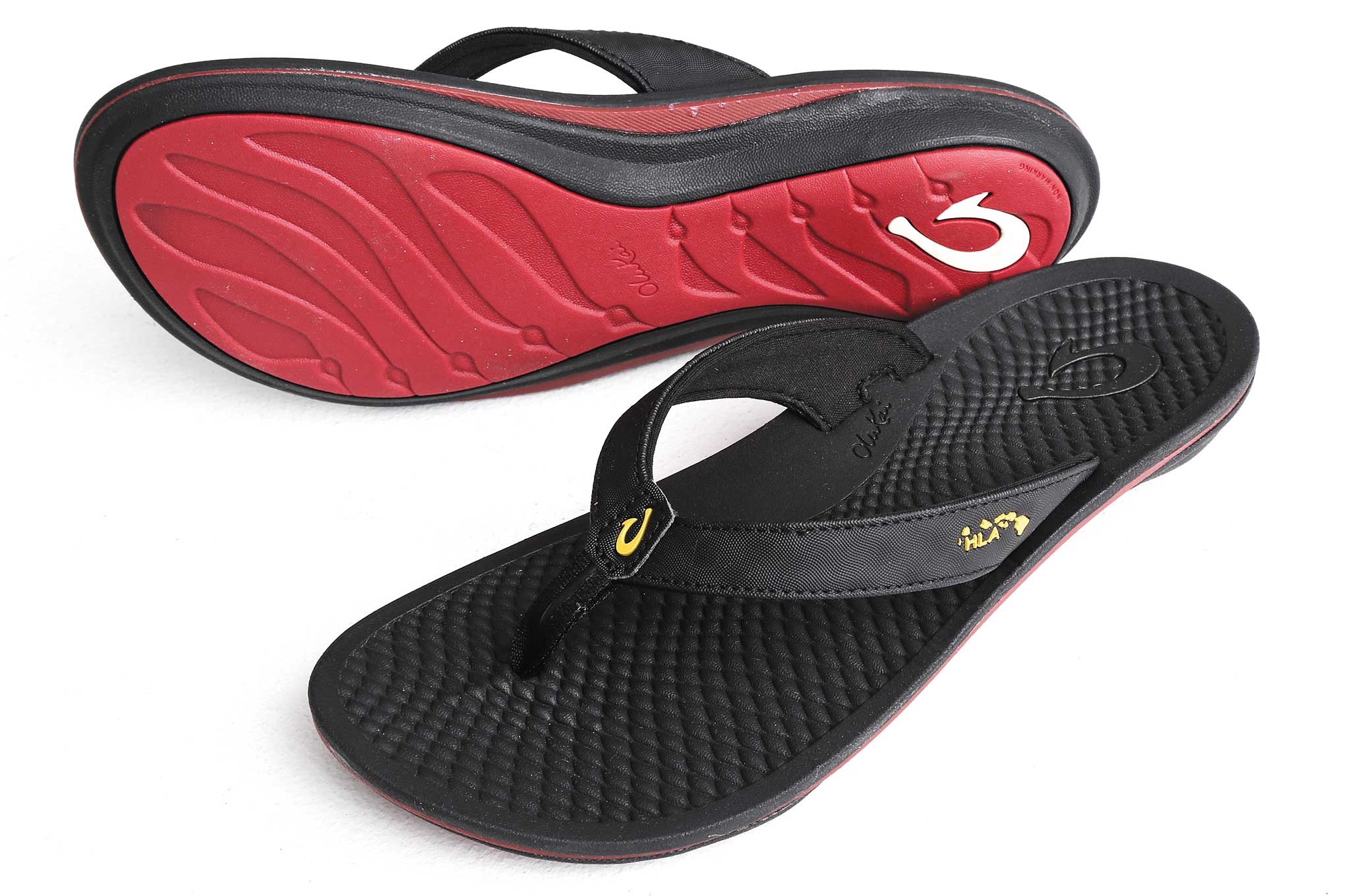
After a weekend of hog hunting or trekking through tough terrain, we love sliding into a pair of flip-flops to soothe our beaten hooves and promote foot recovery. But OluKai makes sandals that you could practically hike in. The men’s Makolea (gray pair shown here) features a non-marking, sticky rubber outsole with multiple zones for traction in wet conditions. The compression-molded EVA midsole is paired with a brushed ICEVA drop-in footbed for maximum ergonomics. The whole thing is water resistant, breathable, and quick drying. Likewise, the women’s Kia’i Wahine is built to last in and around water, has a multi-layer footbed for comfort and stability, and has a non-marking rubber outsole for enhanced traction and durability. Both models are as comfy as they are rugged.

issue-20-gear-up-silky-gomboy-curve-professional-series-saw

MAKE & MODEL
Silky GOMBOY Curve Professional Series Saw – 210mm

WEIGHT
8.3 ounces (saw), 12.4 ounces (with case)

MSRP
$64

URL
www.silky.jp

NOTES
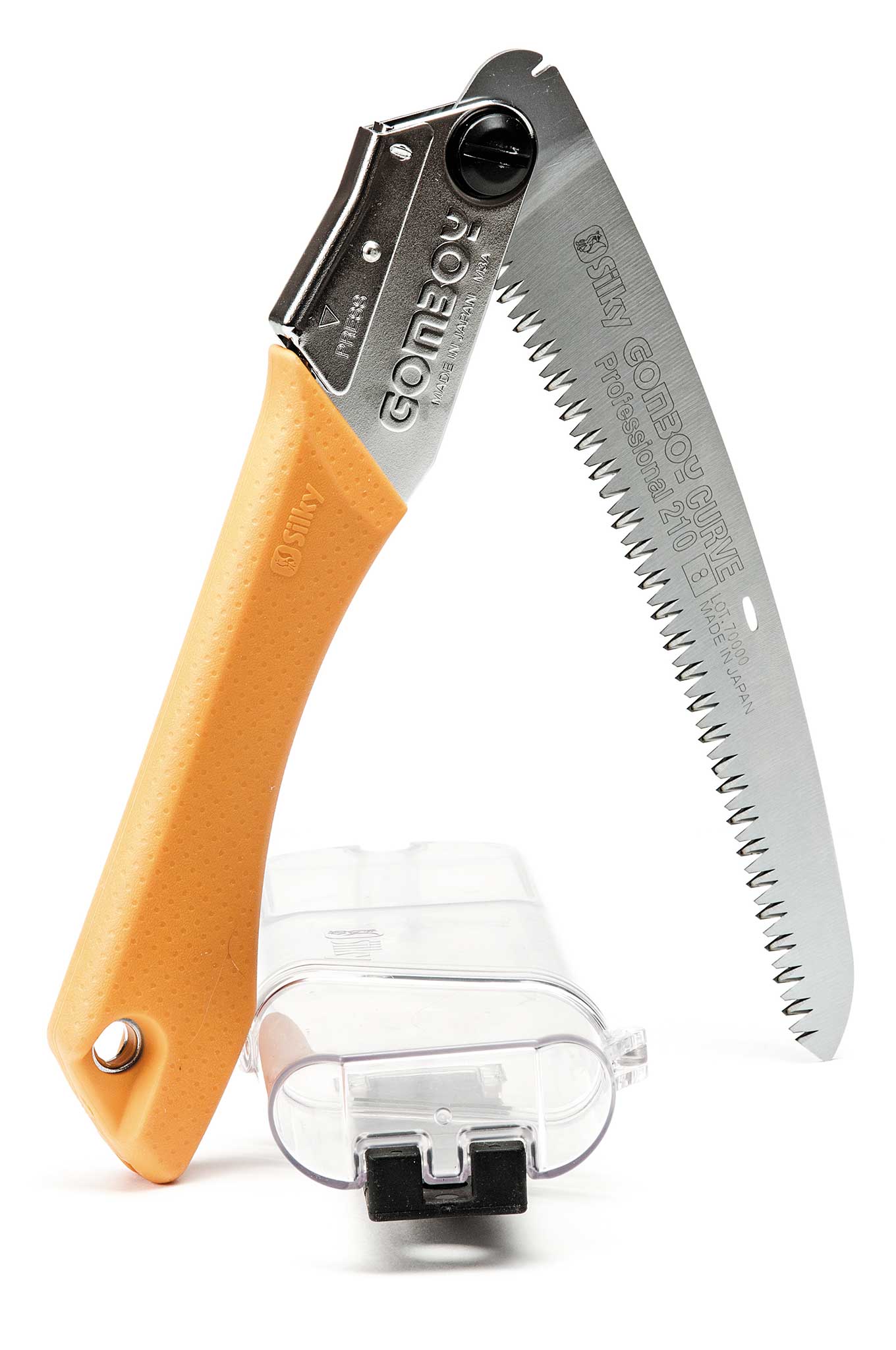
We’re hard-core hatchet fans. But, when we got our hands on Silky’s latest update to its Gomboy series folding saw, it made us reconsider our allegiance to the hammer axe. This saw is fast. We cut through 2.5-inch, live saplings in 30 seconds without fear of amputation or even needing to protect our eyes from flying woodchips. The chrome-plated, curved blade cuts on the pull stroke, preventing the blade from getting bound up in the material. The teeth are formed inside the width of the blade – reducing friction and making for cleaner, faster cuts. And, instead of hardening the entire blade, only the teeth are heated and hardened. This means the blade stays flexible while the teeth enjoy a longer, sharper life. It comes with a belt-mountable case and is made in Japan with a limited lifetime warranty.

issue-20-gear-up-microtech-knives-ultratech-se-partial-serration

MAKE & MODEL
Microtech Knives Ultratech S/E Partial Serration

OVERALL LENGTH
8.48 inches

MSRP
$280

URL
www.microtechknives.com

NOTES
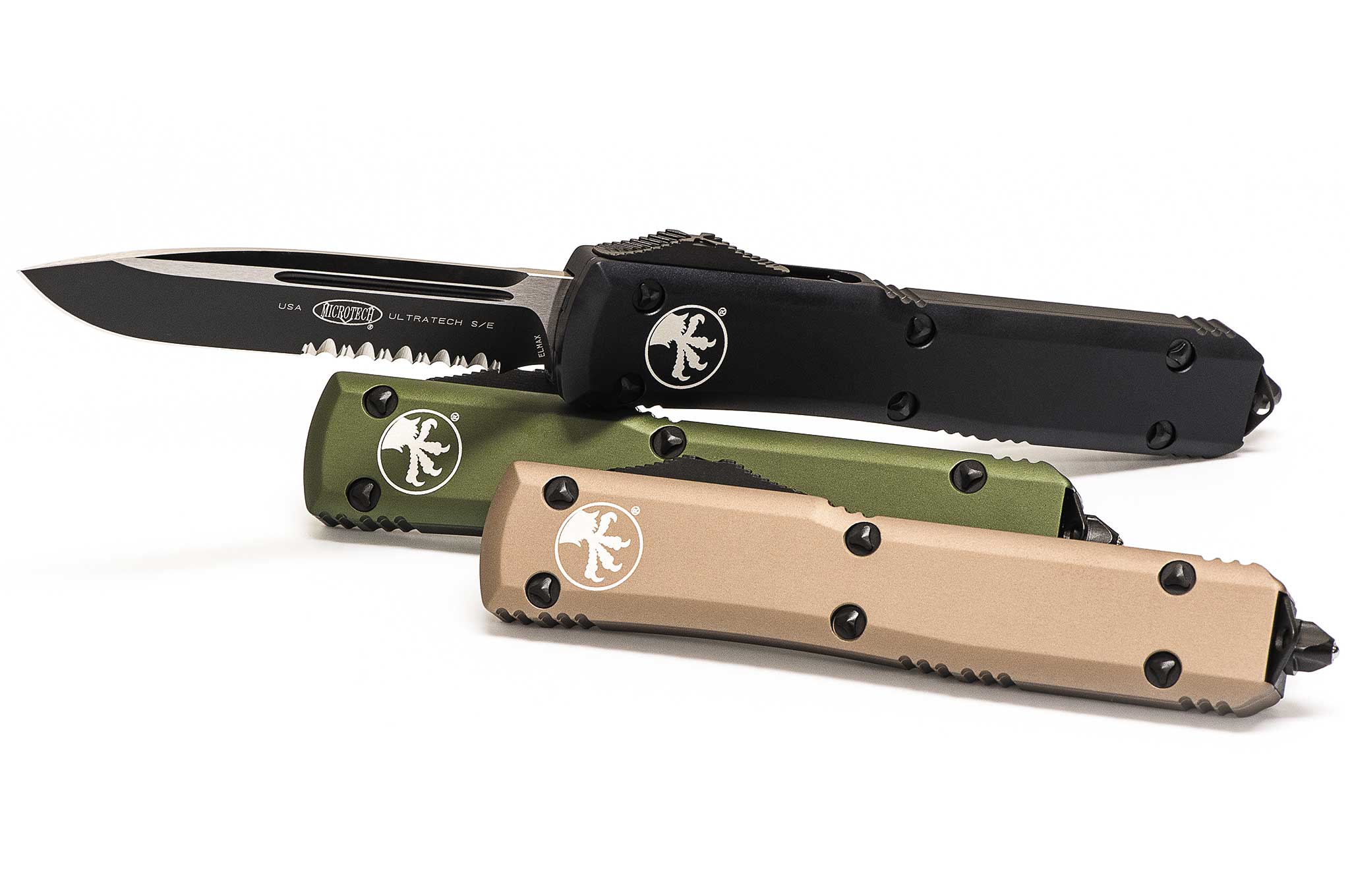
The most common everyday-carry pocketknife is the folder; hence our buyer’s guide on page 36. But if you’re looking for something that’s lightning fast and brings the awe factor, look no further than an out-the-front (OTF) automatic. (Of course, make sure it’s lawfully kosher in your area first.) Microtech’s latest from its popular Ultratech OTF lineup offers both sexy form and practical function. The partially serrated single-edge blade is 3.4 inches long and made from premium Elmax stainless steel. The handle features a double-action OTF mechanism: the blade shoots out and retracts by pushing or pulling the button. This allows for a satisfying Wolverine-like thunk sound and the reassuring knowledge that you can deploy a blade in a split-second. Comes in a variety of COLORS and finishes. Made in the USA.

issue-20-gear-up-eureka-gonzo-grill

MAKE & MODEL
Eureka! Gonzo Grill

WEIGHT
14 pounds

SIZE
14 by 11 inches

MSRP
$190

URL
www.eurekacamping.com

NOTES
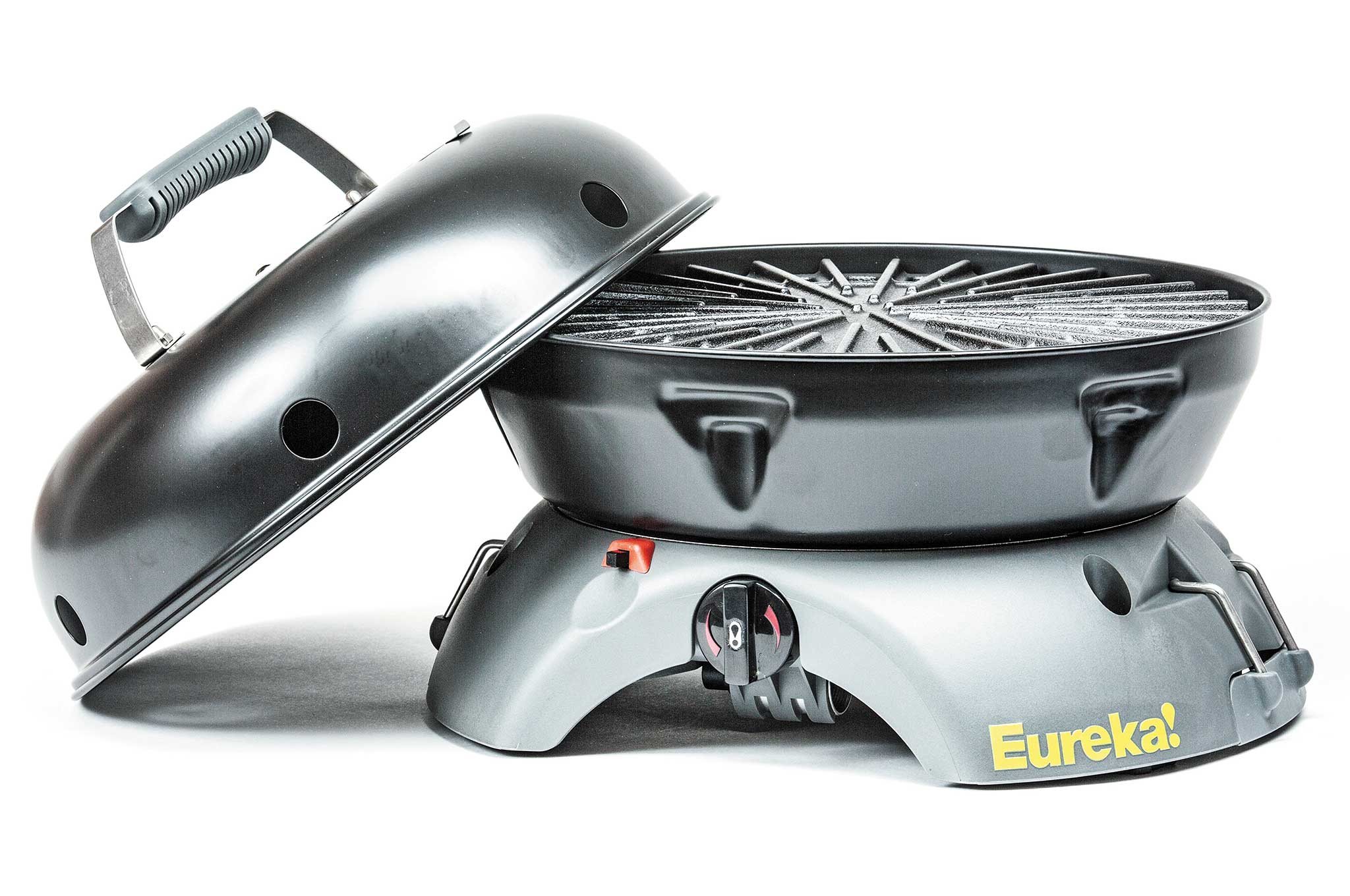
When it comes to cooking in the field, nothing beats the ease and convenience of a propane stove. Add the ability to go from griddle to grill to stove in seconds and you’ve got something special. The Gonzo grill has your three-squares-a-day covered with it’s reversible, cast iron cook top that has a stove grate beneath. The whole thing runs on a 10K BTU/h burner that has an infinitely adjustable output thanks to its 4-turn burner control. The onboard Piezoelectric electric igniter lights the stove in a snap and all other accessories are stored onboard for easy transport.

issue-20-gear-up-park-tool-big-blue-book-of-bicycle-repair

MAKE & MODEL
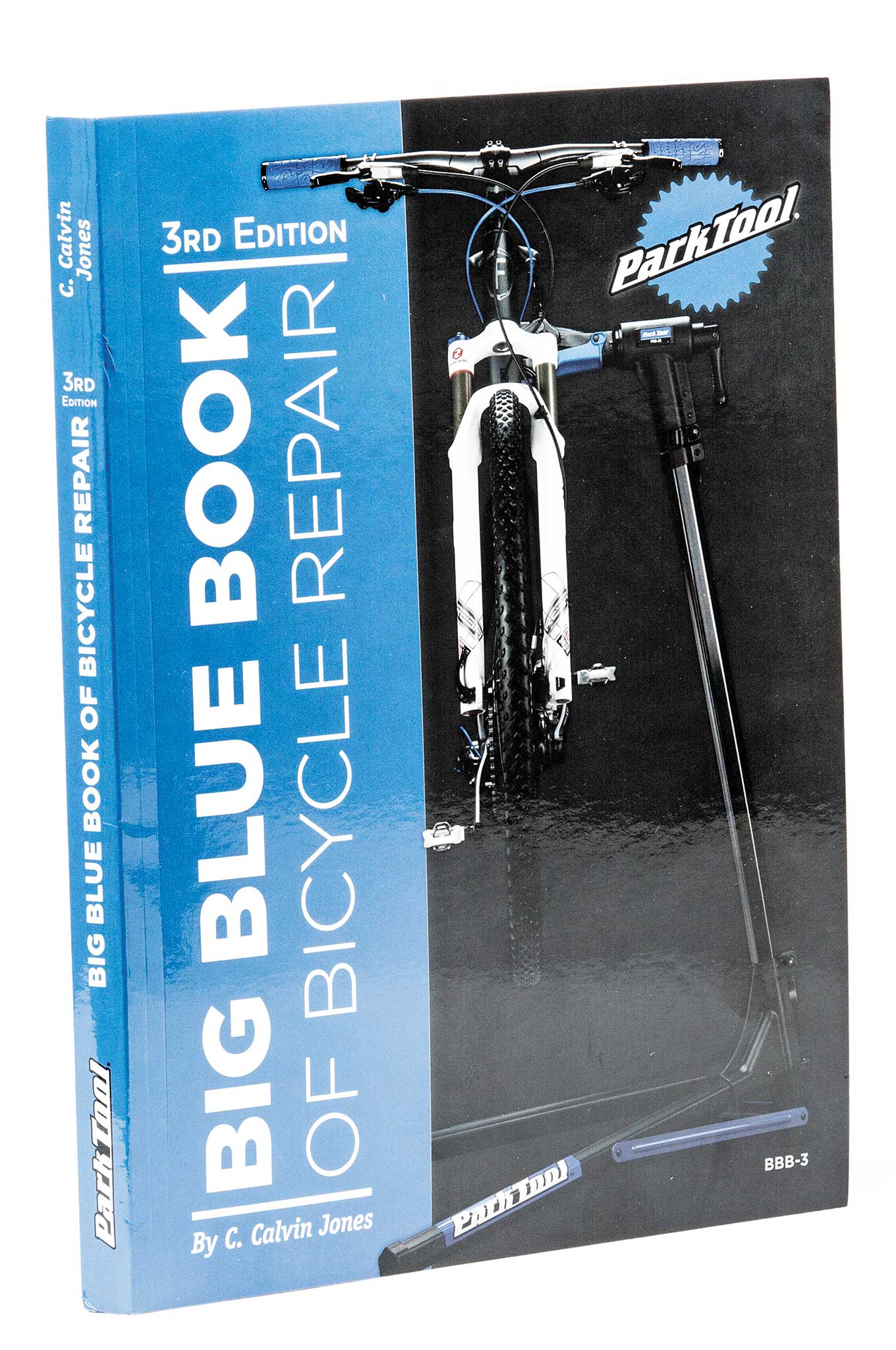
Park Tool Big Blue Book of Bicycle Repair; 3rd Edition

PAGES
241

MSRP
$25

URL
www.parktool.com

NOTES
When the gas is gone and the horses are history, bikes will be a go-to form of transportation. If you aren’t already, you’d better get smart on them. And, that’s no easy task since bike tech seems to make generational leaps in technology every 10 years. Even if you were a pro at toeing in rim brake shoes and swapping out worn bottom brackets once-upon-a-time, hydraulic disc brakes and externally threaded bottom brackets on today’s bikes might have you scratching your head. As old fashioned as books are, YouTube won’t always be there to hold your hand. Park Tool is an authority on bike maintenance, and it lays out 17 chapters on everything from fixing a flat to overhauling headsets. Clear explanations and excellent illustrations demystify all aspects of bike repair.