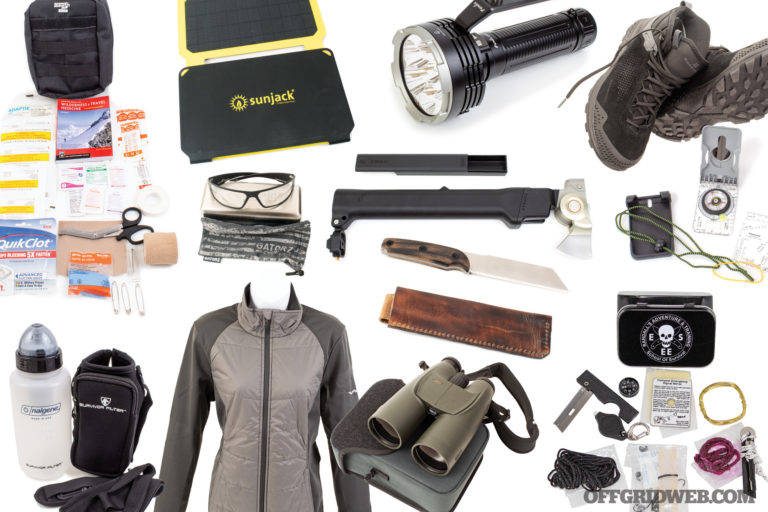
Bag Loadout: 5.11 Tactical RUSH100 AR-15 Backpack

The Scoped Carbine Class at Ridgeline Defense in New Hampshire has been on my to-do list for a long time. A scoped carbine is the Goldilocks porridge of choice, so to speak. Not dedicated for close-quarters or true long-range use, the scoped carbine can do most of it well, as long as you understand its realistic limitations. Configured with a Low Variable Power Optic (LVPO) and the right balance of bolt-on parts, this style of AR is a great contender for the “if I can only grab one” scenario. Shortly after I signed up for the class, COVID-19 hit, along with ammo shortages and social unrest. This situation reinforced the value of a scoped carbine for protecting my family or traveling discreetly to help someone else. The class came at the perfect time to help me level up my skills on a platform that fits easily into a RUSH100 backpack from 5.11 Tactical.

Ridgeline Defense Instructor Rudy Gonsior demonstrating drills for students at the Scoped Carbine Course.

Photos by George Franek Photography

The 5.11 Tactical RUSH100

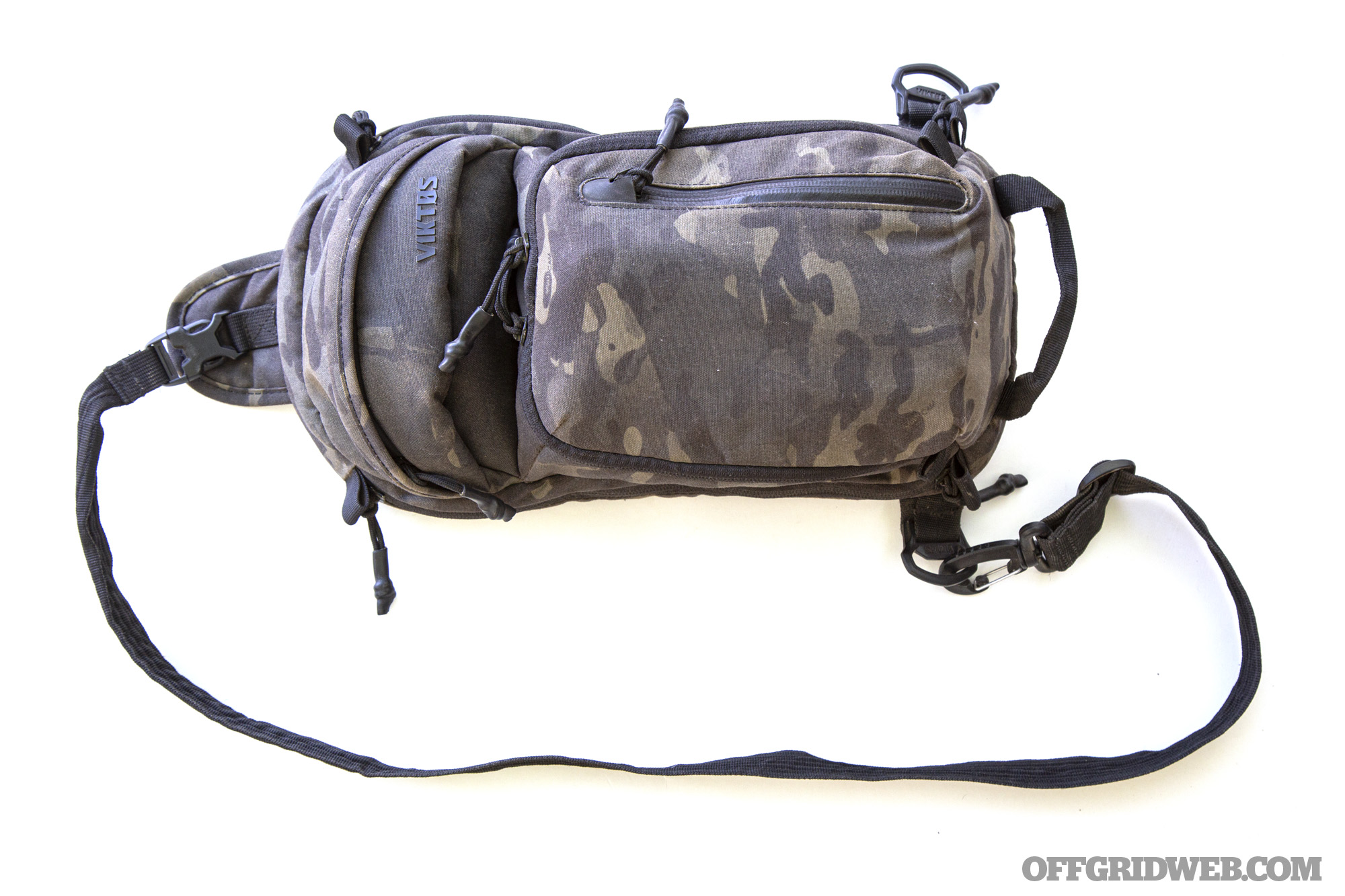
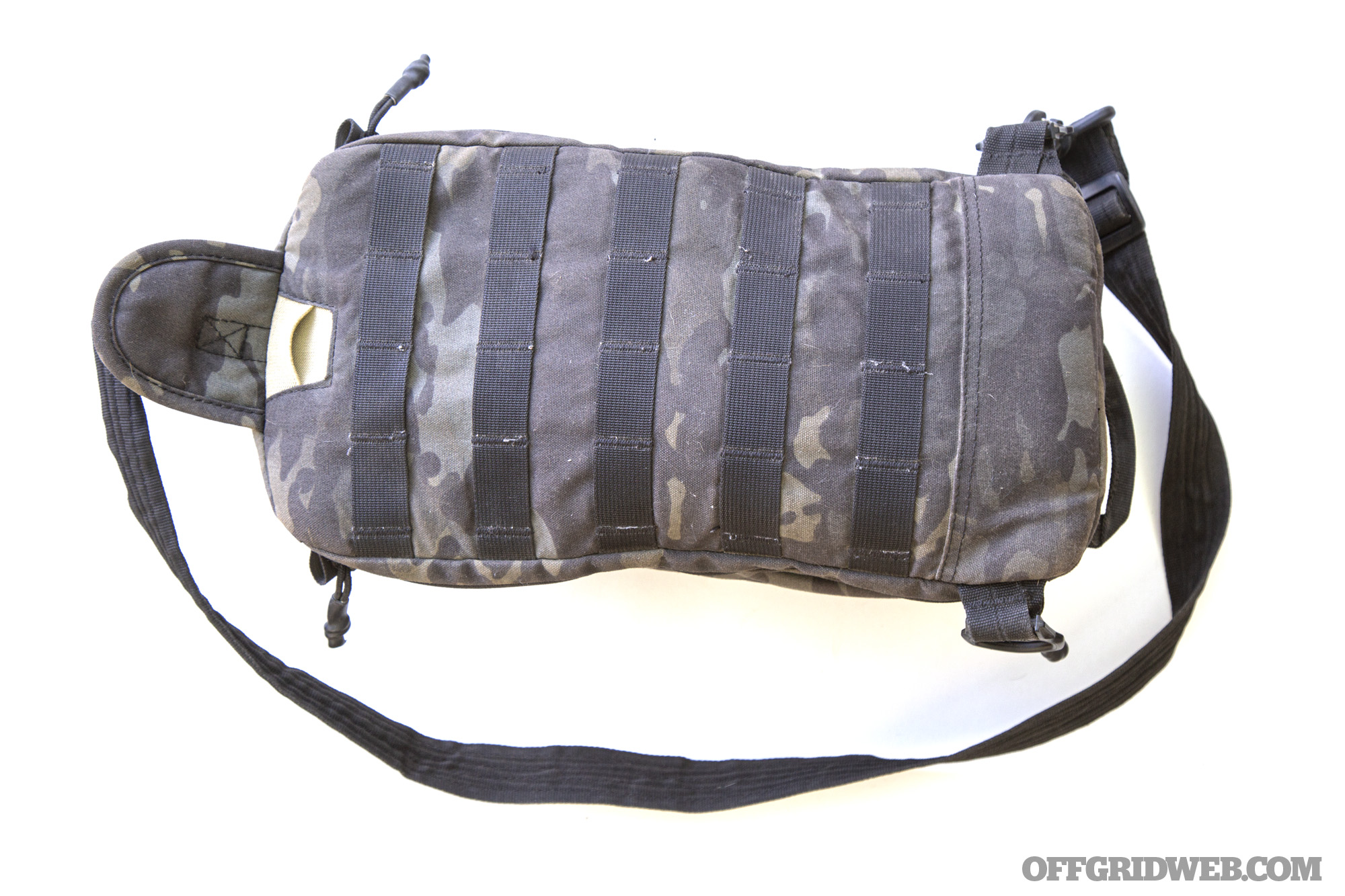
The RUSH100 is a large internal-frame backpack. The design is very straightforward with plenty of adjustment straps to keep the bag close to your body. The side pouches are removable, allowing the user to run the bag slicker, and they can be converted to a shoulder bag if necessary. A top pocket is fleece lined for eye pro, and the bottom pocket is compressible for a sleeping bag or, in my case, the forward and rear shooting rests. The bag comes with attachment straps at the bottom for a foam pad or sleeping bag. The aluminum stays and semi-rigid frame held the bag in place and also could serve double duty as a rifle rest taller than my bipod’s legs.

5.11 Tactical RUSH100 Specifications:

Weight
5.7 pounds

Volume
60 liters

MSRP
$250

URL
511tactical.com

Backpack Contents

With a backpack this big, it’s easy to overpack. Extra room means you can carry more, but that isn’t always positive. For a two-day scoped carbine class, I knew I could pack light, and I had plenty of room to spare. Ridgeline Defense sent students a final packing list a few days before the course, and the 5.11 Tactical RUSH100 could carry all that was required.

Clothing
Weather is always an uncertain variable. What you wear should allow you to change your body temperature accordingly — a notch up and a notch down. This shooting course lined up perfectly with Tropical Storm Fay; the forecast predicted scattered thunderstorms, humidity, and a high chance of rain on each day. Pair this with the state bird of New Hampshire, the horse fly, and what that meant for me was packing long-sleeve shirts and pants for protection. I also wanted to leave room for a watch cap, gloves, neckerchief, and a spare set of socks. Rounding out clothing is a set of dedicated rain pants, gaiters, and rain jacket. Other considerations for the environment include bug dope and sunblock.

The author (6 feet and 215 pounds) wearing the RUSH100 pack for size reference.

Rifle
The most important consideration for this pack was the scoped carbine it would contain. My rifle is a combination of an older (pre-’94 since I live in Connecticut) Eagle Arms lower with Geissele SSA-E trigger, Super 42 buffer, and a Bravo Company Kyle Defoor Spec Upper. This upper features a specific 1:7.7-inch twist barrel optimized for 77-grain Black Hills Ammo. It’s a solid minute of angle rifle with that ammunition, and other ammo in that ballpark does well too. Due to the COVID crisis, I had a hard time acquiring enough Black Hills ammo, so I packed 75-grain Hornady Black ammo instead. The optic for this midrange class is the Trijicon 1-8 AccuPower in a GDI P-ROM mount. The only other accessories added to this rifle are a set of Troy BUIS, Streamlight TLR-1 HL, Blue Force Gear Vickers sling, and a Harris Bipod. A scoped AR-15 carbine is easily broken down and carried inside this pack. A makeshift divider can be fashioned from spare clothing, an old camping pad, or in my case, a folded shooting pad from Crosstac. With this rifle broken down and carried in the pack, I easily walked right into the local hotel each night without raising any concern.

Electronics
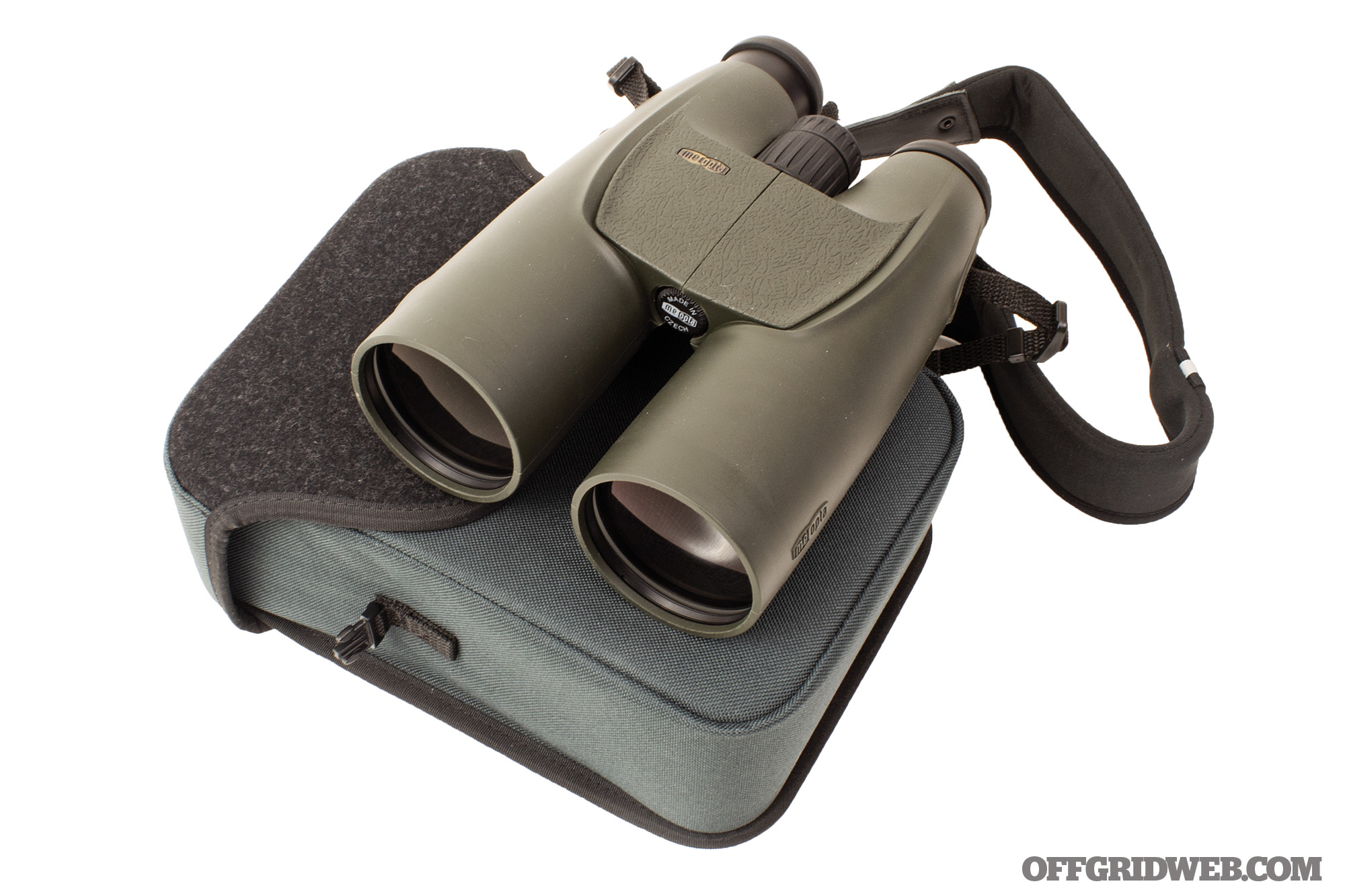
The benefit of using this particular pack for this course was the ability to organize with the multitude of pockets it comes with. I was able to separate my electronics, including a Kestrel, Leupold 650-yard rangefinder, and sensitive optics from my heavy and clunky metal water bottle and other items that could damage them. I also carried active ear pro. Electronics were carried in water-resistant Ziploc plastic bags along with a cotton rag to wipe any moisture from the optics.

Above: The RUSH100 pack easily carried spare ammo, loading equipment, cleaning gear, electronics, and more during the duration of the Ridgeline Scoped Carbine course.

Miscellaneous
Ridgeline’s packing list included a rifle, a minimum of four 30-round magazines, ammo, a shooting pad, and support equipment. I also loaded my pack with basic daily use gear — granola bars and water, a small possibles pouch with emergency gear, a trauma kit, some firearms maintenance/cleaning equipment, flashlight, knife, and other kit. Each day, spare ammo was carried in stripper clips with a StripLULA loader. Generally, as you tack on more miles, a pack feels heavier, but when you burn through the ammo you carry, the opposite is true.

In the Field

In any martial arts or combatives training, you should always seek a better weapon and better position. What’s better than a pistol? A rifle. What’s better than a standing long-range shot? A more stable shot from a supported position. I used the 5.11 Tactical RUSH100 backpack to carry all of my essentials for approximately 20 hours over two days. I had a surplus of room, and discovered I could remove the two outboard pockets and use them as internal storage organizers instead. For a course like this, that meant I could use them to separate short-range ball ammo from my longer-range precision ammo. As predicted, on day two, the skies opened up and poured, with lightning halting our training temporarily. The pack repelled water well, and the contents stayed dry. The lower separated compartment worked great to stow wet rain gear when the weather finally cleared in the final hours of the class.

The RUSH100 pack served a secondary purpose: to create more stability in the kneeling position behind barricades by straddling it like a saddle. This tip was one of many offered by our instructor from real-world experience using his ruck in the same way while deployed overseas. Another tip Rudy offered was using the pack, positioned straps-down with the opening toward the shooter in a prone position, as a gradual ramp to gain elevation and angle for shooting uphill. The training we were given worked well too. Rapid engagement techniques utilizing a 0.1 mil or 3 MOA hold at different ranges resulted in easy hits out to 400 yards with simple holds. The rifle worked extremely well with easy and fast controlled pairs with careful manipulation of the Geissele SSA-E trigger at close range and controlled careful shots at longer ranges. During the culminating events involving unknown distance target engagement from 15 yards out to 600, the pack carried all I needed it to and the rifle responded as predicted with the DOPE we applied. At the end of the course, the pack easily swallowed up all my gear as it was policed and packed away for the drive home.

Above: Torrential rain and thunderstorms tested the willingness of the students and the water resistance of the gear the author carried.

Of course, I didn’t like everything about the pack — most of this came down to personal preference rather than design flaw. The waist belt buckle is only 1-inch wide; I’d prefer a more comfortable and secure 2-inch buckle. I also would’ve liked to see a compression strap on the waistband to pull the lower half of the bag closer to the body. The only other issue I encountered was with the layout of the zippers. I’d like to see an additional set on the main compartment to allow access to the side of the bag without “running” the zipper all the way around the track. Besides those little requests, I was pleased with the way it carried, held up, and organized my rifle gear.

Final Word

Most rucks are shaped like a “ramp” that can be used to elevate your rifle.

The 5.11 Tactical RUSH100 and this rifle are perfectly paired. From this point forward, I won’t keep the bag loaded for a training course, but rather for a modern minuteman scenario where I need to travel discreetly to a family member’s aid. I can ditch the spare clothing for just those environmental layers and have spare room for warmer gear in cooler months. I can keep this bag prepped near my gun safe, so all I’ll have to do is grab the appropriate carbine for it. I never expected a global pandemic and civil unrest double whammy, but I can be better prepared for the next time something of this scale hits again. With the contents carried and skills learned, I can easily reach targets up to the “rifleman’s half K” without issue.

Sources
Ridgeline Training > ridgelineshooting.com

More OFFGRID Bag Loadouts


New: Christensen Arms Ridgeline Scout Survival Rifle

The topic of survival rifles is one we’ve frequently contemplated. As is usually the case with gear, there’s no one-size-fits-all SHTF gun solution. For personal defense in urban environments, you might want a short-barreled AR-15; if you want to hunt varmints while keeping a low profile, a whisper-quiet suppressed 10/22 could be ideal. In wide-open rural areas, a precision bolt-action rifle with a magnified optic might be the best option for keeping your family fed. However, it’s still advantageous to have a setup that’s relatively lightweight and compact so you can stay mobile. The new Christensen Arms Ridgeline Scout rifle is designed to meet this need.
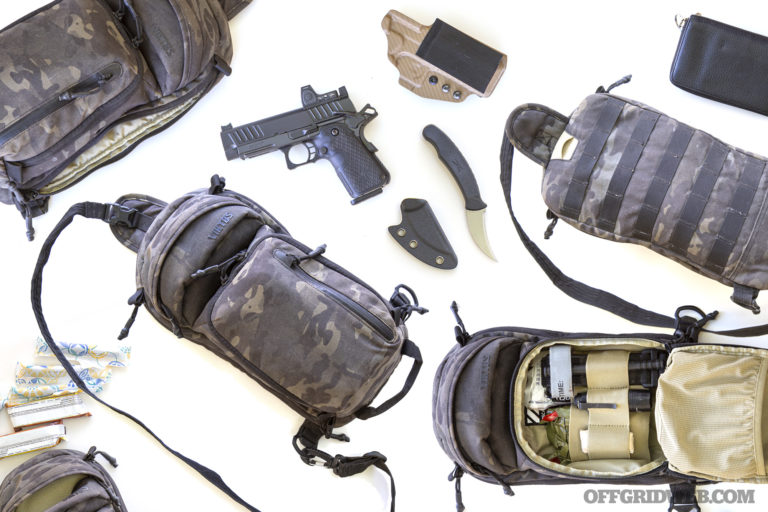
What is a Scout Rifle?

The Steyr Scout rifle was developed with direct input from Jeff Cooper, and serves as a good example of this category.

First, a bit of background info: the concept of a “scout rifle” was developed by renowned firearms instructor Lt. Col. Jeff Cooper in the early 1980s. Cooper saw a need for a versatile rifle that could serve as a tool for hunting and self-defense, especially for an individual who might be traveling long distances alone through challenging terrain. His guidelines included a bolt action design, a caliber powerful enough to take down large game (Cooper preferred .308 Winchester), an overall length shorter than 40 inches, and weight less than 6.5 pounds. Many traditional scout rifles also incorporate iron sights and a fixed-power, forward-mounted “scout optic” with long eye relief. However, some modern interpretations have diverged from these recommendations, instead using low-power variable optics (LPVOs) or medium-power variable optics (MPVOs).

For more details on scout rifles, check out this article from our sister publication Gun Digest.

The Christensen Arms Ridgeline Scout Rifle

This Ridgeline Scout rifle is a new bolt-action model from Christensen Arms. Unlike the original Ridgeline rifles, which offer barrel lengths between 20 and 26 inches, the Scout features a relatively compact 16-inch 416R stainless barrel wrapped in carbon fiber. This reduces length to 37.5 inches and reduces weight to 5.9 pounds, but still provides for guaranteed sub-MOA accuracy. Each rifle comes with a 3-prong flash hider, but it can be removed to access standard 5/8×24 threads for use with various aftermarket suppressors and muzzle brakes.

The Ridgeline Scout comes with a carbon fiber composite stock, finished in tan with a black spattered/streaked finish. A forward-mounted rail allows for easy attachment of a bipod, and includes a barricade stop for use behind cover. The machined, nitride-finished receiver includes a 0-MOA rail, TriggerTech flat trigger, and AICS-compatible magazine with an oversized mag release for easy reloads.

Christensen Arms is currently offering the following chamberings for the Ridgeline Scout:

  • .308 Winchester
  • 6.5 Creedmoor
  • .223 Remington
  • .300 Blackout (ideal for suppressed use, but not guaranteed for sub-MOA accuracy)

Retail price for the Ridgeline Scout is $2,200. For more information, watch the video below or go to christensenarms.com/ridgeline-scout.


The Anarchist Cookbook Review: A Recipe for Controversy

Disclaimer: The Anarchist Cookbook contains techniques that may be dangerous and/or illegal in some jurisdictions. Check your local laws and do not attempt to replicate its contents without proper training and safety precautions.

Our Review of The Anarchist Cookbook

The Premise: This book was promoted as a manual for guerrillas to overthrow a tyrannical government. It includes recipes for all manner of weapons, explosives, and drugs, and also directions for sabotage, surveillance, and improvised weapon use. Originally published in 1971, it was envisioned as a compendium of knowledge to fight what the author considered to be an impending communist tide.

The 411: This book is truly infamous, and its “questionable” contents tend to make some people uneasy. To that end, I was interested to examine it from both a knowledge perspective and a historical one.

The content of this book covers so much territory and, on the surface, seems like a wet dream for a would-be guerrilla. Sections detailing the manufacture of drugs, weapons, explosives, electronic bugging devices, radios, booby traps — and the employment methods for all — are explained in great detail across the 160 pages of this book. The first 20 text pages are the author’s “prefatory note on anarchism today.” While someone coming across this book for the first time might think that this preface would hold some deep insight into the mind of an anarchist or freedom fighter, they’d ultimately be disappointed.
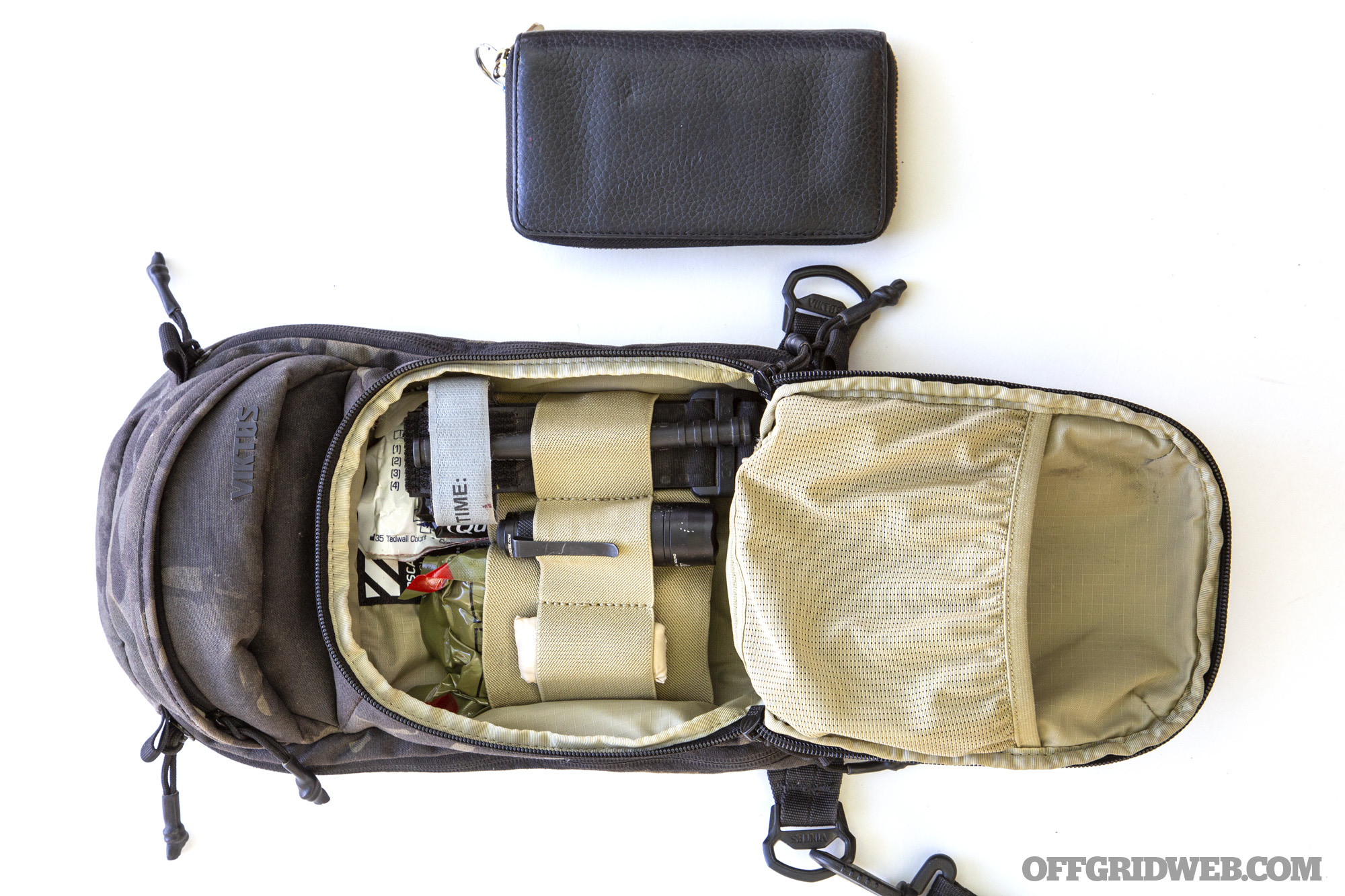
The language and references of the author’s monologues and the “recipes” contained within are very much a product of the era. It’s not, one would argue, cutting edge, but does lend great insight into the mindset of that period, as well as the mindset of someone who fervently believes they were doing something for the right reasons. I’m not here to judge either way, but there are realities that time impacts.

the-anarchist-cookbook-review

To be clear, I didn’t attempt to make or procure any of the items needed to produce any of the weapons, explosives, or drugs discussed in TAC. I did, however, examine the formulae with an eye to accuracy, viability, availability of supplies, as well as risks to health and safety. I should mention that trying almost anything in this book could get you into legal trouble, if it doesn’t kill or maim you.

The technical instructions described for drugs and explosives aren’t “dumbed down.” If you don’t have a background in chemistry — or at least a very good working knowledge — you’d be putting yourself at grave risk trying most of this stuff. Chapter 3, Natural, Nonlethal and Lethal Weapons, is somehow the most straightforward chapter. Chapter 2, Electronics, Sabotage and Surveillance, is woefully outdated for most developed nations, but may be of interest for third- or fourth-world nation service.

The Verdict: Taken at face value, The Anarchist Cookbook comes across almost unhinged, with the author pontificating about humanity approaching the eve of destruction. But a deeper examination of the document as a whole gives insight into what was going on in the counterculture scene from 1966 to 1971. Discussions on anarchism are swapped out in favor of nihilism and “free love,” with long-winded discussions about what anarchism is and is not.

The entire publication is out of date — not just in context of the world today, but also in its specific recommendations. I’d challenge anyone to find me a Thompson Submachinegun for $130 (page 96) or successfully assemble the equipment described to tap a telephone for the suggested $3 to $5. That’s right, a rotary telephone. Nowadays, people can build highly effective and inexpensive electronic devices that far outclass anything this book can fathom, with the same thing said for weapons (thanks to 3D printers) and even drugs. Just ask someone in a state with permissive firearm laws. If it’s the Wacky Tobacky you’re after, come to Canada or a state where it’s legal.

Ultimately, I felt that TAC was useful, not as a manual for the guerrilla, but as a realistic historical perspective. The drug and explosive recipes and instructions are potentially dangerous, and could easily make you a Darwin Award winner. If you have a legitimate interest in the history of guerilla tactics and philosophy, sure, get a copy. Just understand the complete context of what you’re reading and all of its safety and legal consequences. I’ll file this one under “for entertainment purposes only.”

Review by Boris Milinkovich – True North Tradecraft

About The Anarchist Cookbook

Book & Author
The Anarchist Cookbook
by William Powell (with Introduction by Peter Bergman)

Publisher
Medina University Press International (2020)

MSRP
$35

URL
Amazon.com

Pages
160

Rating
Thrive
Survive
>Die

OFFGRID LIBRARY OF RECOMMENDED READING


Car Theft Warning: The Criminal Use of Apple AirTags

Car thieves come in various categories. Most of them are opportunistic criminals who use brute-force tactics to steal older vehicles, or simply search for victims who are foolish enough to leave their keys in the car. However, some car thieves have learned to use modern technology to track and steal vehicles — usually high-end sports cars and luxury cars that will command a premium on the black market. In the past, we wrote about keyless car theft using range-extenders to boost keyless entry signals. Today, we’ll take a look at another method that’s reportedly growing in popularity: illicit tracking of cars using Apple AirTags.

The video above is a public service announcement from the Auto Theft Unit of York Regional Police in Canada. It explains how car thieves in the Toronto region are roaming public parking lots and discreetly attaching  Apple AirTags to vehicles they intend to steal. Hours or days later, once the target vehicle is parked in a more secluded location, the thieves can use the AirTag to find it. Then, they can steal it using various methods, such as the range-extender device we mentioned. This allows them to plan their attacks in advance, rather than using more traditional methods.
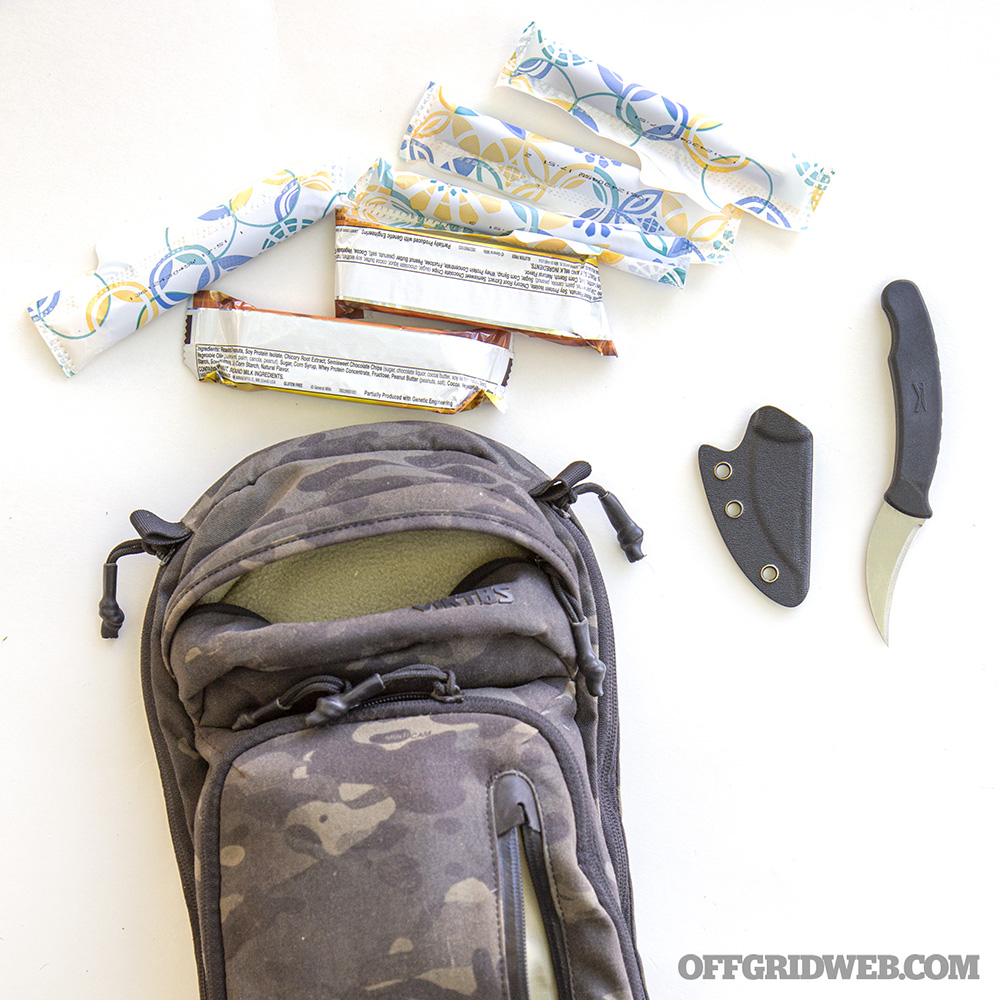
Hidden Apple AirTag photos via York Regional Police

The three images above from York Regional Police show how thieves concealed an Apple AirTag inside the trailer hitch connector on a targeted pickup truck.

A press release included the following details: “Since September 2021, officers have investigated five incidents where suspects have placed small tracking devices on high-end vehicles so they can later locate and steal them. Brand name ‘air tags’ are placed in out-of-sight areas of the target vehicles when they are parked in public places like malls or parking lots. Thieves then track the targeted vehicles to the victim’s residence, where they are stolen from the driveway.”

How Apple AirTags Work

AirTag product image via Apple

Apple AirTags were released in April 2021 at a retail price of $29 each ($99 for a four-pack). They’re compatible with iPhone models 11 through 13. Each Apple AirTag broacasts a secure Bluetooth signal that is picked up by nearby devices in the Find My network, such as iPhones and iPads. Those devices send the AirTag’s location to iCloud servers, where it can be viewed on a map by the owner. So, although Bluetooth has a relatively short range, you can still find an AirTag that’s many miles away as long as there’s another compatible Apple device in the vicinity  — that’s extremely likely in any major city.

Apple is careful to note that it designed AirTags to prevent unwanted tracking: “If someone else’s AirTag finds its way into your stuff, your iPhone will notice it’s traveling with you and send you an alert. After a while, if you still haven’t found it, the AirTag will start playing a sound to let you know it’s there. Of course, if you happen to be with a friend who has an AirTag, or on a train with a whole bunch of people with AirTag, don’t worry. These alerts are triggered only when an AirTag is separated from its owner.”

So, if you have a newer iPhone and receive an unexpected AirTag notification each time you approach your vehicle (or other valuable property), this may be a warning sign that it’s being tracked.

Keep in mind that if you have an Android phone or an iPhone that’s too old to detect the AirTag, only the sound from the tag would aid in its detection. If the sound is muffled or disabled by a malicious user, it may be challenging to find an unwanted AirTag.

A Double-Edged Sword

Although AirTags are reportedly being used by car thieves, they’re also being used by owners as a safeguard against theft. Think of it like a poor-man’s LoJack — if your car is stolen, you could check the tag’s location to help police track it down. Several individuals told The Washington Post that they were able to recover vehicles this way, ranging from a Subaru to an electric scooter. One sergeant from the Houston Police Department said “they’re really helping us out a lot in the police department, retrieving people’s stolen property.”

rally points police car

Like many types of technology, AirTags appear to have the potential for positive and negative uses. A representative from the Electronic Frontier Foundation (EFF) had this to say: “Apple does not advertise these products as a way of tracking down stolen items. It is not the usage Apple has in mind — they don’t want to encourage people to do it. The problem is it’s impossible to build a tool that is designed to track down stolen items without also building the perfect tool for stalking.

York Regional Police offered the following pieces of general advice to safeguard against vehicle theft:

  • If possible, park your vehicle in a locked garage. Most vehicles are stolen from a driveway.
  • Use a steering wheel lock. It will also act as a visible deterrent.
  • Install a lock on the data port. This simple device can be purchased online and blocks access to the computer port where the thieves gain access to reprogram the vehicle’s keys.
  • Consider purchasing a quality video surveillance system. Ensure cameras are properly placed and functioning for day and night time use. Familiarize yourself with the system so it can be reviewed and accessed easily.
  • Inspect your vehicle regularly and call police if you notice any suspicious potential tracking devices.

More Articles on Car Theft Prevention


Encrypted Messaging Apps Ranked by the FBI

We’ve all heard the tired argument, “if you’re not doing anything wrong, you have nothing to hide!” It simply doesn’t hold water. There are many reasons ordinary people take steps to safeguard their privacy, and government surveillance is near the top of that list. That’s one reason why encrypted messaging apps such as Signal, Telegram, WhatsApp, and Threema have skyrocketed in popularity recently. In January 2021, Signal became the most-downloaded free app for both Apple and Android devices, with nearly 18 million downloads in a single week — that’s a lot of users who want to keep their conversations private.

Unfortunately, privacy is a never-ending arms race. Every time individuals take steps to encrypt their data, those who wish to access it take steps to circumvent that encryption. We’ve often wondered just how much access three-letter agencies have to our sensitive information, and a recently discovered internal document from the Federal Bureau of Investigation gives us a rare glimpse at the answer.

FBI’s Ability to Access Encrypted Messaging Apps

The following document was obtained through a Freedom of Information Act (FOIA) request filed by Property of the People, a nonprofit organization that works to promote government transparency.

Encrypted-messaging-app-privacy

Since this text appears to be scanned from a degraded photocopy of the document, The Record converted it into an easy-to-read table:

AppLegal process & additional details
Apple iMessage*Message content limited.
*Subpoena: can render basic subscriber information.
*18 USC §2703(d): can render 25 days of iMessage lookups and from a target number.
*Pen Register: no capability.
*Search Warrant: can render backups of a target device; if target uses iCloud backup, the encryption keys should also be provided with content return can also acquire iMessages from iCloud returns if target has enabled Messages in iCloud.
Line*Message content limited.
*Suspect’s and/or victim’s registered information (profile image, display name, email address, phone number, LINE ID, date of registration, etc.)
*Information on usage.
*Maximum of seven days worth of specified users’ text chats (Only when E2EE has not been elected and applied and only when receiving an effective warrant; however, video, picture, files, location, phone call audio and other such data will not be disclosed).
Signal*No message content.
*Date and time a user registered.
*Last date of a user’s connectivity to the service.
Telegram*No message content.
*No contact information provided for law enforcement to pursue a court order. As per Telegram’s privacy statement, for confirmed terrorist investigations, Telegram may disclose IP and phone number to relevant authorities.
Threema*No message content.
*Hash of phone number and email address, if provided by user.
*Push Token, if push service is used.
*Public Key
*Date (no time) of Threema ID creation.
Date (no time) of last login.
Viber*No message content.
*Provides account (i.e. phone number)) registration data and IP address at time of creation.
*Message history: time, date, source number, and destination number.
WeChat*No message content.
*Accepts account preservation letters and subpoenas, but cannot provide records for accounts created in China.
*For non-China accounts, they can provide basic information (name, phone number, email, IP address), which is retained for as long as the account is active.
WhatsApp*Message content limited.
*Subpoena: can render basic subscriber records.
*Court order: Subpoena return as well as information like blocked users.
*Search warrant: Provides address book contacts and WhatsApp users who have the target in their address book contacts.
*Pen register: Sent every 15 minutes, provides source and destination for each message.
*If target is using an iPhone and iCloud backups enabled, iCloud returns may contain WhatsApp data, to include message content.
Wickr*No message content.
*Date and time account created.
*Type of device(s) app installed on.
*Date of last use.
*Number of messages.
*Number of external IDs (email addresses and phone numbers) connected to the account, bot not to plaintext external IDs themselves.
*Avatar image.
*Limited records of recent changes to account setting such as adding or suspending a device (does not include message content or routing and delivery information).
*Wickr version number.

To summarize, there’s some good news and bad news here. The FBI says it can retrieve “no message content” from six of the nine encrypted messaging apps, with the remaining three — Apple’s built-in iMessage, Line, and Facebook’s WhatsApp — only providing limited message content. From a privacy standpoint, Signal and Telegram appear to be the most secure based on this report. The former only provides date/time of registration and date of last connection; the latter may give authorities a user’s IP address and phone number if there’s evidence of terrorist activity.

Whether you’re wary of domestic government overreach, foreign nation-states, or rogue hackers trying to read your messages, it’s worthwhile to consider which encrypted messaging app you use.

More Articles on Digital Security


The Guerrilla Mentor: Timothy Lacy

Guerrilla is a Spanish word that roughly translates to “little war.” Its indication of diminutive scale doesn’t apply to the size of the battle, but rather to the size of the fighting force — a small unit up against a large opposition. In modern context, this type of imbalance is often referred to as asymmetric warfare, and its significance has been proven in countless conflicts throughout history, from the Global War on Terror to the American Civil War. Each instance has reinforced a single lesson: never underestimate the effectiveness of a small, highly motivated group of fighters.

Timothy Lacy has accrued a wealth of experience in the field of small-unit tactics. While enlisted in the U.S. Army, he served in a Scout Platoon and frequently led reconnaissance missions into enemy-controlled terrain. Later, he switched to a role in law enforcement, where he surveilled gang members and drug dealers. Lacy also spent 13 years working as a private security contractor, protecting VIPs in warzones and training indigenous militia and police forces to defend against insurgents.

Rather than settle quietly into retirement, Lacy eventually returned to his home state of Arizona and applied his skills to a new mission. In 2014, he founded Guerrilla Mentor to teach ordinary Americans about the value of small-unit tactics. Members of our staff have already attended two of his courses, Rural Reconnaissance (featured in Issue 41) and Hostile Encounters (review coming soon). Each class reinforced individual survival skills, including shooting, movement, navigation, observation, and planning. The curriculum also demonstrated the challenges of delegating tasks, communicating, and accomplishing objectives with a tight-knit group.

Despite his imposing resume, Lacy doesn’t fit the gruff soldier stereotype. He’s a soft-spoken family man whose kids showed up to play after class, and whose wife cooked a tasty meal for students at the campsite. His scholarly gray beard and friendly demeanor might even lead you to believe he’s a schoolteacher. In a manner of speaking, that’s exactly what he is — a mentor and educator for the underdog.

Timothy Lacy Guerrilla Mentor sitting on the truck bedAbove: Tim believes preparedness is a task for the whole family. His wife, Cecilia, and their children often appear at Guerrilla Mentor classes to lend a hand.

RECOIL OFFGRID: Tell us a little about your upbringing. Were survival lessons or outdoorsmanship part of your childhood?

Timothy Lacy: I was an Air Force brat until my father retired and moved us from the Phoenix area up to Show Low, Arizona. My dad was an avid outdoorsman, and we always spent our family vacations camping or hunting. After moving to the White Mountains, my brothers and I were in the forest almost every day, exploring and hunting. I spent a great deal of time with my dad stalking game and learning survival lessons. 

What led you to join the military? What was your job while you were in?

Timothy Lacy: I had always dreamed of being a soldier and serving my country. My family has always been very patriotic, and believed it was our duty to serve. All of my brothers and I served in the U.S. military. 

I enlisted in the Army as an 11B, Infantry Rifleman. I loved being a grunt — the lifestyle suited me. I discovered I had a knack for being stealthy, and so did my squad leaders. I soon found myself in the point element along with my friend Hector on nearly every patrol. 

This led me to eventually join an Infantry Scout Platoon, and I felt like I was truly in my element there. 

Timothy Lacy Guerrilla Mentora teaching studentsAbove: Showing students how to forcefully move a VIP out of a disabled vehicle at a Hostile Encounters class.

You mentioned previously that, after the military, you went into law enforcement and then private military contracting. What did you do in law enforcement and how did your military experience shape your work there? 

Timothy Lacy: After the Army, I attended the police academy and worked for two different law enforcement agencies — municipal and county. I spent the majority of my career with the Sheriff’s office where I became a Patrol Sergeant. I was on the Gang Task Force, Counter Narcotics Team as well as a law enforcement sniper. My military experience greatly shaped my work there. The discipline carried over and fit well. My squad members were probably tired of my weapon and uniform inspections, but they were, in my opinion, the best deputies in the state. The infantry, scouting, and reconnaissance skills I learned were a huge asset in assisting me throughout this time. 

Timothy Lacy Guerrilla Mentor as an officer In uniform with the Navajo County Sheriff’s OfficeAbove: In uniform with the Navajo County Sheriff’s Office

When did you make the transition into security contracting? What regions and roles did you work in?

Timothy Lacy: I made the transition from LEO to security contracting in 2006. I worked with a small European group in parts of Europe. I then went to work for DynCorp as a Police Mentor/Advisor in Afghanistan. After a year with Dyn, I got hired by Xe/USTC/ Blackwater and worked on the Afghan Border Patrol (ABP) Program. I later worked for another small company training and living with Afghan Militia/Guard Force personnel. Afterward, I was a Protective Security Specialist for IDS (a Constellis subsidiary) doing high threat protection for U.S. Department of State folks. I left Afghanistan in 2015, and continued doing short-term contracts both stateside and internationally until 2019.

Timothy Lacy Guerrilla Mentor wardak deployment 2009Above: “I’m the tall guy on the left.” Wardak Province, Afghanistan, 2009

Explain the origin of Guerrilla Mentor, and the reasoning behind the name.

Timothy Lacy: I started Guerrilla Mentor around 2014 as a small training company. I felt the need to pass on some of the knowledge and experience I had gained over the years. Guerrilla Mentor became an LLC in 2017. I chose the name based on my wartime experiences training indigenous personnel who were paramilitary. 

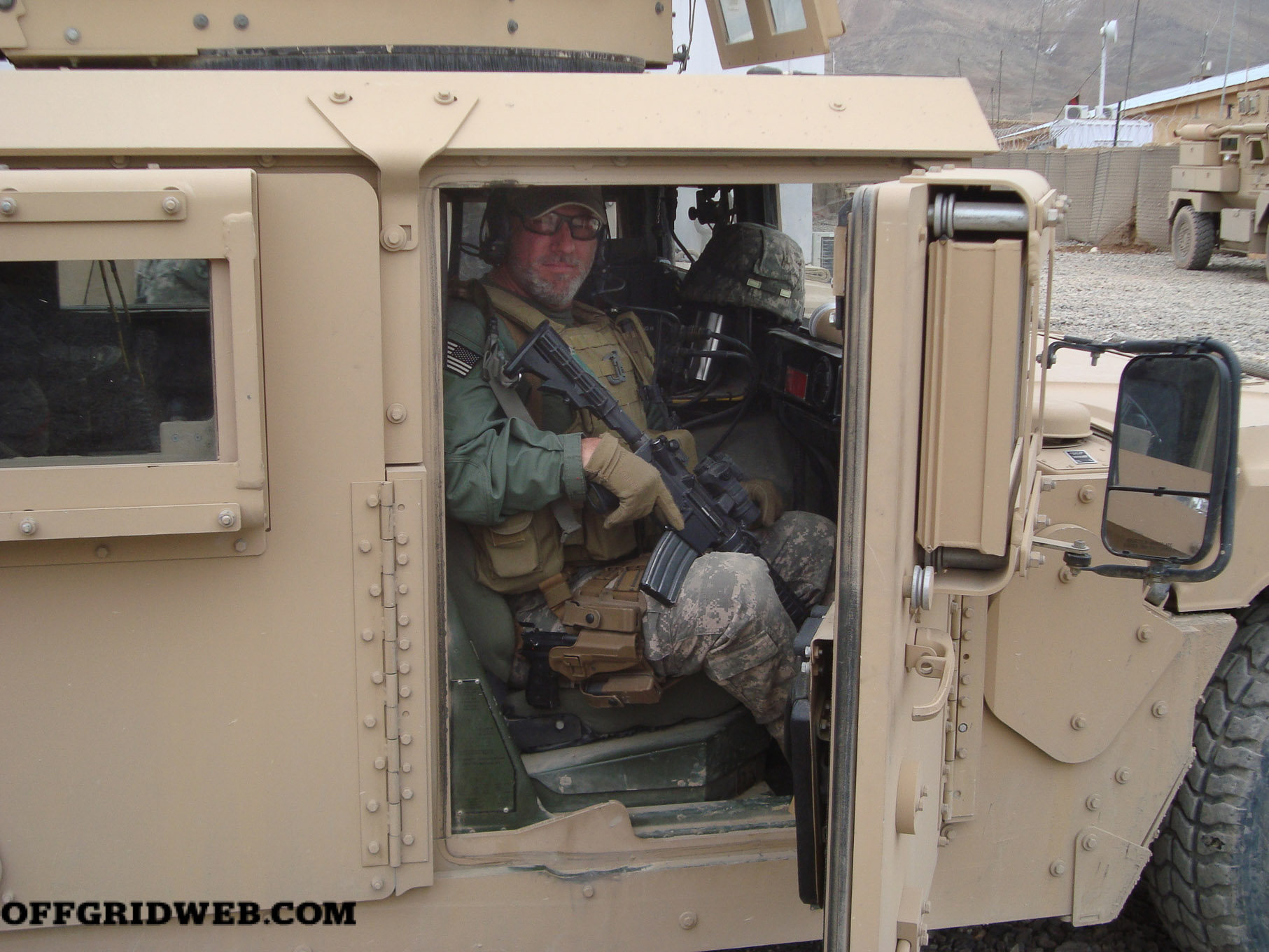
Timothy Lacy Guerrilla Mentor riding in a humvee 2008Above: Riding shotgun in a Humvee, Afghanistan, circa 2008

President Biden recently said, “If you wanted to think you need weapons to take on the government, you need F-15s and maybe some nuclear weapons.” Based on your experience with asymmetric warfare, what’s your response to this statement?

Timothy Lacy: I would have him study any counter-insurgency that the United States has been involved in. While we have some of the best military technology and weaponry on the planet, it isn’t getting the job done. We can see it in the resurgence of hostilities in Iraq, Afghanistan, and all over the world. F-15s and nuclear weapons are no match for weak rules of engagement and a determined opponent.

Timothy Lacy Guerrilla Mentor tora bora 2012Above: Working in Tora Bora, Afghanistan, circa 2012

We’ve seen some heated debates on social media about civilians practicing military-style tactics and wearing military-style gear. Some say it’s beneficial preparedness, and others say it’s unrealistic role-playing. What’s your take?

Timothy Lacy: I believe that every able-bodied American man and woman should not only learn these things, but I see it as their duty. It’s our duty to preserve our Republic. There are many skills that help us — not only martial skills. Gardening, medical, and the like are all very valuable. As for military-style gear, I tell prospective students that they don’t need any cool-guy gear or clothing. If you want to wear military-style gear, go for it. 

What can the average American do to prepare for the kind of widespread violent conflict we’ve seen in certain cities around the country?

TL: People need to train for it, both physically and mentally. If they have no experience, then they should seek out competent teachers. We have a large number of combat veterans with a lot of knowledge to share — you just need to find one who is willing to help. And you need to be willing to pay for good teaching. 

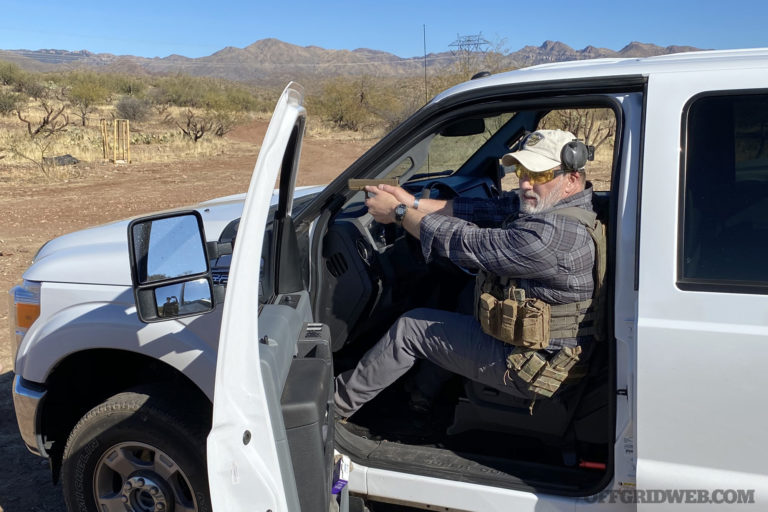
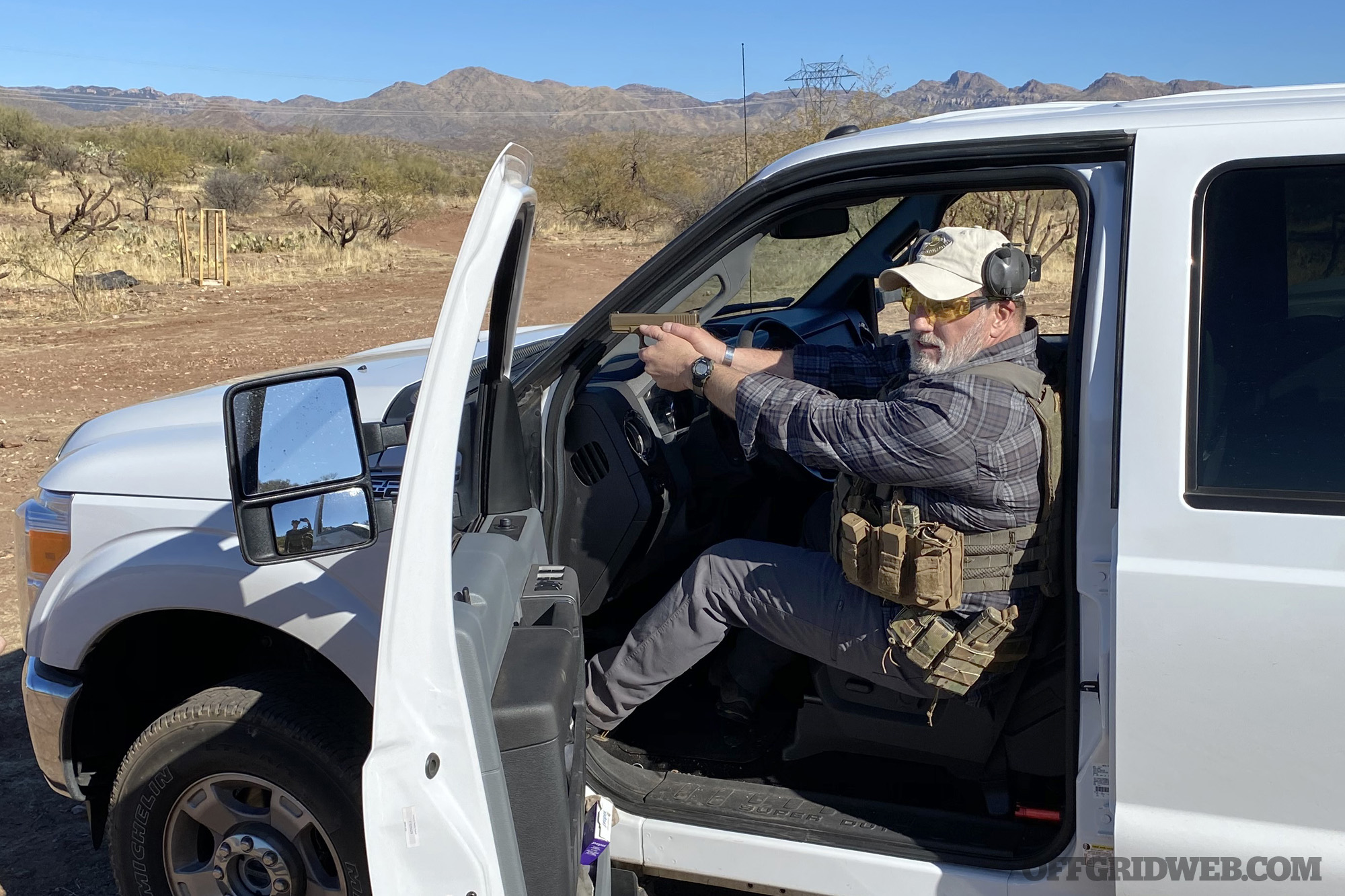
Timothy Lacy Guerrilla Mentor shooting from a vehicleAbove: Demonstrating how to shoot while seated in a vehicle during a Hostile Encounters class

It’s also essential to prepare mentally for violent confrontation. There are too many people who still have the mindset of “it’s not happening here in my front yard, so it’ll never happen here.” It’s past time to wake up and realize that violence can occur anywhere.

There’s a common misconception that survival is a solitary activity. How do you dispel the lone-wolf mentality and teach students to work together?

Timothy Lacy: If you’re going to attempt to be a “lone wolf,” I believe you will soon discover it’s nearly impossible to survive for long. I try to illustrate the need for a team or tribe to my students. After conducting some drills during a class, they catch on quickly that doing it alone is pretty much a myth.

Tell us about the importance of radio, spoken, and nonverbal communication for small unit tactics.

Timothy Lacy: Communication is key when working with one or more teammates. In all of my Small-Unit Tactics and Reconnaissance classes, silent hand and arm signals are taught and utilized extensively. If verbal communication is used, it’s very hushed. The ability to move and communicate silently is invaluable, as stealth is one of your greatest assets. If a team has electronic means of communication, then we combine these with other methods. In the Advanced Reconnaissance course, a field antenna is put up and regular commo checks are conducted. 

Explain the difference between a reconnaissance patrol and a combat patrol. How should gear and tactics differ for each type?

TL: Reconnaissance patrols are there to obtain information concerning the terrain, enemy, resources, and so on, and to accomplish that mission without being compromised. The standard reconnaissance team (RT) doesn’t carry enough ordinance to execute a prolonged fight, so they must rely on stealth. The equipment varies depending on the mission. For reconnaissance, you generally have tools for enhanced observation, such as spotting scopes and binoculars. You may or may not be wearing armor or any ballistic protection.

On a combat patrol, you are looking for a fight. You carry more ammunition, wear ballistic protection, and may carry a small patrol or combat pack as opposed to the larger rucksacks carried by reconnaissance patrols. 

What would you say to folks who feel like patrolling skills don’t apply to urban or suburban environments? Are any of the methods or techniques adaptable for prepared city-dwellers?

Timothy Lacy: I adhere to the philosophy that if you don’t patrol it, you don’t own it. In other words, if you don’t know what threats are in your area, it’s difficult to prepare for those threats. Whether you’re in an urban, suburban, or rural environment, it doesn’t matter.

Of course, there are differences in patrolling styles. In a city, you don’t want to walk around clothed in full camouflage wearing field gear, just as you wouldn’t conduct rural reconnaissance dressed in bright clothing. The methods of surveillance and counter-surveillance differ as well. But the core principles of patrolling and reconnaissance remain the same.

Timothy Lacy Guerrilla Mentor on deploymentAbove: Pointing out unexploded ordnance, 2010

Are there “non-combat” mental or emotional skills that you think contribute to making a good scout? 

Timothy Lacy: Absolutely. I think a good scout needs to be physically strong, but even more importantly, they should be emotionally and spiritually grounded — not given to outbursts of anger or short-fused. Scouting requires patience and a keen eye for attention to detail. When a scout starts slacking off, the consequences can be fatal, not only for the scout, but for their teammates as well. 

Let’s talk about rucksacks/bug-out bags/72-hour bags. What items should always be carried, and what items should be left at home? How much gear is too much?

Timothy Lacy: As far as bug-out bags are concerned, I keep mine packed in a smaller bag like a sling bag. I also mimic as closely as possible the loadout I carried in my go-bag while doing high-threat protection overseas. I cover the basics:

  •  Extra ammunition in magazines, usually three rifle mags and two pistol mags
  •   A good knife, fixed blade or folder, and a multi-tool
  •  At least one civilian smoke grenade
  •   Trauma kit
  •   Signals kit containing a section of VS-17 [high-visibility] panel, Rite in the Rain notepad and pen, infrared strobe, signal mirror, and permanent marker
  •  At least one bottle of water, plus some food (usually Clif bars or something similar)
  •   An emergency Mylar blanket for shelter

My 72-hour pack alternates depending on what I’m doing. In town, it’s a civilian backpack that blends in well; in the woods, it’s a medium ALICE pack or a Crossfire DG3. I carry the essentials for security, shelter, medical, signals, food, and water. I try to keep it as light as possible, depending on the season. 

I just finished an Advanced Reconnaissance Course that ran from Friday to Sunday where I carried a three-liter CamelBak, poncho liner, Gore-Tex bivvy bag, Therma-Rest sleeping pad, extra socks, underwear and T-shirts, grid fleece top, fleece cap, binoculars, night vision scope, four stripped-down MREs, cordage, small spade, hygiene kit, and a field antenna.

All of this was packed inside of a USGI large ALICE pack. 

Timothy Lacy Guerrilla Mentor gear loadoutAbove: Tim’s Gear Loadout:

  • Mayflower SCARAB plate carrier with a Paraclete dual M4 magazine pouch, TYR Tactical triple M4/pistol magazine pouch, and SureFire flashlight in a HSGI utility pouch
  • VTAC Cobra under-belt with a LBT MOLLE padded belt, two TYR Tactical pistol magazine pouches, TYR Tactical M4 magazine pouch, LBT IFAK pouch containing Dark Angel Medical trauma kit and shears, HSGI utility pouch with multi-tool, issued Uncle Mike’s Kydex holster, and a tourniquet.
  • Glock 19X
  • 10.5-inch AR pistol with DPMS lower receiver, LMT upper receiver, SB Tactical SBA3 pistol brace, Knight’s Armament Picatinny rail, Magpul Angled Fore Grip, SureFire Warcomp and Warden blast diffuser, SureFire M3 weapon light, EOTech 552 optic, MaTech backup iron sight
  • Baofeng UV-5R radio

At the Rural Recon class we covered in Issue 41, you reinforced the importance of effective camouflage. What tips do you have for camouflaging skin, clothing, and other gear?

Timothy Lacy: Camouflage is extremely important to the success of your mission. I prefer using camouflage face paint as it covers well and doesn’t interfere with breathing like some of the spandex face coverings do. As a young Infantryman, I learned to put insect repellent on my face prior to the face paint as it helped it go on much easier. I always camouflage any exposed skin and wear gloves. 

I rattle-can spray paint items to break up their outline and shape and to subdue snaps or buckles that may have become worn and shiny. I also paint my weapons to blend in as well.

Timothy Lacy Guerrilla MentorAbove: Helping a student plan his approach to a linear danger area during a Rural Reconnaissance class

As for clothing, I generally wear military pattern camouflage such as Tiger Stripe and MultiCam. Sometimes, I just wear commercial hiking clothes in earth tones like browns and greens. I often have students ask what to wear — I always tell them to get earth-toned or camouflage clothing, no black. You don’t need the latest Gucci-flage to blend in. 

I also carry and very often wear a ghillie cape and boonie hat with jute attached.

What’s one common challenge you’ve seen students experience during classes, and how have you helped them overcome it?

Timothy Lacy: There’s a belief or misconception that you need to have a ton of gear, or the latest fad in tacti-cool clothing and equipment. I demonstrate that as a “guerrilla,” you really don’t need it. If a guy shows up with a piece of equipment that doesn’t match the other “cool-guy” gear, I let him run that gear — if it functions, it ain’t wrong. Guerrilla fighters have been spanking standing armies for many years, carrying little more than the clothes on their backs, a rusted old rifle with little ammunition, and maybe a meal.

The other challenge is teaching them to work together as a team. Students are always surprised at how quickly they can learn to work together, even while conducting some of the more complex live-fire drills. 

How can preparedness duties be shared within the family? What are three survival skills you’ve learned that you think every family should be proficient in?

Timothy Lacy: Every member of the family needs to be a participant, regardless of age, or physical ability. There is always something they can help with, be it training others, gardening, handling livestock, mechanical skills, medical care, or communications/radio skills. 

I put martial skills at the top of my priority list. The ability to protect myself and my loved ones is essential to securing all other skills.

Next is the procurement and treatment of water and food. Knowing how to process wild game, grow your own food, and purify water is very important. 

Next is medical skills, from treating major trauma to the common cold. It should be on everyone’s list.

The evacuation of Kabul airport in Afghanistan is ongoing as we speak. What’s your reaction to the situation over there, and what can the average American learn from it?

Timothy Lacy: As far as the evacuation is concerned, this could have been avoided by keeping Bagram Air Base open and secured. The place is massive, and the military along with civilian air assets could move far more people rapidly than the Kabul Airport can handle. And it’s far more strategically located.

Having spent seven years in Afghanistan, I have mixed feelings about what is happening. Pretty much anyone involved in the training and mentoring of the Afghan National Army (ANA), Afghan National Police (ANP), or Afghan Border Patrol (ABP) knew this was most likely going to occur. Precious few Afghans had any concept of Afghanistan as a nation. To them, it’s all very tribal-oriented — it’s what they know. The lack of discipline and loyalty amongst the Afghan forces is also no secret, so it comes as no surprise at all to see them fold and crumble.

Timothy Lacy Guerrilla MentorAbove: Reviewing notes taken while surveilling an objective during a Rural Reconnaissance class

I do hope that many of the interpreters I worked with can make it to safety. But as I told several of them, I don’t want them to be my neighbor; I want them to stay and fight to make Afghanistan a better place.

For the average American, I would tell them to always have a plan to escape. Have contacts in place to assist you with the successful implementation of your plan. Always have the mindset that no one is coming to save you — you have to be responsible for your training and skill set.

What does the future hold for Guerrilla Mentor?

Timothy Lacy: We shall see. I’d like to continue teaching and training. I truly hope that what I teach will enable students to successfully deal with whatever life throws at them. 

[Photos by Patrick McCarthy, Tom Marshall, and Courtesy of Timothy Lacy.]


Timothy Lacy

Timothy Lacy Guerrilla Mentor ID cardAge: 58
Hometown: Show Low, Arizona
Family Status: Married with four children
Military Experience: 8 years U.S. Army 11B Infantryman
Law Enforcement Experience: 16 years
Childhood Idols: My dad
Favorite Drink: Water
Favorite Quote: Actually, it’s a Bible verse. “And I looked, and arose and said to the nobles, to the leaders, and to the rest of the people, ‘Do not be afraid of them. Remember the Lord, great and awesome, and fight for your brethren, your sons, your daughters, your wives, and your houses.’” – Nehemiah 4:14 (NKJV)

URL: facebook.com/guerillamentor
Instagram: @guerrilla.mentor


MORE SURVIVOR SPOTLIGHTS ON OFFGRID


Haley Strategic Thorax Plate Carrier: First Look

Haley Strategic is known for thoughtfully-designed products, with a focus on functionality, modularity, and efficiency. They’ve played in the tactical nylon world for a while now, with packs and bags such as their Flatpack system as well as chest rigs with their D3CR line, with small to large modular load carrying options. They’ve finally set their sights on plate carriers, with the new Haley Strategic Thorax plate carrier system. It’s a modular, lightweight system that can be configured for the mission at hand. It’s well-rounded, neither a low-vis completely slick carrier nor a full-up, heavy rig — but as a Goldilocks solution, it can be stripped down or bulked up as you wish. With plenty of Velcro, Molle, cable management, and integrated anchor and mounting points, it’s compatible with all of the company’s chest rigs on the front as well as Flatpacks on the rear, to carry as much or as little gear as desired.

We got an early production sample and bring you a first look at it here.

Haley Strategic Thorax Plate Carrier

At the core of the Haley Strategic Thorax system are the front and rear bags. They’re made of 500 denier Cordura and sized for SAPI plates, so commercial plates may or may not fit well depending on their exact dimensions and thickness. An expanding gusset accommodates plates from 0.75 to 1.125 inches in thickness. We tested plates from Midwest Armor, Velocity Systems, and Tencate — all worked great. The front bag has a velcro/Molle field at the top, which easily accepts EUD platforms, and the usual velcro at the bottom. Stretchy tweave covers straps and buckles to clip in any of Haley Strategic’s chest rigs and placards.

Haley Strategic Thorax Plate Carrier

The rear bag has a full Molle field and large lower velcro flap, and is compatible with the company’s Flatpack bags. There are also loops and anchor points on front and rear to integrate comms equipment, PTT devices, antennas, cables, and other accessories.

Haley Strategic Thorax Plate Carrier

Both bags have long flaps to retain plates securely and tabs for ease of use. On the inner side of the bags, there’s a padded chin protector and thermoform pads for cooling and comfort. In keeping with the lightweight and efficient theme, the padding only goes down the center.

Haley Strategic Thorax Plate Carrier Shoulder Straps

We installed the optional shoulder pads over the adjustable shoulder straps; they have more stretchy tweave, 0.25-inch thick hydrophobic foam, and an anchoring system so they won’t move around on you. You can also install piggyback straps for your pack if you’re rolling out heavy.

There are three main options for cinching up the Haley Strategic Thorax: traditional Velcro cummerbunds, low-profile “chicken straps,” and side entry panels for quick and easy donning and doffing.

The cummerbunds are covered in Molle, with a pocket and gusset design for side armor, cables, and so forth. They’re made of 500/1000 denier Squadron and 500 denier Cordura, with dual layer woven elastic for additional mobility while maintaining a snug fit. Cummerbunds are available in small, medium, and large sizes. There will also be accessories for armor and radios.

Haley Strategic Thorax Chicken Straps

The “chicken straps” are for those who want a very low-profile alternative to secure the plate carrier. They’re 2-inches tall with Molle and are made of 500/1000 denier Squadron. The straps are also stiffened, to strike a balance between comfort and rigidity. Chicken straps come in medium and large sizes, with optional pouches to attach armor or a radio.

Haley Strategic Thorax Plate Carrier

Haley Strategic Thorax Plate Carrier

Haley Strategic Thorax Plate Carrier

The side entry panel system makes it easy to get in and out of the Haley Strategic Thorax plate carrier, without having to lift up your placard in the front or thread yourself into the plate carrier like an Olympic high diver. It works with the cummerbunds — get one size down than you’d usually get and attach it to the rear bag. There are vertical flaps on the side entry panels, which as shown here are attached to the D3CRM Micro. Lift up the vertical flap, slap the cummerbund on the velcro field, then fold the flap back down. No muss, no fuss, and you retain as much Molle and comfort as you’d otherwise have.

Our example is configured with the D3CRM Micro chest rig, which clips into buckles on the front plate bag underneath the tweave covers and secures to the front velcro field. Of course, you can use the Micro standalone with its own harness, in either X or H-shaped designs. The D3CRM Micro is a small, handy, and flexible design, with a front zippered pouch with elastic loops and velcro inside as well as a velcro-lined area in the rear to accept various magazine pouch inserts. Haley Strategic offers a triple insert for 5.56mm magazines, a double insert for 7.62mm magazines, and a quad insert for pistol-caliber sticks. Shown here is the 5.56mm triple insert, which holds mags securely even without a retention strap. There are also two side-mounted pouches for pistol mags or other accessories. Haley Strategic also offers a variety of other pouches and sleeves, as well as Multi-Mission Hangers for additional storage below the front plate bag.

Haley Strategic Thorax Plate Carrier placard

If you don’t want to use one of Haley’s D3CR rigs, you can attach a Molle placard or a triple magazine pouch placard to the front. The mag pouch is very low-profile and also features elastic sleeves for tourniquets, det cord, or other gear.

The Haley Strategic Thorax plate carrier system is well constructed, thoughtfully designed, and holds true to the philosophy of providing functionality as efficiently as possible. And its modularity lets you kit up light or heavy, depending on your needs.

The Haley Strategic Thorax system is available in various Multicam, camouflage, and solid colorways. It’s not yet on the Haley Strategic website but will be available soon. UPDATE: here’s the link — https://haleystrategic.com/thorax. Pricing for the Thorax plate carrier system from Haley Strategic will start at $369.

URL: haleystrategic.com


MORE ON NIGHT VISION, TACTICAL GEAR, AND FIREARMS


Dark Angel Medical Training: If It Bleeds, We Can Stop It

Fans of ’80s action flicks should recognize the title of this article as a twist on Arnold Schwarzenegger’s classic line from Predator: “If it bleeds, we can kill it.” Many of you reading this have spent years practicing defensive shooting and hand-to-hand skills. In other words, you know how to make a bad guy bleed if necessary. But how much time have you spent learning how to do the opposite — to stop bleeding and save lives? Statistically, you’re far more likely to use first-aid skills than fighting skills, so allocate your time accordingly. After recognizing room for improvement in my own medical skill set, I attended a two-day Direct Action Response class from Dark Angel Medical. Our instructor, Ross Francis, is a full-time paramedic and former U.S. Navy corpsman. Francis backed many of the lessons covered in the class with stories of firsthand experience in the field.

Dark Angel Medical Training Israeli wrapAbove: Every student had the opportunity for hands-on practice applying tourniquets, packing simulated wounds with hemostatic gauze, and wrapping compression bandages — essential techniques to stop blood loss.

The Dark Angel Medical training class began with a discussion of priorities. After calling 911, your first priority is always to ensure the scene is safe before administering self-aid or aid to others. Don’t rush in and become another casualty. Next, we discussed how to assess an injured person using AVPU — check if they’re Alert and awake, only responsive to Verbal stimuli, only responsive to Pain, or totally Unresponsive. If possible, explain that you’re a trained first responder, ask for permission to help, and inquire about what happened.

After initial assessment, you can proceed in order through HABCDE areas of focus: hemorrhage, airway, breathing, circulation, “da brain,” and expose/environment. In practice, this might look like doing a blood sweep to search for bleeding, confirming that the patient’s airway is unobstructed, and checking if they’re breathing normally — if not, it’ll be hard to overlook. For circulation, check pulse, skin temperature, color, and capillary refill (pinch a fingernail). “Da Brain” means neurologic function, commonly checked by examining their pupils and asking simple questions like “what day is it?” Expose means to fully scan the victim’s body, getting them “trauma naked” if necessary; environment means to keep them covered and warm.

Any injuries revealed during the HABCDE process should be treated in that order. For hemorrhage, we practiced applying tourniquets, wound packing, and pressure dressings. For airway injuries, we placed victims in the recovery position; we also practiced inserting a nasopharyngeal airway (NPA) on a test dummy. Breathing usually means CPR, but occlusive dressings (chest seals) may be necessary if the chest cavity was punctured (sucking chest wound). For circulatory issues, stop external bleeding and watch for signs of internal bleeding. If brain injuries are suspected, the best you can do is stabilize the patient and reassure them that help is on the way. Finally, keep them warm to prevent shock after blood loss; a Mylar blanket is great for this task.

Dark Angel Medical Wound packing

Diagnoses and treatments for specific injuries were covered in detail, from gunshot wounds and eviscerations to burns and snakebites. Med kit gear selection was also covered. The class culminated in several practical exercises — each time, half the students left the classroom, and the other half were given a set of symptoms to act out. Students returned to assess and treat injuries as efficiently as possible.

If you’re not entirely confident in your first-aid skills, I highly recommend you take a class on the subject ASAP. This Direct Action Response course provided a great overview of a broad range of emergency medical topics. For more information on future Dark Angel Medical classes throughout the United States, go to darkangelmedical.com/training


More Training and Emergency Medical Skills


PAMAX Tactical LION: Civilian Flashbang Candidate

When looking at the continuum of force options available to civilians, as opposed to those used by armed professionals in law enforcement and military service, there’s a small but glaring gap in available technology. They’re known by a slew of monikers like flashbangs, NFDDs (Noise and Flash Distraction Devices), concussion grenades, stun grenades, crashers, or bangers. No matter what you call them, the operating principle is the same: a hand-thrown “grenade” type device with a short time-delay fuse that emits a loud bang and blinding flash of light for the purpose of distracting or disorienting anyone in the immediate vicinity. This allows an attacker (or defender) to expand their OODA loop by disrupting their opponent’s, buying valuable time to attack, counterattack, or escape.

The first known example we could find of a device like this is the military-issue Mark 3 (MK3) concussion/demolition grenade. The design dates back to 1918 and was effective in trench warfare. The original concept was that the MK3 could injure or disorient personnel and destroy equipment without endangering friendly forces with indiscriminate fragmentation. It was simply a lump of TNT housed in a cardboard tube with a pull-ring fuse. 

From there, the design was refined over time, with the next major milestone coming out of the UK in the late 1970s, when the so-called stun grenade first saw use by the Counterterrorist Wing of the British Special Air Service (SAS). Stun grenades typically consist of a steel body with holes cut throughout, which then has a more specialized charge of aluminum or magnesium oxide blended with something like potassium perchlorate to achieve a high-flash detonation. Newer versions of this design feature heavy-duty bodies that can be recovered and reloaded with fresh charges for repeat use. 

PAMAX Tactical LION useAbove: The PAMAX Tactical LION is designed such that even dropping it right at your feet poses no risk of frag or direct injury. Just make sure you’ve got eyes and ears on.

The issue that arises with all of these designs is that they rely on high-explosives, which are highly regulated by the BATFE. Civilian possession is extremely limited and comes with a whole host of required boxes to check, including specialized transportation and storage requirements.

These regulations, coupled with a “civilians don’t need this” perception of such devices, have made them essentially impossible to possess for anyone without agency or unit credentials. But a small company called PAMAX Tactical has come up with a solution that overcomes the legal hurdles, and has allowed us to more deeply ponder the question of “need” and application for lay persons in a defensive context. They’ve named their solution the LION BFD – Low Impact Ordnance Non-lethal, Blank Firing Device.

HOW IT WORKS

The PAMAX Tactical LION consists of a two-part design with a body and detachable base, of which there are two variants. The commercially available version uses a machined aluminum body and base. The body has a weighted, free-floating firing pin and a pull-ring safety block. Inserting the pin physically blocks the pin from impacting the blank. When the pin is pulled and the device is thrown, the floating weight is jarred on impact, causing the pin to punch the primer and detonate the device. The screw-on base has a pocket and removable adapter. The adapter has two different holes, one on each end, that can accommodate either a .209 shotgun primer or a flat-face 9mm blank (crimp-nose blanks will not work). If you remove the adapter entirely, the pocket in the base will accept a 1-inch shotgun blank. The base also has vent holes at the bottom to vent the flash and bang when the device goes off. 

PAMAX Tactical LION disassembled civilian flashbangAbove: The LION Blank Firing Device consists of a machined aluminum body with two detachable bases: aluminum for commercial use and a larger stainless steel one for law enforcement.

Building and labelling the PAMAX Tactical LION as a dedicated blank-firing device serves two purposes. First, it avoids any potential legal and liability issues from ATF, as it’s not intended to be a “grenade” of any kind. It also allows the end user a lot of flexibility to scale the intensity of detonation up and down based on use. 

PAMAX does have a second thread-on base module for the LION body, which they call the V2. The V2 doesn’t have any additional adapters but is made of stainless steel and bored a little deeper to accommodate 2-inch shotgun blanks. Neither base will accommodate full-length 2¾-inch shells to eliminate the risk of inadvertently loading a buckshot round into the LION, which could make everyone in the room have a really bad day if thrown. But at time of writing, the V2 base is currently restricted as a law-enforcement-only item. 

Our biggest concern with the V2 base being a restricted item, from a practical standpoint, is whether or not this will neuter the LION’s capabilities for commercial consumers and limit it to being a novelty item for paintball and airsoft games. But PAMAX Tactical tells us that they’re currently working with an ammo manufacturer to produce blank cartridges optimized for the LION that’ll feature charge levels and powder mixtures calculated to wring every ounce of pyrotechnic potential out of their product.  

BANG-RINSE-REPEAT

We had the chance to spend two days with the owners of PAMAX Tactical at the Deep Woods Ranch in Florida. Deep Woods is a private training facility run by former SEAL Rich Graham of Full Spectrum Warrior. Full Spectrum offers a variety of firearms training courses to civilians, law enforcement, and allied partner nations. The ranch features several shooting ranges and enclosed structures perfect for torture testing the LION. We ran tests indoors and outdoors, in barn stalls and shipping containers, with multiple different types of primers and blanks, including black powder blanks. The central Florida sugar sand was just what we needed to get the LION moist, dirty, and crusty to test the firing mechanism and safety features. 

PAMAX Tactical LIONAbove: Even when we actively packed it with wet Florida “sugar sand,” the LION functioned with 100-percent reliability.

We started with .209 primers, which produced only a token pop. Inflating a brown paper bag and popping it is probably louder. Our initial reaction was somewhere in the realm of “What’s the point of this?” until an interesting scenario was put forth: using a LION with primers to train military and law-enforcements K9s who are attached to entry teams. Primers are cheap, LIONs are reloadable, and the pop is enough to get dogs used to working around hand-thrown munitions without the cost and hearing risk to the dog associated with using full-power flash-bangs. We’ll see if someone else comes to that same conclusion, but it certainly adds to the potential versatility of this product.

Next up was testing 9mm blanks. In a confined space, it’s enough to get your attention if you’re scrolling through your phone, tuned out to the world. But it’s hardly what we’d call overwhelming. This might be a good option for paintballers and milsim reenactors who want to simulate that “bang out!” moment from Call of Duty while making entry without blowing out any eardrums. 

PAMAX Tactical LION demo

Loading the LION with 1-inch shotgun blanks is where things started to get interesting. The results weren’t enough to produce sensory overload, but unsuspecting recipients in a small room are likely to at least suffer a distraction/startle response. Is that enough capability to store one in a go-bag? We’ll get to that in a minute …

Finally, we swapped to the V2 base and ran a variety of 2-inch shotgun blanks. The author volunteered to stand inside a dark, open room with a concrete floor while the PAMAX Tactical LION was thrown in repeatedly with different loads. My level of distraction/confusion was largely nullified by context: I knew it was coming and watched the reps from PAMAX launching this thing at me. Having said that, several of the 2-inch blanks produced a flash bright enough to leave me seeing polka dots, and one of the loads produced enough overpressure that I definitely felt the “thump” of overpressure inside my rib cage when the LION detonated. Does it match up to the intensity of an actual flash-bang or stun grenade? No. But the energy disparity between blanks and high explosive charges is significant. We hope PAMAX is able to close that gap with some purpose-built loads made especially for their device. 

In terms of deploying the device, the PAMAX Tactical LION is as easy to use as the oversized safety crayons we get at chain restaurants with paper place mats, whenever we ask for chicken nuggets and apple slices. Load your blank or primer of choice into the base, screw the base onto the body, pull the safety pin, and throw. We literally packed the vent holes with wet sand before throwing and the LION never choked. We threw it on concrete floors and against every part of a vehicle we could hit: windows, windshields, hoods, wheels, and body panels. We only found one issue and one idiosyncrasy with it.

PAMAX Tactical LION demonstrationAbove: Depending on the size and type of blank used, the LION is capable of producing significant flash and moderate concussion.

Because the device requires a jolt to make the weighted firing pin assembly wobble enough to punch the primer, if the impact surface flexes or cushions the landing impact it could result in a misfire. We noticed this primarily with pockets of soft, dry sand and hoods or body panels of vehicles, which will flex or dent when hit hard enough. In these instances, giving the PAMAX Tactical LION a hard overhand throw that makes it tumble end-over-end added enough force to cause detonation, even on softer surfaces. We could not, no matter how hard we threw it, get the device to go off in our hand or in mid-air by throwing it too hard. While a side-arm lob will be plenty on a hard surface, throwing the LION end-over-end seemed to give the best chance of successful firing on the widest array of surfaces. 

The only mechanical issue we saw with the LION was the pull-pin safety. We handled several different LION bodies over the course of our testing and on all of them, the cross-pin that actually inserts into the body fit incredibly tight. On the sample LION we received for studio photos and personal testing, the pin is so tight that it actually had to be tapped in place with a hammer the first several times we removed it. Pulling it free to arm the device is the closest we’ve ever come to an active game of tug-of-war with ourselves. But PAMAX is aware of the issue and already looking at options to make the safety pin more user-friendly. (Our demo unit did eventually loosen up some.) 

We expect production models will either have a different pin or slightly larger hole machined into the body to make this process easier. In the meantime, there’s an alternate way to render the PAMAX Tactical LION safe: Simply unscrew the base from the body by one half-turn. This creates enough clearance that the pin cannot make physical contact with the primer. In our field testing, we eventually stopped using the safety pin and simply left the base unscrewed by a half-turn. When ready to deploy, just tighten the base down and throw. So, even if your safety pin requires some break-in, you don’t have to risk an AD with a blank-firing device.

PAMAX Tactical LION in vehicleAbove: With black powder blanks, the LION creates both smoke and sound diversion.

As a side note, PAMAX already has a couple of thoughtful accessories for the LION as well. They have a purpose-built Kydex holster available in MOLLE or belt-mount configurations, as well as two lanyards (polymer and braided wire) that can be looped through the safety pin and then attached to a hard point on the holster. The idea is that when you draw the LION out of the holster, the safety pin is pulled out along the way. But with the too-tight fitment we experienced, the pin (or pin hole) needs a little re-dimensioning for this to work as intended.

CONCLUSION

The burning question we had about the PAMAX Tactical LION BFD going into this evaluation was: “Is this applicable to civilians as a legitimate defensive or escape tool?”

The best answer we can come up with at this point is a hard, forehead-scrunching “maybe.”

PAMAX Tactical LION

Our experience with preproduction samples using current commercially available blanks didn’t match anything we’ve ever felt when using true explosive-cored flash-bang grenades. That’s not to say it’s not capable of causing distraction or disorientation, but conditions will have to be ideal. Power factor aside, is there even a scenario where this could cause enough of a ruckus to allow you to escape or evade a bad situation? We came up with a couple scenarios where the LION could absolutely be useful, but also figured other solutions to those same problems.

> In your vehicle, being trapped/surrounded by a growing mob of agitated protestors. Could dropping a LION out your window cause a big enough bang to disperse the crowd? Possibly. But, if mistaken for a gunshot, it could also induce armed parties in the crowd to draw their guns and return fire, escalating the situation instead of breaking it up.

> In an active-shooter scenario, could tossing a PAMAX Tactical LION opposite your planned escape route distract a shooter or draw everyone’s attention, giving you a time advantage to make your escape? Possibly. If you have time to successfully deploy it. 

> Something goes bump in the night in your living room. Could tossing a LION into the next room before making entry to confront the threat buy you some tactical advantage? Possibly. But we think you’d have to have received proper training in the specific tactics of making a room entry in conjunction with a distraction device. There’s also a possibility of disorienting yourself in the process, depending on room size, layout, and acoustics. Stealth might be your biggest ally, versus a dynamic one-man room entry — an incredibly dangerous prospect even for armed professionals. If you can evade or barricade while contacting the police, that would be the far more prudent option. 

> Same scenario, in a setting where guns aren’t available, or perhaps where a family member who is uncomfortable with guns is alone. Could the LION scare off a potential home invader? If it does, great. If it doesn’t, you just exposed yourself while escalating the adrenaline level of everyone involved.

PAMAX Tactical LION in vehicleAbove: We were able to use the LION to shatter this truck’s rear windshield but found that on flexible surfaces like safety glass and auto body panels, throwing technique was a factor for reliable detonation.

In the end, we’re a little hard-pressed to find a situation where the LION, or anything like it, would be the tool for the job in a self-defense context. But it’s a reasonable option to have accessible in a number of different scenarios. The proverbial “tool in the toolbox” to add one more capability to your emergency response spectrum. In addition to the reenactment/simulation value for those who want it, there’s also an opportunity for professional trainers to have a low-cost, low-risk way to introduce added stress to scenario-based training. 

Regardless of what you want it for, an MSRP of $249 for body and base, plus the still-very-reasonable cost of blanks and primers, makes the PAMAX LION an affordable if not niche addition to any training toolbox. 


 Sources 

PAMAX Tactical: pmtactical.com
Full Spectrum Warrior/Deep Woods Ranch: fullspectrumwarriors.com


More on Tactical Gear


Could It Happen Here? Civil War Survivors Recount Lessons Learned

Over my years as a war reporter and war crimes investigator, I am often left in awe of the individuals I meet who have survived the most unfathomable things humans do to each other. I’ve sat with people who’ve had their body parts surgically removed by aggressors, women who have been raped until they can no longer move, and children whose tiny bones have been cracked and crushed without mercy.

But for those who survive, the silver lining that shines through them is as miraculous as it is tragic. I’ve often been struck by how these ordinary people, with no formal training or skills, are forced to become extraordinary at the drop of a hat — or a bomb. The resilience to withstand the pain (both physical and psychological), to push through the darkness, and to find the thread of hope in the bundle of misery has left me both perplexed and inspired.

In documenting the lives of a few of these individuals, I hope to shine a light on just how strong the human mind can be when it comes to holding on. I hope to illuminate our ability to prepare for and push through a crisis as it dawns. And above all, I hope to instill what it means to rise above being a victim and into the terrain of survivor, and to seek inner peace long after the torment and war has subsided.

Syria

One moment, Samer Scher was one of the multitude of passionate political college students flooding the wide and dusty streets of Modamiyeh, Syria, chanting for free and fair and elections. The next moment, gunfire from forces loyal to the Bashar al-Assad regime ripped through the open air and those he knew and loved fell to the ground.

As panic and lawlessness erupted in the cool spring afternoon, just like that, Samer knew that their peaceful revolution had fallen down the rabbit hole of a violent war — a war from which he and his country would never return.

Samer Scher Civil War SyriaAbove: Samer Scher

“All we wanted was a future. Back then, if you didn’t have a link to the regime, you couldn’t get a good job; you had no future,” Scher, now 29, lamented from the safety of his small home on the outskirts of Berlin, Germany. “Animals had a better life than we did. We did not just want to receive decisions. We wanted to be part of the decision-making process.”

But from that very first barrage of bullets on the first day of their peaceful protests, the bloodshed and distrust only deepened. At any moment, anyone suspected of being part of the cadre opposing the Damascus overlords could be ripped from their homes and never seen again. Scores would be thrown into jails in the bowels of the earth, where they were subject to rape and torture. Many would be burned and blown apart, as bombs slammed into their bedrooms while they slept.

Samer, who was working as a volunteer medic at a local clinic, anxiously accepted that it was only a matter of time before the brutal enforcers came for him too. He had already seen bullets wedged into the eyes of screaming children and shrapnel searing the flesh of babies as they breathed their last breaths. He was left with the memory of a quiet conversation with a close friend, only to see that very friend shredded into pieces the very next day as a result of a shell slicing his body.

After three terrifying days of heavy fighting on the edge of his besieged hometown between the Free Syrian Army (FSA) rebels and Assad’s Army — a conscripted military — Assad’s forces breached the blockade and stormed in. It was August 22, 2012.

Tank Syrian national army near the combat zone in DamascusAbove: A Syrian National Army tank near the combat zone in Damascus, September 2013.

“I stayed in my home; there was nowhere to go,” Samer, who speaks softly with glazed eyes, continued. “It was a matter of chance — maybe the regime would come for your home, or maybe they would go for the home next door.”

Yet after nights of sleeplessness, Samer’s fogged eyes made out the shadows of soldiers peeking through the holes of his thin walls. Then, the soundtrack: gunshots cracking, footsteps, and the sounds of his front door crashing to the ground. He felt boots pelting against his limp body, splintering his bloody mouth, and then the chilling threats that they were going to shoot him.

“They were humiliating me, calling me a dog, a terrorist, insulting my family. Every one of those men — about 25 of them — were all taking a hit,” Samer said as if sifting through a graveyard of memories. “It was an unimaginable fear; I thought they would arrest me and take me to an intelligence branch.”

First, the soldiers carted Samer around the apartment building like a human shield — holding him up in case anyone opened fire as they knocked down a door. At one point, they propelled him into a bathroom, and when he turned around, he was staring down the barrel of an AK-47 at close range.

“I begged them to spare my soul, that I was just a college student,” Samer recalled.

But a bullet catapulted through his rib, another into the bottom of his arm, then another cleaved below his shoulder. Samer said the only pain he felt was the pain of fear. Facedown in a pool of crimson, he counted three more bullets entering his body and a seventh shattering the wall right by his head. He remained motionless for what felt like an eternity until the laughter and chimes of “he’s dead” faded out.

Civil War Survivors Syrian Civil WarAbove: Rebels in the fight against ISIS and the Syrian regime. Photo courtesy Rojava Information Center.

Samer managed to drag himself down a flight of crooked stairs and phone a friend for help. However, his miraculous tale of survival would only become dizzying as the war intensified into chemical attacks and mortar showers — until one day in 2015. He was given passage to flee into neighboring Turkey, an opportunity he felt would be his last chance at life. From there, he boarded a rickety boat to Greece and then moved through to Germany. Today, he’s trying to move on with life and studies, yet not leave behind the Syrian war that protracts into its eleventh year.

“I don’t know why I survived. I would say it is God’s will. I ask myself why me, and still, I have no answer,” Samer said.

Physically, he’s no longer able to lift his right arm. Psychologically, Samer is awash with an unrelenting desire to keep fighting for his country — this time with his voice.

“I’m going to run for parliament in Germany,” he noted, his strained face thawing into a wistful smile. “That’s the best I can do to protect my future family.”

China

Jennifer Zeng’s crumble into suffocating oppression under the fist of China’s Communist Party (CCP) was beleaguered from the beginning. She entered the world in the Sichuan province in 1966, the year that the Mao Zedong’s Cultural Revolution — the great sociopolitical purge to cement communism — began.

Since her father was part of a secret “intellectual” crowd, he was always on the oust of Beijing’s militant leadership and subsequently ostracized. This meant that Jennifer was born in a clinic where her parents couldn’t afford to pay bribes for the best medical care. As a result, a blood transfusion gone wrong in her first few days of life left her with hepatitis C.

Ironically, it was that liver-ravishing condition that would, decades later, save her life. Her early life was plagued with mandatory “re-education” classes on the fringes of an isolated town, forcibly separated from her mother. Any minor change her father wanted to make, from work to moving to a different house, couldn’t be done without government approval.

Hong Kong Democracy Protest

“My childhood was very lonely. And because my family was looked down on by society, I was discriminated against — even the school would not let me play with other kids,” she said wistfully, her eyes darting off into another world. “We had to be very careful, and life was very hard.”

She didn’t know then just how much harder it would become.

It wasn’t until 1997, when Jennifer was in her early 30s and working in Beijing, that she stumbled upon furtively distributed books about an emerging spiritual adherence called Falun Gong. It was a belief system outside the purview of the authoritarian leadership. For two years, she’d meet other practitioners to pray and meditate under the shroud of secrecy. 

Then, in the summer of 1999 — after hearing that other Falun Gong believers were being apprehended — Jennifer went to the State Appeals Office to plead their case. But authorities abruptly rounded her up too. She was stuffed into a detention center for 48 hours, and her name etched into a black book that would haunt her for many more years. 

Inside the labor camps, time was double-edged. The seconds of torture were elastic — stretching on, with one always waiting for the tenuous band to snap. But the longer she could keep propelling through, the closer she felt to making it to the other side.

Jennifer was arrested for the second time in February 2000. This time, she was dragged out from her workplace — an investment consultant company — and viciously interrogated at a labor camp in China’s Da Xing County. Before officials drew her blood, she informed them that she had hepatitis C. While she was left to starve over the coming weeks, many around her — including her cellmate — dropped dead from forced feeding. 

That’s when Jennifer realized that the organs of Falun Gong practitioners were being nightmarishly harvested to meet the demands of a government-run for-profit organ industry. She was eventually released from this torturous captivity, but not for long. That April, heavy-handed police officers plucked Jennifer from her sleep just after the witching hour with no explanation. 

It was only days later that she learned authorities had intercepted an email she had written to her parents, explaining her zest for the Falun Gong faith despite it being outlawed by the CCP. While some criticize it as being something of a cult, Jennifer maintains that her Falun Gong practice is rooted in meditation and compassion.

But for weeks that swelled into months, Jennifer’s life in yet another labor camp would fall to the hands of that faith. 

“Every day was a struggle between life and death. Most days, we were forced to squat for 16 hours, with our hands behind our heads like dogs. Police would immediately apply electric batons to anyone who fainted to wake them up,” she said. “On the other days, we were made to stand motionless in our cell for those 16 hours.”

When Jennifer refused to renounce her religion as “evil,” prison guards lugged her into a filthy courtyard and whipped her raw with electric rods until she lost consciousness. Yet, the worst pain wasn’t physical. It was watching once bright-eyed humans descend behind the curtain of madness. 

“At night, you would hear the screams of those being tortured. Sometimes, I felt that I would collapse and lose my sanity. That was the most terrible fear for me,” Jennifer continued. “You could see the moment when someone would lose their sanity — when they couldn’t handle the mental torture anymore. Their eyes changed. Their minds went somewhere else.”

As soon as she was set free months later, Jennifer knew that China was no longer home. The only way she would survive was to be somewhere safe enough to tell the world what was happening to the Falun Gong practitioners. She had to make the excruciating decision to leave her 10-year-old daughter and husband behind and flee first to Australia as an asylum seeker in 2001. Years later, Jennifer relocated to the United States, where she has continued her advocacy as an independent writer. 

For now, watching China continue to assault minorities from the Muslim Uighurs to the Buddhist Tibetans from afar is like observing a slow-burning home from behind a frosted glass window. The nightmares haven’t stopped, but Jennifer leans on meditation and deep breathing until the fear fades away. It’s those pillars of benevolence toward all forms of life that pull her through the darkest of days.

“That is the greatest gift, the best skill that I can give myself,” she says with a smile.

Burma

For M Tu Aung, 46, life has always existed as an endless cycle of running — running from danger, running into the unknown, running to lands far away and then running in circles in the hopes someone might hear his cries and prayers.

M Tu Aung Civil War survivorAbove: M Tu Aung outside the Chinese Embassy in DC in April 2021, protesting the military takeover in Burma. Above: Photo by Hollie McKay

“We had to run whenever the military would come in. They would try to kill all the people, they would set fire to the villages and burn down the churches,” recalled Aung. He was raised in the predominantly Christian Kachin State of Burma — also known by its 1989 regime re-title Myanmar — during a time of socialist military governance. “If you could not run, if you were not fast enough, you would be taken by the Burmese Army. Many times, people were killed, and yet we could not stop to bury the bodies — if they caught you, they would kill you. Some of my family members who were running beside me were caught.”

Burma has been burned alive by endless conflicts and persecution since the British handed the country back its independence in 1948. Given the endless wars, Aung never knew his biological parents and was adopted as an infant. He also never knew a life not beset by killing fields.

“They (Armed Forces) wanted all the property for themselves. We always had to run and leave our village and property behind. Everything would be ruined; the Army has no regard for human life,” he continued. “Every day, we lived in fear. We worried, day and night, they would come.”

Civil War SurvivorsAbove: Photo by Hollie McKay

Even if there were peaceful moments inside the threads of the jungle, idyllic in their stillness, they were beset by biting anxiety. There were no warning signs, Aung said, just a crackle of gunfire and howls of panic whenever the troops would force their way in. 

“What I remember most about my childhood is how the soldiers would just come into our villages and take anything they wanted. And they would take the people — sometimes 15 or 16 years old,” he whispered.

Like many from the region, the more painful the topic, the more the survivor laughs — an uncomfortable defense mechanism to mask the invisible wounds nested into memory.

“The Burmese Army would kill and torture — and they would rape,” he said slowly. “I remembered the faces of the young girls and women who they would take away to rape. We didn’t know exactly where they were taking them, but the ladies — most of them — never came back.”

Aung believes he only survived a tumultuous upbringing because his adoptive parents moved him to Rakhine State when he was 15, a state that — back then — was somewhat less butchered.

A decade ago, Aung was granted asylum in the United States with the wild hope for a better life. He studied for an MBA and opened a small business in Maryland. He fell in love with another refugee from Burma, married and had three children, and is heavily involved in the local community of Baptists churches. 

Civil War SurvivorsAbove: Photo by Hollie McKay

But it’s the place he left behind that occupies his mind during most waking hours. He exhibits a dogged devotion in reaching out to the powers of Washington as an active leader in the Nationalities Alliance of Burma, a network of ethnic nationalities organizations based in the United States.

“It has always been about a ‘burmainization’ of the country, of everyone else not in the military circle being treated as second class,” Aung lamented. “The Burmese military wants us out to protect themselves. It is why they are killing protestors and civilians every day.”

Some of Aung’s frustrations have stemmed from the notion that little has been conveyed to the public about the suffering of Christians in Burma. Most of the world is painfully aware of the persecution that the Muslim Rohingyas have endured in recent years in the Rakhine State he settled in as a teen, with many forced to flee into bordering Bangladesh. Aung said Christians have also been slaughtered and have had their houses of worship razed into nothingness, but have been “weak” at conveying the situation on social media.

Civil War Survivors ChurchAbove: Photo by Hollie McKay

“The ethnic cleansing has been happening since long before that of the Rohingya people,” Aung stressed.

Watching his homeland once again be dipped in chaos and blood following the coup in February 2021, in which the military wrestled power back from the first civilian government, Aung feels the urge to keep running. He’s calling for the international community to step in and support a transitional government in that illustrious chase for a free and fair election, calling for the people of Burma to decide their fate.

And despite 10 years in the United States, Aung clings to a life of trauma that reminds him he may never truly know what it is to be safe and secure. He leads a minimalist life with no stockpiling — when all one knows is to run, less is more — and his body is engulfed by chills at the mere sight of any uniformed soldier.

“Even here in the U.S., I just don’t want to see a soldier. It scares me,” he notes with a nervous giggle. “All that is really left, all we can do, is pray for protection. That helps us a lot.”

Egypt

Then, there’s the case of Mohammed Soltan, 33, in which the torture of the unknown still visits him at night. His father “disappeared” months ago into the depths of an Egyptian prison. Last year, intelligence officials informed him that prison guards broke his dad’s jaw and his teeth, yelling that it was his son’s “treachery” for which he must pay the price.

Yet Mohammed, a former Egyptian political prisoner himself, refuses to be silenced. He also refuses to wear the weight of guilt that his dad is suffering because of his vocal activism against the military leadership in Cairo.

“I won’t take that on,” Mohammed said defiantly. “That is on them.”

Civil War Survivors Mohamed Soltan The New York TimesAbove: Mohamed Soltan poses for a photo at his sister’s home in Fairfax, Va., on Friday, August 21, 2015. Soltan spent over two years in jail in Egypt including a year on hunger strike. (Photo by Zach Gibson / The New York Times)

His father and five cousins are being housed in the recesses of the very same underground prison Mohammed was thrown into in August 2013.

But his journey of political activism was one of default. He grew up in what he describes as simple, rural American life in the Midwest — white picket fences, sprinkler summers, and frosty winters. But when the 2011 Arab Spring erupted in Egypt, the place of his heritage, Mohammed wanted to experience what he hoped would be real change in the region.

“I remember watching the protests in my history class at Ohio State University and just knowing that I needed to be there,” Mohammed recollects. “I left the airport and went straight to Tahir Square. It was February 11, and longtime President Hosni Mubarak stepped down. It felt like the whole trajectory of my life had changed. It seemed like a dream. The young people of Egypt had spoken, and we had taken our country back.”

Only his dream of freedom fast descended into a nightmare. After completing his studies in the U.S., Mohammed moved with his father to Egypt in March 2013 to build a life working with the newly elected Mohamed Morsi leadership. However, just a few months later, Egyptians poured into the streets to showcase their displeasure at Morsi, setting up a succession of clashes.

After a few days of demonstrations, the country’s former defense minister Gen. Abdel Fattah el-Sisi oversaw a controversial takeover of power. That part of it had been relatively sudden, Mohammed said. There had been no warning signs to get out early. It seemed that the transition would be one decided by the people … until it was not.

“I was very scared that the military was coming back and interrupting a democratic space. We had hoped there might be a referendum,” Mohammed continued.

The summer flared with the heat of protests and confusion swarming the streets, both in support and in objection to the Army’s government overhaul. Mohammed had been live-tweeting about the chaos erupting around him at Rabaa Square when a bullet zipped past his head. But before he could breathe relief at the near miss, another bullet tore through his arm.

While attempting to tend to his wound without access to proper medical care, Egyptian authorities burst through his home. They were initially looking for his dad, who wasn’t there. So instead, Mohammed was taken away in what would amount to months of beatings, cigarette burns melting his unwashed flesh, the cracks of his bones breaking and the gut-wrenching feeling of his left shoulder dislocating from his deltoid muscle. 

He remembers nails being pressed into his wasting frame during regular torture sessions, and the way his angst would spew into anger every time authorities attempted to force-feed him. Each time, he’d immediately tear the IV drip out of his weakening body.

While behind bars, Mohammed launched a hunger strike that stretched from months into more than a year.

As an American, Mohammed had a robust government on his side that was able to demand his release. After 22 months — including 489 days on a hunger strike, wrapped in despair — he was set free into the sunshine on May 31, 2015. But as any torture survivor will tell you, there’s never really a place one can call home. After that, authorities retaliated by arresting five of his cousins and his father.

Along with the deep pangs of knowing that his dad is still out there in the darkness of the dungeons, alone and in misery, Mohammed still frantically jumps at the sound of keys shaking or doors slamming — sounds that signified the guards coming into his cell for another round of caustic games. His stomach violently rejects heavy meals, and being alone comes with a bundle of distressing solitary confinement reminders.

“I have to keep speaking to myself,” he said. “It’s how I can assure myself that I am still alive.”

The work is far from over. Mohammed’s life now is stuffed with pushing for the release of other political prisoners around the planet, in what he characterizes as “paying it forward.”

“I didn’t think that I ever would get out of prison, and I know that any of us can die at any minute,” he conjectured. “But I have this second lease on my life to fight for others, and that’s the lens through which I view everything. That is why I will be forever grateful.”

Uganda

The upheaval of one’s life isn’t always at the behest of one’s own government. Sometimes, the lack of stability and internal corruption of leadership lays the groundwork for external influences to swoop in and unleash havoc on an innocent populace.

That’s an eerie narrative that Victoria Nyanjura knows all too well. She was just 14 years old when insurgents, under the canopy of Joseph Kony’s Lord’s Resistance Army (LRA), stole her and some 138 other girls from their Catholic boarding school in the Kole district of northern Uganda. These events unfolded in the dead of the night on October 9, 1996.

There had been rumblings weeks earlier that the rebel outfit might invade, yet nothing had come of it. When it happened, it came as a scalding shock — grenades detonated in the dark, wild-eyed fighters rattled the gates until they broke, and then there were the screams. The piercing screams that Victoria will never forget as she glanced up into an abnormally bright sky.

“I tried to hide under the bed, but they found me and took me. I didn’t know what was happening,” she observed, in a small yet stern voice that signified her propensity to push through. “I did not know whether they would let me live or die. But that was the start of all my misery.”

Kony’s name and his trail of terror didn’t become apparent to most Americans until 2012, when the abuses of his self-styled militias were brought to light in a viral video focused on recruiting child soldiers. But for eight years, many moons earlier, it was all Victoria lived and breathed. Thirty of the 139 girls were handpicked and dragged away to be bush wives to the insurgents. Nyanjura was plucked and tied up with banana leaves so she couldn’t run, and immediately she knew with a sinking feeling her life would never be the same.

“Every night, they are having their way with you, and there is nothing you can do. Everything about captivity is about survival. You either survive, or you perish; there is no in-between,” Victoria said. “Often, you would see someone fall to the ground and think they must be resting, but when you get closer, you realize they are gone.”

Victoria Nyanjura Civil War survivorAbove: Victoria Nyanjura

Her years of survival were pockmarked by sucking raindrops and dew for water, secretly gathering wild fruits and hoping that they would not be poisonous, sitting in the sunshine with a body so bruised and swollen, and sobbing to live. Other times, she was sobbing to die.

Victoria’s “husband” was eventually killed in the fighting against Ugandan forces, and for years more, she held her two small children — a daughter and a son — tight and quietly prayed and wept for the will to keep forging ahead. The LRA distinguished itself by slicing off victims’ limbs, lips, and noses — a symbol to instill terror in communities and scar survivors for life, making them forever dependent on others to get by.

“There were times that I begged to God to let me die, that things would be better if I were not there,” Victoria confessed. “I begged if I died; I wanted my children to die too. I wanted us all to perish together.”

One day, Victoria snapped. By that point, she was 22 years old, and much of her life had existed in the confines of captivity, on the tightrope of death and destruction, in the shadow of the grossest miscarriage of justice. She could not take it for one moment longer. With that, Victoria swept up her two children and set off a daring escape that entailed weeks of weaving through a boundless maze of jungle and gray sheets of tropical rain, over hills and into valleys of the dead — praying that she wouldn’t be shot at or re-captured, or step on a land mine embedded in the muddy tracks.

Eventually, Victoria made it to a displacement camp, where she was forced to confront the stigma of surviving sexual violence and shielding her young from the origins of their conception. Now 39, Victoria recently completed a master’s degree in global affairs, focusing on international peace studies, at the University of Notre Dame.

Yet last year, she chose to return to Uganda not only to start explaining to her now-grown children what had happened, but to support other women and survivors of traumas with her own non-governmental organization. Victoria admitted that she struggles to have any sense of a typical romantic relationship and accepts that the healing process is jagged with steps forward and steps back.

But her voice is resilient, with a fierce protectiveness of her children. She will never let happen to them what happened to her.

“In captivity, I called my daughter Hope. There was no other name I could give her because I just had to have hope that God would get us home,” Victoria added. “For anyone in a tough situation, I would say never give up on life. Never give in, never give up. You have to have hope for a better tomorrow.” 


Only Cry for the Living

Only Cry for the Living book cover

Memos from Inside the ISIS Battlefield

Get your copy of Hollie McKay’s latest book by going to gundigeststore.com/living.


MORE LESSONS FROM CONFLICT