At the very beginning of human society, our species mostly focused on the present — there was little need to dwell on what might happen the distant future when we faced starvation or violent death on a daily basis. But as society advanced, we began to have more time for luxuries such as wondering what might happen in 5, 10, 50, 100, or 1000 years.
While we should prepare for the possibility of future catastrophes, we shouldn’t be overconfident about their certainty.
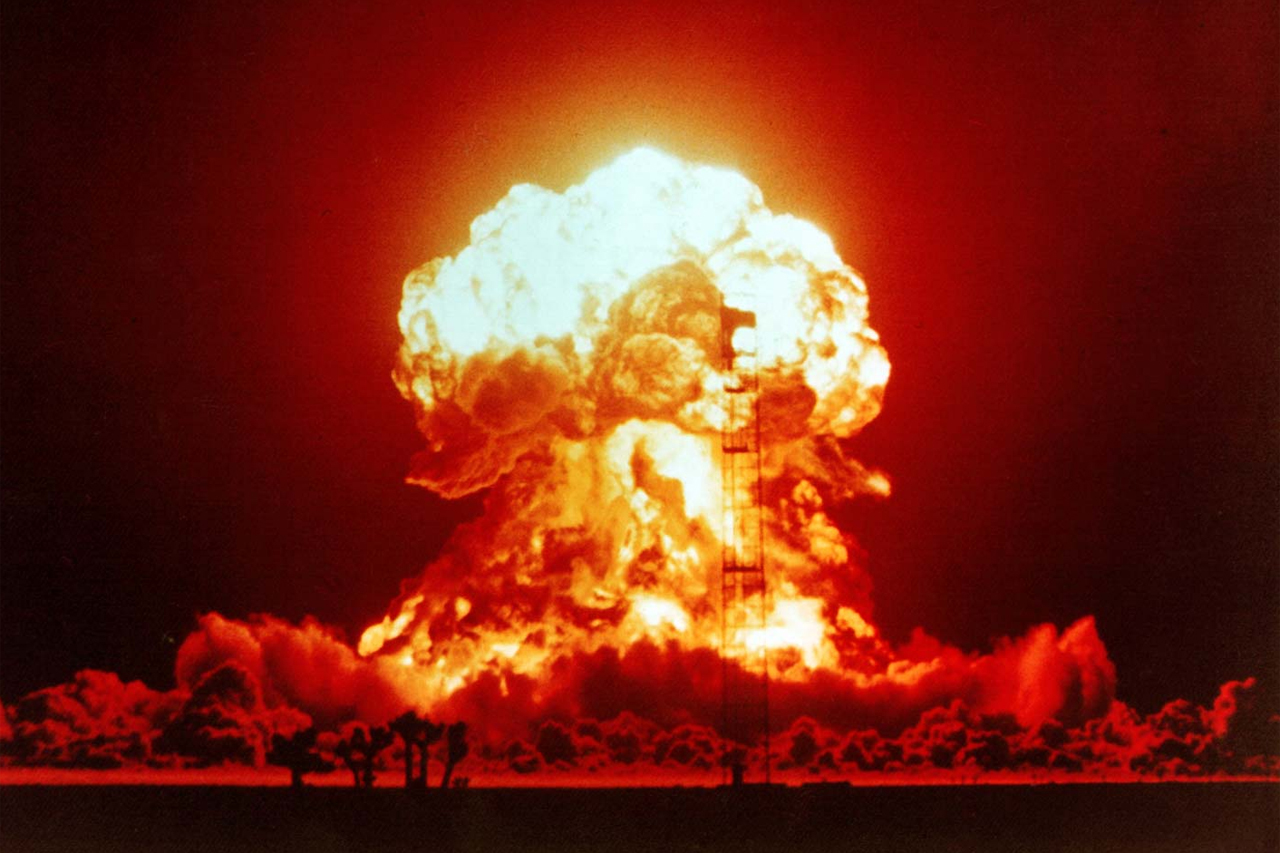
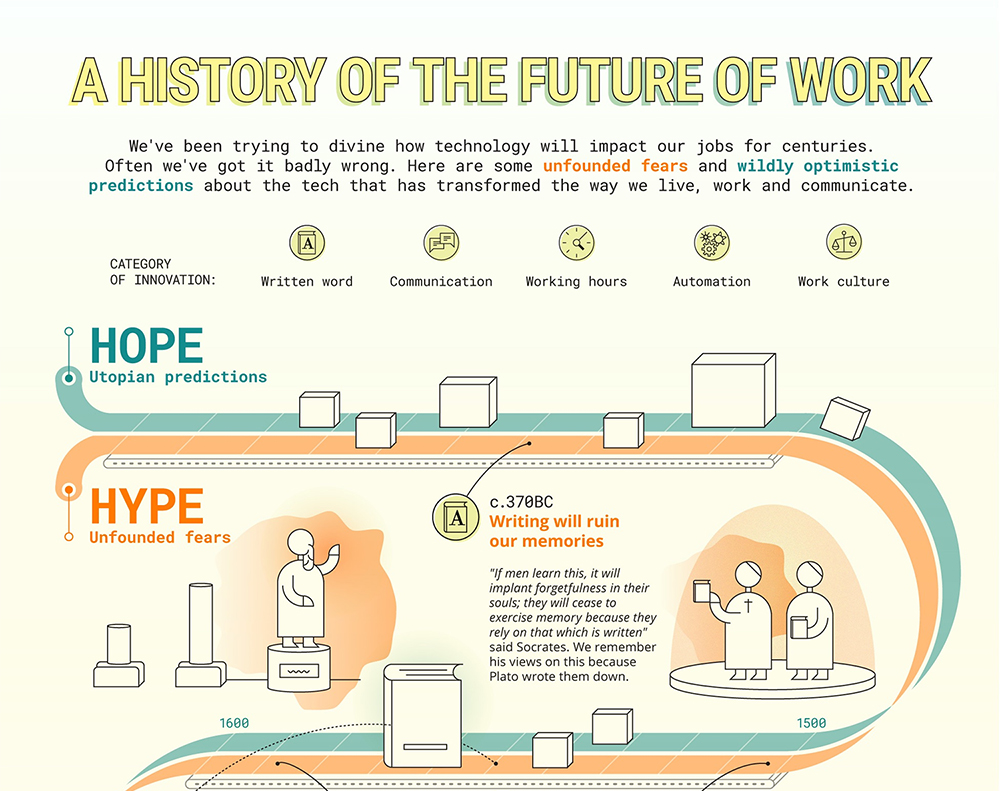
Whether through data-driven estimations, science-fiction fantasies, or philosophical pondering, humans have made countless predictions about the future. However, many of these predictions were far from accurate. Some turned out to be excessively optimistic, imagining a problem-free utopia; others were excessively pessimistic, fearing humans would devolve as a result of ominous trends.
Some skeptics may accuse survivalists of falling into the pessimist category, but that shouldn’t be the case. It’s important that we draw the line between being ready for a variety of potential problems and being unreasonably certain that one specific doomsday scenario will occur.
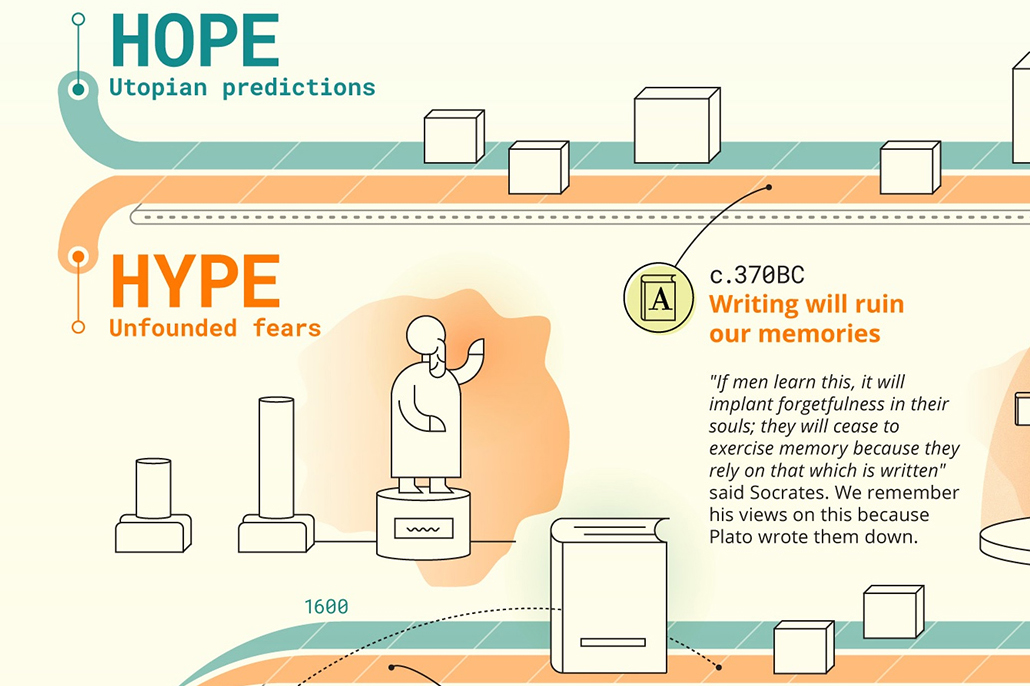
The following infographic from BBC Capital shows a few of these future fears and predictions that never panned out for industry, tech, and society — or at least not to the extent that was anticipated. Understanding these predictions can help you retain perspective next time someone makes a claim about the future, regardless of whether it’s certain doom or a perfect utopia. Click here to download a full-size version of this graphic.
You fled your home several days ago when you received word of mass rioting heading your way. You haven’t eaten since losing your bug-out bag to a horde of attackers two days ago, but you managed to get away with a few cuts and bruises — and most importantly, your life. You’re cold, tired, hungry… and still at least 20 miles from your bug-out location.
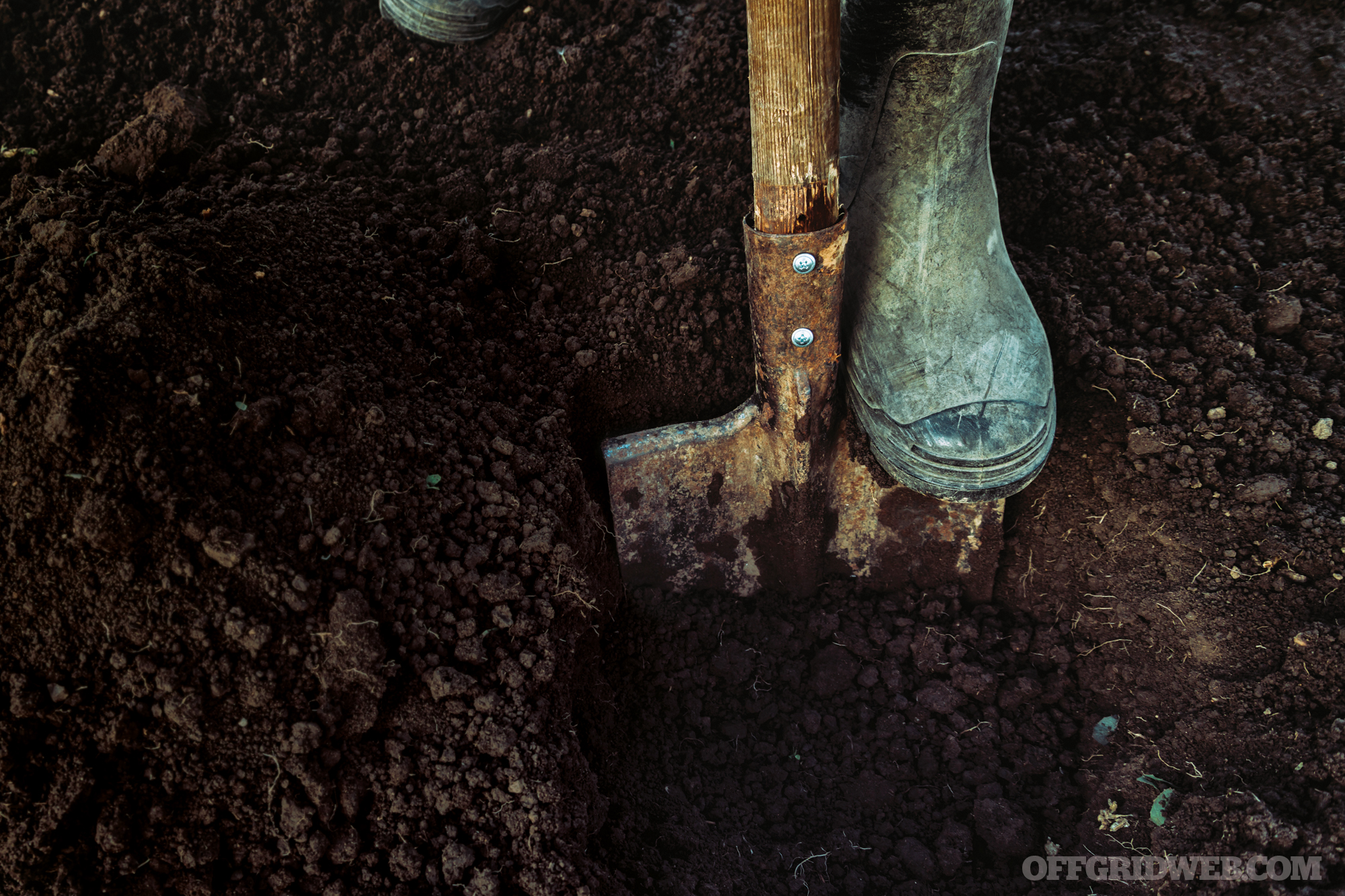
As you crest the next hill, your mood improves as you see how close you are to that proverbial X that marks the spot. Within an hour, you’ve dug up one of the caches you squirreled away along your planned route, and if your upturn of luck continues, you’ll recover the rest and replenish your supplies. You now have water boiling over a fire, almost ready to pour into a bag of freeze-dried food. You’re warm, dry, and just about ready to tackle the last leg of your journey. Morale is improving, energy is returning, and gratitude is at an all-time high because you’d taken the time to bury these important items. Who knows what’s become of those who thought they’d never encounter this situation and never bothered to stash some lifesaving tools.
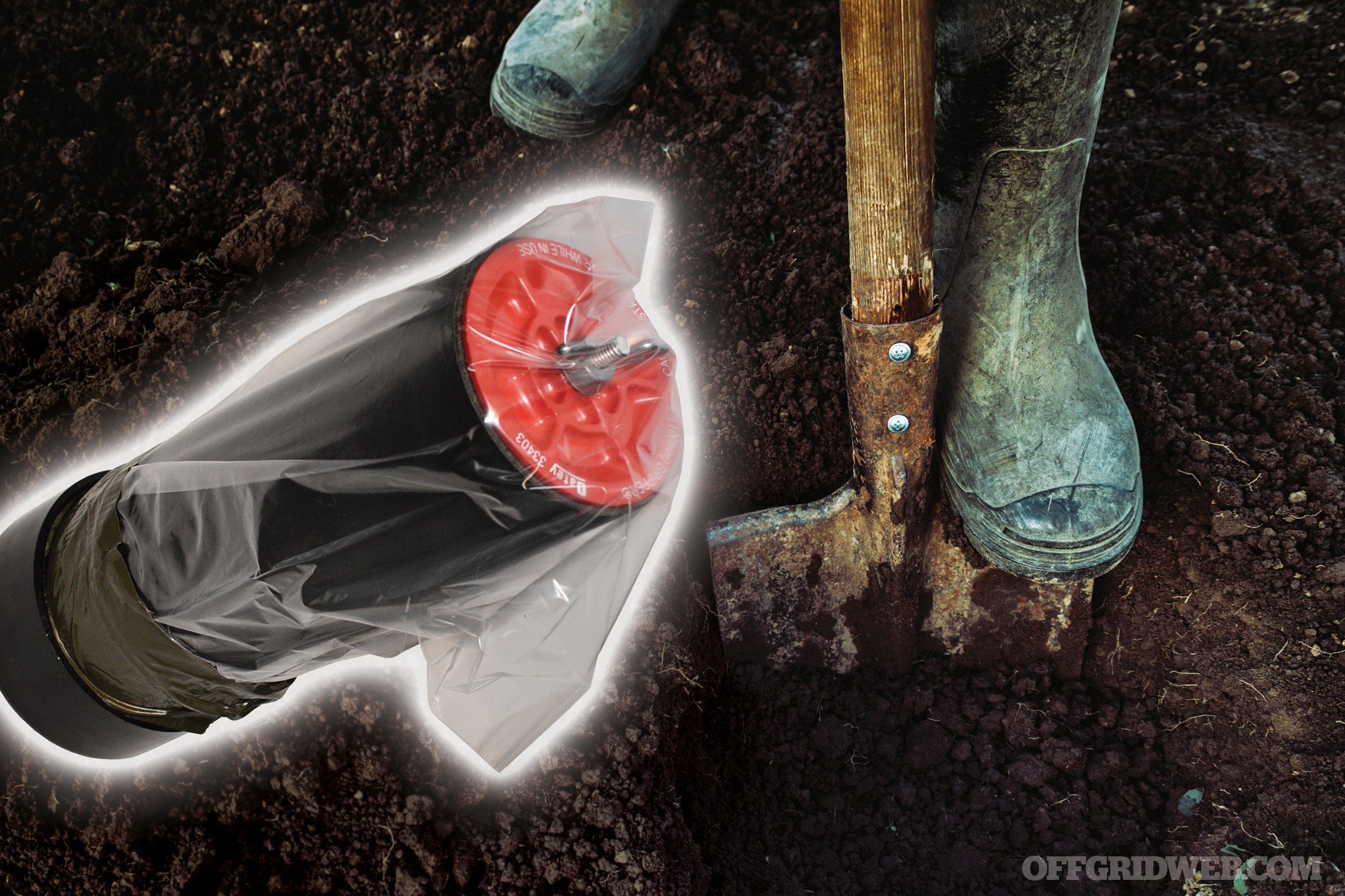
A cache, pronounced “cash,” not “cash-ay,” is simply a collection of gear and supplies you’ve hidden away for future use. For the last few decades, they’ve traditionally been made using PVC tubing of various diameters. I was first introduced to the concept back in the mid-1980s in a book by old-time survivalist Ragnar Benson.
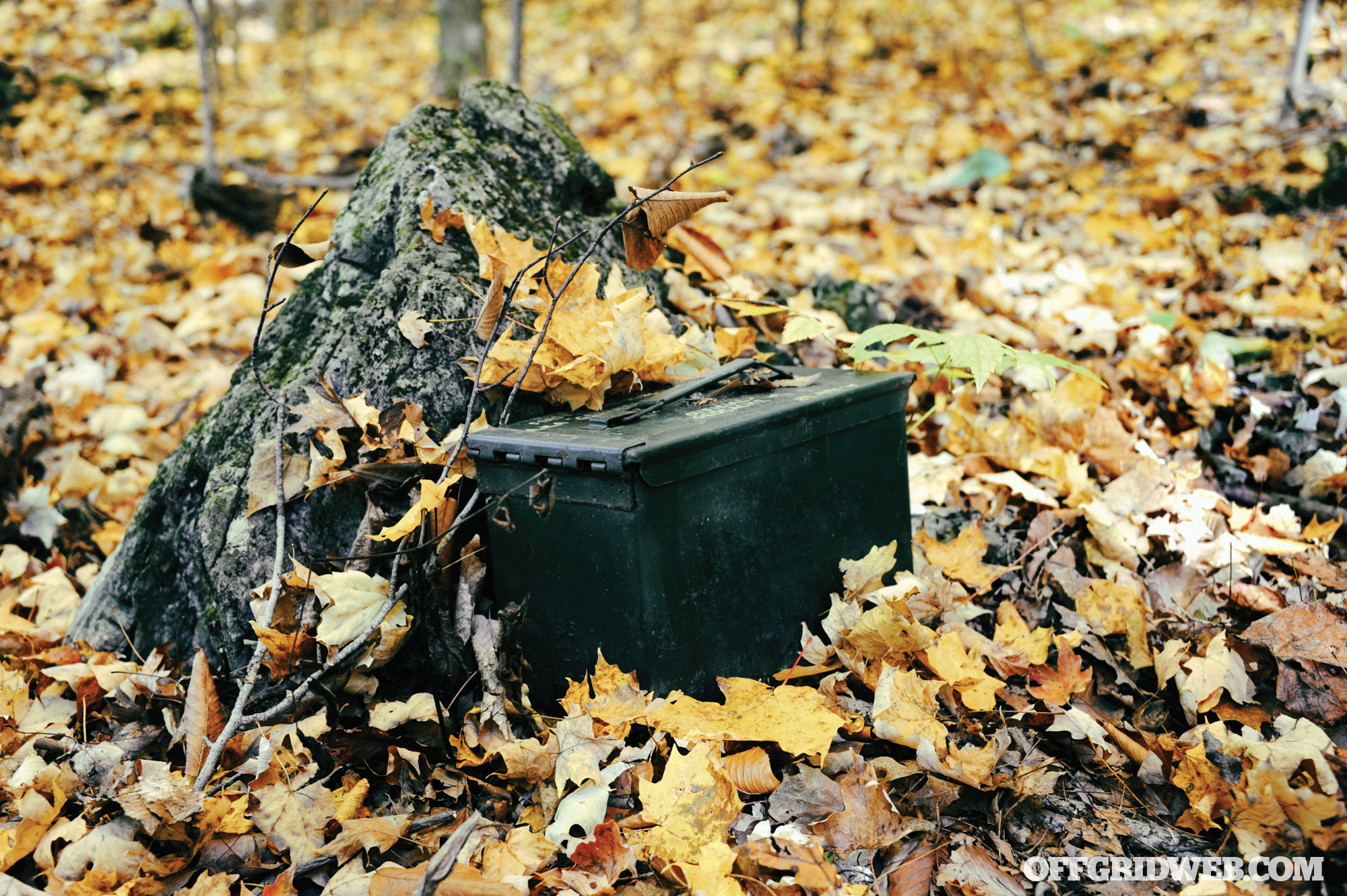
Other common cache containers include ammo cans and 5-gallon plastic buckets. The popularity of geocaching has led to the creation of many types of purpose-built cache containers in every imaginable size and shape, from small ones the size of a 35mm film canister to caches resembling a log.
The size of the cache container dictates what you can stash inside. Fortunately, many of the high-priority items we’ll want to cache aren’t that large.
What Can a Survival Cache Contain?
Shelter
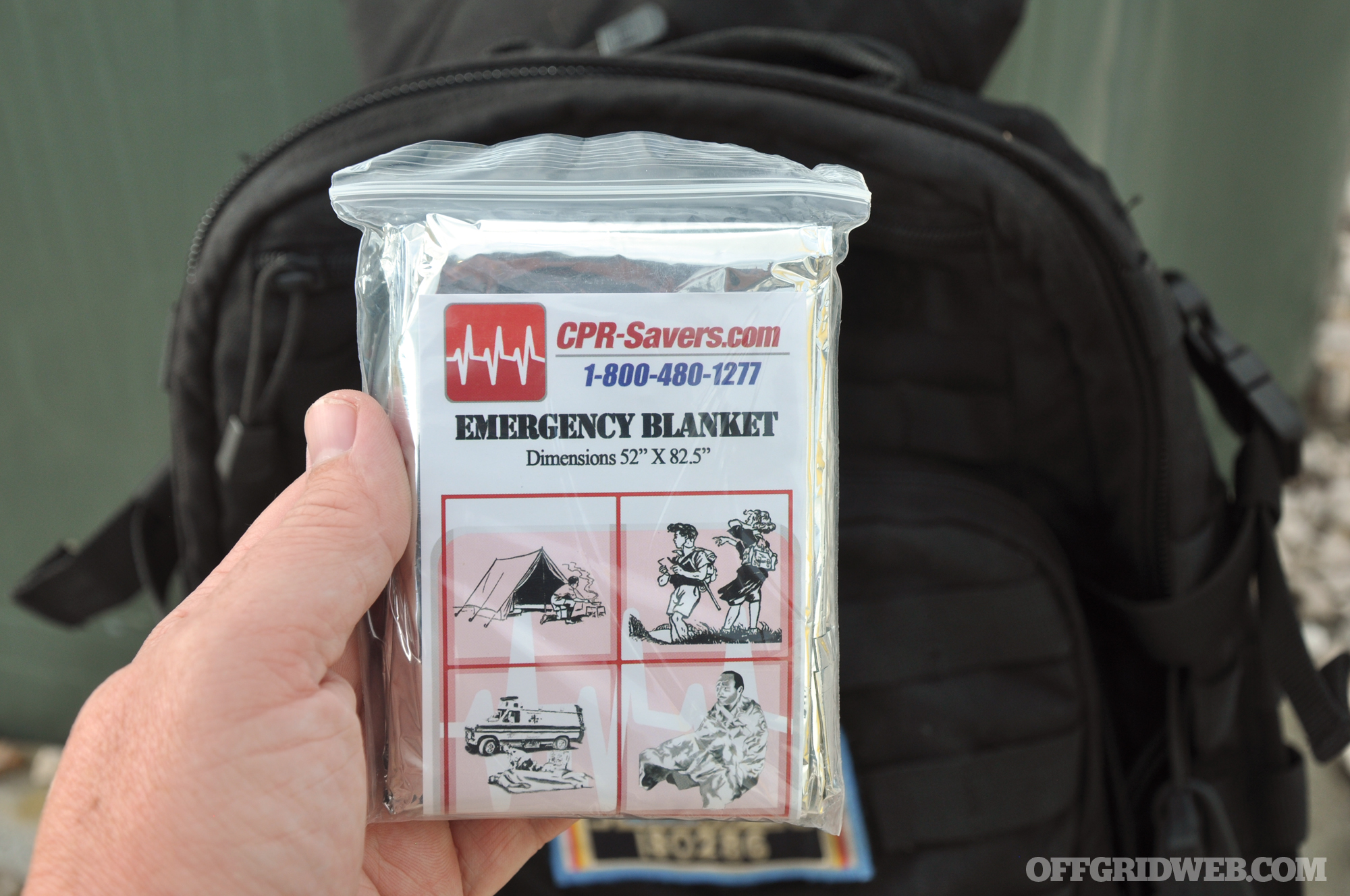
One of the first survival needs you may need to address is protection from the elements. If you read the news recently, we had snow in all 50 states at the same time. In other words, don’t overlook the importance of staying warm. Items such as an emergency blanket take up very little space in a cache. A bivvy may be beneficial as well. A wool hat, cold-weather gloves, and a shemagh will help if you’re forced to bug out in the cold months.
Space permitting, consider tossing in a small tarp and cordage, such as tarred bank line or paracord. This will allow you to construct an expedient shelter to protect you from rain, wind, or snow. An extra pair of socks may also prove to be something you never thought you’d be so excited to see again, especially if you’re desperate for warm, dry clothing.
Water
Use a two-pronged approach to meeting hydration needs with your cache. A variety of companies make water pouches. You often see these in first-aid kits; they’re small, easily storable, and filled with purified water. Most are rated to last a few years. Depending on the company’s ratings, the pouches usually won’t burst if they freeze, though you should be careful to bury your cache well below the frost line anyway.
Cache enough water pouches to prepare at least a couple of meals as well as to hydrate you and those you expect to be with you. Two pouches equal one cup, and there are 16 cups in a gallon. Health authorities commonly recommend eight 8-ounce glasses (or a ½ gallon) per person, each day. It may sound like a daunting task to cache this much water, but it’s all about prioritizing — you’ll be thankful you did if it means the difference between life and death.
In addition to the water pouches, the second prong to fulfill your hydration needs would be to cache a small water filter and collapsible container. Check out RECOIL OFFGRID Issue 15 for our buyer’s guide on water filters. A receptacle for water, like the Aqua-Pouch from Survival Resources, folds flat, and takes up almost no space in a cache, but will hold a full liter of water when deployed.
Food
Storing food items in a cache can be somewhat problematic as you can’t rotate the supply like you would at home or in your bug-out bag, but that doesn’t mean you’re totally without options. What you put in your cache might be there for years, and it’s up to you to be cognizant of when it was stored and how long it’ll last buried.
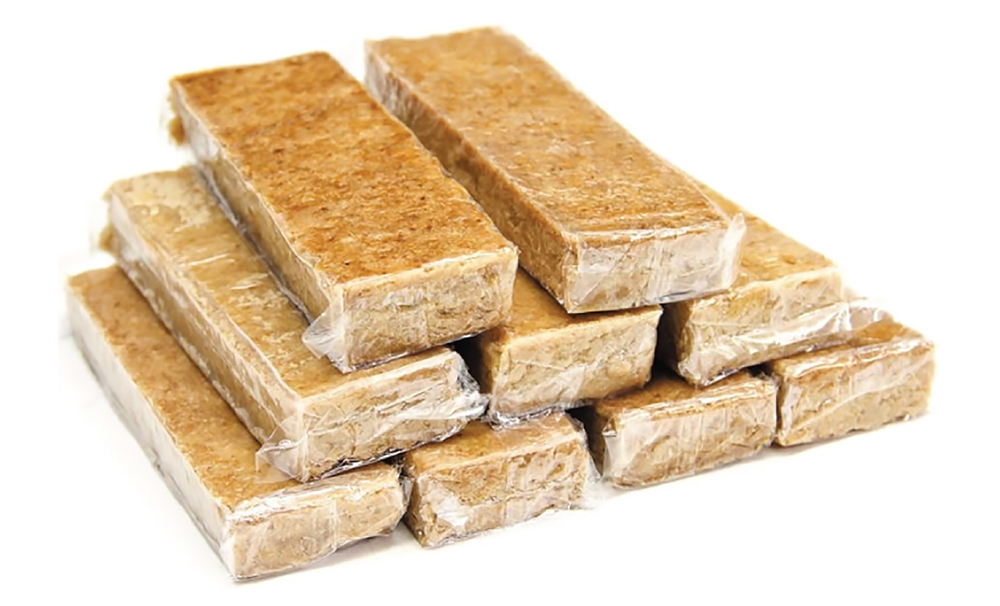
Stick with dehydrated or freeze-dried options. These require nothing more than hot water to prepare, and you can rehydrate the food right in the pouch. The amount of water needed is noted on the pouch, typically one or two cups. It isn’t absolutely necessary to use hot water. Cold water roughly doubles the time needed to rehydrate the food, but hot water does improve the taste considerably and won’t decrease your core temperature.
Depending on the size of your cache, a metal pot large enough to boil water as well as utensils could also be stored. Check out our portable utensil buyer’s guide in Issue 23.
Fire
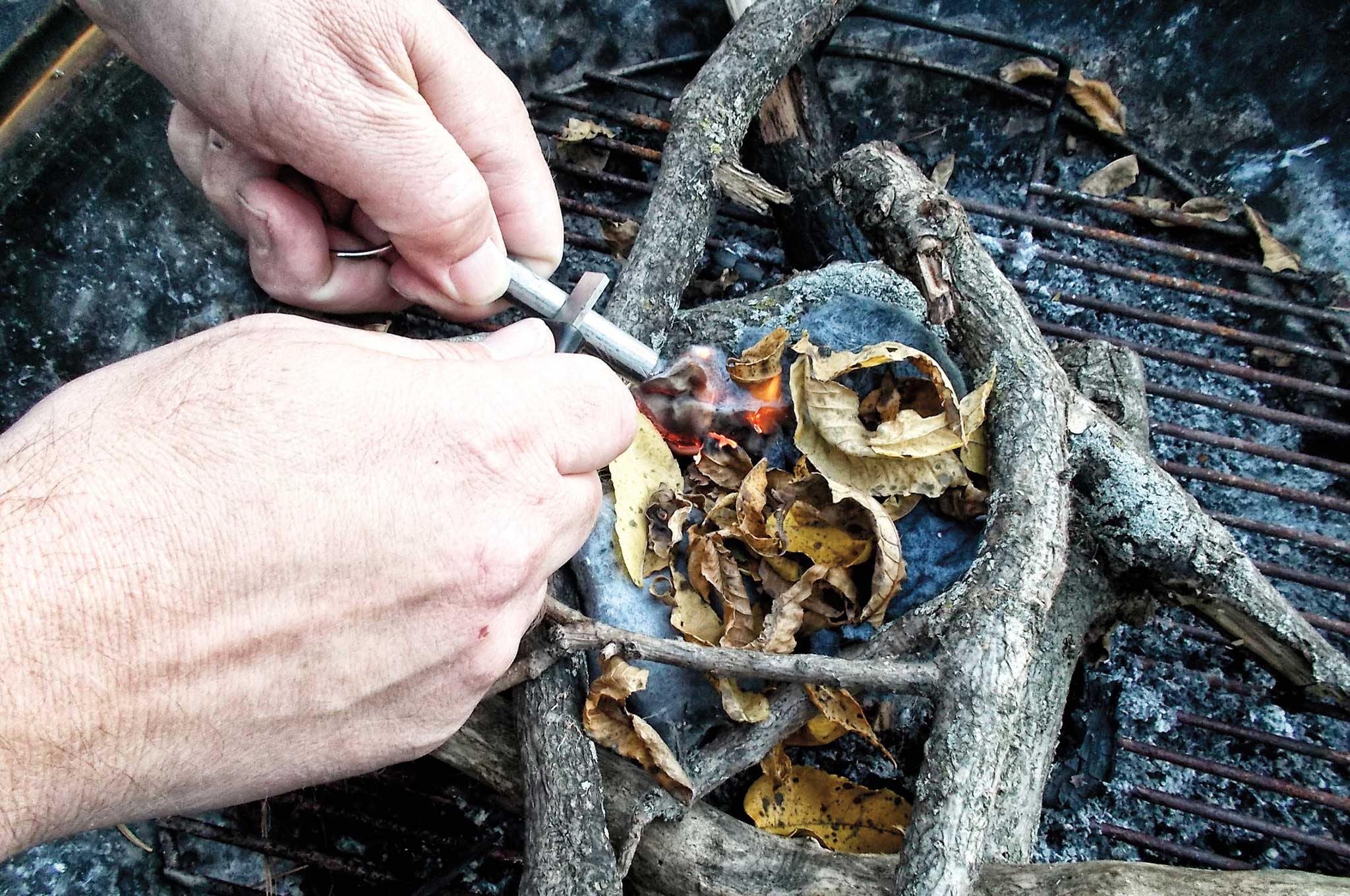
Fire is life. You’ll need a way to heat the water for your freeze-dried vittles, stay warm, dry out, and just generally keep your morale up. Store multiple ways to light a fire. Options include good quality disposable lighters like BICs, a waterproof container of strike-anywhere matches, and a ferrocerium rod with a striker. Waterproof matches should also be considered. Bottom line — have multiple methods to start a fire stored in case one unexpectedly fails.
Packing lighters in a sealed plastic bag will help reduce any chance of corrosion if your cache leaks, or having fuel from the lighters leak and affect other stored items. In addition, pack tinder of your choice in a sealed container within the cache so it stays dry. Instafire is a great store-bought option, as are WetFire Cubes. A common DIY option is cotton balls smeared with petroleum jelly. You won’t want to deal with finding dry tinder if it’s pouring rain out.
Tools
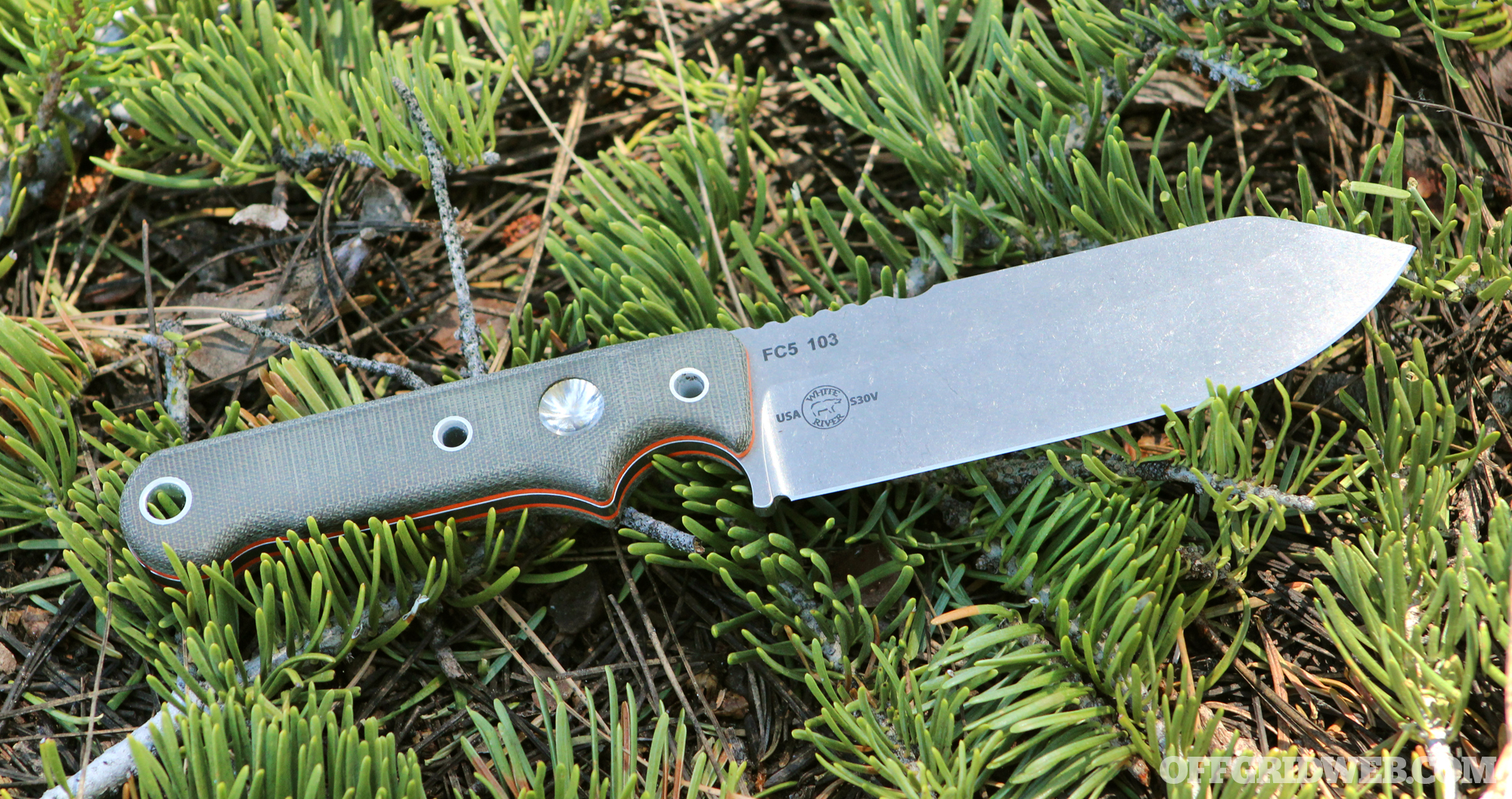
A good knife is one of your most valuable assets in a survival situation. Got a few? Stash one in each cache you create. Lighting is also beneficial, so think about storing some flashlights in your caches. Store the batteries separately from the light. Toss in a few chem lights as well. They glow very bright and don’t require batteries to operate; simply crack and shake.
First Aid
You, or someone with you, might very well be in rough shape when it comes time to access the cache. Adhesive bandages, gauze pads, and other basic first-aid items should store just fine. As for medications, if they’re kept cool and dry, most remedies will remain viable for many years, even after the stamped or printed expiration date on the package. Exceptions to this include nitroglycerin and insulin. For each medication you plan to include in the cache, do your homework and talk to a pharmacist or your doctor to determine just how long they’ll remain useful and under what conditions they’ll become toxic or ineffective.
You can also use a vacuum sealer (see Issue 10) to seal and protect items that you store in your cache. Items in vacuum sealed bags aren’t too pliable once they’re sealed, so give some prior thought to how you group your items and consider trimming bags to fit your items.
A cache is a great way to supplement your bug-out bag and other gear. Like most of our survival supplies, we hope we’ll never truly need them, but it’s reassuring to know it’s there.
Making Your DIY Survival Cache
Creating a PVC Pipe Storage Solution Guide by Ryan Houtekamer
There are many reasons why you’d want to build a watertight storage container. Here we walk you through one method to make your own, small cache.
Tools and Parts Required
Tape
ABS or PVC pipe cement
Handsaw
Thick grease
2x plastic bags
Test plug
Sandpaper
PVC or ABS pipe of required diameter
PVC or ABS pipe endcap
String/paracord
Desiccant
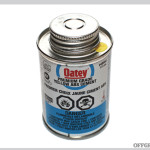
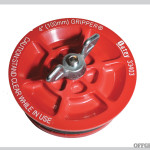
A few of the required materials are pictured above: 1. 1-foot ABS pipe 2. Desiccant package 3. ABS cement 4. Test Plug
Your first trip should be to the hardware store to pick up some ABS or PVC pipe. We chose 4-inch-diameter ABS. It has a fair amount of space to store supplies, is easy to bury, and fits easily in hand or a bag. You’ll also need an endcap, test plug, and some PVC or ABS cement.
Black tube is ABS; white is PVC. For all intents and purposes for building a cache, you can’t go wrong with either. ABS is said to be a bit stronger and able to better withstand cold, but it’s really more a matter of using what’s available and large enough to store the contents you wish to cache.
These pipe segments are the main components of your storage system. You can cut or have a length of pipe cut to your preferred size at the hardware store, but for this cache project, we focus on a 1-foot length of ABS pipe.
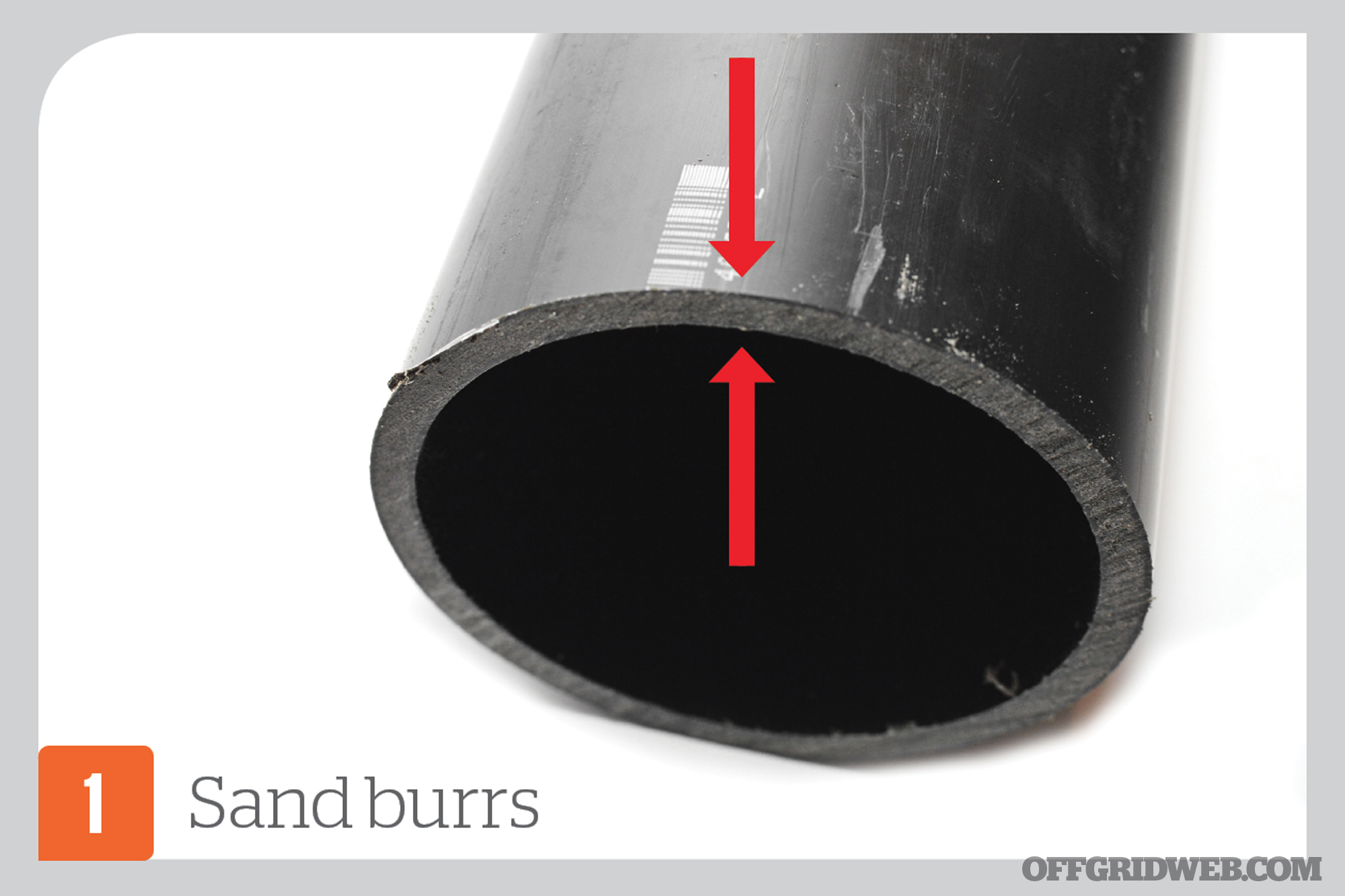
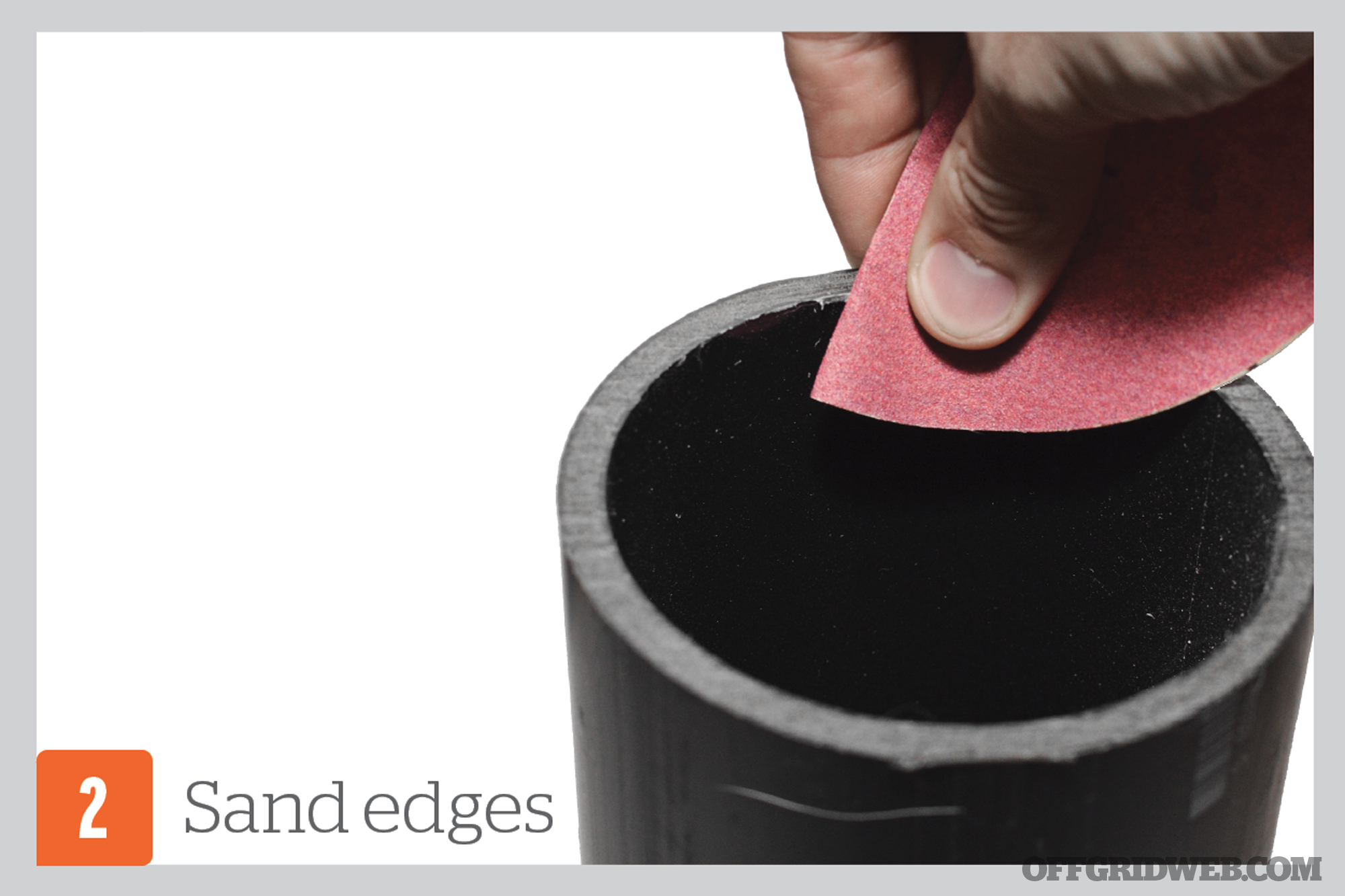
You can cut it yourself using a chop saw or handsaw. The taller your blade, the straighter the cut you’ll get. A hacksaw will tend to wander when you make the cut, so try using a regular handsaw for wood. Once you’ve cut your pipe, clean the edges of the pipe to ensure it seats well. Run a fine-toothed file or a piece of sandpaper over the outside and inside edge to clean it up. This will get rid of any burrs from cutting it and allow you to get a better seal.
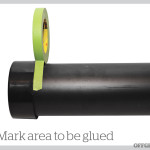
Next, test-fit your endcap onto the pipe and use tape to mark where it ends on the tube. This isn’t obligatory, but it ensures that you cover the entire area of overlap with adhesive. When taping something that you plan to remove, double over the end of the tape to make a small tab. This makes it much easier to pull off.
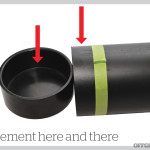
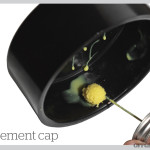
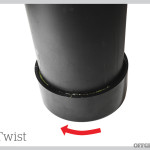
Take the cap off and run the brush from your can of cement around the inside edges of the cap. Do the same for the outside surface above the tape on the pipe. Don’t worry about getting adhesive on the tape since you’ll pull it off later. Remove the tape and slide the cap on. Give the cap a quarter turn, as this will help the adhesive spread out.
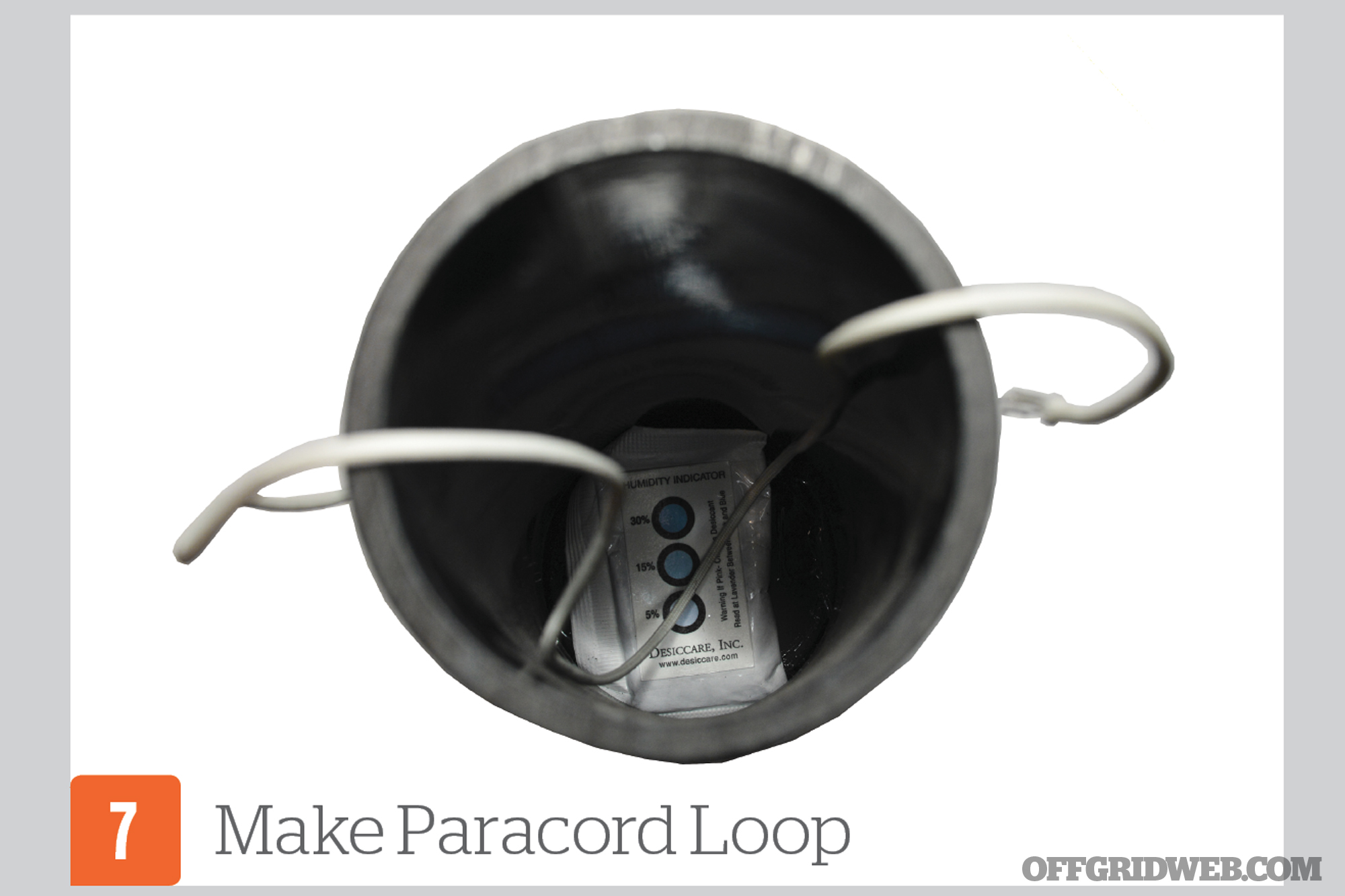
With the bottom capped off, wait until the cement has dried and start placing items inside the tube. The first thing you should put in the tube is the desiccant pack. This will help control any moisture inside the pipe. If you can’t procure a desiccant, you can improvise with a small sock filled with cat litter.
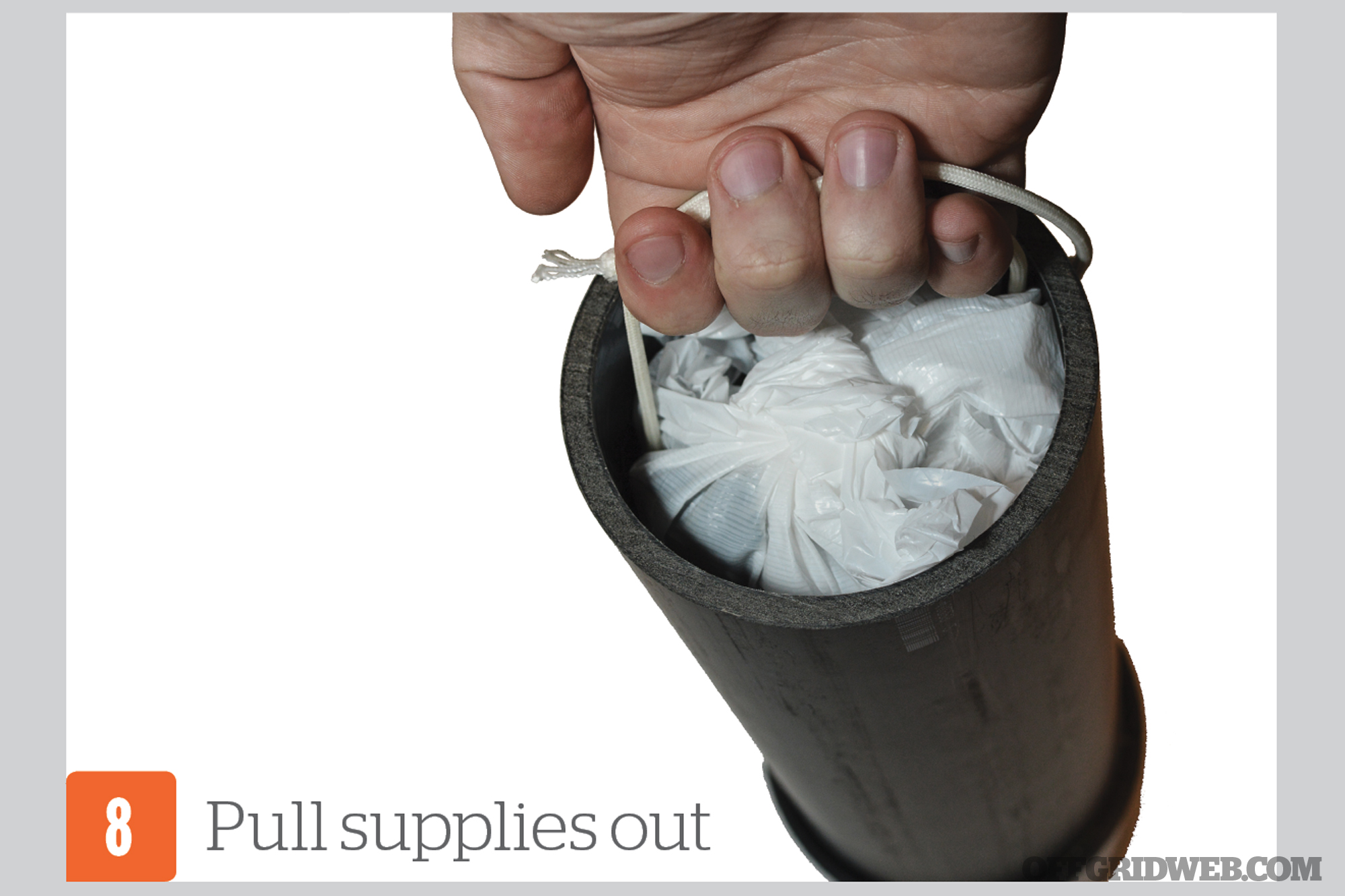
This next part is optional, but we definitely recommend it. Place your items in a bag and wrap a loop of cord around them, which will make much easier to pull the items out of the tube later (think of how some tubes of survival matches are packaged). We also toss another desiccant pack in the bag. Never hurts to ensure your contents stay dry.
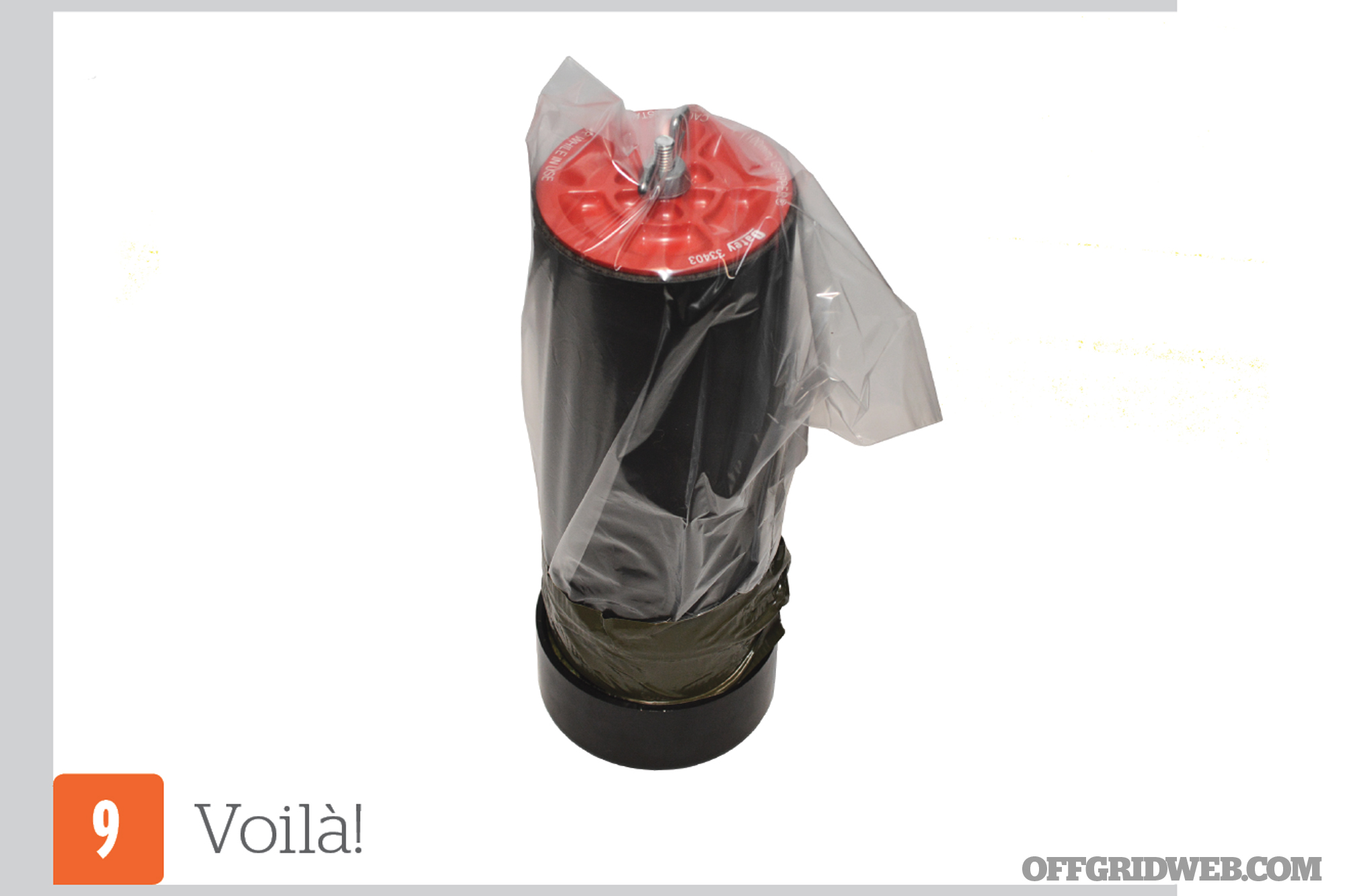
With your desired items stuffed in the tube, we need to seal it from the elements. This is where the test plug comes in. You may have seen other caches constructed using a screw-on PVC endcap. The issue with this method that you might need a wrench to open it. The test plug uses a butterfly nut that you can screw with your fingers to get a seal.
When you tighten the nut, it crushes the rubber seal, forcing it into the interior walls of the pipe. We recommend greasing up the metal parts heavily, though, to save you some grief later. For a bit of added security, take your last bag, toss it over the pipe, and then tape it to the pipe. This will keep any excess moisture from affecting the test plug and your metal parts. When you dig it up, you just need to tear through your bag and unscrew the top.
Selecting Cache Locations
Once you’ve built a cache, you need to find a home for it. One of the best locations, of course, is hidden on property you own. If you own the property, there’s nobody to complain about digging holes. Next on the list would be property owned by someone you know and trust and who has given you permission to place a cache there.
The next option is public land. Here’s the thing, though — legalities. There may be a nice park down the street that has an out-of-the-way corner you like or you might fancy the area right beneath the headstone of a deceased relative, but if there’s a big patch of dirt that looks like it was recently dug up, some city employees or groundskeepers who routinely landscape and service the area might check if someone put something there they shouldn’t.
The trick is to find places that won’t be disturbed or look like an obvious burial site. You wouldn’t put that hide-a-key that mimics a rock in an area where it’s the only rock and sticks out like a sore thumb, would you? Even if you have that perfect place next to a power pole in an easement that gets little foot traffic, you’re likely prohibited from digging in public locations. But like Ed Calderon (featured elsewhere in this issue) would say, “What you’re allowed to do and what you can do are two different things.”
Think it through and determine what direction you’ll likely head in an emergency and bury caches along the way in areas that make sense. Do your research on the ownership of the land, any proposed future construction, or any other circumstances that could put you in jeopardy if your belongings are found. If you cache a firearm, you can imagine what would happen if someone finds it. If you feel you have to store in locations that flirt with legal ramifications, do so at your own risk.
Also, don’t be like Vern in Stand By Me, with only a general idea of where your jar of pennies was buried. Keep a map (and copies of that map) in your bug-out bags, vehicles, in your wallet, and anyplace else you can think of to help you easily locate your caches. Practice finding them to help become more familiar with those locations in case of an emergency. Sometimes geography, foliage, landmarks, and various other surroundings change over time. Think of all the times you’ve returned to a location a year later to find that it looks quite a bit different. What good are caches if you can’t find them? Check your locations at regular intervals to ensure your survival trove is still there.
Storage Units: The Ultimate Cache?
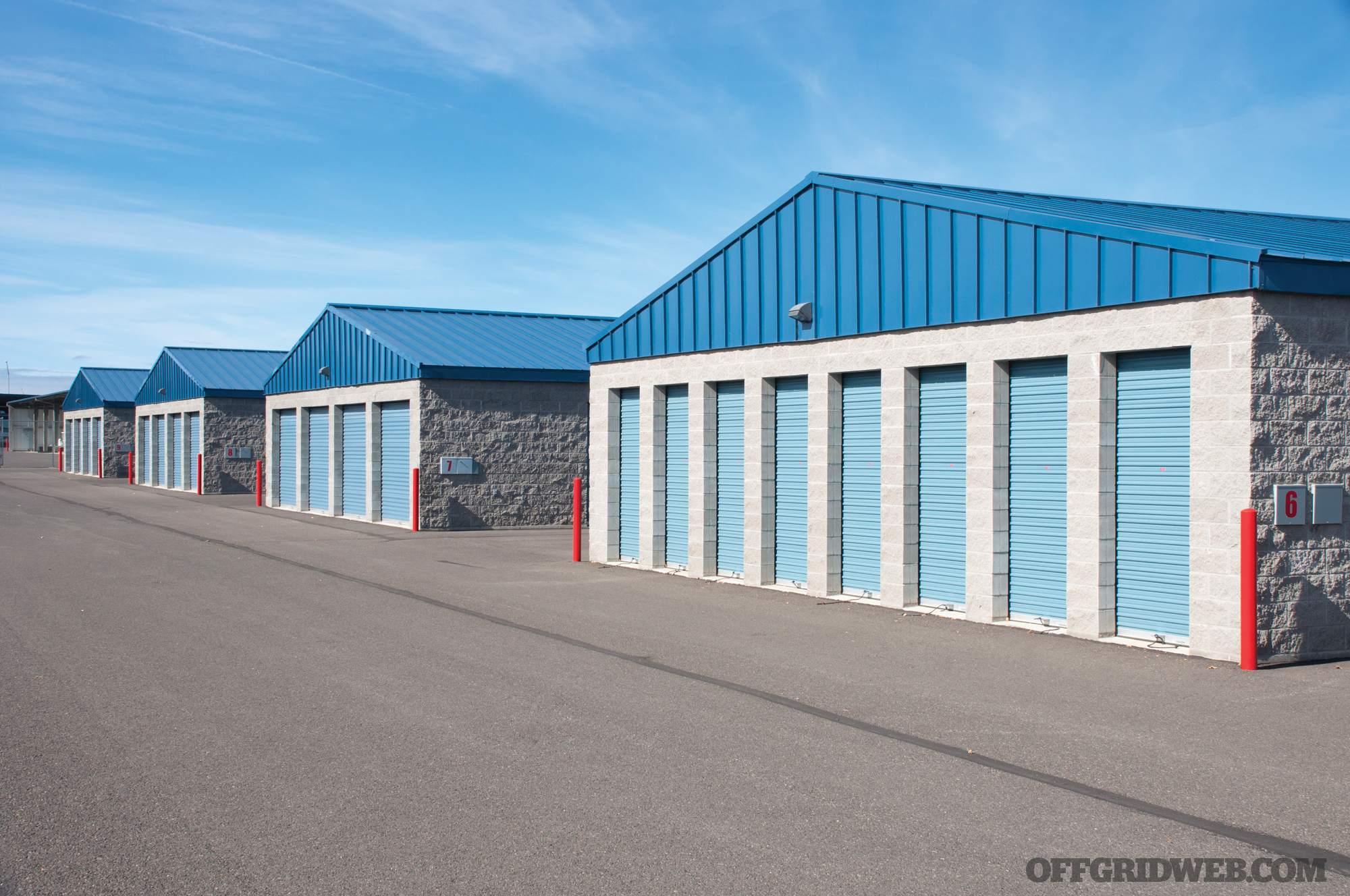
We know what you’re thinking. Self-storage places are usually in the heart of the city, and that’s exactly where you don’t want to be if things are falling apart. Look a little harder, and you’ll probably find storage places that are off the beaten path but still readily accessible.
Many people use a storage unit at some point. Why not have it serve double duty? Choose a location that would be along your bug-out route and that isn’t likely to be a bad area to visit in a crisis. Along with your old dishes and photo albums, store some survival gear and supplies. Make extra sets of keys to keep in various places so you won’t have a problem accessing it. This isn’t a perfect solution for everyone, but for those who can make it work, it might be exactly what they need.
While the average hiker may walk right past valuable natural resources, any experienced outdoorsman or survival instructor can tell you that just about every natural material has potential uses. A single tree might yield fatwood or tinder fungus for fire-starting, pitch for glue or improvised chewing gum, needles for tea, edible mushrooms, or grubs for baiting traps. Even items we normally dispose of, such as food waste, can be repurposed or used for composting. Understanding the value of each resource and using them to their fullest will improve your ability to survive.
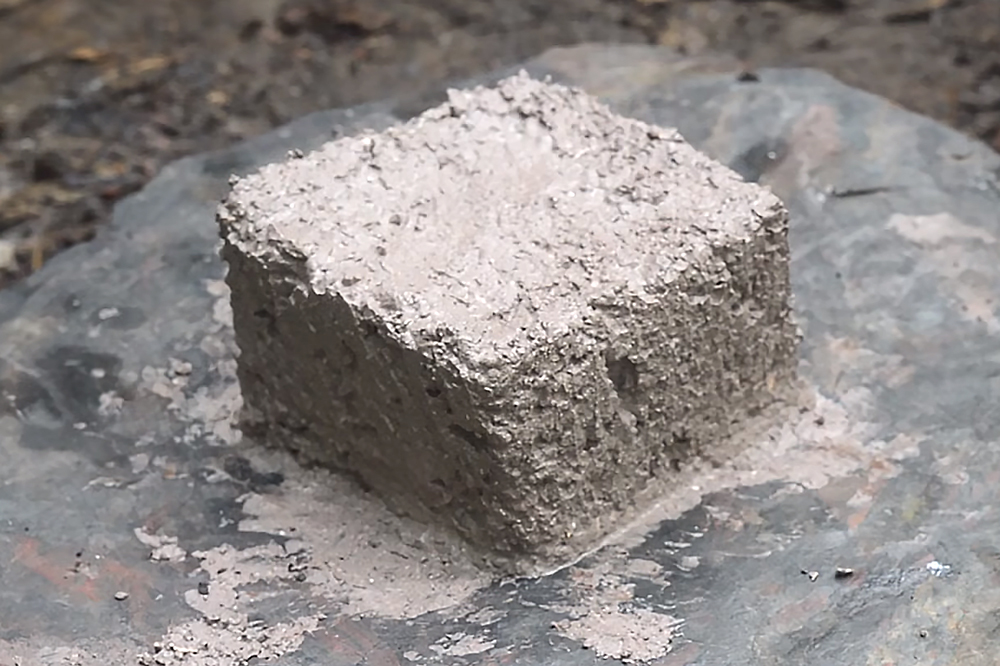
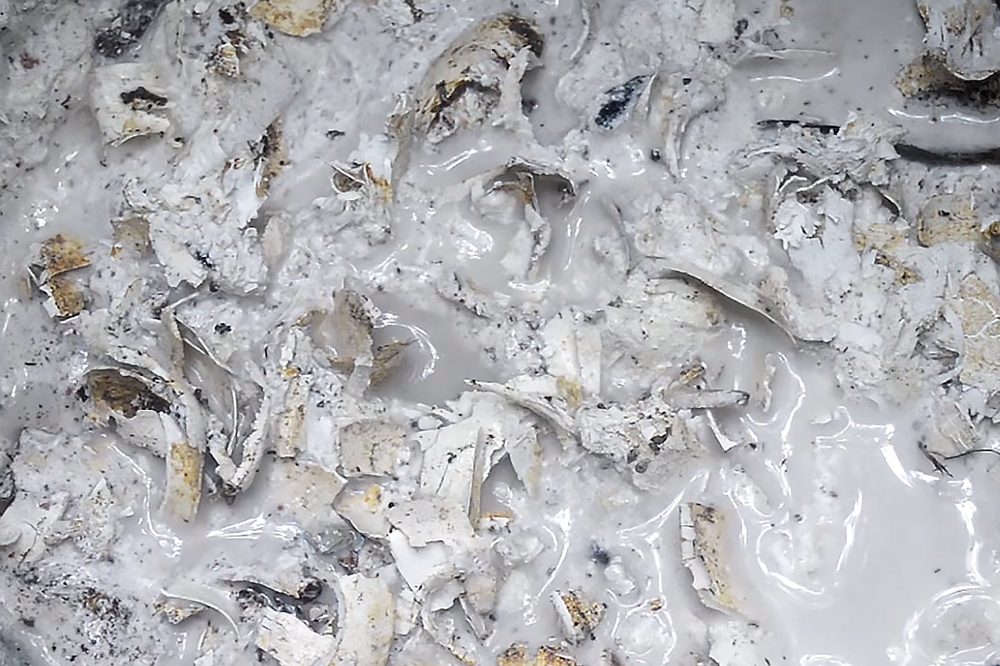
In his latest video, the Aussie survivalist behind Primitive Technology makes use of an item most of us would overlook: snail shells. Knowing that these shells are rich in calcium, he processes them into lime mortar. This material can be applied to seal gaps between stones or bricks, or it can be used on its own to construct shelters.
Lime mortar has been in use for more than 6,000 years, and was seen extensively in Ancient Egyptian, Roman, and Greek buildings. The durability of these structures has been attributed partially to the strength and weather-resistance of this substance. So if you’re looking to build a long-term shelter from natural materials, lime mortar is a great choice.
Check out the video below to see Primitive Technology process snail shells into water-resistant mortar:
Although snail shells will suffice for creating small quantities of lime mortar, gathering and processing these shells is painstaking — the video description states as much. If you’re not interested in gathering hundreds of snail shells, you can also use egg shells, seashells, or coral. However, the easiest way to make lime is to find a natural source of limestone in your area.
Photos and self-defense sequences courtesy of Amber Staklinski and Ryan Hoover of Aperture Fight Focused.
Sixteen years ago while working as a police officer for Salt Lake City PD, I was involved in an intense and frantic search for a missing juvenile. It was the stuff of every parent’s nightmare. In the middle of the night, a cold and calculated psychopath crept through the window of a teenage girl’s bedroom while her family slept. He kidnapped her at knifepoint and, with the help of his wife, subjected her to nine months of intense mental, physical, and sexual abuse. Miraculously, the victim, Elizabeth Smart, was found and rescued. Most victims of such crimes aren’t so lucky.
Women and children continue to be some of the most vulnerable members of society to crimes of this nature. On average, 321,500 people are victims of rape and sexual assault in the United States. Eighty-two percent of juvenile victims are female. Ninety percent of adult victims are female. Females between the ages of 16 to 19 are four times more likely than the general population to be victims of rape, attempted rape, or sexual assault. Not all crimes perpetrated against women and children are sexual in nature either. The sociopathic nature of violent criminals is to target those they perceive to be easy targets. Another alarming statistic is that there are 21-million people trafficked for sexual exploitation worldwide each year, 96 percent of which are women and girls.
So what steps can be taken to become less vulnerable? How can we teach our loved ones to be less vulnerable?
Not being aware of your surroundings will make you a target. Trust your instincts about things that look out of place, like a stranger approaching you while you’re alone. Scan the area and remove yourself from the situation if you feel something poses a threat. The fight you’re never in is the fight you’ll never lose.
Let’s examine some of the conditions and environments in which crimes against women and children commonly take place:
Rapes and Sexual Assaults
Where:
48% of victims were sleeping or performing another activity at home when attacked
29% were traveling to work, school, or other places
12% were working
7% were attending school
Who: Statistically, it isn’t a masked man hiding in the bushes who commits most of these types of crimes. Sixty-six percent of rape victims know their assailant, while 48 percent are raped by a friend or acquaintance. Thirty percent are perpetrated by a complete stranger.
When: The majority of rapes, 43 percent, happen during the six hours between 6 p.m. and midnight. The second highest six-hour window is midnight to 6 a.m., when 24 percent of rapes happen. The remaining 33 percent happen during the 12-hour time frame from 6 a.m. to 6 p.m.
Alcohol is commonly a factor in rapes and sexual assaults. It’s the most common substance utilized in drug-facilitated sexual assaults, considered the number-one date rape drug. Approximately 50 percent of sexual assault cases involve use of alcohol by the perpetrator, the victim, or both.
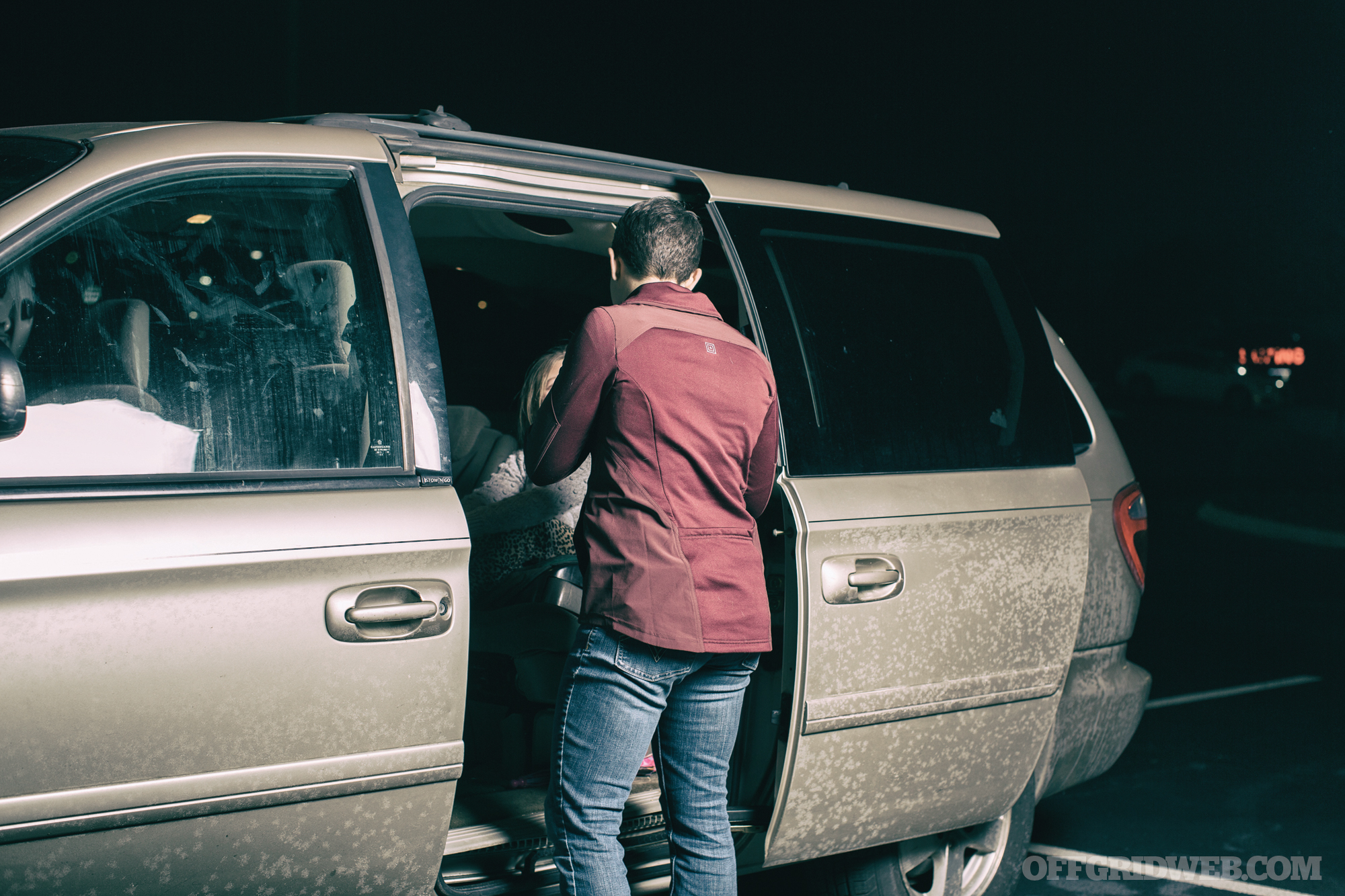
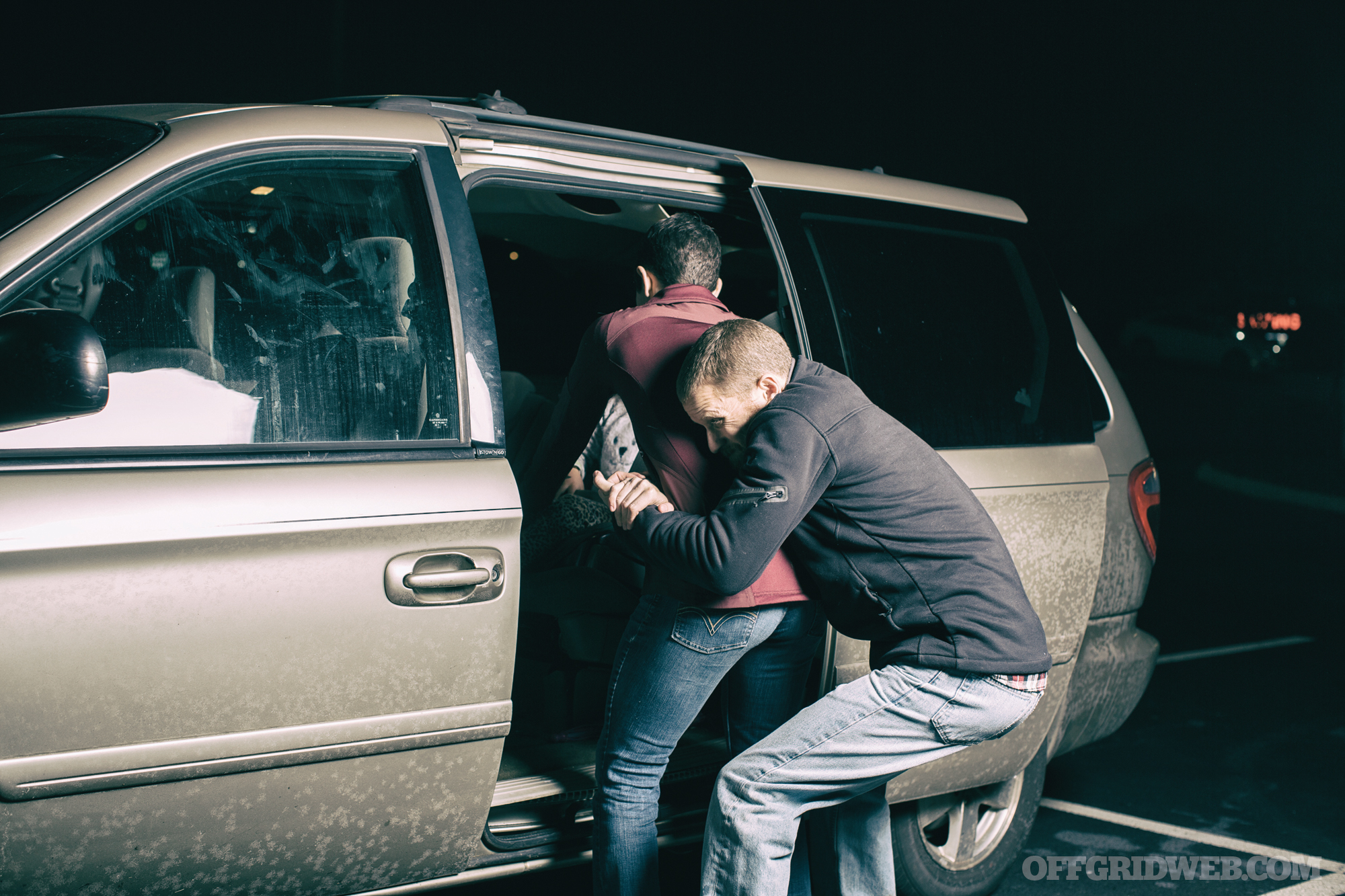
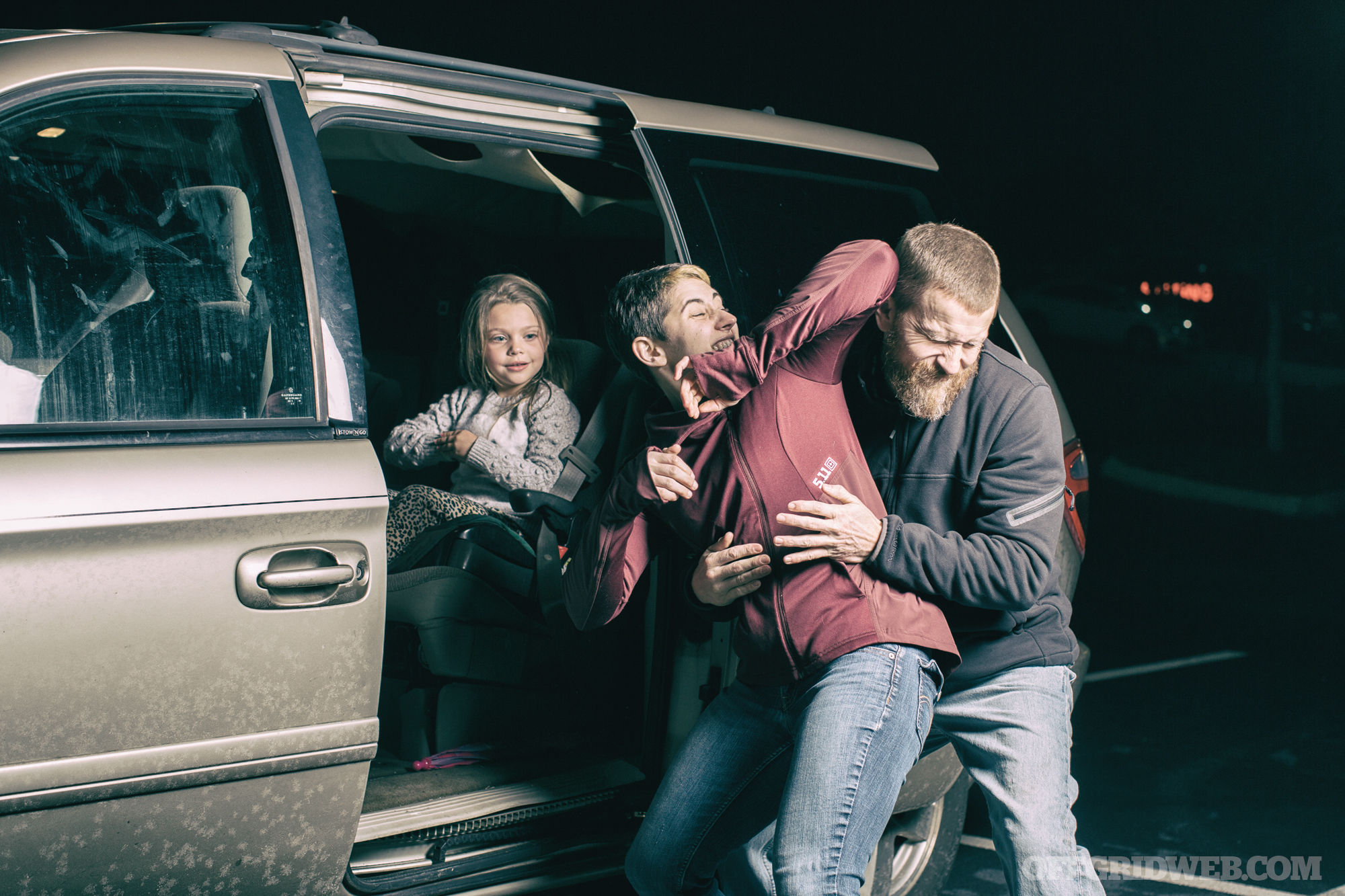
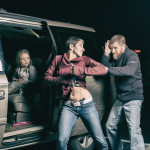
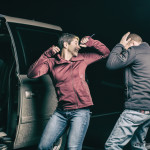
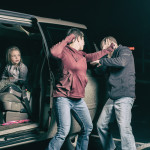
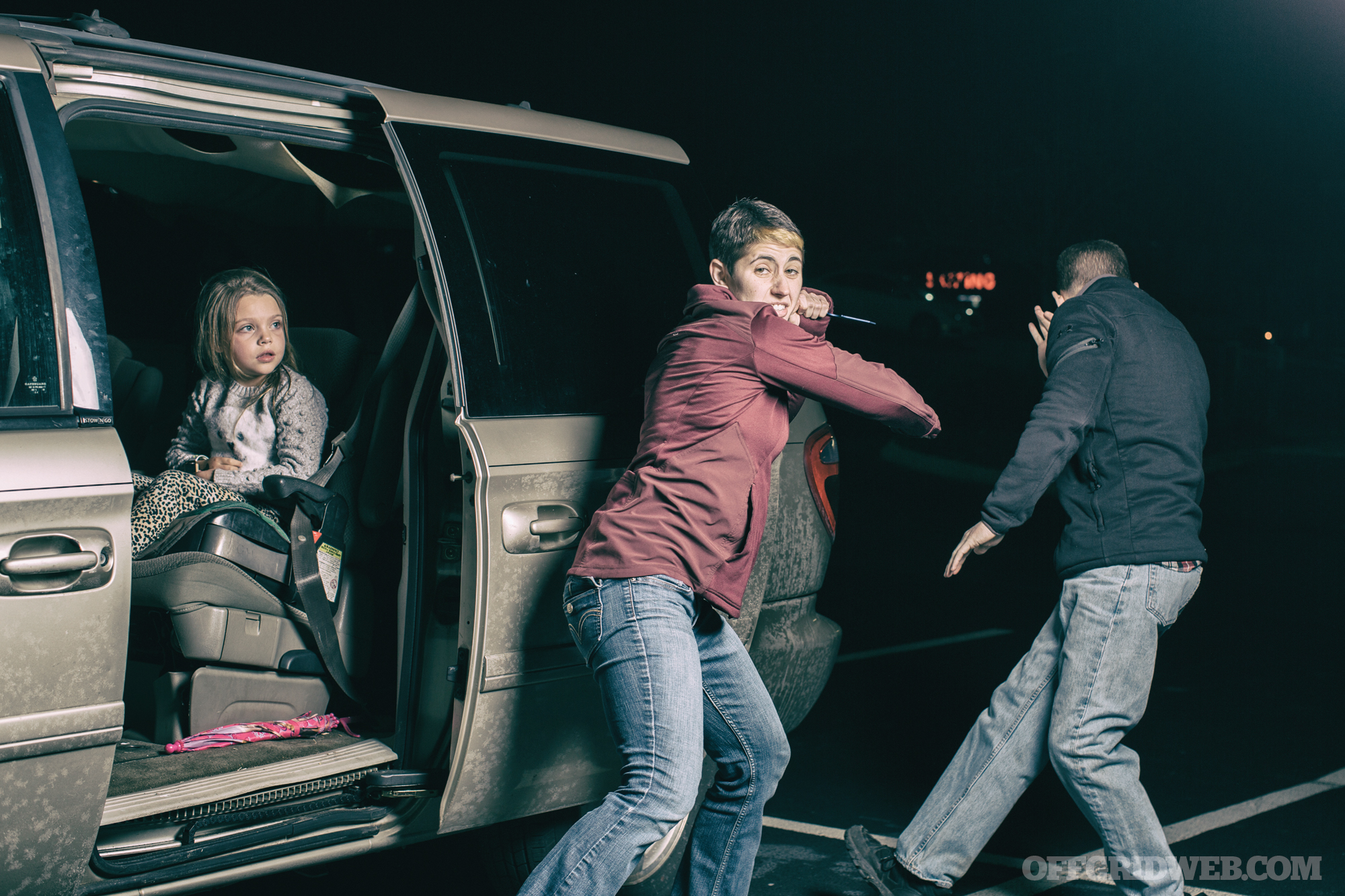
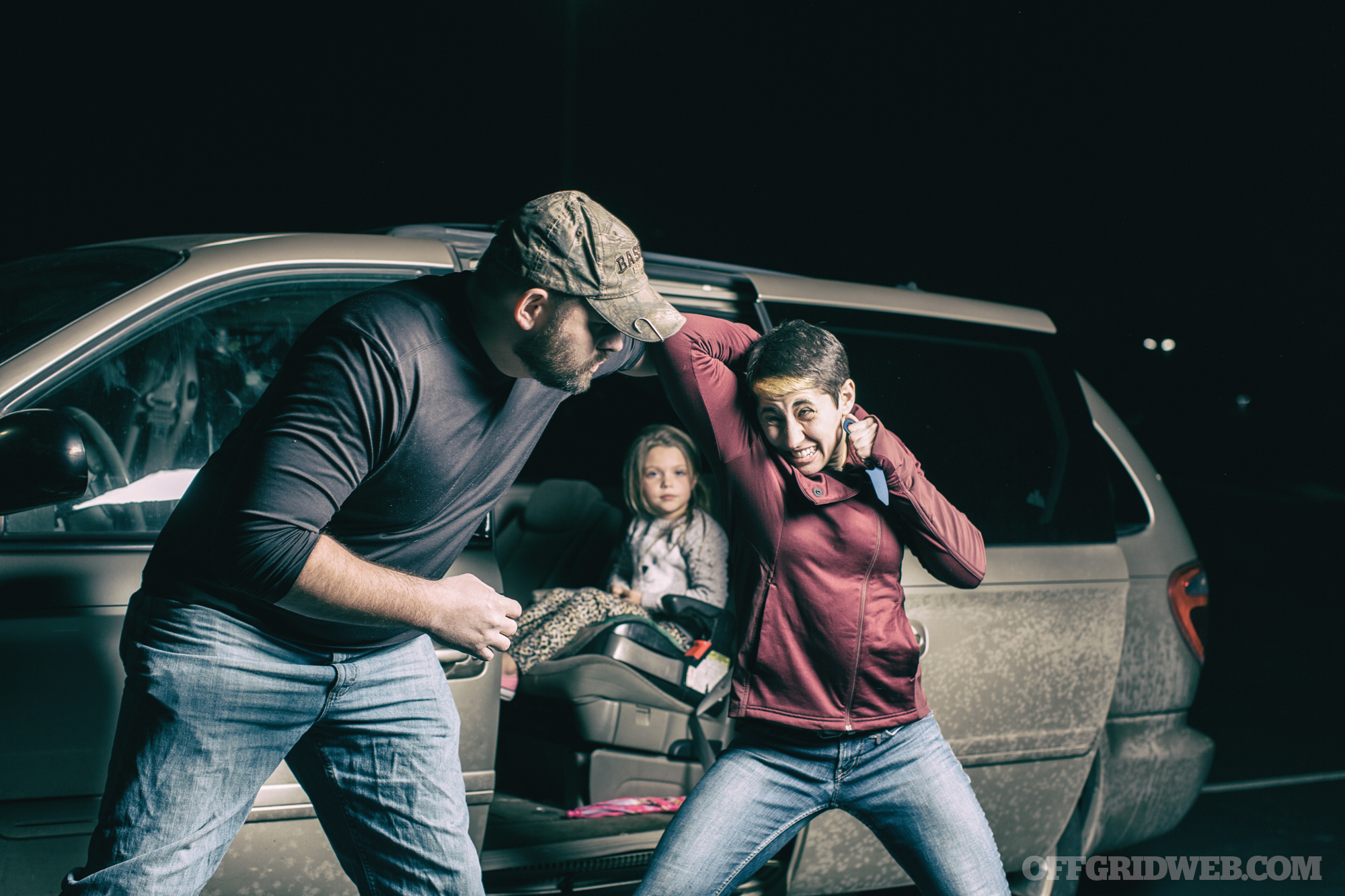
Self-Defense Demonstration #1
1. A woman loses focus of her surroundings while buckling her daughter into her car seat.
2. She’s grabbed around the waist from behind by the first attacker.
3. She lowers her base and gets her hips away from the attacker, making it more difficult for him to lift her. As soon as she breaks his grip, she attacks with elbows to the head.
4. While continuing to strike and turning to face the attacker, she draws a concealed fixed blade knife from her waist.
5. She stays on the offensive, using the knife as an extension of her hand. She continues to strike with her empty hand while stabbing and slashing at the eyes, neck, and whatever targets she can reach with the knife.
6. After doing sufficient damage to ward of the first attacker, she turns to face second one. She keeps her face covered and hands up to stay protected and continues fighting.
7. The second attacker swings at her head. She defends the punch, using a reinforced high cover, while preparing to counter attack.
8. She counterattacks, punching with the pommel of the knife then stabbing and slashing until the second attacker flees.
Child Abductions
Where and When:
Child abductions are most commonly perpetrated or attempted when the victim is traveling to and from school, or school-related activities, between the hours of 2 and 7 p.m. This accounts for about 32 percent of these crimes.
In 70 percent of child abductions, the perpetrator was driving a vehicle, attempting to force the child into the vehicle. The average age of child abduction victims is 11, with 37 percent being between 10 and 14 years old.
These statistics help us understand the three themes that constantly reoccur when teaching about situational awareness: people, places, and things. Before learning physical self-defense techniques, the most important thing to understand is how to avoid being in a position where you’d ever need to use self-defense techniques.
Understanding statistics can help us know where, when, and how these types of crimes are committed, which in turn can help us with our general situational awareness — not making assumptions as to who is or isn’t capable of such crimes, and making sound decisions as to where we should or shouldn’t be, and what we should or should not be doing. It’s also important to train for situations in which no matter what steps we’ve taken regarding awareness and prevention, things sometimes just happen and we need to be prepared. At the end of the day, we can’t hide from the world, but we can prepare to defend against the bad people in it.
Jeff Cooper’s color codes can be valuable when teaching general situational awareness and are worth further study. As mentioned earlier, people, places, and things are constant themes that come up with Cooper color codes Let’s examine each of these themes in depth:
People: Many people wrongly associate negativity with the term “profiling,” when in reality profiling is an essential component of situational awareness. While profiling based strictly on race is certainly wrong, race is one of many factors that contribute to an individual’s profile. Other things include the individual’s gender, age, size, hair style and color, actions, clothing, demeanor, accent/language, verbiage, personal belongings, and odor, to name a few.
Does the profile of a person in your general environment stand out for some reason? If so, you might shift from Condition Yellow — general awareness — into Condition Orange, or a heightened sense of awareness of one or more people around you. Do they look, act, speak, or smell like they’re intoxicated? Does their clothing suggest they could be concealing a weapon? Does their general demeanor suggest they’re nervous or paranoid?
Are they in a group, and if so how many? Are they in a place where they shouldn’t be, based on the location or time? Instead of just teaching “stranger danger” to your children, teach them to never approach a stranger’s vehicle if being lured under any circumstances. Practice creating “what-if” plans in your mind whenever you see someone who has caught your attention. Teach your children to do the same if approached by a stranger.
Places: Part of being situationally aware is being aware of what kinds of situations you should avoid. One thing I often say is “the fight you’ll always survive is the one you’ve been able to avoid.” Avoiding places that have a higher likelihood of getting you into trouble is always a good idea when possible. This might be a certain part of town, a particular nightclub or bar, or a party where you know bad people will be or are known to congregate. Teaching this principle to your children is essential. Not just where they shouldn’t be, but to avoid being alone or traveling isolated routes while walking to and from school.
Whenever you find yourself in unfamiliar environments, whether it be another part of town or another country, constantly be on the alert as to your surroundings. Assessing points of egress is also part of being familiar with your environment. Whenever possible, position yourself with your back to a wall with visibility of entrance points and proximity to points of egress. Take advantage of reflective windows or surfaces to see who’s behind you, or casually stop to act as though you’re checking your phone, if you feel you’re being followed to further assess a situation. Prepared but not paranoid.
Things: Being aware of things in your general environment can also highlight lifesaving information. It might be something suspicious, like an unattended bag or package in a subway station. It might be things in the hands of a stranger who’s walking toward you in a parking lot (or the inability to see what things he might have in his hands). When something suspicious catches your attention, be aware of what things you have in your hands or are in the general environment that can be used as weapons or distractions when hurled at an assailant’s face. Don’t get too attached to material things. If someone is stealing your wallet, purse, or car and you’re confident that’s all they want, give it to them. Don’t risk your life over replaceable things.
This may seem like a lot of information, so how can we condition ourselves to a state of perpetual vigilance? Try to make a game out of it. When in public, constantly practice running “what-if” scenarios through your mind. Not only is this a great way to become more aware of your surroundings, but assessing “what-if” scenarios can actually help you react much faster and more appropriately to a threat should it materialize, and as you’ve already identified it before it happened. To teach your children, make fun games out of it. When in a supermarket or shopping mall, ask them to point out the nearest exit. Where’s the car parked? The man who just walked by — what were in his hands? How many people were in the room we just left? Help them to pay attention to people, places, and things.
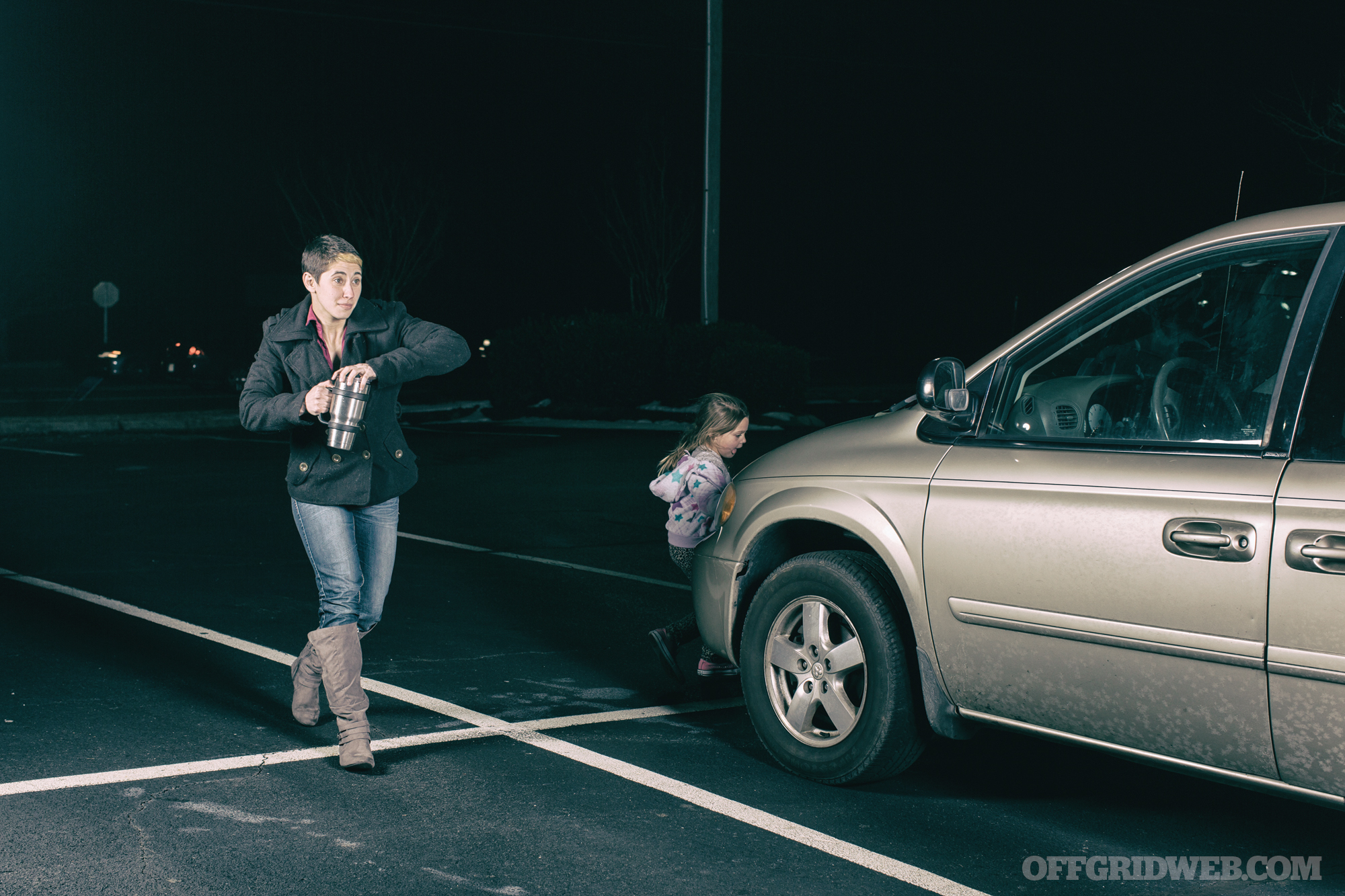
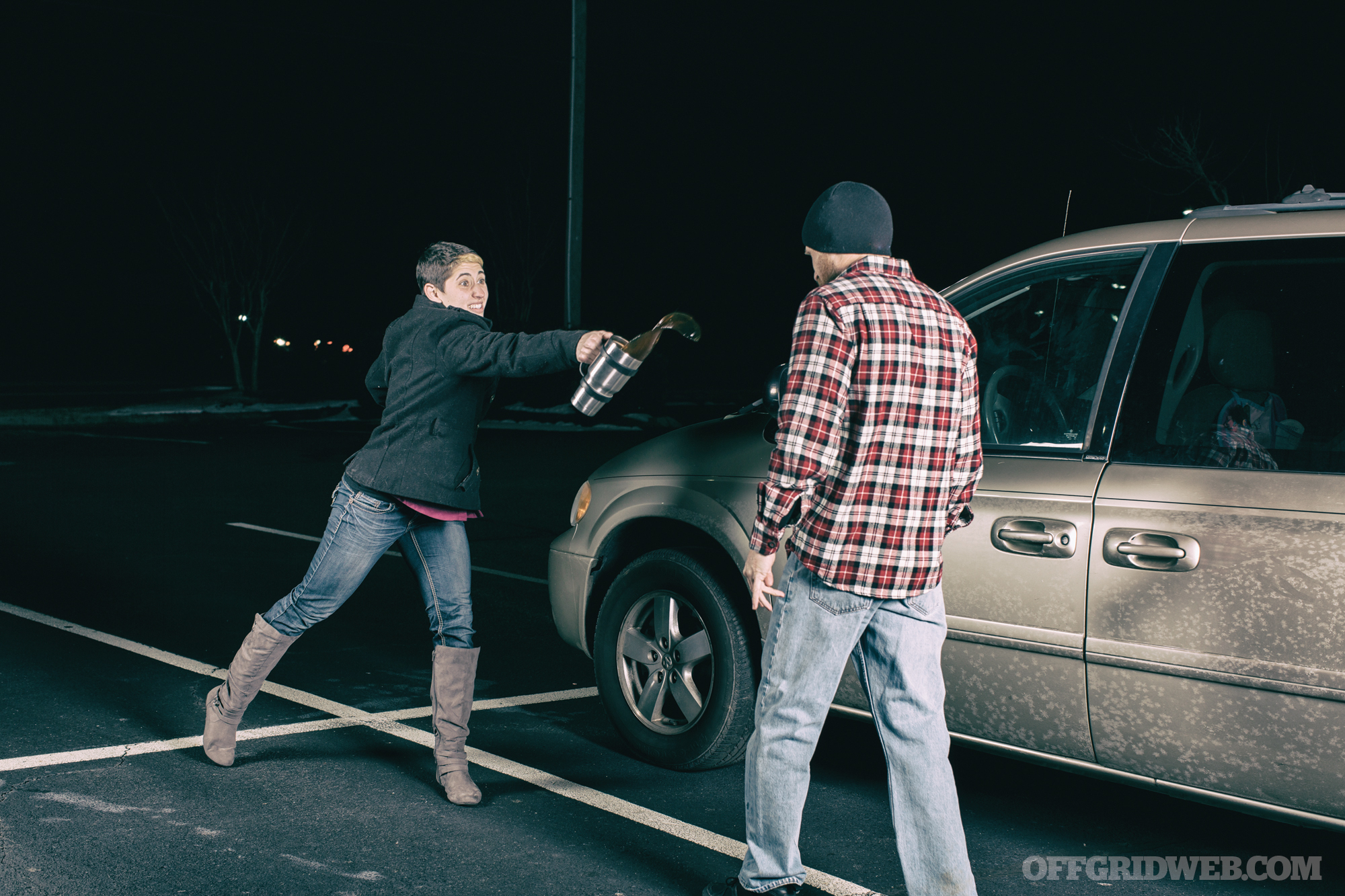
Self-Defense Demonstration #2
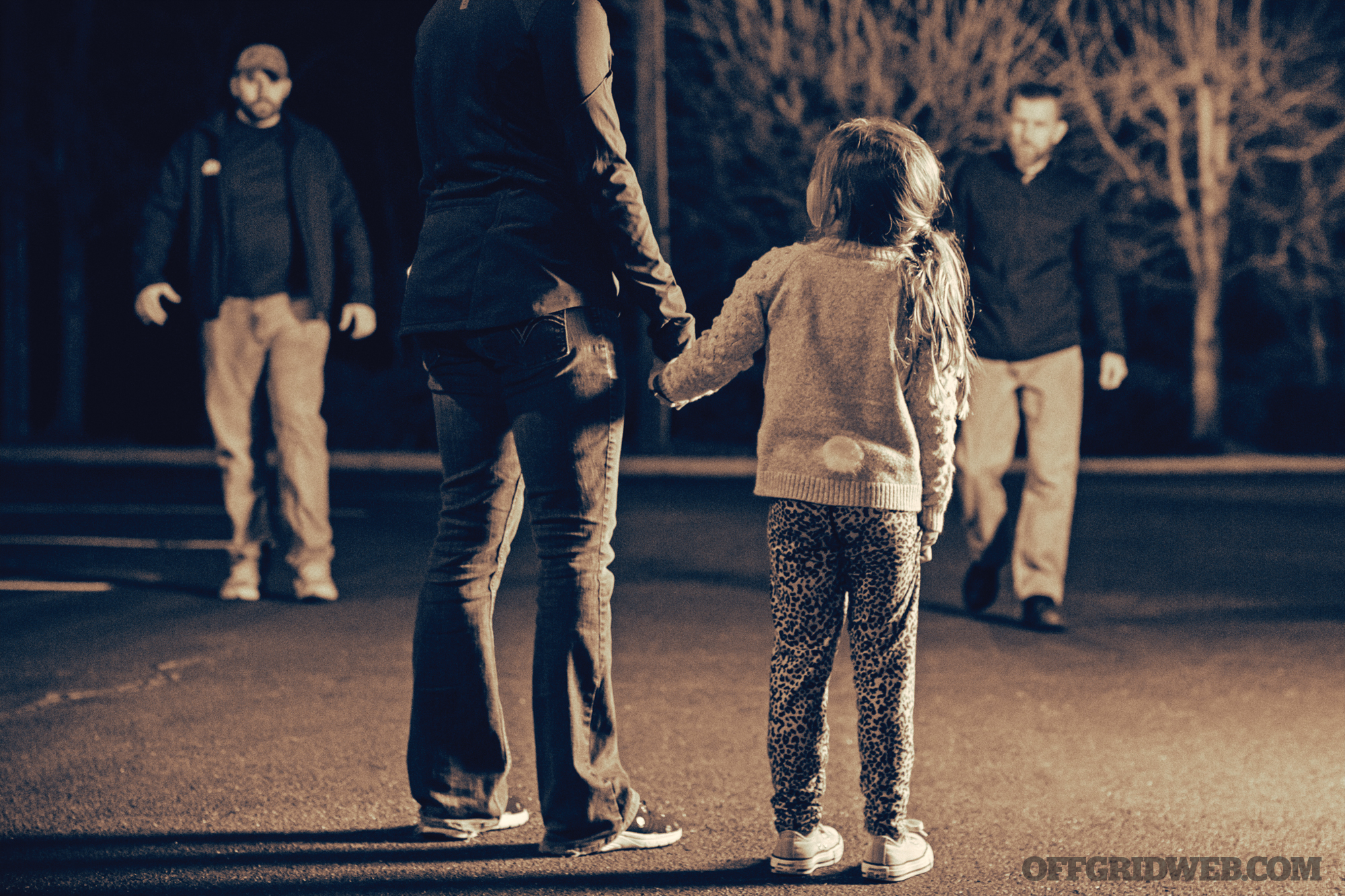
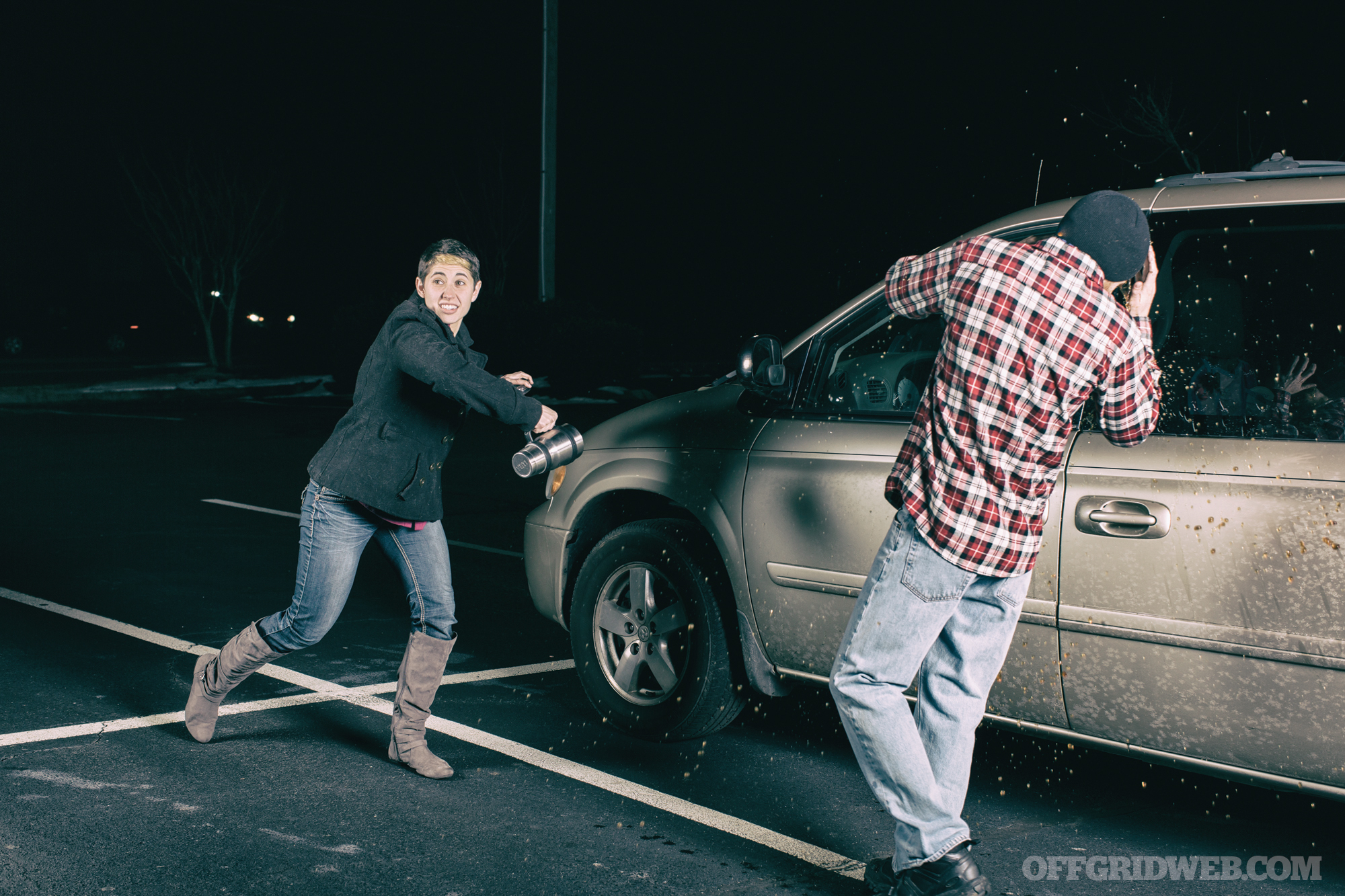
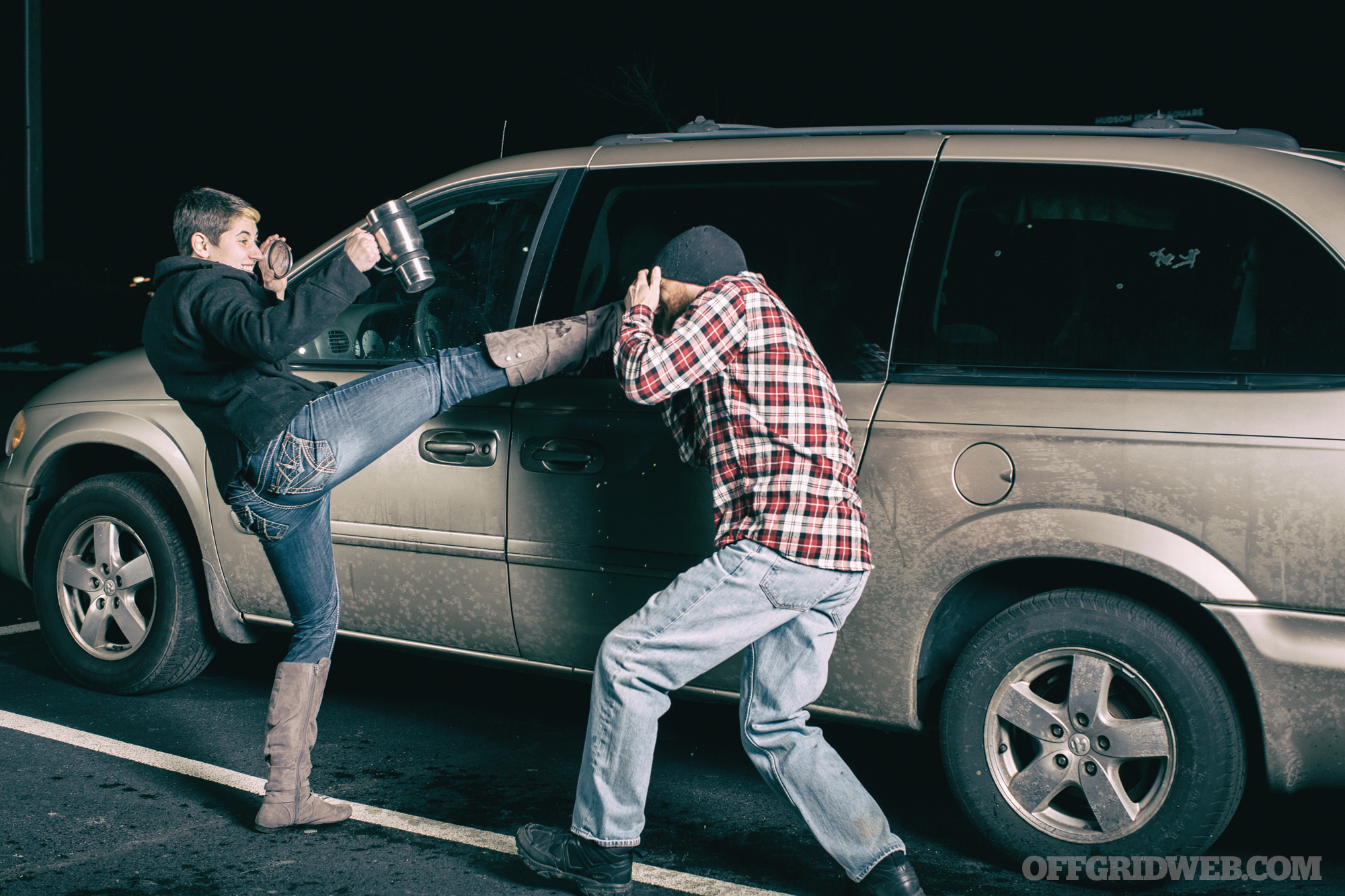
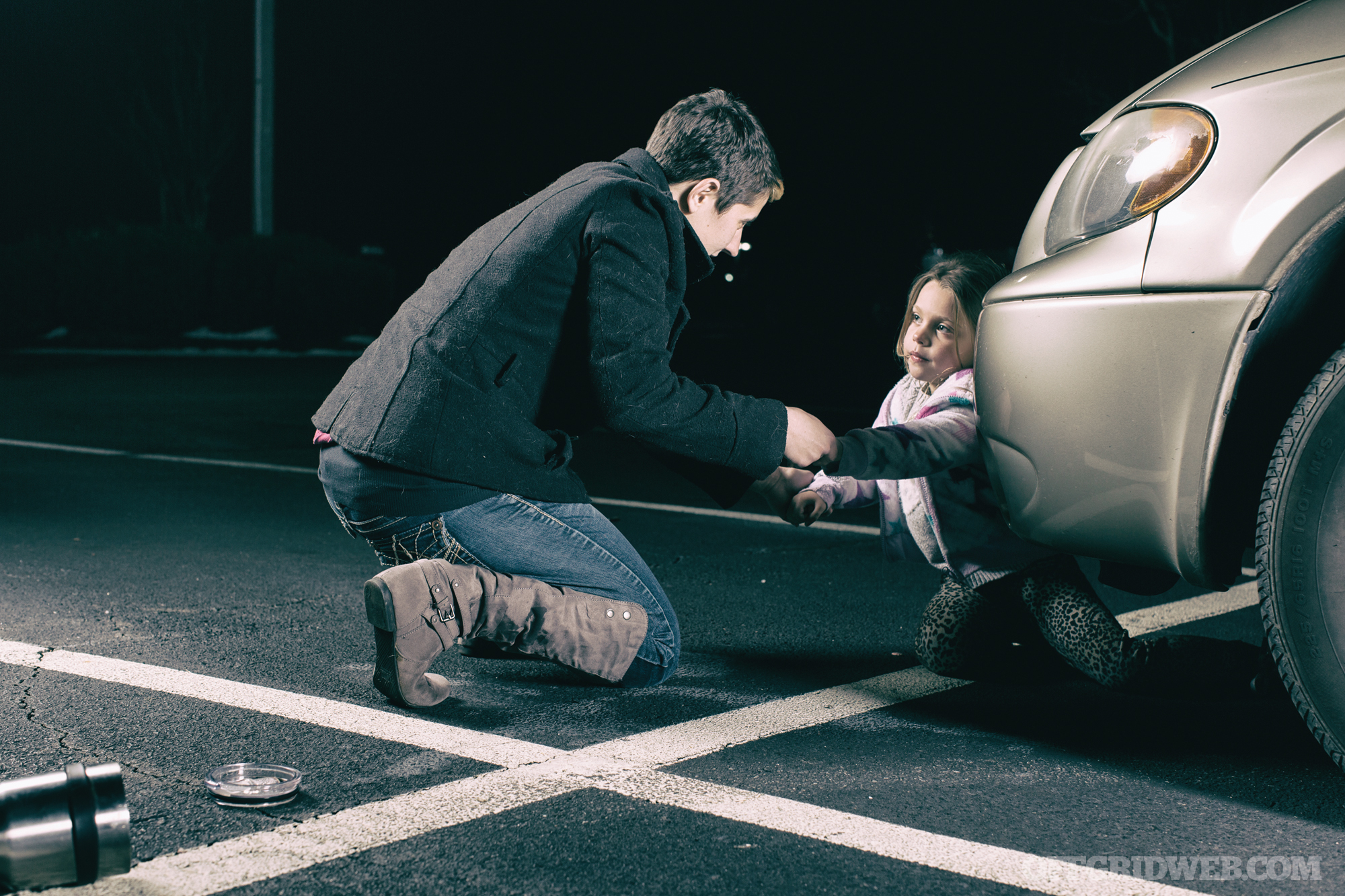
1. Having recognized a potential threat, the mom sends her child to hide under the vehicle. She prepares the contents of her hands (a mug full of hot coffee) to be used as an improvised weapon.
2. The attackers are coming at different angles, so in order to keep distance and create a distraction, she throws hot coffee into the face of the first attacker.
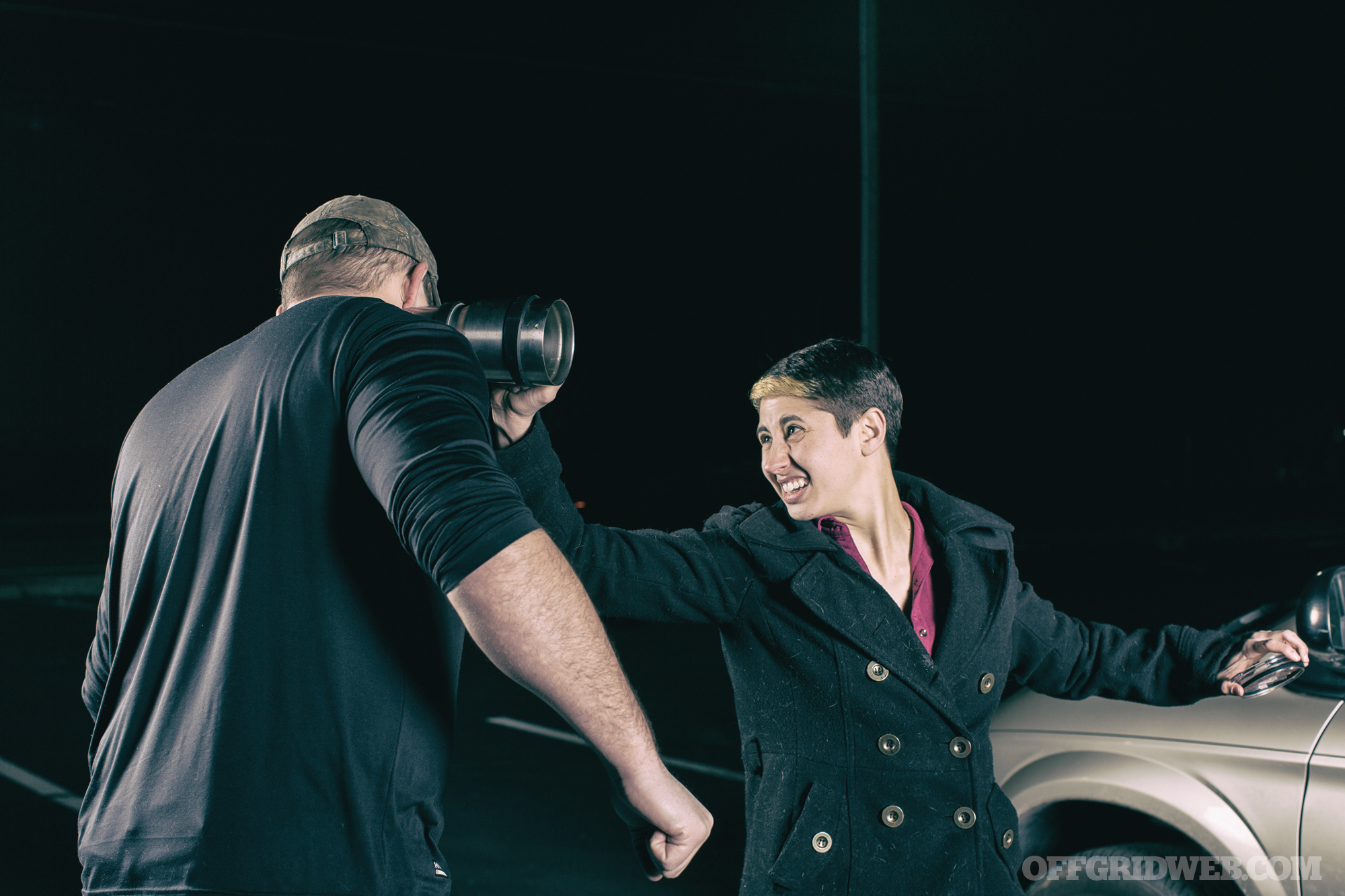
3. Continuing to stay on the offensive, she turns to face the second attacker, ready to strike with the coffee mug.
4. Using a backhand hammer type strike, she hits the second attacker in the jaw with the mug.
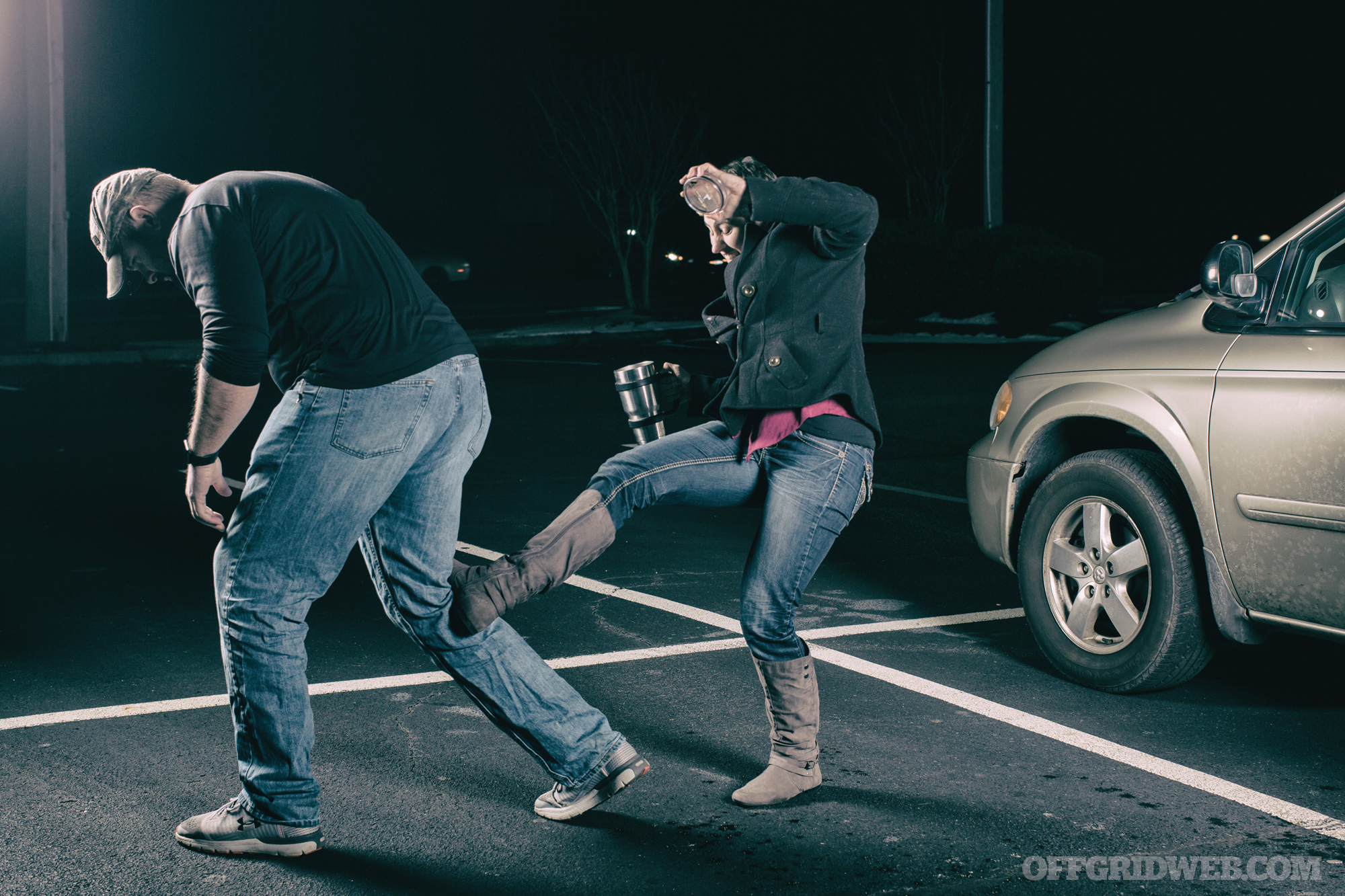
5. She immediately follows with an oblique stomp kick to the attacker’s knee.
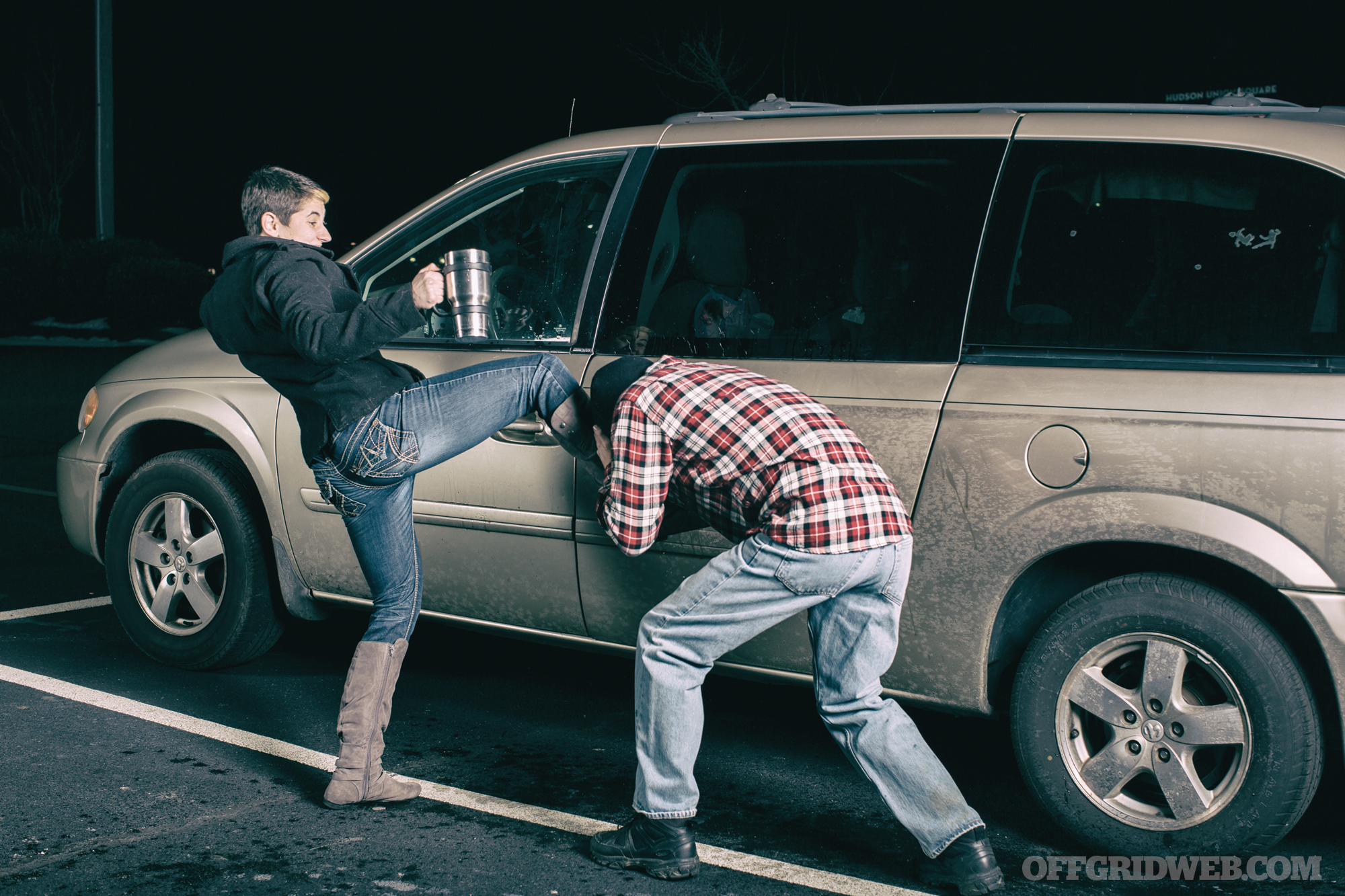
6. Because the initial attacker is still a threat and blocking a safe entry to the vehicle, she uses her shin …
7. … and boot to kick him in the head.
8. Once the threat is no longer imminent, she locates her child and moves to safety while calling 911.
Tools for Self-Defense
Sometimes, no matter what steps you take to avoid a bad situation, you may find yourself fighting to defend yourself. If forced into a self-defense situation, there are a few things that statistically have proved to be effective:
Force multipliers. Weapons. In November last year, a female jogger in Utah was sexually assaulted while jogging during the early morning hours. She was carrying a knife for protection and was able to stab her attacker several times, forcing him to flee. When dealing with an attacker who’s larger than you, improvised weapons or weapons by design can not only be great equalizers, but they can turn the tide dramatically in the defender’s favor.
Distractions. Like weapons, these can be improvised or distraction devices by design and can buy you time to draw a weapon, deliver a counter-attack, or disengage from the situation. Examples of improvised distractions could be whatever you happen to be holding thrown into someone’s face. Examples of distraction devices could be a tactical light (strobe or otherwise), pepper spray, or a conductive electronic weapon (stun gun).
Martial arts. Fundamental, gross motor defensive techniques that tap into natural movement and athleticism can be easier to learn and retain at a functional level for the long term. The sequences illustrated here incorporate these principles. While we give you some ideas for self-defense to add to your tool belt, it’s impossible to build a solid base of functional skills from reading an article. You need to get out and train — even better under the tutelage of a competent and credible self-defense instructor. Locate and research martial arts schools in your area and take trial classes to find an instructor you like. Get involved in different groups and networks that host self-defense or martial arts seminars and workshops. Keep it fun, or it won’t last long.
Fending Off a Larger Attacker
Size and strength dynamics between prey and predator will always be a factor. But just like in the animal kingdom, it’s fully possible and plausible for much smaller prey to drive off their would-be attacker. Many predators aren’t willing to get hurt or risk getting caught, and will quickly flee once they realize they’ve bitten off more than they can chew. Research has shown some common patterns with children who escaped attempted abductions.
They were physically proactive in their defense, including active resistance and running away when possible, as opposed to passive behavior.
They were loud in addition to being physically aggressive, screaming and yelling to attract attention.
When being physically proactive, the more control a child can have in their aggression, the more successful they’ll be. Part of controlled aggression is to understand the concepts of weapons and targets. In the absence of improvised weapons, empty-handed weapons include kicks, punches, elbows, knees, clawing attacks, and biting. Sensitive targets on the body should be the focus of these weapons. For example:
Clawing at eyes with the fingers
Punches or elbows to the nose and throat
Knees or kicks to the groin, shins, or face, if it can be reached
Conclusion
The goal as always is survival, and even if the prospect of physically incapacitating a much larger attacker isn’t entirely realistic, just convincing them that they’ll be hurt or caught can be enough to send them packing.
Find ways to make yourself a hard target. Being within the most victimized demographic doesn’t mean you have to become a statistic. Don’t be of the mindset that it could never happen to you — that can put you in a vulnerable state of mind. Rather, be of the mindset that it’s only a matter of time until someone will try to victimize you, and do all you can to be prepared for that moment.
Jared Wihongi is a 16-year veteran law enforcement officer with considerable time serving in the SWAT community, a specialist in close-quarter combatives, and one of a handful of master-level instructors of the Filipino combat art Pekiti-Tirsia Kali. Moreover, Wihongi has more than a decade of experience instructing armed forces around the globe. He’s the tactical consultant and frontman for Browning’s Black Label line of knives. Learn more about him at: www.jaredwihongi.com
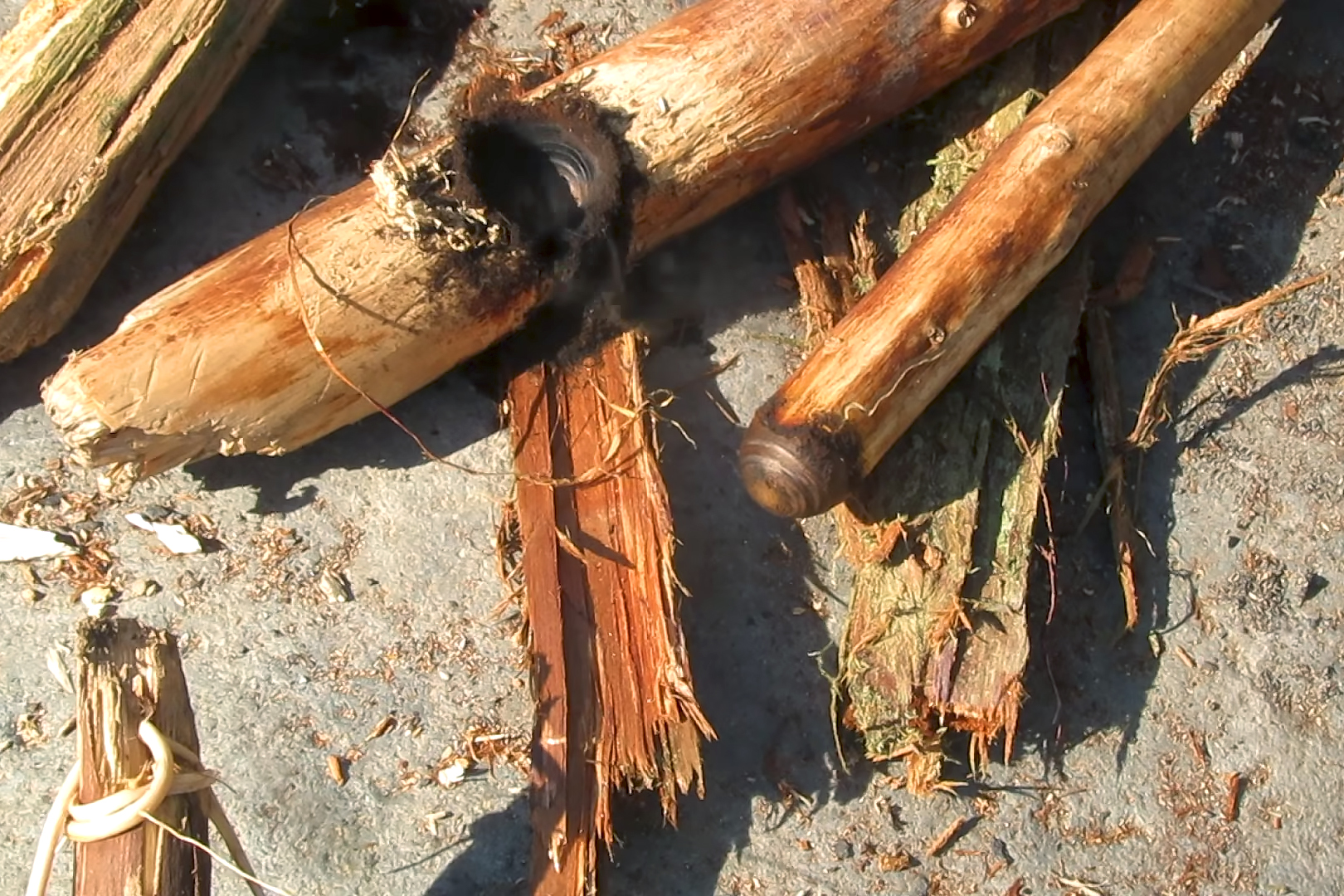
The bow drill is a fire-starting technique that every survivalist should know, and one that has been employed since the dawn of man. For those who aren’t familiar, it consists of an upright drill shaft, a horizontal “bow” with a taut string, and a fire board with a divot and notch. As the bow is drawn back and forth, its string spins the shaft and generates friction against the divot, eventually producing a tiny ember that can be tipped out of the notch.
This fire-starting method may sound easy enough from the description, but anyone who has attempted the technique can tell you it’s pretty tough in reality.
Although making a functional bow drill is difficult under any circumstances, it’s especially tough when you’re doing it the way our ancestors did: without any modern tools. Much like building a shelter is simple when you already have a tarp, paracord, a foam mat, and a sleeping bag, it’s much simpler to make a bow drill with manmade resources. A sharp knife will make notching the board a quick task, and a strand of strong cordage will help produce a durable bow.
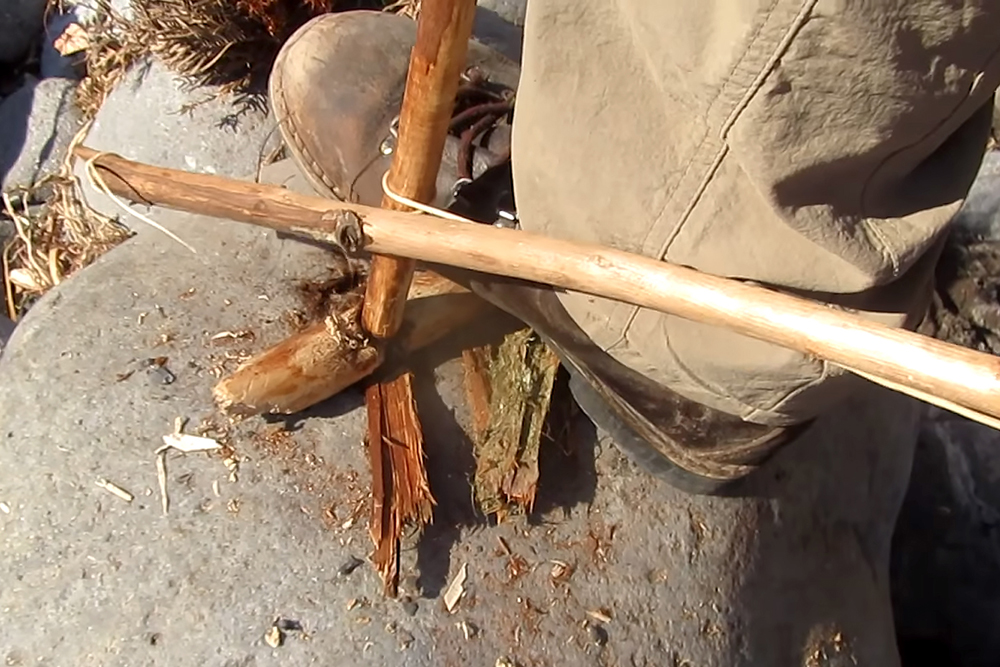
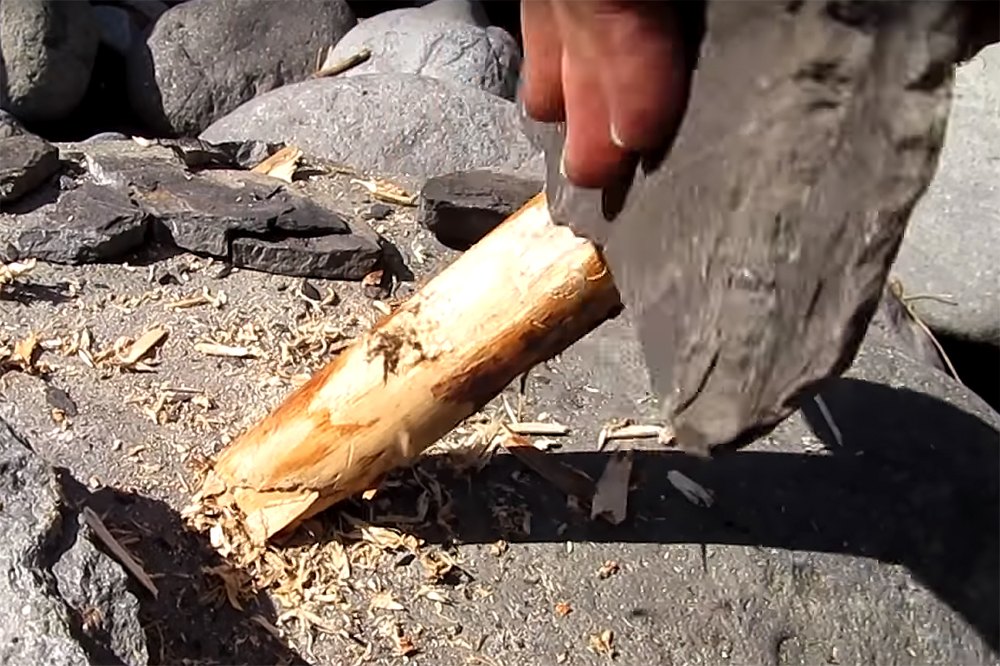
A fractured rock will cut in a pinch, but can’t hold a candle to a sharp knife.
Unfortunately, if you already have a knife and cordage, it’s likely that you also have a lighter, matches, or a ferro rod. In that case, you wouldn’t need to make a bow drill. So it’s much more realistic to test your bow drill skills without these modern items, in case you find yourself in a similar circumstance someday.
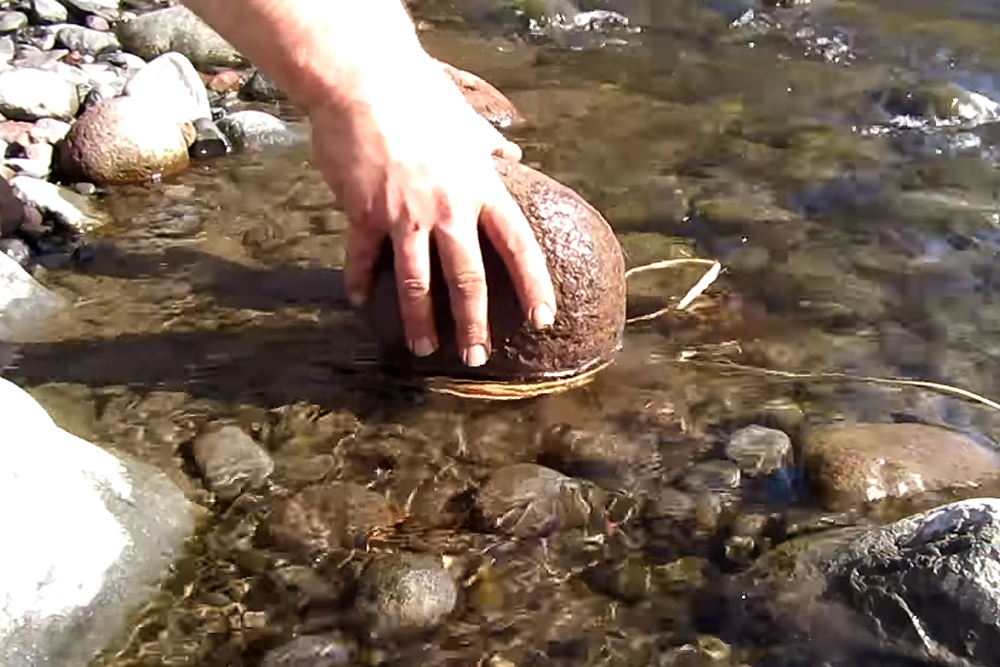
Soaking vines in a river will make them more flexible for use as cordage.
YouTube survivalist NW Primate recently tried his hand at making stone age fire with only primitive tools and natural cordage. The results of this video show just how challenging it can be when you don’t even have a cutting tool:
The takeaways are twofold — first, recognize that starting a fire this way is almost guaranteed to be a test of your patience, so embrace the challenge and don’t give up. Second, always make a point to bring several basic fire-starting tools (even if that means wearing a neck knife with a FireCord lanyard and a ferro rod) so you won’t need to resort to chopping wood with rocks.
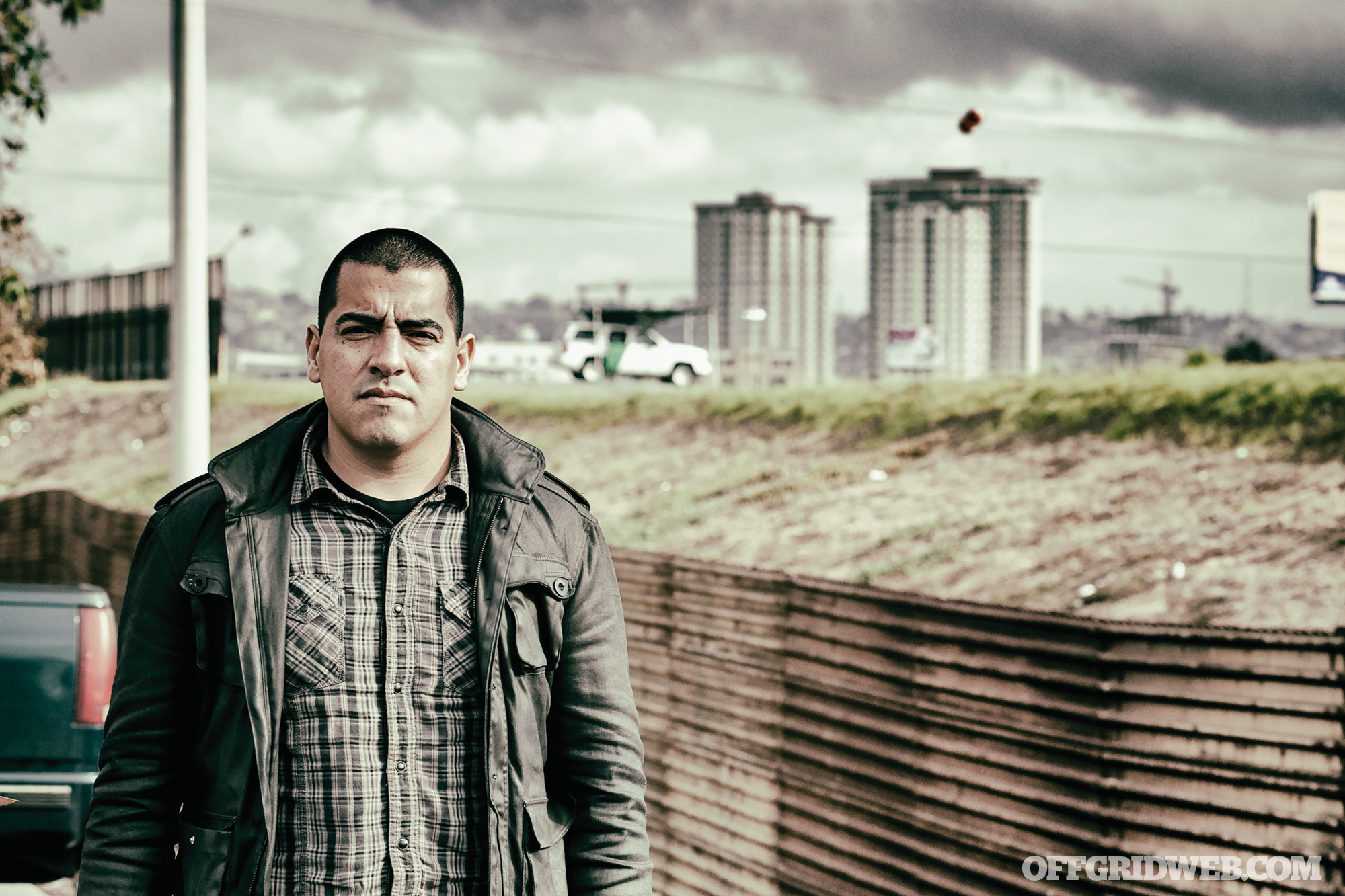
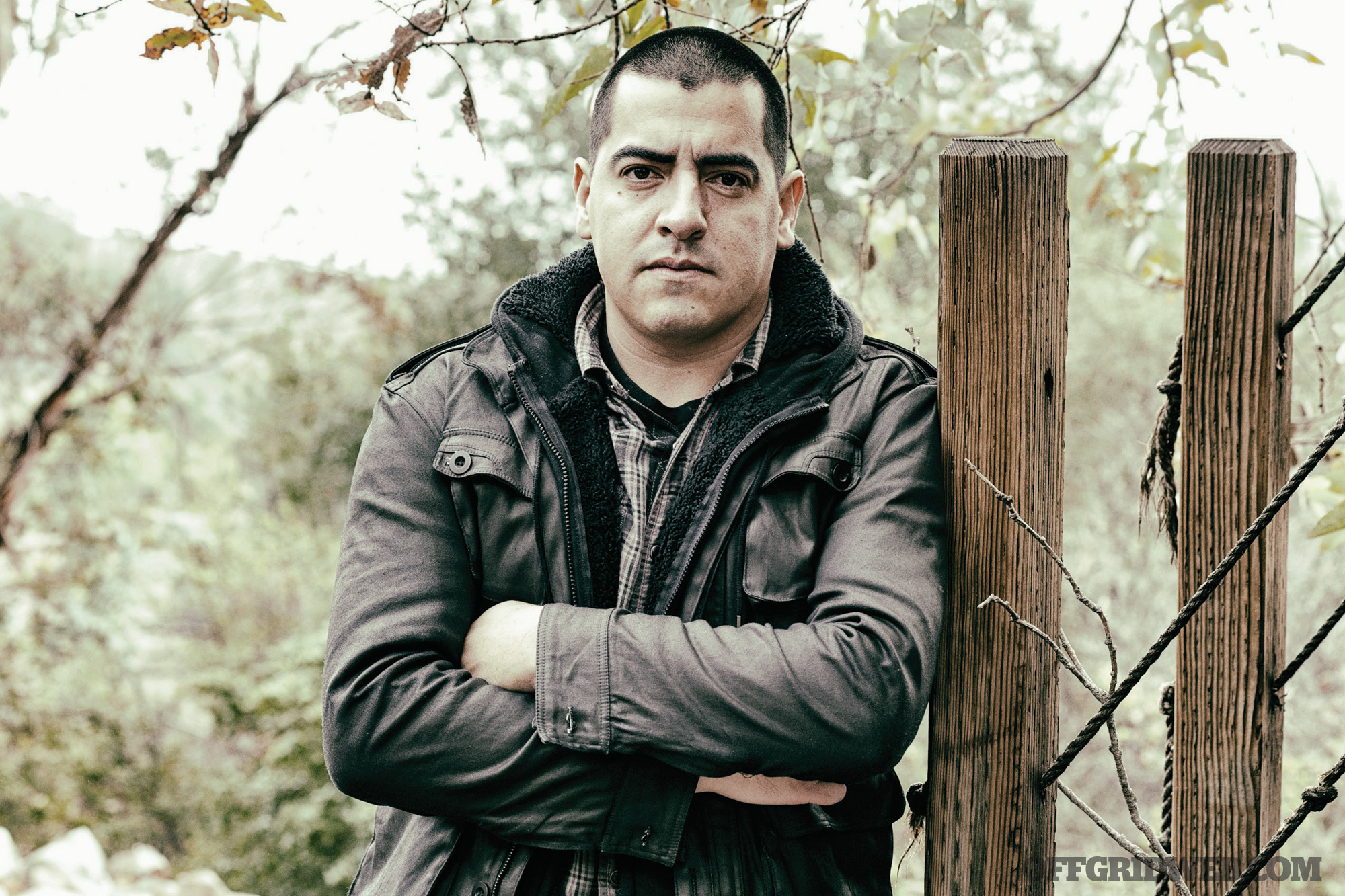
At first glance, it’d be easy to overlook Ed Calderon as a survival instructor. He doesn’t walk around in bare feet, have a lumberjack beard, or spend copious amounts of time talking to a camera from inside a tent. But the skills that one can learn from Ed’s Manifesto aren’t meant for long-term prosperity in harsh weather conditions. They’re meant to ensure survival in its most immediate and primal context — the continuance of one’s existence in the face of imminent physical danger and threat of imprisonment.
Many survivalists consider the forces of nature to be their ultimate foe, but the brutality of other human beings may pose a far greater threat. Abduction by criminals is one of the most dangerous situations that any of us could possibly face. Mr. Calderon is more experienced than most when it comes to this subject matter. He spent years working in Mexican law enforcement, where he regularly encountered the results of a nationwide epidemic of kidnapping-for-profit.
In an article published by the Latin Times, Mexico experienced a 245-percent increase in kidnapping between 2003 and 2013. To put hard numbers on that, in 2003, an average of 34 people were released from kidnaps each month. In 2009, that number was up to 96 per month. By 2013 it was 1,162 per month. We spent several hours with Ed, wherein he shed some harsh light on the reality of cartel activity, philosophy, and the lessons he learned which he now passes on to civilians, law enforcement agencies, and military units around the country.
Our Interview with Ed Calderon
RECOIL OFFGRID: Can you tell us a little bit about your childhood and where you grew up?
Ed Calderon: I was born and raised in Tijuana. I witnessed my first cartel hit when I was 12. My mom and I were at a gas station when four guys came out of a car and approached the owner. They asked him a bunch of questions about who he was. There was some back and forth between the owner and the cartel guys, then they shot him point blank in the face. My mom grew up in violent places as well, and knew well enough to hide me behind the engine block.
How did this affect you going forward?
EC: Culturally speaking, my main influences growing up were all American. Most of my friends were American, I watched American television, and held American values. My mom was very much the same way, and I got most of my values from her. Originally, I never had any interest in law enforcement. But I was in my second year of medical school when Sept. 11 happened and put most of our [Mexican] economy in the tank. I was looking for work and saw an ad in the paper promising a career for young, unmarried people who had stalled out in university. It was vaguely worded, but I knew it was some kind of law enforcement. That’s how I got started.
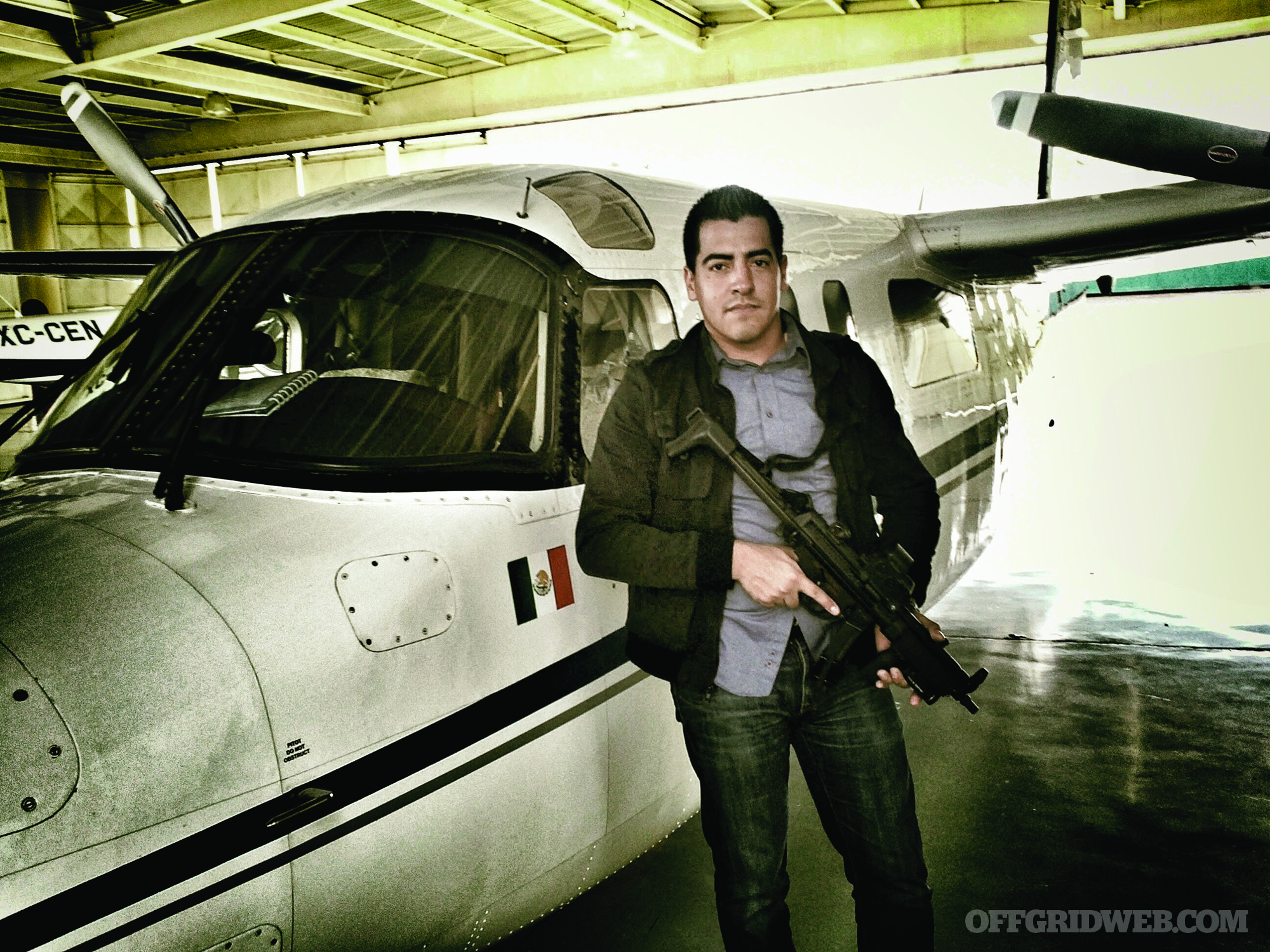
Ed holding his government issued MP5 somewhere in Northern Mexico.
What can you tell us about your military/law enforcement experience?
EC: I worked directly for the Mexican government. I went through a selection process targeting young unmarried individuals between 21 and 35. The selection lasted four months, and was incredibly physically intensive. It was designed specifically to weed out potential double agents from the cartels. In addition to the physical training, every candidate underwent a full FBI background check and polygraph, financials investigation, and home visits. Being trustworthy was vital.
After all this, we were placed into a regional police academy in Northern Mexico — initial training here was very much like military boot camp. The people in charge of the training were primarily military officers and former Mexican Special Operations soldiers. One of them was Colonel Leyzaola. There’s a documentary about him called The Bravest Man in Mexico. They’d shave our heads with a razor and make us do marching practice for hours in the sun. Many of us would develop blisters on our heads from being out so long. We weren’t soldiers, but the training was highly militaristic.
After the first four months, it became more academic, and we learned all the core functions of law enforcement. Firearms training was cursory. We shot 50 rounds through our Beretta 92FS pistols, about 20 rounds of shotgun, and two mags or so through our AR and G3 rifles. Once we left training and got to the field we were issued Glocks with no holster and one spare magazine, plus soft body armor, which didn’t do any good against the rifles carried by cartel fighters.
In the field, we were formed into an operations group that included members of my unit, military special operations, and various branches of Mexican police. Our primary duties included anti-kidnapping and counter-narcotics missions, including eradication of drug growing and production facilities. We also conducted investigations and executed high-risk warrants. But in many ways our work was primarily preventive. We spent a lot of time looking for clandestine transport hubs throughout the peninsula. Sometimes we set up observation posts in an area of known cartel activity. But we also followed up on local police reports and tips. In terms of movement, we had some access to aircraft, but primarily used vehicles to patrol.
Were there any particular crime scenes or experiences that left the biggest impression on you?
EC: There were several. One was having some of my work colleagues be abducted. They went out as a pair, and were picked up by fake federal police officers. They were found dead several hours later. One of them came up through the unit with me, all the way back to the academy. It taught me that we were “on” 24/7, with no ability to just relax after hours. It instilled a fear that to this day is in the back of my mind: It’s easy for somebody to just come take you.
During this time, the cartels had declared open season on our unit. Anybody who could come in with our credentials would be given a reward. Lieutenant Colonel Leyzaola took this as a compliment. He had a lot of us stay at the military barracks, and it caused us to change tactics from law enforcement methods to counter-insurgency methods. It really allowed us to bring the fight back to the cartel. This was right around the time of Felipe Calderon’s [no relation] “call to arms.”
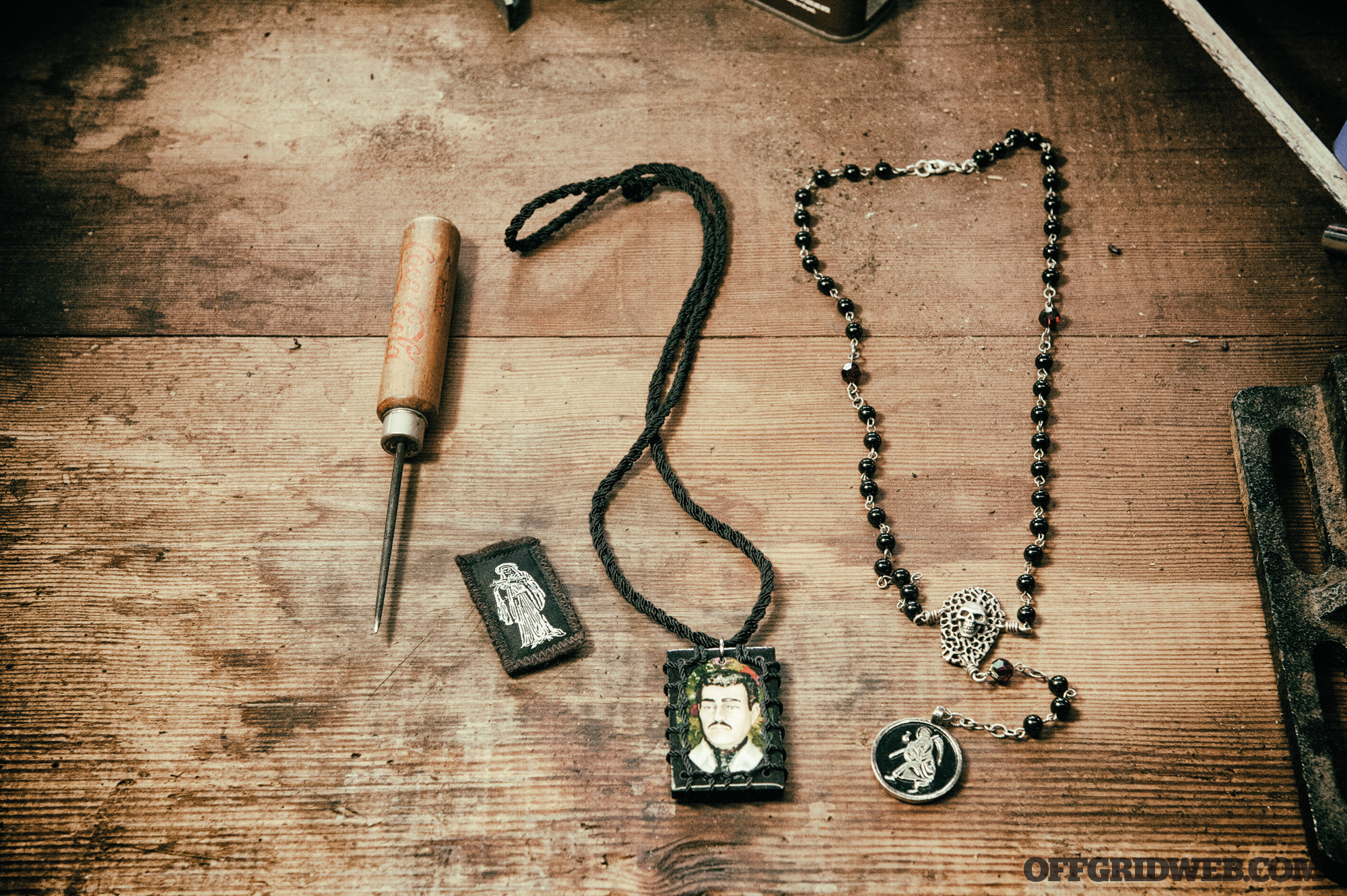
Finally, there were several times that we would hit a house or cartel facility and find background check notes and personal information about members of our unit, pictures of our houses and license plate numbers, and other personal information. There were also Santa Muerte (holy death) altars with pictures of our guys.
How does the occult play into cartel operations?
EC: Colonel Leyzaola used to say, “The hand that steals will always hide. The hand that gives thanks will always show itself.” What this meant was that cartel business operations are always very clandestine, but charity and public works were very high profile. They regularly did things like upgrading churches, paying for burials, and throwing lavish quinciñeras in neighborhoods where kids don’t even wear shoes. There’s a lot of faith involved in some of these groups. They often used Santa Muerte altars. Some in the cartels think this belief gives them an edge, or karma, in the execution of their mission. It’s sort of an attempt to bribe their way into heaven, or at least into success. There are a couple of patrons that cartel members looked to for this kind of extra boost. One was Santa Muerte (“The Holy Death”), an old-school Aztec religious deity. Santa Muerte is an underworld goddess who, through the years, was influenced by European religions, Freemasons, and even [famous English occultist] Aleister Crowley. She’s often seen as a “last ditch” saint to pray to. If praying to other saints doesn’t work, you pray to Santa Muerte.
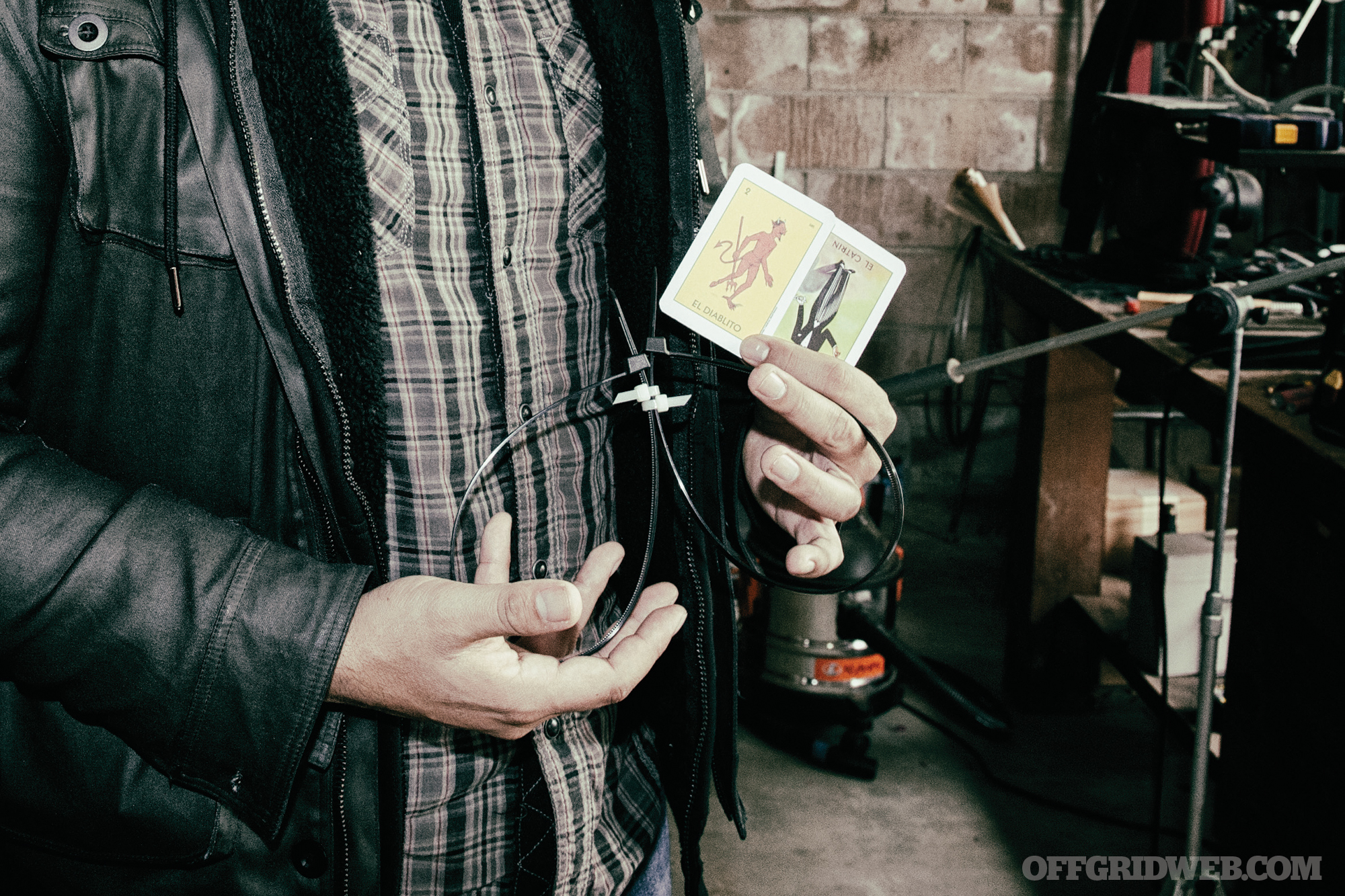
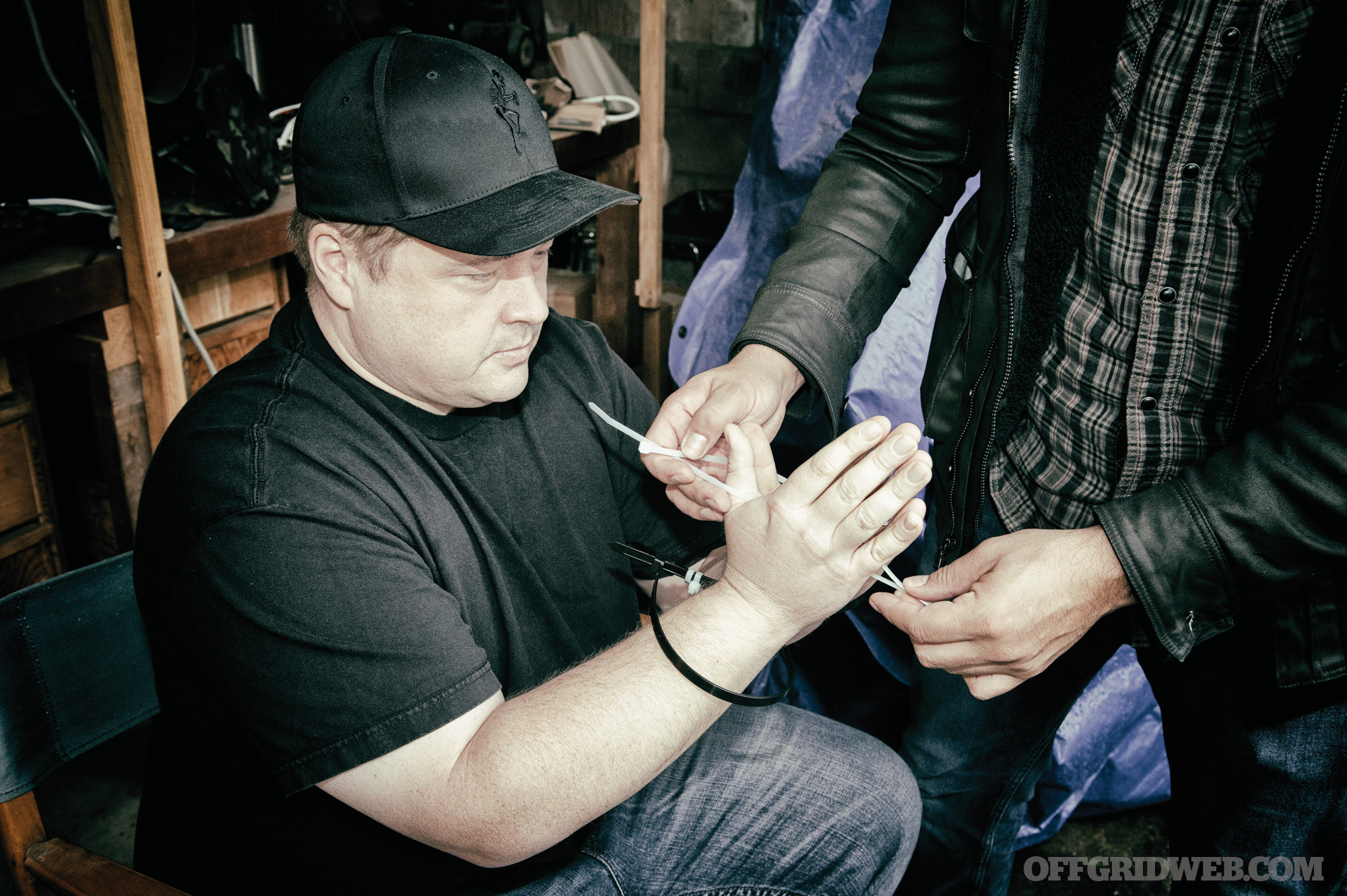
Fortified restraints with angle cut zip-tie barbs in side the cuff, meant to stab in to the victims wrist. The cards are commonly seen as part of the cartels’ occult practices.
Cartel members and police officers would go to the Santa Muerte priestess to get protection rosaries made. These are a promise to protect them as long as they pay her — either in silver, because she doesn’t take gold, or blood. For the latter, hit men or cops would have to acknowledge that certain kills were done in sacrifice. There are rumors about how these particular kills were marked. For example, certain bodies would be found handcuffed in the front or left facedown, but it was all hearsay. But belief in Santa Muerte is widespread, and not just within the cartels, either. Soldiers, policemen, and politicians are all part of it, but their affiliation is often hidden from the public. The military has standing orders to destroy any shrines or altars that are found during missions.
The other occult deity is Malverde — a more regional, Sinaloa-based patron saint of drug traffickers. He’s depicted as a young guy, well dressed with a moustache, sort of like a Mexican Robin Hood (much like El Chapo is viewed now). There’s a shrine to Malverde in Sinaloa where senior cartel members leave offerings and thank you letters.
Do you think the media tends to ignore or falsify information about cartels and the drug war? If so, what aren’t they covering that people need to know about?
EC: One thing I don’t see much coverage on is the fact that the cartels are already here. They’ve been having kids in the U.S. that are now coming of age in places like Chicago and California, where most people wouldn’t think actually have significant cartel presence. Much of what they do is aimed at the immigrant network, so it doesn’t get reported. For example, cartel members will dress as ICE agents to carry out abductions.
Also, we refuse to acknowledge that the drug war, as a whole, is essentially a lost cause. Many Americans think we can just throw money at the problem, and this has yet to prove effective. Many of the resources that the American people put into Mexico don’t go where people think it should. The U.S. and its people should look more carefully at exactly where their money is going. Viewing the drug war as a foreign problem is dangerous because it blinds people to the operations that the cartels are conducting openly on U.S. soil.
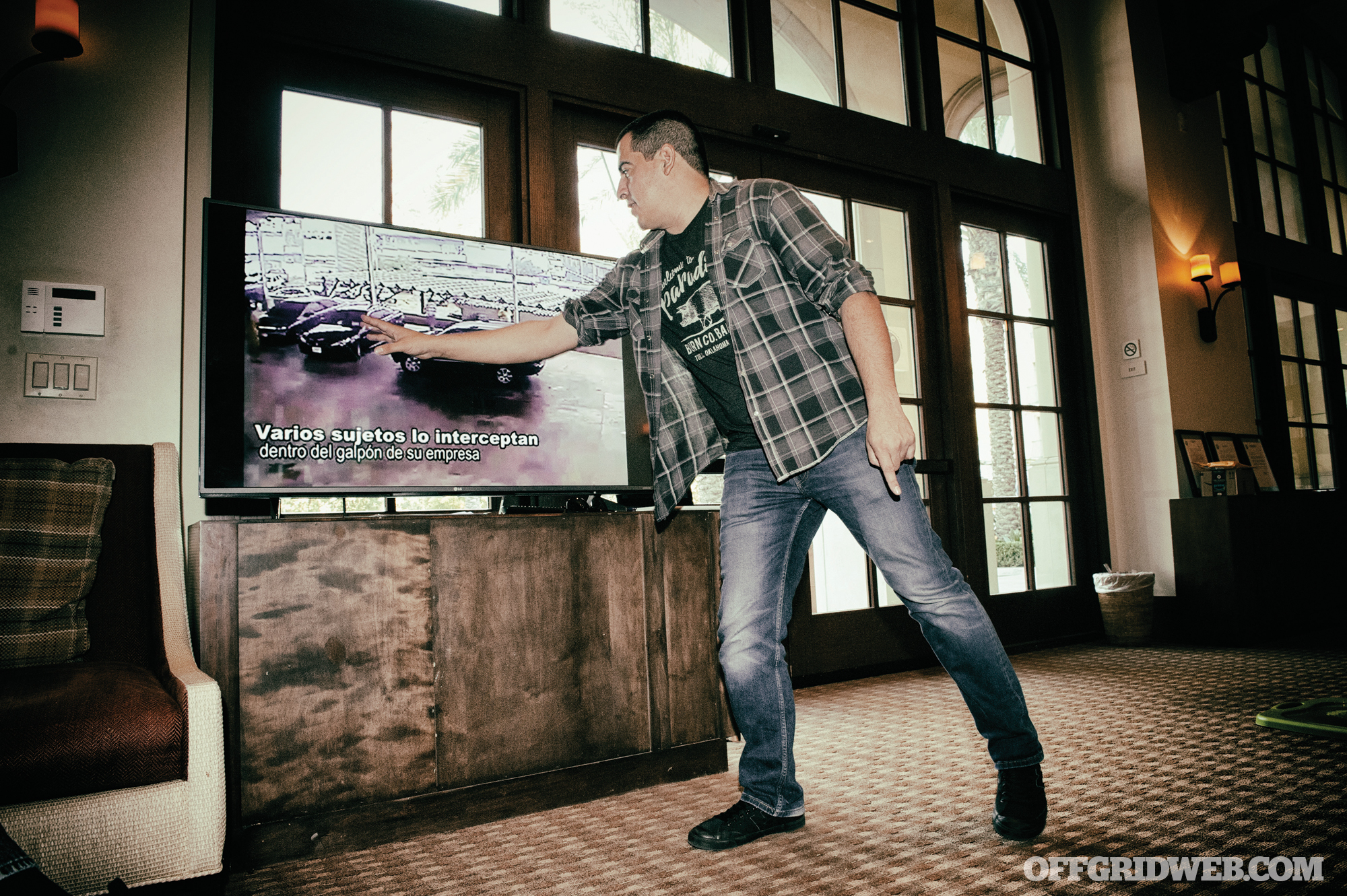
Ed going through the anatomy of an abduction at a Counter Custody Class.
Do you think legalizing drugs would help eliminate or drastically reduce the problems we’re seeing on both sides of the border? If so, how?
EC: I don’t see how. The cartels are diversified. Some of the bigger ones make money through laundering, shell corporations, and property holdings on both sides of the border. They pay for people’s college degrees, immigration processes, human trafficking, sex trafficking, stolen vehicle and chop-shop rackets, and gun-running. They move meth precursors (ingredients) from China. There’s extortion, abduction, and protection schemes. Even if you legalized drugs tomorrow they’d simply focus on the other parts of their businesses. The problem is more systemic, rooted in the political and cultural system. When I was on the job in Mexico, I destroyed acres and acres of marijuana fields and you guys [U.S. government] paid for the gas, the rifles, the uniforms. Then I traveled to Colorado and walked into a dispensary, and it really left me with a sense of futility and wasted efforts.
How many of the kidnappings that take place in Mexico and in the U.S. are directly connected to the cartels?
EC: In my opinion, probably around 80 percent is cartel related in Mexico. The rest would be interpersonal violence or sexual predators whose crimes are specifically disguised or carried out in a way to make them look like cartel activity. I believe Mexico actually has one of the largest active serial killer populations in Latin America.
There are always rumors of organ harvesting for black market sale in Mexico. From what I’ve heard, and my sources, some of that does happen. But there are also some isolated stories of more occult-related organ harvesting, including for rituals or even for cannibalistic consumption.
A small assortment of Mexican criminal occult iconography, and icepick death threat, Malverde necklace and Santa Muerte rosarie.
Walk us through what you think a typical kidnapping scenario would look like — or is there such a thing as a typical scenario?
EC: There is a wide variance in terms of how a target is selected and how surveillance is conducted. The environment has a large impact on this — do the abductors have police/military support? Is the kidnapper a former lover or a family member? I start my material preparing for the point of abduction. There’ll usually be some sort of observational period, this could be anywhere from a few minutes to a week or more, where the kidnappers are establishing patterns of life, looking for an optimal opportunity for physical abduction. There’s a process of figuring this out, which can be widely different depending on the victim selection.
But you do usually see some type of restraint, whether it’s physical, chemical, or psychological. Usually there’s a team.
The larger, more professional operations include a security ring to block roads, chase vehicles, and lead vehicles. It usually takes three to four people to pull somebody into a van or vehicle. Kidnappers dressing as military or local police is also very common. There are ways to spot this — for example, someone might be dressed as a soldier, but not carrying the issued weapon of the local military.
Initial searches are typically very cursory. They’re worried about being seen, so they bring the victim to some place they can control, like a vehicle or pre-set room. They’re betting on you being scared and overwhelmed and not knowledgeable on how these things go down. During the initial search, things can get missed.
Then there’s initial transport phase. At this point they’re worried about 1) maintaining control of the victim, and 2) if they were spotted by authorities or bystanders. This is a good time to consider making a run for it, accessing tools, or trying to fight. They may move you to a temporary holding site like a parking lot, for a vehicle switch or to wait and see if they were followed or noticed. At this point they’ll likely perform a more in-depth search of the victim.
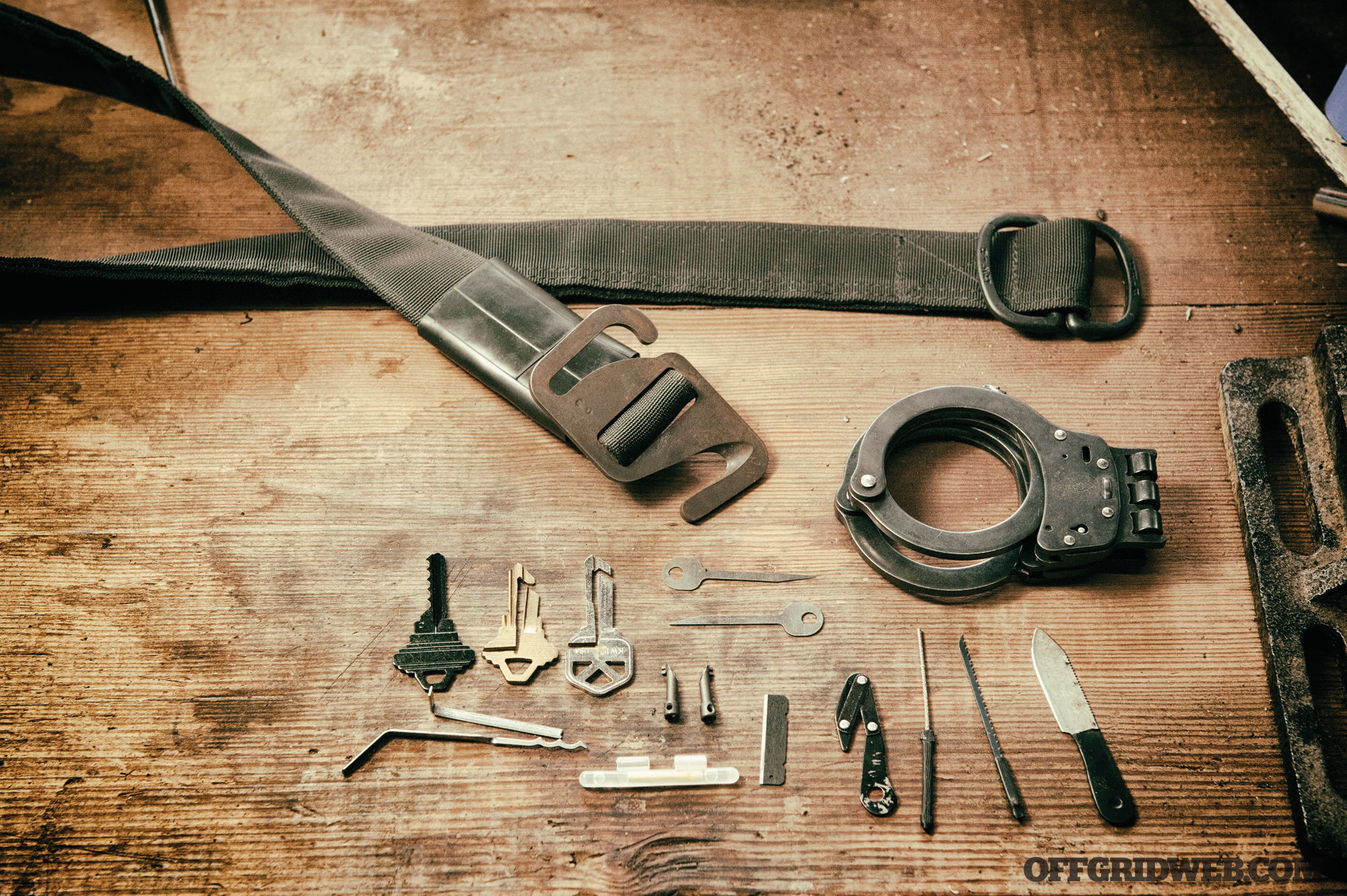
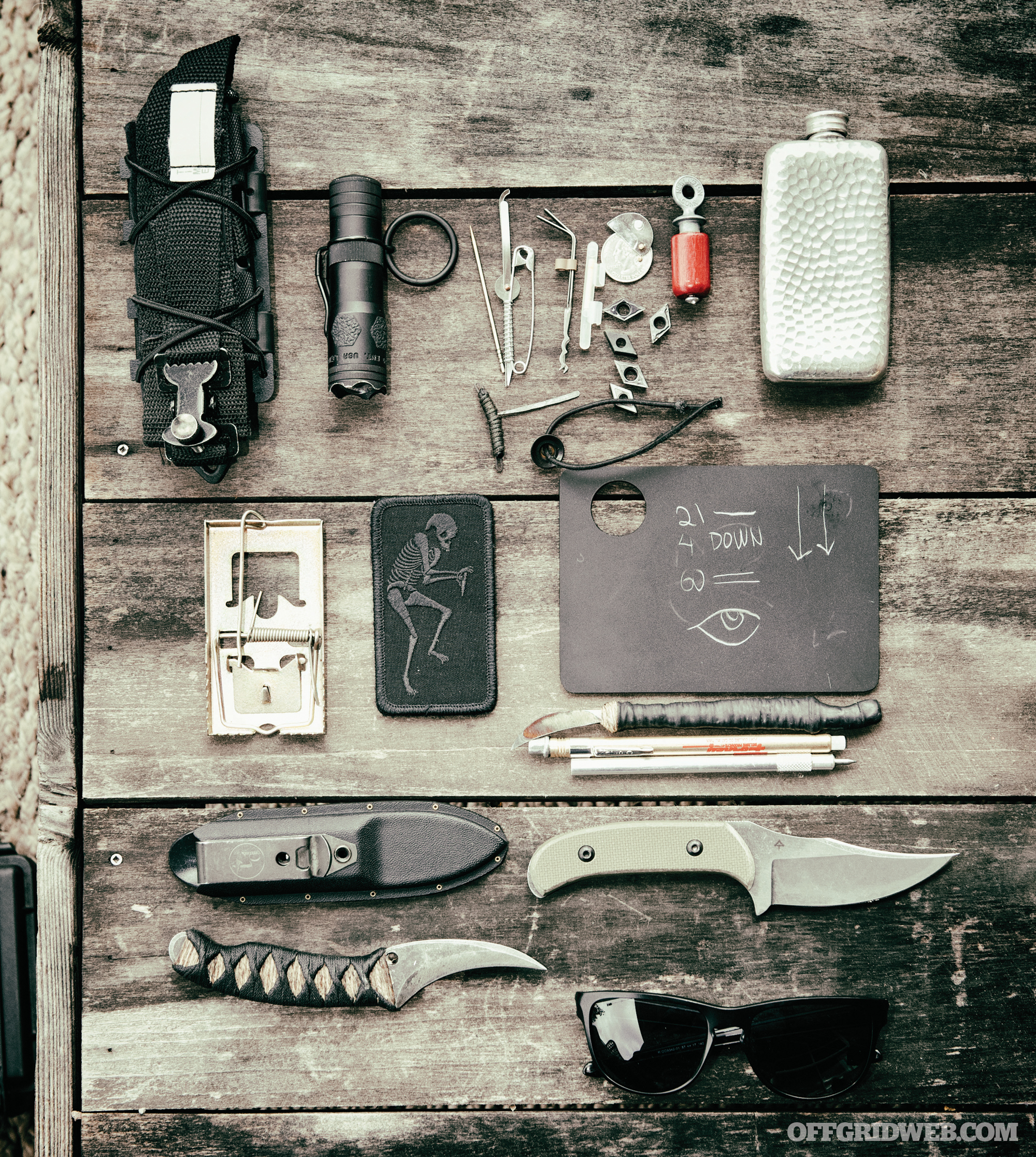
An assortment of premade and improvised escape tools that Ed shows how to carry and use in his classes, including several elements from SerePick.
Victims may be incapacitated. After this, you get moved to a long-term holding site. At this point you’re typically down to your underwear and most of your equipment will be gone. The long-term holding site will likely have bars on the doors and windows, tarp or plastic sheeting on the ground, windows covered with aluminum foil, or makeshift cages. There’ll be equipment for long-term bondage — locks, chains, handcuffs, etc. That’s when you know you’re in for the long haul. If you’re lucky, you’ll get a latrine bucket.
The plastic covering is put on the ground for two reasons: first for cleanliness, because it’s easier to change out, and second, it makes noise. There’s no way to move around quietly on a plastic sheet. I’ve never seen or heard that part discussed publicly.
How do kidnapping scenarios and motives differ from country to country?
EC: In execution, there are differences down to what they use to tie you up, how you’re held, the amount of torture inflicted, and what the life expectancy is for somebody getting abducted. Motivation is also key; religious and ideological versus an organized criminal enterprise. Specific environmental factors such as police or military support for the kidnappers will also be different from place to place.
What are the public’s biggest misconceptions about how kidnappings are carried out?
EC: One of the biggest misconceptions is that people believe they’ll be immediately thoroughly searched and everything on them will be taken away. There’s actually a lot of opportunity to conceal tools, even past the abduction.
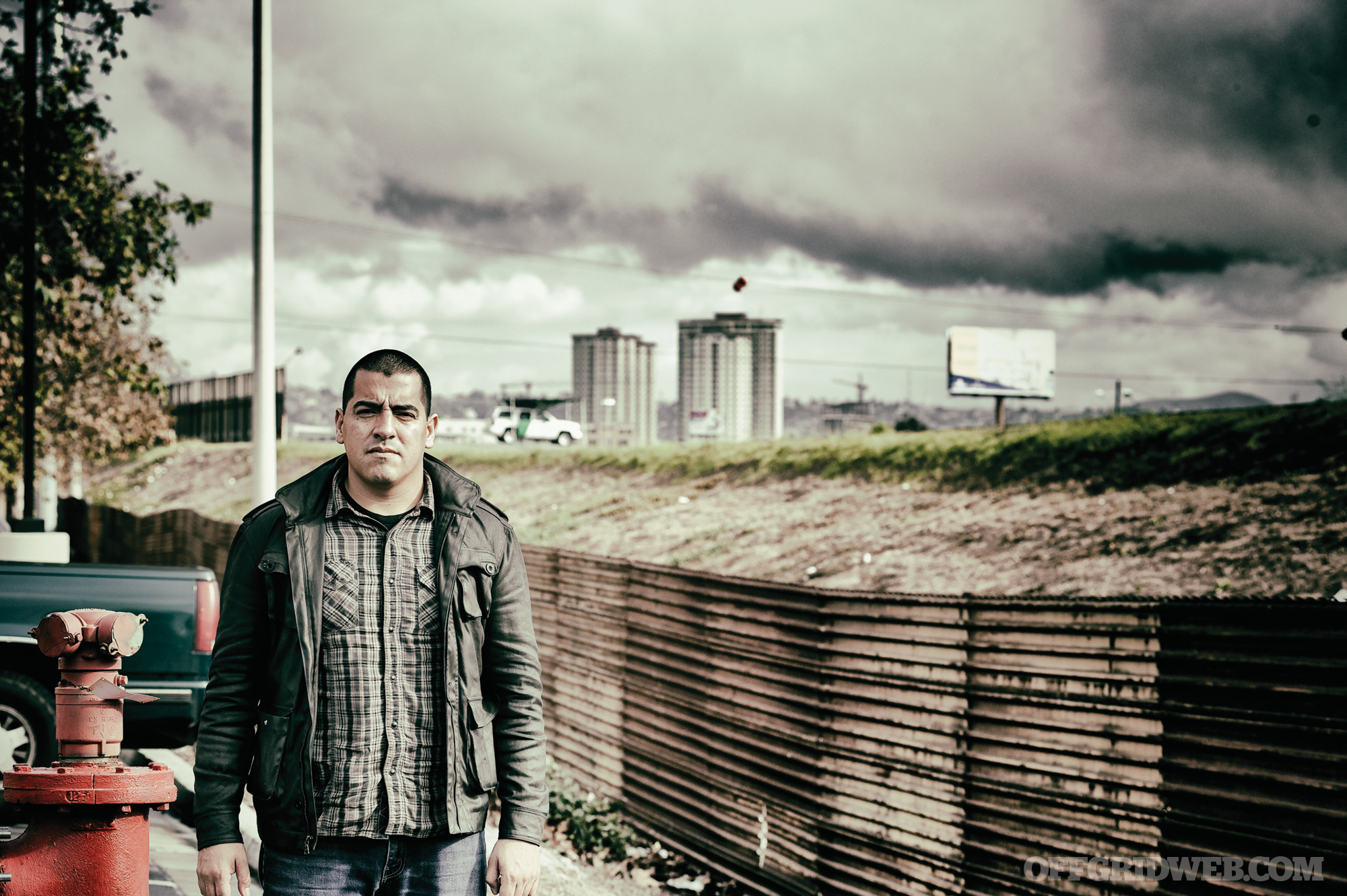
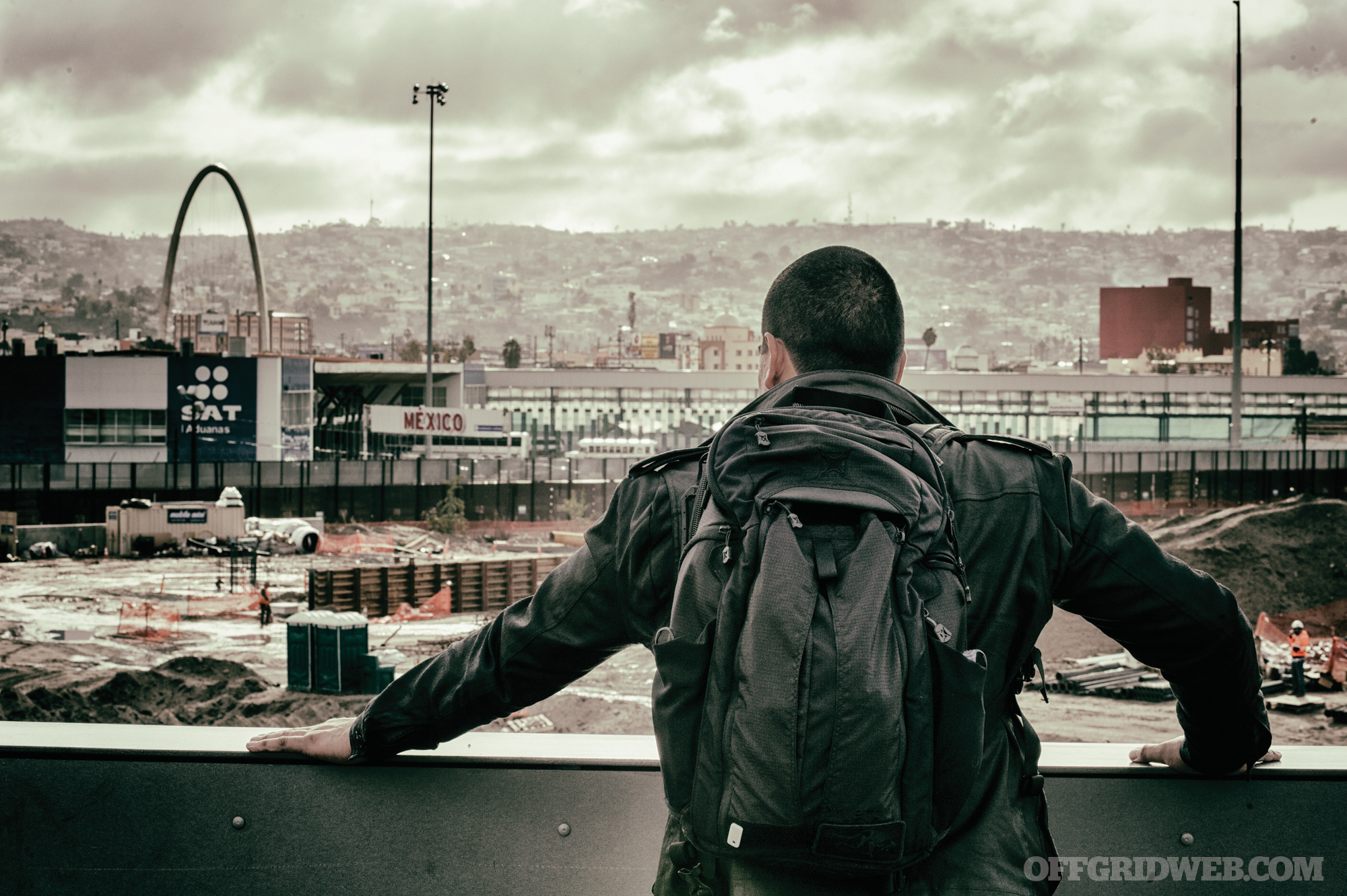
Overlooking the busiest border crossing on the planet between San Diego and Tijuana.
People also believe they’ll never be able to overcome the numbers. But there are lots of cases of people getting away by either spotting the indicators before the abduction or even jumping out of an abduction vehicle after breaking restraints. Training and equipment helps, but mindset is probably the most important factor. Don’t give in to the kidnappers’ illusion that they’re in complete control, and you are helpless to fight back.
What factors make someone a target for kidnapping?
EC: Signs of wealth, demonstrated by their possessions. Their social media, either through demonstration of wealth and status or establishing patterns of life and real-time locations. It’s an open window into your daily life that can be very easily used to target you. If the abduction is ideologically motivated, expressions of your nationality based on clothing, language, attitude, body language, etc., can also be a factor.
What is the usual M.O. of the kidnappers?
EC: Nowadays it’s very common for kidnappers to use social media to select and research targets. They may use your routine to help set up surveillance. They typically choose younger, fitter, military-aged males for actual abduction teams. Targets are almost always searched before they’re bound.
What’s the usual outcome for the victims if the kidnappers’ demands aren’t met?
EC: Death is usually the immediate outcome. Body disposal in Mexico occurs on an industrial level, and you will likely never be found. They’re very professional when it comes to body disposal. Caustic sodas, pig farms, and mass graves are all over the place, and the forensic science isn’t at the level where you will be identified post-mortem.
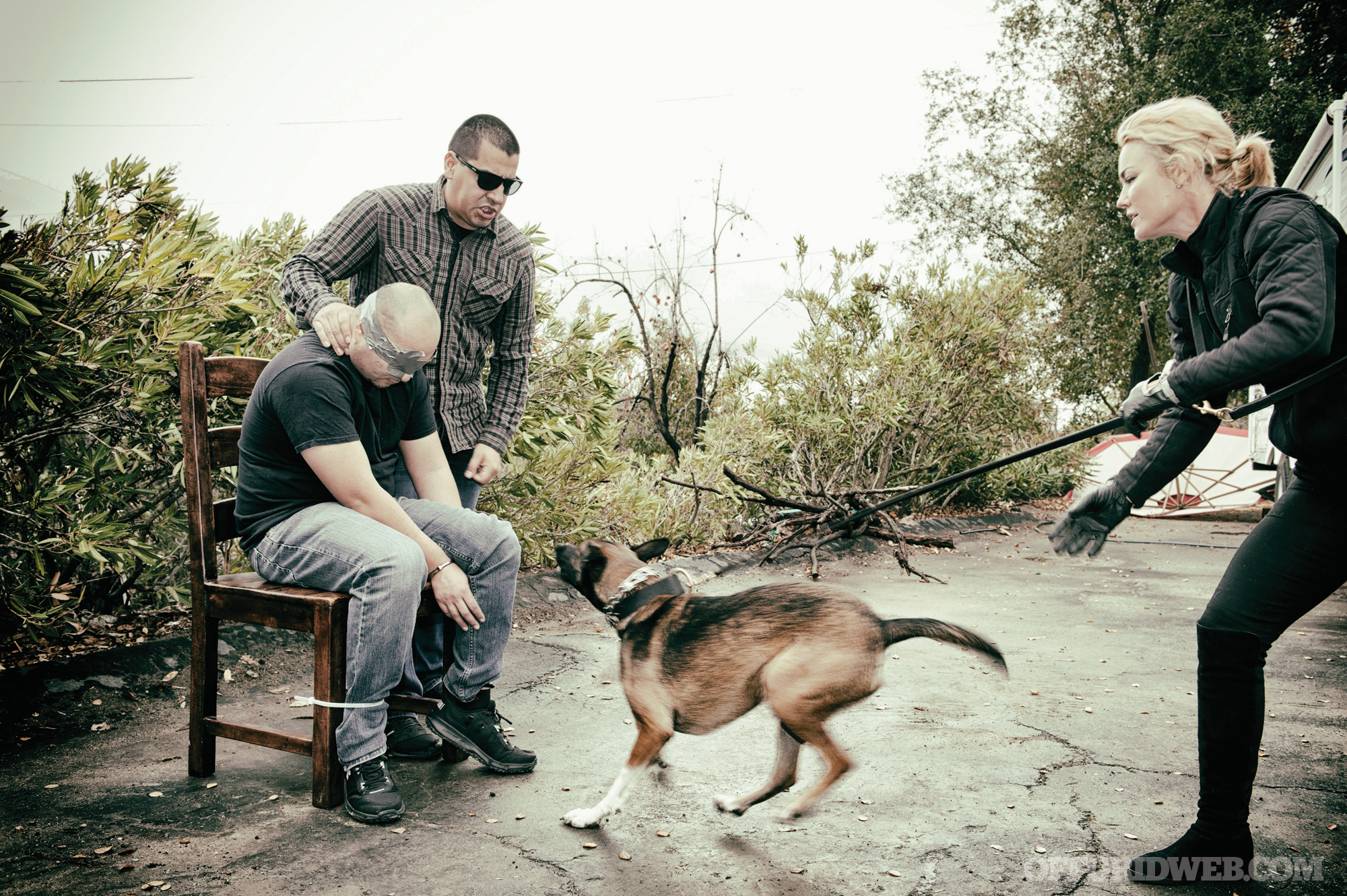
Stress modifiers used in some of the more advanced counter custody materials include the use of dogs to get people in the right mindset. Actress Kelly Carlson and her dog, Kara, are seen here participating in the demo with one of Ed’s students.
You talk a lot on your site about understanding the perspective of a criminal or abductor. What do you think the average person should know about that?
EC: They don’t have everything they need, and therefore they learn how to improvise. Criminals won’t go on the Internet to order their equipment. People assume a lot about capabilities, but creativity is something that gets underestimated when assessing criminals.
What’s the biggest lesson children should be taught about potential abductions?
EC: The value of resisting somebody trying to grab onto you. A karate class or self-defense class isn’t enough. Any sort of preparation of that nature has to include the parents. People should know that kids playing hide and seek are learning a survival skill. Being able to incorporate a play element doesn’t demean or devalue the training. It may actually help them absorb the information. Even with my students, I like to make a game of teaching them situational awareness. I have them pass a card off on each other, without the receiving student knowing the card is on them. The loser may or may not have to sing karaoke.
Include your kids in any kind of training, like firearms or survival, so they can get experience at a young age. There’s no such thing as an R-rated abduction story for kids. They need to know what the boogeyman looks like. It’s not gonna be a guy in a trench coat offering a lollipop. Evil has many faces, and they’re usually pretty charming. It’s not about fear mongering, they just need to be aware that those things are real. Let them know the options, including breaking somebody’s grasp. Above all, I think situational awareness is the most valuable, and easily teachable skill for children.
Tell us about the types of courses you teach.
EC: I teach two types of courses, one mainly focused on counter-custody or trying to escape any kind of irregular custody. Much of the experience I draw on for counter-custody was simply based on what I witnessed in the field, as opposed to any specific training I received. Also, just speaking to the Mexican populous and finding out how everyday people prepare themselves for possible abduction. Being abducted was a daily worry for our guys. We looked for specific training in this skillset, and it was incredibly difficult to find. So we reverse-engineered based off the tactics of the cartels. But the courses I teach aren’t specific to cartel abductions. I draw from anecdotal stories and parallels to Middle Eastern and European threats as well.
Kidnappers won’t make it easy on you. Individual digital restraints can be used to negate the manipulation of escape tools.
Much of it revolves around making yourself a harder target. But there’s also knowing what kinds of restraints are being used. Everyone focuses on zip ties and duct tape, but there are also psychological restraints, like telling somebody their loved ones will be harmed if they escape. Or restraint through mutilation, like cutting the bottoms of the feet, or injecting saline solution into the soles of the feet so you can’t run. There’s also chemical restraint through being drugged or placed under the influence of narcotics. I don’t see a lot of that information being taught, and I think it’s something people should be aware of. I really like taking the approach of having students use role play to self-assess their situation and their own level of preparedness to confront these kinds of threats.
There’s a big movement to be the “gray man.” I believe there are some limits to this theory. Instead of trying to be a chameleon, be a zebra. Create a narrative other than your real narrative and learn that. This will give you a camouflage regardless of where you are, instead of trying to blend into each individual environment.
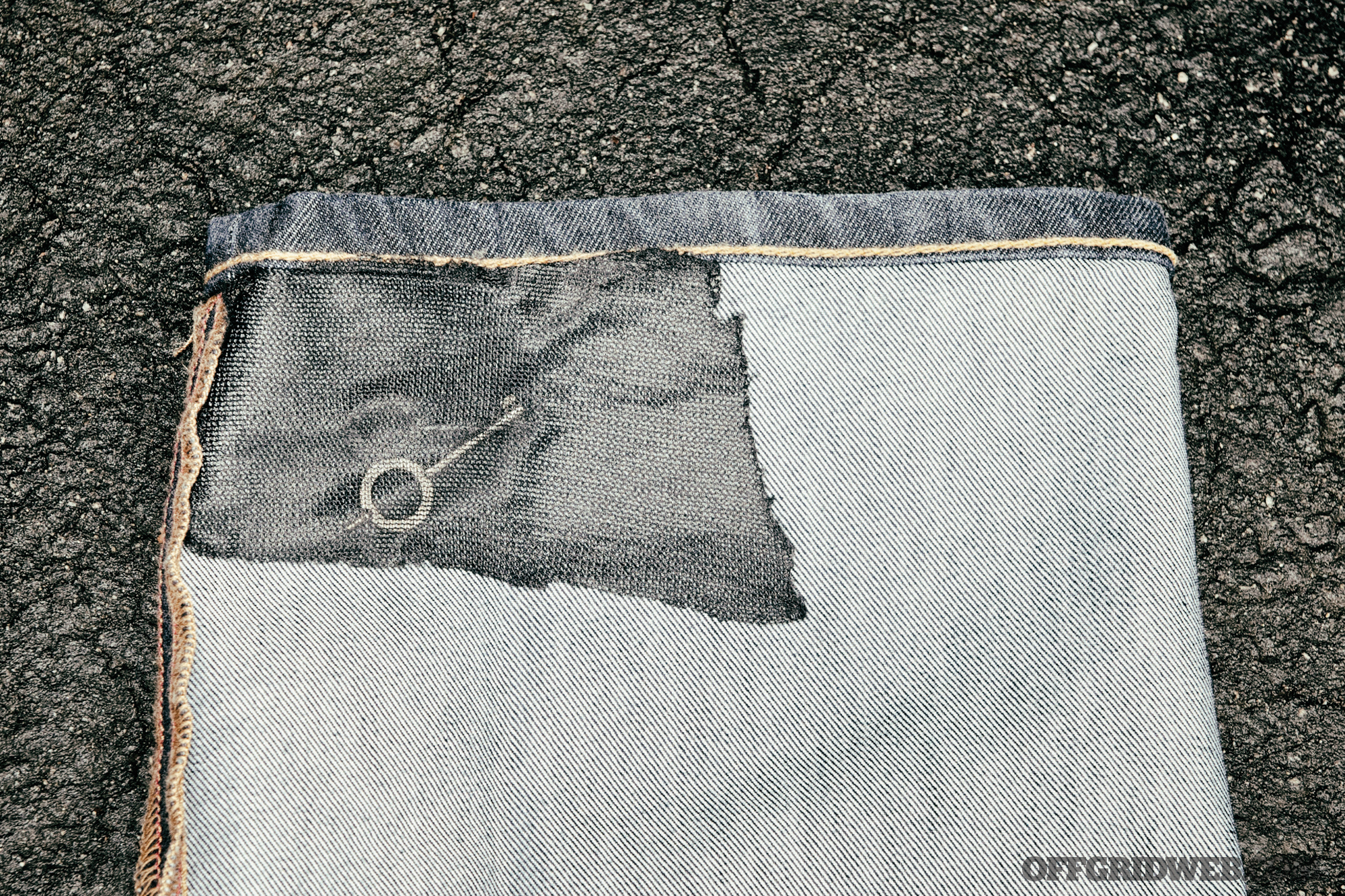
I also teach people how to hide things on their body. How to sew homemade pockets and weave cordage into their clothing. Most of these things I learned from the people we chased, not the people who trained us. It’s a very criminally based mindset, but it’s highly effective. Escape tools must be carried redundantly in case you’re bound in front or back. Criminals are looking at the same YouTube videos you are. They’re researching the same social media and Internet-based information you do. That black paracord survival bracelet isn’t fooling anyone. Example: They are counter-acting the “body break” zip tie technique by making angled cuts in the zip ties to slit your wrists when you put weight on them. They are “hardening” their abduction techniques to beat SERE-level training. Also duct-taping individual fingers to prevent access to tools.
My students learn to prepare accordingly for their region before travelling there, and prepare for the kinds of threats you actually are going to encounter. How to weaponize everyday items. How to hide things on your body, and justify the things you’re hiding. How to source or procure items locally. In the end they must go through a full abduction scenario both as an abductor and as a victim. Each scenario is debriefed so that students can assess themselves going forward.
There are also my Weaponology classes, which are more focused on improvised weapons of both impact and pointy kind, and how to get them past inspection. I have students practice on organic media. Basically I show them how to use the worst, most evil street techniques that I’ve encountered in my career. I also teach how to negate weapons access for an attacker.
Levis 504s are great to hide tools because of their abundance of pockets. Use of seamstress tape is an additional way of making tool concealment pockets on clothing.
Then sometimes I’ll do small one-day classes on Mexican occult criminal practices and urban movement — the mental aspects to movement through a hostile urban area.
Speaking of weapons, what are the firearms laws like in Mexico? Do you think they’ve helped reduce crime or reduced the general public’s ability to defend themselves?
EC: Firearms laws in Mexico are very strict. There aren’t individual state laws in Mexico. There’s one blanket federal law. It limits calibers, where you can buy a firearm, how many you can have, and where you can use them. Basically, you can’t have anything outside of the parameters of the law. For example, a .380 Glock is legal to own, but you cannot carry it. If you belong to a shooting club, you can take it to the club and back. The only gun stores in Mexico are run by the Mexican military. But everyone has a gun in Mexico. The law is very strict, but only the law-abiding citizens follow it. The criminals are armed to the teeth. I think it’s one of the saddest things that the culture of disarming the citizens is still being pushed. Buybacks happen regularly and, usually, there’s a spike in break-ins and robberies in an area immediately after a successful buyback. So I don’t think these laws do anything to help anybody but the criminals.
What do you think most survivalists or TV survival shows overlook about real-life urban survivalism?
EC: Actually doing their research on the cultural dimensions of the region they’re moving into. I get a kick out of these guys wearing 5.11 clothes and bracelets and big bowie knives. I focus on “going local.” Religious iconography, slang, sports teams, how those things will get you into places you didn’t think you could get into, even without speaking the language. Cultural research is just not something you see many people focusing on. For example, what does being Catholic mean in Mexico? Does it mean they’ll have a good place for me to sleep? Does it mean I can hide out in a church? Or are those churches cartel-controlled?
Another great skill is how to barter — I can get into more places by bartering. Learn what is of value to the people around you. For example: SureFire flashlights get you into Mexican nightclubs. Even without knowing the culture, I know he’s a doorman at a nightclub, and light is important to him. What do people need/want in that area? Also, bribery. Knowing how to bribe somebody. Can you approach a police officer in a third-world country? How much does it take to get out of running a stop sign, or an accusation of DUI? It’s not the most exciting thing to learn about, but it has saved me in more situations than anything else. It can save you so much hassle if you just do your research beforehand and then talk to local people when you get there and “learn the flavor.” I guess urban survival in a grid-down situation may be different than urban survival as a traveler in a hostile foreign country. But bartering and bribery are universal.
What do you think is the one survival item people should never leave their house without?
EC: A knife. A knife can be a medical tool, a survival tool, it can make you other things, can help you make a fire. It can also be used as a weapon. Historically, it is the No. 1 anti-rape tool. Women in many cultures would always carry around a small knife. There are accounts of this across history, from Vikings to Japan to Indonesia. In Mexico, women carry knives a lot, specifically prostitutes. It’s part of the reason many edged weapons schools teach a lot of low-body targeting.
So what do you carry with you on a daily basis?
EC: A lighter, a roll of duct tape around that lighter, a small knife (usually a Victorinox fruit knife because it belongs everywhere). A set of titanium Bogota lock picks from SEREPICK. Kevlar cordage because it’s pretty strong and can be used to tie or to cut. It’s infused all over my body through my clothing. A tourniquet. Finally, I always carry a pack of cigarettes. I don’t smoke, but it helps make a lot of friends. Oh, I do carry a silver flask of tequila, for two reasons: because of its soothing alcohol goodness, but also because the alcohol content is so high as to be almost medical grade. This can make an excellent field-expedient disinfectant. It also works as a social lubricant, in the sense that taking a sip from a flask in public is a really reliable conversation starter and friend-maker.
About Ed Calderon
Age: 35
Hometown: Tijuana, México
Required reading list for survivalists:
The Book of Five Rings: A Classic Text on the Japanese Way of the Sword by Miyamoto Musashi
Social Engineering: The Art of Human Hacking (2010) by Christopher Hadnagy
The Liar The Cheat and The Thief: Deception and the Art of Sword by Maija Soderholm
The Art of Deception: Controlling the Human Element of Security (2003) by Kevin D. Mitnick
Black Box Thinking: Why Most People Never Learn from Their Mistakes — But Some Do (2015) by Matthew Syed
The Cartel by Don Winslow
Last meal request: Four New York steak tacos from Tacos El Gallo in Tijuana — trust me on this one.
Personal firearms: H&K MP5 and Glock 19
Favorite quote: Do not sleep under a roof. Carry no money or food. Go alone to places frightening to the common brand of men. Become a criminal of purpose. Be put in jail, and extricate yourself by your own wisdom. — Miyamoto Musashi
Tomatoes have been a staple in gardens around the world for ages, and rightfully so. There are literally thousands of varieties to tailor to your grow space, region, and personal tastes. As survivalists it is important to know which types you and your family will enjoy, as well as which seeds to keep on hand for planting season. Tomatoes can form the base of a variety of foods and condiments which can bring comfort to you when things have gone south.
Home gardening can produce a great deal of food, depending on your space and how dedicated you are to maintenance. Tomatoes can be grown in the ground, on raised beds, in planters or pots, and in many other spaces. This makes them an excellent beginner crop with as little or as much upkeep as you choose. If space is limited, you can even grow tomatoes upside-down from hanging planters.
Virtually anyone should be able to grow tomatoes — in some cases, a single plant can yield as much as 30 pounds of fruit. With this in mind, being able to save your tomatoes for year-round usage is paramount for a prepper!
Canning, Dehydration, and Freeze-Drying
Rather than finding a way to pack fresh tomatoes into every meal to avoid spoilage, one should become aware of preservation methods to stock your prepared pantry.
Canning tomatoes is a process of heating them to kill any micro-organisms that would cause the food to spoil. Canning requires some special equipment that can typically be had for a small initial investment. This process also allows the canner to make a wide assortment of recipes such as salsas, chutneys, sauces, etc.
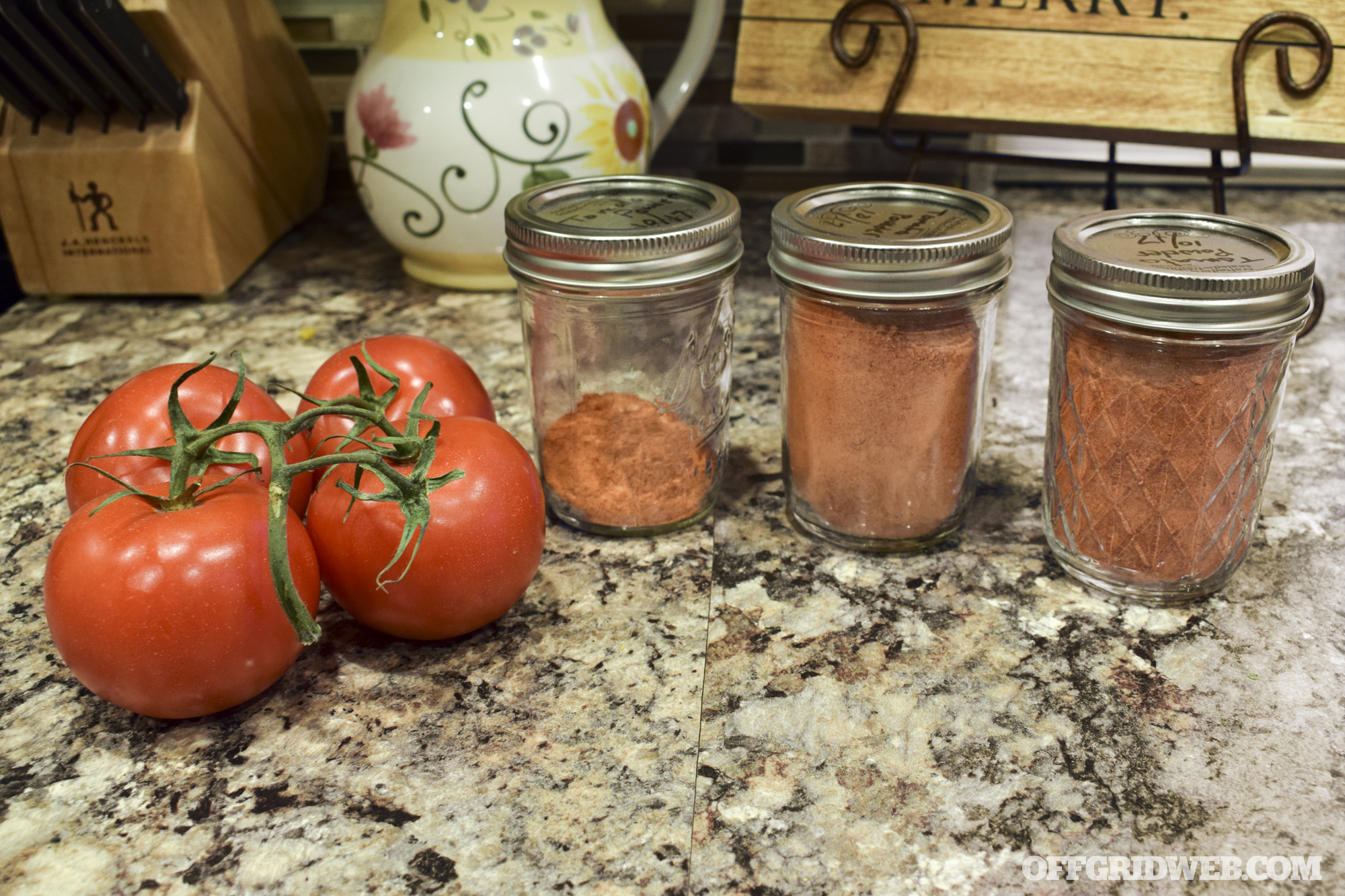
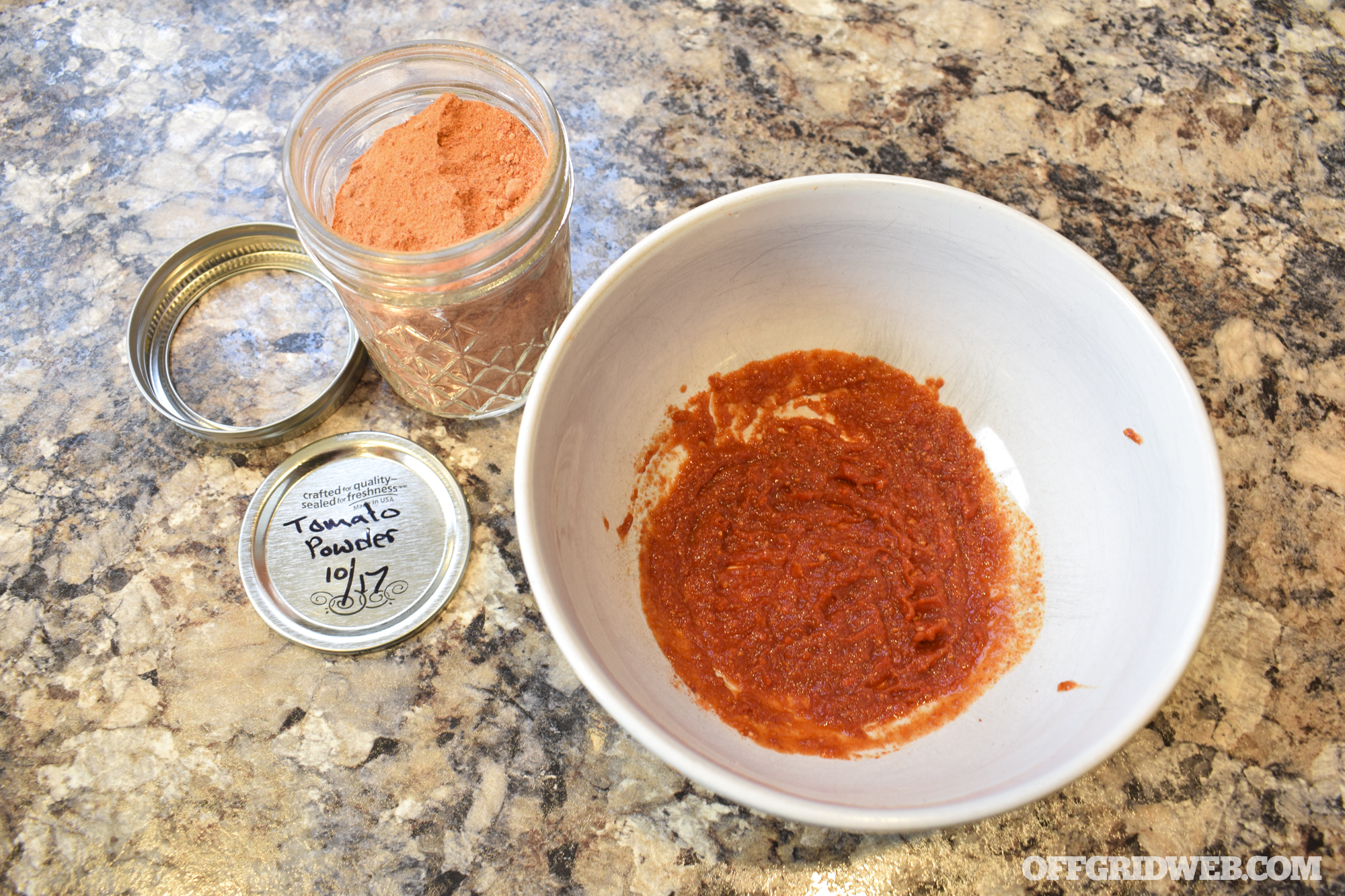
Dehydration is the process of removing moisture from food to impede the growth of mold and bacteria. Not all foods can be dehydrated, but tomatoes are an excellent candidate for this process, and doing so extends their shelf life dramatically. This process forms the basis for tomato powder.
Sun-drying tomatoes is another form of dehydration that can be used in areas with low humidity. This process takes longer than other forms of dehydration, requiring 2-4 days of direct hot sunlight. Due to inconsistencies in weather and humidity, sun-drying is only viable in warmer regions.
The last method for food preservation is freeze-drying. This method removes even more water content from food than simple dehydration, but requires a specialized machine. While freeze-dryers are available for residential use, they generally cost thousands of dollars and are impractical unless you’re processing vast quantities of food.
How to Make Tomato Powder
Tomato powder starts with fresh tomatoes. These can be from your garden, the farmers market, or even a grocery store. This author likes to use a variety of small cherry tomatoes and larger ones like the Beefmaster variety, and always chooses organic. The combination of large and small fruits lets you fit more pieces on the dehydrator trays. A traditional oven can also be used for dehydration if a true dehydrator is not available. The oven method is highlighted below as alternate steps.
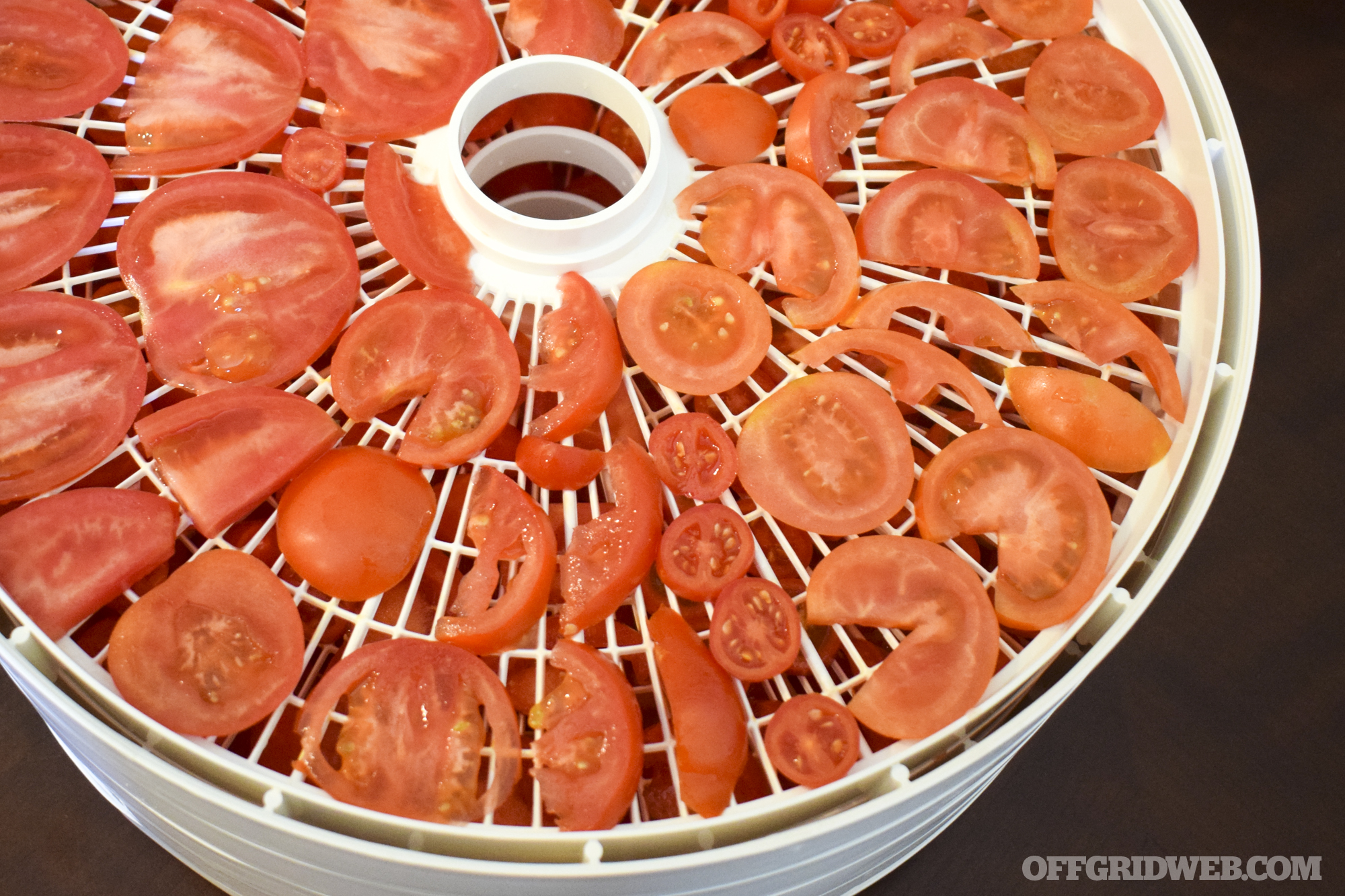
Step 1 Wash all of your tomatoes well. Even if they are organic tomatoes, there is still potential for pest waste or other undesirable debris to be on the skin. All tomatoes will need to be cut — for the smaller ones, we recommend cutting them in half and removing the core. For larger tomatoes, slice them approximately ¼-inch thick and remove the core. Remove any bruised or otherwise damaged areas and discard these. The cores and stems can be composted.
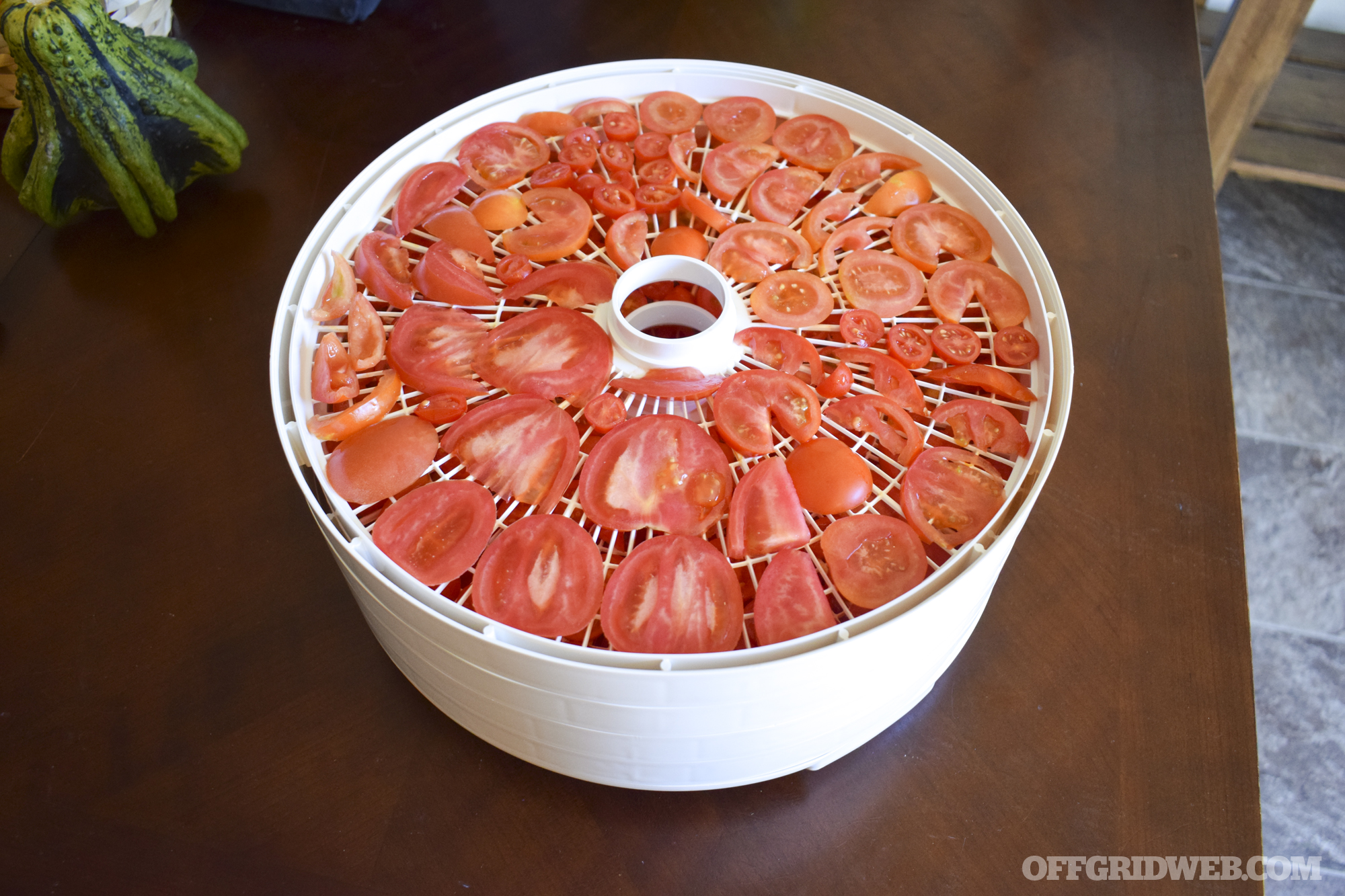
Step 2 Arrange your tomato slices evenly around the dehydration trays. Be sure air can move freely around the pieces for the best results and even drying. (Alternate method: Lay the slices on a clean, ungreased cooking sheet and preheat the oven to the lowest setting.)
Step 3 Set the dehydrator to the vegetable setting or 145° and leave the tomatoes inside for 6-8 hours. Check the tomatoes after 6 hours, if they are still thick or sticky let them sit longer. This applies to the oven method as well. Once the tomatoes are completely dehydrated they will feel stiff and break easily. If they bend, put them in longer. Any residual moisture can lead to spoilage.
Step 4 Remove the tomatoes from the trays. To make tomato powder the dried pieces must be ground. This is easiest to achieve with a food processor. A high-quality blender may also work, or you can get an arm workout with the old standby: a mortar and pestle. Grind the tomatoes to a fine powder and place them in jars.
Storing Your Tomato Powder
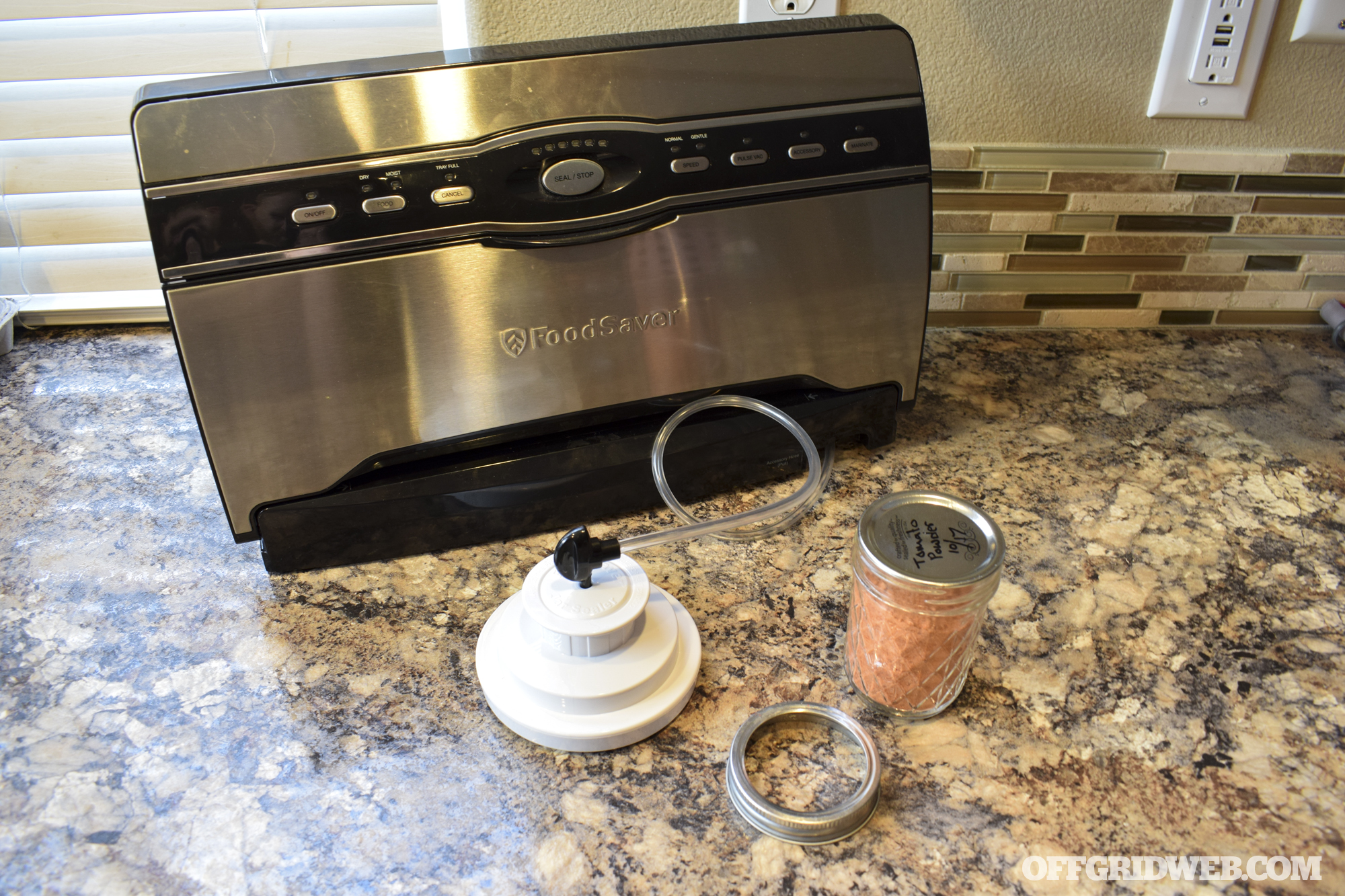
The best place to store the powder is in jars with the air removed. Removing the air from the jar can be achieved with a FoodSaver accessory attachment, or through various other dry pack canning methods. A desiccant packet can be placed in the jar as well to eliminate any remaining moisture, and an oxygen absorber can be included to further reduce the risk of bacteria growth. These jars should be stored in a cool dark place, and once used, the air should be removed before storing again. Tomato powder will last many months in these conditions.
Plastic bags can also be used for storage. The best method is to put the desired amount in the bag, then while the bag is almost sealed, slowly push it under water to expel the air inside before sealing the bag. This will ensure as little air as possible remains. Throwing in an oxygen absorber is also a good idea in this case.
The powder will begin to lose the vibrant red color over time and turn to a dull orange. If the powder has any white, green, or black color to it, this is a sign of mold and it should be discarded. If an off smell is detected, this is also a sign of spoilage.
Tomato Powder Uses & Recipes
In its dry form, tomato powder can be used as a thickening agent or simply sprinkled on meats. The most versatile use is to make your own tomato paste, which can then be transformed into sauces and soups. Tomato paste can be achieved by mixing a 2-to-1 ratio of powder to water.
Here’s another easy tomato powder recipe that adds more flavor with a few spices from your pantry:
Pizza/Pasta Sauce
1/4 cup tomato powder
3/4 cup warm water
1/2 tablespoon Italian seasoning
1/4 teaspoon salt
1/4 teaspoon garlic powder
1/4 teaspoon onion powder
Mix the tomato powder and water until the sauce has thickened. Add the other ingredients, and stir until smooth and fully incorporated. Add additional water in tablespoon increments to thin for use on pasta.
Tomato powder can be used during the cooking process of meats to enhance the flavor. Small amounts of the powder can be added to water to increase its nutritional value and taste (don’t forget to filter or purify suspect water first). The powder can even be used similar to bouillon to make a base for rice, stews, or similar dishes. The applications are limited only by your imagination.
Final Thoughts
As prepared individuals, it is paramount that we have a well-rounded knowledge base in the kitchen. Food is a necessity, however good food is a morale booster and can bring people together during trying times. Growing your own food and being able to preserve it is a valuable skill set we should all strive to hone. This author recommends checking out a few books for more information on food preservation:
The All New Ball Book of Canning and Preserving Book
The Ultimate Dehydrator’s Cookbook by Tammy Gangloff
About the Author
Alexander Crown served as an Infantryman with the Scout/Sniper Platoon of the 3rd Battalion, 509th Parachute Infantry Regiment in Ft. Richardson, Alaska, where he specialized in radio communications and reconnaissance. Since separating, Alexander spends his time as an avid outdoorsman and hunter with an appreciation for self-sufficiency in the form of gardening. He also enjoys woodworking, firearms, and reloading. You can follow him on Instagram @acrown509.
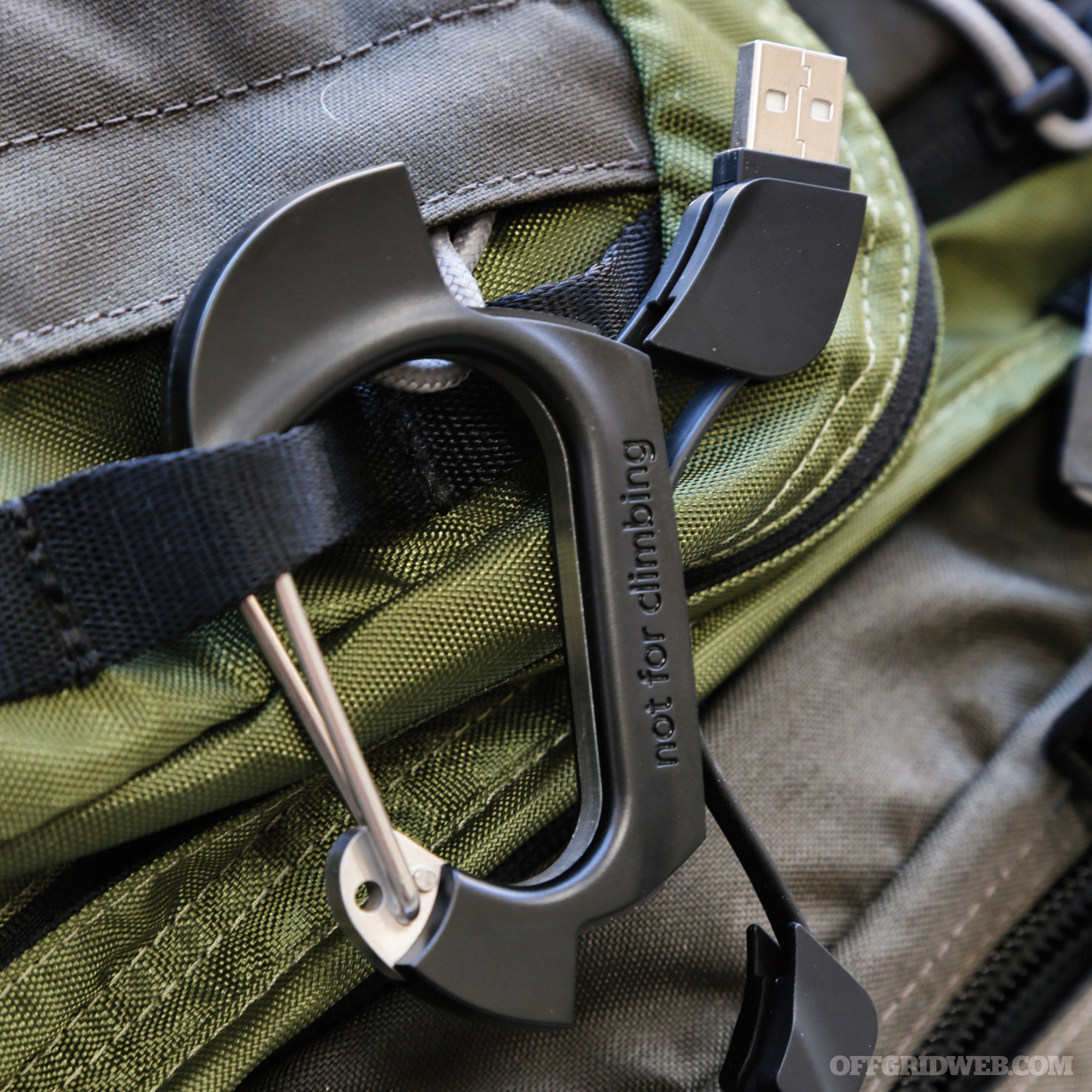
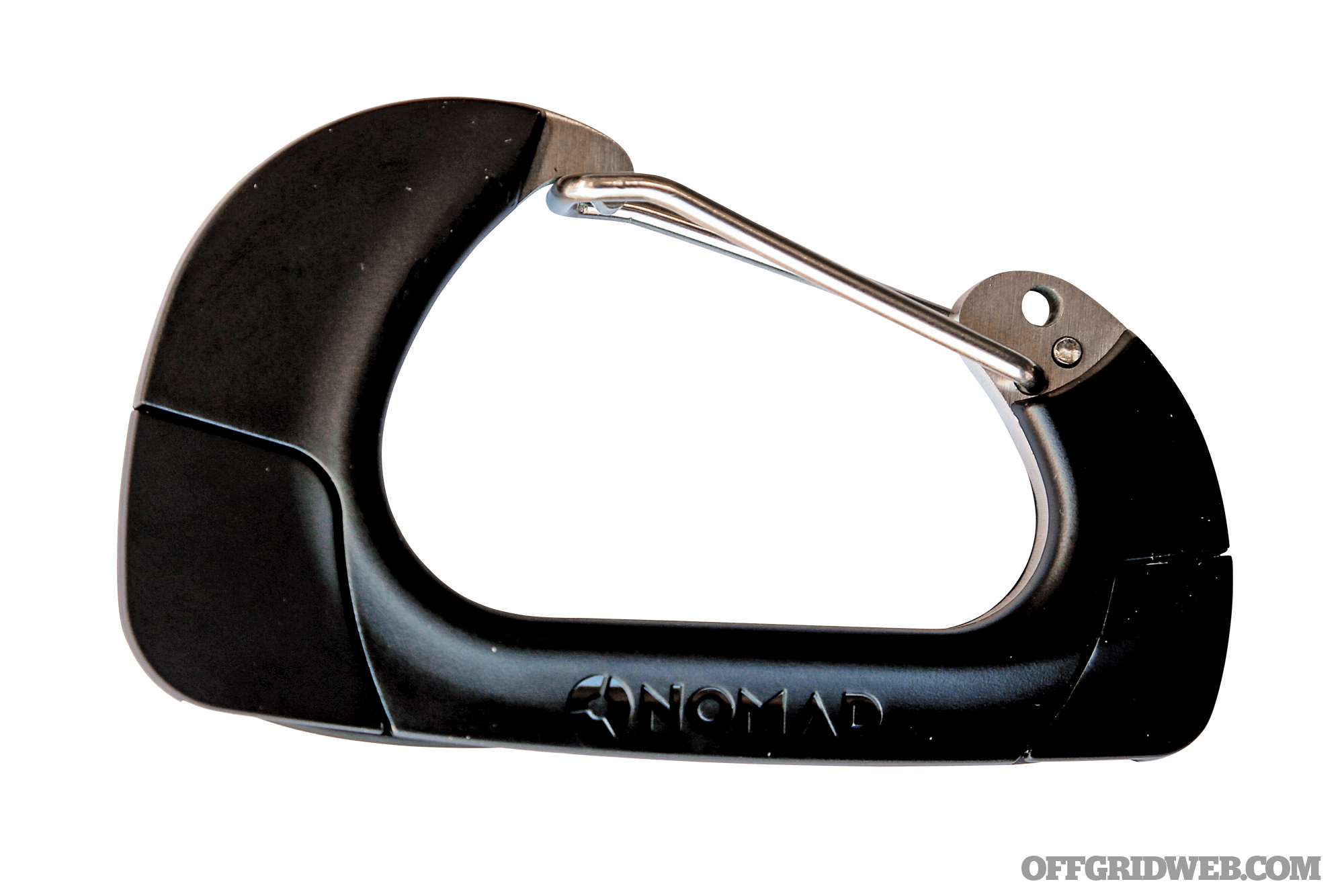
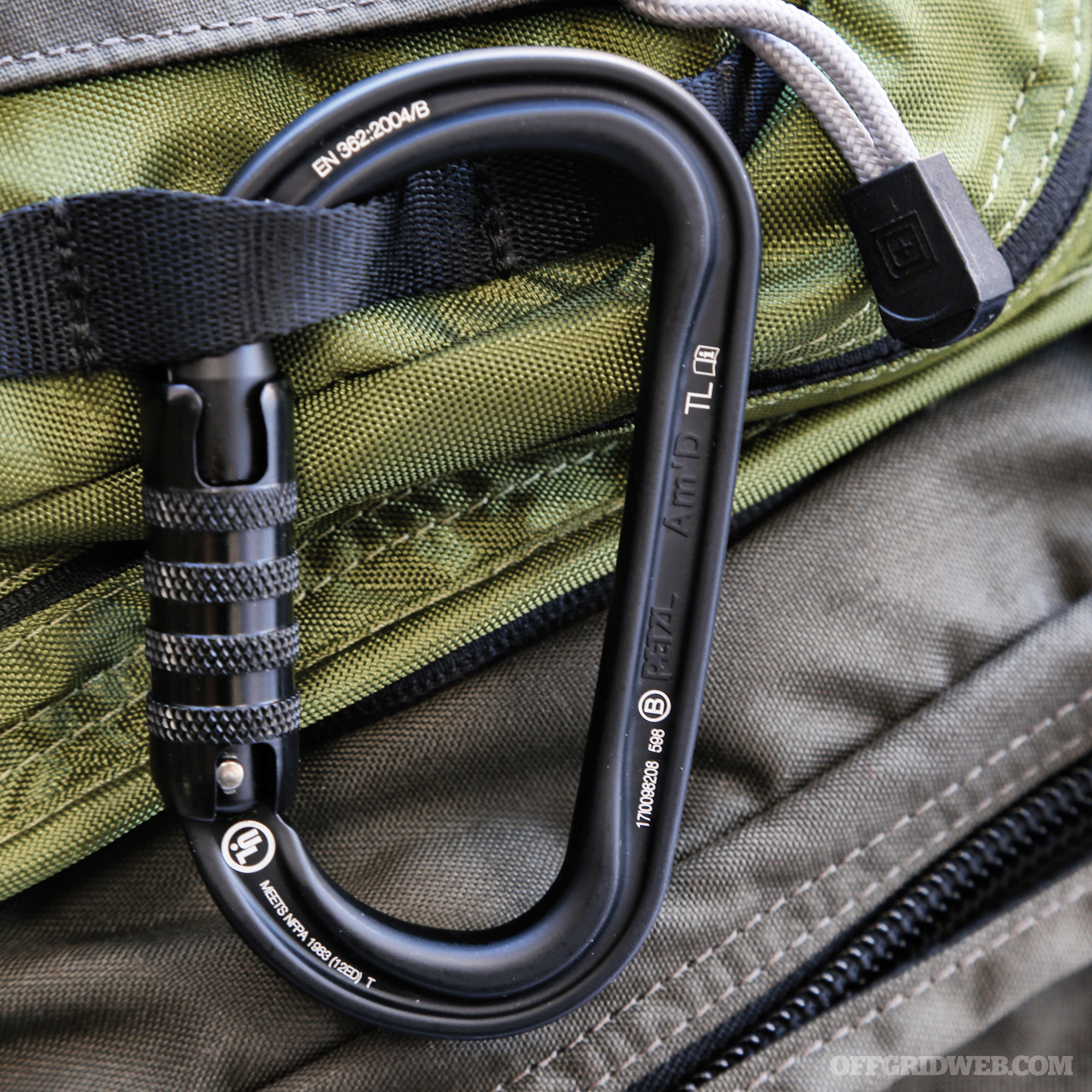
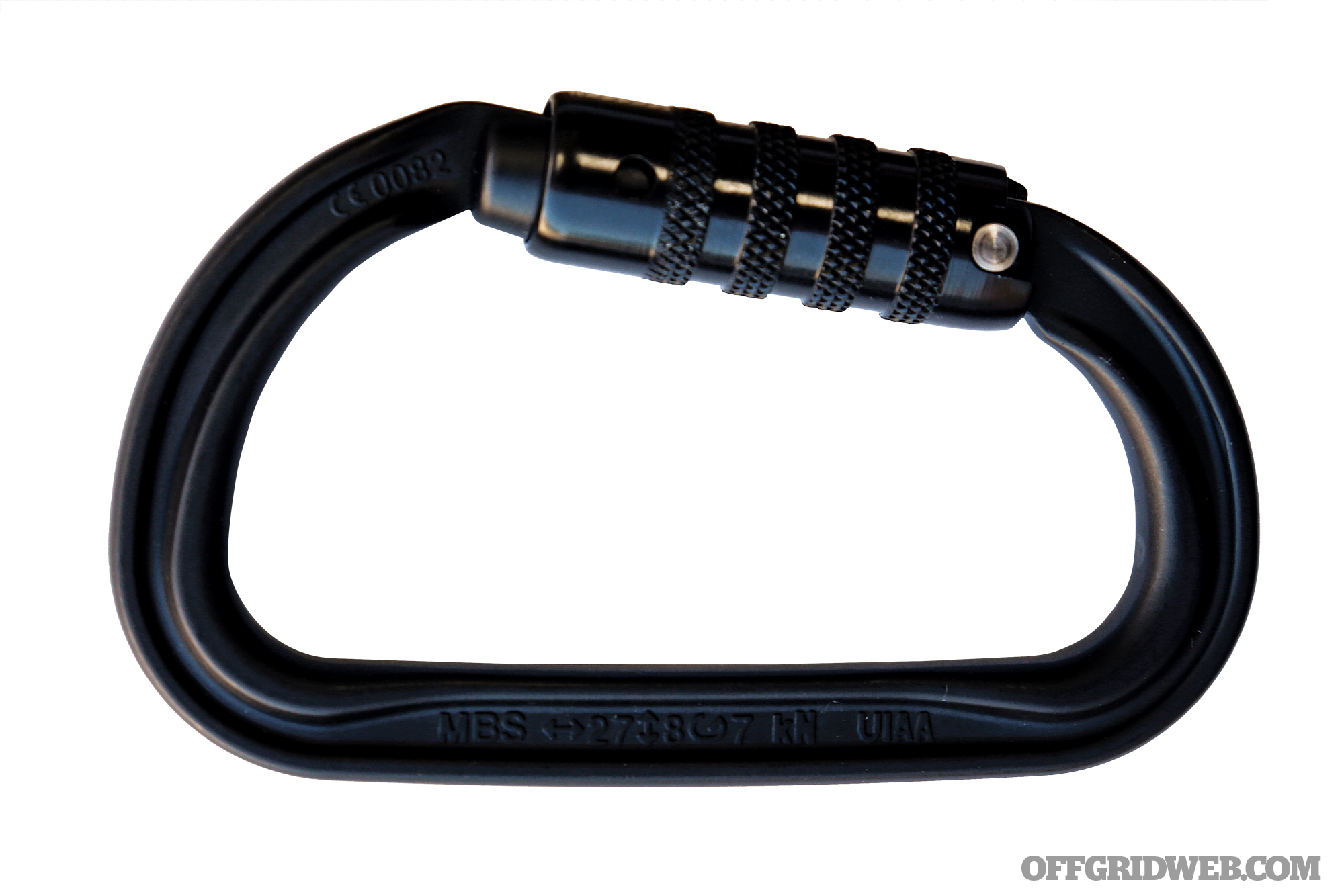
If you haven’t thought about getting a carabiner, you’ll be a convert soon after trying one. It’s an incredibly useful tool, and you don’t have to be a mountain climber to appreciate it. Aside from using them for climbing, rappelling, or caving as intended, ’biners have all sorts of improvised functions, including, but not limited to, rigging a shelter, acting as a tourniquet (when coupled with a cord), being used as a striking implement, and linking smaller packs to your get-out-of-dodge bag. Of course, you can use them for more mundane roles, such as a keychain or to attach a water bottle to your hiking pack.
The predecessor of the carabiner was made in the 1800s for French cavalry troops called carabiniers, who used metal spring hooks and slings to carry their carbines whilst on horseback. However, it wasn’t until after the 1910s when legendary German climber Otto Herzog is credited as having created the first modern ’biner by incorporating a springloaded gate (the component that opens and closes). The German term karabinerhaken means “spring hook,” but translates literally as “carbine hook.”
Today ’biners generally come in four types: asymmetric D-shaped, D-shaped, oval, and pear-shaped. The other important element is the gate, since it’s the part that opens to connect to another object and closes to ensure it stays connected that way. There are three gate types: straight, bent, and wire. Gates can further be grouped into locking and non-locking.
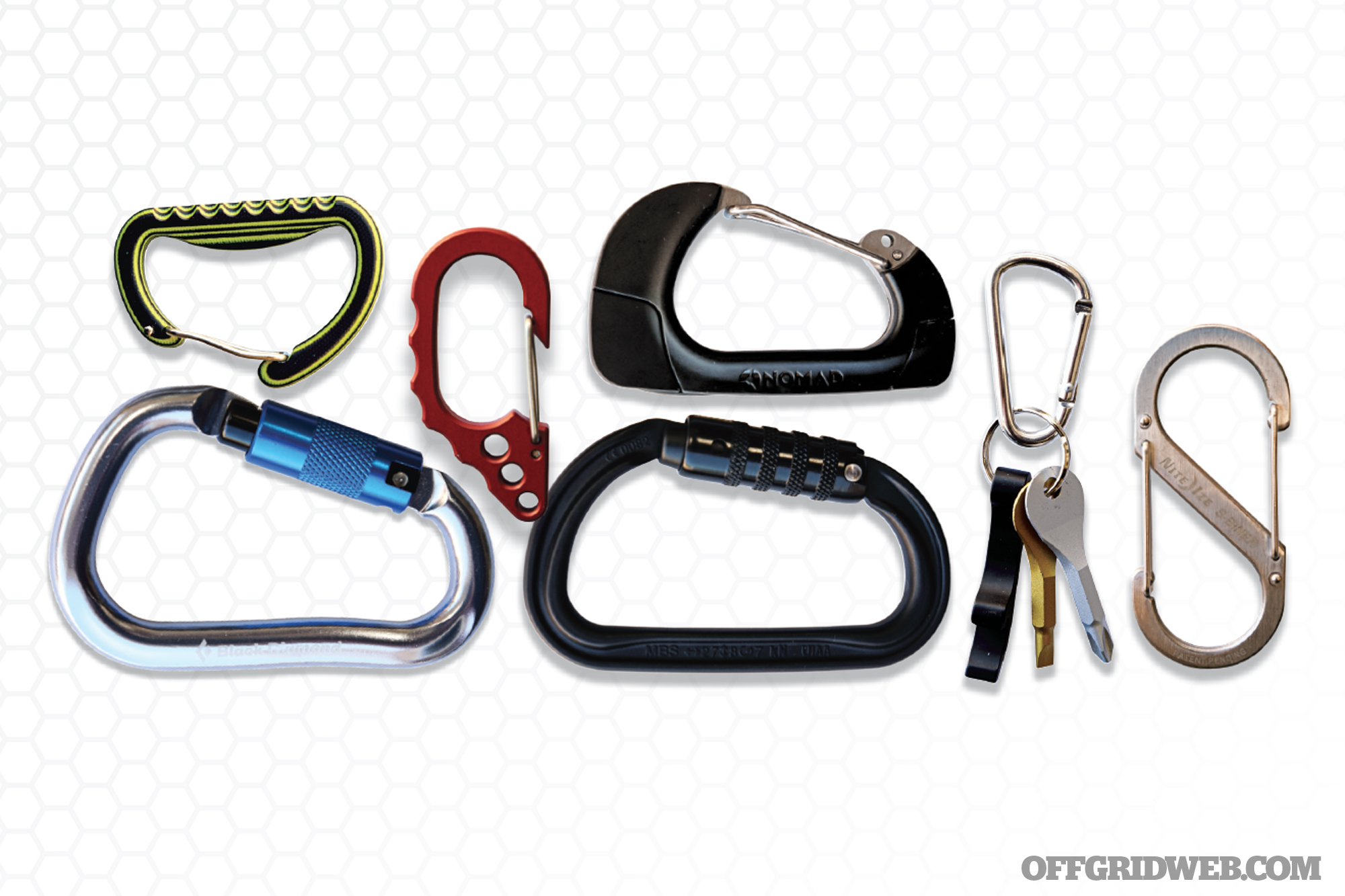
While there are many more factors to consider if you’re using carabiners for load-bearing activities, we’re not delving that deeply here. However, the seven carabiners here give you a quick glimpse at the wide array of options available on the market now. Their uses are limited only by your imagination.
Bison Designs LLC
G10 ClipTex Carabiner
Materials G10
OAL 2.75 inches
Weight 0.7 ounces
MSRP $14
URL www.bisondesigns.com
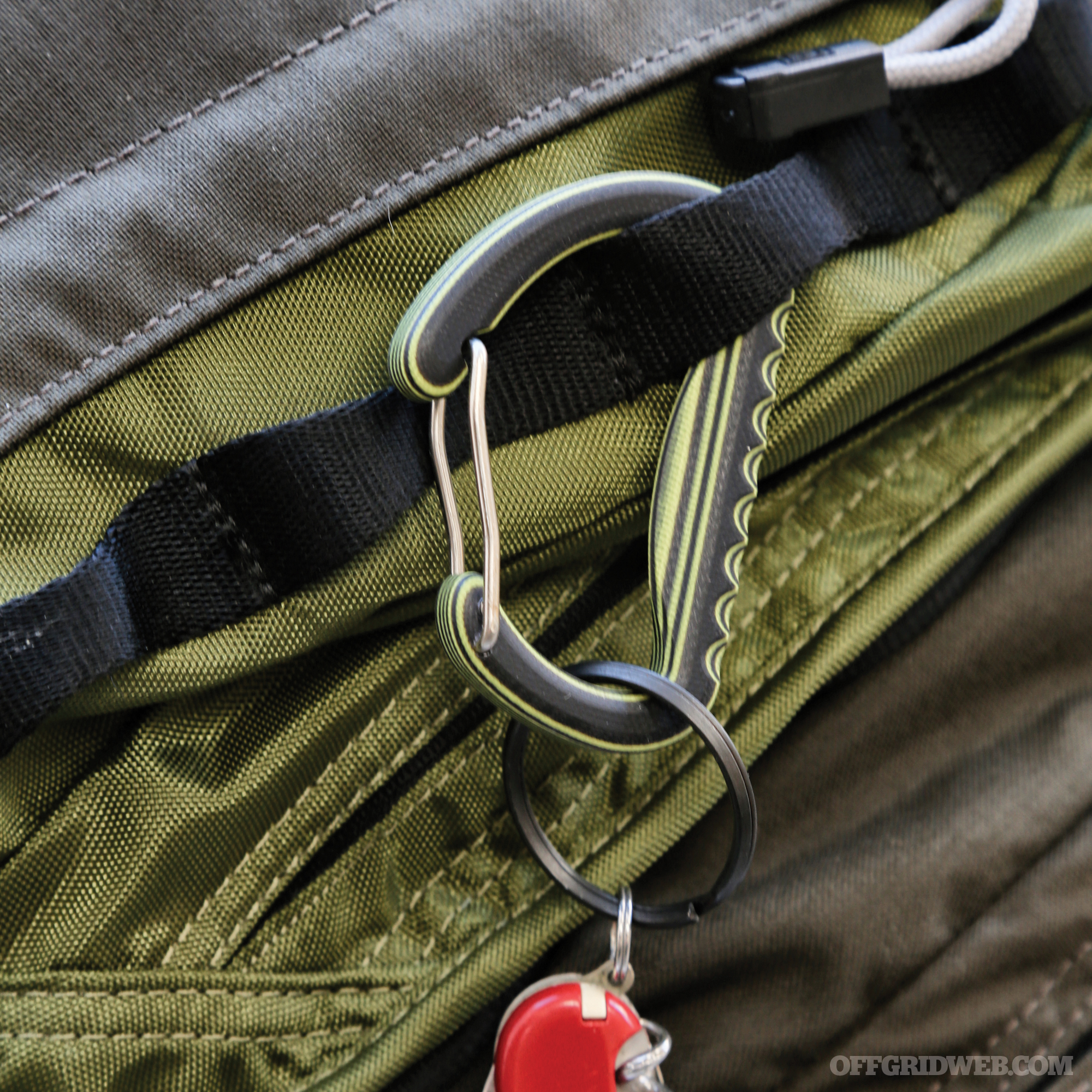
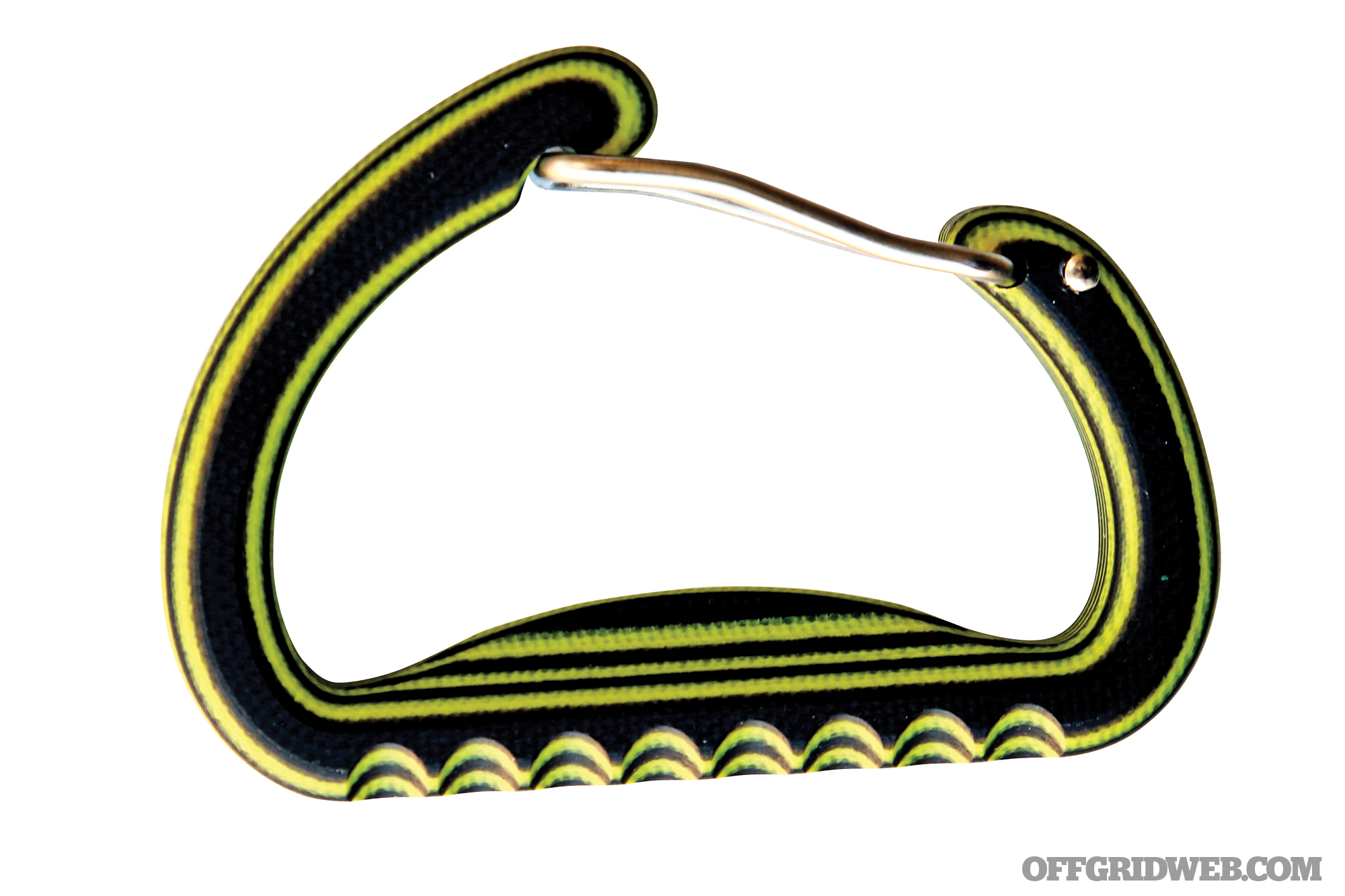
The ClipTex is advertised as the world’s first carabiner made of G10. This glass-based epoxy resin laminate was originally made for use as a base in circuit boards and is now widely used for firearm grips and knife handle scales. Why? It’s strong yet lightweight, as well as non-conductive, non-corrosive, and resistant to extreme temperatures. It also doesn’t shrink or absorb water. This makes for an incredibly durable carabiner, but note that this asymmetric D-shaped ’biner isn’t rated for any load-bearing functions.
Pros:
A featherweight at less than an ounce
Super strong and durable
Wire-gate opens smoothly and closes quickly
Comes with a keyring
Cons:
Not rated for load-bearing activities
Black Diamond Equipment
RockLock Twistlock
Materials Aluminum
OAL 4.5 inches
Weight 3.1 ounces
MSRP $19
URL www.blackdiamondequipment.com
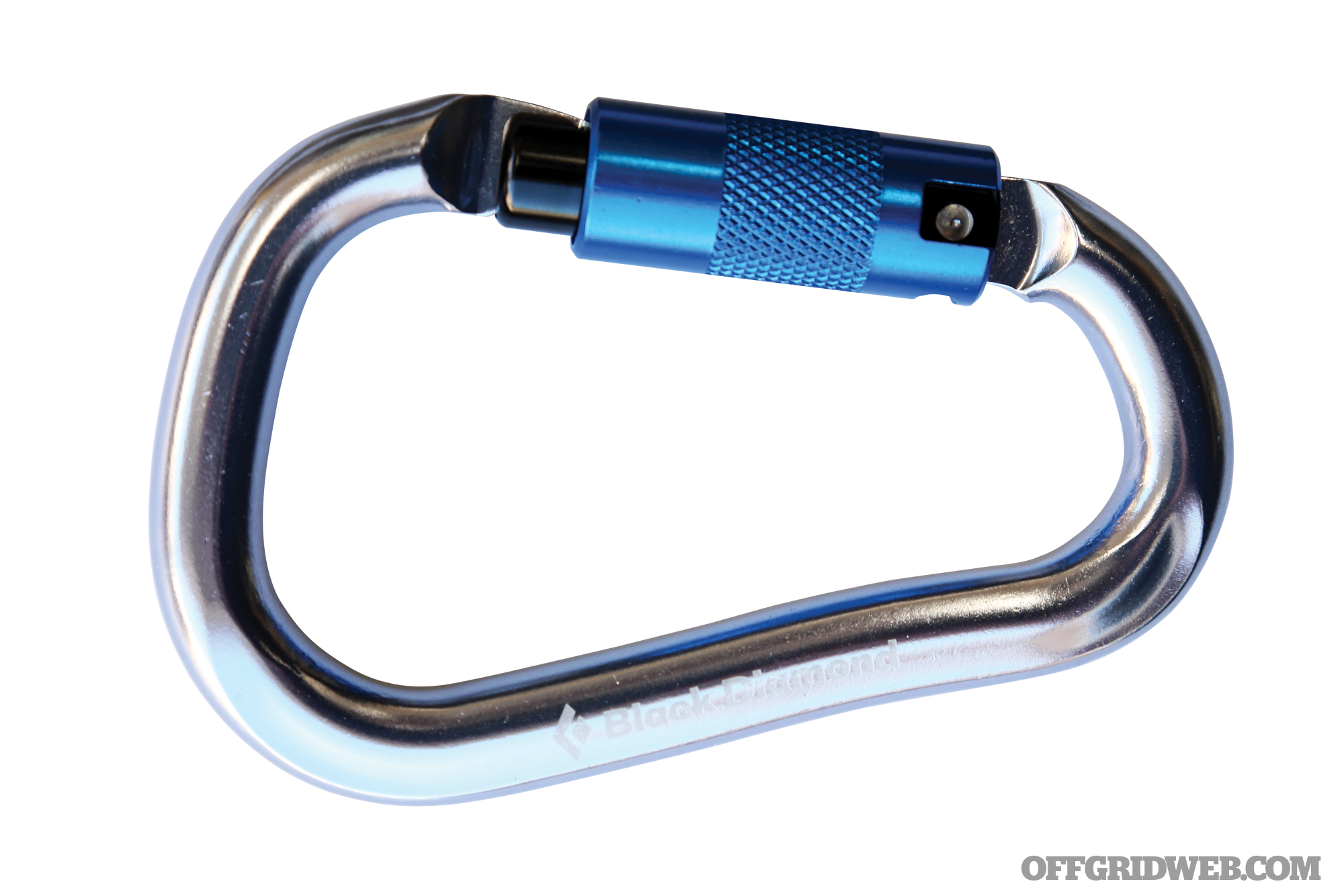
As Black Diamond’s largest belay and rappel locking carabiner, the RockLock features a twistlock gate that can be operated with one hand. Simply rotate the gate sleeve clockwise, then pull it back to open. To lock it, simply let go and it returns to the closed position automatically. Since it’s made of aluminum, it’s tremendously strong — the RockLock has a closed-gate strength rating of 24 kiloNewtons (or 5,395 pounds), yet is quite lightweight. Plus, it feels great in hand in our medium-sized hands. Made in the USA.
Pros:
Automatic twistlock ensures solid lockup
One-handed operation
Awesome strength-to-weight ratio
Slightly curved spine allows for easy gate opening
Cons:
Cons? Um … let us think about this one.
Tuff Writer
Aluminum Carabiner – Red
Materials 6061-T6 aluminum
OAL 3 inches
Weight 1.1 ounces
MSRP $40
URL www.tuffwriter.com
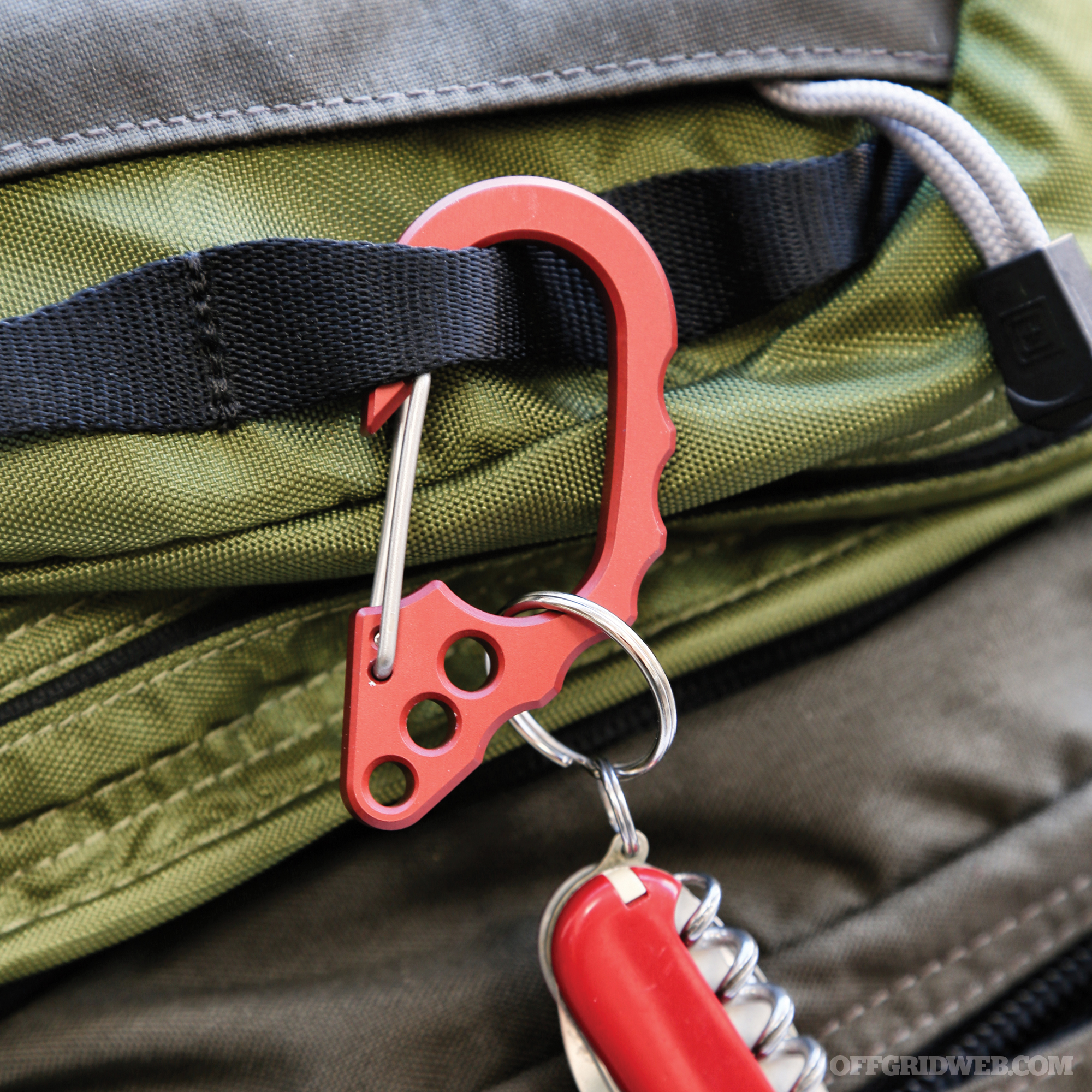
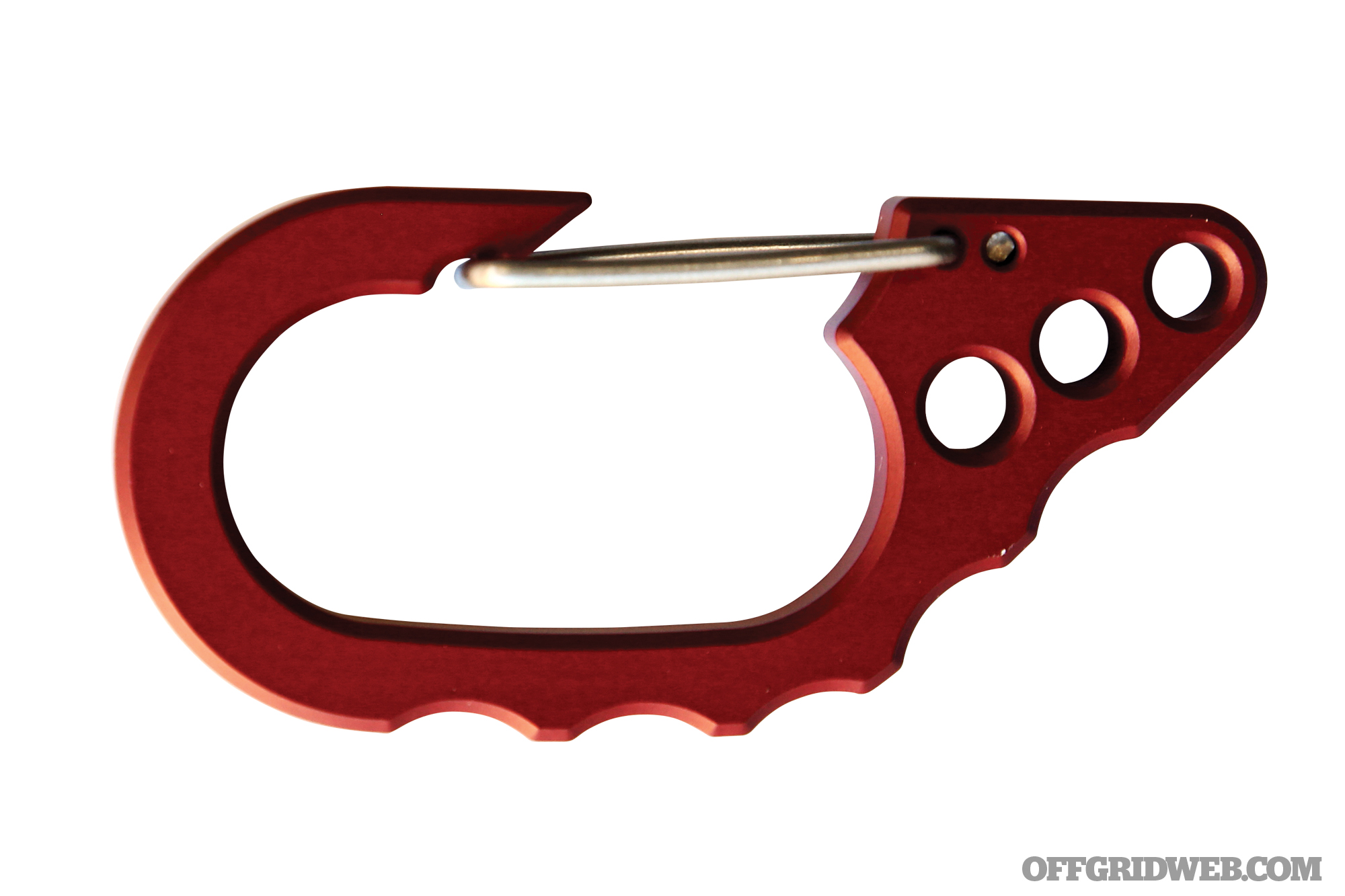
Tuff Writer makes some of the industry’s best tactical pens. Now the Arizona-based company has teamed up with D22 Manufacturing to turn its sights on carabiners. The Aluminum Carabiner is made out of, well, aluminum — 6061-T6 to be exact — and features the same precise machining and balance between form and function as the Tuff Writer pens. Also available in black blue, and purple, as well as with an aged brass frame (for $80) and a flamed titanium frame (for $120). Made in the USA.
Pros:
Strong wire-gate spring that’s smooth to open and snaps shut.
Light yet durable
Hybrid oval-shaped ’biner is aesthetically pleasing and works well as a keyring retainer
Cons:
As a keychain accessory, it isn’t rated for weight-bearing activities.
Smaller size means its gate opening is a tad narrow.
Kikkerland Design Inc.
Key Tools
Materials Anodized aluminum
OAL 2 inches
Weight 1 ounce
MSRP $10
URL www.kikkerland.com
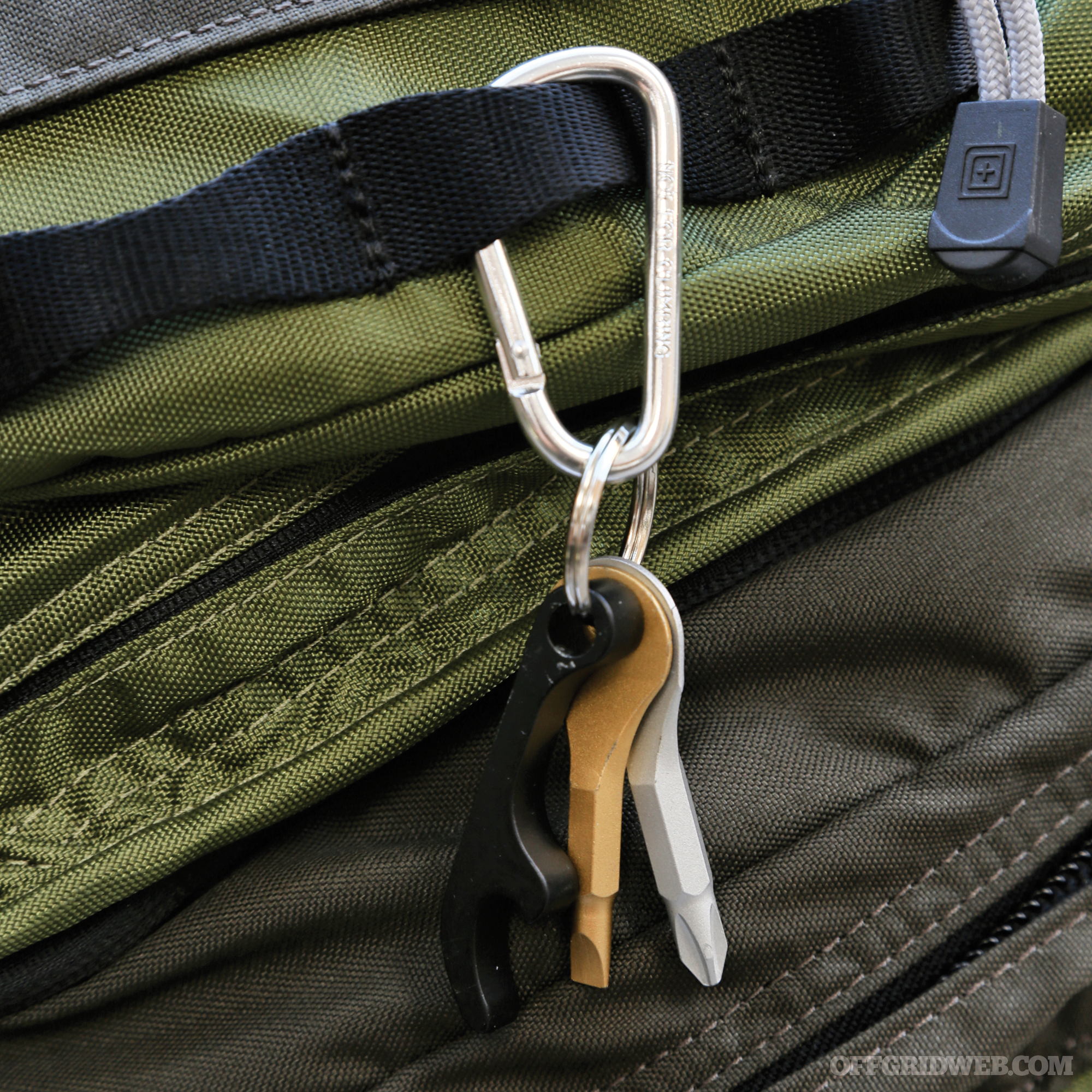
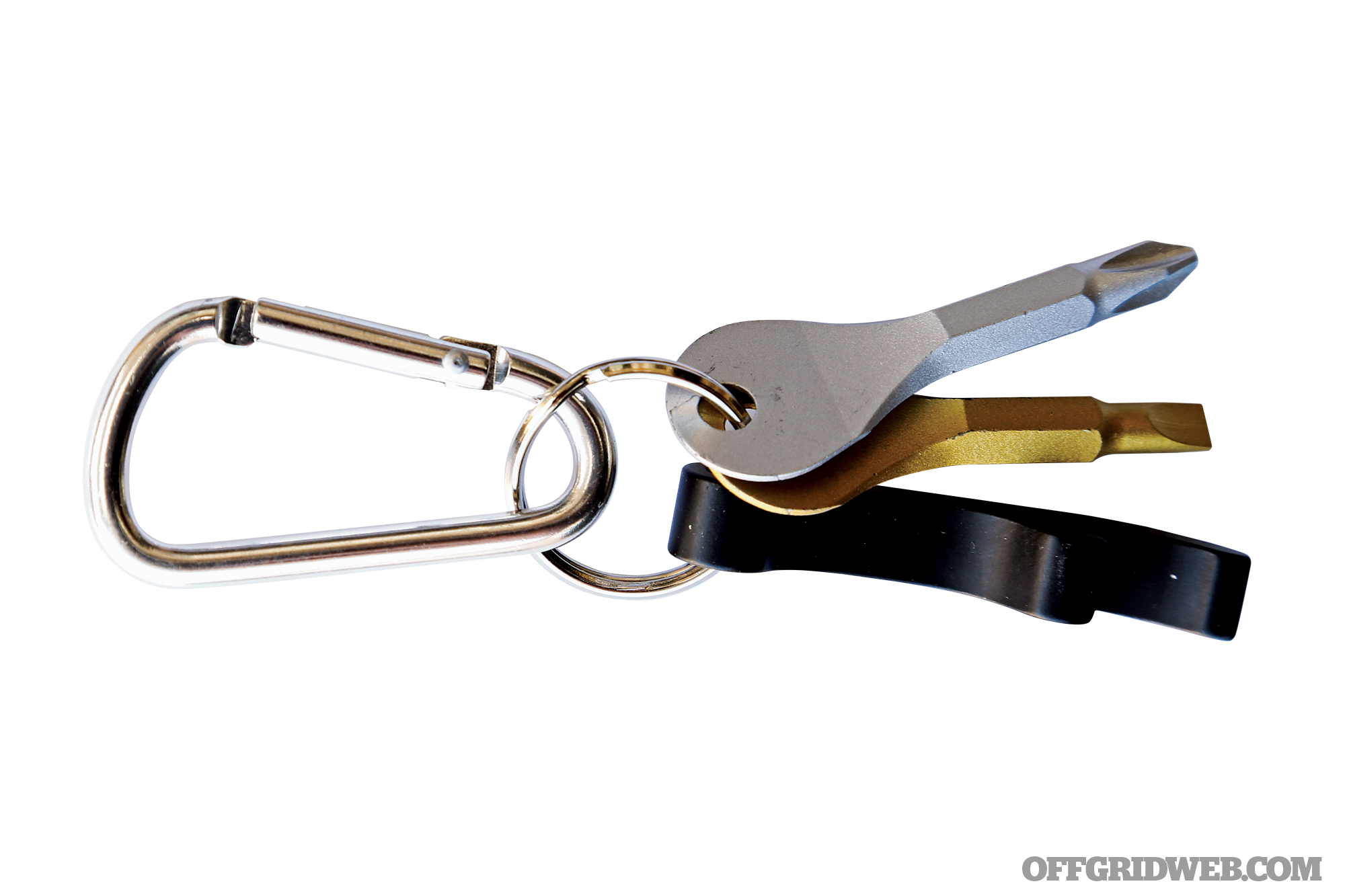
Kikkerland is known for putting a fresh twist on common light-duty devices by redesigning them in clever ways. (See our review of the Kikkerland Wood Axe Multi Tool in Issue 24.) But let’s be clear: The asymmetrical D-shaped carabiner that comes with this Key Tools set isn’t fooling anyone. Its sole purpose is to act as a means to attach the key ring and the included bottle opener and two screwdrivers (flathead and Phillips) to your pack or belt loop. Beyond that, it’s not likely to impress many.
Pros:
The included screwdrivers work well in a pinch, and their key-like shape helps provide torqueing leverage despite their short length.
The Key Tools set as a whole is a smart, convenient idea.
Cons:
The spring in the gate is barely strong enough to keep the gate closed.
We were unable to determine its materials before press time, but we suspect the carabiner is soft aluminum.
This ’biner and its gate opening is teeny.
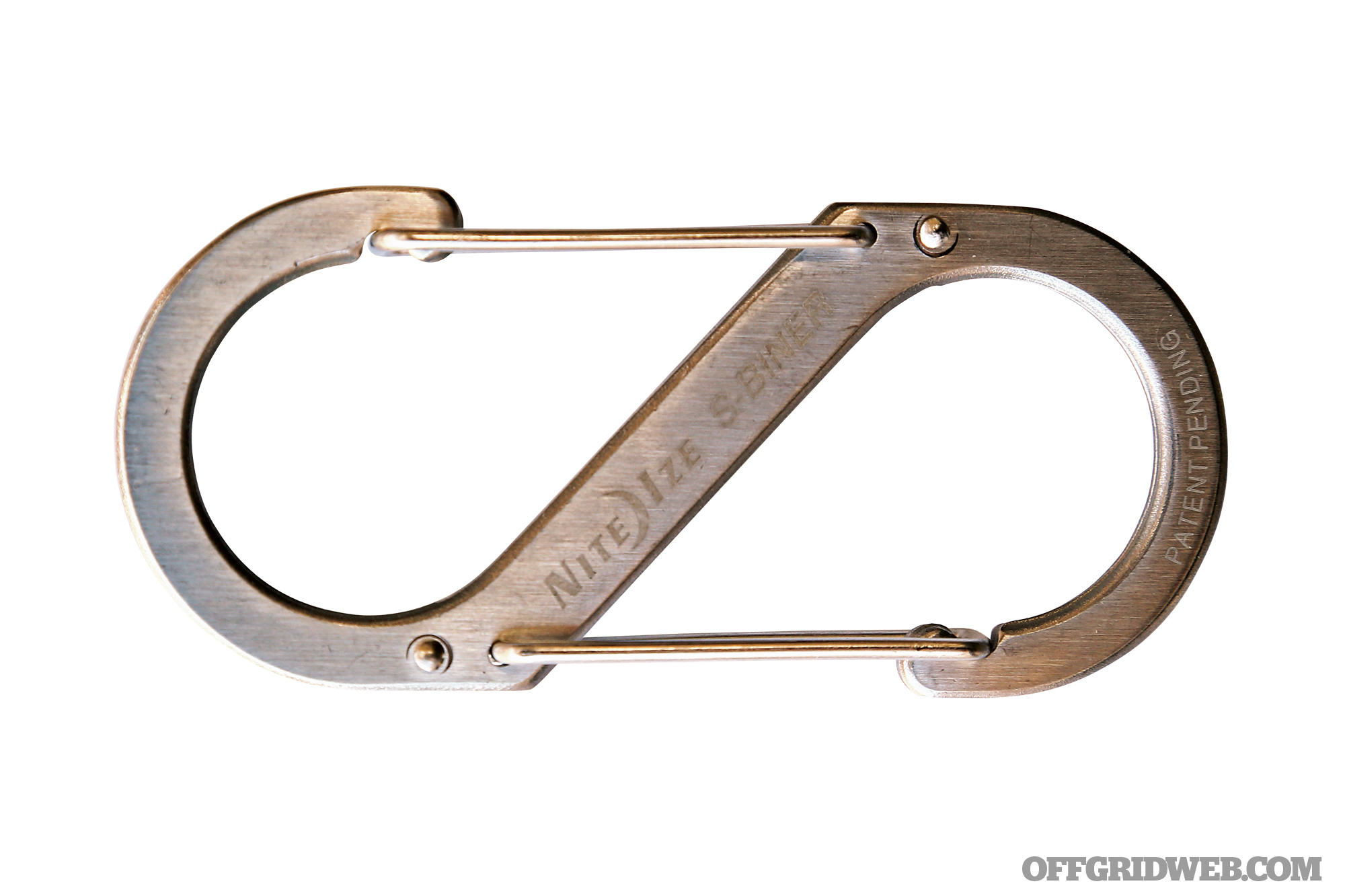
Nite Ize
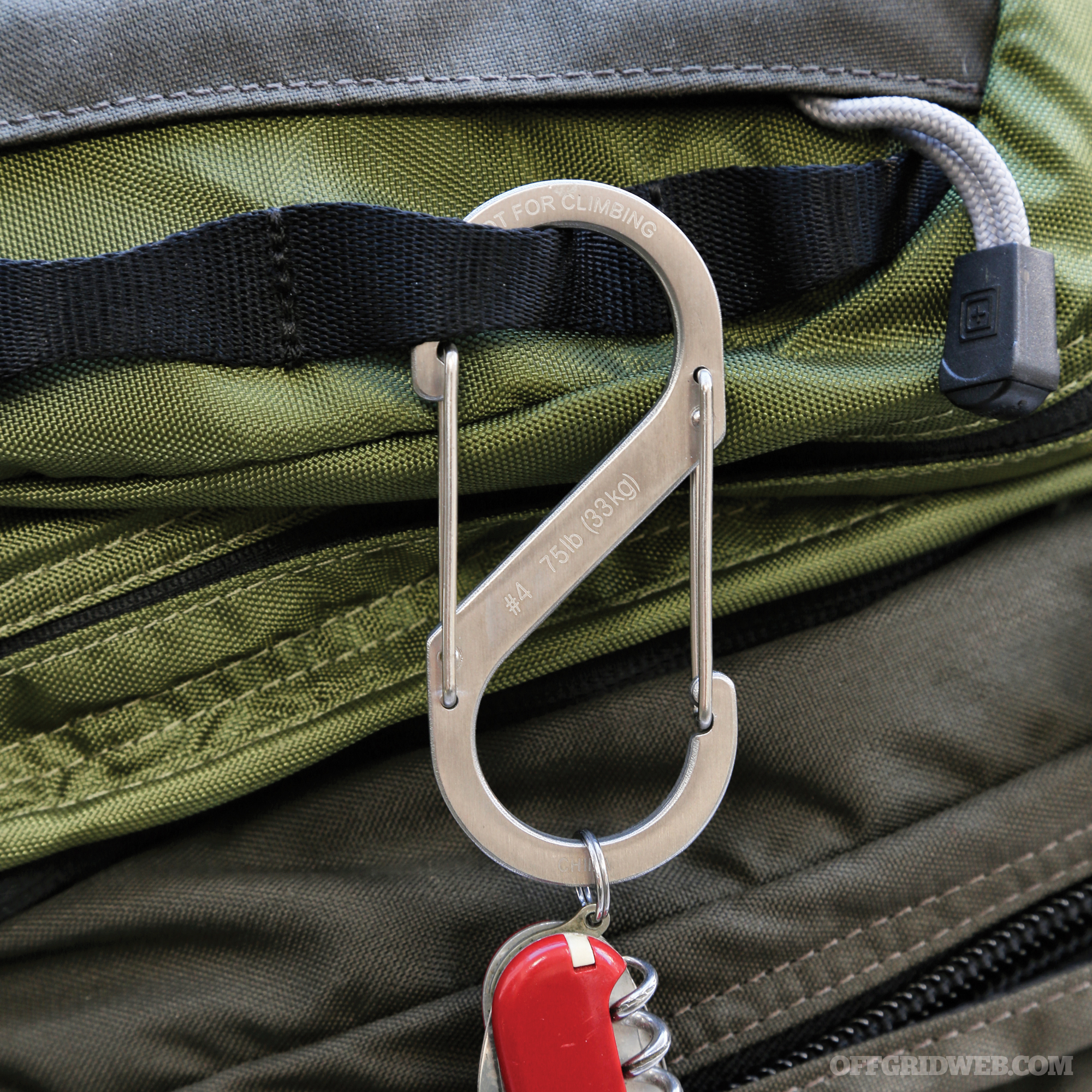
S-Biner Dual Carabiner Stainless Steel #4
Materials Stainless steel
OAL 3.52 inches
Weight 1.6 ounces
MSRP $3
URL www.niteize.com
Colorado-based Nite Ize impresses us with not only the diversity and quality of its products, but also how brilliantly they’re engineered. Case in point: The S-Biner lineup. They come in a variety of sizes and materials, but we reviewed the #4 (second largest) model from the stainless-steel series. It’s an oval-shaped carabiner that features dual wire-gates on either side, making it much easier to connect and disconnect items. Not intended for climbing, this tough yet lightweight ’biner is rated to hold up to 75 pounds.
Pros:
Dual-gate design
Strong and tough, yet lightweight
Crazy affordable price
Good quality despite being manufactured in China
Cons:
Though it can hold up to 75 pounds, it’s not rated for climbing or rappelling.
Nomad
Carabiner – Lightning
Materials Stainless steel and polycarbonate
OAL 3.75 inches
Weight 1.7 ounces
MSRP $30
URL www.hellonomad.com
In this Digital Age, it was only a matter of time before someone did it — Nomad Goods has combined the frame of an asymmetric D-shaped carabiner with a charging cord, giving you a light-duty ’biner that doubles as a backup Lightning cable. It’s USB 2.0 certified to charge up to 2.4 amperes and sync your iPhone or iPad. (Micro USB and DSLR versions are also available.) Not meant to be a primary charging cable, the Carabiner – Lightning is ruggedly built … even if it’s not meant for climbing.
Pros:
Ideal for the minimalist commuter or an emergency situation in which you need your iPhone for communication or navigation
Surprisingly rugged construction
Lightweight and versatile size
Cons:
Short cable, forcing you to keep your phone within 5 inches of the power source.
Not for load-bearing functions
Petzl
Am’D Triact-Lock
Materials Aluminum
OAL 4.5 inches
Weight 2.6 ounces
MSRP $23
URL www.petzl.com
Fernand Petzl was a caving expert who founded his namesake corporation in 1975 to mass produce quality gear for technical rescue workers and vertical sports athletes. Since then it’s developed a strong global reputation. The Am’D Triact-Lock continues that legacy. It feels great in hand, has an auto-locking gate, and can handle 27 kiloNewtons (6,070 pounds). Though this is the tactical (all black) version, the Am’D is also available in various colors with a ball-lock or a screw-lock. Made in France.
Pros:
Aluminum frame offers some serious strength in a lightweight package
Size has greater gate opening, making it easier to link up.
With its asymmetric D-shaped body and automatic Triact-Lock system, it’s ideal for belaying or holding equipment.
Cons:
The Triact-Lock isn’t the easiest to unlock with one hand; you must push the gate sleeve up then, while holding it up, rotate it clockwise before pulling it back.
This triple-action gate opening is especially awkward for lefties to operate.
Today, many of us learn so-called “primitive” survival skills as a precautionary measure, or simply a fun pastime. It’s nice to know the traditional methods of crafting a pair of sandals or making pottery from scratch, even if you’ve already got modern hiking boots and titanium cookware. But for many cultures throughout history, these skills were essential. By studying them today, we can learn to appreciate the way our ancestors survived adverse conditions.
In order to document some of these ancient techniques, filmmaker Ross Harrison traveled to a village on the island of Borneo in southeast Asia. There, he met an elder named Balan, who says he is the only one left in his village who knows how to make a traditional blowpipe. This weapon is used to hunt animals ranging from birds and squirrels to wild boar.
Although the blowpipe is powerful on its own, the real key is the use of tajem, a poison derived from the sap of a local tree. The blowpipe’s darts are coated in this sap, then dried over a fire. Balan says even a tiny scratch from one of these poison darts will kill a man, so they must be carried and loaded with caution.
The 5-minute short film below shows how Balan makes a blowpipe from scratch, using only basic hand tools and knowledge that has been passed down for generations.
In the second 5-minute film, Balan shows how he collects the tajem poison for his darts. It appears that this may be another name for upas, the byproduct of Antiaris toxicaria, a tree that has become notorious for its poisonous latex sap.
Notes Outdoor Edge makes a variety of tools that are smartly designed, well built, and crazy affordable. One such example is the Le Duck, named so for its fowl-looking pommel. This little knife is adaptable thanks to its blade profile and carry options. Made of 8Cr14MoV stainless steel with a Blackstone coating, the razor-sharp fixed blade has a generous belly that allows for detailed slicing and a strong point for thrusting. It comes with a polymer sheath that has a removable clip, which can rotate 360 degrees for multiple carry positions. Also included is a paracord lanyard so you can use the Le Duck as a neck knife. Though made of thermoplastic rubber and a little small even for our medium-sized hands, the handle is comfortable and moisture resistant. Overall, it’s a versatile backup blade for an inexpensive price.
Quantity 1,500 per box
MSRP $13
URL www.airventuri.com
Notes Airguns are great fun, not to mention fantastic survival tools. Unlike firearms, air rifles let you take small game (sometimes even bigger animals, depending on your caliber and model) in a post-SHTF situation without alerting every human and critter within earshot. The problem with BBs is that they can ricochet if you miss. That’s why Air Venturi has come out with what they claim to be the world’s first frangible BB. Rather than bounce in unsafe directions after hitting something solid, these BBs shatter into a puff of powder. Manufactured from a special alloy, the 4.35-grain, .177-caliber Dust Devils are lead-free and reportedly 10-percent faster than steel BBs. They come in an easy-pour box that makes reloading faster. Made in the USA.
Make & Model Trayvax Summit Notebook
Dimensions 3.5 by 3 by 0.75 inches
MSRP $66
URL www.trayvax.com
Notes Trayvax is a relatively new company that aims to upend the traditional bifold wallet by offering minimalist models with fresh designs that are made with such materials as anodized aluminum. Now the Washington state-based company is looking to do the same with the leather journal. The Summit Notebook combines Trayvax’s Summit wallet with an all-weather, 20-page notepad and Fisher Bullet Space Pen wrapped in an oiled latigo leather cover, giving you a multipurpose everyday-carry package without overburdening your pocket. The notepad uses Rite in the Rain paper, which is waterproof and won’t turn to mush when wet or exposed to oil and grime. The Summit Notebook fits up to eight cards, has heavy-duty nylon stitching, and comes with a 65-year heirloom warranty. Made in the USA.
Make & Model Streamlight Microstream USB Pocket Light
Overall Length 3.87 inches
MSRP $50
URL www.streamlight.com
Notes Everyday-carry (EDC) lights tend to be short but stout, due mostly because of their stubby CR123 batteries. But battery technology is constantly improving, and Streamlight’s helping to push it further along. The company’s updated Microstream fits in the palm of your hand or sits unobtrusively in your pocket because its lithium-ion cell pack is so compact — yet puts out 250 lumens for 1.5 hours on high, or 50 lumens for 3.5 hours on low. It recharges in four hours without having to remove the battery; just slide the sleeve forward on its anodized aluminum body to reveal the USB charging port. The Microstream is water resistant, impact resistant up to 1 meter, and has a removable pocket clip that can be attached to a hat brim for hands-free use.
Make & Model Arcade Belt Co. Guide
Size One size fits most (up to 40 inches)
MSRP $30
URL www.arcadebelts.com
Notes Arcade Belt Co. was founded by outdoor adventurers who disliked the casual belts on the market. They wanted something that would feel better, last longer, and outperform the competition. So, they crafted their own out of synthetic fibers and natural rubber, resulting in webbing that’s lightweight and quick drying, yet can stretch with the user’s movements. The Guide is a scuff-resistant utility belt that definitely exemplifies those qualities. The alloy belt buckle is nonslip, sturdy, and sharp looking, while the reinforced stretching is solid. From everyday wear to hiking steep trails, we’ve worn the Guide comfortably for months and found it’s delivered as promised. Available in a variety of colors, including brown, camo, and burgundy.
Make & Model Peltor Sport SecureFit 400 Eye Protection
Quantity Three per pack
MSRP $14
URL www.3m.com
Notes If you’re saving up for a food cache or an extra power generator, then you might cringe at the thought of paying $100 for a pair of Wiley X or Oakley shooting glasses. Thankfully 3M’s Peltor Sport has the affordable SecureFit 400 series of eye protection. This three-pack provides eye protection for you and two loved ones for less than the cost of three caramel macchiatos. Each pair features impact-resistant lenses that meet ANSI Z87.1-2001 standards and come with an anti-fog coating and 99-percent UV protection. The soft-touch nosepiece and temples ensure a comfortable fit while the flat, low-profile arms let you wear earmuff-style hearing protection without any pinching. The glasses come with clear, amber, and gray lenses.
Make & Model Canyon Coolers Copper Adventure Tumblers
Capacity 20 ounces, 30 ounces
MSRP $25, $30
URL www.canyoncoolers.com
Notes When it comes to enjoying a beverage, there’s almost nothing more annoying than having a hot coffee or an iced tea go lukewarm. Talk about blah. Fortunately, Canyon Coolers recently released its new lineup of Copper Adventure Tumblers. Thanks to their vacuum-insulated, double-walled construction, the containers can keep hot beverages hot and cold drinks cold for hours on end. The tumblers are manufactured from food-grade 18-8 stainless steel with a copper coating on the exterior, making them safe and stylish yet durable. They feature sliding lids that prevent leaks and spillage. Plus, Canyon Coolers say they’ll fit in 99 percent of cupholders.
Make & Model Zippo Tinder Shreds
MSRP $5
URL www.zippo.com
Notes Without fire, there can be no life in a survival situation if the timeline’s long enough — especially if there’s inclement weather. Rain, wind, and snow can dampen even a master bushcrafter’s best efforts to get a campfire going. The Zippo Tinder Shreds can help make things a bit easier in difficult times. Made of shredded pine and coated with water-resistant paraffin wax, these coils of tinder light quickly, burn long enough for you to stoke the flames, and are easy to pack in your care. Each set comes with 10 shreds in a resealable clamshell container.
Make & Model CenterPoint Archery Volt 300
Bolt Velocity 300 feet per second
MSRP $300
URL www.crosman.com
Notes Long before Daryl of The Walking Dead made crossbows cool among the zombie apocalypse crowd, soldiers and hunters used this ranged weapon to great effect for centuries. That’s why some crossbows nowadays can cost more than a quality AR-15. Don’t have an extra grand or two lying around? Crosman hopes to ease that financial squeeze by offering the Volt 300 from its CenterPoint Archery brand. It includes a quiver, carbon arrows, an adjustable buttstock, and a 1x40mm three-dot optic for $300. With a reduced draw weight of 130 pounds, it’s ideal for those looking for a smaller-framed model that’s easier to cock yet still delivers plenty of velocity. Also, it has quad limbs, an auto-safety trigger mechanism, a fully machined cams system, and interchangeable grips and buttstock. The Volt 300 should be available come mid-May.
Make & Model Sustain Supply Co. Essentials2
Number of Items 12 products (29 individual pieces, not counting the first-aid kit)
MSRP $99
URL www.getcyalume.com
Notes A great many go-bags on the market are covered with PALS webbing and camo patterns. If you’re bugging out during an urban disaster, those rucksacks will scream, “Look, I have valuable stuff!” The Essentials2 is a prepackaged survival kit that’s much more discreet — and comes with 72 hours’ worth of life-sustaining supplies for two people. It includes food rations, a first-aid kit, a MoraKniv fixed blade, a Sawyer mini water filter, and more. The backpack has various convenient features, such as side mesh pockets, padded adjustable shoulder straps, and a robust grab handle at the top. While we’d prefer the company’s name not be so obvious on the front, the Essentials2 is an otherwise inconspicuous and solid pack to start with if you’re looking to buy a bug-out bag instead of building one yourself.
Make & Model Rogue Ridge Ridge Warrior RB1000
Cargo Capacity 300 pounds
MSRP $4,600
URL www.rogueridge.com
Notes Bicycles, e-bikes, and motorcycles are all potential bug-out vehicles; each has its pros and cons. Take the RB1000 for example. It features a 1,000-watt motor, a 13-amp-hour Panasonic battery, and Kenda Juggernaut Pro tires, giving you the off-road capabilities of a human-powered fat bike, but with the added boost of a rechargeable engine. You can ride up to 30 mph with a range of 29 miles or up to 60 miles in Pedal-Assist Mode. The drawbacks, however, are limited cargo space and single occupancy. Still, the Ridge Warrior’s 6061 aluminum alloy frame can hold 300 pounds, making it ideal for hunters who’ve bagged fresh game or a survivalist who’s bugging out.
Make & Model CGear Original Sand-Free Mat
Colors Blue/Green, Green, and Orange/Tan
MSRP $60
URL www.cgear-sandfree.com
Notes Whether it’s a camping trip or a day at the beach, it’s almost impossible to lay down a tarp or towel and not have sand or dirt scattered all over it within minutes. The Sand-Free Mat can stop that. Originally designed to allow military helicopters to land without “brownout” obscuring the pilot’s vision, the mat is made up of a patented multilayer weave that lets particles fall through to the bottom, but prevents them from coming back up. Plus, it has D-rings to pin the mat down with stakes. It comes in multiple colors and sizes, from small (6 by 6 feet) to extra-large (12 by 12 feet). Note: they’re not lightweight like common tarps, with the smallest mat already clocking in at 3.15 pounds. Still, the Sand-Free Mat is a smart design and ideal for RVers, campers, and beachcombers.