Two months ago, we introduced traveling photographer and videographer Sara Liberte and her new bug-out vehicle project, the Battle Van. If you haven’t already read the introduction to this build, we’d encourage you to do so now — here’s a link to that article.
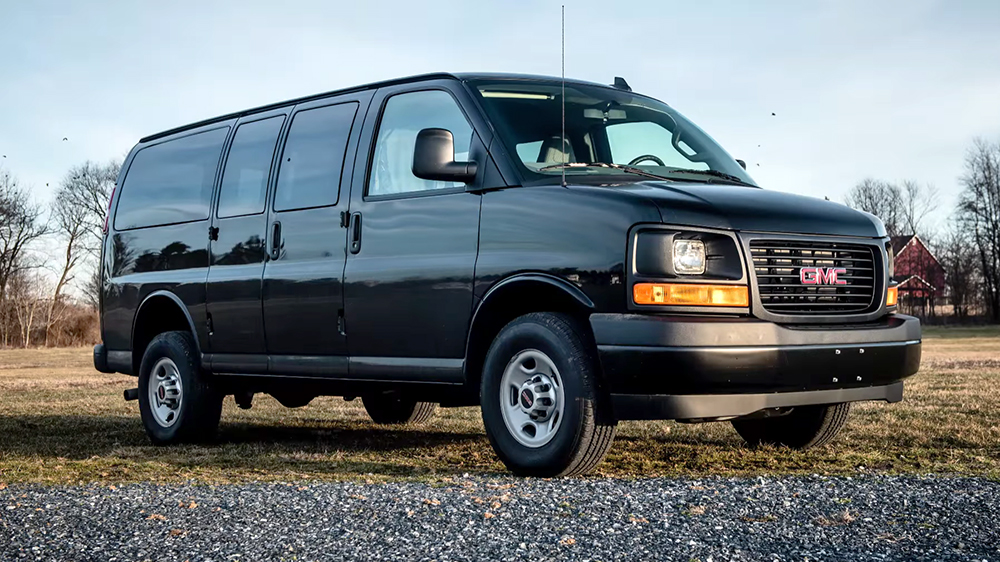
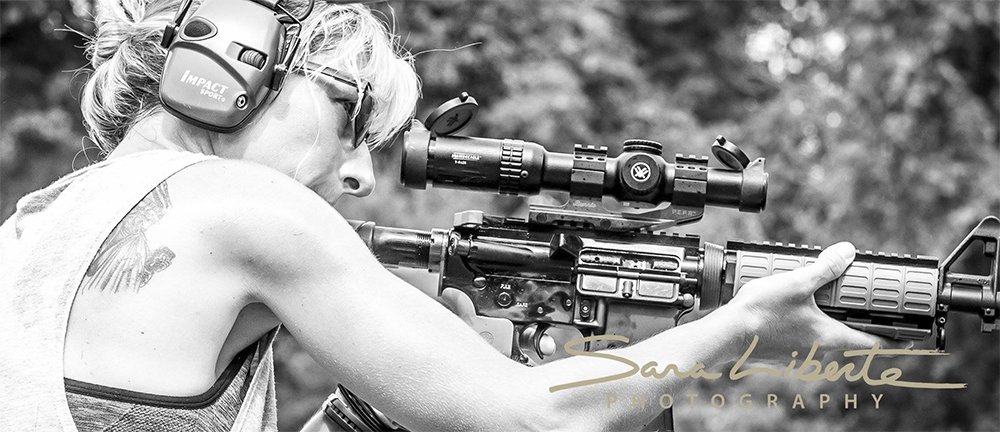
The short version is this: Sara is building a 2017 GMC Savana cargo van into a fully-equipped all-terrain home on wheels, and we’re following along from afar to document the transformation. This isn’t some weekend warrior project that’ll be collecting dust in Sara’s driveway most of the year. It’s her every-day bedroom, kitchen, storage locker, and her transportation to remote photo shoot locations. She’ll be living in this van for extended periods of time, and using it to store her camera, firearms, emergency gear, and communications equipment as she drives from assignment to assignment.
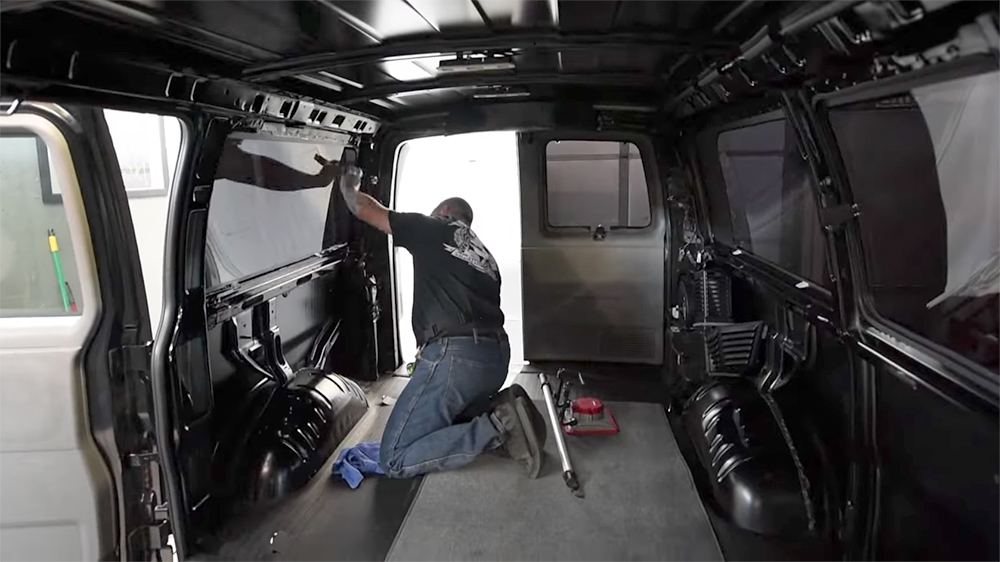
A lot has already been accomplished since we last wrote about the Battle Van. First, Sara brought it to Pro Tint in West Virginia for some window tint to provide much-needed privacy.
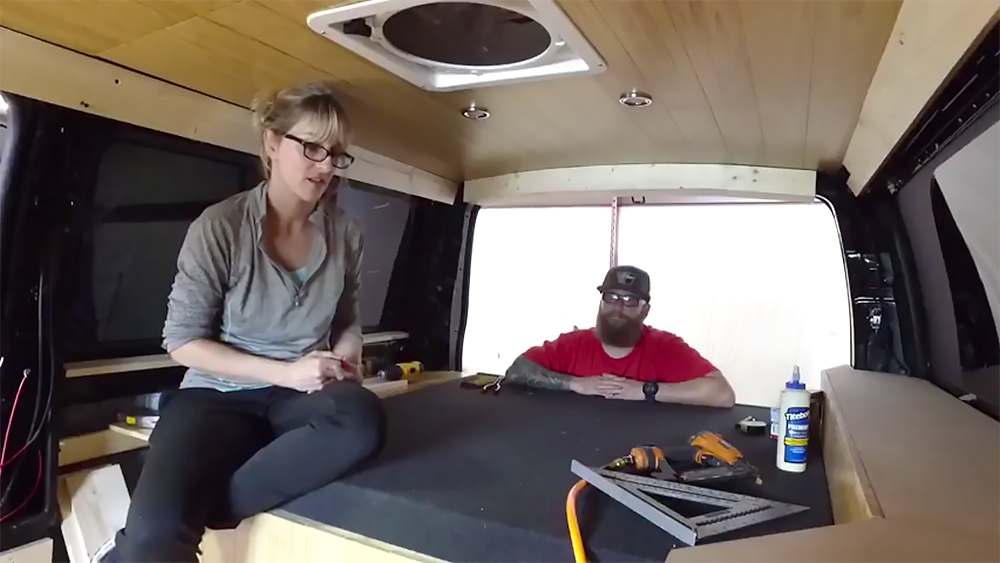
Then she headed to Stillwater, Oklahoma, to meet David Adams at Clever Crow Fab. David lined the interior sheetmetal with DEI boom mat, which will dampen outside noise and vibration, allowing Sara to get some shut-eye even if the wind is howling outside. It’ll also improve the sound quality of the sound system (more on that below).
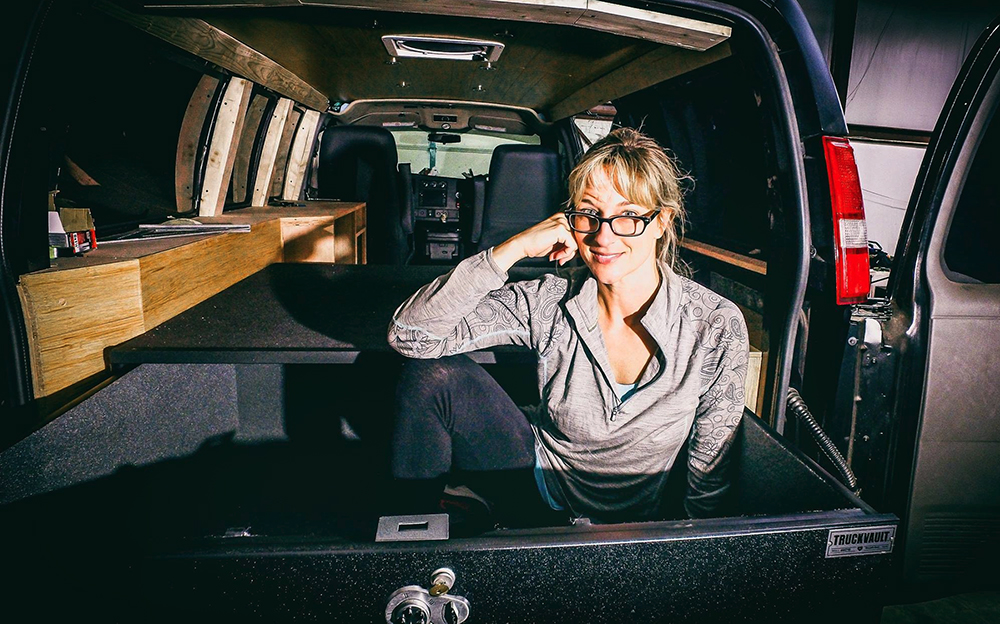
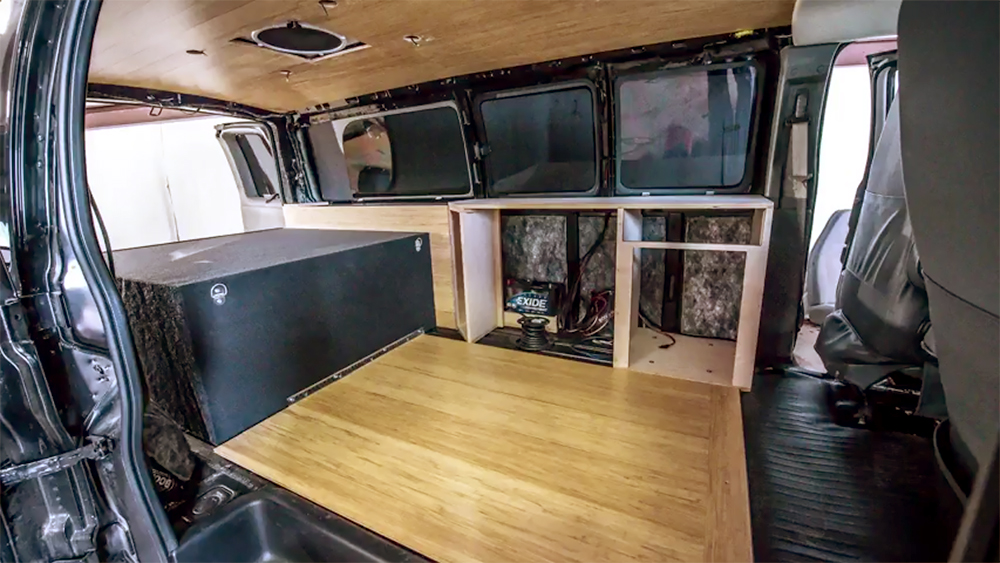
Next, a custom Truck Vault storage compartment arrived, and David hoisted it into the back of the van. It’ll serve as a platform for Sara’s mattress, and includes two slide-out drawers with massive capacity. It also locks securely, so Sara can keep her valuable gear inside and away from would-be thieves.
David also applied his fabrication skills to create wood countertops, cabinets, flooring, and a roof panel with inset lighting. An internal battery and electrical system is also in progress, and Kicker speakers will be installed to upgrade the weak factory GMC stereo.
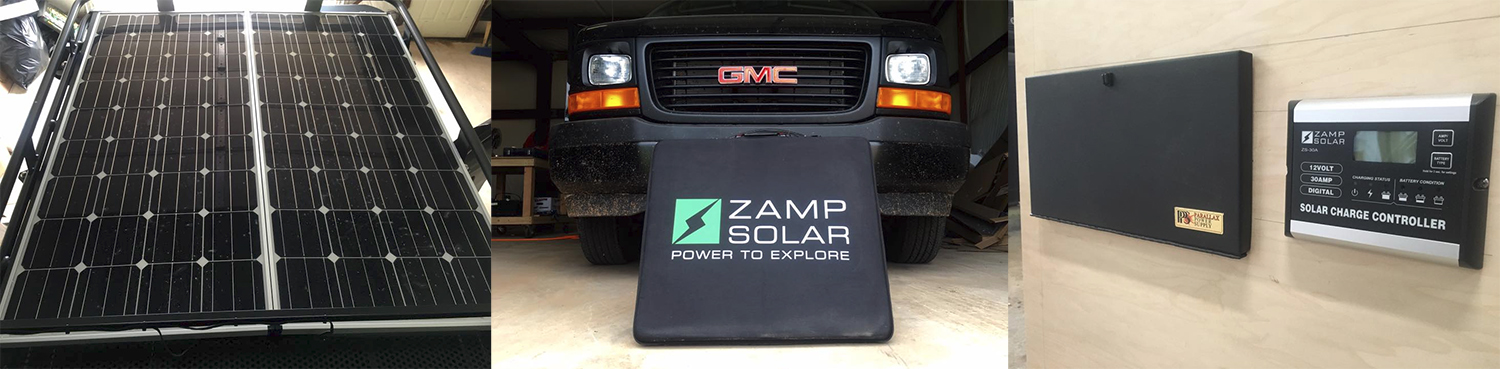
An Aluminess Products roof rack was also bolted onto the exterior, and fitted with large solar panels from Zamp Solar. This will allow Sara to keep her computer and camera batteries topped off, and recharge the vehicle’s electrical system throughout the day, even when she’s in the middle of nowhere. She eventually plans to put in a backup generator to fall back on in emergencies — as the saying goes, two is one and one is none.
The Battle Van is already shaping up to be pretty dang cool, so we’re looking forward to see what’s next. We’ll keep you posted as the Battle Van receives more upgrades. In the mean time, check out Sara’s blog or follow her page on Facebook.
Human history has been a battle to overcome natural dangers, and we’ve come a long way in that regard. A few generations ago, we had a much more limited understanding of the dangers found in nature — hurricanes, volcanoes, earthquakes, and so on. Today, modern technology, engineering, and early warning systems have helped us understand these dangers and be more prepared to deal with them. Nevertheless, some harmful misconceptions still remain.
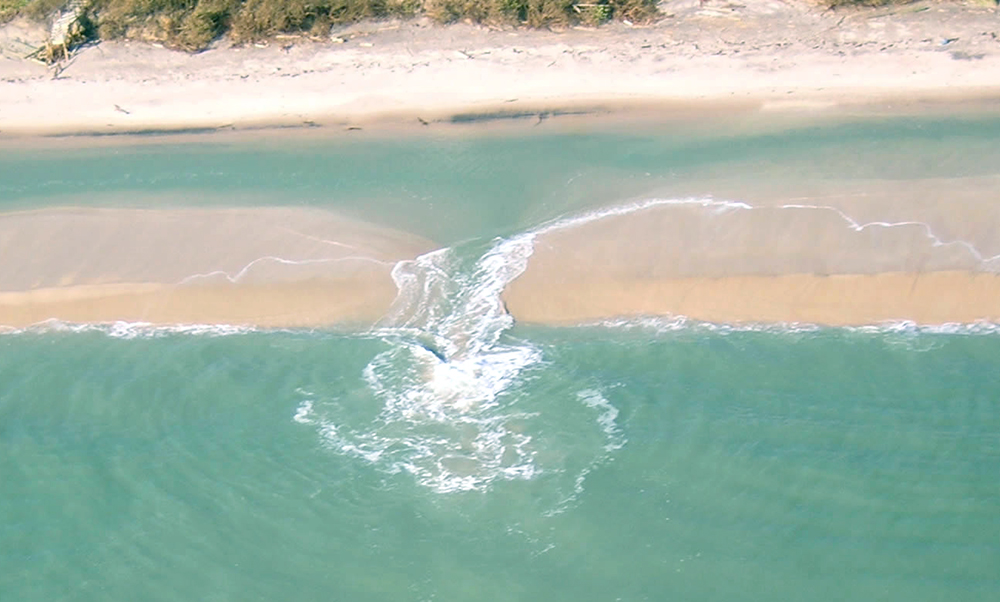
Multiple rip currents in Tunquen, Chile. Photo courtesy of Cecilia and Randy Lascody / NOAA.
You’ve probably heard of a dangerous ocean phenomenon referred to as a riptide or undertow, but neither of these terms is technically correct. This powerful force is actually called a rip current — it’s not a tide, and undertow is a completely different phenomenon. Rip currents pose a serious threat to anyone swimming in the ocean near breaking waves, especially young, weak, or tired swimmers. In the first few months of 2017, the National Weather Service has already recorded 30 surf zone fatalities in the U.S. — more than half were as a direct result of rip currents.
Rip current in Florida after Hurricane Jeanne. Courtesy of Dennis Decker, WCM, NWS Melbourne, FL.
Aside from the confusion over these names, there’s some confusion over how rip currents actually endanger swimmers. Due to the undertow misnomer, it’s often believed that rip currents drag swimmers down below the surface, but this is untrue. Rips actually pull swimmers out away from the shore and beyond the surf zone. Many uninformed individuals react to this by trying to fight the current and swim back to shore, but fighting the strong current only exhausts them further, making drowning a serious risk.
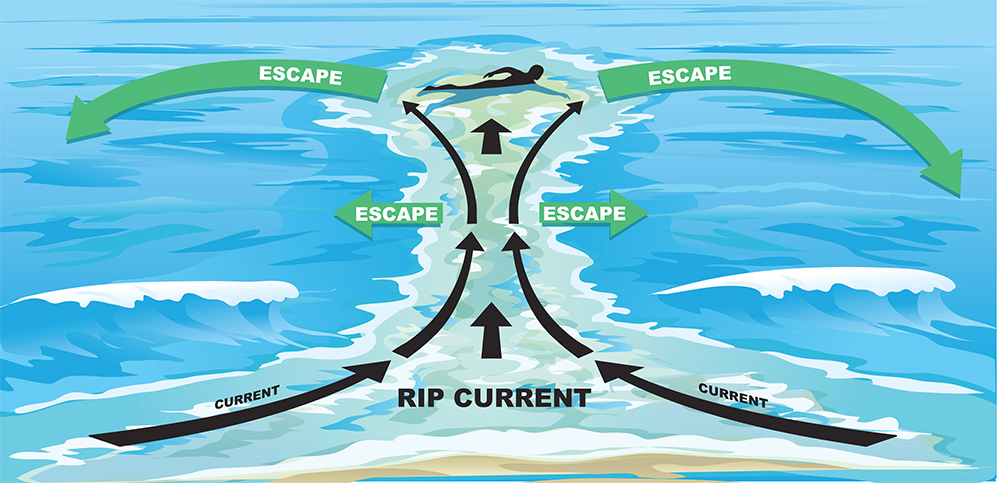
A diagram from the National Weather Service shows how to escape a rip current.
So, what should you do if you’re caught in a rip current? Swim parallel to the shore, out of the path of the current. Once you’re out of the current, you can swim back in to shore. Most rip currents are 50 to 100 feet wide, so you shouldn’t have to swim too far to escape its pull.
It’s also wise to know how to identify rip currents before you enter the water. Look for a channel of smooth surface water where waves appear lower and whitecaps are less prominent — if you see one, that may be a rip, so you should try to avoid it. Check out the video below from NOAA’s National Ocean Service channel on YouTube:
Keep these tips in mind as you swim this summer, and share them with your friends and family. As we glean a better understanding of this natural force, we can prepare ourselves to avoid its danger. For more documentation on this and other oceanic dangers, visit RipCurrents.NOAA.gov.
Warning!The content in this story is provided for illustrative purposes only and not meant to be construed as advice or instruction. Seek a reputable self-defense school first. Any use of the information contained in this article shall be solely at the reader’s risk. This publication and its contributors are not responsible for any potential injuries.
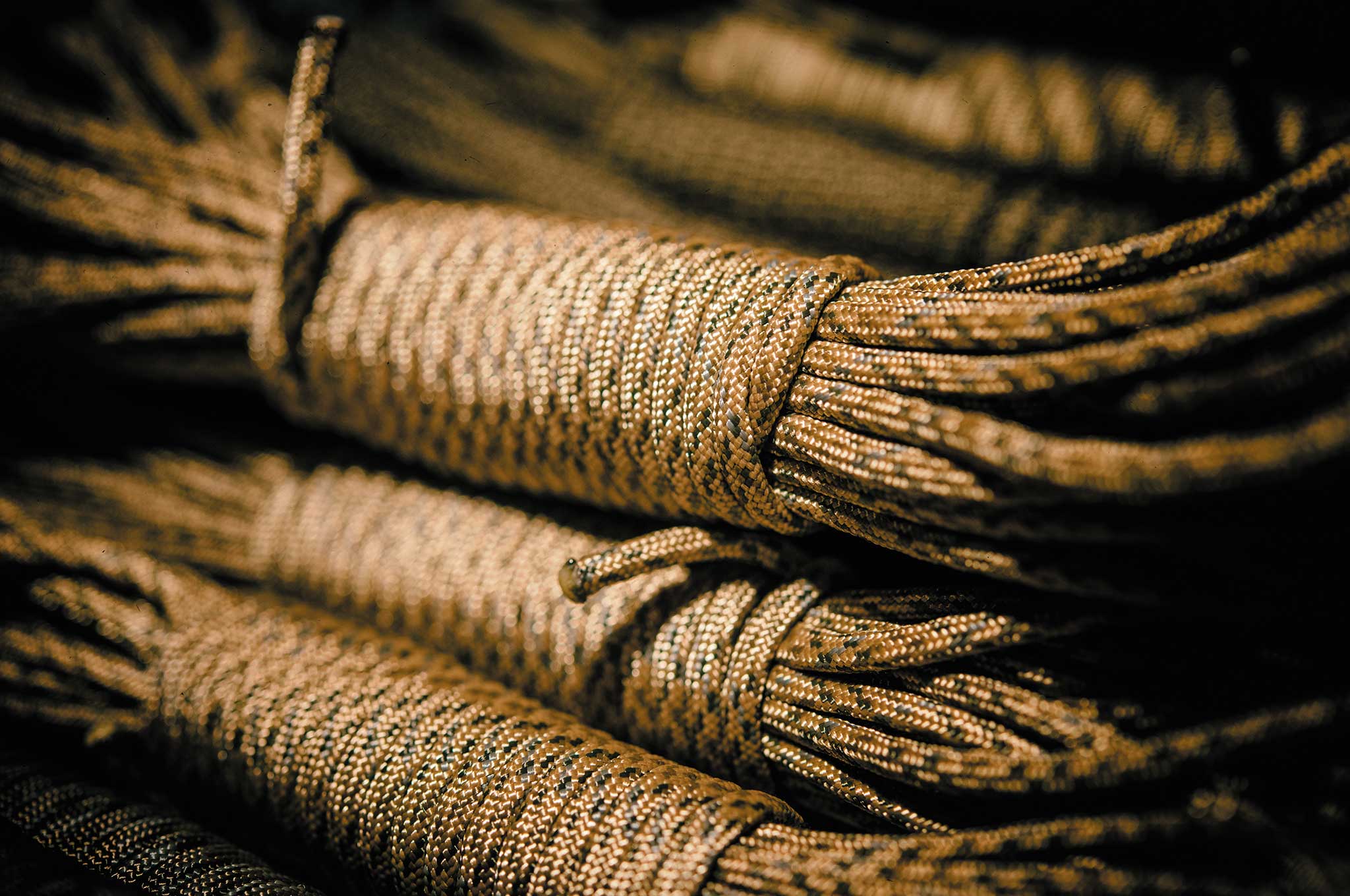
Paracord is to the survivalist as ketchup is to French fries. Carried in hanks, bracelets, shoelaces, neck-knife lanyards, and all over, paracord is a staple piece of kit. But it’s one thing to have some on hand; it’s another to know how to actually use it. Many people look at paracord and see a piece of string. We look at paracord and see endless possibilities to increase our survivability.
This is knot your average cordage article. We were provided with plenty of paracord from Campingsurvival.com, and we’re here to take your skills and readiness to the next level with these RECOIL OFFGRID projects.
Paracord Project #1 – Trapo
Function: Weapon
Difficulty: 5 out of 5
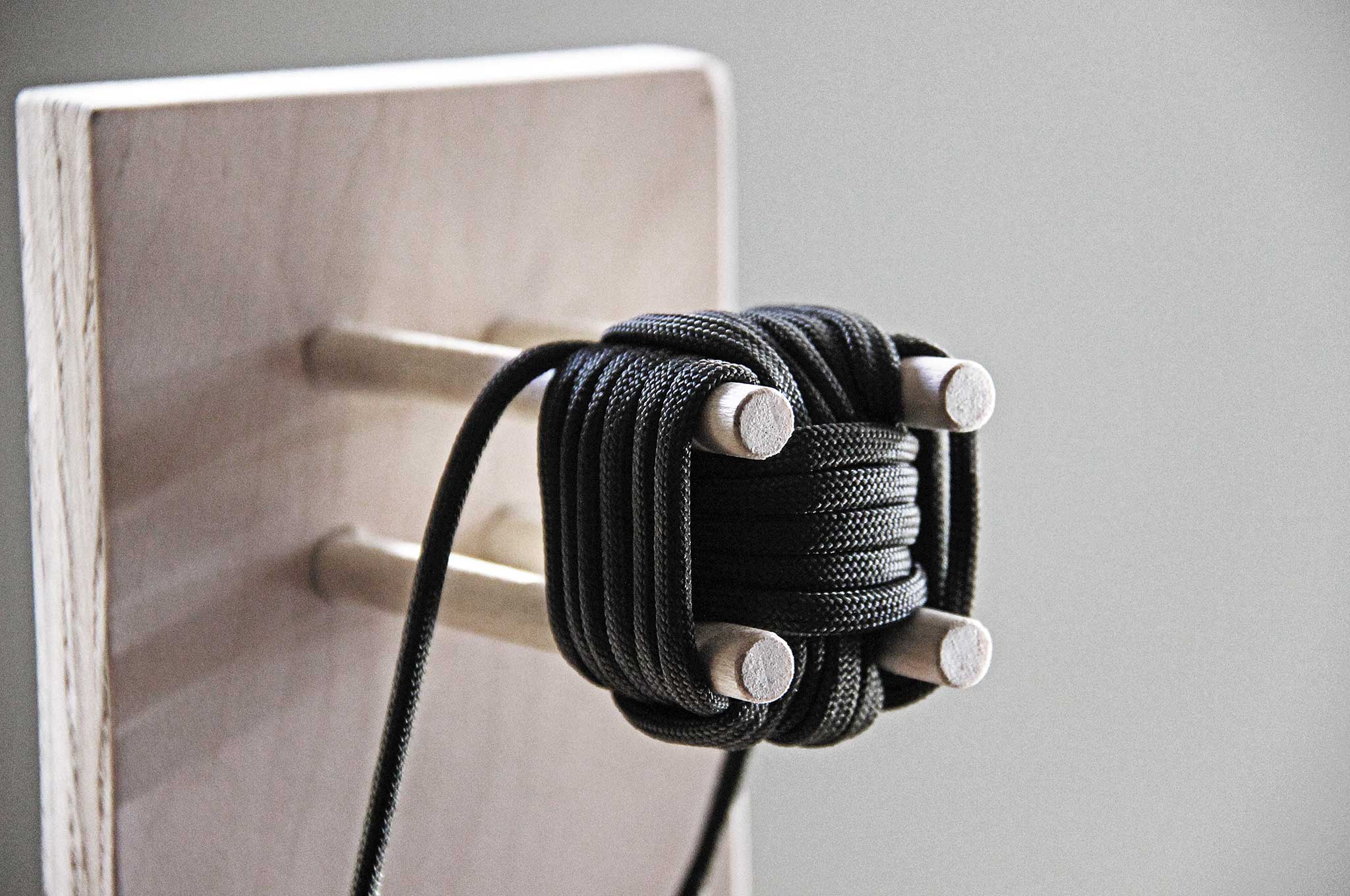
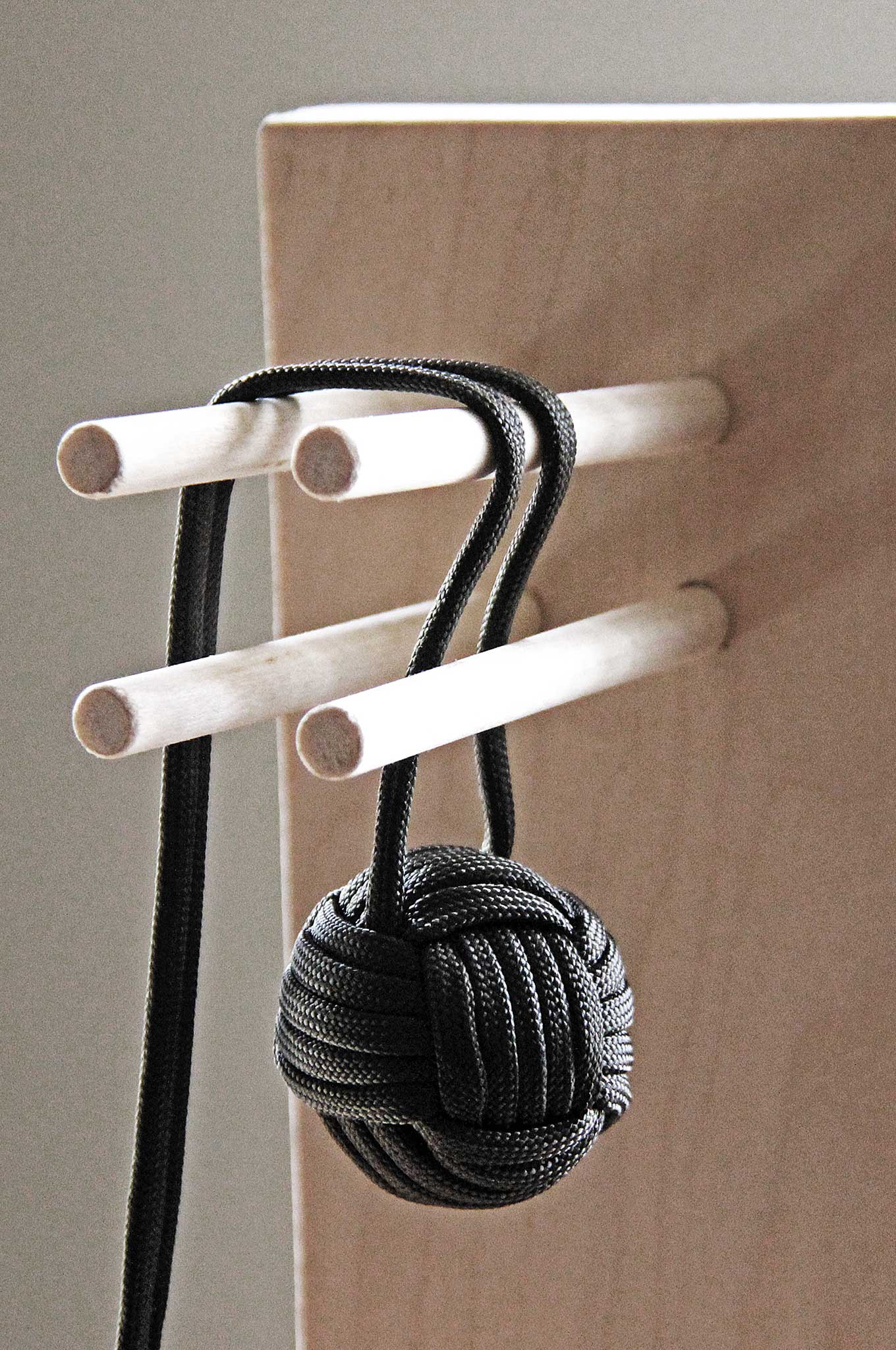
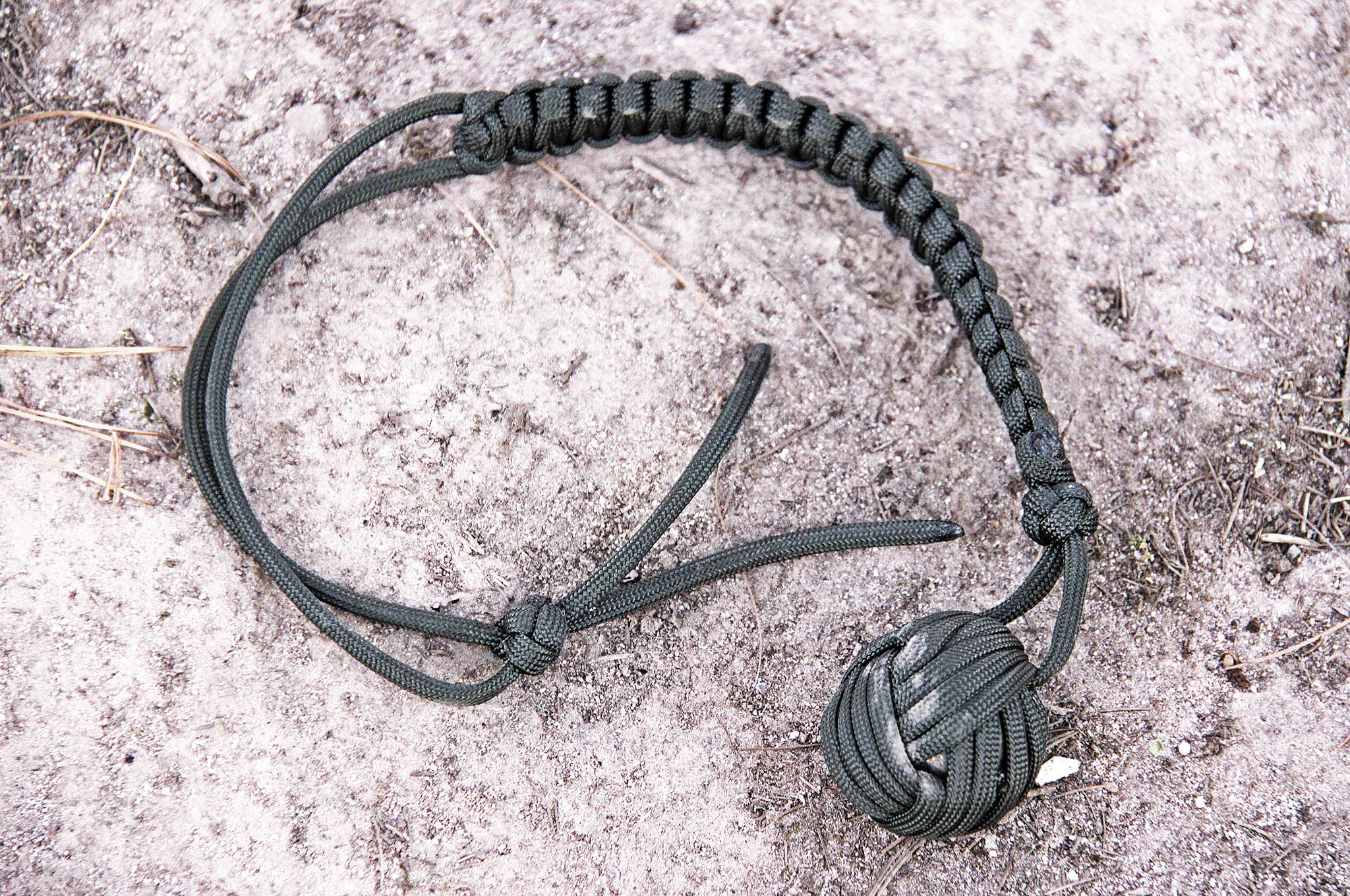
How To: Anyone who has seen the Steven Seagal movie Out for Justice knows what a rock in a sock is even if they don’t know why Ritchie killed Bobby Lupo. Here’s how to make one out of paracord with a ball bearing. This version requires knowledge of how to tie a monkey’s fist knot around a solid sphere.
Start by passing your paracord around the object enough times to cover it. For a 1-inch ball bearing, this is approximately six passes of paracord. Wrap your cord perpendicular to these passes six more times. Thread your paracord another six times to the inside of the second set of passes and around the first set of passes (there’s a reason for the difficulty rating on this one, and you just read it). Dress up the knot by pulling it here and there until it tightens around the ball bearing. Tie the ends into loop that can be slipped around your wrist and flail away.
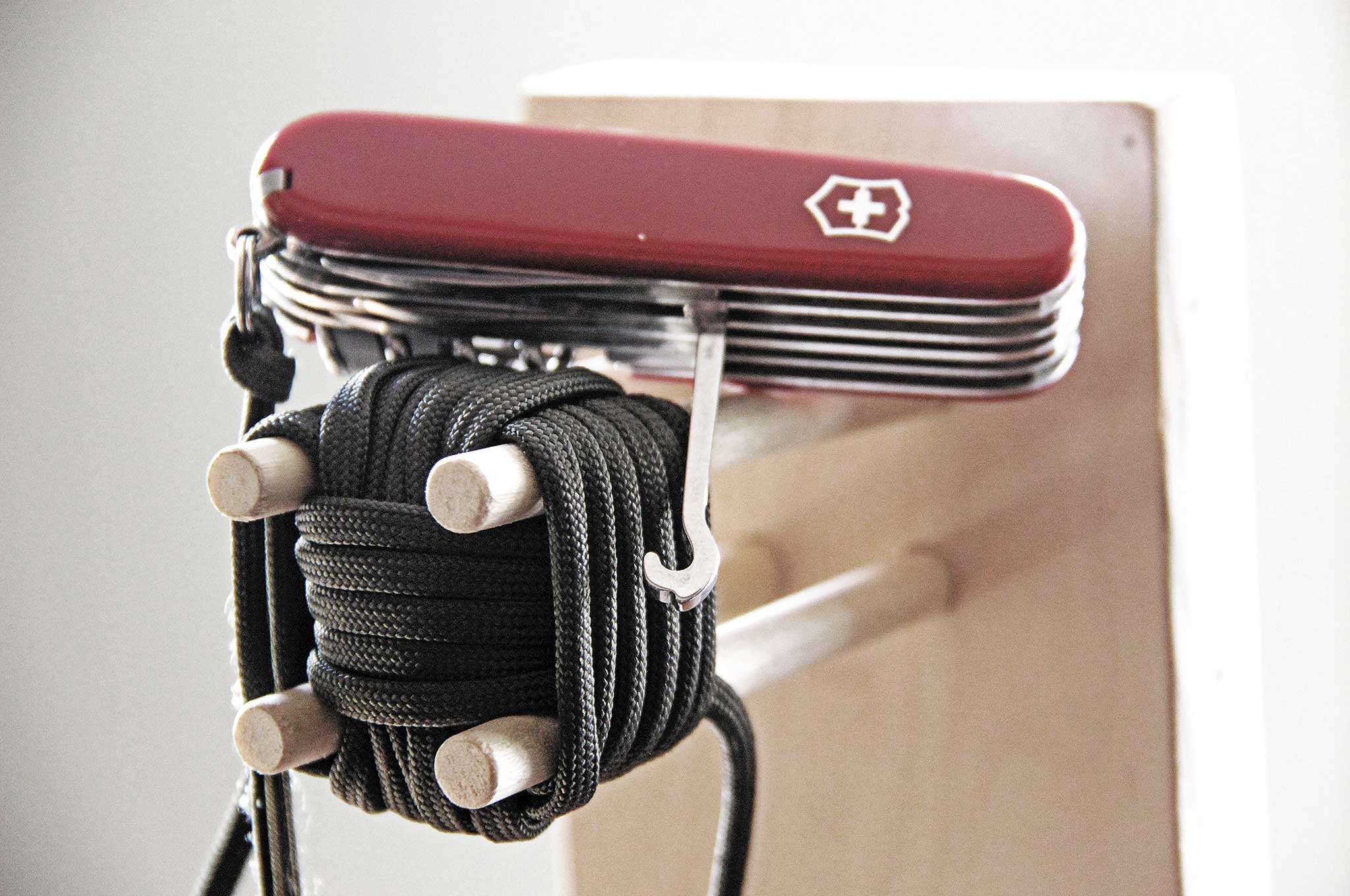
Monkey fist knots can be tied by hand, but a simple jig made out of wooden dowels and a couple pieces of board make this task so much easier.
Notes: We’ve tied these by hand without a jig and must admit it’s worth the extra steps to assemble one. Not since puberty have you wished as much for an extra hand to help out in in the process. Just drill four holes, 1 inch square, into a wooden board and insert wooden dowels to hold your ball bearing for you.
Paracord Project #2 – Friction Saw
Function: Cutting synthetic materials
Difficulty: 1 out of 5
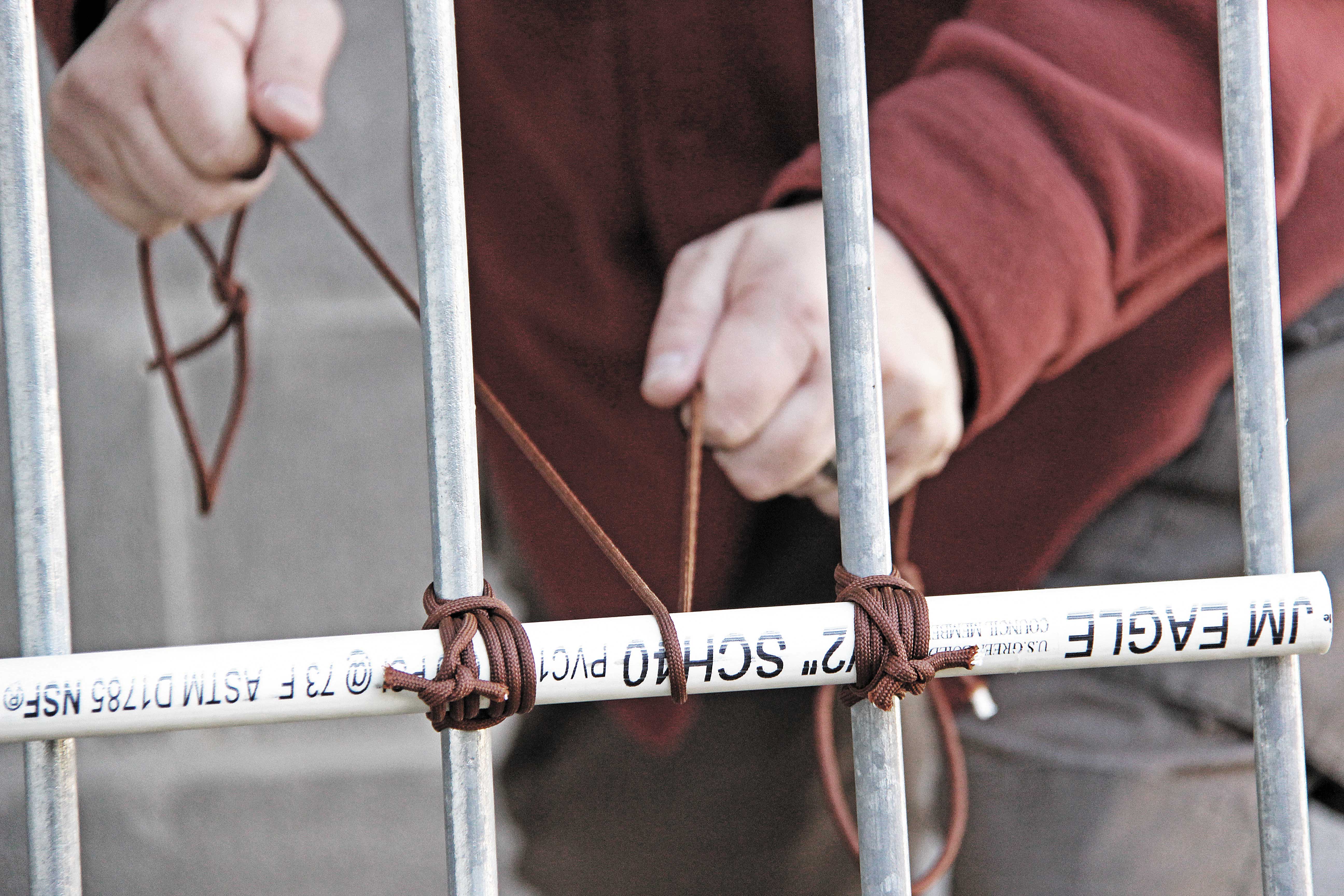
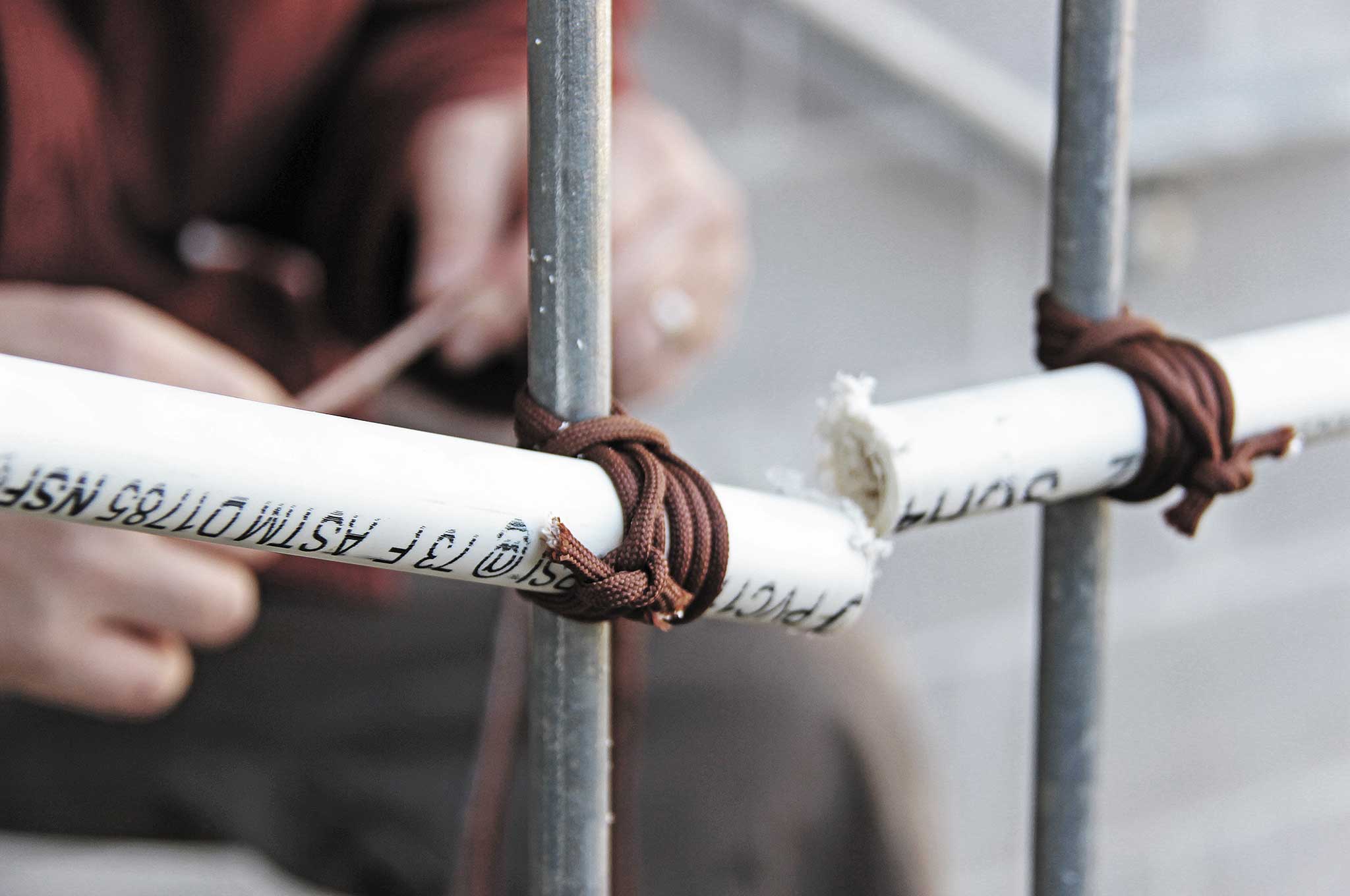
How To: All that’s needed to create a paracord saw is a length of paracord (braided Kevlar cord works well, too, and that’s why we carry it in our wallets) with a couple loops tied in each end, large enough for your hands.
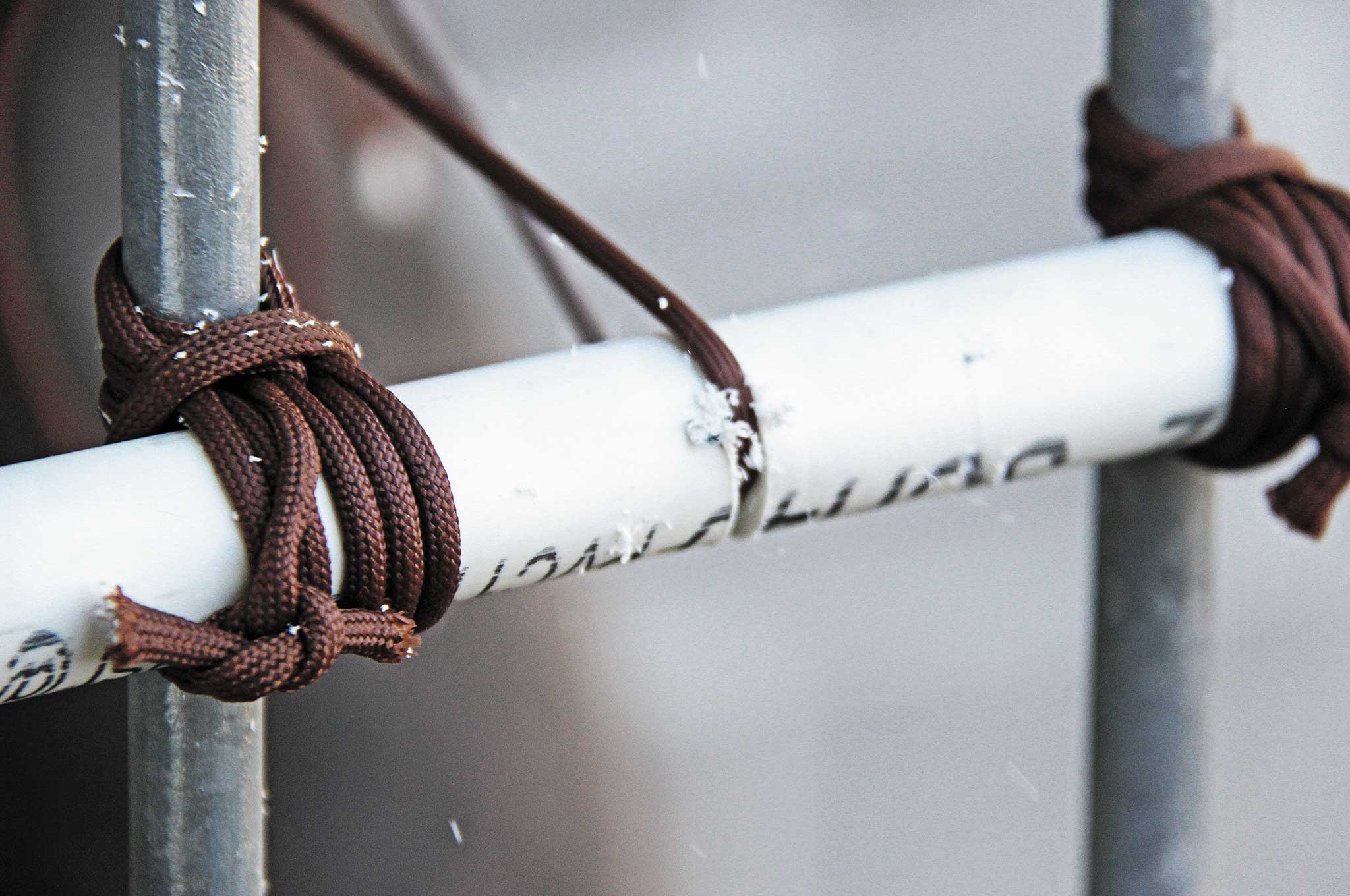
With the saw tied, place it over whatever you plan to cut and run it back and forth, increasing the friction and heat on your work piece, while dispersing the heat over the length of the saw. This will cut through duct tape, webbing, PVC pipe, or just about anything synthetic.
A paracord friction saw works by running the cord over a synthetic object like this PVC pipe. With enough heat, the saw will cut through even the thickest tubing, webbing, or synthetic cordage.
Notes: Watch your hands with this one. Your saw will be hot when you’re done. The longer the saw, the more room to disperse the heat.
Paracord Project #3 – Improvised Tourniquet
Function: Stop bleeding
Difficulty: 2 out of 5
How To: A tourniquet should always be applied “high and tight.” That is, placed up high on the arm near the armpit or up against the crotch. In general, paracord sucks as a tourniquet, as it’s too narrow to avoid causing damage to tissue. However, when multiple strands are tied as one, it’ll work in a pinch.
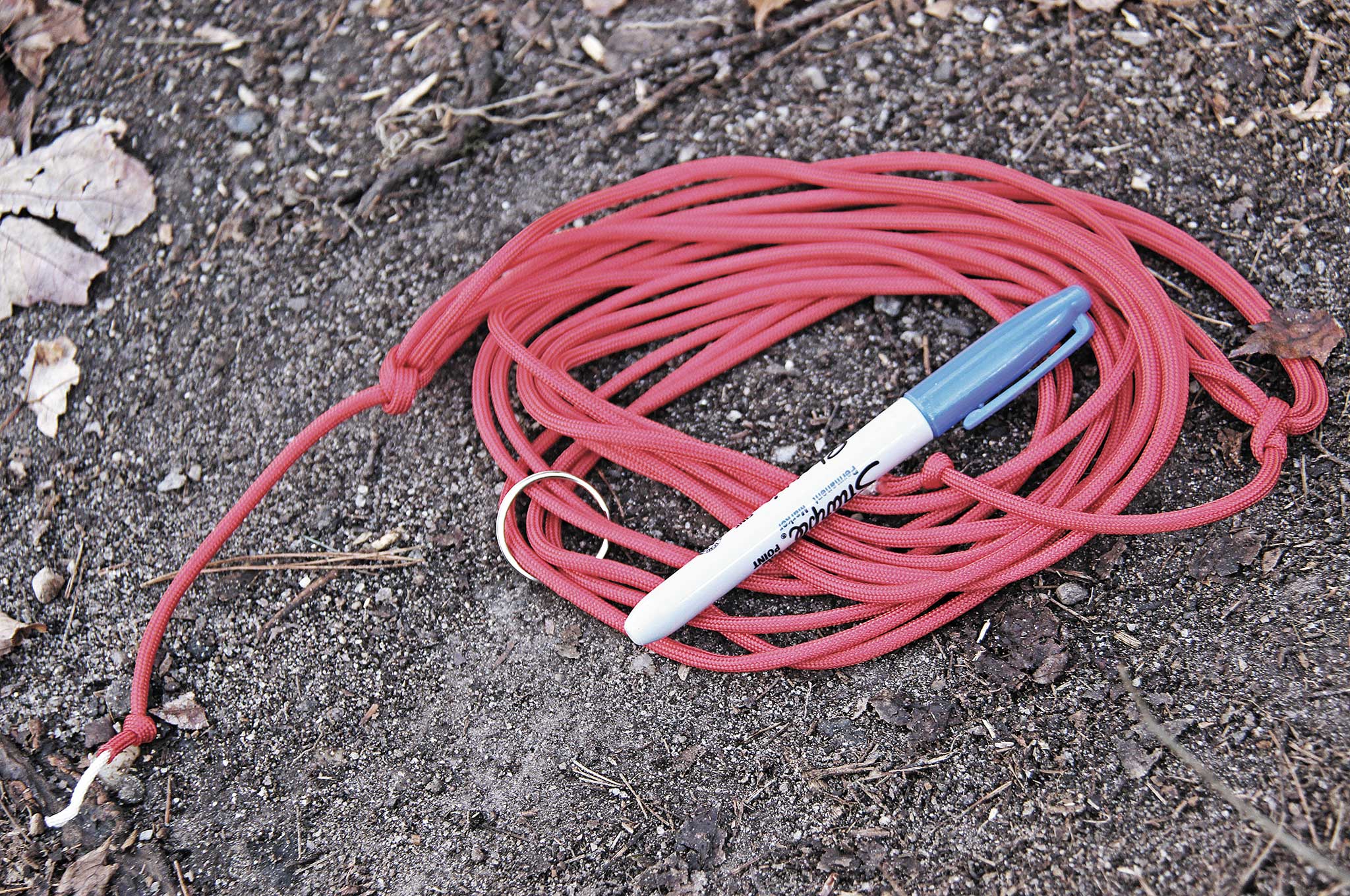
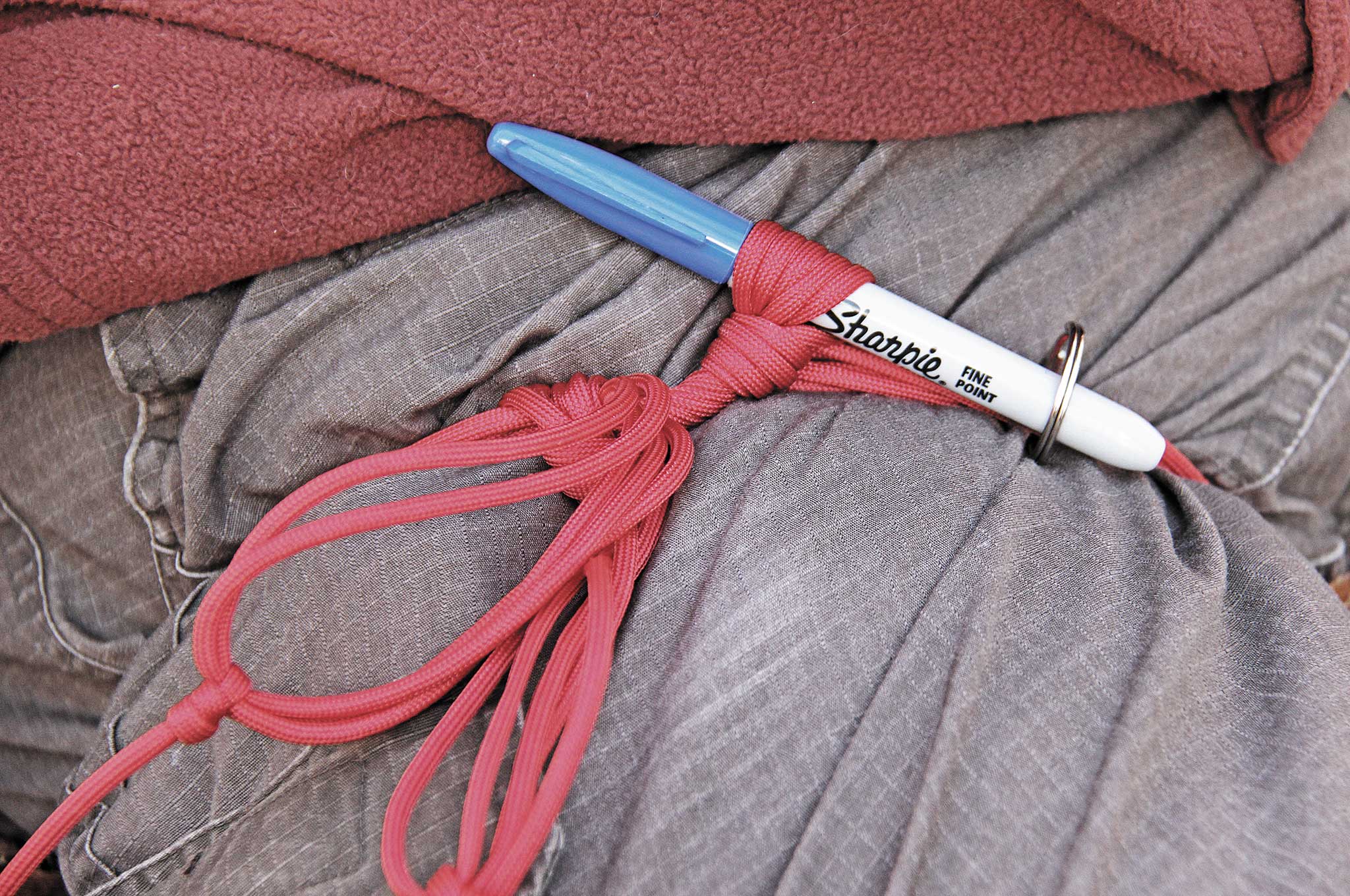
Tie a single square knot with multiple strands by passing left over right, tying a knot then right over left and tying a knot. Insert a tactical pen (or something else that will serve as a turnbuckle). If you can, put a key chain split ring around the strands first so you have a place to tuck that pen once tension is applied. Leave it on, and get your buddy or yourself to the emergency room.
A single strand of paracord makes a horrible tourniquet. Multiple strands tied as one will work well to prevent bleeding out. Lock it all in place with a split ring and pen or similar object.
Notes: While you can do this with paracord, get in the habit of carrying a real tourniquet. They’re cheap and highly effective. What’s your life worth?
Paracord Project #4 – Improvised Harness
Function: Weight carrying (read advisory below)
Difficulty: 3 out of 5
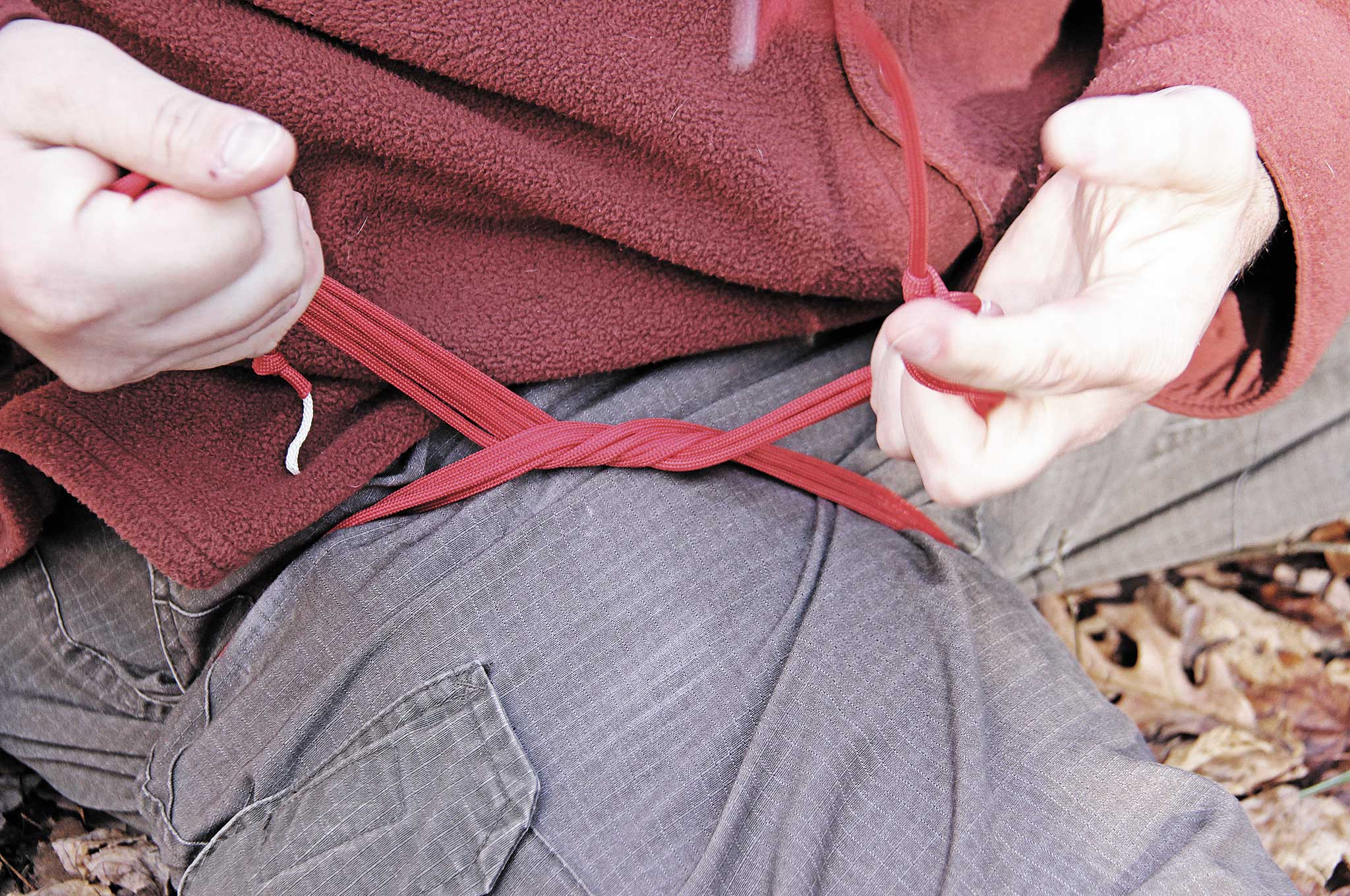
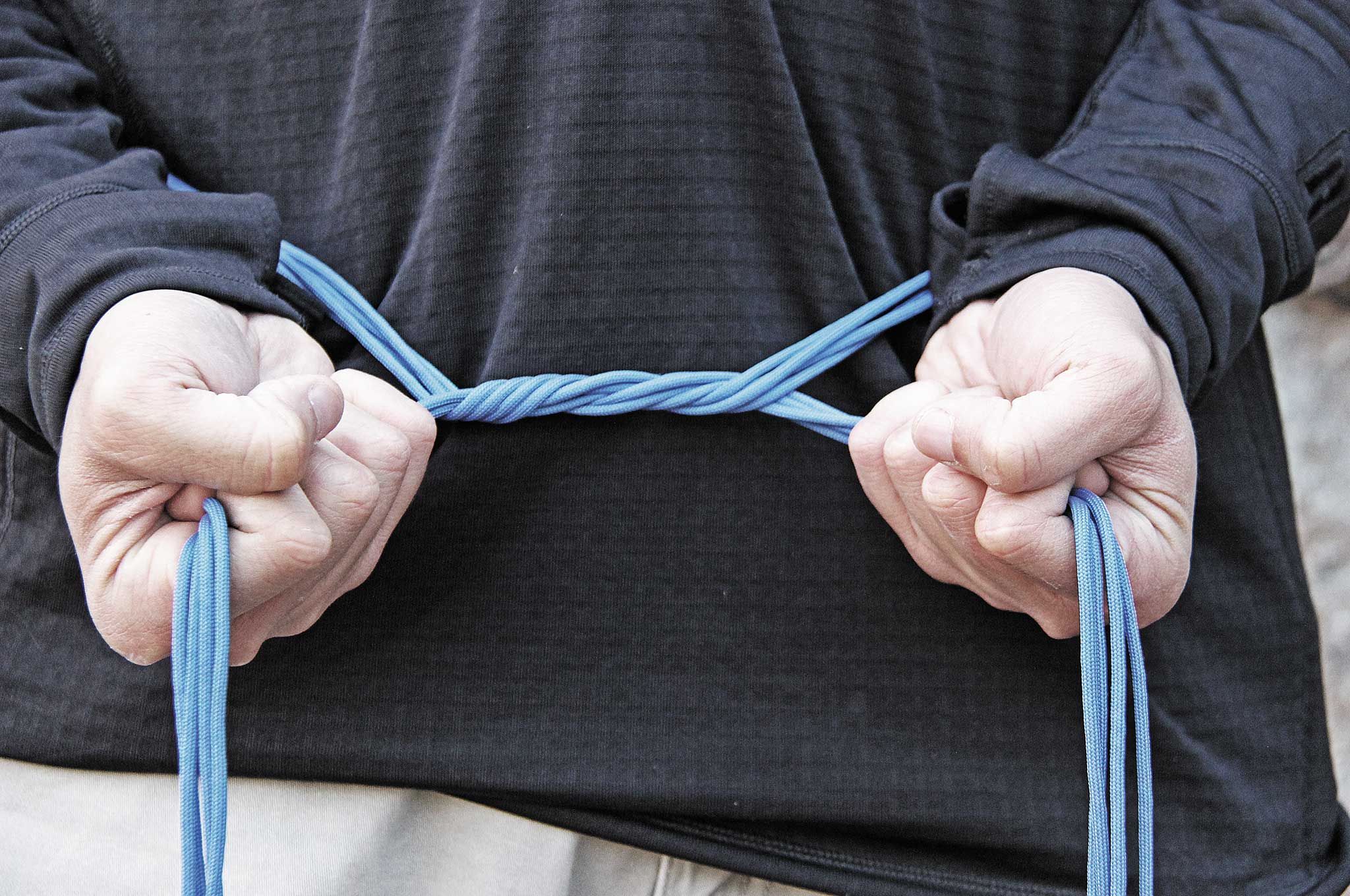
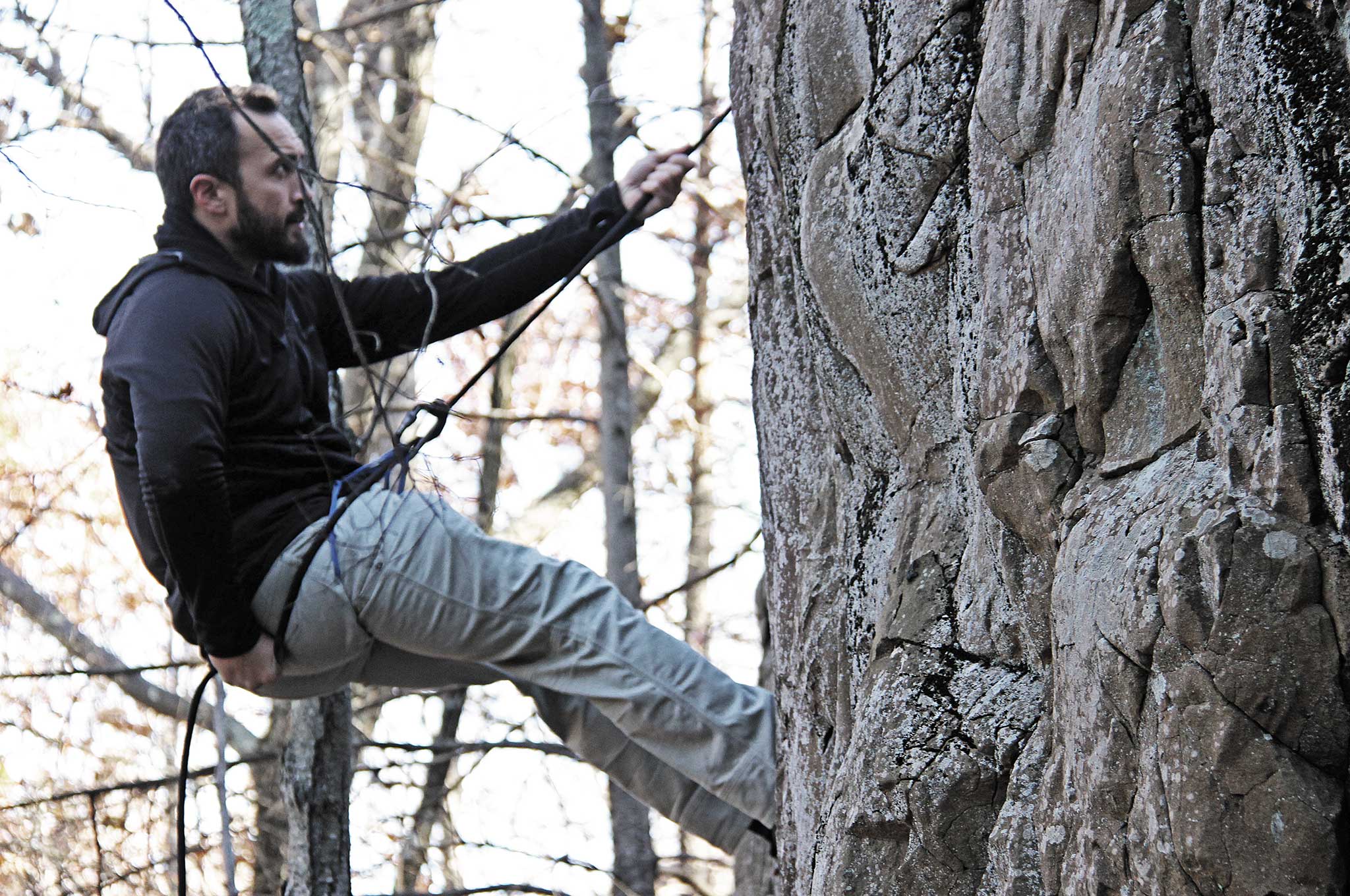
How To: You may need to escape a high rise or descend a cliff. If you have no other option, here’s a solution. A traditional Swiss seat is tied with about 12 to 15 feet of flat webbing or rope. For comfort, you should use multiple strands of paracord unless you want that tourniquet effect from the previous project.
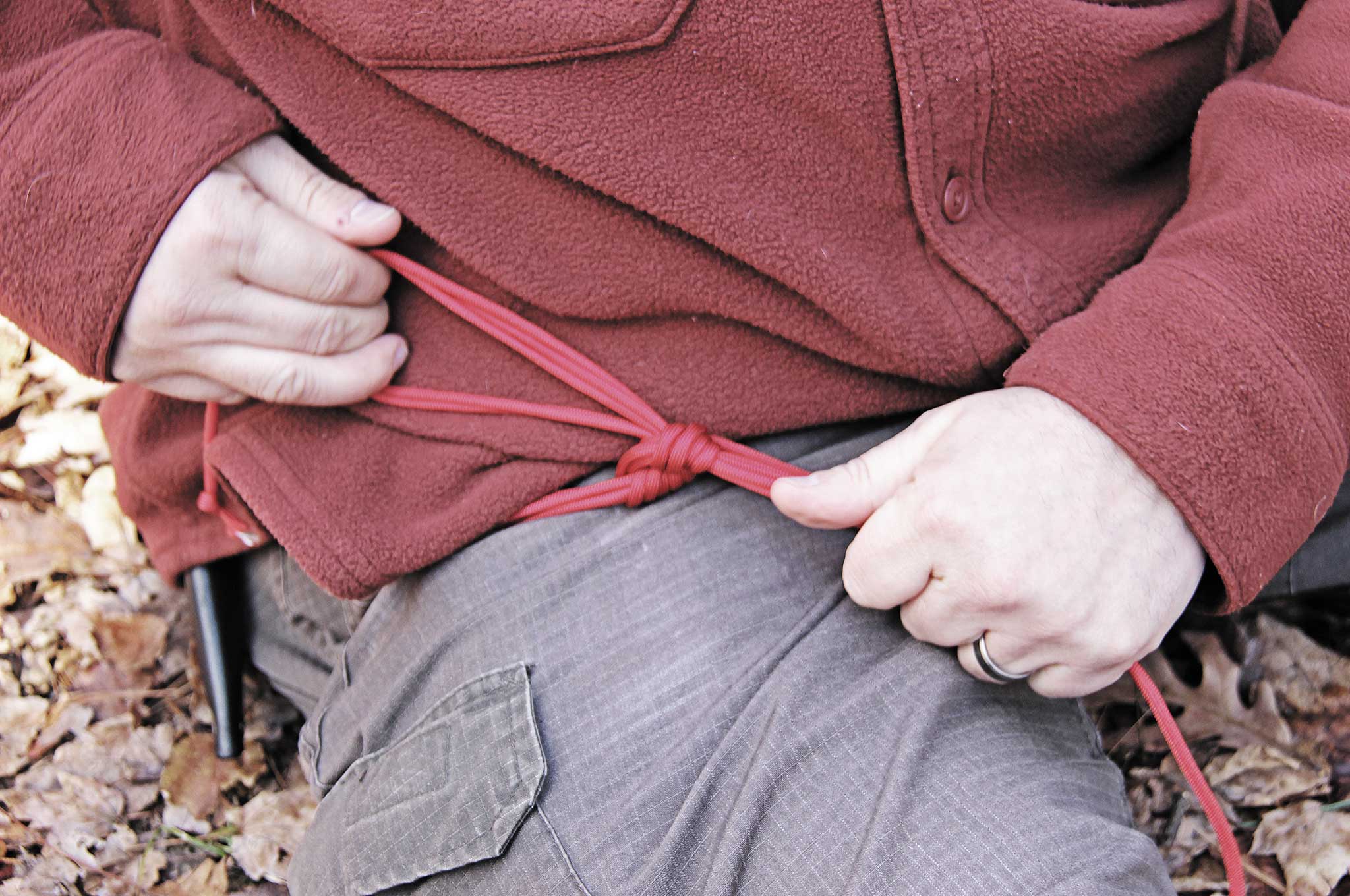
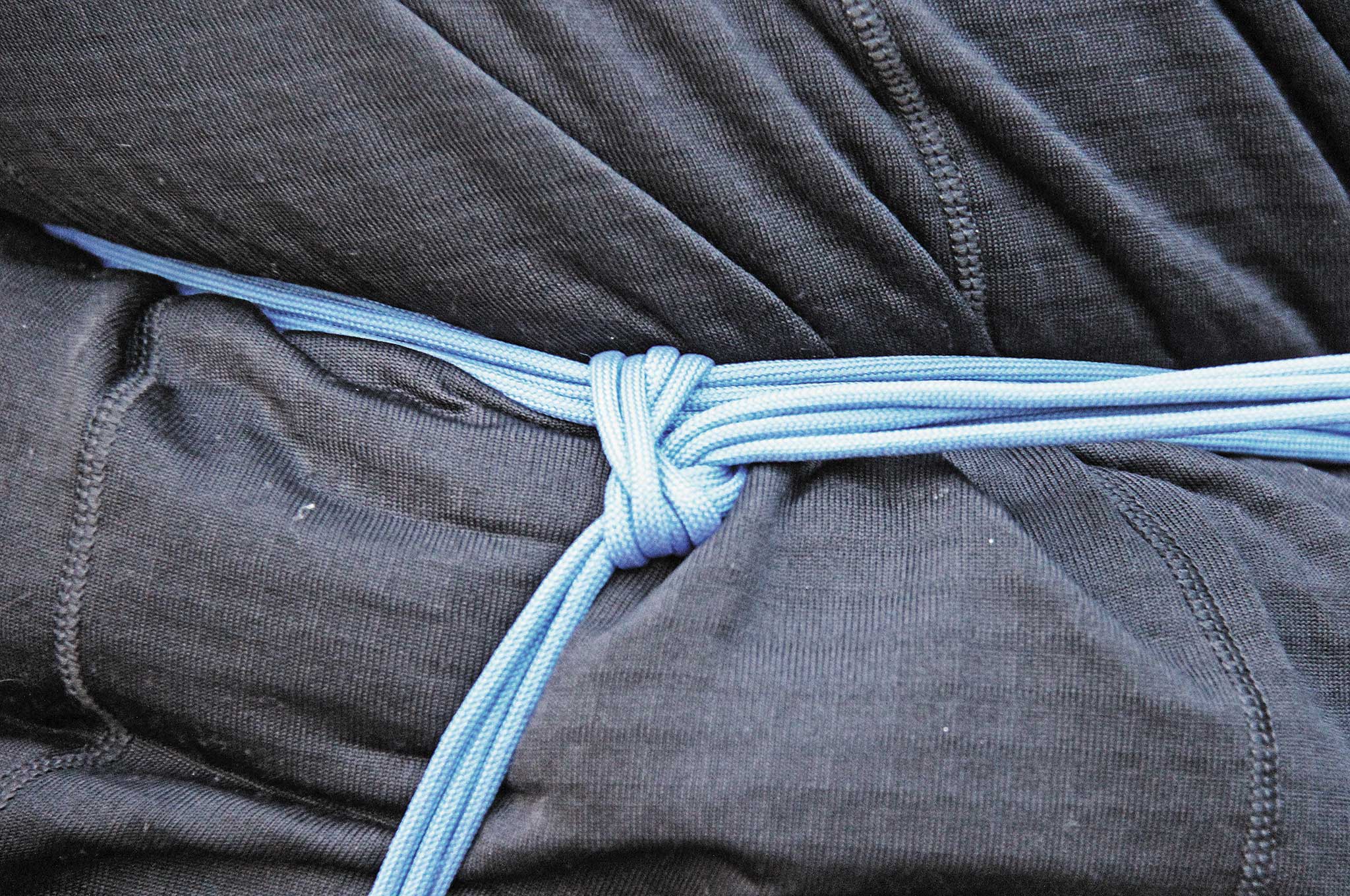
Once you have your cordage ready, find the center and hold it at your side by your waist. Pass one end around your waist and meet in the middle. Create a surgeon’s knot with the two ends. Take the two ends and pass them under your ass. Put the ends over your shoulders and stand up to pull them tight. Pass the ends back through the paracord waistband you made and tie each off with a half hitch. This is the point where you’ll feel a pinch between your legs. Remember, it’s life or limb – or in this case life or sack.
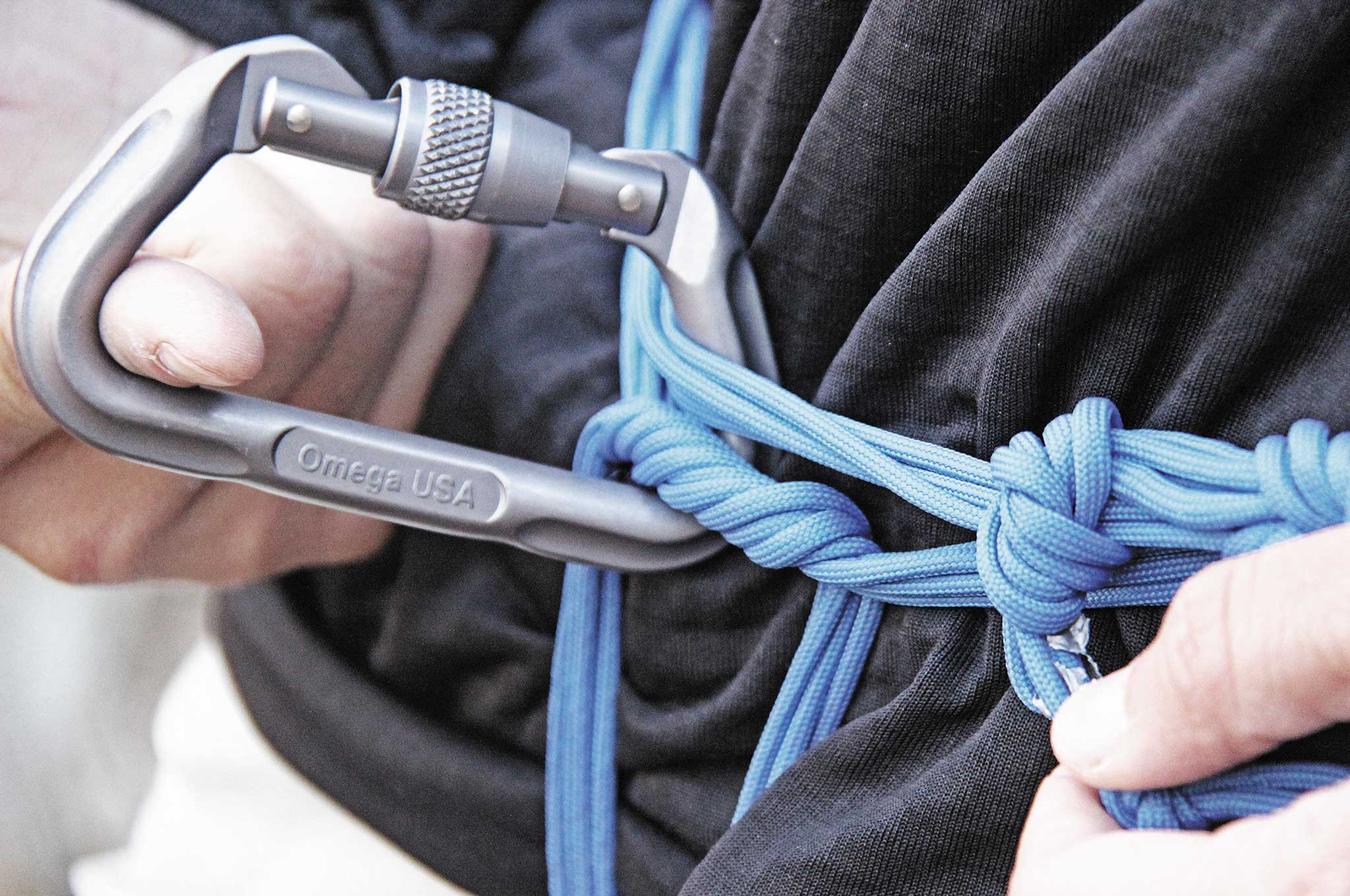
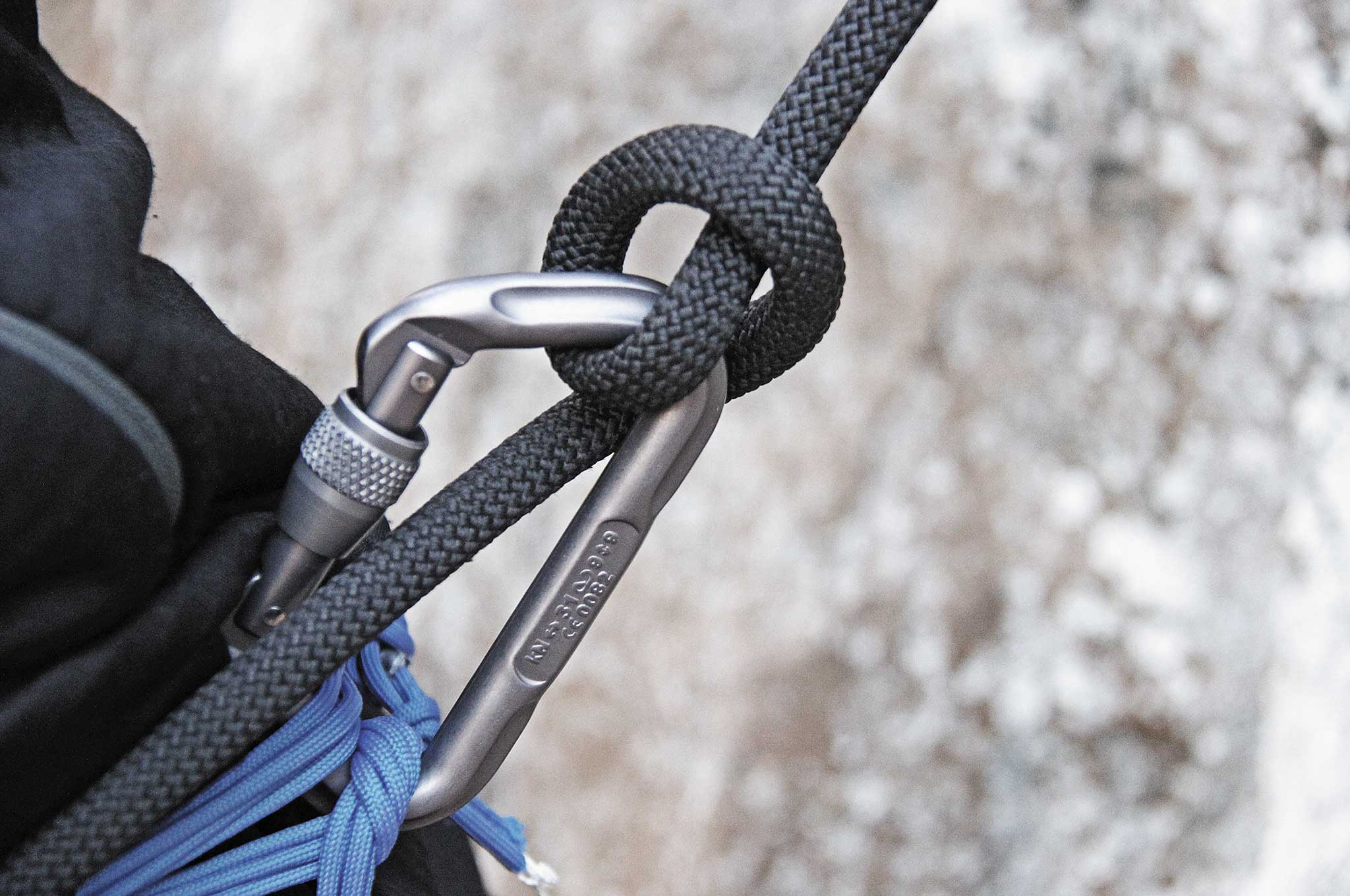
Take the ends of your harness and tie them off with a square knot and backup knots, to your left if you’re a righty and to the right if you’re a lefty. Make sure your knot is on the opposite side of your brake hand. If you’re wearing a sturdy belt, pass your carabiner through that too, making sure the gate opens toward you. The spine of the carabiner is where your munter hitch will be used for rappelling. The majority of your weight will be supported by your paracord leg loops. This works even better with flat webbing, but can work with what you have.
Keep the gate of your locking carabiner facing you when you clip in. This allows the rope to work against the spine of the ‘biner instead of against the gate when you belay or rappel.The author rappelling with a paracord harness. While you can do this, it isn’t nearly as comfortable as a dedicated harness.
Notes: Seek professional climbing and rope instruction before trying this one at home. Rappelling is inherently dangerous. However, even more dangerous than rappelling in an emergency is doing nothing when SHTF. That could lead to death.
Paracord Project #5 – 1-2-3 Anchor
Function: Vehicle recovery anchor
Difficulty: 4 out of 5
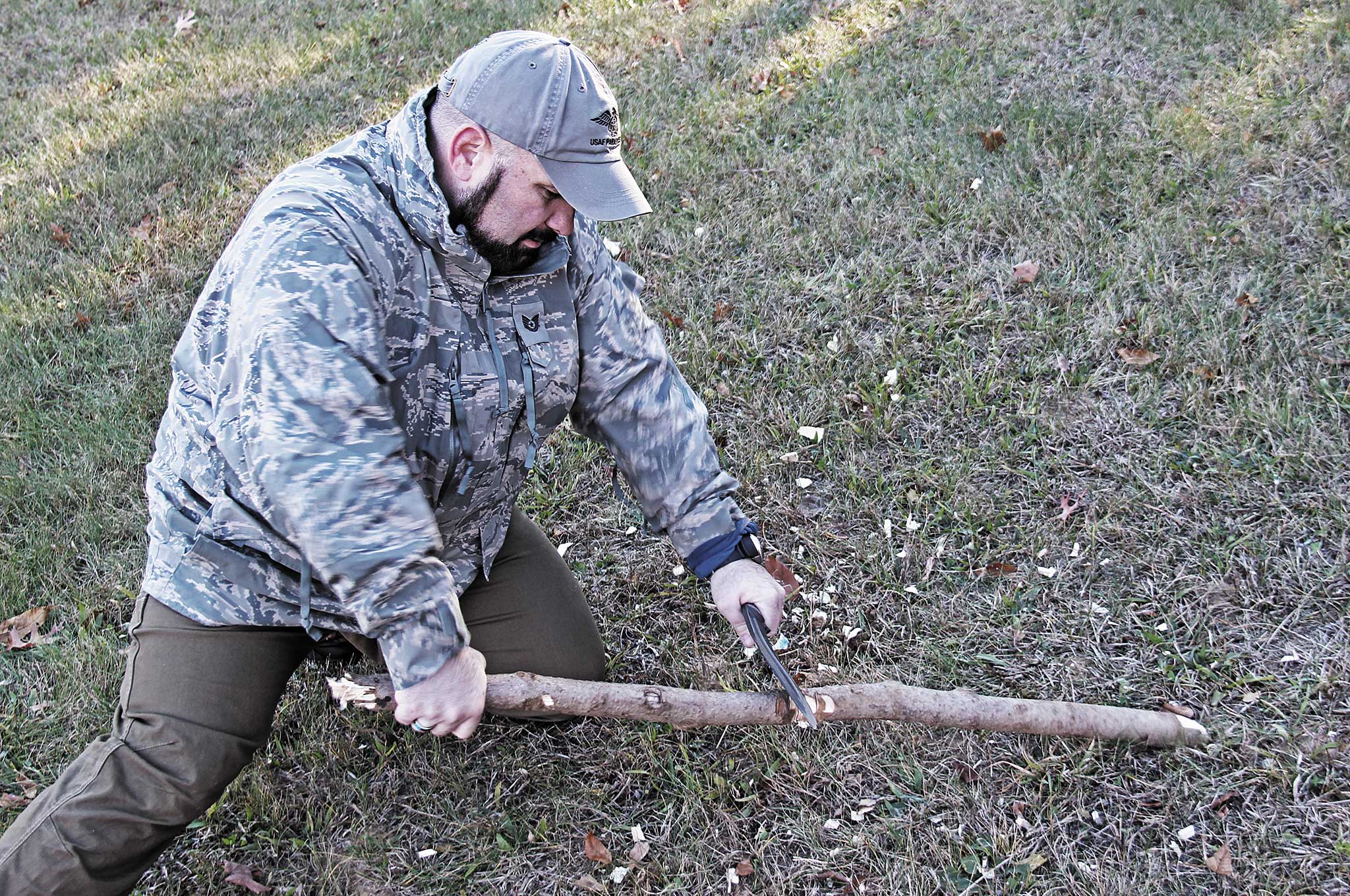
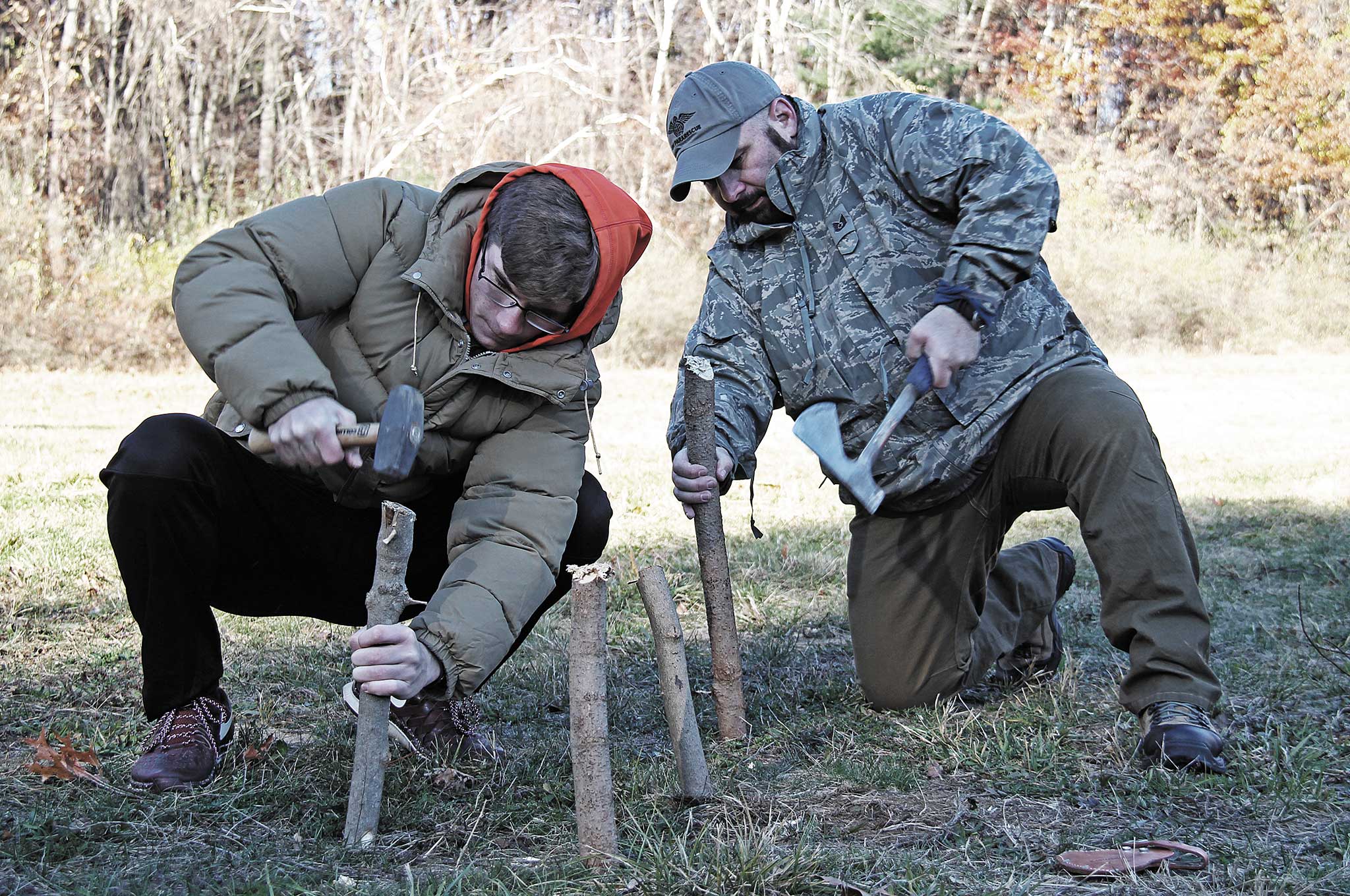
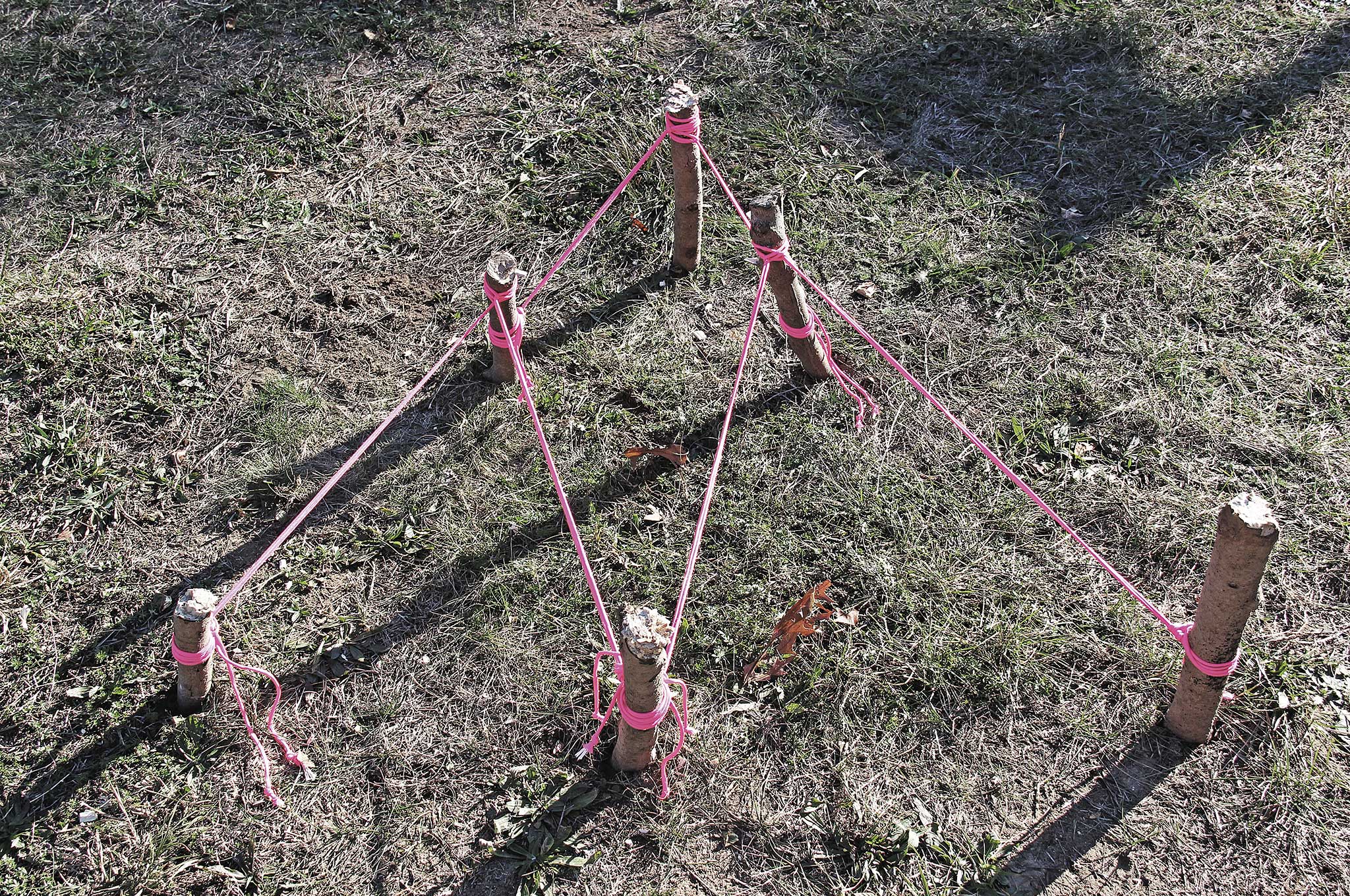
How To: Cut six 1- to 2-inch diameter wooden stakes, measuring approximately 18 inches long. Pound the first stake into the ground at a slight angle in the direction you want your stuck vehicle to go. Don’t make this angle too great. From your initial stake, pound the next two stakes about 1 foot further away on each side at 45-degree angles left and right.
From these two stakes, pound the final three stakes another foot behind, continuing in a pyramid pattern. For those of you who have played Beirut/beer pong, this will be a familiar pattern. Tie a length of paracord from the top of the first wooden stake to the bottom of the two stakes off to 45-degree angles.
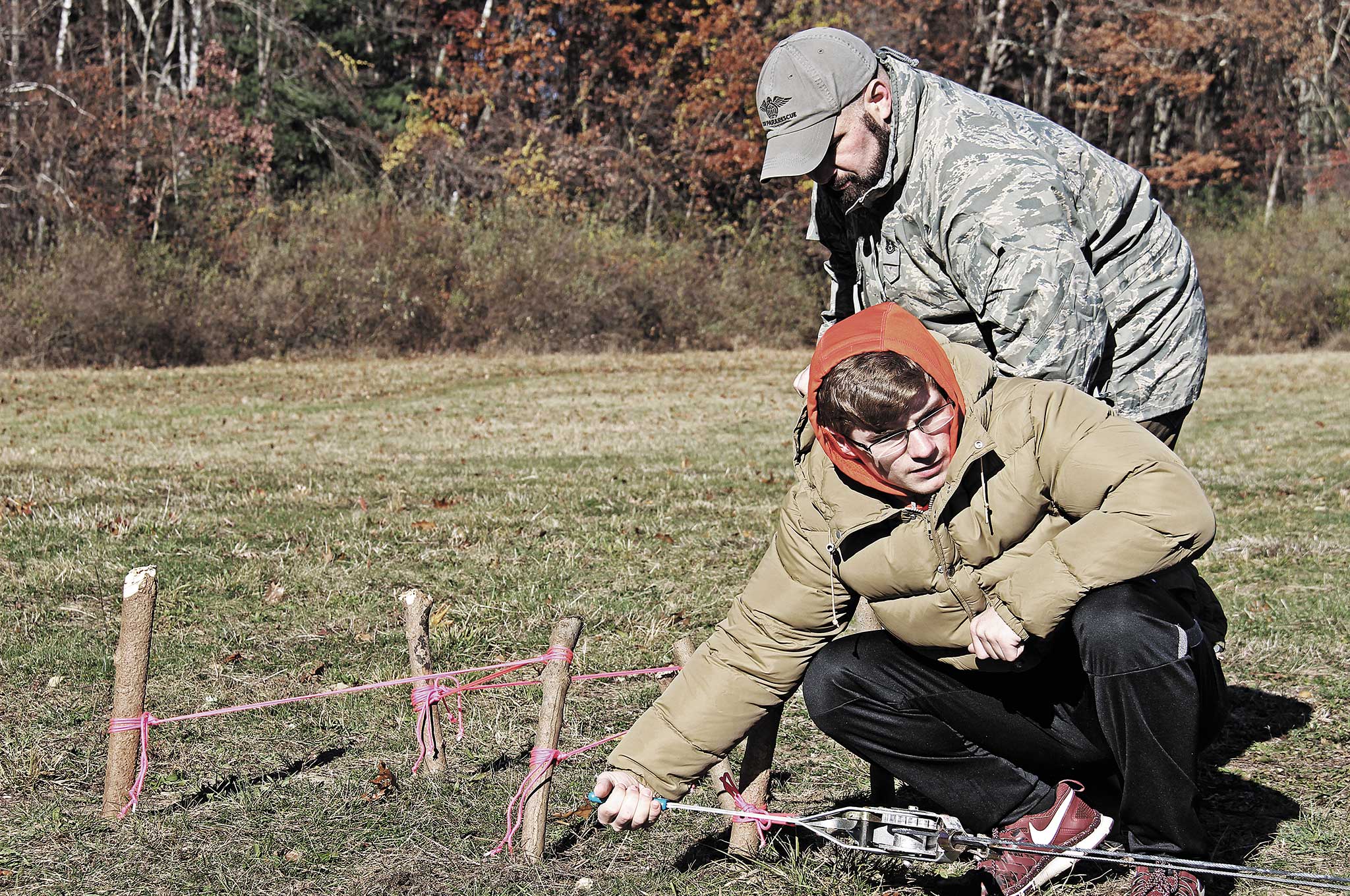
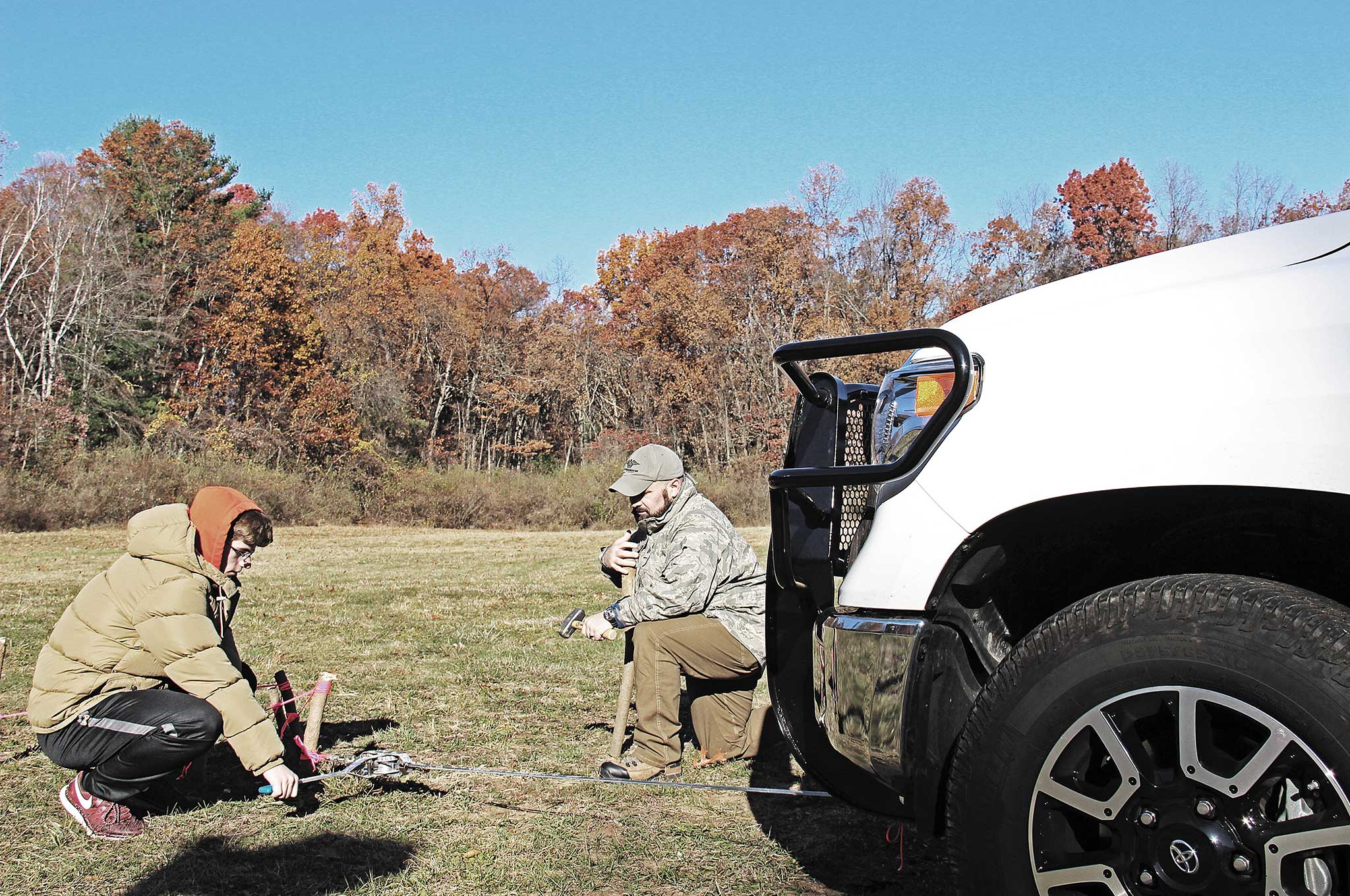
Tie paracord from the second row to the third row in a similar fashion. You can use a lark’s head on the top and a rolling hitch and half hitches on the bottom. Attach your come-a-long to the first stake and to your vehicle. The 1-2-3 anchor works well since the stakes are supported by the following rows.
1-2-3 anchoring requires cutting multiple posts and pounding them into the ground in a triangle stack. Having the right tools – such as a hatchet or kukri, cordage, small sledgehammer, and come-a-long – make self-rescue easier.
Notes: Vehicle recovery can be quite dangerous, even fatal at times. Make sure your vehicle parking brake is on while securing your anchor and off when using it. A small hammer and come-a-long makes retrieval easier than resorting to a Spanish Windlass (the Spanish Windlass will be featured in a future issue of RECOIL OFFGRID).
Paracord Project #6 – Tripod
Function: Suspending objects and much more
Difficulty: 3 out of 5
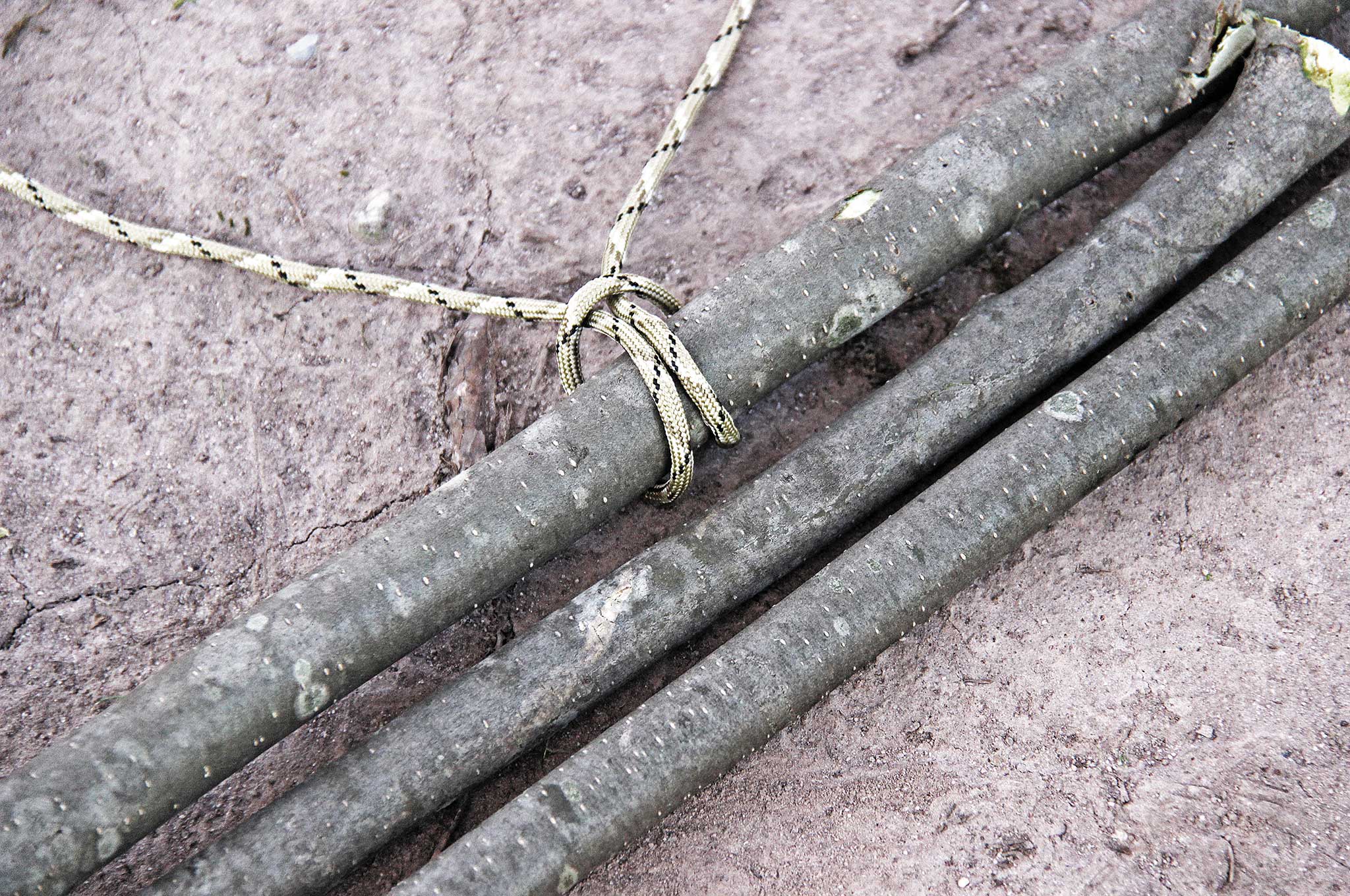
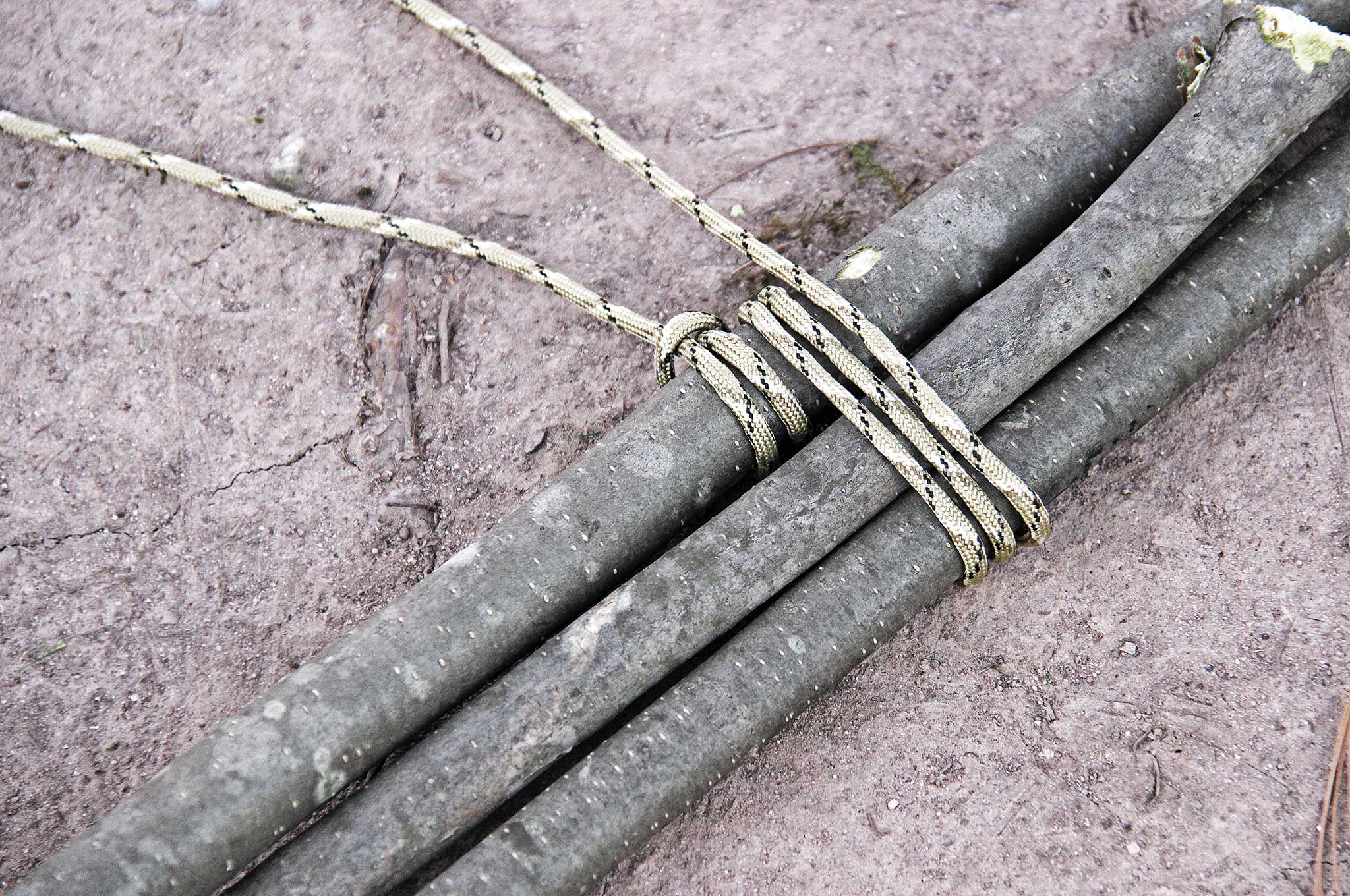
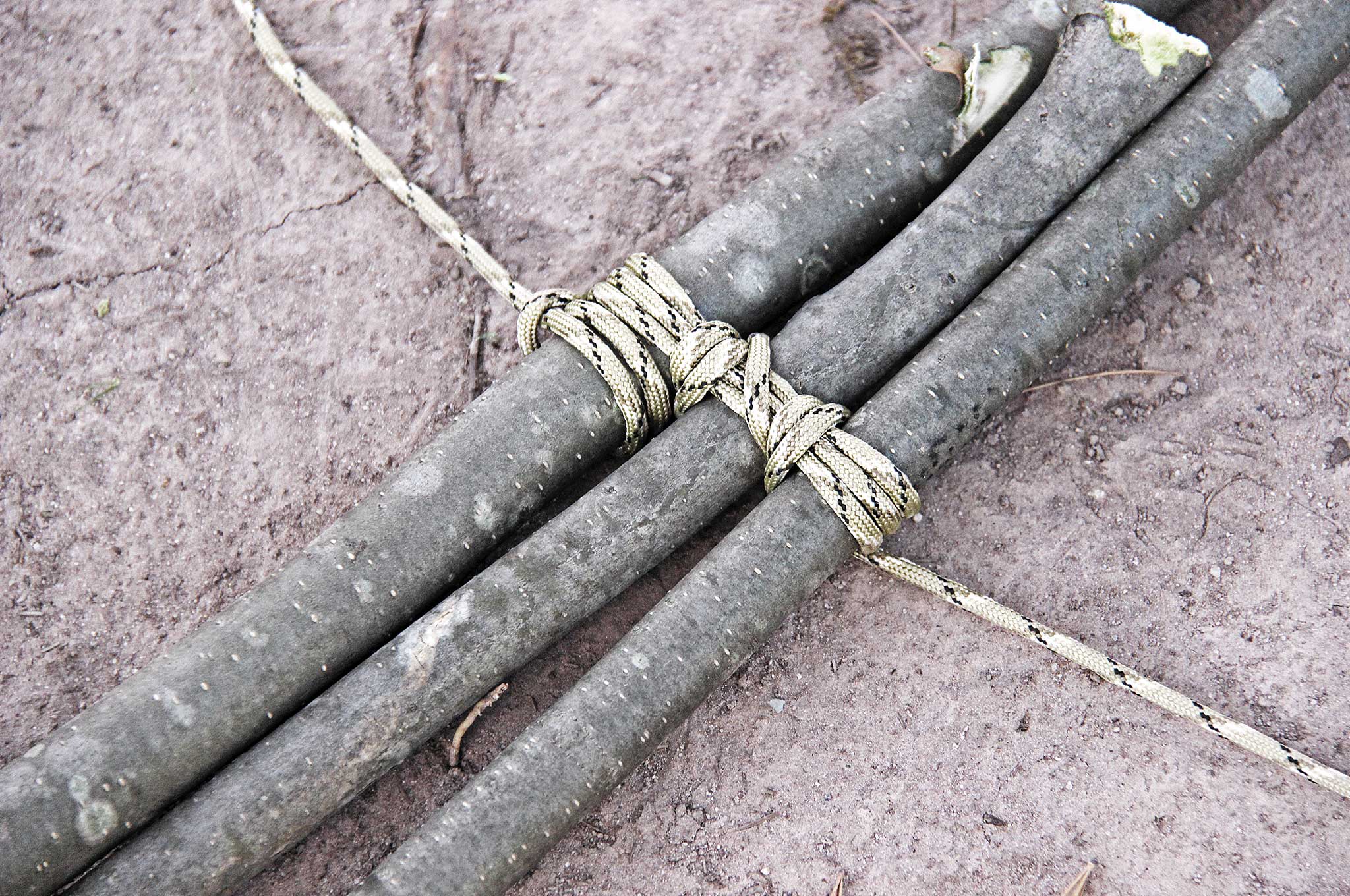
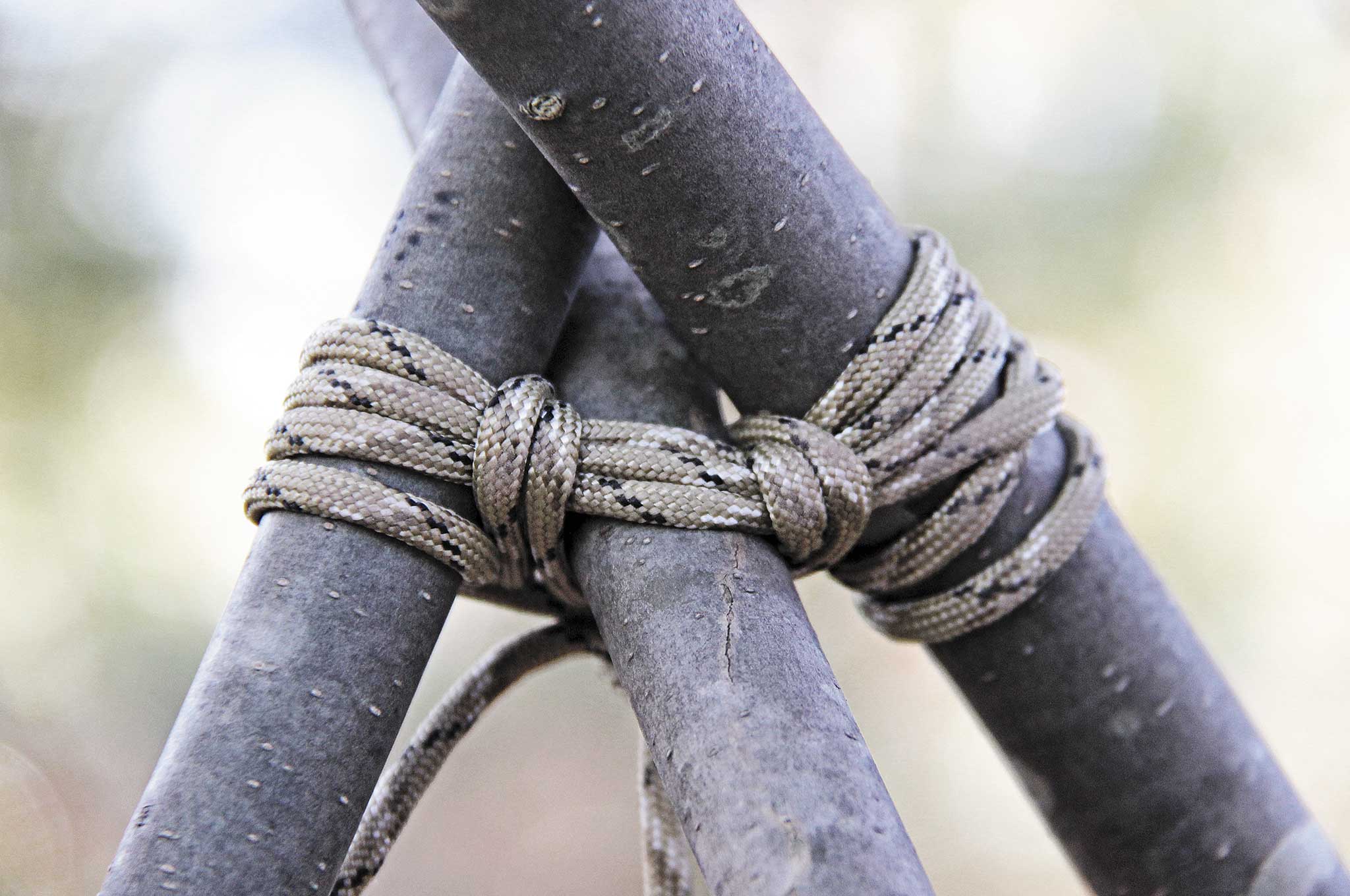
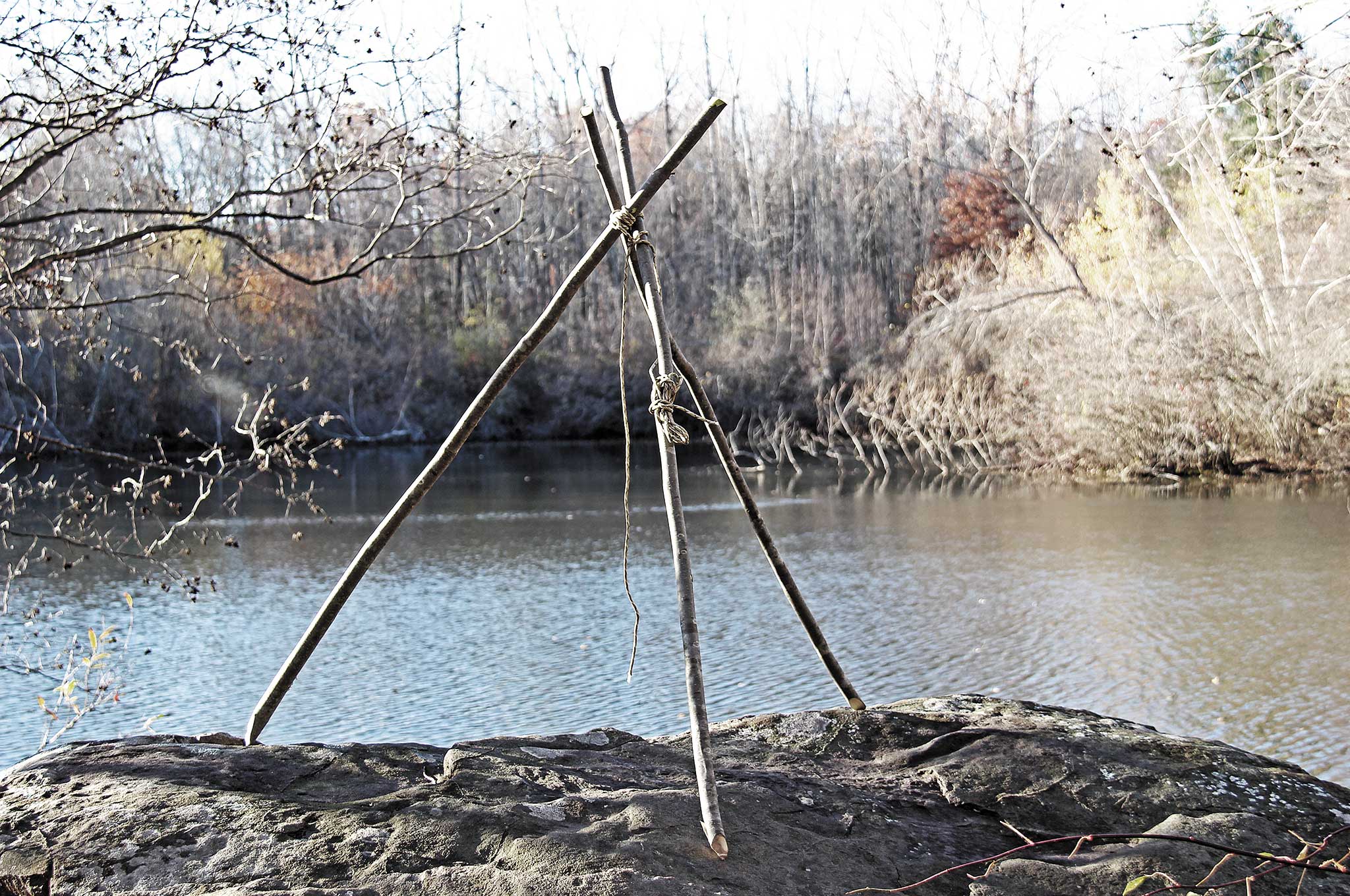
How To: Gather three poles and place them on the ground. They need not be the same length as the legs can be kicked out once assembled to make it stand straight. Wrap paracord around one of the poles with a lark’s head knot to start the tripod lashing. Then wrap the three poles three or four times.
The strength of the tripod lashing comes from frapping, when you pull the paracord in between the middle pole and pole closest to you and pull it tight to constrict on the wrapping on all three poles. Do it a second time between the middle pole and the pole furthest from you. Finish the tripod lashing by taking the end of the cord and securing it to the remaining end of the lark’s head knot.
Tripods are staples in traditional woodland basecamps. They can be used to create raised beds, camp kitchen potholders, camp seats, and jerky smokers.
Notes: Tripods can be used to suspend stew pots over the fire, to build raised beds in wet conditions, as camp furniture, or as the framework for a hauling “crane.” Anyone who wants to build advanced tripod projects should also know how to make a square lashing.
Paracord Project #7 – Bottle Carrier Net
Function: Holding bottles, containers, potted plants, etc.
Difficulty: 2 out of 5
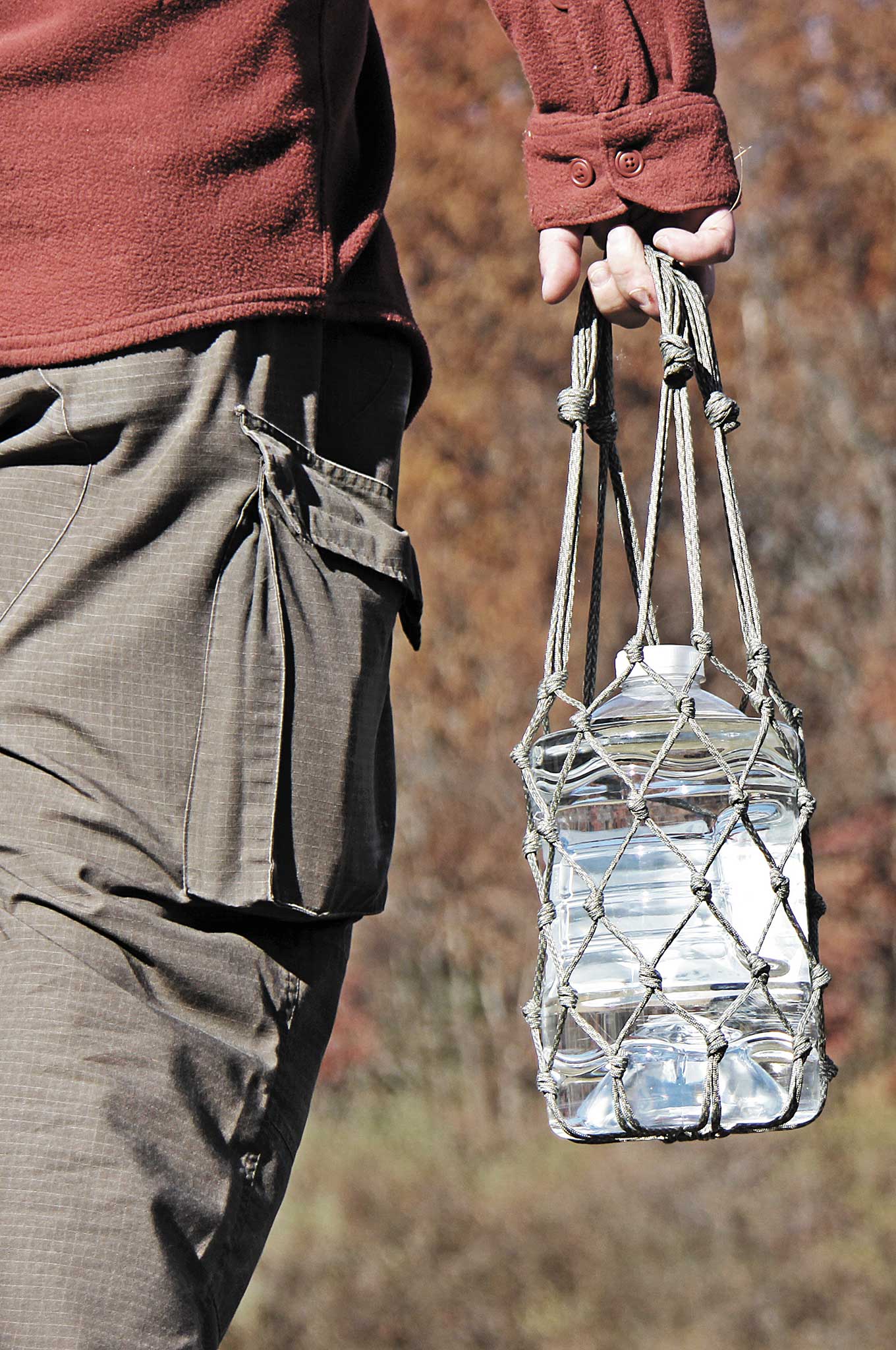
How To: Measure eight lengths of cordage by placing it under your bottle and holding the ends over it. It should measure approximately three times the height of your bottle. For the bottle used in our tutorial, this meant approximately 6 feet in length for each cord.
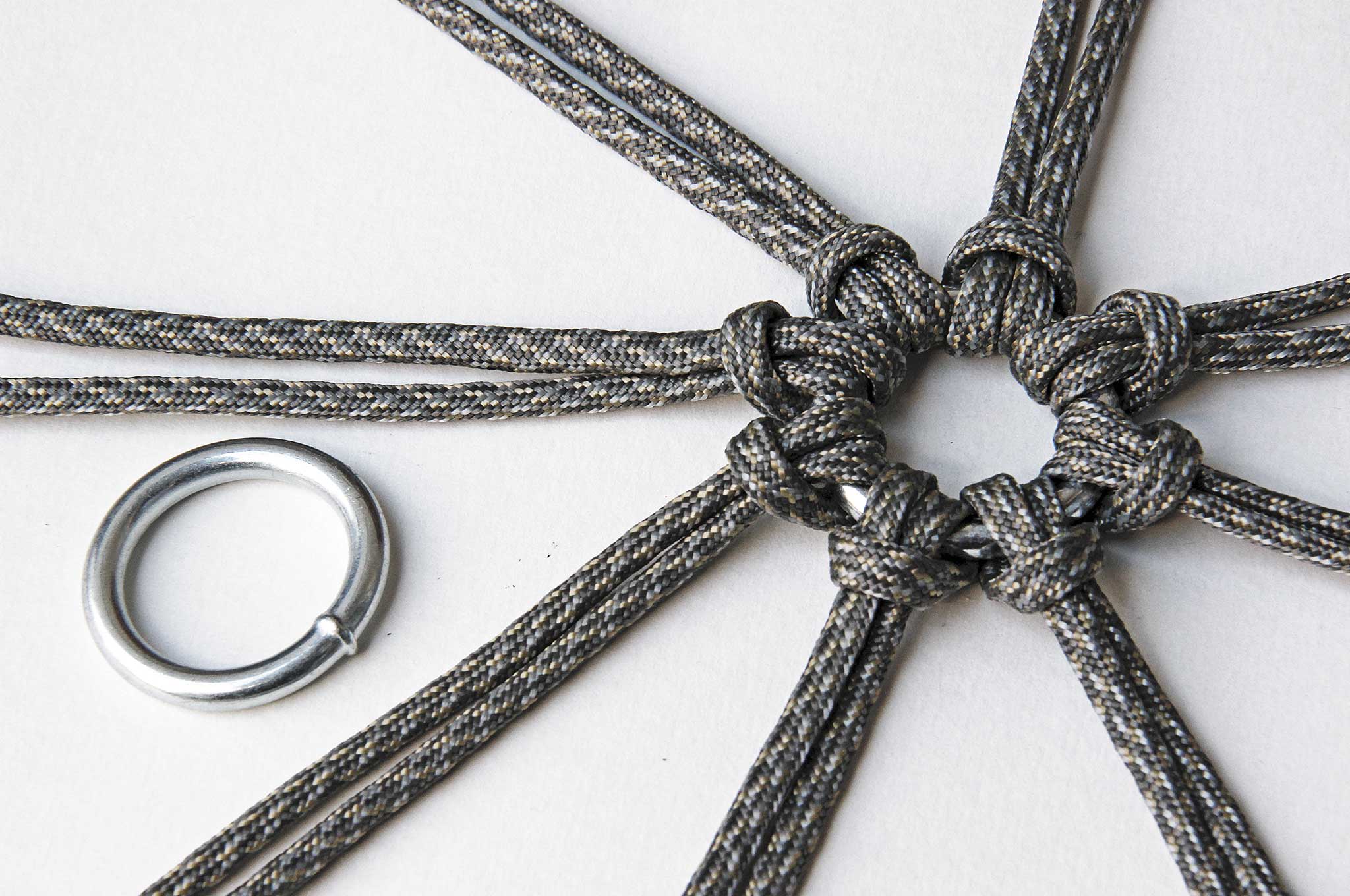
Cut eight lengths of cord out of a 50-foot-long hank. The last 2 feet will be used to create a handle. Attach the eight strands to your split ring with lark’s head knots. The trick to this bottle carrier is tying knots with strands of cord adjacent to one another.
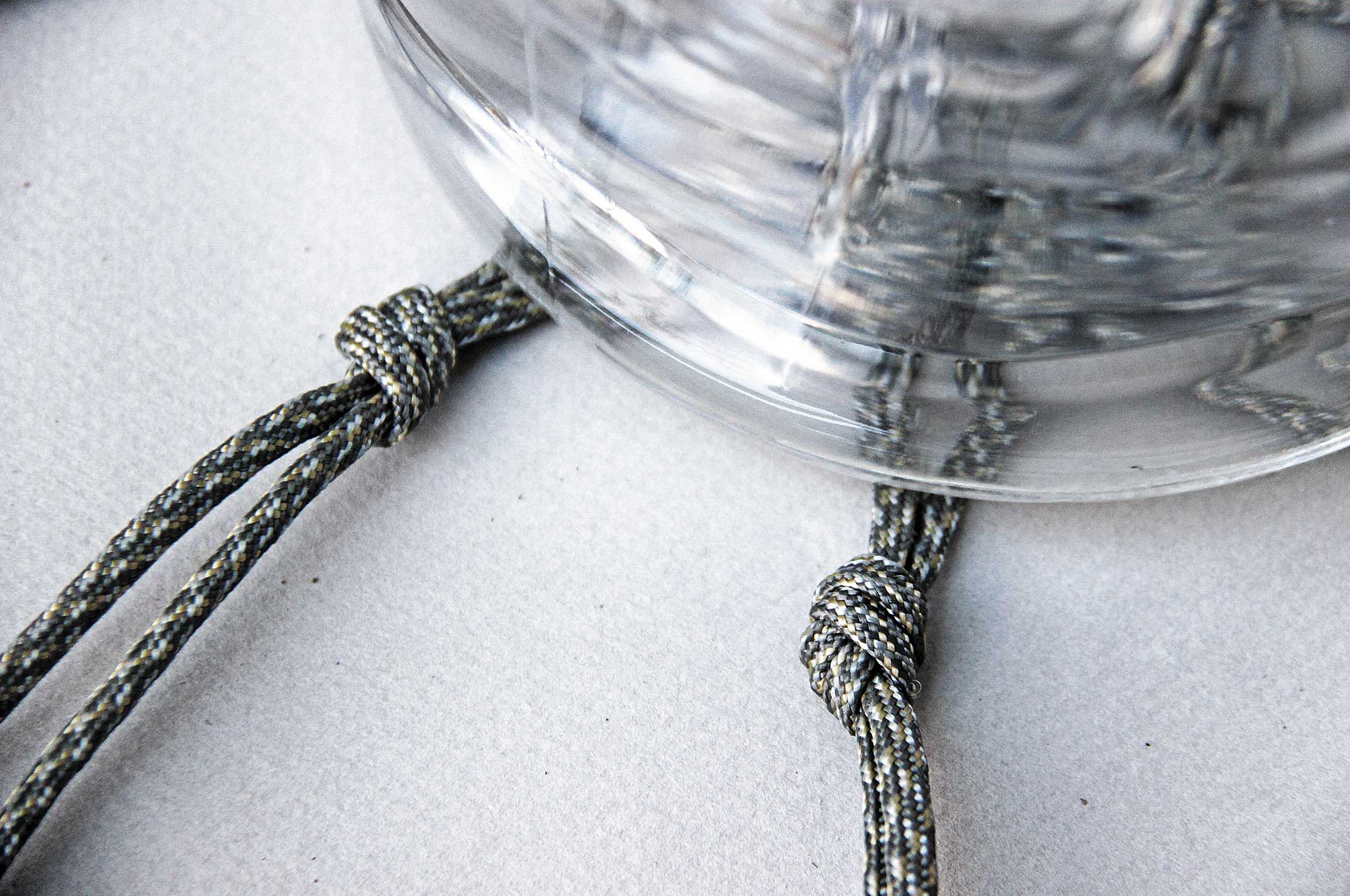
Tie the first overhand knot tied 3 inches from the ring, putting the knot on the side of the bottle rather than under it. From here, each knot works its way up the bottle every 1.5 inches. Try to keep your knots spread out consistently or it’ll look like rubbish. Continue working up the bottle until you get to the top. Finish the carrier by tying four of the strands together as one handle and the remaining four as the other handle.
Water bottle net carriers are more time consuming to make than they are difficult. Make sure to make your knots evenly spaced; your first knots should be alongside your bottle, not under it.
Notes: This same pattern can be used on almost anything box-like or cylindrical in shape. Make sure your split ring can handle the weight, or use a welded ring available at hardware and boating stores. If you don’t like overhand knots, you can use square knots instead.
Paracord Project #8 – Turnbuckle Rattler
Function: Camp alert system
Difficulty: 5 out of 5
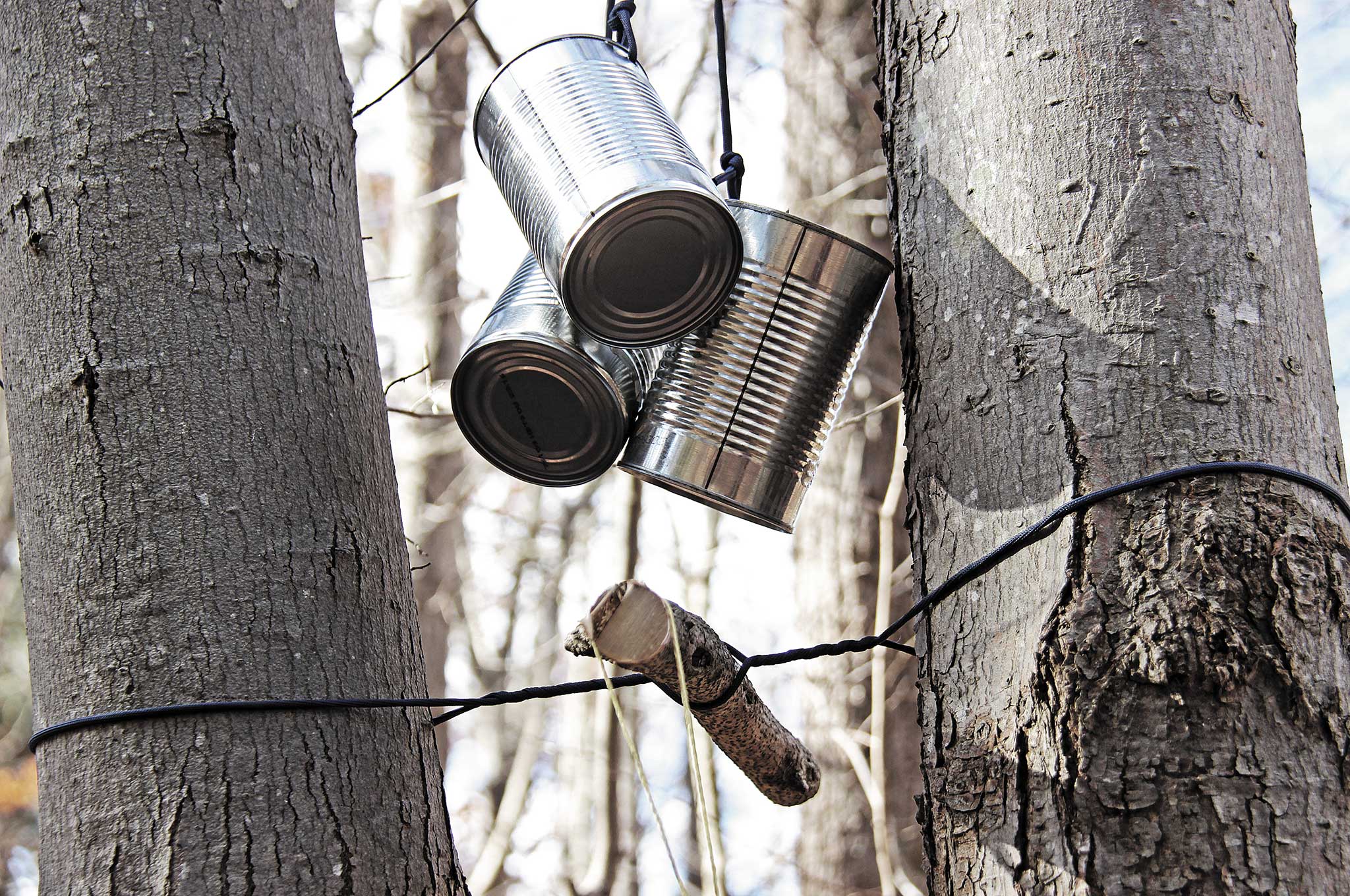
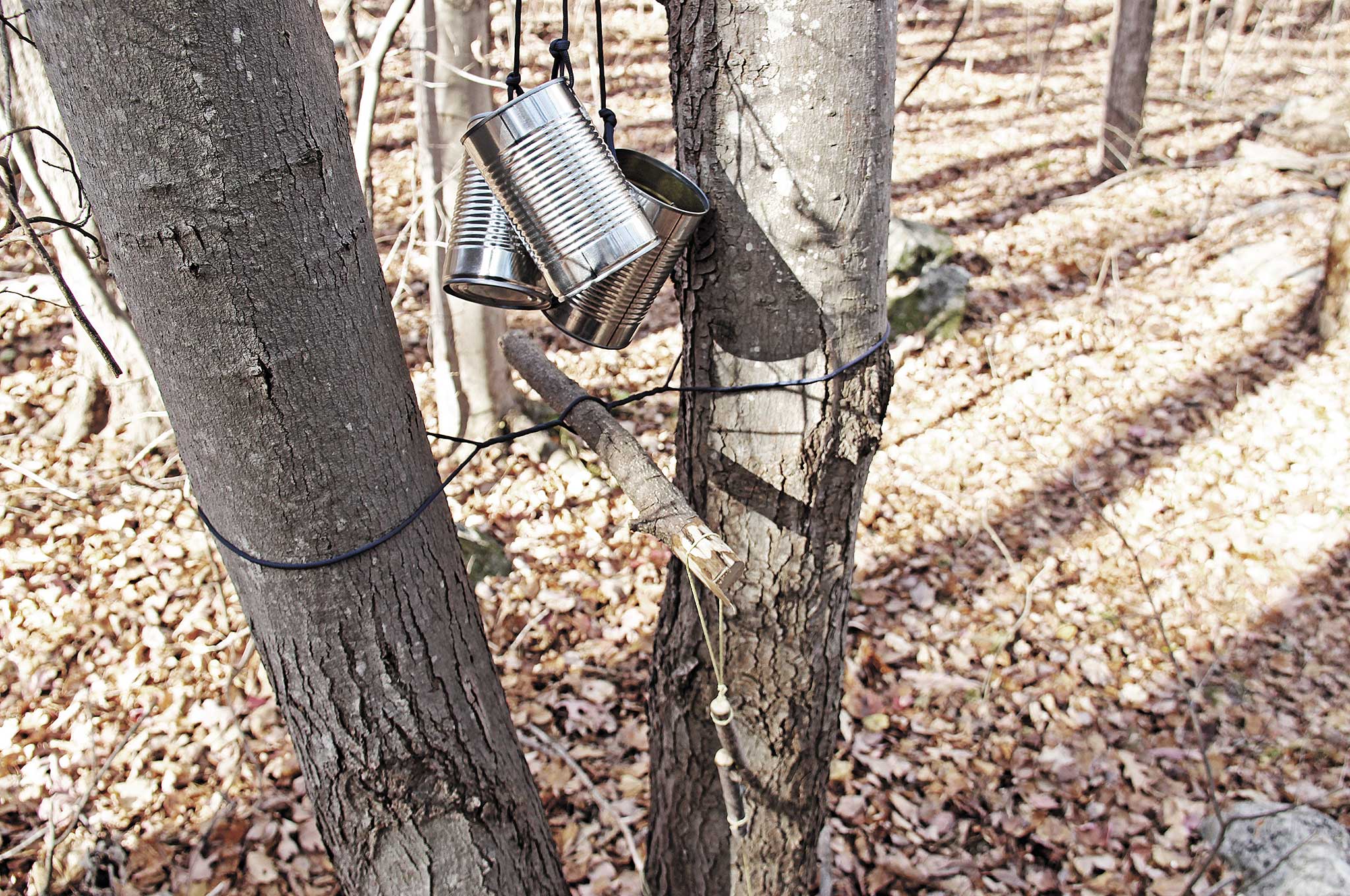
How To: When constructing the turnbuckle rattler, look for two sturdy trees with minimal flex in their trunks. This won’t work well with small diameter saplings. Take a length of paracord and wrap it around both trees. Tie an overhand knot in the paracord, leaving tail ends to your knot as well as very little slack in the loop you just created.
Just about one foot above the loop you just tied around the trees, tie another loop. From that, suspend a length of paracord down from the center in the gap between the trees and attach a few aluminum cans.
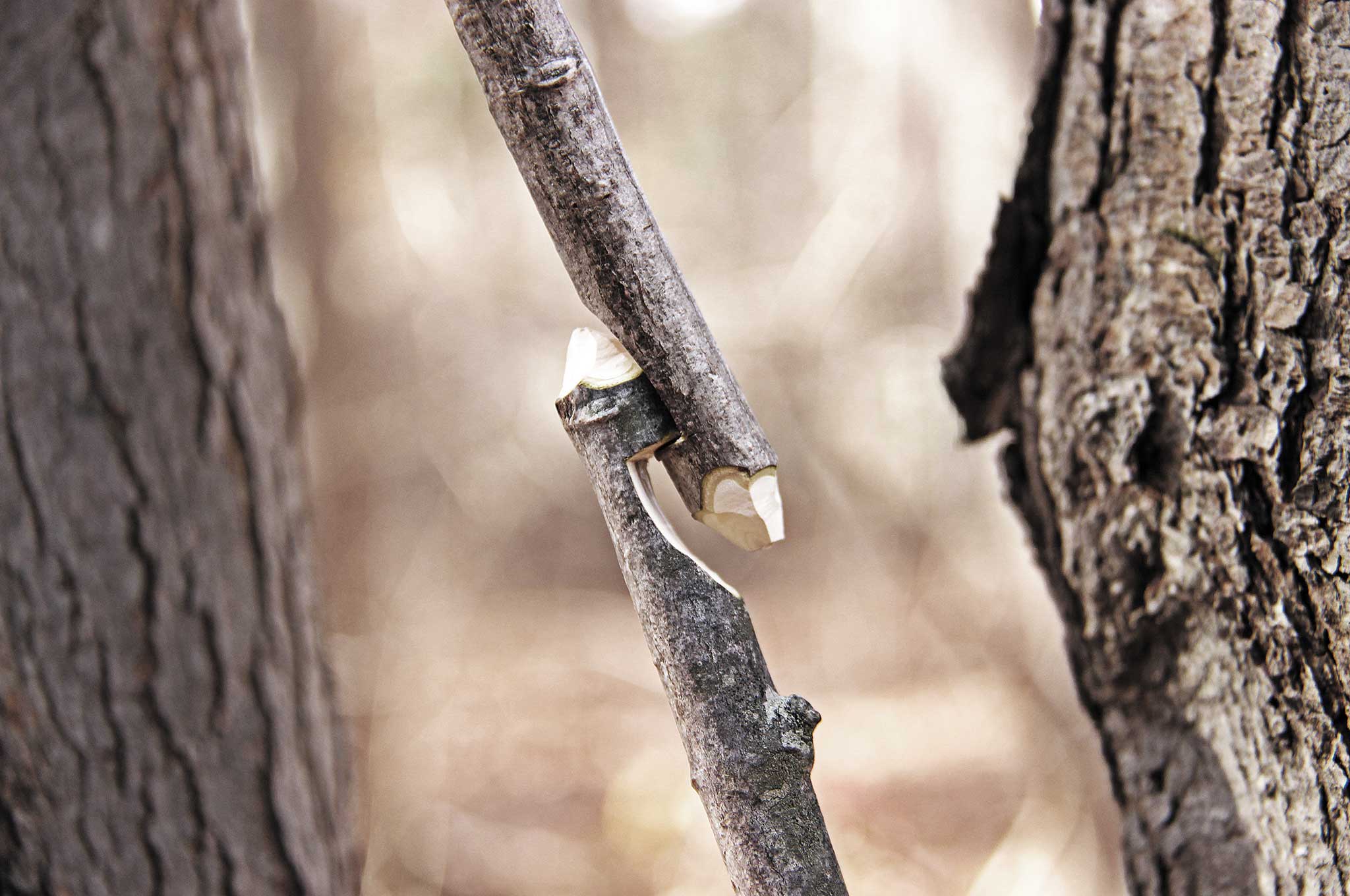
Cut a small wooden dowel from a tree branch or sapling. Put this dowel between the gap in the trees in the original loop and take up the slack in the loop by cranking the dowel end over end, increasing the tension. Slip a paracord loop over one end and attach it to a tripwire. When an unexpected guest enters your camp, they’ll trigger the turnbuckle rattler, striking the cans and alerting you to their presence.
Never be surprised in your camp by constructing a turnbuckle rattler with aluminum cans commonly found in the woods. Use the trigger and tripwire of your choice to set up this makeshift alarm system.
Notes: The difficulty rating in this trap is derived from the trigger and tripwire mechanism. A simple 90-degree toggle is all you need, but that requires knife carving knowledge and skill. When setting this alert system, watch your eyes. This device is under tension and disrespecting it can lead to accidental triggering.
Paracord Project #9 – Sling
Function: Weapon
Difficulty: 3 out of 5
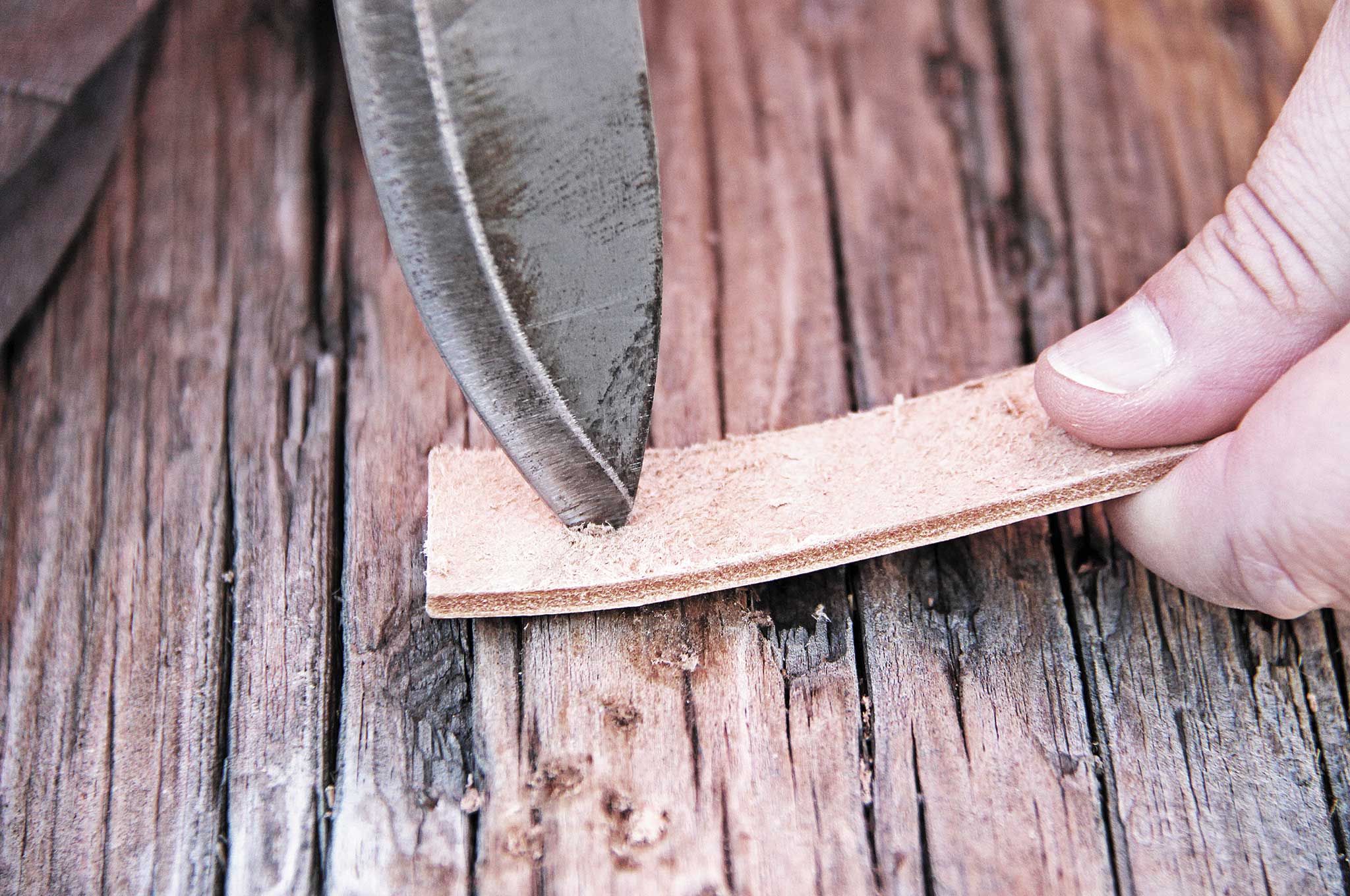
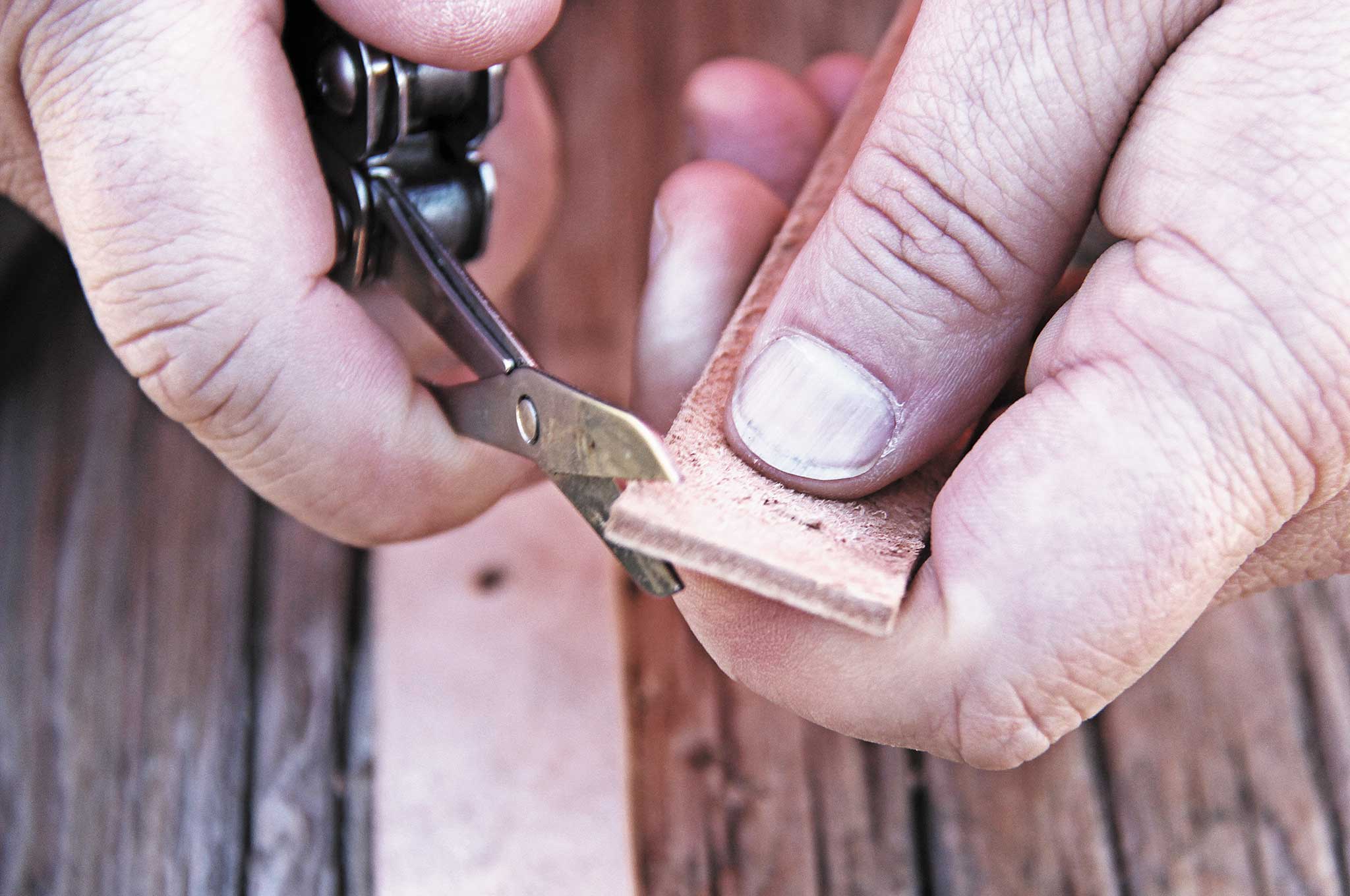
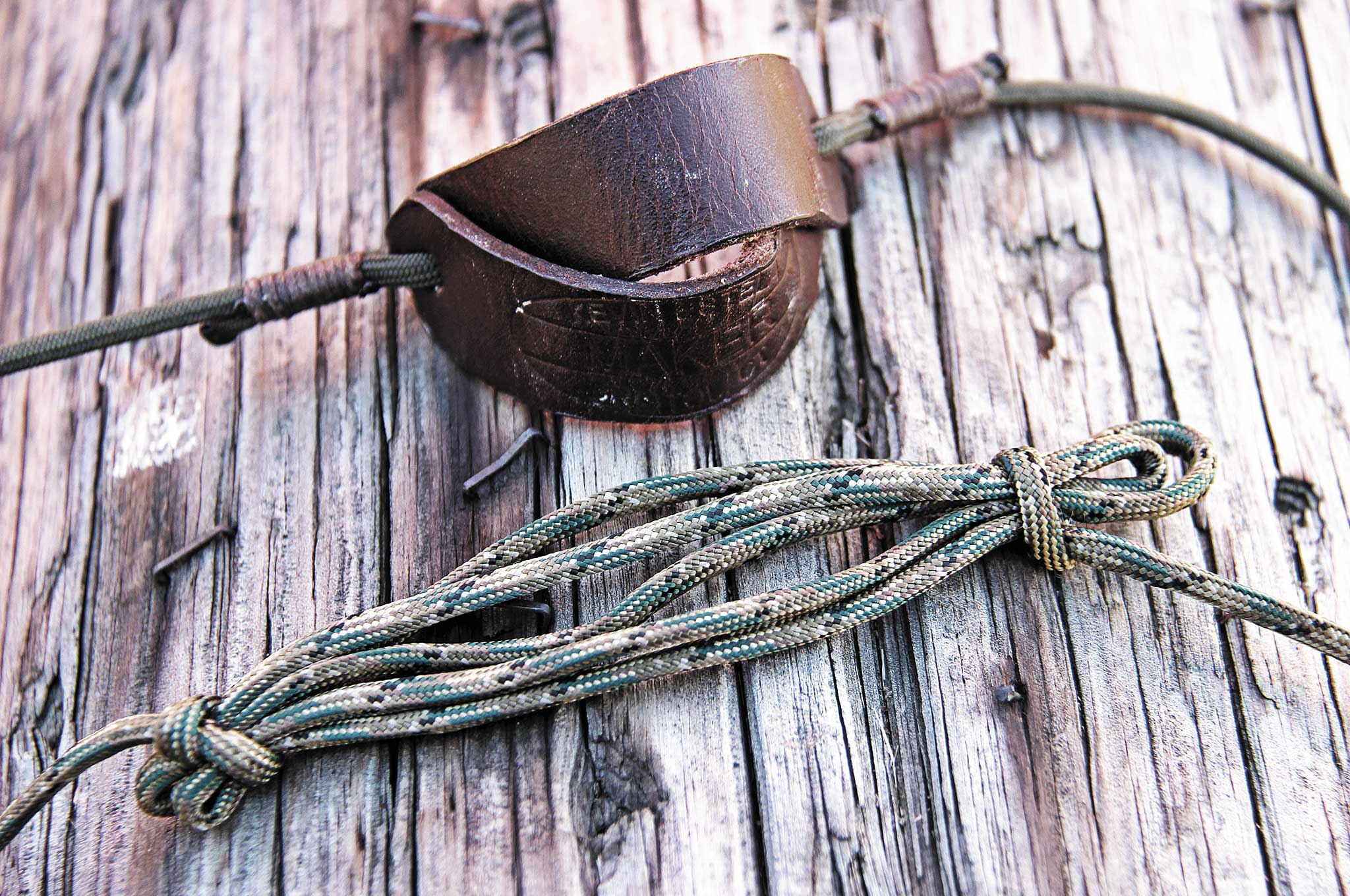
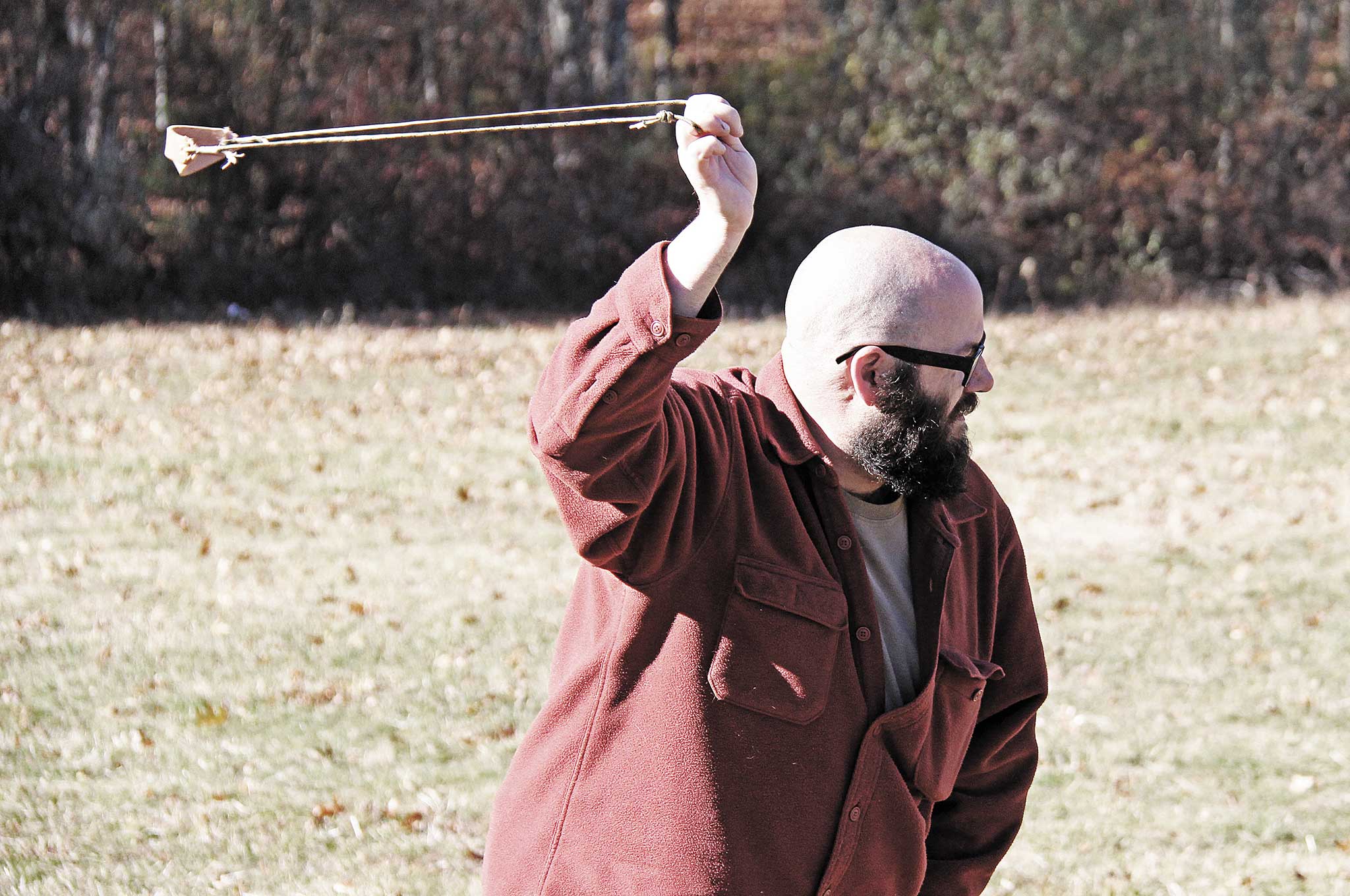
How To: Paracord makes a great sling. For starters, determine what you plan to toss. For this tutorial, we’re using golf balls. On one end, create a loop for your middle finger. About 2 feet from this knot, create a pouch out of duct tape, a couple pieces of leather, or flat webbing.
Tie a second piece of paracord to this pouch; make it as long as the other side with the middle-finger loop. On this end, create a knot you can pinch. If you’re skilled at braiding, an entirely paracord version can be made with a web pouch. To streamline it, you can whip the paracord to the pouch with the inner strands.
Slings can be made with leather, nylon webbing, braided paracord, or even duct tape. They’re centuries old and still extremely effective if they can be mastered. A word of advice: Wear eye-protection and duck when your friends try this for the first time.
Notes: This is easy to make but difficult to master. Try tossing this horizontally, vertically, or in a figure eight path. With enough practice you’ll be ready to kill that giant or challenge your skills.
Paracord Project #10 – Stretcher/Travois
Function: Moving an injured person
Difficulty: 3 out of 5
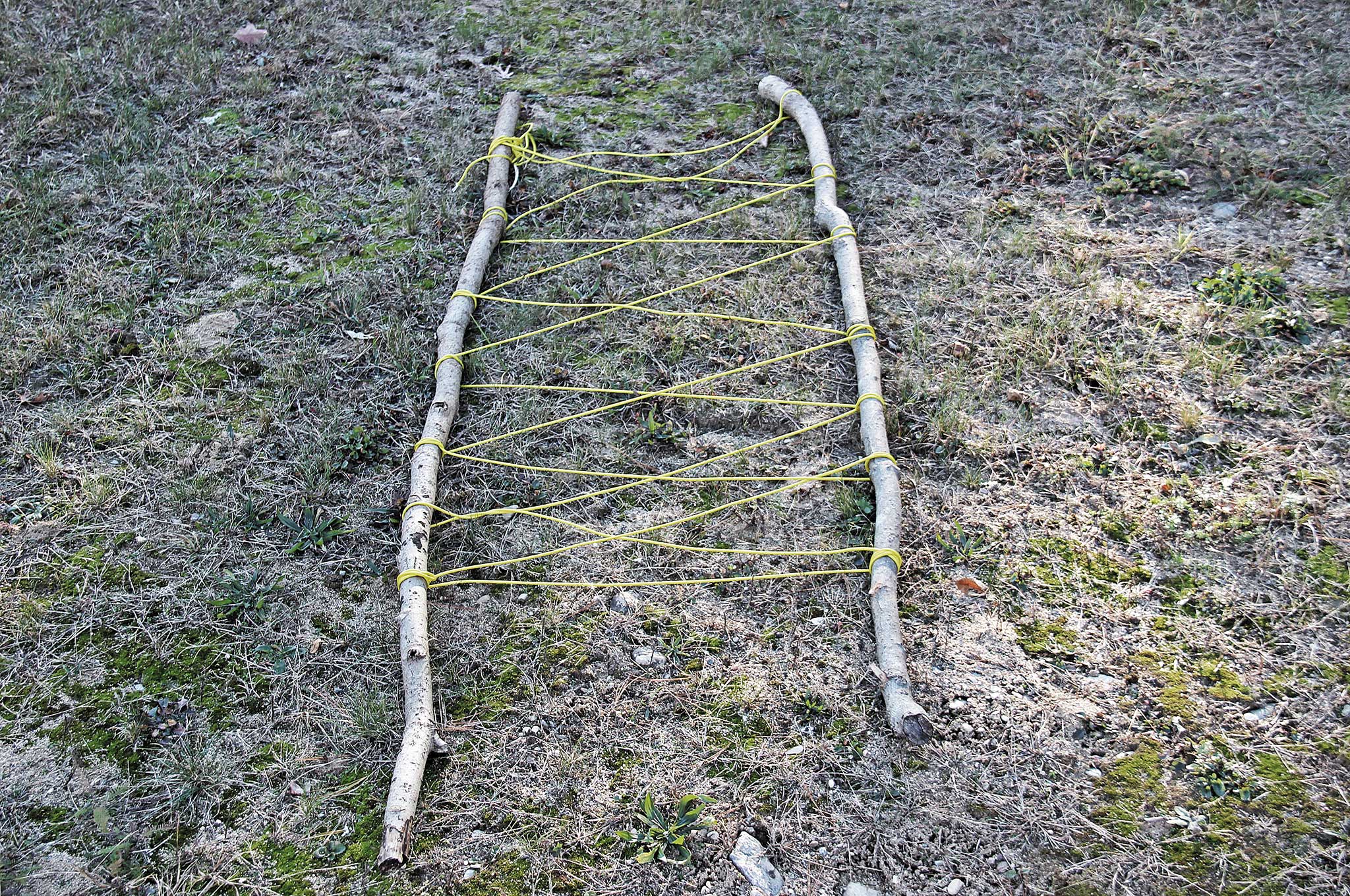
How To: Prior to starting, cut two poles at least one-and-half times the length of the person to be carried. If you’re making a travois, make them twice as long if you can. The poles should be sturdy and have minimal flex. Place them parallel to each other and as wide apart as your patient for a stretcher; cross them about a quarter of the way down in an “X” for a travois.
Tie your paracord to one pole, then directly across from it. About 25 feet should be enough to hold a patient. Don’t cut your cord! Continue zigzagging down your poles then back up again creating web work. Secure the end of your paracord and cover your web stretcher with a camping pad. It can be used without a pad, but for patient comfort, hook them up if you can.
Notes: A non-paracord version of a stretcher can be made with just a blanket and poles. Whether paracord or blanket, learn ways of helping your buddies out and teach them so they can help you in case you’re the one who screws up.
The 550 paracord is the industry standard when it comes to cordage. It’s a great baseline of comparison for other types of ropes. For example, tarred bank line is referred to as “thinner than paracord,” and jute twine is said to be “not as strong as paracord.” As outdoor enthusiasts, we hold 550 paracord in high regard, but there are times when other options may be better. Here are a few other cordage options to carry next to the hanks of paracord in your pack.
Braided Kevlar: This line is ridiculously tough. Thinner than 550 paracord, it has much more strength pound for pound. It’s harder to cut and knot, but the tradeoff is packability.
Jute Twine: You don’t always need 550 pounds of breaking strength, and there are times when you want to tie something up in camp and not worry about taking it down. Jute twine isn’t synthetic and can be left behind to biodegrade. That’ll make the tree huggers in your group happy.
SpiderWire Braided Line: This fishing line is the only type we trust. If you can catch a 50-pound freshwater fish, you’re a stud. All other fish can be landed without worrying about breakage with this super line. Rather than using one of the inner strands of paracord, use this dedicated line. Just watch your fingers if you hook onto a fish and it runs. It’ll slice your skin like a laser.
Dental Floss: Wicked strong, pre-rolled into cute spools, and dentist-approved, this is handy cordage. Waxed floss is great for whipping lines that’ll unravel, and it also works well for setting up traps. When visiting your dentist, ask for samples. Rip them out of the packaging and tuck them into your pack pockets.
You eat, and by any means necessary, or you don’t, and you die… Life is an endless search for energy. Do you know where your next meal will be from?
This quote from a new video by The Wooded Beardsman reminds us about the harsh reality of finding food in a survival situation. As survivalists, it’s a topic we often insulate ourselves from. We may think: My bug-out bag is stocked with several days of freeze-dried food, I have a basement stockpile that’ll last for months, and when those run out, I know several places to scavenge in a nearby town. I have firearms to hunt with, tackle to fish with, and traps for small game. I’m prepared.
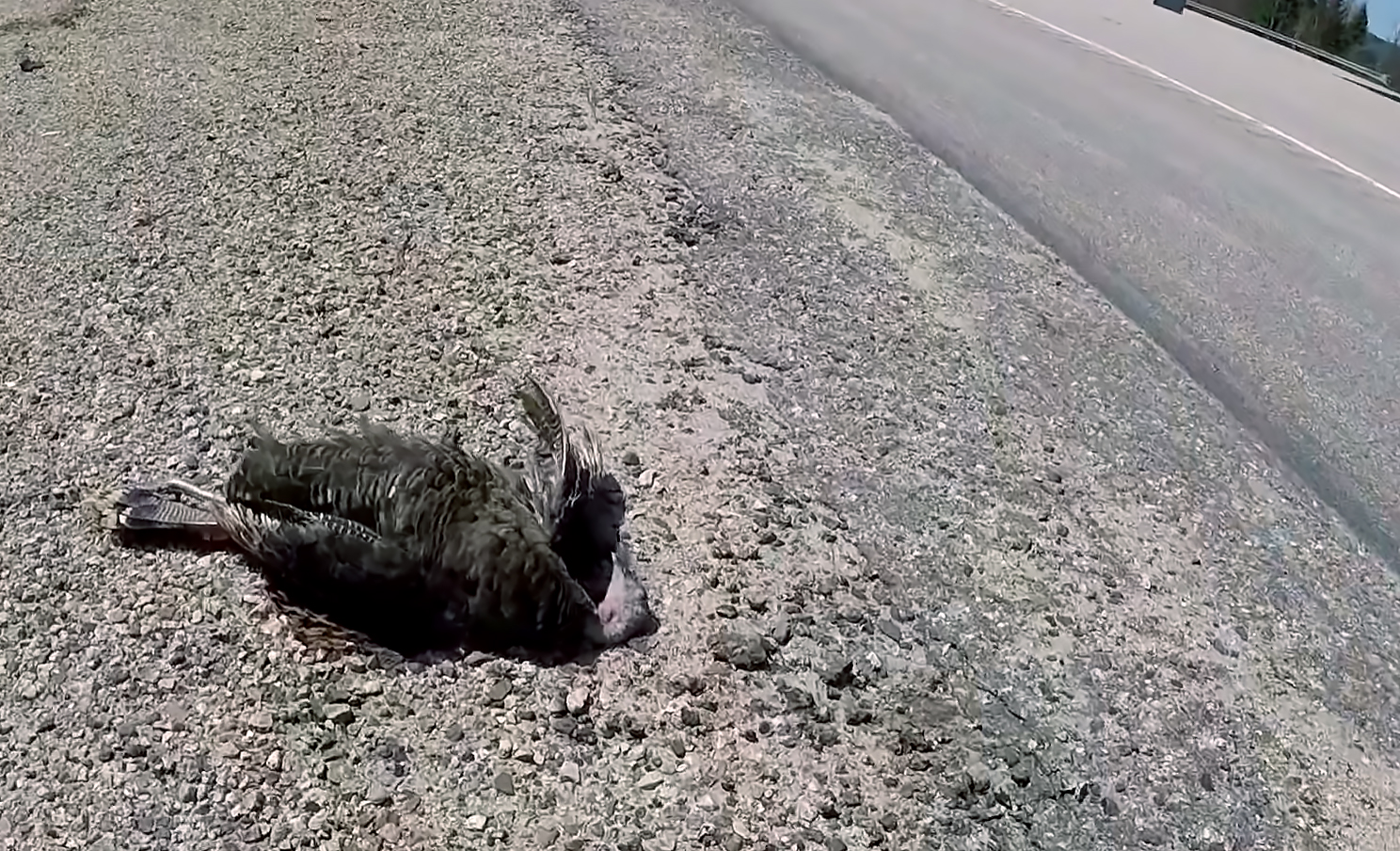
Roadkill isn’t glamorous or fresh, but it might be a viable food source in emergencies.
It’s reasonable to call someone who can make this statement “prepared”, assuming they actually have the skills and training to back up the words. However, there’s no such thing as 100% preparedness. Real preparedness is realizing that these steps only delay the inevitable return to a total reliance on nature. In an indefinite survival situation — i.e. the complete breakdown of society as we know it for the foreseeable future — all of these caloric preps will be helpful at first, but the principle of entropy tells us that they will eventually falter and fail. Stockpiles run out, shelves get picked dry, traps break, fishing lines snap, and weapons run out of ammo.
Sooner or later, you might end up eating like you’re back in the stone age. It’s wise to begin thinking about food accordingly.
As we’ve said before, one of the keys to survival is mental fortitude. When it comes to eating in a survival situation, that means overcoming your disgust to stay alive. Everyone has a different gross-out threshold. Will you forgo store-bought, sanitized, shrink-wrapped meat to hunt and butcher your own? Some would have a hard time with even this step. Will you eat sinewy sewer rats, wriggling grubs, or a cute animal which was once someone’s pet? These are bigger mental hurdles to overcome. Will you scrape maggots off a roadkill carcass to find morsels of viable meat? It’s a psychological battle to keep the dry heaves at bay and take that first bite.
With proper preparation, something which looked disgusting may become much more appealing.
The point of all this introspection is to realize that what you can do and what you’re willing to do are two different things, even in a survival situation. If you can come to terms with this now, and gradually overcome the aversion to unconventional or unappetizing food, you’ll have a valuable element of long-term preparation to complement your short-term survival food stockpiles and tools. That’s what we call food for thought.
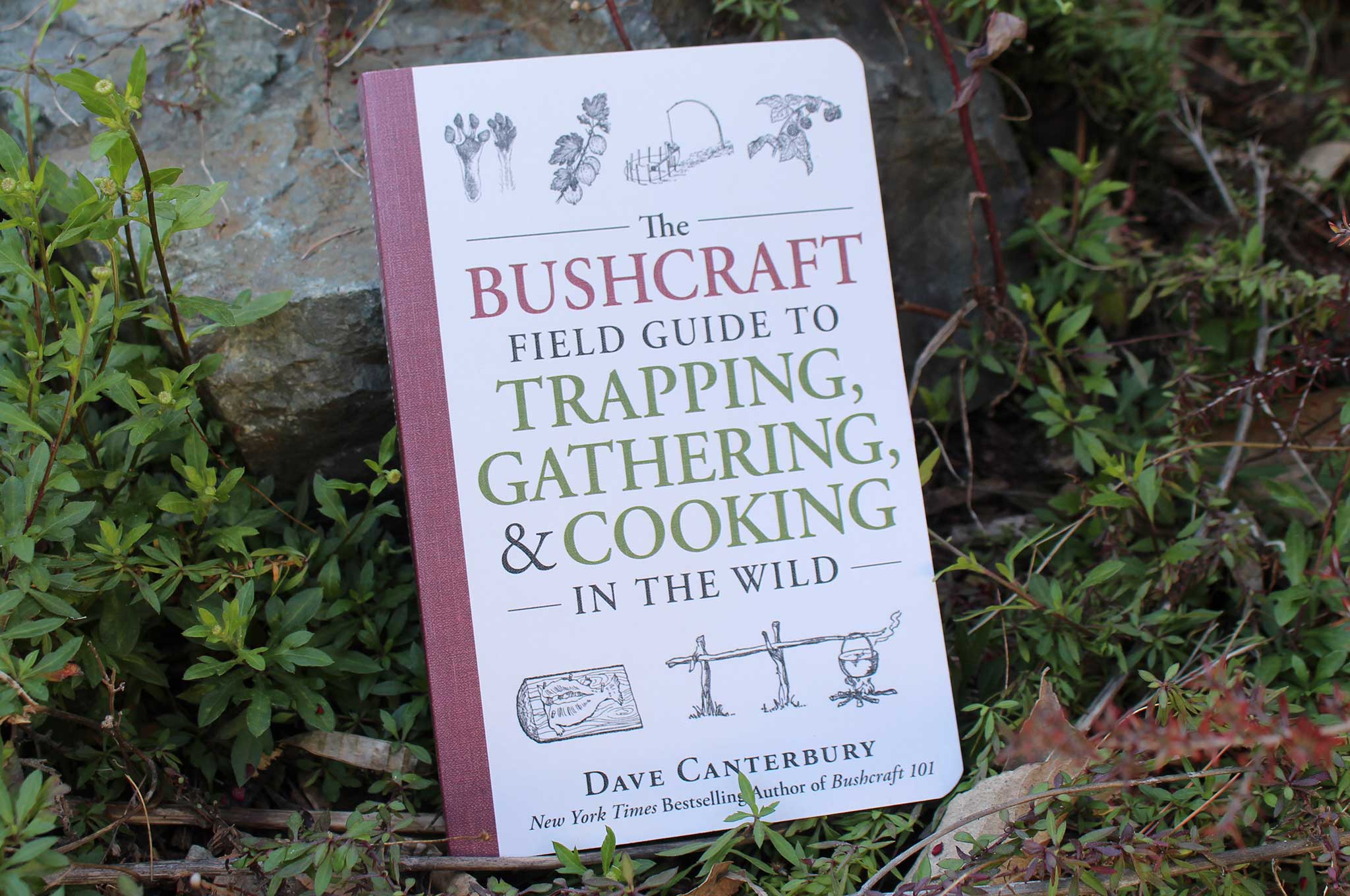
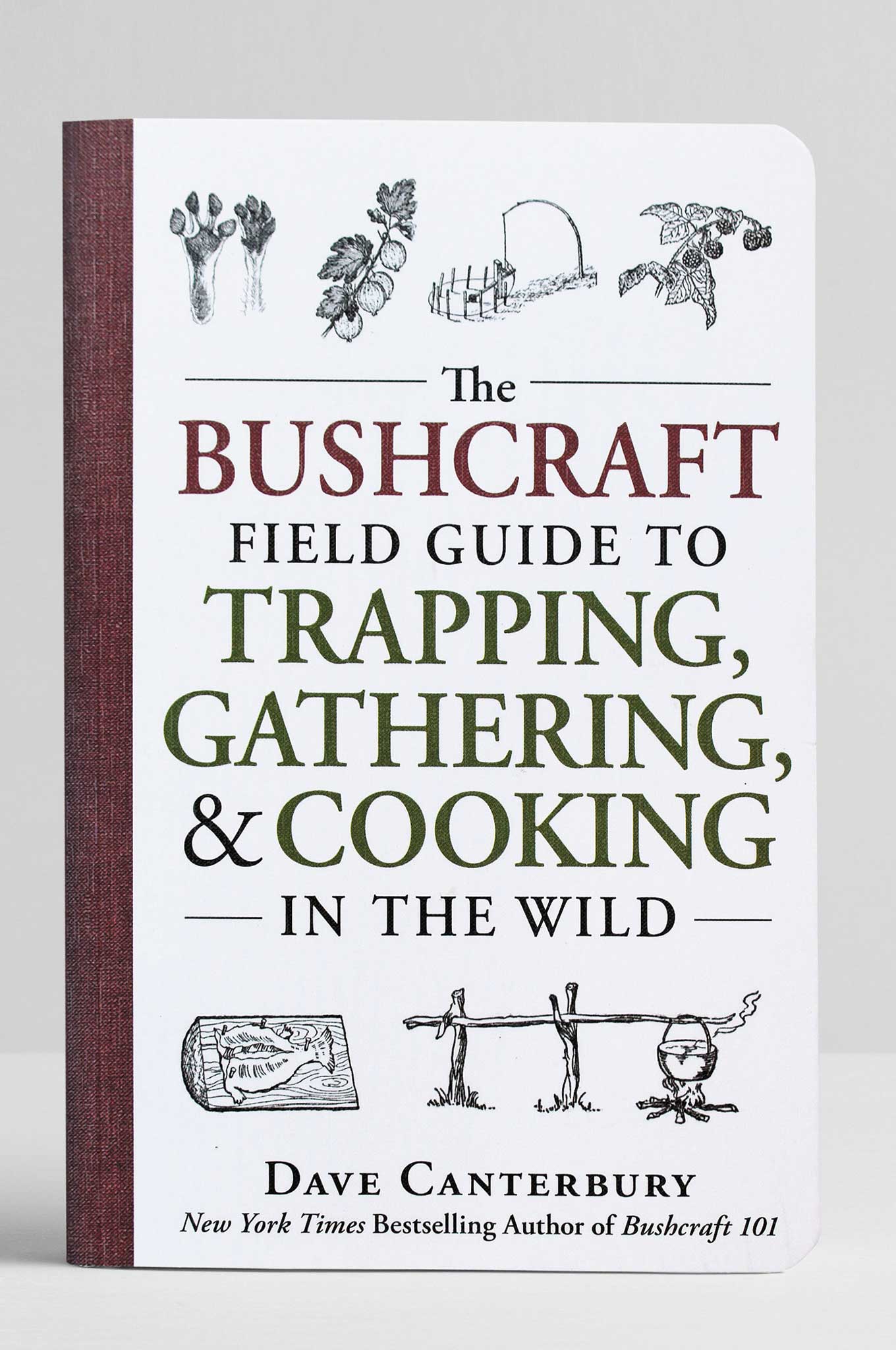
The Premise: As of this writing, four of the top five best-selling books in Amazon’s outdoor survival skills section are written by Dave Canterbury. His latest offering, The Bushcraft Field Guide to Trapping, Gathering, & Cooking in the Wild, is one of them. Upon initial gaze, this manual appears to go into great detail about how to procure and prepare foods when civilization is well out of reach. Canterbury’s straightforward approach is easy to read, and the text is laid out so you can find pertinent information quickly. But can the reader trust the source?
The 411: For those who didn’t follow the drama surrounding Discovery Channel’s Dual Survival, in order to land the role of cohost, Canterbury reportedly embellished his Army record by claiming that he served as a paratrooper and a sniper, among other things, when, in fact, he was military police. The ensuing dustup caused him to be fired after the second season. While misrepresenting one’s military record is an abhorrent act, one can still have strong survival skills in the woods.
This leads to the question: Can the merits of a book stand on their own despite the tarnished past of the author? It’s possible — but in this case, no, they can’t.
The Verdict: Despite being called The Bushcraft Field Guide to Trapping, Gathering, & Cooking in the Wild, the first 100 pages has little to do with bushcraft skills. Though the entire book is laden with useful snippets regarding general camping, food preparation, and gear needed to be comfortable in the outdoors, it falls short of its claims that it’s a field guide for bushcrafters. It’s more like a manual for casual campers.
Under the confines of “trapping, gathering, and cooking,” the book focuses too heavily on impractical recipes and doesn’t concentrate enough on the skills a real bushcrafter craves: tracking, hunting, fishing, foraging, water-sourcing, and container construction.
If you’ve picked up this book with the intention of learning about real bushcraft survival, skip ahead 129 pages to Chapter 11 (“Hunting and Trapping Game”), the first chapter that offers any discourse on dealing with life in the wild — but ironically it doesn’t deal with hunting or trapping game. Instead, it briefly introduces how to locate animals, but does so in a mere four pages. This includes a chart of animal tracks containing those that can be found within city limits (cat? dog? crow?).
A redeeming section, “Chapter 13 Trapping: Beyond the Basics,” is a thorough, nicely illustrated guide to various types of traps and snares, what they can be used for, and how to construct them, especially the section on primitive traps. It’s a well-thought-out chapter that would be useful when attaining fauna from the wood.
A blight, however, is Canterbury’s recipes at the end of some chapters (in addition to Chapter 16, which is chock-full of impractical dishes). Though they’re very creative and probably quite delicious — if you’re desperate enough to eat opossum, squirrels, and pond frogs — you’re unlikely to have a box of hushpuppy mix, Cholula hot sauce, or a jar of raspberry preserves tucked into your ruck sack.
Probably most damning, the book exploits the spirit of bushcraft, misrepresents the concepts, ideals, and essence of the skills needed, and poorly represents the general topics purported in its name. The title proclaims “…In the Wild” whereas most of this book relies on the reader having a fully stocked kitchen. Subjects are broached broadly and watered down for a general understanding of the concepts without giving the details needed to successfully employ them in the wilderness.
Ultimately, this book doesn’t have enough recipes to be called a cookbook, nor does it have enough information to be called a practical field guide. It lumbers incomplete somewhere in the middle, trying too hard to be too many things without succeeding at any one thing. In the introduction, Canterbury writes: “…we cannot go on a weeklong hunting camp and expect to live completely from what we can provide by rod and gun or even necessarily from traps and foraging.” Many would take umbrage with this claim, and an author who would make such an assertion probably shouldn’t write a book about bushcraft.
Novel & Author The Bushcraft Field Guide to Trapping, Gathering, & Cooking in the Wild, Dave Canterbury
Me gusta la biblioteca. ¿Que hora es y dónde está el baño? That pretty much exhausts our Spanish 101 language skills, but you don’t have to be un experto to recognize the name El Chapo. Chapo, meaning Shorty, is the alias of ruthless Sinaloa Cartel drug lord Joaquín Guzmán. This seriously bad hombre was once worth $1 billion US, was called “the most powerful drug trafficker in the world” by the U.S. Department of the Treasury, and escaped from prison twice before being extradited to the United States in January 2017.
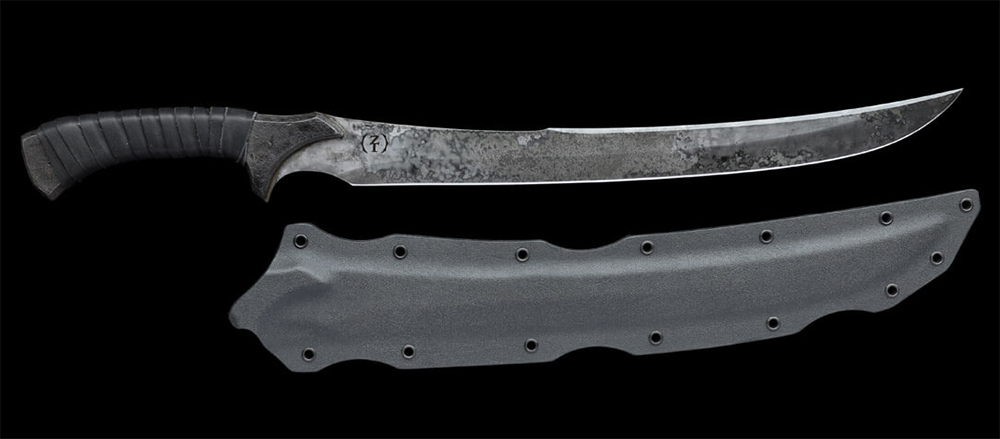
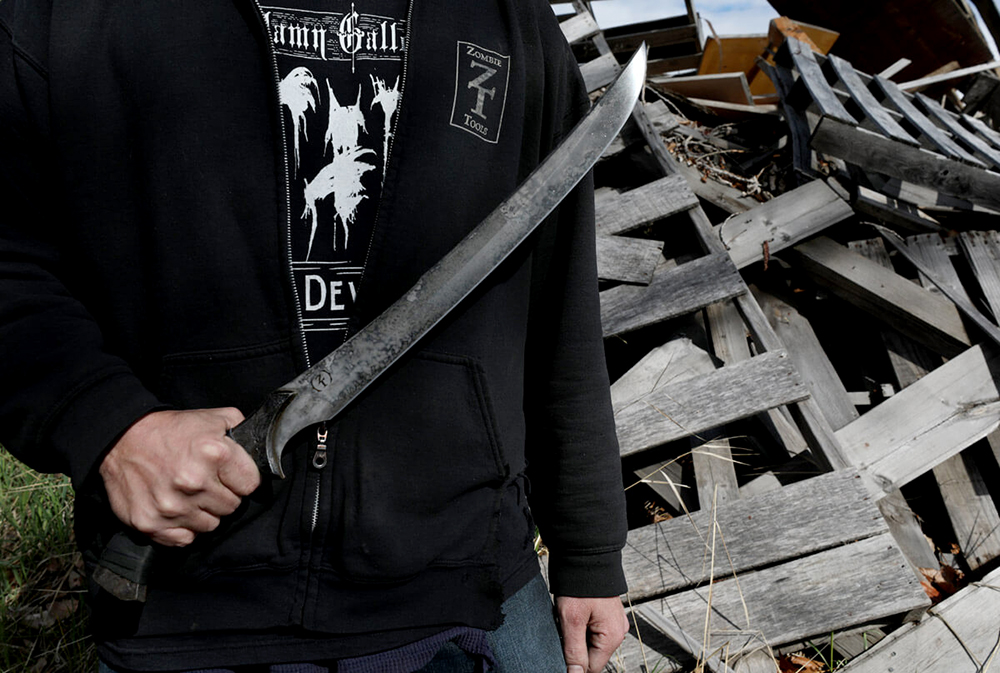
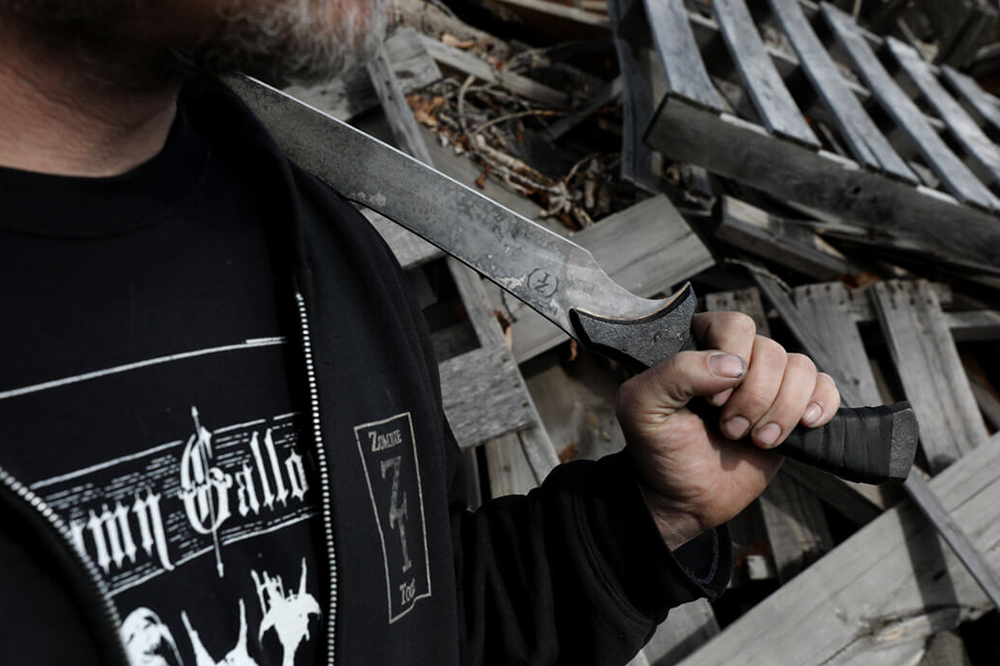
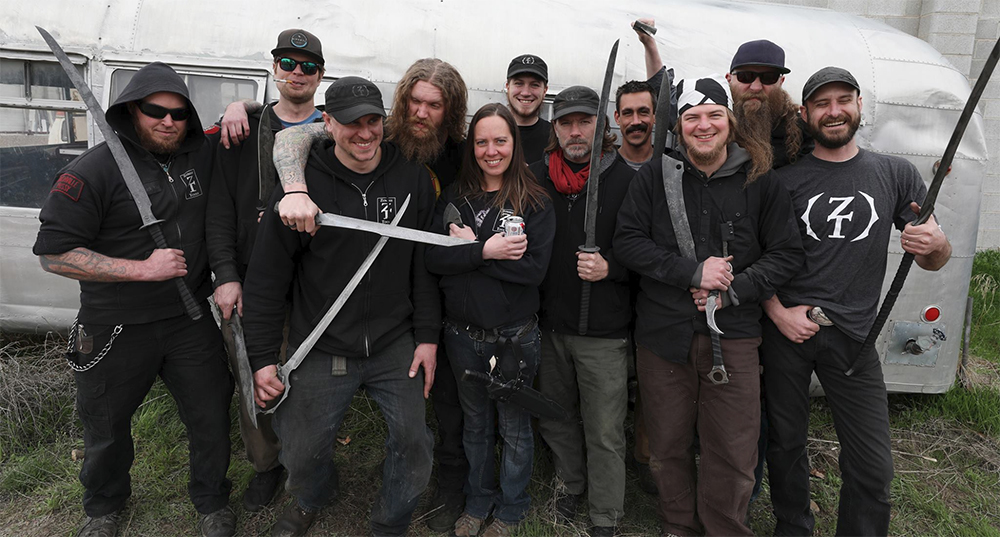
El Chapo’s fearsome reputation inspired the crew at Zombie Tools to name their latest blade El Choppo — we can’t deny it, that’s a pretty solid pun. ZT doubles up on the artful wordplay with its description of the new knife:
If you have the huevos to wander the narrow street of the barrio late, late at night, when tequila worms dream in the bellies of snoring whores, you can sometimes hear slurred songs stumble out the doors of certain cantinas, songs in the style of the narcocorrido, that tell the tale of the knife, El Choppo. Forged in the high mountains to a family that looked up to dirt, El Choppo was raised thwacking at banana trees and cane, chopping kindling for the stove, and fighting back a forest avowed to reclaim all fields.
Putting aside the clever product description, we’ll get down to the facts. The Zombie Tools El Choppo is a 24.75-inch knife forged from sturdy 5160 steel. The 8.5-inch curved handle is clad in dark aluminum scales, and then wrapped in a strip of black leather. It includes a fitted Kydex sheath, and like all Zombie Tools blades, it’s handmade in America (specifically Missoula, Montana) from American materials.
The El Choppo will set you back $290, and it’s made to order, so there’s a 6-8 week wait time. However, if our past experience with the company’s Vakra kukri is any indication, this blade will be able to take a beating. For more information on the Zombie Tools El Choppo and other ZT blades, go to ZombieTools.net.
The internet is a great resource for survival knowledge, but it also has the potential to spread survival myths and misconceptions at an alarming rate. All it takes is for one ignorant individual to post a blog article or YouTube video to a large online audience, and the idea spreads like wildfire. Pretty soon, you may even see less-than-reputable online publications re-posting these myths without fact-checking them, luring thousands of new readers in with sensational clickbait headlines — Bear Grylls doesn’t want you to know about this one cool survival trick! You won’t believe it! Click here!!, the headlines insist.
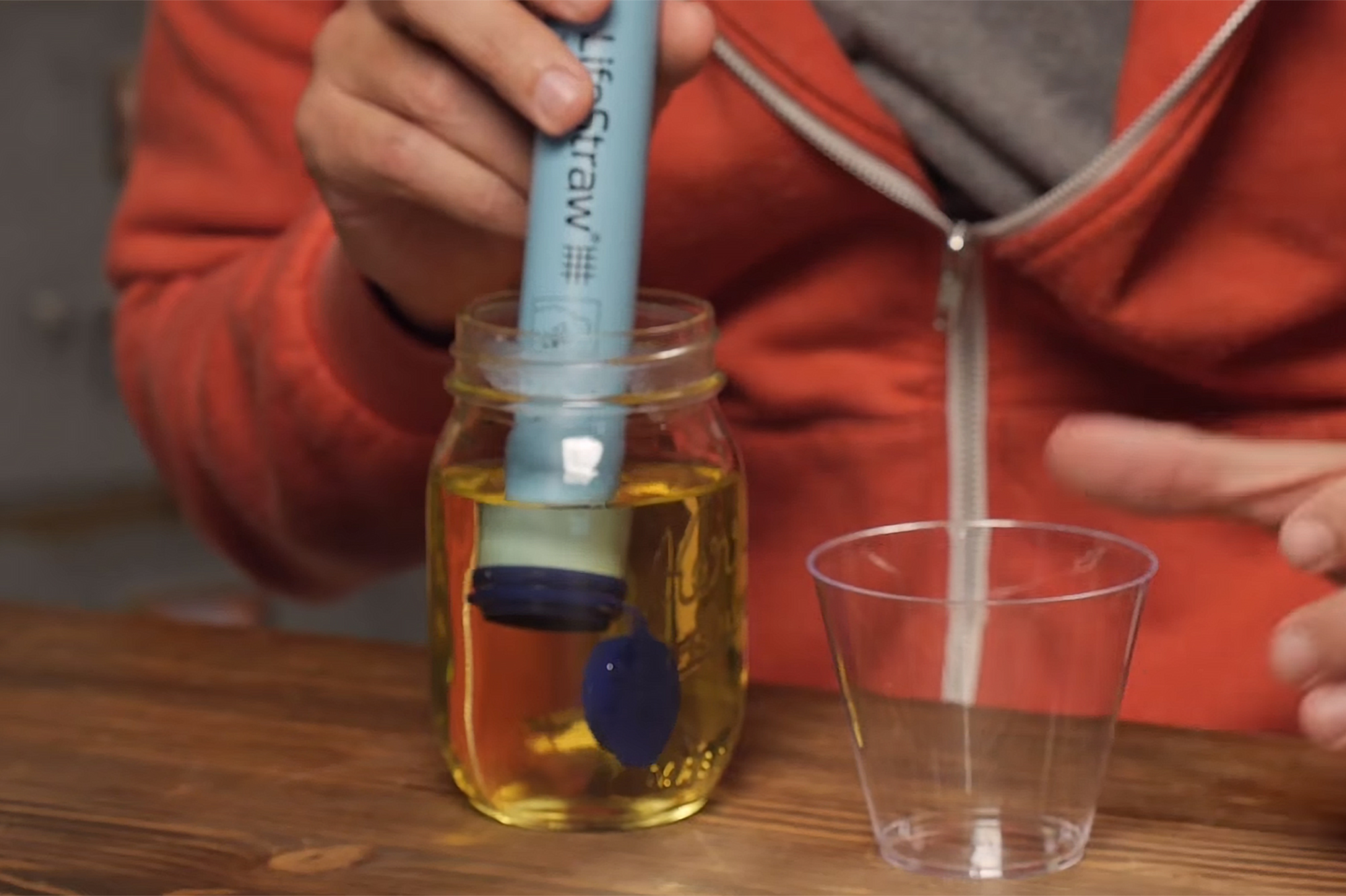
Drinking urine through a LifeStraw is a really bad idea, yet it still spread rapidly online.
Those who know the truth behind these survival myths will roll their eyes and move on, but innocent or uneducated readers may fall for it hook, line, and sinker. The clickbait articles go viral on social media, and the misconceptions continue to spread. If you want to see this phenomenon in action, check out our previous articles on the myths of “safely” drinking urine with a LifeStraw and making a fire-starter from a lemon battery. The source videos for those myths received 6 million and 22 million views, respectively. That’s infuriating, but it also motivates us to spread the word about the truth.
When is Water Safe to Drink?
Due to the complex nature of the microbiological science involved, water purification is often the subject of these survival myths, like the urine-through-a-LifeStraw video above. We can’t observe the bacteria present in a sample of water with the naked eye, and we can’t necessarily smell or taste them either. Obviously foul, murky, and stinking water is a red flag. But crystal-clear stream water or even water direct from the tap can harbor dangerous microbes. This leads to all sorts of folk remedies and tall tales about ways to make water potable. Some have elements of truth; others are obviously false.
(For an in-depth look at how water filters and purifiers remove or inactivate bacteria, protozoa, and viruses, check out the article H2O Hygiene from Issue 15 of our magazine.)
We recently stumbled upon an interesting water-related misconception in a comment on social media:
“Calm, shallow water exposed to the sun is pretty safe because surface bacteria are killed by the sun and most everything else settles to the bottom. If you really need to drink untreated water, you are generally better off skimming a calm pond than dipping out of a stream or river.”
This statement is almost entirely false, and it contains potentially dangerous misinformation, but there’s also a grain of truth as well. To shed some light on this issue — forgive the pun — we’ll delve into the concept of solar water purification. First, we’ll discuss what’s wrong about the statement above, and then we’ll establish the truth about the sun’s power to kill bacteria in water.
Misunderstandings About Solar Water Purification
So, would direct sunlight really kill pathogens in a calm pond, making its water safe to drink? If you’ve studied water purification at all, you should know that the answer is emphatically NO. In fact, water in a stagnant pond is likely some of the most dangerous water you could find in a survival situation. The World Health Organization states, “Stagnant pools should not be considered a safe source of potable water.”
The dangers of stagnant water are twofold. First of all, warm and still water provides an ideal breeding ground for pathogens. Giardia thrives in water at a balmy 70°F (21°C), and its harmful cysts can remain viable for almost one month at this temperature, according to the EPA. Even at a scalding 129°F (54°C), hot enough to burn your skin, the EPA states that Giardia cysts can survive for 10 minutes.
Even in the hottest areas, it’s extremely unlikely that the sun would heat a pond’s surface to a temperature sufficient to kill all pathogens, much less raise the temperature uniformly throughout the stagnant water. A few inches below the surface, the water may still be cool enough to harbor bacteria or other pathogens. Most ponds also have shaded areas and surface vegetation where bacteria can flourish and spread throughout the water. Then consider that animals may be drinking from this water source, defecating in it, or dying and rotting in it.
Secondly, there’s the risk of mosquitoes and other disease-spreading organisms. Warm, stagnant water is frequently a breeding ground for mosquitoes and other insects, and a little bit of sunlight won’t deter them. In many parts of the world, malaria and Dengue fever are serious risks around stagnant water.
Again, even the warm surface layer of a stagnant pool is likely to be contaminated in some way, and should not be considered safe to drink without boiling or other purification. Then again, the same can be said for running water, like streams and rivers. Regardless of the flow rate of the natural source, you should always purify water before consuming it if at all possible.
The Truth About Solar Water Purification
Now, we mentioned earlier that there’s a grain of truth in the original quote — specifically, it’s the phrase “bacteria are killed by the sun”. Exposing water to sunlight for extended periods is actually a viable method of water purification, but it’s not going to happen naturally in a pond. It takes effort and human intervention to purify water with the sun’s rays.
Solar water disinfection, also called SODIS, has been studied extensively by the Swiss Federal Institute of Environmental Science and Technology. This research has also been supported by one of the world’s largest humanitarian organizations and providers of aid in developing nations, the United Nations Children’s Fund (UNICEF). Here’s a quote from a UNICEF document titled “Promotion of Water Treatment and Safe Storage in UNICEF Wash Programmes”:
Solar disinfection, which combines thermal and UV radiation, has been repeatedly shown to be effective for eliminating microbial pathogens and reduce diarrhoeal morbidity (Hobbins 2004) including epidemic cholera (Conroy 2001). Among the most practical and economical is the “SODIS” system, developed and promoted by the Swiss Federal Institute for Environmental Science and Technology.
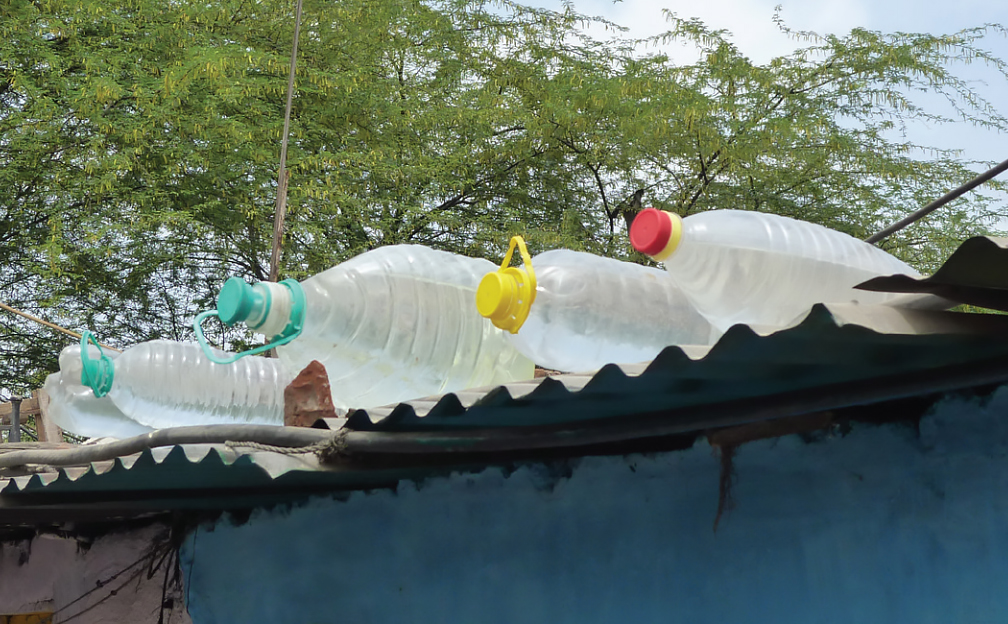
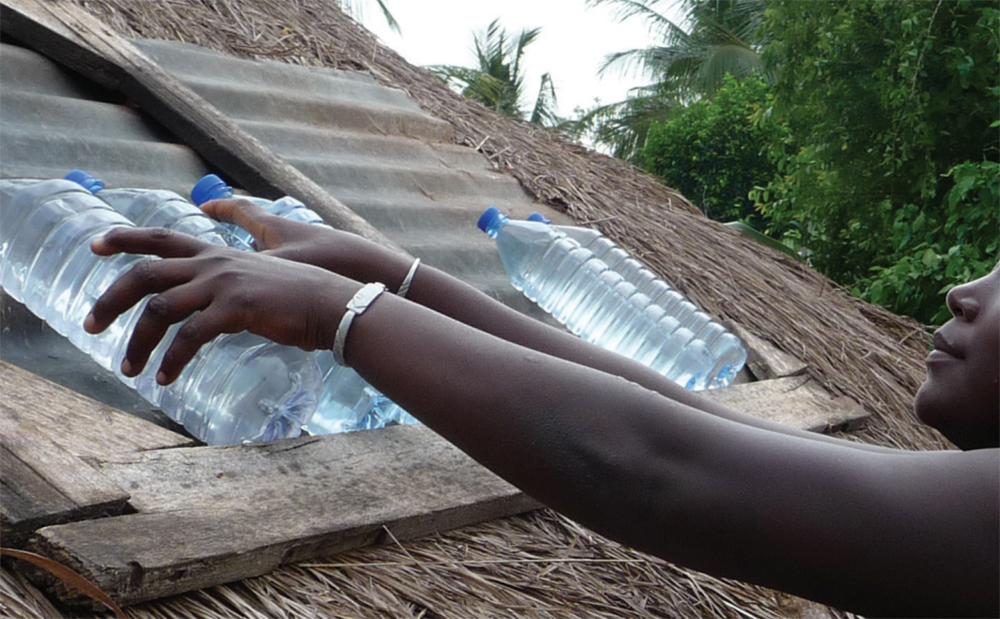
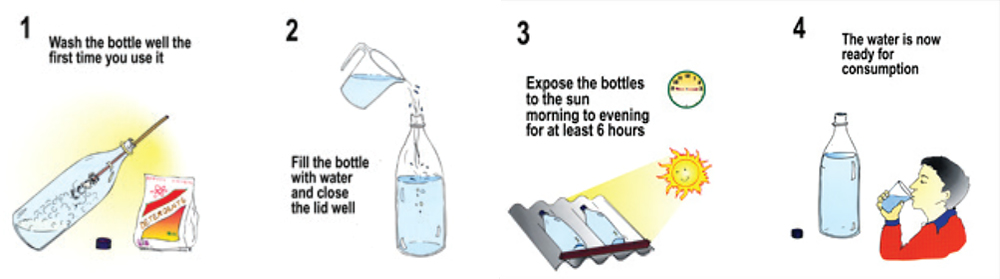
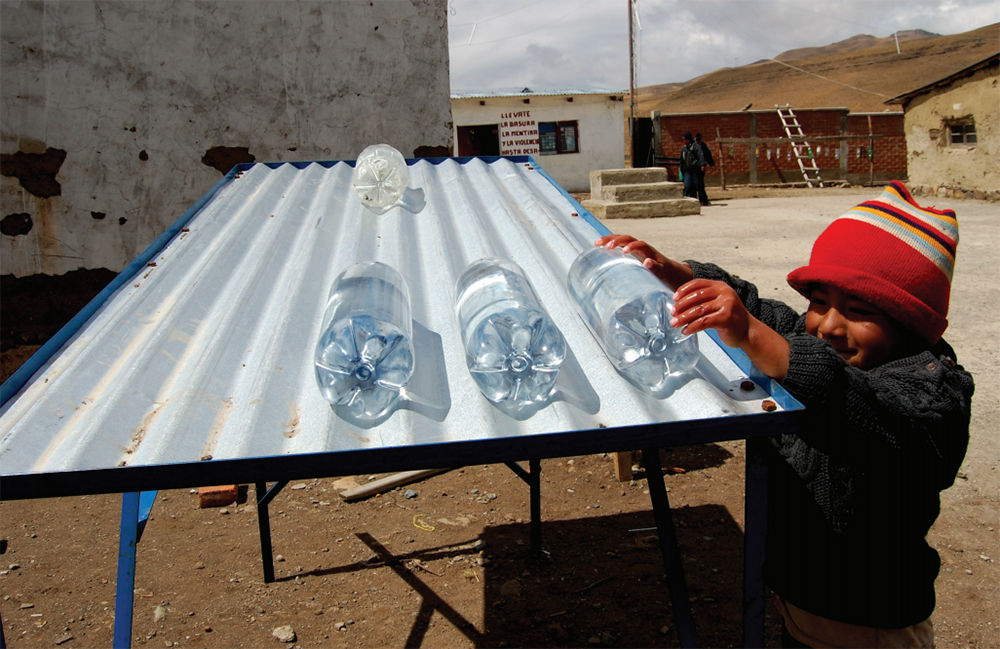
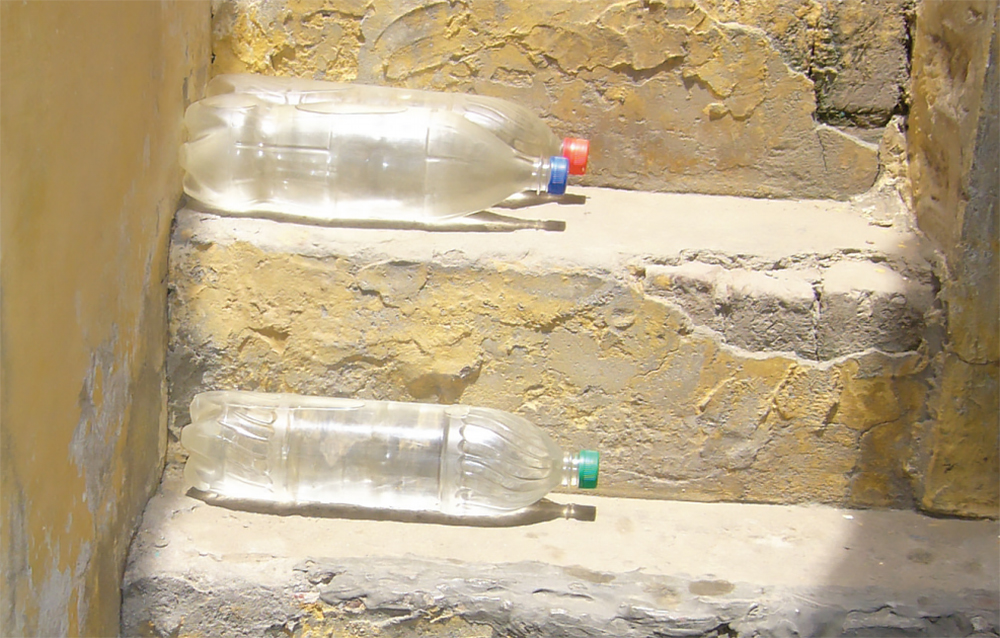
It consists of placing low turbidity (<30NTU) water in clear plastic bottles (normally 2L PET beverage bottles) after aerating it to increase oxygenation and exposing the bottles to the sun, usually by placing them on roofs. Exposure times vary from 6 to 48 hours depending on the intensity of sunlight. Like filters, thermal and solar disinfection do not provide residual protection against recontamination. Accordingly, householders must have a sufficient number of bottles to allow them to cool and maintain treated water in the bottles until it is actually consumed.
For a complete guide to this solar water treatment process, refer to the SODIS training materials page. These materials are available free of charge in more than a dozen languages. For more information on solar water purification, and the Swiss research which has proven its effectiveness, click here to view a PDF of the 2016 SODIS Manual.
This method of placing water in a sealed clear plastic bottle and exposing it to direct sunlight is highly effective at creating clean potable water. Unlike the exposed warm water on the surface of a pond, this creates a closed system with a small volume of water. Under these conditions, sunlight can effectively purify the water in most cases.
Conclusions
Like all water purification methods, solar water purification is not foolproof, since the research indicates that certain pathogenic viruses and protozoa will still survive the treatment. However, it’s far superior to drinking untreated water, and has dramatically reduced the incidence of waterborne illnesses in developing nations. One study showed that children in Bolivia who drank water that had been treated with the SODIS method were 70% less likely to suffer from diarrhea than those who drank untreated water.
If you ever find yourself in a survival situation without access to clean water, remember the simple technique of solar water purification. If you can fill a clean plastic water bottle and expose it to sunlight for a full day, you can create potable water and avoid illness. Just be sure to follow the SODIS method, and don’t assume that all water exposed to sunlight is automatically clean.
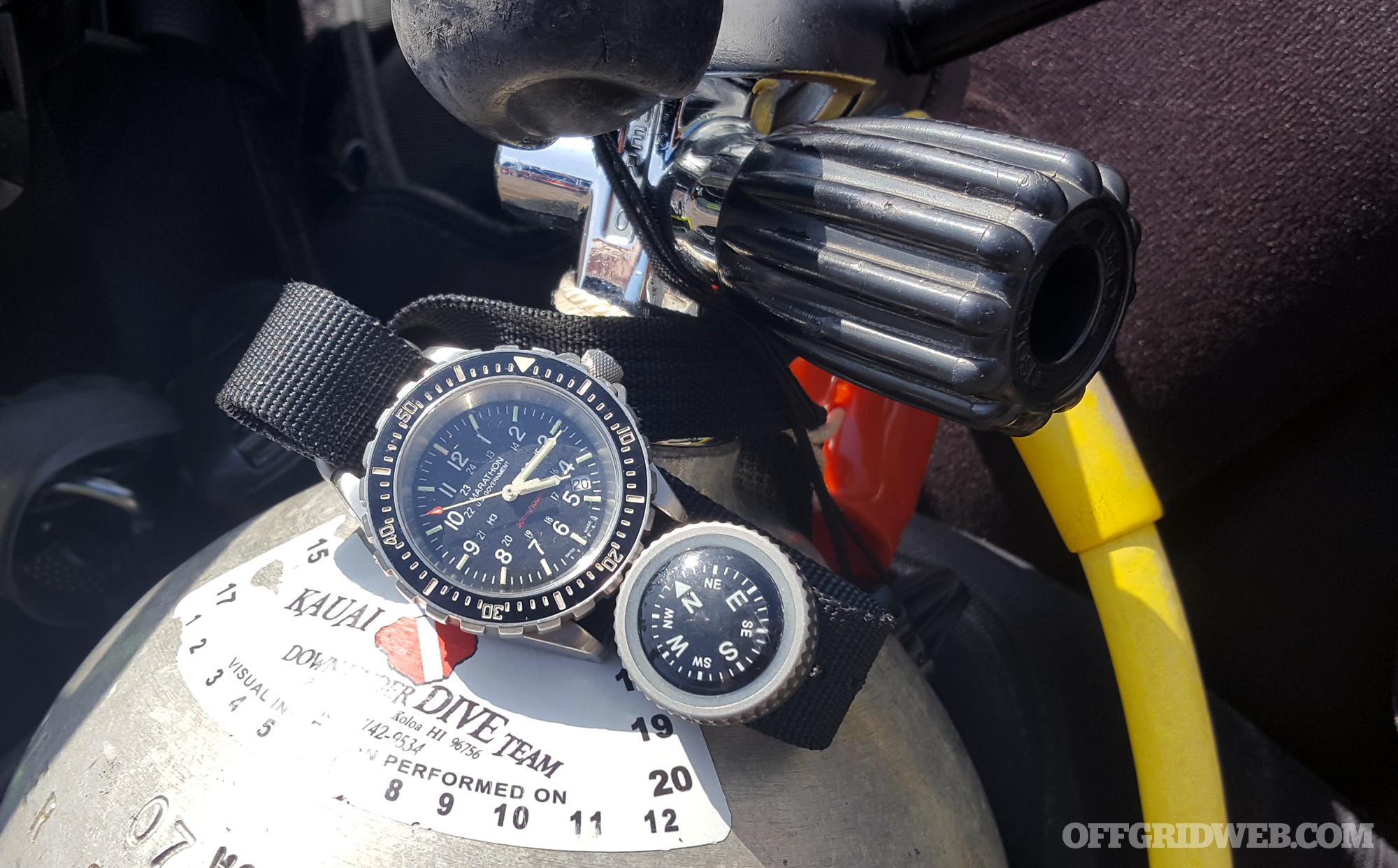
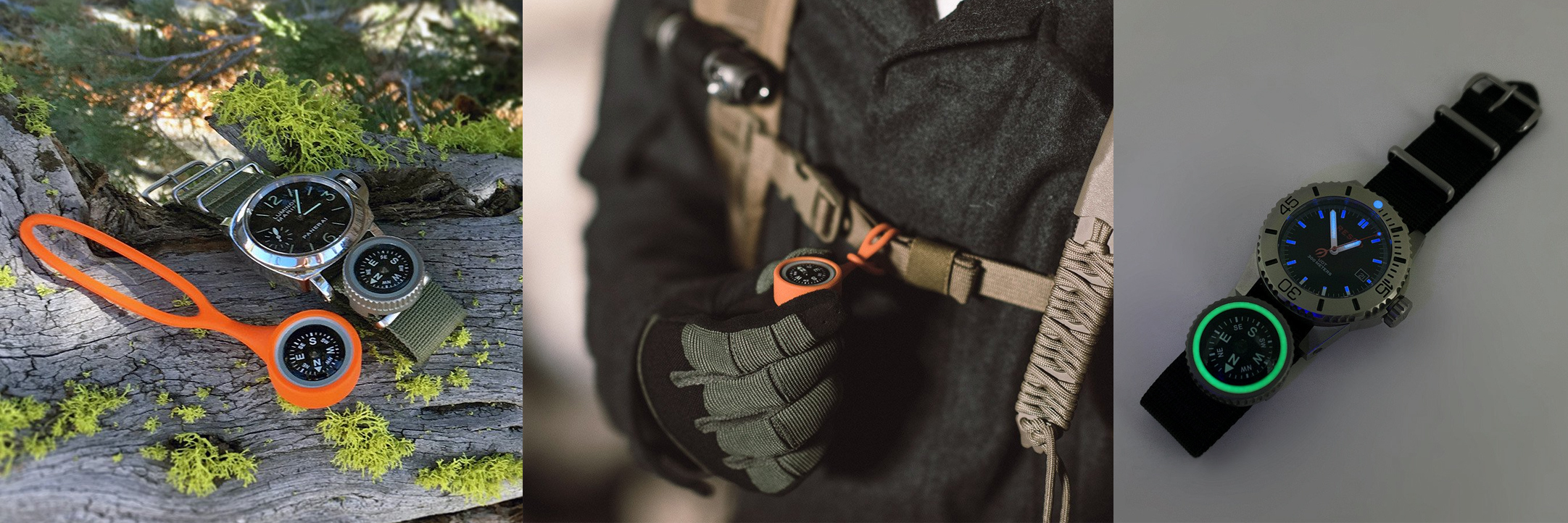
Nobody likes to admit they’re lost. Fortunately, the Ti Expedition Watch Band Compass Kit from Prometheus Design Werx will give you no excuse to lose your bearings. Inspired by the NATO watch band compasses worn by UDT divers and the special forces of the 80’s, this compass is extra insurance to your safety; even if you aren’t working behind enemy lines or in the line of fire. The PDW Ti Expedition Watch Band Compass Kit relies on proven magnetic fields instead of digital technology. Even if all electronic devices go down, this watch band compass will prove reliable.
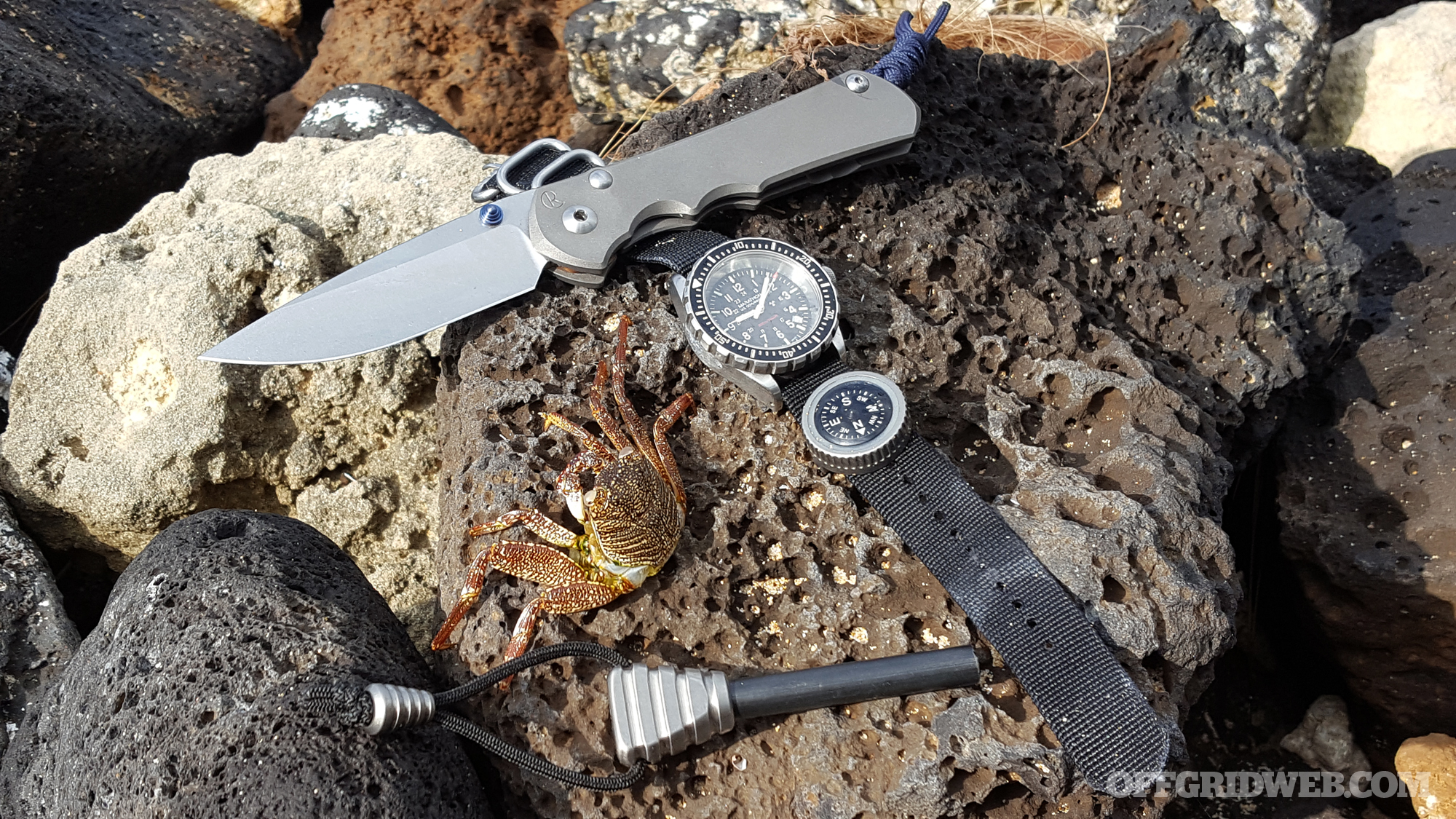
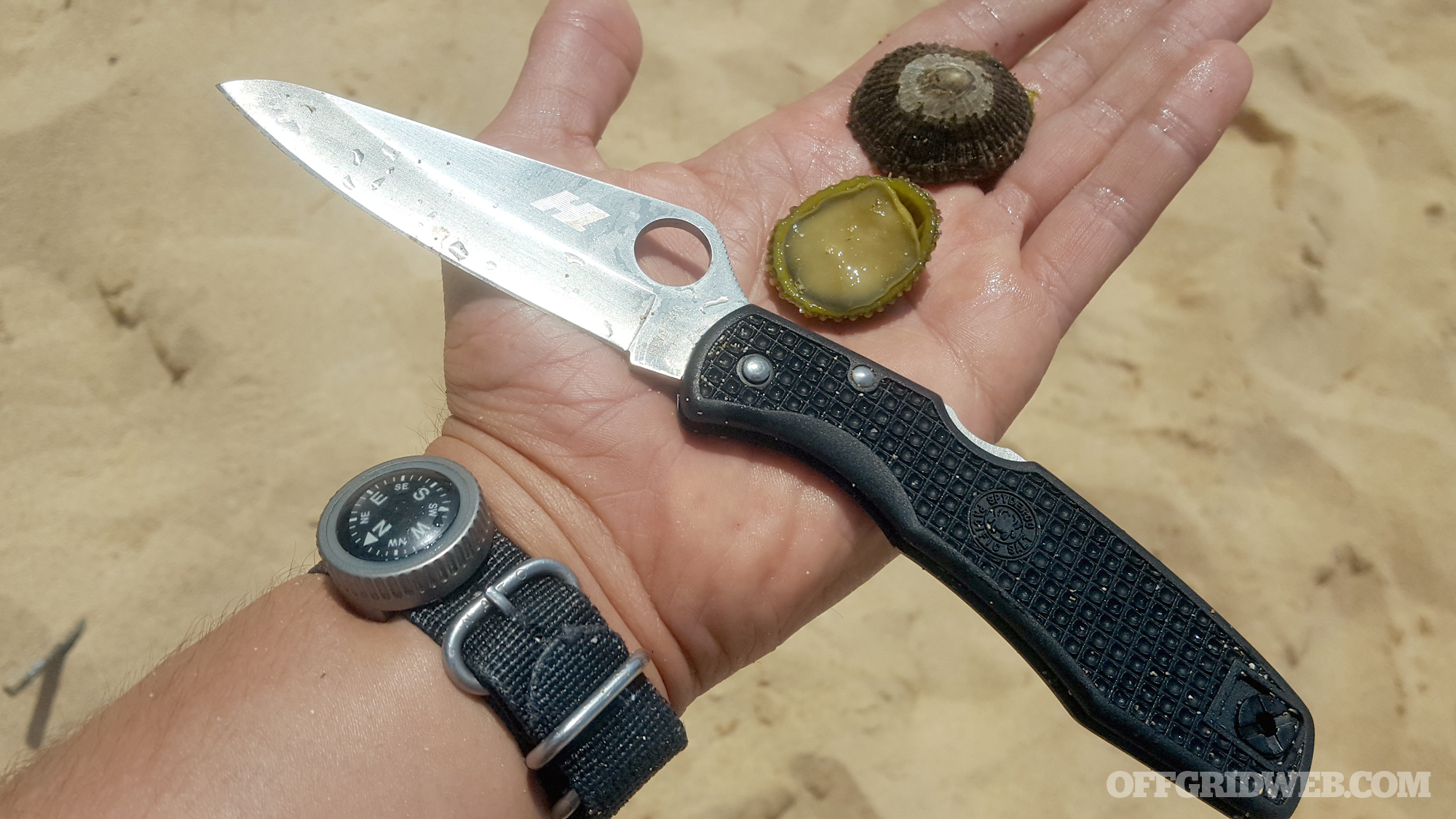
We’ve used our PDW compass in many conditions and it never disappointed. From high up in the cold mountains while skiing and backcountry hiking to spear fishing and diving in the tropics and during numerous trips to the range, the PDW compass went unnoticed until it was needed. It worked as promised while finding our bearings in the great outdoors, and it helped with general wayfinding in urban environments. The accuracy of the compass was tested against a couple dedicated baseplate compasses and magnetic north registered the same.
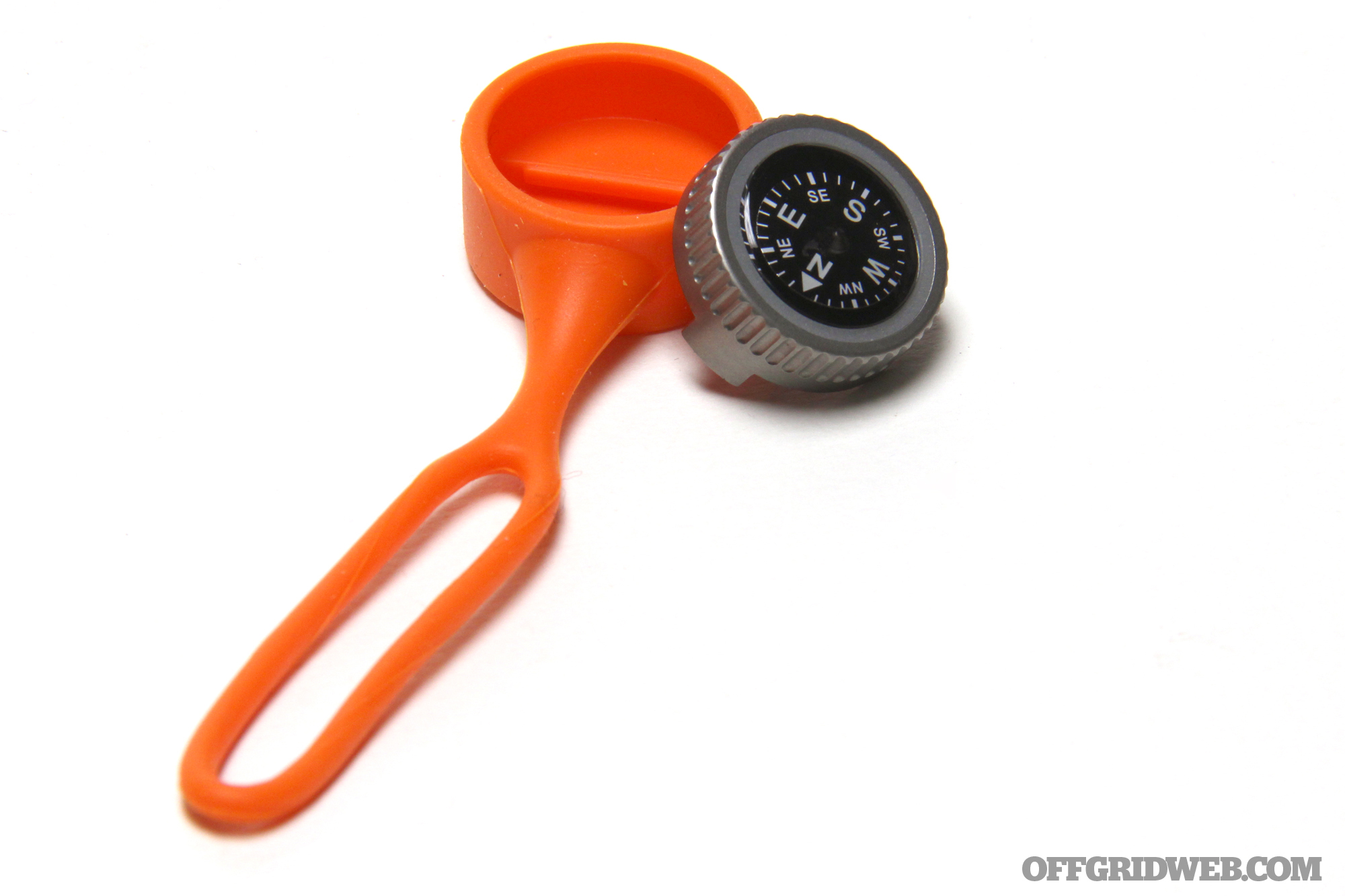
At only .72 ounces, the PDW titanium watch band compass doesn’t add any noticeable weight to the wrist. The oil-filled 20mm x 8mm compass functions flawlessly above and below water. Even in the extreme cold of the Northeast, the compass did not freeze.
The markings are luminous and rechargeable with a flashlight or exposure to sunlight. This attribute helps the user navigate in dark conditions and preserves their night vision.
The compass is water resistant to 100 meters, a rare attribute found in few compasses of this variety. Both aluminum and titanium versions of this compass case are considerably more durable than the plastic housings of lesser-quality watch band compasses.
The silicone carrier with UV inhibitors allows the user to carry it girth-hitched around multiple points on gear, and it adds some color and visual flair to your loadout if desired. The PDW Ti Watch Band Compass also makes an excellent addition to a pocket emergency kit if carrying it exposed is not possible.
Navigation and a sense of direction are important for the adventurer, outdoorsman, soldier, and prepared citizen. When batteries fail in your GPS or when you lose your primary compass, this little tool will help you stay on the right track and prevent you from having to ask for directions like a helpless tourist.
PDW Watch Band Compass Specs
Dimensions: 1.063” x .455” Compatible Watch Bands: NATO style — recommended for bands up to 22mm wide, but 24mm bands may fit with some effort Materials: 6AL-4V Titanium Body (machined in the USA), acetylcellulose oil-filled compass, luminous gasket Weight: .72 ounces Water Resistance: 100 meters Silicone Carrier Colors: Orange, OD Green, Black MSRP: $114.00 URL:PrometheusDesignWerx.com
About the Author
Kevin Estela is the owner/head instructor of Estela Wilderness Education, a bushcraft and survival school in New England. He is a Sayoc Kali Associate Instructor, Brazilian Jiu-Jitsu practitioner, and an avid marksman. As a “survival athlete” he can be found regularly testing his physical and mental limitations in the gym, woods, and urban landscape preparing for the fight.
The information shown here is for illustrative and academic purposes only. Seek help from a licensed health professional before attempting any techniques and treatment discussed or shown in this story. This publication and its contributors are not responsible for any potential injuries or health problems.
It’s been a month after the big one hit. Out of food and water, you figure it’s time to hit the road for supplies. Despite the sad state of affairs, you’ve been feeling good for a long time now. Still, you can’t shake the nagging feeling that something is about to go wrong and — bang! — it happens. You hop into your rig and your lower back goes into lock-down. The pain takes your breath away. You’re now SOL and basically useless to your family and your community.
You’re not alone — about 80 percent of the population will experience a back problem at some point in their lifetimes. If it doesn’t happen to you, it may happen to someone you love or a member of your group.
Therefore, we’re delving into the topic of back pain. Whether you’re an outdoor adventurer who doesn’t want to get hobbled mid-hike or you’re a prepper looking to prevent a debilitating injury while bugging out, you’ll no doubt find some valuable information in these pages.
The bad news? Back pain is the leading cause of disability around the world. Behind only upper-respiratory infections (à la the common cold and the flu), people visit doctors for back pain more than any other reason. The back is a smorgasbord of bones, muscles, tendons, ligaments, discs, blood vessels, lymph, and nerves. You may strain muscles, sprain ligaments, bulge discs, misalign bones, compress nerves, or have a combination of injuries. Did you get all that? Add to this the complexity of “referred pain” (pain coming from a different area) and the back pain plot thickens.
The good news? The cause of most back pain is musculoskeletal in nature (think muscles, bones, tendons, and ligaments) and rarely organic conditions like arthritis, infection, cancers, or fracture. There, go ahead and breathe your sigh of relief because back pain prevention and liberation is within your grasp.
Top Risk Factors
Age: Growing old is not for sissies. As we age, we lose muscle strength, ligament stability, disc height, and experience a loss of bone density — the perfect recipe for back pain. The first back pain episode often starts between 30 and 50 years old, becoming more frequent with aging.
Fitness (or lack thereof): This risk factor is like aging, but on speed. Without a strong and supple body from exercising, we lose strength, flexibility, ligament stability, disc height, and experience a loss of bone density. Poor fitness levels also predisposes people to injuries (traumatic or repetitive) and once injured, it prolongs recovery. [Editor’s note: This is why we have a Health column in every issue.]
Weight Gain: Gravity is a downer, and it’s even worse when we carry a spare tire. The extra pounds weigh down our spinal joints and discs (the cushions between your vertebrae), which leads to more stress and pain.
Occupational Hazards: Sedentary desk work leads to poor posture, tight muscles, and reduced blood flow. On the other end of the spectrum, heavy work from lifting, bending, twisting, pulling, and pushing can be traumatic. In the middle is repetitive work (performing limited motions over and over for an extended period of time), a major cause of disability. Just can’t catch a break, can we?
Bottom line: It hurts, and you need fixing. Let’s get to it.
Pre-Apocalyptic Treatments
Does civilization still exist when back pain strikes? Are you close enough to something resembling a city or town? If so, you’re in luck. Use the following recommendations.
Leave It to the Pros: Get thee to a licensed healthcare practitioner. There are experts who have spent years learning to take care of back pain. Why try to reinvent the wheel? Get experienced hands on your poor body, and relief will arrive more quickly.
As a chiropractor, my advice is to seek out natural and less invasive therapies first. For over 120 years, chiropractors have made the treatment of low back pain their bread-and-butter practice. Other practitioners to check out include acupuncturists, certified massage therapists, and physical therapists. Look online or get a referral from someone you trust. Finally, use drugs and surgery as a last resort, as they can have lasting side effects.
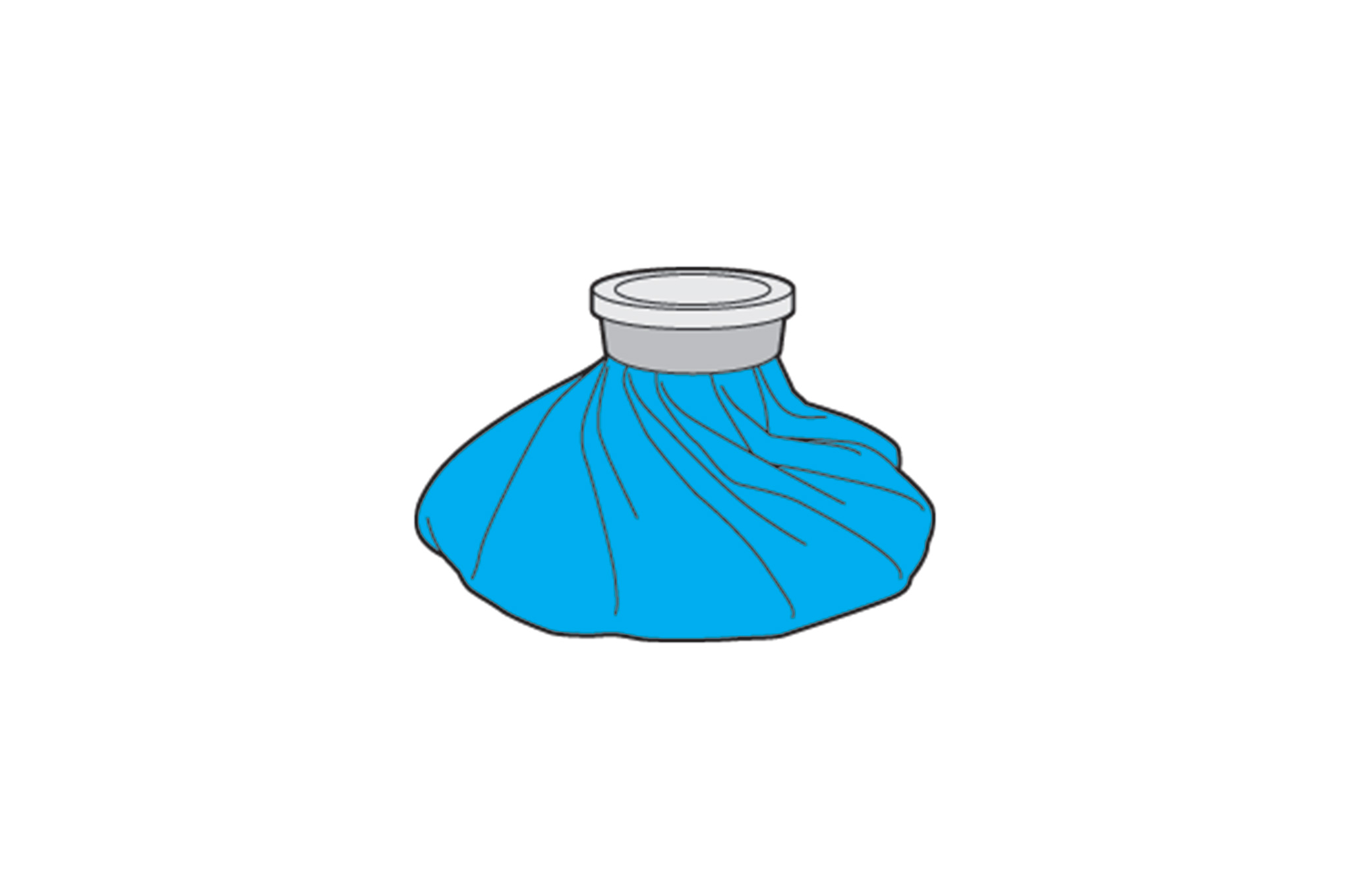
Ice, Ice Baby: Use the cool tool during the first 24 to 48 hours of a back bombardment. Get an ice pack or a pack of frozen vegetables, wrap it in a thin towel, and place on your back. Apply for 20 minutes, remove for 10 minutes, and reapply for 20 minutes. Do this two to three times a day. What can be easier? Icing will help:
Reduce pain: The cold reduces nerve transmission, causes endorphins to be released, and activates the pain gate (cold sensations can block out or override pain sensations).
Reduce muscle spasms: Because of the pain, muscles go into spasm to brace the injured area. Ice reduces the pain, which reduces the muscle spasms.
Reduce inflammation and swelling: Ice produces the Hunting Response; blood vessels start pumping the bad stuff out and the good stuff in.
Omega-3 Fatty Acids: “Did you say fish oil?” Isn’t that for the heart and brain? Omega-3 helps reduce inflammation. Reducing inflammation reduces pain. I was a nonbeliever, but when I injured my knee, I tried it out. Lo and behold, the stuff actually worked.
The Journal of Surgical Neurology reported that omega-3 EFA fish oil supplements are a safe and effective alternative to non-steroidal anti-inflammatory drugs (like ibuprofen, naproxen, and Celebrex). Unlike pharmaceutical drugs, the researchers noted no nasty side effects with omega-3. The participants in this study took 1,200 mg of omega-3 per day. If you’re allergic to fish, substitute with flax oil supplements.
Post-Apocalyptic Treatments
What can you do when crap has already hit the fan, and you’re without the comforts of civilization? You might not always have access to a medical professional, some fish oil or ice. It’s time to turn your attention to more self-reliant care. Naturally, these methods will work in times of normalcy, as well.
Stretch Out: Lower back pain can be so extreme that it may drop you to the floor. Floor-based stretching can help relax muscle spasms. Reducing muscle spasms will take the edge off the pain so you can be more functional. Since you’ll already be on the ground from intense agony, might as well start with these stretches and look for loose change or wild edibles while you’re at it.
Knee-to-chest stretch: Lie face up. Bend one knee, clasp it with both hands, and pull the knee toward your chest. Take long, deep, slow breaths, and pull a little more with each exhalation. Hold for 10 seconds, switch knees. Do five reps on each leg.
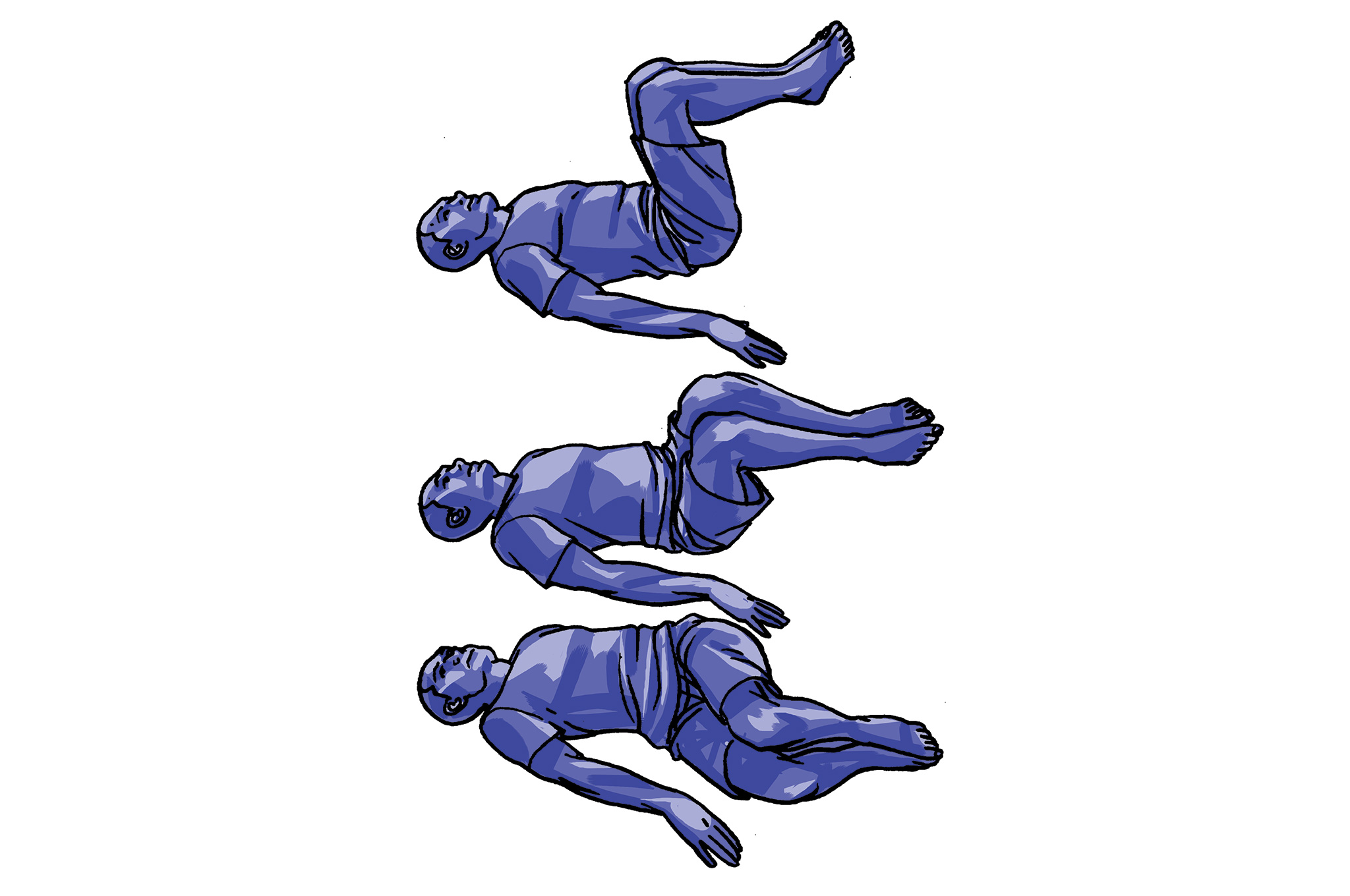
Lumbar rotation: While lying on your back, bend both legs with your feet in the air. With your knees together and shoulders flat to the floor, slowly bring your knees down to one side. Hold for 10 seconds and slowly bring your knees to the other side, keeping both shoulders on the ground. Do five reps on each side, or as many reps as needed to crawl off the floor.
Relief At Your Fingertips: Pressing and rubbing on areas of the body to relieve pain has been around since the beginning of our species. It’s instinctive to rub and massage areas of pain. Generation after generation of observance and experimentation culminated into the science of acupressure (the usage of acupuncture theory, without the needles — good news for those who faint at the sight of needles).
Behind the knee: In a sitting position, find the point (called Urinary Bladder 40) behind the knee where the skin folds at the joint. Then simply stick your thumb into the fold and press until there is discomfort. Release and repeat two more times. You can press both sides at the same time.
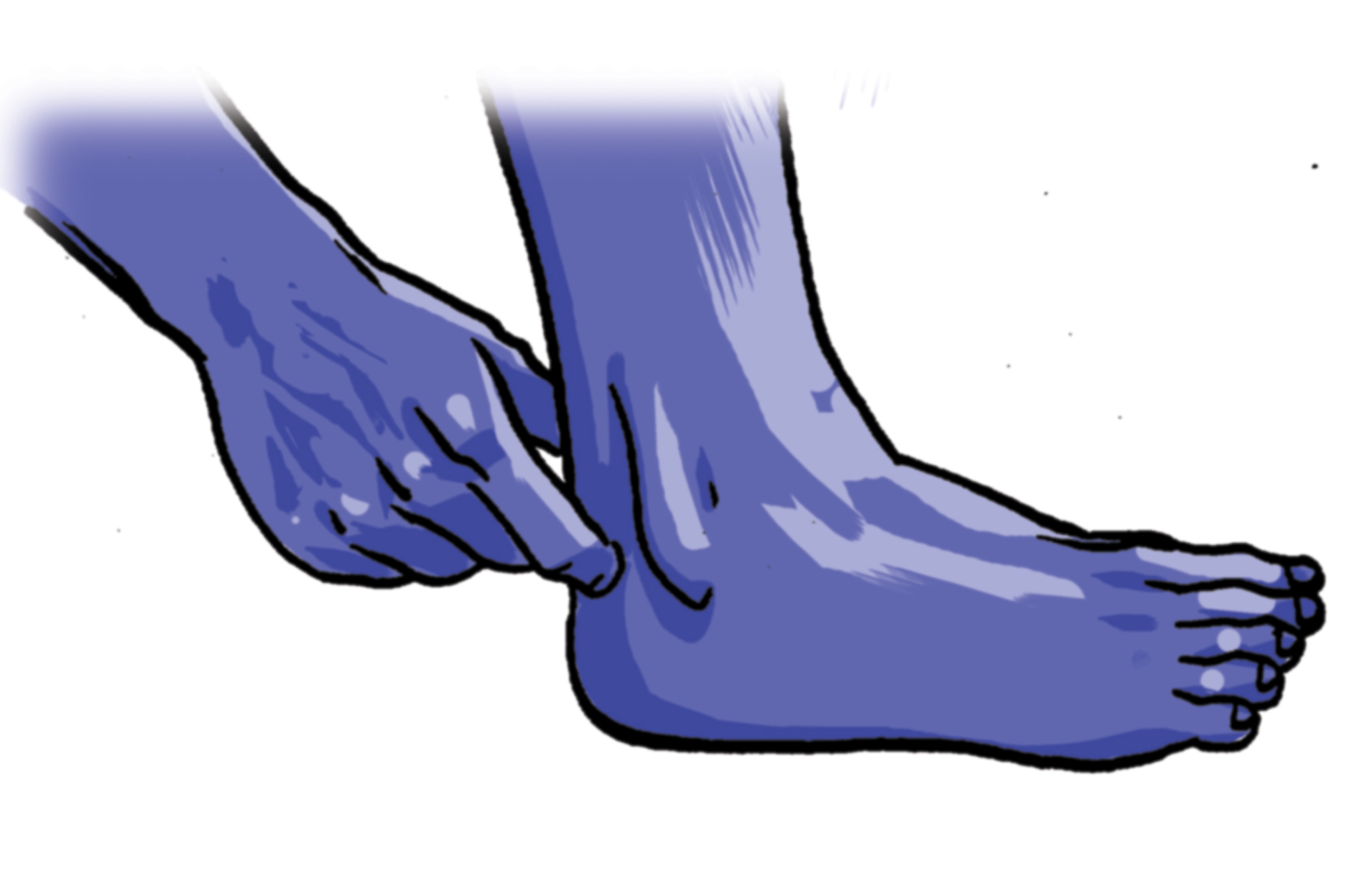
On the ankle: In a sitting position, find the point (called Urinary Bladder 60) just anterior to the Achilles tendon and behind the lateral malleolus (the bony protuberance at your ankle). Grip this point with your pointer finger and thumb. Squeeze until there is discomfort. Release and repeat two more times. You can squeeze both ankles at the same time.
Science of acupressure? Indeed, my friend. Research on acupressure and acupuncture continue to surface from both the United States and Asia on how it helps everything from headaches to heartburn. For lower back pain, the British Medical Journal discovered that, “acupressure conferred an 89-percent reduction in significant disability compared with physical therapy.” Not bad for natural and free. The only thing it’ll cost you is knowledge. Here are two points that can ease lower back pain.
Back Myth Busters
There are a lot of old wives’ tales floating out there. Here are the top three:
Myth #1: Surgery is Always Effective
The Truth: Back pain surgery may not always be effective and certainly shouldn’t be the first choice for noncomplicated, mechanical back pain. For a few patients, it’s a godsend, but for others, a nightmare. According to a 2011 study in the Journal of Spine, back surgery (in this case, fusion) showed an abysmal 74-percent failure rate. (The researchers said if surgery was avoided, there was a 25-percent increase in the patient’s chances of returning to work.) Add to this the complications of infection, anesthesia, and post-op drug dependency, and you can see why surgery may be the answer only in the most dire of circumstances.
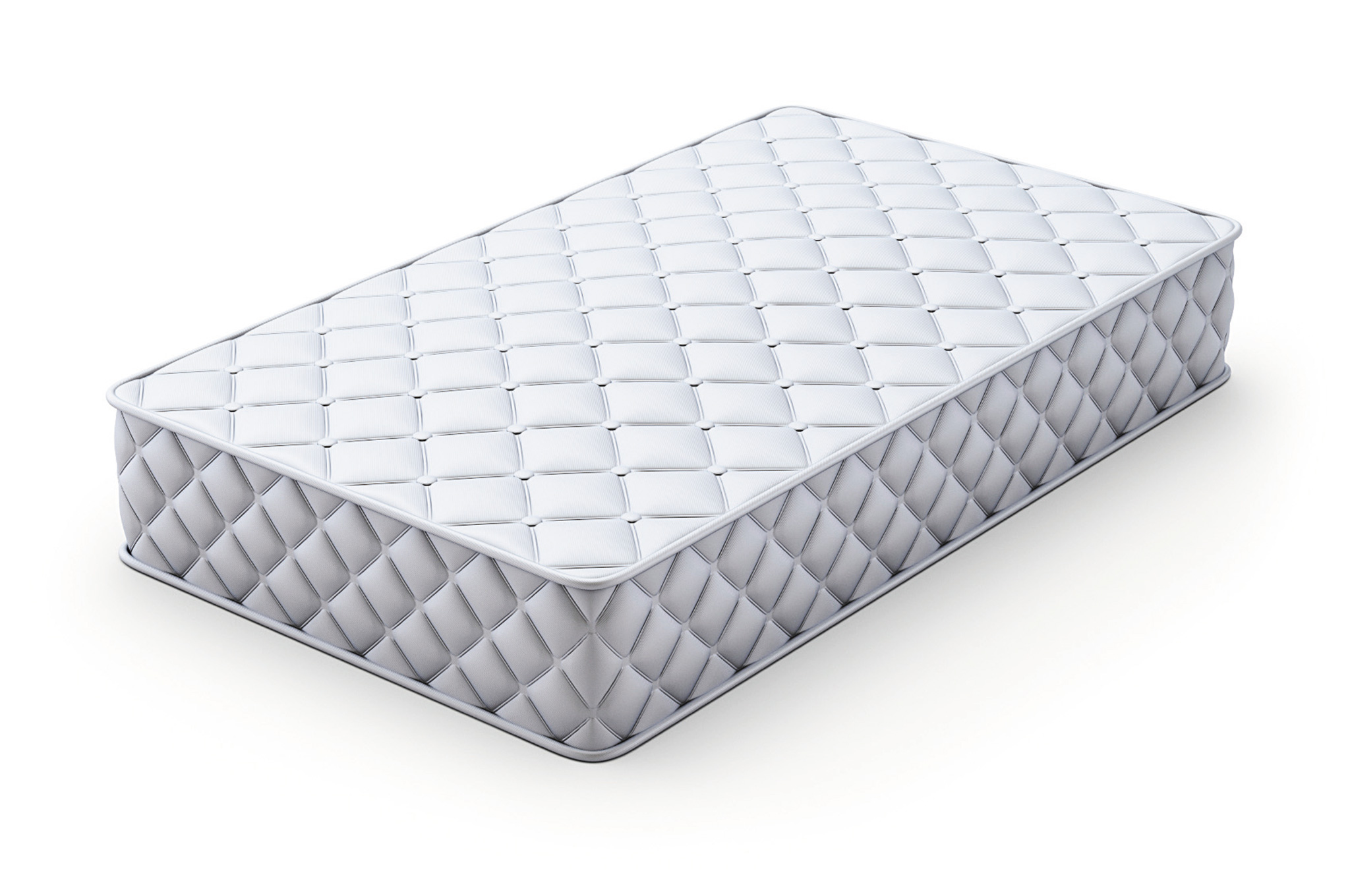
Myth #2: Get a Hard Mattress
The Truth: Unfortunately, if the mattress is too firm, there will be increased pressure where our bones stick out, mainly shoulders and hips. Too soft, and there’s no support. Studies have concluded that a medium-firm mattress is best, providing enough support without the pressure.
Myth #3: Bed Rest is Best
The Truth: Staying in bed for one or two days may be advised in extreme cases, but prolonged rest will only make things worse. Lower back pain leads to a vicious cycle of muscle spasms and joint fixations in the spine and hips. The best thing to do is get up and walk around to your tolerance. Although counterintuitive, gentle movement will reduce muscle spasms, joint fixations, and break the lower back pain cycle.
An Ounce of Prevention …
Preventing back pain is not difficult. A strong, stable, and pain-free back can be had for just a few minutes a day of activity and a dash of awareness. Here are quick and simple steps you can take right now to avoid future spinal beat-downs.
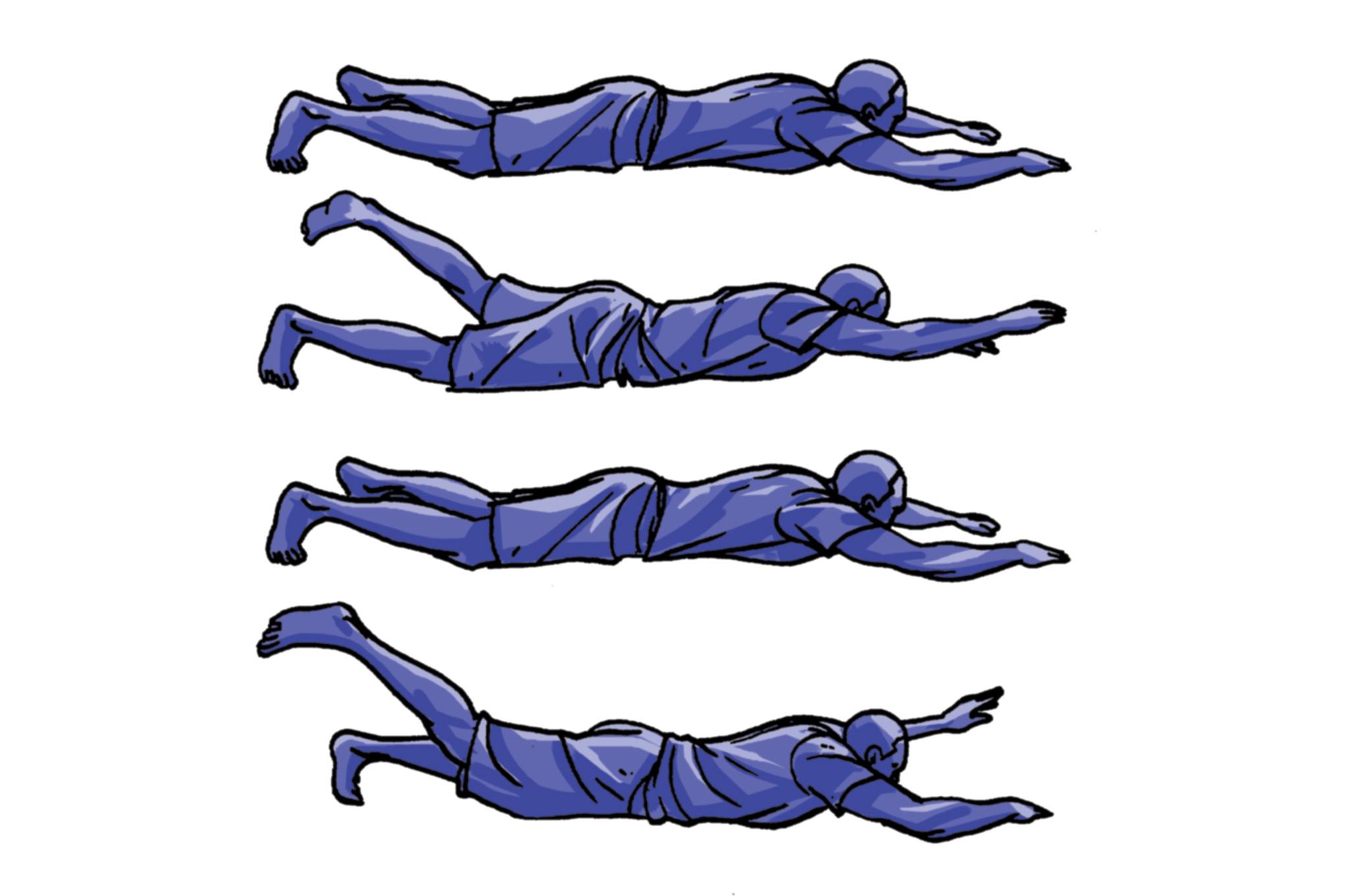
Back Extensions: Working the abs is a common and very important method to strengthening the core. With the goal of the all-elusive six-pack, the back is often neglected. And who can blame you? All the good stuff is found in the front anyway. Unfortunately, this leaves weak back muscles that spasm and give out.
Opposing Arm and Leg Lifts: Lie face down on your stomach with your arms extended overhead like Superman. Lift only your right arm and left leg off the ground simultaneously. Do 10 reps, switch sides, and do 10 more reps.
Sky Divers: Lie face down and extend both arms overhead. Lift both arms and legs off the ground. Do 10 reps and call it a day.
The Three S’s: Having the knowledge and being aware goes a long way in preventing back pain. The following is what you need to know to cover your own back.
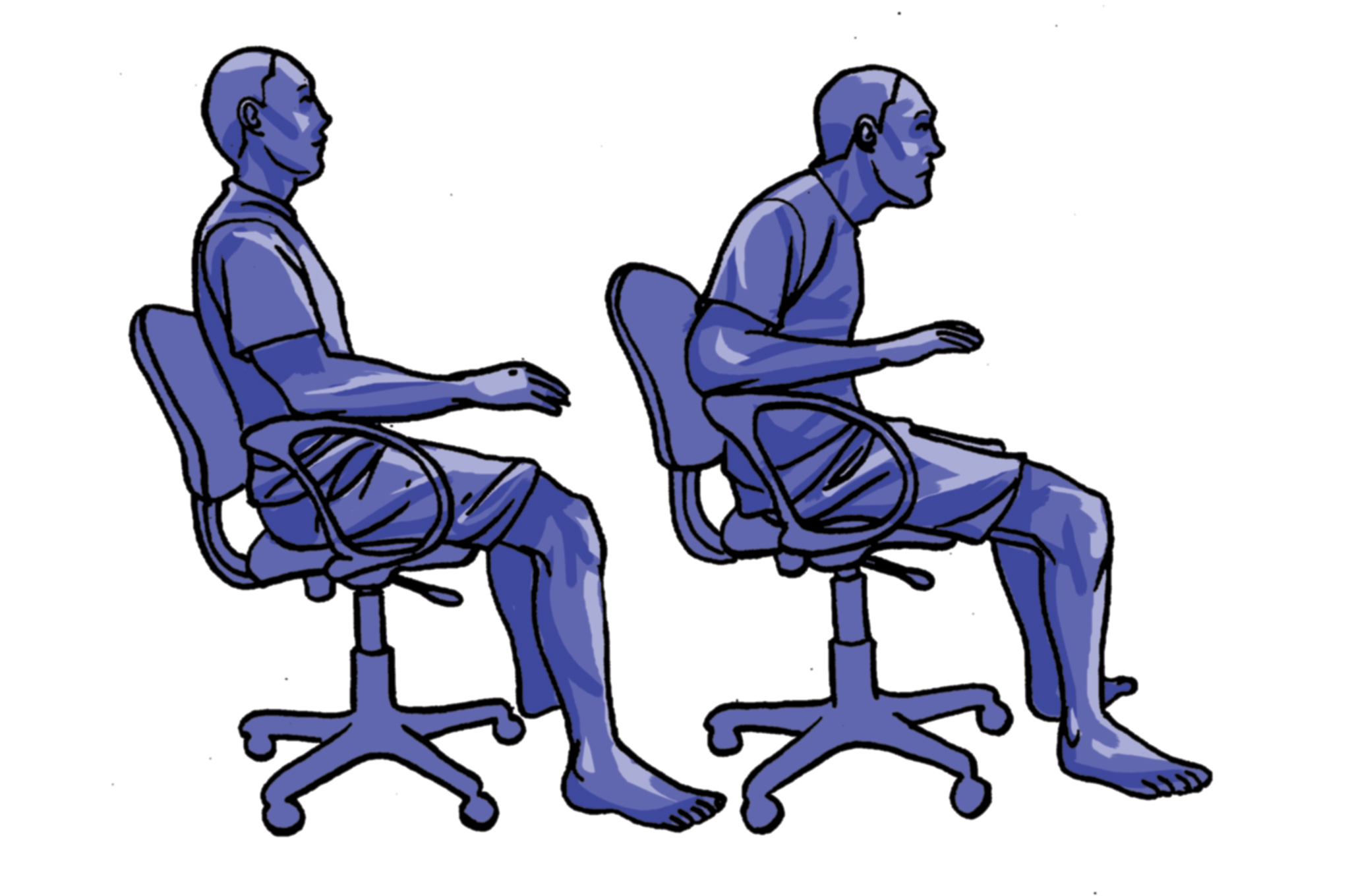
Sitting
Sit up straight (mom was right all along).
Use a back cushion to maintain your lumbar curve.
Keep your hip above your knees to maintain good posture and allow blood flow to the feet.
Sleeping
Lying on the side is best. Use a pillow between your legs if you need to.
Lying on your back is second best. A pillow behind your knees will relieve lower back pressure.
Lying on your stomach is the worst. Wear a T-shirt with a front pocket, place a golf ball in the pocket, and safety pin the pocket. The golf ball will cause discomfort every time you try to lie on your stomach, breaking the habit of stomach sleeping.
Standing
Proper posture will shift weight off your overworked muscles and places the stress on the skeletal structure, where it belongs. From the side view, your head should be over your shoulders, shoulders over hips, and hips over knees.
Avoid forward head posture and shoulder hunching. Think Denzel Washington and not Quasimodo.
Proper Lifting: Use the following steps to prevent back sprain and protect your spinal discs.
Get your core as close to the object as possible.
Keep your back straight, bend at the knees into a squat position.
Lift the object and bring it as close to your core as possible. Use your legs to push off the floor and rise to the standing position.
Move your feet and bring the object where you need to. Keep your torso neutral and avoid twisting.
Don’t let your back become a pain in the butt. No matter if you’re hauling your kids from a burning building or just desk jockeying at work, back pain can strike at any time. But having the knowledge to take care of your spine can save you loads of medical bills … and possibly even help you save your mates.
Red Flags
The following are warning signs of serious conditions that require a trip to a licensed healthcare practitioner or emergency room ASAP:
Severe trauma
Unrelenting pain for more than four to six weeks
No alleviation of pain, even during rest
Pain worsens at night and wakes you up
Abdominal pain associated with the back pain
Numbness or tingling inside the thigh (saddle-like paresthesia)
Weakness in the legs and feet. Not able to stand on heels or ball of foot.
Loss of bowel and/or bladder control
Unexplained weight loss (5 pounds or more a week)
Radiating pain past the knee
About the Author
An outdoors enthusiast, Dr. Conrad Bui is a chiropractor with more than 20 years of experience. His offices in Denver have helped thousands of patients recover their health naturally. A former lower-back pain victim since high school, Dr. Bui is proud to say he has conquered this condition. Since graduating from chiropractic school, he has gone on to earn his doctor of naturopathy degree from Trinity College along with certifications in acupuncture and auto-collision injuries. He enjoys the outdoors, teaching martial arts, and practicing chi kung in his spare time.
We’re always hearing requests for budget-oriented gear guides — this has led us to implement our “Best Value” awards in the magazine, and feature more affordable items in our buyer’s guides. However, there’s obviously a fine line between getting a good deal on a much-needed item, and wasting money on something that’ll break the first time you use it. Much like expensive doesn’t always mean excellent, cheap doesn’t always mean good value.
Beggars can’t be choosers, but this $5 survival kit is a whole lot better than nothing.
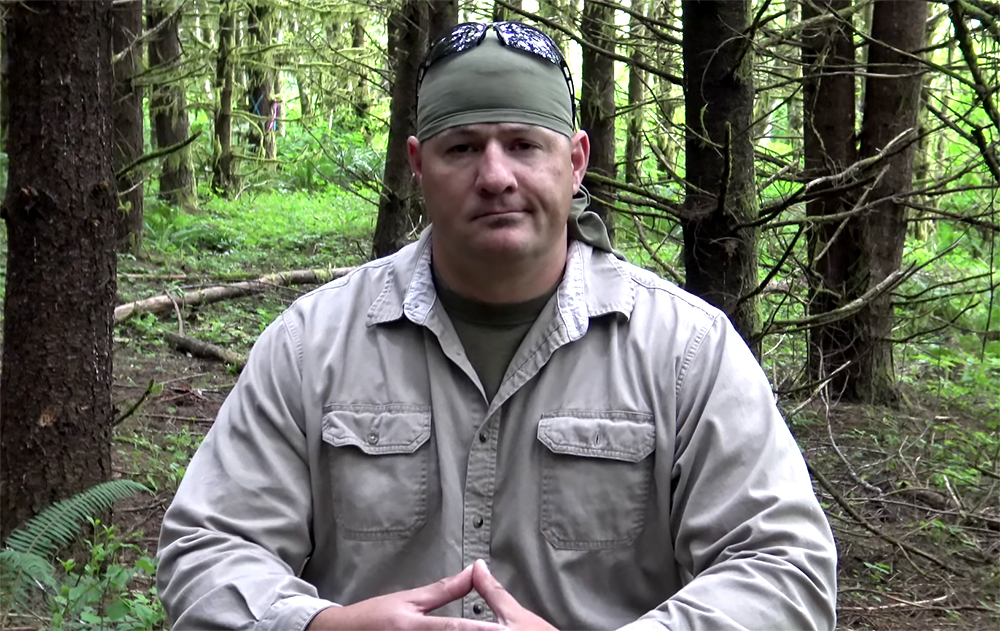
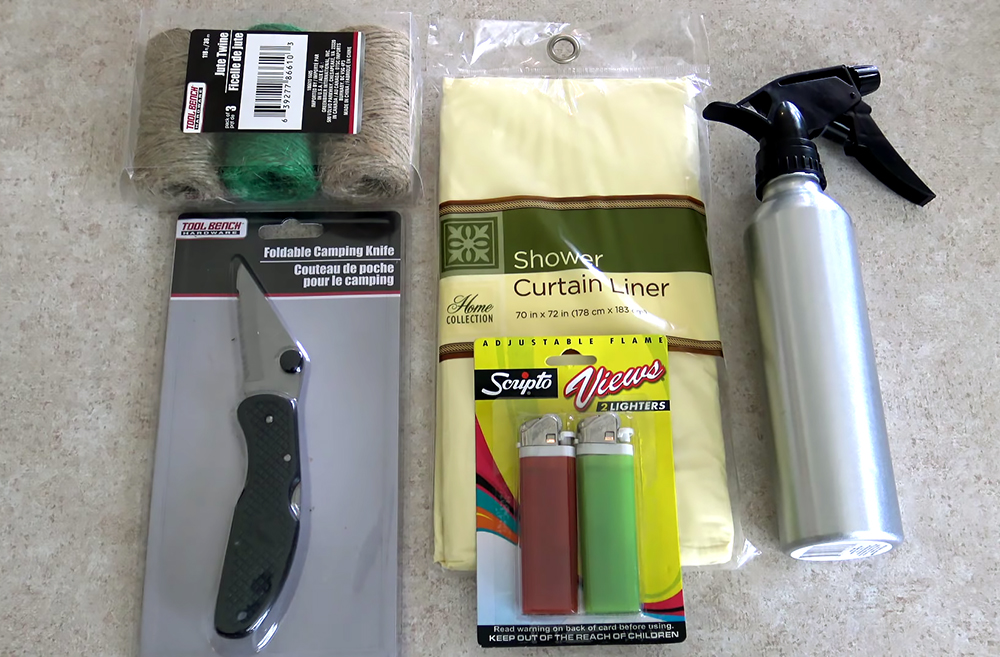
But, if you want to throw caution to the wind and save money at all costs, just how little can you spend on a basic survival kit? YouTube channel Corporal’s Corner set out to answer this question. With $5 in hand, Corporal Kelly strolled into his local dollar store, and selected a 5-item survival kit. This kit is based on one school of thought for essential survival gear, known as “the 5 C’s”:
Cutting – A knife, machete, ax, or other blade
Combustion – A fire-starter, such as a ferrocerium rod or lighter
Cover – A waterproof tarp or rain fly that serves as the basis for your shelter
Cordage – 550 paracord in a perfect world, but twine or string will do in a pinch
Container – A vessel for water, ideally one which is heat-resistant and can be used to cook and boil
Cpl. Kelly demonstrates his 5-item/$5 survival kit in the video below:
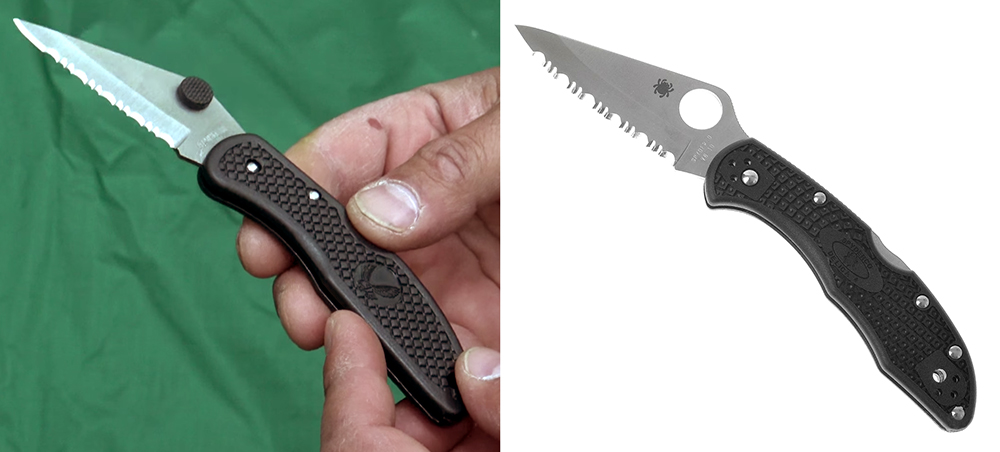
First of all, that knife — yikes. It’s obviously trying very hard to be a Spyderco Delica, with a chunk of plastic shoved into the round thumb hole to skirt trademark infringement. And the side-to-side flex is horrifying. But it’ll cut the jute twine, so that’s something.
The dollar store knife bears a sliiiiight resemblance to a Spyderco. You may have to squint to see it.
Speaking of cordage, the jute is a solid choice. It can be braided into rope, as Cpl. Kelly shows, or can be shredded and used as tinder. It also provides a way to suspend the shelter, which is a humble PVC shower curtain. That may sound ghetto, but it’s designed to repel water, so while it’s not the most durable item, it’ll keep you dry.
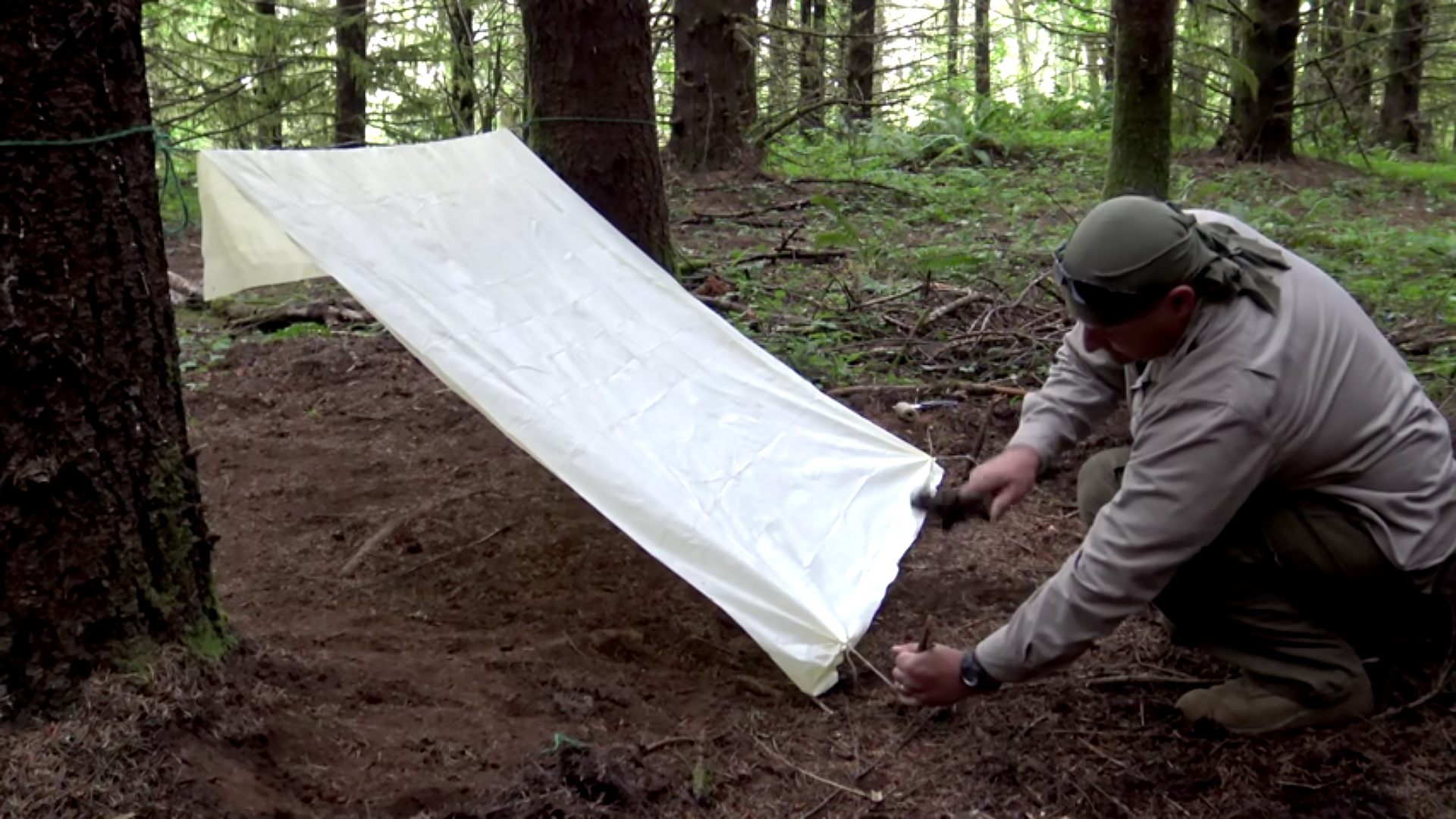
With a ridgeline and two guylines tied to weights along the base, the tarp can be secured into a small lean-to shelter. As for the water container, Kelly has some good points about that as well. The metal spray bottle container can be useful for boiling water, but it’s too small to carry a substantial amount of water. Alternatively, a larger plastic vessel and a few drops from a $1 bottle of unscented bleach can provide an alternate method of water purification, but you won’t be able to use it for cooking or boiling. That’s a trade-off you’ll have to consider.
So, while $5 isn’t the optimal budget for a survival kit, Cpl. Kelly shows that it can provide the 5 basics you need to get by. What items, if any, would you change in this kit? Add a comment below.