What is phishing? No, it’s not a misspelling of your favorite aquatic hobby, nor is it a nickname for what people do at Phish concerts. Phishing is a technique Internet-based criminals use to trick you into giving up your personal information. It’s also referred to as social engineering — but these are just nice-sounding names for the predatory behaviors of digital con artists and fraudsters.
Phishing attacks take place through various forms of electronic communication: email, phone calls, text messages, and social media sites. One highly publicized example of this is the famous “Nigerian prince” scam. You know, the one where an unexpected email claims you can inherit millions of dollars from royalty overseas, but you supposedly need to make the transfer possible by replying with your bank account info, social security number, and/or a small cash deposit.
An example of a spoofed “Facebook” login page, used by phishers to steal passwords.
Then again, many phishing attacks are more stealthy. You may get phone calls that seem to come from government agencies (like the IRS), or receive official-looking messages from what appears to be your bank. There are even entire fake web sites set up to mimic popular real sites, just so they can steal users’ passwords. If you browse the Internet, use email, or own a cell phone, you should be aware and cautious of these malicious phishing attacks.
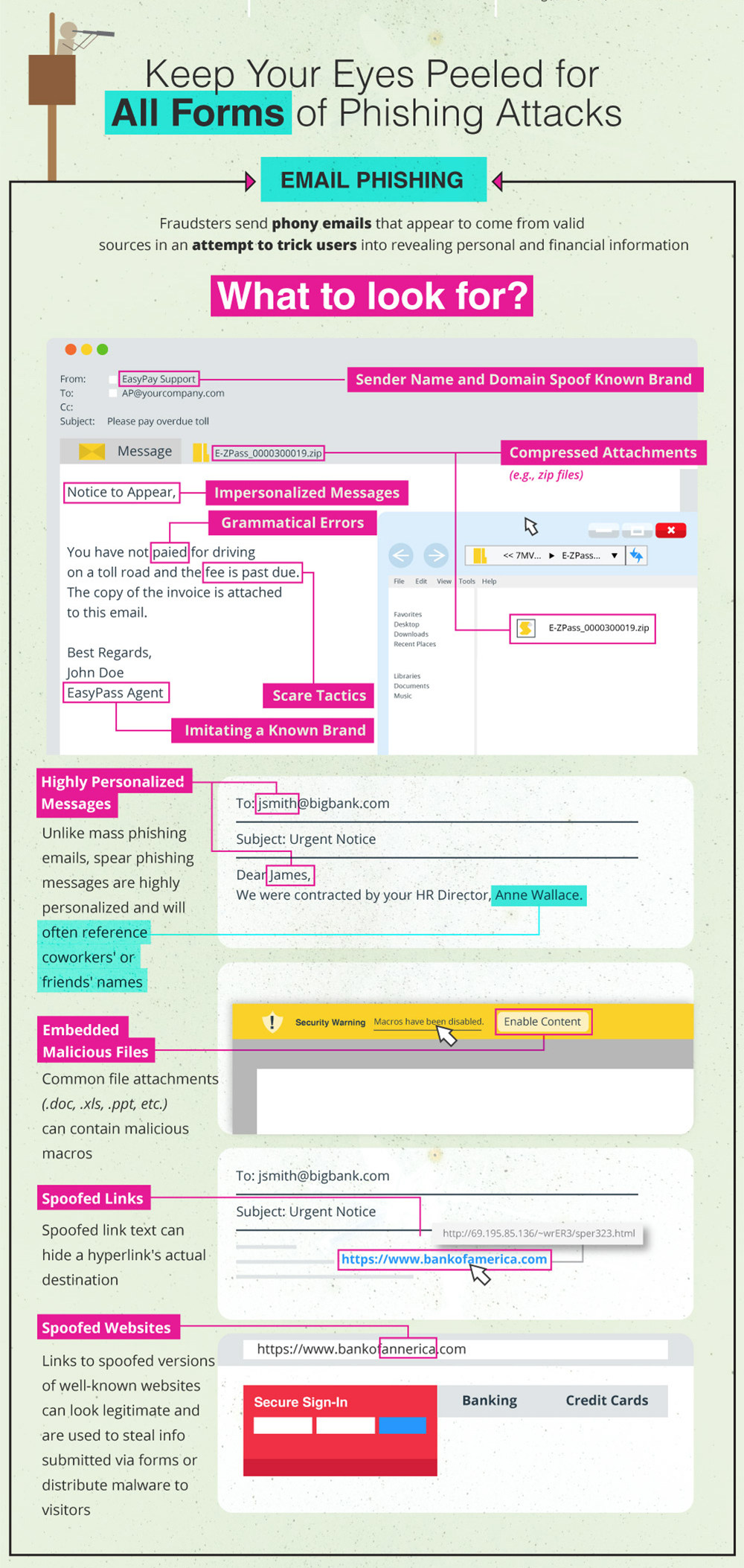
The following infographic from DigitalGuardian provides an in-depth look at the various forms of phishing attacks. It also gives an excellent mental checklist of warning signs to look out for. If enough of these red flags appear, you should stop what you’re doing and immediately contact the appropriate authorities. Sites like Google and Facebook also have reporting systems in place, if you think you’ve witnessed phishing. However, due to the international nature of many phishing attacks, it’s difficult to catch and prosecute the perpetrators, so it’s crucial to be ever-vigilant about your digital security.
We spend a lot of time discussing bug-out bags, and for good reason. The bug-out bag is an essential lifeline during any emergency or disaster situation, and it contains all the supplies you need for immediate survival. Shelter construction, water purification, hunting for food, applying first aid, navigating to safety — all of these tasks are facilitated by the contents of a bug-out bag.
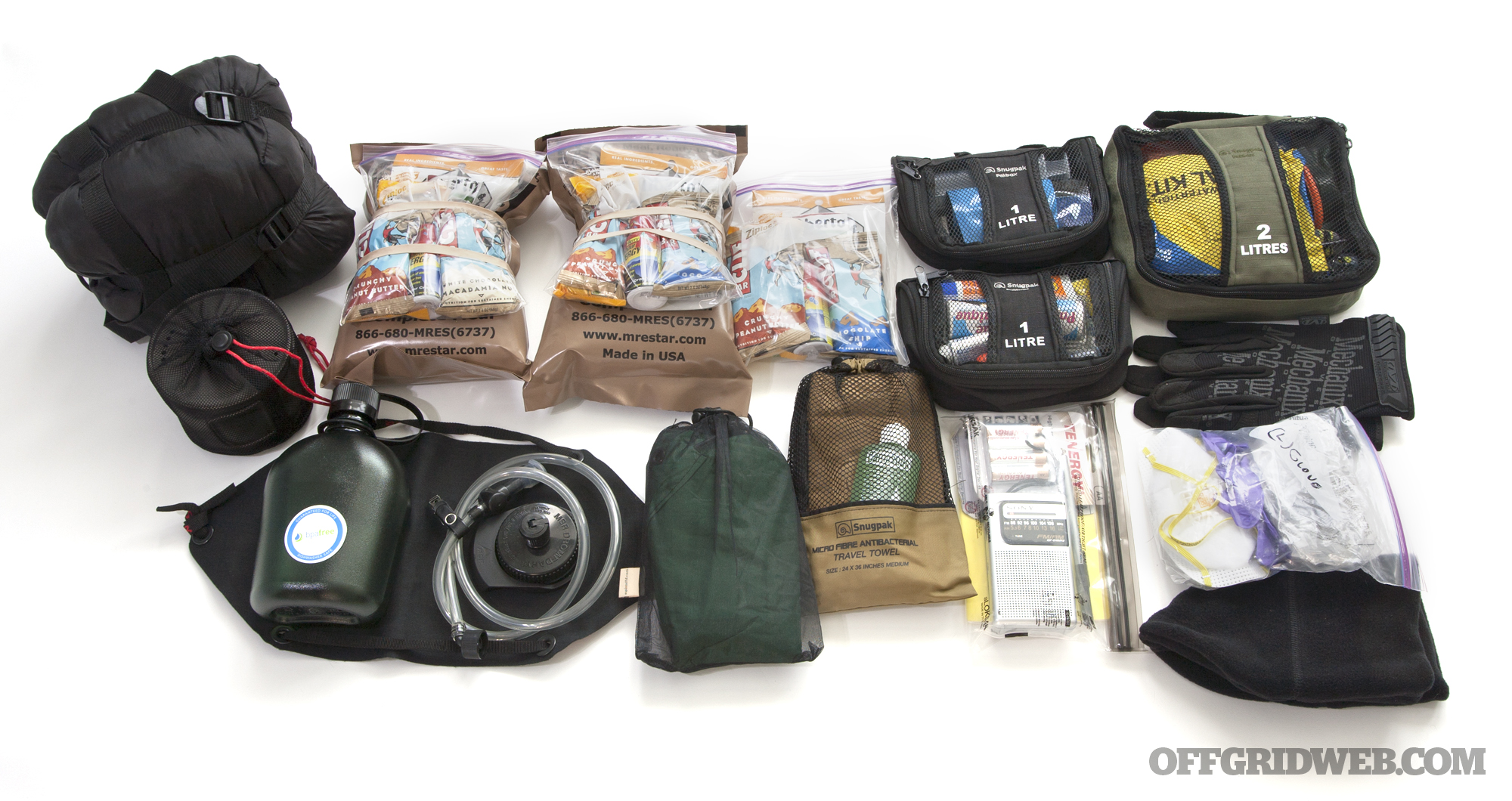
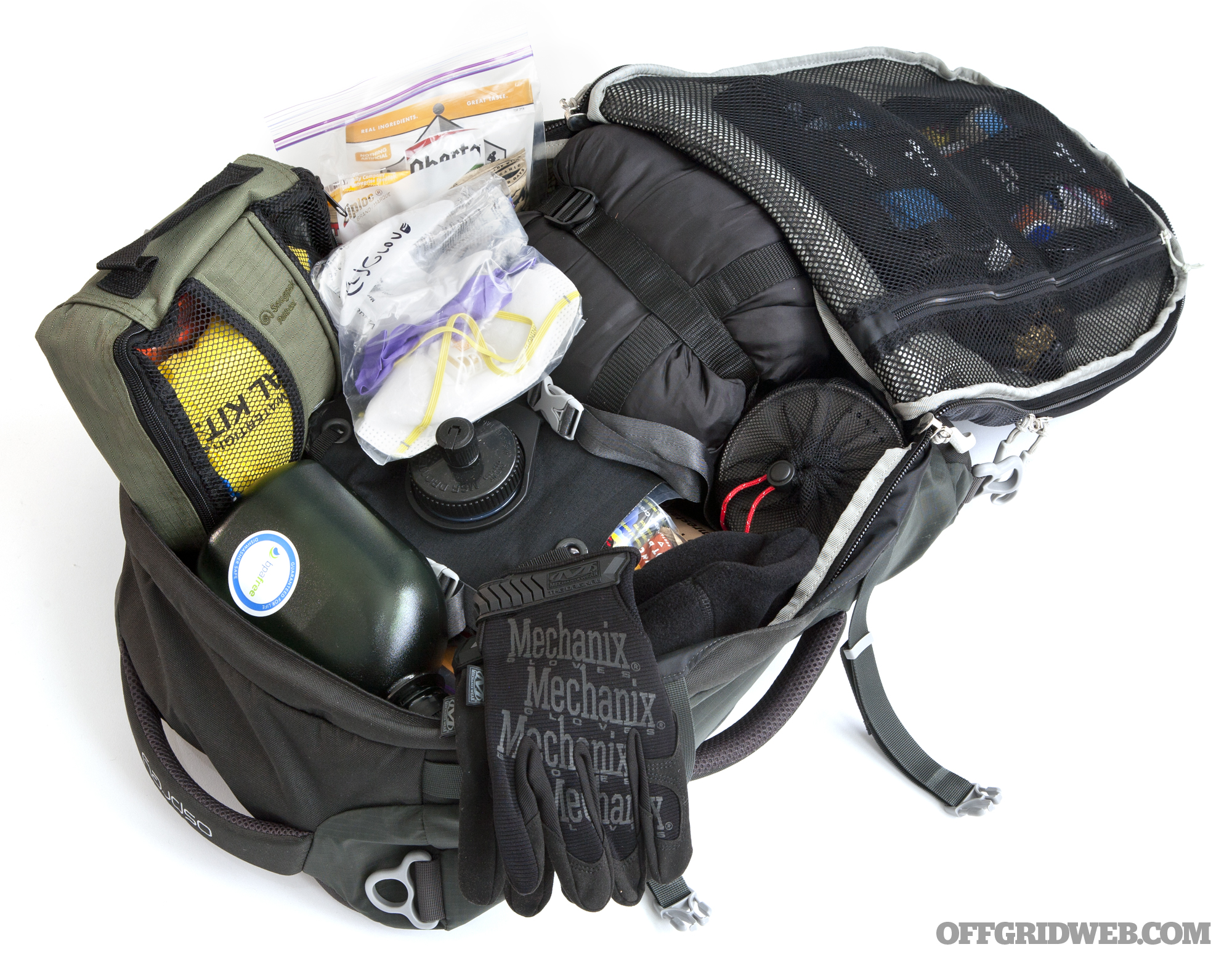
It’s easy to get caught up in thinking about which items to include inside a bug-out bag, since there are so many choices and variables to consider (weight, size, shape, quantity, value, etc.). However, an equally-relevant question is less obvious — how should these items be packed and organized? If the contents of your B.O.B. are imbalanced, they can throw off your posture and cause muscle fatigue. Disorganization is even worse, as you’ll be left aimlessly rummaging through your supplies when seconds count.
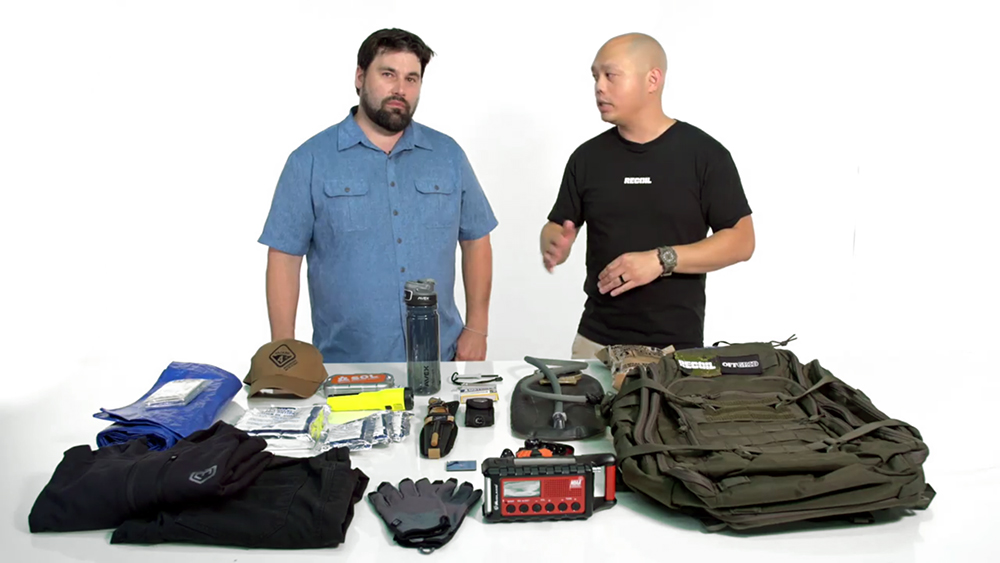
Due to the importance of this topic, RECOIL OFFGRID editor Patrick Vuong met with survival expert Tim MacWelch of Advanced Survival Training. In the latest RECOILtv SHTF/OFFGRID video below, the two discuss how to pack a bug-out bag. Check it out now:
In case you’re wondering about any of the gear featured in this video, here’s a complete list:
Fashion is probably not high on the list of priorities for most survivalists. We tend to care a lot more about the functionality, weight, and durability of our gear, rather than its outward appearance. That’s not to say we’re slobs, either — careful apparel choices can help you be “the gray man” and blend seamlessly into your surroundings. However, we must recognize that function takes precedence over form in a life-and-death scenario.
Therefore, you probably won’t see anyone bugging out during a disaster while wearing an Armani suit, Louis Vuitton shoes, and Gucci shades (unless disaster strikes Monaco or Wall Street). Tactical pants, a moisture-wicking shirt, and boots are preferable, especially if you’ll be slogging through the mud. Similarly, fancy gold and jewel-clad watches may be a good tool for displaying wealth, but they’re less than ideal for displaying the time in a survival setting. You’d be much better off with a simple and easy-to-read timepiece.
An Introduction to Field Watches
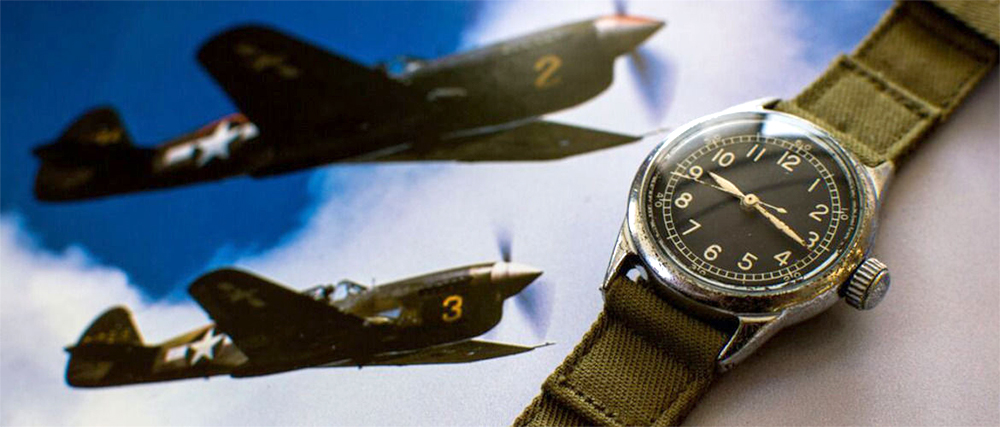
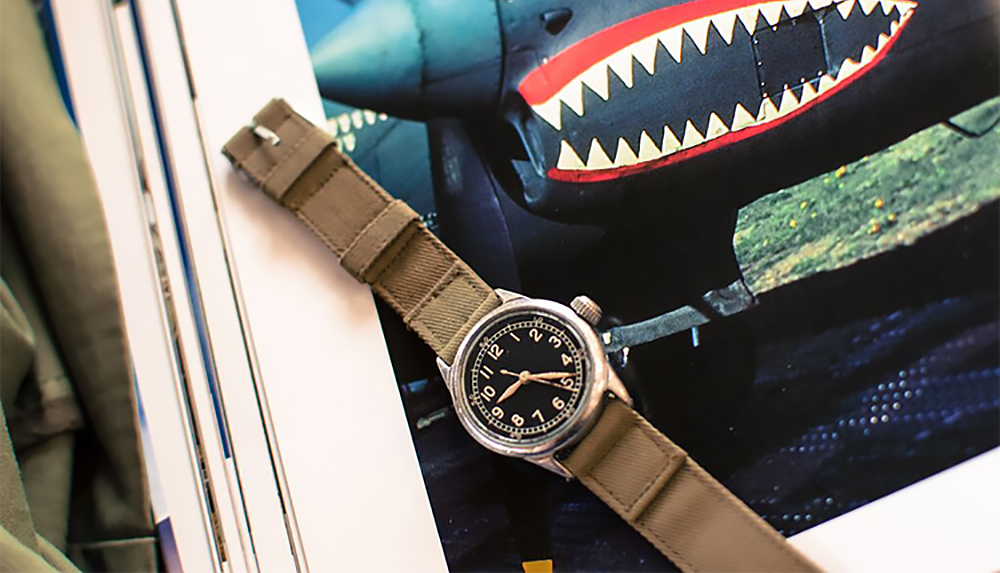
A standard-issue A-11 field watch, one of the most iconic designs of the WWII era. Source: Crown and Caliber
On the subject of survival watches, personal preference is undeniably a big factor. Some like the look and feel of modern digital designs, but many others prefer their classic, reliable analog counterparts. If analog watches are your choice, you’ll certainly want to consider what are known as field watches.
So, what’s a field watch? It’s a tough, simple, easy-to-read analog watch style that is inspired by vintage military wristwatches. Prior to World War I, pocket watches were commonly used by men, while wristwatches were almost exclusively worn by women. The Great War changed all of that, since many male soldiers found wristwatches more appropriate for the rigors of trench warfare. By WWII, the U.S. military had developed its own specifications for standard-issue field watches, like the A-11 seen below.
These early field watches typically shared a few common features:
A compact, slim, and durable case (often dustproof and waterproof)
Large, high-contrast black and white markings for maximum visibility
A tough fabric or leather band with subdued coloration, sometimes colloquially referred to as a “NATO strap”
In some cases, luminous markings for nighttime visibility
The simplicity and ruggedness of early military-issue watches served soldiers well during WWII, and they remain effective today. However, modern watchmakers have crafted new watches that honor the original styling and functionality of these timepieces, while simultaneously making improvements using modern technology. These modern field watches use space-age materials and precision engineering to bring the concept into the 21st century.
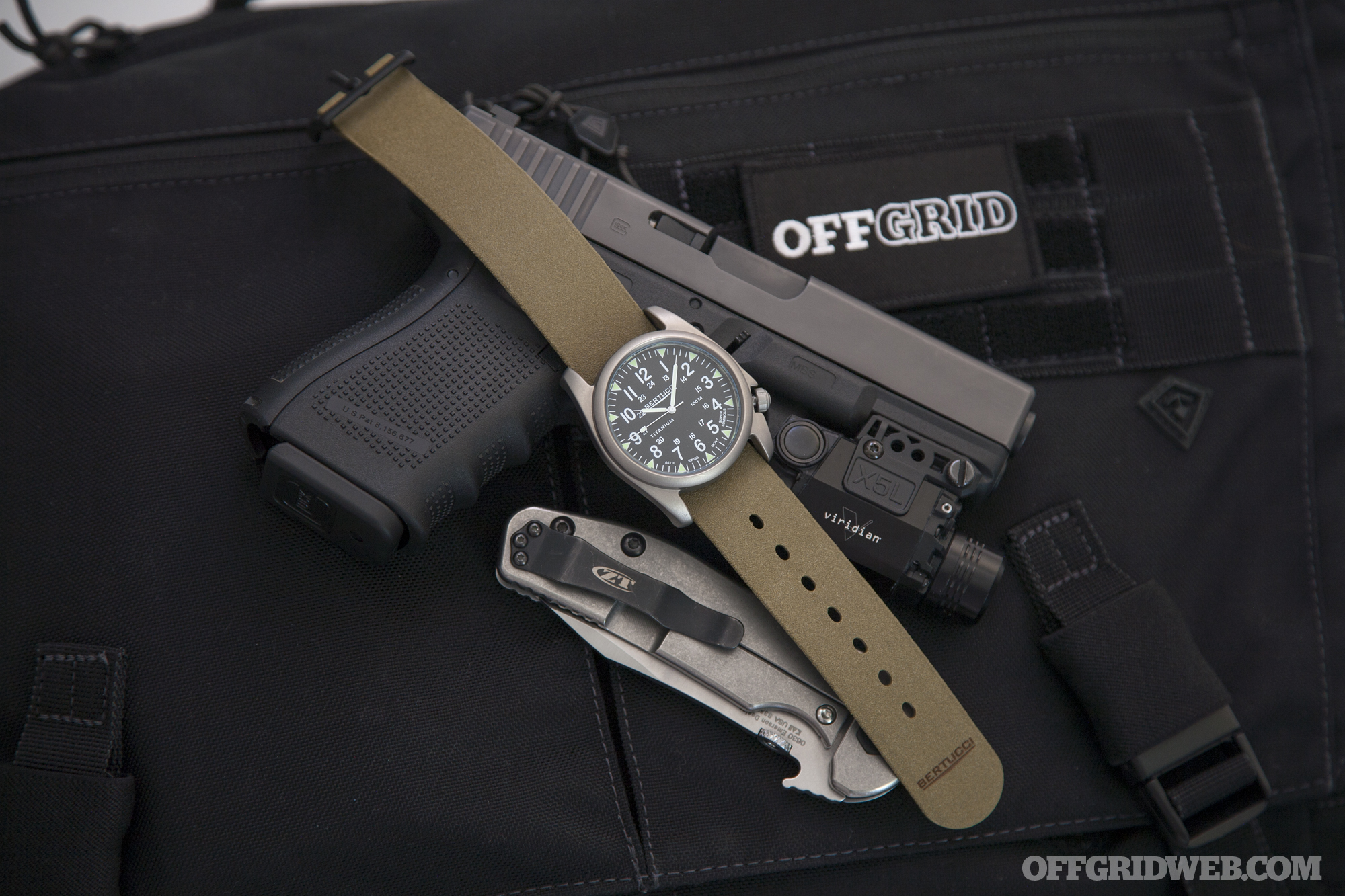
Bertucci A-4T Vintage Yankee
“For some people, substance is style.”
Bertucci is one such modern watchmaker. In fact, the company’s full name is Bertucci Performance Field Watches. Founded in 2003, Bertucci has focused solely on creating watches within this niche. No huge faces, thick bezels, gaudy bracelets, or complex features. Just simple designs that accomplish the most important goal — telling time clearly and reliably.
We stopped by the Bertucci display at the Outdoor Retailer Show earlier this year, and one particular model caught our attention: the A-4T Vintage Yankee.
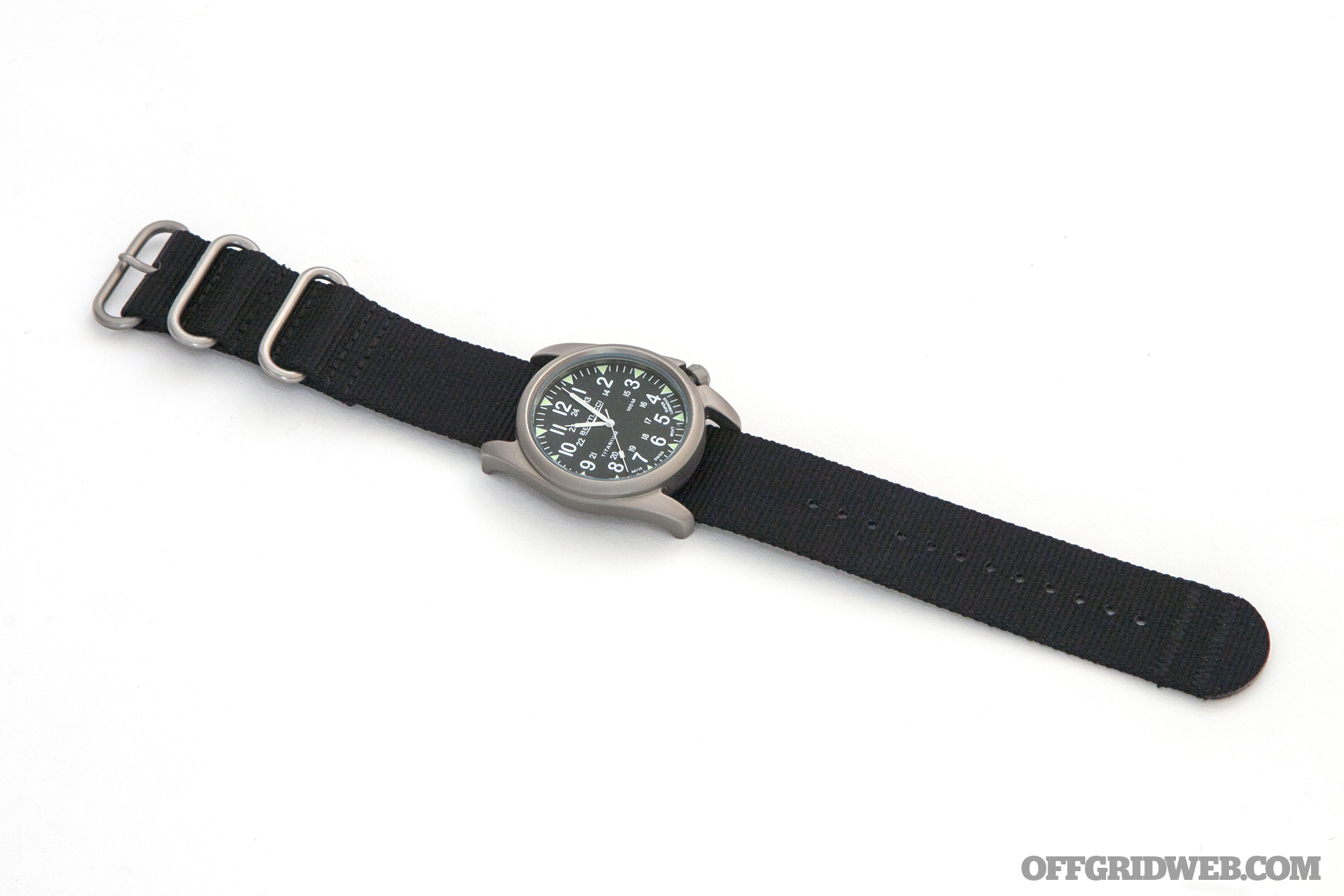
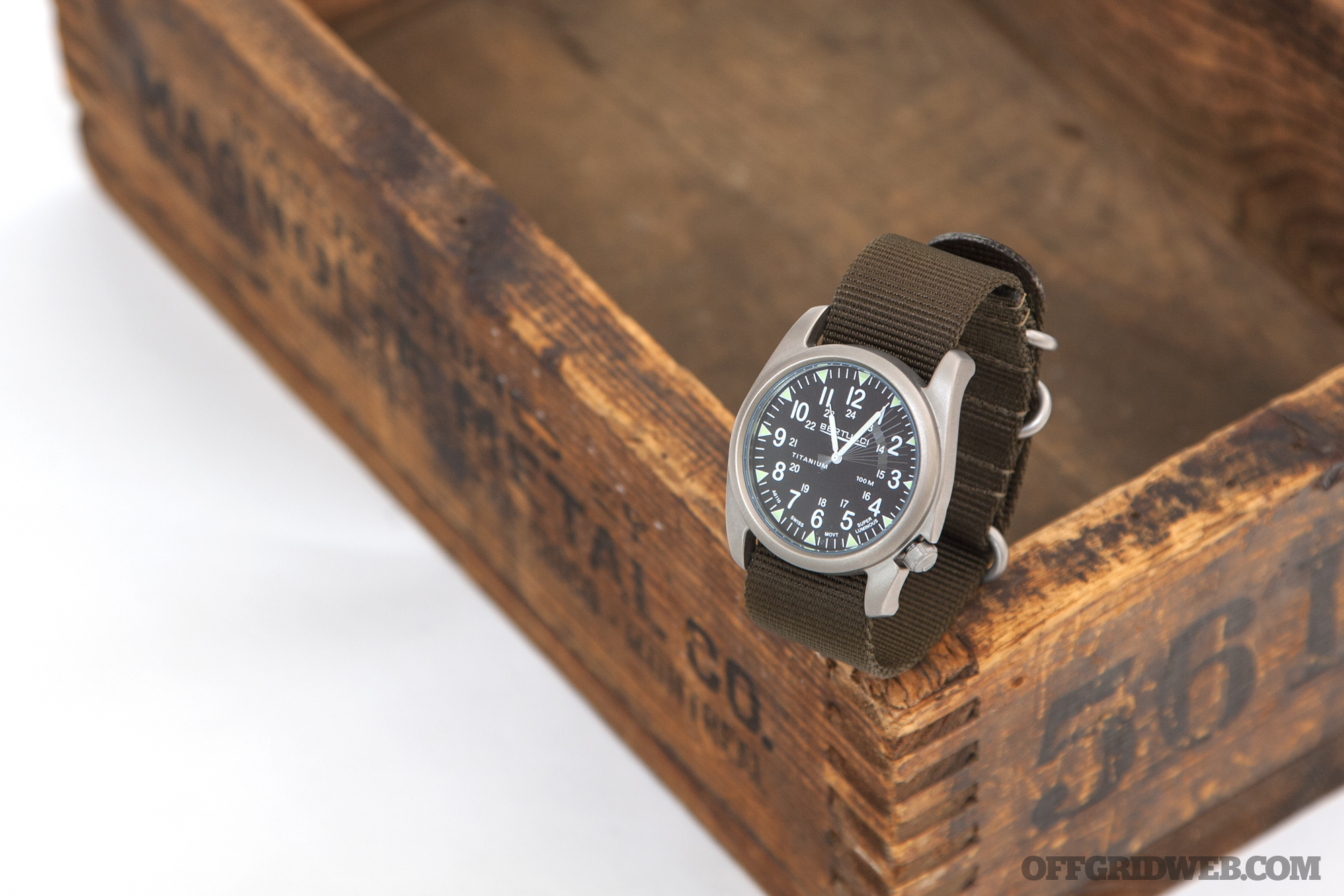
As evidenced by its name, this watch has the classic WWII look, but it also comes with a few key high-tech features beneath the surface. Before we get to the construction and inner workings, we’ll address the cosmetics.
The Case
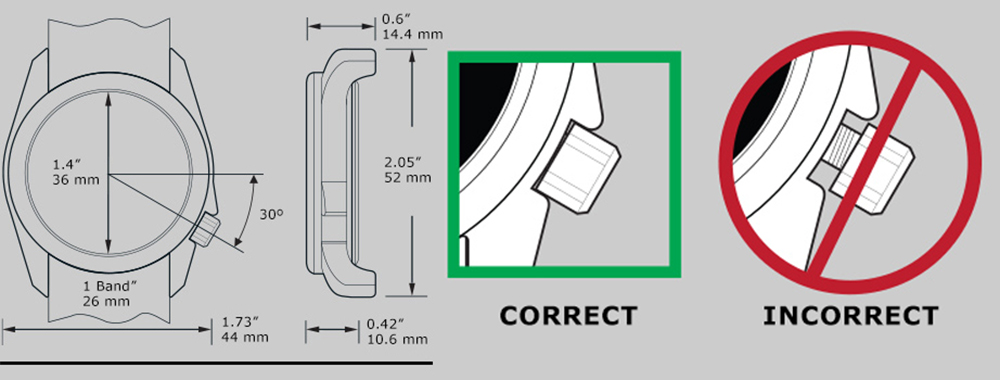
The A-4T Vintage Yankee has a 44mm case diameter, and lugs which accommodate a 1-inch-wide band. Both of these measurements are larger than the early field watches we mentioned previously — the WWII A-11 had a 30mm case and 16mm (0.63-inch) band. But, keep in mind that watch dimensions have changed a lot since the 1940s. By modern standards, those early field watches are positively tiny, and this Bertucci can be considered a mid-size watch.
While the 44mm case size is slightly above the 38-42mm average field watch range, we like the size for two reasons. First, it improves legibility in low-light conditions. Second, for those of us with larger builds, this case diameter won’t seem dwarfed by the wrist. If you have thinner wrists or prefer a smaller case, Bertucci offers numerous other models ranging from 36mm to 42mm.
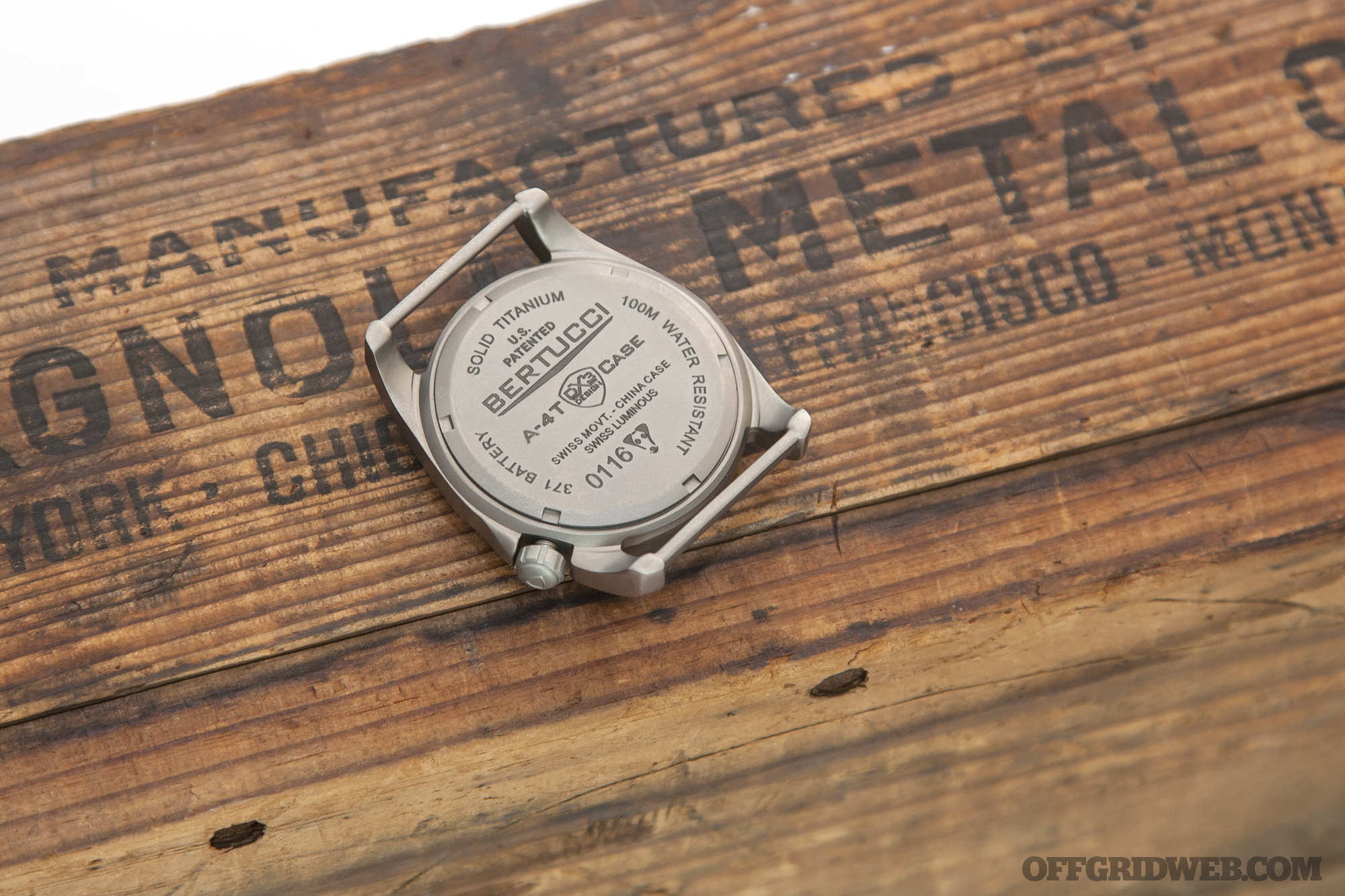
Left: A-4T case dimensions. Right: screw-down crown operation; our photos show it unscrewed prior to setting the time.
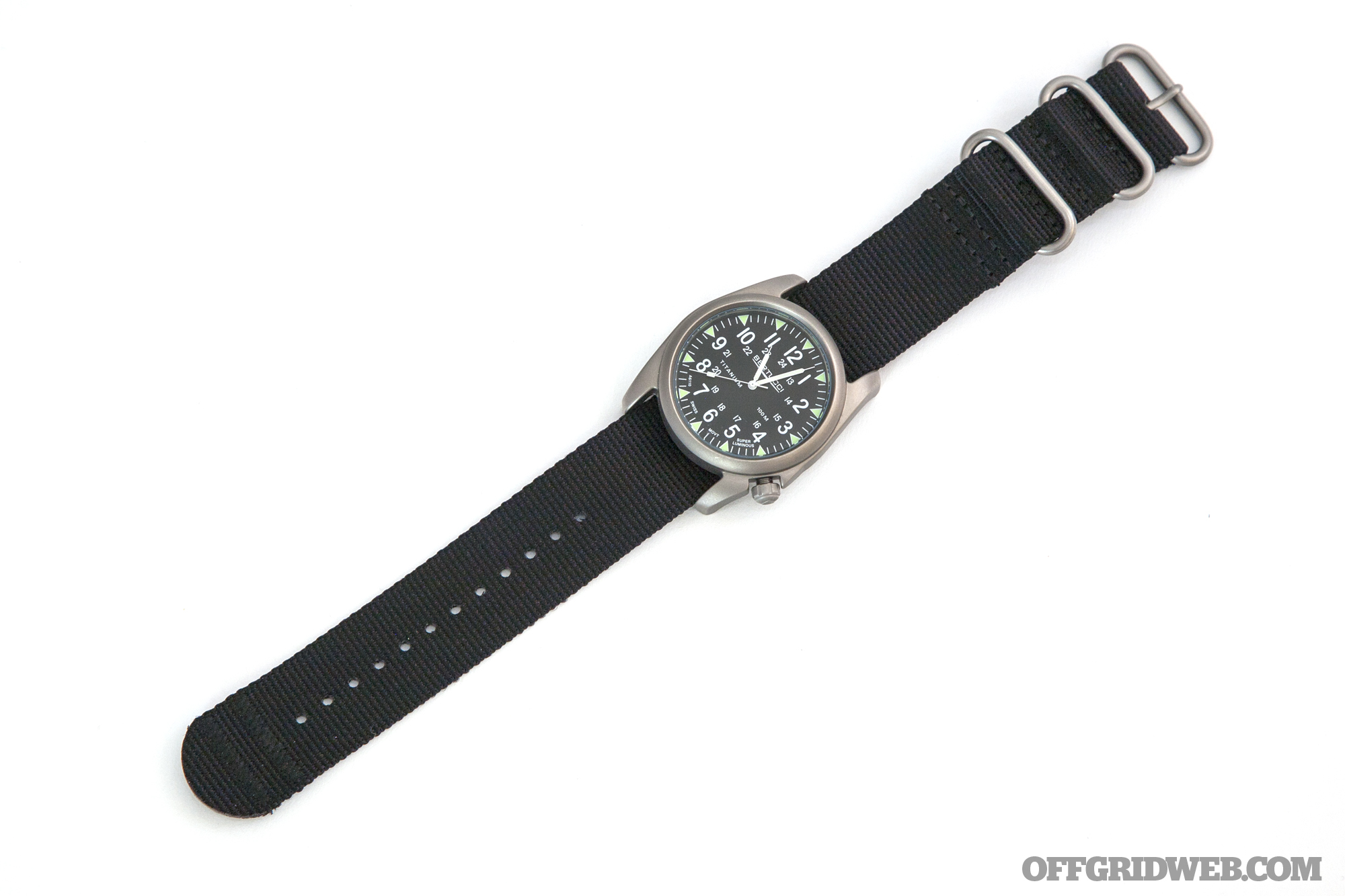
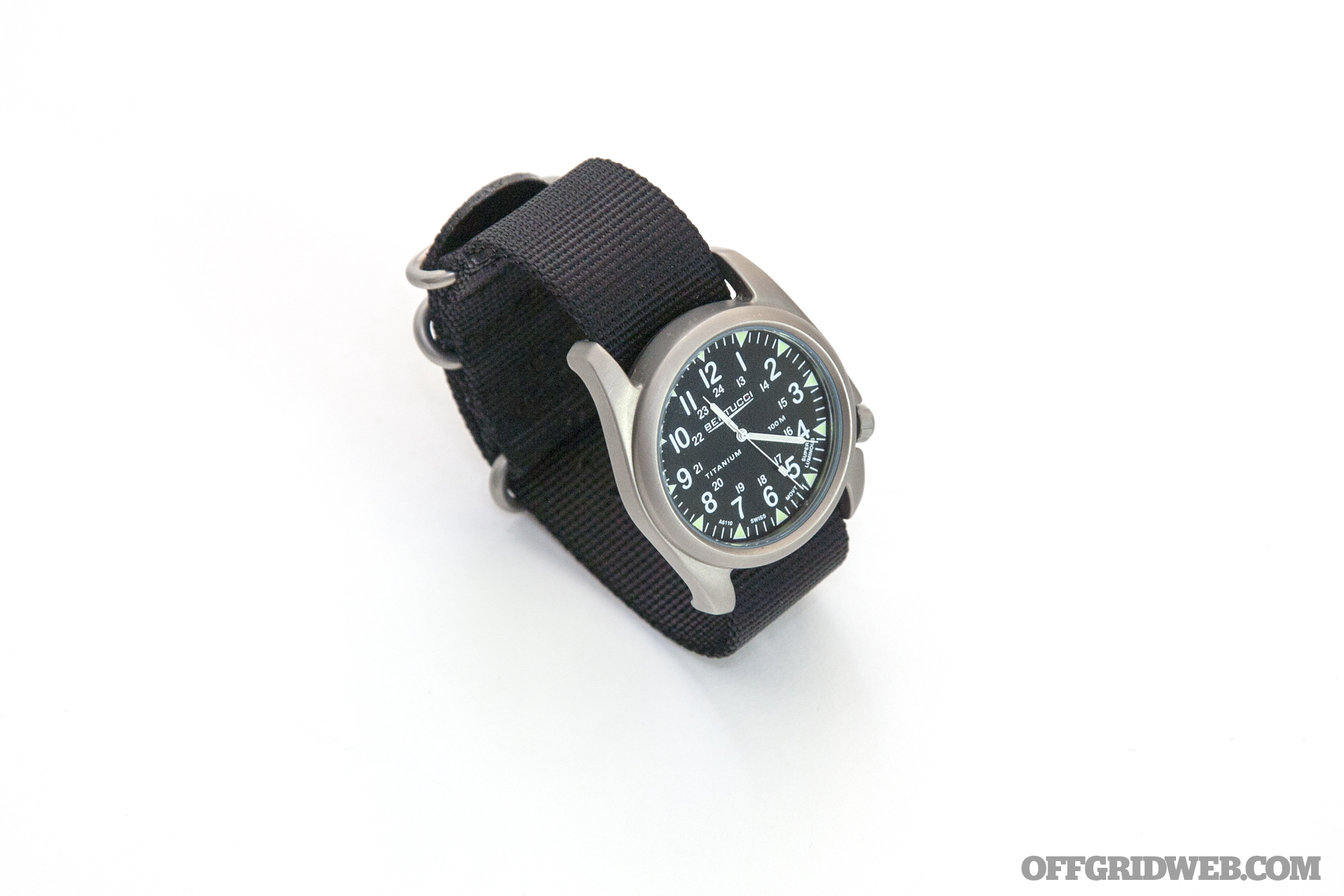
The case has a matte finish, and a single screw-down crown at the 4:00 position. The 36mm black dial features white 12-hour markings in a period-correct typeface, as well as smaller 24-hour inset markings. Triangular hour indicators provide added clarity.
The Band
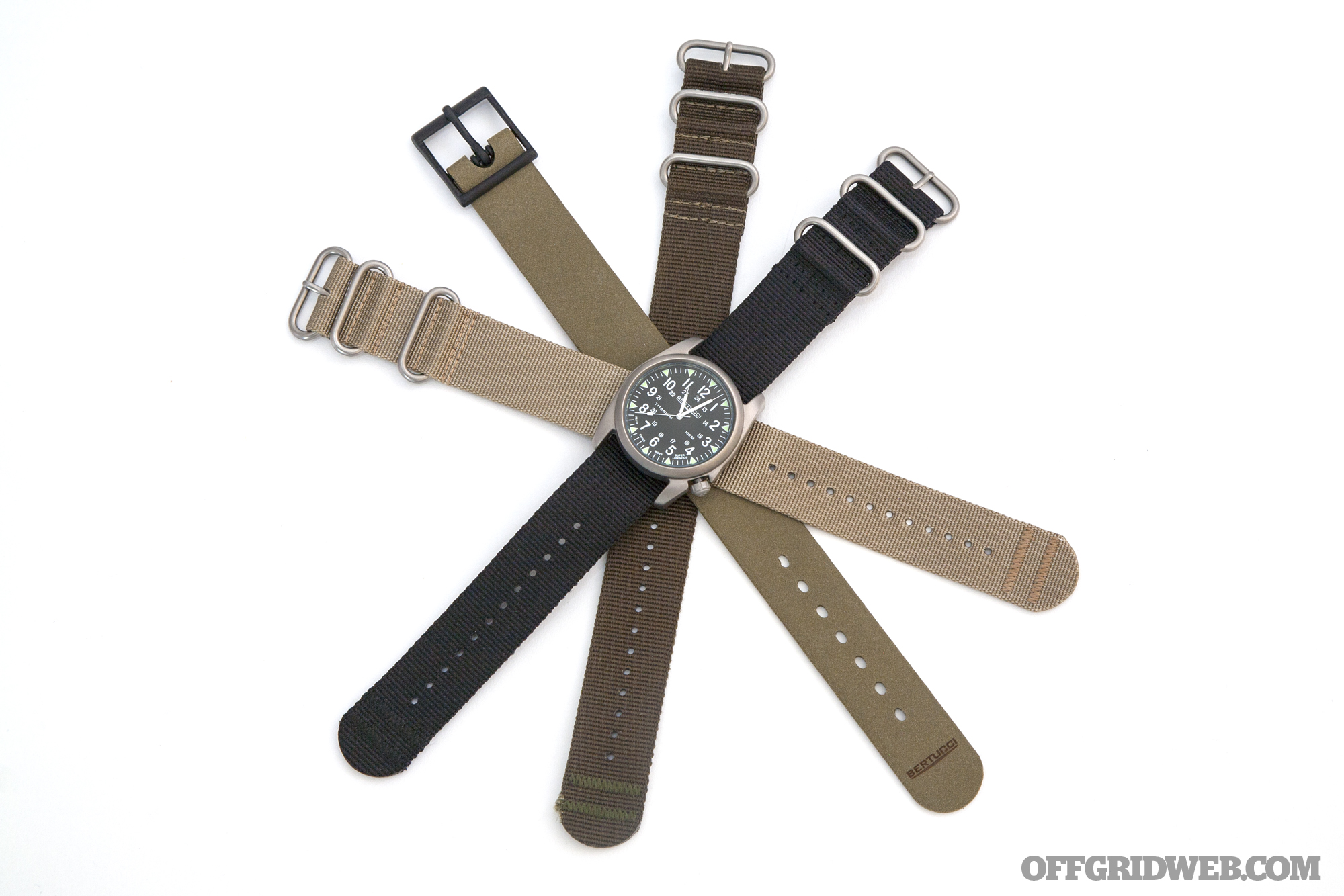
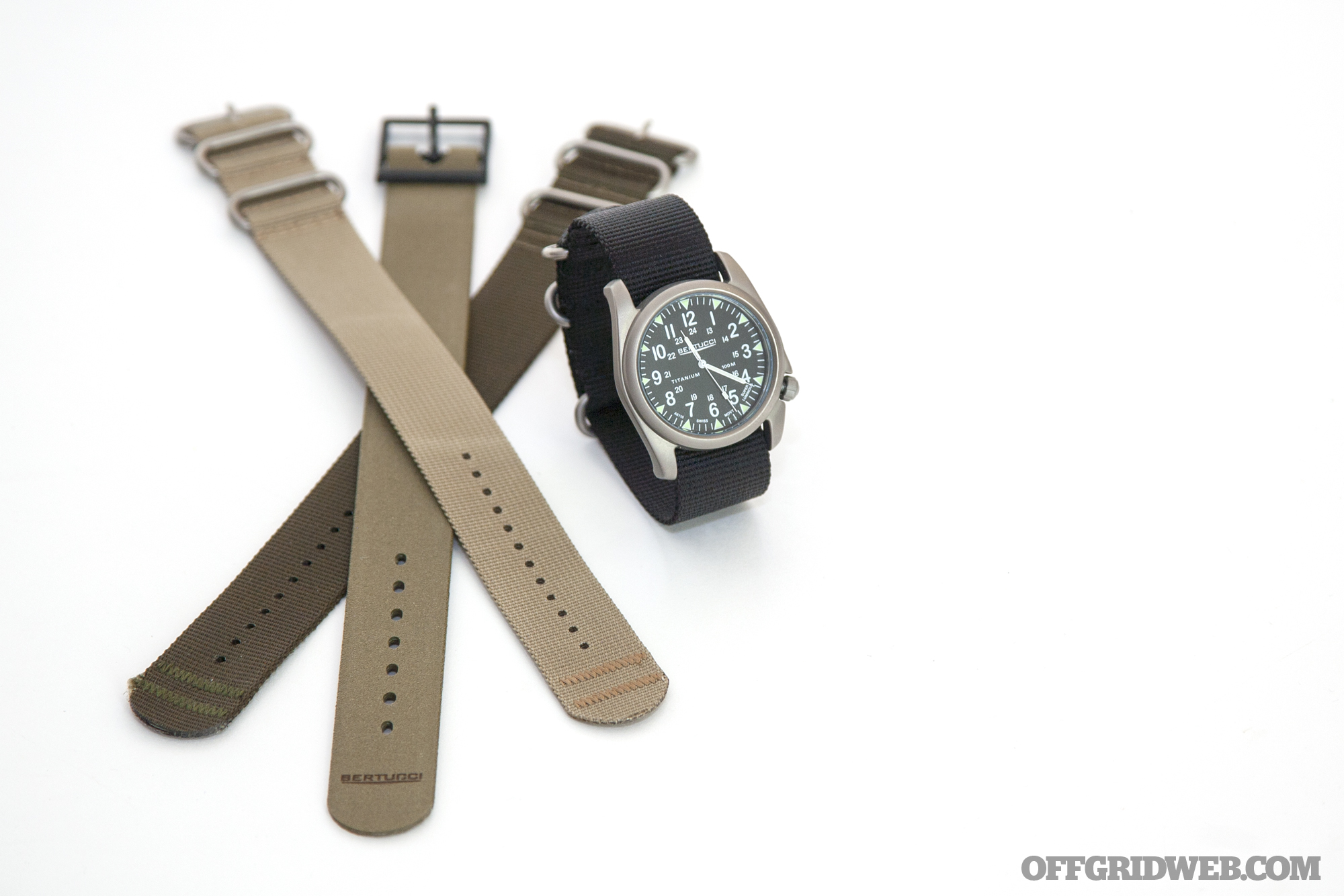
The A-4T we selected (Model 13406) ships with a single black nylon band. However, like many field watches, the A-4T Vintage Yankee is designed with a straight-through band, rather than a two-piece strap that is pinned to the case lugs. This enables changing the watch band in seconds without any tools.
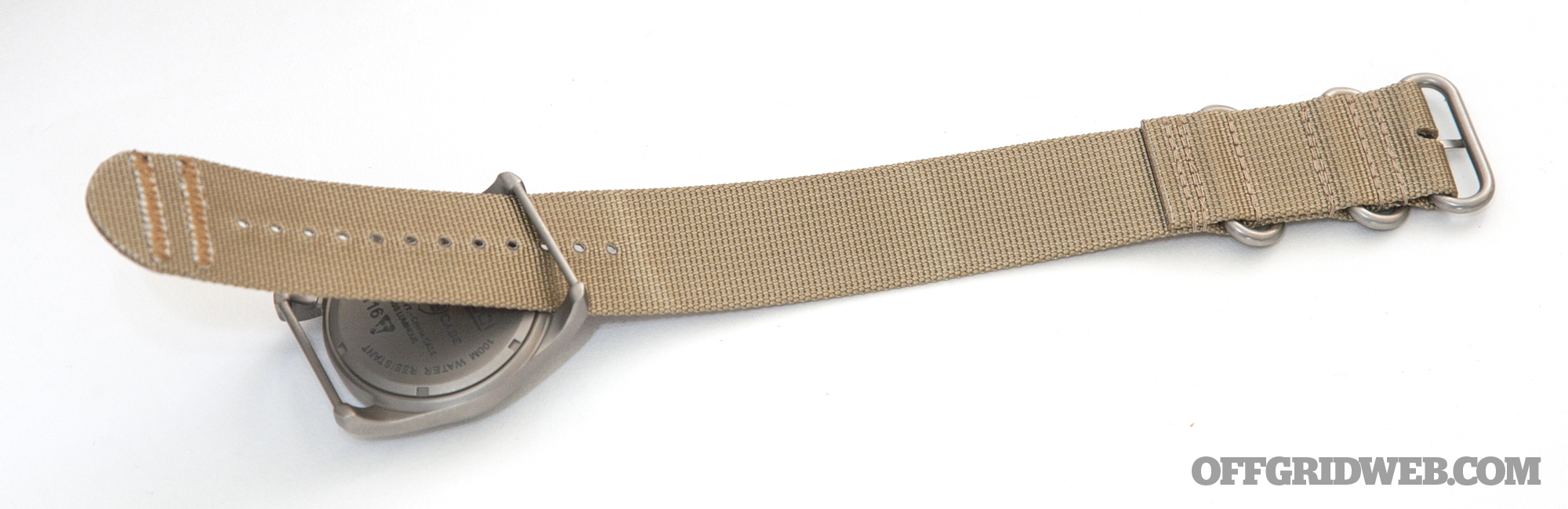
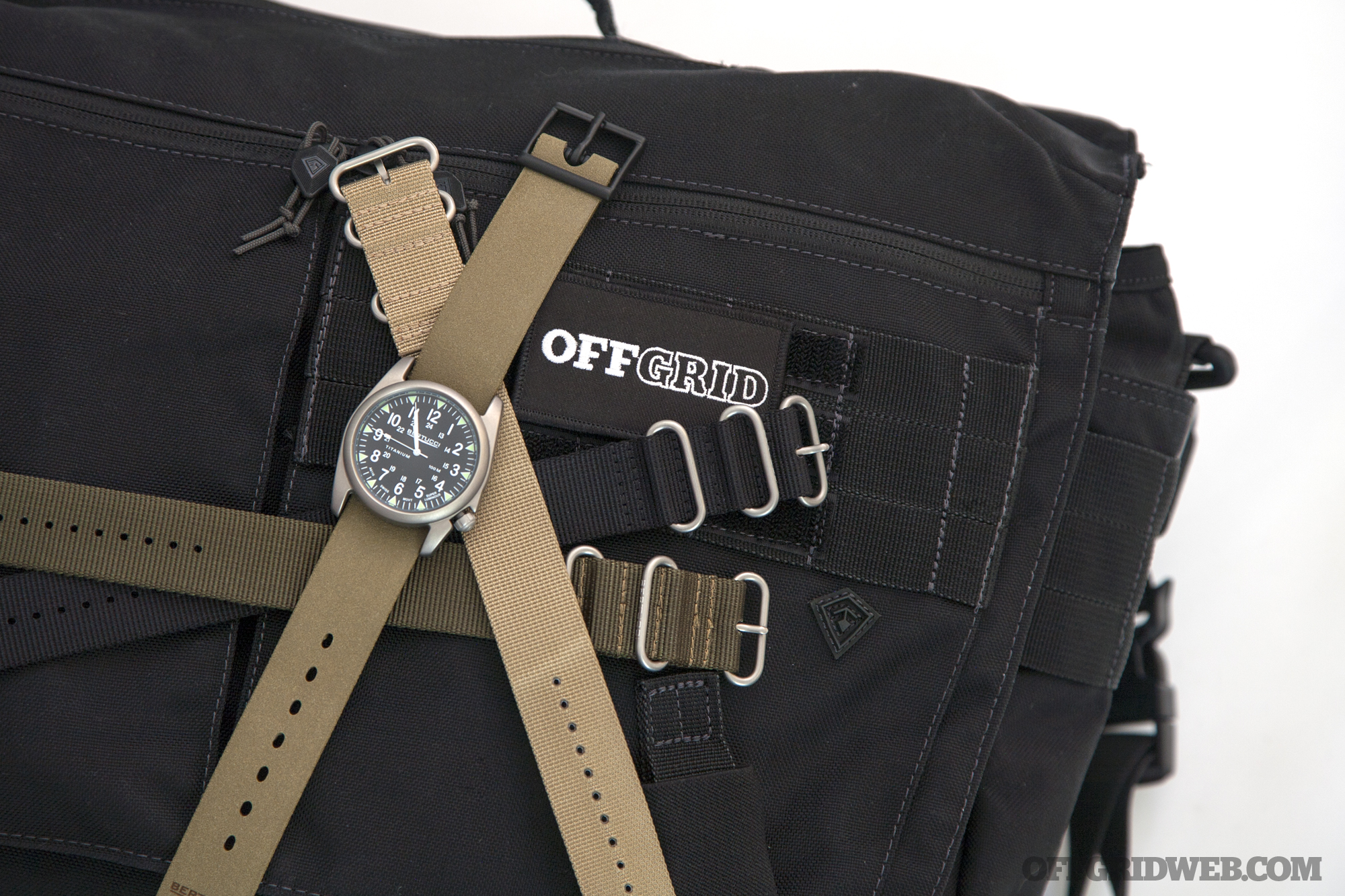
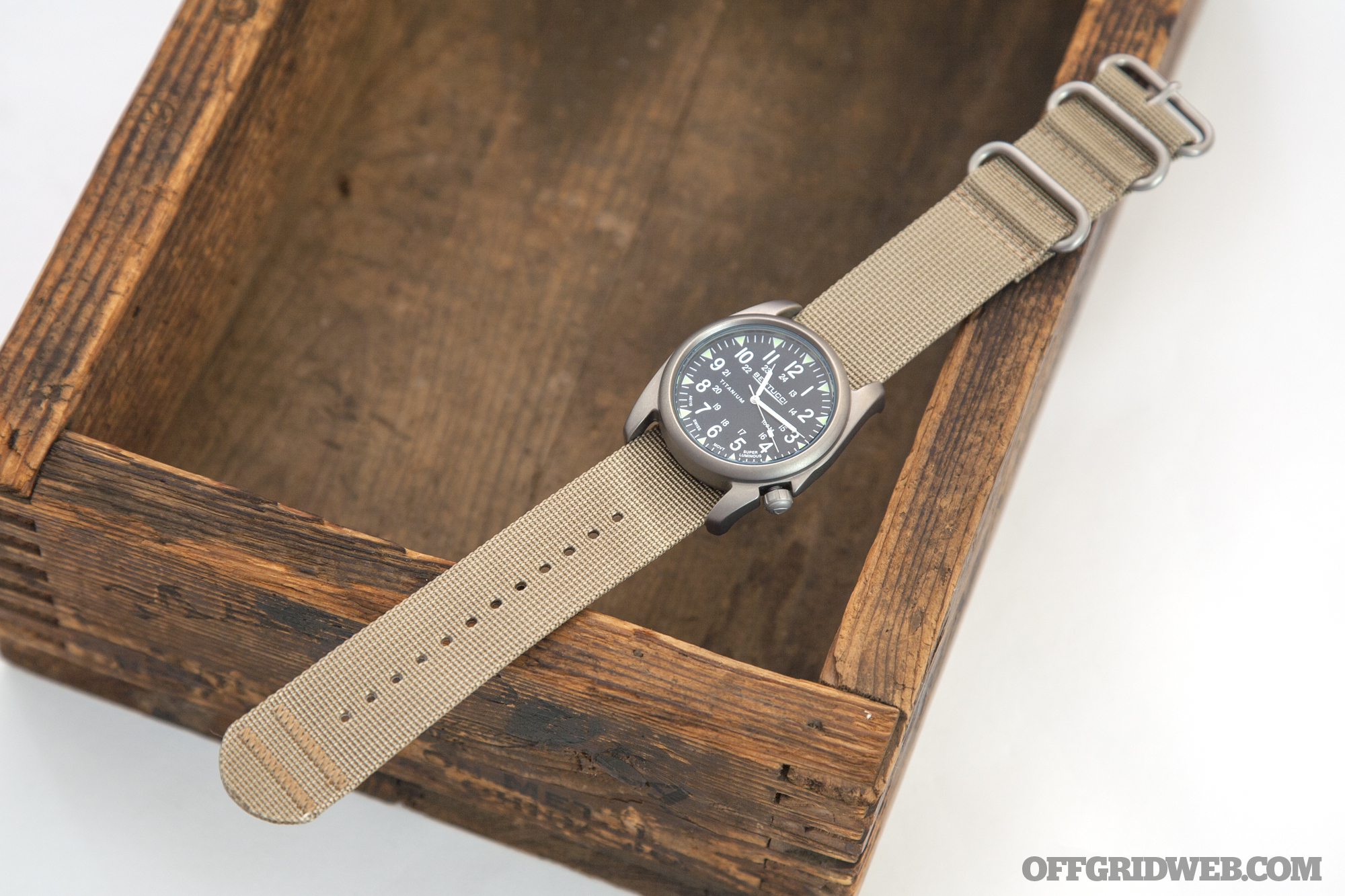
Bertucci offers dozens of band styles and materials, so we requested a few additional styles to try out. Along with the standard black DX3 nylon band, we received a DX3 Olive band and a DX3 Khaki band. Functionally, these three are all the same, but we can interchange them to match the other gear we’re wearing (or our surroundings).
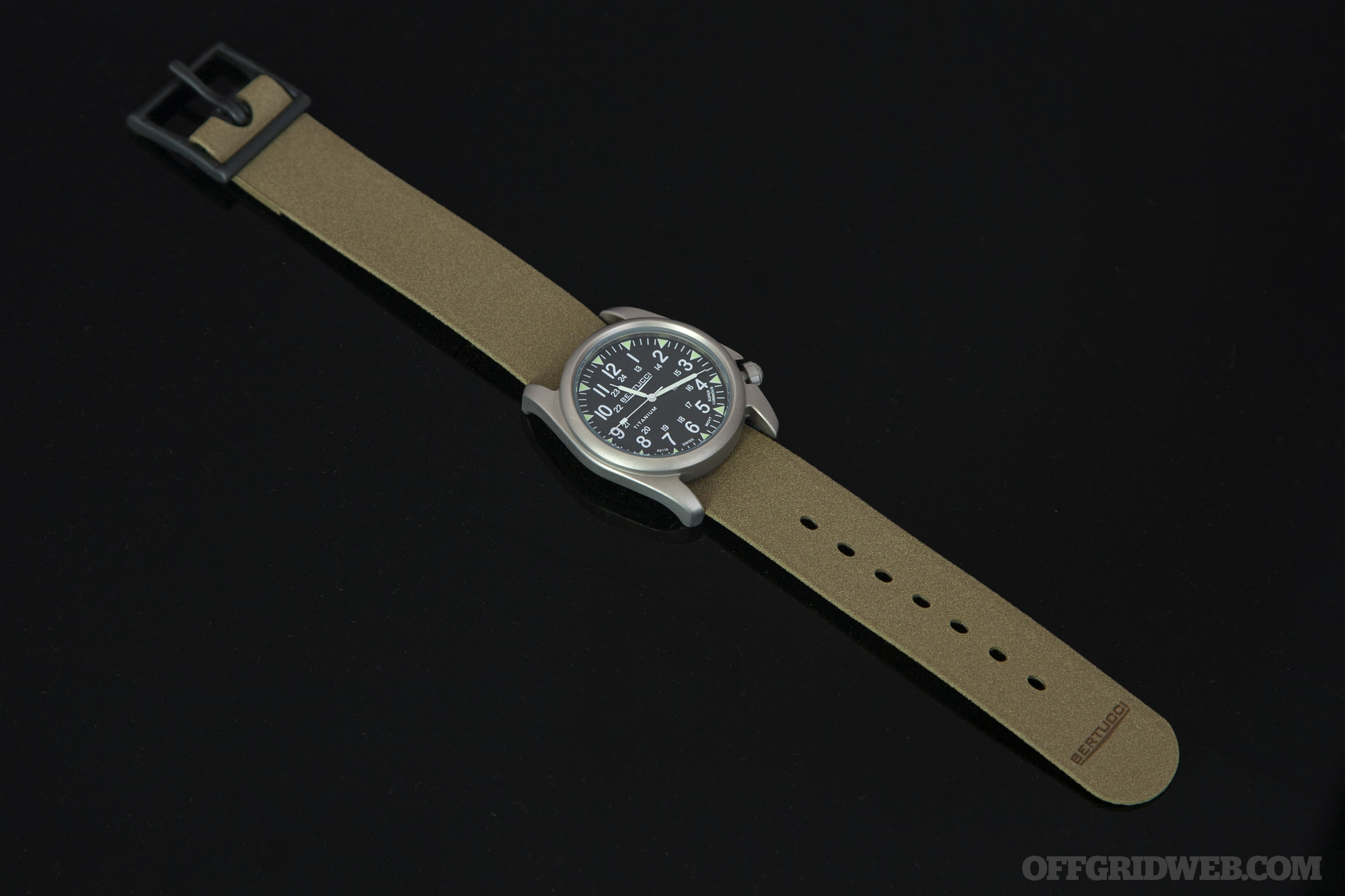
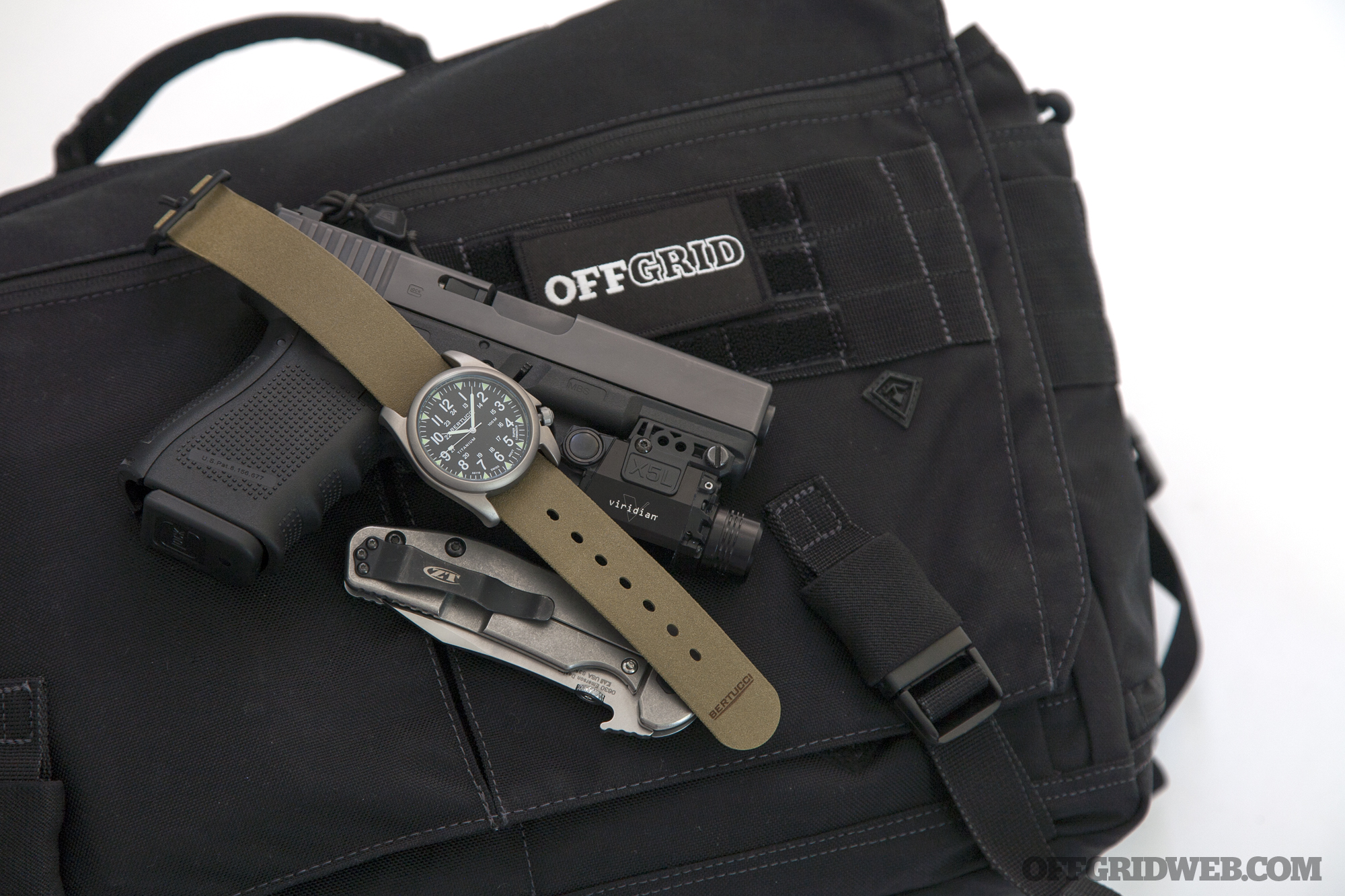
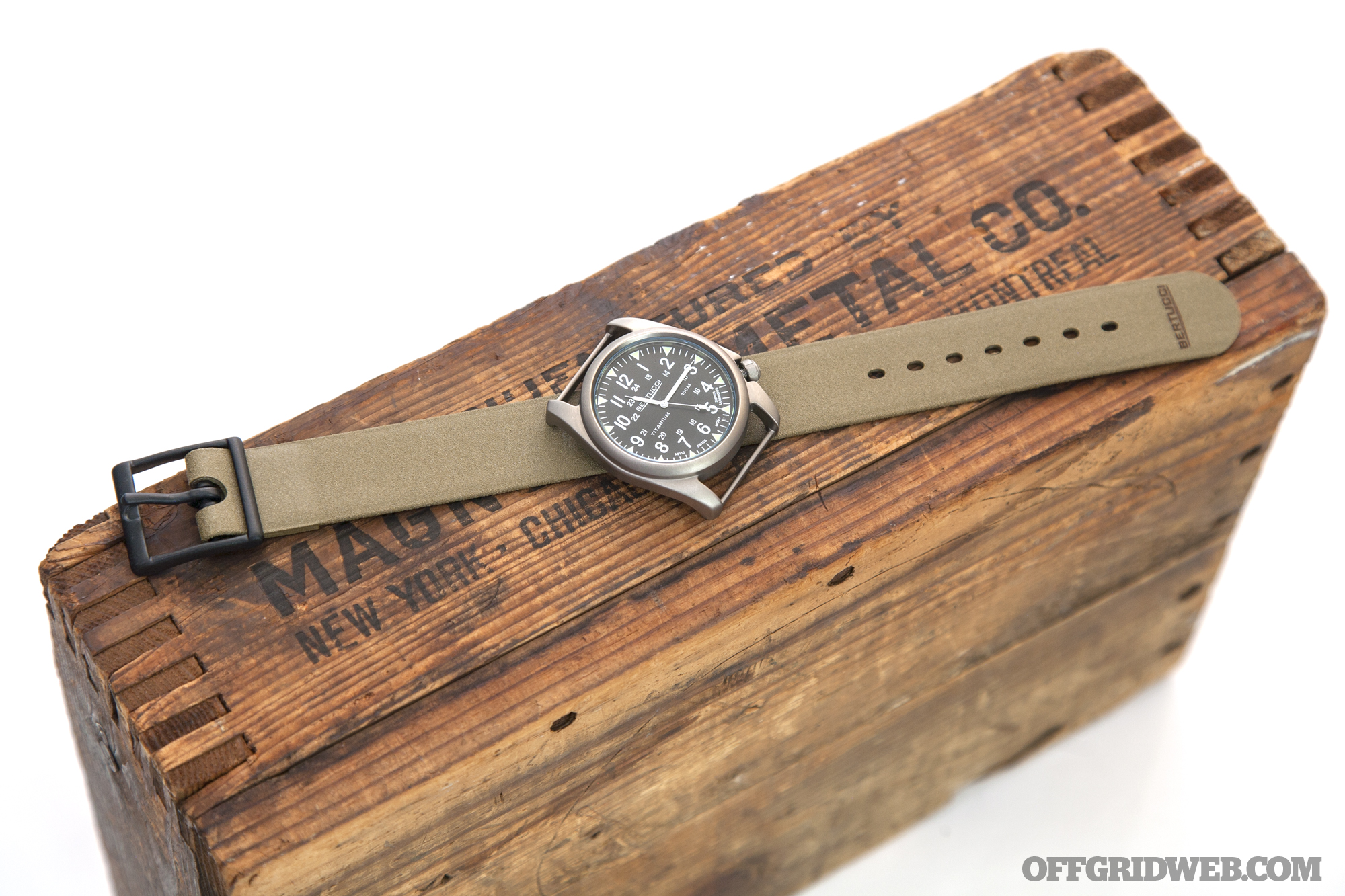
The final band we tested is a different material altogether. It’s made of Tridura, an “ultra-duty polymer-encapsulated webbing” material patented and developed by Bertucci. This Tridura material is pretty impressive stuff — it’s a heat-fused polymer that contains a woven webbing core for extreme durability. It resists water, dirt, odors, UV rays, abrasion, tearing, cracking, and fraying. It’s also made in the USA, and weighs next to nothing (0.58 ounces, to be exact).
The Tridura material has a suede-like matte finish and powder-coated black buckle. The color seen here is Olive Drab, but various other colors are also available through Bertucci.
Modern Elements
As mentioned before, the Bertucci A-4T field watch may resemble a WWII-era design, but there’s more here than meets the eye. Bertucci has incorporated modern elements to improve the functionality, while maintaining the classic appearance.
Upon picking up the watch, you’ll notice how light it is. That’s because the “T” in A-4T stands for titanium. The Unibody case is constructed of a solid piece of titanium, which brings the weight to only 2.28 ounces (including a nylon band). Once the time is set and the crown is screwed in place, this case is water-resistant to 100 meters.
In order to keep the watch affordable, the titanium case is made in China, but we will say that we’d never have known it without reading the engraving on the back. It looks and feels like a high-quality piece of metal, with tight tolerances and a uniform matte finish. The dial is protected by a scratch-resistant hardened mineral crystal, which is slightly recessed for added protection.
Aside from the outer case, the Bertucci A-4T’s internal movement assembly originates in Switzerland. This Swiss movement is all-metal and jeweled with quartz, yielding high accuracy and reliability. There’s a reason the phrase “like a Swiss watch” is used as an indicator of precision. It’s all powered by a 5-year lithium battery, and includes a low-battery indicator (the second hand will begin to skip before the battery runs out). Bertucci supports every one of its watches with a 3-year warranty.
Finally, some WWII field watches had luminous markers, but never quite like this. The A-4T hands and markers are treated with Swiss Super Luminous material, which passively absorbs ambient indoor or outdoor light. Once the lights go out, the non-radioactive photo-luminescent paint glows a bright green color. It’s tricky to capture in photos, but quite bright in person.
Review Conclusions
I had never worn a Bertucci watch prior to this review, but I’m a fan of field watches, so I was anticipating the experience. After wearing the A-4T Vintage Yankee throughout my daily routine, I can say I’m legitimately impressed. It’s lightweight, comfortable, and I love the clean no-frills appearance. And it does what a watch should do — tell the time, day or night, regardless of conditions.
The quick-change bands are a plus, especially if you’re the kind of person who gets bored wearing the same thing day after day. You can stick with a neutral nylon band for day-to-day use, or pick up a leather band for dressier occasions. You can select MultiCam to match a uniform, or go high-vis with solar orange or laser green. Heck, there’s even a red-white-and-blue American Stripes band if you’re feeling patriotic.
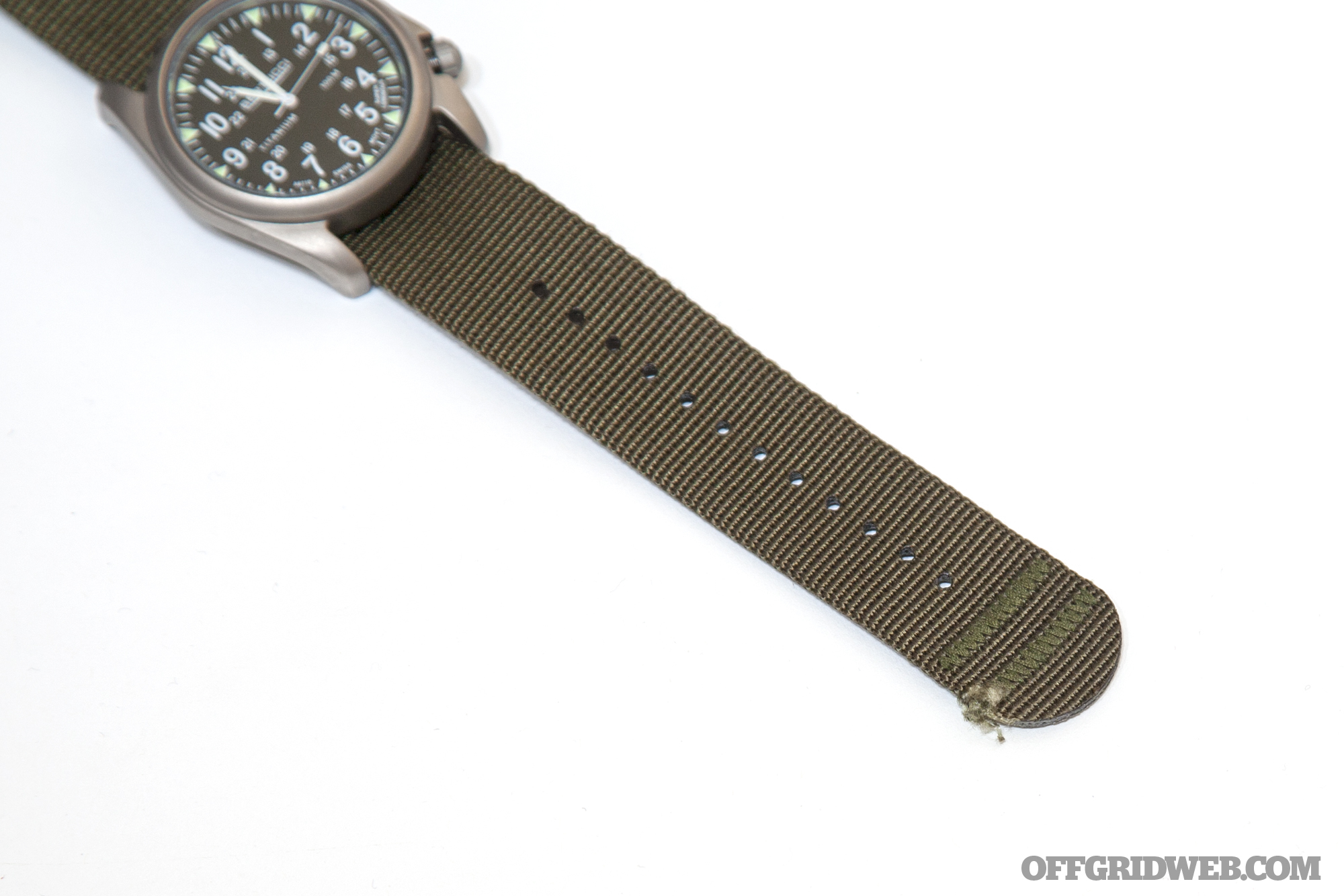
The DX3 nylon bands are fine, but they’re a bit rough on the wrist until the material is thoroughly broken-in. We do like the DX3 bands’ precise 12-hole adjustability, and the dual loop keepers to keep the band tight to the wrist. Unfortunately, the Olive band we received wasn’t cut accurately, leading to a small fray (seen above). Thankfully, a few seconds with scissors and a lighter trimmed and sealed the frayed nylon.
Of the bands I tested, I’d definitely go with the Tridura. Admittedly, it’s less adjustable than the nylon bands, with only 7 holes. Also, it lacks a keeper loop for the band’s loose end, which means you may need to trim off some material if you have smaller wrists. However, it’s light, comfortable, and doesn’t absorb moisture. The nylon seems stiff and thick in comparison.
It’s also worth mentioning that you must remember to tighten the crown after setting the time. Forgetting to do so would be an easy mistake to make, but according to Bertucci’s Watch Care Guide, this will “cause the watch’s internals to be flooded with water and void the warranty.” This is especially relevant to those who frequently cross time zones and/or submerge the watch in water.
At $190 MSRP — plus $36 if you want the optional Tridura band — the A-4T won’t break the bank. Bertucci even offers a Certified Pre-Owned program if you’re looking to save some money.
I found the standard luminous markings more than sufficient, but if you’re looking for 24/7 visibility in any lighting, you can go with the A-4T Illuminated model. It includes Swiss tritium markers, a sapphire crystal, and a date feature. However, at $440 MSRP, it’s substantially more expensive.
At the end of the day (no pun intended) I found myself forgetting this watch was on my wrist, due to its lightness and comfort. I’d say those are very desirable characteristics. The A-4T Vintage Yankee seamlessly blends classic style and simplicity with modern materials, producing an appealing survival watch.
For more information on this and other performance field watches, go to BertucciWatches.com.
Remember the Dr. Evil line from the first Austin Powers film about “sharks with frickin’ laser beams attached to their heads”? It seems like a ridiculous weapon that only a maniacal supervillain could devise. After all, who else would take the time to catch, train, and arm marine animals to autonomously defeat enemies? Well, truth is sometimes stranger than fiction, because various military forces around the world have actually been training war dolphins since the 1960s.
Are those really the eyes of a hardened killer?
War dolphins, also called military dolphins, have been used for a wide range of porpoises (sorry, we couldn’t resist). Some of these highly-intelligent mammals have been trained by the U.S. Navy Marine Mammal Program for search and rescue, locating swimmers lost in the ocean, similar to the military and police canines used on land. Others have been taught more complex tasks, like detecting underwater mines via their natural echolocation capabilities, a skill which was used during the Iraq War.
There are even some allegations that suggest these dolphins may have been trained to kill swimmers, or destroy submarines. Former Navy SEAL Brandon Webb wrote that he underwent training to deal with enemy combat dolphins. Trainers in this exercise used dolphins “to track down enemy divers, outfitting them with a device strapped onto the head that contains a [simulated] compressed gas needle. Once the dolphin has tracked you down, it butts you; the needle shoots out and pokes you, creating an embolism. Within moments, you’re dead.”
The New York Times once reported that dolphins were taught to kill enemy divers with nose-mounted guns and explosives, according to former Navy dolphin trainers. The U.S. Navy Marine Mammal Program vehemently denies these claims, stating “The Navy does not now train, nor has it ever trained, its marine mammals to harm or injure humans in any fashion or to carry weapons to destroy ships.”
A dolphin wears a tracking device on its fin while performing mine clearance work in the Persian Gulf. Source: U.S. Navy / Brien Aho
However, the Soviet Union is also known to have worked on its own military dolphin program, which may have had different standards. The Soviet dolphin program started in 1965, and was based in Sevastopol, close to the now-contested Crimea region. After the fall of the USSR, the program passed to Ukrainian leadership, and the animals were eventually sold to Iran in 2000. In 2014, Russia reinstated the military dolphin program, and just this year allegations surfaced that the program was looking for new dolphin recruits.
According to Doug Cartlidge, a former dolphin trainer who visited the Crimea dolphin facility, the animals “were sometimes armed with needles connected to carbon dioxide cylinders, a poke from which could be lethal.” Cartlidge even said that “they’d learned to parachute out of helicopters.”
So, next time you’re thinking about improvised weapons, just remember that war dolphins exist. Although some of these cetaceans’ combat abilities may be the stuff of myth and legend, they show that thinking outside the box can produce some surprisingly effective tools for warfare.
Whether you’re an ordinary survivalist, law enforcement officer, or military operative, being captured and imprisoned by your enemies is essentially the worst-case survival scenario. It’s almost unimaginable to be a helpless captive at the hands of those who might wish to do you harm. This is why it’s wise to study the concepts of SERE — Survival, Evasion, Resistance and Escape. With knowledge of these principles and a few essential tools, it’s possible to escape your captors, or avoid being captured in the first place.
Purpose-built escape tools can save you hours of fumbling with a paperclip.
When it comes to SERE tools, many people think of items like a concealed handcuff key, small blade, and perhaps lock picks or shims. These items are certainly important for breaking free of illegal restraints, but other items will be required for long-term evasion and survival. You’ll need to purify water, obtain food, start a fire, and possibly signal for help.
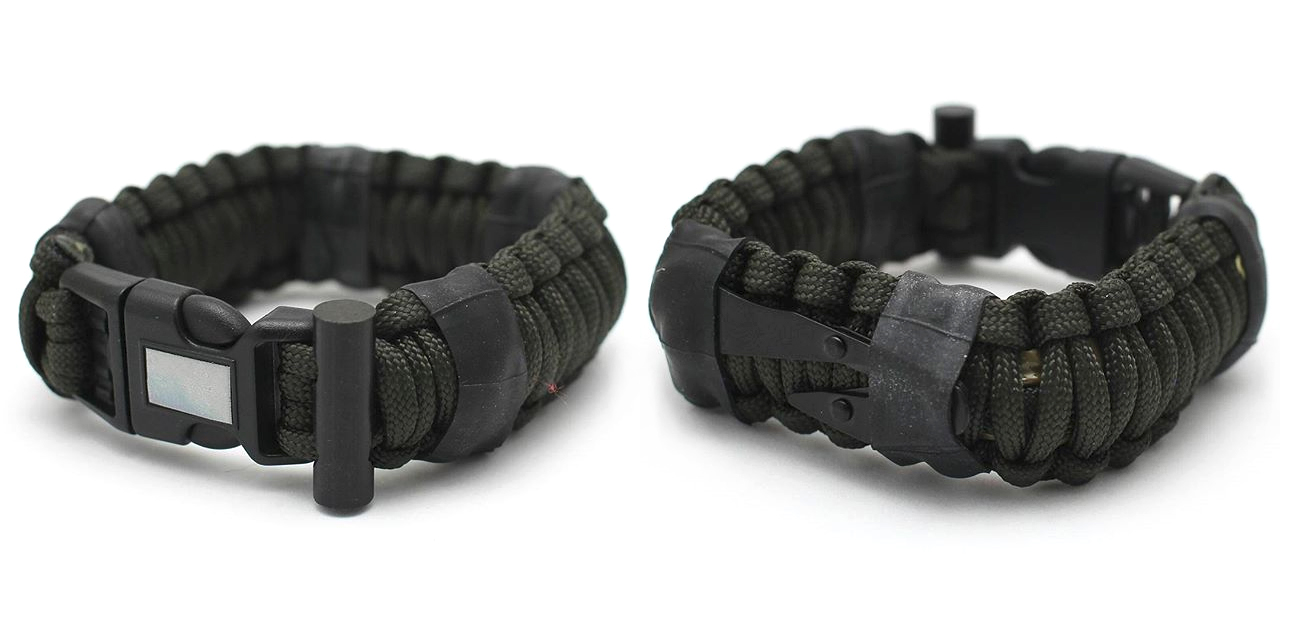
Superesse Straps has announced an updated version of its SERE Sidekick paracord bracelet, which provides many of the tools necessary for survival, evasion, resistance, and escape. It’s all contained in one compact bracelet, which you can disassemble in case of emergency. Like the Superesse Straps Bug-Out Bracelet we reviewed in the past, the SERE Sidekick is handmade in the USA by the owner (a former U.S. Army SOF soldier) and his wife.
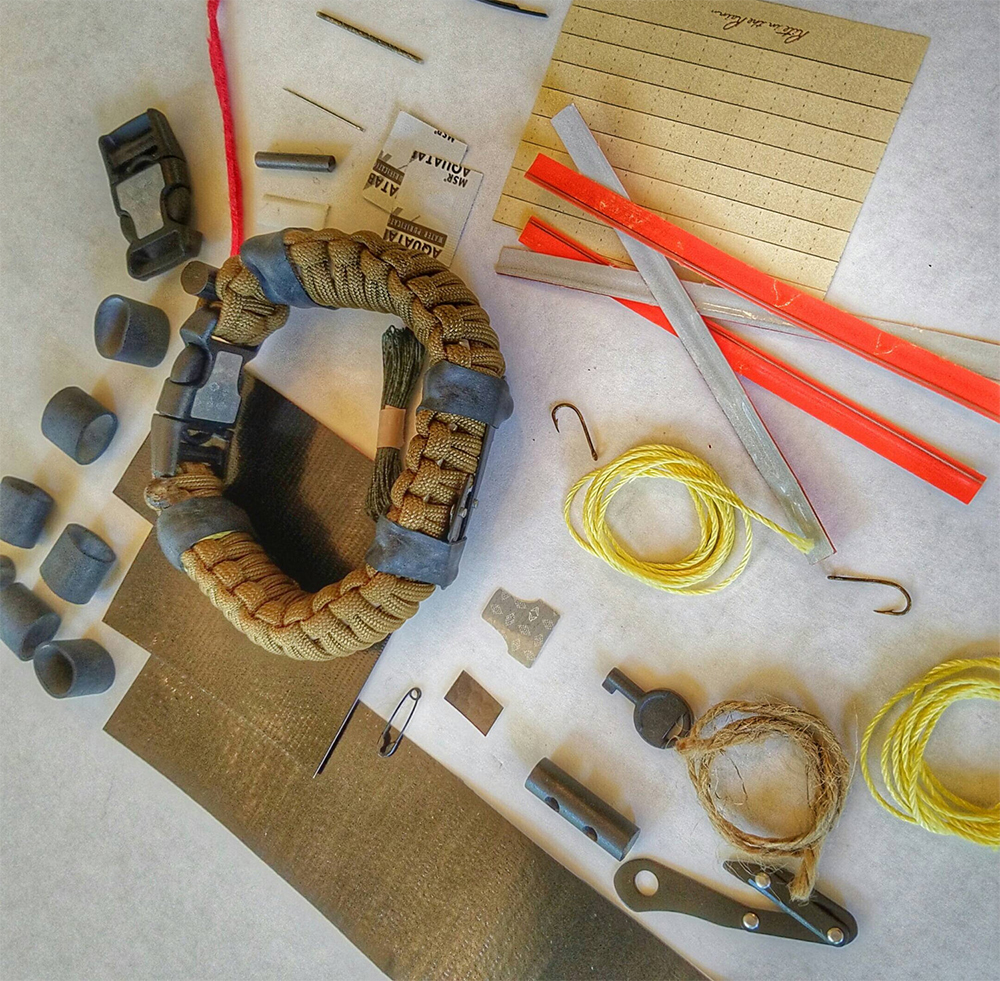
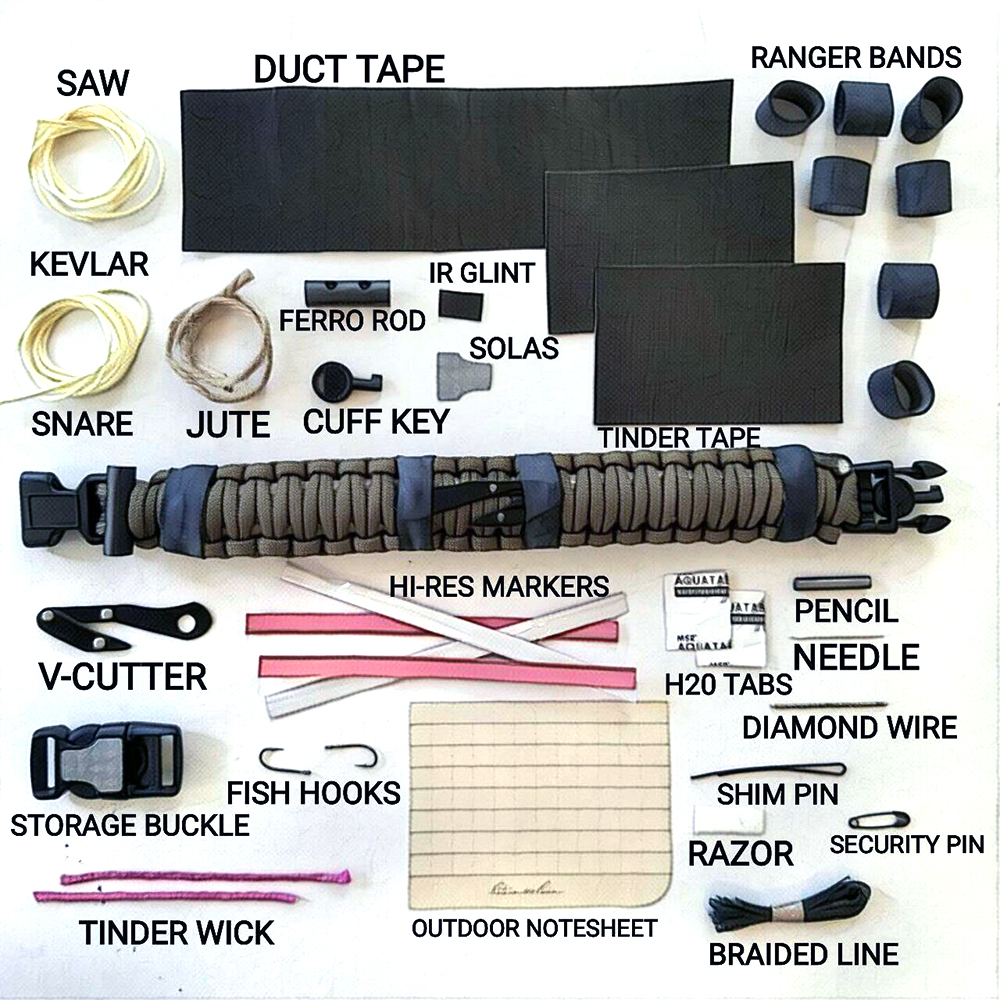
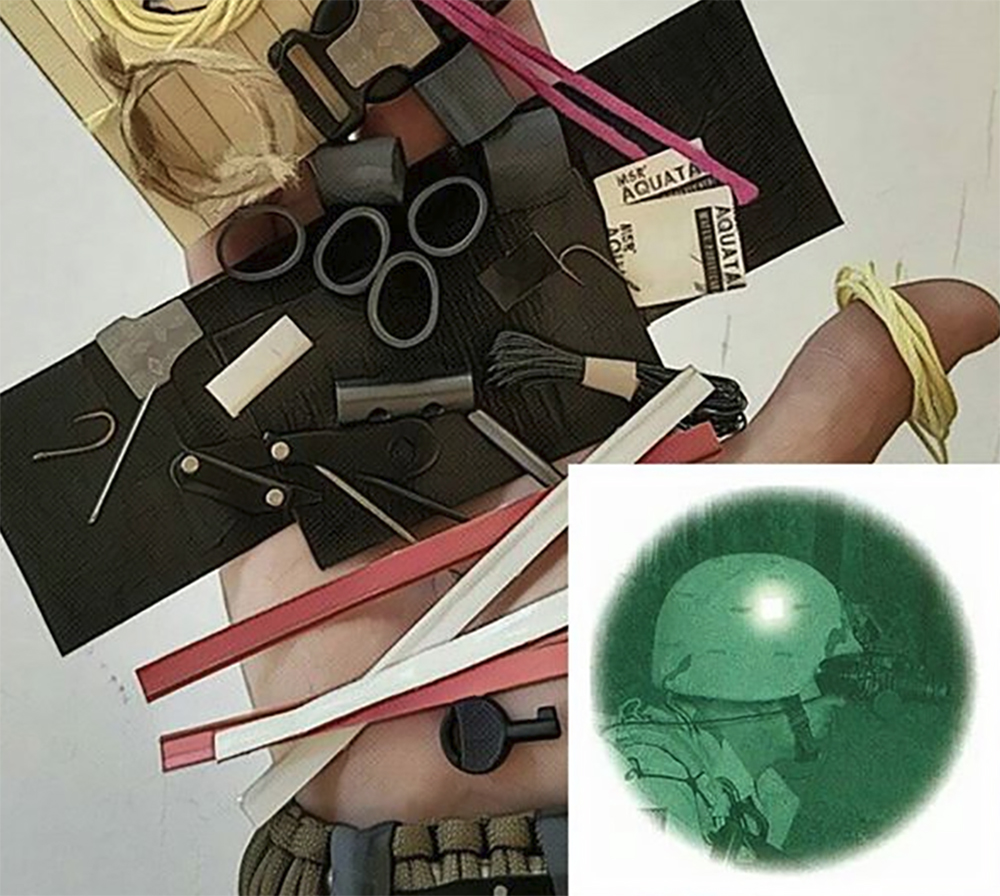
The updated version of the Sidekick bracelet offers added escape and signaling packages, which can be selected during the order process. First, the Tactical Escape Kit includes a 70mm diamond wire cutting tool, which is capable of sawing through solid iron bars and steel chains. Superesse Straps’ founder tells us it will take patience to saw through solid bars with this tool, but in a captive or POW situation, you’ll likely have days or weeks of confinement to orchestrate an escape. This upgrade package also includes a zirconia ceramic razor blade and fire striker with sheath. The non-metallic blade can be used to spark fires or slice through rope/zip ties.
Also available is the new Plan/Signal Ops Kit upgrade. This kit includes a 5HB pencil lead segment and half-sheet of Rite in the Rain waterproof paper. There are also reflective “limb lights” (red and white strips in the image above) which can be attached to trees, sign posts, and other landmarks for marking trails and land navigation. Finally, an IR glint tag can be used as covert combat identification, and glows only when viewed through night vision optics. (IR glint tag can only be sent to domestic shipping addresses for security reasons.)
The basic SERE Sidekick bracelet includes 15 standard items (click here for a list) and retails for $98. It’s available in many colors, including black, coyote tan, OD green, safety orange, various camouflage patterns, and even custom colors. The Tactical Escape Kit is a $65 option, while the Plan/Signal Ops Kit is an extra $25. There are also a Sustainment Kit option ($25) and SERE V-Cutting Tool option ($30), or you can go for “the works” with All Options & Upgrades ($95).
For more information on the Superesse Straps SERE Sidekick bracelet, SuperesseStraps.com or check the company’s Etsy page.
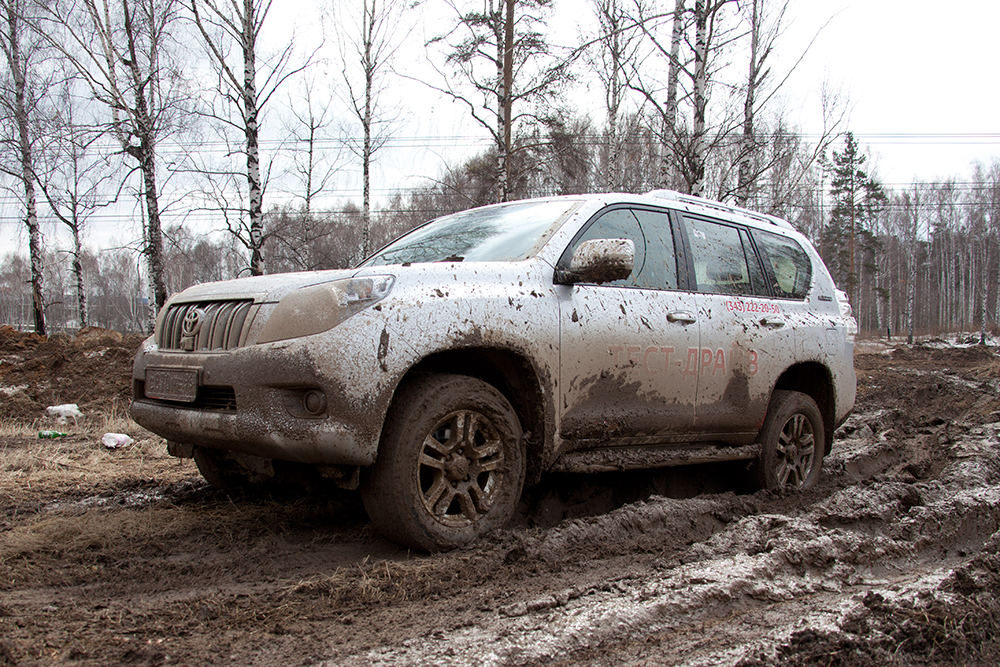
It’s an awful feeling to get stuck in a vehicle, especially when you’re miles away from civilization. You can floor the gas pedal all you want, but you’ll only make the problem worse as your tires dig deeper into the soft mud, sand, or snow. If you’re an experienced off-roader, you may be able to lock your axles, switch to 4-low, or winch yourself to safety. But if you’re stuck in a vehicle without these capabilities, and without any purpose-built rescue tools, you’ll need to improvise a way out.
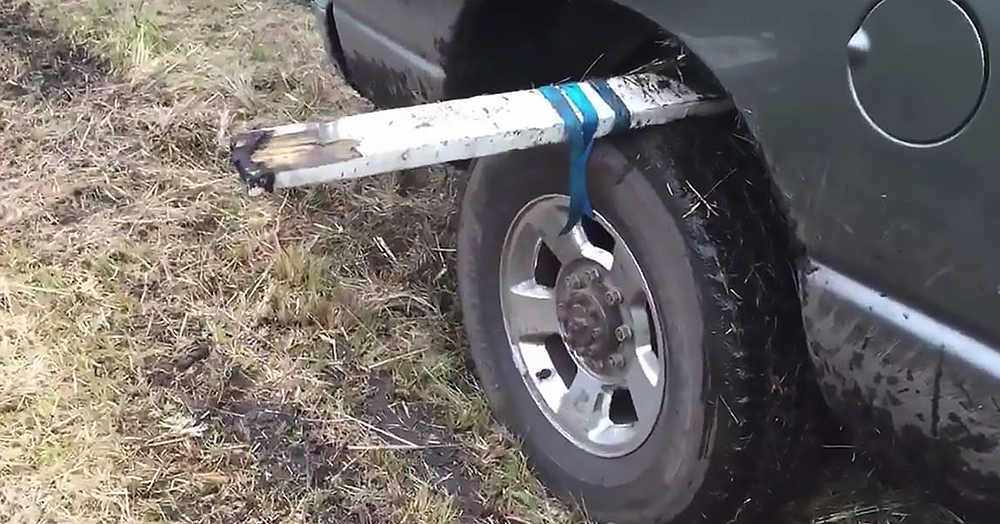
One option is to jam a piece of wood — such as a 2×4 or thick tree branch — underneath your stuck drive wheel. In dry conditions, this can work as a ramp. However, in wet and muddy conditions, this wood can become even more slippery than the ground below. Fortunately, there’s another way of using the same piece of wood, provided you also have some strong cordage or a ratchet strap. The video below demonstrates the concept:
This method of strapping a stick perpendicular to a wheel can provide an effective way to escape the mud. It works much like a snowshoe or tank tread, distributing the vehicle’s weight over a larger area so it doesn’t sink in to the soft terrain. The raised surface also digs in, providing added grip. The method could be more effective with multiple sticks, but one should be enough in most cases.
Unless you have a friend who can tow you to safety with a rig like this, you may need to get yourself un-stuck.
A word of warning: be gentle on the gas pedal when using this method. As seen in the video above, the tire’s tread will continue to slip until it reaches the stick, at which point it will suddenly regain traction. If you accelerate too quickly, this repeated loss and regaining of traction can generate a condition called wheel hop. Under these conditions, the wheel will violently shudder and bounce as it spins, resulting in potential damage to the axle, differential, and drivetrain. Here’s what wheel hop looks like:
Notice how the wheels begin to bounce starting at the 9-second mark — that’s not good. If you ignore wheel hop and try to power out of the rut you’re in, you could end up permanently damaging your vehicle, and then you’ll really be stuck. But, if you’re slow and steady, the traction stick method should help you get to safety.
Have you ever wondered why certain animals always seem to be sleeping? Whether it’s your pet napping all day around the house, or wild animals becoming seemingly invisible during the daytime, there’s a simple answer to this question. Biologists have studied various animal species, and determined that their sleep patterns vary dramatically.
It’s easy to assume our pets are being lazy, but they don’t operate on the same sleep schedule we do.
Some animal species are purely nocturnal, while others are active throughout the day and night. Certain animals sleep in long stretches like humans, while others take many quick naps throughout the day. Specific species can even snooze while moving around, or stay alert for days on end.
Knowing when predators are most active can reduce the risk of attack.
So, as survivalists, why should we care about animals’ sleep patterns? There are two reasons. Firstly, any experienced hunter can tell you that understanding when animals are active increases your odds of putting food on the table. Second, understanding when dangerous wild animals are on the prowl can help you stay safe while camping, hiking, backpacking, or surviving outdoors.
The following infographic from Sleepopolis shows a comparison of various animals’ sleeping habits. For a larger and easier-to-read version, click on the image, then select the “Download” button in the top right corner. Alternatively, you can click here for a direct link.
The above graphic provides perspective, but you obviously won’t be hunting whales, giraffes, or orangutans in a survival situation. So, here’s another infographic which focuses on more common wildlife. Researchers installed motion-sensing cameras in areas surrounding Chicago, then used the photos to chart animal activity throughout the day. Unsurprisingly, deer were active during the day, but due to their sleep patterns, other species were rarely spotted between 7am and 5pm.
For more on animal behavior and tracking, check out our previous infographic post about recognizing animal footprints and droppings.
Ernest Emerson is a living legend in the knife community, and for good reason. First, there’s the wave-shaped opening feature he developed, which enables users to quickly open a folding blade without the need for an assisted-opening or automatic mechanism. More importantly, Emerson has made strides to grow the tactical knife industry as a whole, designing and producing many blades for military, law enforcement, and even NASA.
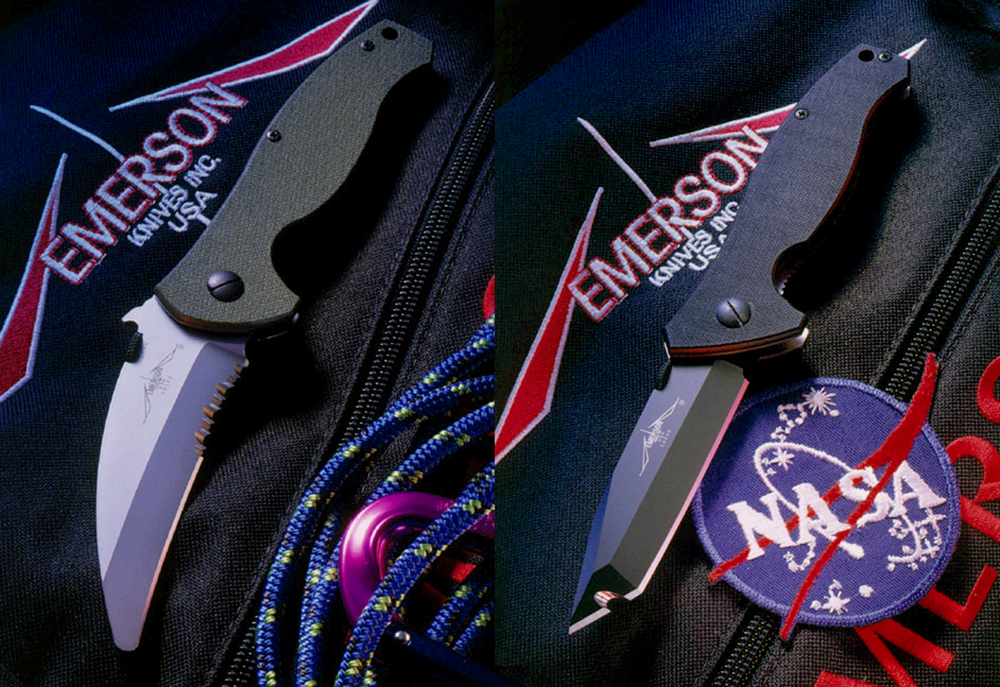
Left: Emerson SARK (Search and Rescue Knife). Right: Emerson NASA knife, with a gut hook tip for opening food packages.
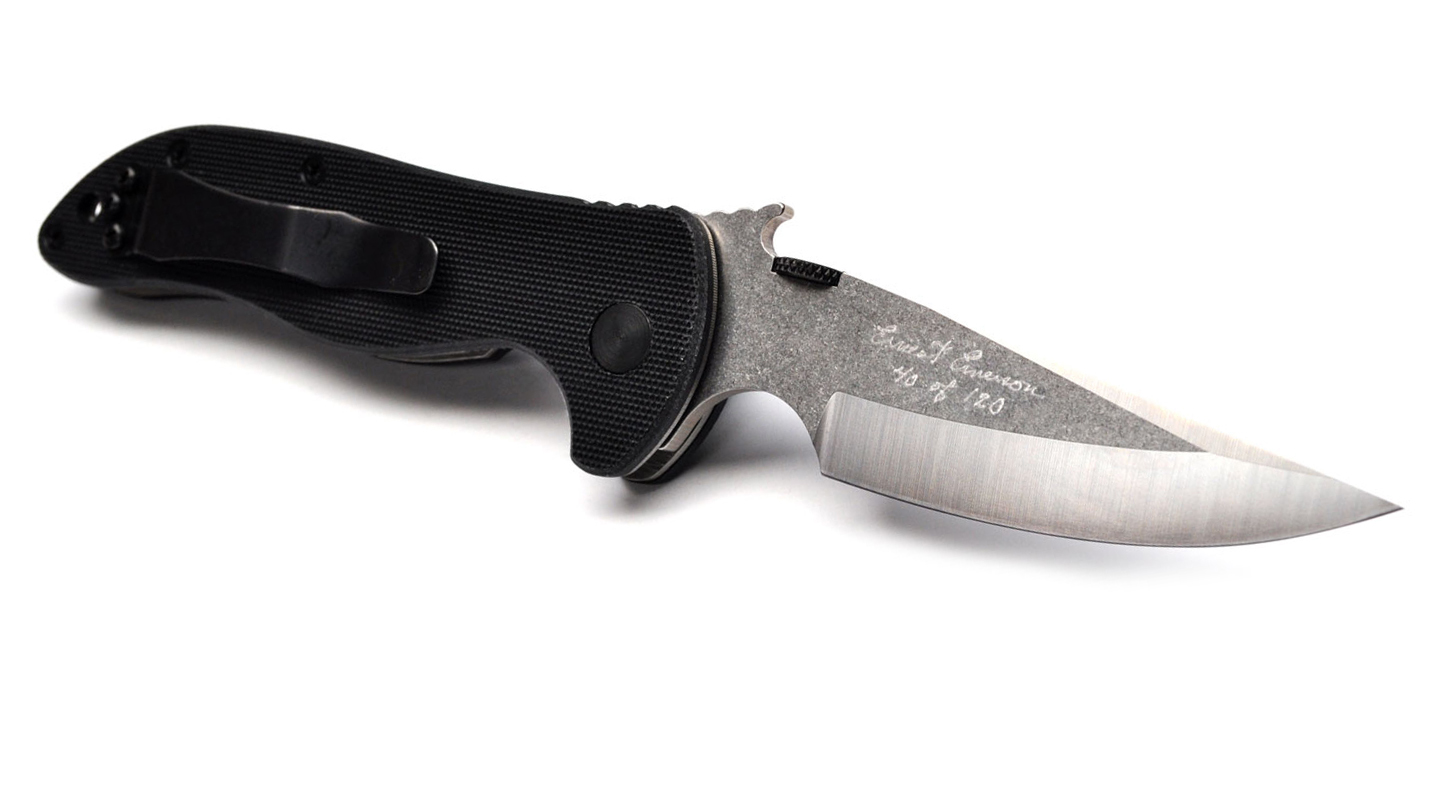
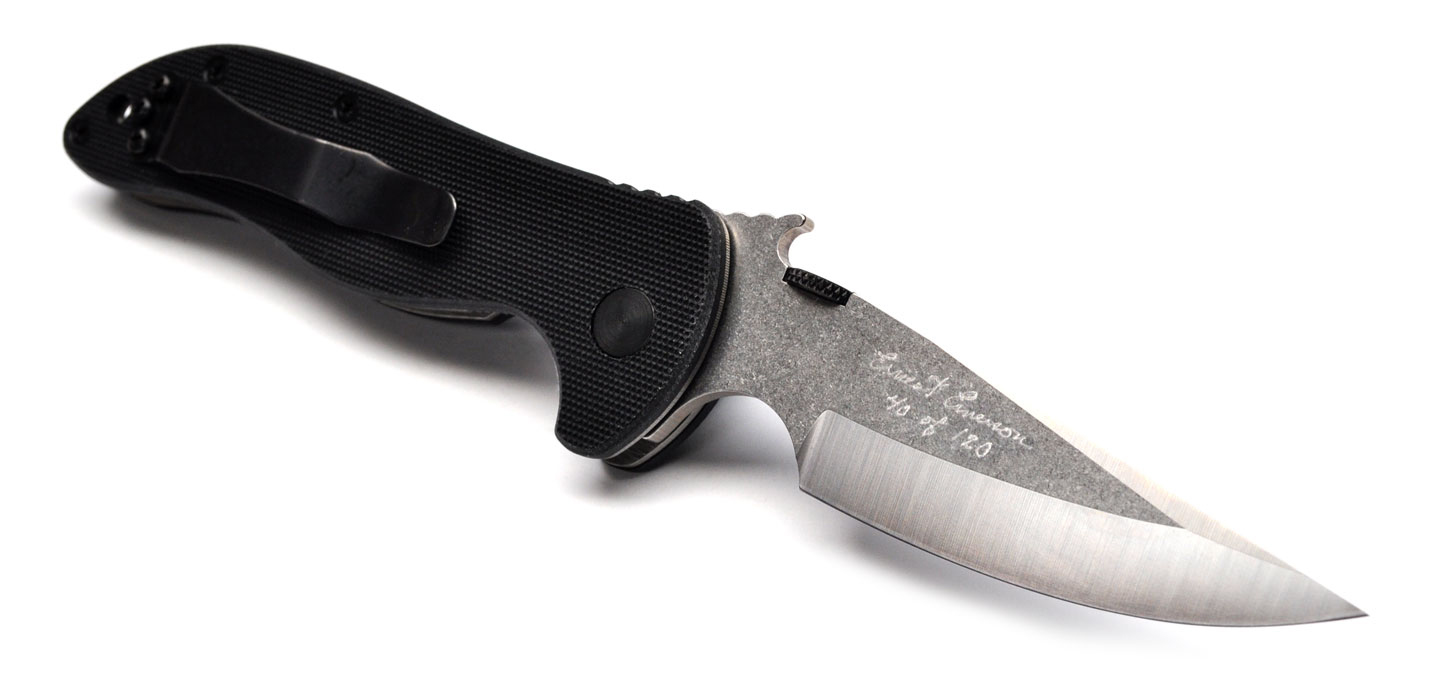
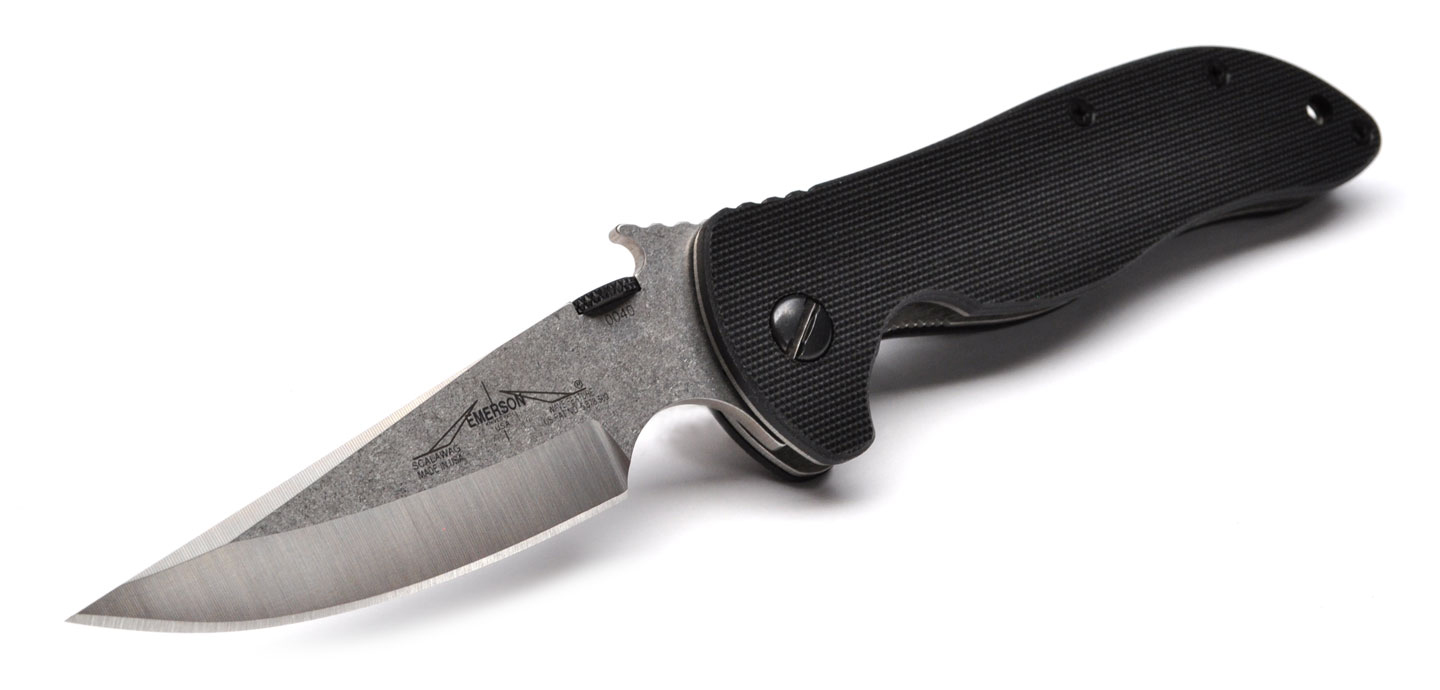
Recently, Emerson Knives has announced the release of a new special-edition folding knife, known as the Emerson Scalawag. A scalawag is an trickster or rascal, and this blade is inspired by that unpredictable spirit.
The knife is part of the Emerson Signature Series, and its limited-production release will consist of only 120 units. Each will be hand-signed by Ernest Emerson himself, and include a handwritten serial number.
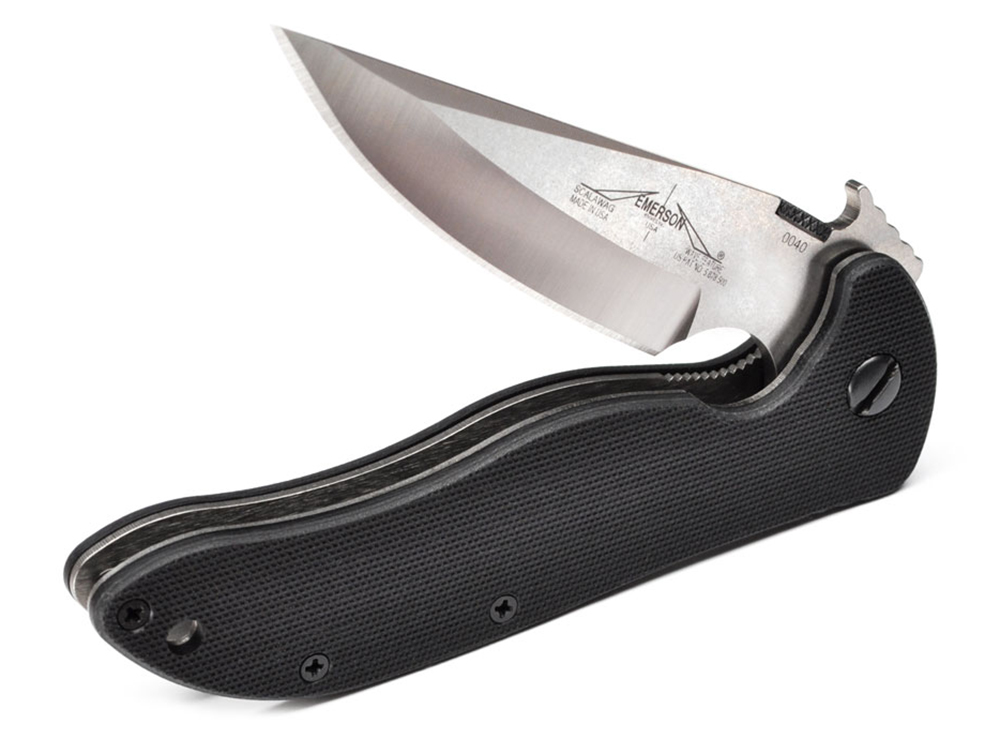
The Emerson Scalawag consists of a 3.6-inch 154CM blade, hardened to RC 57-59, with a stonewashed finish and double-V grind. The wave-shaped opening feature and thumb disc are found on many other Emerson blades, but the deep choil along the blade’s base is a unique addition. This permits the user to grip the knife with a forefinger in the choil for added control.
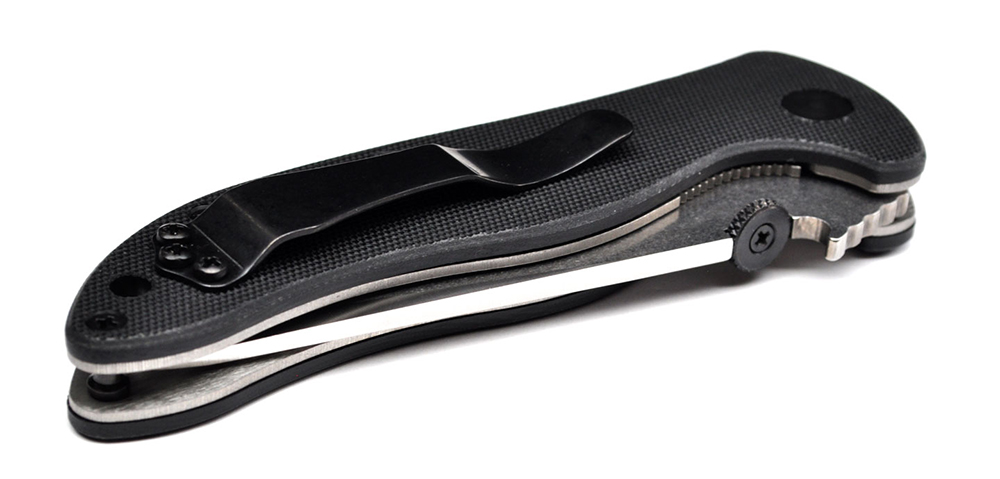
The Scalawag’s handle features a 6AL-4V titanium liner lock, flanked by black textured G10 scales. There’s also a black pocket clip, black hardware, and a built-in lanyard hole. Folded shut, the knife measures 4.7 inches long, and it weighs 5 ounces.
This knife is available at an MSRP of $225, until all 120 units are sold. Buyers can also customize the blade with a few additional options: a skull lanyard ($15), serrations ($5), or reversed pocket clip for left-hand carry ($25). For more information on the Emerson Scalawag, visit EmersonKnives.com.
Emerson has also announced the release of a new X-HD Karambit, which we snuck a photo of at Blade Show. Our friends at RECOILweb.com will be writing about it in the near future — stay tuned for a link.
Whether you live in a location that naturally experiences cold weather, or you actively seek out snow for recreational purposes, you’re bound to learn the value of quality winter clothing. Apparel that’s too breathable, like a cotton sweatshirt, will soak up moisture like a sponge. Apparel that’s not breathable enough, like a plastic emergency poncho, will trap your body’s sweat leaving you feeling stifled and hot.
In fact, non-breathable winter gear can be even worse than absorbent cotton in some circumstances. It will shock your body into overheating, dehydrate you through excessive sweating, and tempt you to remove clothing layers. If you do remove layers, your sweat will cool rapidly in the open air, causing your body temperature to plummet and potentially leading to hypothermia.
Polartec Neoshell fabric allows water vapor to escape, while blocking external moisture sources.
This is why selectively permeable fabrics are essential during winter months. They block outside moisture, so you won’t be soaked by rain or snow, but also allow your perspiration to escape. In the video below, YouTube channel In the Making meets with Strafe Outerwear to discuss the importance of breathability. Strafe uses Polartec Neoshell fabric to regulate air exchange in their clothing.
Of course, there’s a delicate balance between keeping the skin cool and dry, and releasing too much heat or moisture. Different fabric blends can regulate this process, which is why companies like Polartec offer dozens of materials to choose from. Apparel manufacturers can then strategically use these raw materials to craft gear designed for a specific setting or temperature range. Just like you wouldn’t sleep in a 0°F sleeping bag during the summer, you shouldn’t wear winter gear that’s designed for an environment that’s significantly colder (or warmer) than your surroundings.
To learn more about the science behind insulation, check out Polartec.com.
We’ve said it before, and we’ll say it again: when it comes to survival gear, two is one, and one is none. This mindset of redundancy leads us to carry backups of our most important survival tools, and there are few tools more essential than the knife. Survival experts around the world will agree that a trustworthy knife is one tool you won’t want to do without, so in many circumstances, it makes sense to carry a pair of blades.
The question then becomes, what pair of blades is the most practical for survival purposes? Unless you want to look like a total mall ninja, dual-wielding two identical knives is not going to work. It’s most practical to diversify your capabilities by choosing two different blades which complement each other. Usually, this means…
A large blade, for heavy-duty chopping, splitting wood, clearing vegetation, and extended reach.
A small blade, for precise slicing, skinning, carving, and peeling.
Beyond these general guidelines, there are many choices within each category. The large blade can come in the form of a machete, parang, kukri, axe, or simply a large and sturdy fixed blade. These will all enable the user to fell saplings, break down firewood, and hack through tough brush. The small blade can be fixed (such as a neck knife, boot knife, or dagger) or a folding pocket knife. Compact blades permit higher dexterity, and are used for delicate tasks where the large blade would become unwieldy.
Steel Will Knives
At Blade Show 2016, we stopped by the Steel Will Knives booth, and noticed that the company has been expanding its Druid line of Outdoor Series knives. This got us thinking about testing out a pair of Steel Will blades from this line, to see if they could serve as the complementary one-two punch we look for in a pair of survival knives.
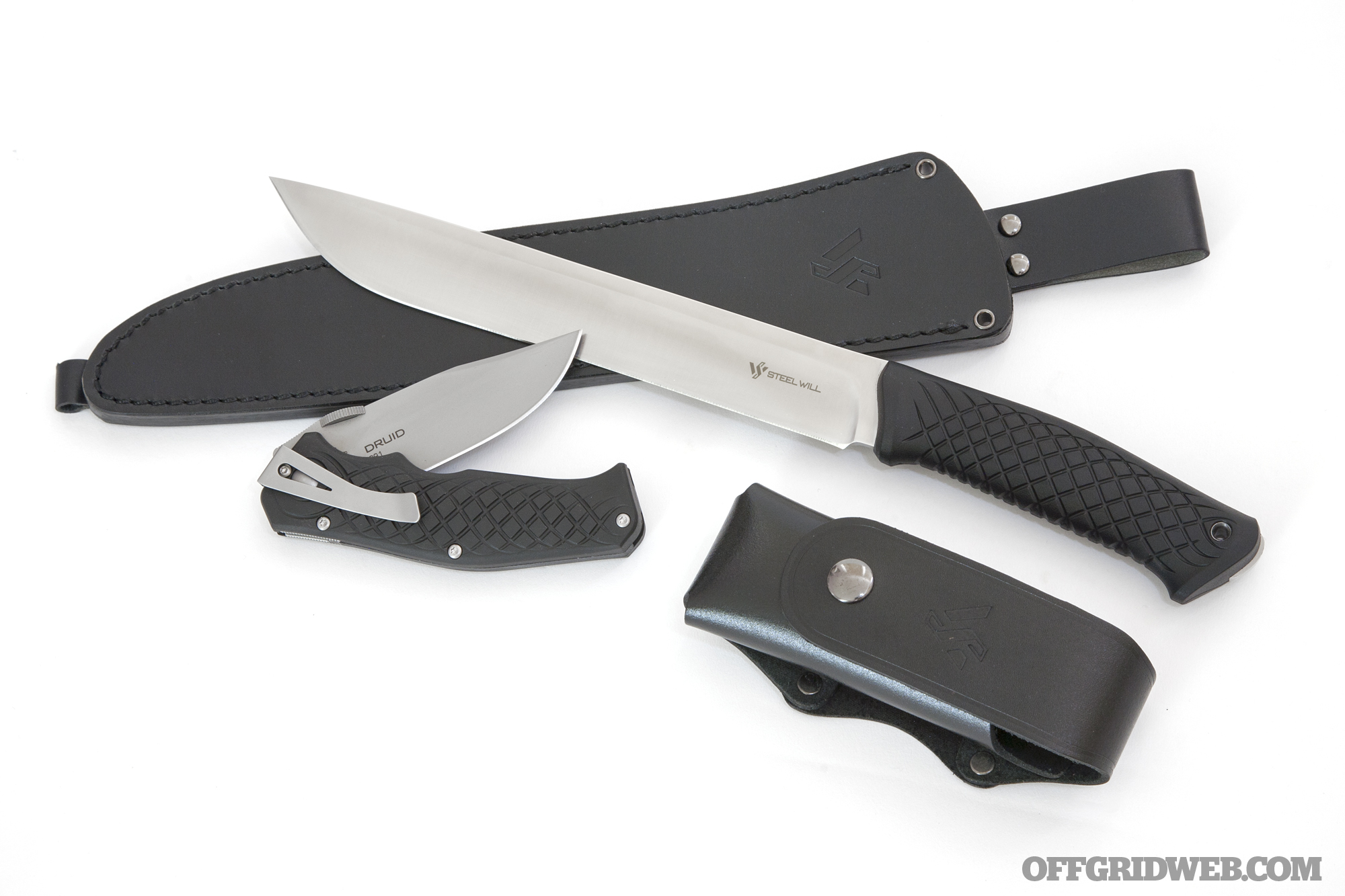
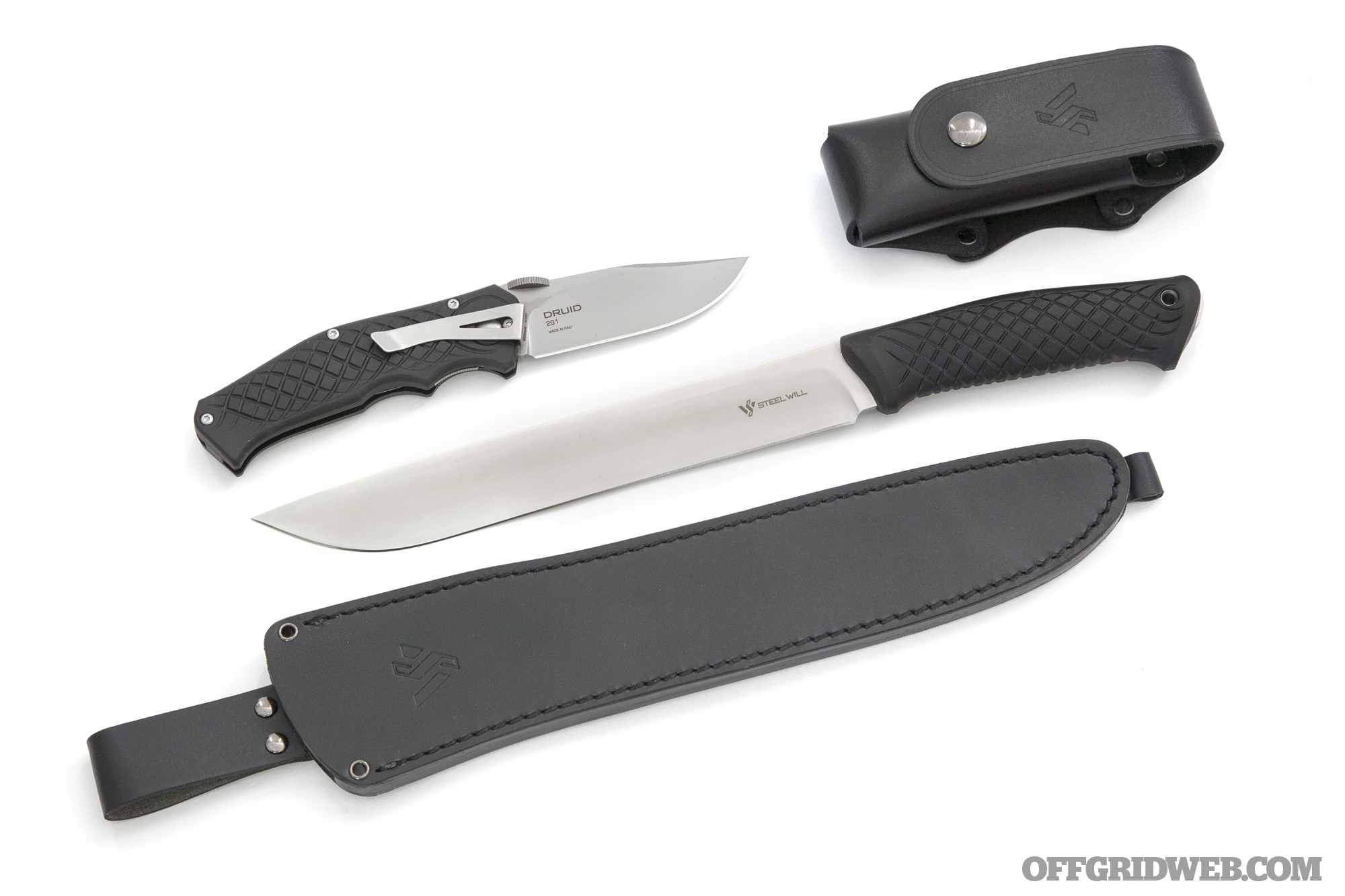
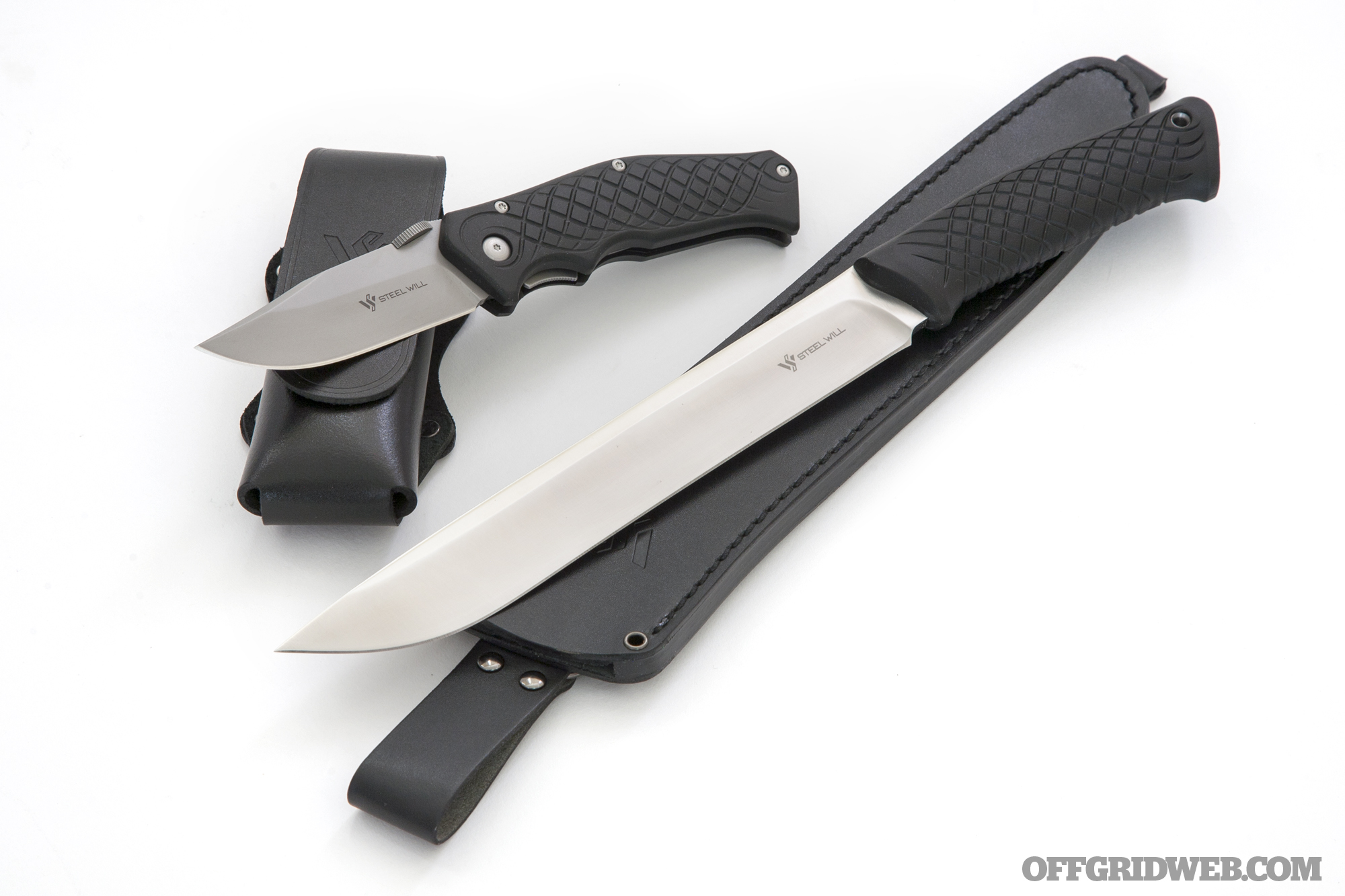
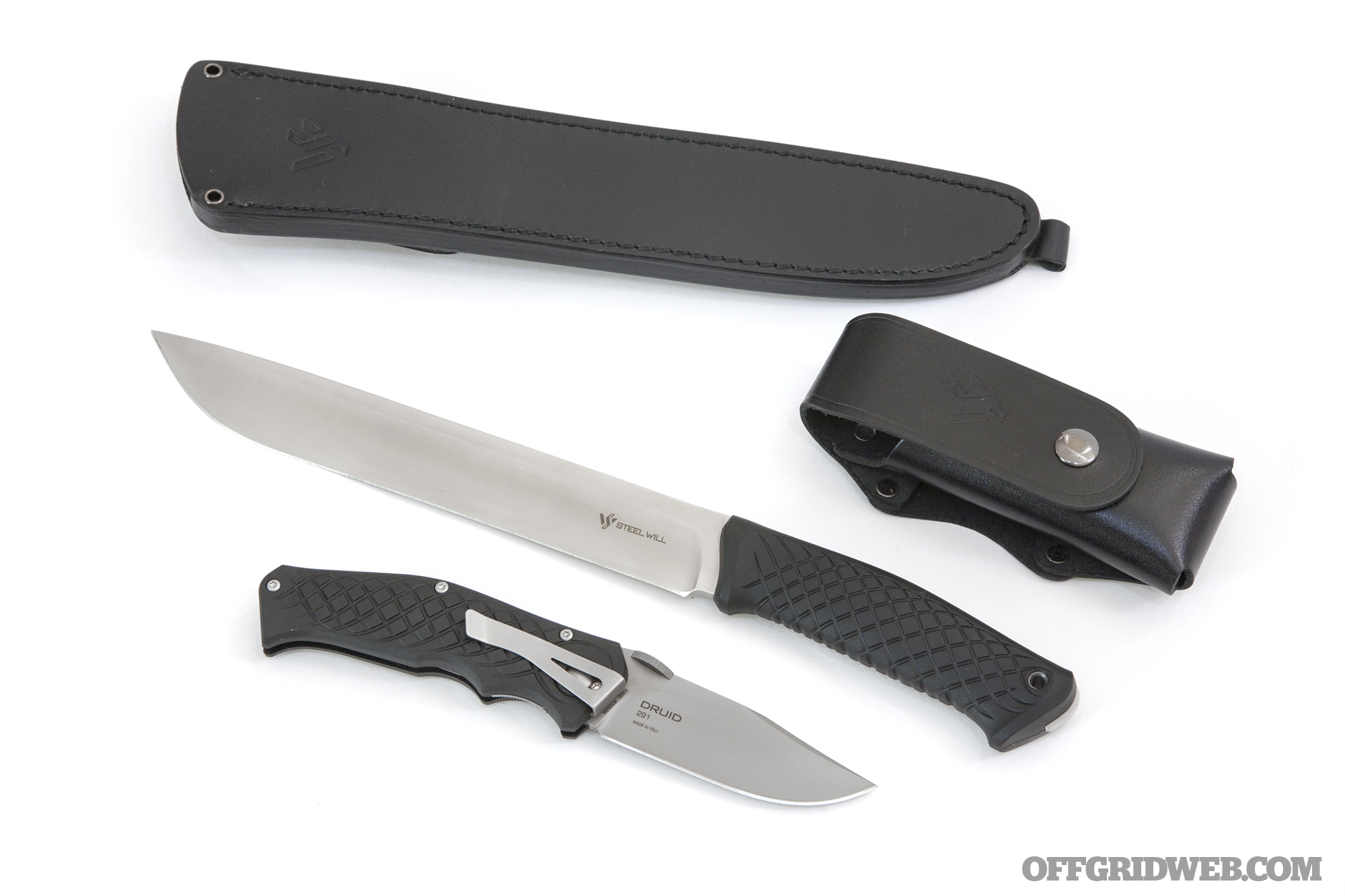
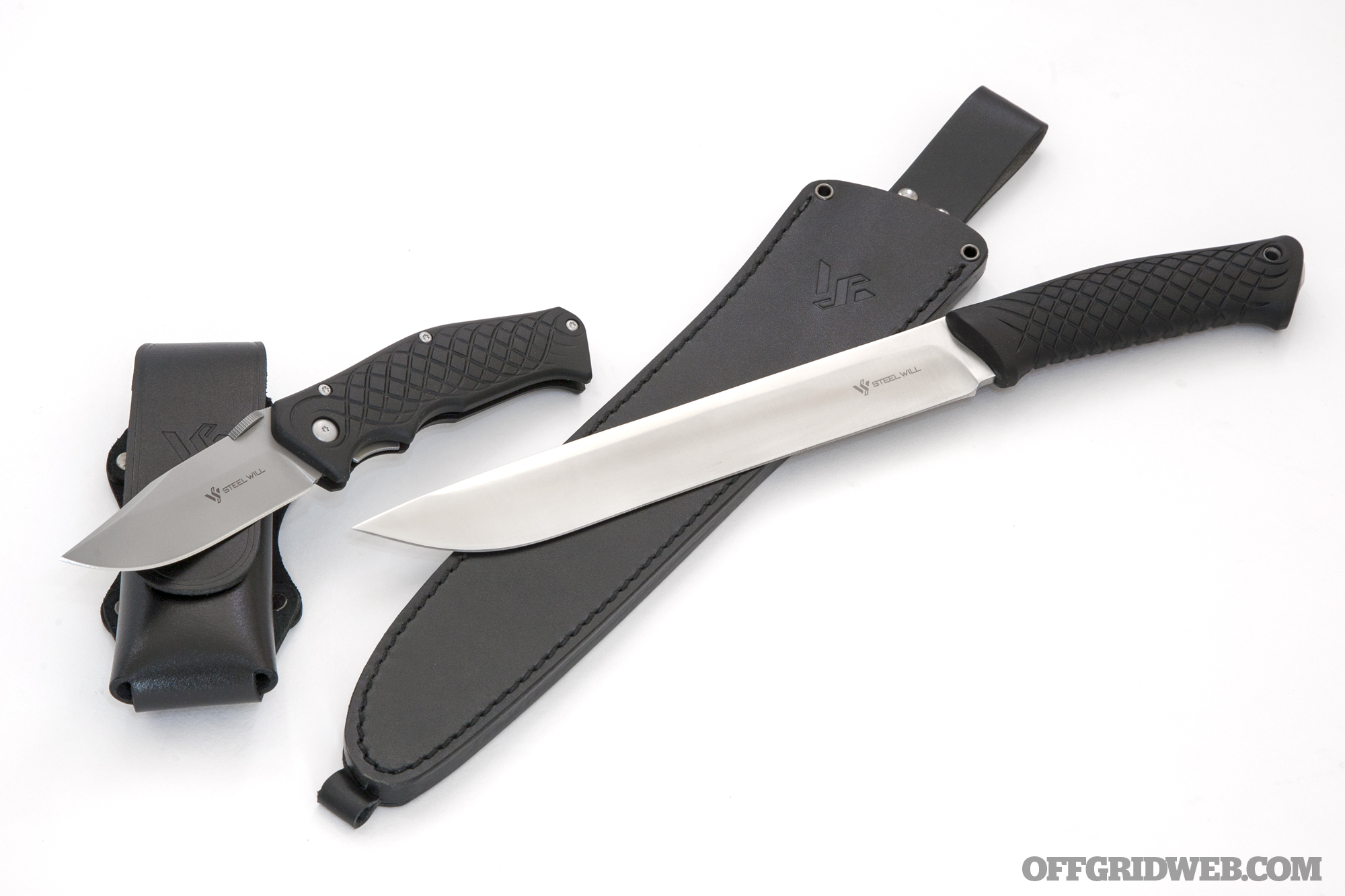
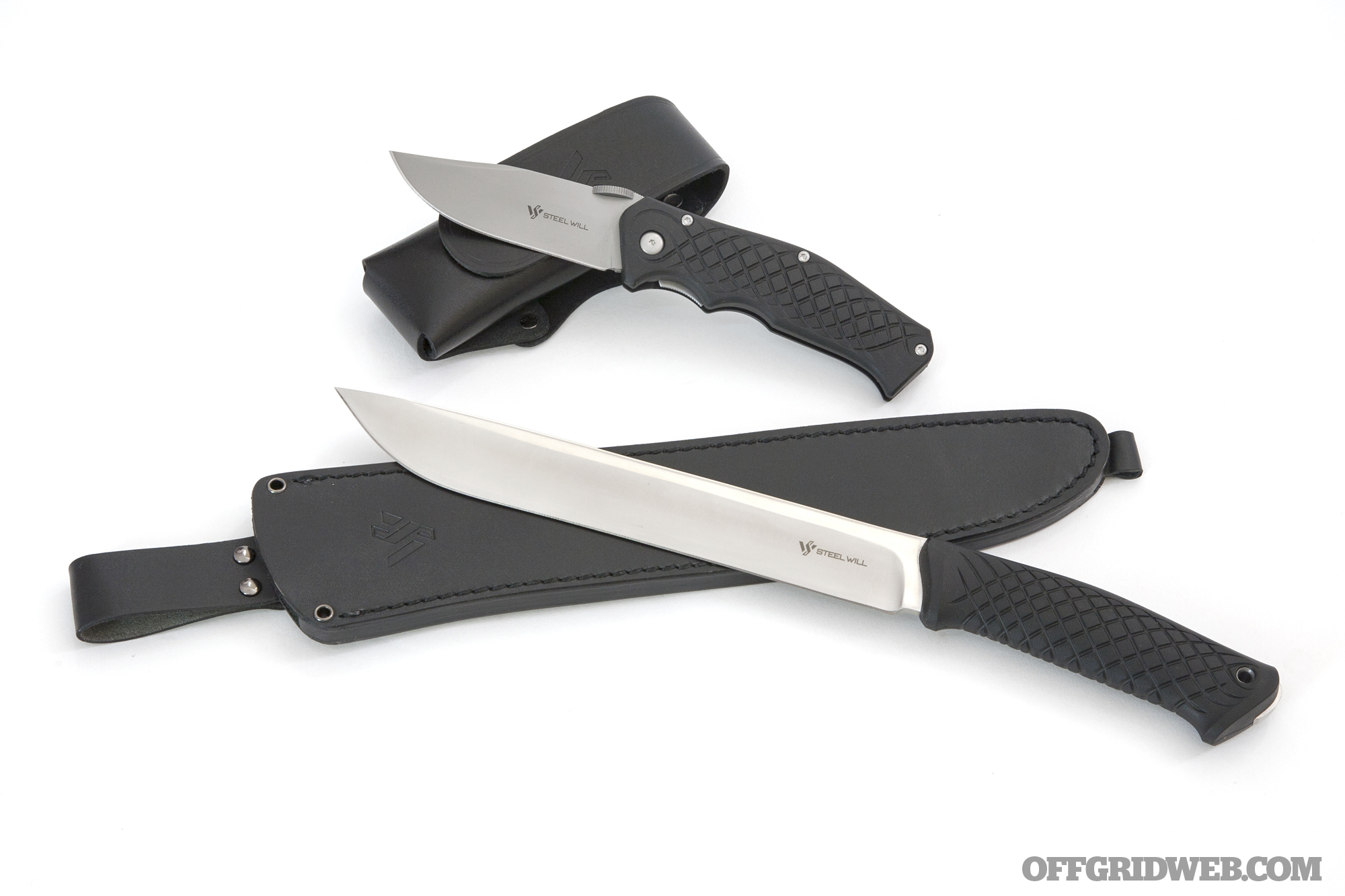
So, after the show had passed, we requested a pair of blades from the Steel Will Druid series:
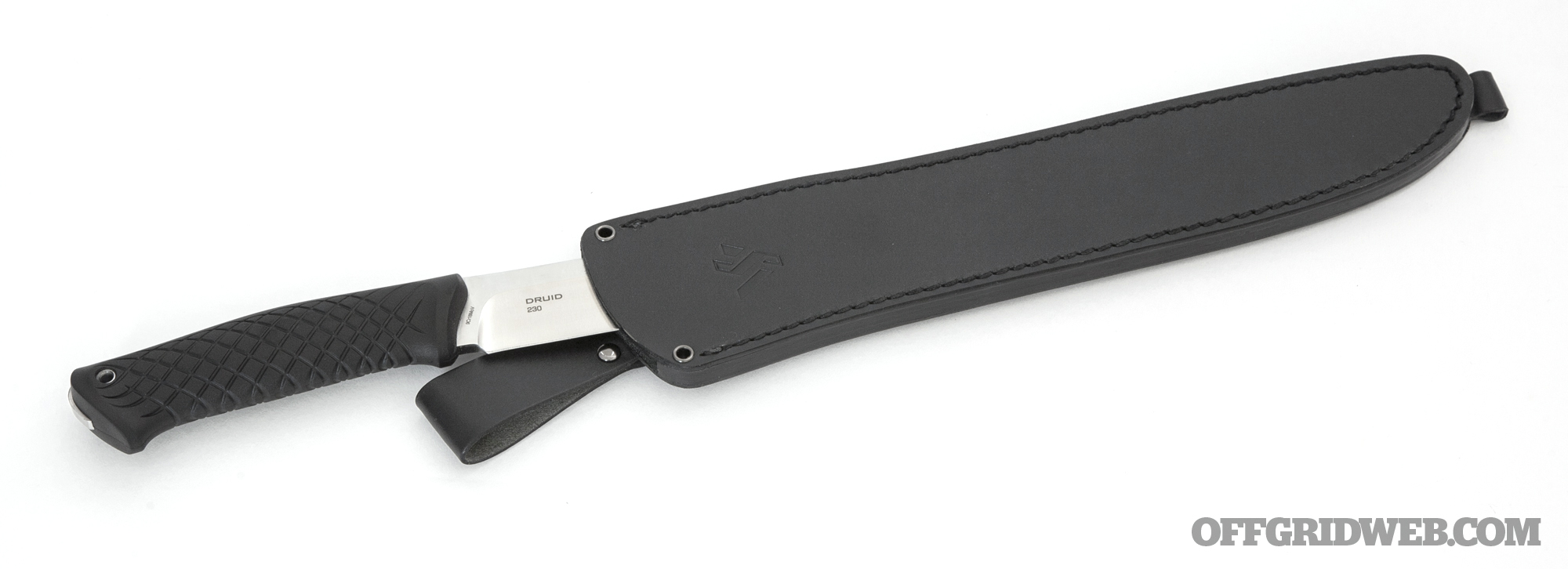
Druid 230 – a sleek fixed bushcraft knife with a 9-inch drop point blade
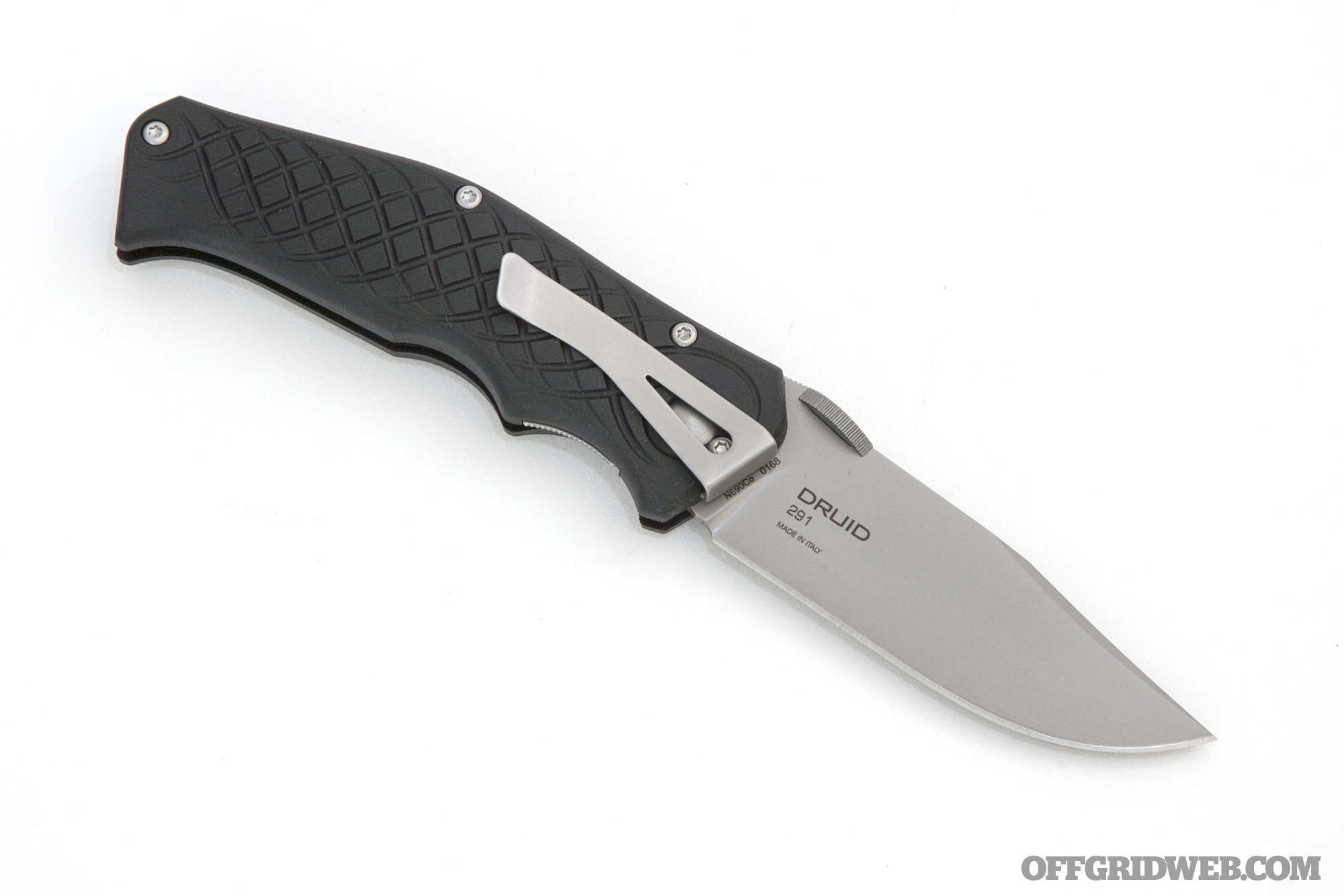
Druid 291 – a compact folding knife with a 3.7-inch clip point blade
Both of these Druids are designed with hunters, fishermen, hikers, and other outdoorsmen in mind. This is illustrated by the knives’ simple but elegant design — there are no ostentatious notches, holes, colored coatings, or unconventional blade profiles to be found here. The handles come in any color you want, as long as it’s black.
If you’re the type who prefers simplicity and clean design, these blades should appeal to your aesthetic. That’s certainly not to say they’re visually unappealing, but they’re not exactly flashy, either. This focus on purposeful design is ideal for a survival knife, as its function matters more than form.
While these two Druid knives share a similar appearance, their constructions and features differ significantly. We’ll outline the specs of these knives below, then give our verdict for each blade at the end of this article.
Druid 230 Fixed Blade
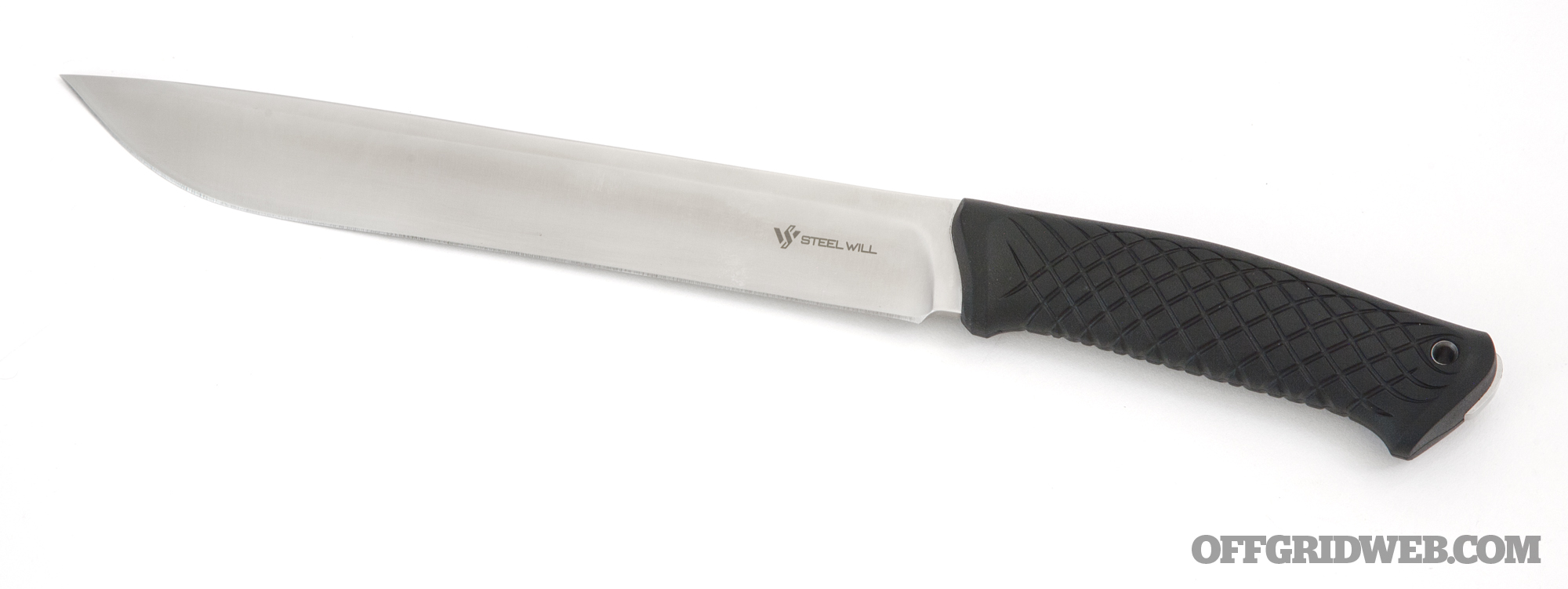
The Druid 230 is the larger of the two blades, with an overall length of 14.6 inches. The drop-point blade is 9 inches long, 0.2 inches thick, and constructed of 9Cr18MoV stainless steel. With its high 18-percent chromium content, this steel offers strong corrosion resistance. The 230’s tapered full tang extends slightly past the butt of the handle, forming an impact point for pounding, hammering, or breaking glass.
Speaking of the handle, it’s formed around the tang from thermoplastic elastomer, also called TPE or thermoplastic rubber. This material offers a slight amount of give, cushioning your hand against hard impacts. It also has excellent grip characteristics in wet or dry environments, thanks in part to the cross-hatched groove pattern found on all Steel Will Druid handles. A lanyard hole is also present, for those who wish to add decorative paracord or a wrist retention strap.
The Druid 230 includes a black leather sheath, with a belt loop and upper and lower attachment points for thigh straps. The Steel Will logo is embossed into the leather. The sheath’s slotted opening fits the blade rather loosely, so you’ll need to massage the leather a bit to open it up enough to conform to the handle.
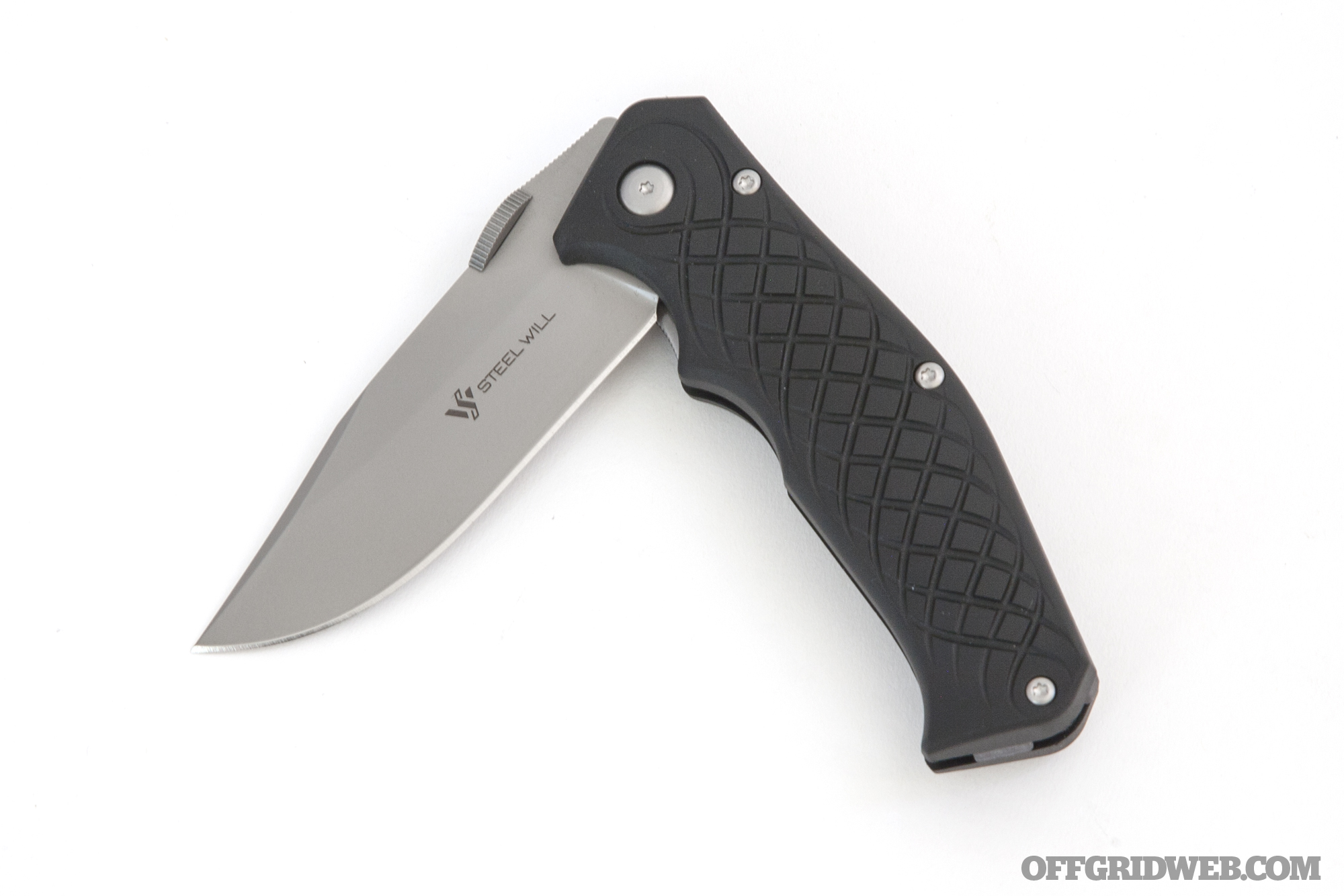
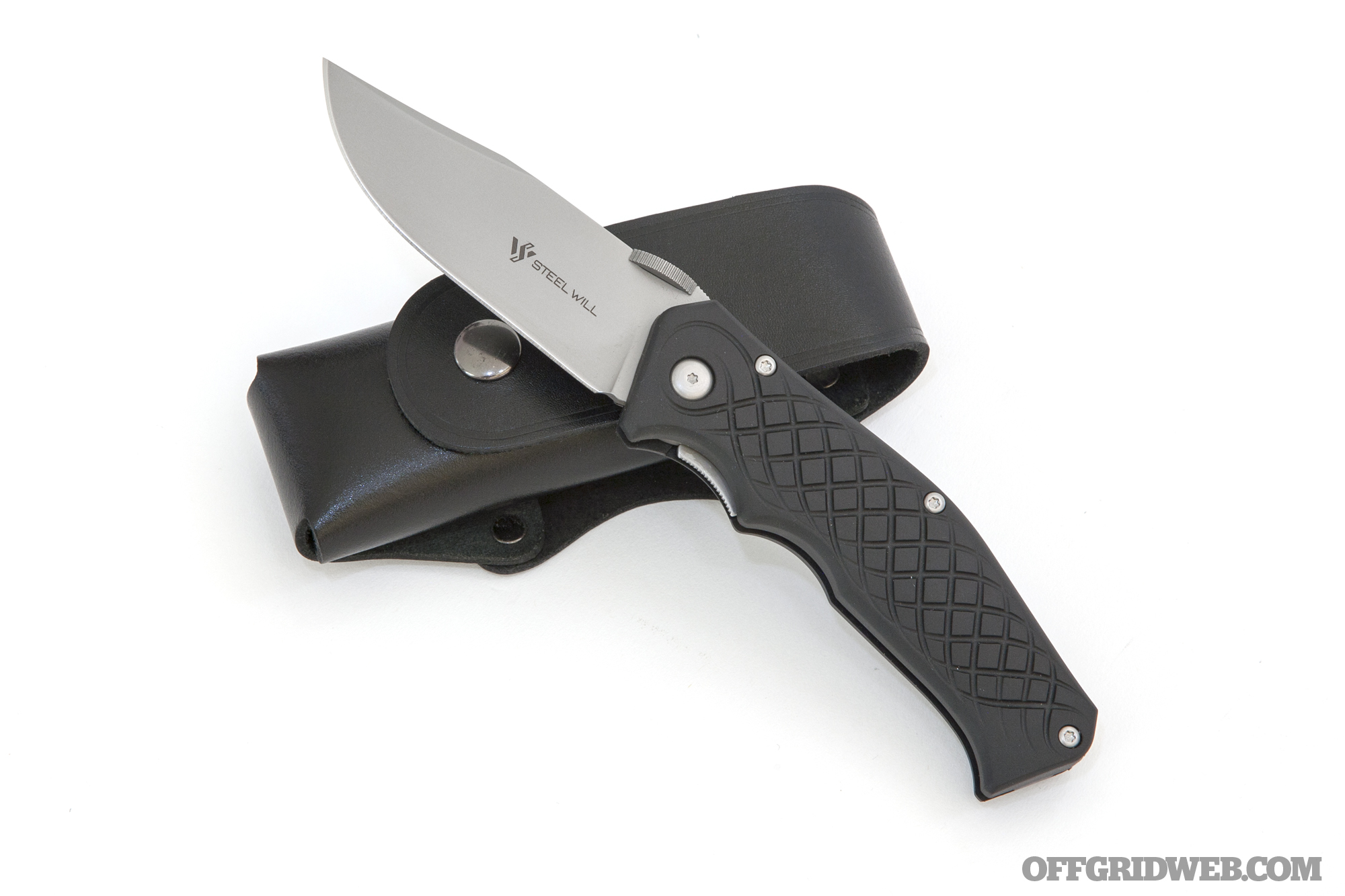
The smaller of the two blades, known as the Druid 291, is an 8.9-inch folding knife. Its 3.7-inch clip-point blade is constructed of satin-finished N690Co, an Austrian-made stainless steel. The N690Co steel is comparable to 440C or VG-10, but also contains cobalt for added hardness, and offers excellent corrosion resistance. This knife is manufactured in Italy, as noted on the flat of its blade.
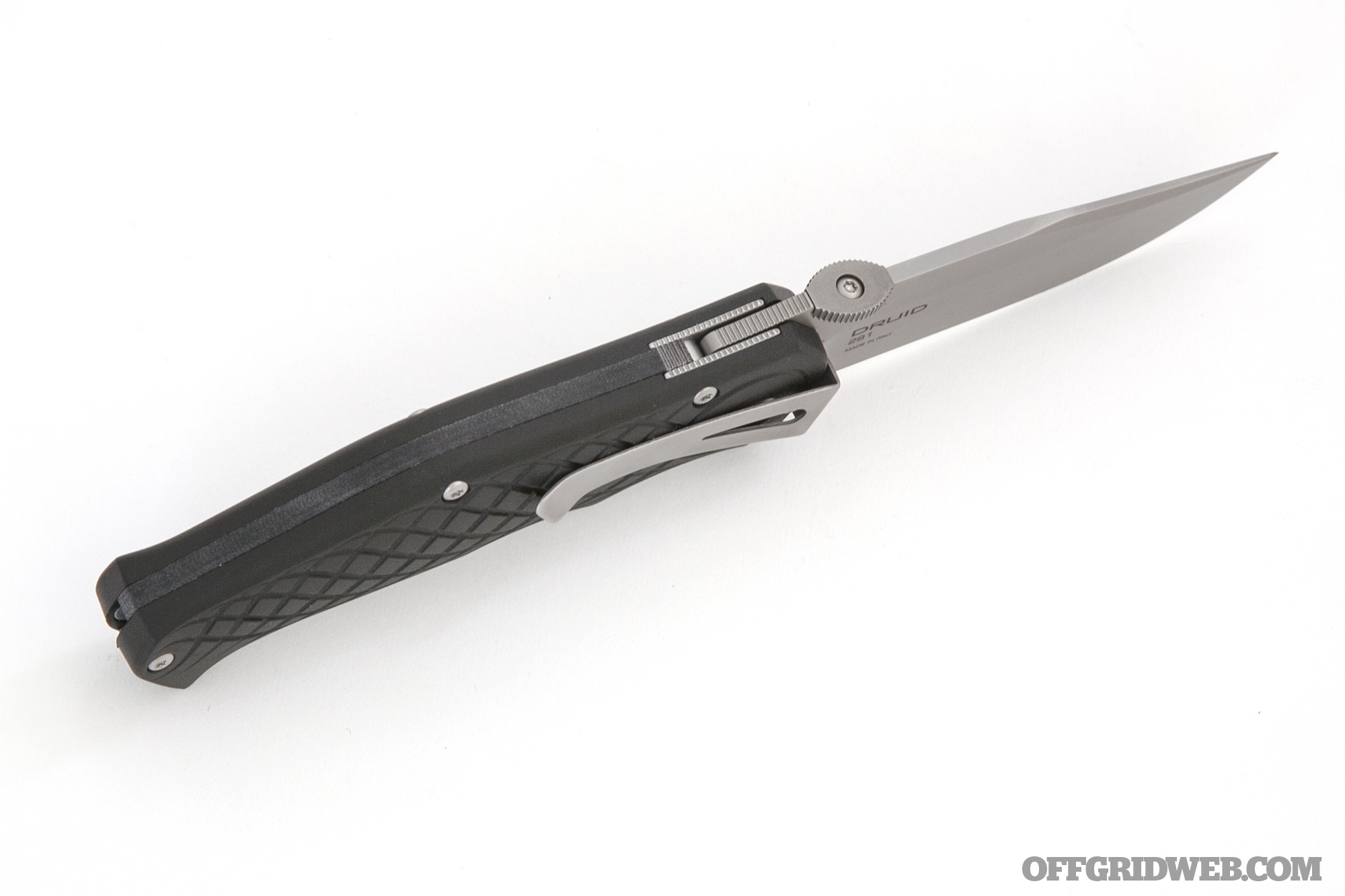
An oblong thumb disc yields plenty of leverage to flip open the blade, and also provides leverage while cutting. A liner lock keeps the blade locked in place. The Druid 291’s handle color and texture are nearly identical to that of the larger Druid 230, but its composition differs. This folder’s handle scales are formed from fiber-reinforced nylon (FRN), which is harder than the TPE handle material used on the fixed blade.
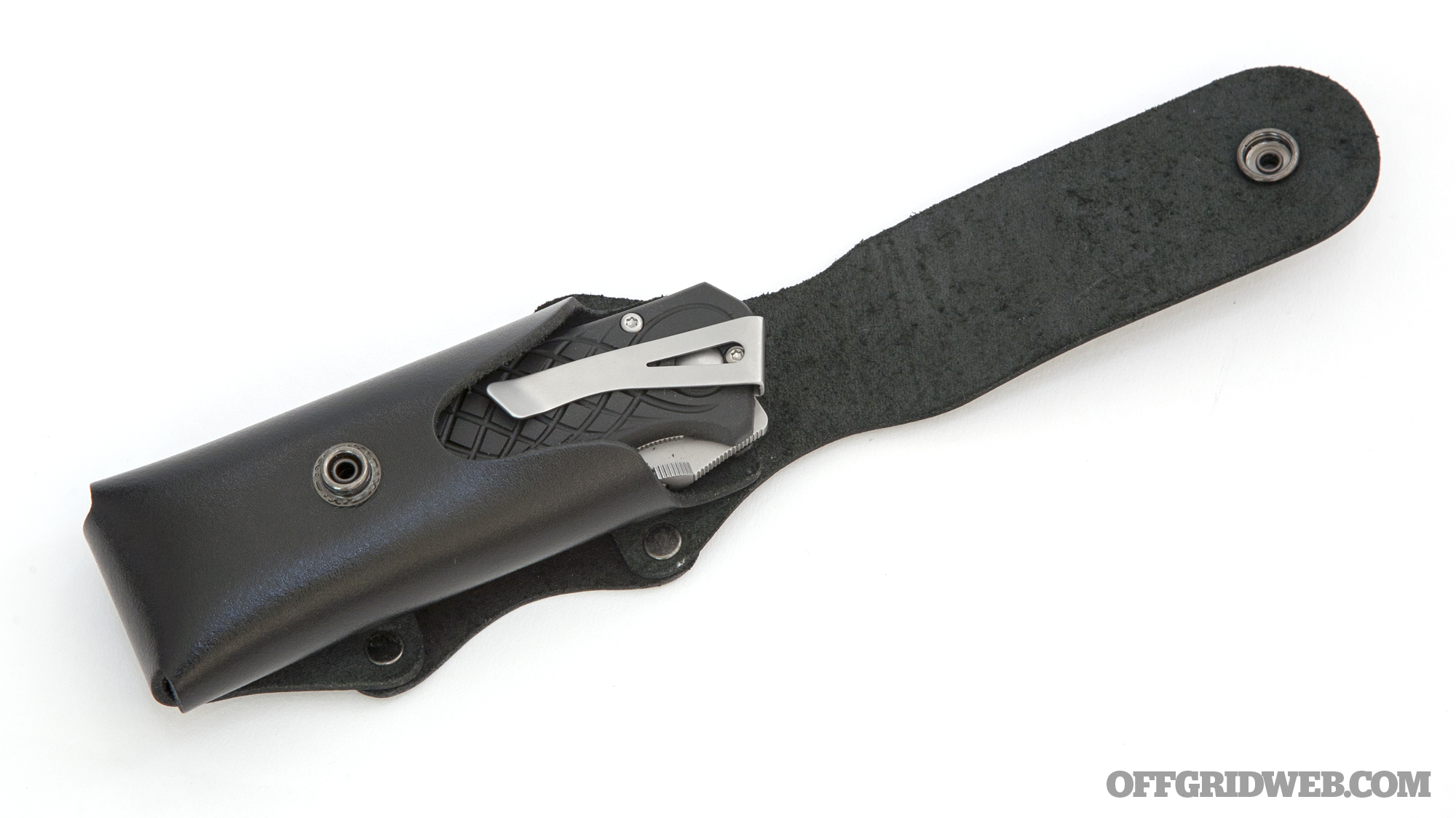
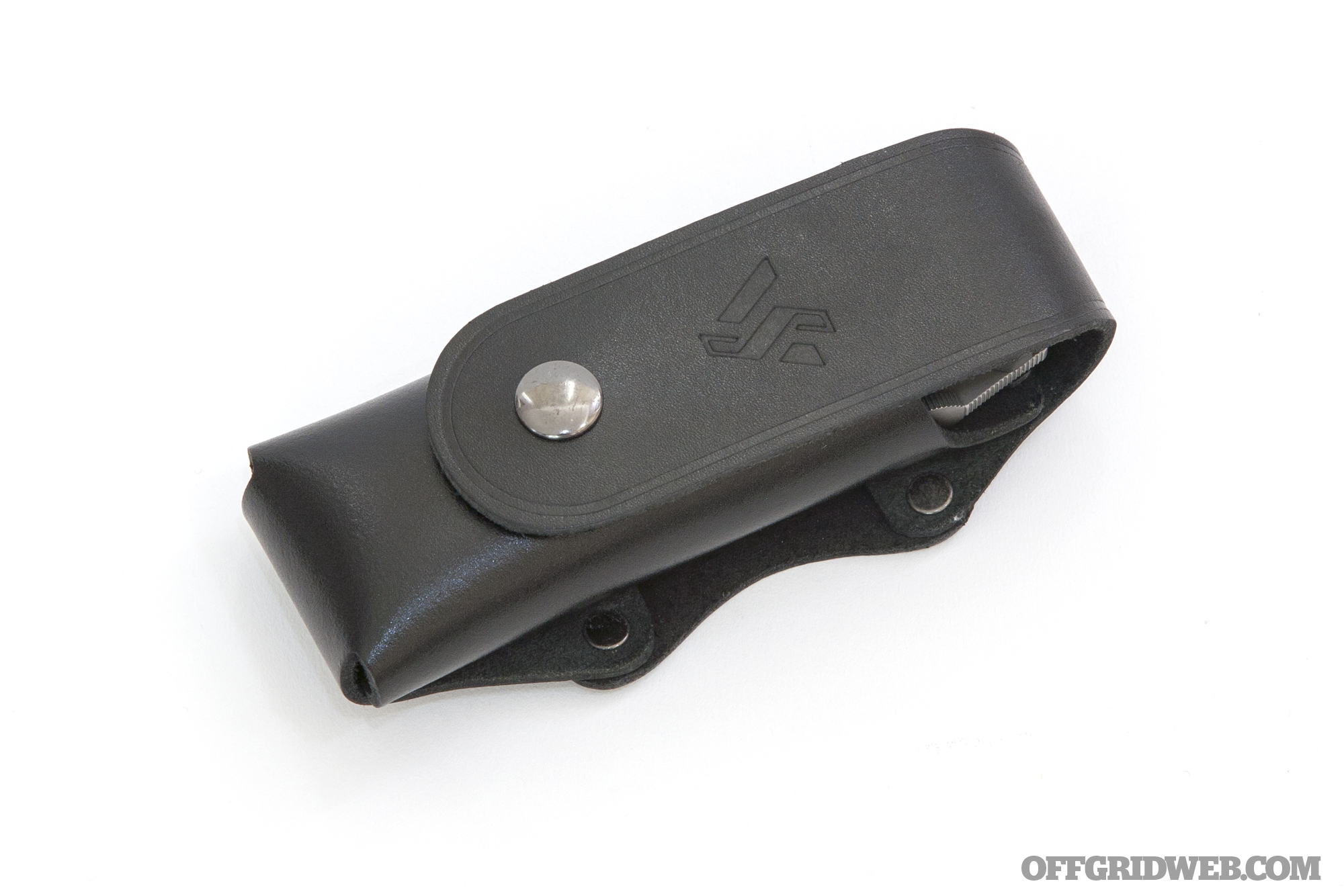
You may notice the Druid 291 has both a pocket clip and a leather holster. Steel Will tells us that during initial testing, the deep-carry clip and textured handle made the knife difficult to remove quickly from some pockets—it’s so grippy that it dragged on and wore down thicker fabrics. So, the company added a belt holster as an additional method of carrying the knife. It’s nice to have the extra option, depending on your preference.
We spent some time testing out each of these blades, and wrote down our general impressions, as well as a list of pros and cons for each.
First, the Druid 230 — its light weight and excellent balance makes it feel like a natural extension of the hand. Given its straight and slender blade, it behaves a lot like a hybrid between a machete and a large knife. It’s easy to swing quickly, and excels at slashing cuts.
The handle material is nicely textured, but our real gripe with the Druid 230 is the handle shape. It feels like it belongs on a 7- or 8-inch knife, like some of the smaller fixed-blades in the Druid family, rather than a 14-inch chopper. Also, it lacks a proper forefinger guard to prevent your fingers from slipping onto the blade (or off the end of the handle). That’s not reassuring for a knife this size, and we’d say it’s this blade’s biggest flaw.
The affordable 9Cr18MoV steel resists corrosion well, and held its edge admirably. However, most stainless steel in this family originates from China, and the fact that this blade’s country of manufacture is unlisted (unlike the Italian-made Druid 291) leads us to believe it may be made in China as well. If you’re planning on lots of extremely hard chopping and batoning wood, you may be better off with a tough yet less corrosion-resistant high-carbon blade. The Druid 230 is better suited for users who don’t plan to hammer it mercilessly.
Pros – Druid 230:
Wonderfully balanced and lightweight (11.5 oz)
Included high-quality leather sheath
Good value for under $100
Cons – Druid 230:
Handle lacks a substantial forefinger guard
9Cr18MoV stainless steel wouldn’t be our first choice for heavy and repeated chopping
Now, on to the recently-released Druid 291 folding knife. The fit and finish of this knife really impressed us. The blade pivots smoothly, and its liner lock clicks firmly into place. The clip point blade shape is timeless, and this knife is also offered in a drop point style (the Druid 290). Austrian-sourced Bohler-Uddeholm N690 is one of our favorite steels for folding knives, due to its hardness and edge retention.
The handle is what we’d call chunky, but that’s not a flaw per se — it works well for those with larger hands due to its substantial thickness and 5.2-inch folded length. As far as the carry options, we’d agree with Steel Will’s statement that “using the included holster is ideal”. The deep pocket clip is a nice backup option, but we found that it’s rather awkward in most cases. Unless your pants have thin seams and taut fabric, this knife is almost guaranteed to provide resistance as you yank it from your pocket. Forget about trying to draw it quickly from a pair of jeans.
That said, the leather holster is quite well-made, and we found ourselves growing to like it. We will mention that it’s less subtle than a pocket-carried knife, if discretion is a priority.
Pros – Druid 291:
N690Co steel is excellent for this application
Thick handle design and thumb disc provide tons of grip while cutting
Nice fit and finish
Cons – Druid 291:
Not ideal for pocket carry — expect to use the holster in most cases
Conclusions
To return to our original question, do these two Steel Will Druid knives form a cohesive pair? After testing, we’d say that they do. The fixed-blade Druid 230 works well for clearing brush, and the folding Druid 291 provides the precision needed for smaller cuts. Neither knife is without flaws — specifically, the lackluster finger guards on the 230, and the 291’s reliance on an external holster. But looking at the bigger picture, they complement each other well, and both Druid knives would be strong assets in any outdoor situation.
For more information on these and other Steel Will blades, visit SteelWillKnives.com.