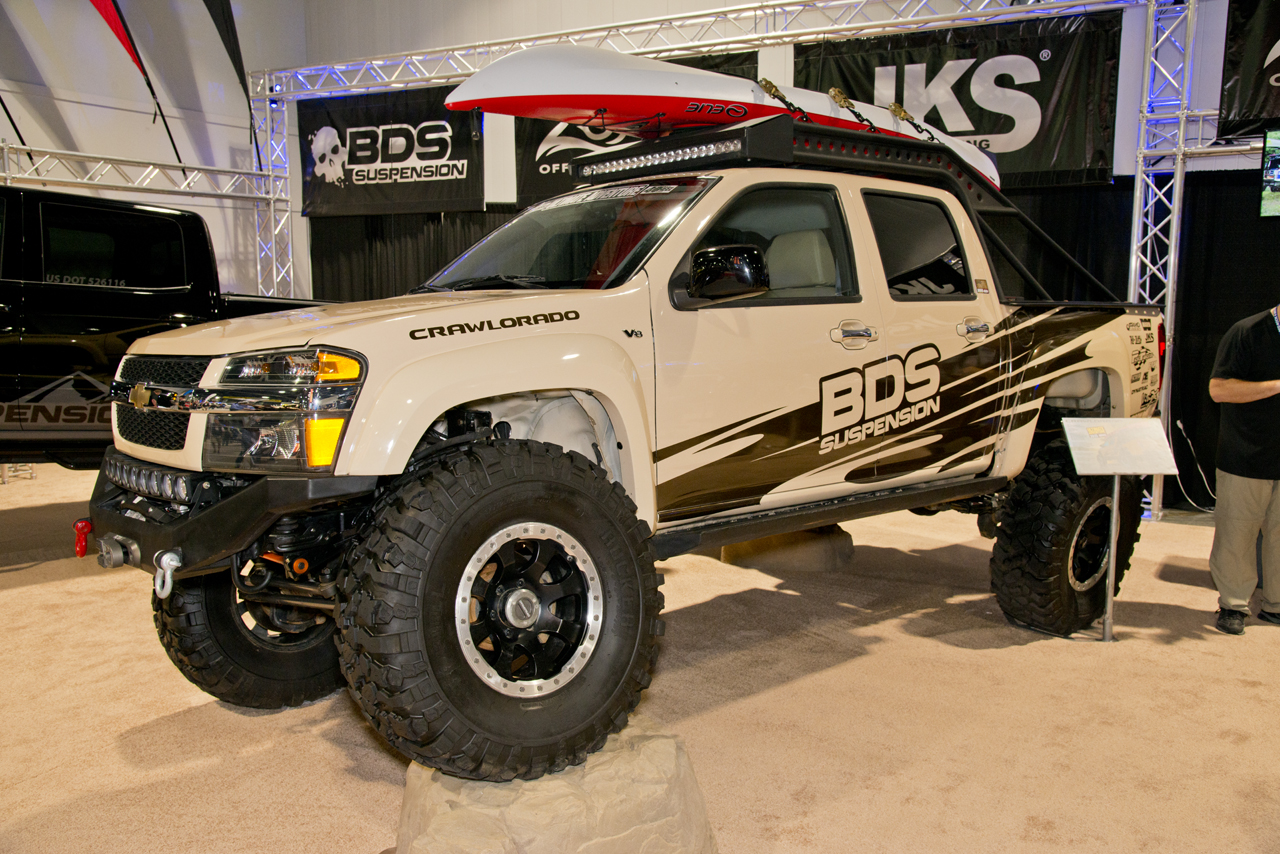
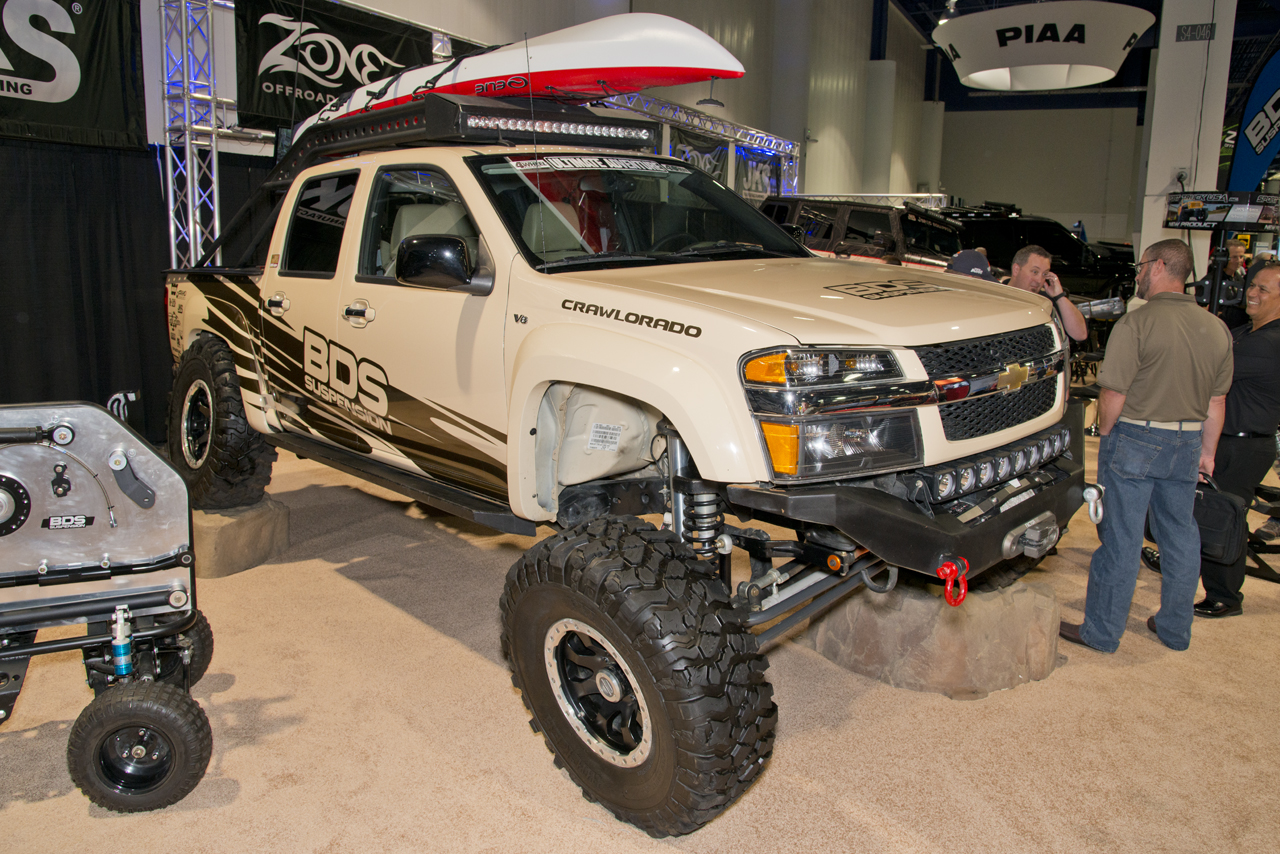
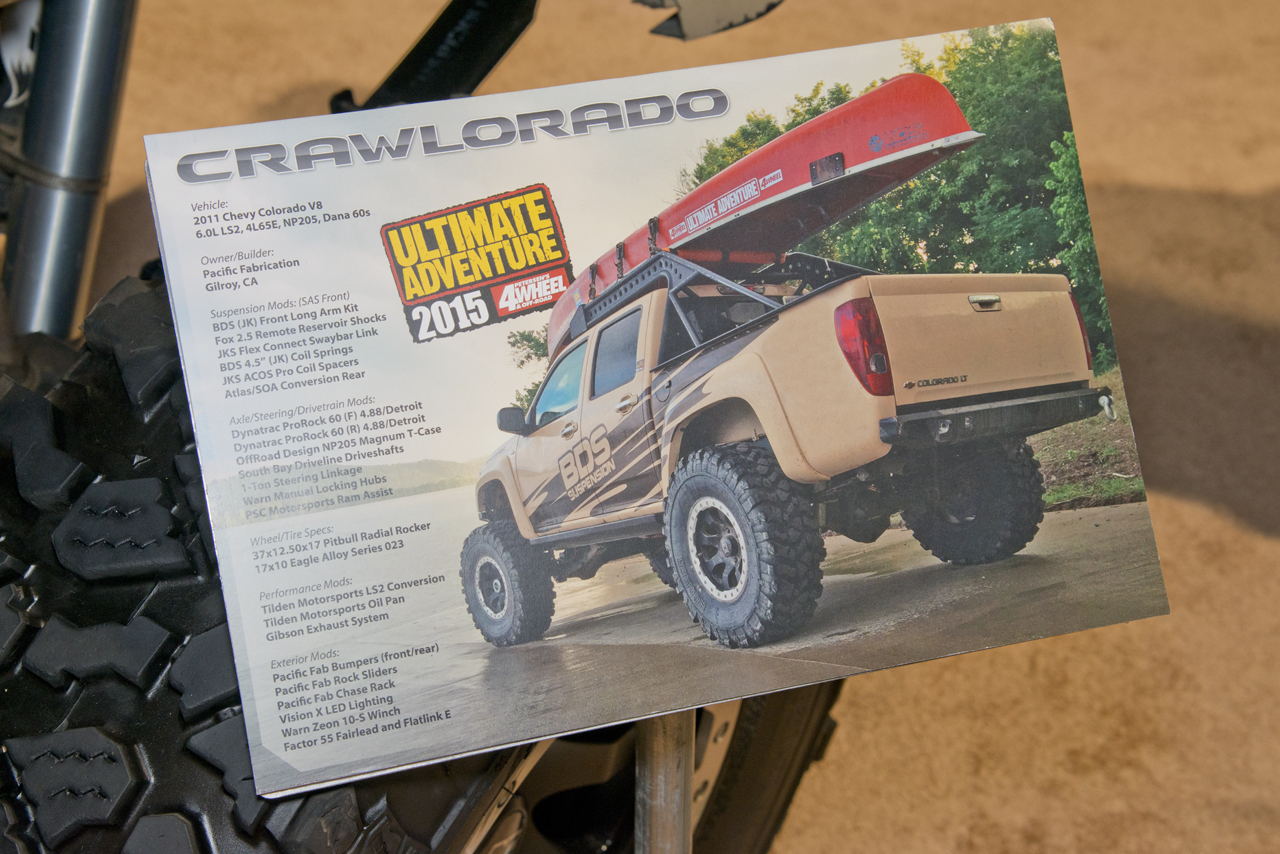
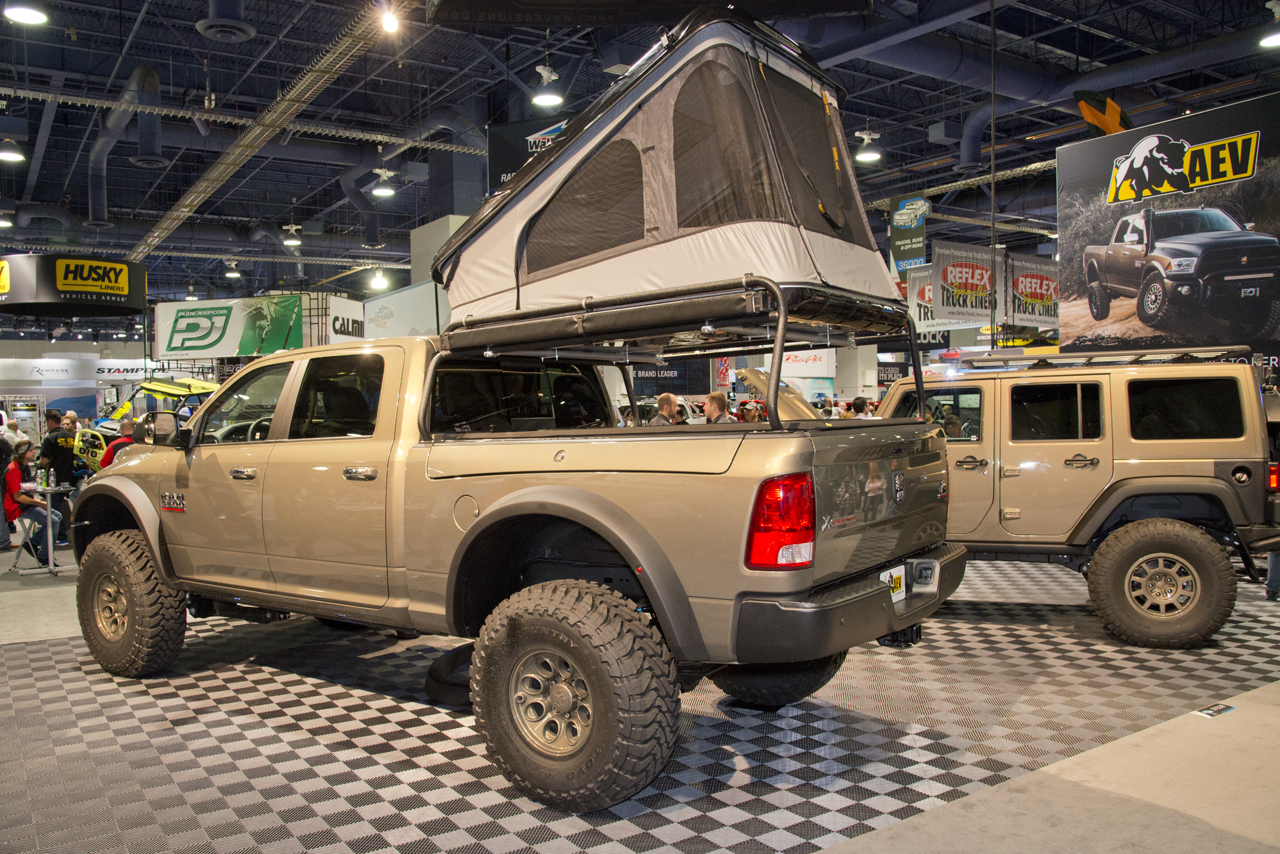
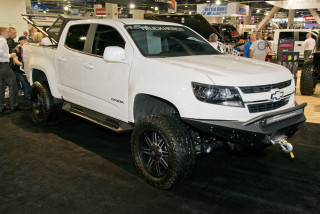
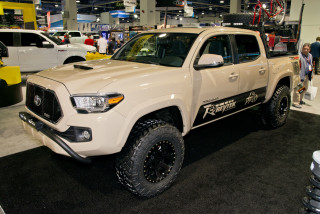
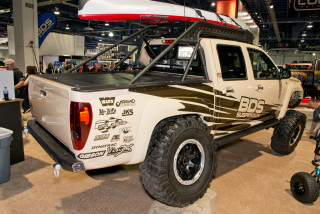
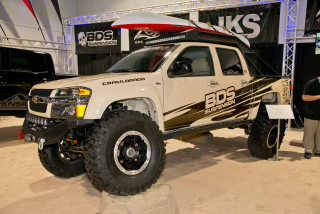
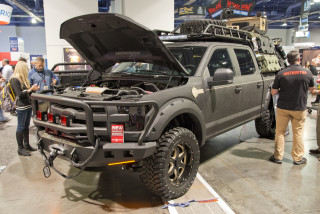
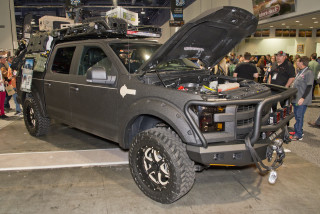
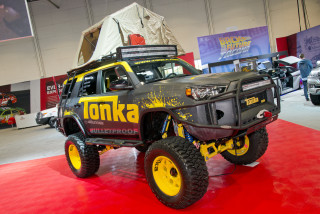
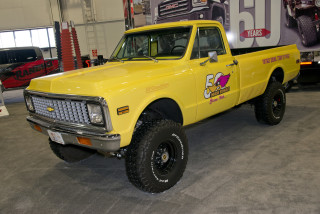
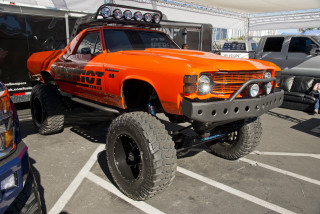
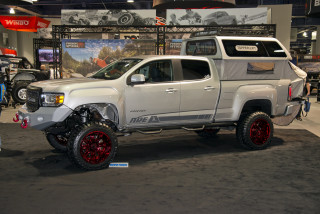
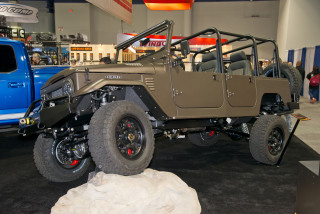
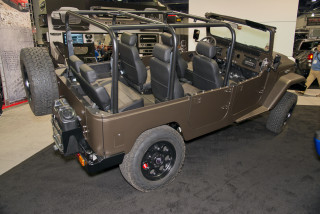
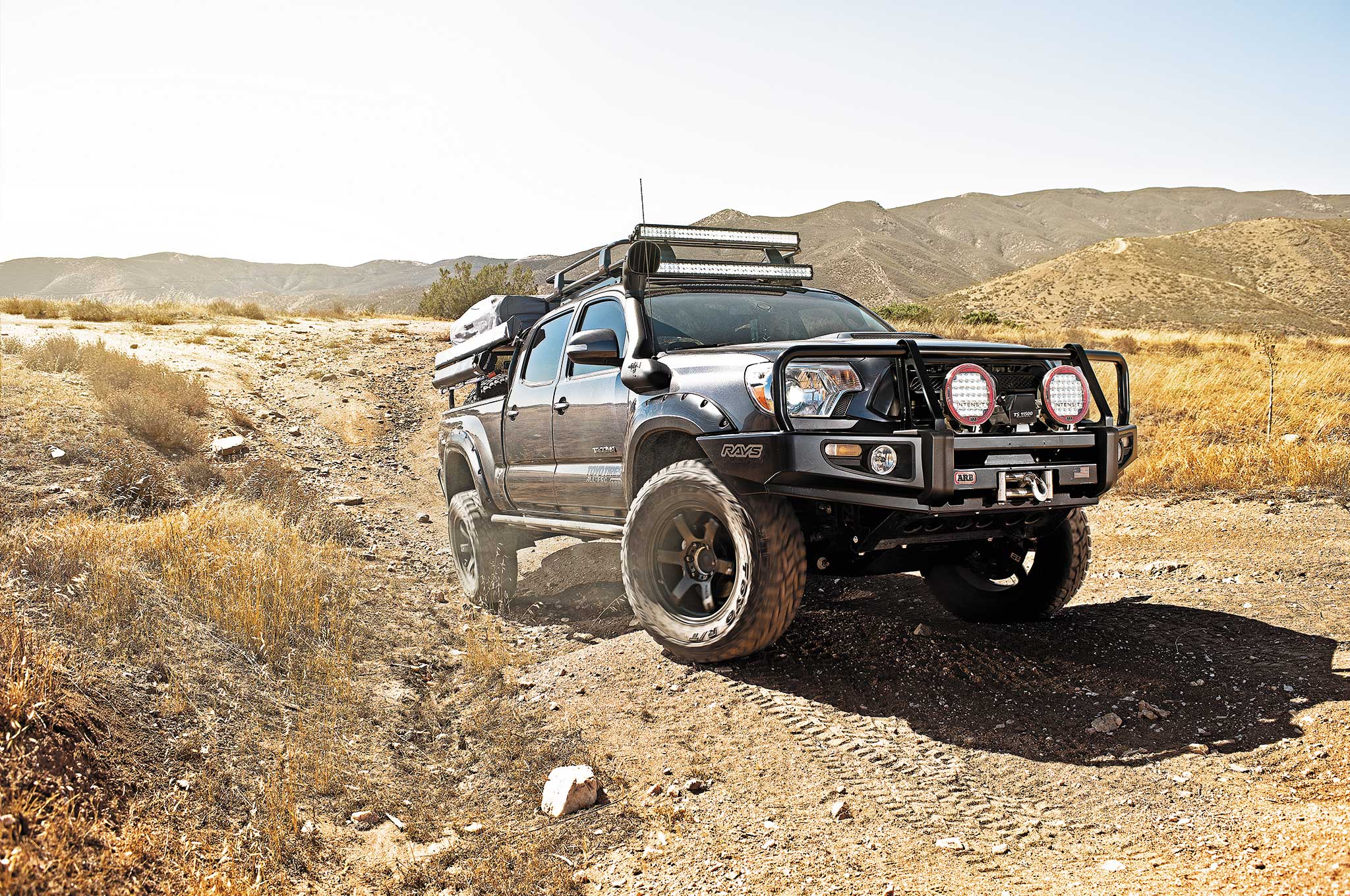
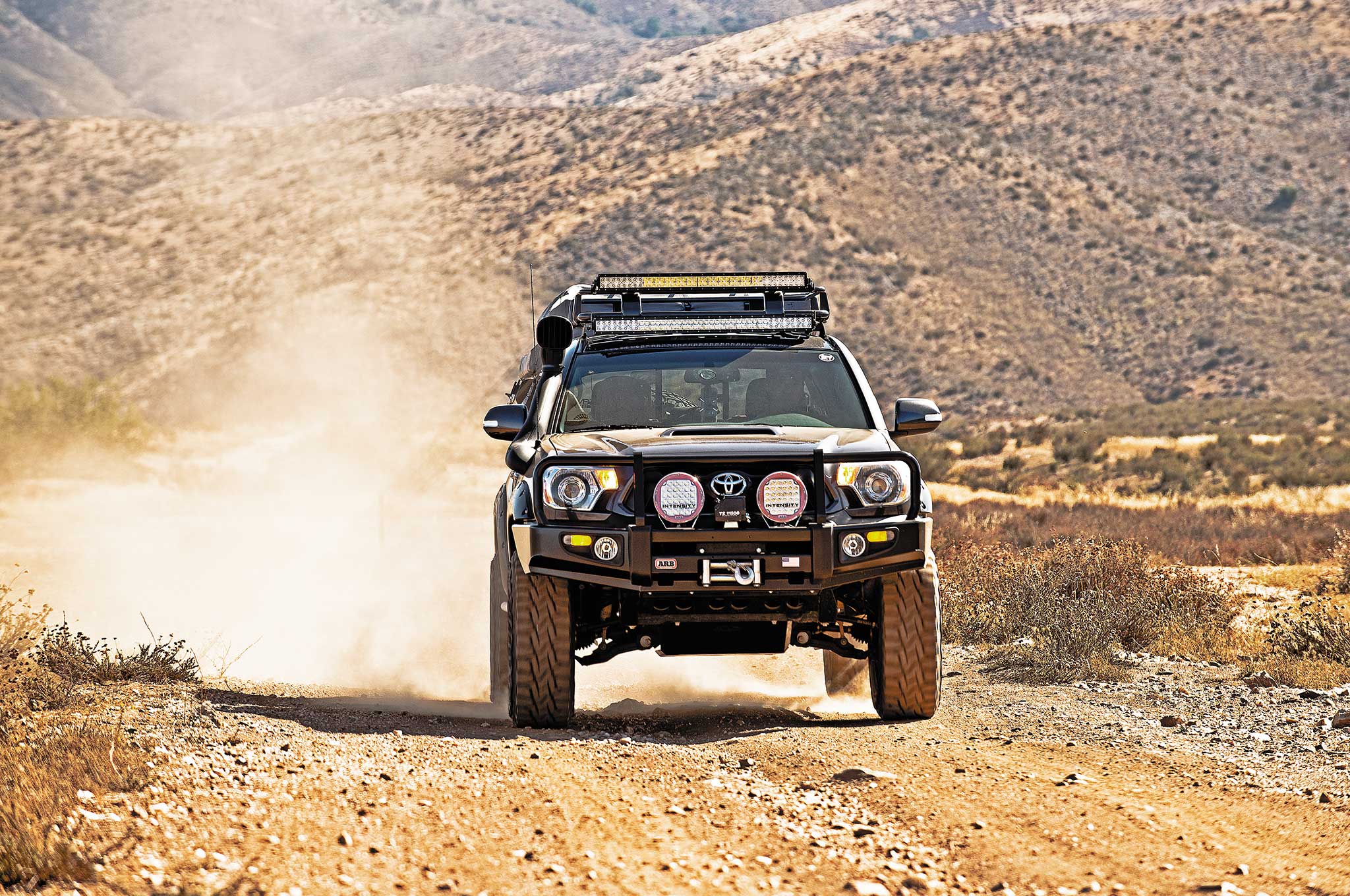
Every custom vehicle needs a cool nickname, and as far as nicknames go, it doesn’t get much better than this 2011 Chevy Colorado dubbed “Crawlorado”. We spotted this badass rig at the 2015 SEMA show in Las Vegas, and it immediately caught our eye with its burly 37-inch mud tires, straight axle conversion, and roof-mounted kayak. With its increased suspension travel and articulation, it looks like it would have no problem crawling over rocks and other obstacles.
There are plenty of trucks at SEMA that appear to be trailer queens, but the Crawlorado doesn’t seem to be one of them—this Chevy looks like it gets down and dirty on a regular basis. In fact, the sheetmetal bumpers even showed some scuffs and scratches. The truck was built by Pacific Fabrication in Gilroy, California, in partnership with BDS Suspension and a variety of other aftermarket parts vendors, and sports some of the industry’s best purpose-built off-road parts.
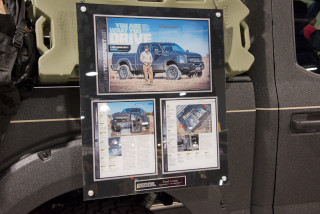
Lending to this truck’s off-road credibility, it was designed for the 2015 4Wheel & Off-Road Magazine Ultimate Adventure. This world-famous “road trip” actually doesn’t involve many roads—but it does involve brutal trails, river crossings, steep ascents, and lots and lots of mud. BDS was the Ultimate Adventure event’s title sponsor, and they weren’t looking to put their name on a vehicle that would end up stuck and embarrassed, so the Crawlorado was built accordingly. Since it was able to handle the Ultimate Adventure and still show up to SEMA in one piece, we figure that’s worthy of the OG seal of approval.
The biggest thing we liked about the Crawlorado was the fact that it’s not just a show truck. There are patches of surface rust, scuffs on the rock rails, and its suspension components aren’t tricked out in flawless chrome. Also, we like the custom fabrication involved—anybody with a big checking account can buy a bunch of off-the-shelf parts for their truck and call it “custom”, but it takes more skill to weld up bumpers, rock sliders, and a chase rack from raw metal. Overall, the Crawlorado is a very cool build, and one of our favorite trucks at SEMA 2015.
If you’re familiar with our printed magazine, you probably know what to expect—survival-related tips, techniques, and knowledge to help you and your loved ones be ready for any adverse scenario. However, here on the web site, we’ll be sharing this info with you in real-time, allowing you to stay up-to-date with the latest OG news and helpful information. Knowledge is the most important asset in any survival situation, and now we’re bringing it to you on a daily basis!
With the launch of this site, we’ll also be looking for your feedback regarding what you like, what you don’t, and what you want to see more of. We want to hear what you have to say! So, feel free to add a comment below or post on our Facebook page.
Each November in Las Vegas, Nevada, some of the world’s finest custom-built vehicles gather for a trade show known as SEMA. SEMA stands for the Specialty Equipment Market Association, but it’s better known as the representative body for the entire automotive aftermarket industry. The SEMA show represents the culmination of a year’s worth of automotive upgrades and technical development, and it’s where you’ll find the most cutting-edge products and accessories currently available for cars and trucks. However, it’s much more than a showcase for auto parts. It’s also where you’ll find millions upon millions of dollars in custom cars, trucks, SUVs, and motorcycles in every imaginable size and shape.
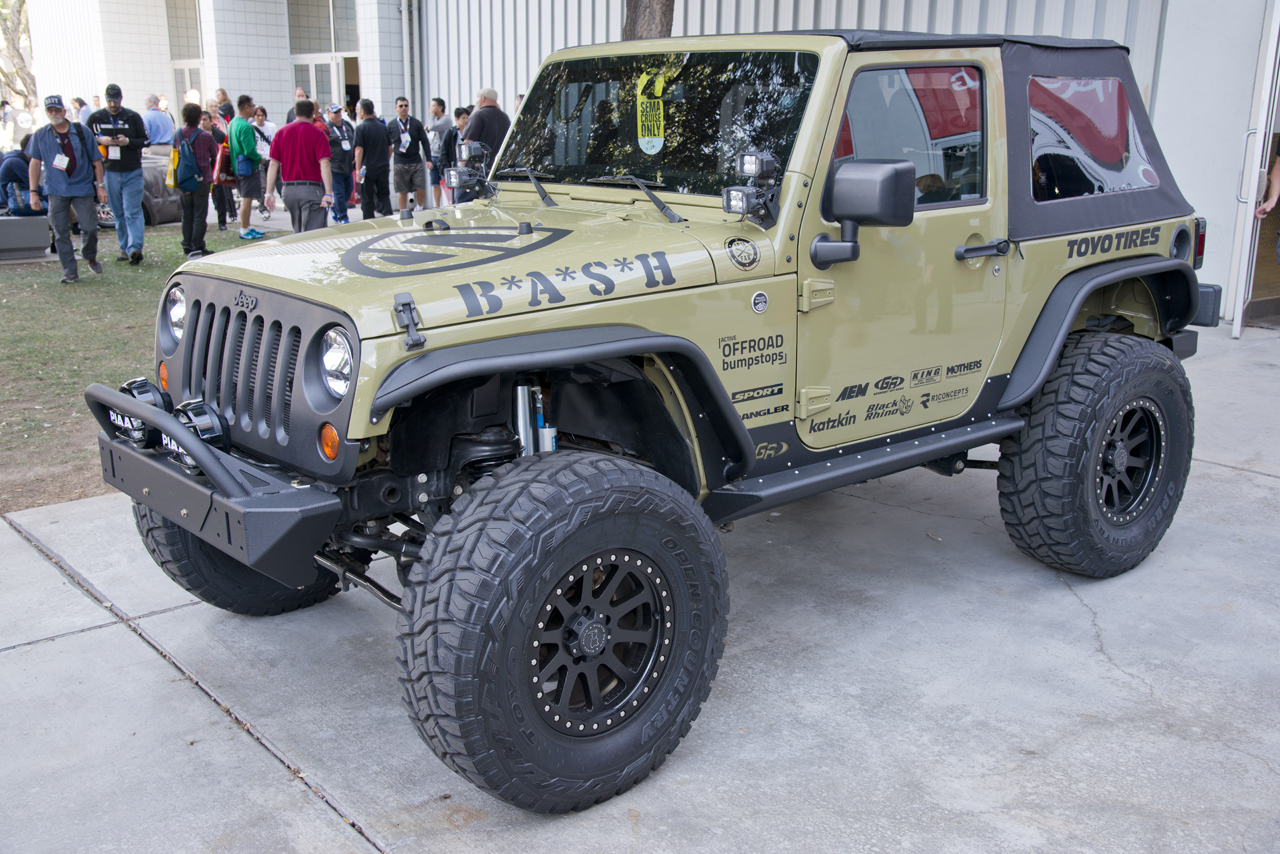
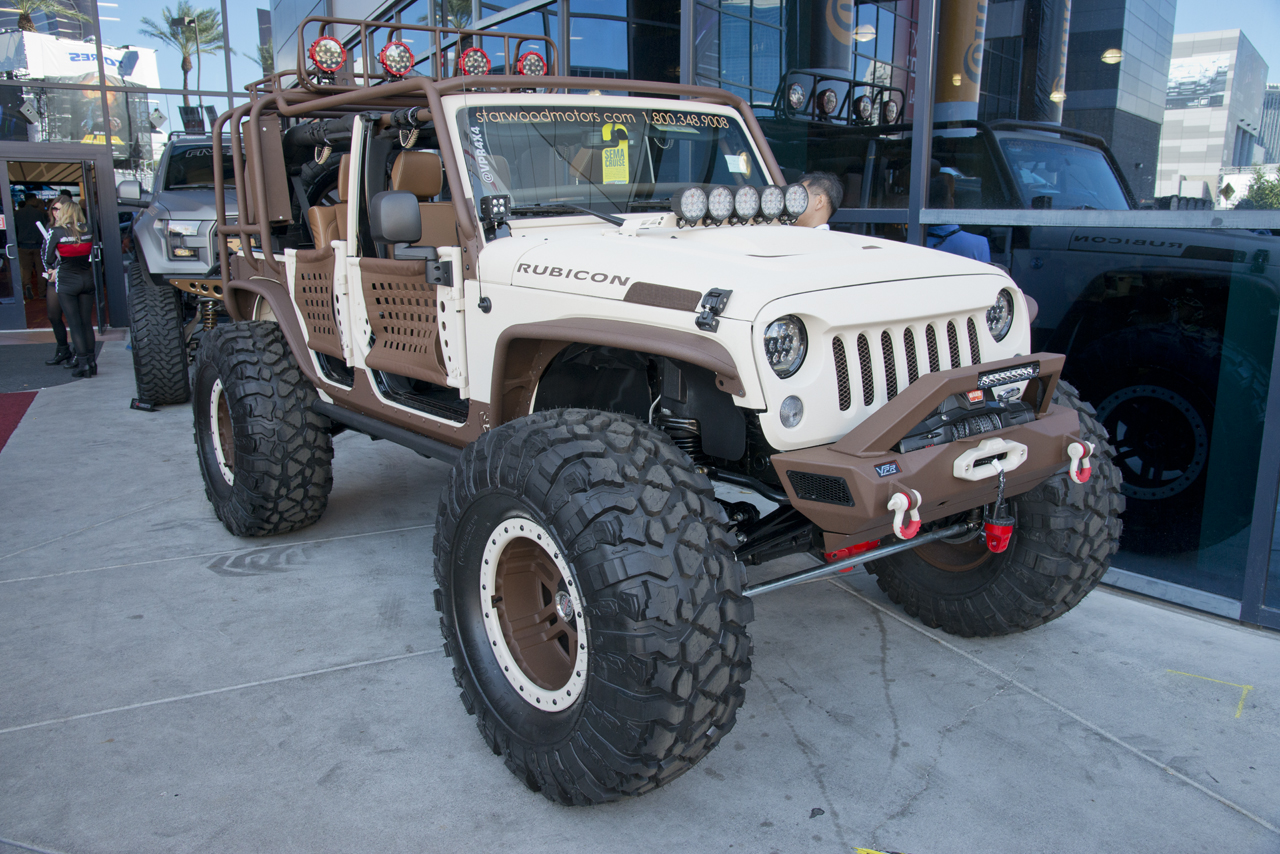
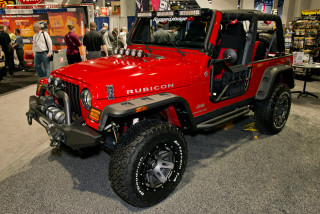
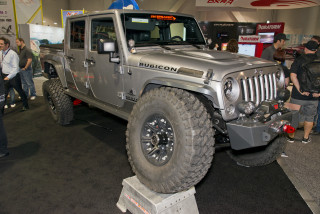
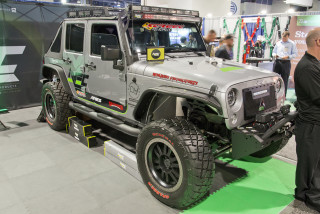
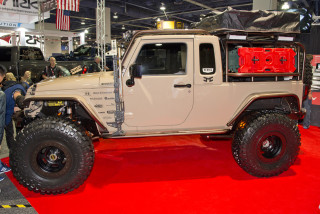
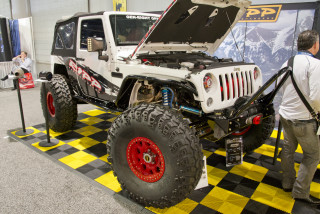
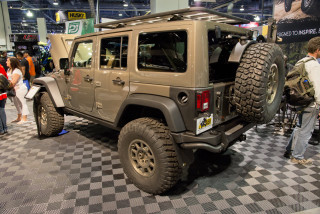
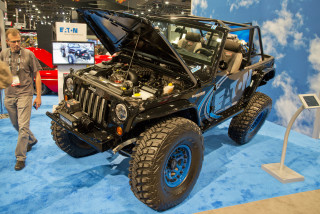
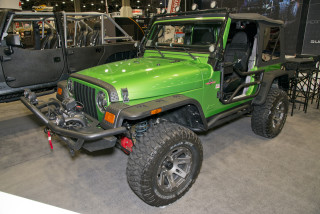
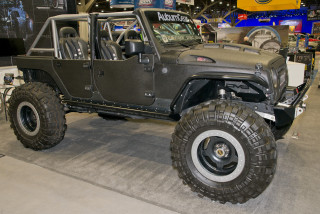
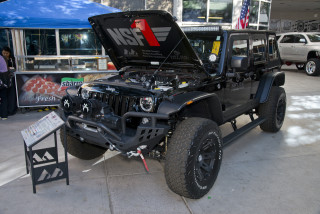
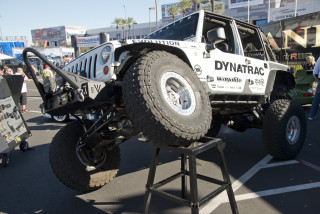
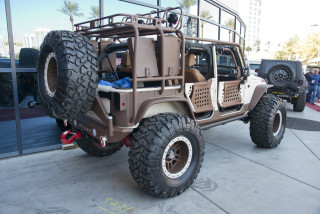
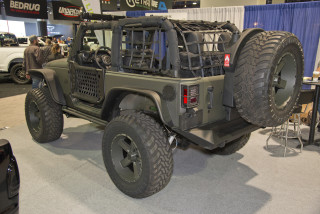
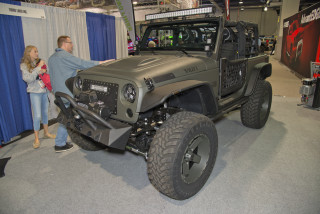
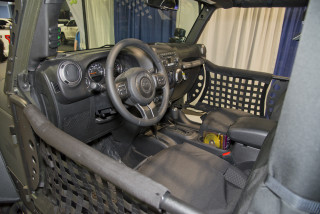
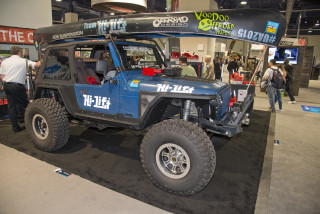
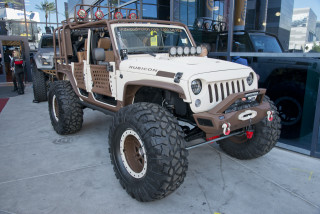
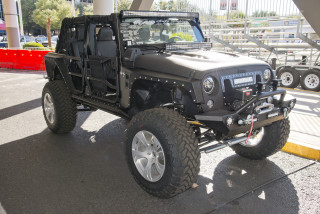
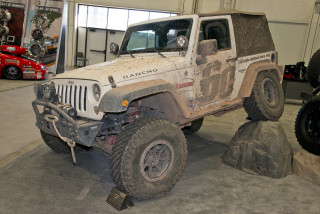
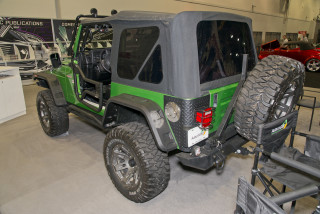
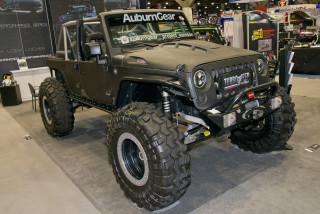
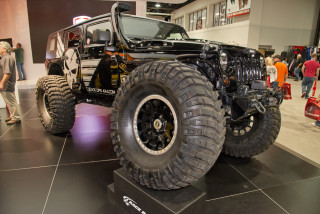
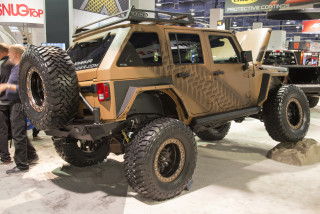
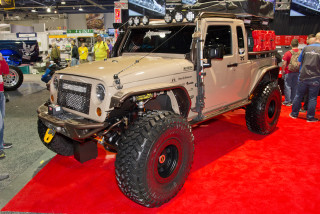
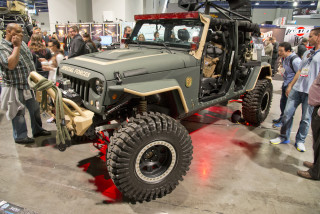
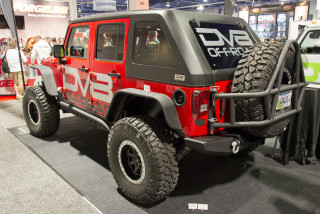
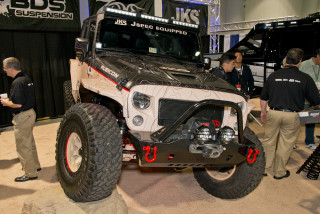
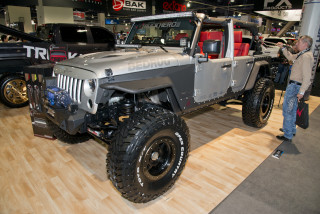
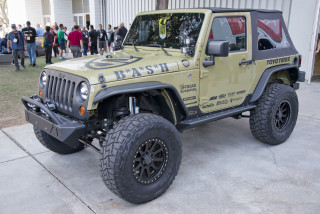
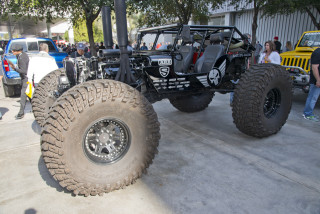
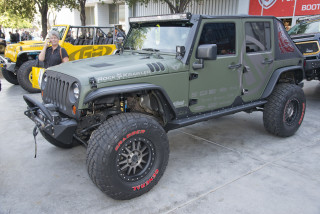
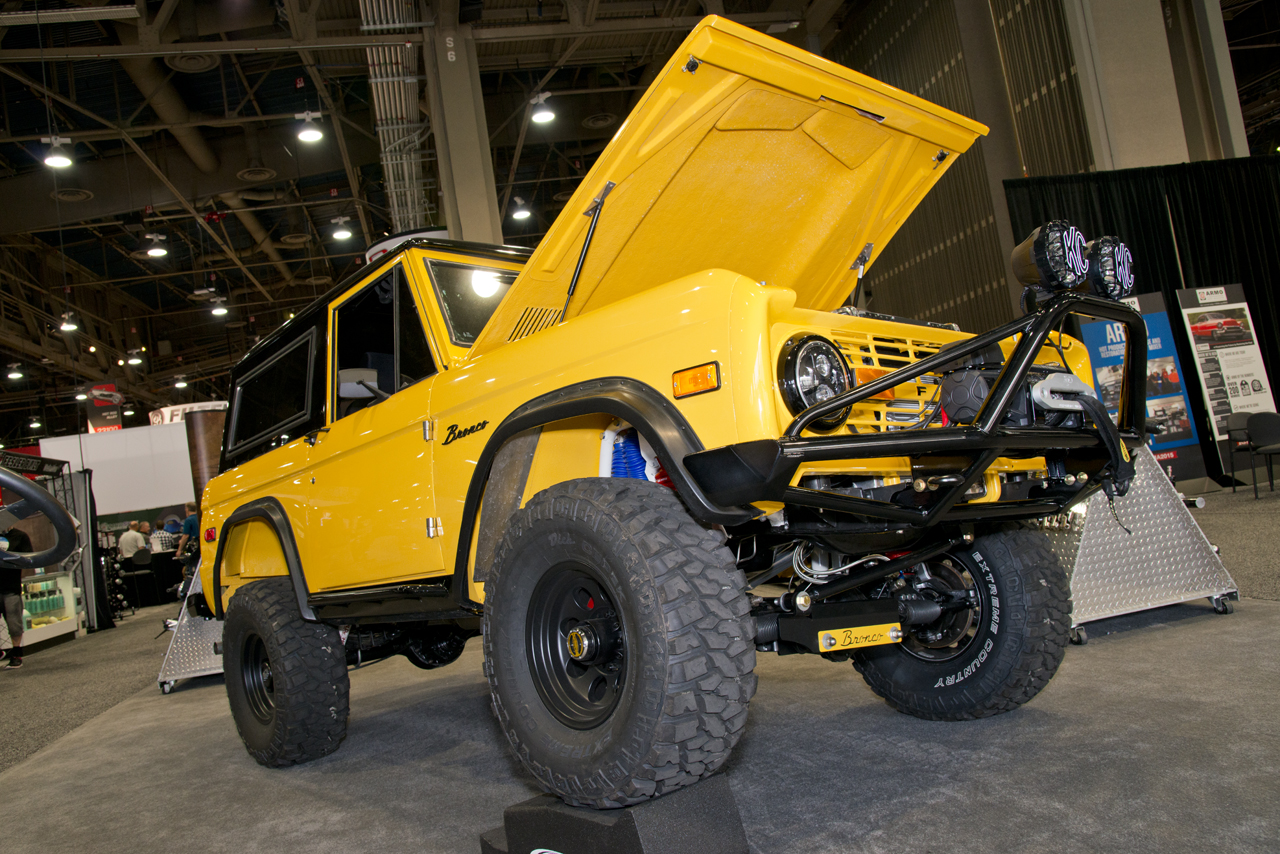
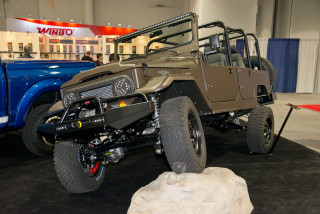
If you haven’t already seen our gallery of Trucks & SUVs of SEMA, go take a look. Today, we’ll be focusing on a vehicle that—while similar to both of these previous categories—is in a class of its own. The Jeep Wrangler was one of the most popular vehicles at SEMA 2015, and for good reason. It’s capable, versatile, tough, and has a huge assortment of available aftermarket parts. This allows owners and builders to make their Jeeps unique, and tailor them to their exact needs and wants. There are rock crawlers, desert rigs, mud boggers, supercharged powerhouses, and simple daily drivers—something for everyone.
Check out the gallery below, and don’t forget to tell us which Jeep is your favorite in the comments.
Each November in Las Vegas, Nevada, some of the world’s finest custom-built vehicles gather for a trade show known as SEMA. SEMA stands for the Specialty Equipment Market Association, but it’s better known as the representative body for the entire automotive aftermarket industry. The SEMA show represents the culmination of a year’s worth of automotive upgrades and technical development, and it’s where you’ll find the most cutting-edge products and accessories currently available for cars and trucks. However, it’s much more than a showcase for auto parts. It’s also where you’ll find millions upon millions of dollars in custom cars, trucks, SUVs, and motorcycles in every imaginable size and shape.
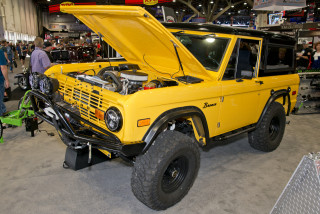
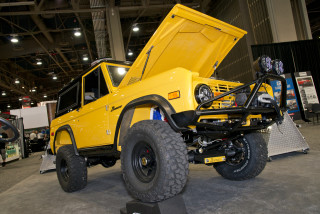
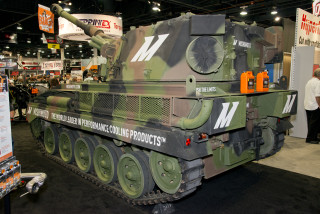
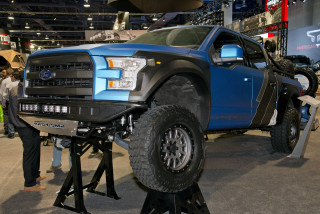
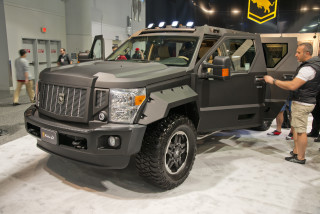
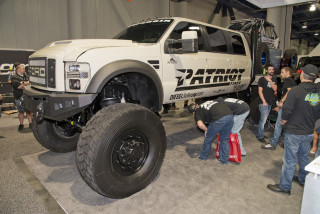
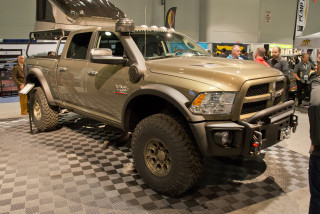
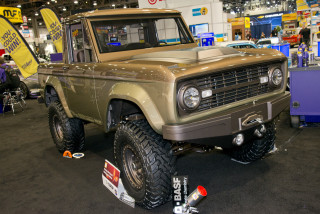
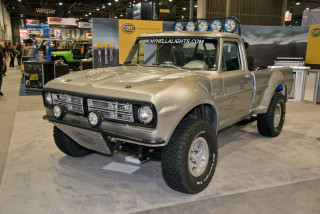
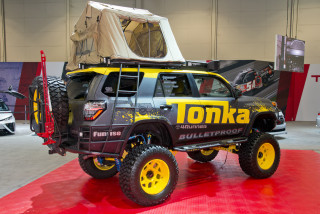
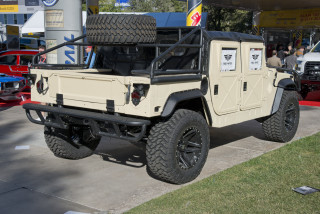
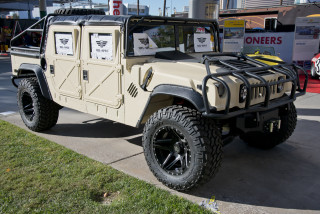
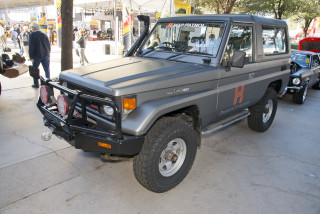
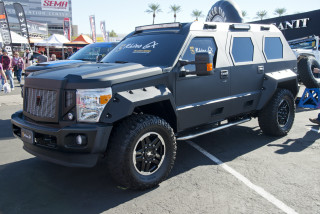
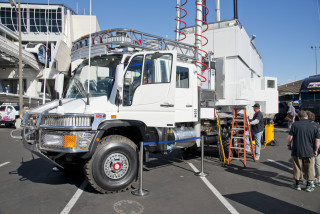
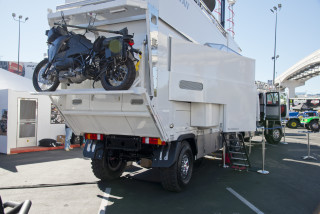
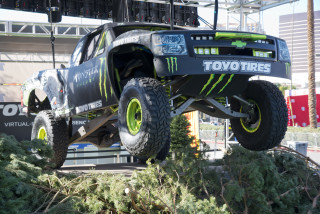
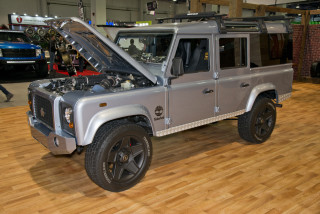
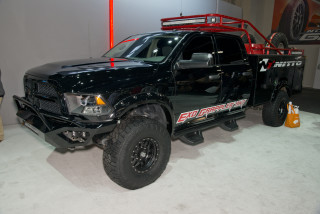
Since the SEMA show is an industry-only trade show, and not open to the general public, we wanted to give you a look inside the Las Vegas Convention Center and show you what we saw there. This being a survival publication, we skipped over the flashy muscle cars and tuned-up imports to capture the OG-worthy vehicles of SEMA. While some of the rides we saw looked to be more “show” than “go”, all of these trucks and SUVs grabbed our attention for their survival-oriented features.
So, check out the gallery below, and let us know which one you’d want to bug out in!
If the city comes crumbling down around you and you have no choice but to bug out, what kind of vehicle would you choose to get out of town in? It sounds like a simple question, but reality makes it a lot tougher to answer than we’d like it to be.
Ask 10 people this question, and you’re bound to get at least 10 different answers. Some might say an old carbureted truck, others swear by diesel power, yet others still would ride off on a motorcycle. Then there are those who would reach for their paddles instead. Because everyone’s situation and needs are different, there’s no one-size-fits-all answer. What type of area you live in and the number of people in your household are just two in a long list of variables that determine what type of transportation you end up selecting.
For Mike Shin, choosing his daily driver (and just-in-case bug-out truck) was dictated by several factors. After a couple of outings over a few dirt trails in his previous ride, a two-wheel drive Nissan Xterra, Shin quickly realized that he needed a ride swap if he were to drive more aggressive routes. While the Xterra was great to run errands around town, it was not suited for the unpaved regions of the mountains and deserts of Southern California — the very areas he might need to bug out to one day.
Make and Model
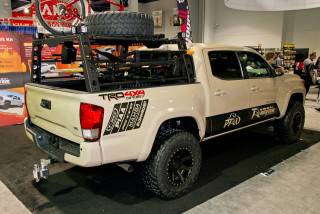
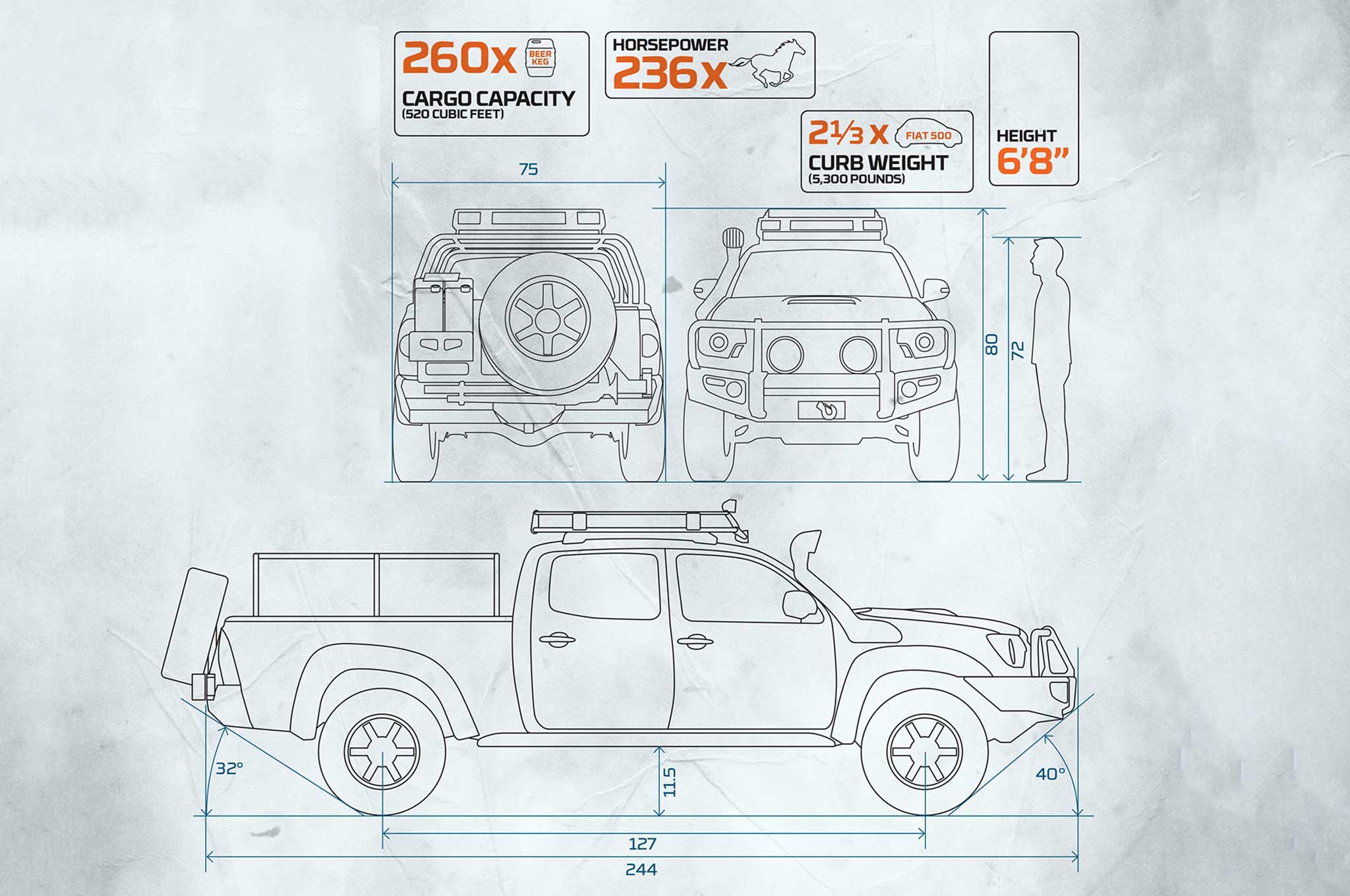
Shin drew inspiration from go-anywhere Australian Outback-style 4x4s. One of his dream trucks was the venerable Toyota Land Cruiser Hardtop 150. He considered traveling to his wife’s home country of Guatemala to drive one back, but soon realized that the logistics and legalities of owning such a vehicle in the United States was more work than he was willing to take on. Instead, he looked at more readily available stateside options. Shin quickly discovered the 2013 Toyota Tacoma Double Cab 4×4 TRD Sport Package and figured it would more than meet his requirements.
From Show to Go
The ball really got moving when Shin, a former employee at Toyo Tires, got the call to display his truck at the Toyo Tires booth at the 2013 Specialty Equipment Market Association (SEMA) Show being held in Las Vegas, Nevada, with the caveat that he build a show- and off-road-worthy truck out of his Tacoma in less than three months’ time — and on his own dime. Considering the time and budget concerns, it was far from certain that he would be able to pull this endeavor off. Even so, he was up to the challenge.
An ARB Deluxe Bull Bar replaces the factory front bumper. The All Pro Off-Road Front IFS Skid Plate was added to armor up the vulnerable IFS third member and steering components. A weather-sealed Superwinch Tiger Shark 11500 Winch in the front bumper can pull up to 11,500 pounds of trouble with its 6hp motor.
Engine
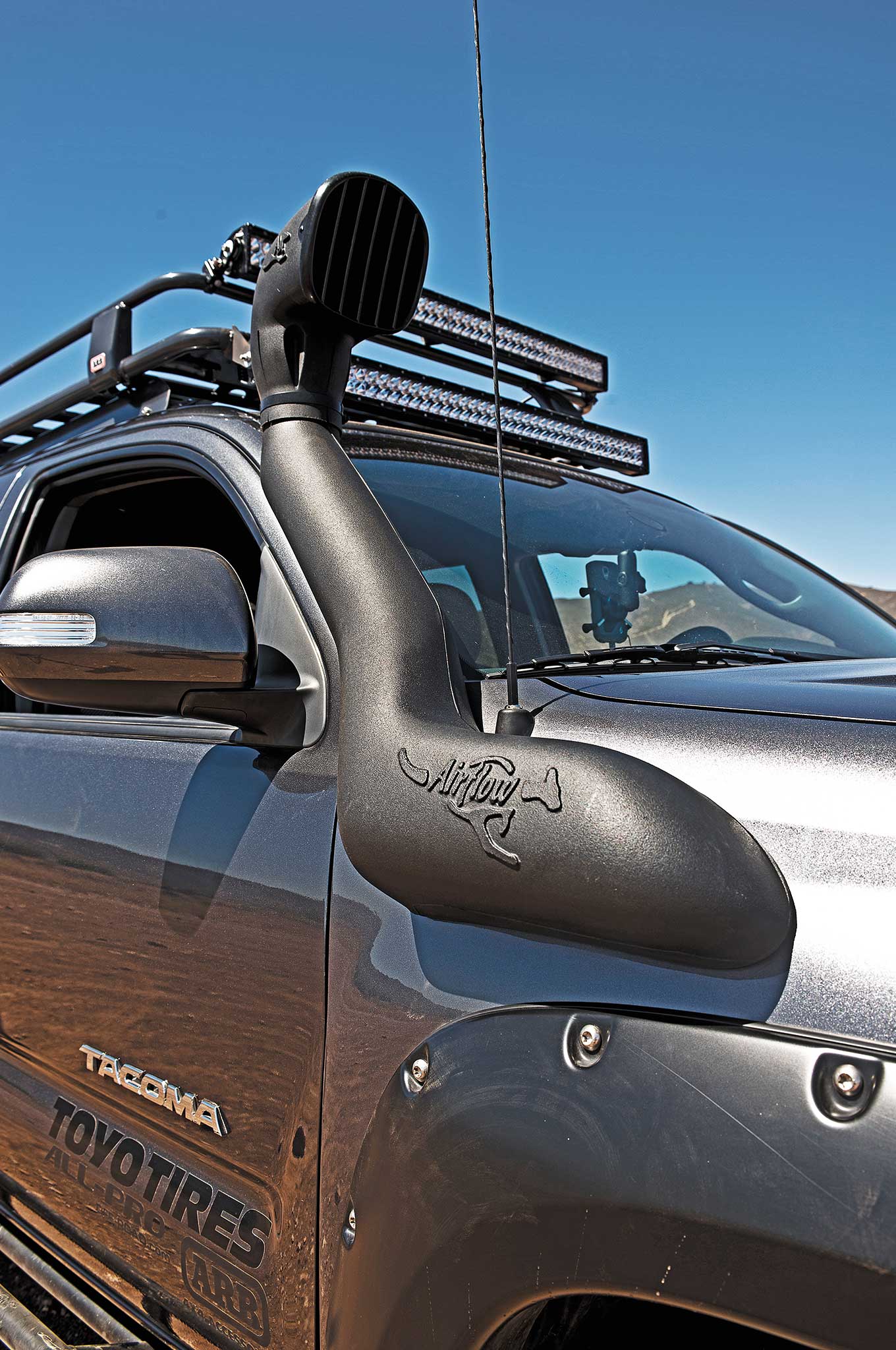
Its 1GR-FE model V-6 engine displaces 4 liters and runs on regular-grade fuel. That’s good enough to churn out a factory-rated 236 horsepower and 266 lb-ft of torque. To help it breathe easier, an Australian-made Airflow Cold Air Induction System (ACAIS) snorkel was installed to force in air that is free of water and other contaminants. According to Airflow, the high positioning of the ACAIS’ snorkel air inlet also allows for cleaner, colder air to be driven into the engine’s induction system. Colder air contains more oxygen, helping to improve fuel efficiency and power.
To keep the entire system free flowing, Shin coupled the ACAIS with a custom-fitted MagnaFlow Race Series exhaust system. The fully stainless-steel cat-back exhaust system optimizes exhaust flow and is mounted just behind the factory catalytic converter. We noticed that it also gives the truck a refined yet throaty sound.
The high positioning of the ACAIS snorkel air inlet allows for cleaner, colder air to be driven into the engine’s induction system, helping to improve fuel efficiency and power.
Suspension
The Tacoma was lifted 2 inches for additional ground clearance to get over natural and manmade obstructions. Shin opted for an Old Man Emu Lift Kit for the front that consisted of sets of Nitrocharger shock absorbers and coil springs. He matched the rearend with Old Man Emu Dakar Leaf Springs and shocks, as well. These suspension upgrades not only improve the ride, handling, and load-carrying capability of a heavily laden truck, but also decreases the chance of suspension-component failure. Because of the 2-inch height increase, an Old Man Emu Driveshaft Spacer kit was installed to reduce driveline vibration common to lifts on Tacomas of this type.
Shin further beefed up the frontend by installing a set of ReadyLIFT Off-Road Upper Control Arms. These arms are stronger than stock and feature zerk fittings that make re-greasing its urethane bushings a breeze. Because the wheel and tire combination he’s running is heavier than stock, he went with ReadyLIFT’s Off-Road Heavy Duty Steering Kit to avoid possible parts breakage down the road. The kit consists of heavy-duty aftermarket tie-rod assemblies that are suited for lifted trucks running larger tires.
ReadyLIFT’s Off-Road Heavy Duty Steering Kit consists of heavy-duty aftermarket tie-rod assemblies that are suited for lifted trucks running larger tires.
Differentials
This Toyota drives power to all four wheels with aftermarket ratio ring-and-pinion gears made by Nitro Gear and Axle, that are encased in the factory 8-inch front and 8.4-inch rear clamshell IFS differential housings. The stock 3.72 gear ratio is better suited for economy and the truck’s standard 30-inch tires, but it doesn’t cut it with the larger wheels and tires that Shin went with. Due to the increase in rolling mass of larger 33-inch tires, both power and fuel economy are lost with the factory setup. The new ring and pinion by Nitro Gear and Axle “lower” the ratio to 4.56, which better compensates for the larger tires.
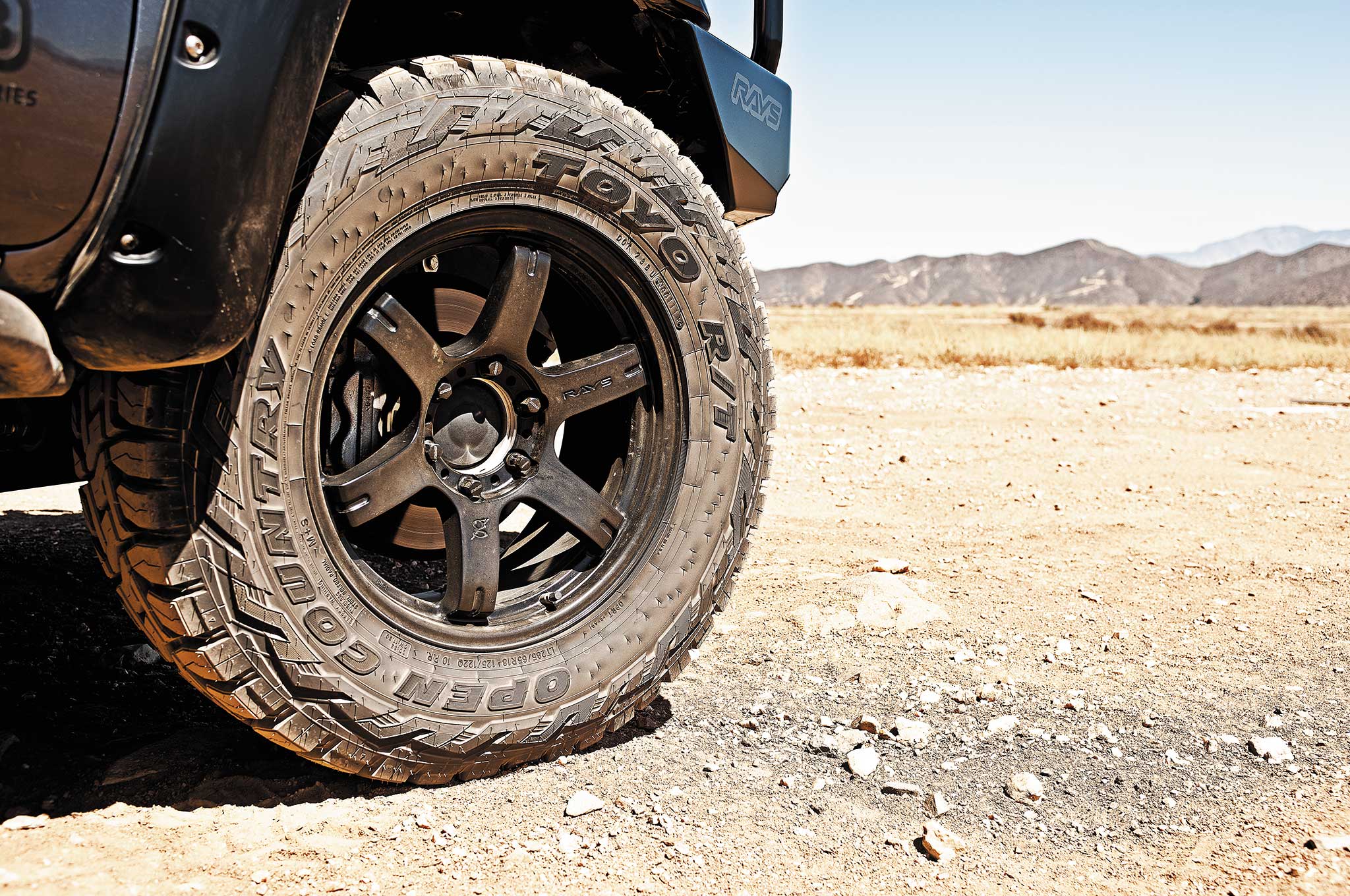
Rays Gram Lights 57JX6 rims in 18×8-inch sizing are mounted with Toyo Tires’ all-new Open Country R/Ts.
Body Armor
To protect the truck’s body and better increase approach and departure angles, Shin added some heavy-duty truck armor. Up front an ARB Deluxe Bull Bar replaces the factory front bumper. Stronger and capable of mounting a winch and several lights, the ARB bumper has become ubiquitous in the off-road world and is available for many makes and models of trucks.
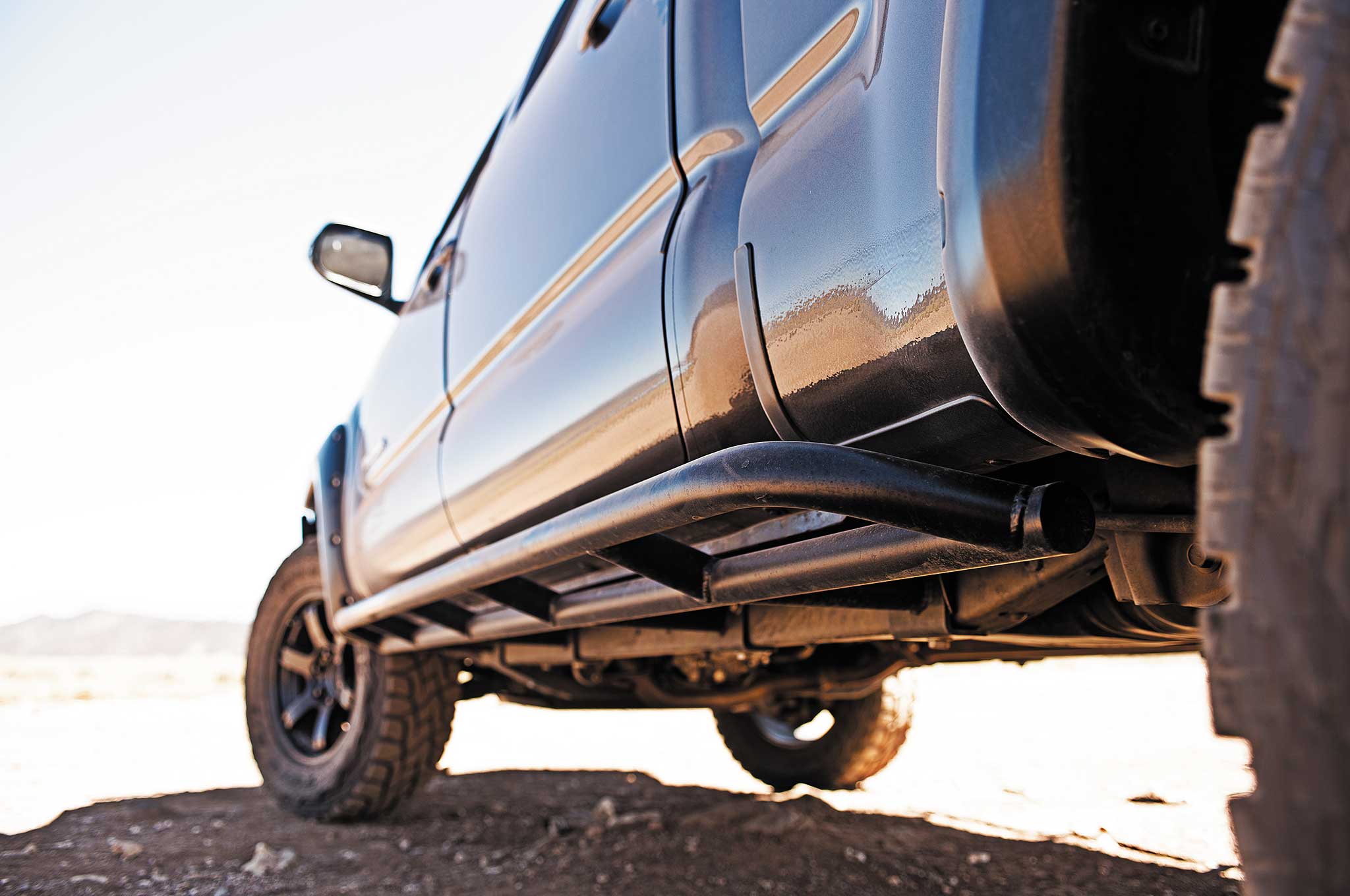
CBI Off-Road Rock Sliders help protect the doors and doorsills from impact with obstacles.
Underneath, a laser-cut 3/16-inch steel All Pro Off-Road Front IFS Skidplate was added to armor up the vulnerable IFS third member and steering components. Running along the bottom of the truck body between the front and rear wheels are CBI Off-Road Rock Sliders. These rock sliders help protect the doors and doorsills from impact with obstacles (fallen tree branches, boulders, etc.) and keep the body in pristine shape even if the sliders themselves are bumped.
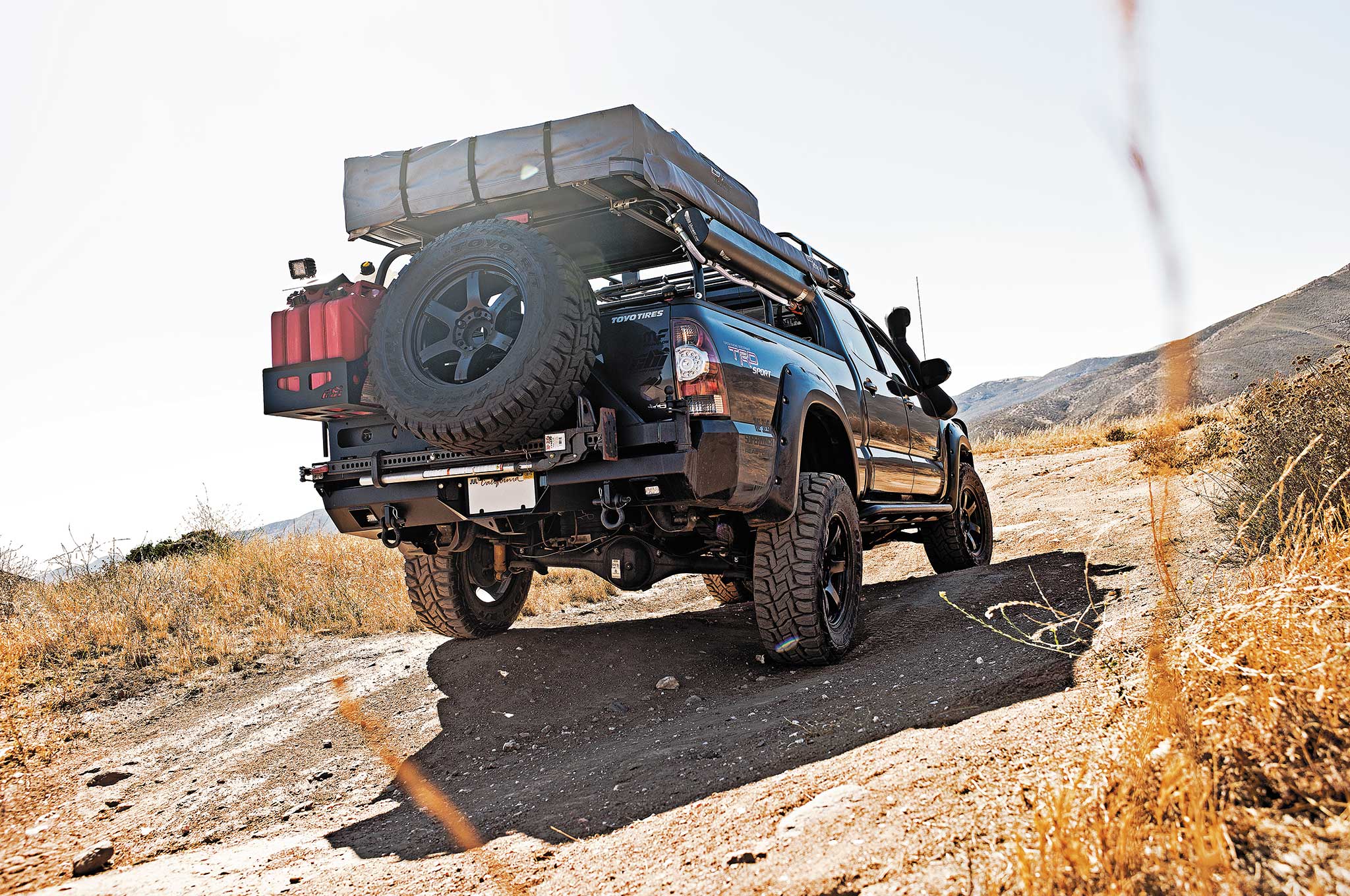
A CBI Off-Road Trail Rider 2.0 bumper with swing-away tire carrier protects the rear end. Tucked below the spare tire in the rear is a Hi-Lift X-TREME Jack which can be used not only for jacking the truck up to swap out a flat tire, but also for manual winching and clamping.
A CBI Off-Road Trail Rider 2.0 bumper protects the rear. Because having extra fuel on hand is a bug-out essential, it’s fitted with two 5-gallon Jerry Can fuel carriers and a spare wheel and tire. The tire carrier swings away, allowing for easy access to the tailgate and bed. It even conceals a fold-down camp table further increasing its usability. The bumper’s higher undercut allows for the truck to clear steeper departure angles that the stock bumper can’t.
Storage and Gear
Storage is always at a premium whether you’re packing for a camping trip or trying to haul you, your loved ones, and your gear out of a bad situation. Shin wanted to maximize the organizational space of his truck bed with the use of a bed rack.
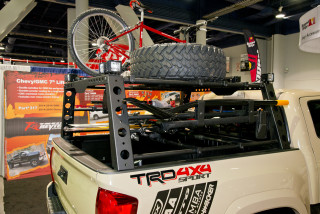
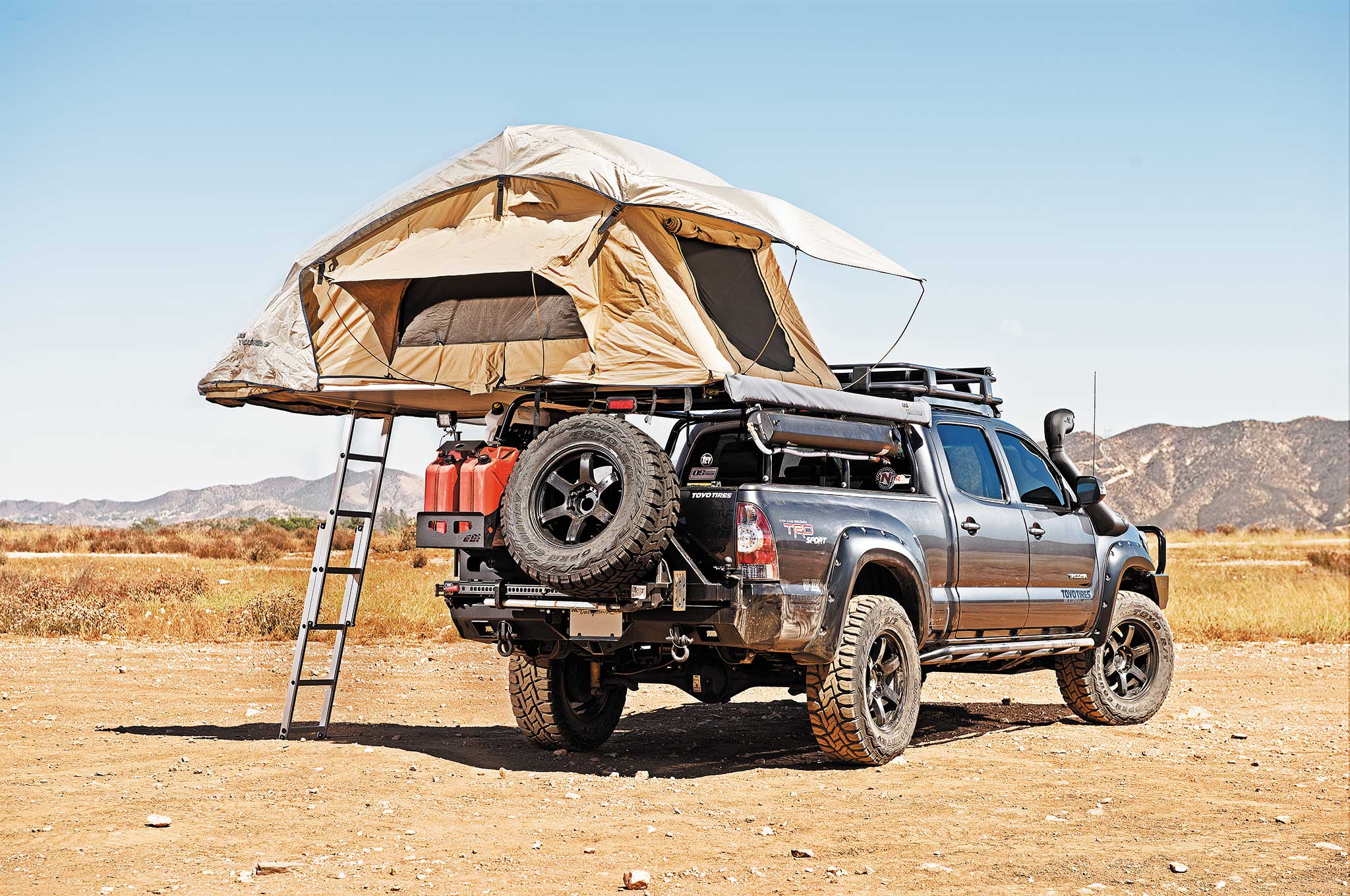
The All Pro-Off Road Expedition Series Pack Rack helped him do just that all without compromising the hauling capacity of the truck’s bed. The Rack Pack allows him to carry an ARB Series III Simpson Roof Top Tent up top that comfortably sleeps two adults and an ARB Awning 2000 that deploys to the side, providing about 53 square feet of overhead coverage from the elements. Keeping clean is a real morale booster — imagine being able to take a warm shower when bugging out. A Road Shower sits on the side of the rack and holds 5 gallons of water, heats up in the sun, and works by either having gravity push water out of its 55-inch length hose or alternatively, the tank can be pressurized with an air compressor or bike tire pump to provide a more powerful jet of water.
The All Pro-Off Road Expedition Series Pack Rack bed rack helps create organized storage space over the truck bed without compromising hauling capacity. A bevy of gear is attached to it, including an ARB Series III Simpson Roof Top Tent, ARB Awning 2000, and a Road Shower.
On the opposite side of the Pack Rack sits a Rotopax 2-gallon water container and a Rotopax First Aid+Preparedness Kit. The efficient kit contains everything from medical supplies and a shovel to toilet paper and zip ties.
To add even more storage area, Shin custom-mounted an ARB 52×44-inch Steel Roof Rack Basket above the truck’s cab using a fitment kit made for a Toyota Hilux. The roof rack basket allows for gear and other supplies to be stored as well as a high position for roof rack lights to be mounted.
Lighting
For better forward view in low light and blacked-out moonless nights, Shin decked his truck out with a wide range of lighting options. He went to The Retrofit Source (TRS) for a set of OEM-quality Morimoto FX-R Bi-Xenon HID projectors to retrofit his stock halogen lights. The reason for going with an HID retrofit is to improve light quality, as the factory halogens are generally pretty dim, especially when in off-road environments. The problem with sticking any cheap aftermarket HIDs in existing halogen housings is that they typically cast an uncontrolled beam pattern due to higher light output. This ends up blinding other drivers while giving the user only mediocre visibility.
Opting for OEM-quality HIDs results in a piercing beam that is controlled and distributed with a crisp and focused cut-off beam pattern, delivering maximum visibility to the driver with higher light output that doesn’t also blind oncoming drivers. To install the TRS-sourced HID projectors, Shin relied on a company called Essential Lites to do the painstaking work of retrofitting them into his factory headlights.
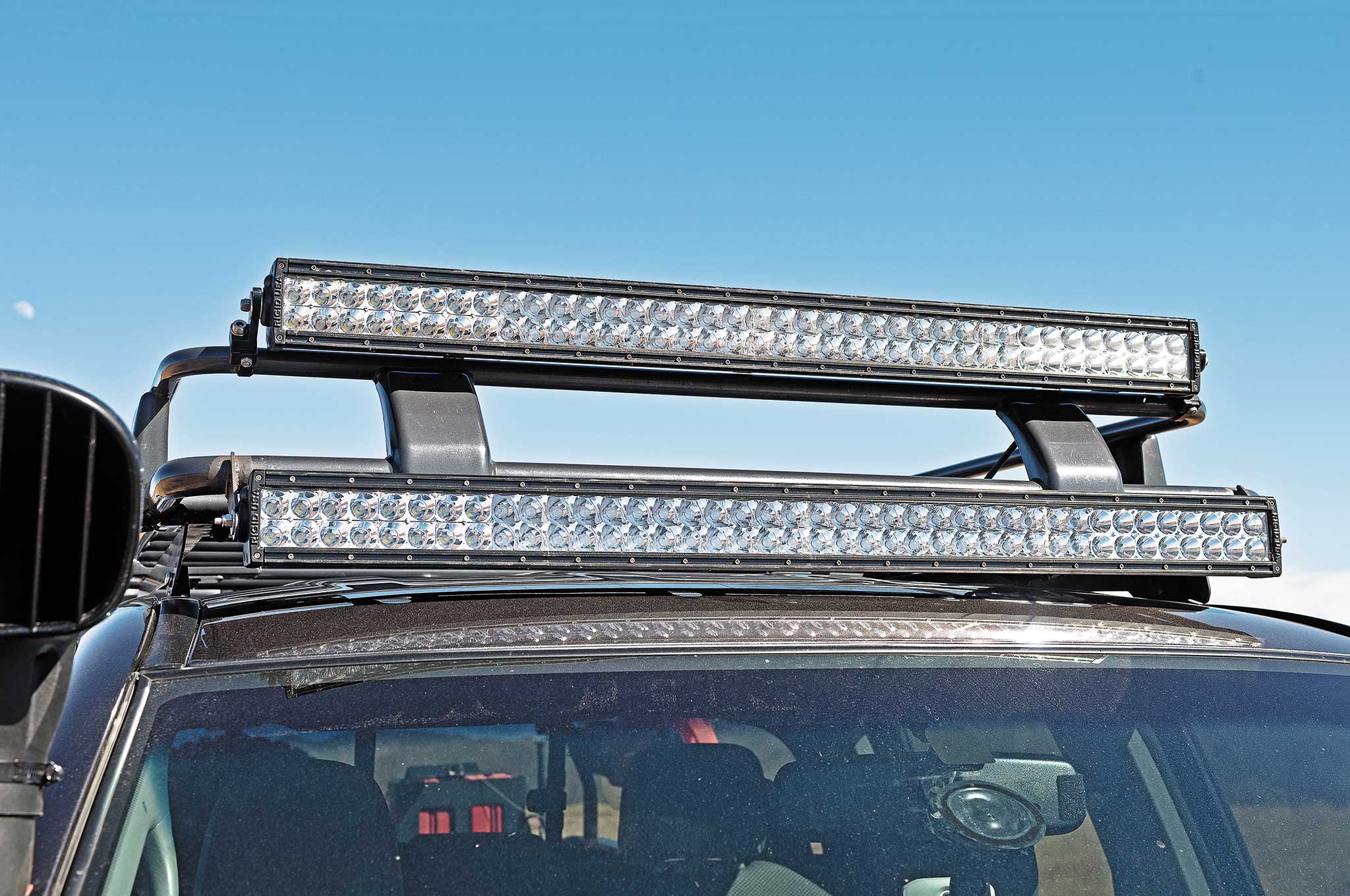
These Rigid Industries 38- and 40-inch E-Series LED light bars are configured in a spot-and-flood-light combination.
He continued by adding dual rows of high-mounted lights to the roof rack. Sitting on the top row is a Rigid Industries 38-inch E-Series LED Light Bar, which is configured in a spot and flood light combination. This combination is rated at 17,480 raw lumens and allows him to see a wide swath immediately forward as well as out to more than 1,300 meters ahead of the vehicle. If that isn’t enough, a second 40-inch E-Series LED Light Bar sits just under the 38-incher. Also in spot-and-flood-combination configuration, this bar spits out 18,400 raw lumens of light up to a distance of 1,400 meters. For those keeping count, that’s a range of almost 13 football fields.
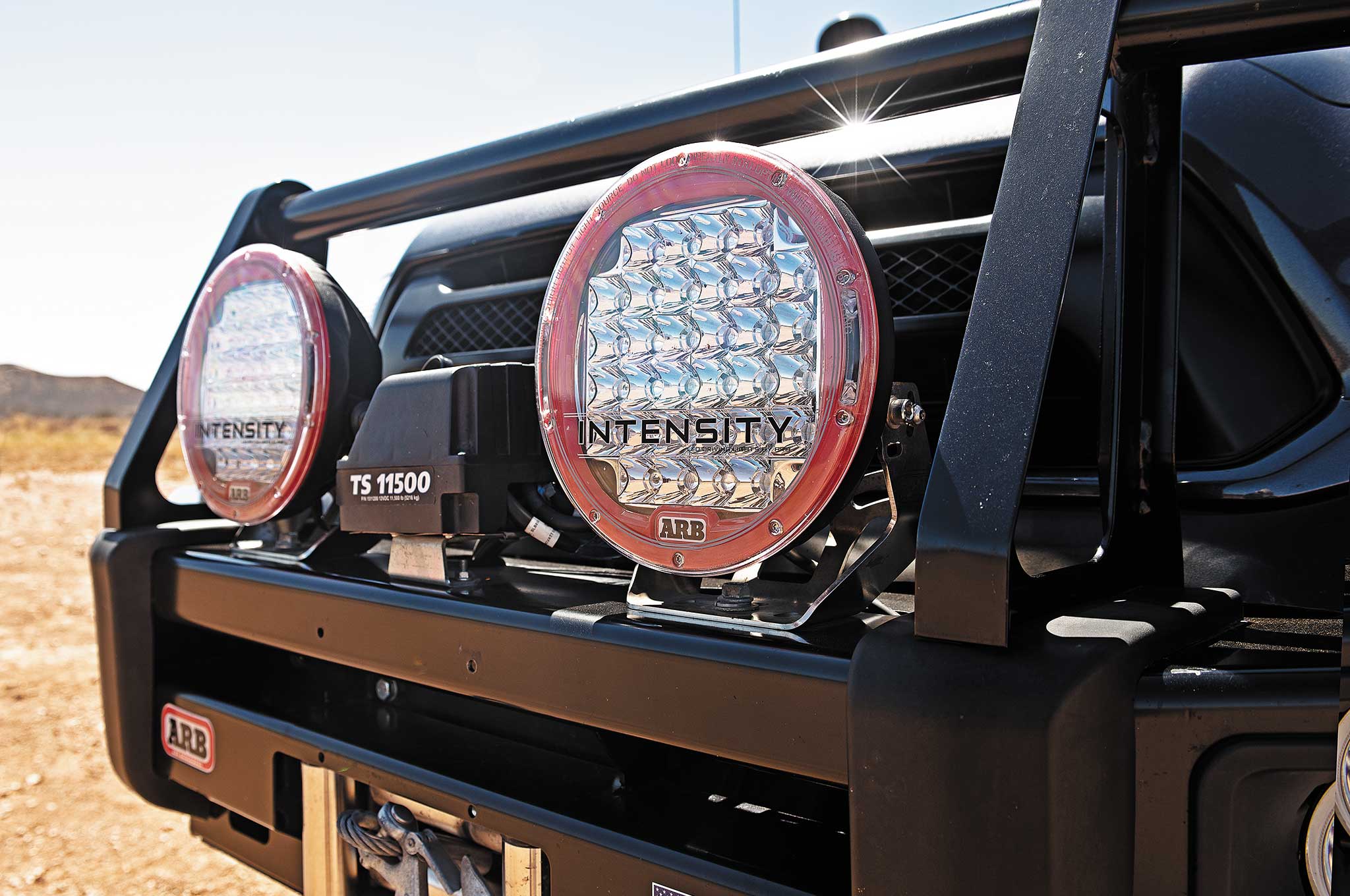
Each of the 9-inch ARB Intensity LED Driving Lights that are mounted to the front bumper contain 32 LEDs, producing 8,200 raw lumens.
As if he plans on exploring the eternal darkness of a black hole, Shin found a need to further mount a pair of 9-inch ARB Intensity LED Driving Lights to the front bumper. The flood and spot combination lights each contain 32 LEDs that produce 8,200 raw lumens and a spot reach of almost 1,000 meters.
Not to be outdone, the rear end was treated to a bank of LED lights as well. Rigid SR-M Back-Up lights, a Rigid SR-M Bed Light, and a Rigid Q-Series Camp Light mounted on the tire carrier round out the rear facing light fixtures.
Electronics
A Scan Gauge II monitors the vehicle’s performance and is programmable to display information, such as trip data, transmission temperature, fuel economy, engine speed, among other statisti
A Scan Gauge II monitors the vehicle’s performance and is programmable to display information such as trip data, transmission temperature, fuel economy, engine speed, and vehicle speed, among other statistics. What’s really useful too is that it is capable of displaying trouble codes, so you can troubleshoot problems.
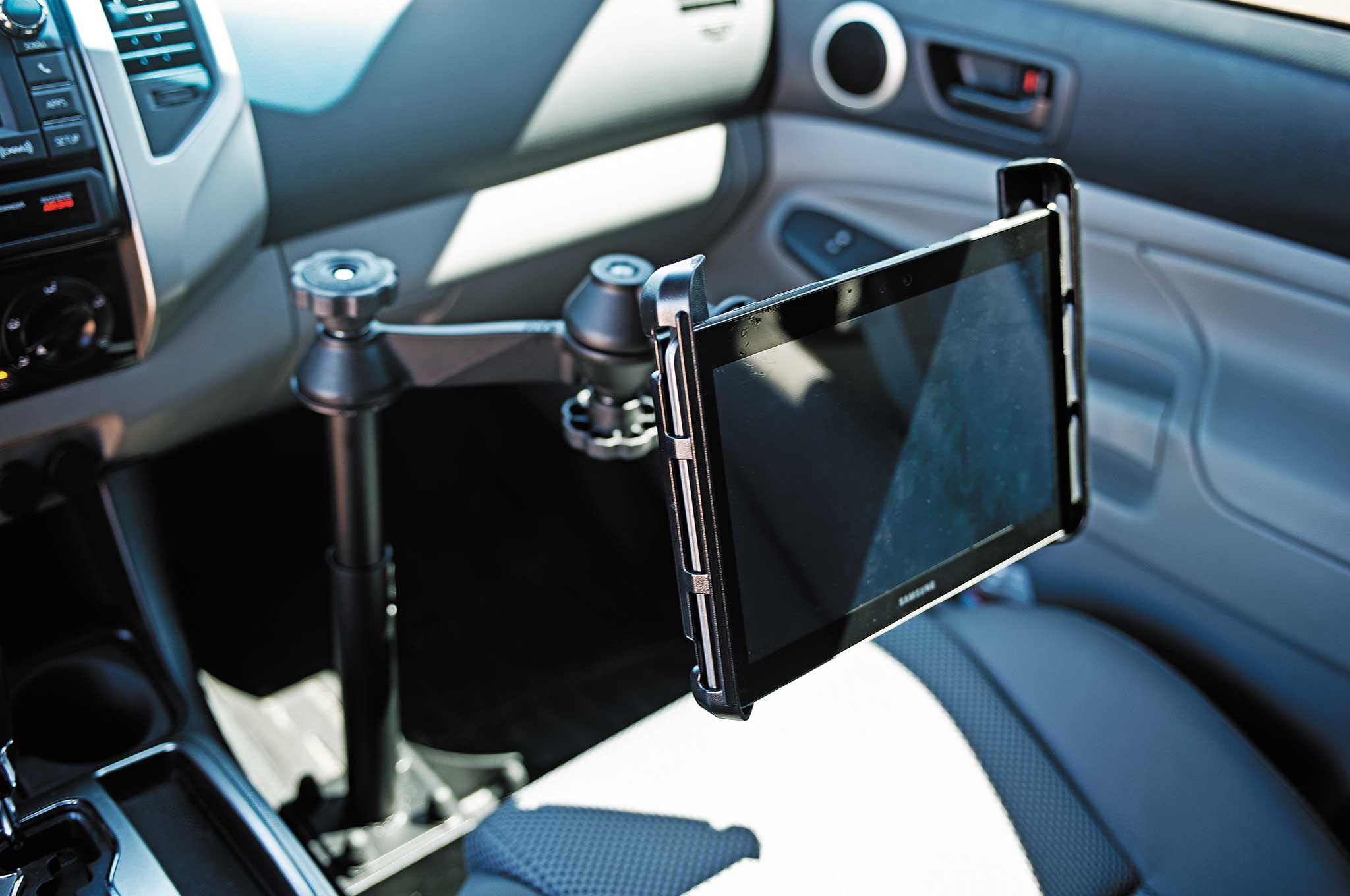
Ram Mount’s versatile No Drill Laptop Mount can be configured to use with a tablet.
Ram Mount Phone and No Drill Laptop Mounts help keep what otherwise would be loose electronics in place, even over the roughest of turf. The versatile No Drill Laptop Mount, as its name implies, requires no drilling for installation into your vehicle and, as seen here, can be configured to use with a tablet. Other than accessing electronic maps over his phone or tablet, Shin also carries an old-fashioned Thomas Guide (remember those?) and a compass for backup land navigation.
Never Done
Shin’s Tacoma fits each of the roles he initially outlined quite nicely. It’s a reliable daily driver that’s a blast to take out for the occasional trail run. If push ever comes to shove, it looks as if this pickup will be a capable rolling urban escape plan as well. But automotive enthusiasts know that a project is rarely ever complete. When asked what the next step for his truck was, Shin mischievously smiled and said that he was done with it…somehow we’re not so convinced.
Make & Model 2013 Toyota Tacoma Double Cab 4×4 TRD Sport Package
Today, the Cold War era is often regarded as a time of unnecessary paranoia. After all, there was much talk of impending nuclear war, but mutually assured destruction never really panned out. So, it must have been nothing more than unfounded fear of exchanging nukes with the Reds, right? Wrong. As more stories from this tenuous time are revealed, we’re coming to the realization that we very well may have missed all-out destruction by the skin of our teeth.
In order to illustrate this point, we’ve gathered two historical incidents which demonstrate the danger that accidental nuclear war once posed (and may still pose, for that matter). If not for the courageous actions of these military men on both sides of the Cold War conflict, the world could have become an irradiated wasteland decades ago.
The Okinawa Missile Incident – October 28th, 1962
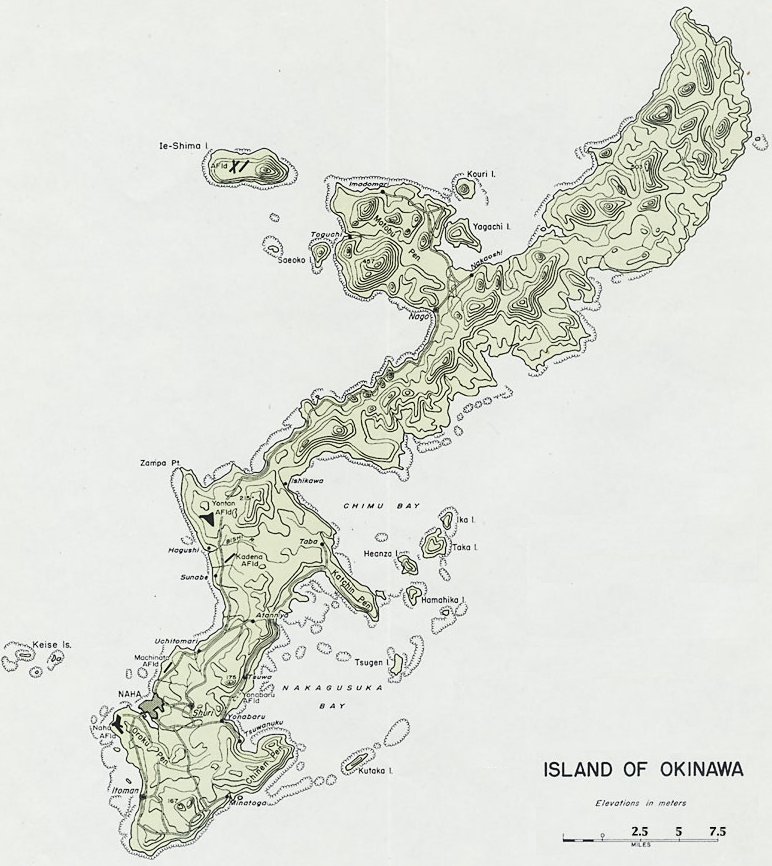
In October 2015, Air Force veteran John Bordne revealed for the first time the story of one fateful evening during the height of the Cuban Missile Crisis. Bordne was stationed at one of the four secret U.S. missile launch sites located on the island of Okinawa. During his midnight shift on October 28th, 1962, U.S. forces were operating at DEFCON 2, and were ready to be upgraded to DEFCON 1 at any time. Under DEFCON 1, 7 other Air Force crews like Bordne’s could have been ordered to launch nuclear cruise missiles within minutes, as a potential retaliation against Soviet strikes.
The island of Okinawa, roughly 400 miles south of Japan, serves as a major base of operations for the U.S. Military to this day. There are now a total of 32 bases there, occupying approximately 20% of the island’s area.
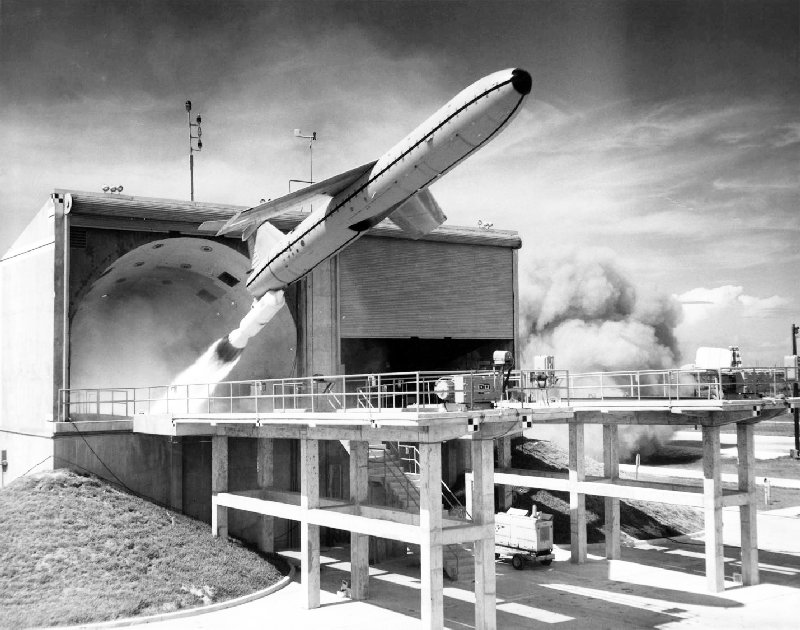
To put things into perspective, each of the Mace B cruise missiles on the island was mounted with a Mark 28 warhead with a 1.1-megaton yield. Each warhead would have been approximately 70 times the power of the bombs detonated at Hiroshima and Nagasaki. On Okinawa alone, there were 32 of these missiles ready for launch at a moment’s notice.
This photo from the USAF Museum Archives shows the test launch of a Mace tactical cruise missile, the same model found at the bases on Okinawa in 1962.
Several hours into Bordne’s shift that night, a routine transmission came through. Captain William Bassett, the senior commanding officer of Bordne’s crew, noted that the first part of a three-part launch code was included with the weather report transmission. This was sometimes done for training purposes, so nothing seemed amiss… then the second part of the code was transmitted. Both codes matched what the airmen had on hand at the facility, confirming that this was no test. This had never happened before. Finally, the third part of the launch code was radioed to the men, prompting Captain Bassett to open a sealed pouch on his person to confirm the alphanumeric string. It, too, was a match. They had been ordered to launch their missiles immediately.
However, according to Bordne, Captain Bassett read the target list to find that 3 of the 4 (still unnamed) targets were not in Russia. Another launch officer on Okinawa called Bassett, and reported that he, too, was ordered to launch missiles at two non-Russian targets. Not only this, but the official status still remained at DEFCON 2, and not launch-ready DEFCON 1. Captain Bassett sensed something was very wrong, and stalled for time, going as far as to order armed airmen to shoot if a Lieutenant tried to launch missiles without a senior officer’s authorization or the upgrade to DEFCON 1.
After a few extremely tense moments on the phone with the Missile Operations Center, Bordne says Captain Bassett was finally given confirmation that no missiles should be launched. To this day, we still don’t know how or why this happened, nor what the Missile Operations Center said on the phone to explain these orders. Captain Bassett died in 2011, and never mentioned the incident publicly. In fact, Bordne says he told his crew that night, “None of us will discuss anything that happened here tonight, and I mean anything… Am I making myself perfectly clear on this subject?” A month after the incident, Bordne states the Captain breached protocol one more time, and revealed to his men that the Major in charge of the faulty launch order had been court-martialed, demoted, and forced into early retirement.
It’s worth noting that there is no official record of this incident, and that several other missileers have expressed doubt about the truth of Bordne’s story. However, there is currently no conclusive proof that the story is inaccurate, either. Scott Sagan, a Stanford University professor and the author of a book on nuclear accidents, told Stars and Stripes that finding strong evidence to disconfirm Bordne’s account may be difficult because “embarrassing events are sometimes covered up.”
Much like the Okinawa incident during the Cuban Missile Crisis, this incident occurred during another particularly tense part of the Cold War period. Only a few weeks earlier, the Soviet military had shot down a South Korean passenger jet that entered their airspace. All 269 people onboard were killed, including many Americans and a U.S. congressman. Understandably, Soviets were worried that the U.S. military would strike in retaliation, and their military forces were on high alert as a result.
Korean Airlines Flight 007 was shot down when it ventured into Soviet airspace in 1983, leading to high tension and renewed fear of a Soviet war with the United States.
Stanislav Petrov, a lieutenant colonel of the Soviet Air Defense Forces, was stationed inside a command bunker near Moscow. This bunker acted as the control center for Oko, a network of nearly 100 geosynchronous early warning satellites which were intended to detect offensive missile launches. The Oko system was relatively new technology, having only been placed on active combat duty in 1982, and many were skeptical about its reliability. Nevertheless, it had become the Soviets’ first line of defense, since land-based radar could not detect ICBM launches across the globe.
Under the doctrine of mutually assured destruction, the Soviet policy at the time was to immediately launch a massive counterattack if a single missile was launched by the United States. Ironically, that’s almost exactly what happened—after midnight on September 26th, the Oko computers reported a single missile launch within the United States. Petrov had no other data to go on, but rejected the report, believing that the U.S. would surely launch more than one missile simultaneously if they attacked. Minutes later, the system detected four more U.S. missile launches directed at the Soviet Union, but Petrov continued to ignore the warnings, contrary to his orders. Petrov later cited two reasons for his decision: his distrust for the reliability of the newly-developed Oko system, and his belief that a U.S. missile attack on the Soviets would contain far more than five ICBMs.
Fortunately for everyone, Petrov was vindicated for his choice. It was later found that a rare high-altitude cloud formation over the U.S. had reflected sunlight into one of the Oko satellites, resembling a missile launch blast and causing a false alarm. If not for Petrov’s disobedience of Soviet counterattack policy, nuclear war may have started that day in 1983. Petrov’s actions were initially praised by his military superiors, but he was later reprimanded for inadequate filing of paperwork about the incident. He stated in an interview, “All that happened didn’t matter to me — it was my job. I was simply doing my job, and I was the right person at the right time, that’s all.”
These nearly-disastrous events make us wonder: how many other incidents of this magnitude remain classified to this day? Regardless of the number, this is why we prepare for the worst and learn to survive—you never know what could happen tomorrow.
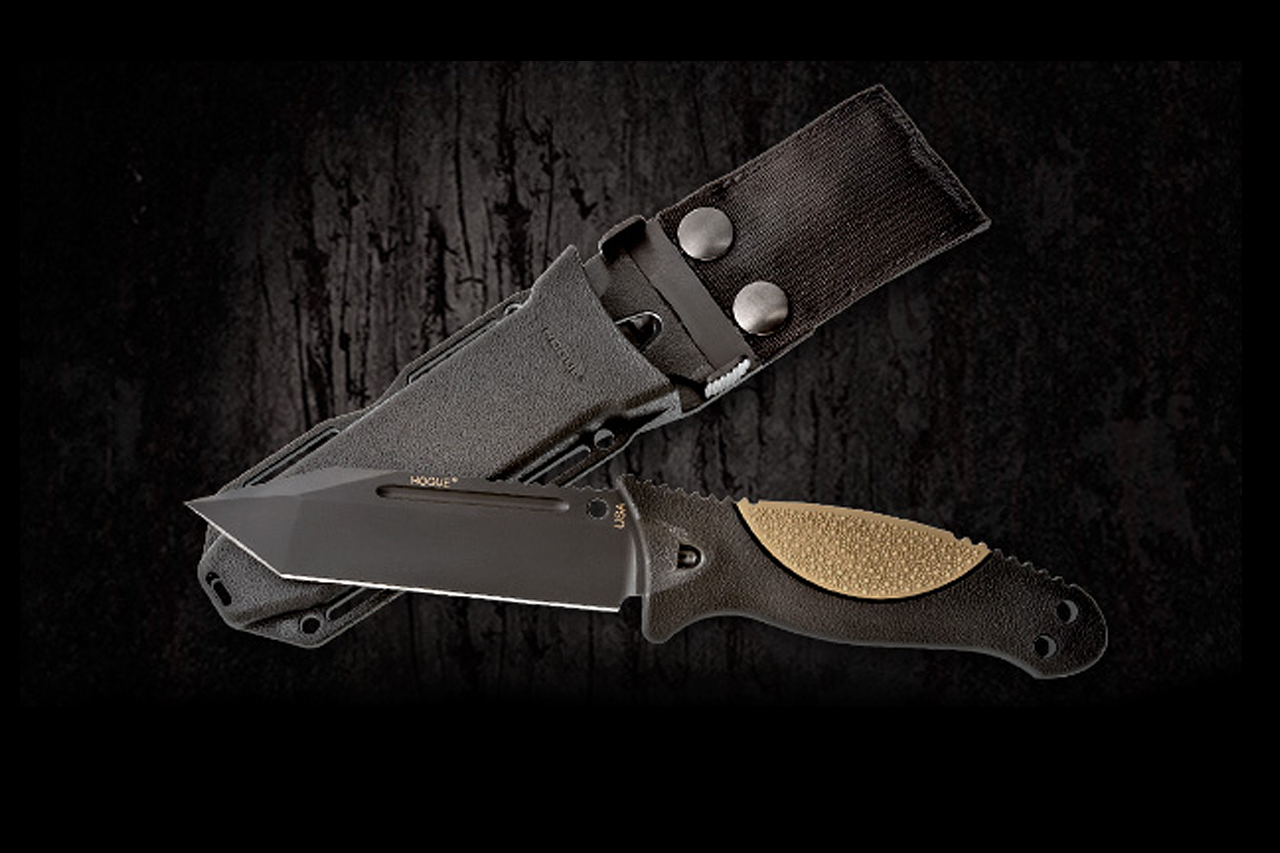
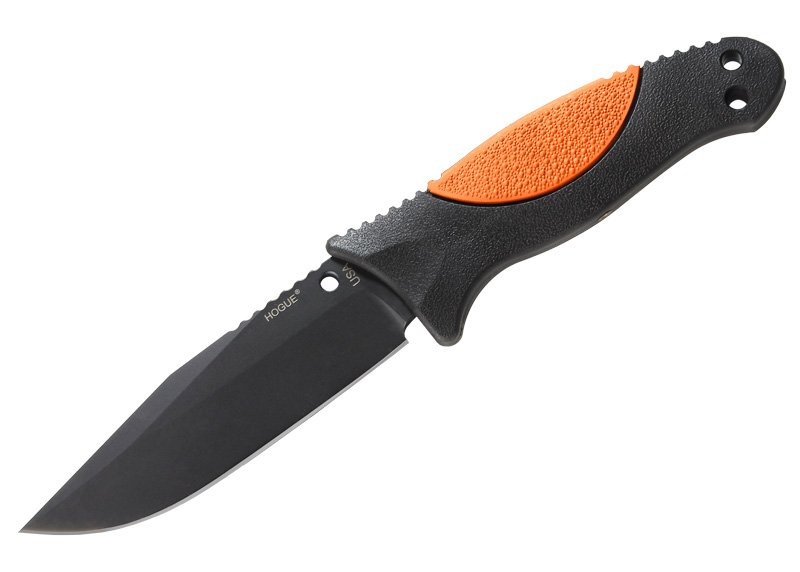
We’re always on the lookout for new contenders in the field of fixed-blade survival knives, and Hogue has stepped up with their own offering: the EX-F02. Although Hogue’s folding knives have become pretty well known since their introduction in 2010, until recently they only offered one fixed-blade knife, the EX-F01. The EX-F01 is a straightforward fixed-blade design, with a drop point, bolt-on hardwood or G10 handles, and included soft sheath.
Now, Hogue has branched out with the unveiling of the new EX-F02. It shares the cryogenically-treated A2 tool steel construction of the EX-F01, but this new fixed-blade also features a rugged design targeted at outdoorsmen. The most noticeable feature is its rubber and polymer hybrid handle that is said to improve grip, and offers four color options (black, OD green, dark earth, or hunter orange). Additionally, it’s available with either a 4.5” drop point or a 4.5” tanto blade. Not overlooking the sheath, Hogue created a new hard polymer design with automatic retention, ambidextrous release mechanism, and MOLLE compatibility.
The EX-F02 is priced at $149.95 MSRP and is available now through Hogue’s web store or your local Hogue dealer.
We realize we may sound like a broken record sometimes, since we’re always reiterating the importance of a good fixed-blade knife for survival scenarios. Then again, we only say it because it’s true. If you’re stuck somewhere with little to no resources, and you’ve got a sharp, sturdy knife, you’re already on the right track to collecting food, building a shelter, and defending yourself. There’s only one problem: there are literally thousands of different choices for fixed-blade survival knives. How do you choose what’s best for your needs?
First of all, let’s get something out of the way. Here at OG, we have the privilege of getting our hands on all kinds of handcrafted high-dollar blades. As awesome as those $300+ hand-finished knives can be, most ordinary folks just aren’t looking to spend that much on a piece of sharpened steel. That said, we wanted to come back down to earth and try out some more affordable, sub-$100 mass-market blades. Not everyone is a high-end knife collector, and when it comes to survival blades, you really don’t have to be. They’re going to get scratched and banged up, anyway.
If you walk into any outdoors store or sporting-goods store in the U.S., two brands you’re likely to see on the shelf are Gerber and SOG. That’s not surprising, either, since both companies produce wide ranges of good quality consumer-grade knives and tools. More importantly, both companies produce survival knives that are priced under $100. So, we decided to pick up the latest of these fixed blade knife options from Gerber and SOG, and compare them head to head.
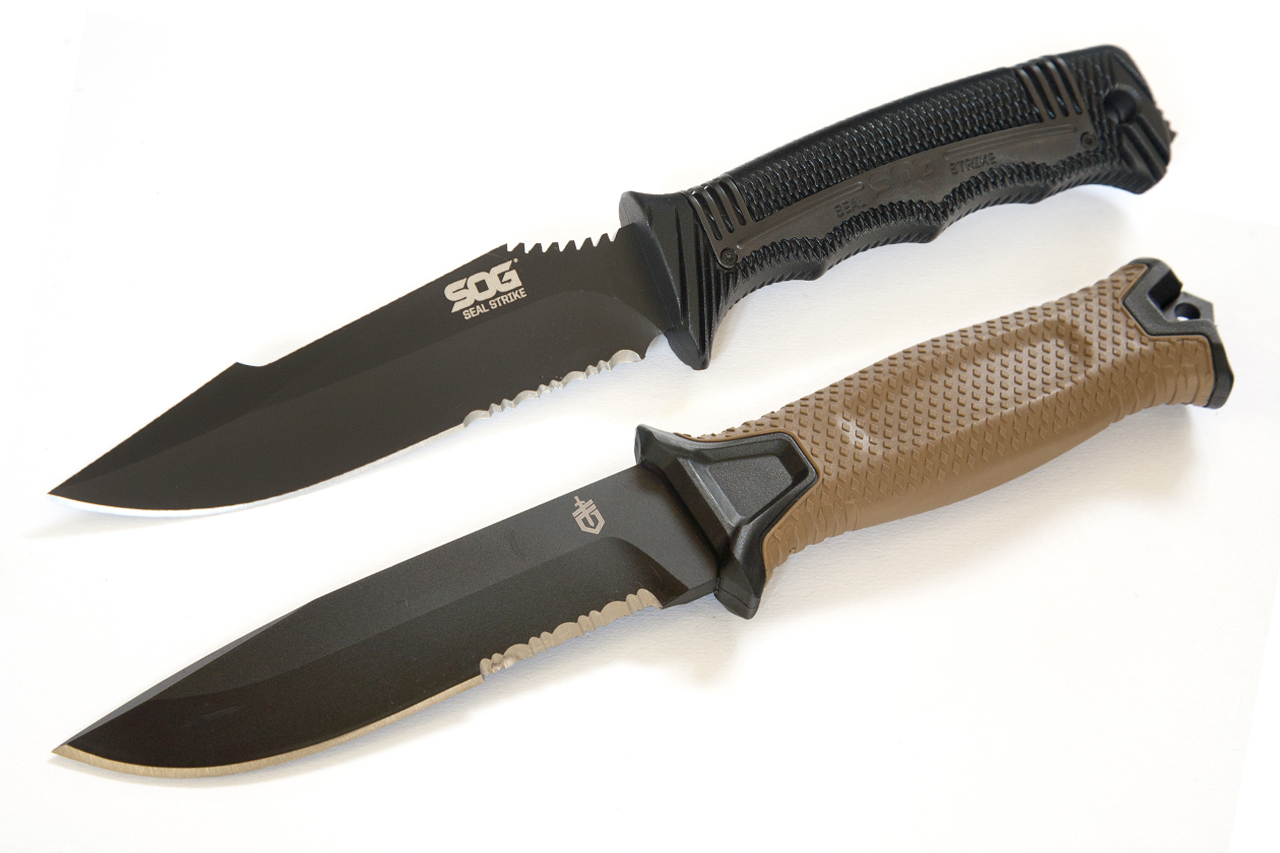
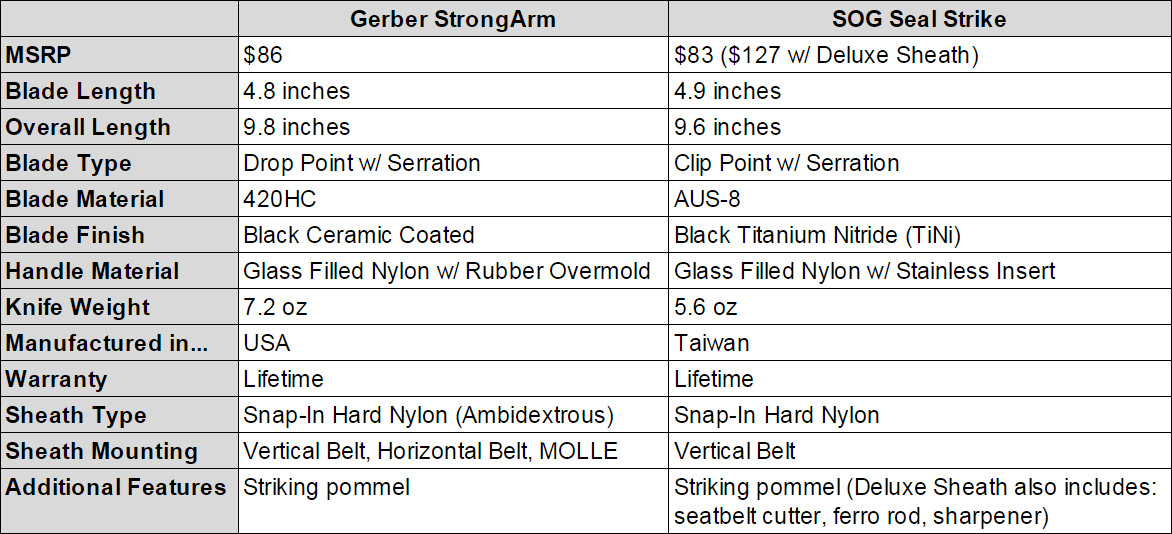
The two knives we’ll be reviewing are the Gerber StrongArm and the SOG Seal Strike. Both are very comparably priced at $86 MSRP for the Gerber and $83 MSRP for the SOG. The SOG also included an optional “Deluxe” sheath that brings its MSRP to $127, but we’ll get into that more later. To start, we’ve created a table below to compare the objective features. Next, we’ll compare our hands-on impressions of the knives, and finally, we’ll draw conclusions.
Gerber StrongArm
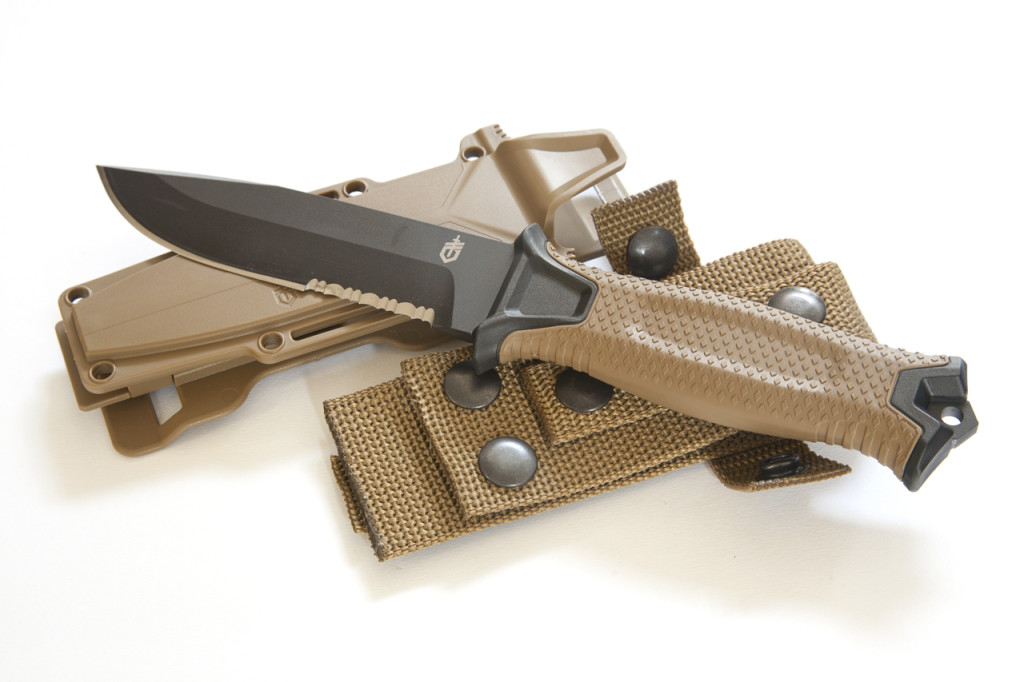
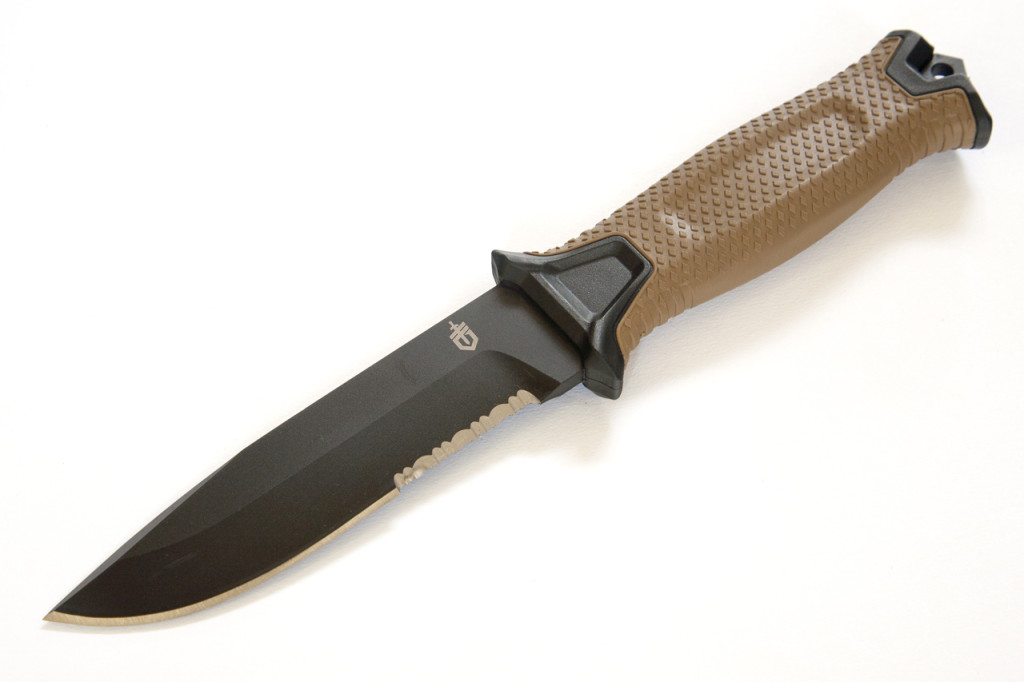
Now that we’ve got the technical side of things out of the way, we unboxed the Gerber StrongArm. Immediately upon grabbing it, the handle became one of our favorite features. Like the SOG, the Gerber handle is composed of strong and light glass-reinforced nylon, but unlike the SOG, the Gerber has a textured rubber overmold around the nylon core. On our StrongArm model, this overmold is Coyote Brown, but Gerber also offers it in black. The rubber’s raised diamond pattern feels pliable and grippy, and it ensures the knife won’t slip when your hands get sweaty or dirty. At the rear of the handle is a pointed steel striking pommel, with a hole that’s perfect for a paracord lanyard or retention strap.
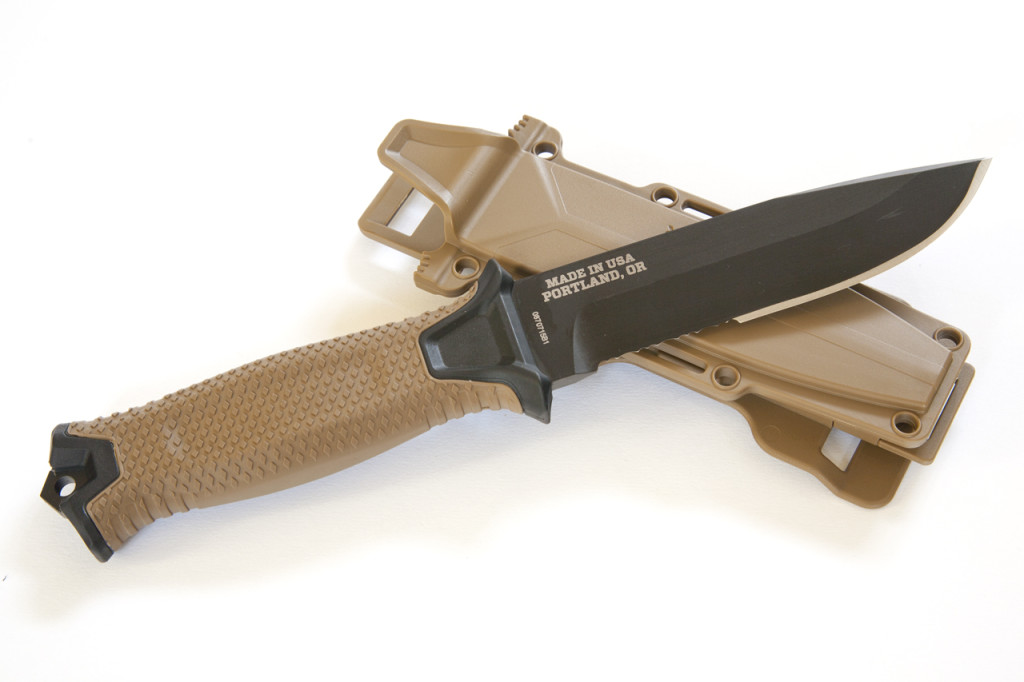
Moving to the business end of the StrongArm, you’ll find a black ceramic-coated 420HC steel blade. The 420HC steel is a mainstay of many survival knives, since it features excellent durability and edge retention, even under heavy use. The blade is quite thick (about 3/16 of an inch) and has reassuring heft—it feels like it could handle some abuse. Our StrongArm features a traditional drop point with a serrated edge, but Gerber also offers a non-serrated version. We did notice that the satin black ceramic finish had several noticeable smudges and discolored blotches, which are visible in our photos of both sides of the knife. Despite our best efforts, these blemishes did not wipe off, as they appear to be baked into the finish. If you’re picky about cosmetics, we could see this being an annoyance. However, the imperfections haven’t seemed to affect the finish’s durability thus far. There’s also “Made in USA, Portland, OR” in large lettering on the blade, and we definitely appreciate that the Gerber was manufactured here in the United States.
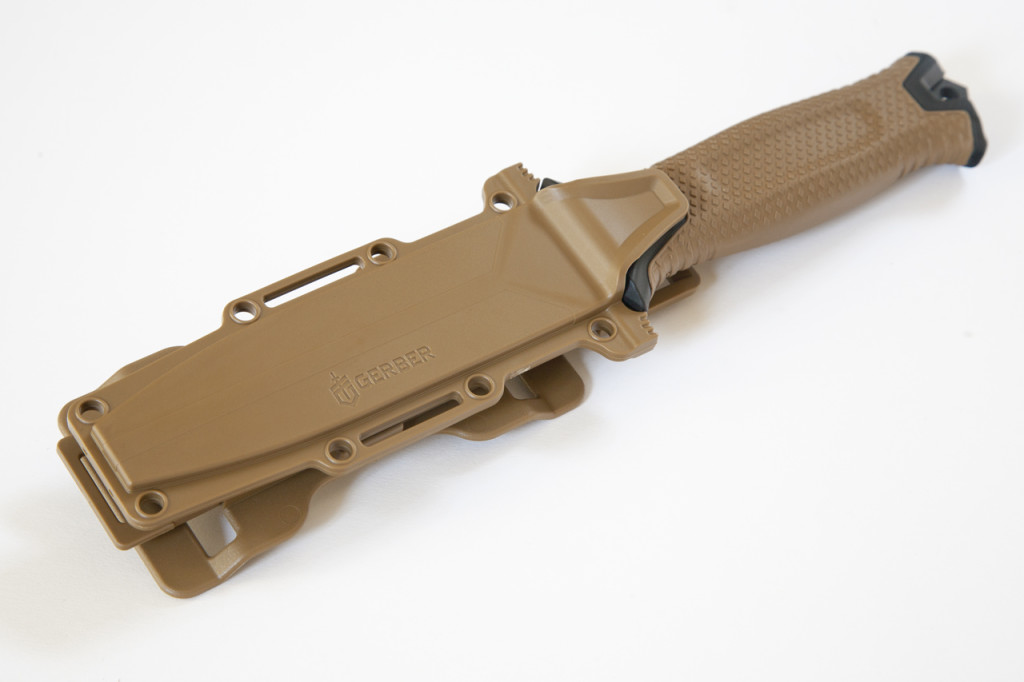
Finally, we tried out the StrongArm’s sheath. Its hard nylon matches the Coyote Brown color of the knife’s handle, and we were pleased to see it’s a fully reversible/ambidextrous design, so the blade can be inserted facing either direction. We also liked the thumb leverage points on either corner of the sheath, which make popping the knife out of its retention notch a snap. The Gerber sheath features several mounting options: vertical (or drop-leg) belt mounting, horizontal belt mounting, and MOLLE compatibility. Getting the MOLLE strap configured correctly is a bit tricky, but it’s a great option to have.
SOG Seal Strike (Deluxe Sheath model)
First, a clarification: the SOG Seal Strike we received is the Deluxe Sheath model, which has an MSRP of $127 versus the Standard Sheath model’s $83 MSRP. However, the Deluxe Sheath knife itself only differs from the Standard model in two ways—the Deluxe has a more durable Titanium Nitride finish instead of the Standard’s black powdercoat, and the Deluxe Sheath has several additional survival features built in. So, since the only functional change to the knife itself is the finish, we feel it’s still comparable to the $86 Gerber. After all, you’re mostly paying for the sheath features.
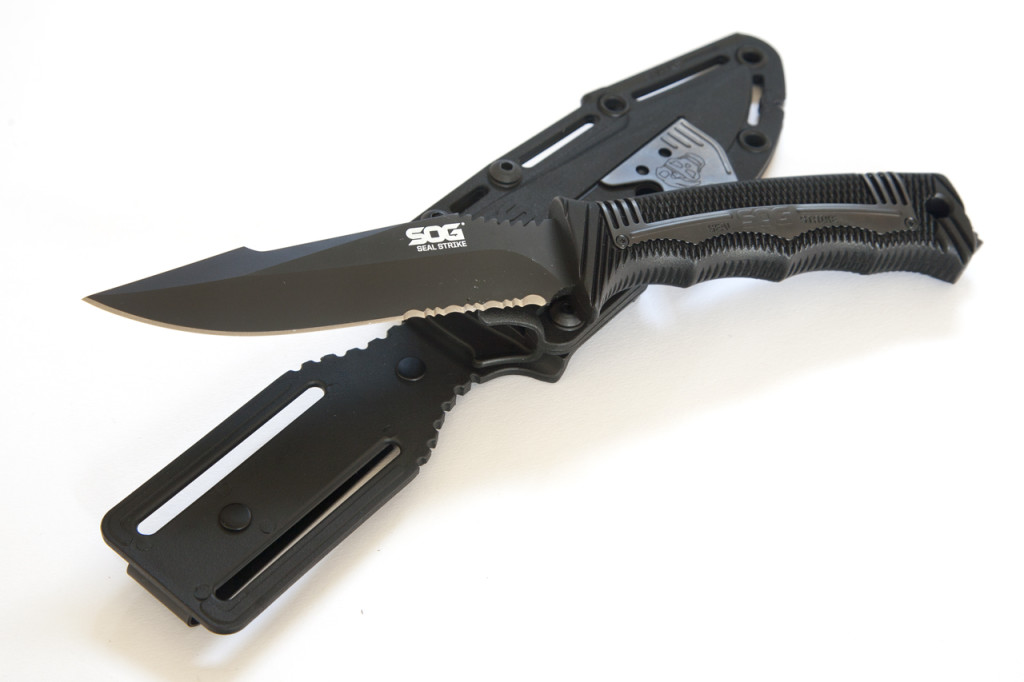
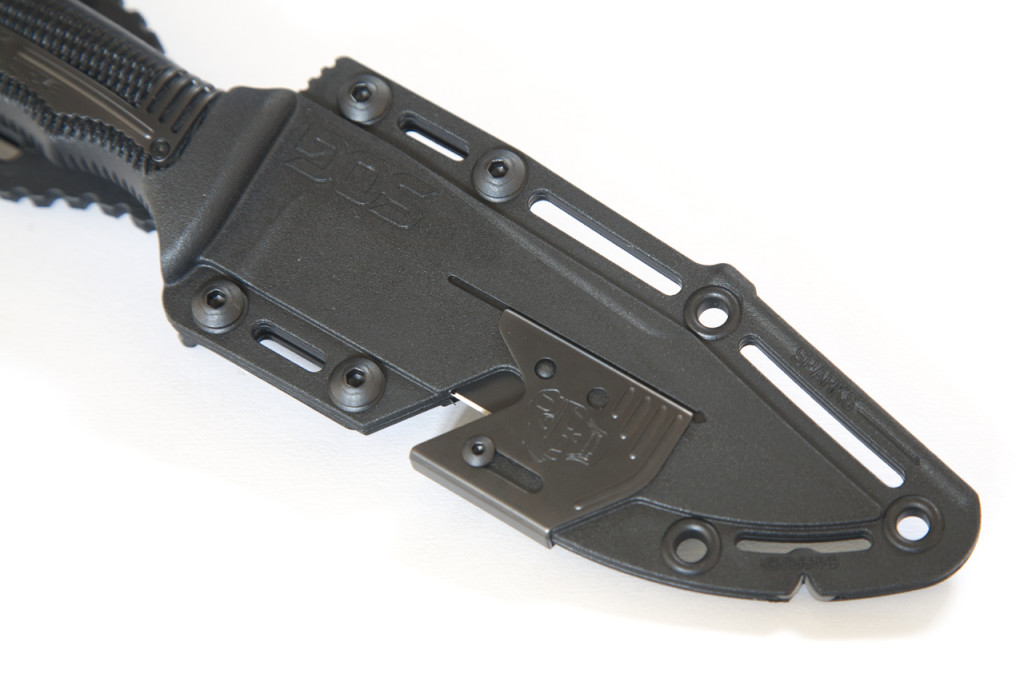
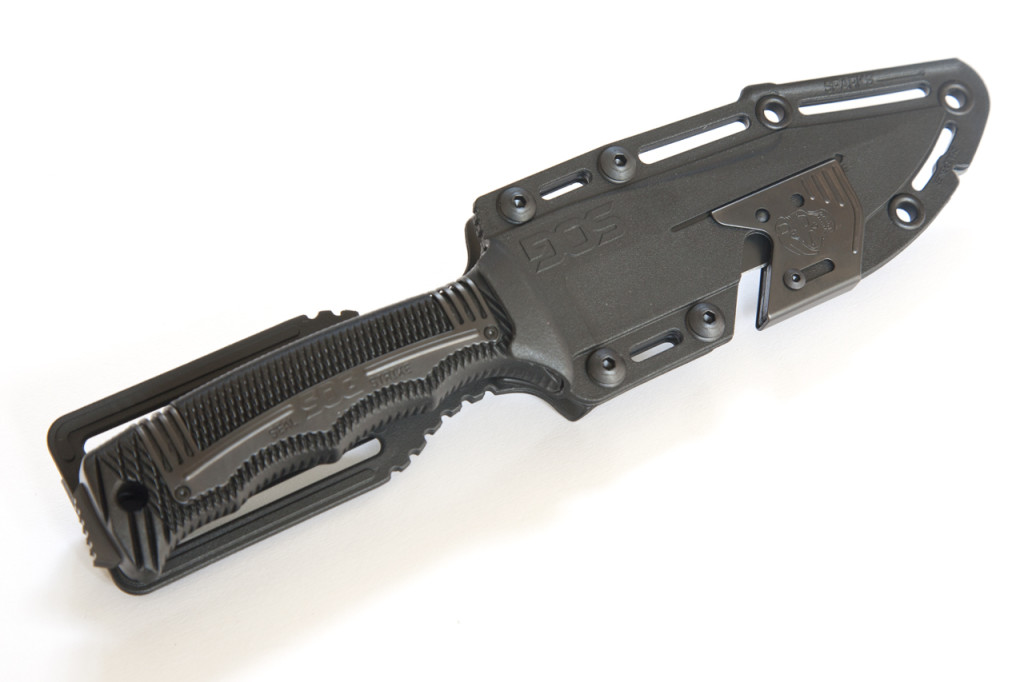
Speaking of sheath features, we’ll address those now. The Deluxe Sheath has a fully rigid nylon design, while the regular sheath has a fabric upper section and button retention strap. The Deluxe sheath also includes three added features: a fire striker ferro rod, a sharpener, and a sliding metal cover that reveals a seatbelt cutter. All these features are certainly nice to have, but we question if they’re worth a $44 premium over the Standard Sheath. Also, despite the helpful added features on the SOG’s Deluxe Sheath, we found its ergonomics were less than perfect. Unlike the Gerber sheath, the SOG sheath’s belt loop extends all the way to the end of the handle. This means you can’t fully grasp the handle as you draw the knife—you have to pinch it with your fingertips and pull.
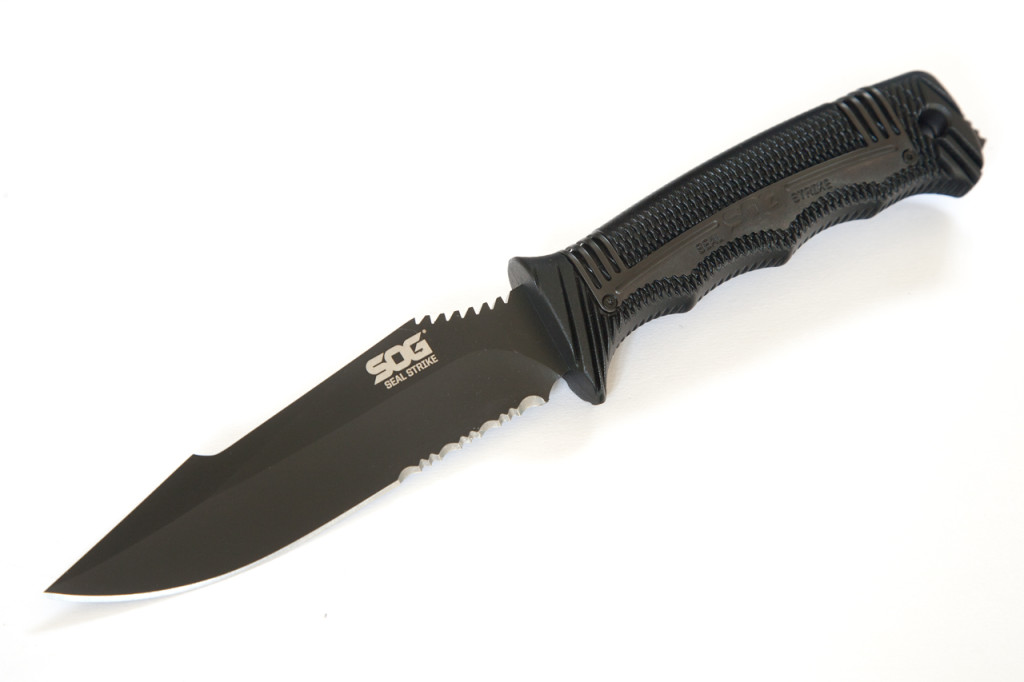
Putting aside the sheath, we gave the Seal Strike a try. Its handle is composed of hard glass-reinforced nylon with a thick crosshatch pattern and a decorative black stainless steel insert. We liked the finger grooves and thumb ridges, but we felt the hard plasticky nylon wasn’t as grippy or comfortable as it could’ve been. The end of the handle has a steel striking pommel and a lanyard hole wide enough for two strands of 550 paracord.
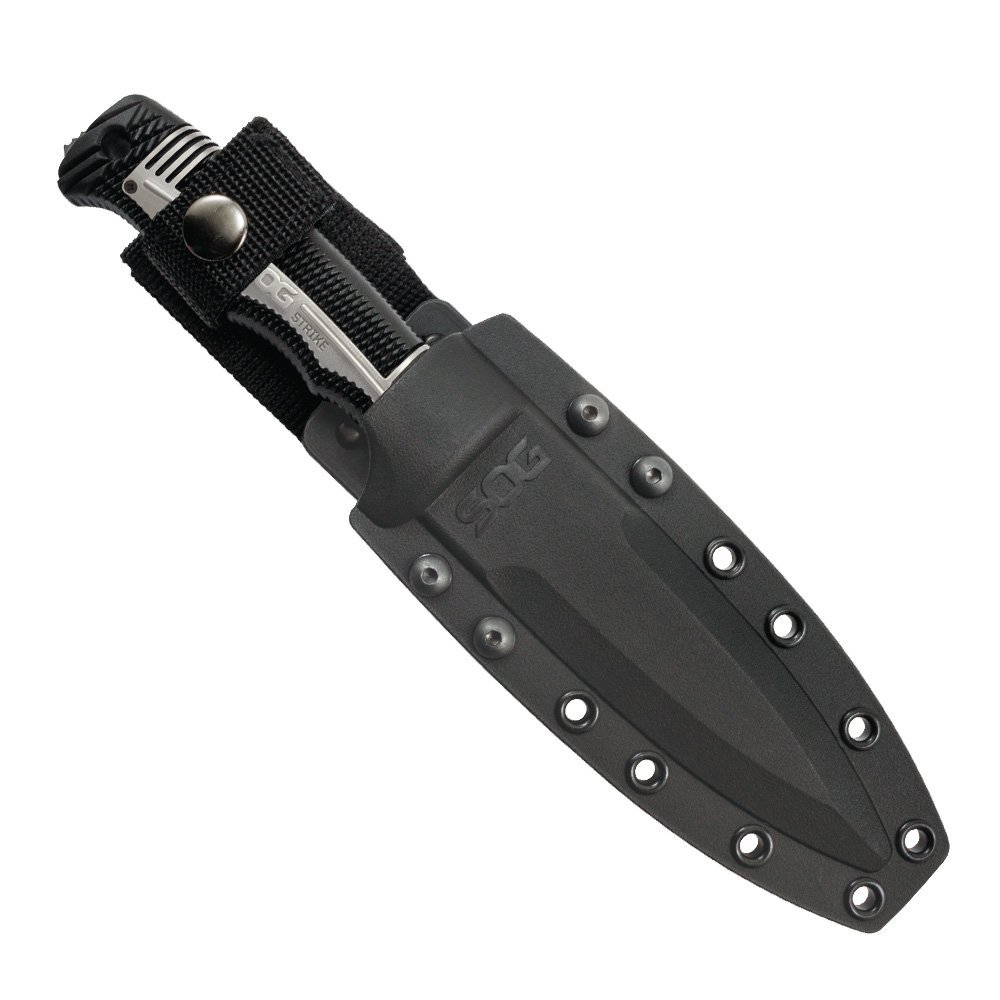
The Seal Strike with Standard Sheath features a hard nylon lower with a soft fabric upper. It also lacks the ferro rod, sharpener, and seatbelt cutter of the Deluxe Sheath model.
The Seal Strike’s blade is constructed of AUS-8 steel, a material used by SOG on many of their knives. Unlike 440 series steel, AUS-8 also includes vanadium, which improves its wear resistance and helps it take a razor-sharp edge. The Seal Strike blade is relatively thin and lightweight, with a tapered clip point, causing it to feel more like a precision instrument than a hacking and chopping tool. The SOG blade is well-balanced, and its black TiNi finish showed none of the cosmetic imperfections that the Gerber’s ceramic coating had.
Conclusions
Both the Gerber and the SOG are solid fixed-blade knives, and would likely serve you well in a survival situation. That said, each knife has its strengths and weaknesses. The Gerber’s rubberized handle feels far superior to the SOG’s hard nylon, and we liked the ambidextrous design and versatile mounting options of its sheath. We also preferred the thickness and heft of this knife, as well as the fact that it’s made in the USA. Then again, the blotchy finish was a major disappointment cosmetically.
On the SOG Seal Strike, the nylon handle feels rather cheap, even with the stamped steel insert. We also have a hard time justifying the 53% price increase for the Deluxe Sheath model over the Standard Sheath model. However, the added sheath features are a nice option to have, and the TiNi finish is cosmetically perfect (unlike the Gerber). Also, the Seal Strike’s light weight and tapered blade design make it feel precise and easy to wield.
When it comes down to it, if we had to pick one of the two blades to rely on, we’d go with the Gerber. It’s simply a better ergonomic design—the grippy rubberized handle feels appropriate for a knife in this price range, and the ambidextrous sheath doesn’t get in the way while drawing the knife. All the blemishes in the ceramic finish are ugly, but at least they don’t interfere with functionality. As for the SOG, the Deluxe Sheath model is a good choice if you want the additional survival features in a single package, and spending $44 extra doesn’t bother you. Without the Deluxe Sheath, the SOG Seal Strike is a good knife, but its ergonomic shortcomings prevent it from being truly great.
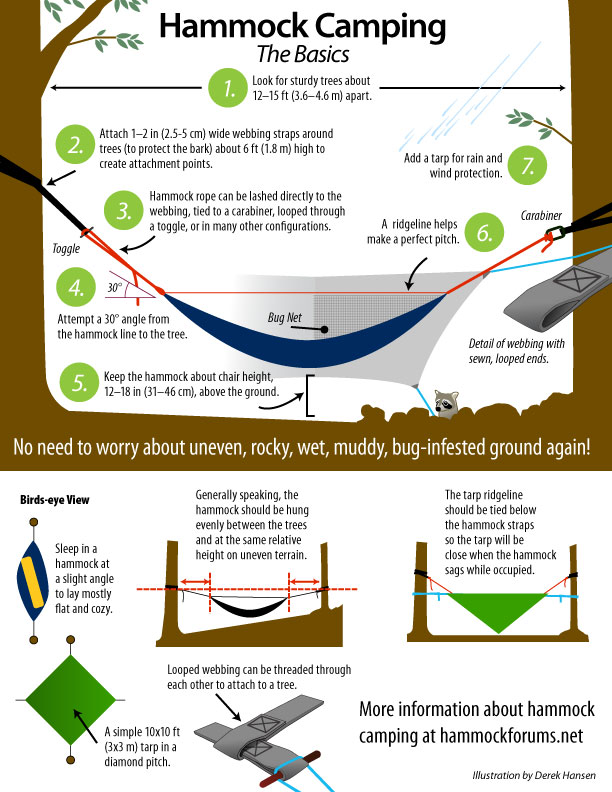
We recently came across this useful infographic from Derek Hansen at TheUltimateHang.com. It does a nice job of conveying the basics of hammock rigging for those who don’t have prior experience. It’s really not that complicated, and it requires minimal gear, so it’s perfect for those who want to travel light. Check it out:
As opposed to sleeping on the ground or in a tent, hammocks can have a number of advantages. Hammocks are often lighter and more compact than tents, they’re relatively easy to set up (assuming your location permits), and they generally cost less than tents as well. If you set up a hammock correctly, they can also be quite comfortable. And, of course, they help keep you off the ground and away from nocturnal critters, uncomfortable rocks, and rain water.
For those who want to learn more about hammock camping and more advanced techniques, visit Derek Hansen’s web site at TheUltimateHang.com. It’s packed with good info and guides for this unique form of camping.
Serac, a leading manufacturer of camping hammocks, also offers some useful tips and tricks on their blog. Click here to read Serac’s “Ultimate Beginner’s Guide to Hammock Camping”. The company’s blog entry answers many common questions about staying warm in your hammock, rigging your hammock correctly, and hammock safety.
MREs, or Meals Ready to Eat, are a staple for American military servicemen and women worldwide. As many of you know, they’re also a well-known choice for disaster preparedness, due to their compact packaging, relatively long shelf life, and calorie-dense contents. However, if you haven’t had much hands-on experience with MREs, you may not know how to check their packaging date. It’s not labeled in the standard MM/DD/YY format found on most consumer goods, and you might not recognize it if you don’t know what to look for.
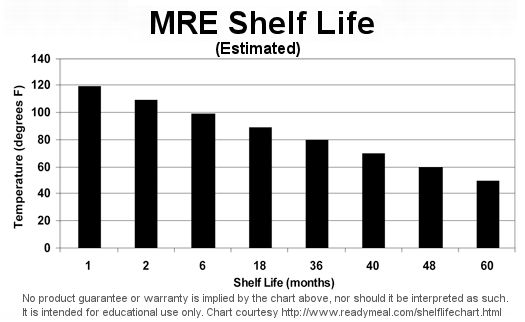
First of all, why does it matter if you know an MRE’s packaging date—they last practically forever, right? Well, no, actually. When stored in ideal 50-degree conditions, most modern military-grade MREs have a claimed shelf life of approximately 60 months (5 years). At a more realistic 80 degrees, this lifespan drops to just 36 months (3 years). Some old-style MREs from the 1980s and ‘90s contained freeze-dried elements that increased shelf life to 10 years or more, but modern MREs are not freeze-dried and do not last as long. Knowing the packaging date on MREs (and the components inside) will help you to determine if they are still safe to consume. However, note that depending on storage temperature, manufacturing date, and ingredients used, certain MREs and components may go bad faster than others—so, only consume borderline expired MREs at your own risk.
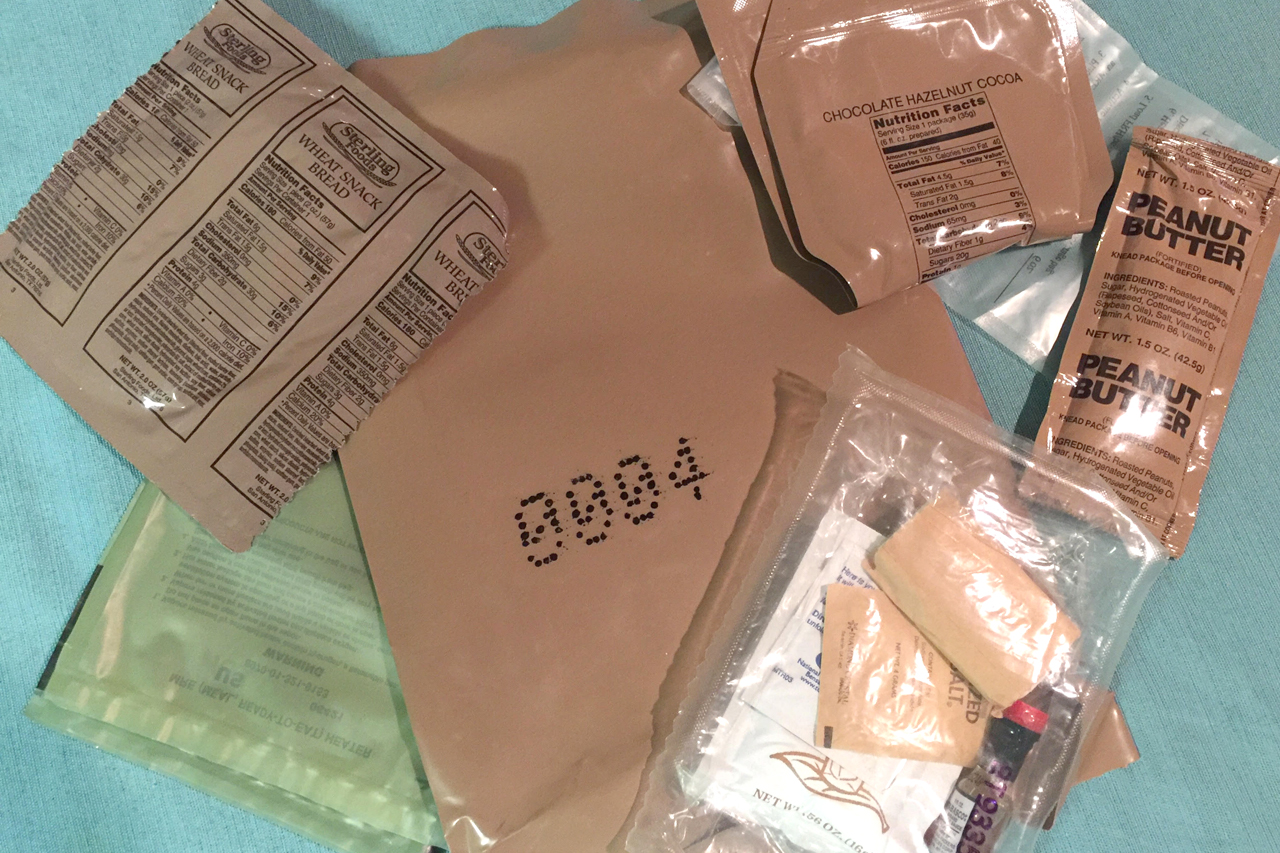
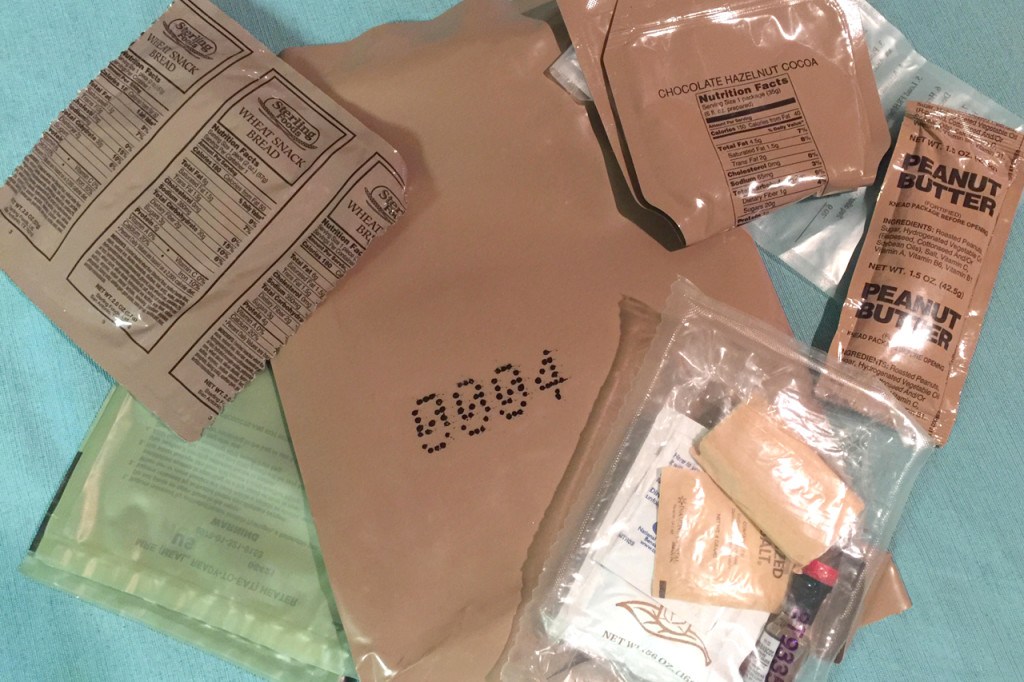
Now, let’s get to the actual dates. Standard military MREs will have a four-digit code either printed on the bag’s exterior or stamped/embossed into its seam. In the MRE pictured here from SoPakCo, it was printed clearly on the back: 0004. This is a format called the Julian date code, simplified as YDDD. The first number is the year of packaging, in this case, 0 denotes 2010. The next 3 numbers are the day, with 001 indicating January 1st and 365 indicating December 31st. So, in the case of our SoPakCo MRE, the 0004 date code means it was packaged on January 4th, 2010. We know it was stored in 70-80 degree conditions, so according to official guidelines this should be considered expired by a year or two. However, that doesn’t necessarily mean it’s inedible—we tried the Carrot Pound Cake inside, and although it tasted a bit stale, we didn’t notice any ill effects from eating it (again, only try this at your own risk). Before 2003, date codes weren’t labeled on MREs’ exterior bag, so the only sure-fire way to date pre-2003 MREs is to open them and check the dates on interior components.
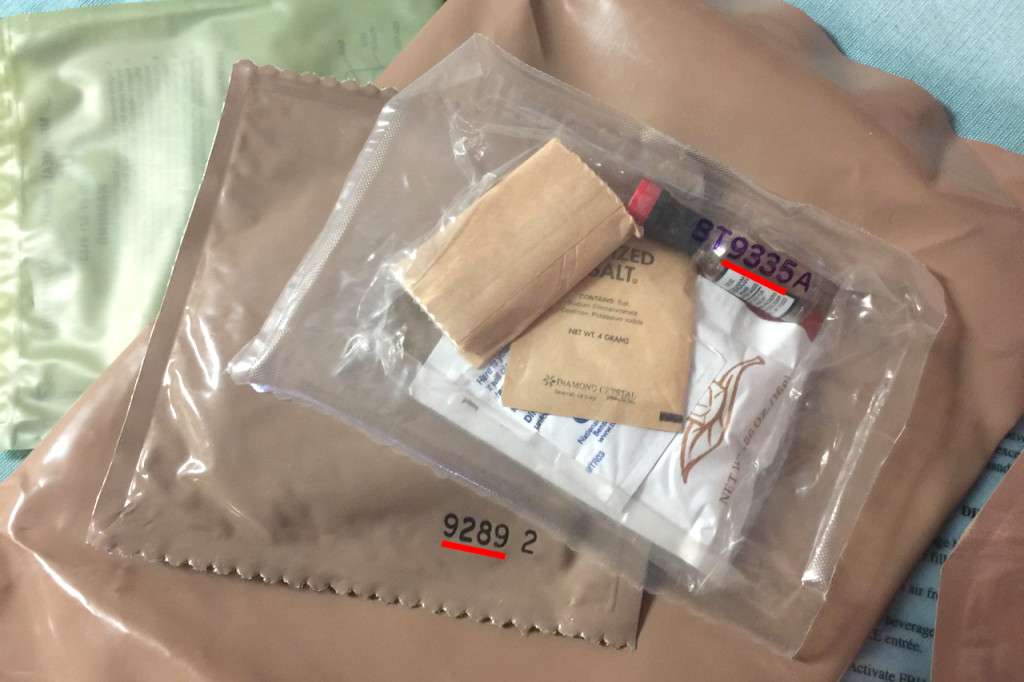
Now that we mention the interior components, you’ll notice they also feature the same YDDD date format, and that the components will all have dates slightly earlier than the exterior 0004 date. The dates on contents of this SoPakCo MRE ranged from 9289 to 9335. In normal format, that’s October 16th, 2009 through December 1st, 2009.
There’s a lot more to be said about MREs, but this should give you the information you need to at least determine if they’re relatively safe to eat. Bon appetit!