Home Blog Page 170

The Power of Survival Comes From Within

0

Illustrations by Joe Oesterle

When the proverbial excrement hits the fan, why might someone who’s considered fragile or vulnerable survive, while the seemingly tougher one fails? Before training, gear, and prep, there’s something more foundational to our survival. That foundation is our human spirit.

Nine-tenths of survival is psychological. If you don’t have the willpower to persevere, all that great gear may as well be nonexistent. In reality, survival gear is meant to be an adjunct to your survival instincts. We’re here to help you hone those—lest you be in a situation like the following one experienced by a young John F. Kennedy.

He led nine survivors on a 3-mile swim to landfall, while towing another who was badly burned using a strap between his teeth. Over the next six days, he swam dozens of miles to seek help. He sliced up his feet on coral reefs, risking death (or worse) by infection, currents, dehydration, capture, or attacks from oceanic predators.

Beyond physical and mental exhaustion, JFK said he drew on a spiritual strength, fed by his command responsibility for his crew. Eleven of his 13-member crew survived after a Japanese destroyer sliced his boat, PT 109, in half.

Warriors, artists, and healers have long recognized this power within ourselves. It’s described in metaphoric, religious, ethical, and transcendent terms. At the cusp of life and death, the human spirit can make or break us.

Human Spirit

The spirit is the metaphoric stone tablet of the presuppositions of our being, and it drives our deepest emotional, ethical, societal, mental, theological, and physical responses. One might say the spirit is the foundation from which we make choices. It includes:

  • What drives us: our goals for this lifetime
  • What is most important to us: what we’re willing to die for
  • Our convictions: what we’ll live for
  • Our code: what we’ll stand up for
  • Our sense of the transcendence: what we believe about “the big out there”

When our spirit is troubled and things happen that shake this foundation, it manifests itself in powerful emotions. For example, two police officers could be confronted with an armed suspect; identically trained, each officer draws their weapon and stops the threat, killing the suspect. In the aftermath, one officer processes the emotions, embraces the lessons learned, and moves forward. The other officer suppresses the emotion and begins to have recurring stress, bad dreams, and is eventually diagnosed with PTSD. This is deep emotional territory, life and death. If, in a survival situation, a life is taken and we come to terms with that choice, we can move forward. But if we get emotionally jacked up, we can suffer from an invisible injury that can make the rest of our life spiral out of control.

If, in the face of our own death, our certainty of life and survival rises up from the spirit of our being, we can do miraculous things. But if we believe it is our time to die, that the odds are too great, then they are … and we will. So, we must condition our spirit before the worst of the worst happens. In a SHTF situation we won’t have time for hesitation, so it’s important we map out our emotional wiring so we don’t short circuit when we’re under extreme stress.

The Importance of Spirit

The spirit is the place from which we’ll decide to kill, and the place from which we choose to survive. Let’s look at an example of someone put in this situation and the resolve they willfully demonstrated.

finding-spiritual-strength-aron-ralston

In 2003 Aron Ralston fell and his arm became inextricably lodged between boulders in the canyon he was exploring while hiking in Utah. With no expectation of rescue, he cut off his own forearm using the knifeblade in a cheap multi-tool and hiked to safety. He demonstrated a will to survive. At his spiritual foundation, Aron Ralston’s desire to live outweighed the cost of an arm, and the excruciating pain of its removal.

The spiritual strength to kill is harder to illustrate. Imagine a Marine Corps sniper looking down his scope at a 12-year-old headed for his buddies with a bomb strapped to her body. Imagine if, after SHTF, we were looking through the scope and our families were at risk. There’s a lot to work through in order to be OK with taking a life that may jeopardize our loved ones.

When these situations rear their ugly heads, there won’t be time for these questions. Will we kill or be killed and how will we live with the consequences?

We live in a democratic republic that affords due process, and other protections provided by the U.S. Constitution and the Bill of Rights. These are the conditions we operate under in a stable American society. The spirit has adapted to these norms.

Here are two exercises to prepare: the first is called pre-flection, a visualization exercise of ethical consequences.

The second is called emotional self-aid. Spiritual trauma, moral injury, and traumatic stress disorders manifest with emotional outbursts. This is an exercise to deal with those emotional flare-ups instead of suppressing them.

Pre-flection

One could call this exercise spiritual stress inoculation. It plays out the ethical consequences of a life-and-death decision before being faced with this kind of reality. It prepares the spirit for what follows such an event.

Outline a mock scenario where you have to kill someone to protect yourself or others. Write it in sort of a classroom assignment format as a logical exercise.

Example: You’re forced to shoot a poacher who is stealing a deer on land you’d planned to use to feed your family. Choose a quiet time where you can focus your thoughts and recall this scenario with a focus on what you may feel in that situation, moment by moment.

finding-spiritual-strength-poacher

Visualize the scenario step-by-step, imparting as much realism as possible. The key is to feel the reality as if you’re watching it unfold. Make the people authentic, not like comic book villains. Be vivid in your description. What do people look like? What time of day is it? Where are you living? What are the thoughts racing through your head as you make this decision? Write it as if you’re a novelist.

Imagine the aftermath: the shooting, the body, the surroundings, how your family might react. Imagine it until you feel it, the anger that forced you to pull the trigger, or the anguish that you took a life, or the sheer disbelief—whatever comes to your heart and mind. The intent is to shake your spiritual foundation, to make yourself painfully uncomfortable with what happened.

Now back off the image and work through the feelings. What did it feel like? Could you do it? Would you do it again? Write down the results, date them, and file it.

Run the exercise several times, leaving days or weeks between. After four or five repetitions of this exercise, go back and see the progress that has been made.

Pre-flectioning the scenario aligns spiritual issues of what we should do and what we will do. This will be the time to uncover and, as necessary, change the deep truths of what we believe and are willing to do.

Emotional Self-Aid

Pain, injury, death – and life, in general – can raise unfamiliar or undesired emotions as the spirit adapts to new circumstances. When we shove those emotions into a box, it’s inevitable that the contents of that box will eventually permeate other aspects of our life.

While in seminary, I traveled to Israel for a short-term study. During that time, we witnessed a protest of the recent death of a young Palestinian man taking place at the Church of the Nativity. This protest was surrounded by the Israeli military. When a young Palestinian woman thanked us for being there, because the Israelis were “less likely” to fire with American tourists present, it affected me much more deeply than I realized at the moment. In that instant, I simply packed all my conflicting emotions into a box and tried to leave the area as quickly as possible. It wasn’t until we returned home that the shame of what might have been seeped into my consciousness.

Survival in a SHTF situation will leave us tired and distracted enough. Adding the burden of emotional turmoil on top of a disaster scenario is nearly guaranteed to overwhelm. Training our coping mechanisms ahead of time will lessen the blow of any circumstance we might not have prepared for. Unlike going to the range, one doesn’t simply sit and practice anger. This exercise is practiced in real life.

Prepare a list of emotional identifiers. An easy system is “glad, sad, mad, bad, and afraid.” Name the emotions as they come to mind as you walk through a variety of events in your memory that span the emotional spectrum. It’ll be very clunky at first.

Expand and adapt your own vocabulary through real-life experience. For example, your kid crashes and totals your new pickup—mad doesn’t begin to describe it. Build the vocabulary. The more descriptive or colorful the language, the more it’ll make sense to you.

Your brain only works as far as the words you have to describe what's in it. Writing down your emotions as you experience different events helps you handle difficult experiences and identify your emotions better.
Your brain only works as far as the words you have to describe what’s in it. Writing down your emotions as you experience different events helps you handle difficult experiences and identify your emotions better.

Be aware of involuntary physical reactions. Elevated heart rate, jitters, sweating, shallow breathing, etc.—maybe anger triggers a freeze because you fear lashing out. When these physical manifestations of emotion happen, calm can be achieved with tactical breathing. Lt. Col. David Grossman explains this process in his lectures to law enforcement officers—using both our voluntary and involuntary physical reactions as handles to regain self-control.

Tactical breathing (breathing in, holding, breathing out each for a count of four) will calm the physical processes and eventually ease those emotional triggers. As you work it through, catalogue the physical reactions. Learn to recognize when yours are coming to the surface.

Ultimately, this is an exercise in self-awareness. Practiced in the relative safety of everyday life, it provides tools to work through the potentially overwhelming emotions that’ll come when the world is turned upside down.

Spiritual Fortitude

There’s a sign in a law enforcement training facility that says, “In times of trouble, we do not rise to the occasion, but fall back to our level of training.” This includes the human spirit. It’s one thing to claim we would kill to protect our families. It’s quite another to actually do so. It’s one thing to declare that if caught in a bear trap, we’d hack off a leg to survive. It’s quite another to have the spiritual power to actually cut into your own flesh if the need calls for it.

Most of the time, the human spirit doesn’t manifest itself. Our conscious mind is adequate to deal with the choices of normal life. When we go off the cliff of proper behavior to behavior to contemplate what’s worth dying for and what’s worth killing for, the spiritual trauma will manifest as powerful emotions.

In that moment, when we have to decide to live rather than die, no matter how grim the odds may be that choice is a spiritual one. From the spirit flows a wellspring of strength when all else has failed. Spiritual strength allows us to transcend limitations.

About the Author

Peter Hofstra is a law enforcement, fire department, and emergency management chaplain. He works actively at developing the skills of these heroes to better prepare himself to survive and be more effective working alongside these first and second responders. His pastoral work has been in the understanding, development, and strengthening of the human spirit as a creation of the Almighty in every person. He resides in central New Jersey with his wife, Lynn, and their two children.

More From Issue 23

Don’t miss essential survival insights—sign up for Recoil Offgrid’s free newsletter today!

Read articles from the next issue of Recoil Offgrid: Issue 24

Read articles from the previous issue of Recoil Offgrid: Issue 22

Check out our other publications on the web: Recoil | Gun Digest | Blade | RecoilTV | RECOILtv (YouTube)

Editor’s Note: This article has been modified from its original version for the web.

A Guide to Portable Solar Charger Kits

0

At more than 100 times the diameter and over 300,000 times the mass of the Earth, that enormous ball of plasma at the center of our solar system is the primary energy source for our planet. Without the sun, life on Earth wouldn’t be possible, and George Hamilton wouldn’t know what to do with himself. According to NASA, the sun produces about 500,000,000,000,000,000,000,000 horsepower worth of energy per second. That’s a lot of damn zeroes. It’s no surprise that sun deities permeate ancient cultures and mythologies.

With so much energy beaming down from the heavens, free and clear, it’s also no surprise that mankind has looked to harness the sun’s power by devising various technologies to convert sunlight into electricity. The first photovoltaic cell, which generates electric current when exposed to light, was developed in the 1880s. Photovoltaic technology has continued to improve, with industrial, commercial, and residential installations becoming more common over the past several decades. Solar installations around the globe represented a total capacity of about 177 gigawatts in 2014, according to the renewable energy association REN21.

As with so many kinds of technology, end users benefit as they’re productized and miniaturized. From solar-charged watches to sun-powered radios, small and increasingly efficient solar cells have made their way into consumer products. And with so many battery-powered devices proliferating across people’s lives, solar chargers are coming of age.

Juice ‘Em Up

Portable solar charger kits are essentially compact solar cells that output electricity via USB or other jacks. The solar cells might be composed of rigid crystalline panels or flexible thin films; the former tend to be more efficient and rugged while the latter are more compact. The larger the panels, the greater the potential power output. The panels are packaged for convenience (e.g. folded up like a pamphlet) and may also feature electronics to detect the appropriate protocols for charging different types of devices, deal with dips in power output from passing clouds, and so forth. Some have integrated batteries — so the panels charge the battery pack, which then provides power to your devices, rather than routing power directly to your iThingies. More on this later.

solar-panel-charger-soaking-up-sun

The general concept is to place your solar charger in direct sunlight and enjoy the resulting electricity to charge your devices. However, the blunt truth is that if you have consistent access to the power grid, using now-ubiquitous rechargeable battery packs to juice up is generally a better solution than solar chargers. Getting the most from solar chargers can be a fussy and frustrating process.

For example, there’s an optimum angle to position solar panels to maximize energy collection from the sun, depending on your geographic location, time of year, and time of day. Our product testing was done in the winter, and based on our location, the proper tilt was approximately 32 degrees from vertical. In our unscientific testing, placing panels completely flat (90 degrees from vertical) versus at the optimal angle resulted in up to a 42-percent decrease in power production. Cloud cover, objects blocking the sun, and precipitation can all significantly reduce power output as well. Trying to ensure proper exposure to the sun for several hours (or all day) in a static position can be challenging enough, much less when you’re on the move.

Furthermore, some devices (such as iPhones and iPads) may stop charging if the power input drops temporarily due to shade or a passing cloud. What a waste that would be if you left it unattended to charge or didn’t realize it had stopped. Numerous chargers have circuitry to deal with this exact problem so that devices will start charging again once the power level creeps back up.

So why bother with solar chargers? As a prepared individual and/or outdoorsman, you know that you won’t always have access to power. The grid may go down for extended periods in an emergency, and there aren’t any outlets in the wilderness (much to the chagrin of smartphone-obsessed teenagers everywhere) or often at the range, where we’ve used solar to charge our cameras, which are more power-hungry than a politician. Solar chargers are perfect for those situations, and if you’re a reader of this magazine, no doubt you’ve said this before: “Better to have and not need …”

One more thing: Given the challenges we’ve described, we highly recommend using rechargeable battery packs in conjunction with your solar charger rather than connecting your devices directly. This allows you to capture all of the power generated by your panels, and you’ll always have the power stored in your battery packs on tap to use no matter the weather conditions. Some products shown in this article have integrated batteries, but you can easily use one or more separate battery packs with stand-alone solar chargers. This will result in having a few more doodads to keep track of, but pay off in a lot more convenience and versatility. Cobbling together your own kit is also a lot cheaper, as pricing on stand-alone rechargeable battery packs has dropped faster than a Forever 21 dress on prom night.

solar-panel-close-up

Considerations

What you should look for in a solar charger kit?

Power Output (rated): The higher the maximum power output of your solar charger, the more you can make use of each minute of sunlight. The larger panels can charge two devices or two battery packs at the same time. Power output is usually expressed in watts, which equals voltage multiplied by current (amps). Tablets and large phones guzzle down 2 amps for optimum charging — at the USB standard of 5 volts that translates to 10 watts of power. More is definitely better here, but there’s a trade-off in portability from necessitating larger solar panels. Additionally, while many products tout 2 amps of power output, our measured results often fell short.

Portability: With an intended use for emergencies and while on the go, size and weight matters, especially if you’re on foot. None of the chargers in this article are particularly heavy — but some are lighter than others and the larger panels can get a bit bulky. If you carry multiple battery packs, the weight can also start to add up.

Usability: All the products in this guide have some sort of carrying case, often with pockets to store accessories and devices as well as eyelets and carabiners or other methods of attaching the solar panels to backpacks or other objects. Many have multiple rigid panels that fold up for storage. A pocket is useful to hold your device or battery pack, so that they aren’t exposed to direct sunlight while charging.

Features: Solar charger kits can be packed with features — smart charging controllers, clever packaging, integrated or included battery packs, accessory cables and adapters, methods to tie them down (we’d suggest packing some paracord with your charger), and more. Some have more weatherproofing than others, which may be important depending on your climate. Also, if you plan to charge devices directly, take note of those that recover from drops in sunlight.

You don’t have to drive a Nissan Leaf, wear a man bun, or protest BP to take advantage of solar chargers. Following is a representative selection of solar charger kits, one of which is bound to meet your particular needs.

[buyersguide title=”A Guide to Portable Solar Charger Kits” ids=”5155, 5156, 5157, 5158, 5159, 5160, 5161″]

More From Issue 13

Don’t miss essential survival insights—sign up for Recoil Offgrid’s free newsletter today.

Read articles from the next issue of Recoil Offgrid: Issue 14

Read articles from the previous issue of Recoil Offgrid: Issue 12

Editor’s Note: This article has been modified from its original print version for the web.

Last Man Projects: Survival Lessons from a Road Tramp

0

When was the last time you grabbed your bug-out bag and set out on foot for an overnight trip? What about for a week, a month, or even longer on the road? Most of us are prepared for the idea of short-term survival — 48 to 72 hours away from home. But during an actual emergency, you may be forced to remain on the road far beyond this time frame, so it’s important to consider how you’d face these long-term survival situations.

stay-or-go-marked-trail

Brandon Barton of Last Man Projects had an opportunity to speak with someone who has made a permanent lifestyle of surviving on the road. The man, known as Charles, considers himself a road tramp — this is defined as “a long-term homeless person who travels from place to place as a vagrant, traditionally walking all year round.” This may sound strange to those of us who’ve settled down, but by opting in to this lifestyle, Charles has some interesting insights for any survival-minded individual.

Road tramp survival lessons dog animal hiking backpacking camping 1
Charles calls his dog, Roxy, his “first line of defense” and prioritizes her health and training.

We’ve shared an excerpt of Brandon’s post below. A link to the complete list of tips can be found at the end of this article.


Today I had the chance to speak with a man who’s spent the last 8 years of his life living out of a backpack. For Charles, being a Road Tramp is a lifestyle choice; and every day is about adapting and improvising to survive to the next. Here’s a few tips and lessons Charles gave me about living his way of life:

1) Stay out of shelters and homeless camps. Charles camps nearly every night. On his own and with his dog Roxy, he and his gear are safer. [Editor’s note: this logic is especially relevant to overcrowded community centers and emergency shelters during a disaster.]

2) Leave room in your pack. Stuffing your pack full is a rookie mistake. You never know when you might come across extra canned goods or water. You need room to carry what you’re fortunate to find.

3) Always keep your gear with you. Stashing it somewhere is risking losing everything.

4) Charles uses a gallon of water a day between him and Roxy, and she gets most of that. Wash days use up about 3 gallons when he has it, and that is usually twice monthly.

5) Take care of your feet and change your socks often. He carries 2 changes of clothes but lots of socks and underwear.

6) Tarps are quicker and easier than tents, and he considers his sleeping bag his most valuable item. He used to carry a short shovel, but doesn’t anymore saying it wasn’t worth the weight.

7) Out of sight is out of mind. He camps in remote or out of the way places, uses natural material to camouflage his camp, and usually eats things from a can cold to avoid having a fire.

Click here to read the rest of the article from Last Man Projects, including 9 more of Charles’ tips.

Curated Offers: This Tactical Flashlight Is An Emergency Kit Essential

0

Just because the sun has set doesn’t mean your adventure has to come to an end. With a flashlight, we can light our path while deterring any assailants or hostile wildlife. But when you’re out in the thick of the night, you can’t trust your run-of-the-mill, convenience store flashlight. You need more power. Enter the Army Gear Z9 Tactical Military Flashlight, a tactical flashlight used by the likes of the Army Rangers and the Marine Corp.

Composed of aircraft grade aluminum, this flashlight is powered by an impressive 500 lumen LED light that can be seen from over a mile away. Additionally, it’s capable of five different modes, from strength adjustments to an SOS mode, helping keep you safe in an emergency situation. During the daytime, you can easily tote this flashlight in its complimentary padded case, complete with a charger and a rechargeable battery, so you don’t have to worry about it losing power when you need it. It’s an all-in-one flashlight that packs enough light for any situation you find yourself in. Plus, this tactical flashlight is dressed in infantry camo print, allowing you to blend into the scenery.

If you’re headed out on an adventure anytime soon, you’re going to want to make sure you have an Army Gear Z9 Tactical Military Flashlight in tow. And you can pick one up for $19.99, which is 86% off the original price.

Video: Living Out of a Storage Unit

0

In dense urban areas around the world, housing costs can be extremely high. Paying several thousand dollars each month for a one-bedroom flat isn’t unheard of in many cities, and in Manhattan, the average apartment price has reached $2.19 million. Yes, you read that right. This fact has led some city-dwellers to come up with creative ways to live independently and dodge these extreme rent costs. Take, for example, the Google employee who lived in a box truck in his employer’s parking lot. By doing so, he managed to avoid the area’s exorbitant housing prices and save 90% of his income.

A 23-year-old Google employee named Brandon lived in this repurposed Ford box truck.

We recently came across another fascinating (and very strange) example of what some might call unconventional urban housing — others might call it illegal squatting. A YouTuber known as 007craft posted the following video of his tiny home inside a rented 10′ by 10′ storage unit. He says in the description that the unit costs him $205 per month, as opposed to the “$1,000+ a month” for a small apartment in the area.

Storage unit locker tiny home apartment urban house 3

As you might expect, it’s generally a breach of the rental agreement to live inside these units under normal circumstances, so we’d advise against trying any of this unless the complex has been abandoned during some kind of SHTF scenario.

Since that’s not the case for this video, 007craft has taken some steps to conceal his presence — he says “you have to be a ghost… if anybody finds out you’re here, that’s when you start running into trouble”. However, the taped-up extension cord running from the complex’s outlet into the door frame remains laughably conspicuous. This seems like a fast way to get caught, evicted, and hit with a trespassing notice, but he doesn’t seem too concerned.

Storage unit locker tiny home apartment urban house 4

He then proceeds to give a tour of his abode, like an ultra-low-budget version of MTV’s Cribs. He has a full-size bed, couch, big-screen TV, stereo system, mini-fridge, microwave, hot plate, sink with clean water and grey water tanks, and even centrally-controlled lighting. You may wonder how he can afford all this but not an apartment… but that’s besides the point.

"I even have a paper towel holder, I have all the amenities you'd find in an apartment."
“I even have a paper towel holder, I have all the amenities you’d find in an apartment.”

Using some 2x4s and angle brackets, he built compartments down from the unit’s ceiling to house essential items like footwear, a snowboard, and his nunchucks (you just can’t make this stuff up). Hey, you never know when he might need to defend himself against marauding ninjas.

Storage unit locker tiny home apartment urban house 5

Near the end of the video, 007craft shows how he refills his water tanks using a plastic jug, a hose, a funnel, and the nearby drinking fountain. There’s no mention of a bathroom, but we imagine he uses the complex’s facilities for that, too. Otherwise, it might involve more 2x4s, funnels, and plastic jugs, so we’re not sure we want to know the details.

Storage unit locker tiny home apartment urban house 6

After about two months, 007craft says he moved into an actual apartment. So, even if you’re dedicated to flying under the radar, living out of a storage unit in an active complex clearly isn’t a long-term solution. And although many aspects of this video seem unintentionally humorous, we’ve got to give the guy kudos for making a 10×10′ room into a pretty efficient tiny home. Watch the full video below, and for more on unconventional off-grid housing, check out our previous articles on the DIY box truck RV and Sara Liberte’s Battle Van build.

Improvised Knife Sharpening Methods

0

A knife is the most quintessential of all survival tools. Whether you’re stranded in a desert, inundated by floods, caught in a snowstorm, or stuck in any other potentially life-threatening situation, having a reliable cutting tool is a must.

While opinions on what constitutes a proper “survival knife” will always vary greatly, the defining quality that makes a knife a knife remains the same: it must cut. It must also continue to cut until your emergency situation is over and life as you know it returns to normal. To make sure it does that, you need to know how to sharpen your knife, if necessary, with improvised means.

Cutting-Edge Basics

A knife essentially functions as a miniature saw or a miniature ax. When properly sharpened, its cutting edge terminates at an acute V-shaped angle. Depending upon the grit size of the abrasive used to finish the edge, the size of its microscopic teeth varies from relatively coarse (great for cutting rope and other fibrous materials) to extremely fine and polished (for scalpel-like cutting, usually in softer materials).

In its saw-like mode, the edge cuts when it’s drawn longitudinally through the material while constant pressure is applied. This slicing style of cutting takes full advantage of the edge’s tooth pattern and typically cuts with maximum efficiency.

As an ax, a knife’s cutting edge works like a pure wedge. Rather than drawing the length of the edge through the material, it meets it at a right angle. The force of that contact — either ballistic (chopping or batoning) or sustained pressure (whittling) — sinks the edge into the material to separate it.

Either way, the key to a knife edge’s performance is the acute V shape at its terminus. The exact angle of the V depends upon the blade’s grind (i.e. flat, hollow, saber, convex, Scandi), its thickness at the beginning of the terminal cutting edge, the steel the blade is made from, and the hardness of that steel at the edge.

When a knife gets dull, the tiny teeth at the edge become mangled and ultimately the acute point of the edge’s V is worn away, broken off, or bent over. When this happens, the cross-section of the edge looks more like a U than a V and your knife’s defining function — cutting — is compromised until you sharpen it again.

Staying Sharp

In simplest terms, sharpening is the process of maintaining or, when necessary, recreating the V shape of your knife’s edge. Since prevention is always better than a cure, let’s start with keeping your knife sharp.

First of all, let’s assume that when your specific balloon went up, you started the party with a sharp knife. Sharp, unlike pregnant, is a relative term, and some knife geeks have taken its meaning to crazy extremes. Assuming you have a life and don’t spend all your time literally splitting hairs with your EDC folder, let’s set a simple baseline. If you can cleanly slice a piece of typing paper with your knife, it’s got a sharp, utilitarian edge suitable for most survival applications.

Based on that standard, let’s say you’ve cut a few things and you notice that your knife’s not as keen as it was when the emergency started. Rather than waiting for it to get duller, it’s much easier to restore the edge by stropping it.

Have you ever seen an old-school barber run a straight razor against a piece of leather? That’s stropping. It’s basically the action of drawing your edge across a mildly abrasive surface to realign the terminal portion of the V.

Like a barber's straight razor, knife edges can be touched up to cut more smoothly by stropping on a piece of leather — like this gun belt.
Like a barber’s straight razor, knife edges can be touched up to cut more smoothly by stropping on a piece of leather — like this gun belt.

To strop a knife, hold it in a normal grip and place the blade flat on the stropping medium. Ideally, do this with an overhead light source so you can clearly see the shadow under the edge. Now, raise the back of the blade until the shadow disappears and the bevel of the terminal cutting edge is flat on the strop. Maintaining that angle and moderate downward pressure, wipe the blade across the strop, leading with the spine of the blade so the edge trails behind (just like spreading butter on toast). Flip your hand over and repeat the process on the other side of the edge. Work from the “heel” of the edge (closest to the handle) to the tip so you strop its entire length.

Initially, maintaining the proper angle throughout each stroke will be tough, but with practice you’ll get more consistent. That muscle memory and understanding of angles will also come in handy when learning other improvised sharpening methods.

What materials make good improvised strops? The easiest and most practical is the stout leather belt that may already be part of your EDC kit. Take the belt off, hook the buckle to something or step on one end, hold the other end taut, and strop away. Purpose-designed leather strops are usually rubbed with jeweler’s rouge or polishing compound before they’re used. Doing the same with the inside surface of your leather belt ensures that you’ve always got a way to touch up your knife edge at all times. If you want to be an overachiever, you could even consider sticking a patch of fine (about 240-grit) adhesive-backed sandpaper to the inside of your belt for more serious improvised sharpening.

In addition to belts, heavy cardboard also makes a great improvised strop. Lay a piece of dry corrugated cardboard on a flat surface and use the same technique to touch up your edge. Ideally, it should be about twice the length of your blade to make it easy to hold as you sharpen. Sprinkling a little dry dirt or fine sand on it can replicate the abrasive quality of polishing compound and give even better results.

Stropping is very easy to learn, and keeping a knife sharp is simpler than making it sharp once it’s dull.

Iron Sharpeneth Iron

If you watch a good butcher or chef in action, you’ll notice that he regularly touches up the edge of his knife with a long, wand-like thing called a steel. Drawing the edge along the hard, grooved surface of a butcher’s steel realigns its teeth and keeps it sharper longer. Like stropping, steeling is a maintenance strategy and won’t restore a very dull edge, but it’s still worth adding to your bag of tricks.

To steel one knife on the spine of another, draw the edge from heel to tip while maintaining the proper angle, then alternate sides.

So where do you find a hard piece of steel with fine longitudinal grooves in it in the field? How about the spine of your other knife? In a survival situation, two is one and one is none. Carrying two or more knives allows you to have different tools for different jobs (i.e. one for tough jobs and one for fine work) and can allow you to use the back of one blade to steel the edge of the other. If your knives don’t naturally have a longitudinal groove pattern in the spine, create that pattern before you go afield by draw-filing the blade spine with 150-grit sandpaper.

To steel your edge, use the same overhead light and shadow method described earlier to determine the sharpening angle of your knife. However, instead of wiping the edge as if spreading butter, lead with the edge — as if trying to slice a thin layer off the spine of the blade you’re using as a steel. Use light pressure, work from the heel to the tip, and alternate sides with every stroke.

Back to the Grind

Sooner or later, your edge is going to get dull enough that stropping or steeling it won’t be enough to keep it sharp. In simple terms, the acute V shape of your edge has been dulled to a rounded U shape. To restore its sharpness, you’ve got to grind away steel on both sides of the edge to turn the U back into a V. Doing that requires two things: 1) an abrasive hard enough to grind steel yet fine enough to leave an acute edge angle, and 2) a steady enough hand to maintain a consistent angle as you remove steel on both sides of the edge. Let’s tackle the hard part first: skill.

Like using turn signals and saying please and thank you, knowing how to sharpen a knife on a flat stone used to be a common skill. However, as fewer people carry knives and old-school Arkansas stones are replaced by motors, angle jigs, and weird Rube Goldberg, crew-served sharpening contraptions, freehand sharpening is becoming a lost art. Well, if you have visions of yourself bringing your knife to hair-popping sharpness on a river rock, I strongly suggest you find that lost art. Invest in a good bench stone at least as long as your longest EDC blade, break out your knives, and spend some time learning how to sharpen.

If you want to have any hope of sharpening a knife on an improvised abrasive, first learn how to do it with a traditional flat stone. After determining the proper angle, start with the heel of the edge closest to the handle and draw the entire edge across the stone as if trying to slice off a thin layer. Repeat on the other side and keep going until you've achieved the desired degree of sharpness.
If you want to have any hope of sharpening a knife on an improvised abrasive, first learn how to do it with a traditional flat stone. After determining the proper angle, start with the heel of the edge closest to the handle and draw the entire edge across the stone as if trying to slice off a thin layer. Repeat on the other side and keep going until you’ve achieved the desired degree of sharpness.

The basic technique, as described previously, is to lay your blade flat on the stone. With a light source directly overhead, raise the spine of the blade until the shadow under the edge just disappears. For most knives, this happens when the blade-to-stone angle gets to about 20 degrees. Do this repeatedly until you start to get a tactile feel for the proper angle. Then, maintaining that angle and applying firm (but not hard) downward pressure, draw the edge across the stone from heel to tip. If your blade has belly (i.e. upward curvature) near the tip, you’ll have to raise your hand a bit to maintain a constant edge angle.

To see if you’re doing it right, get a Sharpie marker and a magnifying glass. Color both sides of the edge bevel with the marker and take a few passes on a dry stone. Then, examine your work with the magnifying glass. If your angle is correct, you should be removing steel right near the edge. If your angle is off or inconsistent, the shiny spots where the marker is scraped away will let you know and help you adjust your technique. Once you get the hang of it, follow the stone manufacturer’s directions, using oil or water as necessary to keep the stone’s pores clean.

When You Can’t Get Stoned

Armed with the skill to sharpen on a proper stone, you can now apply that skill to less proper, field-expedient abrasives. The exact abrasives you choose will depend upon your environment, but anything that’s hard enough to scratch your knife blade can work. In general, you want to look for relatively smooth materials that allow you to achieve finer teeth and a sharper edge. Light-colored materials are also preferred as they provide visible evidence that they’re actually removing steel.

The rounded, frosted edge at the top of a car's side window is an excellent improvised abrasive for knife sharpening. If you learn proper technique on a traditional stone, translating it to the car window should be no problem.
The rounded, frosted edge at the top of a car’s side window is an excellent improvised abrasive for knife sharpening. If you learn proper technique on a traditional stone, translating it to the car window should be no problem.

In an urban environment, one of the best expedient abrasives is the top edge of a car’s side window. Glass is extremely hard and, when properly textured, will readily grind steel. The rounded, somewhat frosted surface at the top edge of a car window is just about perfect for this. Just roll the window down partway and use the same technique you use with a stone.

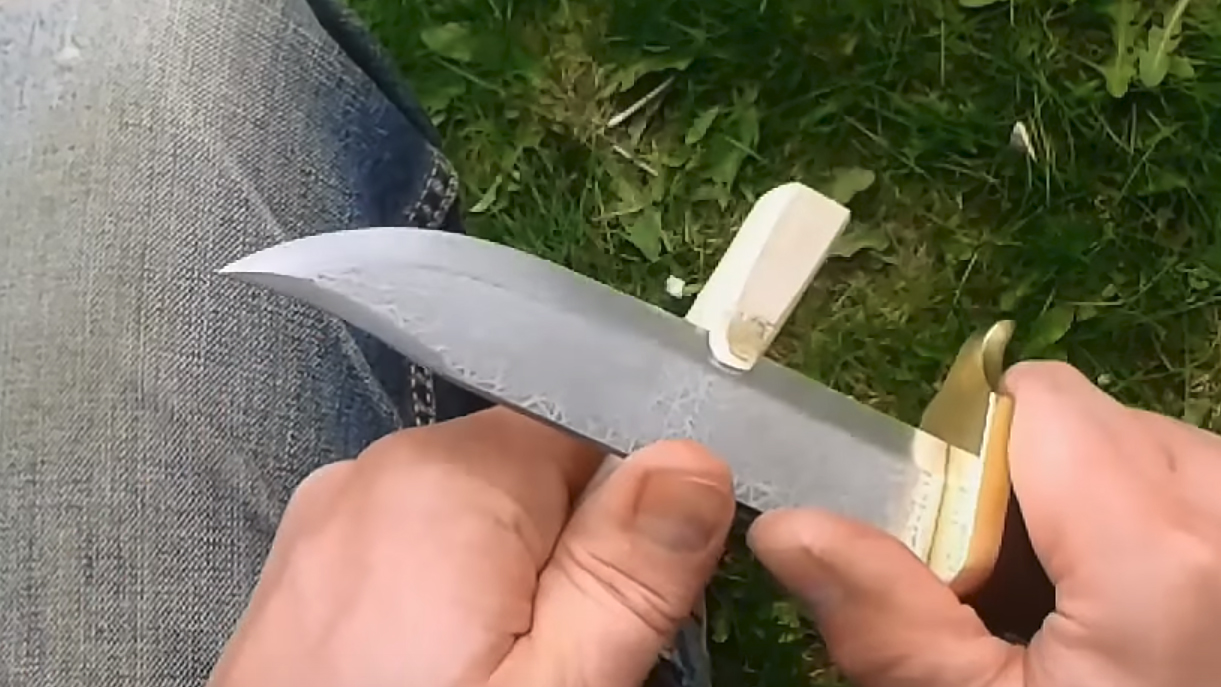
Many old-school knife users sharpened their knives on the rims of crocks, bowls, mugs, or other ceramic vessels. The exposed rim of the bottom of a coffee cup, which isn't covered by smooth glaze, will easily sharpen knife edges. Note the darkened area, which displays steel that's been removed from the edge.
Many old-school knife users sharpened their knives on the rims of crocks, bowls, mugs, or other ceramic vessels. The exposed rim of the bottom of a coffee cup, which isn’t covered by smooth glaze, will easily sharpen knife edges. Note the darkened area, which displays steel that’s been removed from the edge

Many modern sharpening systems use ceramic abrasives. The very first modern sharpener of this type, the Crock Stick, got its name from the traditional method of honing knives on the rim or bottom of a ceramic crock. A modern expedient for this is the slightly rough bottom rim of a coffee cup or bowl. Use the same stone technique, pay attention to your angles, and you’ll be cutting stuff in no time.

When all else fails, even a smooth, reasonably flat rock can be used to sharpen a knife. Light-colored rocks allow you to easily see when you're removing steel.
When all else fails, even a smooth, reasonably flat rock can be used to sharpen a knife. Light-colored rocks allow you to easily see when you’re removing steel.

In wilderness environments, even ordinary stones can be used as improvised sharpeners. Smooth, flat, river rocks work very well, especially if they’re lighter colored so you can see the steel coming off and confirm your progress. Larger stones are easier to hold or brace than smaller stones, and once your knife is reasonably sharp, you can always follow up by steeling and stropping the edge to refine it.

The only good knife is a sharp one. With the right skills and knowledge, you and your knife can stay sharp anywhere.

Knife Sharpenability Factors

One aspect of knife selection that has a tremendous impact on “sharpenability” is blade steel. In recent years, the development of steels suitable for or specifically geared toward cutlery applications has exploded. The carbon steels and relatively simple stainless steels that used to dominate the production knife world have now been superseded by exotic, powder-metallurgy steels packed with ultrahigh levels of carbon, as well as vanadium, molybdenum, cobalt, niobium, and other elements. These alloys can greatly enhance the wear resistance and toughness of blade steels, allowing them to hold an edge better than ever.

Remember, though, that there are tradeoffs to everything. Blades that are resistant to dulling in use are also notoriously hard to grind and therefore more resistant to your efforts to sharpen them. Some high-performance alloys refuse to yield to anything less than diamond abrasives, so you’d be hard pressed to sharpen them with improvised means.

Simple, traditional blade shapes are also much easier to sharpen than blades with complex grinds and multiple bevels. In most cases, they cut better and offer greater versatility, too. Don’t be fooled by hype or looks; focus on knives that look like knives, not something out of Star Wars.

Sharp is a relative term, but in general, an edge that's keen enough to slice typing paper is sharp enough for most chores. The challenge is how to get it that way and keep it that way without purpose-designed sharpening tools.
Sharp is a relative term, but in general, an edge that’s keen enough to slice typing paper is sharp enough for most chores. The challenge is how to get it that way and keep it that way without purpose-designed sharpening tools.

Serrations are another controversial topic when it comes to survival knife selection. While well-designed serrations will hold an edge longer than a conventional plain edge and absolutely devour fibrous materials like rope and webbing, they are considerably more difficult to sharpen than straight edges and exceedingly difficult to sharpen with makeshift tools.

If you have to sharpen a serrated blade in the field, your best bet is to use a rock or other abrasive to work the edge on the side opposite the grind of the serration teeth (serrations are typically beveled only on one side of the blade). This method restores the sharpness of the serration points and edge without trying to reach down into the concave of every tooth. Depending upon the size of your blade’s serrations, the rounded surface on the top of a car window may be able to fit the recesses, but it’s still simpler and quicker to sharpen the non-bevel side.

Bushcrafters and other survivalists have always preferred simple carbon-steel blades with zero-ground “Scandi” (short for “Scandinavian”) grinds that are easy to sharpen with any available abrasive. While modern steels, serrations, and other high-tech features may offer high-performance in some circumstances, it often comes at the price of being high-maintenance — perhaps too high for SHTF-style sharpening.

More From Issue 23

Don’t miss essential survival insights—sign up for Recoil Offgrid’s free newsletter today!

Read articles from the next issue of Recoil Offgrid: Issue 24

Read articles from the previous issue of Recoil Offgrid: Issue 22

Check out our other publications on the web: Recoil | Gun Digest | Blade | RecoilTV | RECOILtv (YouTube)

Editor’s Note: This article has been modified from its original version for the web.

The Psyop Way

0

Thoughtless steps lead to a path of happenstance, chaos, and destruction — this is a short saying I came up with that has guided my life since I was a psychological operations (psyop) sergeant in the U.S. Army. Simply put, how you think dictates your actions, and actions that are thought through create a greater potential for success. Seems like common sense, but there are so many people who fail to think before they act. They react based on emotions, like preprogrammed robots driven by software called instinct.

It’s not that instinct doesn’t matter, because instinct is important to every aspect of survival. However, operating without consistently thinking through your actions is a recipe for disaster. I used to think this was the extent of this lesson, but that’s not the case — it’s just scratching the surface. In the U.S. Army, I learned a lot about human nature and, over time, realized that the key factor to triumphing over any threat to your safety is to stay one step ahead — both physically and, more importantly, mentally.

Whether your car breaks down in a rough neighborhood, you’re in the middle of an urban riot, or you’re just surviving after society has collapsed, understanding behavior psychology and mental warfare will give you an advantage when times are tough. Over the years, I’ve compiled a list of four strategies that will help anyone gain a mental edge in a survival situation.

Strategy 1: Self Awareness

Lesson: Mental warfare is a two-way street. It’s both internal and external. How you feel can be deduced by others based on your actions in the world. Also what’s happening in the world can influence your feelings and actions.

When you feel happy, you smile. When you smile, it makes other people feel better; some may even smile with you even though they don’t know what you’re smiling about.

Many people make the mistake of believing they’re in complete control of their actions. They refuse to believe that feeling a certain way can cause them to act a certain way. Conversely, there are people who refuse to believe that their environment can influence their thinking and actions. In psyop, we learned that there’s a huge number of daily decisions made subconsciously. “No one is immune,” said one of my psyop instructors. There are social cues that our brains use as shortcuts to decide what actions to take.

One example of lacking self-awareness is the common automatic response of group approval. We look for a response that’s accepted among the group, allowing our brains to bypass thinking through the scenario. If everyone runs, then we run; if most people stay, then we stay.

Real-World Example: Once, I was at a club with a friend when a fight erupted. The bouncers grabbed the combatants and threw them out the front door. Several friends of those involved started running to the front door. A few minutes later it seemed most of the club was outside. My friend suggested that we leave, and I agreed. He started to walk to the front door when I grabbed him and said we should leave out the side emergency exit. Upon exiting, we heard gunshots coming from the front, accompanied by loud frantic screams. We walked to a gas station a few blocks down the other way and called a cab.

Applications: Take an opportunity to study up on social psychology. Learn about automatic responses that are specific to you. Work consistently to attain control over them and make them more conscious actions. This will help you make calculated decisions in a high-stress environment rather than an automatic unsafe one.

Strategy 2: Experience Versus Assumption

Lesson: Know what makes you tick. Understand what brings you comfort and discomfort. Determine what boosts your morale and what lowers it. This is one of the deepest lessons of psyop survival. Not everyone reacts the same to a situation. Understand how and why you respond a certain way. This will help you form a strong game plan.

Real-World Example: A friend wanted to get a gun for self defense. She asked for my help in learning to shoot. I asked her if she had ever been around a gun before. She said no, but wouldn’t have a problem being around one. At the range, I gave her a safety brief and opened my gun case to show her the pistol we would be using for the day. She immediately began shaking uncontrollably and tears ran down her face. She backed away, shaking her head side to side. “Are you OK?” I asked. She didn’t respond. I quickly closed the case. “What was that … what just happened to me?” she asked, confused. I replied, “I believe you had a mini panic attack.” She was shocked by her reaction.

If all you can think about is how difficult the road ahead will be, you'll probably give up.
If all you can think about is how difficult the road ahead will be, you’ll probably give up.

Application: So many people overestimate themselves. They make statements like, “I would do this, and I would do that.” But they’re surprised to find they don’t respond in the way they expected when presented with the situation. Take time to test yourself physically, mentally, and emotionally. Find a means to test it out safely, but under pressure. Use a friend who can push you and help you when you need it.
Can you really run a mile? Do you latch onto a task, or can you switch focus immediately without hesitation? If the sun is going down while you’re in the wilderness and you can’t start a fire, are you psychologically and physically equipped to make it through a cold night of darkness? Perhaps the safest way to answer these questions is to take various classes from reputable instructors. My instructor drilled into my brain, “No thought ever makes it past your skull when you just think about it. Knowing is what leads to action, and action is the only way to success.”

Strategy 3: Situational Awareness

Lesson: Take notes on your environment. Keep track of who is who, what is what, and where is clear. It doesn’t take a genius to understand that knowing your environment is important. However, most people fail to realize that the environment is like an organism — it’s a living thing that changes constantly.

Real-World Example: This was another important lesson taught in psyop training. We had to adapt our message to the changing environment. As psyop soldiers, it was our mission to gain allies in foreign lands and bring the locals over to our cause.

We attempted to influence hundreds of citizens, changing their minds and patterns daily by maintaining a connection to factors around us and adapting our message quickly. When meeting with a foreign local official, we had to understand the outside influences that would sway his or her thinking. When they came to the meeting, we paid attention to every gesture, every word, and every interactio

It's hard to adapt to your environment without situational awareness. Put your phone away. Pay attention.
It’s hard to adapt to your environment without situational awareness. Put your phone away. Pay attention.

Application: Challenge yourself to always be mentally prepared for the “what if.” A Special Forces friend and I often meet at my favorite bookstore to talk about current events. We always play the “what if” game. He always carries a concealed pistol and often makes fun of me for not carrying mine at all times. His common question is, “Are you a sheep or a sheep dog?” I explain to him that to always carry can give a false sense of security. It can dull or numb one’s ability to be prepared for challenges that may arise that you can’t shoot your way out of. It can also render you ill-prepared when you’re not able to carry a pistol in nonpermissive environments. When I don’t carry, it forces me to examine my situation differently and very carefully and prepares me with options applicable to the environment.

Because your environment can change at any given time, your mental assessment should change. New people will arrive on the scene and others will leave, and the nature of those new arrivals will change the dynamics of your environment.

Imagine these scenarios and think about what you would do: You’re at a bookstore when a custodian locks a door that you had as a viable means of escape, if warranted. Maybe the air conditioner stops working and you notice everyone removing articles of clothing to cool down — except the guy sitting across from you, as if he’s hiding something. Or what about an older man obscuring his position behind a bookshelf, glaring at the seemingly loving couple across the room as they hug and kiss. You observe that the older man is wearing a wedding band and so is the girl — but her mate isn’t. This could be a case of infidelity, and you could easily become collateral damage if the older man goes over the deep end. You should know if there are any security guards nearby and, if so, where they are in relation to you? If there’s none, where’s the nearest exit you can get to safely?

There’s only so much preparing you can do, but the real purpose of this mental preparation is to encourage you to habitually think on the fly.

Strategy 4: I Think, Therefore I am

Lesson: Creativity first, prepping second. Preparation breeds confidence, but when the game changes and the preparations are no longer valid, then you’re left with anxiety, lost morale, and hundreds (if not thousands) of dollars of supplies you can’t use. Creativity is king. Be flexible and open to change; acknowledge that you can’t control everything. See everything as an opportunity for you to succeed.
Real-Life Example: I have so many security-minded friends. If you open their trunk or look in their closet, it looks like they’re prepared for a limitless amount of scenarios, but the truth is that can never be. As a psyop warrior, I learned that you’re limited only by your ability to think over, around, under, or through any given situation. “Don’t put yourself in a box,” my Army instructors used to say. “Change the rules of the game constantly. Redefine winning when it’s needed.”

Always think ahead so you can anticipate danger before it happens, and "change the rules of the game" by redefining success in a given scenario.
Always think ahead so you can anticipate danger before it happens, and “change the rules of the game” by redefining success in a given scenario.

I explained this lesson to a friend, and he couldn’t understand it. In the midst of the conversation he began to use chess as a means to help him explain this quote. He gave some examples of board configurations and strategies. “So how would you win this game if these are the rules?” I said I would bet $100 against my winning. This way when my friend won, he would win his pride and I would walk away with $200, which is more important to me than the game.

Application: Survival is a chaotic game. It’s unpredictable and in many ways uncontrollable. As things change you must redefine what success is. This will always steady your morale and give you a strong foundation for achieving new levels of success — “small victories” is what we called them in the military. This is where the aforementioned scenario playing is paramount. Keep your mind sharp by forcing yourself to train worst-case scenarios. This will develop the enhanced thinking power needed to stay one step ahead.
brownshells-esg-essentials-hygiene-kit

power-sources-batteries-chargers-and-solar-panel

Conclusion

How you react to your physical world is a direct reflection of your mental and emotional state. Therefore, survival on all levels is first and foremost about your mental capacity to understand how you operate, manage stress, adapt to change, and apply what you know on the fly. These are the focuses of a psyop warrior and a strategy that will allow you to succeed in the face of adversity on multiple levels.

“Persuade, change, and influence the hearts and minds of a foreign target audience,” is the creed of psyop. The true lesson is understanding that our first foreign target audience is oneself — master your mind and survival becomes that much easier.

Social Programming

“Social engineering” is a science based on using common social programing to alter people’s behavior and, in some cases, take advantage of people. Con artists use these tactics constantly. Another example: most of us may have given money to a hobo who used some social engineering on us.
Hard vs. Soft

The skills you acquire can normally be categorized into two groups: hard skills and soft skills. Hard skills are usually manual skills that you learn, like tying your shoelaces, starting a fire, or reloading a handgun. Soft skills are normally mental and psychologically related skills, such as solving a math problem, navigating a conversation about history, and the use of marketing strategies and ideas.

Everything Matters

In the U.S. Army’s psychological operations units, we were taught “everything matters.” Every color, every sound, every word, every gesture means something. It all influences and solicits a response. No action is taken without a thought made consciously or subconsciously based on the factors surrounding the reason for the action.

Some physical survival traits born out of the “everything matters” motto are:

Know the people: Know who’s surrounding you. Know as much about the people around you as you can gather.

Know your position: Know how you’re perceived in the eyes of those people or, if that’s not an option, know how you can move to a safe place if needed.

Know your options: Know what options you have to sway things in your favor. Is there a piece of equipment you need? Do you know how to speak to the people in your vicinity who can help you if needed?

Know your paths: Know multiple ways for you to reach your point in a conversation, or multiple routes to a safe place.

About the Author

hakim-isler

A former psychological-operations sergeant with the U.S. Army, Hakim Isler is the designer of several wilderness survival products and the owner of Elevo Dynamics, the first “Dojym” (a 24-hour gym and martial-arts facility) in the United States. He is also the founder of the SOIL Foundation, a nonprofit that offers off-grid training and excursions to help veterans, law enforcement, and civilians recover from anxiety, depression, and PTSD. Moreover, Isler is a fourth-degree black belt in To-Shin Do under Stephen K. Hayes, an instructor in the Filipino combat system of FCS Kali, and the author of Modern Hand to Hand Combat.

http://www.TheSoilFoundation.org
http://www.BlackMacGyver.com
http://www.ElevoDynamics.com

More From Issue 13

Don’t miss essential survival insights—sign up for Recoil Offgrid’s free newsletter today.

Read articles from the next issue of Recoil Offgrid: Issue 14

Read articles from the previous issue of Recoil Offgrid: Issue 12

Editor’s Note: This article has been modified from its original print version for the web.

Infographic: Lowering Your Dependence on Electricity

0

Efficiency is key in any survival situation — making the most of the limited resources you have will help you stay comfortable and safe for longer periods of time. This obviously applies to how you ration food, water, gasoline, medical supplies, and other consumables. However, you should also consider how it applies to your home’s electricity.

Infographic electricity home tech emergency generator battery outlet 7

Unlike the other supplies we mentioned, the power coming out of your wall outlets isn’t going to run out under normal circumstances, so you might not think of it as a consumable. But if a storm or other catastrophe does temporarily knock out the power grid, it’ll soon become apparent that your stockpiled batteries are finite. Even if you’ve got a backup generator or solar panel array, the fuel and time spent powering or recharging devices are finite resources.

Infographic electricity home tech emergency generator battery outlet 8
If the seemingly-infinite power grid dries up, you’ll soon be reminded that electricity is a consumable item.

So, it’s advantageous to look at your home’s power consumption and electrical efficiency before a disaster arrives. Doing so will help you determine which appliances really need backup power, and which of these critical devices can be adjusted to use less energy. This will help your battery supplies and generator fuel last longer in an emergency, and it’ll also save you money throughout the year. That money can then be applied to other necessary preps.

The following infographic from Ashford Realty Group shows 24 basic ways you can reduce electricity consumption in your home. Some are fairly obvious and others are less so. Click here to download a full-size version of this infographic.

Infographic electricity home tech emergency generator battery outlet 2Infographic electricity home tech emergency generator battery outlet 3Infographic electricity home tech emergency generator battery outlet 4Infographic electricity home tech emergency generator battery outlet 5Infographic electricity home tech emergency generator battery outlet 6

Review: Microtech SOCOM Alpha Knife

0

When someone hears the name Microtech, it’s very likely that the first things they will think of are the expertly-crafted automatic knives that have become a staple of the brand. It may be surprising for some to learn that Microtech also has some awesome fixed-blade pig-stickers in its product line. One such blade is the SOCOM Alpha.

Microtech SOCOM Alpha knife review Summit in the Sand RECOIL 16

The SOCOM Alpha is the newest addition to the SOCOM series offered by Microtech. It is essentially a fixed-blade, full-tang version of the SOCOM Elite, a folder belonging to the same family of Microtech knives. Originally offered exclusively as a Microtech Custom, the Alpha is now available as a production knife in Microtech’s standard lineup.

Microtech SOCOM Alpha knife review Summit in the Sand RECOIL 21

Hands-On at Summit in the Sand

I personally encountered the Alpha during RECOIL’s inaugural live event, Summit In The Sand, a training-focused event held at CowTown Range in Phoenix, Arizona, where I was teaching Defensive Blade Tactics as a guest instructor. Microtech sponsored this portion of the event, and the SOCOM Alpha was the company’s featured piece of steel.

Microtech SOCOM Alpha knife review Summit in the Sand RECOIL 13

Just for this event, Microtech ground the edges and points off several Alphas and converted them into trainers. This afforded attendees the opportunity to train with a blade that provided the actual weight and feel of the live blade they would end up walking away with at the end of the day (a not-so-little surprise from the sponsor). Having never seen or handled the SOCOM Alpha myself prior to the event, I left with a newfound admiration of this well-designed knife.

Microtech SOCOM Alpha knife review Summit in the Sand RECOIL 17

The Alpha has some impressive “credentials” in materials alone. The blade is made out of Bohler-Uddenholm ELMAX steel. If you’re not familiar with ELMAX, we think pretty highly of it. Considered by knifemakers to be a “super-steel,” ELMAX is a high chromium-vanadium-molybdenum-alloyed steel, consisting of 1.7% carbon, 18% chromium, 1% molybdenum, .8% silicon, .3% manganese, and 3% vanadium. The end result of this alloy composition is high wear and corrosion resistance, a high compressive strength, and excellent edge retention qualities – all while remaining easy to sharpen.

Microtech SOCOM Alpha knife review Summit in the Sand RECOIL 3

The powdered metallurgy process used to produce ELMAX has some distinct advantages over traditional ingot steel. With this type of metallurgy, fine-powdered materials are blended and pressed into a desired shape and then bonded through heating. This process results in a more consistent, homogenous steel with a superb microstructure. In layman’s terms, its good stuff.

Microtech SOCOM Alpha knife review Summit in the Sand RECOIL 6

The Alpha boasts a large 10.47” overall length with a 5.42” hollow-ground blade. The knives provided for the class were of the tanto blade variety, though the Alpha is also available in a clip-point version. This large knife – a relative term for blade aficionados – tips the scale at 8.25 ounces, enough weight to feel solid in the hand without being outright heavy. It’s also nicely balanced right at the center of the handle’s forefinger notch.

Microtech SOCOM Alpha knife review Summit in the Sand RECOIL 18

Speaking of the handle, it features nicely-indexed G10 handle scales that are affixed with 17-4 PH stainless, 3-hole screws. This is some of the most beautiful handle hardware we’ve seen on a production knife in a while.

What stands out more than any other feature on this knife, though, is the jimping that runs down the entire spine of the handle. Aside from being beautifully-paired with the accompanying jimping on the G10 handle scales, this added texture provides aggressive grip that ensures this knife won’t slip in your hand. Combined with the thumb ramp and forefinger grove, it pretty much negates the absence of a guard on this knife. Oh, and for those of you who like to accessorize, there is a lanyard hole on the butt of the knife as well.

Microtech SOCOM Alpha knife review Summit in the Sand RECOIL 7

The Alpha ensemble is completed with a well-designed, carbon-fiber-lined Kydex sheath. It’s fully-equipped with 550 cord for lashing or a lanyard, and Blade-Tech MOLLE-Lok attachments for MOLLE compatibility. Again, the 17-4 PH stainless hardware used to affix the MOLLE-Lok to the sheath adds a touch of class, like elegant cufflinks on a dress shirt.

Training with the SOCOM Alpha

Microtech SOCOM Alpha knife review Summit in the Sand RECOIL 5

So, what about function? The Summit participants and I spent a lot of time working the Alpha trainers on the Rubber Dummies 3D Silhouette Targets. This allowed the students to deliver full-power strikes against a solid, anatomically-shaped surface.

This type of training is invaluable, as it gives the user feedback against the blade. It will definitely expose any weaknesses in the user’s grip, as well as the grip design of the knife. Surprisingly, I didn’t see anyone’s grip slip forward of the handle, something I fully expected given the narrow profile of the handle and the edged-weapon inexperience of most of the attendees. I would have to say that this serves as a testament to the Alpha’s grip design.

Microtech SOCOM Alpha knife review Summit in the Sand RECOIL 10

The Alphas supplied for the event had Microtech’s tan Physical Vapor Deposition (PVD) finish. This finish proved to be virtually bulletproof after all the hard use the knives went through. The white enamel paint used to coat and refresh the 3D Silhouette Targets took a liking to the blades and bonded firmly onto the surface. To remove the paint from the blades, I had to use an abrasive Scotch-Brite pad, hot water, and a lot of elbow grease. I expected when I was done I would have a bunch of bare-metal blades staring at me, but the finish on the knives looked almost as good as it did when we took them out of the boxes.

Microtech SOCOM Alpha knife review Summit in the Sand RECOIL 8

Prior to this event, my experience with Microtech knives was very minimal. Even though I was familiar with Microtech’s reputation for quality and innovation, I am always skeptical of anything I haven’t had personal experience with. That skepticism quickly left once I got the knife in my hand. To say that I was impressed with the design, craftsmanship, and performance of the SOCOM Alpha would be a bit of an understatement.

Microtech SOCOM Alpha knife review Summit in the Sand RECOIL 20

If you are looking for a solid, fixed-blade tactical knife that is as beautiful as it is functional, you might consider Microtech’s SOCOM Alpha. You won’t be disappointed with the money spent.

Specifications

Weight: 8.25 ounces
Blade Length: 5.42”
Type: Fixed, Full-Tang
Steel: ELMAX
Blade Coating: Physical Vapor Deposition (PVD)
Blade Thickness: .160”
Handle Material: G10
Overall Length: 10.47″
Sheath: Kydex w/ MOLLE-Loc
Country of Origin: USA
MSRP: $303.20

About the Author

Microtech SOCOM Alpha knife review Summit in the Sand RECOIL 23

Chad McBroom is the owner of Comprehensive Fighting Systems, a company that offers practical training in armed and unarmed combatives. He has over 30 years of martial arts experience and specializes in edged weapons. He also does a bit of knifemaking himself, a hobby he took up to gain a greater understanding and appreciation of blade craft. Follow him on Instagram @cfs_combat.

Looking Back: Bollinger Motors B1

0

Over the last few years, the idea of commuting to work in an electric car has become more feasible. Battery technology has improved, and these cars have gotten lighter, faster, and more efficient. Tesla even announced the release of an all-electric semi truck, which it hopes will overtake traditional diesel rigs. However, the off-road market hasn’t seen as much attention from electric vehicle manufacturers — until now.

Bollinger Motors B1 electric truck offroad SUV bugout vehicle 4

Bollinger Motors, a New-York-based automotive company, has developed a truck known simply as the B1. The company calls it a “no nonsense back-to-basics all-electric sport utility truck”, and its appearance echoes classic off-roaders like the Jeep Wrangler, Land Rover Defender, and Mercedes G-wagen. However, rather than the gas or diesel engines found in those vehicles, the Bollinger Motors B1 is powered by dual front and rear electric motors.

Bollinger Motors B1 electric truck offroad SUV bugout vehicle 3

The powertrain reportedly produces an equivalent to 360 horsepower and 472 lb-ft of torque, and sends it through a pair of 2-speed gearboxes with electronic locking differentials at the front and rear of the truck. The result is an all-wheel-drive truck with hi/lo-range capabilities.

Bollinger Motors B1 electric truck offroad SUV bugout vehicle 5

The system relies on either a 60 kWh or 100 kWh lithium ion battery pack, for either 120 or 200 miles of range, respectively. These batteries can be recharged via a J1772 (110 & 220) or CHAdeMO (DC Fast) port. Charging a fully-depleted battery via a Level 2 220V source takes 7 hours for 60 kWh models or 12 hours for 100 kWh models. Regenerative braking also recharges the batteries as the truck is used.

Bollinger Motors B1 electric truck offroad SUV bugout vehicle 7

With standard 33-inch mud tires on 8-lug alloy wheels, the Bollinger Motors B1 offers 15.5 inches of ground clearance. Total travel of the hydro-pneumatic suspension is 10 inches. Short overhangs allow for 56- and 53-degree approach and departure angles, so you can drive over steep obstacles without snagging a bumper.

Bollinger Motors B1 electric truck offroad SUV bugout vehicle 1

Portal axles keep the half-shafts tucked up in the wheel arches, further improving clearance. In case you do manage to get stuck, a 12,000-pound hydraulic winch is also included.

Bollinger Motors B1 electric truck offroad SUV bugout vehicle 2

The inside of the Bollinger Motors B1 is just as spartan as its exterior, but it offers four seats and a huge 95 cubic feet of storage capacity. Thanks to its lack of engine, it also offers a unique pass-through “frunk” (front-trunk) compartment for long objects. Bollinger Motors B1 electric truck offroad SUV bugout vehicle 8

The cab is also convertible from full to half-covered configuration, so you can pull out the back seats and use the rear area as a truck bed.

Bollinger Motors B1 electric truck offroad SUV bugout vehicle 9

The idea of an electric off-road vehicle has some considerable advantages, including the storage capacity mentioned earlier, as well as instant torque for fast acceleration and obstacle-climbing power. According to Road & Track, the B1 can reportedly launch from 0 to 60 mph in 4.5 seconds — that’s nearly a second faster than a 2017 Ford Raptor. Road & Track even went so far as to call it “the future of off-roading”, but an on-sale date and pricing info are not yet available.

So, what do you think of the Bollinger Motors B1? Let us know in the poll below.