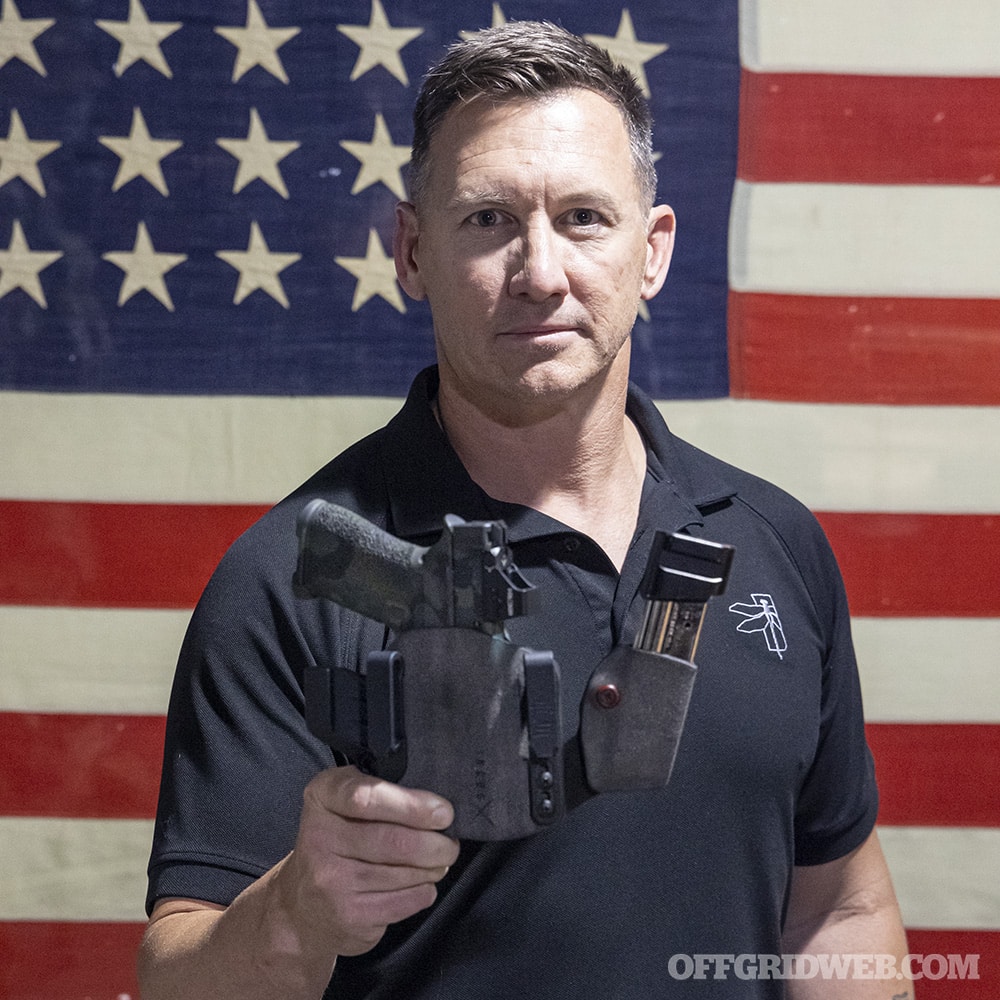
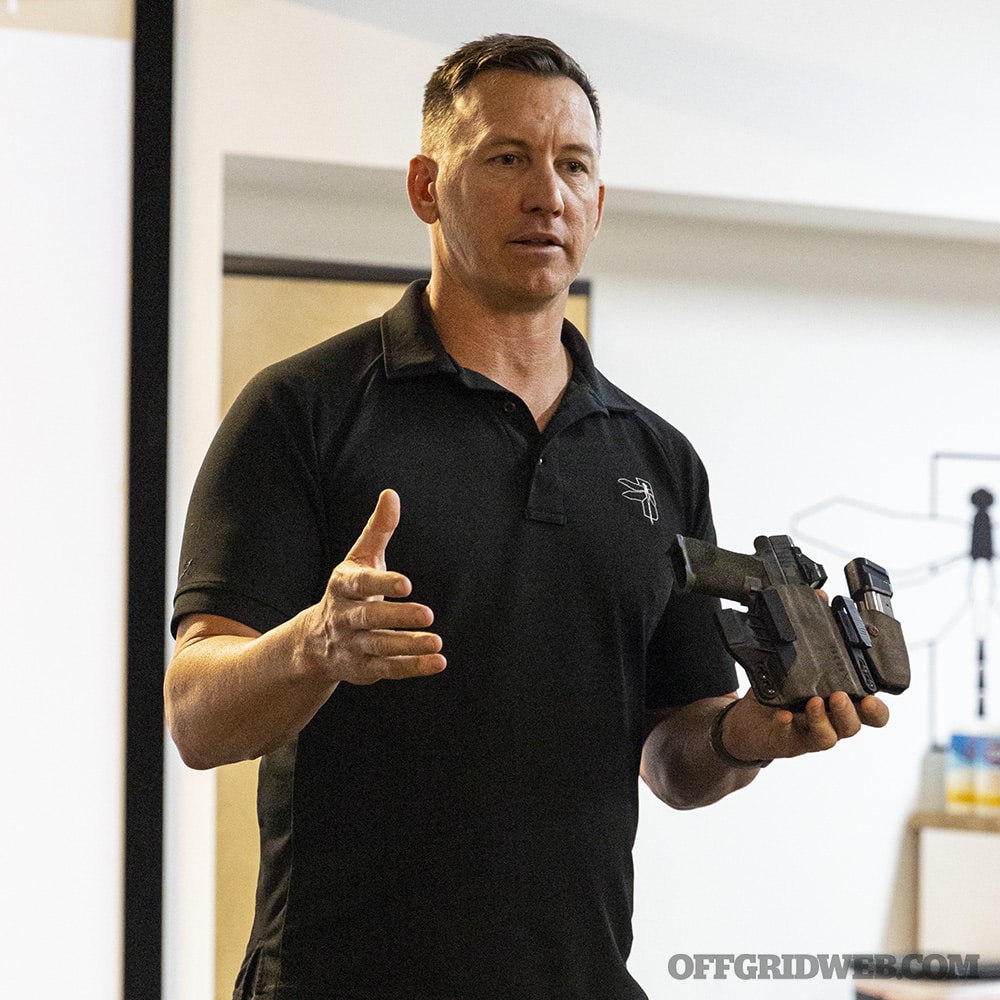
If you’ve ever carried a firearm in an outside-the-waistband holster, especially on a law enforcement duty belt, Safariland is undoubtedly a name you’re familiar with. The company, established in 1964, has become the industry standard for retention holsters. However, their options for concealed carry holsters have been somewhat lacking — a fact they’ll openly admit. Safariland’s Product Manager David Higginbotham said bluntly that taking a Safariland outside-the-waistband duty holster and making it into an inside-the-waistband design is “a garbage idea,” since OWB retention holsters do not translate to IWB everyday carry. The company needed a different approach. So, in order to capture a bigger segment of the civilian concealed carry holster market, Safariland partnered with someone who has considerable experience in that field: Travis Haley of Haley Strategic Partners (HSP). Together, HSP and Safariland developed the new INCOG X holster, which will begin shipping on July 14th.
Ten Years in the Making
The original HSP INCOG was conceptualized in 2011. At that time, Travis Haley wanted an appendix inside-the-waistband (AIWB) holster with an attached magazine caddy — a format that has become commonplace today, but was substantially less so back then. He began experimenting with some sheets of Kydex, foam, and a toaster oven. The resulting design became the original HSP INCOG holster, which was manufactured by G-Code for roughly 10 years. In 2022, Haley began thinking about updating the holster design, and after a conversation with acquaintances at Safariland, decided to partner with them for this tenth-anniversary redesign. It’s aptly called the INCOG X after the Roman numeral.
INCOG X Features & Options
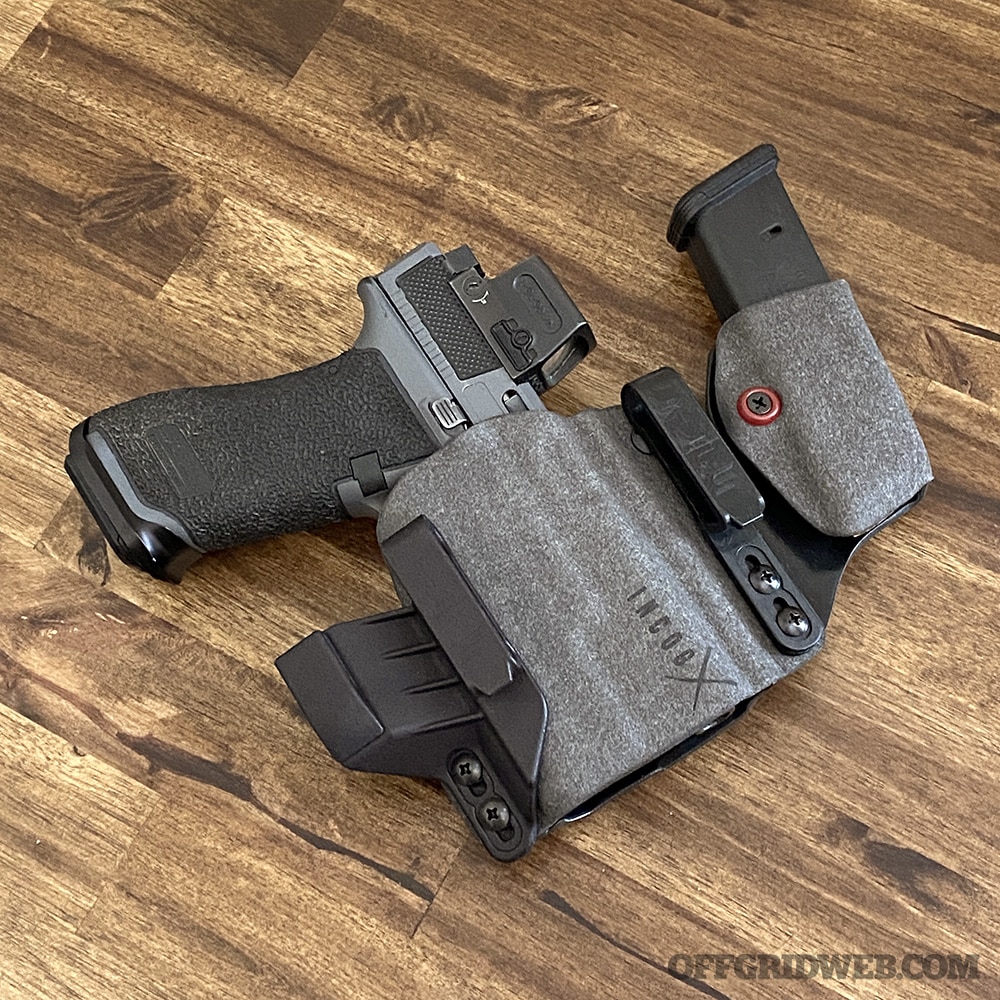
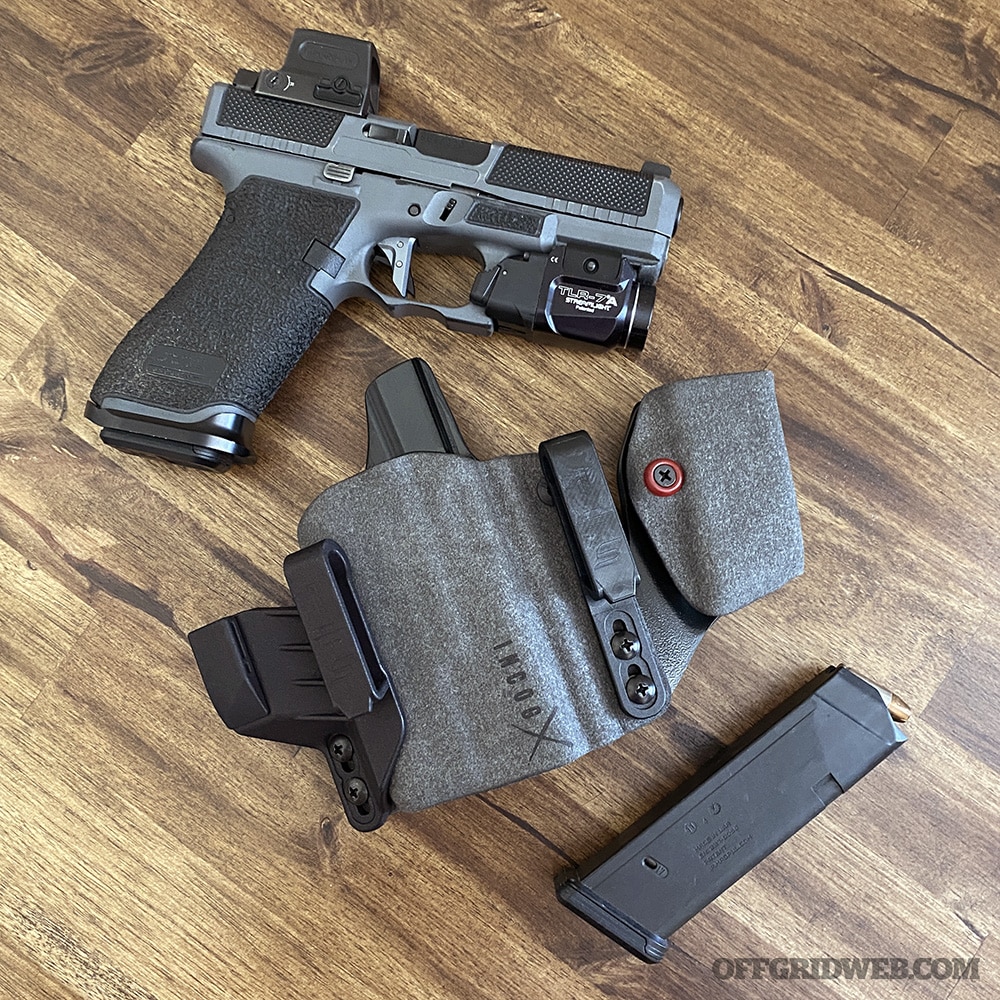
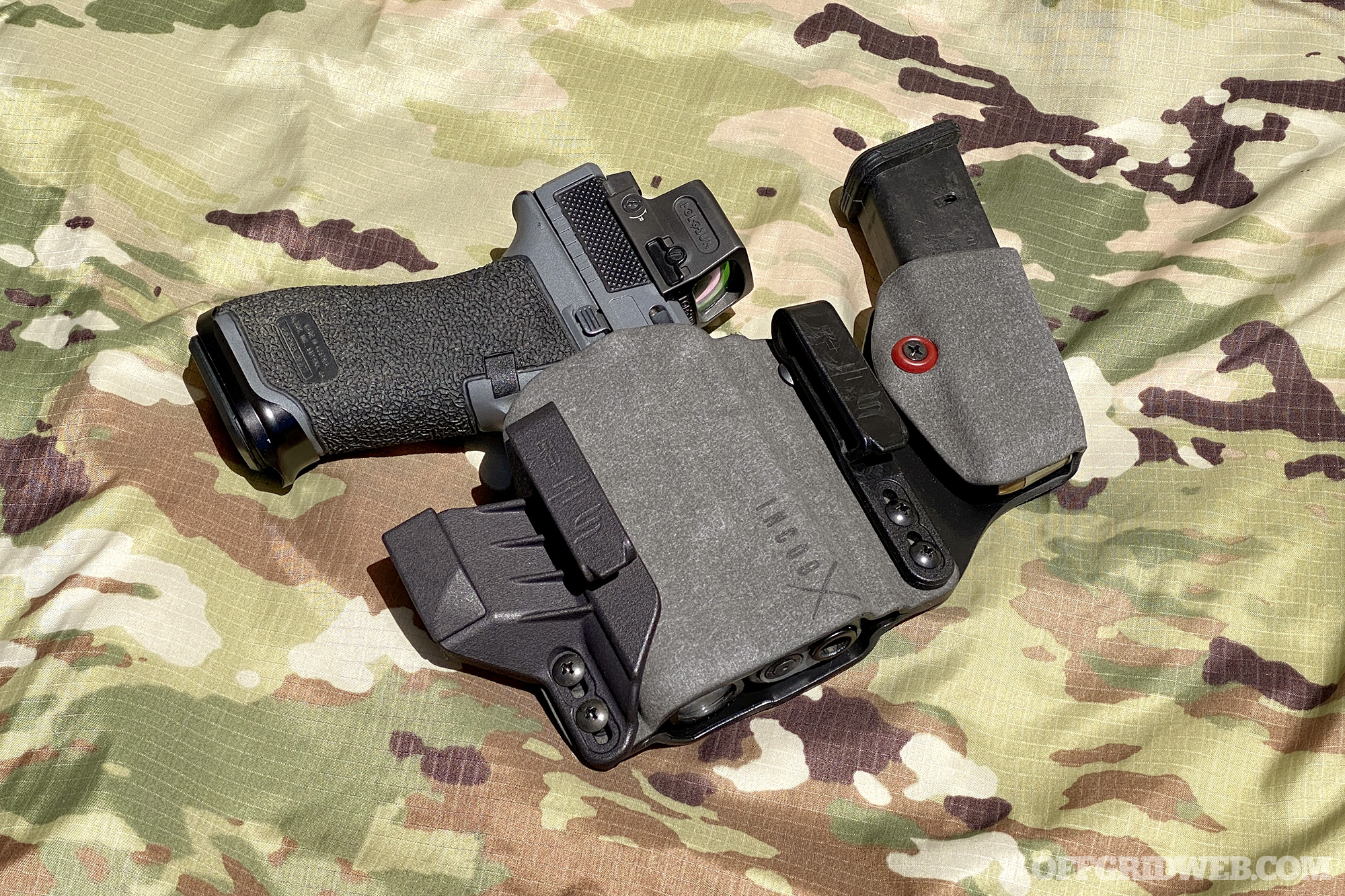
The new HSP / Safariland INCOG X is constructed from thermoformed Boltaron polymer, finished with an outer layer of microfiber suede for added comfort. It features re-engineered clips, one of which includes an integrated concealment strut. The strut comes with three modular, snap-in spacers to fine-tune the angle of the gun’s grip against the user’s body and reduce printing. The optional mag caddy is designed to flex slightly with the user’s belt, but it does so based on the stiffness of the Boltaron material, not an additional hinge or elastic. This, along with the use of minimal hardware (4 clip screws plus 2 for tension adjustment), is designed to eliminate as many points of failure as possible. Many of us have had holster screws work their way loose over time, so Haley’s logic is the fewer to check, the better.
For users who prefer different clips, Safariland noted that the clip screw spacing allows for installation of various aftermarket options.
Knowing that many users carry pistols with red dot sights and compensators, the INCOG X comes standard with breathing room for these accessories. Light-bearing and non-light-bearing options will be available, with the former intended for compact, EDC-friendly lights such as the Streamlight TLR-7. The holster comes in HSP’s signature grey with black and red accents. At launch, 16 models will be available to cover the following platforms:
Glock 17/19
Glock 43/48
SIG P320
SIG P365
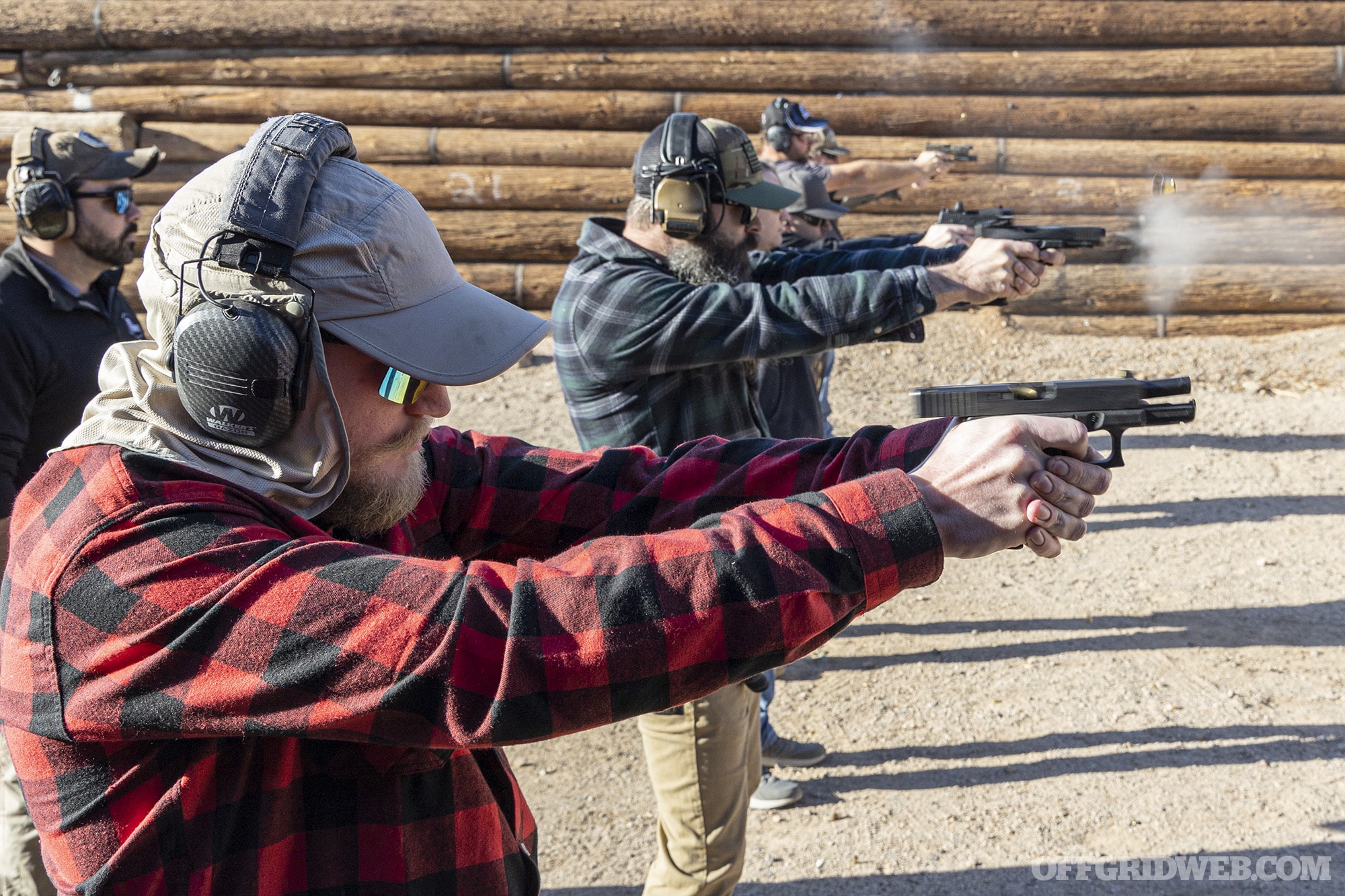
Above: My custom Glock 45 fit the INCOG X like a glove, along with its TLR-7A light and Holosun 509T optic. In this photo, it’s also equipped with a new Nelson Precision trigger shoe.
Each holster will be available with or without space for a weapon light, and with or without an attached mag caddy. A Safariland rep mentioned that other pistol applications are being considered for the future, including Walther, H&K, and Staccato, but those may not be available until 2024. MSRP will be $120 with the mag caddy or $90 for variants without it.
For the launch of the INCOG X, Travis Haley invited a small group of media members to his training facility in Scottsdale, AZ. As mentioned in our previous article about the Haley Strategic D7 course, this facility has a multi-million-dollar VirTra shooting simulator that can be used with gas-blowback training guns. After taking a look at the INCOG X holsters, we put them on and stepped in front of the projector screen to warm up on some virtual paper and steel plates.
After spending the morning doing concealment drills in front of the single-screen VirTra sim, we moved on to the wraparound VirTra 300. Inside this immersive environment, we experienced a variety of scenarios, starting with our CO2-powered Glocks concealed in our INCOG X holsters. The VirTra system isn’t just pre-programmed for one outcome, it’s operated by an instructor who can send you on branching paths and cause armed assailants to react differently each time, so we had to put ourselves in Haley’s “thinkers before shooters” mindset and react dynamically to threats.
Since I’ve spent time in the sim before, I was given a challenging scenario involving a gunfight with two shooters who both had AR-15s and body armor. Other attendees faced scenarios ranging from an ATM mugging to a home invasion to a shooting inside a crowded movie theater.
I’m looking forward to spending more time wearing and training with the new INCOG X to see how it compares to my other favorite EDC holsters. For more information on this holster, keep an eye on HaleyStrategic.com and Safariland.com as we approach the June 14th official launch date.
On June 19th, the 2023 Outdoor Adventure Summit will be hosting an impressive array of outdoors experts and streaming their classes online, completely free of charge! For five days (June 19th through June 23rd), from noon to 3pm EST, a guest speaker will walk you through fieldcraft skill, or discuss lessons they’ve learned from their years of experience. This is a great opportunity to learn from some of the best survival instructors in the world, especially if you live in the urban jungle or if attending in-person classes is challenging. Event host Brady Patterson has lined up 13 speakers, each covering a unique topic related to the outdoors, or the outdoors industry.
Outdoor Adventure Summit Upgrades
If you can’t attend the online event each day, there are a few options that will help ensure that you don’t miss a single moment. For $77 you can get access to all of the recordings after the event to rewatch, or view at your leisure. And for $97 (the VIP upgrade) you receive all of the recordings, and get added to group calls to ask presenters questions. This includes: Carleigh Fairchild — two-time Alone contestant; Brady Patterson — event host, survival instructor and business consultant; Bushcraft Global — jungle expedition leaders; and several more. The VIP upgrade also puts your name in the running to win a knife, and get a free year of online bushcraft training when the platform goes live this fall. Of course, watching the event without the access to the recordings afterwards is completely free of charge, but paying for the extra features is a great way to support the group, and help ensure the Summit continues into the future. Sign up for the event can be found here: outdooradventuresummit.com
In no particular order, here is a list of the Summit topic presenters:
Ross Hinter
Summit Topic:Trapping and the Ethics of Wildlife Management
Background: Ross has been actively utilizing and teaching survival, bushcraft and trapping skills in Alberta Canada for over 30 years. His clients range from university students to farmers, and he strives to give everyone a deeper understanding of the environment we are surrounded by, the creatures that we encounter within that environment, and how we can better coexist.
Background: Alex is a born and raised Canadian outdoorsman. He is a contributor to The Bushcraft Journal and has been the sponsorship coordinator for several Global Bushcraft Symposiums. Alex is an instructor at the renowned Karamat Wilderness Ways bushcraft school.
Background: If you’re a fan of History Channel’s survival show Alone, then you know Carleigh. She is has competed on the show twice, once in Patagonia, and again in Mongolia. Carleigh also teaches earth skills in a unique way that helps her students reconnect with the land, and with their inner selves.
Summit Topic:The Magic of Canvas: A Conversation about Camping, Foraging, and Running a Family Business
Background: Heather is the co-founder of PNWBUSHCRAFT along with her husband Todd, and is a pioneer in modern waxed-canvas. She is an avid bushcrafter, and has been running a successful business making outdoor products to withstand the Pacific Northwest for many years.
Summit Topic:Lessons Learned from Starting 3 Companies and Running one of the Largest Bushcraft Events in the World
Background: Casey is a serial entrepreneur with a passion for the outdoors and bringing likeminded folks together. He has been successfully owning and operating Griffin Pocket Tool, and Bushcraft Coffee Co., in addtiont to hosting the popular campout/bushcraft events known as the Fall and Spring Gatherings on his ranch in Georgia.
Summit Topic:How I Learned about the Outdoors, or Confessions of a Gear Junkie
Background: This popular content creator is a self-proclaimed gear-do, knife nut and camping nerd. By sharing the journey of connecting with nature, The Whimpy Camper’s audience gets a view of just how rewarding spending time in the wild can be.
Summit Topic:How to Make and Use a Grabate from Your Backyard to the Jungle and In Between
Background: Joe wears many hats. From designing blades for companies like Condor TK, TOPS, CJRB and Artisan, to leading world-class survival expeditions through the Amazon rainforest, and many things in between. Joe has an academic background in zoology and entomology, and is passionate about teaching and reconnecting with primitive skills.
Summit Topic:The Unintentional Influencer and How I Ended Up Recording All the Wisdom I Could Find
Background: Morris is the lead instructor at a survival skills school called Fuel the Fires. This school covers everything from botany and shelter building, to firearms training and first aid. With many years as a SAR operator under his belt, he brings a ton of real world survival experience to the table.
Background: Peter is a former U.S. Air Force veteran, which is where he trained with the military’s top SERE instructors. Later he trained with the late Mors Kochanski, the Jack Mountain Bushcraft School, and the Boulder Outdoor Survival School. Most recently he picked up the role of Wilderness EMT for Bushcraft Global, and has led discussions as a subject matter expert at the 2022 Jungle Warfare Symposium.
Summit Topic: Living Off Grid, Surviving Alone, and Exploring Living History
Background: Melanie is a serious off-the-grid aficionado. She lives in a self-made homestead in the Adirondacks, runs a school that teaches how people lived in the 1700’s, and was contestant on the History Channel’s Alone. Melanie is a bushcraft skills instructor and has made it her life’s work to pass these skills and knowledge on to others.
Background: In addition to being a survival and bushcraft skills instructor at the esteemed Karamat Wilderness Ways school, Kelly has a diverse background ranging from SAR and firefighting, to IT and mountain biking.
Summit Topic:How to Locate and Use Spruce Root for Lashing
Background: Frank is a wilderness guide and survival instructor at Earthworks Program. When he is not out in the bush instructing students in earth skills, he is teaching as a Professor at Smith College. Frank is a wilderness first responder and has consulted for camps, museums, conferences and schools.
Summit Topic:The Portable Interview: How One Adventurer Navigates the World with Essential Gear
Background: Dustin turned his passion for selfless service, and his love of the outdoors, into the entrepreneurial undertaking known as Wazoo Gear. He has a long list of skills and accomplishments, including serving in the U.S. Coast Guard, becoming a certified Divemaster, volunteering as a Texas Wildland Firefighter, and Wilderness First Responder, to name a few. Dustin knows what it takes for gear to withstand the rigors of the field, and as co-founder of Wazoo, ensures their products are up to the task.
Deep in the heart of the Colombian rainforest, danger abounds, and it may seem impossible that four children survived the Amazon in those treacherous conditions. Poisonous creatures roam beneath the thick canopy, lethal jaguars silently stalk their prey, and mosquito born illnesses sicken the healthiest who are bit. Humans who tour this vibrant but deadly ecosystem face peril, even when they are part of an organized expedition. That’s why we need to learn from the children who survived a plane crash into a remote region of the Amazon, and continued to hold their own for 40 days afterward.
The Crisis
On May 1st, 2023, a Colombian family — three adults and four children, ages 13, 9, 4 and 1 — traveling from Araracuara to San Jose del Guaviare in a single-engine Cessna, crashed into a remote region of the Amazon rainforest after their plane suffered a catastrophic failure. At the time of this post, it is suspected that two of the adults perished immediately upon impact except for the mother of the children. It was initially reported that she stayed alive for about four days, before insisting that her children go on without her. The four children spent those first four days living off the supplies they had brought on the plane, but after those ran out, they had only the indigenous knowledge passed on by their tribe and whatever resources the jungle could provide. Only after 16 days did the search and rescue operation first locate the crash site, and by then, the children were gone.
Indigenous Knowledge
As fate would have it, the four children were a part of the Huitoto tribe, a group that resides in some of the most remote regions of the Amazon. Part of their tribal tradition is passing down the indigenous knowledge of their forebears to the next generation, and the stranded children used this to great effect. This included shelter-building to stay warm and prevent exposure, something extremely important, since at the time of the crash, it rained for more than half of every day. They also used this knowledge to stay safe from predatory animals, poisonous amphibians, biting insects, and arachnids. Huitoto upbringing taught them how to live off the land, what to eat, and how to drink water without getting sick. The silver lining to the situation was that the jungle was presently going through a productive growing season, and fresh fruit was in abundance. But without the knowledge of what was a safe to eat, what was potentially toxic, or how to stay dry and thermoregulate, these children may not have lasted as long as they did.
Rescue – Four Children Survive the Amazon
Colombian Army soldiers and skilled Huitoto trackers with an intimate knowledge of the jungle, combined their efforts to find the missing children. To maximize the chances of keeping the missing children alive, food was dropped by aircraft into areas where they believed the kids might be, and signal flares were fired to try attracting their attention. As it happens in many search and rescue operations in remote wilderness, it is thought that the searchers passed near the children on a few occasions, but the dense jungle prevented their detection. However, after 40 days of continuously searching a 1,600 mile region, they were all found — dehydrated and undernourished, but relatively okay — 3 miles from the crash site.
The Takeaways
How would you fare in the scenario above? Surviving a plane crash is a miraculous thing in and of itself, but facing weeks of isolation in a hostile jungle is another beast entirely. Granted, as adults, many of us know that staying at the site of a crash can make it easier for search and rescue teams to find us. But in the thick jungle with no overhead visibility, that’s not as certain as it would be in open terrain; it might be necessary to find a nearby location with better visibility for a distress signal. It’s also extremely easy to become disoriented and lost in the vegetation while searching for food and resources. And we must remember that these were children whose loved ones’ bodies were still at the crash site, so staying put would have been undeniably traumatic.
One of the most important things to recognize here, is how relevant indigenous knowledge is, even in our modern world. Once we strip away all the things which make us comfortable — climate controlled buildings, just-in-time logistics, internet connectivity, gear, etc. — all that we are left with is what is between our ears. Let’s take a second to ponder that implication, what those four Huitoto children survived, and consider whether or not we are equipped to face nature raw and unfiltered as they were able to.
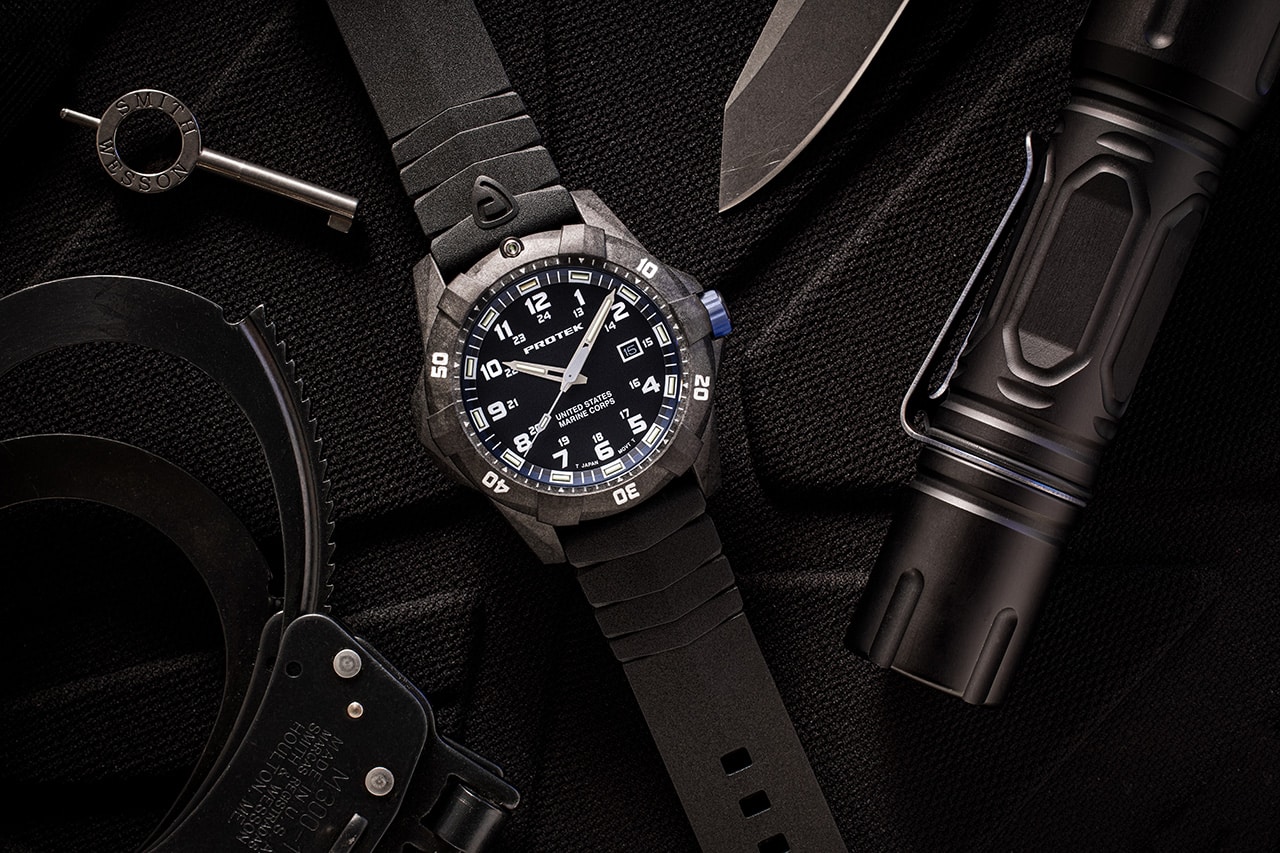
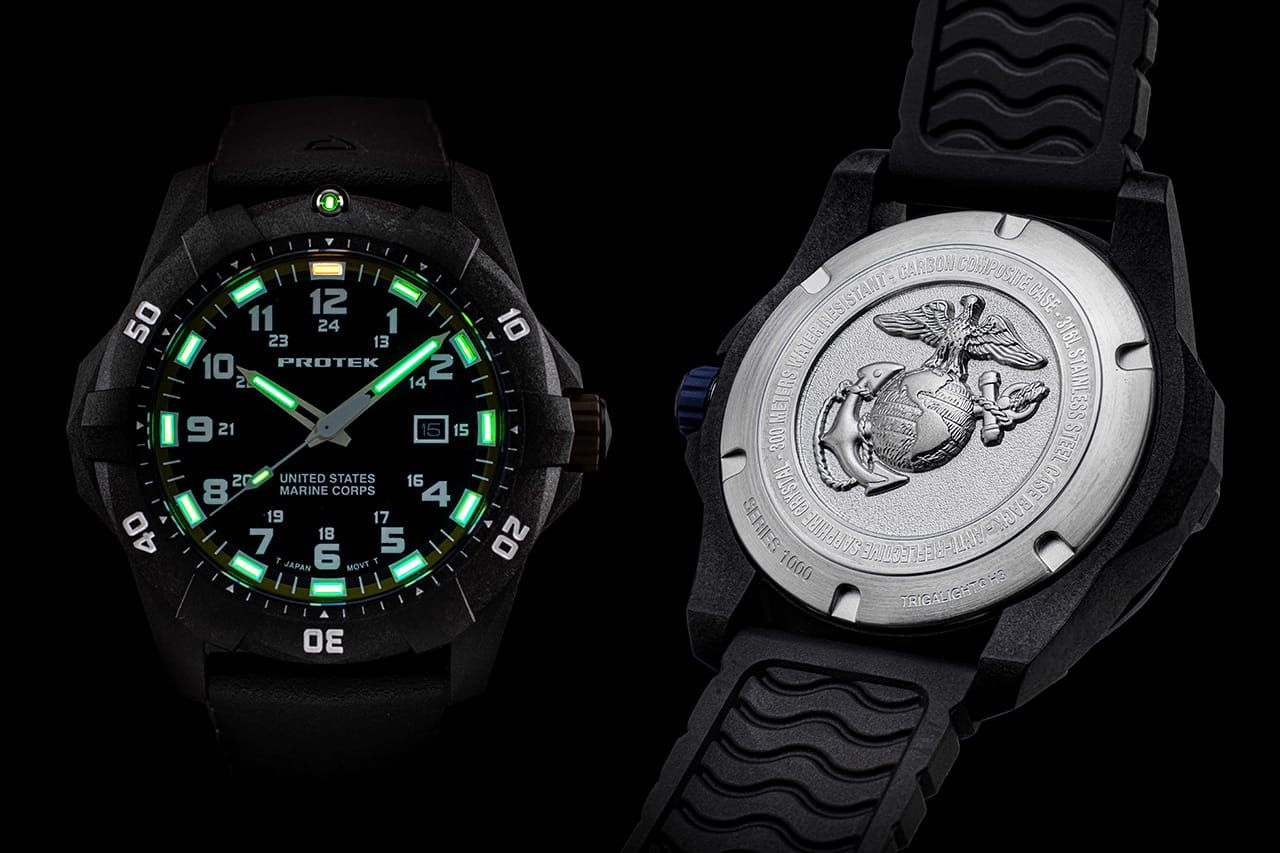
Barry Cohen may not be a name you’re familiar with, but you’ve almost certainly heard of the watch company he created in 1989, Luminox. Recently, after several decades of producing illuminated watches for the U.S. military with Luminox, Cohen set out on his own to launch his latest creation: the ProTek watch series. ProTek was designed for hard use by those who need a rugged, dependable, and easy-to-read timepiece, such as members of the military, law enforcement, and first responders. Cohen appears to have accomplished exactly that, since the ProTek collection has been designated an Official Watch of the U.S. Marine Corps. These watches feature tritium built into the face and hands for illumination that lasts consistently for 25 years.
Above: The ProTek Official USMC Dive watch is available in a variety of colorways, each with the company’s signature tritium illumination (as seen in this article’s lead photo).
Series 1000 Carbon Composite Dive
As the name suggests, this model was made for underwater operations. Water resistant down to 300 meters, the 42mm carbon composite case has a 60-click timing bezel and a sapphire crystal with an anti-reflective coating. Japanese quartz keeps the time, the illumination system is many times brighter than other watches of a similar vein, and the rubber strap is reinforced with light-weight steel tubing.
An additional line of products in the Carbon Composite Dive series features ProTek watches with the USMC logo engraved in the back of the case.
Series 2000 Stainless Steel Dive
This watch is rated down to 200 meters of water resistance, and is entirely stainless steel. For timing, the Gents Steel Dive features a 120-click unidirectional bezel, and the strap is genuine Italian leather. Japanese quartz keeps the hand and date movement, and its battery will keep it ticking for about 10 years. As with all ProTek watches, these feature self-powered tritium illumination.
Series 3000 Titanium Field
Last but not least is the Titanium Field 3000. As the name suggests, the 40mm case, caseback, and push crowns are made from marine grade titanium. It is water resistant down to 100 meters, and features the same sapphire anti-reflective crystal and Japanese quartz as the other watches. The Titanium Field also comes with an Italian leather strap, and uses the largest tritium tubes available for the indices in three different colors.
Modifications and Accessories
In addition to the different series of ProTek watches, they can can be further customized to one’s personal style. Replacement straps are available in both rubber and water-resistant leather in a wide range of colors. Rubber watch straps can come in: charcoal gray, red, blue, green, orange, USMC red, USMC blue, USMC green, and USMC desert sand. Leather watch straps can come in black, dark tan, and dark brown with stainless steel buckle, black with gun metal buckle, black with black titanium buckle, and tan or dark brown with a titanium buckle.
Much like cookies and cream or chocolate and peanut butter, some products like firearms, optics, suppressors, and ear-pro were made for each other. Utah is home to several companies — Desert Tech, HUXWRX, Armasight, and AXIL — all within close proximity to each other, who decided to combine forces to show off some of their newest products to members of the media. With the help of the North Springs Shooting Range, and a pit stop at the Black Rifle Coffee Company HQ for a quick caffeine fix, we were invited to take a closer look at what these companies had going on, and to take their many of their products for a day and night test drive.
Desert Tech
To kick things off, we headed to the Desert Tech facility. Desert Tech (DT) is a firearms company that specializes in weapons based on the bullpup design. For those who might be unfamiliar, this is where the firing grip is located in front of the breech instead of behind it, making the firearm more compact for its barrel length. Not only does this make a rifle look futuristic, it can also help it remain lighter and more maneuverable than a traditional counterpart. DT has several firearm platforms: the Hard Target Interdiction (HTI), the Stealth Recon Scout (SRS), the Micro Dynamic Rifle (MDRX), all of which can swap barrels depending on which caliber is being used. Additionally, they offer a .22 long rifle bullpup called the Trek-22, and have designed a unique AR-15 lower called the Quattro-15 which houses a custom 53-round, quad-stack magazine.
Above: Desert Tech Gunsmiths assemble parts of Desert Tech Rifles.
With a focus on precision shooting, DT has their own line of ammunition to pair with their rifle barrel selections, including .308 Win, 6.5 Creedmoor, .338 Lapua Magnum, .375, .408 and .50 BMG. To further dial in that shot group, they include a ballistic data chart with each caliber and have even developed a firing solutions iPhone app called TRASOL 2.0. The app can be wirelessly connected to other devices, such as external cameras, optics, and can even tie in to local doppler radar information.
No less than fifteen DT rifle platforms with every variety of their ammo was loaded up and brought to the North Springs Shooting Range. Not stopping there, they also provided several Ulfhednar tripods and shooting mats so that their rifles could be fired from a wide range of angles and positions.
Above: A birds eye view of the Desert Tech production facility.
HUXWRX Safety Co.
Next, we walked through the HUXWRX facility to learn more about some recent changes. Previously known as Operators Suppressor Systems (OSS) and recently rebranded to Human Exposure Workshop (HUXWRX Safety Co.), this suppressor fabrication company focuses on a type of design called “flow-through.” Flow-through simply refers to how the gas from a fired round moves through the baffles of a suppressor. Traditional suppressors trap the gas inside an internal baffle system, while gas travels through and is vented out of the front of a flow-through suppressor. This is meant to keep the operator from potentially inhaling harmful gasses that are normally trapped within the firearm during the use of traditional suppressors.
Above: HUXWRX uses precision tools to ensure exact specifications.
HUXWRX utilizes the latest in 3D metal printing, a process that fuses powdered metals with a laser into detailed and precisely layered structures. This is the same process used to make custom parts for companies like Space X. With this method, they can design an intricate system of internal baffles without needing to worry about whether a stock-removal system, such as CNC machining, can reach the inner nooks and crannies. It also eliminates the need to weld pieces together.
By using the latest in manufacturing processes and flow-through design, HUXWRX is focused on mitigating exposure to toxic gas, and improving the health and well-being of military, law enforcement, and firearm enthusiasts. To show off the versatility of their product range, HUXWRX suppressors were mounted to every DT rifle, and several handguns that were brought to the range.
Armasight
To this day, many people think of night vision as a grainy-green video, or thermal imaging as something out of a 1980’s action movie. But modern-day technology paints a much clearer picture than the old school NVGs. Armasight brings the latest in night vision tech to a variety of products, ranging from wearable monoculars and goggles to clip-on rifle optics. Most of the products are available in both green and white phosphor and have clarity that’s light years above and beyond what is shown in older movies.
Above: A Team Wendy Bump Helmet with Armasight Pinnacle Night Vision Goggles.
Recently they put together an entire package that includes everything you need to attach an NVG system to a Team Wendy bump helmet, taking out all of the mounting guess work. This kit was brought to the North Springs Shooting Range, along with several of their rifle mounted clip-ons and infrared lights for a night shoot at the range’s cowboy town.
AXIL
Above: Traditional earplugs work fine to block loud noise, but active ear pro (such as the AXIL XCOR earbuds the author is wearing in this photo) make it much easier to have conversations on the range.
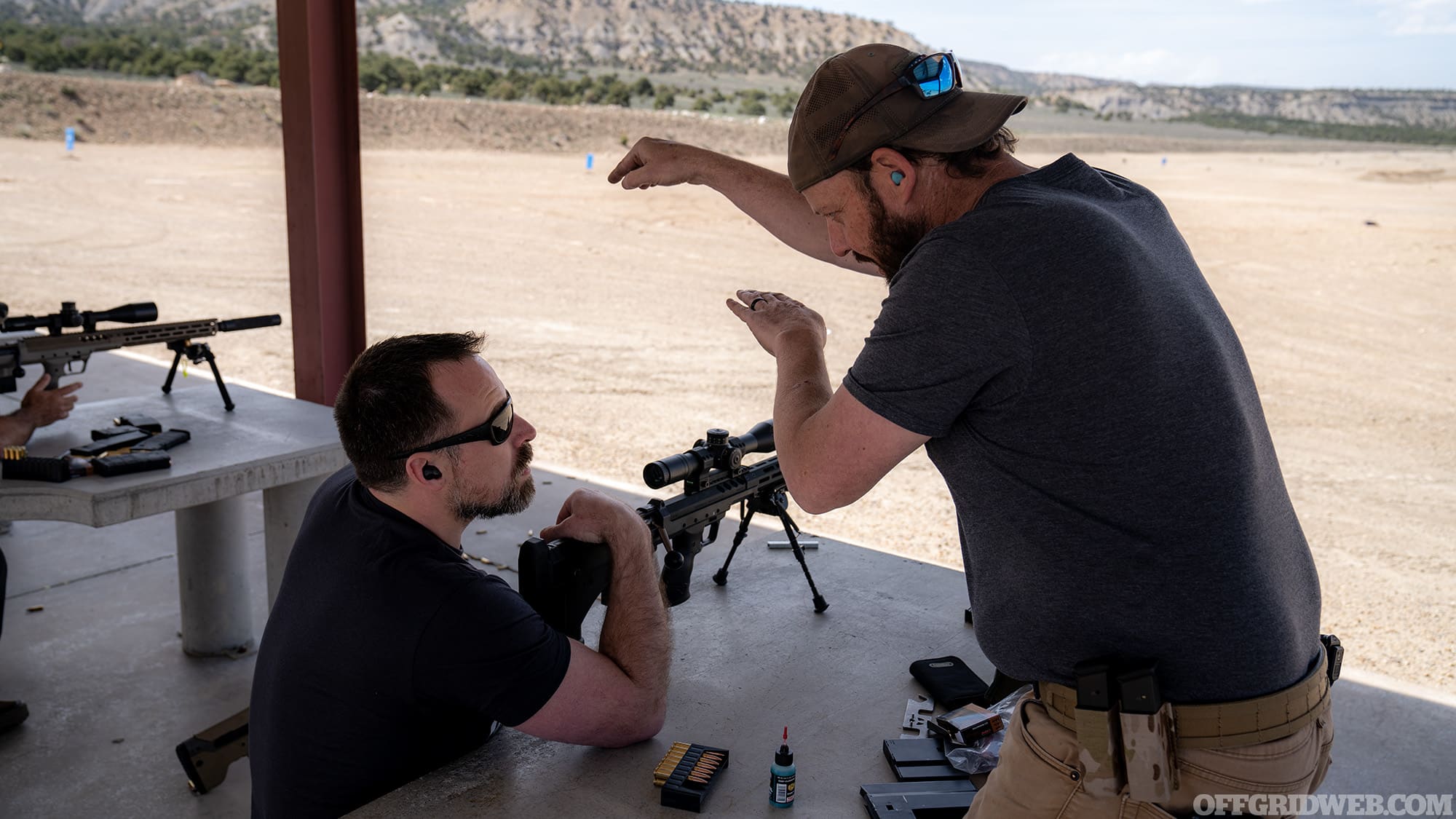
Spending an entire day and most of the night at the range, even with suppressors attached, can use a little extra hearing protection. To enhance the range experience, we also met with AXIL to learn more about their background and try out some of their ear protection.
Inspired by a family business over 50 years in the making, with its roots in designing hearing aids, the company has evolved into designing premium ear buds, muffs, and plugs. AXIL prides itself as a company that does not take any short cuts when sourcing materials for their products, or releasing a product until they are sure it is completely ready for their customers. Most recently, they released a product call the XCOR, which is an earbud with Bluetooth connectivity. It can enhance ambient sound and dynamically reduces overly loud decibel levels in real time. Meaning, between sending rounds down range, in-person conversations are possible without removing them, and the built in mic allows one to answer calls from a Bluetooth connected phone. AXIL’s new XCOR ear buds were the icing on the shooters cake.
Range Performance
Spending the majority of an entire day at the range can be a blast, pun intended, but the North Springs Shooting Range enhanced the entire experience with the stunning backdrop of the Utah high desert spanning as far as the eye could see. Close range targets as close as a few yards to as far as two miles were available to try out the HUXWRX suppressed DT rifles, and a cowboy town was available for the night shoot. All of the rifles were set up, ammo was readily available, and with our XCOR’s fully charged and put in place, we got to shooting some targets.
Above: Patrick Diedrich fires a Desert Tech SRS-M2 equipped with a HUXWRX suppressor.
Personally, as someone with minimal experience firing bullpups, I was surprised by how versatile of a platform they could be. The smaller caliber platforms were light and compact, but it did take a few mag changes to get used to the location of the magazine well behind the firing grip. And for someone with large hands, finding a comfortable hand position took a little experimenting. On the bolt action rifles, there were occasional misfeeds, but this always turned out to be operator error by not sliding the bolt back far enough between rounds. It takes some practice to get used to cycling a bolt that’s mounted further back on the rifle.
Larger caliber DT rifles were heavier, but their precision was undeniable, and before long we were consistently hitting targets as far out as 1000 yards. To showcase the versatility of their rifles, a DT barrel and bolt were rapidly exchanged in the field. Without any further adjustments to the rifle or the optic, I was hitting 600 yard targets as if nothing had happened.
Above: After changing the barrel and the bolt, the SRS can still hit targets out to 1000 yards and beyond without any zero adjustments.
HUXWRX flow-through suppressors kept the decibels of larger calibers to a minimum, all while avoiding gas build up. Since we were firing these rifles for hours, not having to deal with a cloud of acrid smoke pouring back down the barrel, through the ejection port, and into our faces was refreshing. Smaller calibers made even less noise, and the first time the suppressed .22 LR platforms were fired, nearby shooters couldn’t even tell the shot was fired until they heard the plink on the steel targets. While firing a fully automatic Quattro-15, the suppressor was held to feel how fast it would heat up, and the temperature never reached a point where holding on became unbearable.
After the sun had set, we headed to the cowboy town to don our Armasight night vision and take out a few steel bank robbers and buffalo silhouettes. People who wear NVGs typically experience serious problems with depth perception, but the ghost white phosphor Pinnacle night vision goggles were astonishingly clear. There was a little loss of depth perception, but nothing even close to those old military PVS-7s or 14s. Their rifle mounted night vision and thermal optics were equally clear, and target identification was further enhanced with IR flashlights.
Above: A Desert Tech Rifle equipped with an Armasight Vulcan Gen 3 night vision rifle scope and HUXWRX suppressor.
Final Thoughts
Sending hundreds of rounds of varying calibers downrange all day seems like it would inevitably lead to some sort of breakdown or malfunction, but this never occurred. Overall, our impression of these companies and their products was positive, and the time spent at the range was enjoyable. It was apparent that each one that contributed to this day at the range was passionate about what they do, and cared deeply about the function of their products. This passion was also evident in their staff — after taking a peek behind the curtain of their production facilities, even their line workers were enthusiastic about the role they played. It will be exciting to see how these companies move forward, and we hope to get our hands on some of their newest gear for in-depth reviews in the near future.
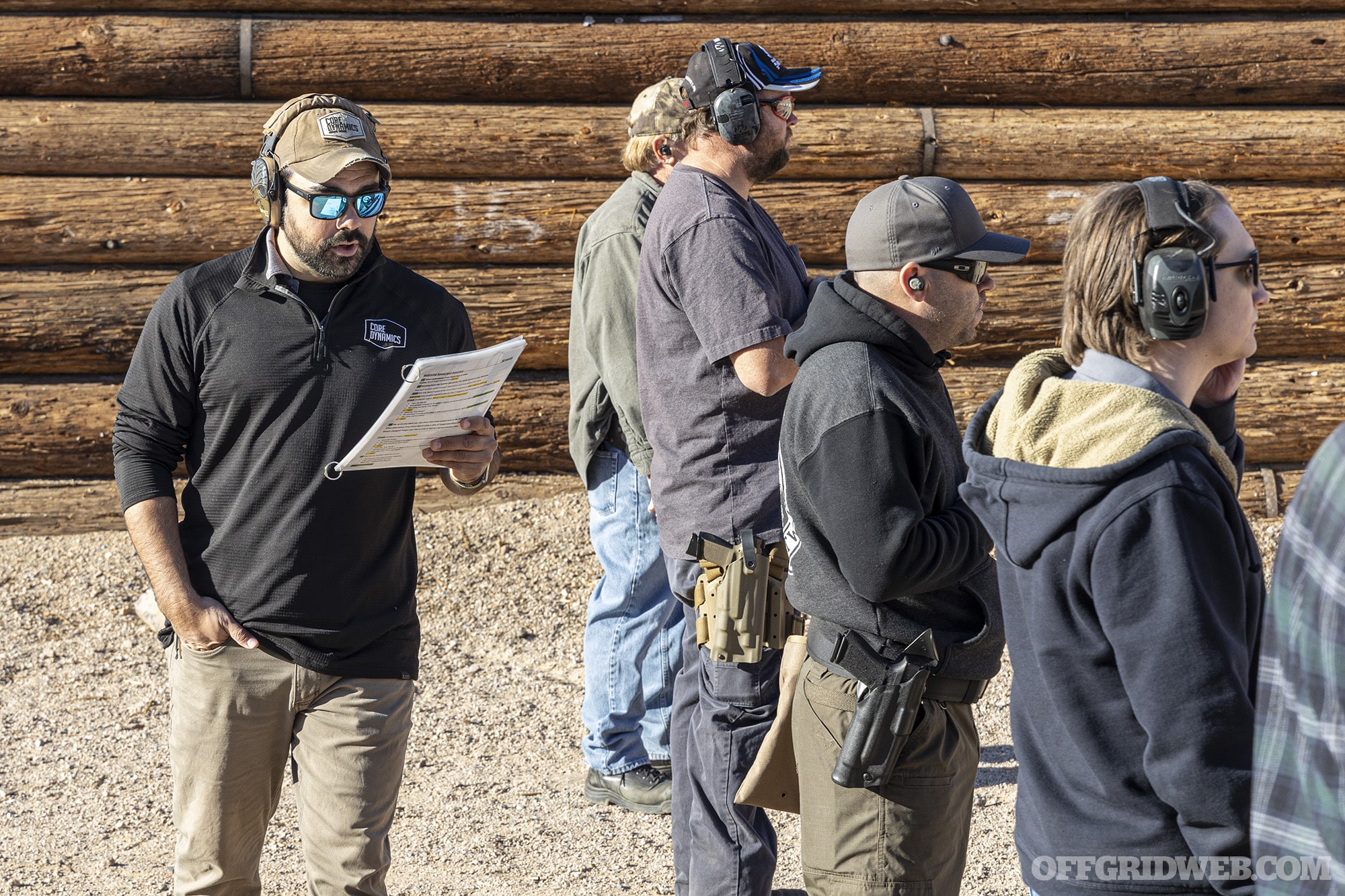
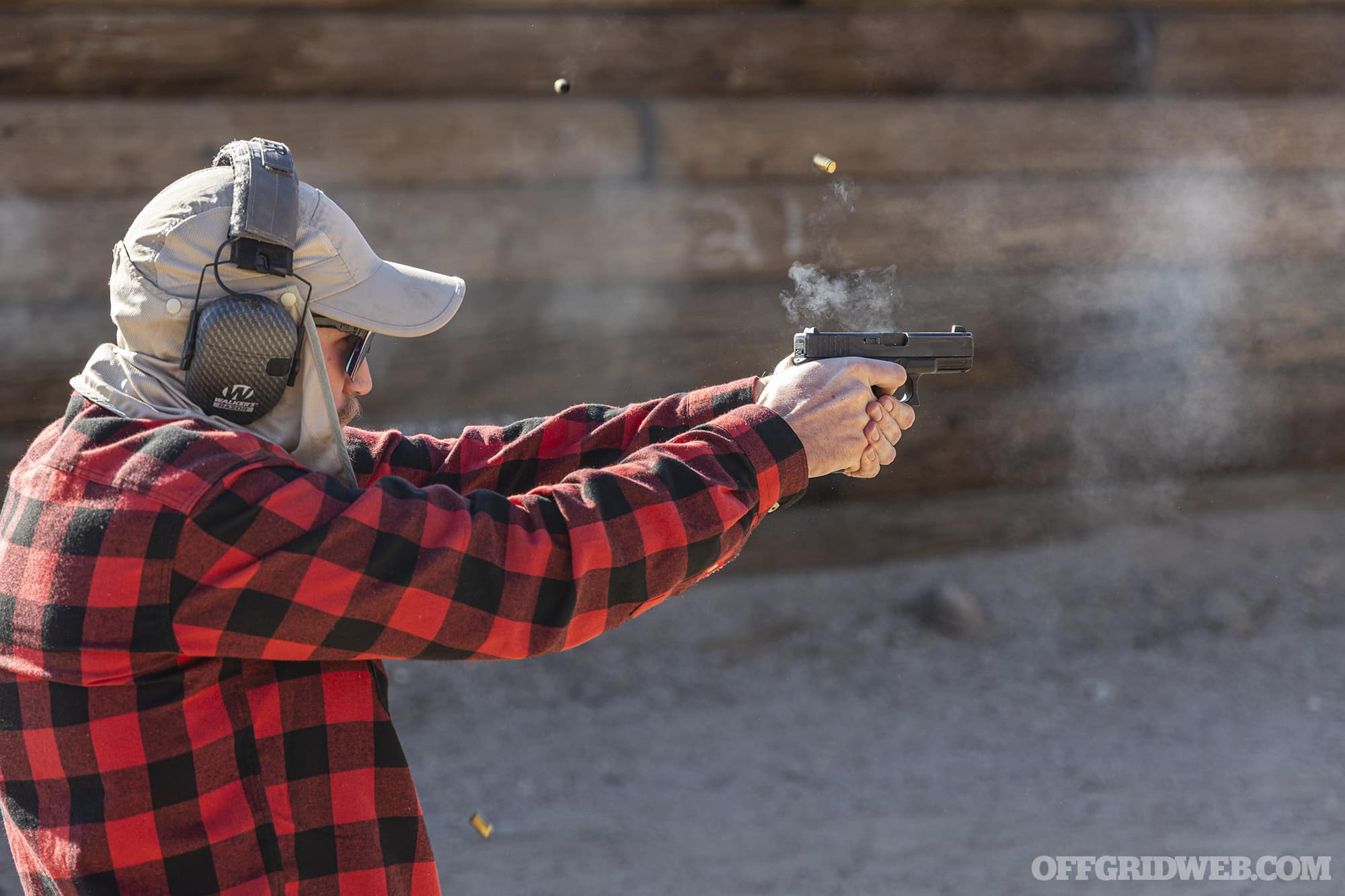
Shooting and gunfighting are not the same thing — this is a statement we’ve made countless times on this site and in our magazine, and it’s always worth reiterating. A strong grasp of technical shooting skills is essential if you expect to defend yourself with a firearm, but that alone doesn’t make you a gunfighter any more than owning a plane and knowing how to perform a basic takeoff makes you a fighter pilot. Preparing for a gunfight involves maintaining situational awareness, developing a defensive mindset, a smooth and consistent draw, balancing speed and accuracy, footwork, transitioning between multiple targets, and the ability to manage stress. It may also involve skills that are rarely practiced in a typical “flat range” setting, such as one-handed shooting, shooting from retention (i.e. before the gun is fully extended with sights on target), and clearing malfunctions. Each of these important skills were addressed at a Core Pistol class I recently attended, taught by lead instructor Chris Vermeer of Core Dynamics Firearms Training.
Core Dynamics Core Pistol Class
The Core Pistol class began with a discussion of defensive mindset principles. In addition to reminders of Murphy’s Law (if it can happen, it will happen) and the OODA loop (observe, orient, decide, act), Vermeer mentioned the less commonly known Hick’s Law (the more choices you have, the longer it’ll take to make a decision).
From these three principles, students learned the importance of preparing for worst-case scenarios, continuously observing our surroundings, and “pre-gaming” situations mentally in order to streamline our heat-of-the-moment defensive decisions. We were also reminded that violent criminals don’t think the same way we do; they may be desperate addicts, mentally unstable, or ruthlessly determined enough that the presence of a gun won’t phase them in the slightest. In those cases, lethal force may be the only way to stop an attack.
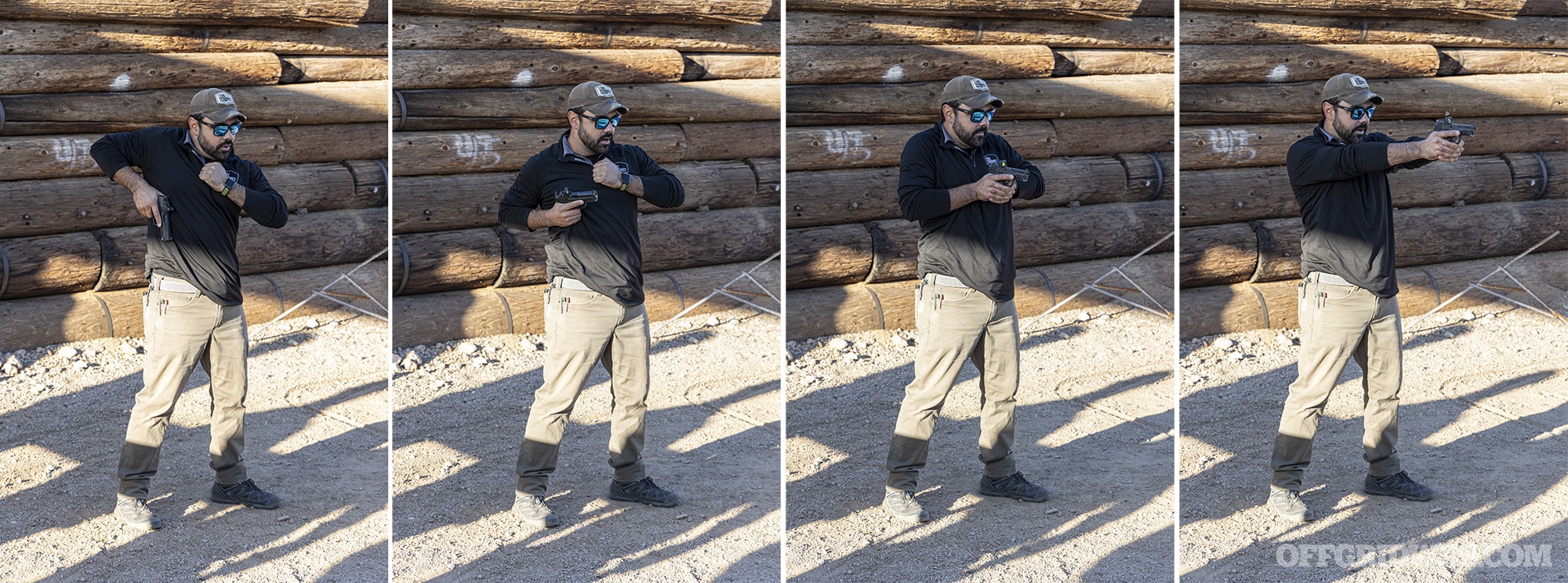
Above: Vermeer demonstrates steps two through five of the traditional five-step draw.
Stepping out onto the range, we practiced the classic five-step draw process from concealment: clear cover garment and establish a secure grip, draw the gun up out of the holster, rotate muzzle towards target, join with the support hand at sternum level, and finally extend to acquire the sights. Next, we worked from three ready positions: low ready (looking over the sights), temple index, and compressed. As we checked our targets, Vermeer reminded us that line breaks don’t count in this class, because accuracy in a real defensive situation must be held to the highest standard. Shooting drills started with slow and precise single shots to test our fundamentals, but quickly moved on to multi-shot strings with varying cadences based on target difficulty. We tested ourselves at distances from 5 to 25 yards, and even practiced no-shoot situations to simulate an opponent who surrendered before a shot was fired.
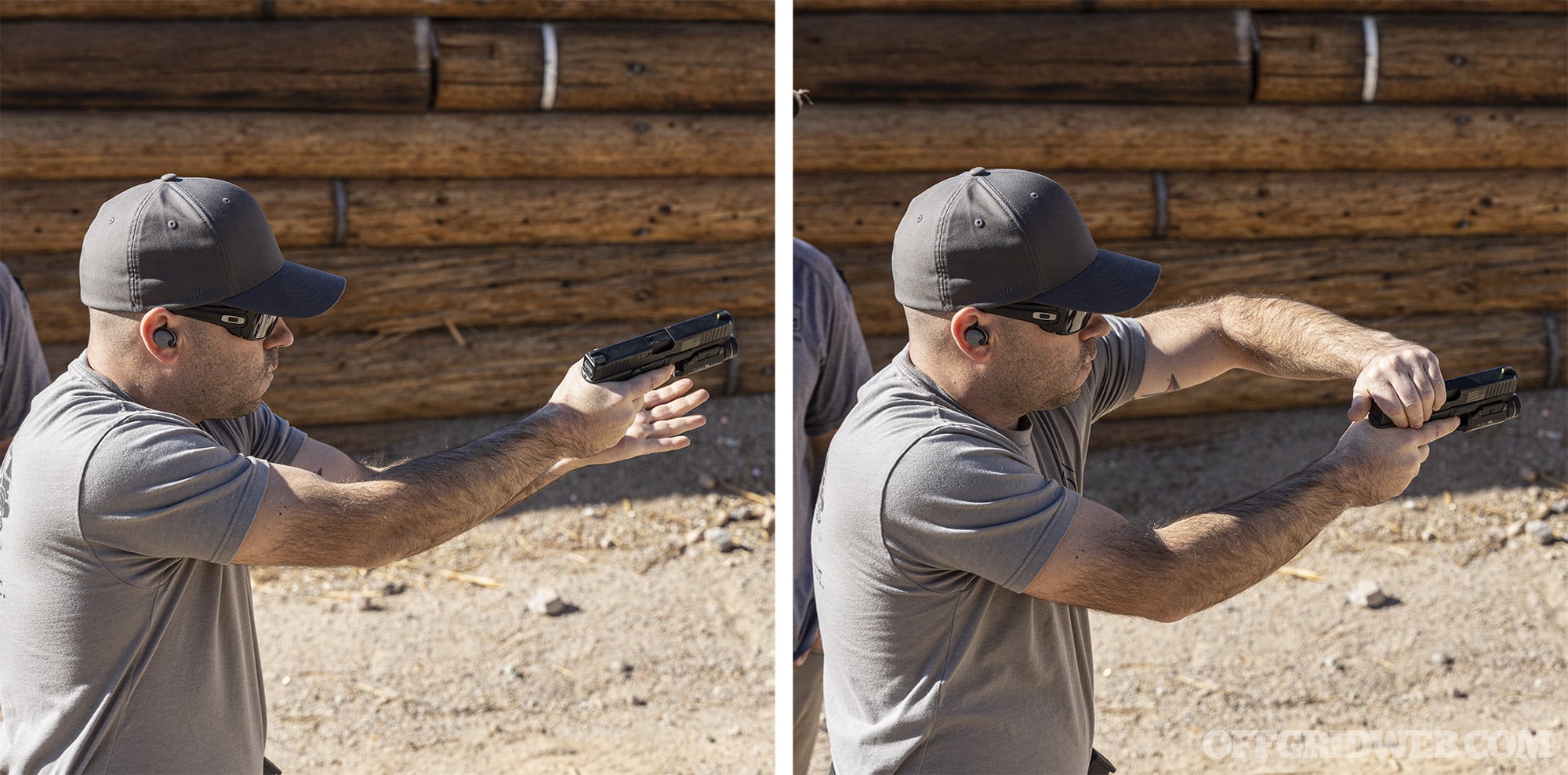
Above: Many of us have heard of the “tap-rack” malfunction clearance technique, but when was the last time you actually practiced it? Frequent tap-rack reps are important to speed up your reaction time if a real malfunction occurs.
Malfunctions — which should be rare but are never impossible — were an important component of the class due to the aforementioned Murphy’s Law. The classic tap-rack (smacking the magazine to ensure it’s seated, then racking the slide) is a technique Vermeer says most shooters don’t practice frequently enough. In order to make it a reflexive action, he recommended students integrate it into our daily dry fire practice routine.
Above: One-handed shooting is another skill that’s often overlooked, but it could be critical if one hand is injured or if you’re using it to push a loved one out of the line of fire.
As drills continued, students began sidestepping left or right while drawing, issuing verbal commands to the hypothetical assailant, and scanning a full 360-degree radius after firing. Obviously, we kept our weapons pointed downrange, but turned to look over each shoulder past the usual 180-degree “scan and assess” range. To ensure the latter task wasn’t simply range theatrics, Vermeer quizzed us about what we observed once we had scanned our surroundings. For example, “what color shirt was the person over your right shoulder wearing,” or “how many people were standing behind you?”
Above: Many “scan and assess” drills involve quickly pivoting the head 180 degrees left and right as if you’re crossing a street. However, in the real world, it’s wise to carefully scan a 360-degree radius and observe important details.
In our final exercise, students paired up in front of two steel plates for a simulated fight. On the buzzer, each student quickly drew and shot the steel three times; whoever got three hits the fastest was the winner, and advanced to the next round. This induced stress, since each of us was aware of the consequences a fumbled draw or missed shots might have in a real gunfight.
Closing Thoughts
I enjoyed my time at the Core Pistol class, and felt it was a nice refresher for critical skills related to self-defense with a concealed handgun. For more information on upcoming Core Dynamics pistol, carbine, and medical classes in Arizona, go to coredynamicsaz.com.
The recurve blade is a design that has been around forever in some form, but in the past 25 years or so, it has really taken off and become a popular EDC profile. At one time, the design was made to facilitate chopping and hacking, but as knives and blade steels have evolved, so has the application of the recurve blade. Depending on which historian you believe, the design originated in the ancient world. The kukri, kopis, falcatta, golok, dao, scimitar, and other similar designs exhibit recurve styles with a larger curve and more weight toward the front of the blade. They were all almost undoubtedly choppers — whether meant to hack through thick vegetation or a warrior’s leather, metal, or wicker armor.
The geometry of the recurve potentially allowed for efficient slicing, and this pattern was popular on butcher knives and skinning knives in more recent centuries. We still see them on various choppers like machetes or kukris, but on the full range of EDC blades they offer another advantage: They pack more usable blade length into a smaller package. If you compare blades with even a slight recurve, you’ll find that you’re gaining the cutting power of a blade from 25- to 75-percent longer than the straight length measurement of the recurve blade. To simplify this, think of your 4-inch-bladed recurve having the cutting power of a 5- to 6-inch blade.
If there’s a drawback to the recurve, it may be maintaining the edge. Much like the hawksbill — but not as bad — you’ll find that most whetstones and straight sharpening devices won’t work well with a more dramatic recurve. You can either send them back to the maker or manufacturer, visit or send to a professional knife sharpener, or invest in a round-shaped sharpening stone or rod.
The recurve was born out of basic geometry and has really improved over the centuries we’ve seen it in use. Whether you need something for slicing, chopping, or just a good self-defense blade, the recurve has a little bit more to it than meets the eye.
CSSD/SC
Mini My So
Bram Frank is a Grandmaster of Arnis and has developed a series of self-defense-oriented knives based on his teaching. The Mini My So is a small concealable folder featuring a recurve blade fit for an ancient warrior with respect to its design. Available in a variety of colors (pink, black/pink, black/tan) and three sizes (mini, medium, and large), this is a knife designed to be carried comfortably but ready to deploy instantly. This is a somewhat specialized design, and it’s advised that you seek training with Bram Frank or one of his instructors in order to fully understand the intricacies of its design.
Pros:
Like all of Bram Frank’s designs, this includes the BRAMP that allows you to open it against an attacker’s body if needed.
The blade slices like a razor, a testament to the grind more than the steel used.
Its smallish size leads to a lot of concealment options for daily carry.
Cons:
There’s currently no training variant for this model.
While the basics are simple, these knives really need the user to work with Frank or one of his instructors.
The North Fork has a dressy look to it with its stabilized Dymandwood scales, and the blade has one of the slightest recurves compared to the rest on our list. Benchmade offers this as a potential pocket skinning blade for processing game, but it makes for a very effective EDC knife. The Axis lock mechanism makes it easy to open or close the blade with one hand and a flick of the wrist.
Pros:
Very sharp out of the box with a nice thin edge for slicing
The North Fork relies on Benchmade’s ever popular Axis lock for a safe and robust locking mechanism.
CPM S30V is a premium knife steel with superb edge retention.
The clip can be positioned tip-up and either left- or right-handed.
Cons:
As good a steel as S30V is, it can be difficult to sharpen.
The handles can get slick under wet conditions. Be mindful if you’re using it to dress game. A retention lanyard should be used if possible.
Zero Tolerance is a division of KAI/Kershaw Knives, and this company prides itself on their designs coming from the demands of military professionals. The ZT 0350 is a good-sized recurve blade that deploys by means of the speed-assist mechanism. This is a scaled-down version of the ZT 0300, making it lighter and more pocket friendly. The G10 feels great in the hand with its natural texture.
Pros:
The blade is made from CPM S30V; it’s tough, razor sharp, rust resistant, and sports excellent edge retention.
This knife performed well as a cutter, and the factory grind was just about perfect.
Fires like a rocket every time, like all assisted or flipper knives should function.
Cons:
The pocket clip is a bit too tight from the factory and seems prone to damage.
S30V may keep its edge for a long time but it’s not the easiest steel to sharpen.
Mercworx Knives has a long and consistent history in the realm of tactical fixed blades. Made by professionals for professionals, these knives have seen serious use with elite troops all over the globe. The Golgotha sports a chili-pepper-shaped handle that locks into your hand in either the forward or reverse grip and is extremely comfortable. The blade is a bold-styled recurve that brings to mind a Kopis or Falcatta, albeit a scaled-down one.
Pros:
It’s made from either 154CM or S30V. This version is 154CM and has been an absolute performer.
Razor sharp out of the box, the way all knives should ship
The rubber belt loop carry attachment works well for keeping the blade in an upright and ready-to-go position while remaining secure.
Cons:
These blades are handmade one at a time to order, so availability may be an issue in some cases.
Some users don’t care for a mirror-polished blade; it’s very reflective unless you bead-blast it.
SOG Knives has been partnered with custom knifemaker Kiku Matsuda for a number of years. He brings quite a few fixed blade and folding designs to the table with his compound recurve designs. The FX Fixed blade features a variety of different handle materials and colors, from natural linen Micarta in this one to orange G10. The handle material and texturing give this knife great ergonomics.
Pros:
The blade is generously sized and can tackle just about any task you have in store for it.
The handle is extremely comfortable and ergonomic.
The blade is made from S35VN; it’s tough, razor sharp, rust resistant, and sports an easily maintainable edge.
Cons:
Although the sheath is well-made, the Tek Lok makes it sit a bit farther out than most other designs.
The blade could’ve been a hair sharper, but it was easily touched up due to the compound edge and approaching it from two different angles.
Emerson was asked to design a folding knife for use by the SEAL Teams, and the original submission was deemed too scary by the Navy brass, despite the fact the SEALs loved it. Emerson changed the blade design to a more utilitarian shape in the form of a recurve. He was asked to incorporate a blade catcher on the top of the blade for knife fighting. As silly as this may sound, the device, now known as the Emerson Wave Shaped Opening Device, opened the knife as it was drawn from the pocket, which soon propelled Emerson into an even higher demand from knife users.
Pros:
The blade, made of 154CM, is tough, razor sharp, rust resistant, and sports an easily maintainable edge.
The knife excels at cutting and slicing.
The Emerson Wave Shaped Opening Device allows this one to deploy as it’s drawn from the pocket.
Cons:
The Emerson Wave Shaped Opening Device can shred your pocket corners up with regular deployment.
It’s only tapped for clip use for right-handed users. Emerson Knives can tap the other scale for an upcharge.
V Nives is one of the fastest-growing knife companies in the U.S., producing collaborative designs with custom knifemakers. The Deplorable Titanium is based on a design by custom maker Jerry Hossom. There’s an economical version of this model about $300 cheaper, but they sent us the version with the sculpted titanium frame lock handle. The sculpted handle offers a nice grip and imparts the look and feel of a custom knife. Whether you go with this one or the economy version, the Hossom-designed blade makes for an amazing recurve style even if it’s more of a strike point than a curve.
Pros:
This one is very comfortable in the hand, V Nives did an outstanding job here.
The blade is made from S35VN; it’s tough, razor sharp, rust resistant, and sports an easily maintainable edge.
Flipper action is buttery smooth and opens perfectly every time.
Cons:
The polished titanium handles could be susceptible to scratching with everyday use.
DISCLAIMER: This is a general overview and not a comprehensive guide to all waterborne contaminants and water purification methods. If you’re unsure if a source of water is safe, be sure to purify it thoroughly before using it for drinking, cooking, or cleaning.
Photos By: Amy Alton
Water. The source of all life, there’s no animal that isn’t composed partly of it. The microscopic tardigrade, also known as a “water bear,” can drop its moisture content to less than 1 percent of normal, but still harbors about 3 percent at its driest. Humans, however, are about 60 percent water and don’t have the ability to survive without fresh water for more than about three days.
In normal times, those who receive a water bill from their town or city are purchasing it from a system where the water is tested, and one that must prove to the Environmental Protection Agency (EPA) that it meets National Primary Drinking Standards. An annual water quality report is compiled and available through the water company with information about contaminants that have possible health effects. Having said that, germs and chemicals can get into the water, either at its source, through the distribution system, or even after leaving water treatment facilities. The Flint, Michigan, water crisis is one of the most infamous examples of this in recent history. The city’s drinking water was contaminated with harmful levels of lead, and studies also found evidence that an outbreak of Legionnaire’s disease (caused by waterborne bacteria) may have been linked to the municipal water supply.
Above: Clean drinking water is something we take for granted in modern society.
How Water Gets Contaminated
If water is taken from the wrong source, it can result in miserable illness or even death. The challenge is to find safe drinkable (potable) water or, at least, to have the materials and knowledge to make it safe to drink.
Harmful microorganisms or toxic chemicals can get in the water from many sources, including:
Fertilizers, pesticides, or other chemicals used on land near the water
Concentrated feed operations from livestock farms
Manufacturing operations from factories
Overflowing sewers and cracks in water piping systems
Flood waters
Wildlife (usually in smaller water sources like creeks)
Soil containing substances such as arsenic and uranium
Above: Flood waters aren’t safe to drink, as they often contain sewage and chemical runoff.
Safe to Drink or Not?
It’s not always obvious that water, even from the tap, is safe to drink. Some signs that should warn you of questionable water is if it’s:
Cloudy – Turbidity, or cloudiness, could signal the presence of disease-causing microbes.
Slimy – Hard water can cause your hands to feel slimy when touching it. This doesn’t have to mean danger but could indicate the presence of lead or other toxic metals.
Discolored – Brown or other colored water may signify the presence of microbes or toxins like copper, iron, or lead. It could also indicate tannins. Tannins are natural organic matter that can result from water passing through decaying vegetation. In small concentrations, they aren’t dangerous, but can cause a number of problems if present in excess.
Smelly – Water that smells bad could harbor disease-causing organisms or toxins like barium or cadmium. Odors like rotten eggs may indicate the presence of hydrogen sulfide. When exposed to certain bacteria, it converts into sulfate, which can cause dehydration or diarrhea.
A high level of suspicion is wise with just about any new water source. Even the clearest mountain stream may harbor giardia, a parasite that causes diarrhea and dehydration. Better safe than sorry.
If you lose access to municipal drinking water, you can still count certain sources in the home as generally safe:
Melted ice cubes made with water that isn’t contaminated
Liquid from canned vegetables and fruit
Water from your home’s toilet tank (not from the bowl), if it’s clear and not discolored by chemical treatment
Water from your home’s water heater (the tank that connects to the water that comes out of your faucets and showerheads)
Bottled water from coolers
Water from swimming pools and spas can be used for hygiene purposes, but not for drinking. Also, never use water from radiator tanks or boilers that are part of your home heating system. They are different from your water heater for faucets and showers and not safe to drink.
Above: Water supplies are tested to see if they meet National Primary Drinking Standards.
Myths About Water Purification
Water filters are expensive and high maintenance. Cheap water filters such as the Sawyer Mini, Lifestraw, and others are compact, lightweight, and easy to use.
Bottled water is better. Bottled water is fine, but the quantity required for a family is huge over time and contributes to environmental damage. A water filtration system, on the other hand, is a one-time investment for continuous supplies of safe water.
Water filters remove all the good minerals from your diet. Water filters do remove minerals, but the percentage of calcium, iron, and other minerals in water is small compared to what you get from food like vegetables, fruits, and leafy greens.
Your city or town guarantees the supply of pure water. Municipalities use a lot of chemicals to make water safe for consumption; contaminants may always be present.
Clear water and/or fast-flowing water is safe water. Pesticides, chemicals, microorganisms, and other contaminants that aren’t visible to the human eye may be present in tap water or naturally occurring sources.
Water filters completely purify water. Water filters, well, filter, but they don’t always make water safe to drink. For example, a Lifestraw cannot remove the dissolved salt in seawater. Always consider the source of your water carefully and use a treatment method that’s suitable for the contaminants it might contain. To be extra safe, double-up with two purification methods.
Above: The Lifestraw, a compact, lightweight commercial water filter.
Disinfecting Water
If you suspect that the water quality is questionable, there are simple ways to help make it safe to drink. Boiling is perhaps the most well-known and eliminates bacteria, viruses, and parasites. Simply take a container, fill it with water, and get it to a rolling boil for one full minute. For altitudes over 6,500 feet, boil for three full minutes. Why? As altitude increases, the atmospheric pressure decreases as does the boiling point of water. To compensate for the lower boiling point, the boiling time must be increased.
Boiling takes fuel, so you might consider, instead, chemical disinfection to get rid of bacteria and viruses. This is most easily accomplished with 5 to 9 percent sodium hypochlorite (unscented household bleach). Use eight drops of bleach per gallon, but 16 drops if the water is cloudy. Mix the bleach into the water thoroughly, and let it stand for 30 minutes before consuming. Other chemicals such as iodine or chlorine dioxide will work as well after a period of waiting. Be aware that old bleach (older than six months) loses potency.
For storage purposes, calcium hypochlorite may be an improvement on household bleach. A 1-pound package of calcium hypochlorite in granular form can treat up to 10,000 gallons of drinking water. It destroys a variety of disease-causing organisms including bacteria, yeast, fungus, spores, and viruses.
Calcium hypochlorite is widely available for use as a swimming pool additive. Using granular calcium hypochlorite to disinfect water is a three-step process.
To make a stock of chlorine solution (do not drink this!), dissolve one heaping teaspoon (about one-quarter of an ounce) of (78 percent) granular calcium hypochlorite for each 2 gallons (8 liters) of water.
Add just one part of the chlorine solution to 100 parts water to be treated.
Let the mixture sit for at least a half hour before drinking.
Above: Calcium hypochlorite can be stored as a solid water disinfection method.
In some circumstances, you may have neither fuel for boiling nor chemical agents for disinfection. In this case, you can use the ultraviolet light from the sun. This is known as the solar water disinfection (SODIS) method. Colorless, label-less 2-liter plastic or glass bottles will serve the purpose. Fill the bottle about 90 percent with the questionable but clear water. Then, expose it to full sunlight for six full hours. Cloudy weather takes much longer. If raining, collect the rainwater instead. For the best effect, consider placing the bottle on a reflective metal surface, such as aluminum foil, to increase the bottle’s light exposure. For a simpler way to UV sterilize water, there are commercial UV sterilizers available, such as the Steri-Pen.
It should be noted that water containing toxic chemicals or radioactivity is not made safe with any of the disinfection methods mentioned thus far.
Above: Ultraviolet light from full sun disinfects water in about 6 hours.
Common Waterborne Contaminants
Many bacteria, parasites, and viruses thrive in an aquatic environment, including:
Cryptosporidium
Legionella
Campylobacter
Norovirus
E. coli O157
Rotavirus
Enterovirus
Salmonella
Giardia
Shigella
Hepatitis A
Chemicals that have been known to contaminate tap water include:
Arsenic
Nitrate
Copper
Radon
Lead
Above: Questionable water sources require disinfection.
Filtering Water
You may have methods to disinfect water, but if it’s cloudy or has particulate matter in it, you must filter it first. Commercial filters such as the Lifestraw, Sawyer Mini, or the Berkey are useful and highly effective, but if you don’t have these, some improvisation is required.
Here’s a list of what you’ll need:
Plastic bottle with a cap
Knife
Hammer and nail
Coffee filter or thin cloth
Large cup or mug (either one works)
Activated charcoal
Sand
Gravel
Container to catch the water (jar, cup, mug, etc.)
Above: Materials used to improvise a simple filter.
First, use the knife to cut the bottom off the plastic bottle. Take the hammer and nail and punch a hole or two in the cap. If you don’t have a hammer or nail, use the knife to cut an X shape into the bottle cap.
Above: Cut off the bottom third of a clear plastic bottle.
Above: Make one or two holes in the bottle cap.
Cover the mouth of the bottle with the coffee filter and tighten the cap over it. Put the bottle upside-down into the container that’ll collect the water (or use the cutout bottom of the bottle).
Above: Place the coffee filter or thin cloth between the bottle and the cap.
Now add layers of filtering material. Start by filling the bottom of the bottle with the charcoal. If the charcoal is in large pieces, break it down with the hammer into pea-sized particles.
Above: Place a layer of charcoal in the upside-down bottle.
Fill the middle with undyed sand.
Above: Add a layer of loose sand.
Fill the rest with gravel (layers should be about the same thickness) but leave an inch or so of space at the top to avoid spillage.
Above: Add a layer of gravel or small rocks.
The gravel layer will catch larger pieces of debris. The sand layer catches smaller particles, such as dirt, and the charcoal layer can reduce levels of bacteria and some chemicals. Be aware that, at the beginning, the charcoal may have some “soot.”
Above: Pour water to be filtered on top, let drain into container at bottom.
Hold your improvised filter over a container. Pour water in slowly and be patient, as the now-filtered water may take some time to flow into the container. If still not clear, put the water through a second time. If it takes too long, use thinner layers. Additional graduated layers may be added as desired.
Above: The improvised filter manages to capture most of the murky particulate.
Another method suggests making a filter out of the sapwood of trees like pine. Sapwood contains xylem, which filters out dirt and even bacteria (but not viruses). For this, you’ll begin with a plastic bottle as before. Then:
Cut a 4-inch-long piece from a pine tree branch of the thickness that, when the bark is peeled off, fits tightly into the bottle’s neck.
Slide the first inch or so of the stick into the neck of the bottle.
Cut the bottom of the bottle off and turn the bottle upside down.
Fill the bottle with water, and let the water drain through the stick.
With this method, it’s important that the xylem remains constantly moist, or you will lose the filtering effect.
While improvised water filters can greatly improve taste and odor as well as reduce levels of contaminants, it’s wise to follow up with a secondary purification method (such as bleach or boiling) whenever possible. Even if your DIY filter eliminates 90 percent of bacteria, the remaining 10 percent might still be enough to make you sick.
Above: Bring water to a rolling boil to disinfect it.
Storing Water Safely
Once you have a safe water source, you’ll want to store a supply of it. Use food-grade water storage containers; these won’t leach toxic substances into the water they’re holding and can be found at camping supply stores. The container you use should be made of durable materials; in other words, not glass. It should have a narrow opening that makes pouring easy and have a top that can be closed tightly. Avoid containers that previously held toxic chemicals, such as bleach. Write the date on a label and keep them stored in a dark place with a temperature preferably between 50 and 70 degrees F. Replace your water supply every six months or so.
Stored water will often taste “flat.” This occurs because, over time, the water loses oxygen much like soda loses carbonation. To restore the original taste, shake your water in a container for a minute or two before drinking.
Above: Water storage containers must be food-grade quality.
What About Salt Water Purification Methods?
You’ve heard that it’s dangerous to drink salt water. Among other reasons, this is because:
The human kidney can’t eliminate large amounts of salt, causing excessive strain and leading to dehydration.
Too much salt causes elevated blood pressures that may lead to organ failure.
Drinking salt water causes muscle cramps.
Above: The Lifestraw and Sawyer Mini are compact, lightweight commercial water filters. However, they cannot be used to desalinate seawater.
If your only option is salt water, there are ways to desalinate it. Off the grid, the best method may be distillation by evaporation. When water is evaporated, salt and other particles are separated from it. The distilled water is caught in a container and should be safe to drink. Desalination is most quickly achieved by boiling to trap steam; you can, however, get condensation from seawater with sunlight. You’ll need a pot, a smaller pot, some plastic wrap or sheeting, and one or two weights.
Partly fill the larger pot with sea water and put the smaller pot in the larger pot. Cover the whole thing with plastic wrap and put a weight on the plastic over the center of the smaller pot (but not touching it). Condensation of fresh water will occur on the inside of the plastic sheet, leaving the salt behind. The weight on the plastic will cause fresh water to drip into the smaller pot, which you can drink from. They call this method a “solar still” or “moisture trap.”
Above: An improvised solar still
About the Author
Joe Alton, MD, is a physician, medical preparedness advocate, and N.Y. Times-bestselling author of The Survival Medicine Handbook: The Essential Guide For When Help Is Not On The Way, now in its 700-page fourth edition. He’s also an outdoor enthusiast and member of The Wilderness Medical Society. His website at doomandbloom.net has over 1,300 articles, podcasts, and videos on medical preparedness as well as an entire line of quality medical kits designed by the author and packed in the United States.
Whether you’re searching for a lost item, locating a wire or water pipe for safety reasons, or have personal security in mind, having a reliable metal detector can be a game-changing tool. MineLab offers multiple metal detecting solutions in their product lineup, including the Pro-Find 35 pinpoint metal detector. At 9.38 inches long and weighing just over 6 ounces, it can be stored easily in a pack, on your belt, or in a vehicle, ready to be used whenever it’s needed. The Pro-Find has five sensitivity settings so you can filter out undesirable metal detections, and it’s waterproof up to 3 meters, making it ideal for shallow water searching. Volume from its detection indicator can also be adjusted, including vibration intensity. The vibration allows the user to feel if something is being detected if you don’t want noise alerting others nearby, or if searching underwater and unable to hear the detection indicator tone. There are lost-proofing features built into the design as well, which include the bright yellow housing color and an inactivity alarm.
This isn’t your average pocket knife, but a versatile array of tools that comfortably fits into easily accessible places. Versa’s blade length is a little over 3 inches, made out of a high carbon stainless steel, and has a slew of built-in features — including straight and serrated cutting edges, a flat head driver, and a wrench to adjust the valve of oxy-acetylene tanks. Built into the rubber-coated handle is a pry bar, glass breaker, and strap cutter. Essentially, it has a tool to mitigate some of the most life-threatening situations you could find yourself, all neatly compressed into a 5-inch handle. If that wasn’t enough, Jason Hanson, former CIA operative, has put together several tutorial videos of how to apply the tools built into the Versa Knife, which can be found on the blade’s website. Rather than load your bug-out bag with the extra weight of a dozen individual tools, the Versa offers a lightweight and convenient way to be ready for anything.
Born of the collaborative efforts of several elite military operators, the Professional Outdoorsman Precision Skinner (POPS) MK2P is a nearly invincible knife for serious use. CNC ground from CPM 3V steel, the 0.210-inch-thick blade can withstand serious abuse without flinching. Gunfighter Design incorporates its Double Thumb Relief into the blade for a higher level of control when you have to get work done in tight places. G10 handle slabs give the MK2P better durability over other handle materials, and hollow titanium handle pins make it easy to add a lanyard or lash the blade into a fixed position. The blade itself is 3.5 inches long, with an overall length of 8 inches, making it a fixed blade that’s not overly cumbersome. A point is machined into the design of the hilt for glass-breaking purposes, and the custom Kydex sheath makes it easy to conceal the blade in pocket, pack, or vehicle.
Known for producing some of the best outdoor gear on the market, Suunto has rolled out a time-keeping device capable of much more. Designed and tested to withstand military-grade durability standards, the watch face of the 9 Peak Pro is sapphire crystal, the body is stainless steel, and some models are available in titanium. It’s waterproof up to 100 meters and can run 40 hours continuously with the most power-hungry GPS features running. If the Peak Pro is used lightly as a timepiece, it can last as long as 21 days on a single charge. Whatever your outdoor activity is, there are 95 individual sport modes to track your activity, including a dedicated snorkeling mode. Bluetooth connectivity connects the 9 Peak Pro to most current smart phones and offers an enhanced method of planning workouts, tracking performance, and navigating the landscape. It’s thin and light, only 0.43-inch thick, weighs 2.26 ounces, and with the incorporation of a few Suunto accessories, can be strapped to a handlebar or customized with different colored wrist straps.
Nothing leads to more fatalities in the outdoors than exposure to the elements, so finding rain gear that’s both functional and durable is crucial to self-preservation. The Pnuma 3L Element Proof Rain Jacket delivers both. By utilizing interwoven polyester, the 3L is 100-percent waterproof up to 20,000mm, and has a breathability rating of 15,000 g/m2/24h. What this means is that it can keep torrential rain from seeping through without overheating the wearer while out and about. The built-in hood keeps the noggin dry, and anti-abrasion overlays in high-wear areas, like the shoulders, prevent damage from things like pack straps. For hunters or other tactical situations, the Caza pattern easily blends into many wilderness settings, and for the urbanite or casual use, the Beluga color is a classy neutral tone. Weighing in at just over 20 ounces, the 3L is serious protection from the elements that will not feel like a burden in a ruck.
It has been said that the best optic is the one you have. Hopefully, the one you have is a German-engineered Meopta, because it’s hard to beat their level of visual clarity. As if Meopta’s crystal clear objective lenses weren’t enough, they’ve gone and added a built-in laser range finder to their binos. The Optika LR 10×42 HD is a serious pair of binos, capable of accurately ranging out to 2,600 yards with a minimal margin of error of +/- 2 yards. Its magnesium body is coated in rubber to keep it from getting damaged by moisture, dust, or drop shock. Each Optika LR also comes with a protective case, carry strap, and lens covers. Looking through the binos will give the user a 6.7-degree field of view, with 85 percent daylight transmission up to 10 times magnification. And with the press of a button, you can easily determine the range of whatever you’re looking at. A fully charged battery will yield up to 1,200 measures.
Going to the range can quickly turn into a hassle when more than one firearm is being lugged around. Cases tend to be big and clunky, and it can be stressful leaving a gun unattended while making multiple trips to and from a vehicle. The DRC (Double Rifle Case) 36, is here to mitigate that stress by offering the storage capacity of two rifles up to 36 inches long. A padded divider separates the main compartment, preventing bumps and scuffs when storing two rifles. Extra accessory compartments easily store common range gear like ear pro, targets, or maintenance tools. MOLLE webbing built into the outside adds another layer of versatility, allowing for endless customized loadouts. Carry it like a briefcase for short distances or utilize the pack straps to wear it like a backpack for those range sites off the beaten path. The DRC’s matte color blends into a multitude of surroundings for tactical applications, and it has a nylon Velcro backing for name plates or morale patches.
Not every dismounted excursion overland necessitates an 8-inch hiking boot. For those family trips to a well-established park or a light stroll through some rolling hills, footwear that’s light and breezy can make the experience much more enjoyable. Garmont’s 9.81 HELI is a lightweight, low-top shoe that looks and works great in the urban jungle just as much as it does in an oak savannah. Striking a comfortable balance between comfortability and support, strapping on a pair of 9.81 HELIs will have you enjoying light hiking or Nordic walking in no time. For those who want to enjoy the outdoors in a hurry, Garmont’s speed lacing system will expedite hitting the trails. The aesthetics make the 9.81 HELI a great contender for casual office wear for those who may want to get up and move during a lunch break, and Garmont’s attention to quality design will have these shoes lasting for years to come.
Got a few fixed blade knives lying around and would like a traditional and timeless way to keep them organized? PNW Bushcraft has the solution with their Birch Waxed Canvas Knife Roll Up. PNW Bushcraft is leading the waxed canvas revival by crafting durable handmade products perfect for the outdoors. Their Birch Roll is 15 by 25.5 inches and features eight pockets that are 5 inches deep by 3 inches wide. Once all your favorite fixed blades are stowed in the pockets, roll them up and secure them with the leather cord, or use the built-in grommets to hang them on the wall for easy access. The waxed canvas will protect your knives from the elements and add another layer of corrosion resistance to high carbon steels. Waxed canvas is easy to clean and maintain, making the Birch Roll perfect for outdoor expeditions. In an era of synthetic fiber, CNC machines and intelligent software, having a product made of materials that have stood the test of time for hundreds of years is a refreshing change of pace.
Few things are as important as being able to create a fire. Cooking food, staying warm, and feeling comforted by the glow of a campfire are just the tip of the flame, so to speak. Unlike past generations, modern tech has made fire-making knowledge nearly obsolete. Fortunately, we don’t have to be the master of friction fire-starting methods to get a blaze going. Prepared 4X bridges the knowledge gap with the Survival Torch. Available in two sizes, the Survival Torch utilizes a thick ferrocerium rod, curved steel striker, and 36-inch wax-infused hemp rope to easily transform sparks into flame. The hemp rope is great tinder; it catches the spark almost effortlessly. The 36-inch length has an approximate continuous burn time of three hours. The aluminum housing of the Survival Torch is bright orange, so it’s easy to keep track of and has a tube to pull the hemp cord through to safely extinguish the flame. Keeping the lit hemp cord close to the end of the tube protects the embers from high winds and makes for a handy lighter.
Keeping a knife sharp is undeniably one of the most important maintenance skills the owner of a blade can master. But sharpening freehand can lead to uneven edges and possibly ruin cutting potential. Cold Steel, one of the best-known knife companies in the world, has just the tool to keep your sharpening angles even and consistent, regardless of your level of skill. The Benchtop Knife Sharpener holds your blade locked in place, while you move the sharpening stones at a predetermined angle. Simply adjust to the desired angle — anywhere between 15 and 30 degrees — choose the appropriate grit, and pass the sharpening stone over one side of the edge as many times as needed. Once one side of the knife edge has been adequately sharpened, rotate the blade clamp and run the sharpening stone over the other side. The base of the Benchtop Knife Sharpener is sturdy enough that it doesn’t require clamping, and the whole kit comes in a durable storage case to keep all the components neatly organized.
Depending on where you live, traveling in a vehicle can pose complex security risks. There may be a need to keep high value items discreetly locked away. In areas with high crime rates, balancing local laws with having access to some form of self-defense could be a life-saving endeavor. Glove compartments are an obvious place for vandals breaking in, and typically not considered a secured location for the transportation of a firearm. This is where the Headrest Safe comes in. As the name implies, it’s a locked safe built into the form of a vehicle headrest. There are models available for both the driver and passenger side of the vehicle. They come in a variety of colors and materials to blend in seamlessly with the vehicle’s upholstery. Programmable key codes and a programmable touch sensor ensure only the intended user has access. The inside cavity is 11 inches long, 8 inches tall, 6 inches wide, and protected by 16- and 18-gauge steel.
It may be hard to believe, but over two centuries ago, a man by the name of Michael Faraday invented the electric motor, the first dynamo, and what would come to be known as the Faraday cage. By coating a room entirely with metal foil, Faraday could prevent electromagnetic fields outside the room from interfering with sensitive equipment inside. Conversely, signals from inside the Faraday cage could not escape. At first it was useful for scientific research, but has since expanded into other realms, most notably in recent times for data security. Today, the concept behind a Faraday cage is still used in everything from science labs to USB cables, and even prison buildings. Some folks have probably experienced the effects of a Faraday cage by trying to make a call on their cell phone in an elevator, or in a steel structured building. Wireless signals from devices are unable to get in or out, a feature mimicked with the SLNT E3 Faraday Backpack.
In the digital age, Faraday’s methods of blocking signals have become increasingly important for safety and security. Nefarious individuals can use active and passive devices to read RFID or NFC chips embedded into cards, steal information from smart devices, and possibly even damage hardware. A study at the University of Maryland found that there is a “near-constant rate of hacker attacks on computers with internet access,” equating to an average of 2,244 attempts per day per device studied — most of these attacks are automated brute-force techniques probing every computer they can find, leaving users blissfully unaware they’re happening. Even Mother Nature can take its toll on electronics in the form of solar radiation or geomagnetic storms. Look up the Carrington Event for an idea of how destructive our own sun has the potential to be. Society has become intrinsically intertwined with electronic devices, and we increasingly rely on them to store critical information. Now more than ever, it is important to find a way to keep those devices safe from tampering or destruction. But who wants to carry around a metal shielded box or line an entire room in foil?
This is where the company SLNT comes to the rescue. By incorporating metallic fabric into common everyday carry items, like wallets, purses, and backpacks, they’ve leveled the electronic warfare playing field. One of their items, the E3 Faraday Backpack, is particularly versatile. Electronic shielding lines parts of this pack, some of which is Military Standard 188-125-2 compliant, which means it’s rated to block the effects of a high-altitude electromagnetic pulse (HEMP). For anyone who hasn’t read the book One Second After, it is a well-known fact that a single HEMP has the capability to cripple most of the continental United States for years. It also exceeds IEEE 299-2006 standards, which covers radio frequency ranges between 1 and 40 GHz. These are ratings meant to ensure nuclear missile silos and sensitive database infrastructure will be able to survive mutually assured destruction, so a bag built to withstand that level of electromagnetic power should be able to block malicious short-range hackers.
Above: Disguised as a classy EDC day pack, SLNT’s E3 Faraday backpack blocks nefarious wireless signals.
SLNT E3 Faraday Backpack
The E3 is a 23-liter bag, measuring 20.5 by 12.2 by 7.1 inches (52 by 31 by 18 cm), which makes it quite handy for day pack or airplane carry-on. It’s black and stylish, giving it a professional vibe for the office or school, and looks like a pack you wouldn’t be embarrassed to bring to a meeting. For those environmentally minded, the material is made from 100-percent recycled products and is coated to increase weather resistance. A total of 15 separate compartments allow for plenty of storage options, and it comes with a removable shoe or laundry bag to keep items such as gym clothes separate from the rest of your gear. One of the shoulder straps is designed with an easily accessible zippered pocket, perfect for a key fob, room key or thumb drive. Connecting the two shoulder straps is a magnetic sternum strap that helps reduce shoulder strain. Inside, two sizes of silent-pocket Faraday sleeves magnetically lock into place — one large enough to store a 16-inch laptop and a smaller one for a large model of smartphone. The entire bag comes packaged in a lightweight dust cover perfect for use as a dirty laundry bag when you’re on the go.
This bag looks good and sounds good on paper, but we’re interested in real-world performance. So, let’s take a deeper dive into its effectiveness at blocking signals and see if it lives up to the company’s claims. SLNT’s website has an entire page dedicated to its own testing results that looks impressive. Call me a bit of a skeptic, but it’s easy to make claims and fabricate tables to back them up, so I like to verify things independently. To perform my own testing, I downloaded a few apps to an iPhone 12 that’ll test upload and download speeds, GPS communications, Bluetooth connectivity, and run it through some common scenarios.
Above: There is ample padding on the backs and shoulders for increased breathability and comfort.
Testing Faraday Capabilities
To establish a baseline of the phone working normally, the signal testing apps were run with the phone in the open air. Signal testing is performed inside a residence built with an aluminum roof, and about 4 meters from a Wi-Fi router. Inside the house are several devices that connect via Bluetooth, and there’s a 4G cellular tower less than a half-mile away. This location is in a sparsely populated residential zone in the Upper Peninsula of Michigan, and the signal density isn’t as high as you would find in a metropolitan area. The phone settings are typical of what would be used to conserve data, connecting to known Wi-Fi networks when they’re available, and using cellular data when they’re not.
Unfortunately, if a phone’s settings allow it to automatically connect to signals as it comes within range, it becomes vulnerable to attacks from hackers lurking on unsecured networks. Even secured networks can be hacked with enough time and effort, allowing whoever is on the other side to victimize any devices that are connected. So, it pays to take device protection seriously. Smartphone at the ready, I began to test how well the E3 can prevent these types of attacks from occurring in the first place.
The aforementioned apps indicated that baseline data transfer speeds on the smartphone were relatively fast, with average download speeds between 80 and 100 Mbps, and upload speeds clocking in between 10 and 13 Mbps. GPS status varied more drastically inside the residence with error rates ranging between 10 and 50 feet horizontally. Perhaps this was due to the aluminum roof, or the location of GPS satellites. Regardless of the reason, the phone was tracking my location. Bluetooth connectivity functioned normally, with the phone able to easily detect the devices communicating with it, such as headphones and smart devices. As expected, the phone was functioning the way it usually does, and was able to communicate with the world around it.
Still inside the building, I placed the phone in the main backpack compartment, closed the zipper, and started running the speed tests. For reference, modern Wi-Fi routers run between 2 and 5 gigahertz (GHz), GPS communicates near the 1.5 GHz range, and Bluetooth communicates near the 2.4 GHz range. Cell phones can make use of a huge range of frequencies, between 600 MHz and 39 GHz, depending on the carrier. RFID chips can use anything between around 500 MHz and 1 GHz, and in the U.S., key fobs operate in the around the 315 MHz range.
Above: Using numerous connection testing apps, E3’s signal-blocking capabilities were put to the test, specifically cellular, Wi-Fi, Bluetooth and GPS signals.
After running the test inside the main backpack compartment, the app reported that data transfer speed was slightly diminished, but the phone was still connecting to both Wi-Fi and cellular data with relatively fast speed. The smartphone did not detect Bluetooth objects that were greater than 5 meters away, and GPS error margins increased dramatically. Similar results were obtained in the second large backpack compartment as well. It seems that these main compartments have more of an effect on electromagnetic frequencies between 1.5 and 2.4 GHz, and only a slight impact on the 2 to 5 GHz range.
Nestled close to the back of the pack is a pocket made for passports and other travel documents. The lining of this pocket makes a louder metallic crackling noise when it’s opened, suggesting there’s a thicker Faraday lining. The same connectivity tests were repeated with the zipper closed, and the results were similar to what occurred in the main compartments of the pack: slightly slower transfer speeds, much larger GPS error margins, and reduced Bluetooth detection. To test something with a different frequency range, a key fob was placed in this travel document pocket, zipped closed, and the buttons were pressed through the outside of the pack. However, the key fob was able to communicate with the vehicle, even while enclosed in the pack. What this back pocket did well was to prevent my smartphone from reading an NFC tag, which suggests that most of the backpack prevents low frequency electromagnetic radiation from getting to whatever is inside.
Moving on to the more serious protective features are two specially shielded removable pouches, magnetically clipped inside the E3, which SLNT dubs the Silent Pocket. One is smartphone sized, and another is laptop sized. These two pouches specifically are the ones with the Mil-spec and IEEE ratings. Once an electronic device is placed inside, it’s supposed to be safe from cellular, GPS, Wi-Fi, Bluetooth, RFID, NFC, EMR, EMF, EMPs, and solar radiation. Each pouch opens and closes silently with a magnetic strip holding it closed. No obnoxious-sounding Velcro to wake up a passenger sleeping next to you on a trip or draw unwanted attention in a public setting. This seal is tight enough to feel confident, knowing that an expensive electronic will not fall out when it is jostled around.
After placing a smartphone inside the Faraday pouch, the same connectivity tests were run, and the results were much more dramatic. Simply put, there was no connectivity once placed inside the pouch — no cell tower communication, no Wi-Fi connection, and no Bluetooth pairing. I recruited someone with my contact info to call and send messages while my phone remained in the sealed Faraday pouch. They were unable to send anything through, and from their end, it looked like my phone was turned off completely. Placing a laptop in the appropriately sized Faraday pouch yielded the same results. No signals got in, and nothing got out. Sadly, I do not have the power to detonate a HEMP or control the flow of solar radiation, but I think it’s safe to assume that these Silent Pockets will offer a decent, if not total, amount of protection.
Above: Two detachable faraday pouches are magnetically clipped into specific places within the E3 Faraday Backpack.
Faraday Effectiveness
SLNT’s E3 Faraday Backpack looks great and is one of the most functional packs for EDC purposes I’ve had the opportunity to review. Overall, the pack has minimal shielding, suitable only for protecting RFID cards and tags from being scanned, but it’s material is sturdy enough to protect from most inclement weather elements. Its shoulder straps are comfortable, and the padding against the wearer’s back will maintain comfort and airflow while out and about. For more serious electromagnetic defense, electronics need to be placed and sealed completely inside one of the removable Faraday Silent Pockets. Once inside, nothing can communicate with or damage the device via electromagnetic fields.
Data is huge in our modern era, especially user-specific data regarding individuals. Thanks to the GPS functionality of the devices we carry every day, corporations and governments can actively or passively track our every move and establish patterns. With enough of this kind of information, a profile can be built, and some entity or agency can start to understand us better than we understand ourselves. While this is going on, unethical, tech-savvy hackers can use wireless vulnerabilities to read sensitive data from our mobile devices. This knowledge can make data security feel like an insurmountable threat that’s too complicated to think about or prepare for.
Thankfully, few preparations are easier than putting a device in a bag. That simple action with SLNT’s E3 Faraday Backpack and Silent Pockets could be what prevents a stolen identity, data theft or destruction, and possibly years of heartache. Many people, when they think about a disaster, often experience cognitive dissonance in the form of, “it could never happen to me.” But why even take the chance when options like this exist?