Here’s something that looks like it came straight out of spy movie—a cell phone gun designed by Mirko Vugrek. This isn’t your average James Bond gadget; it’s a real piece of hardware that’s been seized by law enforcement. The video we’re discussing is a looks into this fascinating and intriguing invention. So, why should you care? Because understanding the evolution of clandestine firearms can help us stay prepared and vigilant.
Main Points
The video, hosted by Ian McCollum, takes us to the Croatian Police Museum where this unique firearm is displayed. At first glance, it looks like an old-school cell phone, but don’t let that fool you. Hidden within are four .22 rimfire barrels, each with its own firing pin. The phone’s buttons serve as triggers, allowing for four shots. This device started appearing around 2007-2008 and led investigators straight back to the Vugrek family in Croatia.
Historical Background
Mirko Vugrek isn’t new to the world of firearms. He initially developed the Agram 2000, a submachine gun. The Vugrek family had real talent as designers; Mirko’s son Ivan even became a wind turbine designer after serving time. However, the family’s path took a darker turn, leading them to create these concealed weapons. It’s a story of what could have been, had circumstances been different.
Final Thoughts
The Vugrek cell phone gun is a stark reminder of the ingenuity that can be applied for nefarious purposes. It’s a well-engineered piece of equipment that serves as a cautionary tale. The Vugrek family had the talent to contribute positively to the world of firearms design but chose a different path. Understanding such inventions is crucial for our collective safety and preparedness. Intrigued? You should be. Go ahead and watch the full video at Forgotten Weapons to get all the details. And while you’re at it, don’t forget to subscribe to our free newsletter for more eye-opening insights into the world of emergency survival and preparedness.
The significance of a dependable saw in a survival situation cannot be overstated. This article delves into an instructional video by outdoor skills instructor Joe Price, who provides a step-by-step guide on crafting the ideal wilderness saw. This skill is not merely a DIY endeavor but a crucial addition to any survival toolkit. Check out the video here:
Key Points
The video commences with Joe Price highlighting the essential tools for the project: cordage, a quality belt knife, and a 12-inch bow saw blade. He offers an in-depth discussion on the types of blades—dry wood and green wood blades—each suited for specific tasks.
The core of the video focuses on the construction process. Alder wood serves as the material of choice for the saw, which consists of two upright arms and a cross arm. One of the unique aspects of this design is the square notch, a feature that ensures the saw’s stability and sets it apart from other designs.
Why Make a Saw?
The mechanics of a saw are rooted in the design of its teeth, commonly referred to as pegs. These pegs are engineered to slice through wood fibers efficiently. In the case of dry wood blades, the pegs are uniform, while green wood blades feature alternating pegs and “raker teeth.” The latter aids in removing the wood that has been cut, making the process more streamlined. This engineering underscores the the importance of knowing what your tools are capable of. Saws are incredibly useful for a multitude of outdoor endeavors, and knowing how to whip one up with minimal materials is an great skill to learn. It also beats lugging around a chainsaw.
Conclusion
The instructional video by Joe Price serves as an invaluable resource for those keen on enhancing their survival skills. From selecting the appropriate blade to mastering the art of crafting square notches, this bushcraft saw construction tutorial is an essential skill to acquire. The video even offers additional tips, such as creating a “smudge pot” to deter mosquitoes during the building process. For those interested in elevating their survival skills, watching the video is highly recommended. Subscribing to the channel will also provide access to a wealth of information on survival techniques and tips. You can find it here @inforestsandlands
Survival in the wilderness is a topic that has fascinated many, but few have the courage to put themselves in a real-life survival situation to test their skills. The Decivilized video titled “Mountain Survival,” available on CarbonTV, does just that. The video serves as a comprehensive guide to surviving a night in the mountains with minimal gear. The video is relatively short and packed with juicy nuggets of survival know-how:
Key Points
The video emphasizes the importance of prioritizing tasks in a survival situation. The first priority is to find a sheltered location away from the mountain’s exposed ridge. The host carries only essential items: a water bottle, a knife, a rain jacket, a lighter, and some toilet paper. The focus is on building a shelter to protect against hypothermia and gathering enough firewood to last through the night. The video also provides practical tips on choosing the right location and materials for your shelter, as well as how to keep a fire going in challenging conditions.
Analysis
What sets this video apart is its realistic approach. Unlike many survival guides that list an array of tools and gadgets, this video shows you how to survive with what you might realistically have on hand. It also highlights the psychological aspect of survival—keeping calm and making rational decisions can be as crucial as any piece of gear. The video’s emphasis on using natural materials like pine needles for insulation and firewood for heat aligns well with the ethos of self-reliance and resourcefulness.
Conclusion
The video is particularly relevant in today’s world, where outdoor activities are gaining popularity as a form of social distancing. Moreover, the rise in extreme weather events makes survival skills more essential than ever. The video serves as a timely reminder that being prepared isn’t just about having the right gear but also about knowing how to use your environment to your advantage. Whether you’re an avid hiker or someone who’s just getting into the world of outdoor adventures, “Mountain Survival” is a must-watch. It strips down the romanticized Hollywood version of survival to its bare essentials, providing viewers with practical, actionable tips. So, if you’re looking to up your survival game or just want to be more prepared for the unexpected, head over to CarbonTV and give it a watch.
The New York Times recently published an article titled “Danelo Cavalcante, Pennsylvania Fugitive, Is Now Armed as Manhunt Continues”. The piece delves into the intensifying search for Danelo Cavalcante, a fugitive on the run who recently armed himself with a stolen rifle. The article paints a vivid picture of the heightened tension and urgency surrounding this manhunt.
UPDATE: Early in the morning on September 13th, 2023, Cavalcante was captured by authorities without serious incident.
Background Info
The fugitive, Danelo Cavalcante, escaped from jail on August 31 and has been on the run in southeastern Pennsylvania. He accomplished this by shimmying up between two walls and exploiting vulnerabilities in the prisons’ perimeter fencing. Since making the escape, and as of the date of this article, he has managed — either by luck, skill, or a combination of both — to evade the manhunt which is growing larger by the day. The situation escalated when he stole a .22-caliber rifle from a homeowner’s garage. The homeowner fired at Cavalcante but missed, allowing him to flee with the weapon. Cavalcante is not just any fugitive; he has a murder conviction in Pennsylvania and is wanted in connection with a killing in Brazil. Authorities have advised local residents to stay indoors, lock their doors, and secure their vehicles. Schools in the area have also been advised to close.
Survival Analysis
From a survival and preparedness standpoint of the everyday citizen, this situation is a stark reminder of the importance of home security and situational awareness. The community in which Cavalcante escaped is known for its traditional values where neighbors know each other and look out for one another. Many residents there don’t even consider locking doors on a regular basis. As a result, the fugitive was able to exploit this community by breaking into unsecured outbuildings, acquiring a firearm that was not locked away, and pillaging other supplies needed to extend his probability of surviving in the surrounding wilderness. For law enforcement who are hunting Cavalcante, this could be an important reminder of how important it is to learn soft skills like tracking, counter tracking, or the predictable patterns people tend to make in survival situations. If you’d like to learn more about these topics, check out some of our previous articles:
The homeowner who Cavalcante stole the firearm from had another pistol and attempted to fire at the intruder, but was unsuccessful at hitting his target. This brings awareness about the need for proper firearm training, especially during high-stress situations. Additionally, the community’s collective anxiety highlights the necessity of emergency preparedness plans, not just for natural disasters but also for human-made crises. Especially for those living within close proximity of an active corrections facility.
Conclusion
This incident is part of a larger trend of increasing concerns about public safety and the challenges law enforcement faces in capturing dangerous individuals. It also underscores the role of community vigilance. The ongoing manhunt for Danelo Cavalcante serves as a cautionary tale for both urban and rural communities. It emphasizes the need for preparedness, vigilance, and community cooperation in times of crisis, and should be a wake up call for the need for continuous training for the agencies that respond to events such as these. For a more in-depth understanding of the situation and its implications, read the original article on The New York Times.
The field of passive range finding has been evolving, and one of the latest additions to this category is the RANGE-R Card FLEX by Black Hills Designs. This hand held tool requires no batteries, is as light as feather, and is relatively accurate. There are two designs, a small version the size of a playing card, and a slightly larger model about the size of an index card. Cut into the corner of the larger model is a place to stick a small chem light to be able to read the engravings after dark.
Key Features of the RANGE-R Card FLEX
Zero Emissions: One of the most notable aspects of the RANGE-R Card FLEX is its lack of thermal, IR (infrared), EM (electromagnetic), or SWIR (short wave infrared) emissions. This feature allows for discreet operations without the risk of electronic detection, which is crucial in certain tactical scenarios.
Compact Design: With the smallest dimensions measuring 5.375″ x 3″ and a weight of approximately 1 oz, the card is designed for easy portability. It can fit into various compartments, such as a cargo pocket, a binocular pack, or a general-purpose pouch.
Versatile Applications: The card can function as a standalone tool for range finding or can be integrated with other traditional methods like Laser Range Finding, GPS, and Milling to improve accuracy. It’s also a reasonably accurate contingency incase a primary, battery powered range finder fails or breaks, extending the time one can remain in the field.
Educational Utility: For those learning the art of range finding, this card serves as an effective educational tool, aiding in the development of intuitive ranging skills.
Multiple Reticles: The card incorporates six different reticles, including those for ranging a man, a door, a semi-truck, an shipping container, a ranch fence, and an average SUV. This variety allows for a more flexible approach to range finding.
Enhanced Features: The third generation of the RANGE-R Card comes with improvements in optical clarity, overall accuracy, and additional retention points. It is also 50% thinner and flexible, making it easier to handle.
Conclusion: A Comprehensive Tool for Range Finding
While there are several range finding cards available, the RANGE-R Card FLEX offers unique features that set it apart. Its emission-free operation and compact, lightweight design make it a practical choice for users who require discretion and portability. Although using it at night with a small chemlight is an interesting feature, it may not be the best method to use if light discipline is a concern. Also, the groove that holds the chemlight may not be a perfect fit. In the image above, a small strip of duct tape was used to give the chemlight a fit that was more snug. That being said, the RANGE-R Card FLEX offers a new perspective in the field of passive range finding. Its unique features and benefits make it a versatile and reliable tool for both professionals and learners.
Opportunities, both good and bad, are everywhere for those who are paying attention. Pursuing a detrimental opportunity can lead to unfortunate events and an early demise. Taking advantage of the good ones can lead to a life pursuing passion and finding fulfillment. In the case of Michael Neiger, having the foresight to answer noble callings placed him in a unique position to help those who chose the latter. Over the span of his career in law enforcement and search and rescue, he has developed a unique skill set, and a powerful understanding of human nature.
Michael, now retired from the Michigan State Police, and founder of Michigan Backcountry Search And Rescue, spends his time searching for long-term lost and missing loved ones. This painstakingly difficult task often takes place in some of the most remote corners of the world, under the most extreme conditions the human body can endure. However, his passion helps bring closure to those suffering the agony of not knowing what happened to their lost family or friends.
Many cases that he has worked on have been featured in several books such as Where Monsters Hide: Sex, Murder, and Madness in the Midwest, by New York Times bestselling author M. William Phelps, and The Cold Vanish: Seeking the Missing in North America’s Wildlands, by John Billman, just to name a few. His exploits have been highlighted in Outside Magazine, Explore Magazine, and Readers Digest. A regular speaker at outdoor symposiums throughout the midwest, his expertise and unique casework has found its way on the air on several media outlets like ABC’s 20/20, HBO’s Crime Watch Daily with Chris Hansen and many more.
After attending a class on how Long Term Missing searches were conducted in the backcountry, we dug in a little further to learn more about his methods, the training he endures to perform optimally in the field, and what aspiring backcountry searchers can do to follow in his footsteps.
Interview With Michael Neiger
RECOIL OFFGRID: The wilderness has always been a part of your life because of your family’s passion for the outdoors. What key moments in your childhood helped kindle your own inner passion for outdoor adventure?
MICHAEL NEIGER: My parents took my older brother and I to the outdoors often. We were in the Boy Scouts, and my Dad was a Troop leader. He taught us how to hunt, fish, pick mushrooms, collect maple sap, build a fire, melt snow in the winter, camp, ski, snowshoe, and canoe. Each summer, he took us to his fishing camp, a two-story log cabin on a remote lake in the Canadian bush.
What attracted you to starting a career with the Michigan State Police, and how did your interests in Law Enforcement evolve over time?
MN: My Dad was an administrator at Northern Michigan University in Marquette, Michigan. He was charged with setting up educational programs, two of which were an associate, and bachelor degree in law enforcement. When he was interviewing and recruiting teachers for the program, they would come over to our house for dinner. During that time I was working as a mechanic on BMW motorcycles. Helping others and investigating crimes was more appealing to me, so I switched from a degree in industrial technology to one in law enforcement.
It takes a lot of stamina to go on arctic expeditions or search the wilderness for long-term missing, and you obviously work very hard to stay in peak physical condition. What does your favorite workout routine look like?
MN: While I have done a lot of trail running–including multiple 26-mile marathons, a 50-mile ultra marathon, and a 62-mile ultra marathon–I currently exercise daily, for 8 or 9 days in a row, before taking a rest day. My workouts usually last 45 to 60 minutes a day, and focus on cross-training and high-intensity interval training (HIIT): weight-lifting with free weights and machines, core strengthening, swimming, spinning, rowing, climbing a 40-degree Jacobs Ladder, ascending an inclined treadmill or stair climber, working on an elliptical trainer, and trail running. To complement this regimen, I try to eat and drink healthy, lots of protein, not so much sugar.
At what point did you make the decision to start working on Long Term Missing cases?
MN: A few years after retiring from my 26-year career with the Michigan State Police, I read about a man and his dog who went missing in a very remote, inhospitable section of Tahquamenon Falls State Park in the eastern Upper Peninsula of Michigan. When the search was called off and suspended after two weeks of searching by first-line SAR teams and K-9 teams with no results, I offered my search and investigative services to the County Sheriff. This initial case led me to found Michigan Backcountry Search and Rescue (MibSAR) and its Long Range Special Operations Group (LRSOG) 15 years ago. Since then, I have worked on dozens of long-term missing (LTM) person cases, unsolved murders, and other cases, in the remote bush between the Upper Great Lakes in Michigan and Wisconsin, and the Arctic Ocean in Ontario, Canada
While serving with the Michigan State Police, what skills did you learn that you apply while conducting LTM searches?
MN: There are many skills that transfer nicely to LTM searches. Some of those include: crime scene searching; evidence documentation, collection, processing, and analysis; interview and interrogation techniques; observation; investigative techniques; report writing; crime scene drawings; courtroom exhibits; photography; testifying in a court of law, etc.
You have several guidebooks to remote locations. What inspired you to take on this endeavor, and did you start writing guide books before or after working on LTM cases?
MN: I started writing guidebooks to national and state parks immediately after retiring from my 26-year career with the Michigan State Police (MSP). I had done a lot of writing with the MSP, and really enjoyed the research and writing process. Having organized and guided 100s of wilderness trips and expeditions over decades, I decided to write about some of the more off-the-beaten-path natural gems I had come across.
For example, in doing the fieldwork for Exploring Pictured Rocks National Lakeshore, I found and cataloged hundreds of little-known and seldom-visited caves in the backcountry of the Lakeshore. The biggest grotto is known as The Amphitheater. It has its own 49-foot waterfall, and is massive enough to hold around 2,000 people. Another book I am currently writing is: Exploring Porcupine Mountains Wilderness State Park, and involves documenting a large number of old copper mines, pits, and associated mining works.
In addition to my finished guidebooks, I have completed the fieldwork for Exploring the Agawa Canyon in Canada, and am currently doing the fieldwork for a guidebook on the Seney National Wildlife Refuge.
How many LTM cases have you worked on, and how many have you been able to close?
MN: I have worked, investigated, searched, or consulted on dozens of cases, including around 100 in the United States, 13 in Canada, and one each in Mexico, Peru, and Columbia. The cases I work on are generally the hardest of the hardest, as the best of the best have already worked on them, so they are very difficult, if not impossible in many cases, to close. That said, I have found human remains on several LTM expeditions, and contributed to the closure of many other cases.
While I have worked on a few national and international cases, most of my work involves investigating long-term-missing (LTM) person cases and unsolved murders in the remote bush between the Upper Great Lakes in Michigan and Wisconsin, and the Arctic Ocean in Ontario, Canada.
If we define the success of an LTM case as either finding, or knowing definitively what happened to the missing subject, what are some of the greatest challenges faced that affect the outcome of a successful LTM case?
MN: At one time, about half my LTM cases were murders, which are infinitely more difficult to close, often because they may involve dismemberment, the destruction of human remains using chemicals or heat, or the concealment of remains at one or more clandestine burial sites.
LTM cases are also very challenging due to the passage of time, perhaps months, years, or decades. In many areas, seasonal conifer needle drop and deciduous leaf shed can eventually cover spoor – human remains, clothing, and other evidence – to a point where it is not visible to the naked eye. Ground-level growth, such as ferns, grass, moss, and lichen, can also obscure human remains and other evidence.
With the passage of time, scavenging insects, rodents, birds, and animals – especially the fox, coyote, wolf, and even bear – reduce human remains through consumption, disarticulation, and scattering.
What are some of the greatest challenges that Search And Rescue (SAR) operations will face that affect a successful outcome?
MN: The inability to gain access to tracts of private property is a big problem in some cases. Owners with criminal records, or those involved in nefarious activities, such as possessing stolen property, illegal drug operations, or conservation law violations, are often less than helpful.
On cases that are several years old, especially decades old, it is not uncommon for the entire case file, including search records, to have been lost, even intentionally destroyed.
As an independent investigator, who often works directly for loved ones of the missing – free of charge – it is often very difficult, if not impossible, to gain access to official reports and search records on the case, even when the search has been suspended for years or decades. It is not uncommon to have to comb through newspaper microfilm, search social media posts, and reinterview those involved in the case.
For someone who may be interested in getting involved in SAR or LTM work, where should they start and what kind of training should they seek?
MN: I recommend those interested in volunteering with a SAR team contact their local sheriff, as in many jurisdictions, he or she is charged with responding to search-and-rescue calls, and often maintains a volunteer SAR team.
Independent K-9 teams are very common in many areas too, and they need handlers as well as support volunteers. An internet search should identify K-9 teams in your local area. You could also contact a regional or national search dog organization, such as the National Search Dog Alliance (NSDA), to identify member teams in your area. www.n-sda.org
As for SAR training, the National Association for Search and Rescue (NASAR) has trainers all over the country who offer a wide variety of SAR classes, from beginner to expert level. www.NASAR.org
Training in wilderness first-aid, CPR, traditional map-and-compass land navigation, GPS use, wilderness survival, knot-tying, rope handling, man-tracking and sign-cutting, lost-person profiles, lost-person behavior, search strategies, evidence recognition and preservation, personal load-out, and FEMA’s incident command system (ICS) are also important skill-sets SAR professionals need to master.
Which outlets (social media, publications, posters, etc.) do you think generate the greatest amount of awareness in a missing persons case, and how often does it generate useful intel?
MN: Social media is a very powerful means of getting the message out on missing persons’ cases, both current and old. I design social-media-friendly missing persons posters for all my cases, upload them to the internet on my website, and then share them on Facebook. They get great reach this way, and accompanied by a good textual narrative, pop-up easily when keywords are searched, even years later. I also distribute hard copies of posters in areas relevant to an investigation, and they spread awareness, stimulate discussion, sometimes even tips.
After going on so many solo trips, many of them to the inhospitable arctic, were there any moments where you thought you wouldn’t make it back?
MN: One of the biggest threats I face in the Arctic Ocean bush is falling through a patch of weak ice that is concealed beneath drifted snow, since most of my expedition routes are along frozen rivers, pulling a heavily-loaded expedition sledge with snowshoes, just as the Cree First Nations people did back in the day.
I have been very fortunate to never have fallen completely through rotten ice. For some margin of error, I carry self ice-rescue picks readily available at all times, and also use a custom, 6-foot-long ice probe to monitor for changing ice conditions. One end has a steel chisel tip so I can chip at the ice to see how thick and solid it is. The other end has a hardwood tip so I can pound on the ice, and sound-it-out, to see if it is supported by water (solid sound is safest) or air, from dropping water levels (hollow sound is very dangerous).
What knowledge or skill sets do you attribute to your survivability during solo trips?
MN: When I started solo expeditioning 40-some years ago, GPS units were not available, and I had to be very careful with my map-and-compass work so I knew where I was at all times, and did not get lost in the expansive, road-less terrain.
Likewise, satellite rescue beacons were not available, except to pilots, and 2-way satellite messaging was a long way off, so I had to be very careful to avoid injury or illness, since I had no comms. Eventually I purchased an emergency locator transmitter (ELT) carried by pilots. They were illegal for me to use, but, if it saved my life, I was willing to pay the 4-figure fine.
Another thing that has helped me survive my expeditions is being in peak physical condition all the time, and spending countless nights in the bush beforehand. This allowed me to hone my wilderness skill-set to a high level of proficiency.
Lots of time in the bush has taught me how to gauge my hydration and fuel levels for maximum performance, while at the same time avoiding exhaustion. I also learned to thermoregulate by layering like an onion, doffing and donning layers as needed to avoid getting soaked from sweat, or dangerously cold and hypothermic.
What is your typical load-out for a solo arctic trek?
MN:
Clothing worn while man-hauling sledge: thin wicking beanie and wide-brimmed boonie hat with ear flaps; thin wicking long-sleeve top with hoodie and wrist gaiters; thin wicking long johns with rip-off legs; thin liner socks inside vapor barrier socks inside thick wool socks; wind-proof over-parka with tunnel hood and wolf-fur ruff; wind-proof overpants; fingerless gloves; mitten shells with removable fleece liners, attached to web neck harness; sun glasses; bandana; watch; large wrist compass; breathable mukluks with moose-hide soles, frost plug insoles, thick wool felt insoles, and two nesting 9mm wool felt liners; butane lighter suspended from neck on shockcord to keep it warm and ready for use; bowie knife in drop-sheath with two pouches containing ice-rescue picks, toilet paper, and small channel lock pliers and multi tool on loss-prevention lanyard.
Heavily-insulated clothing: two 1/4-inch-thick insulated jackets, one with hood; one pair of 1/4-inch-thick insulated overpants with full side-zips; one two-inch-thick insulated overparka with hood; one two-inch-thick pair of insulated overpants with full side-zips.
Extra clothing: two pair of fleece mitten liners; wool felt mukluk insoles and liners; 3 pair of thick socks; 3 thin wicking tops; two thin wicking bottoms with full side zips; thin and thick balaclavas; insulated bomber hat; oversized rain parka and rain pants, rain mitts, rain cover for boonie hat.
Transport: 12- by 60-inch Cree or Alaskan snowshoes; two big-basket ski poles; custom 6-foot-long expedition cargo sledge with cargo-retention straps and brush-guards so it does not snag on brush, pulled with chest-and-waist harness via 6-foot-long aluminum X-traces. Sled deicing kit (scraper and scrub pad). A chest-and-waist pulling harness has multiple pouches racked on both shoulder straps and the waist belt for ready access to snacks, water bottle (insulated pouch), compass, GPS, map, basic first-aid kit, extra hats and mitten liners, extra wicking T-shirt and long-sleeve top, pair of zip-off wicking bottoms, pair of heater insoles, thin micro-insulated jacket and pants with side-zips for exposure to high winds or colder temperatures.
Communication gear: SARSAT-enabled Personal Locator Beacon (PLB); sat phone and rescue-and-evacuation insurance on some expeditions.
Hydration system: two heavy-duty one-liter Nalgene water bottles; two heavily-insulated water bottle parkas; one 20-ounce insulated thermos for hot lunch.
Ice-rescue gear: two ice-rescue picks are carried in a pouch on drop-sheath bowie knife; one climbing-grade carabiner; 6-feet of tubular webbing for anchor sling; 50-feet of floating rescue-grade rope in throw-bag mounted on front of sledge for rescue, and rigging belay or hall system in steep terrain; and a custom, 6-foot-long ice probe to monitor for changing ice conditions.
In-pockets/on-person survival gear (not in sledge or on removable hauling harness): lock-blade pocket knife; magnesium tinder rod; ferro sparking rod and scraper/striker for magnesium and ferro rod; adjustable-flame butane lighter; water-proof fire-starters; wind-proof and waterproof lifeboat matches; pealess whistle; signal mirror; large rip-proof emergency blanket (shelter and signal panel); high-quality button-size compass; high-quality single-AAA aluminum flashlight; and map of area of operation.
Ration cooking system: custom continuous-burn Trangia alcohol stove; multiple aluminum Sigg fuel cells for alcohol; stove float and windscreen; adjustable-flame butane lighter; one two-liter titanium cook pot with lid and campfire bail; pot holder; dipper cup; spoon; insulated mug with lid; and insulated food container with lid.
Rations: 4,000 and 7,000 calories of rations per day, or about 2.5 to 3 pounds of food. Breakfast: granola; pound cake bar; vitamins; coffee or tea. Snacks: two liters of electrolyte drink mix; chocolate bars; granola bars; mixed nuts. Lunch: ramen soup; beef jerky; cheese; pilot biscuits; jam; cookies. Dinner: freeze-dried meal; pilot biscuits; jam; cheese; cookies.
Spare equipment: extra batteries for flashlight and GPS; backup set of topographic maps; toilet paper; 9-hour candles.
Repair parts and equipment: 50-feet of 1/8-inch-diameter lashing cordage; small roll of duct tape; small coil of wire; snowshoe binding hardware; sledge trace attachment bolt; sewing kit; small channel lock pliers and Leatherman multi-tool.
First-aid equipment: Ace bandage; butterfly bandages; mole foam; moleskin; bandaids; gauze pads; roll bandage; first-aid tape, Israeli bandage; pain medicine; antibiotic; anti-inflammatory medicine; tweezers and scissors in pocket knife; cold, flu, and allergy medicine; diarrhea medicine.
Bivouac equipment: snow shovel; 10-by-10 foot sil-nylon tarp, pre-rigged with cordage; short and long closed-cell insulating ground pads; snow-proof bivy sack; minus 60-degree Fahrenheit sleeping bag; vapor barrier liner for sleeping bag; 9-hour candle; single AAA lithium battery aluminum LED flashlight mounted on head strap; wood saw; and fire starters.
Hygiene: small toilet paper roll in plastic bag; hand sanitizer; toothbrush; tooth powder (does not freeze); tooth picks; dental floss; and small pack towel.
How has your load-out changed over time, and what caused you to make those changes?
MN: The main changes I’ve been forced to make to my load-out were for weight reduction, simplification of processes, and improvements in reliability.
The weight of an Arctic Ocean kit is critical, since I have to man-haul it on a 6-foot-long expedition cargo sledge, often in up to 4 to 6 feet of powder snow, wearing huge, 12- by 60-inch, high-float Cree or Alaskan snowshoes. Add in negotiating semi-mountainous terrain tangled with brush and blowdowns, and every ounce counts. So, I am constantly looking at my kit, lightening it as best I can. Sometimes modifying an item helps reduce weight, or just replacing it with a new one if it can’t be changed.
Operating at ambient temperatures of minus 30- to 50-degrees Fahrenheit – much lower with windchills – means you only have a short period of time, sometimes measured in seconds, to use your fingers, before you need to tuck them back into your plunge mitts to rewarm them. This means every process must be as simplified as possible to reduce the number of steps or complexity, such as lacing one’s snowshoes, rigging a shelter, lighting a stove, or preparing food. If your fingers get too cold, you will not be able to do any of these critical tasks, and being unable to light a fire or zip up a parka could result in a slow death.
Trying to fix a piece of equipment in windchills approaching triple digits is also extremely difficult, so every piece of an Arctic Ocean kit needs to be bombproof. In deep, subzero cold, everything must be very reliable, and easily field maintainable if it goes down.
How do you sustain yourself during your trips without resupply, and how long can you keep yourself going with your methods?
MN: My Arctic Ocean expeditions are usually limited to two weeks or less due to the weight of rations and fuel. On arduous expeditions in deep cold, I usually carry between 4,000 and 7,000 calories of rations per day, or about 2.5 to 3 pounds of food per day. To melt snow into water, and then boil it, requires about 10 ounces of fuel per day. So, two-weeks would mean man-hauling about 35 to 42 pounds of rations, and about 9 pounds of fuel, and that does not include 48 hours of backup rations and fuel.
If someone with no skills in wilderness trekking wanted to start, what skills should they master beforehand?
MN: Map-and-compass land navigation skills are essential, as is proficiency with a global positioning system (GPS).
Carrying an in-pockets survival kit (not in a rucksack or sledge, but on their person, in case they get lost), and proficiency with using each item, is very important, especially if you are traveling alone, and off-trail. For me, this includes: a bowie sheath knife, lock-blade pocket knife, magnesium tinder rod, ferro sparking rod, scraper/striker for magnesium and ferro rod, butane lighter, water-proof fire-starters, wind-proof and waterproof lifeboat matches, pealess whistle, signal mirror, large rip-proof emergency blanket (shelter and signal panel), high-quality button-size compass, high-quality single-AAA aluminum flashlight, and map of area of operation.
Since they need to be very familiar with how their body reacts to arduous wilderness tripping, as well as how to use and maintain their kit, adventurers should spend as much time in the bush – in foul weather, not fair weather – as they can, prior to any remote trek. A cold-weather survival class would also be very helpful, as would knowledge of wilderness first aid.
Clothing-wise, adventurers should avoid cotton clothing at all costs, even blends. Since it kills when wet – rapidly sucking the heat out of anything it comes in contact with – I call it the ‘Devil’s Cloth’.
The key to operating in austere environments in very foul weather is having a rain parka and rain pants that are oversized, big enough to fit over all your layers, including your insulating layers. In addition, adventurers should have multiple thin layers of head-to-toe polypro wicking layers, all large enough to wear together in the worst conditions. Additional, roomy, insulating layers would then be worn over the wicking layers, and under the rain parka and pants.
Another key to successful wilderness tripping is being able to doff and don layers at will, fine tuning your layering system to the weather and workload you are facing at the moment, and when it changes. Layer like an onion.
Having a partner and some iron-clad means of communication with the outside world – such as a SARSAT-capable personal locator beacon (PLB) and a satellite phone – would also be recommended, as would rescue and evacuation insurance.
When you present or teach, what are the answers to some of the most frequently asked questions about what you do, and how you prepare?
MN: People often want to know how I stay alive on a remote expedition in deep-subzero cold – without a fire. The key is preparation and execution. I train hard so I am in peak physical condition for expedition; stay well hydrated and fueled-up; and dress like an onion, doffing and donning wicking, insulating, and shell layers to avoid becoming too hot (and sweating up my clothing) or becoming dangerously cold.
When you are teaching an outdoor skills class, what are some of the most common mistakes you see people making when they are trying to learn a new wilderness skill?
MN: Starting a fire is a huge challenge for those who are not skilled at it. Especially firewood selection and processing in a field setting without a saw or axe, particularly in foul weather. I teach them to carry a stout bowie knife, and then show them how to split lengths of wet wood to get at the dry heartwood using a bowie knife and a baton.
What is your advice to the friends and family of someone who has been missing for a long time?
MN: Read the Missing-Person Sourcebook. After having worked with so many loved ones of the missing or murdered, I authored the Missing-Person Sourcebook: A How-To Manual for Families Searching for a Missing or Murdered Loved One – Best Practices from the World’s Top Experts. This huge, 22-chapter compendium of expert info is written specifically for families with unresolved cases, and it is free, online, at www.TinyURL.com/MPsourcebook.
They should search for volunteer K-9 search teams in their region, as they are often looking for cases to work on.
They should also make sure their missing loved one is listed in the US National Missing and Unidentified Persons System (NamUs) database at www.NamUs.gov. They can start this listing themselves, and then solicit the help of the law enforcement agency with jurisdiction over their case to get their loved one’s DNA sample entered into the FBI’s CODIS database. This process will assist authorities across the county, and beyond, in matching family DNA samples with those of the missing and unidentified, no matter where they went missing or are found.
What are some common mistakes people make that get them killed in the wilderness?
MN: Getting lost or injured, and then succumbing to hypothermia (becoming too cold), hyperthermia (becoming overheated), dehydration (running out of water), often due to a lack of survival gear and proper insulating clothing in a daypack.
What are the most important steps people can take to prevent them from becoming a missing person?
MN: Always tell someone where you are going, etc. Use this hardcopy itinerary form I put together at www.MibSAR.com/classes/itin.pdf or download this itinerary app at www.AdventureSmart.ca
Always carry survival gear in your pockets, in case you get separated from your daypack.
Always carry a daypack lined with a large waterproof garbage bag containing insulating layers, rain gear, water, snacks, torso-length ground pad, large emergency blanket for shelter, metal cup for melting snow or boiling water; small saw, fire starters, lashing cordage, etc.
Carry a map, compass, and GPS unit, and learn how to use them beforehand.
Carry a Personal Locator Beacon (PLB), which will activate the satellite-based SARSAT-COSPAS international rescue system (the same system that provides authorities with the GPS coordinates for a plane when it crashes anywhere in the world).
How can people improve their situational awareness and decision making to help prevent them from becoming a missing person to begin with?
MN: To avoid poor decision making, always stay well hydrated and fueled-up, and never allow your body to get dangerously cold or hot. Always try to travel with a partner, and then monitor each other for signs of hyperthermia, hypothermia, and dehydration.
To learn more about wilderness tripping, read as much as you can, both in books and online; watch YouTube videos from experts; take classes; and find an experienced mentor. And then get outside as much as you can, starting locally, not venturing far from your vehicle, until you have learned the necessary wilderness skills for your desired outdoor activity.
About Michael Neiger
Hometown: Marquette, Michigan
Education: Ph.D. – Doctor of Philosophy in Political Science (Public Policy)
Childhood Idols: Frontiersman and soldier David Crockett – King of the Wild Frontier
Recommended Reading List:
Ultimate Navigation Manual: All the techniques you need to become an expert navigator, by Lyle Brother
Mountain and Moorland Navigation, by Kevin Walker
Essential Wilderness Navigation: A Real-World-Guide to Finding Your Way Safely in the Woods With or Without a Map Compass or GPS, by Craig Caudill & Tracy Trimble
Man Tracking in Law Enforcement, by David Michael Hull
Fundamentals of Mantracking: The step-by-step method, by Donald C. Cooper and Albert “Ab” Taylor
Bushcraft: Outdoor skills and wilderness survival, by Mors Kochanski
Bushcraft 101: A field guide to the art of wilderness survival, by Dave Canterbury
The SAS Survival Handbook: How to survive in the wild, in any climate, on land or at sea, by John ‘Lofty’ Wiseman
Favorite Movie: Black Hawk Down
Favorite Drink: Muscle Milk Protein Shake
Favorite Quote: Seek not the wilderness trip of a lifetime, but a lifetime of wilderness tripping!
Law Enforcement/SAR Experience:
26 years with Michigan State Police (Det/Sgt)
15 years with Michigan Backcountry Search and Rescue’s (MibSAR) Long-Range Special Operations Group (LRSOG), (Founder and Lead Investigator)
Certified as a SAR TECH 1 and Crew Leader by the National Association for Search and Rescue (NASAR)
In the age of information, we often turn to the internet for quick answers to our questions. But what happens when the information we rely on is not only incorrect but potentially life-threatening? This is the issue mushroom enthusiasts are facing with the rise of AI written foraging guides on Amazon.
According to a recent article by Tech Times, Amazon’s marketplace has been flooded with books that appear to be written by AI chatbots. Titles like “The Supreme Mushrooms Books Field Guide of the South-West” and “Wild Mushroom Cookbook: From Forest to Gourmet Plate, A Complete Guide to Wild Mushroom Cookery” have sparked controversy and concern among experts.
Why It’s Risky Business
The issue isn’t just about AI taking over human jobs; it’s about the potential risks involved. Professor Myron Smith, a fungal expert at Carleton University, called these AI-generated materials “totally irresponsible.” The problem lies in the fact that identifying edible mushrooms from toxic ones often requires experience and expertise that a chatbot simply can’t replicate.
The Bigger Picture
While mushroom foraging might seem like a niche topic, the implications are far-reaching. AI-generated content is infiltrating various industries, sometimes even impersonating authors. This raises questions about the reliability of information in an era where factual accuracy is crucial. Amazon has yet to clarify how they intend to handle this growing issue, but for now, it’s buyer beware.
What Can You Do?
If you’re into foraging or just love reading about it, make sure to buy books from known authors and experts. Your life could literally depend on it. And hey, while you’re at it, why not support your local bookstores? They could use the love, and you’ll be sure you’re getting quality information.
Final Thoughts
In a world where AI is becoming increasingly sophisticated, it’s essential to remain vigilant about the sources of our information. Whether it’s mushroom foraging or any other specialized activity, let’s make sure we’re getting our facts from reliable sources. Because when it comes to matters of life and death, there’s no room for error.
In recent times, a new form of criminal activity has been making headlines, particularly in California. Known as “bank jugging,” this crime involves criminals observing individuals as they leave financial institutions, visibly holding cash. The criminals then follow their targets to their next destination, seizing the opportunity to either burglarize the vehicle or commit robbery directly.
The Anatomy of a Bank Jugging Crime
The Fontana police department in California recently took to Instagram to warn residents about the escalating number of bank jugging incidents. In a typical scenario, a person leaves a bank holding cash, drives to another location, and becomes a victim of theft or robbery. For instance, in July, a man left a Fontana bank with $1,060 in cash, drove to a nearby Walgreen’s, and while he was inside, thieves broke into his car and stole the money.
Not Just a California Problem
While California has seen a surge in these incidents, the problem is not confined to the Golden State. The Orlando Police Department in Florida also warned of a “major uptick” in bank jugging cases. The alarming part? It takes mere seconds for these criminals to complete the robbery.
Safety Tips to Consider
The police have offered some safety tips to help you avoid becoming a victim of bank jugging. These include being vigilant for people loitering around financial institutions, avoiding distractions like using your phone, securing cash in a nondescript bag, and being conscious of any vehicles that might be following you. If you suspect you’re being followed, call 911 immediately or head straight to the nearest police or fire station.
The Importance of Awareness
While it’s essential to be cautious, awareness is your first line of defense. Knowing what to look for and how to react can make all the difference. So, let’s be vigilant and look out for one another because safety is a collective responsibility.
Ah, the great outdoors of Montana—majestic mountains, sprawling forests, and the kind of wilderness that makes you feel alive. But for anyone unfamiliar with its vast landscapes, it can also be a bit intimidating, especially if you’re not prepared. That’s why events like the Backcountry Skills Summit are a goldmine for anyone looking to level up their survival game. Hosted by the TREAD Agency, this three-day event a few hours north of White Sulfur Springs, MO was a crash course in wilderness survival and a great way to connect with leaders in the outdoor industry. Attendees from CarbonTV, Outfitter Services, and other industry professionals shared a campfire with subject matter experts to learn and to share their expertise.
Above: Base Camp being set up the first night of the Backcountry Skills Summit.
The Experts and Their Wisdom
Over the course of the summit, several classes were taught to help level up our survival skills and impart a deeper appreciation for the Montana wilderness. Subject matter experts from popular TV shows, federal agencies, and several outdoor companies put together well thought out and relevant instruction.
Laura Zerra: The Survival Kit Guru
You might recognize Laura Zerra from the show “Naked and Afraid,” but let me tell you, she’s anything but afraid when it comes to survival. Her session on what to pack in a survival kit was eye-opening. From cutting tools to fire starters, she emphasized the importance of being prepared for any situation. Laura also touched on the psychology of survival, explaining that a calm mind can be your best tool in a crisis. She even discussed her own experiences where she had to rely on her survival kit to make it through tough situations. It is interesting to note that her survival kit was small, light weight, and versatile enough to provide essential needs during an emergency. Laura also has her own show called “Decivilized” which overs a myriad of survival topics on CarbonTV. (URL: https://www.carbontv.com/shows/decivilized)
Above: Laura Zerra imparts her survival wisdom periodically during the hike to the top of the mountain.
Amber Kornak: Bear Safety 101
Amber Kornak from the U.S. Fish and Wildlife Service not only survived a grizzly bear attack but also taught us how to protect ourselves from these majestic yet dangerous creatures. Her advice? Carry bear spray and know how to use it! Amber shared her personal story, which added a layer of authenticity and urgency to her tips, and proceeded to instruct on the proper techniques to carry and shoot bear spray at its intended target. She also discussed the importance of understanding bear behavior to avoid encounters in the first place. Since the Montana wilderness is home to a large population of bears, this advice was potentially life saving. (URL: https://www.fws.gov/staff-profile/amber-kornak)
Above: Amber Kornak discusses bear behavior and how to protect yourself during a bear attack.
Jordan Jonas: Shelter Building
Remember Jordan Jonas from History Channel’s “Alone”? This guy knows his way around a tarp and some paracord. He showed us how to build a survival shelter that could withstand the elements, and it was surprisingly easier than you’d think. Jordan emphasized that the skills for building a shelter can be adapted for several survival scenarios, in a multitude of environments. He also gave us a rundown on how the tarp can be folded to keep pesky mosquitoes from disturbing a good night’s rest. Plus, he threw in some pro tips on how to make your shelter more comfortable, because let’s face it, if you’re stuck in the wild, a little comfort goes a long way. (URL: jordanjonas.com)
Above: Jordan Jonas teaches some quick shelter building techniques with the use simple items like cordage and a tarp.
Tyler Beck and Doogie Courvreux: Guzzle H2O
Clean water is a must in the backcountry, and the guys from Guzzle H2O have developed a device that pumps and purifies water on the go. It’s a game-changer for anyone who loves to venture off the beaten path. Tyler and Doogie explained the science behind their water purification system, and demonstrated how easy their system was to deploy. In fact, all of our potable water during the Summit was provided via Guzzle H2O from a nearby river. For city folks, they pointed out that having a portable water purification system can be invaluable during natural disasters when tap water may be contaminated. (URL: guzzleh20.com)
Above: Guzzle H2O’s water filtration system is quick to deploy and simple to use.
Derek Jerrel: Winchester Ammunition
Self-defense is crucial in the wilderness. Derek Jerrel from Winchester Ammunition introduced us to their new “Big Bore” hollow point ammo, which is optimized for personal defense and hunting applications. Derek went into the technical aspects, explaining the engineering behind the ammunition’s effectiveness. He also discussed the ethical considerations of using firearms for self-defense, emphasizing the importance of awareness and decision-making. For urbanites concerned about self-defense, Derek mentioned that understanding the basics of ammunition can be useful, even if you’re not in a backcountry setting. (URL: winchester.com)
Above: Winchester ammunition being used during long range marksmanship.
Scoute Arms: Precision in the Wilderness
When it comes to long-range shooting, the team from Scoute Arms are the experts you want to learn from. Led by Creighton Greene, John Torres, Justin Rassmusen, and Trent McMurtrey, their workshop was a masterclass in precision and technique. They broke down the complexities of long-range shooting into understandable lessons, covering everything from the basics of rifle setup to advanced wind reading. Their hands-on approach allowed attendees to get real-time feedback, making adjustments on the spot to improve accuracy. But it wasn’t just about hitting a target; Scoute Arms emphasized the ethical considerations and responsibilities that come with wielding such a powerful tool. (URL: scoutearms.com)
Above: Scoute Arms instructors discuss the proper use of tripods during long range marksmanship.
Montana’s Open Arms
Mitch Staley from the Montana Department of Commerce spent some time with the group, and gave us the lowdown on why Montana is a great place to live and explore. From tax incentives to a welcoming community, Montana is extending its arms to adventurers and settlers alike. These perks seem to be working, given that the state is currently seeing a boom in new residents. For outdoor enthusiasts, Montana has countless opportunities. (URL: commerce.mt.gov/)
Gear Up
Shiftpod: The Future of Tents
Shiftpod provided the shelters we slept in each night. The company is taking camping to the next level with its space-age composite fabrics and quick setup. These tents are designed to withstand extreme conditions, from scorching desert heat to icy snowstorms. What’s more, the tents are insulated and UV reflective, and have plenty of ventilation ports, ensuring a comfortable environment inside. (URL: shiftpod.com)
Above: Shiftpod tents look like something you might find on the surface of Mars, but they are tough and well insulated.
Coast: Light Up Your Adventure
For both visibility and cutting tools, Coast provided the gear every camper needs. Their range of LED flashlights and hands-free lighting solutions are designed for performance and durability, with some products boasting up to 5,300 lumens and a beam distance of over 500 meters. Coast also offers a variety of knives for any survival kit. (URL: coastportland.com)
Mystery Ranch Backpacks
These aren’t your average backpacks. Mystery Ranch provided attendees with 40L Coulee backpacks that are both durable and adjustable. The technology behind their ergonomic design distributes weight more evenly across your back. Various compartments designed for specific gear, such as the zippered pockets on the hip strap, make it easier to stay organized. (URL: mysteryranch.com)
Above: Gear provided during the Backcountry Skills Summit covered many of our outdoor needs, including cutting, illumination, and storage.
The Experience
The Backcountry Skills Summit was more than a series of workshops; it was a full-sensory journey that began in a river valley and culminated at the summit of a mountain. The first night set the stage with Steve Christman from Xman’s BBQ serving up a roasted boar. The smoky aroma mingled with the fresh mountain air, creating an atmosphere that was as rustic as it was inviting. The second night was a culinary escapade led by Tyler McManus from Velma Elaine Catering. We feasted on elk, bison, beef and chicken, each dish a culinary masterpiece that seemed to capture the essence of Montana’s untamed wilderness. Gear companies were there to augment the event by showcasing their models
Above: Xman’s BBQ served up a feast for the first night of the Summit.
But the real showstopper came when we hiked from the river valley to the mountain summit. As we reached the peak, we were greeted by a sunset so stunning it seemed as if the sky itself was ablaze. The hues of orange, pink, and purple reflected off the clouds, casting a magical glow that made the strenuous hike worth every step.
Above: Montana is also home to some amazing vistas.
Conclusion
As the Backcountry Skills Summit wrapped up, it was clear that the event was more than a crash course in survival — it was a lesson in life readiness. The experts didn’t just share tips; they imparted wisdom that applies to anyone, anywhere. Each piece of gear showcased, from Shiftpod tents to Coast lights and Mystery Ranch backpacks, were not just products but essential tools for navigating life’s unpredictabilities. Leaving the summit, attendees were better equipped not just for outdoor adventures, but for the challenges that lie ahead, wherever they may be.
A flashlight is one of the most useful items you can add to your vehicle, but simply tossing one into the glovebox or center console isn’t always ideal. In those locations, it may end up rolling around and getting buried under other items you’ll have to rummage through. More importantly, you’ll have to remember to charge or replace its batteries periodically, otherwise Murphy’s Law says the batteries will be dead when you really need a light (ask us how we know). So, how can you guarantee you have a flashlight that’s always within arm’s reach and always fully charged? That’s the problem we set out to solve by installing a hardwired Maglite ML150LR in our 2022 4Runner project truck.
About the Maglite ML150LR Rechargeable LED Flashlight
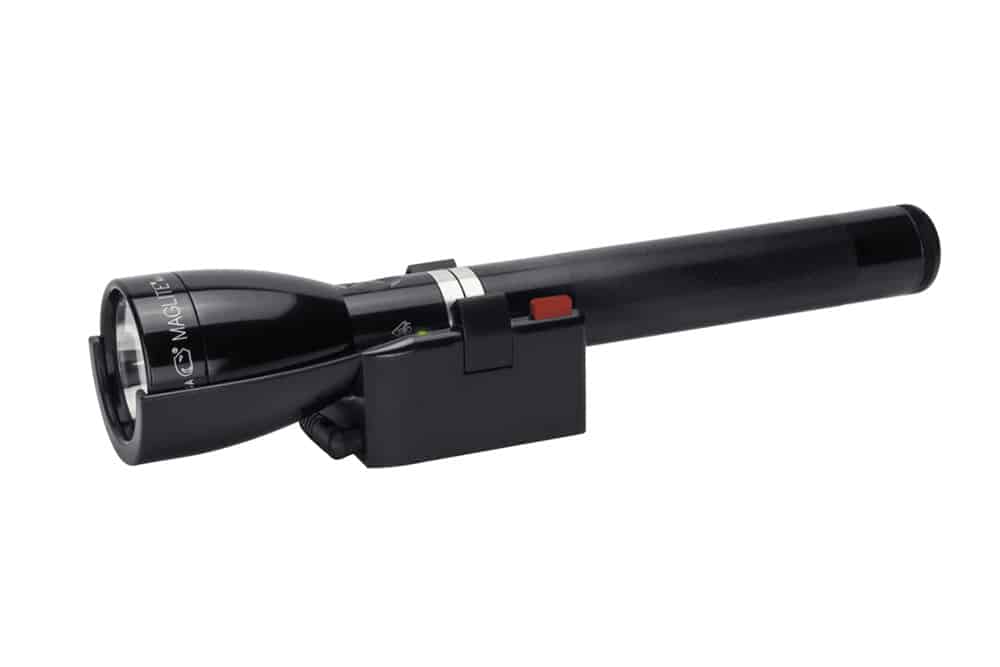
Above: The Maglite ML150LR is available in gloss or matte finish, each with various wall/car/hardwire charging cable configurations. A shorter ML150LRS model is also available for those who prefer a more compact light.
If you grew up in the ’80s or ’90s, you’re probably familiar with the old D-cell and C-cell Maglite flashlights with incandescent bulbs. They were great for their time, but flashlight technology has come a long way since then. Thankfully, Maglite isn’t just resting on its laurels. The ML150LR features a 1,082 lumen LED powered by a LiFeP04 rechargeable battery. It’ll run for 3 hours and 15 minutes in high-output mode, or can be switched to 138-lumen low mode for an 18-hour runtime. There’s also a 25-lumen eco mode that boasts 79 hours of runtime.
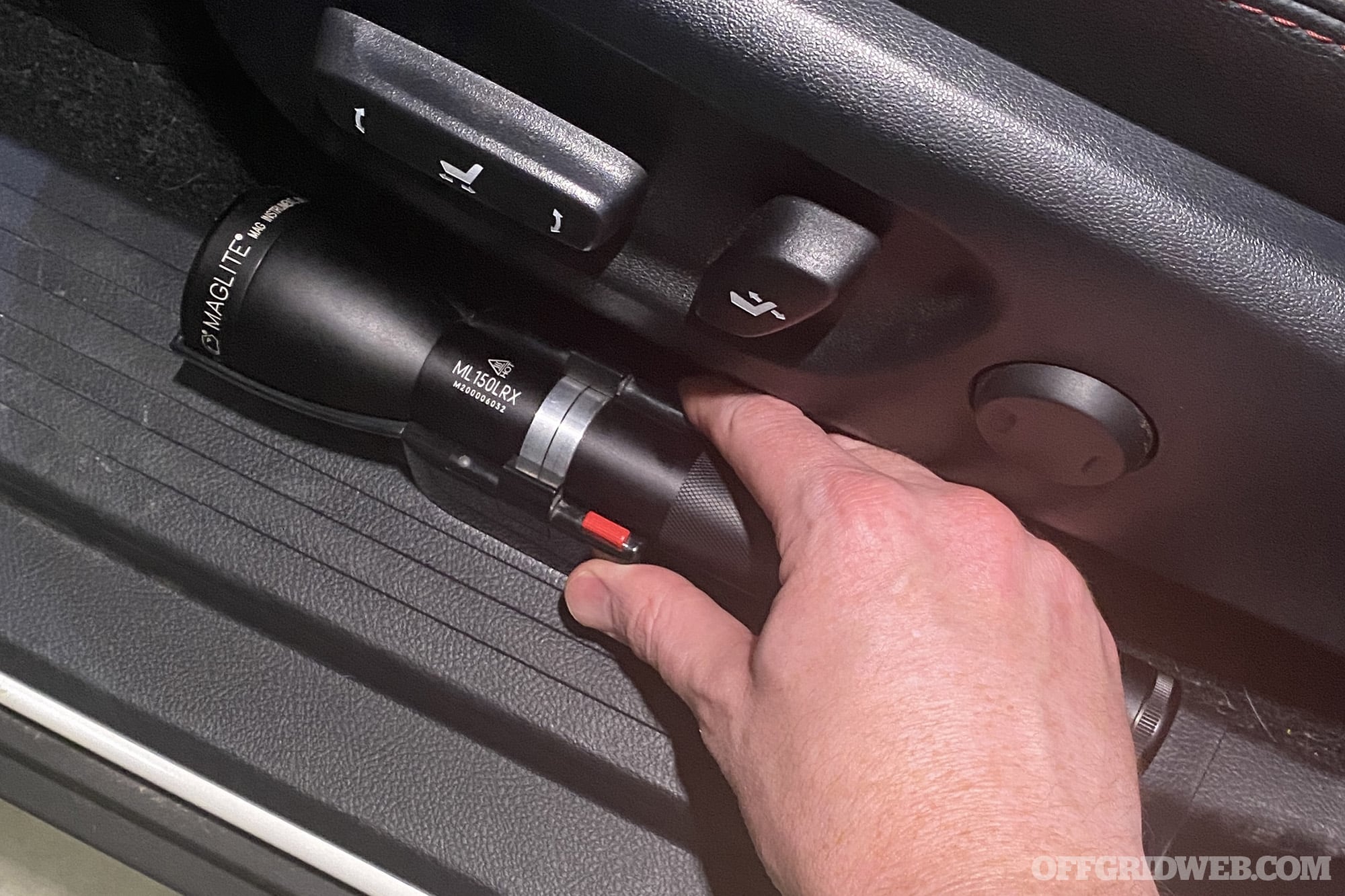
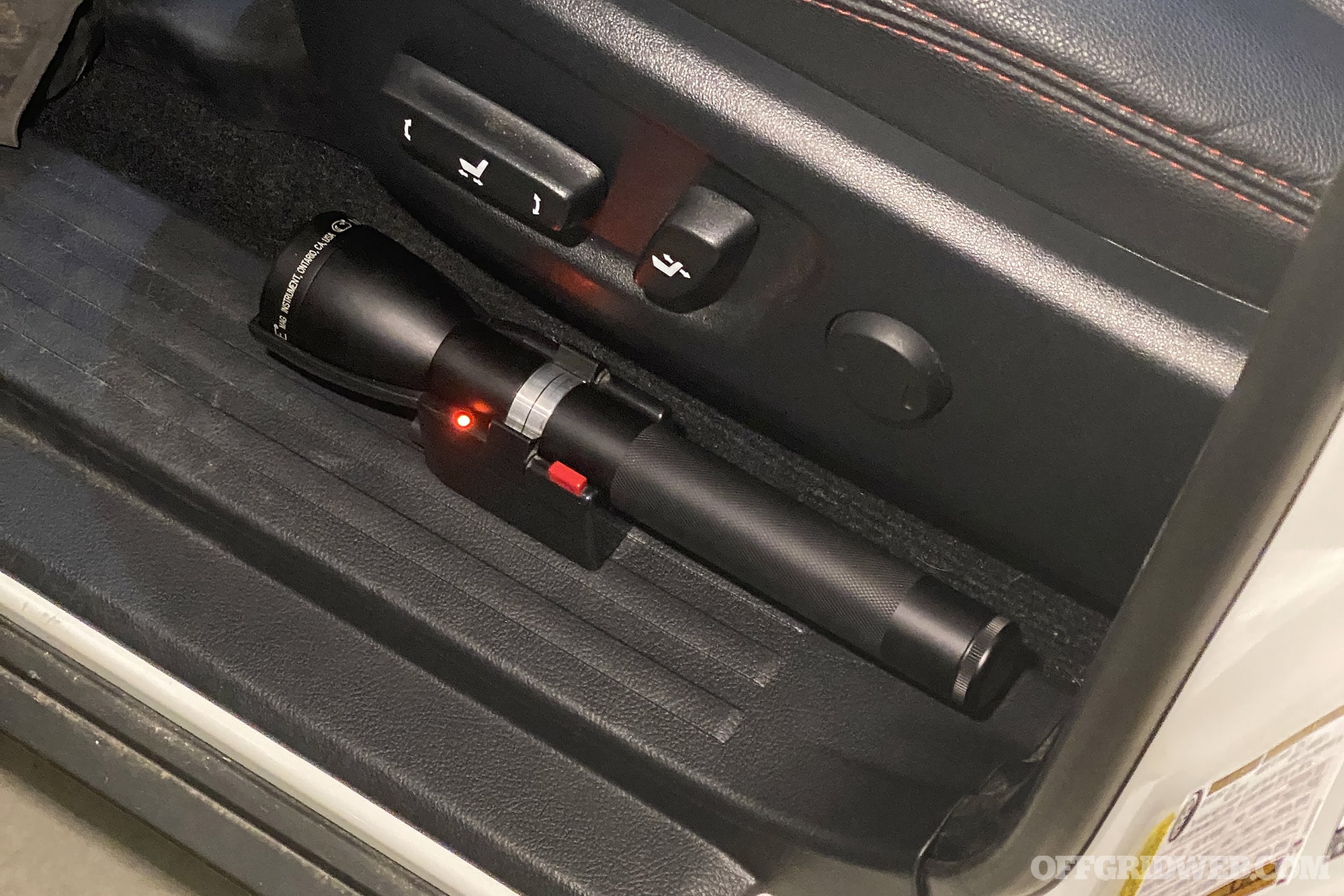
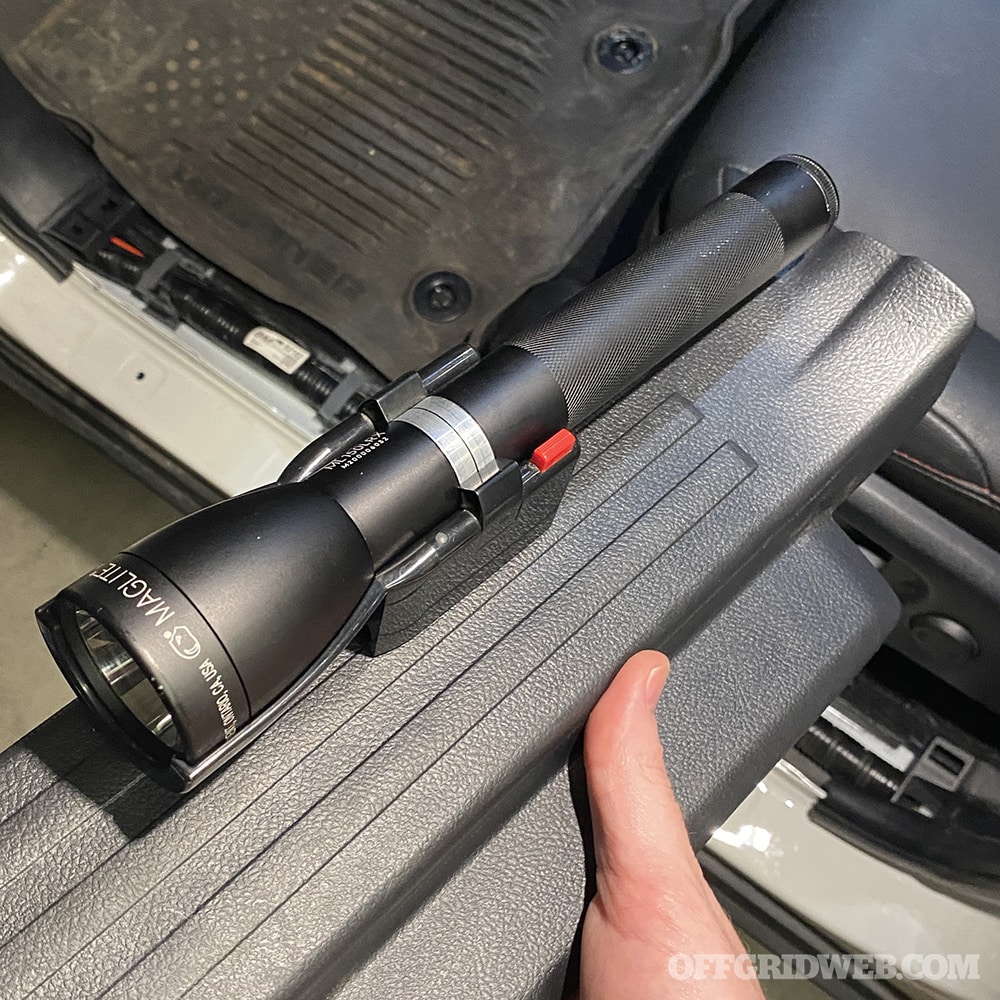
The included charging cradle locks securely around the flashlight when it’s pressed into place, and will only release it if the red release button is pushed. The charger can replenish the battery from 0% to 80% in 30 minutes.
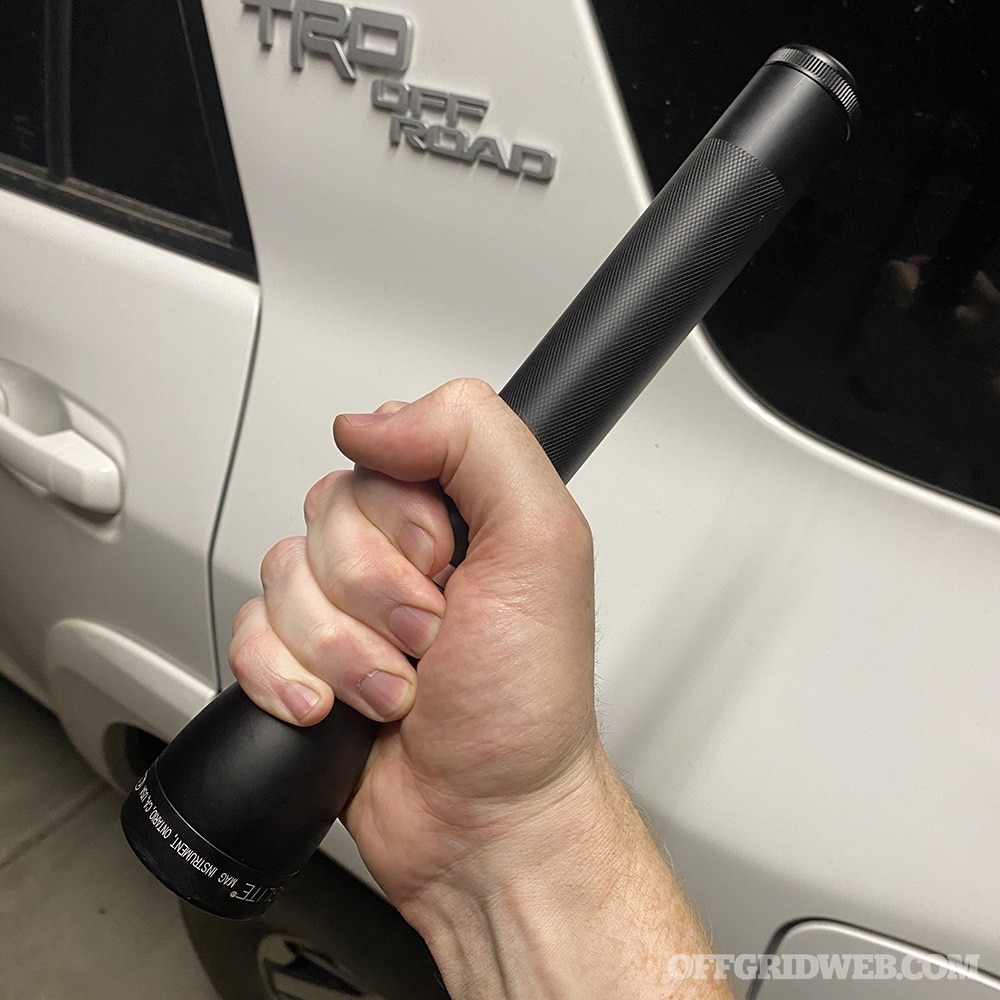
Above: The ML150LR is comparable in size to one of Maglite’s classic 3 C-cell alkaline models. The large size offers extended battery life and allows it to double as an impact tool in a pinch.
The ML150LR can be configured by the user in one of four function sets. Secondary and tertiary functions are accessed by quickly tapping the activation button two or three times.
General — High, low, eco
Outdoor — High, low, strobe (our preferred function set)
Law Enforcement — Momentary, high, eco
Tactical — Momentary, high, strobe
Despite all these modern features, this is still a classic Maglite at its core. It’s constructed from impact-resistant aluminum, it’s IPX4 water resistant, and the head features Maglite’s twist-focus functionality. Maglites are also popular due to their ability to be used as an impact tool, glass breaker, or baton in defensive situations, and the ML150LR seems well-suited to those tasks.
Hardwired Maglite Installation
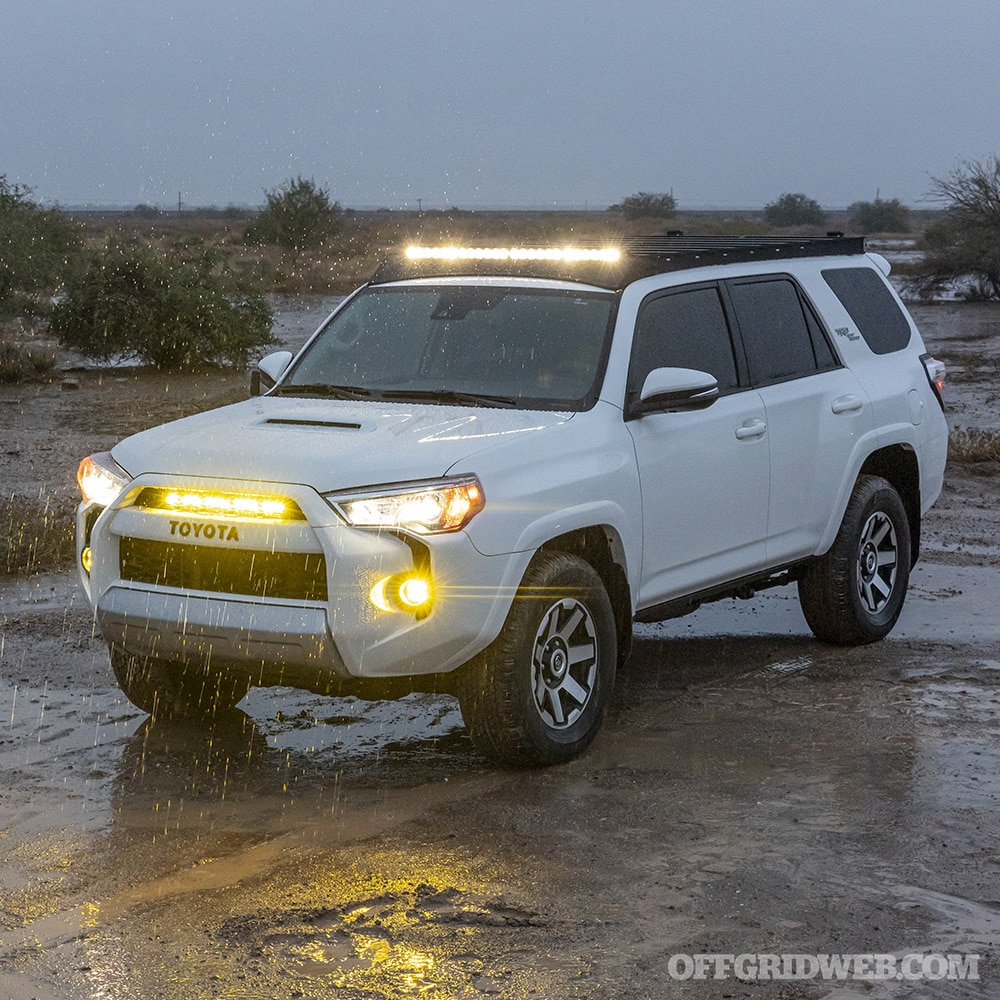
Above: Our 4Runner project truck has plenty of forward-facing and rear-facing Baja Designs lights to illuminate the trail, but there are many situations where we might need to scan out a side window or walk away from the truck. A handheld flashlight is a necessity for these instances.
The first step is to determine where you’re going to mount the hardwired Maglite charging cradle. In our 5th Gen 4Runner, it fit perfectly between the driver’s seat and interior door panel, with about 1/2-inch of clearance on either side. We positioned it carefully and used a pencil to mark the outline of the charger onto the plastic door sill panel. Be sure to check clearance by shutting the door firmly and moving the seat forward/backward — nothing should make contact with the cradle or flashlight.
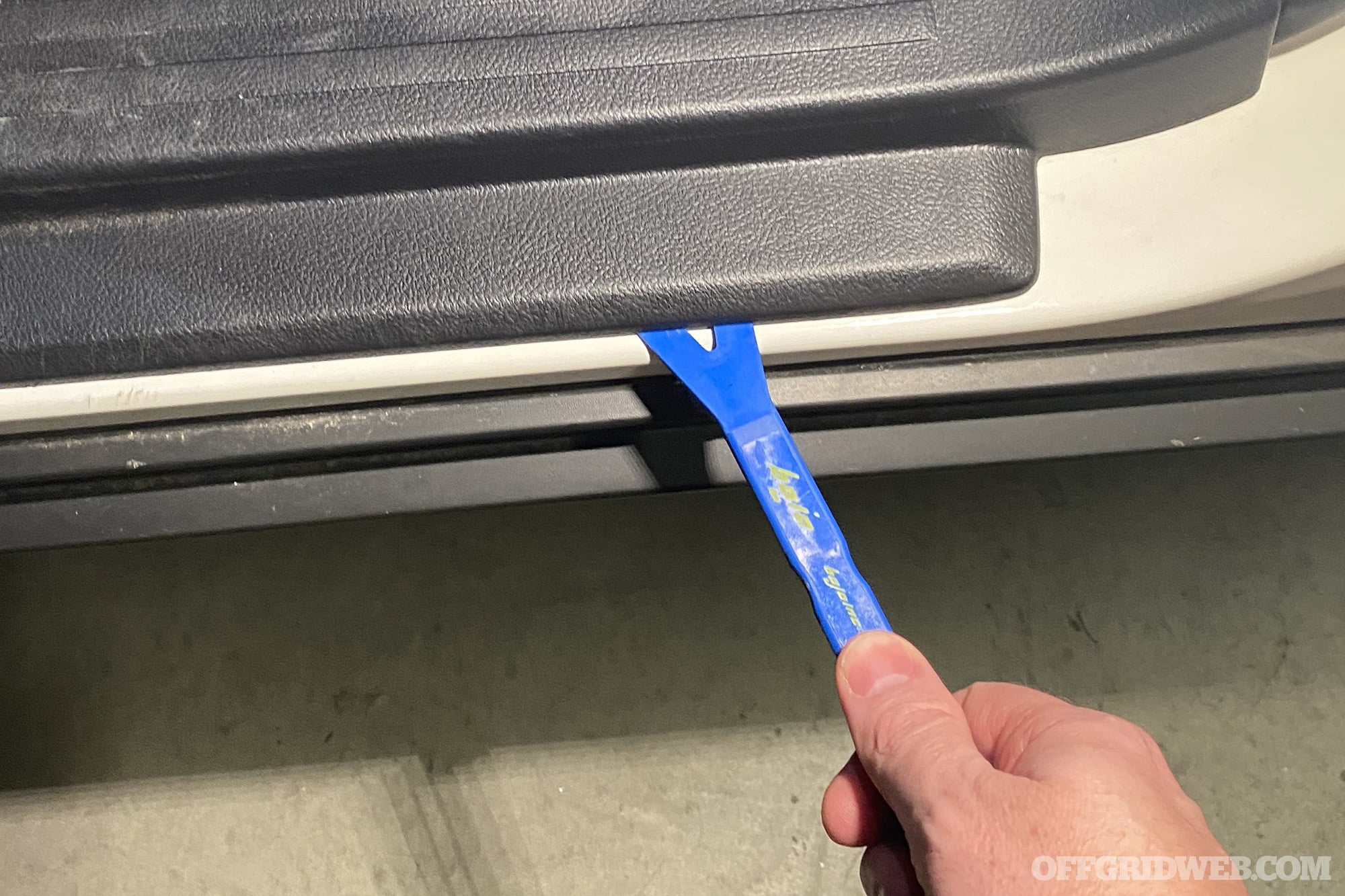
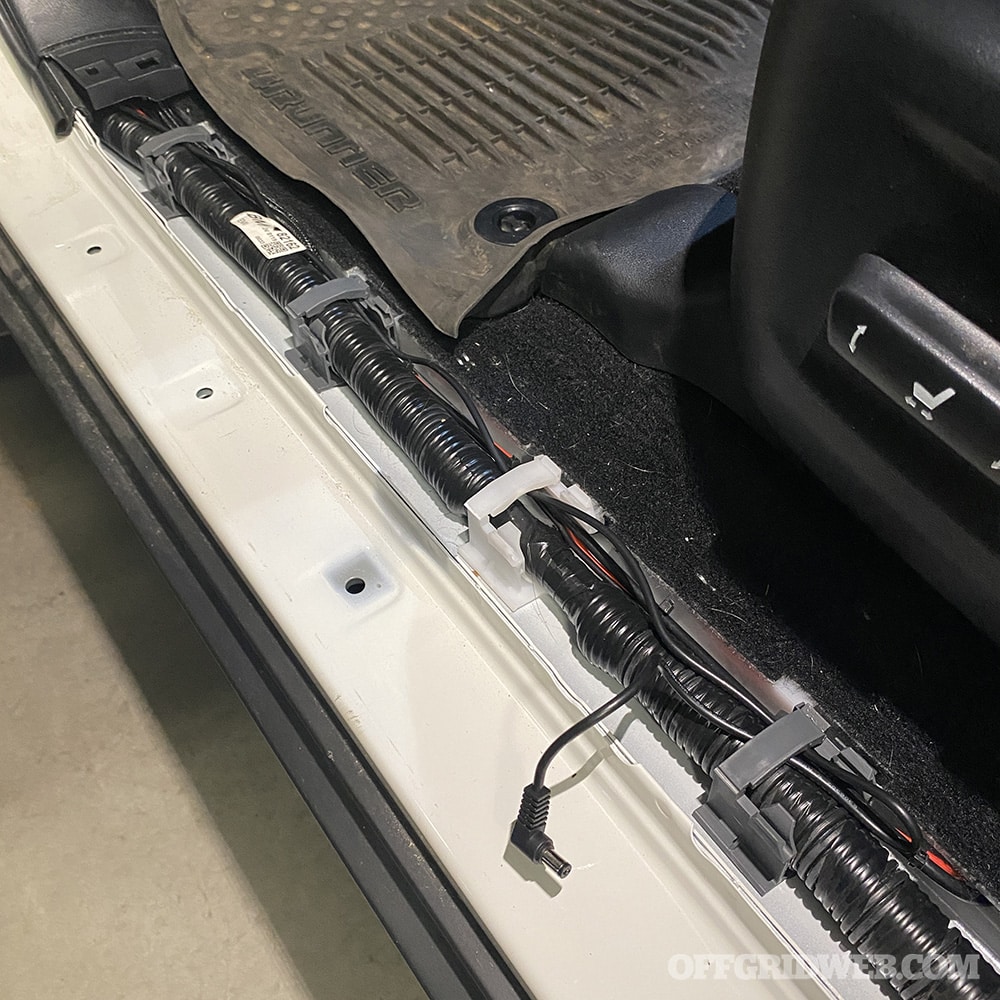
Once you’ve determined the placement of the charger, use a plastic pry tool to gently pry upward around the edges of the sill panel. The clips will pop out without too much effort, revealing a channel with a bunch of wires already running through it. This is where we ran the wires for our hardwired Midland GMRS radio, which is mounted under the driver’s seat.
Place the end of the charging cable next to where the cradle will be installed, then run the other end towards the front of the vehicle and up through the kick panel by the driver’s left foot.
We cannibalized the 12V car charger that came with our Maglite, snipping off the 12V DC plug and stripping the outer sheath to reveal positive and ground wires. If you don’t want to do this, Maglite offers a ML150LR Straight Wire accessory for $17, or you can buy the complete ML150LR package with a straight wire. Either way, you’ll want the positive and ground wires routed up through the driver’s side kick panel.
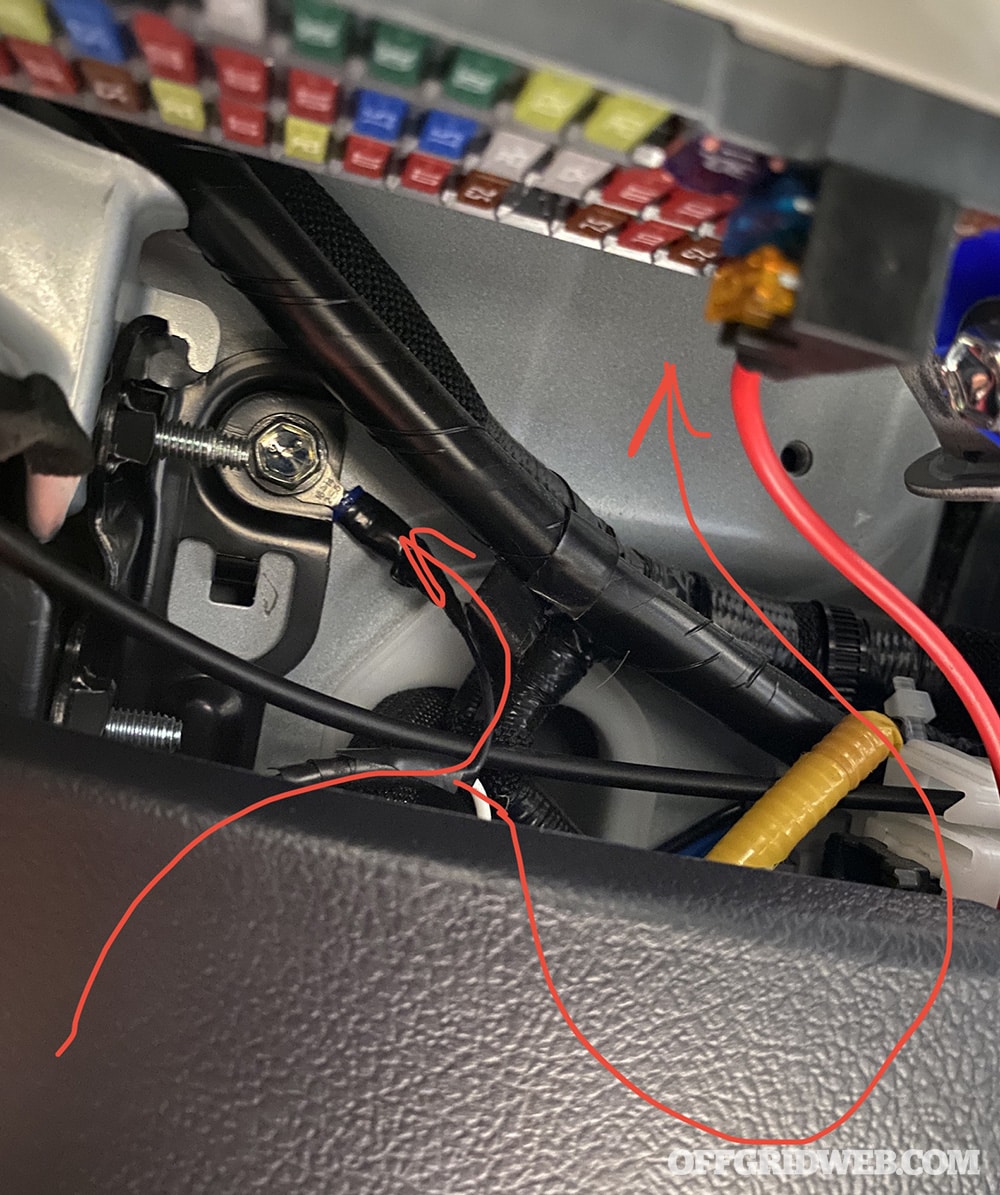
Above: Under the lower left side of the dash, the ground wire (originally bare, now protected by heat shrink and electrical tape) is connected to a grounded bolt via a spade terminal. The positive wire (white) is attached to a fuse tap, which connects to the interior fuse box a few inches away.
The ground wire should be connected to a ground point on your vehicle. We crimped the wire into a spade terminal and placed it under the head of a nearby bolt that attaches directly to the body. It’s important that the bolt isn’t attached to plastic or another insulated surface; bare metal is best for a reliable ground.
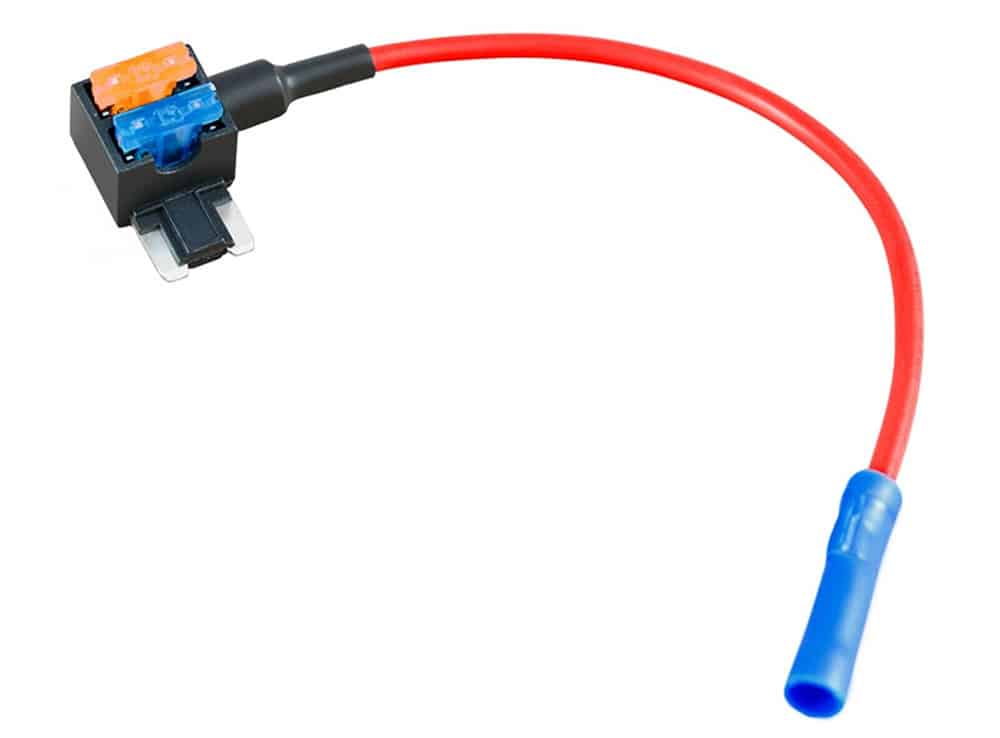
Next, the positive wire should be crimped into a fuse tap, which will be inserted into our 4Runner’s interior fuse box (located under the dash by the driver’s left knee). The fuse tap you use will depend on the type of fuses your vehicle has; our ’22 4Runner required a low profile mini fuse tap.
Above: A low-profile mini fuse tap. The bottom fuse (blue) is the fuse for the original circuit (the one from your fuse box), and the top fuse (orange) is the fuse for your new circuit (the hardwired Maglite).
Which Fuse to Use?
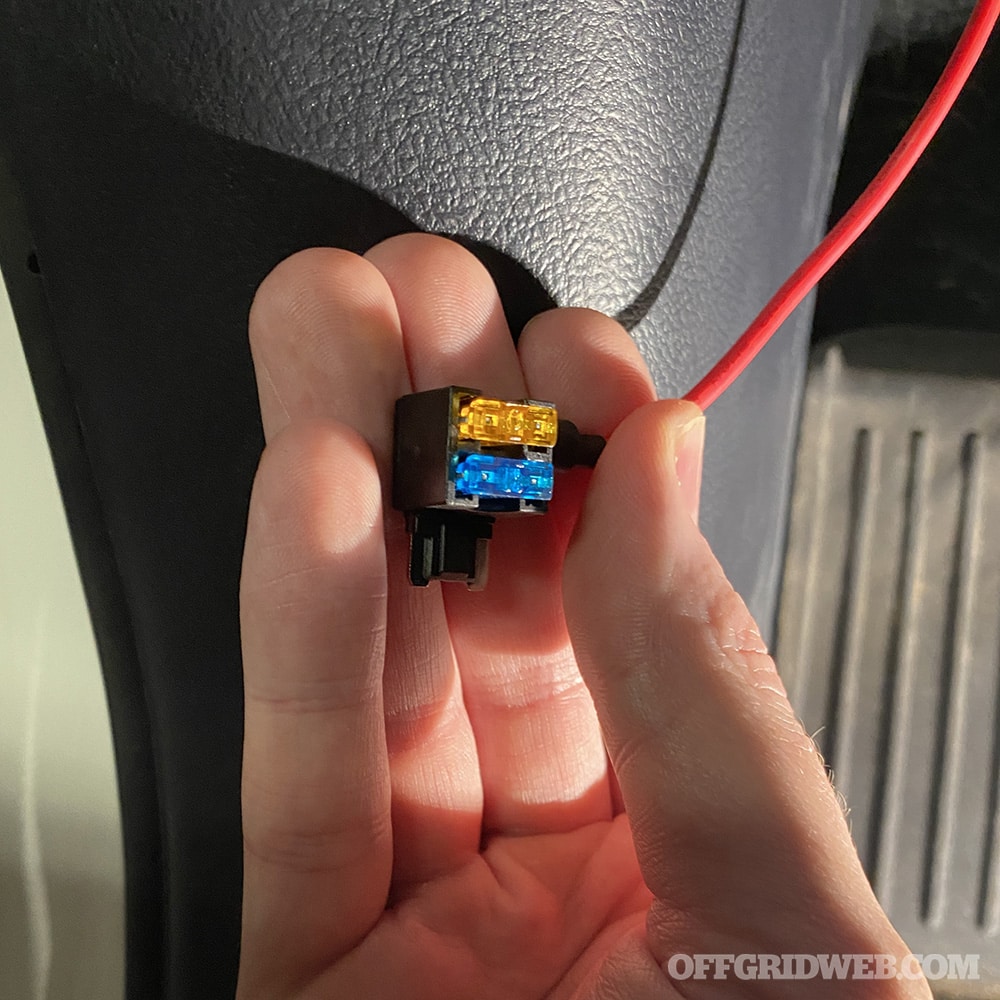
Above: The mini fuse tap with 15A and 5A fuses installed. The order of these fuses does matter, so be sure not to mix them up!
Since we want our Maglite to charge only when the truck’s ignition is turned on, we need to find a fuse for a circuit that gets ignition power. We’d recommend doing a Google search for “[your vehicle year/make/model] ignition fuse tap,” since someone online may have already found an appropriate fuse. If you don’t find the answer, or you want to be extra sure, you should use a test light or a multi-meter to check the circuit. Place the ground probe on the ground bolt, and touch the positive probe to the metal contact point on the fuse in your fuse box. With the vehicle’s ignition turned on, you should see roughly 12 volts; with it turned off, you should see 0 volts.
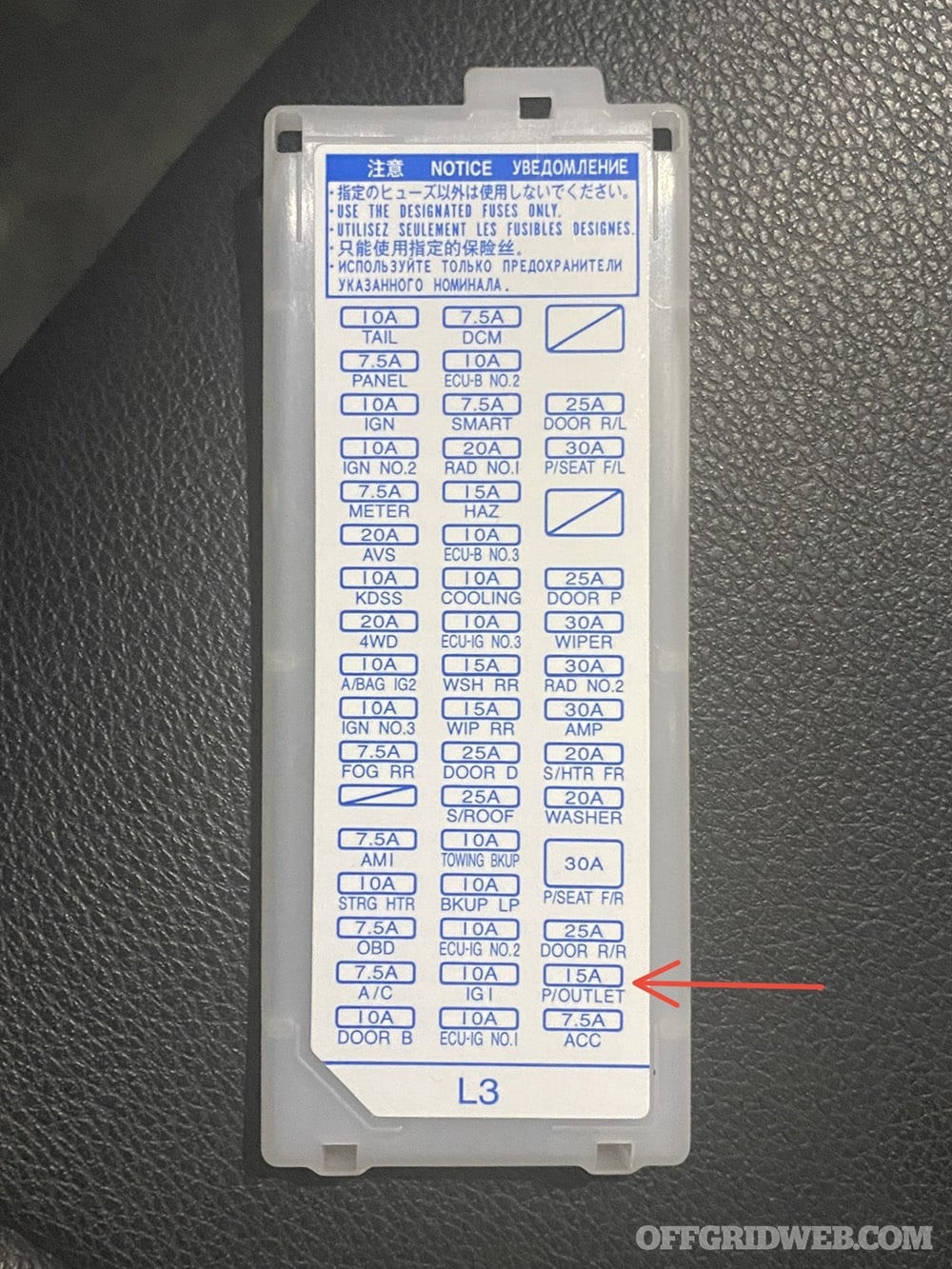
Above: The 2022 4Runner interior fuse box lid shows the amperage and purpose of all fuses. We selected this 15A power outlet fuse, and tested it with a multi-meter to confirm it’s powered by the ignition.
For our 2022 4Runner, we removed the 15A “P/OUTLET’ fuse and placed it in the bottom slot on our fuse tap. Then we added a 5A fuse to the top slot to protect our new Maglite charger circuit, and inserted the fuse tap into the fuse box slot where the 15A P/OUTLET fuse had been. Maglite’s manual recommends a 10A slow-blow fuse installed in-line on the positive wire, but we haven’t had any issues with a standard 5A blade fuse in our fuse tap. Just don’t use a fuse greater than 10A, since that could potentially lead to melted wiring or even a fire if the circuit shorts out.
Above: The orange light on the cradle indicates our ML150LR is between 0% and 80% charged. When it’s between 80% and 100% charged, the light blinks green.
At this point, you should plug in the Maglite charging cradle and turn on the ignition to confirm the charger status light illuminates. If it does, congrats — you’re done with wiring!
Mounting the Cradle
Above: Two 3/4-inch-long hex bolts attach the cradle to the sill panel. Strips of double-sided mounting tape were also used for a secure, vibration-free fit.
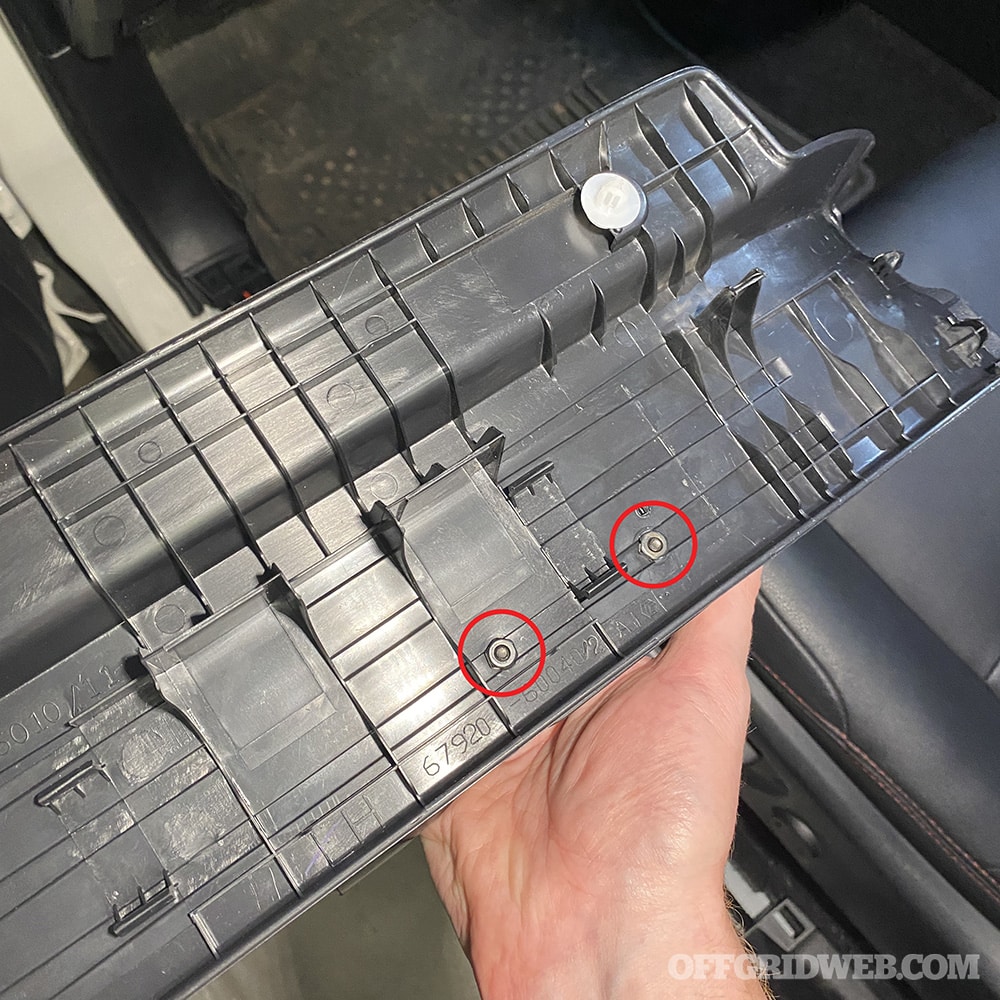
Now that our hardwired Maglite is working properly, it’s time to finish permanently installing the cradle. Using the pencil marks from earlier, we set the Toyota sill panel on our work bench and carefully drilled two holes through it in the appropriate locations. Maglite includes self-tapping screws for this purpose, but we definitely don’t want the sharp tips of those screws anywhere near the sensitive wiring harness that passes under this sill panel. So, we used some 3/4-inch-long #8-32UNC hex bolts and nuts. We also applied strips of 3M heavy-duty mounting tape to the underside of the cradle — this will prevent any noisy plastic-on-plastic vibration as we’re driving.
Once the bolts were tightened and the sill panel was pressed back into place, we stood back and admired our new hardwired Maglite setup. Now we’ll never have to wonder if our flashlight is fully charged or fumble around for it in the dark. It’s always nearby and ready to go.
For more information on the Maglite ML150LR and other duty-grade flashlights, go to Maglite.com.