Making the Cut: Kukri History & Practical Use

Photos by Q Concepts

WARNING: The concepts shown here are for illustrative purposes only. Seek professional training from a reputable instructor before attempting any techniques discussed or shown in this story.

The kukri is an intimidating weapon. With its fat, forward-curving blade, it looks like a dagger on steroids. Whether you’ve seen one in a movie or in the hands of a famed Gurkha soldier, you’ve probably wondered if it’s any more special than a Bowie knife — and you’re probably curious as to how to use it.

Well, guess what? It’s been used as a utility, tactical, and survival tool for generations.

An original hybrid, the kukri (also spelled “khukuri”) is native to Nepal. Some scholars theorize that it originated from the sickle, the knife, and the bent hunting stick. As with any ancient weapon, opinions differ. There’s speculation that the angled blade came from Europe via the Greek kopis or from Egypt by way of the khopesh. Any which way you cut it (pun intended), the forward bend of the blade brings a new “angle” to cutting tools.

Kukri machete blade knife sword tool survival combatives defense 1

Naturally, its distinctive shape caught the attention of the film industry, which has showcased the kukri in movies like Jean Claude Van Damme’s Cyborg and more recent apocalyptic fare like Mad Max: Fury Road. The blade also showed up in Resident Evil: Extinction, in which Milla Jovovich showed off her pair of naked, curvy … um, kukris. Celluloid aside, does the kukri really deserve a place with your survival gear? We say, “Absolutely!”

Having a kukri in your possession makes sense if you’re camping, working in the yard, or caught in a violent encounter (e.g. an armed burglar bashes through your front door). The aggressive blade also makes it a wicked weapon on the battlefield — just ask any Gurkha (see “Gallant Gurkhas” sidebar for more). But more than likely it’ll be used as a tool for more mundane, yet vital, tasks. History shows that it can be used for many utility jobs, and is used daily in the homes and fields of Nepal. So, follow along as we cut through the mystery and mystique of the kukri and show you how it can be a worthy blade to add to your kit.

Anatomy: Parts Unknown

When looking at a kick-ass kukri, comparisons to the common machete is immediate. (See RECOIL OFFGRID Issue 10 for “Get to the Choppa! Machetes Truly Are the Original Survival Multitools”). Handle? Check. Lengthy blade? Check. Thick spine and full tang? Check and check. Bent, forward blade angle that would make a chiropractor faint? Freakin’ un-check. What’s with that bending anyway? It turns out, the angled blade (which typically ranges from 10 to 15 inches), maintains the lightweight maneuverability of a machete, while giving it the chopping power of a hatchet.

The Nepalese multitool: The kurki (center) hacks like a machete, slices like a sickle, chops like a hatchet, and can even be used as an improvised hammer.

The kukri (center) hacks like a machete, slices like a sickle, chops like a hatchet, and can even be used as an...

Traditional kukris also have a notch at the bottom of the blade. This notch (called a cho or kaudi) is said to resemble a cow’s foot or a cow’s teat. Religiously, the kukri should not be used in slaughtering the cow, which is sacred to Hindus. The circular notch also delineates where the sharpened edge stops and helps to drip fluids, like blood, away from the handle.

Two smaller knives — the chakmak and the karda (typically with 2- to 4-inch blades) — are also sheathed with traditional kukris. The chakmak is blunt, used to sharpen and polish the kukri. The sharpened karda is utilized for finer cutting purposes, like whittling or skinning game. The two extra tools are welcome additions to the main blade, especially when far from civilization.

Utility Uses

The kukri’s aggressive design makes it an effective chopping tool and a deadly weapon. Utilize extreme caution when handling. If available, use eye protection. Protecting your eyes from flying debris, especially when hacking and chopping are essential. Sturdy leather gloves are also highly recommended. Also, pay attention to your immediate surroundings. A large kukri can decapitate a buffalo in one swipe. (Yeah, we saw the footage on YouTube.) Any flesh found within the arc of a swing will quickly become separated from its owner.

Kukri machete blade knife sword tool survival combatives defense 5

Chopping
With the angled blade, the kukri can easily split wood like a small axe. We have no delusions of hewing down a sequoia, but for branches used to make shelter, fire, or improvised weapons, the kukri is more than enough. (See RECOIL OFFGRID’s Winter 2015 article titled “Improvise to Survive” on the art of building effective makeshift weapons.) To become a master hacker, keep a relaxed arm with a firm grip, and drop your body weight into the chops to maximize leverage, making contact with the top third of blade.

Be extra careful at the end of your swing (the deceleration phase). The forward angle of the kukri’s blade will place the edge a few inches ahead of where you would expect, especially if you’re used to swinging a straighter edge, like a machete.

Kukri machete blade knife sword tool survival combatives defense 6

Batoning
Not looking to create a path of lumber destruction? There are times when splitting wood requires more finesse and precision. This is where batoning comes in. Finer duties — such as making kindling, animal traps, notches, and shelter — are reasons enough to learn this skill. Kukris are known for their thick spine and will stand up to the abuse of batoning. Simply position your kukri on the wood. Make sure several inches of the blade is sticking out from the wood. Hammer away with a sturdy stick (AKA baton) on the spine of the kukri. (See RECOIL OFFGRID Issue 10 for “Firewood Fundamentals,” a feature on how to baton wood with a knife.)

Kukri machete blade knife sword tool survival combatives defense 3

Brush Clearing
A kukri will come in handy when you’re in the thick of it — from trimming trees in the yard to clearing a path in dense brush. It’s light enough to maneuver in confined areas, while the cut is assisted by the blade’s forward mass. We cannot emphasize safety enough during chopping and slashing with the anterior offset of the blade. Keep your limbs and those of your companions out of the kukri’s path.

Hammering
The butt cap or spine of the kukri’s blade can act as a hammer for light-duty pounding. Driving in a tent stake, breaking open a window, or cracking the skull of a two-legged predator is no sweat for the kukri. When hammering with the spine of the blade, be extremely careful because the tip and the edge will be pointed toward you.

Shoveling: While you cannot dig a well using the blade of a kukri, you can use it for simpler jobs like digging a fire pit. With your dominant hand, grip the handle and use your nondominant hand to grip the lower spine of the blade and dig away. Make sure your fingers are nowhere near the edge.

Kukri machete blade knife sword tool survival combatives defense 7

Sickling
Some researchers claim that the kukri’s shape descended from the sickle; thus cutting grain, grass, or weeds with the curved blade is a no-brainer. To use the kukri as a sickle, simply grab the grass (or other vegetation) with your nondominant and pull up, making the grass taut. Make sure there’s plenty of space between your support hand and the base of the grass, where the cut takes place. Take the kukri, using the bottom half of the blade (the convex part), and pull from left to right (if you’re right handed). Make sure to keep your legs and fingers away from the blade at all times, or else you’ll end up harvesting your own body parts. Now you have a bundle of grass to feed your horse, use for kindling, or lay down as bedding for the night.

Kukri Combatives

During a violent encounter, having a kukri in your hand will quickly help transform your bushcraft skills into bushwacker skills. Using this tool during a life-or-death encounter can give you an edge (yes, pun intended!). The forward angle of the blade will produce deadly hacks, with the potential for severing limbs.

Gripping
When you or your loved ones are in danger, grip the kukri like your life depends on it. We mean a death grip, as if you were in the middle of the ocean holding onto a flotation device. Your wrist can be mobile, but there’s no compromise on the grip. And no fancy spinning because if you drop your kukri — or any weapon for that matter —
during a confrontation, you may end up dead.

Meeting the Force
When attacked by a short-range weapon, like a fist, knife, machete, or club, move your body out of the way of the attack (so you don’t die!), and retaliate with a cut to the offending limb. When performing this counter (often called “tenderizing” in pentjak silat, a bladed art from Indonesia), you can use your kukri to either “meet the force” or “follow the force.”
With blades, meeting the force means cutting at the limb that’s attacking you. If done correctly, one strike will end the fight. A large amount of force is produced because two incoming objects crash together from opposing sides, similar to a head-on car collision. Be prepared to follow-up, because one counterstrike may not be enough.

Example A
Michael Guadamuz raises his bat to pound Conrad Bui into the pavement. Bui immediately steps in at a 45-degree angle and meets the force of the attack with his kukri (and his left arm as backup). Guadamuz drops the bat as kukri and flesh collide. Bui is prepared to follow up, if the need arise.

Example B
The author sees Michael Guadamuz coming. Conrad Bui purposely sticks his head out and Guadamuz takes the bait by swinging for his head. Bui immediately moves his head and body out of the way while delivering a counterstrike.

Example C
With his hands low, Conrad Bui is out of position to “meet” Michael Guadamuz’s strike. So, he immediately moves his head and body out of the line of fire and follows the force of the hammer attack. Because it isn’t enough damage to get the bad guy to stop his attack, Bui has no choice but to follow-up.

Following the Force
Because a fight is unpredictable, there will be times when the kukri is used to “follow” behind the force of an incoming attack. The counterstrike of following the force is utilized to change the trajectory of the attacker’s strike, while damaging the attacker. The damage will not be as severe as meeting the force. This is similar to a rear-end collision. When both cars are moving, the rear car can “bump” the forward car off course, with less force than a head-on collision.

To execute this counterattack, move out of harms way, and swing your kukri behind the attacker’s arm or hand.

Following the force is generally used as a “Plan B,” when you find yourself out of position and unable to counter by meeting the force. This can happen anytime you first draw your weapon, when you’re caught unaware, or if you miss a strike. If and when this happens, just continue to use the force, young Skywalker.

Move It!
Footwork and mobility is crucial during close-quarter combatives, and silat provides a good lesson on the “when” and “whys” of mobility. Sun Tzu, the great military strategist, said it best: “Mobility is better than fortification.” Your feet will allow you to move out of harm’s way, position you in range for a counterstrike, or help you make like a tree and leave.

When armed with a kukri, do you want to step forward or backward to tenderize the attacker’s limbs?

When your attacker is armed with a weapon that has a longer reach, distance is not your friend but rather an ally of the attacker. Your odds of surviving will be improved on the inside. If a weapon is longer than the kukri (like a baseball bat or pool cue) and you see the attacker loading up for a strike, rush forward at a 45-degree angle, moving inside the arc of the weapon immediately. With any luck you’ll avoid getting nailed by the weapon, and even if you do, the damage will not be as great as if you were on the arc of the attack.

If your opponent is armed with a weapon of similar length or shorter, stepping back at a 45-degree angle, out of range just enough to where you can chop the hand or wrist of the bad guy, will be your best bet. Distance just did a 180 and is now our friend since your kukri is just as long or longer than the weapon of your opponent. The step back will move your head and torso away from the danger, while keeping you in range for the counterstrike.

A Cut Above

Kukri buyers guide review Nepal gurkha knife blade sword steel tool 29

Using the kukri as a tool or weapon requires the proper training and practice. The techniques in this article are a good place to start, and we encourage you to find a qualified teacher for proper training of both the bushcraft skills and the combatives. The investment will be worth it. As exotic as it looks, the kukri deserves a place (or at least serious consideration) with the rest of your equipment. The crazy, crooked multitool is angled to save the day, when the need arises.

Kukri Trainer

Kukri machete blade knife sword tool survival combatives defense 21

To become proficient in using the kukri as a weapon, a training blade is highly vital. Just like a blue gun for firearms, a blunt trainer allows participants to practice safely alone and with partners. Steve Rollert of Keen Edge Knives makes excellent kukri trainers, along with many other types. His high-quality training knives have been used by police, military, and martial artists all over the world. His aluminum kukris have a cord-wrapped handle and come in two sizes: 17¾ inches and 16 inches. www.keenedgeknives.com

Gallant Gurkhas

When discussing the kukri, you cannot help but mention the deadly Gurkha soldiers of Nepal. Some even go so far as to call the kukri a “Gurkha knife.” The Gurkhas (or Gorkhas) are known for their small stature, ferociousness in combat, and big blades. Their legendary status in the West as courageous warriors came about during their service with the British starting back in 1815. The English chaps immediately saw value in the Himalayan troops when Britain failed to annex Nepal as part of their empire. To this day the Gurkas still take a licking and keep on kicking.

Kukri machete blade knife sword tool survival combatives defense 2

Just how badass are these soldiers? During WWII, Bhanbhagta Gurung, a rifleman for the Gurkhas, saw his buddies getting picked off by a sniper. Not able to get a clean shot from cover, Gurung calmly stood up and eliminated the threat despite heavy enemy fire. That same day while advancing, his battalion again met heavy resistance. Gurung immediately advanced forward, clearing out four separate foxholes with his grenades and a bayonet. He flung his two remaining smoke grenades into a bunker and, using his kukri, took down two Japanese soldiers who ran out. Running into the bunker, Gurung quickly dispatched the remaining soldier. What is more surprising, Gurung was under fire the entire time. For his bravery, he was awarded the Victoria Cross, the highest British military decoration for bravery.

More recently in 2010, while on sentry duty in Afghanistan, Sergeant Dipprasad Pun was attacked from all sides by more than 30 Taliban fighters armed with RPGs and AK-47s. Pun expended more than 400 rounds of ammo, 17 grenades, and a mine — and used his machinegun tripod to beat an intruder climbing over the compound wall. When the smoke settled, Pun singlehandedly fought off the attackers in under an hour. Like Gurung, Pun was also honored with the Victoria Cross for his bravery.

Gurkhas have proven their bravery and effectiveness, time and time again. What makes them so deadly? It may be the high altitude they’re raised in. It may be the deadly kukri they carry. Or possibly their belief that it’s “Better to die than to live a coward.”

About the Author

TMA Sport Side Kick.JPG

A San Francisco-based chiropractor, Dr. Conrad Bui has over 30 years of continuous martial arts experience. He is a certified instructor in six different martial arts systems including silat, a bladed art from Indonesia. In his spare time, he contributes to RECOIL OFFGRID and spends time in the outdoors with his family.

More From Issue 14

Don’t miss essential survival insights—sign up for Recoil Offgrid’s free newsletter today.

Read articles from the next issue of Recoil Offgrid: Issue 15

Read articles from the previous issue of Recoil Offgrid: Issue 13

Editor’s Note: This article has been modified from its original print version for the web.


Video: Twisting Char Cloth Fire Starters

Knowing that fire-starting is an essential survival skill, most of us have multiple tools for igniting a flame — lighters, matches, ferro rods, and so on. However, even with a powerful blowtorch you’ll struggle to get a fire going if you lack access to highly-combustible tinder. Your tinder material is the substance that bridges the gap between an initial spark or small flame and a healthy roaring campfire.

Char cloth cotton fabric fire starter cord rope twist tinder wood 2

Char cloth is one of our favorite man-made tinder materials, since it’s easy to ignite, easy to make, and a great way of re-purposing old T-shirts and scraps of fabric. Rather than burning energetically, it smolders and glows with enough persistent heat to ignite wood shavings or dry grass.

Char cloth fire starters 16

Unfortunately, normal squares or strips of char cloth will only last for a short period, and produce a relatively small area of embers. This can make it tougher to ignite more stubborn materials such as damp wood. In the following video, bushcraft YouTuber NW Primate shows how he used twisted strips of cotton to create a denser char cloth bundle with a stronger ember.

In the video description, NW Primate provides some more information on potential issues with this char cloth technique:

As with anything, there are some downsides to this method. On advantage to using flat sheets of cloth is that they sit so nicely on a flat stone, where these pieces of char require a bit more finesse to hold in place without crumbling them. The final product is a bit brittle, so you may find conventional char cloth easier to use during the sparking stage.

Char cloth cotton fabric fire starter cord rope twist tinder wood 4

This method also uses quite a bit of material, although I only twisted one of the strands that I cut; but if you were in a situation where you were cutting your only t-shirt; it might make more sense to be more efficient and use small squares to conserve the material.

100% cotton from an old T-shirt makes a great source for cloth to char.

100% cotton from an old T-shirt makes a great source for cloth to char.

For more instructional videos on fire-starting, knife work, and other bushcraft skills, check out the NW Primate YouTube channel.


Putting Waste to Work with Backyard Composting

Mother Nature has a way of taking things back, whether it takes months or millennia. This inevitable process is known as decomposition— in layman’s terms, this is when organic matter rots, decays, or breaks down into simpler compounds. For the prepared, decomposition processes can be a valuable tool for waste management and soil enrichment — this is commonly known as composting. Today, we’ll look at a few rules to speed the process up and some ways to incorporate a compost heap into your prepping strategy.

Composting survival backyard gardening soil planting fruits vegetables fertilizer food 9

As much as we may try, food waste is inevitable. Whether it’s that head of lettuce you forgot in the back of the fridge or garden scraps, something always ends up in the trash. Using these scraps toward a compost pile helps keep them out of the trash and turns them into incredibly-beneficial soil amendments. Leaves falling from trees will decay over time and help the soil below, but the process can take months or even years. That may not be a problem in the middle of a forest, but those of us with limited space and time can make the process go much faster.

What Goes In…

The best way to think about items going into your compost pile is to separate them into “browns” and “greens”. Browns are your sources of carbon. These includes things like dry leaves, shredded paper, and wood shavings/dust. Greens are sources of nitrogen. These are grass clippings, fruit and vegetable scraps, and manure.

Keeping your additions to the pile cut into chunks in the range of ¼” to 2” will help them decompose faster by increasing the surface area without limiting aerobic activity.

Composting survival backyard gardening soil planting fruits vegetables fertilizer food 7

Above: A helpful guide to items that will make effective additions to your compost heap, and those that could be problematic or dangerous. (Source: Idaho Master Gardener Handbook / NRAES-43)

Ideally you want to create an environment with a 25:1 carbon-to-nitrogen (C/N) ratio. This translates to approximately 2 or 3 parts green to every 1 part brown. However, there’s a spectrum ranging from strong greens like fresh manure (7:1 C/N ratio), to weak greens like coffee grounds (25:1), to weak browns like hay (90:1), to strong browns like wood chips (700:1). Too many items from either extreme will skew your C/N ratio and cause problems, which we’ll discuss later in this article.

Microorganisms are doing the work in your compost by breaking down the materials. They will “eat” sugars and proteins first for energy and then feast on more woody materials. Keeping the ratio even will aid the microorganisms in their job.

This pile has too many greens. Browns should be added to correct the ratio.

This pile has too many greens. Browns should be added to correct the ratio.

Keeping your heap moist is important for a healthy decomposition. If compost becomes too dry the process slows dramatically; too much water and a similar problem occurs. Lack of water is a very common problem in arid environments with little rain. Adding water often to keep the pile uniformly moist while also turning it is paramount for success. To check the moisture level of your pile use a simple squeeze test — grab a handful of compost and squeeze it in your hand. If water drips out you are over-watered, if it stays clumped together and is damp you are just right, if it is dry and crumbles apart, add water.

Moist material stays clumped and is not excessively wet.

Moist material stays clumped and is not excessively wet.

Methods

Pile: Composting can be as simple as a pile of twigs, leaves, and scraps in the middle of your yard. Adding the right materials, in the right amounts and turning them frequently with a pitchfork will ensure success.

Fences: Piles can be supplemented with walls such as readily available pallets or other wood structures. These allow the heap to be controlled and easily layered without spreading around too much. These are simple to build and only require three sides to be closed off. Leaving the front exposed for you to work in makes these a very attractive option.

A simple pallet compost pile.

A simple pallet compost pile.

Wire Units: With readily-available chicken wire or similar materials making a cylinder and piling materials inside will create an effective structure for composting.

In-Ground Method: Another simple method for composting is to dig a large trench or hole in the ground (or use an existing one such as a removed tree stump) and fill with your material. This method allows microorganisms in the hole to easily access the new material and begin to break it down.

The author's experience with these types of bins is that they are difficult to keep moist and monitor for proper progress.

In our experience, these types of bins are difficult to keep moist and monitor for progress.

No matter which method you choose it is best to keep the pile’s footprint to roughly 3’x3’ to 5’x5’. This size is large enough to allow the pile to heat up properly. Having multiple piles is also beneficial to allow materials to break down over time and be able to continuously add to them.

Temperature

Unstructured piles are less efficient. This one needs more green items, water, and aeration.

Unstructured piles are less efficient. This one needs more green items, water, and aeration.

Your compost pile must reach a specific temperature in order for the microorganisms to really get to work. The ideal temperature is between 125°F and 140°F. If you have maintained the correct brown-to-green ratio and the pile is of adequate size, reaching these temperatures inside the pile should not be a problem.

Testing the core temperature inside the pile is easier than taking a human’s temperature. Simply use a long thermometer and insert it into the middle. Obviously weather and seasons play a factor but generally during normal summer temperatures you can hit the mark.

Troubleshooting

Problems can arise with compost piles but the end result will be the same. It all depends on time and quality. The two most common problems, although not the only two, are odor and slow decomposition.

Starter and fortifier can help a slow going pile.

Starter and fortifier can help encourage a slow-going pile.

Odor problems generally stem from excess moisture or an inaccurate ratio of greens and browns. An overly wet pile will smell rotten and can easily be corrected by turning the pile and mixing materials to soak up the water. An ammonia odor is associated with too much nitrogen. Mixing in carbon-rich brown materials such as leaves and pine needles will allow the pile to right itself.

Another problem that can occur are pests such as flies, rodents, and other critters being attracted to your pile. These usually persist when food scraps are not properly mixed in with brown materials. The typical suggestion is to bury these types of greens 6-10” below the surface inside the pile.

Conclusions

Compost piles can provide the maker with greatly-improved soil. Compost can be used for simple things like top dressing a yard to improve soil health or sowed directly into a garden to improve soil nutrients. Being able to recycle your food scraps and turn them into a quality product is beneficial and keeps waste and pests down creating a cleaner and healthier environment.

Coffee grounds, egg shells, and fruit are great for compost.

Coffee grounds, egg shells, and fruit scraps are great for compost.

Whether you’re looking to live a fully-sustainable off-grid lifestyle or simply trying to reduce your family’s grocery store and garden center bills, composting is a worthwhile endeavor. Rich composted soil will decrease your reliance on curb-side garbage pickup and help your backyard garden thrive.

Looking to learn more about how home gardening can factor into your survival plans? Check out our review of 6 Gardening Books for Your SHTF Library.

About the Author

Alexander Crown OFFGRIDweb author photo

Alexander Crown served as an Infantryman with the Scout/Sniper Platoon of the 3rd Battalion, 509th Parachute Infantry Regiment in Ft. Richardson, Alaska, where he specialized in radio communications and reconnaissance. Since separating, Alexander spends his time as an avid outdoorsman and hunter with an appreciation for self-sufficiency in the form of gardening. He also enjoys woodworking, firearms, and reloading. You can follow him on Instagram @acrown509.


Video: Constructing an Easy Square Tarp Shelter

We all know that shelter is one of the top priorities in any survival situation — in many cases, it is the top priority. Although it’s possible to build a shelter entirely from natural materials, this requires substantial time and effort (and usually a whole lot of chopping wood). Carrying a tarp greatly simplifies the shelter construction process since it provides durable protection from wind, rain, and harsh sun. With a tarp, some paracord, and a little practice, you can build and dismantle an effective shelter in minutes.

In the following video, Lonnie of Far North Bushcraft and Survival shows how to construct a simple shelter using a large square tarp. This design is big enough to stand under, and provides three-sided protection from the elements. Better yet, it can be rigged on a ridgeline between two trees or in a free-standing design on poles.

If you’re taking stock of your gear, here’s all you’ll need:

  • Large waterproof tarp with grommets (Lonnie uses a 12’x12′ tarp)
  • For ridgeline setup: 25+ feet of paracord or rope, two paracord loops with small carabiners, 4 stakes
  • For free-standing setup: two 6-foot poles, two 15-foot guy lines, 8 stakes
  • Additional stake and guy line for porch overhang (optional)

Square tarp shelter paracord knot guy line grommet cordage 3

Above: A prusik knot and carabiner can be used to quickly rig the tarp to the ridgeline.

Lonnie states that if your tarp doesn’t have grommets, you’ll need to add them yourself, but it’s also possible to improvise a tie-out point. The classic backpacker’s trick is to place a small stone on the inside of your tarp and bunch the tarp around it to form a pouch. Then, from the outside of the tarp, tie a secure knot around that pouch to attach your guy line to the tarp (as pictured below).

An improvised tie-out point for a tarp. Source: REI.com

An improvised tie-out point for a tarp. Source: REI.com


Practical Prepping from an Insurer’s Perspective

The concept of prepping is often viewed with disdain by the general public, and there seems to be an unfortunate perception that it’s only for paranoid bunker-dwelling types. As a result, we’ve had countless conversations with friends, family, and even members of the outdoor industry who have insinuated that we must be a little weird to take emergency preparedness so seriously.

At the recent Outdoor Retailer show in Denver, our emphasis on prepping was met with resistance.

At the recent Outdoor Retailer show in Denver, our emphasis on prepping was often met with resistance.

Although we don’t do what we do for the approval of others, it’s nice to occasionally get some public vindication from mainstream sources. One recent and memorable example was the Medium article “The Surprisingly Solid Mathematical Case of the Tin Foil Hat Gun Prepper” — while the “tin foil” title is sensationalized, the content within is impressively compelling. And most importantly, it’s approachable to those outside the prepping community.

Photo via USAA

Photo courtesy of USAA

We recently read an article published by USAA, titled “How Much Disaster Prep Should I Do In A “Safe” Zone?”. It comes as no surprise that an insurance provider — especially one closely tied to the military — would emphasize the value of preparedness, but we were pleasantly surprised to find the details of the article went beyond simply updating your policy. Check out some excerpts from the article:

Maybe your family constantly hears “Better safe than sorry” and “Be prepared” whenever you’re around. That’s a good thing, says Matthew Angel, a USAA advice director and Certified Financial Planner practitioner.

“Lots of people don’t think about prepping for a disaster until after the disaster strikes,” he says. … “So if you’re already thinking about protecting your home and family before they’re in jeopardy, you’re on the right track.”

Angel notes that recent weather events have demonstrated that nature’s ferocity can be unleashed in areas where it wasn’t expected or with unexpected intensity. While Houston, due to its location, has seen its share of hurricanes and floods through the years, few anticipated a storm like Harvey, which dumped trillions of gallons of rain in a matter of days, inundating homes in areas thought to be at low risk for flooding.

“You should widen your thought about what could happen where you live,” he says.

You don’t have to live in Tornado Alley or along a major geological fault line to have a plan for surviving and riding out a disaster. It’s prudent to have an emergency plan and an emergency kit in place no matter where you live, because even if you’re at low risk for a hurricane or earthquake, events like house fires and power outages can happen anywhere.

You can read the full article from USAA here. Next time someone implies you’re paranoid for taking steps to be better prepared for emergencies, articles like this one can provide some ammunition for that discussion.


New: Leatherman Coyote Tan Cerakote Tools

At the end of the day, what matters most about any tool is how it functions. However, most of us also give some consideration to the appearance of our tools. Alternate metal coatings and handle finishes can help your every-day carry items better fit your style, and can also provide a more durable barrier against scratches and corrosion.

Leatherman recently announced the ongoing expansion of its Coyote Tan lineup, which now includes more of the company’s most popular multi-tool models. These models feature a black DLC finish on the pliers, blades, tools, and hardware, along with a Coyote Tan Cerakote finish applied to the handles. The two-tone color combo is available on the following models:

OHT – 16 tools – $90 MSRP

Leatherman coyote tan multi tools knife skeletool oht rebar signal 5

Rebar – 17 tools – $60 MSRP

Leatherman coyote tan multi tools knife skeletool oht rebar signal 4v2

Signal – 19 tools – $110 MSRP

Leatherman coyote tan multi tools knife skeletool oht rebar signal 6v2

Skeletool – 7 tools – $TBD (tan version not listed online at time of publication)

Leatherman

Skeletool KBX – 2 tools – $25 MSRP

Leatherman coyote tan multi tools knife skeletool oht rebar signal 2

Based on images from the Leatherman press release, it appears that a non-serrated Skeletool KB and non-DLC-coated Skeletool — seen below — will also join the Coyote Tan lineup the future.

Leatherman coyote tan multi tools knife skeletool oht rebar signal 7

For more information on the new Coyote Tan Leatherman multi tools, go to Leatherman.com/coyote-multi-tools.


The Legendary Survival Story of Sir Ernest Shackleton

For those of us who study survival skills, history can provide some powerful success stories. Some of these historical accounts are recent, such as Mauro Prosperi’s journey through the Sahara desert, while others date back hundreds of years, like the tale of Alexander Selkirk (whose true story served as inspiration for the castaway novel Robinson Crusoe). Either way, they yield many survival lessons that remain valuable to this day, and provide insight into the mindset that’s needed to endure dire circumstances.

One particularly incredible survival story is that of polar explorer Sir Ernest Shackleton and the crew of his Trans-Antarctic Expedition. Despite being stranded for more than a year in a barren frozen wilderness, these men improvised, adapted, and survived.

Sir Ernest Shackleton

Ernest Shackleton survival story Antarctic expedition ice snow ocean ship rescue 3

Shackleton in 1909 prior to his most fateful expedition. Source: National Library of Norway

Born in Ireland in 1874 and raised in England, young Ernest Shackleton struggled with boredom and restlessness in school, and eventually got his father’s approval to join the crew of a commercial sailing ship at age 16. This would be the beginning of a lifetime of adventures at sea.

After rising to a position as an officer in the Royal Navy, Shackleton participated in and led several successful British expeditions to Antarctica between 1901 and 1909. The last of these, the Nimrod Expedition, marked the first ascent of the colossal volcano Mount Erebus and the discovery of the Magnetic South Pole.

Ernest Shackleton survival story Antarctic expedition ice snow ocean ship rescue 5

Members of Shackleton’s expedition to the Magnetic South Pole in 1909. Source: Tannatt David, The Heart of the...

After returning to England, he received multiple medals, was honored as a Commander of the Royal Victorian Order (CVO), and was knighted Sir Ernest Shackleton.

However, Shackleton wasn’t content to live an easy and sedentary life as a hero. He was still determined to explore further and complete a task others had failed to accomplish — crossing the continent of Antarctica. He began planning this Imperial Trans-Antarctic Expedition, gathering funding, and hiring a crew of sailors who could handle the arduous journey.

The Imperial Trans-Antarctic Expedition

A map of the proposed route across Antarctica. Source: Glasgow Digital Library

A map of the proposed route across Antarctica. Source: Glasgow Digital Library

Shackleton’s plan to cross the frigid 1,800-mile expanse involved two ships and a total of 56 men split evenly between them. The first, Endurance, was under his direct command. It sailed from the remote South Georgia Island in the Southern Atlantic ocean. The second, Aurora, sailed from Australia to the opposite side of the continent. While Shackleton and the crew of the Endurance would be the ones to complete the journey, the Aurora’s crew would journey inland to set up supply depots and assist the explorers when they arrived.

This plan was set into motion in December of 1914 — the beginning of summer for the Southern Hemisphere.

A view of the deck of the Endurance. Photo: Royal Geographical Society (with IBG)

A view of the deck of the Endurance. Source: Royal Geographical Society (with IBG)

To reach the shore of Antartica, the Endurance had to carefully weave through impassable pack ice and endlessly shifting ice floes. The density of this ice grew unexpectedly thick as they sailed on, slowing progress to a crawl. Shackleton would later write in his autobiography, “I had been prepared for evil conditions in the Weddell Sea, but had hoped that the pack would be loose. What we were encountering was fairly dense pack of a very obstinate character.”

The Disaster Begins

After more than a month of sailing, Shackleton could see land on the horizon. However, inclement weather and currents forced the Endurance to redirect, and in mid-January 1915, progress toward shore ground to a halt. Ice crushed in from all sides, trapping the ship completely. In February crew pounded away at the ice with picks and chisels to free the Endurance, but these efforts proved futile. They were stuck — worse yet, the ice around them was drifting north.

Photo: Royal Geographical Society (with IBG)

Source: Royal Geographical Society (with IBG)

The ship’s primitive wireless communications equipment had no hope of calling for rescue at this distance, so Shackleton and his crew had to wait for the ice pack to release them. But months passed, and the pack continued to forcefully carry the Endurance away from shore. Soon it was May and winter had arrived. By July, the ice began to break up somewhat, but storms in August and September made the situation even worse, pounding the hull with massive chunks of ice.

Shackleton some time after the Endurance sank. Photo: The James Caird Society

Shackleton some time after the Endurance sank. Source: The James Caird Society

On October 24th, the Endurance could endure no more. Ice punctured the hull and water began steadily seeping in. Shackleton ordered all 28 of his men to abandon the ship and bring all supplies to camps on the ice. This included their remaining food, several packs of sled dogs intended for the trans-continental journey, and three 20-foot lifeboats.

In late November, the Endurance sank to the bottom of the Weddell Sea, leaving the men stranded on the ice hundreds of miles from shore.

The crippled Endurance slowly sank beneath the ice. Photo: Royal Geographical Society (with IBG)

The crippled Endurance slowly sank beneath the ice. Source: Royal Geographical Society (with IBG)

The crew’s photographer, an Australian named Frank Hurley, was able to save his cameras, photo plates, and 150 existing photographs from the sinking ship. All of the powerful behind-the-scenes images from the Trans-Antarctic expedition are thanks to Hurley’s unwavering dedication to documenting the story.

Struggling Ashore

The crew dragging one of the three lifeboats across the ice. Photo: Royal Geographical Society (with IBG)

The crew dragging one of the three lifeboats across the ice. Source: Royal Geographical Society (with IBG)

At this point, various destination options were considered, but none looked good. Shackleton eventually decided to march with his men across the ice, dragging the lifeboats behind them. Once they reached open water they would attempt to reach Paulet Island, which was 250 miles away.

Ironically, December brought warmer temperatures that made the ice soft, slowing their progress yet again. This led to a near-mutiny and caused Shackleton to abandon the plan. The crew of the Endurance set up the appropriately-named Patience Camp and waited for the ice to provide an opening.

Two more months passed and supplies dwindled. The men hunted seals and penguins to stay alive, and were eventually forced to shoot and eat the sled dogs. Finally, on April 8th, 1916, the ice split, allowing Shackleton and his crew to board the lifeboats. They set out for the nearest accessible piece of land, Elephant Island.

The view from Elephant Island. Photo: Royal Geographical Society (with IBG)

The view from Elephant Island. Source: Royal Geographical Society (with IBG)

After five grueling days at sea, with little remaining food and temperatures as low as -20°F (-30°C), they set foot on land for the first time in over a year. All 28 men had made it alive.

Out to Sea Again

Although they were now on land, Elephant Island was uninhabited and barren. Frank Hurley wrote, “Such a wild and inhospitable coast I have never beheld.” Shackleton knew that there was no chance of rescue if they stayed put, so he made the decision to set out again in one of the three lifeboats. He would attempt to travel 800 miles to return to South Georgia Island.

Launching the James Caird from the shore of Elephant Island.

Launching the James Caird from the shore of Elephant Island. Source: “South” by Ernest Shackleton

The boat with the least damage was selected, and dubbed the James Caird after the trip’s chief financial sponsor. The crew’s carpenter reinforced it with wood and canvas scavenged from the other lifeboats, and coated its hull with oil paint and coagulated blood from the seals the men had been hunting. Four weeks of supplies were packed. On April 24th, Shackleton boarded with five other men and set out to get help.

The remaining 22 men stayed on Elephant Island and waited. If the James Caird capsized or Shackleton failed to find help, the remaining survivors would almost certainly die.

Making Contact

Battling high waves and brutal winds, it took the James Caird 16 days to reach the southern shore of South Georgia Island. Unfortunately, they still needed to make contact with the whaling stations on the north shore of the island. This meant one of two choices: get back in the battered lifeboat and try to sail around the island, or attempt to hike across the island’s uncharted interior.

A photo taken by Frank Hurley of the rugged landscape of South Georgia Island.

A photo taken by Frank Hurley of the rugged landscape of South Georgia Island. Source: “South” by Ernest...

Shackleton felt making the trek on foot was the best option, so three of the men stayed with the boat while Shackleton and the other two began walking. To prepare for the mountainous and icy terrain, they pushed screws through the soles of their boots to serve as improvised crampons, and brought along a length of rope and a carpenter’s adze.

Impassable cliffs, frozen waterfalls, and other obstacles repeatedly blocked their route across the island. After a day and a half of sleepless marching, they made human contact at a whaling station. The whalers helped Shackleton rescue the remaining three men on the southern shore, but they couldn’t reach the 22 at Elephant Island.
Shackleton would make three more attempts to rescue his crew — first with a ship borrowed from Uruguay, then with one from a British expatriate in Argentina, and finally with one from the Chilean government. The first two attempts were blocked by ice, but the last attempt succeeded. On August 30th, 1916, Shackleton rescued the stranded men.

The Fate of the Crew

The men who stayed behind on Elephant Island. Photo: The James Caird Society

The men who stayed behind on Elephant Island. Source: The James Caird Society

In the end, all 28 crew from the Endurance survived — but only by a narrow margin. The 22 survivors on Elephant Island had overturned their two lifeboats to form improvised shelters, and subsisted on meat from seals and penguins they hunted. However, when meat became scarce, they were nearly forced to cannibalism. One of the crew wrote, “We shall have to eat the one who dies first.” Just days before they were planning to embark on a suicide mission to get help, Shackleton returned to rescue them. He had been away for more than three months.

A map of the path of Shackleton's expedition after the Endurance sank. Source: Luca Ferrario, DensityDesign Research Lab

A map of the expedition’s path after the Endurance sank. Source: Luca Ferrario, DensityDesign Research Lab

On the other side of the continent, the 28 men from the Aurora had also suffered considerable difficulties. A powerful storm broke the Aurora from its mooring, leaving a 10-man shore party stranded on land with minimal supplies. Nevertheless, knowing that Shackleton would die if the Aurora’s mission failed, these men journeyed inland and deployed the supplies as planned. As we now know, Shackleton never reached them.

The 10 men from the Aurora would remain stranded in Antarctica until rescue arrived in January 1917. By that time, three of them had perished — one as the result of scurvy; the other two simply disappeared (it is believed they may have fallen through thin ice).

Shackleton’s Final Years

Ernest Shackleton survival story Antarctic expedition ice snow ocean ship rescue 2

A portrait of Shackleton taken by Frank Hurley circa 1916.

Shackleton returned home to England in 1917, and found that the war he heard about just before leaving in 1914 had grown into the First World War. True to form, he immediately volunteered for the Army and is said to have repeatedly requested to be sent to the front lines in France. Due to his deteriorating health and increasing alcohol consumption, he ended up serving Britain in a diplomatic role in South America, and later as a cold-weather survival adviser for troops in Russia.

In 1919, Shackleton did what most would consider unthinkable given his prior experience — he organized another expedition to the Antarctic. This time he planned to circumnavigate the continent, map 2,000 miles of uncharted coastline, and investigate islands for possible mineral resources. After obtaining funding, a ship, and a crew for this mission, Shackleton was once again on South Georgia Island making final preparations for his voyage.

On January 5th, 1922, Sir Ernest Shackleton died suddenly of a heart attack. He was 47 years old. Alexander Macklin, one of the physicians from the Endurance who continued to serve Shackleton, wrote that the death was a result of  “overstrain during a period of debility”.

Shackleton's grave on South Georgia Island. Source: Lexaxis7 / Wikipedia

Shackleton’s grave on South Georgia Island. Source: Lexaxis7 / Wikipedia

At the request of his widow, Shackleton was buried on a hillside on South Georgia Island. Macklin wrote, “I think this is as ‘the Boss’ would have had it himself, standing lonely on an island far from civilisation, surrounded by stormy tempestuous seas, and in the vicinity of one of his greatest exploits.”

The Expedition’s Completion

Ernest Shackleton survival story Antarctic expedition ice snow ocean ship rescue 15

Source: Cliff Dickey, U.S. Navy / National Science Foundation

A successful trans-Antarctic expedition was not completed until 1958, 36 years after Shackleton’s death. The internationally-sponsored Commonwealth Trans-Antarctic Expedition was made possible by use of tracked snow vehicles, aerial reconnaissance, and logistical support from a permanent research station built at the South Pole. This feat would not be repeated until 1981.


Book Review: “Irish Republican Army Manual of Guerrilla Warfare”

The Premise: This small tome is a tale of two halves, comprised specifically of the IRA’s Green Book, and the Provisional IRA’s (PIRA) Green Book II. The first dates from the largely successful 1919-1921 Irish War of Independence, which resulted in the partition of Ireland and forced a political outcome acceptable to both the British and Irish states, while the second was written in the mid ’70s while PIRA was actively engaged in a terror campaign in Ireland, Northern Ireland, and the British mainland. The two versions of the Green Book familiar to students of Irish COIN ops were published in 1956 and 1977, with the earlier one containing revisions of the 1919 document. Both offer historical insight to insurgent campaigns, in this case from the insurgents’ perspective.

Shortly before WWI, Britain and the Irish nationalist movement had negotiated devolution of political power to Dublin, a change put on hold by the events of 1914 that not only included the conflict in Europe, but also near insurrection by Unionists in the north, unwilling to be governed by a Catholic establishment. Nationalists, seeing an opportunity to seize power while Britain was occupied in France, staged an uprising during Easter week in 1916, which unsurprisingly wasn’t regarded with affection by the British government, seeing as it was actively supplied and encouraged by the German state. British excesses in putting down the rebellion laid the foundation for subsequent revolutionary activity by republican guerrillas.

The 411: This first section of the book is a manual on how to mount a guerrilla campaign of a century ago, employing tactics of the “Flying Column.” These entail the establishment of local units of up to 30 men, who can be raised at short notice, and quickly mount ambushes and bomb attacks, before melting back into their communities — a strategy no doubt familiar to anyone who’s served at the sharp end of the global war on terrorism. There are historical admonishments not to use “motor transport” and advice that, when attacking railways, “a half-hundredweight of fat, lard, or grease spread on an upward gradient will prevent the engine gripping the rails.”

While some specific tactics might seem hopelessly anachronistic today, the overall strategy of reliance on a supportive population while making dispersed deployments of opposing troops and government representatives untenable through harassing attacks worked well enough to force both sides to the negotiating table.

The book’s second half is a partial reprint of the Provisional IRA’s recruit’s manual, which gives more attention both to the ideological aspect of their campaign, as well as a lot of advice on resistance to capture and interrogation. As such, it offers a glimpse into the mid-’70s socialist revolutionary philosophy of European terrorist organizations, such as the Red Army Faction, Red Brigades, and Revolutionary Cells. While the previous version referred to its followers as guerrillas, here they’re “volunteers,” part of a wider socialist movement and committed to the “long war.”

While the reader won’t find any specifics regarding the deployment of the PIRA’s favored weapons, notably the vehicle-borne improvised explosive device and proxy bomb (techniques, tactics, and procedures were deleted from publicly released copies), the chapter regarding post-capture conduct is solid advice. Up to a point. Note, however, that if security forces encountered an interview subject employing the Green Book’s advice to pick a spot on the wall and use visualization techniques to shut out the interviewer’s questions, that would be immediately taken as in indicator of PIRA training.

The Verdict: Should you buy it? As a “how-to” manual, it’s been overtaken by history. It is, however, a reminder of how a small group of motivated individuals with limited access to weaponry can impose their will on a much larger and well-equipped state. When PIRA’s political wing signed on to the Good Friday power sharing accords, it was on the condition that they disarmed. While no one in the intelligence community believes that all ordnance was accounted for, they surrendered about 1,000 rifles, a few machine guns, and 3 tons of explosives. Think about that the next time someone claims the Second Amendment is useless due to the state’s overwhelming numerical and technological advantages.

Book & Author
Irish Republican Army Manual of Guerrilla Warfare: Strategies For Offensive & Defensive Maneuvers
Irish Republican Army

Publisher
Mikazuki Publishing House

MSRP
$10 (Amazon.com)

URL
Amazon.com

Pages
166

Rating
Thrive
>Survive
Die


OFFGRID Library of Recommended Books

More From Issue 27

Don’t miss essential survival insights—sign up for Recoil Offgrid’s free newsletter today!

Read articles from the next issue of Recoil Offgrid: Issue 28

Read articles from the previous issue of Recoil Offgrid: Issue 26

Check out our other publications on the web: Recoil | Gun Digest | Blade | RecoilTV | RECOILtv (YouTube)

Editor’s Note: This article has been modified from its original version for the web.


Debunked: Preventing Infection by Rinsing with Seawater

WARNING: This article is meant to be a quick overview and not a detailed guide on emergency wound care. Professional medical treatment should always be sought before attempting any of these methods.

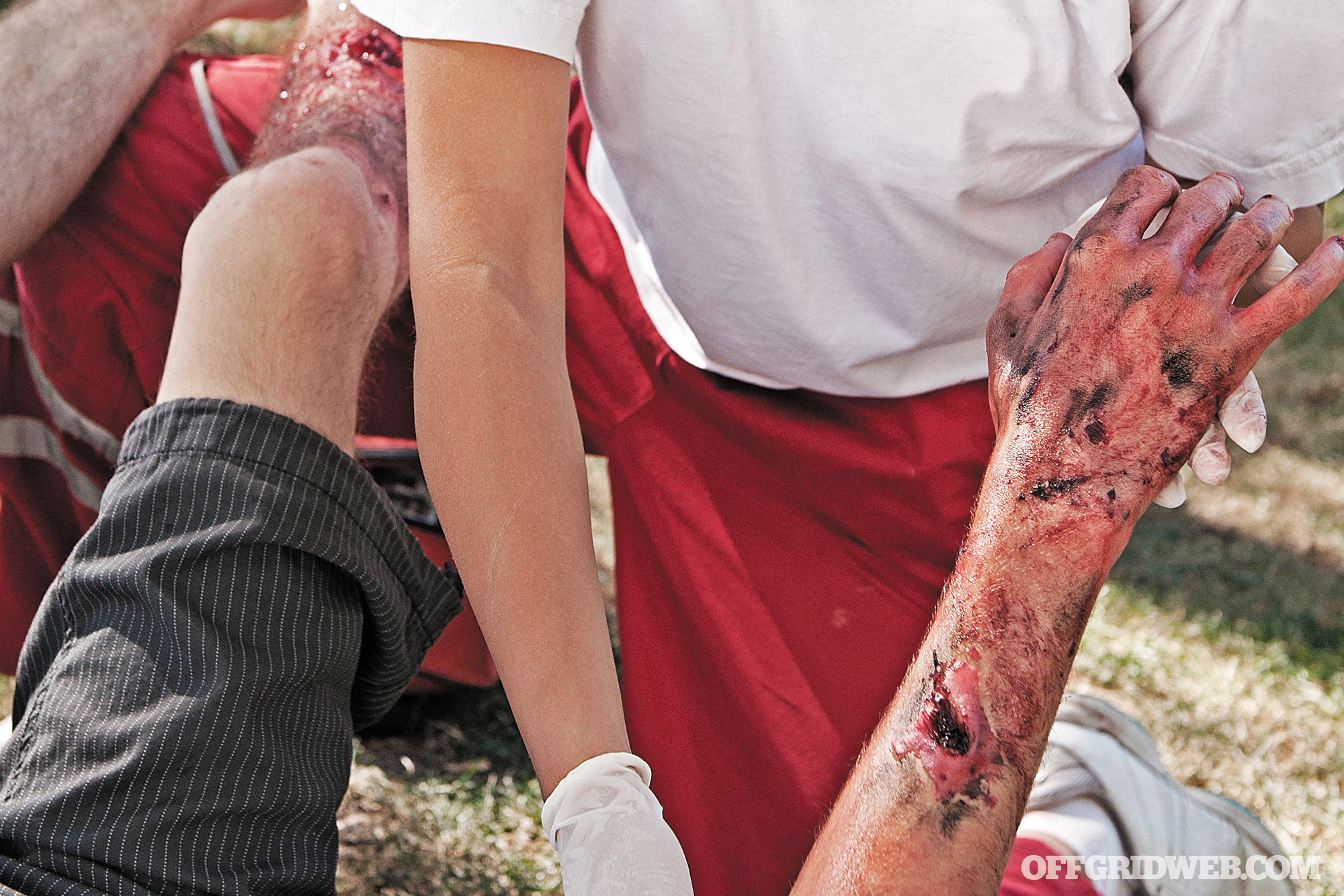
Imagine for a moment that you’re stranded on a remote coastal shoreline. As you climb over the slick rocks, your foot slips and you fall forward, slamming your forearm against the edge of a sharp stone. Feeling dizzy and nauseated, you examine your arm and see a deep bleeding gash flecked with sand and grit from the fall.

The Myth

Reeling from your injury, you recall hearing that saltwater can kill bacteria, and you know that hospitals often rinse wounds with saline solution. So, you contemplate washing out your wound with seawater with the hope of preventing infection. Unfortunately, it’s likely that doing so will make your situation even worse.

Despite pervasive claims about infection prevention, the scientific consensus is clear: rinsing your wounds with seawater is dangerous.

Wave in Pacific Ocean

The Reality

Like most myths, the supposed healing properties of seawater are founded on a grain of truth. Salt is certainly capable of preventing the growth of some types of bacteria. High salt concentration in liquid creates a hypertonic solution that pulls moisture out of susceptible bacteria cells via osmosis, slowing or stopping their growth.

For thousands of years, salt curing has been used to preserve meat, and salt was used as a primitive antiseptic in ancient Egypt, Greece, and Rome. You’ve probably heard the phrase “rubbing salt in a wound,” a saying that’s rumored to have originated from sailors who would rub the crystals on the cuts they received from lashings. Salt in these wounds intensified pain and caused scarring, but the men suffered through it in a desperate attempt to avoid deadly infections.

Gargling warm saltwater can be beneficial for oral health, as mentioned in our health column, Off-the-Grid Dentistry, from RECOIL OFFGRID Issue 27. Most notably, saline solution is widely used by medical professionals to irrigate wounds. However, there are two critical differences between medical saline and seawater.

Salinity: Medical saline is isotonic, and typically contains 0.9-percent salt to mimic the body’s natural salinity — that’s why there’s no excruciating burn when it’s applied. Saline irrigation is intended to flush out the wound rather than kill bacteria on a cellular level.

Seawater is hypertonic, with salinity of about 3.5 percent. This causes a painful stinging sensation as it draws water out of the exposed cells in a wound. The higher salinity is capable of killing some types of bacteria, but other salt-tolerant microorganisms thrive in seawater. This leads to our next point.

Sterility: Medical saline won’t introduce new bacteria into your wound, but seawater is far from pure. It can contain traces of human pollution, such as sewage or chemical runoff, and it’s teeming with a variety of microorganisms, including:

  • Dinoflagellates that cause red tide and produce harmful biotoxins
  • Enteric viruses that cause gastroenteritis, hepatitis, myocarditis, and aseptic meningitis
  • Protozoan cysts such as cryptosporidium and giardia, which are washed out from freshwater sources and can remain infectious for up to 12 weeks in seawater
  • Staphylococcus aureus, the bacteria that causes staph infections
  • Vibrio bacteria, a category that causes serious diseases. This includes V. cholera, the bacteria strain responsible for the infamous disease of the same name.

In an essay published by ABC News, Wake Forest University Professor John G. Spangler, M.D. wrote, “Marine vibrios can infect the bloodstream, causing potentially fatal illness. Skin infections, which occur when open wounds are exposed to sea water, can lead to large areas of blistering as well as deep skin and muscle infections. These also are extremely dangerous and often fatal.”

The Alternatives

Knowing the risk of infection from seawater, it’s worth considering alternate treatments that could be applied in scenarios such as our hypothetical beachcombing incident.

Sterile saline is an easy choice, but you probably won’t have any unless you’re carrying a first-aid kit. Don’t bother trying to improvise your own saline with table salt — getting the correct pH and isotonic salt concentration while maintaining sterility isn’t feasible outside a lab.

Fortunately, clinical studies have indicated that saline solution isn’t substantially more effective at preventing infection than clean tap water. In fact, a clinical study published in 2013 in the BMJ Open medical journal found that slightly fewer infections occurred when using tap water, calling it “a safe and cost-effective alternative to saline solution for wound irrigation.”

This means you can simply rinse your wound thoroughly with clean drinking water. Proper wound irrigation requires some pressure to wash away debris — this can be achieved by squirting water out of a clean syringe, squeeze bottle, or even a plastic bag with a slit in the corner. Then, apply a dressing to keep the wound clean and do your best to find some antibiotic ointment, or better yet, a hospital.

More From Issue 27

Don’t miss essential survival insights—sign up for Recoil Offgrid’s free newsletter today!

Read articles from the next issue of Recoil Offgrid: Issue 28

Read articles from the previous issue of Recoil Offgrid: Issue 26

Check out our other publications on the web: Recoil | Gun Digest | Blade | RecoilTV | RECOILtv (YouTube)

Editor’s Note: This article has been modified from its original version for the web.


RECOILweb: Where to Download 3D Printed Gun Files

Editor’s Note: The following article was originally published by our sister publication RECOIL, and appears here in its entirety with permission. For more articles on guns, training, and gear, go to RECOILweb.com.

3D printed gun files have been all over the news with lawmakers like Steve Israel, Ed Markey, Richard Blumenthal, Chuck Schumer, and others making largely inaccurate claims about how easy it is to print a gun. Further claims by lawmakers that the printed guns will be wielded by terrorists and criminals have fueled a rather heated debate.

Back in 2013 Defense Distributed was told by the US State Department that they wouldn’t be able to share the 3D firearm files on the internet due to an interpretation of ITAR. Why? Because the files and plans were being treated in the same manner as firearms being exported. In 2015, Defense Distributed filed a lawsuit against the State Department for violating their First Amendment rights.

Defense Distributed filed a lawsuit and solicited donations on their website to fight the State Department’s decision. On July 10, 2018, a settlement was reached that allowed Defense Distributed to put the files back online.

Days later a federal judge granted a temporary restraining order that blocked Defense Distributed from releasing the files on defcad.com.

Firearm Policy Coalition has set up the website codeisfreespeech.com so that potential 3D printers have an easy-to-reference source for the files. The website was taken down by Amazon initially but FPC has found a suitable host for the file-sharing site.

3D printed gun files download links defense distributed liberator parts 1

The One Big File

Google user Branwolfe1 has uploaded a giant zip file to Google Drive (you can find it here) that includes just about every 3D printing file and blueprint that you can imagine. If downloading a giant Zip file isn’t your thing, check out GetHub user maduce’s FOSSCAD Library or go straight to the FOSSCAD website and download the FOSSCAD Megapack.

Some of the more notable files are as follows:

  • Flying Swallow Revolver
  • Glock .22LR Revolver Unit (Attaches to accessory rail)
  • Partisan Revolver
  • Super Liberator
  • Liberator
  • Marvel Revolver
  • Supreme Revolver
  • Zig Zag Smart Phone Gun
  • Zig Zag Revolver
  • FOSCAD Bump Stock
  • Ruger 10/22 Receiver
  • AR15 Lower

Also in the giant zip file are plans for a drop in auto sear, suppressors, grenades and more. Keep in mind that 3D printing a gun isn’t an easy task and many of the files mentioned will likely not result in a working firearm.

3D Printable Guns

Liberator

Liberator Pistol – https://archive.org/details/Liberator

o_19nrb6u5vgon7fp2bj12d9npn1i

Gun, 8mm, Printable – https://3dsha.re/product/gun-8-mm-printable/

o_19j439u3g1npv1abmkgv1sfg1sh41o

Printable Liberator Gun – https://3dsha.re/product/gun-printable-liberator/

Ruger_Charger

10/22 Receiver – https://github.com/maduce/fosscad-repo/tree/master/Rifles/10_22_Receiver-Unnamed

CYt3LcDUoAAHLXZ

Shutty Pistol – https://github.com/maduce/fosscad-repo/tree/master/Pistols/9mm_Shuty_AR-15_Pistol_v4.0_MP-1-unnamed

3dp_washbear_printed-e1448088731451-1024x535

PM522 Washbear – https://github.com/maduce/fosscad-repo/tree/master/Firearms/PM522_Washbear_Revolver_v2.0-JamesRPatrick

511dcb26f362fb3b62c444050a6021ec_preview_featured

Flying Swallow Revolver – https://www.thingiverse.com/thing:2630109

render01

Grizzly Handgun – https://github.com/maduce/fosscad-repo/tree/master/Firearms/Grizzly_Handgun-Canadiangunnut

render2

Sacramento Pistol – https://github.com/maduce/fosscad-repo/tree/master/Firearms/Sacramento_Pistol-Caboose

Printable Suppressors

We also found several plans for 3D printed suppressors while compiling this list.

156005c5baf40ff51a327f1c34f2975b_preview_featured

5mm Supressor – https://www.thingiverse.com/thing:2828534

eb115a8b54dcea479f8fa853b432219c_preview_featured

Monocore 5.56/.223 Suppressor – https://www.thingiverse.com/thing:2599322

render2

Gryphon .22 Suppressor –  https://github.com/maduce/fosscad-repo/tree/master/Muzzle_Devices/22_Suppressor_Baffle_Gryphon-Remove_Kebab

Y5ac3yl

Mystique Suppressor – https://github.com/maduce/fosscad-repo/tree/master/Muzzle_Devices/FOSSCAD_Mystique_Suppressor-unnamed

Printable Gun Parts & Tools

How about a bunch of useful 3D printed gun parts and tools?

830f1c2c9fd553258398c30b1d695988_preview_featured

UpLULA M&P Shield Spacer – https://www.thingiverse.com/thing:2734617

40a08b190c55b16590b41bab57a3d7c8_preview_featured

Reinforced Liberator Pistol Trigger – https://www.thingiverse.com/thing:1615992

f3d358d1ceec76aa2aa7bdb52ad8273f_preview_featured

P320 Magazine Limiting Blocks – https://www.thingiverse.com/thing:2979623

ed5065d5d20f3e0498ddeceee2e56854_preview_featured

Adjustable Blade Arm Brace for AR Pistol – https://www.thingiverse.com/thing:2934481

7997b6838ace855d686e7e5e11348bbd_preview_featured

Colt 1911 Grips – https://www.thingiverse.com/thing:2852983

e399006b63ab4ac0c20815d843ebe0a2_preview_featured

Glock 43 Grip Plug – https://www.thingiverse.com/thing:2849561

d6aca71ff1b911ef5d7d00d6d33a91df_preview_featured

Sig P210 Grips – https://www.thingiverse.com/thing:2822530

4ce5788dee73558900c7700201dec5ef_preview_featured

AR15 Grip – https://www.thingiverse.com/thing:2806009

db4b423f403c8cd71756f57e00822ef4_preview_featured

5.56/.223 Chamber Flag – https://www.thingiverse.com/thing:1609864

ecd9b3945bf45d2d1298d9284d1beabe_preview_featured

Vortex Strike Eagle Throw Lever – https://www.thingiverse.com/thing:1724289

534c485227d3bb18c39651d3093047c8_preview_featured

XDs .45 Rear Slide Plate – https://www.thingiverse.com/thing:2802422

763a8141f38416fa444c2a86e774e782_preview_featured

California Compliant AK Grip – https://www.thingiverse.com/thing:2690189

622679046eced096c3af70a5b60abb45_preview_featured

Smith & Wesson 586 & 686 Barrel Vice Pads – https://www.thingiverse.com/thing:2087868

1e9e442a43ec15caf79bfcae77839621_preview_featured

Sig Sauer P938 Grips – https://www.thingiverse.com/thing:2323101

1911_Barrel_Bushing_Wrench_preview_featured

1911 Barrel Bushing Wrench – https://www.thingiverse.com/thing:5649

Glock19_Gen4_preview_featured

Glock 19 Gen4 Grip Plug – https://www.thingiverse.com/thing:1036926

Printable Ammo Boxes, Magazines & Extensions

There are even 3D printed magazines, magazine extensions, and ammo boxes to print.

77dc33d7d27cdc5e485e75fcb687a390_preview_featured

DPMS AR15 .22LR 10-Round Magazine – https://www.thingiverse.com/thing:2782642

b02f7abe124f65929ca3175a81f7c102_preview_featured

PMAG Gen3 Magazine Coupler – https://www.thingiverse.com/thing:2664449

glock3

3D Printed Glock Magazine Extention – http://www.printedfirearm.com/3d-printed-glock-basepad-extension/

f59f3cbce9428b17916cc2aca369262a_preview_featured

Chiappa M1-22 Extended 19-round Magazine – https://www.thingiverse.com/thing:2685411

3d7a4dfdf035f5fb2b37a5fc7db26625_preview_featured

200 Round .22 LR Ammo Box – https://www.thingiverse.com/thing:2927662

0992f539aea65465a1e77ba467fb78dc_preview_featured

10 Round Limiter For Black Dog .22 Magazines – https://www.thingiverse.com/thing:2266735

60bf72a5289d5ae014aed631d5c3052e_preview_featured

Speed Loader Model 27A – https://www.thingiverse.com/thing:2858227

695f2953f79ef153468894d41fe73dbc_preview_featured

SP101 .327 Speedloader – https://www.thingiverse.com/thing:2418575

0f204fd0660a1d5281bddb5ee39a9f80_preview_featured

Glock 43 Plus 2 Mag Extention – https://www.thingiverse.com/thing:2464038

babc42e430cedea199c1f7226f3736aa_preview_featured

Shockwave Blade “Adaptor” – https://www.thingiverse.com/thing:2551583

2fc76257a284d10bce856c9da83bdbd4_preview_featured

Glock Gen3 Magazine Catch – https://www.thingiverse.com/thing:2569574

Printable Gun Stands, Mounts, Holsters & Mag Pouches

1d22b320134202b36fdb28f619e12a5d_preview_featured

Pistol Stand – https://www.thingiverse.com/thing:2883255

760983fdec7511d75d0641e7fecce122_preview_featured

Stack-On Security Cabinet Mount – https://www.thingiverse.com/thing:2859508

91d54c7c1fb78decdda0e88e2309ec65_preview_featured

Glock 19 Stand – https://www.thingiverse.com/thing:2846384

c7ab614c3d4e3caa1b50174d1fa56b53_preview_featured

Walther PPK Magazine Pouch – https://www.thingiverse.com/thing:2831049

1ef2884700b1383ef418c847c36e5de6_preview_featured

AR15 Wall Mount With Hinge – https://www.thingiverse.com/thing:2829239

912aa590446a2fd3ce3f16f324ecb339_preview_featured

12-Gauge Shot Shell Holder – https://www.thingiverse.com/thing:2770518

e1063b9d0cc1bc961f2c68dbd58cafbd_preview_featured

AR15 Floating Wall Mount – https://www.thingiverse.com/thing:2757790

03dbeec2488bbcd0b63e49d144092f41_preview_featured

Walther P22 Under Table Holster – https://www.thingiverse.com/thing:2733761