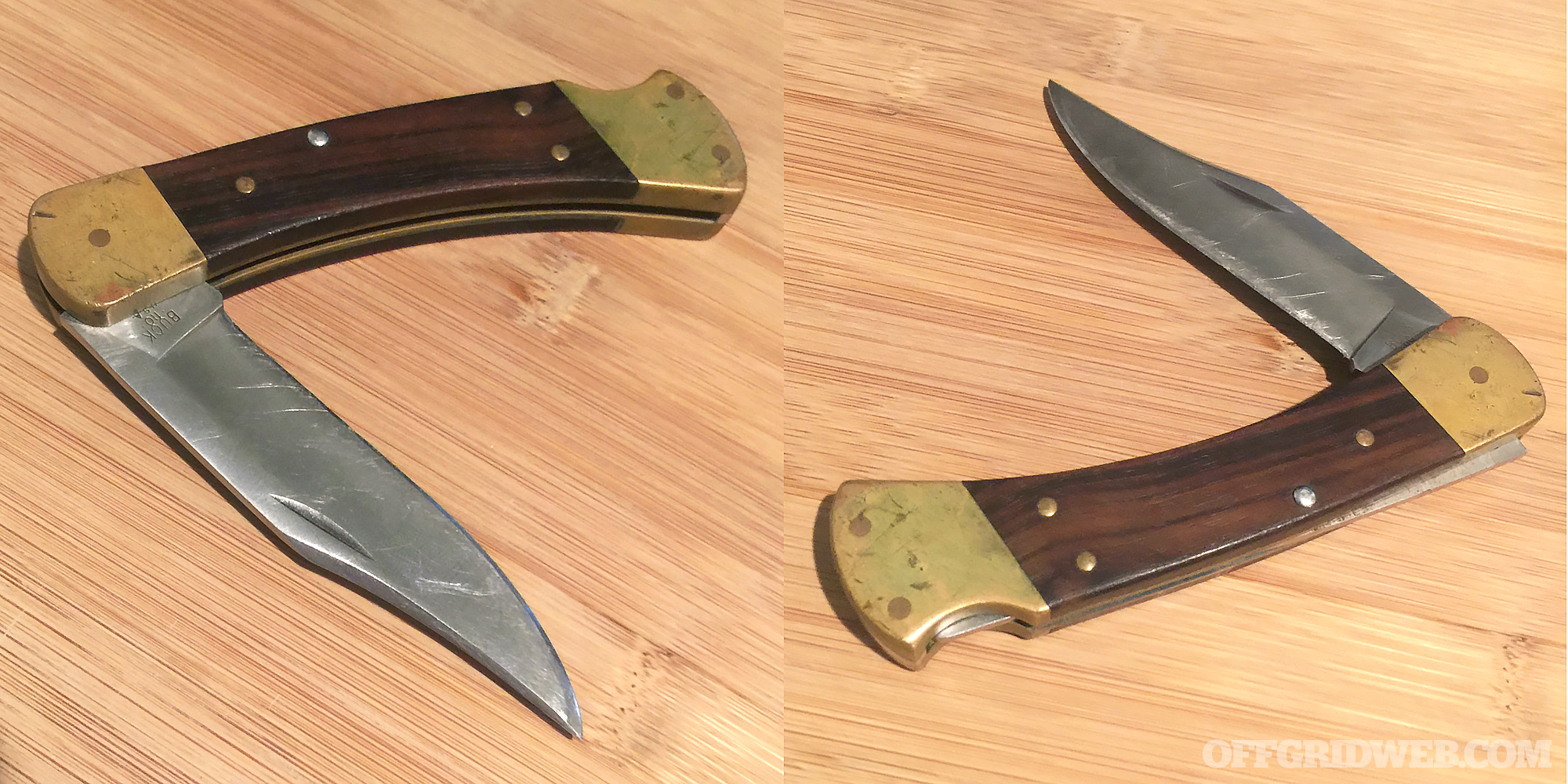
I’ve mentioned in the past that one of the first knives I ever used was a Buck 110 Folding Hunter that belonged to my dad. During a recent visit, I asked if he still had it, and lo and behold: he did. This knife (pictured below) brings back fond childhood memories for me, and given the model’s popularity, I’m sure many of you have similar experiences. It’s a classic American design that’s arguably as iconic as a pair of Ray-Ban Wayfarers or a 1969 Camaro.
Earlier this year, Buck Knives announced a new 110 Auto push-button version of this design, and the company has just announced another variant — but this time, it’s not a folder at all.
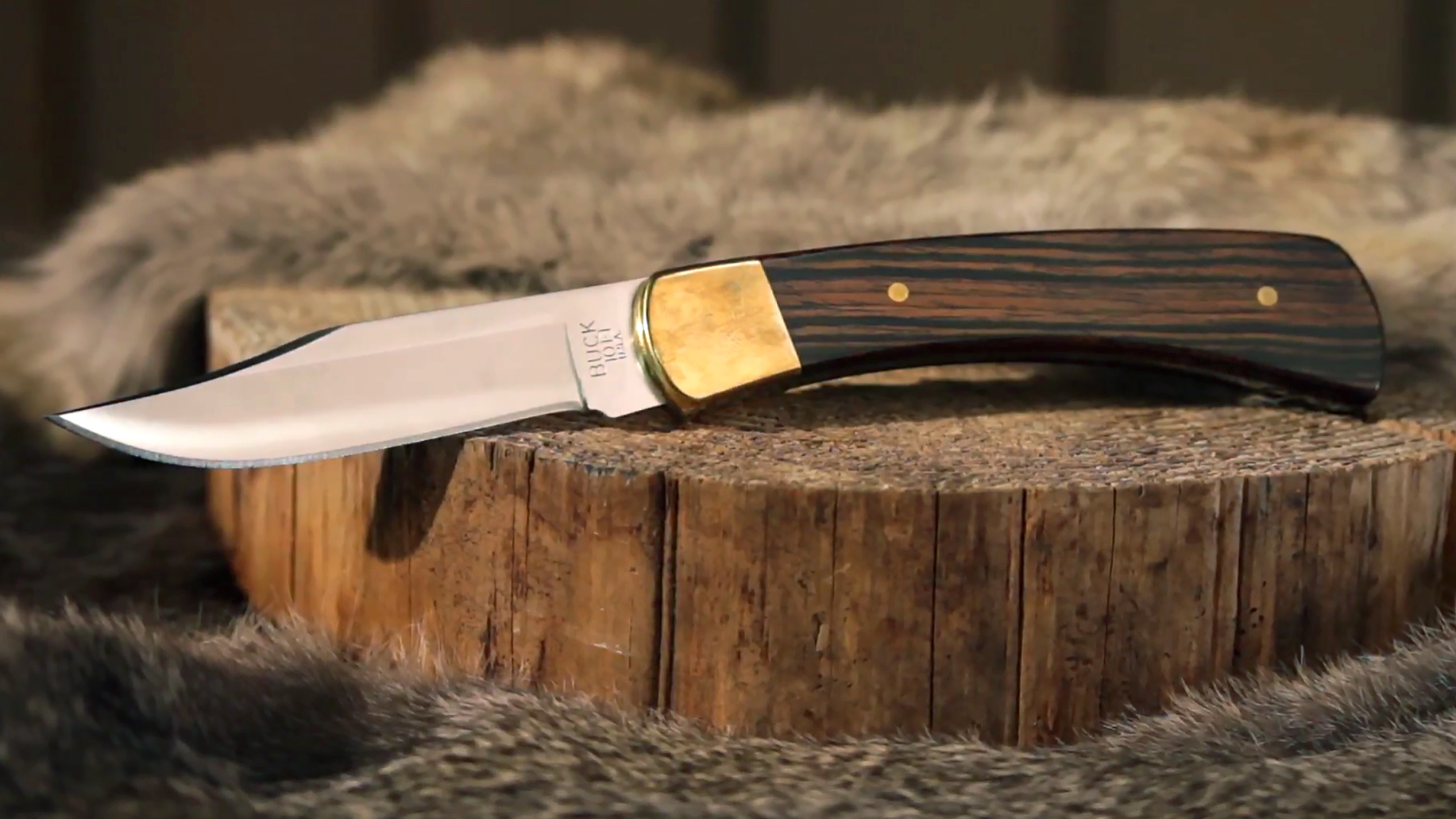
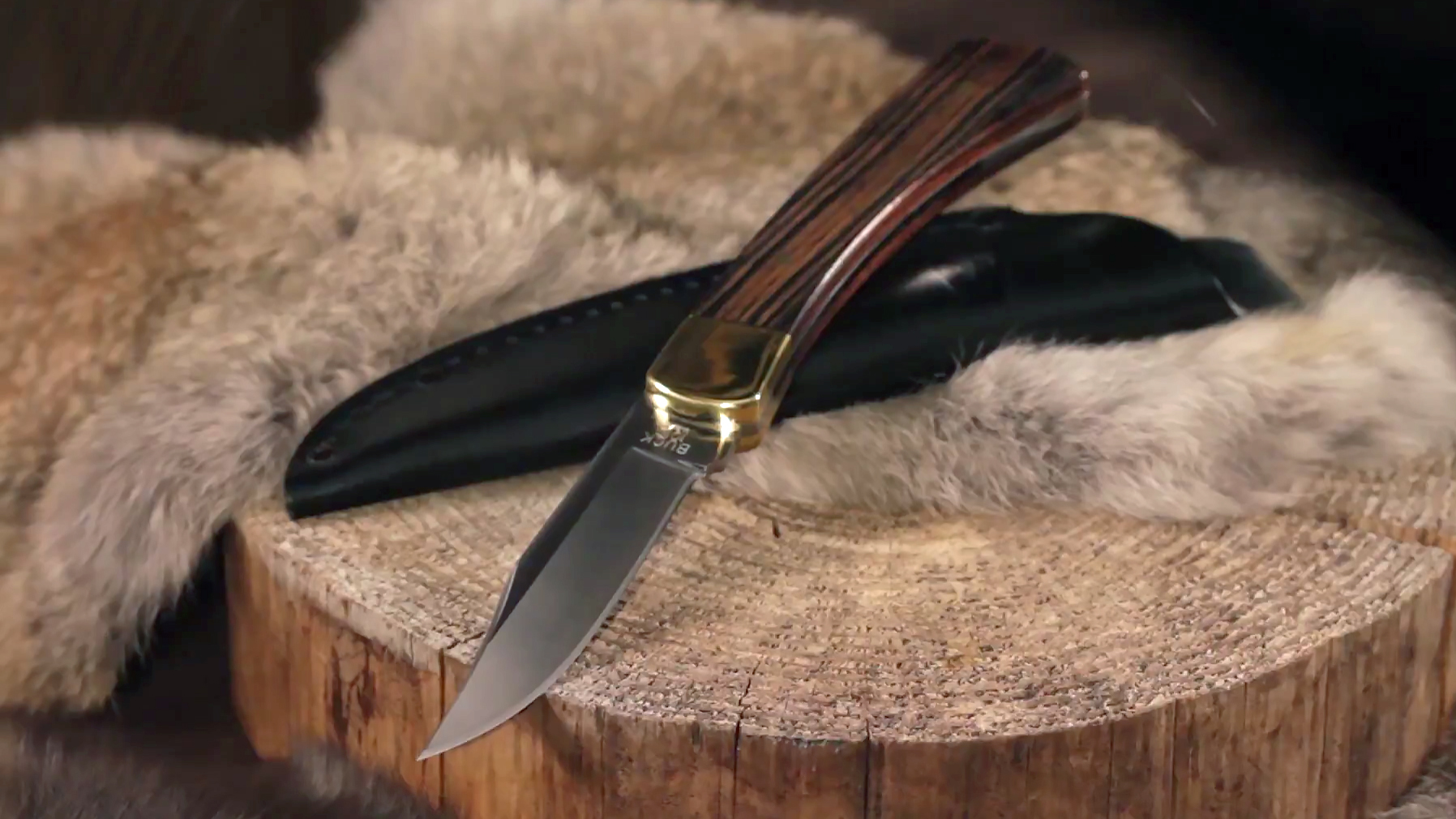
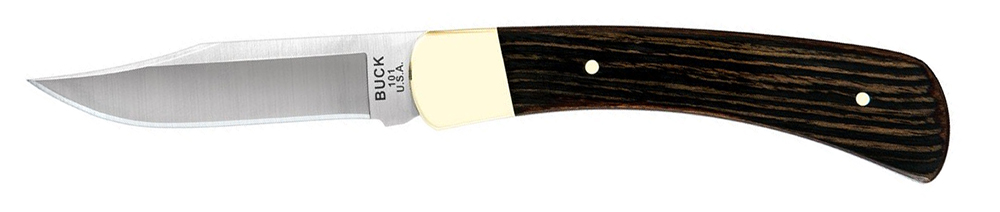
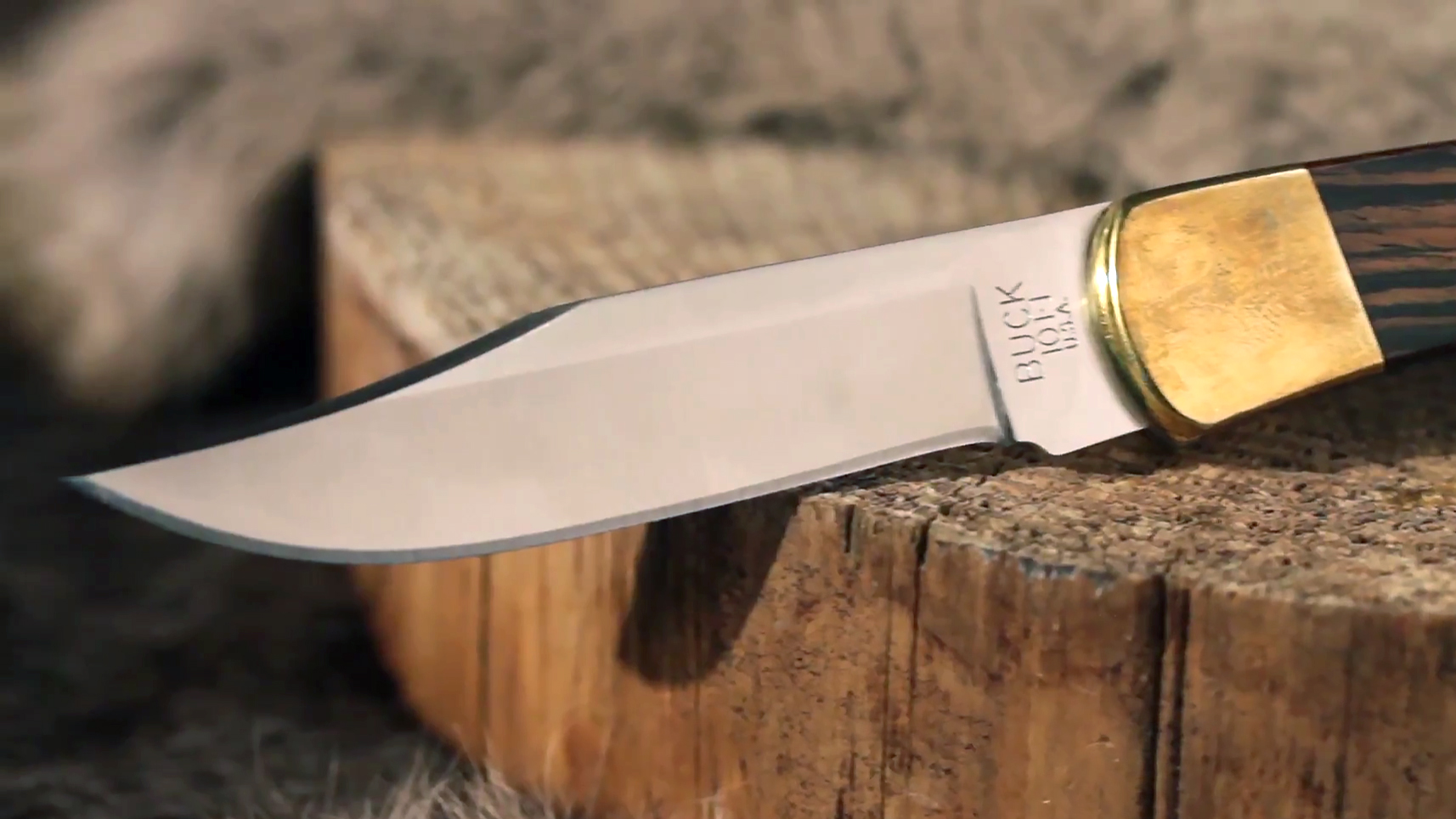
The new Buck Knives 101 Hunter is a fixed-blade version of the 110 design. CEO and Chairman CJ Buck said that “many customers have requested a fixed blade version of the 110 over the years,” so the company decided to fulfill those requests with this knife.
Buck’s 101 Hunter features a full-tang construction for maximum strength, and retains the simple but functional clip-point design seen on its predecessor. The blade is 3.75 inches of 420HC steel, and overall weight is 5.1 ounces (about 30% less than the 110 folder).
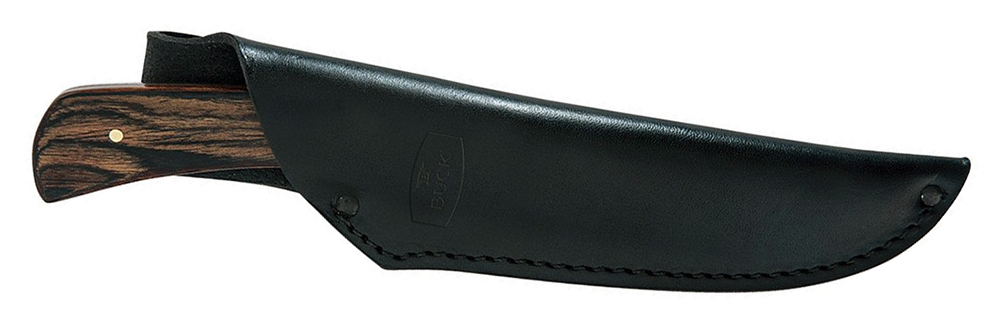
This knife also features Macassar Ebony Dymondwood flanked by brass on the handle, though there’s only a front brass bolster on this model, as opposed to the dual bolsters on the folder. A black leather sheath is included with each knife.
As you’d expect from Buck, it’s made in the USA. MSRP is $100. For more information on the Buck Knives 101 Hunter, go to BuckKnives.com or check out the video below.
If you’re in a survival situation and you don’t have a fire-proof and water-tight pot or canteen, cooking and water purification suddenly become much more difficult. This is why Les Stroud ranked “a pot to boil water” in his top 5 most important items for a survival pack — pick up a copy of Issue 21 for our full interview with Les. If you find yourself without a modern metal pot, you can always do what primitive cultures have done for millenia: make your own clay pottery.
The YouTube survivalist behind Primitive Technology is experienced in creating pottery, and even built a large kiln which we featured in a previous article. In his latest video, he updates his bushcraft furnace with a fan blower to drive more air and generate more heat, much like the bellows used by blacksmiths.
The blower impeller is driven by a manually-operated shaft and a pull-cord similar to that of a pump-drill fire starter. A clay housing draws in air from a small opening, and channels it into the fire above.
The silent host then experiments with firing pottery from three types of clay mixtures:
Clay topped with a brick of iron bacteria, charcoal powder, and wood ash, which melted over the clay to coat it
Check out the full video below to see the steps used by Primitive Technology to construct the kiln and pottery. Don’t forget to check the video description for a detailed explanation of the materials and steps.
Survival is a skill that’s beneficial to everyone. Staying safe and making the best of adverse situations is important no matter who you are. So, we’re always glad to see quality gear manufacturers providing more gear options for women without resorting to the “shrink it and pink it” corner-cutting strategy.
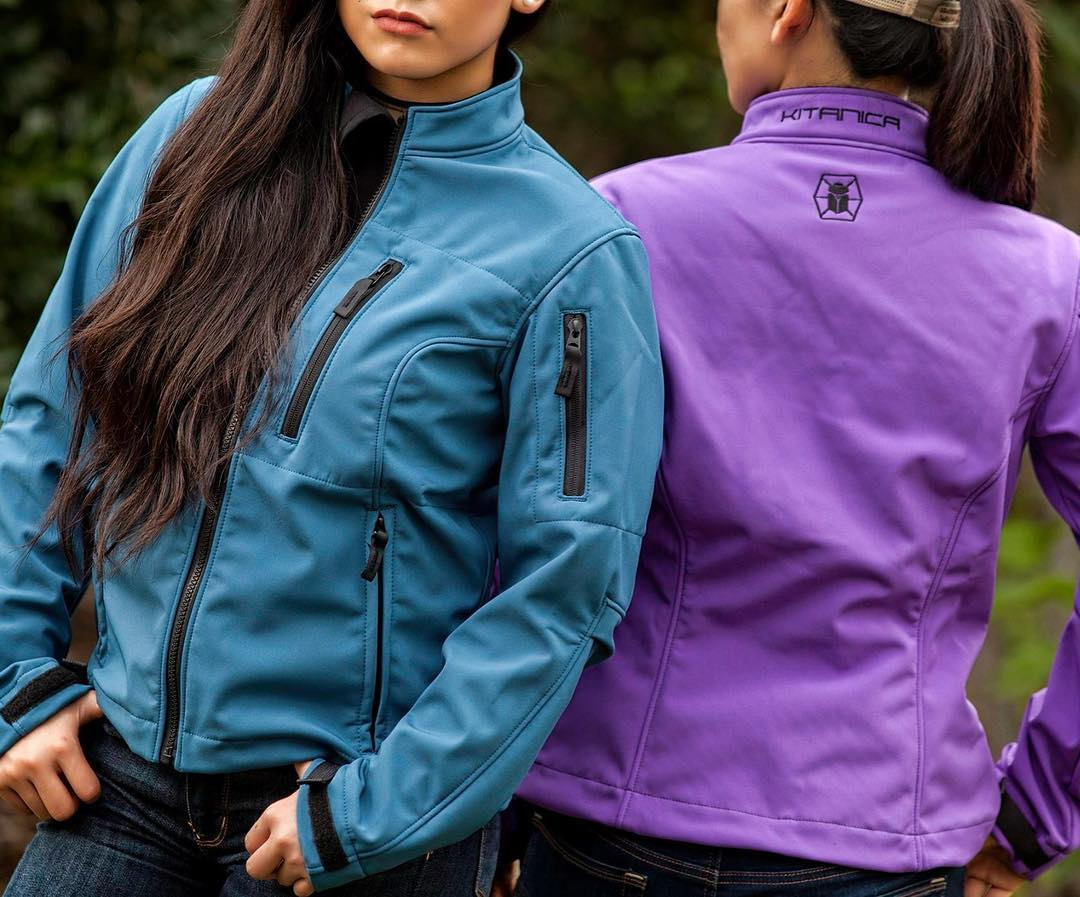
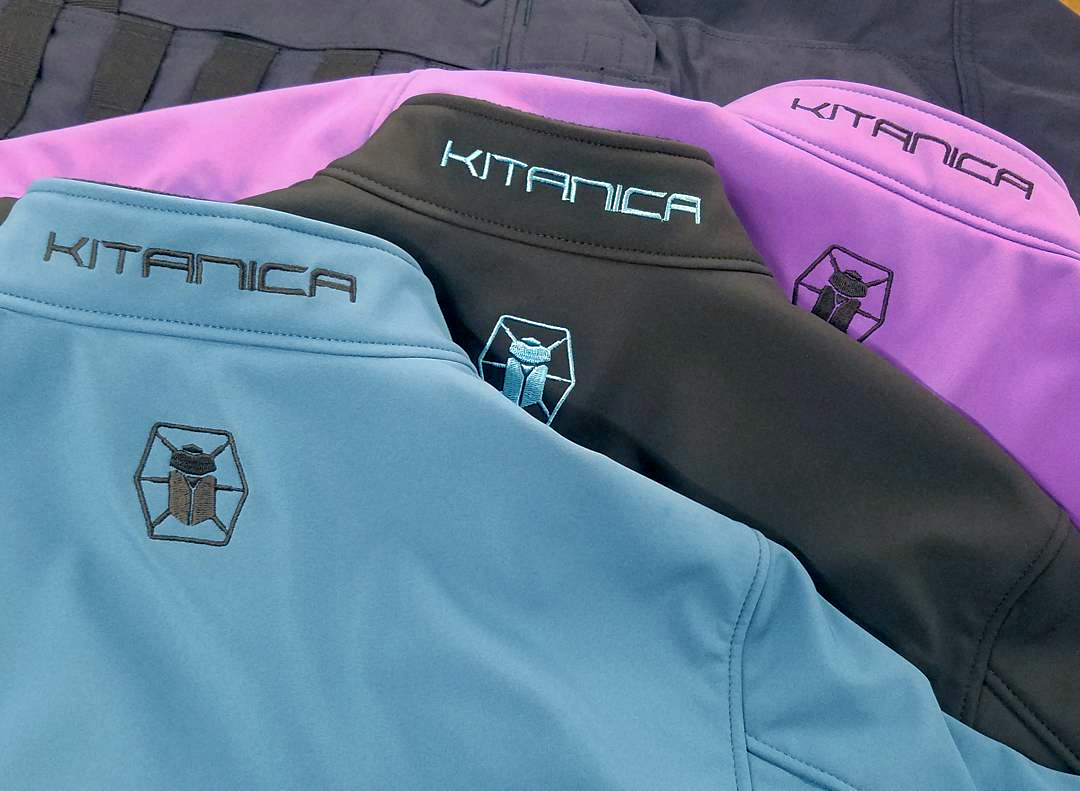
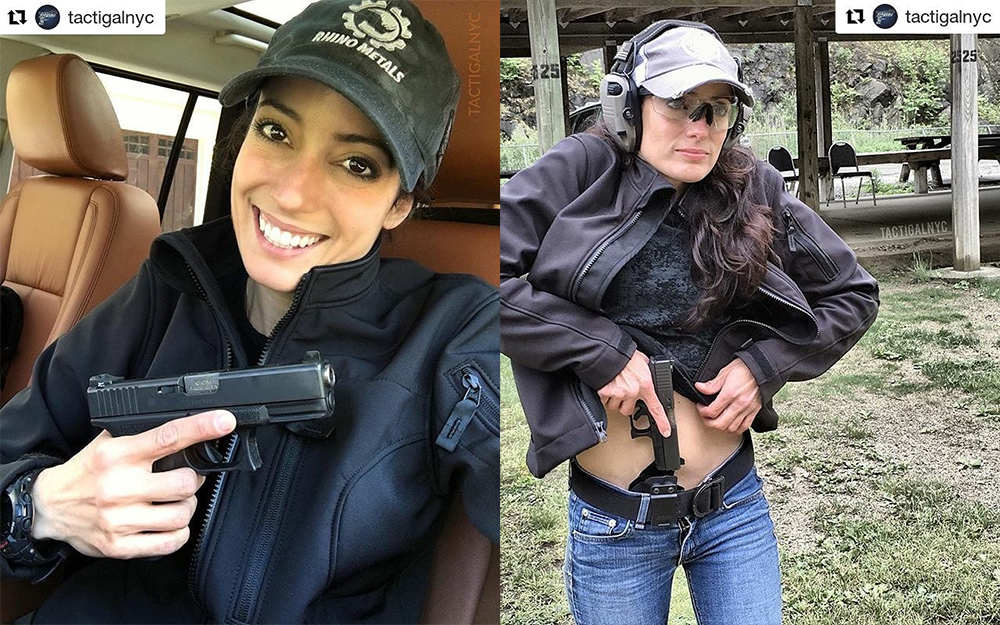
Kitanica has released an all-new Lady Bug fleece jacket designed specifically for women. We initially noticed this jacket on display at SHOT Show 2017 alongside the new ultra-tough Mark IV jacket (which we’ll be reviewing here in the near future). Since then, Kitanica has completed development of the jacket and made it available to the public.
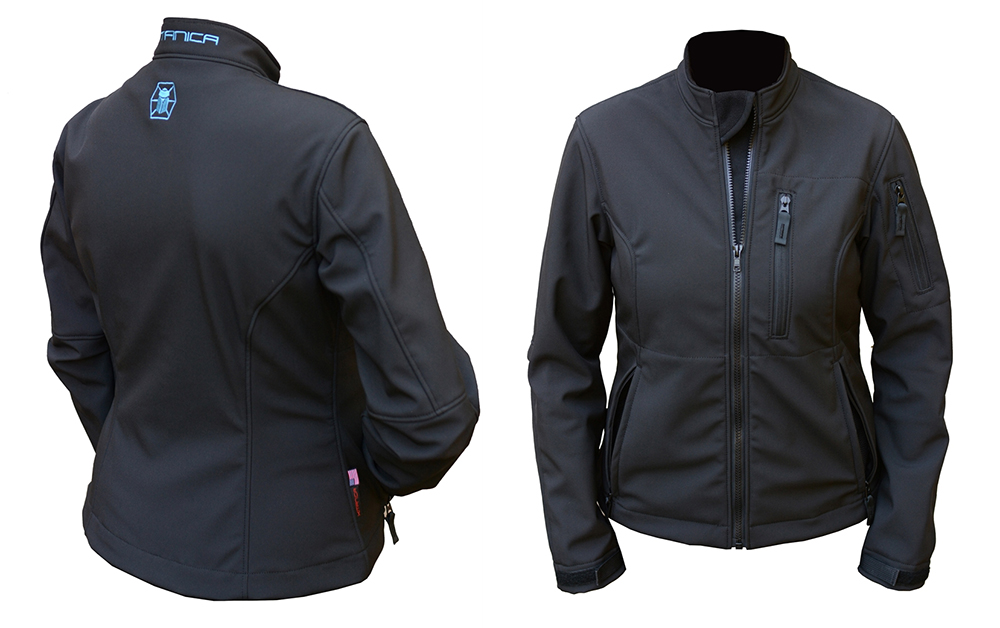
Like all of the company’s apparel, the Kitanica Lady Bug fleece is made in the USA, and constructed from durable abrasion-resistant materials. The 100-denier laminated polyester fleece material is treated with a Durable Water Repellent (DWR) coating to repel rain and other moisture. The material is also designed to stretch for improved flexibility on the range or the trail.
Photos via @kitanicausa / @tactigalnyc
The main zipper is backed by a wind placket, which is a fabric flap that prevents a strong headwind from chilling you through the teeth of the zipper. Velcro cuff cinches and a waist draw cord also improve the insulative properties by retaining body heat. Zippered pockets are found on the chest and left bicep area.
Photo via @kitanica / @lloydwainscott
The Kitanica Lady Bug is available in three colors — Atomic Blue, black, and purple — and in women’s sizes from X-Small to X-Large. MSRP is $165. For more information on this fleece, go to Kitanica.net.
The popularity of unmanned aerial drones has continued to increase over the last few years, and this trend shows no signs of stopping. Whether they’re being used to carry TV cameras over film sets, sensors for search and rescue operations, or munitions over the battlefield, drones have a variety of uses.
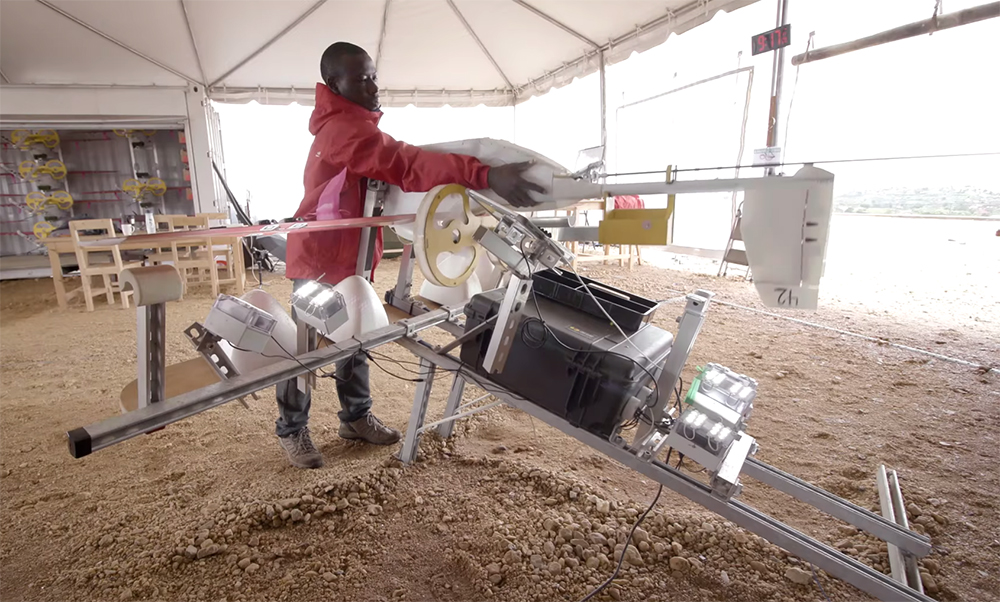
One particular type of drone has recently been adopted on a national scale by the government of the African nation of Tanzania. It’s called Zipline, and the Tanzanian government is using it to deliver essential medical supplies to remote areas.
Ground travel to these isolated settlements may be slow and difficult due to poor road infrastructure, while manned plane flights are time-consuming and costly. When it comes to certain time-sensitive medical supplies, such as blood for transfusions, either of these options can too slow to save lives. On-demand drone flights are potentially much faster when medical emergencies arise.
Health workers at clinics send a text message to Zipline to request specific supplies.
Zipline’s medical distribution hub immediately packs the supplies in an insulated temperature-controlled container, and loads it onto a drone.
The drone is launched within minutes, and cruises at 62 mph (100 km/h) to its target.
In as little as fifteen minutes, the medical products are delivered by parachute to a designated area the size of a few parking spaces. Hospital staff are notified via text message.
The drone turns around and returns home.
This nation-wide system has the potential to be useful in just about any area where accessibility is limited. For example, even in developed first-world nations, there are many hiking trails where helicopters cannot land and Jeeps can’t reach. We could see a system like Zipline being useful to deliver snakebite antivenom, epinephrine for severe allergic reactions, or other critical supplies to hikers in these inaccessible areas.
What do you think of this delivery drone tech? Would you like to see it implemented in your area?
Thanks to Andy Schrader for the tip about this drone technology.
When an emergency emerges, you don’t want to be the guy who’s struggling to push a wheelbarrow full of gear uphill to a safer location. You want to grab your pre-stocked bug-out bag, put on your boots, and be out the door in seconds. It’s also helpful to organize your B.O.B. so it’s easy to unload and repack — this minimizes the amount of time you’ll need to stop on your journey.
No matter the details of the scenario, remaining mobile is at the core of every bug-out plan.
The same principles apply to your vehicle and your campsite. If you own a truck with poor fuel economy and weigh it down with tons of gear, or you buy an elaborate tent that takes an hour to set up and tear down each day, you’re effectively limiting your mobility. This means you may not make it to your bug-out location on schedule, or you may not even escape danger at all.
The Advantages of Truck Campers
A truck camper improves bug-out mobility in both these areas, by combining your campsite and your vehicle into a single unit. Instead of finding a viable patch of flat ground, parking your truck, unloading your tent, and setting it up every day, you’re able to camp virtually anywhere in comfort. The world is your campsite, and setup/teardown take seconds instead of minutes.
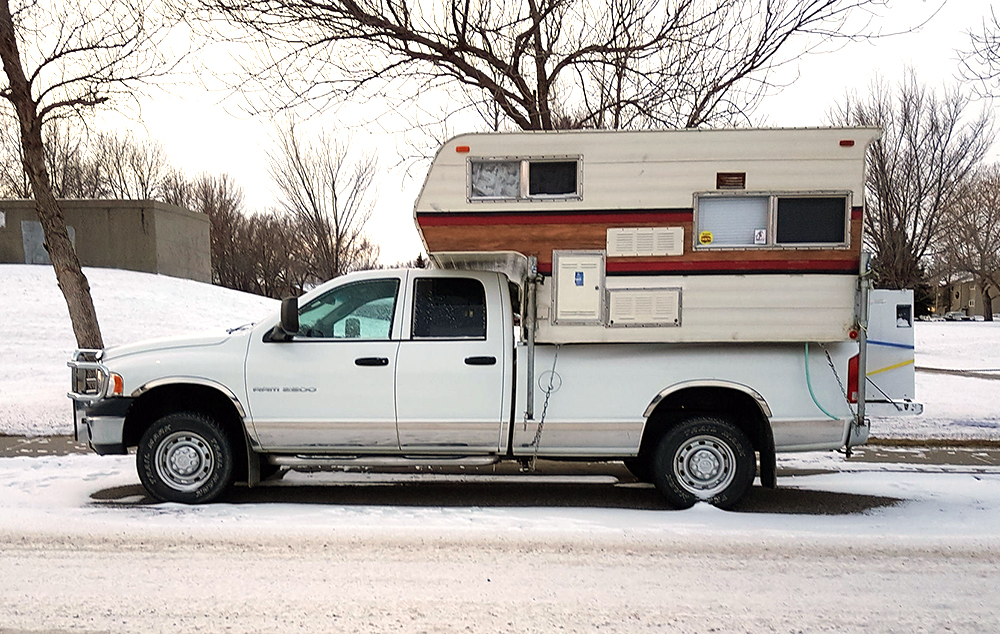
There are many styles of slide-in truck campers, but the traditional sort are typically designed to fit into the beds of full-size pickups. These old-style truck campers are often constructed from heavy wood and metal, and use side support jacks to distribute their weight once parked.
Old-style truck campers are often heavy and bulky. Photo: dave_7 / Flickr
More recently, lightweight fiberglass campers have been developed for both full-size and mid-size trucks. These newer campers don’t require external support jacks, and won’t overload your truck’s suspension with thousands of pounds of weight. That means your truck can handle better, accelerate and brake faster, carry more supplies, and traverse rough trails more easily than it would with a heavy camper. For a bug-out vehicle, those are some massive advantages.
The Earthcruiser GZL Truck Camper
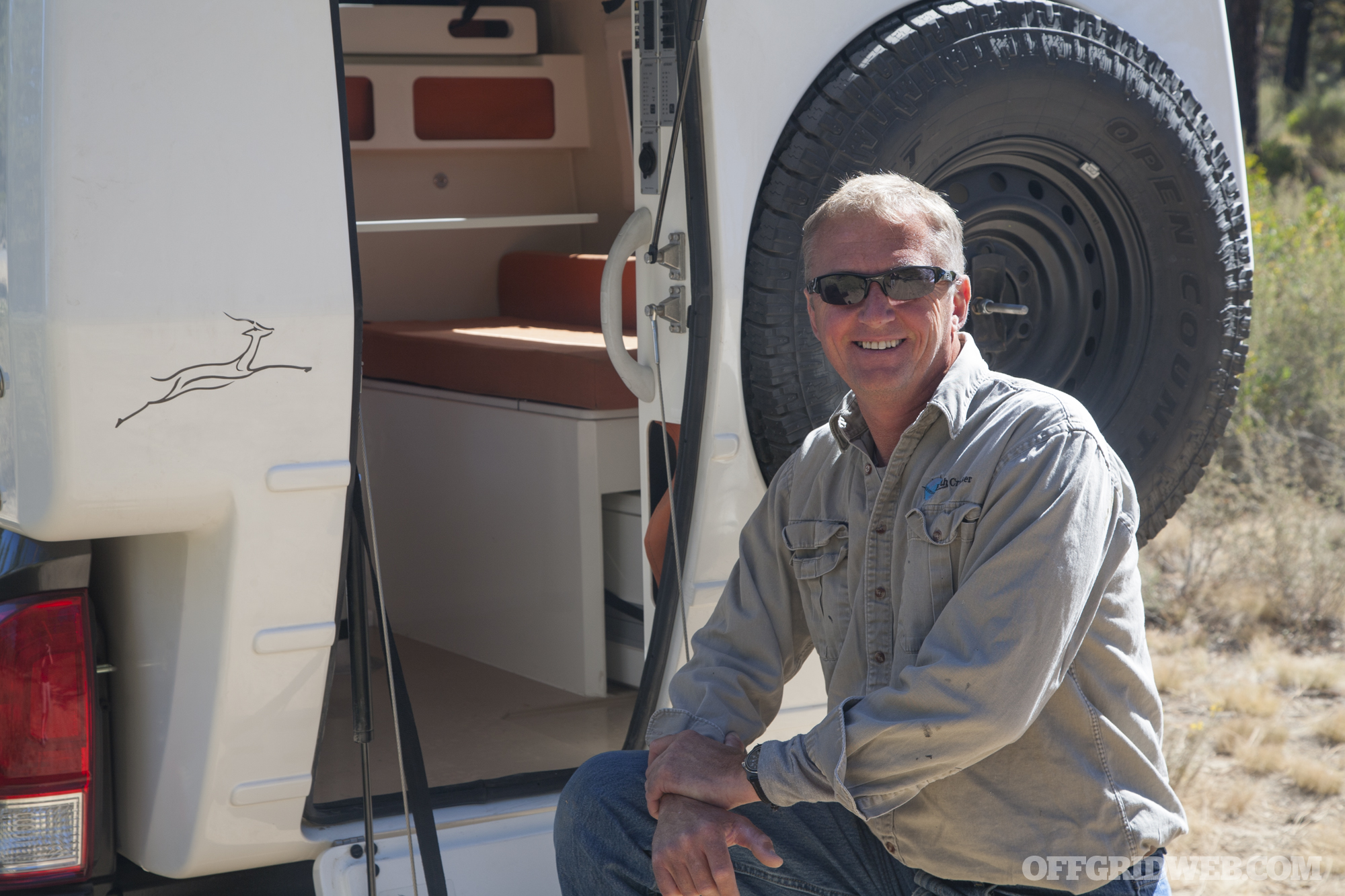
On a trip to Bend, Oregon, we stopped by the headquarters of EarthCruiser Overland Vehicles. The company was founded by Australian expat Lance Gillies in 2009, and specializes in purpose-built expedition vehicles like the heavy-duty EarthCruiser EXP and FX. Recently, the company has also branched out into slide-in truck campers with the launch of the new EarthCruiser GZL series.
EarthCruiser founder Lance Gillies hails from Australia, where 4x4s and outback expedition vehicles are hugely popular.
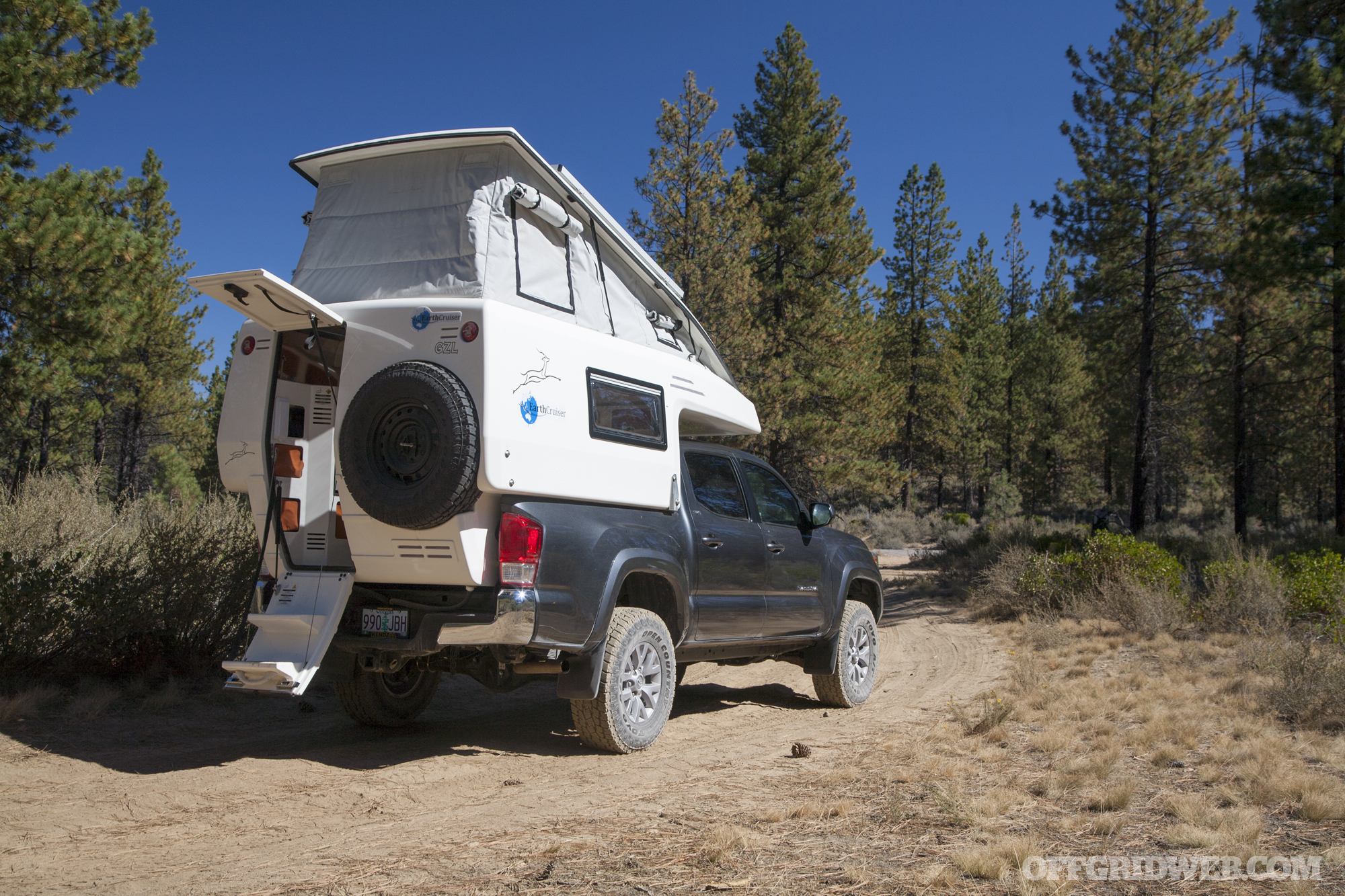
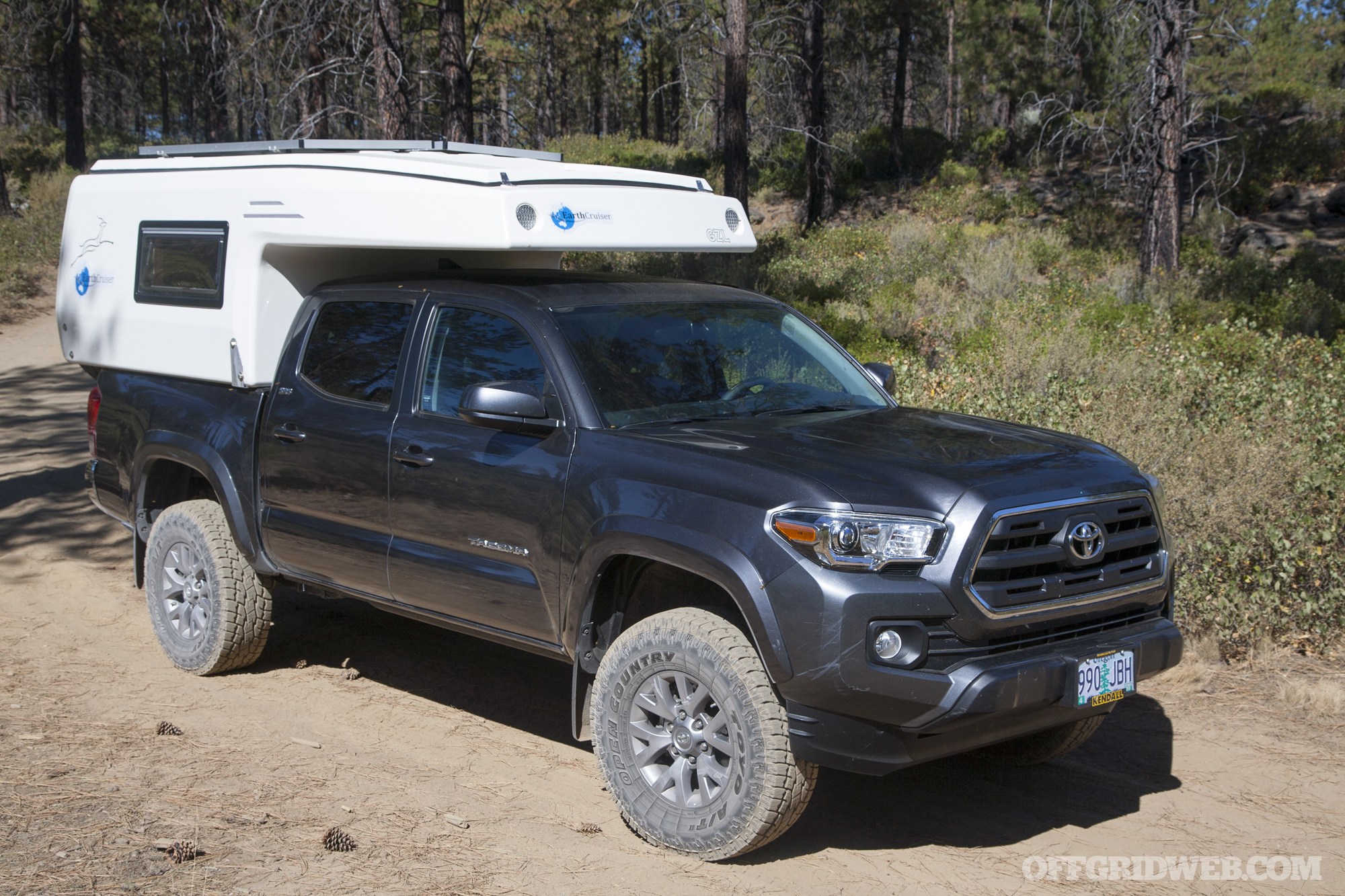
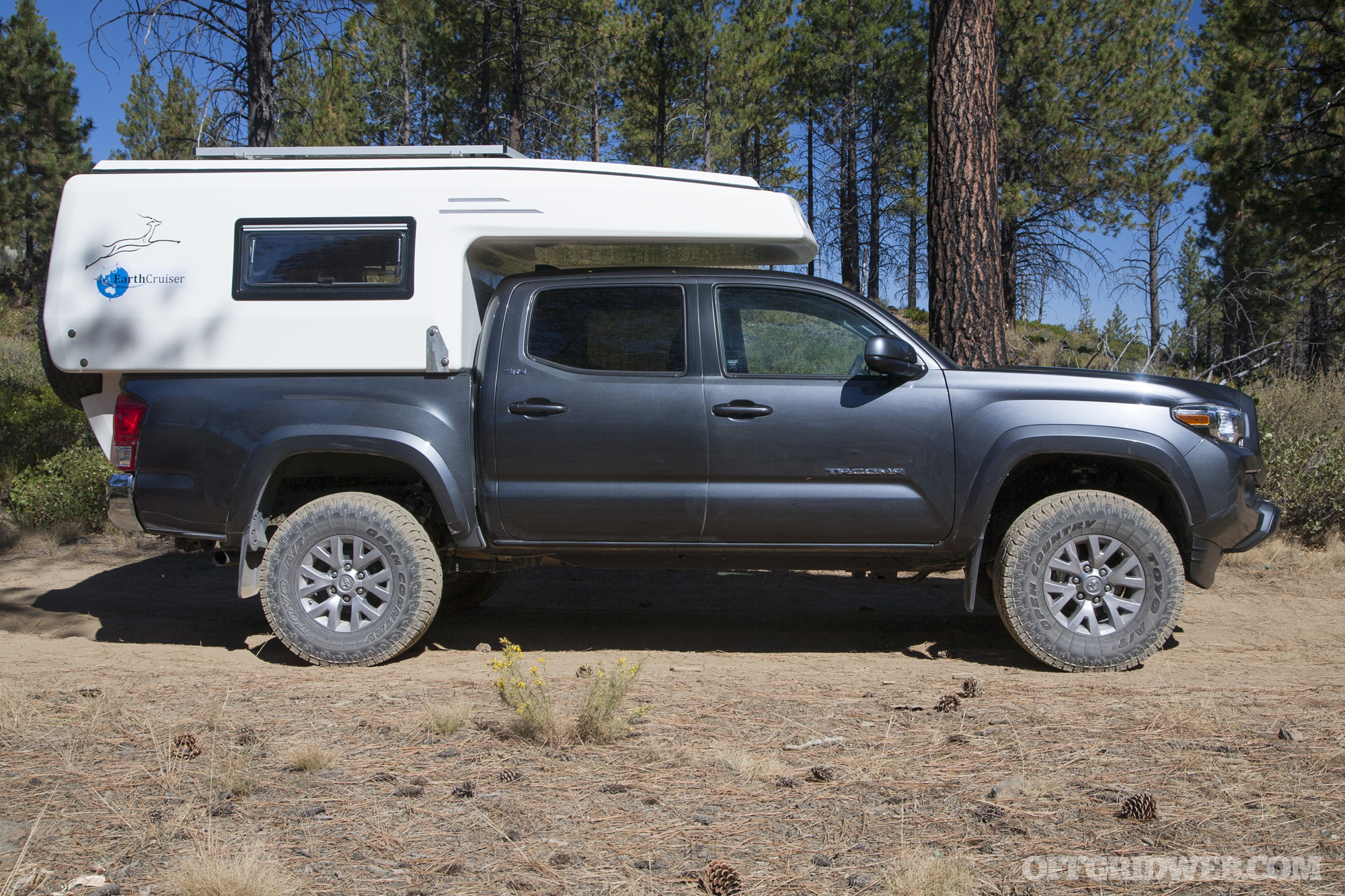
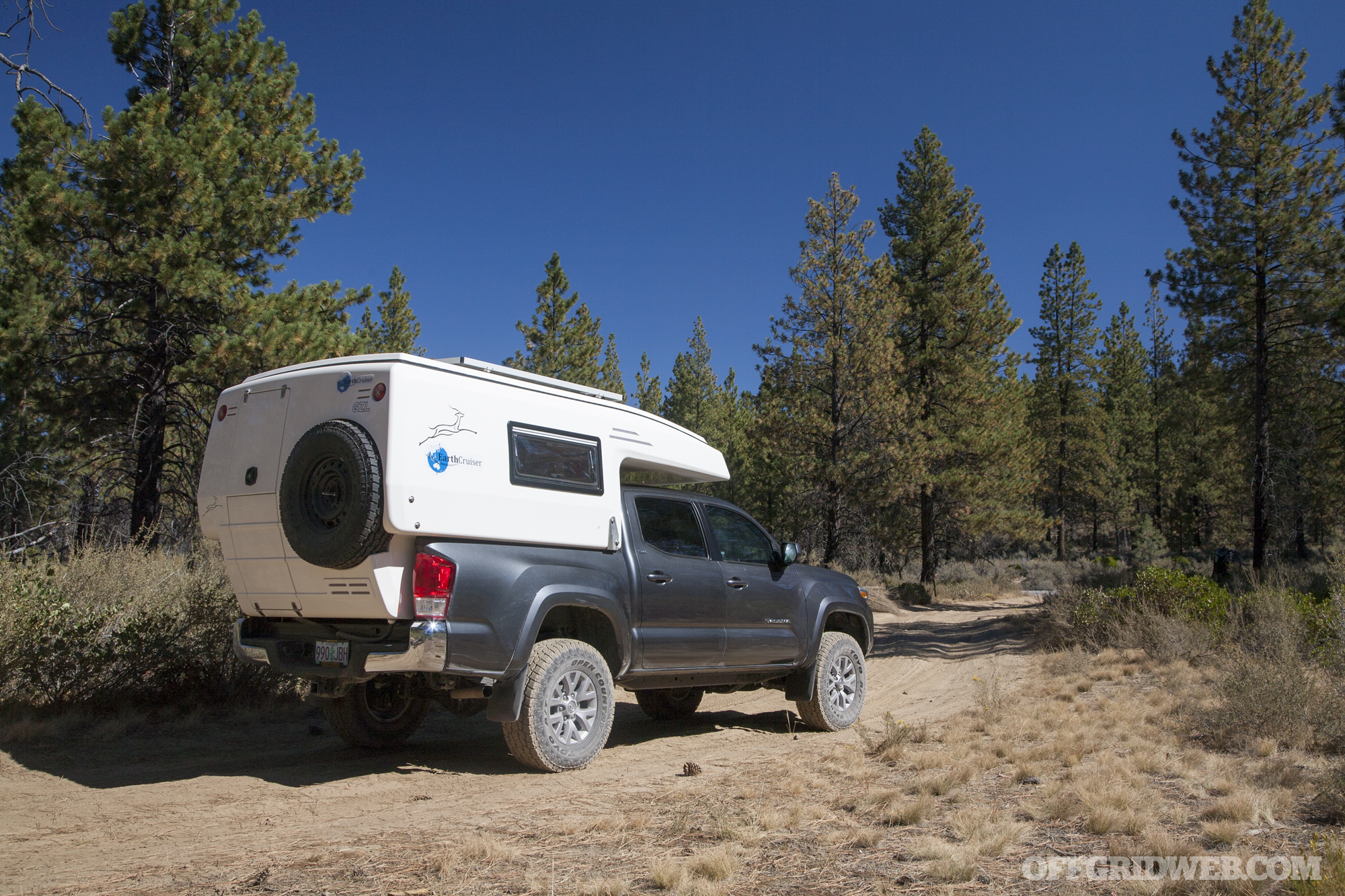
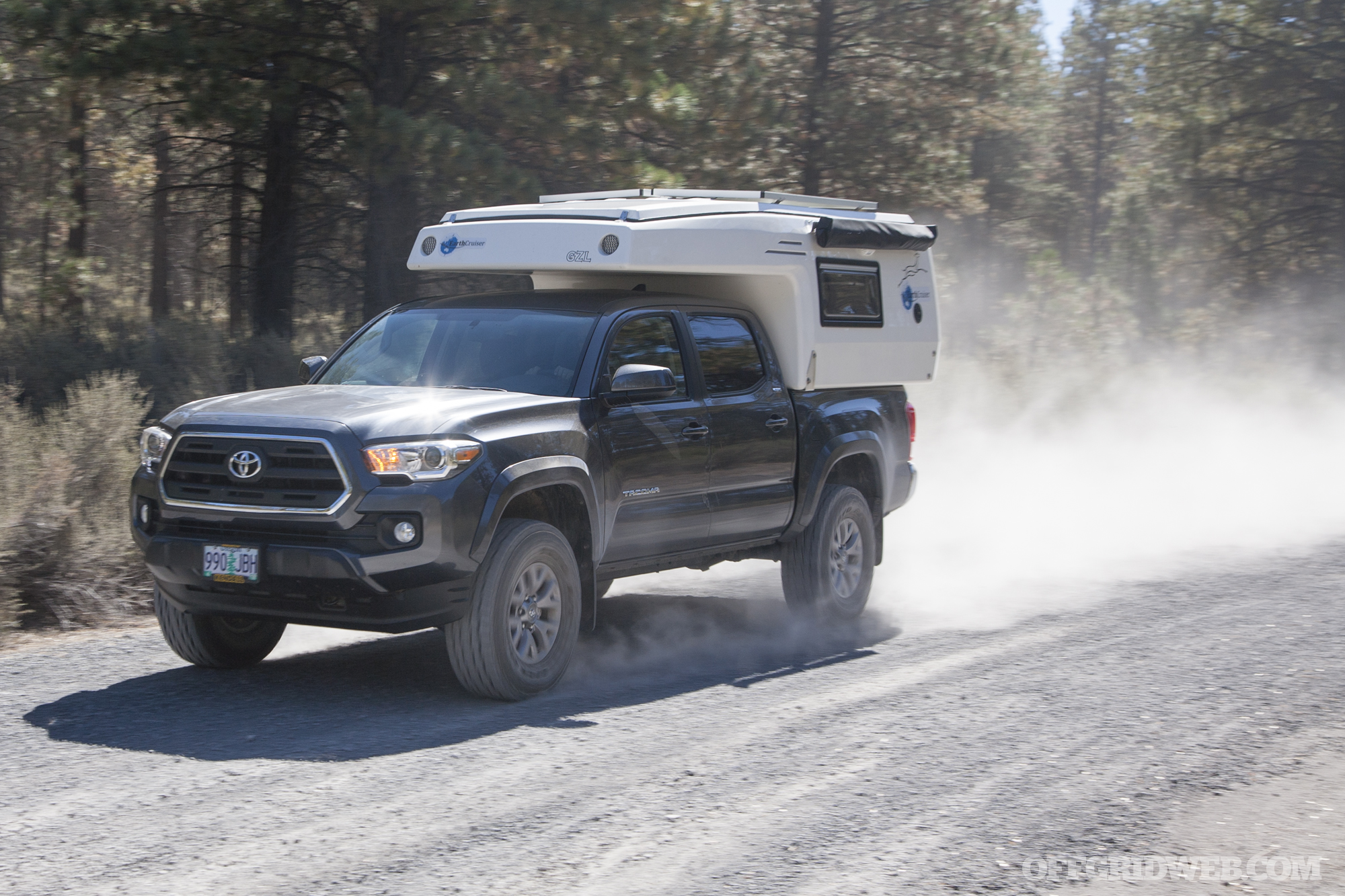
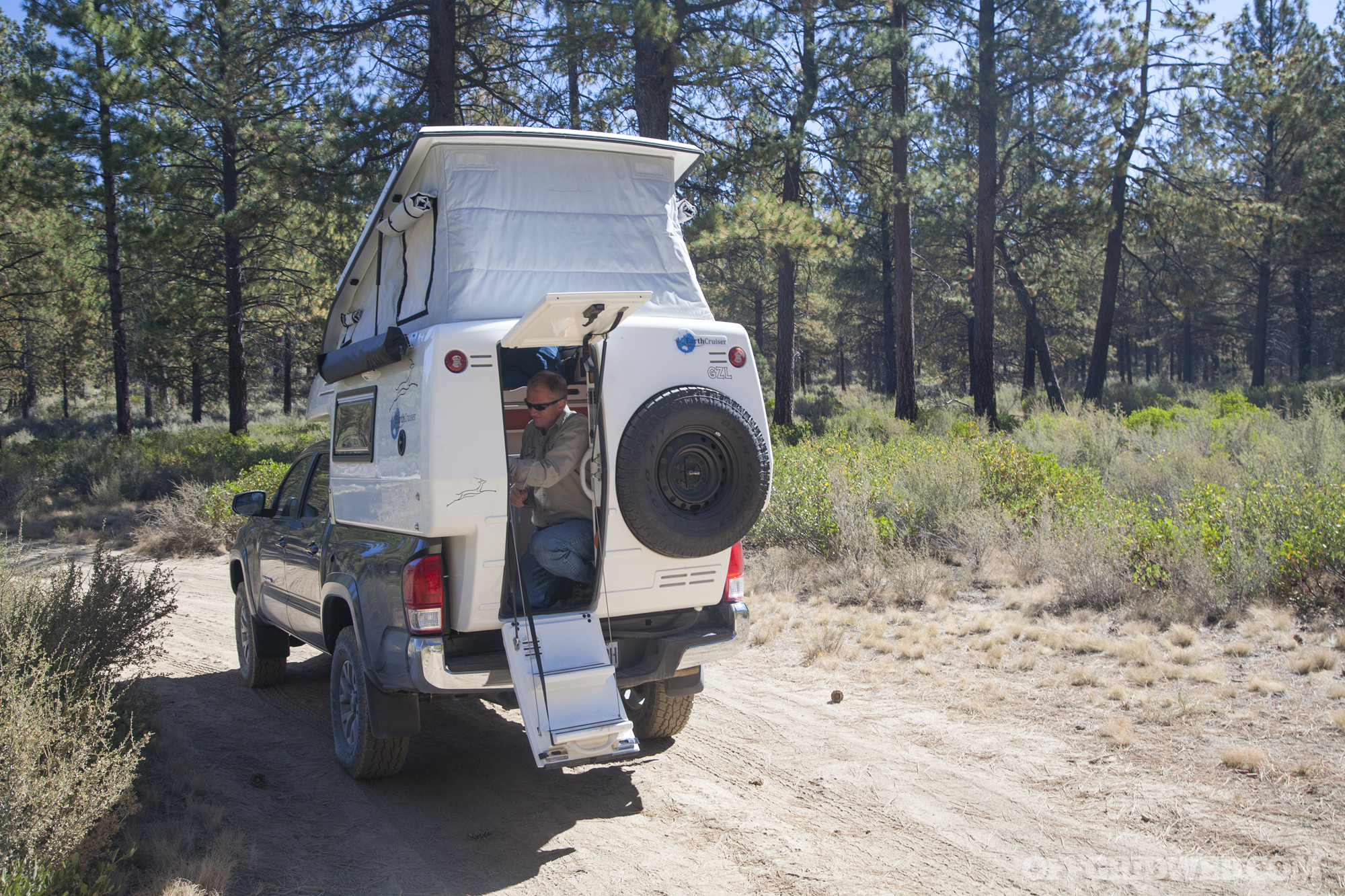
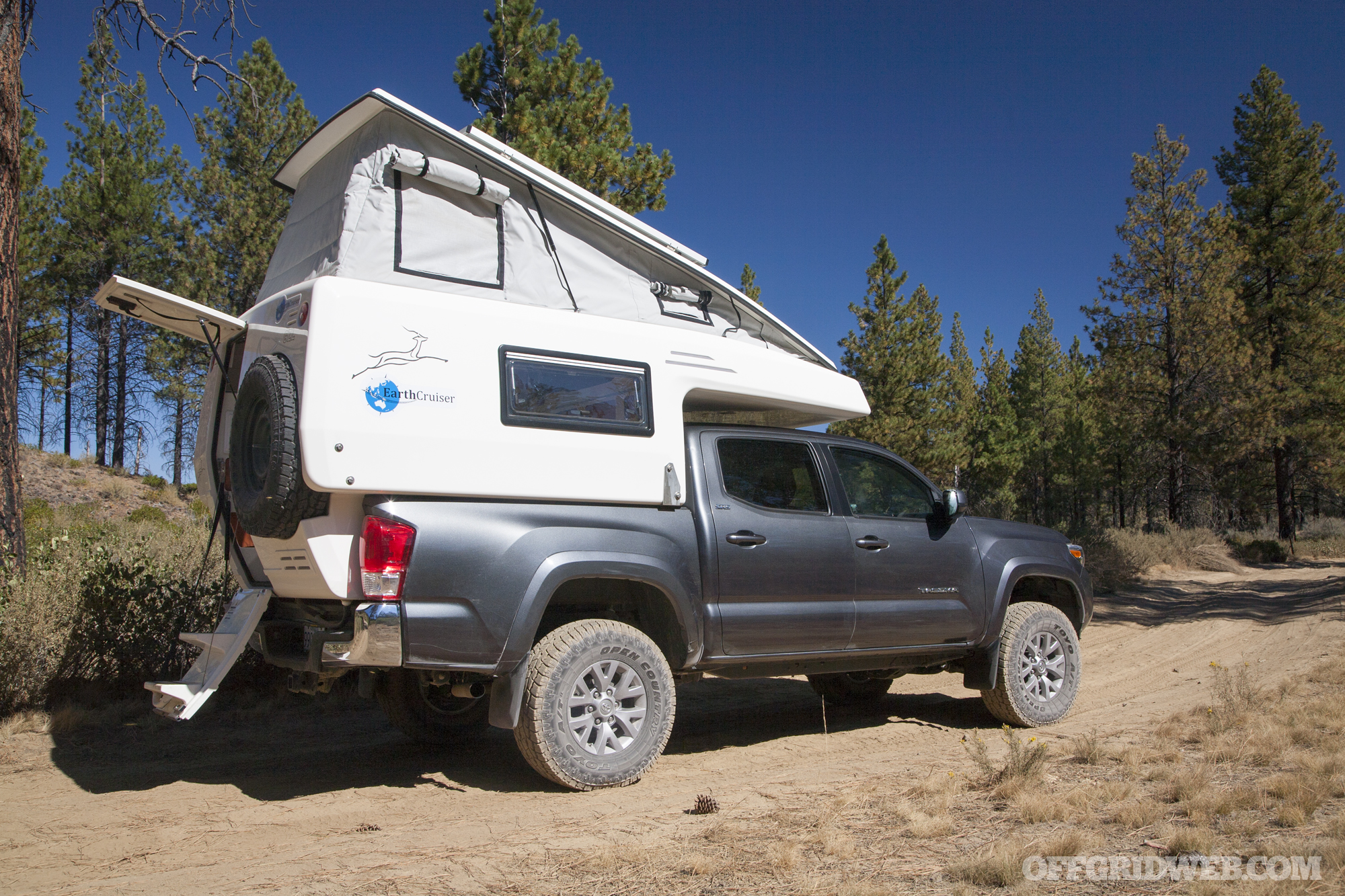
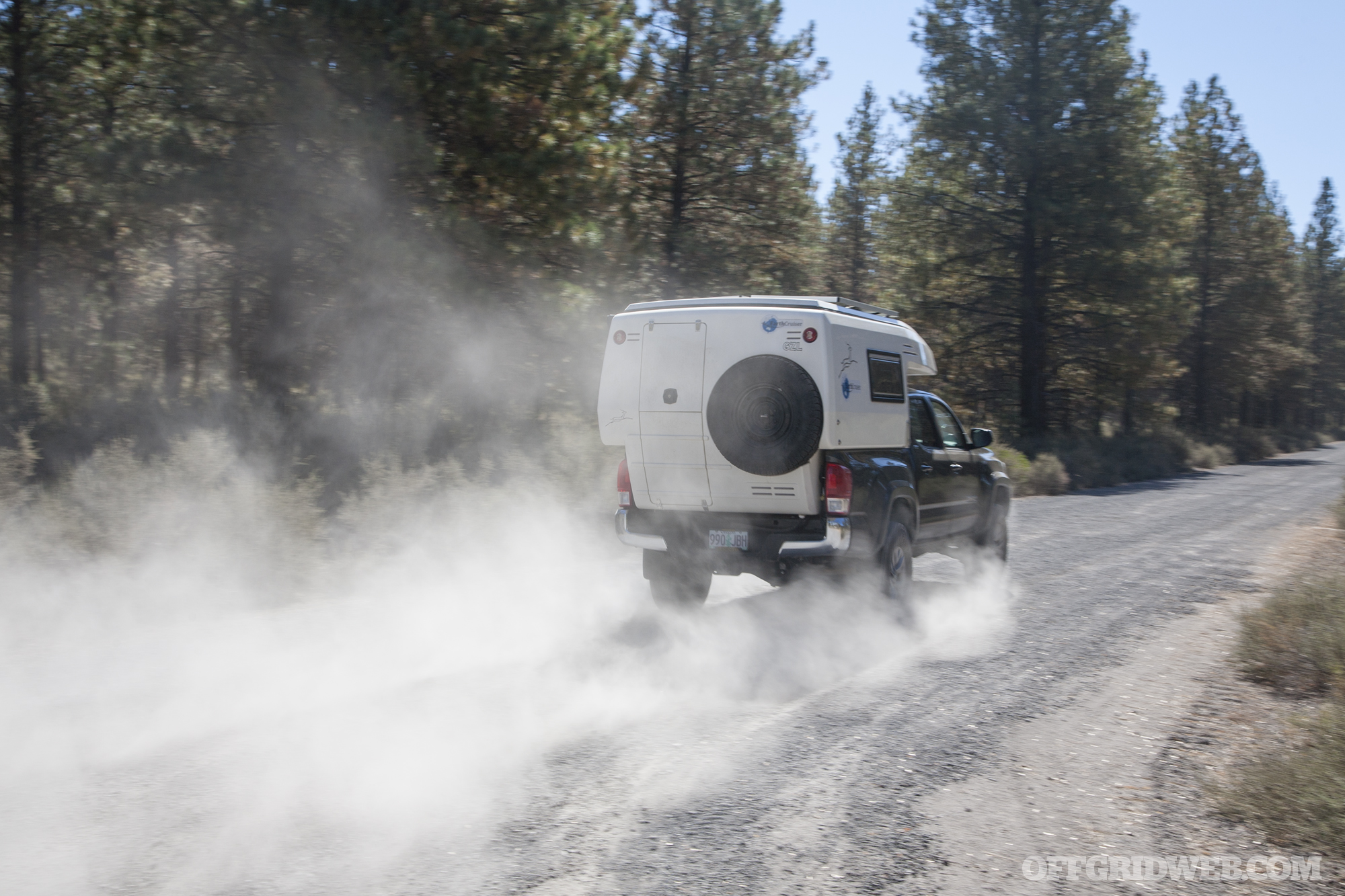
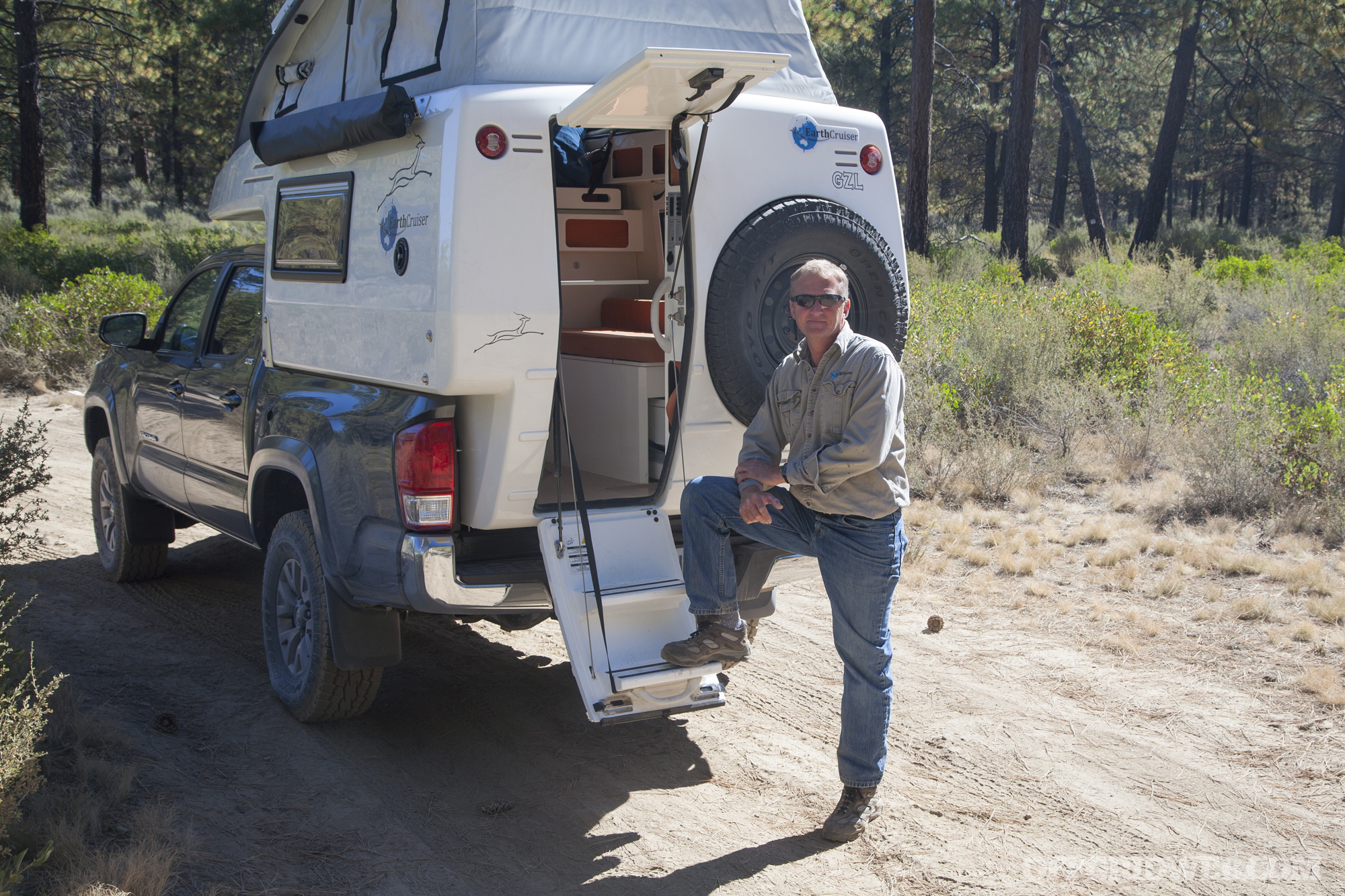
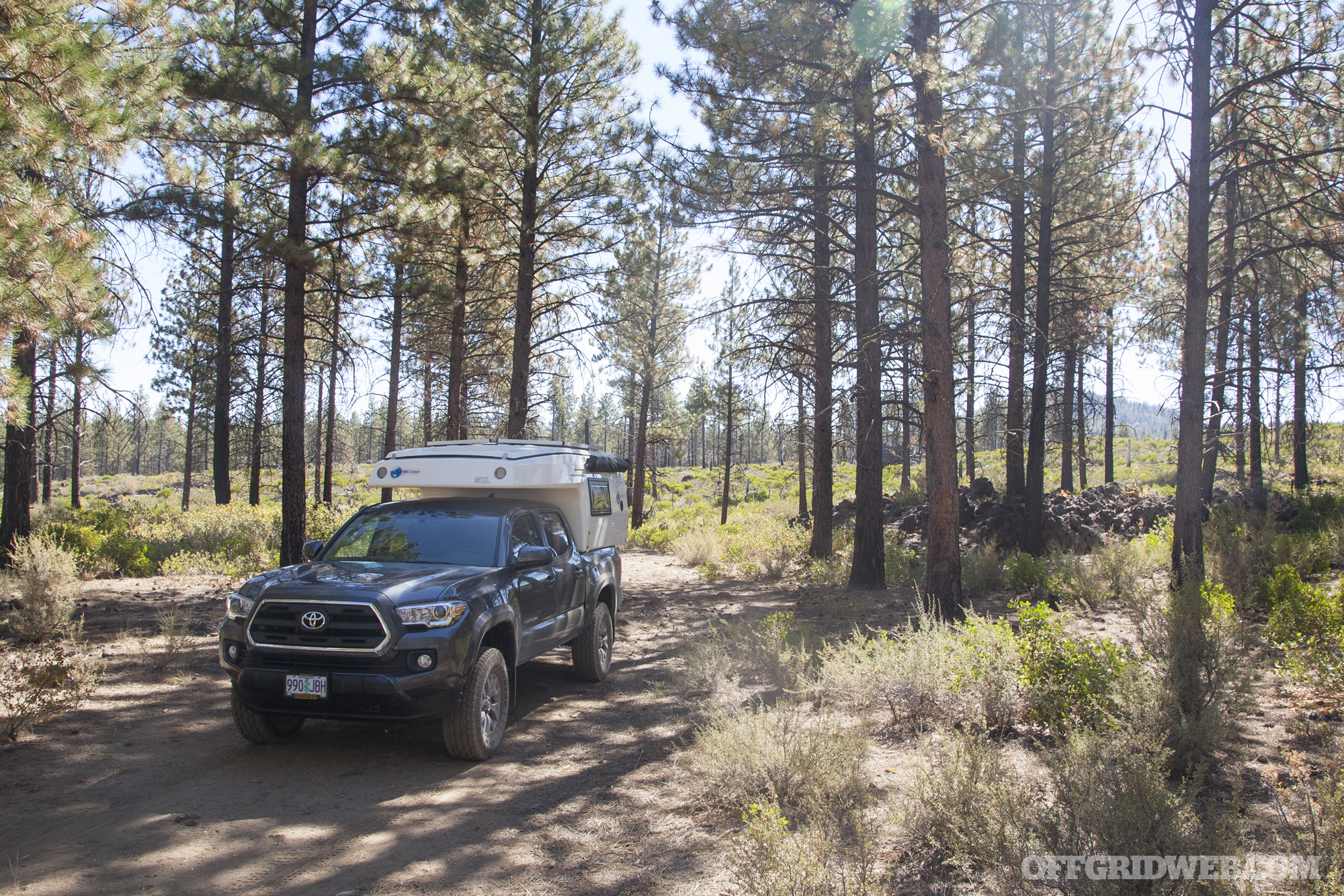
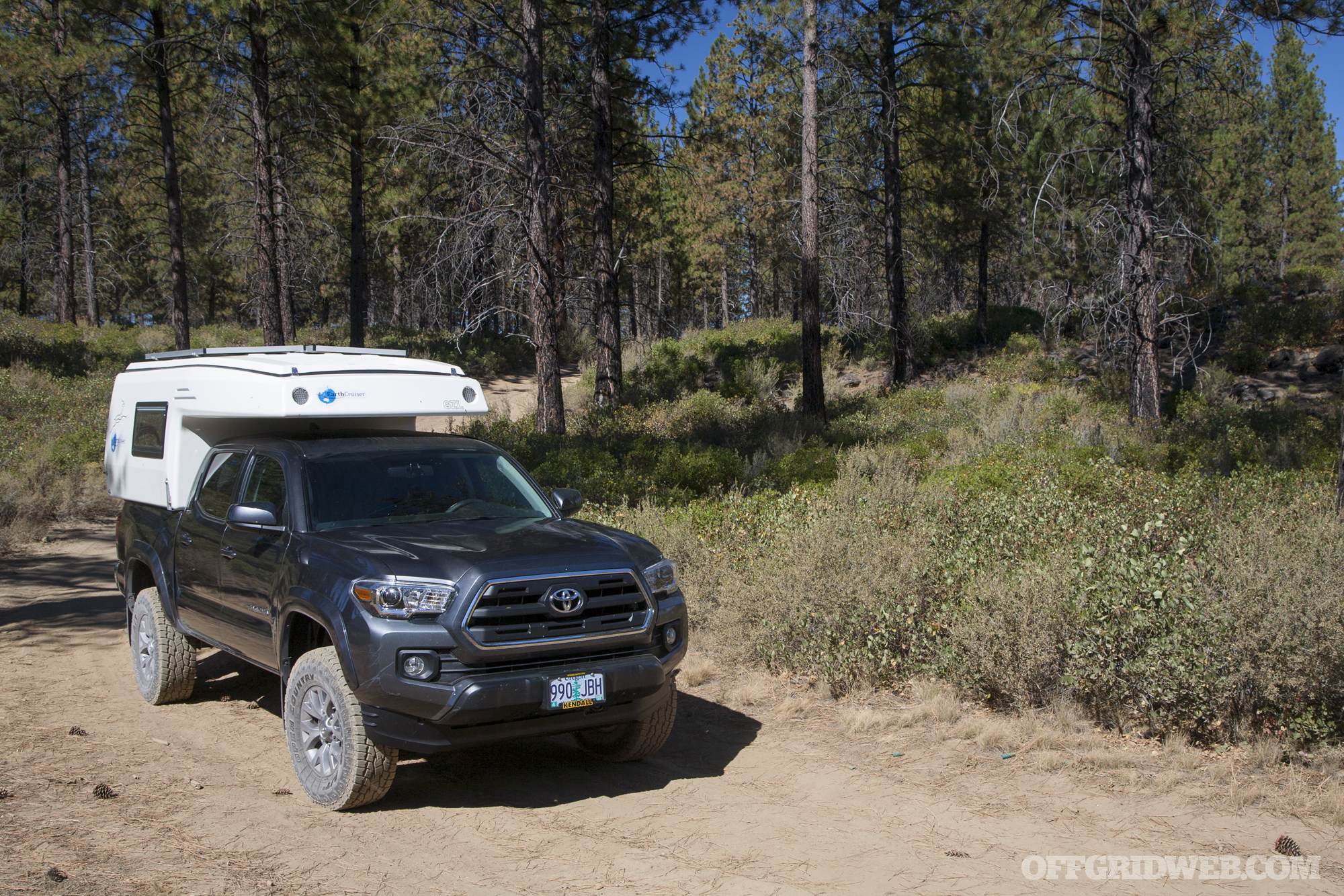
We checked out one of the first examples of the EarthCruiser GZL-300, mounted on a Toyota Tacoma Double Cab with 5-foot short bed. It’s also compatible with other mid-size trucks such as the Chevy Colorado/GMC Canyon, Dodge Dakota, Honda Ridgeline, Nissan Frontier, and Ford Ranger (here’s a full compatibility list). A GZL-400 model is also available for full-size trucks like the F-150, Silverado/Sierra, Ram, Tundra, and Titan.
GZL-300 Exterior Features
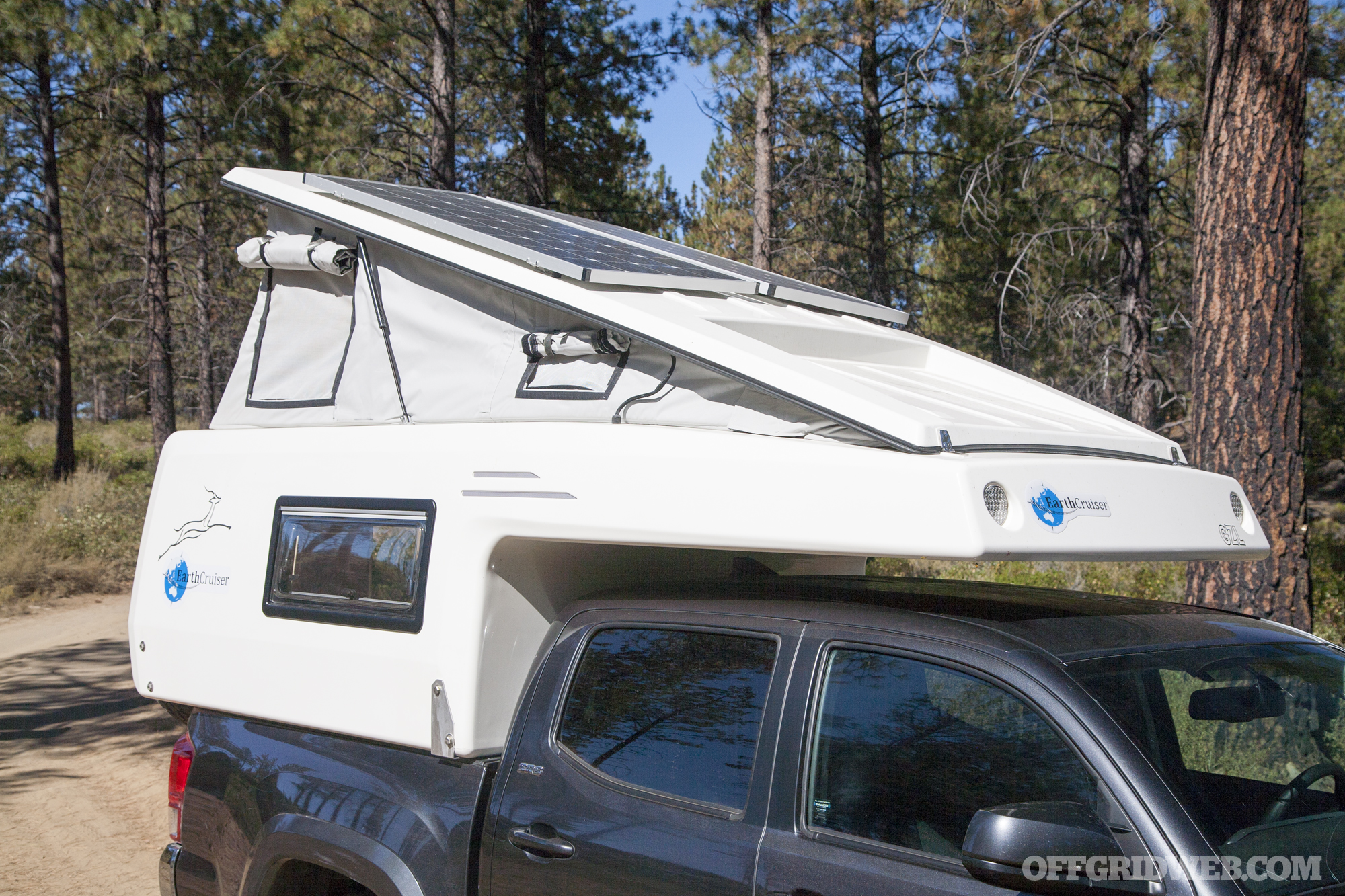
The EarthCruiser GZL is built around a fiberglass monocoque shell layered with 20mm (0.78″) insulation. It measures approximately 11’8″ long by 6’4″ wide by 4’9″ tall with the roof closed, and weighs just 900 pounds wet (i.e. fully loaded with water, propane, and batteries).
That’s practically featherweight, considering other truck campers can weigh more than three times this much. It’s also well within the carrying capacity of the Tacoma, so modified rear springs and other suspension upgrades shouldn’t be necessary. Gillies told us the truck in these photos was fitted with upgraded shock absorbers, but that was only to improve ride quality and smoothness — it’s not mandatory.
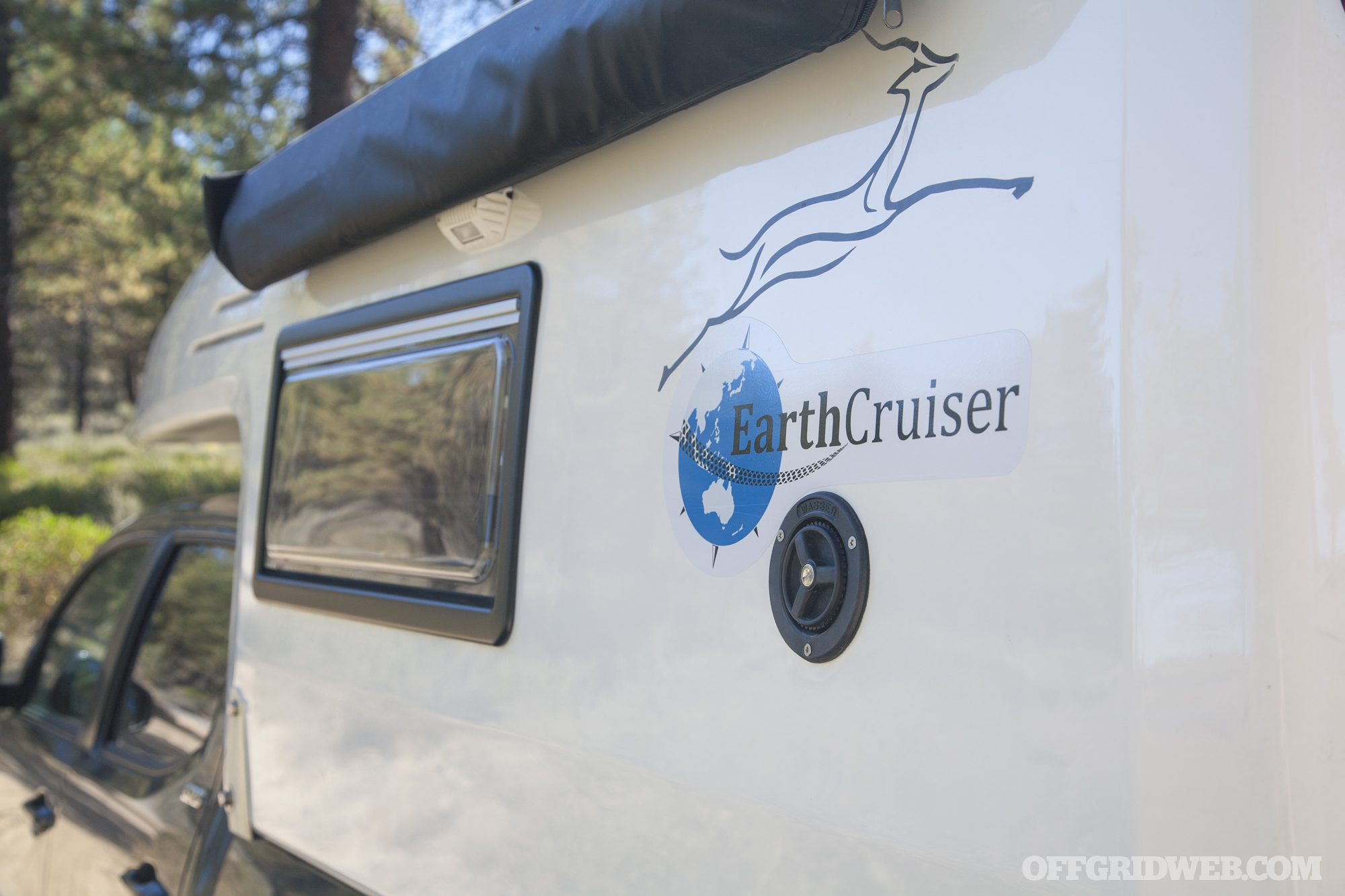
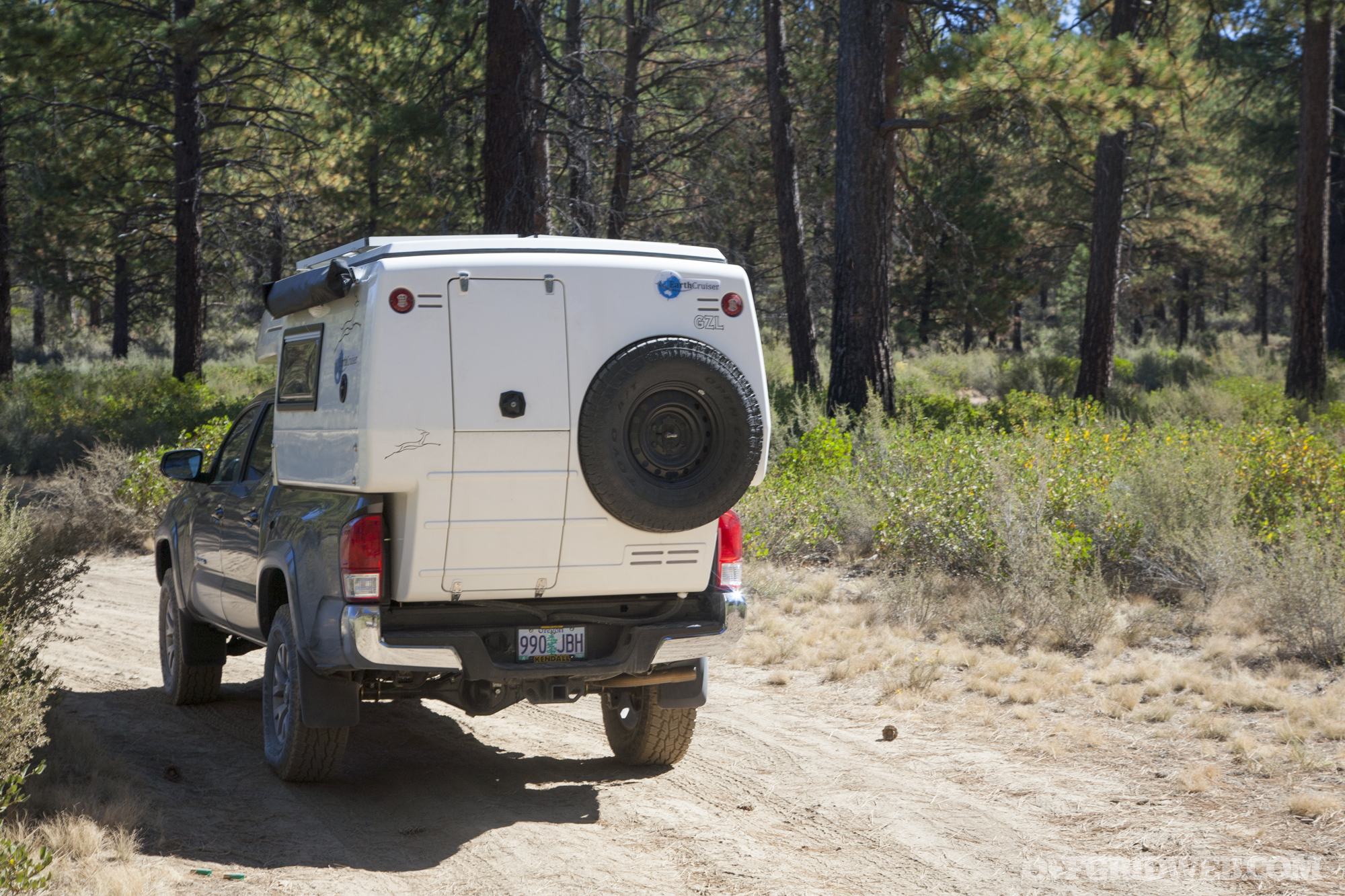
Other standard exterior features include dual side windows, a spare tire carrier, 6.5-foot roll-up side awning, two 100-watt Zamp solar panels, and a pop-up roof (more on that later). A roof rack, camper jacks, and storage extension for long-bed trucks are also available options.
GZL-300 Interior Features
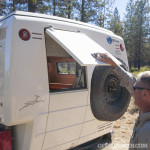
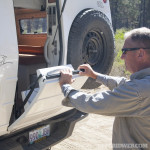
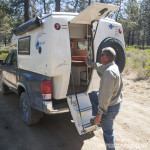
Opening the EarthCruiser GZL-300 consists of three simple steps:
First, the upper half of the rear door is opened, and swings upward thanks to an automatic gas strut. Then the lower section is opened, revealing steps to enter the cabin. The user steps inside and releases the pop-up roof, which rises automatically on another pair of gas struts. If this still sounds like too much work, EarthCruiser has developed an optional power roof lift, which will be available in Fall 2017.
The fabric pop-up section offers more than enough space to stand comfortably, with 6’11” of headroom at the highest point. It also includes more ventilation windows with curtains and rain fly flaps.
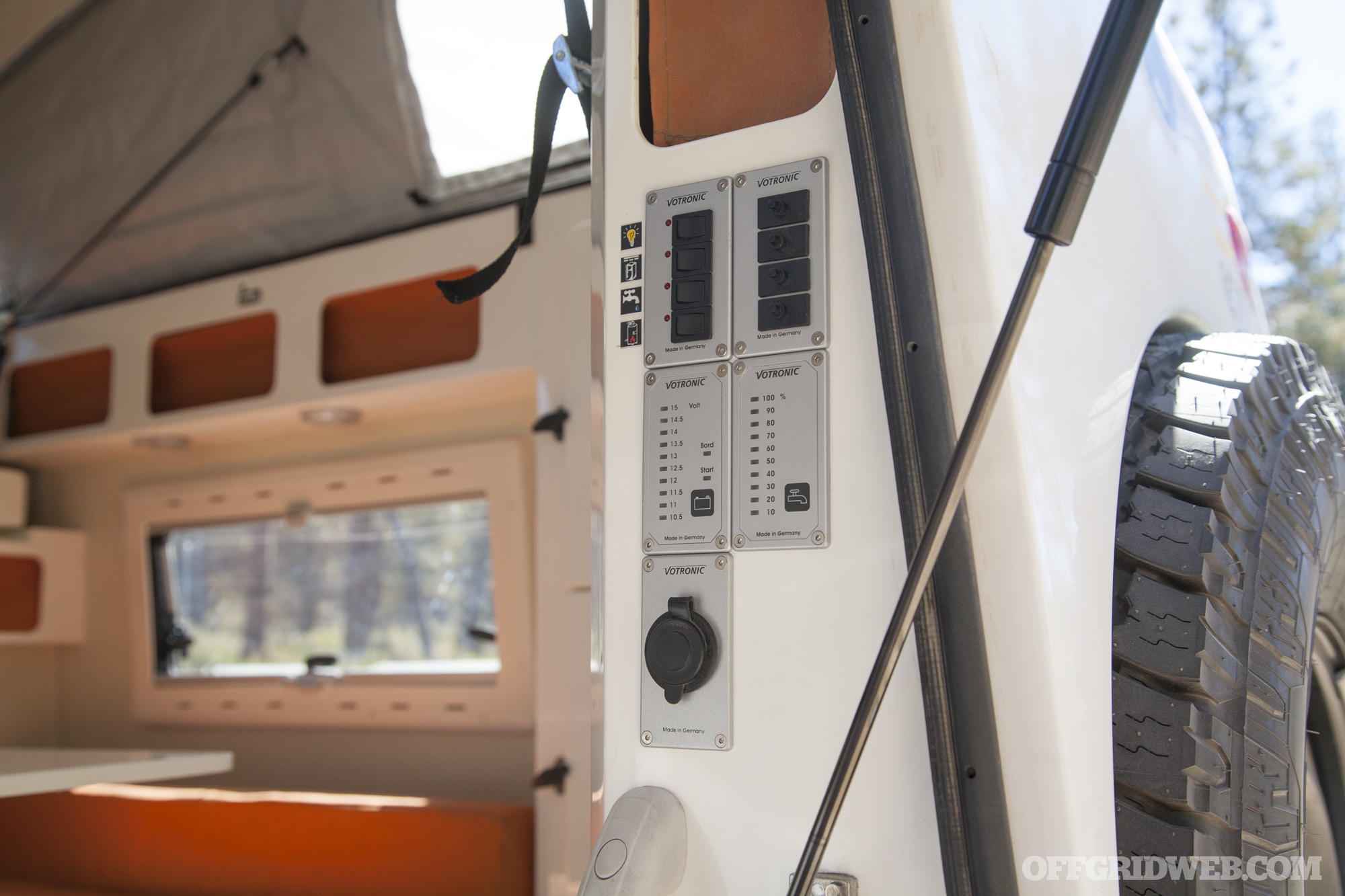
A panel on the doorframe reveals controls for the lighting, refrigerator, water, and water heater, as well as battery voltage and water level gauges.
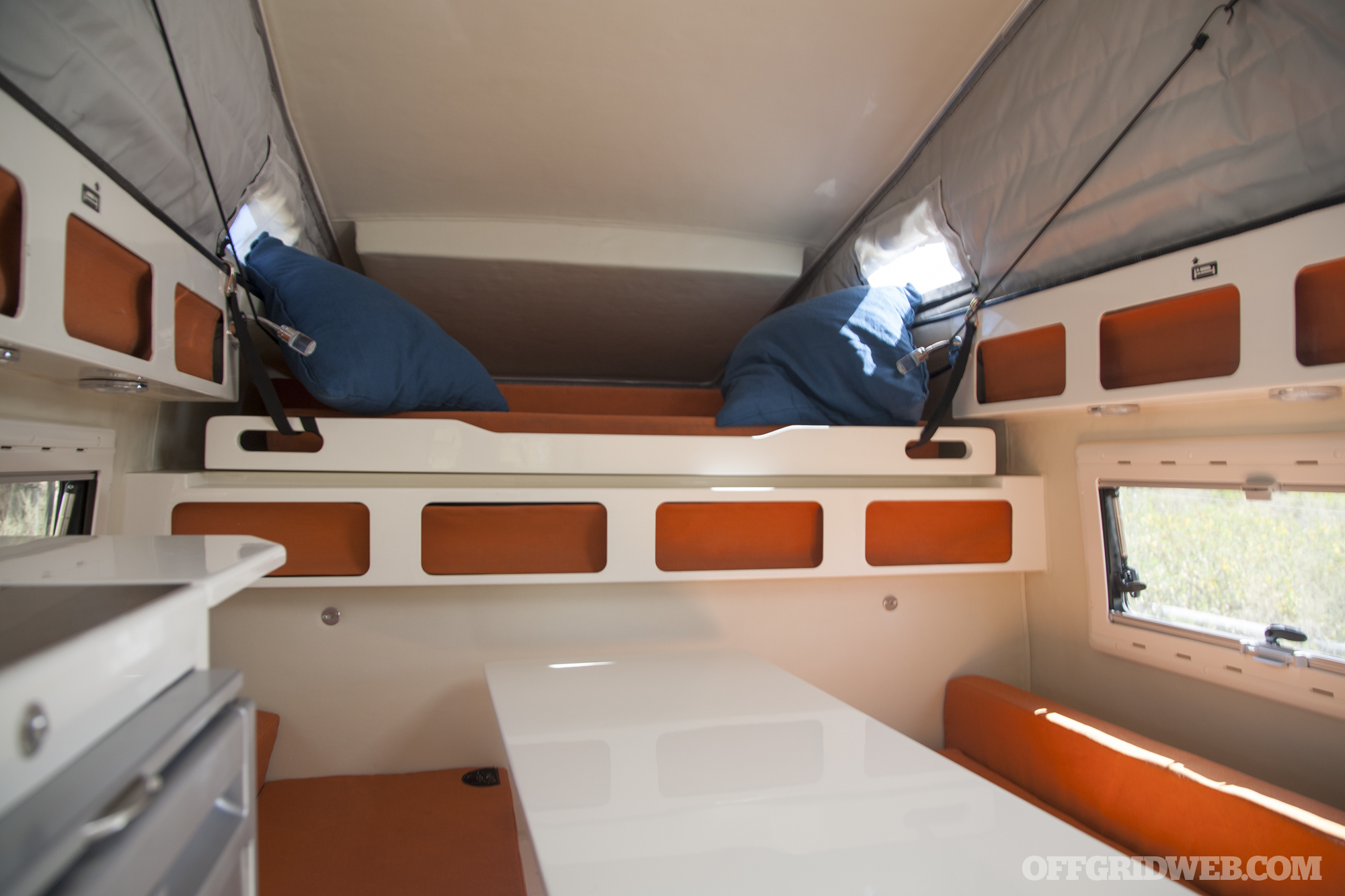
The interior space is compact but well-utilized, with a table and two opposing bench seats in the center of the living area. This area is flanked by overhead storage cubbies and LED lights.
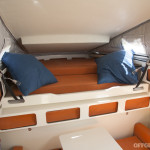
The shelf at the far end of the cabin is the sleeping area, with a tray that pulls out above the dining area to form a bed. Support straps with metal hooks ensure the bed stays securely in place.
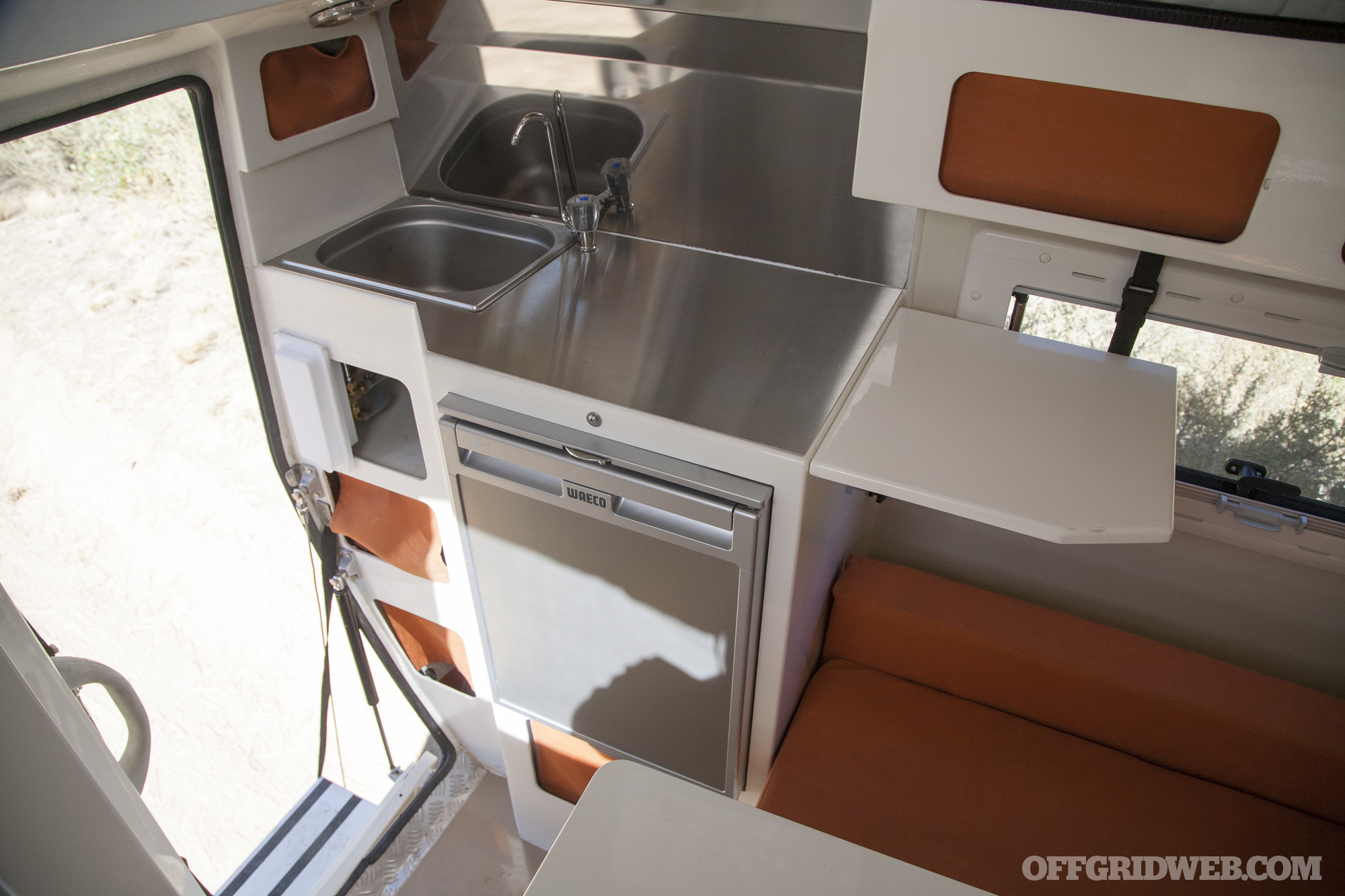
The driver’s side rear corner of the camper contains a sink, stainless steel workspace, and a small 1.5-cubic-foot refrigerator. The opposite corner provides a pantry area with storage cabinets, and a fold-down 2-burner cooktop that’s connected to the onboard 3-gallon propane tank.
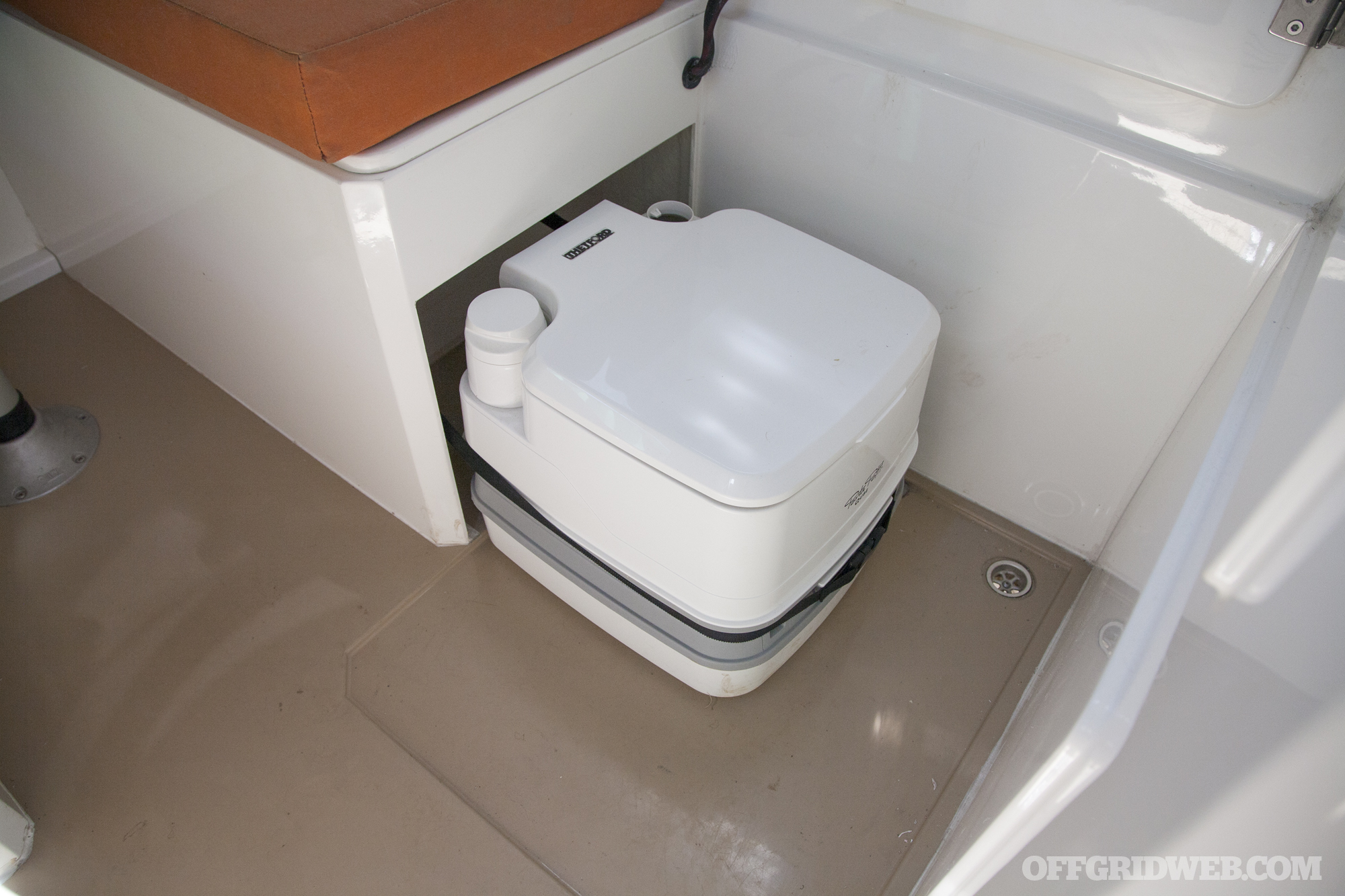
Beneath the passenger-side bench seat, there’s an optional pull-out toilet, and a recessed floor space that serves as a shower area. The shower (like the sink) is fed by a 22-gallon fresh water tank and 2.6-gallon water heater, and empties into a 9-gallon grey water tank.
Other interior options include a water purification system, Bluetooth stereo, outdoor kitchen system, and electrical upgrades such as an additional 90-amp battery and 1600-watt power inverter.
Conclusions
There’s no question in our minds that the EarthCruiser GZL camper would make an excellent addition to a mid-size bug-out truck like this Toyota Tacoma. It’s comfortable, easy to set up, and it offers lots of room for gear organization and storage. We appreciate the inclusion of standard solar panels and an optional water-purification system for long-term use away from civilization.
Most importantly, the GZL’s light weight won’t over-burden your truck’s factory suspension. This means you’ll still be able to tackle difficult trails, have a comfortable ride, and retain enough cargo capacity to load up several hundred pounds of other gear without exceeding your truck’s carrying limitations.
However — you were probably expecting this by now — all these features come at a substantial cost. The EarthCruiser GZL-300 starts at a little over $36,000, with a $5,000 up-front deposit required.
That means that you’ll probably end up paying a higher price for the camper than you did for the truck it’s riding in. For reference, MSRP for a new Toyota Tacoma like the one in these photos is approximately $34,000. Everyone’s financial situation is different, and if you’re fortunate enough to be in a position to afford a camper like this one, we have no doubt that it’d make one heck of an awesome bug-out hideaway.
For more information about the EarthCruiser GZL-300 truck camper, go to EarthCruiser.com. If you’ve got a full-size truck, or want to purchase a complete 4×4 expedition vehicle for globe-trotting adventures, EarthCruiser can also accommodate those needs.
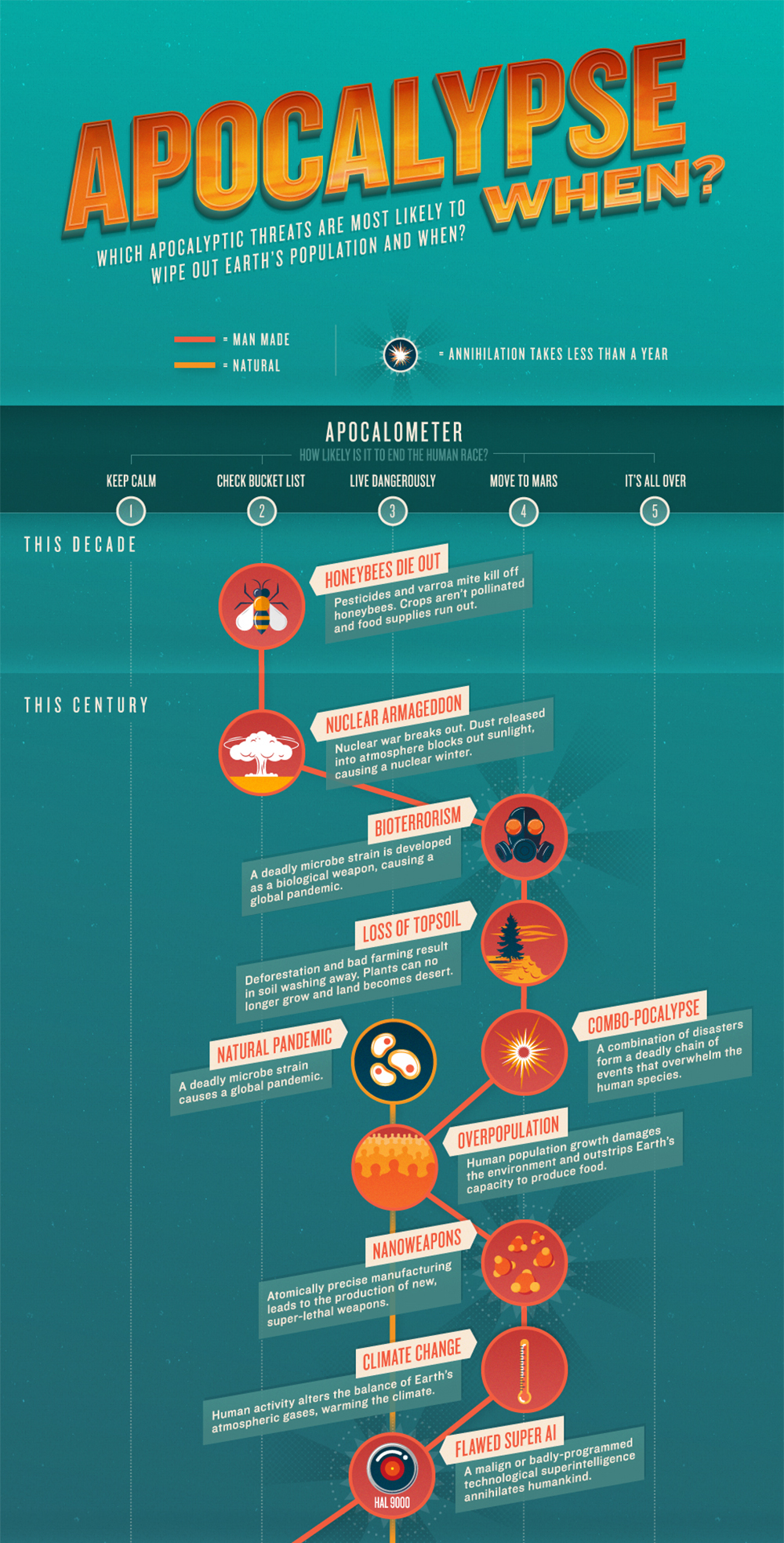
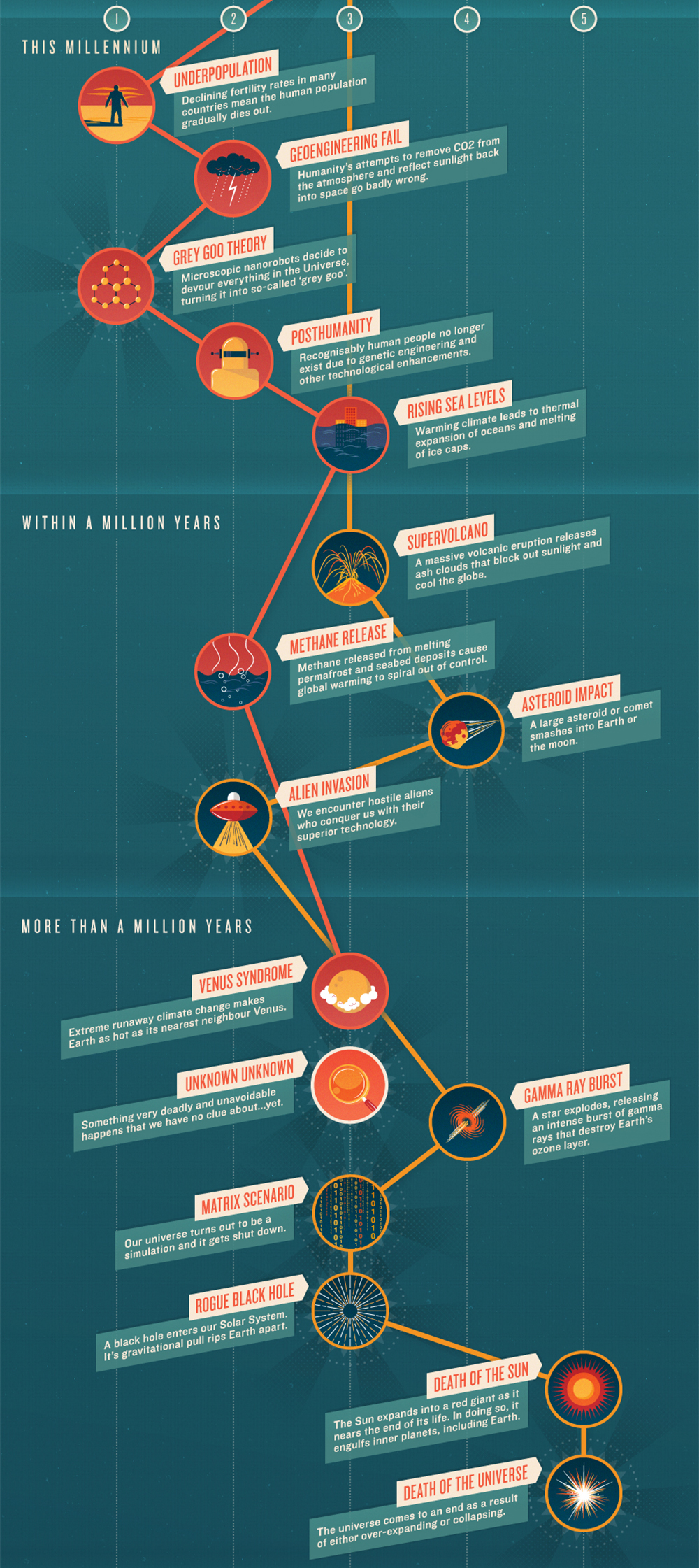
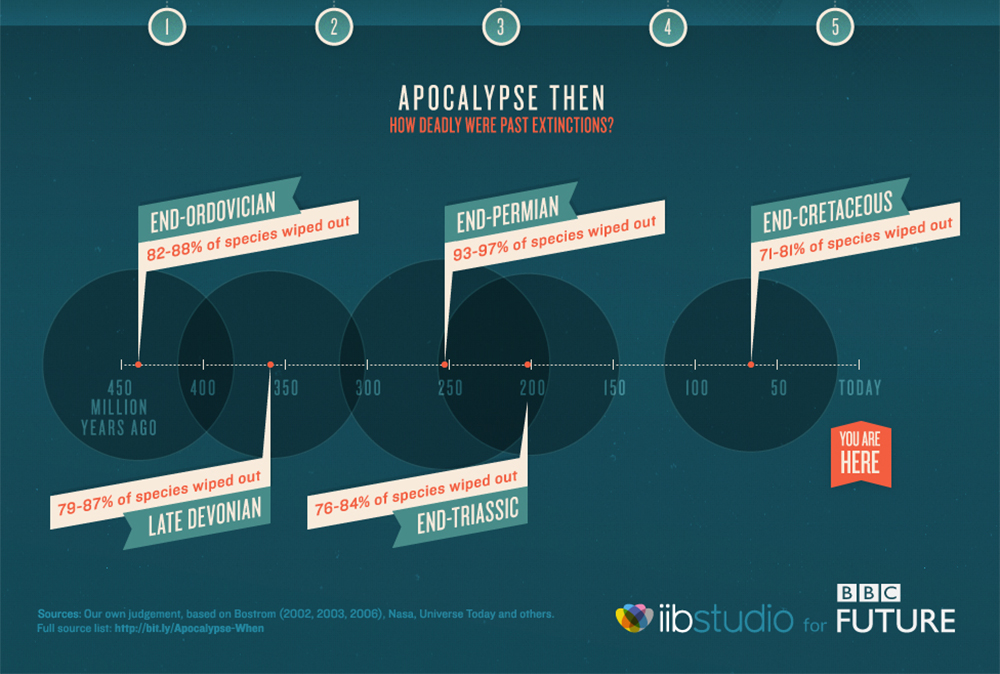
How will the world end? And more importantly, when will it occur? Unless you’re Kyle Reese, traveling back in time to warn humanity of the coming rise of genocidal robot overlords, these questions are impossible to answer definitively. However, it hasn’t stopped scientists from speculating and making predictions about the likelihood of apocalyptic events.
BBC Future has compiled the following infographic, known as Apocalypse When?This graphic creates a visual ranking of world-ending events, and their estimated likelihood based on current scientific theories. If you’d like to view a full list of sources and statistics used by the BBC to create this graphic, you can do so here.
Check out the infographic below, or click here to download a full-size version. Then take our poll at the end of this article to let us know which of the BBC’s top ten ranked apocalyptic events (if any) you think is most likely to occur in the next 100 years.
So, what do you think of the ranking of the world-ending threats in this infographic? Let us know in the following poll:
As a law-abiding citizen and a trained gun handler, I, like you, am obligated to carry wherever the law permits. It’s my duty to protect and serve. It’s my duty to protect myself and my loved ones — and to serve my community. And, at the end of the day, you are your own first responder.
But let’s suppose you’re not carrying when sh*t goes south. How do you survive a mass shooting? Whether it be an ISIS fanatic or a lunatic with too many prescription meds flowing through his bloodstream, what steps can we take to avoid becoming a victim?
I travel nearly every weekend to various states. My concealed carry permit gives me reciprocity in 36 states. But, when I’m in the Dark Blue States, I follow the law and don’t carry. And, I’m conscious of it wherever I travel. Your everyday Larry Lunchmeat and Joe Bag O’Doughnuts doesn’t think about safeguarding himself or his loved ones until he has to. Those of us who carry everywhere are way more cognizant than when we’re not. But we can’t carry in schools, banks, bars, courts, and airports. And we can’t count on the likes of a TSA agent to save the day when sh*t hits the fan.
There’s no simple serum solution to this quandary. One’s attitude, aptitude, desire, level of training, situational awareness, wits, and moxy may steer the scenario in different directions. We have to rely on our wits and default to our best level of training.
Move, Move, Move
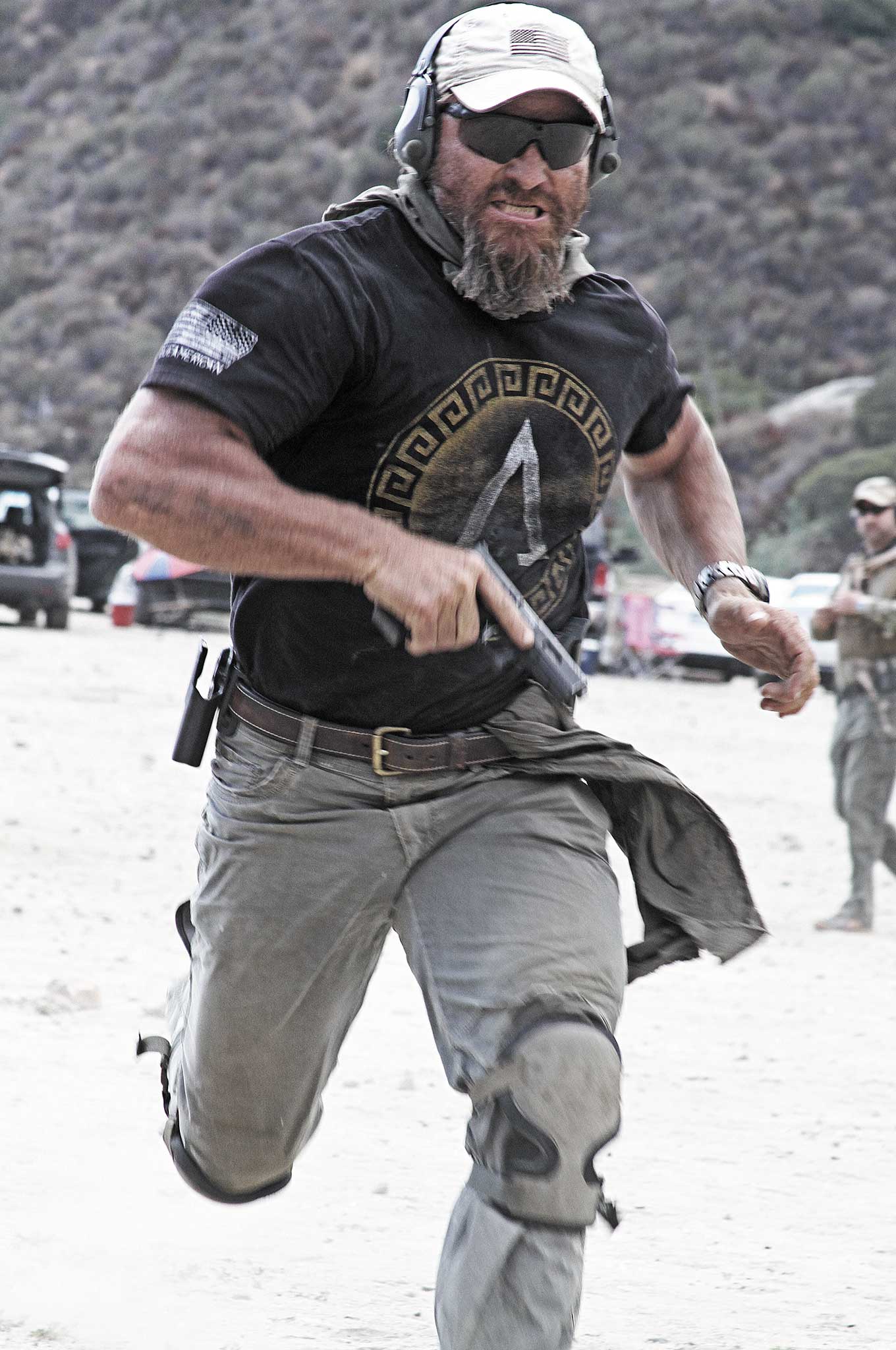
A common denominator, however, is mobility. Hunkering down and praying not to die (or hoping to get lucky) aren’t viable options — unless dumb luck is your solution to survival. It’s easy for a nutcase to kill someone execution-style when your head is between your legs in the fetal position.
Sometimes, we have to put the analytical mind aside and allow the body to work as it has for millions of years. We must access the brain’s primal side. We’re human beings born with natural defense mechanisms. We must give the mind permission to allow these mechanisms to work automatically. We humans have been here a long time, and though we’re no longer hunting mammoths and dodging saber-toothed tigers, danger lurks around the corner.
Here’s a tip: Ditch the flip-flops. They’re for the beach or the backyard barbecue. You’re no good to yourself or your loved ones if you can’t run your ass off. Our primal survival instinct is mobility — and mobility equals survivability.
Scan and Plan
Many of us have relinquished our primal survival instincts, becoming fat, flaccid, gelatinous, button-pushers stuck in a 45-degree-syndrome world. And by that I mean head oriented 45 degrees at our smartphones. Too often I find myself on a people-mover at an airport or a shuttle bus heading to the rental car counter, and I’m literally the only one looking around. Everyone else is completely oblivious to his or her surroundings. So, too often, I say to myself, “Well, looks like I’m in charge of security.”
For those of us with our wits about us, try to see things in full spectrum. Perform a focal shift in your everyday life.
Look around. Slow down before you enter a building or other venue and observe the people in your proximity. Examine what’s close to you, and then continue your scan further. Perform a “5 and 25” — scan 5 meters around you then out to 25 meters. It’s OK; you were born to do this. It only takes a second.
A successful assault happens with surprise, speed, and violence of action. We can mitigate the surprise by tuning in and being situationally aware. Look for any demeanor that’s out of whack. If you take the element of surprise away from a would-be attacker, perhaps he may fear reprisal and forgo the attack.
Whether I’m armed or unarmed and enter a venue, I do the same thing. I consider it a possible crisis site. First, I get a pretty good lay of the land. Exits, avenues of approach, choke points, intersections, safe areas, alternate routes, and lines of drift are all stored in the data bank. I give people a once over and look for potential assets and liabilities. I visualize chaos. I picture complete bedlam with everyone running for the same exit.
Often, people don’t plan to fail, but they do fail to plan, so this process of visualization becomes a crucial step in disaster preparation. We must mentally prepare ourselves to exit without hesitation, if exiting is the safest recourse — even if it means throwing a table or chair through a window, which may be your best option. When pandemonium strikes, there’s no time for analysis. Through analysis comes paralysis — hence the importance of preparation.
Pay attention, look around, and always have a plan in mind.
Agent in Charge
If you’re with your kids, ditching the scene of chaos is non-negotiable. You’re the agent-in-charge of your own personal protection detail, and those kids are your principals. Steer them in the right direction, and give short, clear, concise commands.
When I’m with my kids, I make sure they know where we’re parked in reference to the inside of the venue, whether it’s the mall or the state fair. I make periodical en route checkpoints with them and make sure that they’re oriented to exits. I ensure they know which one gets us to our vehicle the quickest. I don’t need my kids to become liabilities if things go to pot.
If gunshots ring out or an explosion shakes the ground, running along with the rest of the “sheeple” may not be the best course of action. Don’t be victimized by an ocean of people who have their heads up their asses. Lines of drift and likely avenues of approach may be part of a plan with a well-organized adversary. The bad guy may use a ruse or diversion to send the herd in a desired direction. Exercise your OODA (observe, orient, decide, and act) loop and come up with a quick plan of egress.
Sometimes, flanking or egressing at an oblique increases your survivability. Run until you’ve made it past effective small-arms range or have some good cover. Then take a second to assess the situation and to readjust your plan.
If you feel barricading yourself in a safe room is your only option, tie the door shut or wedge the handle. Don’t just put something heavy in front of the door that can be pushed out of the way. Keep quiet and stay out of the line of fire. Look for a corner, but don’t put too much separation between you and the door. That way, if the adversary breaches your barricade, you can quickly close the gap and tie him up rather than giving him a clean shot at you from across the room.
Be an Asset, Not a Liability
Everyday schmucks with their eyeballs glued to their smartphones are myopic in more ways than one. They couldn’t spot a psycho with a shotgun if it were hanging a foot below his trench jacket. So it’s our job to protect and serve — however, priority goes to self and loved ones.
I know that I’ll look for an opportunity to go full Batman on a POS who disrupts my day. I can run like a scalded ape. I can differentiate between calibers of guns, have a pretty good idea on round count, and will look for a lull in the fight. At which time, I’ll close the gap with a flanking assault.
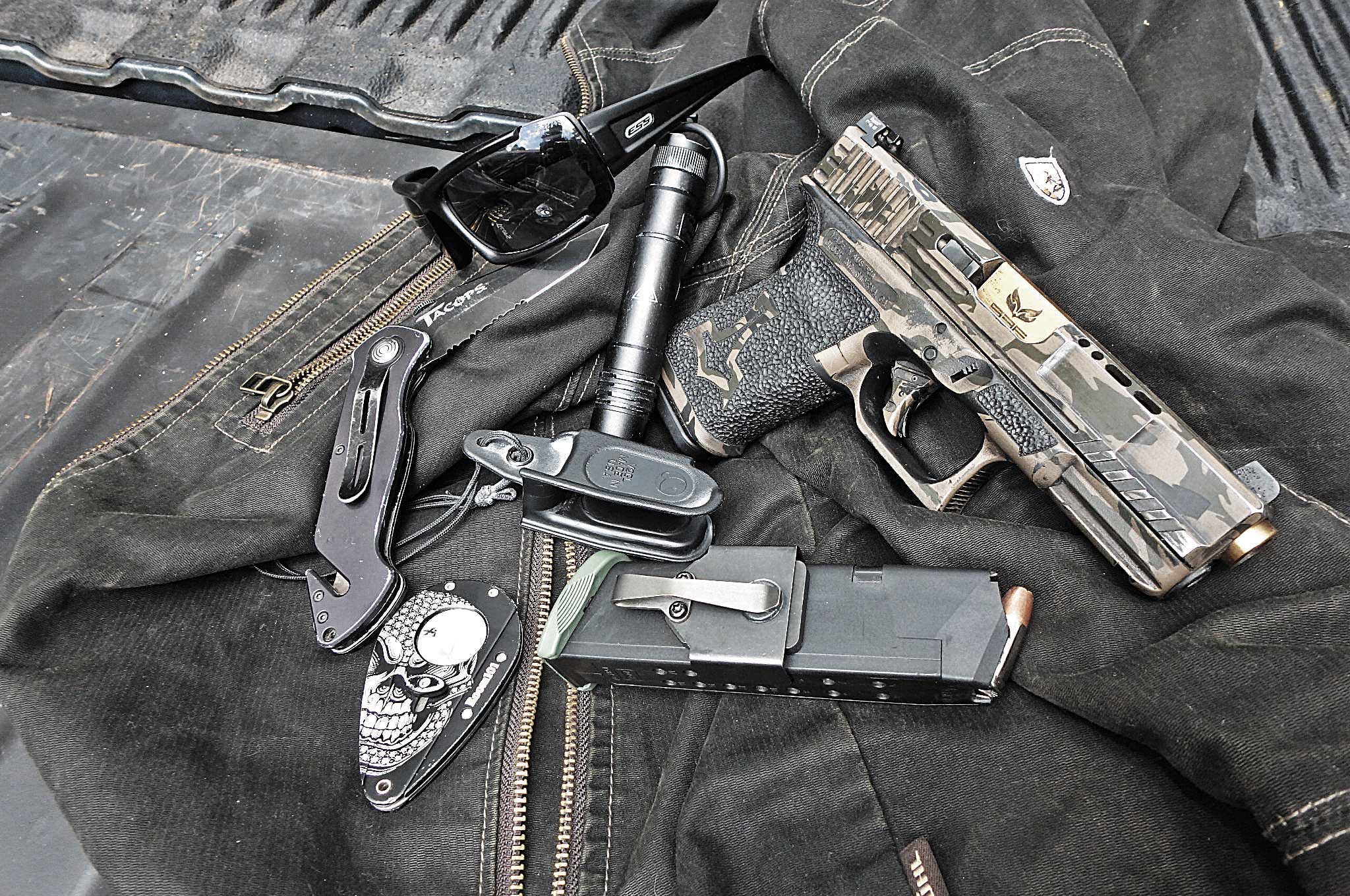
On-Body EDC: The author’s everyday carry ensures he’s always ready: SSVI Glock 19 with a Raven VanGuard holster; extra magazine with a NeoMag clip; 127-grain +P hollow-point rounds; Streamlight flashlight with an O-ring attachment; TacOps lock blade; and cigar cutter.
For me, carrying is habitual, and my EDC (everyday carry) is more than just a wallet and smartphone. I appendix carry an SSVI Glock 19 in a Raven VanGuard holster, along with an extra magazine with a NeoMag clip in my back pocket. The mags are loaded with 127-grain +P hollow-point rounds. I also carry a Streamlight flashlight with an O-ring attached to it for easier employment. My knife is a simple TacOps lock blade with a hook blade and window breaker. And the cigar cutter is for, well, just cutting cigars.
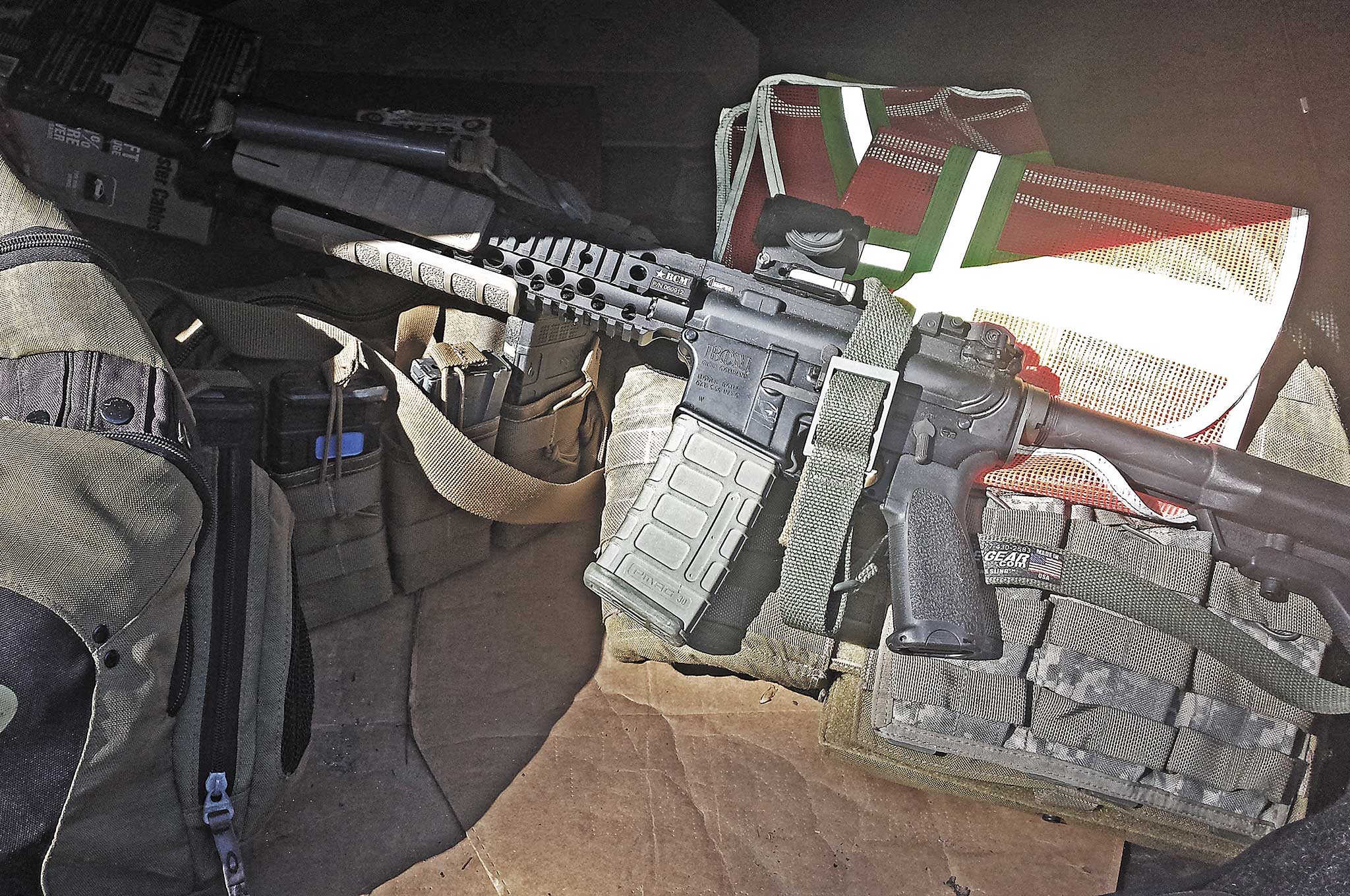
Additionally, I have an assault package in the trunk of my car, which includes a 16-inch AR. I have two bags. One I call a “Hey, I’m coming to get you” bag. The other I call the “I’m coming to get some!” bag. Inside the “I’m coming to get you” bag is basic survival gear in the event I have to assist in rescuing someone. The “I’m coming to get some!” bag is an over-the-shoulder bag with 10 30-round magazines. It also has water, oil, eye protection, hearing protection, grease pencils, and Sharpies.
Off-body EDC: Everyday carry doesn’t have to be limited to what you can clip to your belt. The author always stows two packs in his vehicle’s trunk: a survival bag with gear to rescue others and an assault pack with a 16-inch AR, extra loaded magazines, water, and other supplies. This stash also includes a bright orange safety vest.
Lastly, I have a huge bright orange safety vest that has a “Security” label on it. This is worn over everything, and is intended to give momentary pause to a rookie cop or another good guy when they see me. Yes, this is legal in my state.
It’s our duty and responsibility to protect and serve. If you’re a competent and trained gun handler, you should be carrying wherever the law permits — but never go outside the parameters of the law. And don’t be a nugget. Just because your state allows open carry doesn’t mean you should. That’s some amateur hour bullsh*t.
And remember, just because you have a gun doesn’t mean that you’re armed. Take proper classes, get proper training, and be an asset to your community rather than a liability. There’s more than enough of those already.
About the Author
Pat (Mac) McNamara has 22 years of special-operations experience, 13 of which were in the U.S. Army’s 1st SFOD-D (Delta). He has extensive experience in hostile fire/combat zones in the Middle East and Eastern Europe. He trains individuals in basic and advanced levels of marksmanship and combat tactics. He retired from the Army’s premier hostage-rescue unit as a sergeant major and is the author of T.A.P.S. (Tactical Application of Practical Shooting) and Sentinel. www.tmacsinc.com
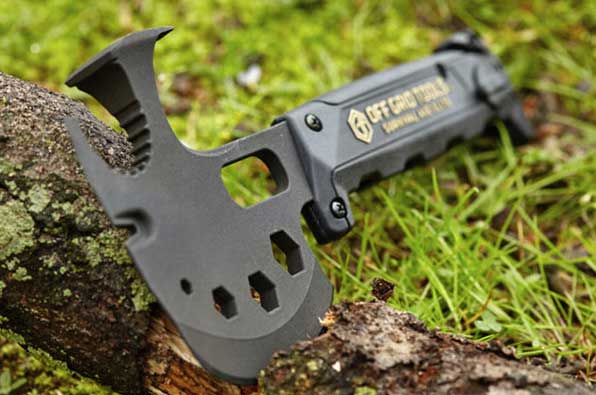
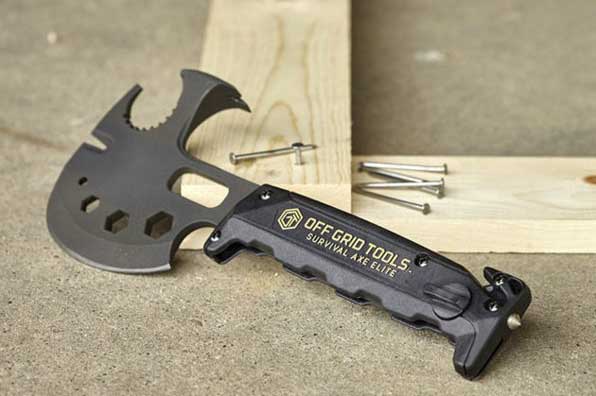
When you think of an on-the-go survival tool, a Swiss Army Knife or Leatherman might come to mind. Yet these popular tools can come up short in at least one crucial category. This Off-Grid Survival Axe dwarfs your pocket knife and most other mainstream survival tools when it comes to both power and functionality. Despite its simple use, it also offers a slew of life-saving and practical tools.
The ax’s main feature is, of course, its all-steel head—used for cutting rope, chopping wood, or anything else requiring more power than a multitool blade. Yet this ax is much more than a giant blade. There’s a hammer, pry bar, sharpened hook, nail puller, hex wrench, folding Sawzall blade, can and bottle openers, strap cutter, and more. It even features a glass-breaker on the bottom of its handle for extreme situations. The best part is that it’s now on sale for 25 percent off—get it here today.
There’s plenty we can’t prepare for — impending nuclear doom, for example. And then there’s stuff you can control, like these unique everyday-carry goods.
Blazing a trail through a dense jungle is a difficult task, and one that’s often accomplished by hacking and slashing your way into thick undergrowth. A long, tough, and sharp blade is essential in this setting. In the southern Philippines, a leaf-shaped blade known as the barong fulfilled this role.
Like the machete, parang, and kukri, the traditional barong design has subsequently been adopted by jungle-trekkers around the world, and has evolved over time. TOPS Knives general manager Craig Powell spotted some variants of the barong-style blade during trips to Costa Rica and Colombia, and on his return home, he decided to use them as inspiration for a new TOPS knife design.
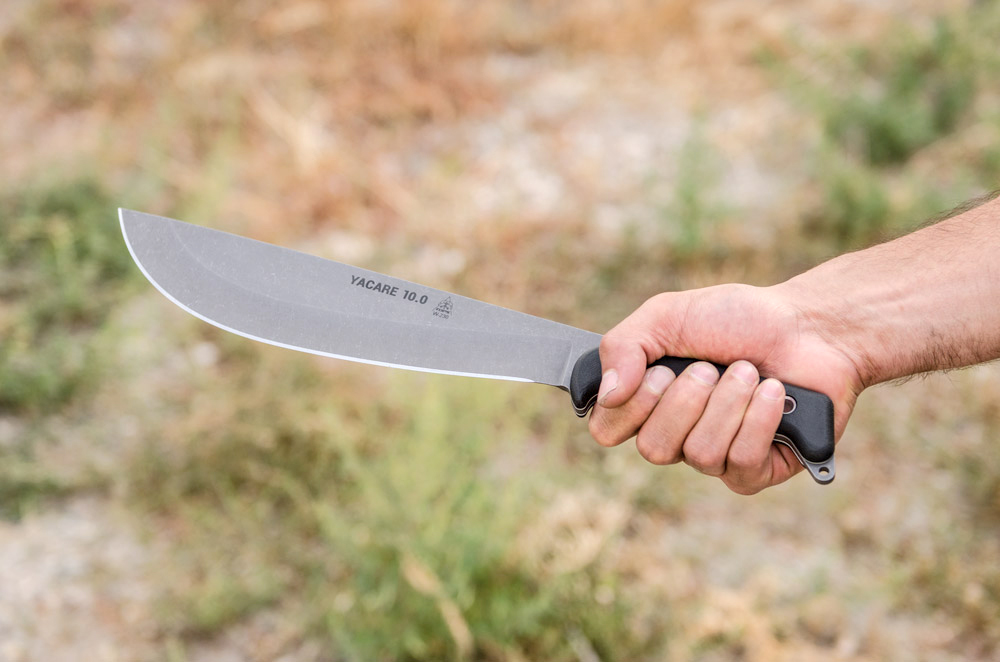
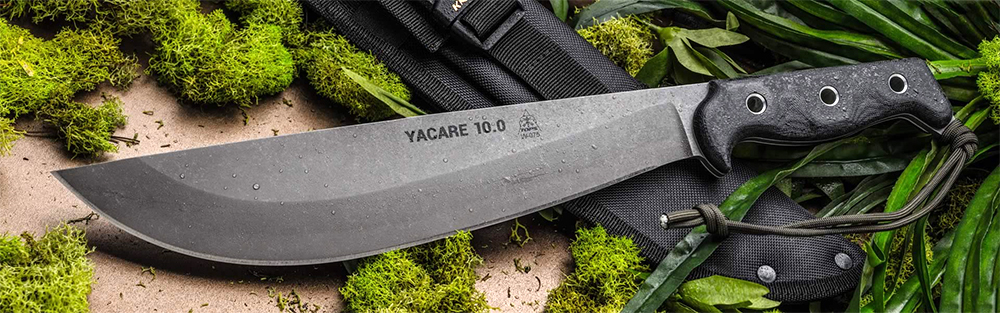
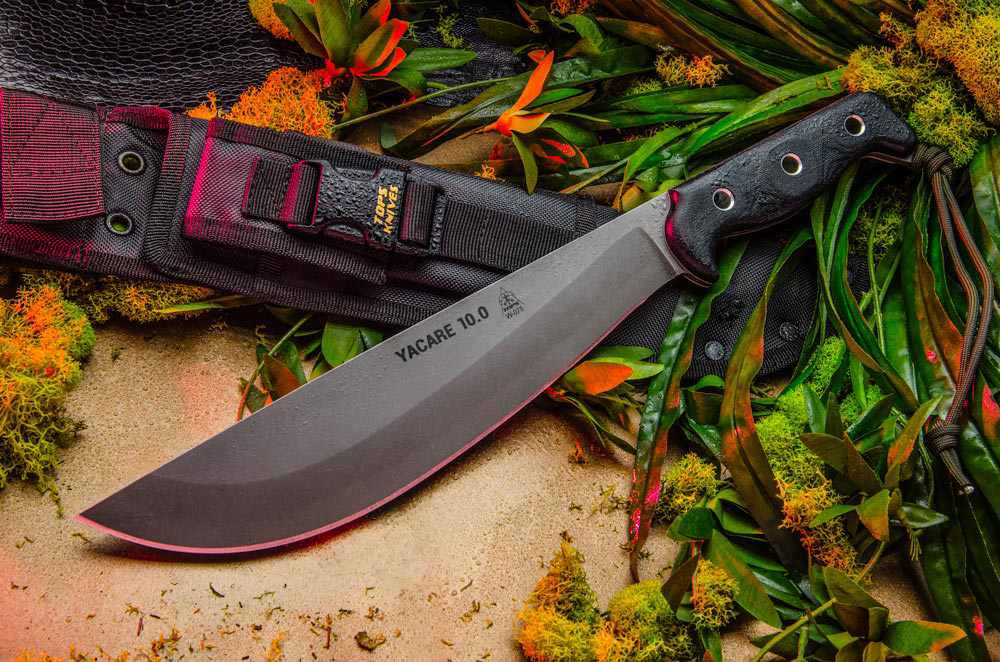
The TOPS Yacare 10.0 blends the straight spine of a machete with the wide belly of a barong to create what appears to be a formidable chopper. Its 3/16-inch thickness adds heft and rigidity, but a high bevel and fine edge are said to make it versatile for a variety of tasks.
Like most TOPS knives, the Yacare is made from high-carbon 1095 steel and hardened to RC 56-58. Overall length is 15.5 inches; blade length is about 10 inches.
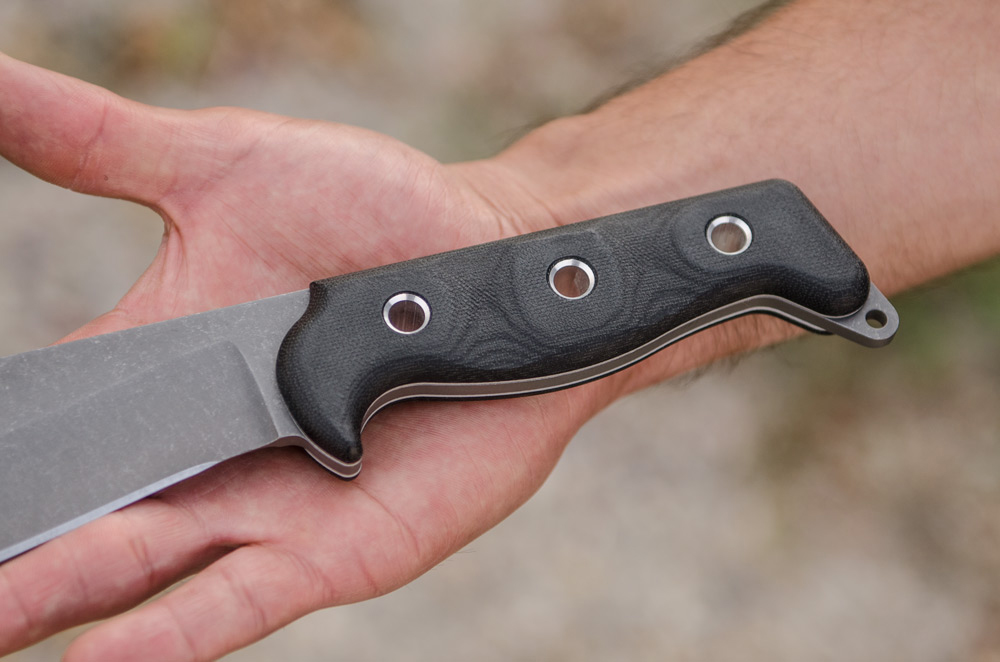
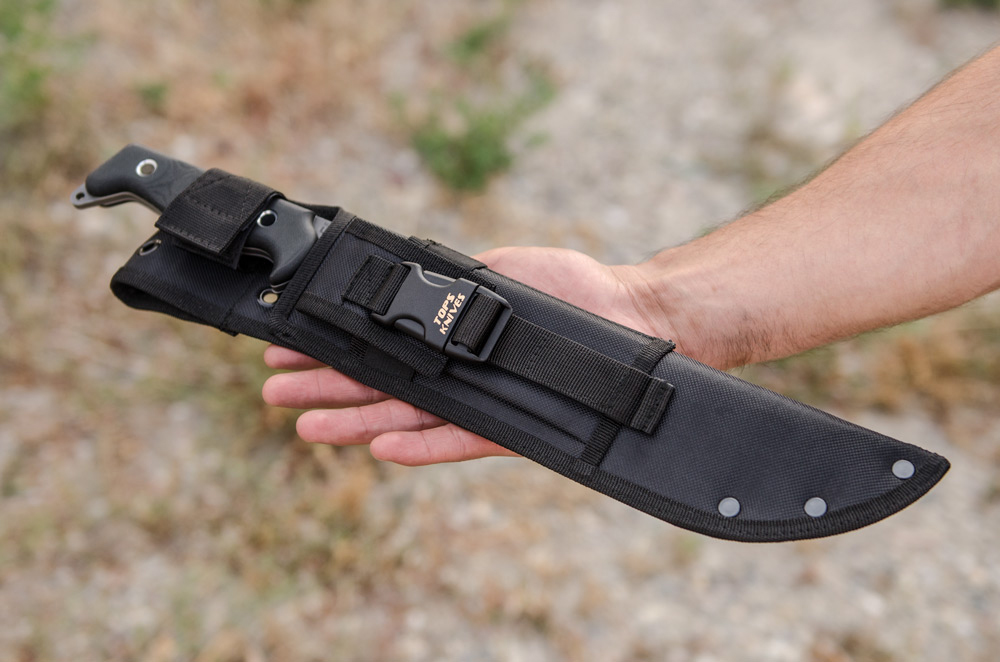
The Yacare bears a new etched and tumbled finish that TOPS calls Acid Rain, and is fitted with black canvas micarta handle scales. Three hollow pins and a lanyard hole on the butt provide plenty of retention options. The knife also includes a black nylon sheath with a belt loop and exterior pouch (ideal for storing a sharpening stone or fire-starting kit).
MSRP for the new TOPS Yacare 10.0 is $250, but it’s currently available on the company’s web site for $200. For more info on this knife, go to TOPSKnives.com.