The Premise: Since the 1950s, the United States has had a plan on how the government could survive a nuclear attack. In August 1949, the Soviet Union detonated their first atomic bomb, sparking the nuclear arms race and the Cold War. In the early days, the nuclear threat was small, but it gradually escalated to earth-shattering superweapons such as the Russian Tsar Bomba. At 50 megatons, that hydrogen bomb was over 1,500 times more powerful than the bombs dropped on Hiroshima and Nagasaki combined. What started as a few hardened facilities able to withstand a near miss snowballed into a multibillion-dollar, multitiered plan to save the government in hopes of rebuilding the United States of America after a catastrophic event. Underground facilities such as the Raven Rock complex exemplify this plan.
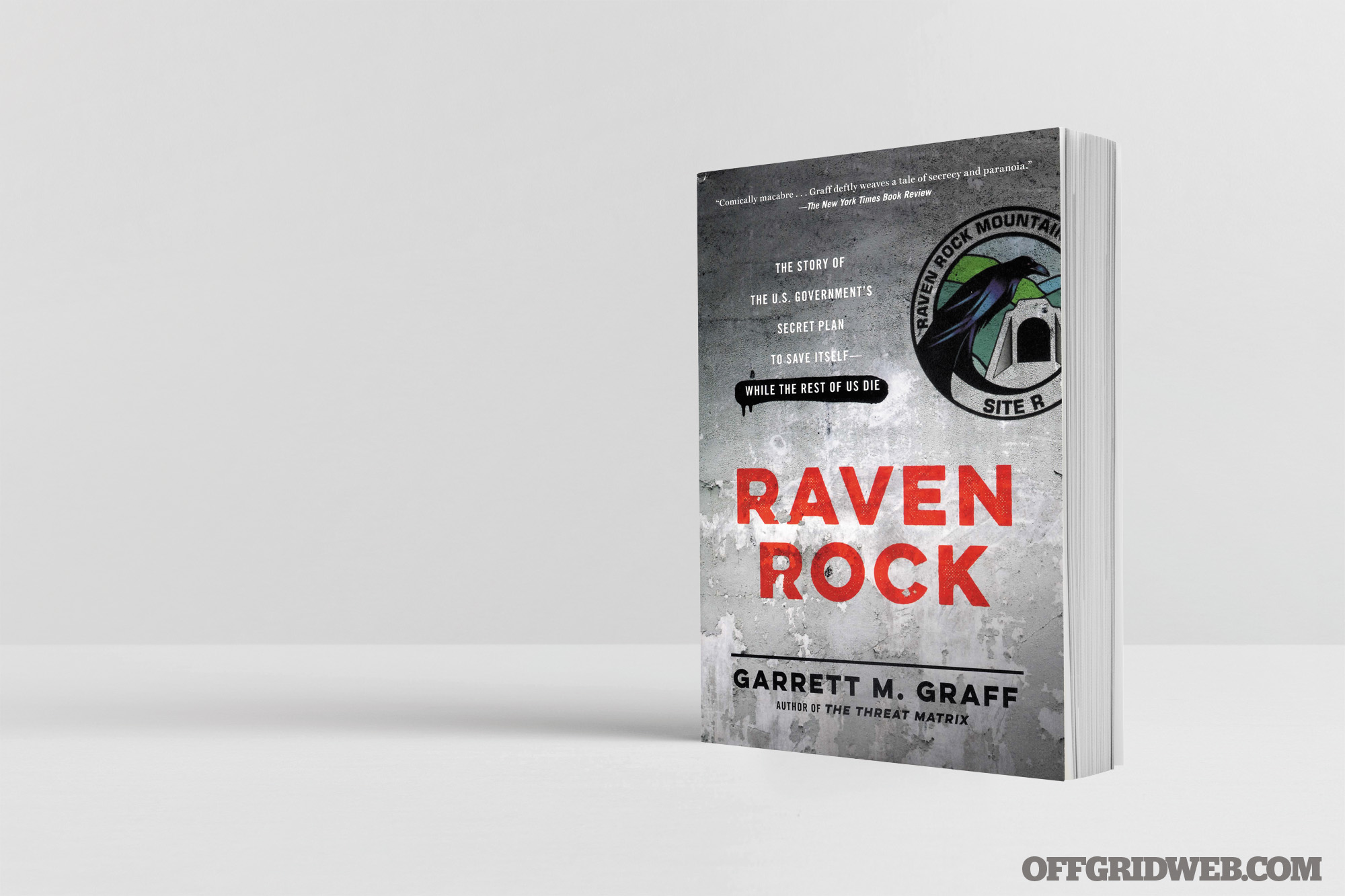
Our Review of Raven Rock by Garrett M. Graff
The 411: In writing Raven Rock, author Garrett M. Graff delves deeply into the history of how the U.S. Government plans morphed from some basic protection to very comprehensive Continuity of Government (COG), Continuity of Operations (COOP), and Enduring Constitutional Government (ECG) programs that continue to this day. The author writes, “What began in the 1950s as a nationwide push to ready every household and workplace for a Soviet attack shrank decade by decade, until by 9/11, there was just one aspect of the grand plans left in operation: the evacuation of the nation’s leaders to bunkers hidden under mountains … The terrorist attacks of September 11, 2001, and the subsequent anthrax attack on the U.S. Congress restarted a focus on COG and COOP planning that continues to this day. Today, this secret world still exists, just beneath the surface of our country. In many ways, it’s actually more expansive, powerful, and capable today than it ever was during the 20th century.”
The book further explains the size, rough capability, and government function of several unclassified facilities. Also of note are the civilian-owned facilities, such as the AT&T bunkers, “Atomic Storage” contractors that housed records for companies like IBM and General Electric, and yet others built by Fortune 500 companies like Standard Oil and Shell Oil. These private bunkers far outpaced what the U.S. Government was building, in terms of sheer size and quantity. But in terms of importance to the United States Government, Raven Rock stands out. “The Raven Rock Mountain Complex (RRMC) is a unique hardened, survivable, deep underground command center and relocation site with rigorous redundancy, reliability, and security standards charged with a mission to support the Secretary of Defense, the Chairman of the Joint Chiefs of Staff, select DoD components, and as appropriate, non-DoD agencies of the Federal Government. The installation encompasses at least 35 distinct tenant activities with specialized infrastructure and buildings spread out over a 700-acre campus and several distinct remote sites.”
There are a lot of interesting tidbits contained within the read. For example, the now-infamous Greenbrier facility reveal by the Washington Post in 1992, the suggestion to use Mammoth Cave in Kentucky as a government relocation facility, and the symbolism of the “Fallout Shelter” signs. Was there ever a foreign nuclear device stored in the United States? Would any private-sector personnel have priority to be saved ahead of other doomsday planners? How did the Cuban Missile Crisis affect the civil defense effort? How did Hurricane Katrina affect Continuity of Government plans?
The Verdict: This book is a must-read for anybody who has an interest in knowing how the U.S. Government plans to withstand a national catastrophe — whether it be a nuclear exchange with a foreign power or a rogue asteroid capable of killing millions of people in seconds. The author has successfully managed to peel away the layers of the unclassified aspects of these programs and presents them in an engrossing manner. The book is heavily researched and annotated, with an extensive bibliography of more than 400 references.
About Raven Rock
Book & Author
Raven Rock: The Story of the U.S. Government’s Secret Plan to Save Itself – While the Rest of Us Die
By Garrett M. Graff
Publisher
Simon & Schuster
MSRP
$20
Pages
560
Rating:
>Thrive
Survive
Die
OFFGRID LIBRARY OF RECOMMENDED READING
- Tactics and Firearms
- Two Person Close Quarters Tactics by Special Tactics
- On Combat by Lt. Col. Grossman
- The Irish Republican Manual of Guerrilla Warfare
- 100 Deadly Skills by Clint Emerson
- Violence of Mind by Varg Freeborn
- Skillsets and DIY
- Visual Guide to Lock Picking, 3rd Edition
- Primitive Technology Survivalist Guide Book by John Plant
- 101 Skills You Need to Survive in the Woods by Kevin Estela
- The Survival Medicine Handbook by Joseph & Amy Alton
- Bushcraft by Mors Kochanski
- Novels and Literature
- The Final Day by William Forstchen
- The Savage by Frank Bill
- Scenarios and Survival
- Lights Out by Ted Koppel
- Waste Land by David T. Hanson
- Choose Adventure by Greg Ellifritz
- The Meateater Guide to Wilderness Skills and Survival by Steven Rinella
- Left of Bang by Patrick Van Horne and Jason A. Riley