Accurate navigation is key to any bug-out plan, and in this age of easy-to-use GPS devices, it’s easy to become over-reliant on digital maps. During a major disaster, GPS services will likely be inaccessible unless the maps are saved locally on your phone or PC. Even then, the lack of a reliable power source can make reading those saved maps difficult or impossible. In these situations, physical paper maps are an invaluable resource for survival.
A screenshot of the new National Geographic USGS map database. This new interactive system is easy to use.
In years past, obtaining a printed map of your area often meant purchasing said map from a local outdoor gear store. While this was relatively convenient, it was also costly, and map quality varies substantially depending on the source. Some of the most accurate and reliable maps come from the U.S. Geological Survey, or USGS, but physical copies of these maps could cost in excess of $10 per sheet.
A sample page of a USGS topo map of Albuquerque, New Mexico. Note the impressive level of detail.
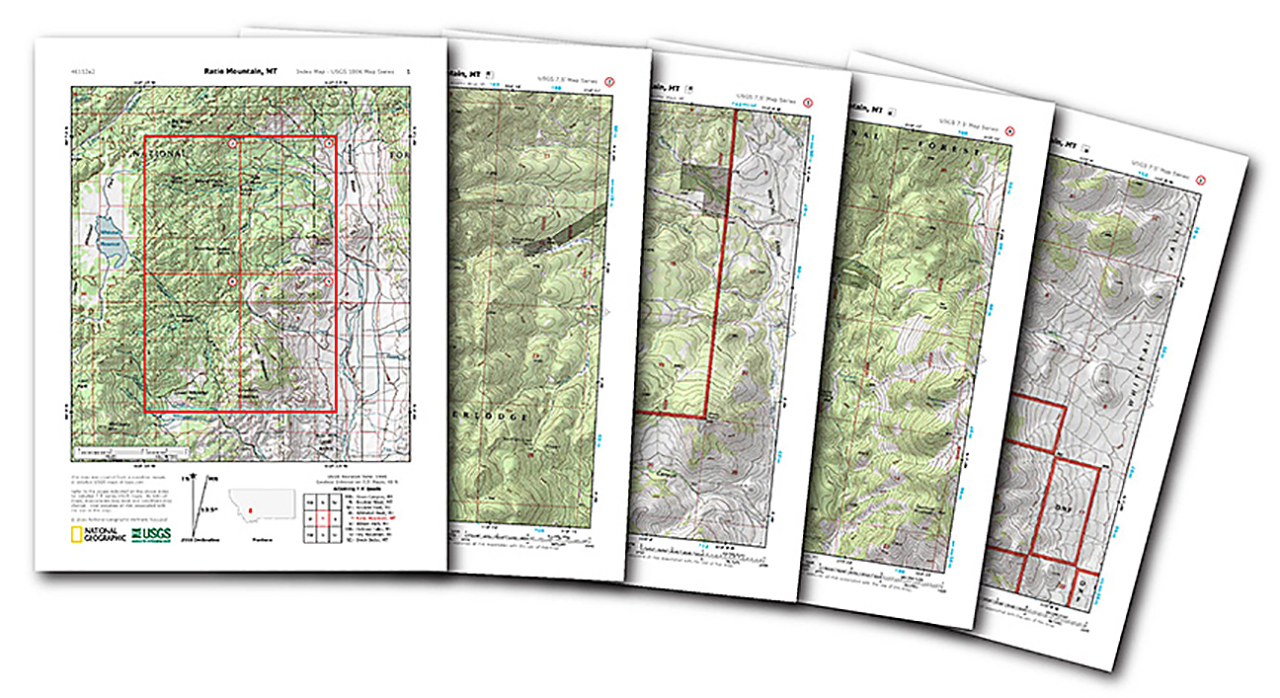
Fortunately, National Geographic has partnered with USGS to make these maps available to the public, free of charge. The new NatGeo Topo Maps web site offers an easy-to-use interactive map, where users can enter an address or zoom to a local area to find the appropriate map. Each region then shows a red callout symbol, which opens a 5-page PDF document when clicked. This PDF can be saved to your computer, emailed, or printed at home.
Whether you have an existing bug-out plan in place, or you simply want a reliable backup map to store in your vehicle or backpack, these USGS topographic maps are an excellent resource. They show local roads, highways, bodies of water, landmarks, and changes in elevation in an easily-readable format. If you print these out at home and have them laminated at a local office supply store, you’ll have a set of accurate maps that can remain useful for decades—and they’ll never run out of batteries, either.
If a major disaster occurs and SHTF, some people assume this would mean returning to a “stone age” level of technology. However, that’s not necessarily the case. When the power grid is down and everyone else is preoccupied with finding food and shelter, it’ll be possible to scavenge lots of abandoned electronics. Even now, there are plenty of people throwing out old computers every day. Fortunately, if you’re patient and willing to tinker, you can re-purpose these electronics into useful tools.
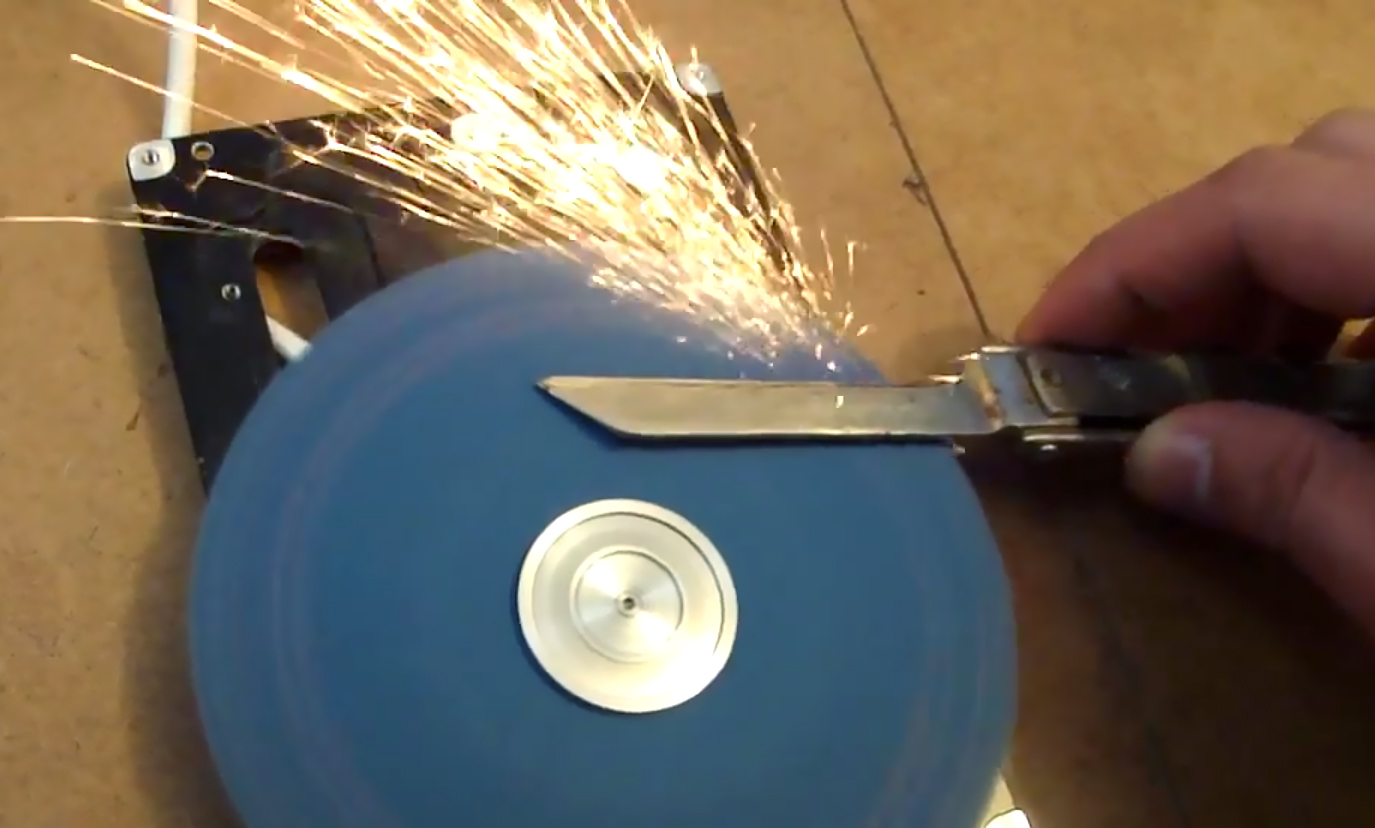
Old hard drives are an especially common form of electronic waste. These disks may seem useless outside a computer, but don’t forget that they have a powerful brushless rotary motor that’s capable of anywhere from 5,400rpm to 10,000rpm. If you don’t care about the data on the drive, you can harness this motor to create a hard drive rotary sander.
Here’s an example of a hard drive sander in action:
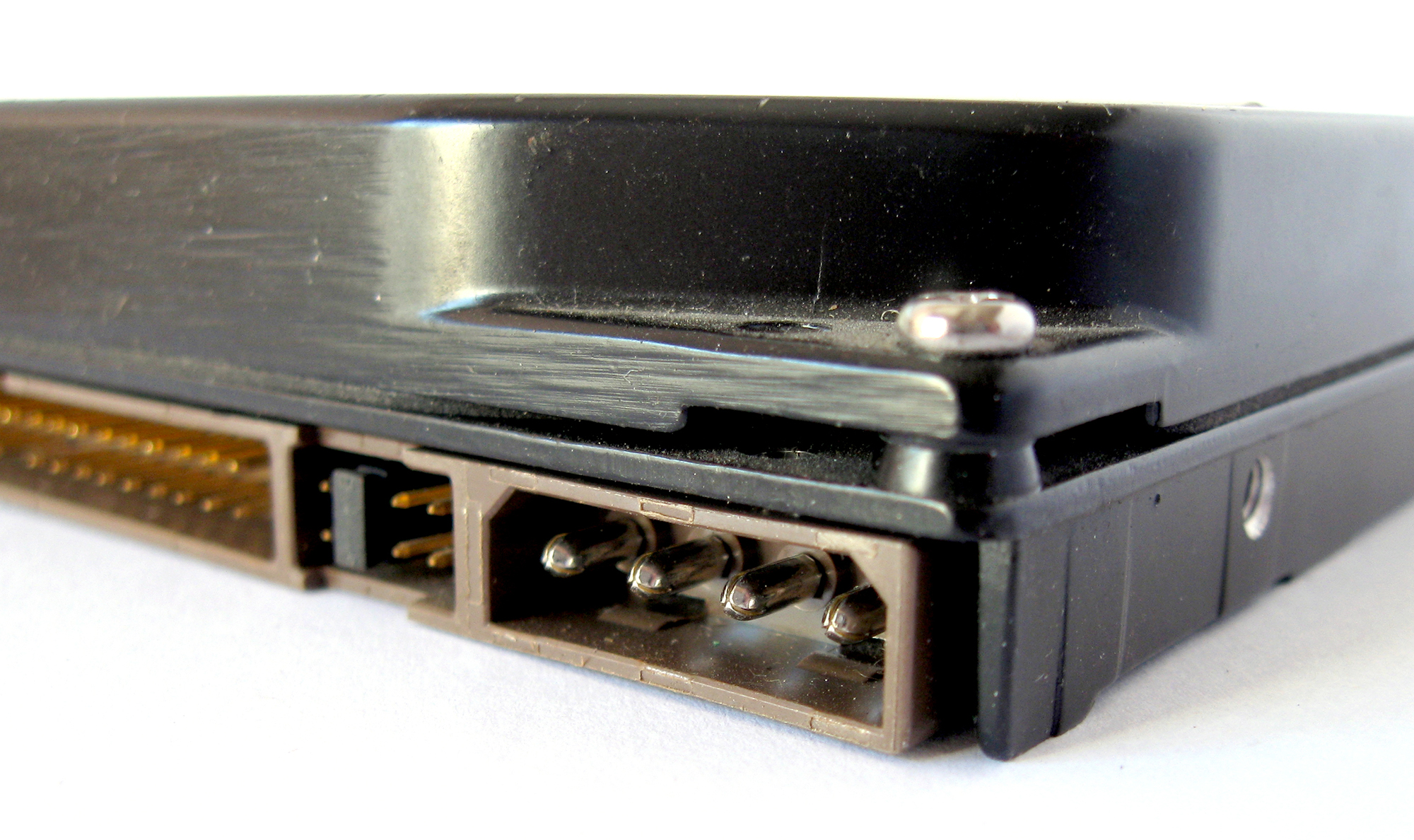
Obviously, there are many uses for this device, from sharpening knives to crafting arrowheads and other tools. To make your own, you’ll need an old hard drive, preferably with a 4-pin MOLEX power connector, as seen below. Newer drives with L-shaped SATA connectors will still work, but they may require soldering your power source directly to the drive’s motor.
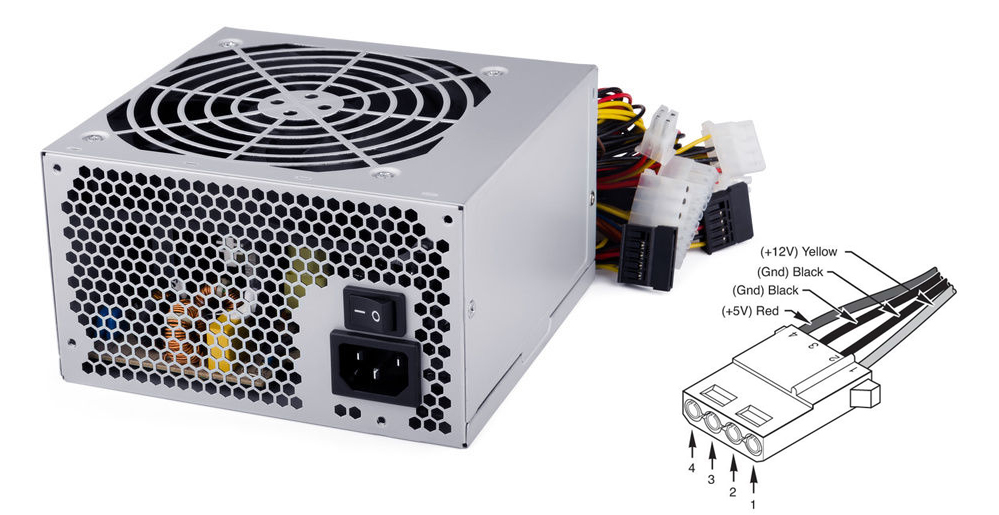
You’ll also need a screwdriver with Phillips and Torx bits to open the drive case, some sandpaper, glue or double-sided tape, and a power source. The power source is the only tricky part, as it needs to provide both 12V and 5V DC power. If possible, you should scavenge a computer power supply that already has this plug-and-play connection, as seen below:
Note the pinout diagram in the bottom right corner. If you have access to power from a wall outlet or generator, this computer power supply will be your best option, as you can simply plug the power supply into the wall and hard drive, and switch it on. If not, it’s possible to power the sander from a portable 11.1V to 12V lithium battery pack, as seen in the video below:
This device won’t be as powerful as a purpose-built sander or angle grinder, but it also won’t be as desirable as those tools, since it’s made out of discarded junk. It’s also relatively quiet and can be used on a workbench for detailed tasks. So, if you’re ever thinking about throwing out an old computer tower, you might consider re-purposing it into a hard drive rotary sander.
We’ve all heard stories of less-than-reputable mechanics scamming clueless customers with stories of blinker fluid and muffler bearings. Of course, we all think, “that would never happen to me!”—but how knowledgeable about automotive troubleshooting are you really? If a light on your dashboard comes on, will you be able to correctly identify its meaning without digging for the owner’s manual?
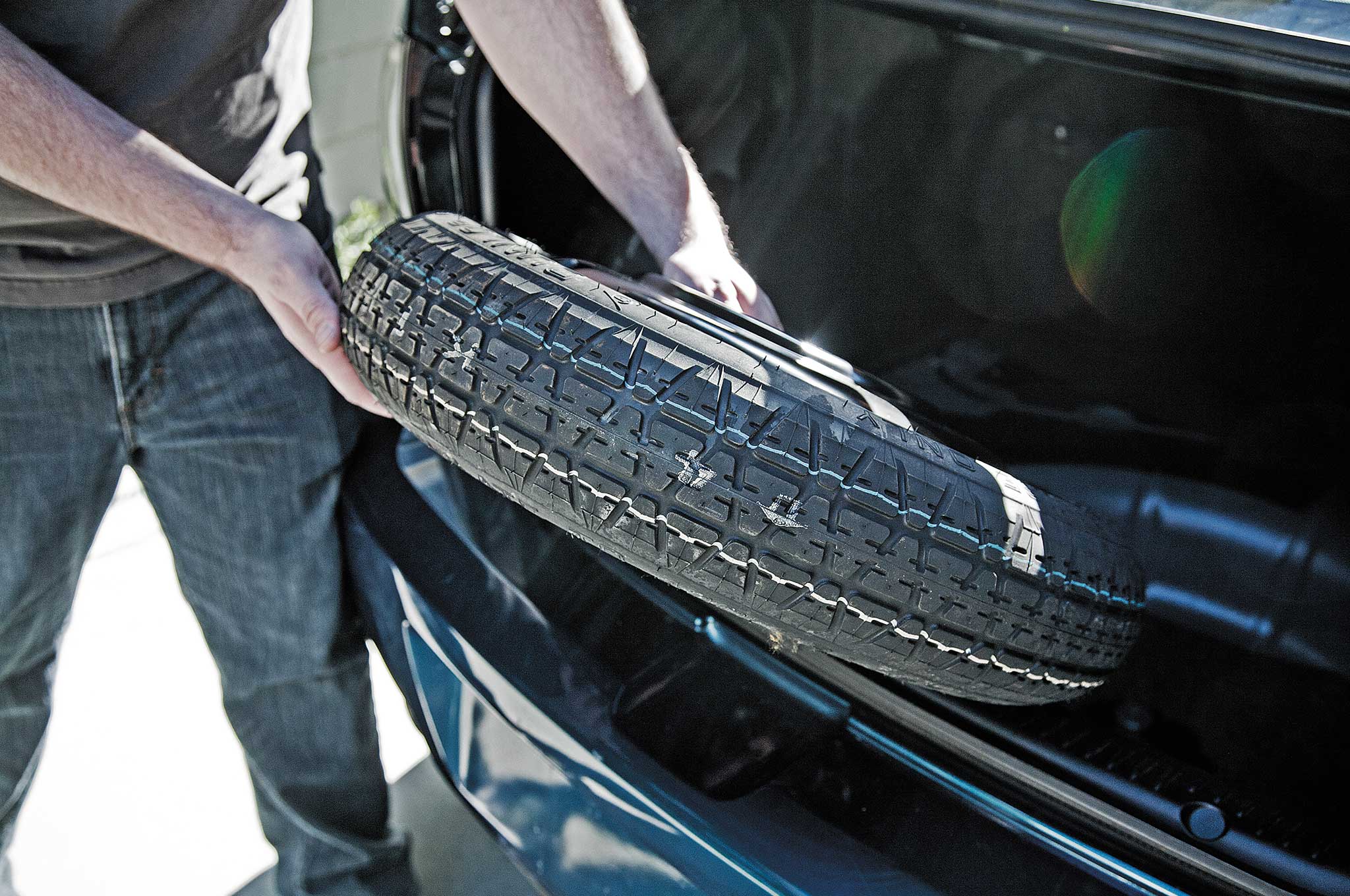
Recognizing a TPMS tire pressure warning light can make the difference between a leisurely tire change and an emergency.
This question becomes especially important if you find yourself in a survival situation. Let’s say you’re caught in the early stages of a hurricane, and you load up your car with your belongings and hit the road to evacuate. If a light on the dashboard comes on unexpectedly, you’d better know whether it’s a friendly reminder (e.g. replace your windshield washer fluid) or an urgent warning (e.g. low oil pressure or a punctured tire).
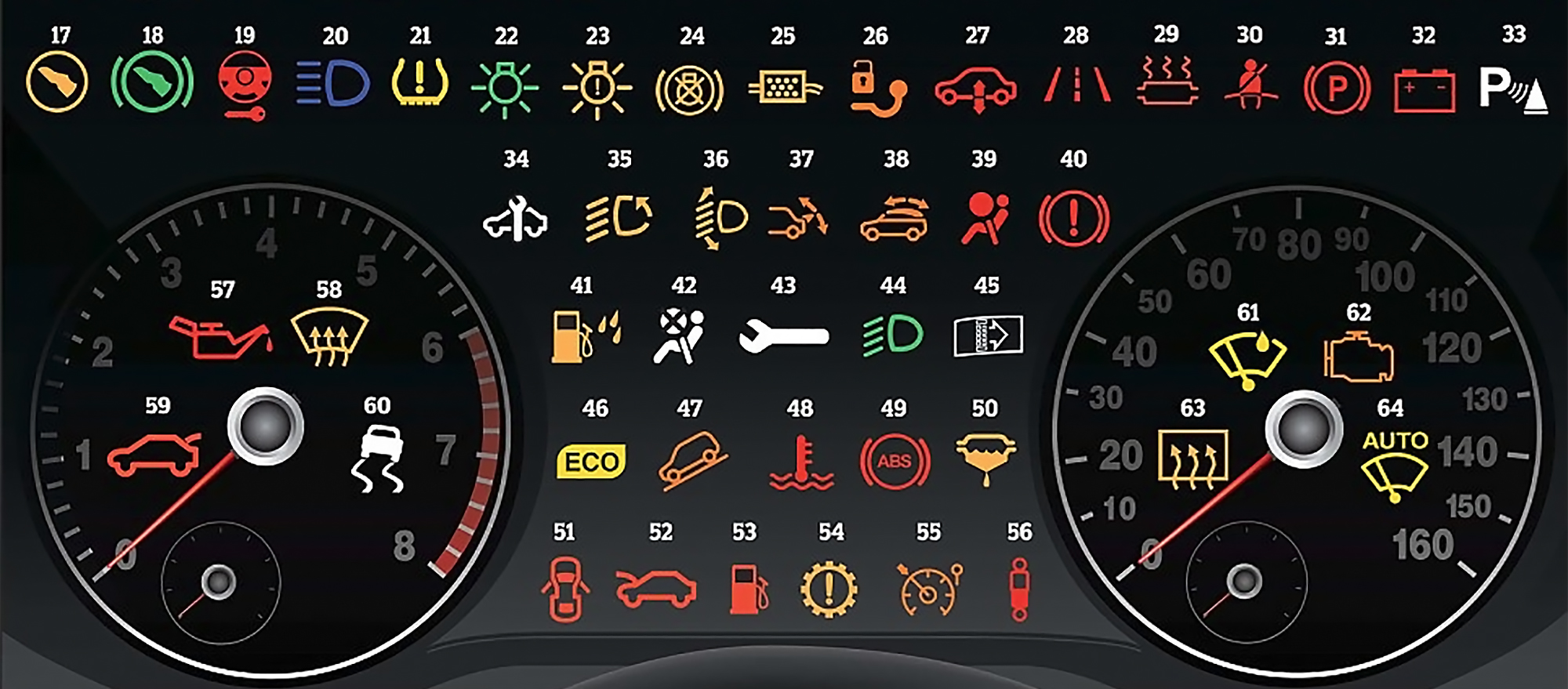
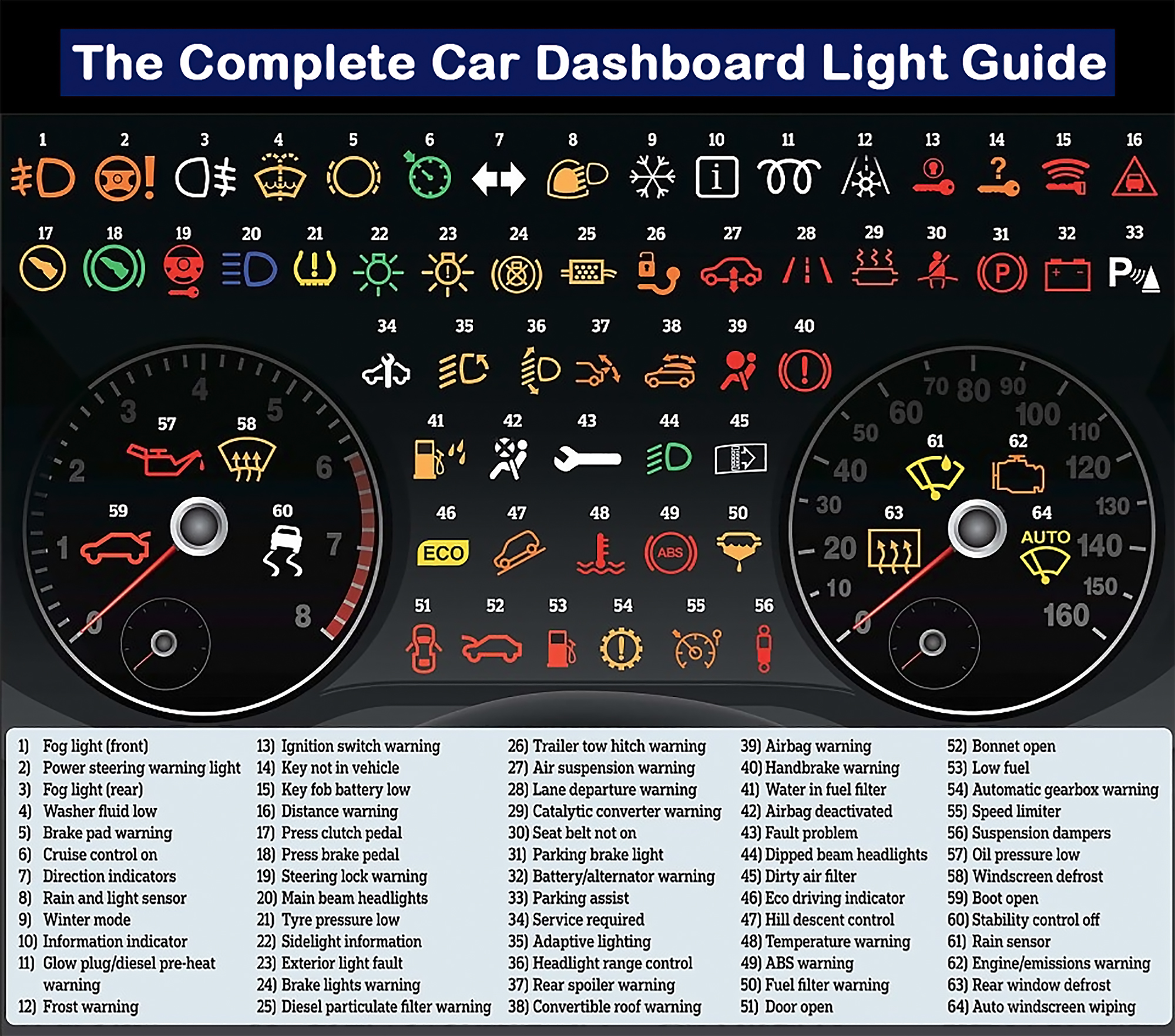
The following infographic shows 64 of the most common vehicle warning lights, and can help you quickly identify a problem without relying on an owner’s manual or Internet search.
Even if you know these symbols in your own car, you may find yourself driving a friend’s vehicle which uses new or different symbols, so it’s wise to study the entire list. For example, glow plug and DEF lights won’t show up in gas-powered vehicles, but they’re important in diesel cars and trucks. Most cars won’t have even half these lights on the dashboard, but if you’re behind the wheel of a European luxury car, you may end up with a cryptic warning about magnetorheological shock absorber failure (yes, that’s a real car part).
It’s also important to remember that these lights are not standardized from one vehicle to the next, so you may encounter symbols that vary from those pictured here. However, this guide should at least give you a solid head start towards understanding vehicle warning lights.
If you’ve ever been to a traditional barbershop, you’re likely familiar with the concept of a straight razor. This classic style of blade originated centuries ago, and remained the primary means of shaving until the development of disposable safety razors in the early 1900s. The straight razor certainly has an iconic design, with a thin handle, wide blade, and lever-action folding mechanism.
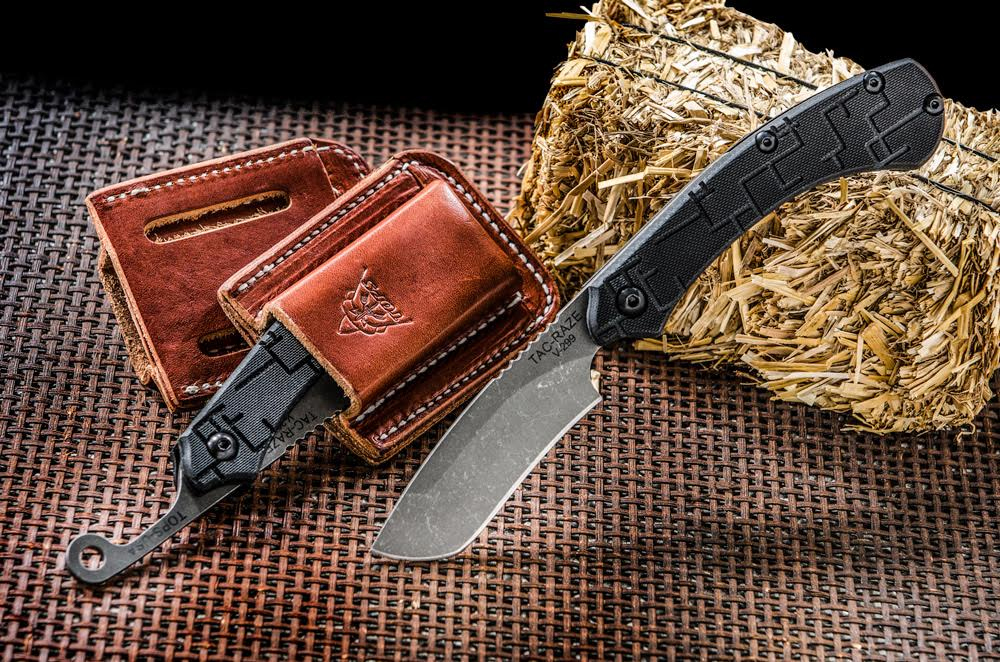
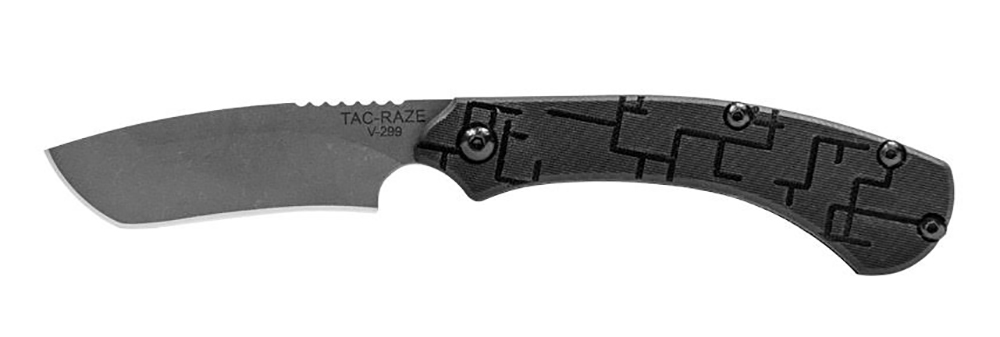
TOPS Knives has released an all-new blade that’s inspired by elements of the straight razor design, but also adds a modern twist. It’s known as the TAC-Raze, and it’s the company’s very first friction-folding knife. For those not familiar with friction-folders, this type of knife stays open due to friction, rather than a locking mechanism.
The TOPS TAC-Raze features a long and narrow tang, which allows the knife to be opened easily via leverage, and slots between the handle scales for stability when the knife is open. TOPS calls it a “gentleman’s EDC blade” due to its simple and functional design. It’s also worth mentioning that while it may be influenced by a straight razor, you might not want to actually shave with it due to the recurved blade shape (unless you’re Sweeney Todd).
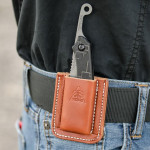
The TAC-Raze is constructed of 1095 high-carbon steel with a tumble finish, and uses black G10 handle scales with a Cryptic Cyber pattern. The knife also includes a molded brown leather sheath, which can be worn horizontally or vertically on a belt.
Any time we bring up the subject of electronics in a bug-out bag or EDC kit, there tends to be a common objection. Someone will chime in and say that electronics won’t be useful in a survival situation, so you should just ditch them and rely on your physical tools and survival knowledge. Although tools and knowledge are essential, we’d disagree with the rest of that sentiment—depending on the situation, portable electronics can give you a huge advantage for communications, navigation, and comfort.
Cell phones allow us to communicate instantly over long distances, even in some survival situations.
Of course, if there’s a massive electromagnetic pulse that simultaneously wipes out all cell towers, computer networks, and the power grid, there might be some truth to the claim that electronics won’t help you much. In most other situations, having a working cell phone, GPS device, or rechargeable flashlight can be invaluable. Also, remember that the vast majority of disasters are confined to a small geographic region. So, even if your cell phone is displaying “no signal”, if you can travel a few miles it might become useful again.
This is why we emphasize the value of electronics, and the value of being able to recharge them. As many of us have experienced firsthand, a cell phone with a dead battery is about as good as none at all. So, you’ll want to prepare several ways to recharge your batteries on the road, whether you’re in a city, a rural area, a car, or the middle of nowhere.
EDC Electronics Kit
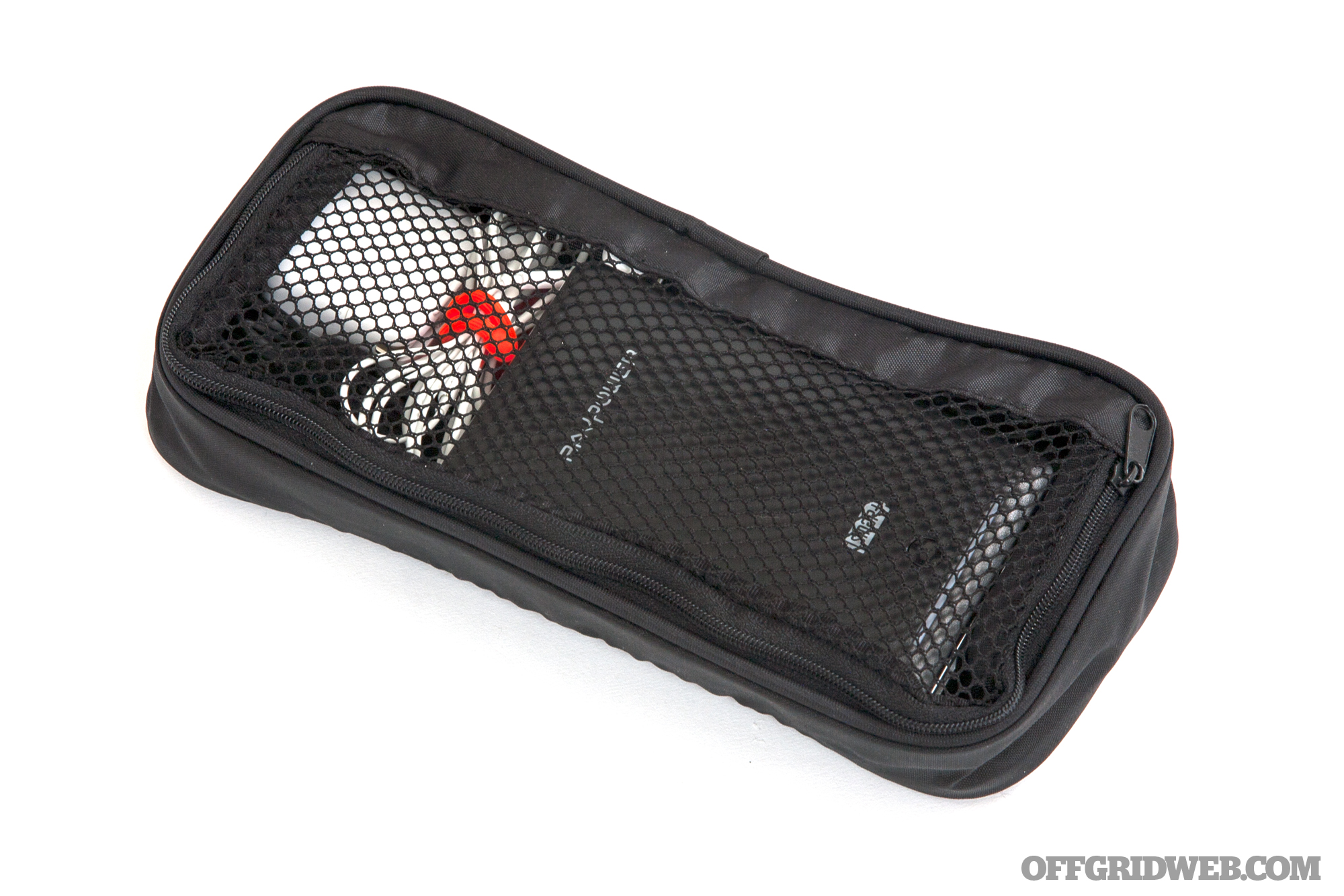
Instead of tossing a bunch of tangled cables and loose adapters into your backpack or get-home bag, we’d advise assembling a self-contained recharge kit. This starts with a container of some sort.
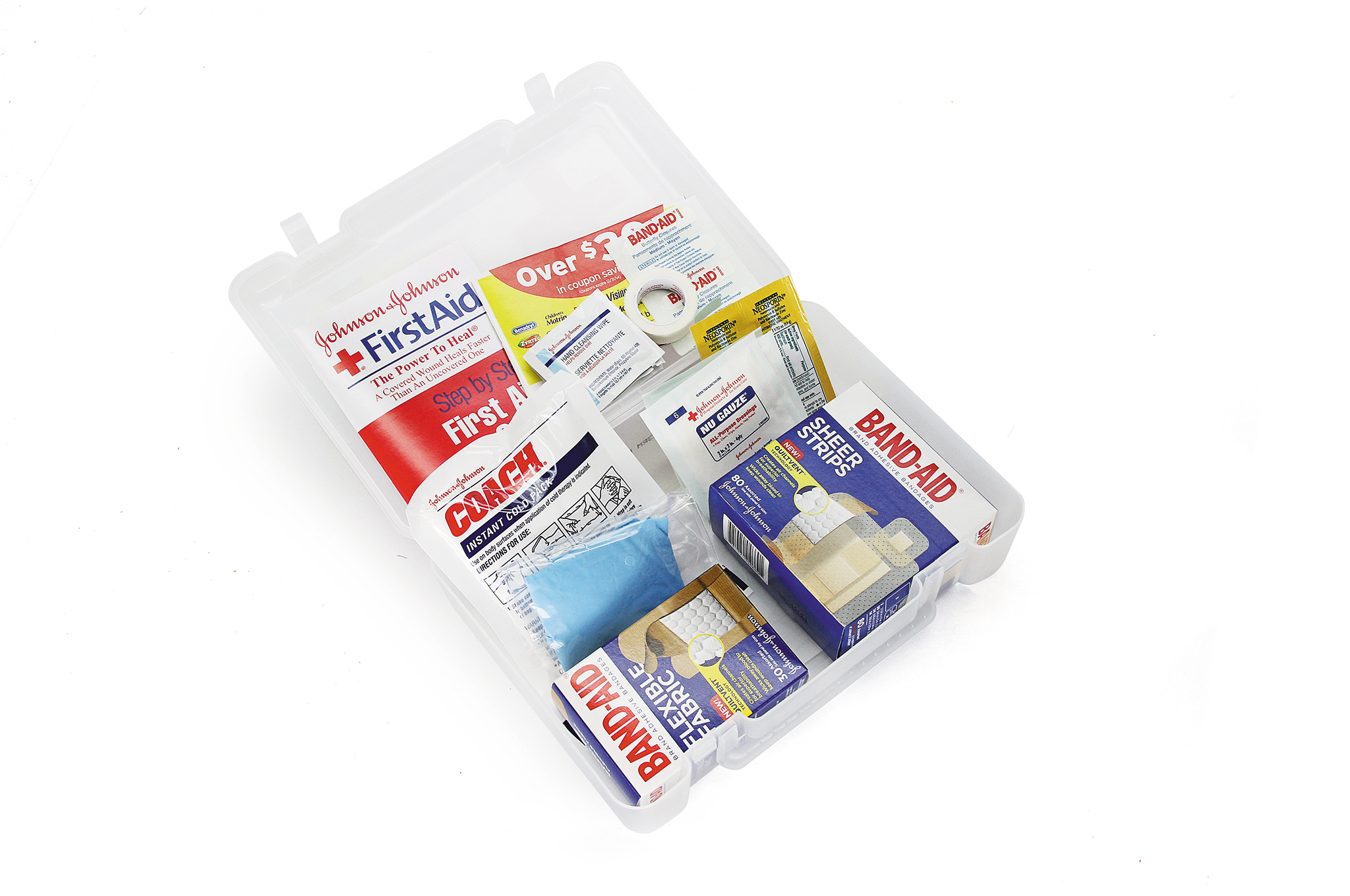
Think of a EDC electronics kit as a first aid kit for your portable devices. It should be compact and organized.
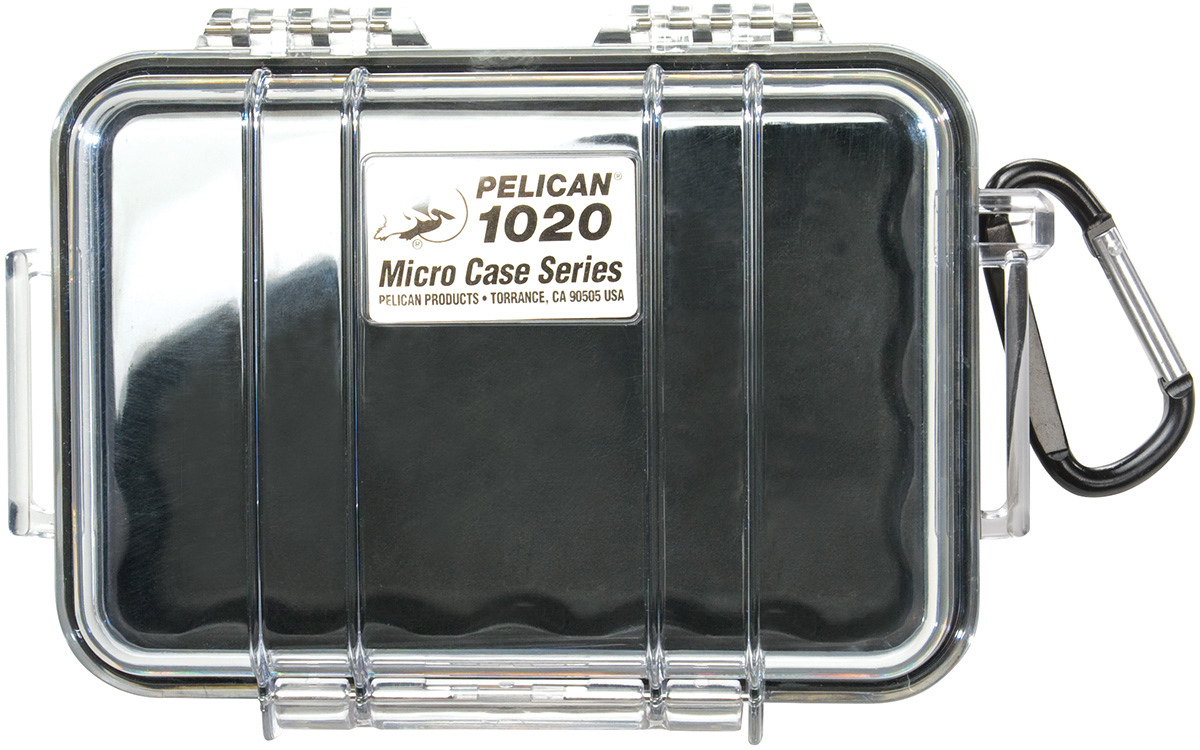
For harsh environments, you may want to consider a waterproof hard-sided case, such as a Pelican Micro Case. These tough containers keep out damaging dust and moisture, so they’re great if your pack might get doused with water or tossed around. They’re also relatively light for their size.
A Pelican 1020 Micro Case. These make excellent containers for cables, batteries, and adapters.
Unfortunately, these cases can be bulky, and they don’t compress or conform to tight spaces. So, we usually recommend a soft zip-up pouch for everyday use. They weigh almost nothing, they’re inexpensive, and they keep your gear organized. These pouches are sometimes called “packing cubes” or pocket organizers, and can be found for only a few dollars at various online retailers.
I’ve owned the pouch seen here for years, and it’s a non-name-brand item that I’ve never needed to replace. For new buyers, I’d suggest looking into Eagle Creek Pack-It organizers or searching on Amazon. You shouldn’t need to spend more than $10-15 on a soft travel case.
Cables & Adapters
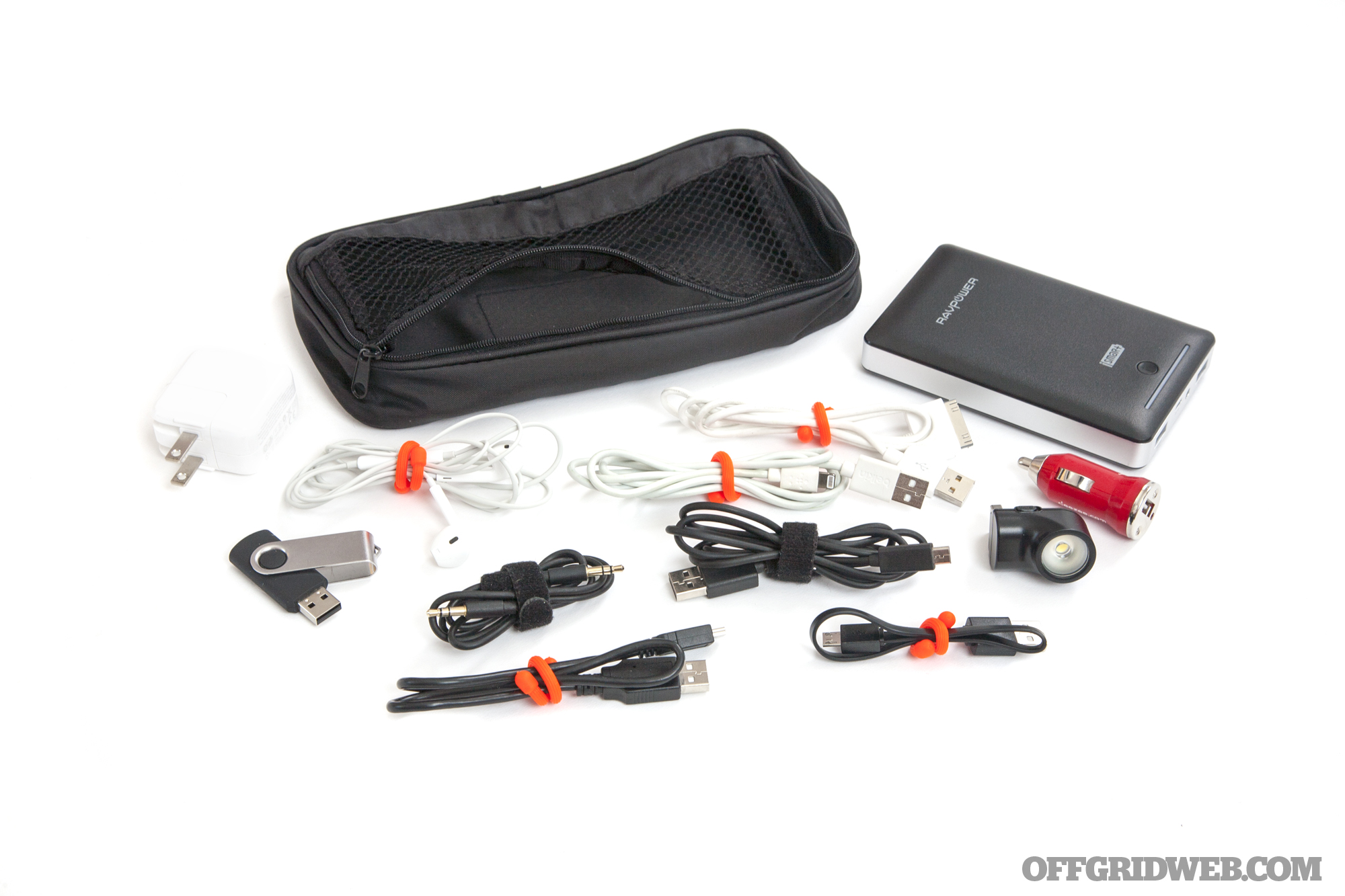
If you don’t have the right cable or adapter to connect your device to a power source, you won’t be recharging anything, so this is a good place to start. Here’s a quick list of the cables and adapters my simple EDC kit contains:
USB wall charger/”power brick”, Apple 12W 2.4A — This was included with an iPad, and provides up to 2.4 amps, allowing it to charge electronics much faster than a standard 1A power brick. I also like that the plug prongs fold away, taking up less space in my pouch.
Cigarette lighter to USB adapter, generic brand — This little red adapter allows me to recharge electronics on the move via a 12V car cigarette lighter port.
USB to Apple Lightning cable — Standard connector for newer iPhones and iPads.
USB to Apple 30-pin cable — I don’t use this much anymore, but it’s good to have for friends and family members with older Apple devices.
2 USB to micro-USB cables, long and short — Almost all non-Apple smartphones and tablets use micro-USB, so it’s good to have two of these cables. It also allows me to recharge two devices at once via my USB power bank (more on that later).
USB to mini-USB cable — This isn’t used as often as micro-USB, but some cameras, smartphones, and flashlights still use mini USB.
3.5mm audio cable — Handy for connecting a phone to external speakers or a car stereo input jack.
Earbud headphones with built-in microphone, Apple brand — For hands-free calls or simply listening to music.
All of these were items I’ve accumulated over the years through the purchase of various devices. Actually, I haven’t had to go out of my way and buy a single one of the items listed here—they’re all extras included with other products. Rather than throwing these spare cables in the trash or a desk drawer, I put them in my electronics kit.
Miscellaneous Extras
You may also notice a few extra items, namely the orange cable wraps. These rubber-coated wire wraps are Nite-Ize Gear Ties, and I picked them up on sale at a local hardware store. They keep the cables tightly wrapped, neatly organized, and free of annoying tangles. The two cables that don’t have Gear Ties were designed with built-in Velcro retention straps, a feature I really wish more cables included.
Finally, there’s a small USB LED light attachment. This can be plugged into the power bank, and used as a flashlight.
RAVpower USB Power Bank
At this point, my EDC electronics kit has everything necessary to recharge devices from a wall outlet. But what about if there’s no outlet nearby? What if I’m in the middle of nowhere, and need to recharge my phone or GPS unit to navigate to safety? This is where the power bank comes into play.
Note: for more information on USB power banks, check out the upcoming “Take Charge” buyer’s guide in Issue 16 of our magazine.
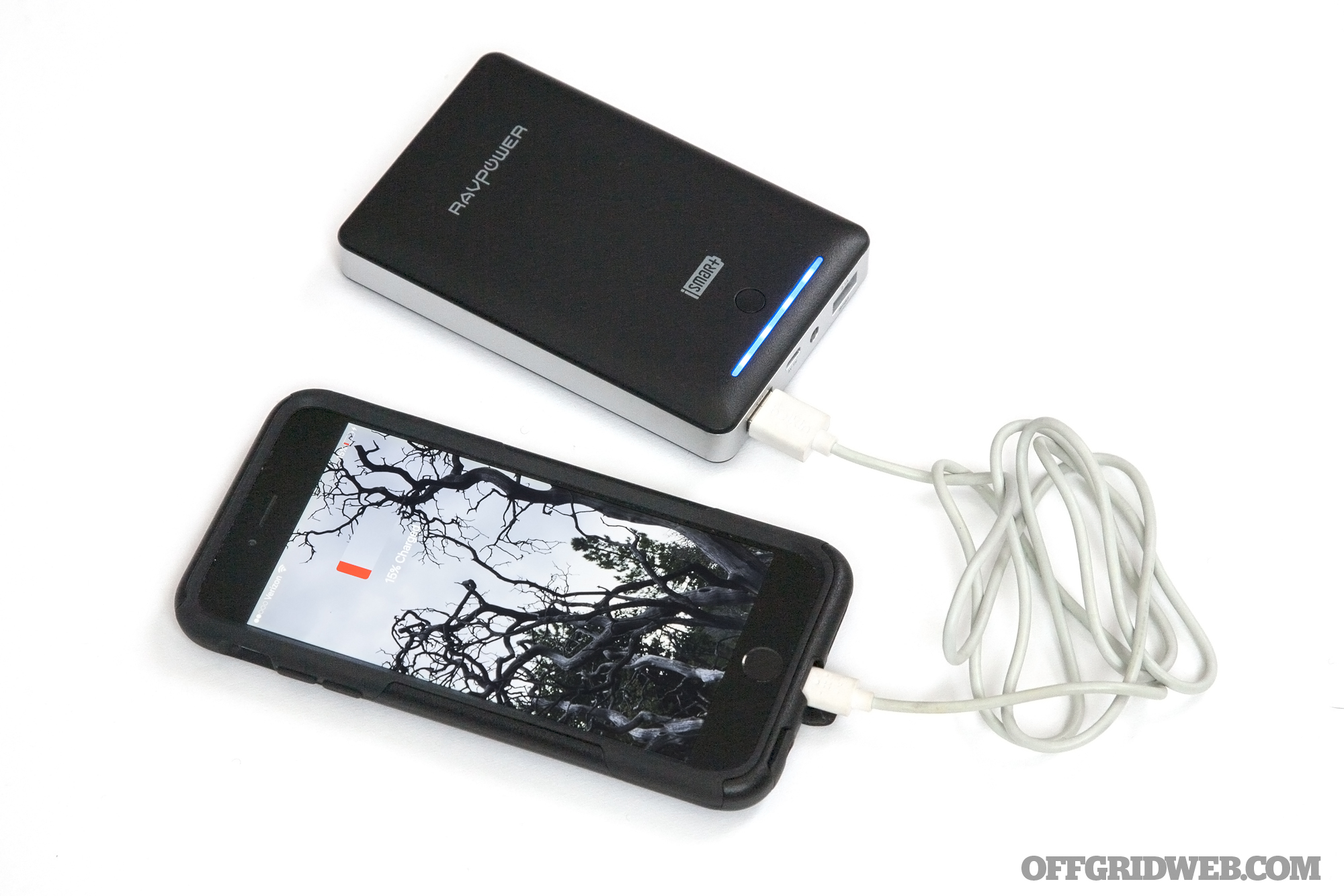
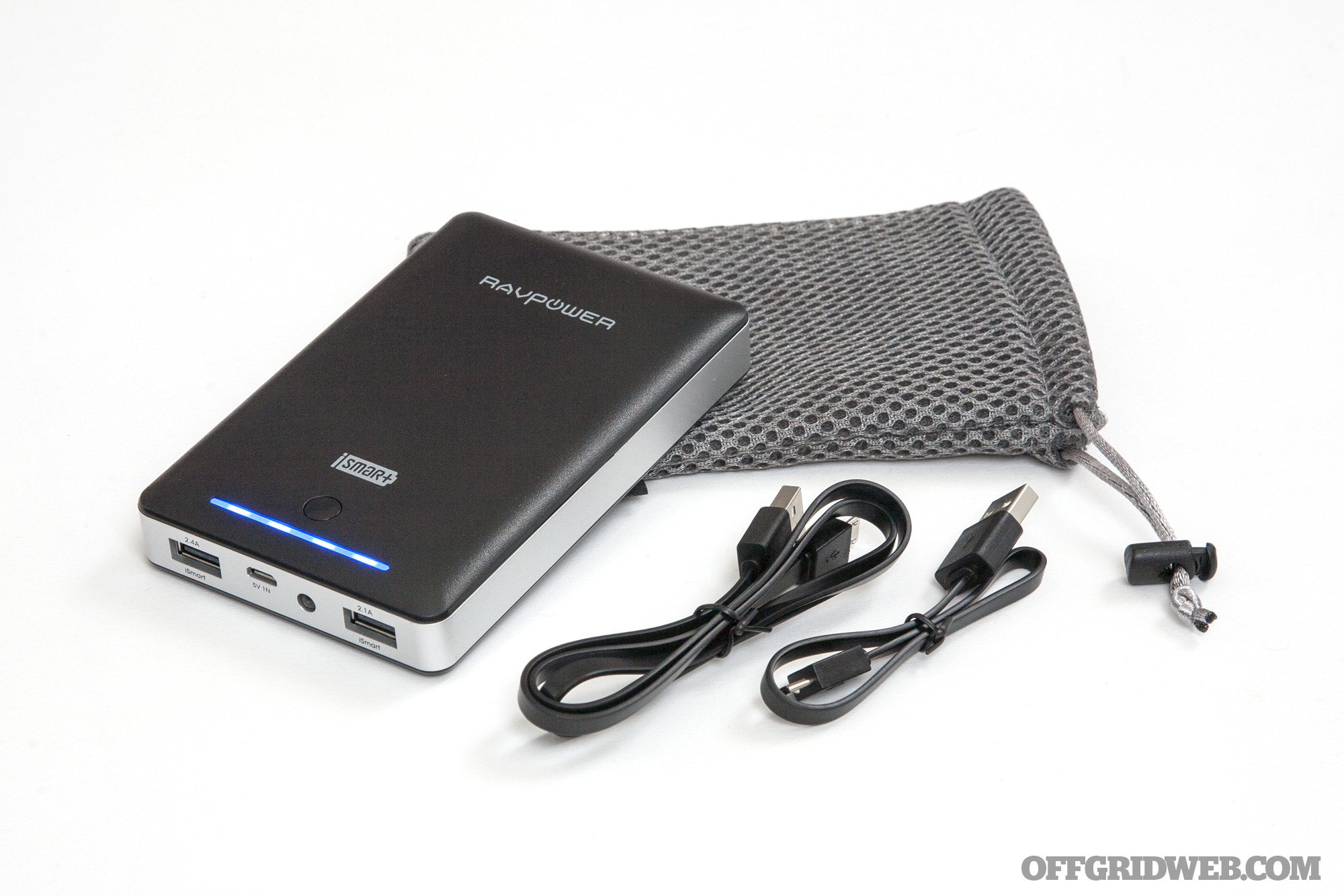
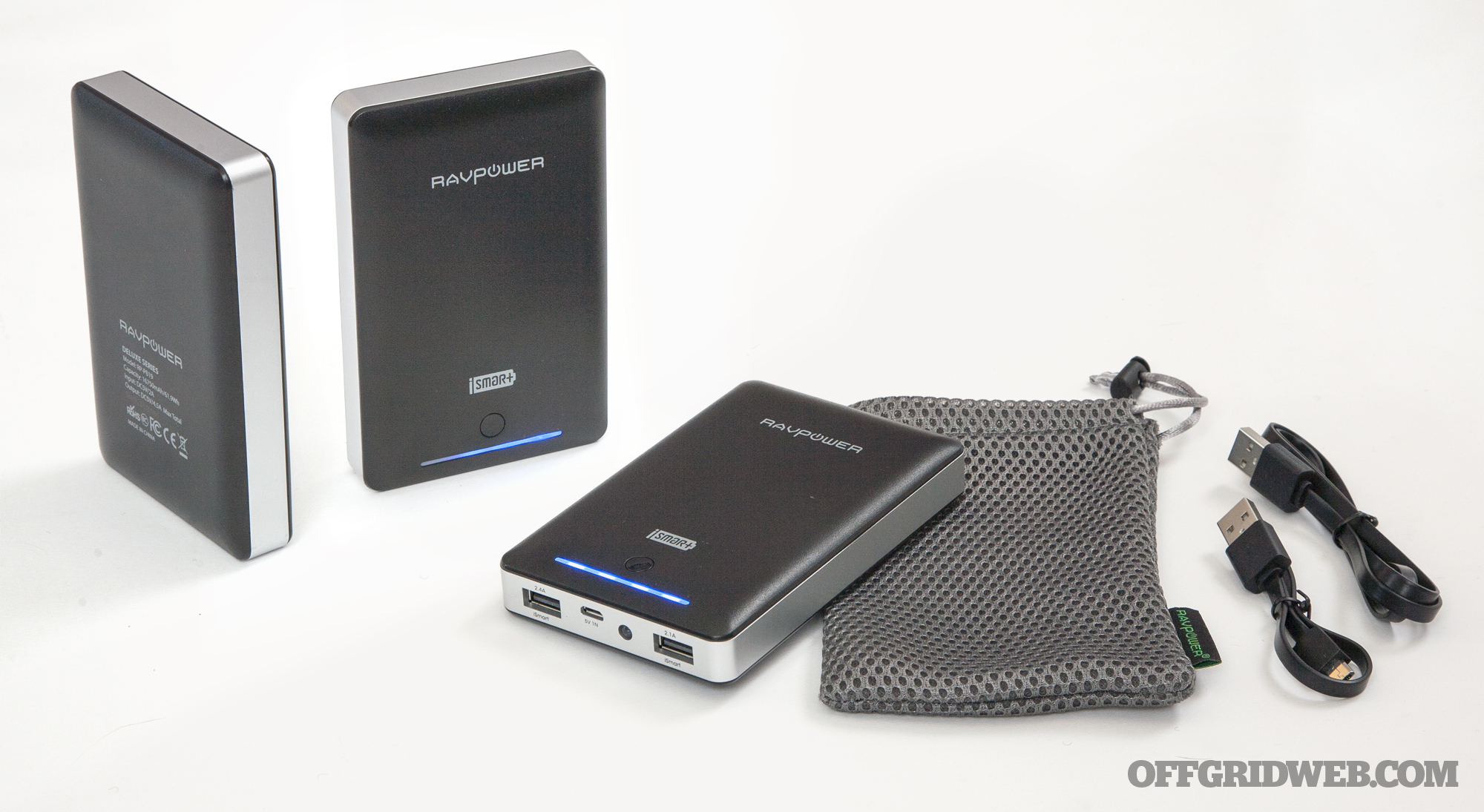
The power bank seen here is a RAVPower 16750 mAh Deluxe Charger, with dual USB charging ports. It can provide up to 2.4A from a single port, enough to charge a phone just as fast as the wall outlet. The 16,750 mAh capacity is enough to fully recharge my iPhone 6 Plus almost seven times, so there’s plenty of power to get me back to civilization. At 10.9 ounces, it’s not going to weigh my pack down, and it’s pretty affordable at a retail price of $33.
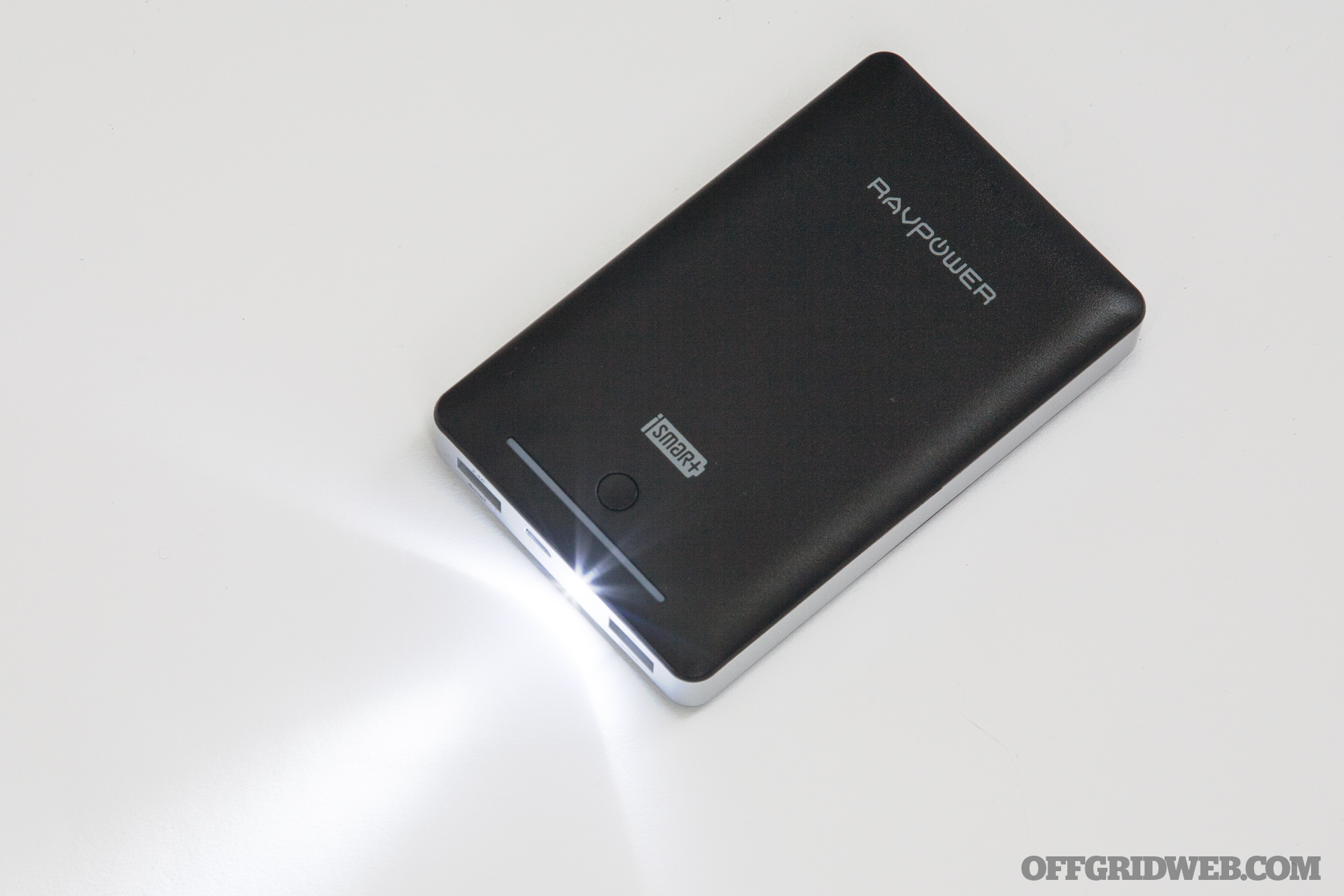
This RAVPower battery also has iSmart technology, which detects and delivers the optimal charging output for any device you connect. When searching through my pack in the dark, I can use the RAVpower’s built-in LED light, or plug in the USB LED light mentioned earlier.
You’d be foolish to rely entirely on wall outlets, so some form of portable battery or power bank is a must for any EDC electronics kit. If you’re really planning to go beyond the grid, we’d also recommend a third power source—solar panels.
Goal Zero Nomad 20 Solar Panel
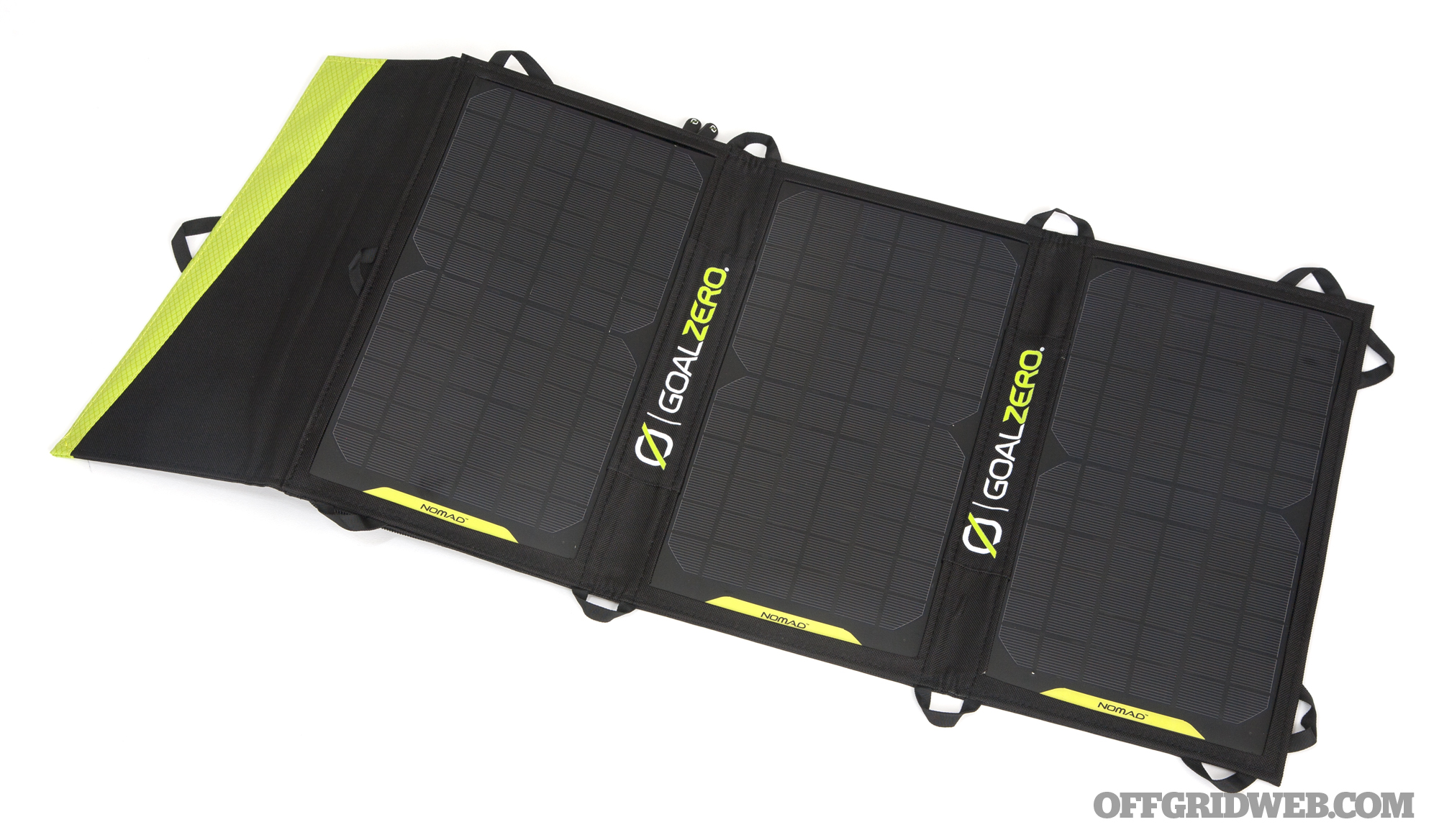
If the power grid is unavailable for more than a few days, your wall charger will be rendered worthless, and your battery pack will eventually run out of juice. In these cases, you’ll need a sustainable power source. Solar panels serve this purpose well, and we’re fans of the Goal Zero Nomad series. We recently tested the Nomad 20, which is a portable 3-panel system with a rugged exterior and USB output.
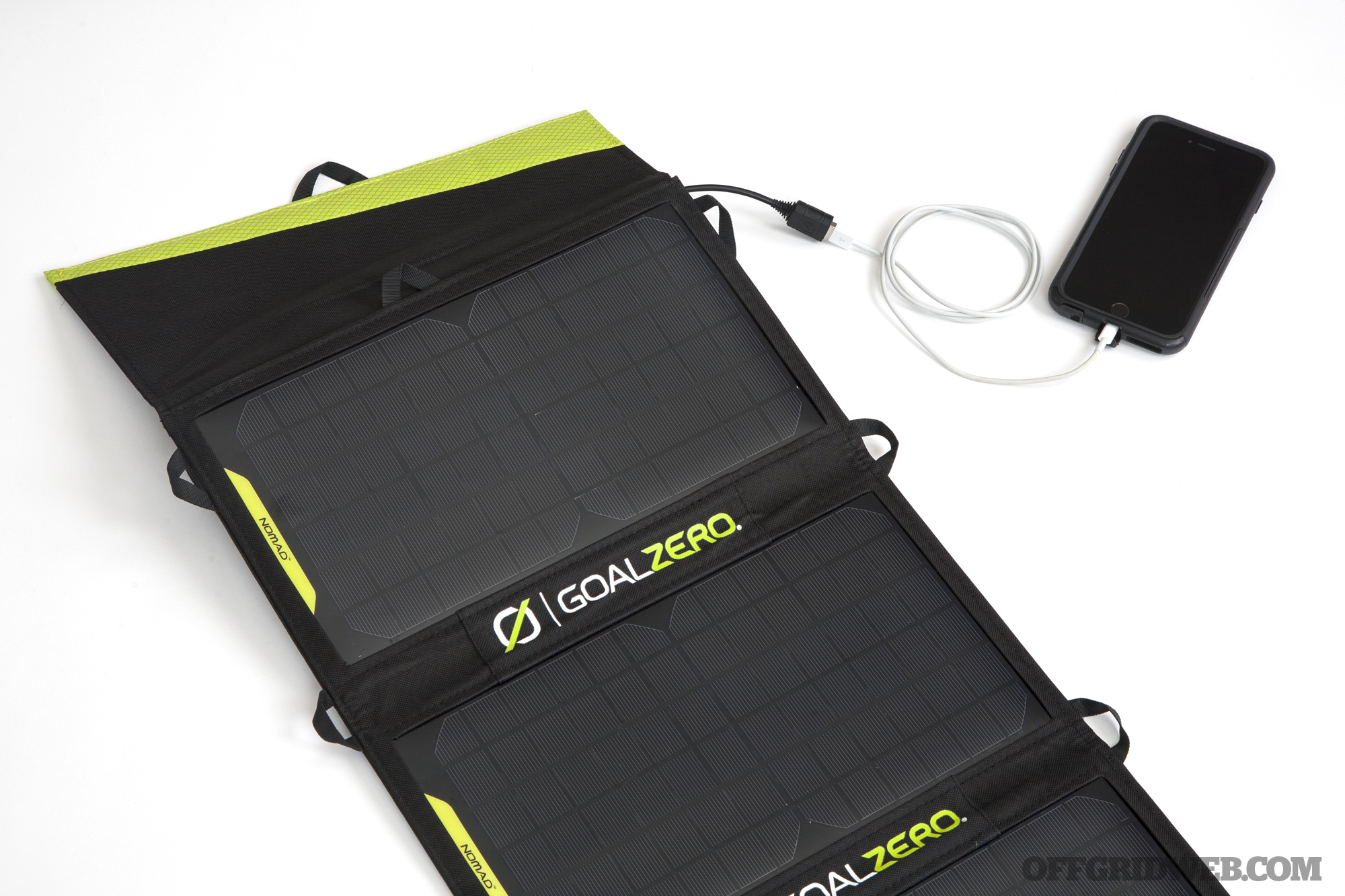
Packed flat, the Nomad 20 ends up being about the size of a small laptop (13″ x 8″ x 1″). That’s much bigger than the rest of our EDC kit, but carrying this panel on longer outings will pay tremendous dividends. You can hang it from your backpack using included mini-carabiners, or set it up on a balcony or at your campsite. In full sunlight, it can recharge my iPhone 6 Plus in about 4 hours, or recharge the 16,750 mAh battery pack in around 10-12 hours.
With a solar panel setup like this Goal Zero Nomad 20, you could keep your electronic devices running indefinitely, no matter where you are. All you need is some bright sunlight. It may not be necessary for every EDC kit or get-home bag, but depending on how far you venture from the power grid, it could be a valuable addition. The MSRP on this panel is $200, but smaller panels like the Goal Zero Nomad 7 can be had for $80.
Conclusions
As with any survival gear guide, our suggestions would vary depending on personal needs and circumstances. If you’re an IT professional living in the big city, you should probably expand on the materials in this guide, and add more cables and tools. If you’re the kind of guy who lives in a remote rural area and doesn’t require anything more sophisticated than a flip phone, you may want to only carry a charging brick and one USB cable.
Consider all the devices that would be valuable to you in a survival scenario, and plan your EDC electronics kit accordingly. To close, we’ll leave you with some other items that might be worth including in your kit:
Rechargeable batteries (AA, AAA, CR123, etc.) and USB charging cradle
Device-specific batteries, such as those for insulin pumps and other medical equipment
Special connectors or docks for rechargeable electronics
Spare smartphone battery pack, if yours is replaceable
USB splitter or hub
Wall socket adapters for other countries, if you travel internationally
Replacement fuses, screws, clips, and other hard-to-find gadget parts
Have you ever pulled out a flashlight to inspect a nearby object, only to temporarily blind yourself when the light reflects back in your face? Lots of flashlights offer adjustable brightness modes, so you can avoid this problem by selecting the low-power mode—but that’s only if you remember to do so ahead of time. When you quickly turn on your light in a dark room, it’s easy to forget which brightness mode your light is set to, or simply fumble with the controls and select the wrong one. That’s far from ideal, especially in a tense situation, since it will quickly obliterate your night vision and leave you disoriented.
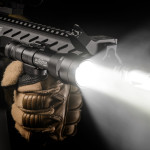
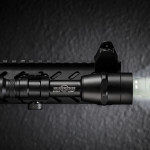
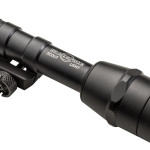
Surefire has developed a clever solution to this problem, by developing a light that can automatically adjust its brightness level to your surroundings. This new light is known as the M600IB Scout Light, and the built-in proprietary auto-adjustment system is called IntelliBeam. Each M600IB light contains a sensor and microprocessor, which continuously evaluates the beam’s target area. Based on the sensor’s feedback, the flashlight adjusts between 100 and 600 lumens. Surefire says it can do so in a matter of milliseconds—faster than the human eye can detect.
The new M600IB Scout Light uses a high-output LED that can produce 600 lumens for up to 1.5 hours, or run for a maximum of 5 hours (per ANSI standard testing). It uses two CR123A batteries, contained in a hard-anodized aluminum body with O-ring seals and a tempered glass window. The tailcap switch offers partial-press for momentary activation, full click for constant activation, and a patented lockout feature. An included thumbscrew mount attaches the light to MIL-STD-1913 Picatinny weapon rails.
Here are the rest of the key specs for this flashlight:
Output (high): 600 lumens
Output (low): 100 lumens
Runtime: 5 hours (per ANSI standard)
Length: 5.8 inches
Bezel Diameter: 1.37 inches
Weight with Batteries: 6.2 oz
Battery Type: CR123A (two)
MSRP: $299
For more information on the new Surefire M600IB Scout Light with IntelliBeam Technology, visit Surefire.com. We’re looking forward to getting our hands on one of these lights and doing some thorough testing in the future.
When it comes to selecting a projectile weapon for a survival situation, it’s pretty hard to beat a modern rifle. Just take a look at our Ruger 10/22 takedown survival rifle build if you don’t believe us. However, there are plenty of instances when a rifle is not practical, or simply is not available. Maybe you have a weapon but ran out of ammunition, or maybe your firearm was left behind, damaged, or destroyed during a survival scenario. What sort of projectile weapon can you build from everyday materials?
There’s an obvious choice, and that’s a bow. This tried-and-true weapon has been used effectively for millennia, and it requires no complex materials or expensive tools. In fact, it’s possible to construct a powerful bow with a piece of PVC pipe from a local hardware store, and you don’t even need power tools or a heat source.
Basic tools: tape measure, permanent marker, rat tail file, small hacksaw, gloves (to protect against fiberglass dust)
Later in the video, the host shows some other PVC bow designs he has used, which range from larger straight bows, to recurve bows, to a compound bow with pulleys. As for arrows, you’ll be best off using proper arrows from a sporting goods store. But, if those aren’t available, not to worry—you can make your own arrows as well. Here’s another video from ZNA Productions that shows how to do it:
Obviously, we’re not saying that it’s ideal to chuck all your firearms in the dumpster and adopt a bow for all your survival needs. But a DIY bow and arrows can provide an excellent backup weapon that’s silent, reliable, and can even be fun to make.
Envision an expert survivalist, and think about what that individual looks like. It’s likely that your vision included a burly bearded “mountain man”, or perhaps a younger guy with a clean-cut military look. While many survivalists fit that general description, it’s important to remember that this stereotype is not always the case, and that we shouldn’t judge any book by its cover.
For example, take Survival Lilly. This Austrian YouTuber has posted dozens of survival videos on topics ranging from eating grubs to making an urban get-home bag. And, unlike the stereotype, this expert survivalist is a young woman.
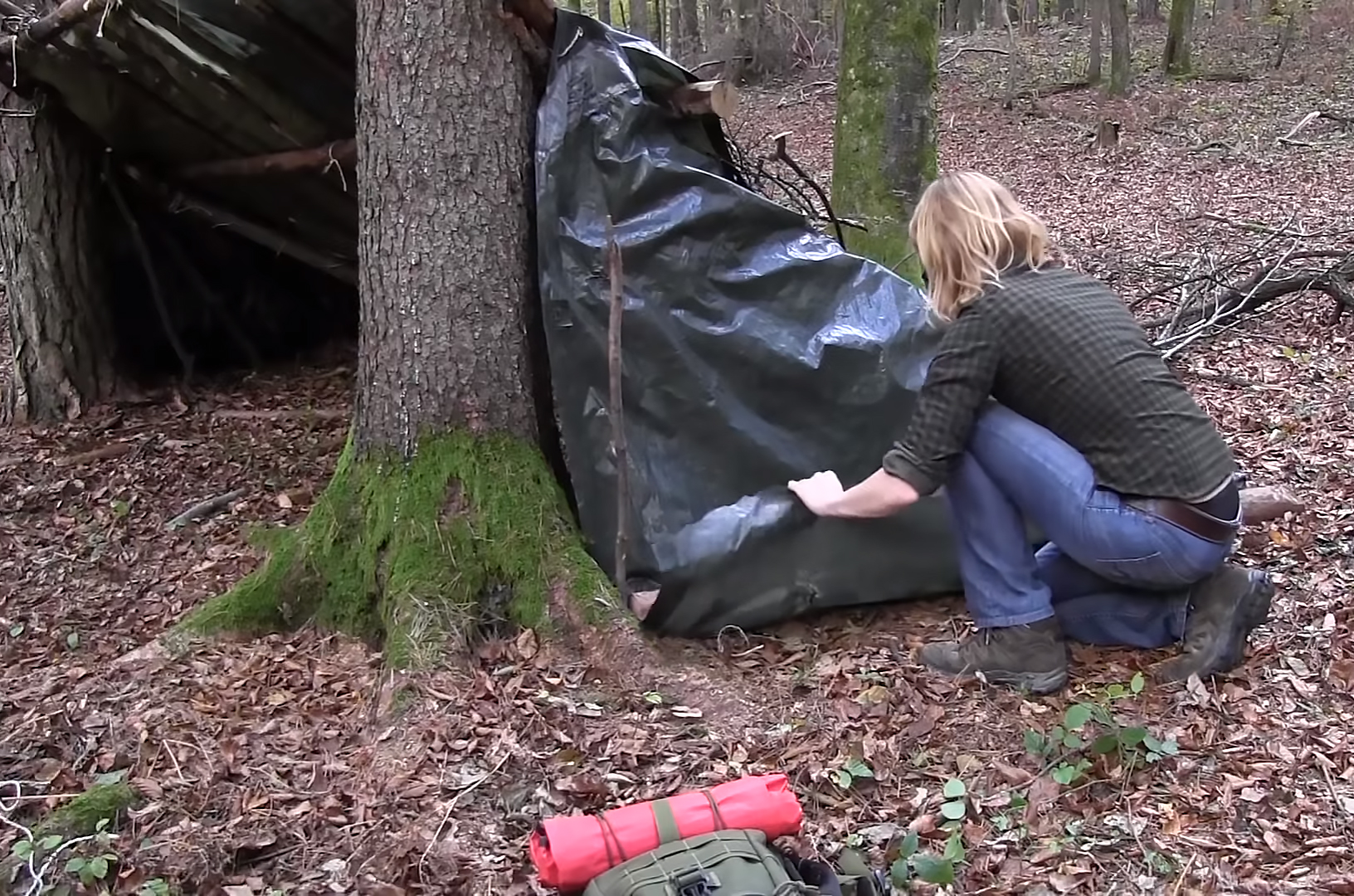
In the YouTube video below, Lilly shows off her survival skills by creating a impressively sophisticated lean-to shelter. It starts out pretty straightforward, with some logs leaned against a pair of trees, and cross-beams lashed in place horizontally. She then adds a tarp for waterproofing, and some smaller branches to hold it in place.
It doesn’t stop there, though—Lilly goes on to build a sleeping platform, fire pit, shelves, a fence, hinged gate, and even a lawn chair. All of this is done with simple materials, like a hacksaw, axe, nails, and twine. Even the gate hinges could easily be scavenged from an abandoned building or shed.
Needless to say, this shelter is designed for long-term survival, or else it wouldn’t be worth expending so much time and materials. However, it’s definitely a pretty cool setup. The fence will keep predators at bay, the central fire pit will radiate heat to the sleeping platform, and there’s plenty of storage space for supplies. And yes, it’s built by a girl who is clearly a talented survivalist—that’s encouraging to see, and we hope it inspires other young women to try learning survival techniques.
What do you think of this shelter design? Add a comment below and let us know how you’d change the shelter, or if you’d leave it exactly as-is.
If you liked this video, check out the Survival Lilly channel on YouTube and consider subscribing. She has quite a few other videos on a wide range of useful topics.
Backup plans are essential to any survival situation. As the saying goes, two is one and one is none—if you don’t have anything to fall back on, the first mishap you encounter may be your last. This philosophy is especially applicable to your core survival gear, such as your shelter, fire-starter, means of water purification, food source, and your knife. You can get away with losing your toothbrush, or forgetting to pack an extra pair of socks, but you won’t survive long without shelter from the elements, nutrition, or tools.
Speaking of backup gear, it’s wise to diversify. You may use a water filter as your primary means of hydration, but store a small bottle of chlorine dioxide tablets as your Plan B. You may have a warm sleeping bag, but keep a Mylar emergency blanket on hand in case you need it. This allows you to adapt more easily to changing circumstances.
You’ll need a large blade for heavy tasks, and a smaller blade for delicate ones.
Applying this logic to survival knives, it’s usually a good idea to have a large workhorse fixed-blade for heavy-duty tasks like chopping wood. This might take the form of a machete, parang, kukri, hatchet, or even just a 6-inch fixed blade on your hip. This means that your secondary knife can be something smaller, lighter, and possibly even concealable elsewhere on your body. Such a blade could be used for skinning game, carving traps, or as a last-resort self-defense tool.
Disclaimer: This should be common sense, but know your local and state laws before carrying any knife, especially a concealed fixed blade. Knife concealment laws vary, so we recommend double-checking them for your region before making any purchases.
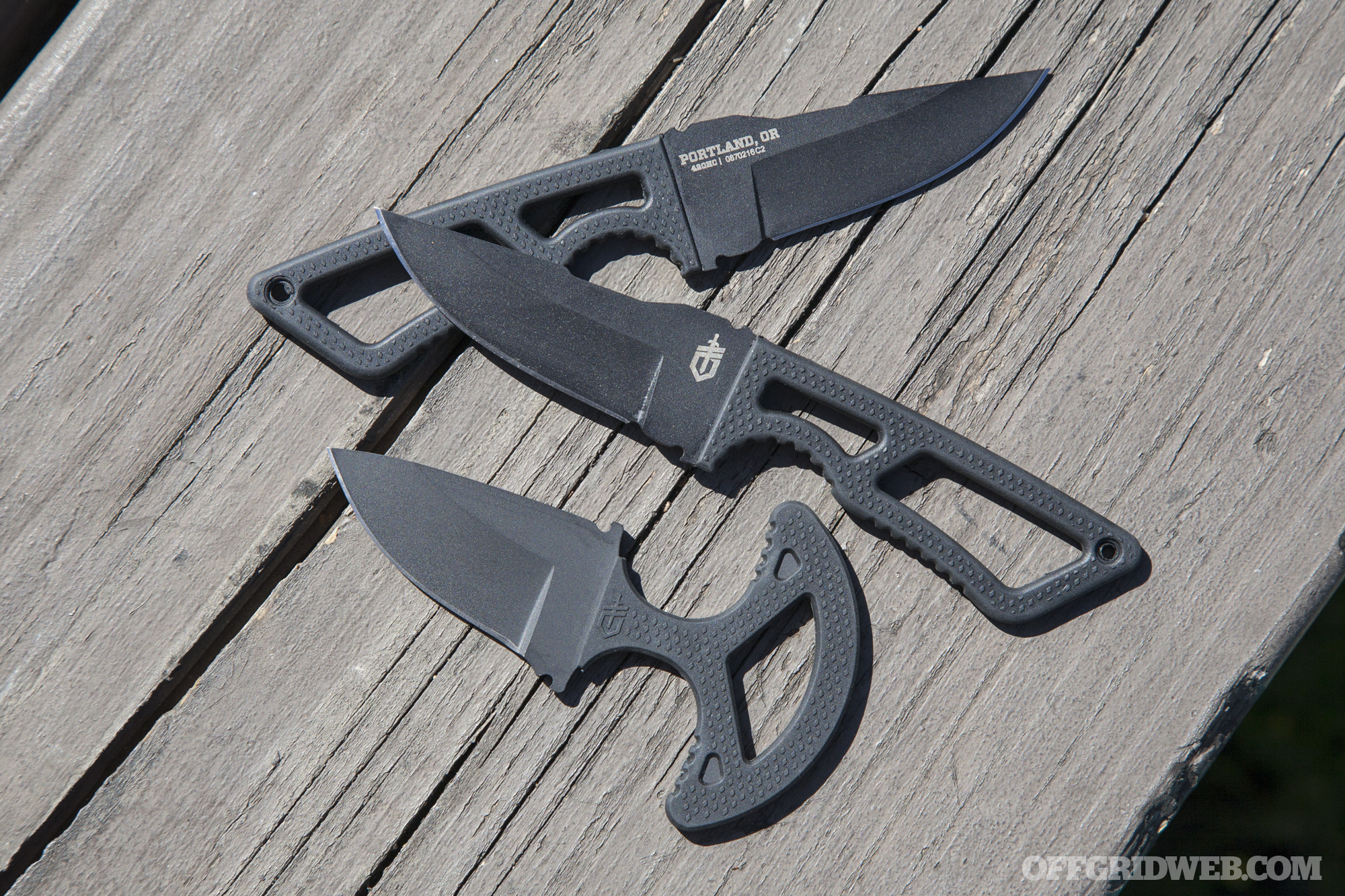
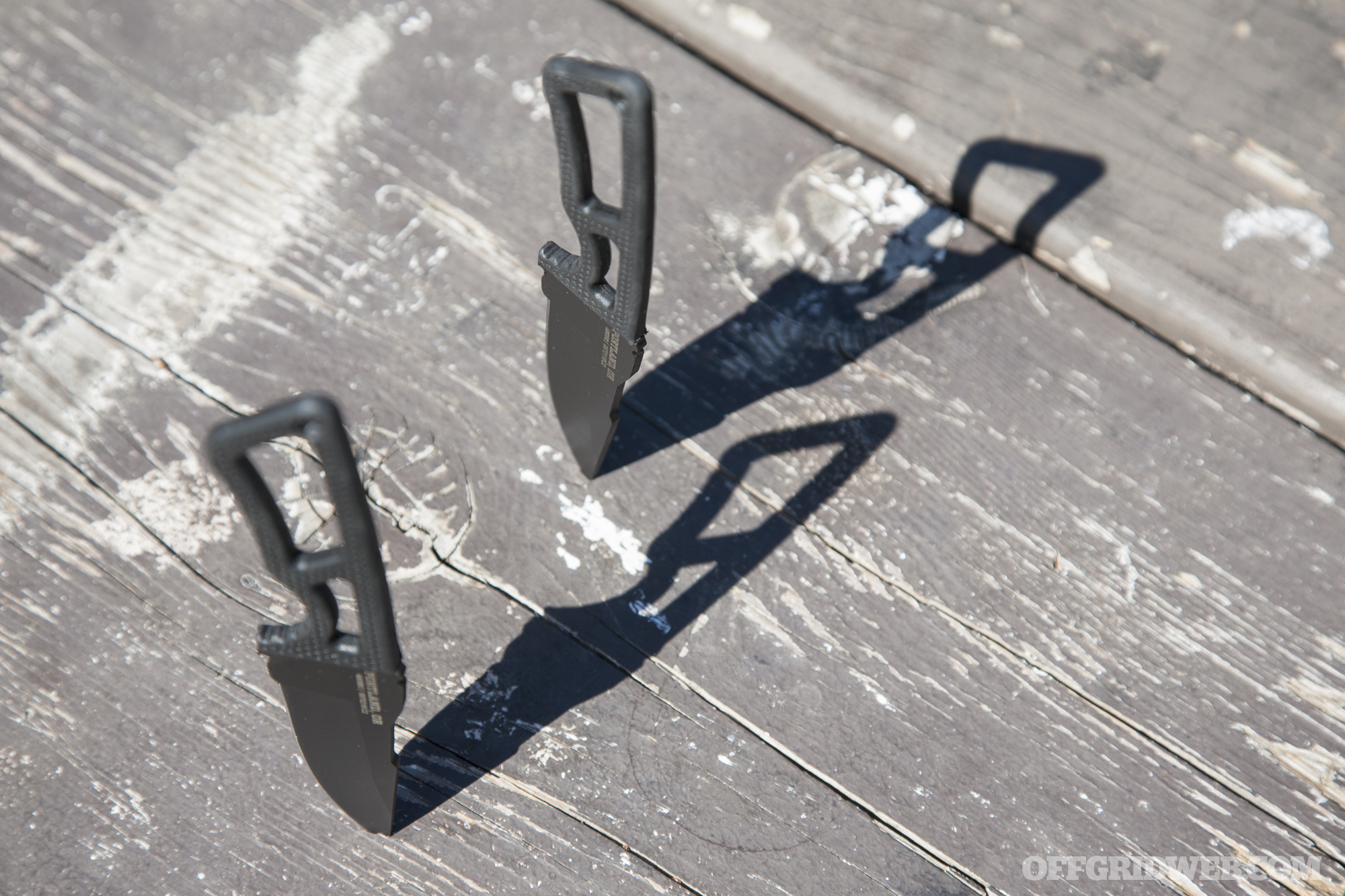
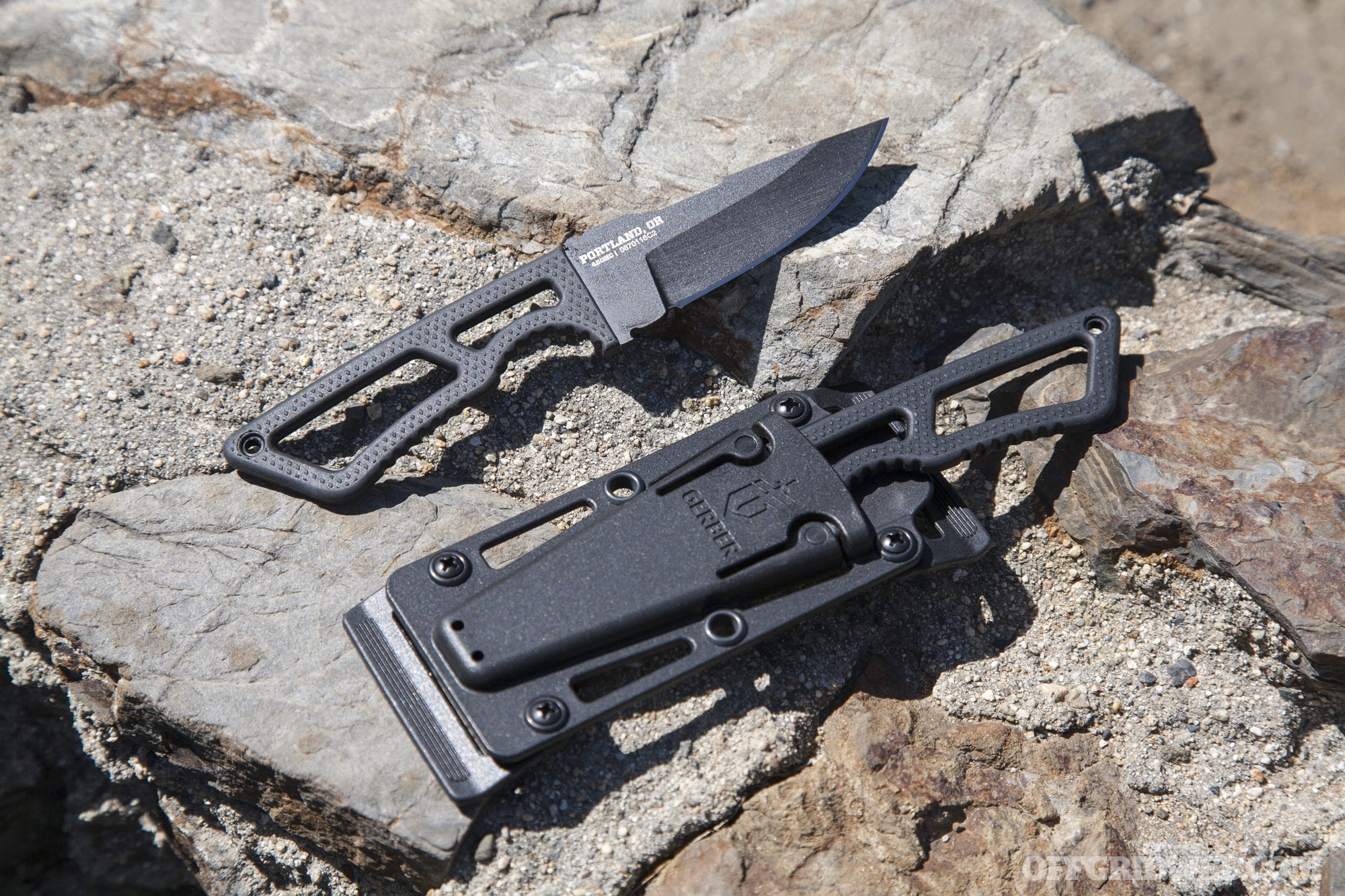
With over 70 years of experience producing knives and tools, Gerber understands the need for an ultra-light and discreet fixed-blade knife. Given this philosophy, the company recently launched a line of blades called the Gerber Ghoststrike series. The blades are described as “a three-piece self-defense system designed for discreet carry in any environment.” This sounded ideal for our secondary blade needs described above, so we requested a set to test and review.
The Ghoststrike series is composed of three models:
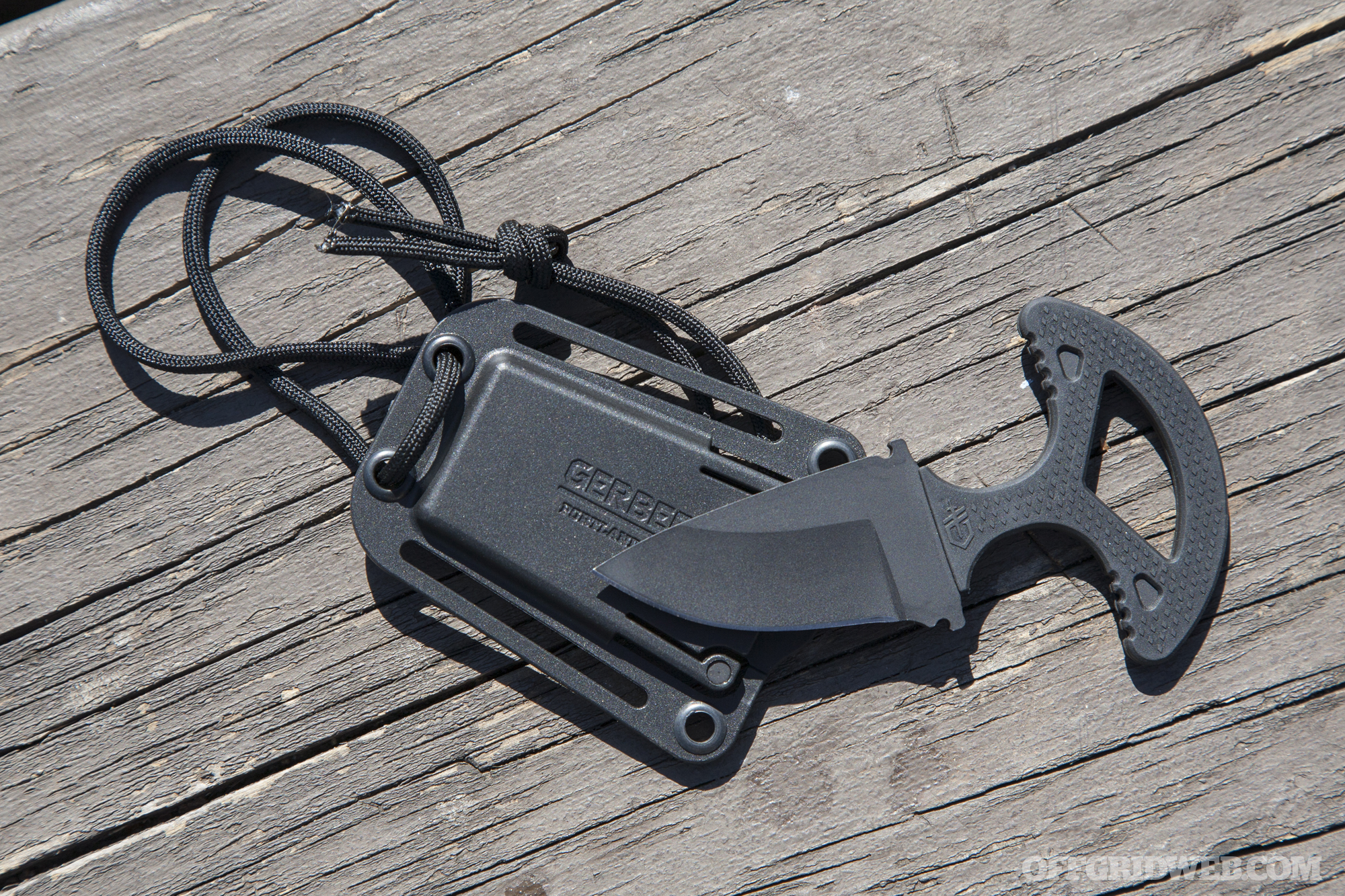
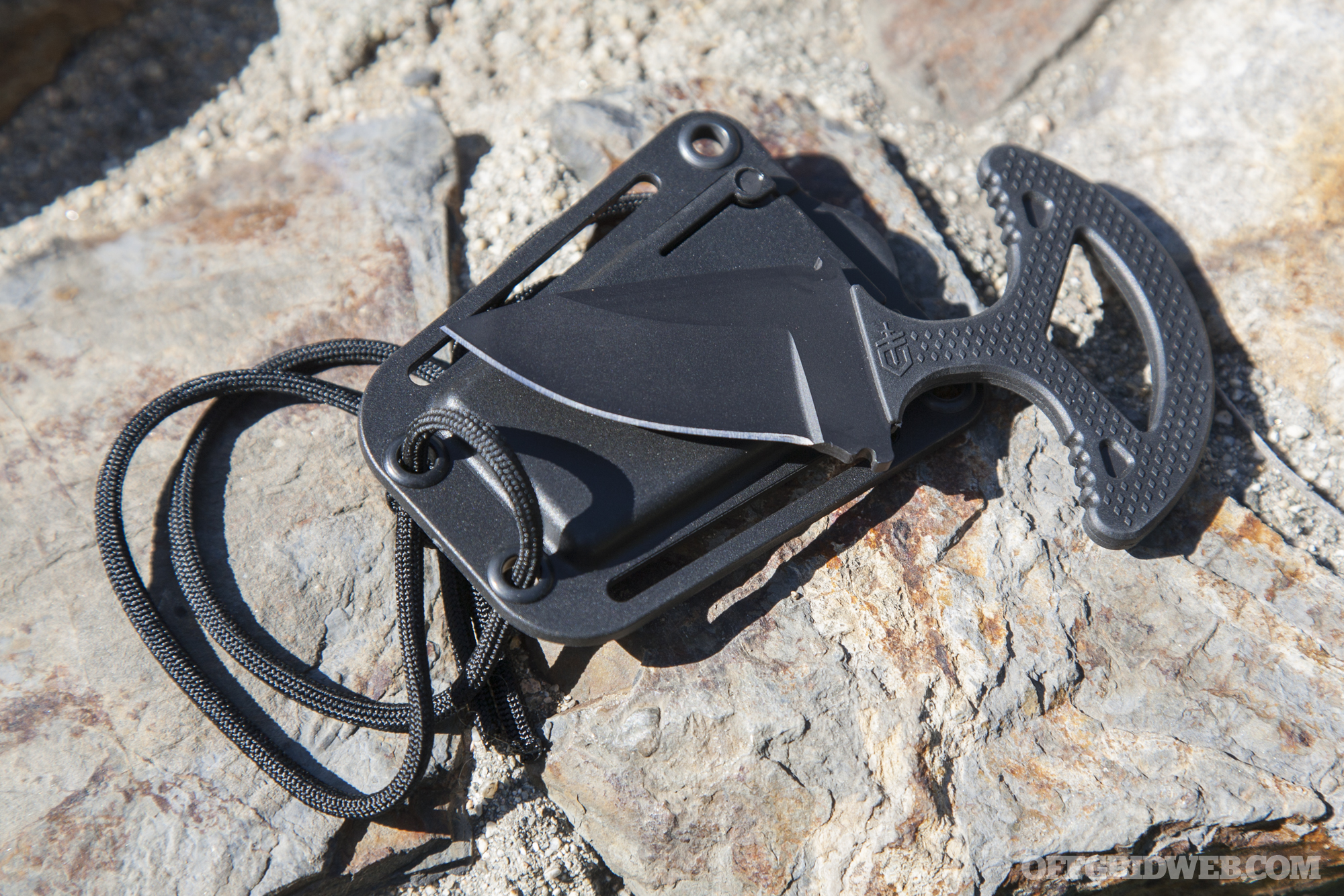
Ghoststrike Punch Knife – A short push dagger with a sheath designed to be worn around the neck or on a belt.
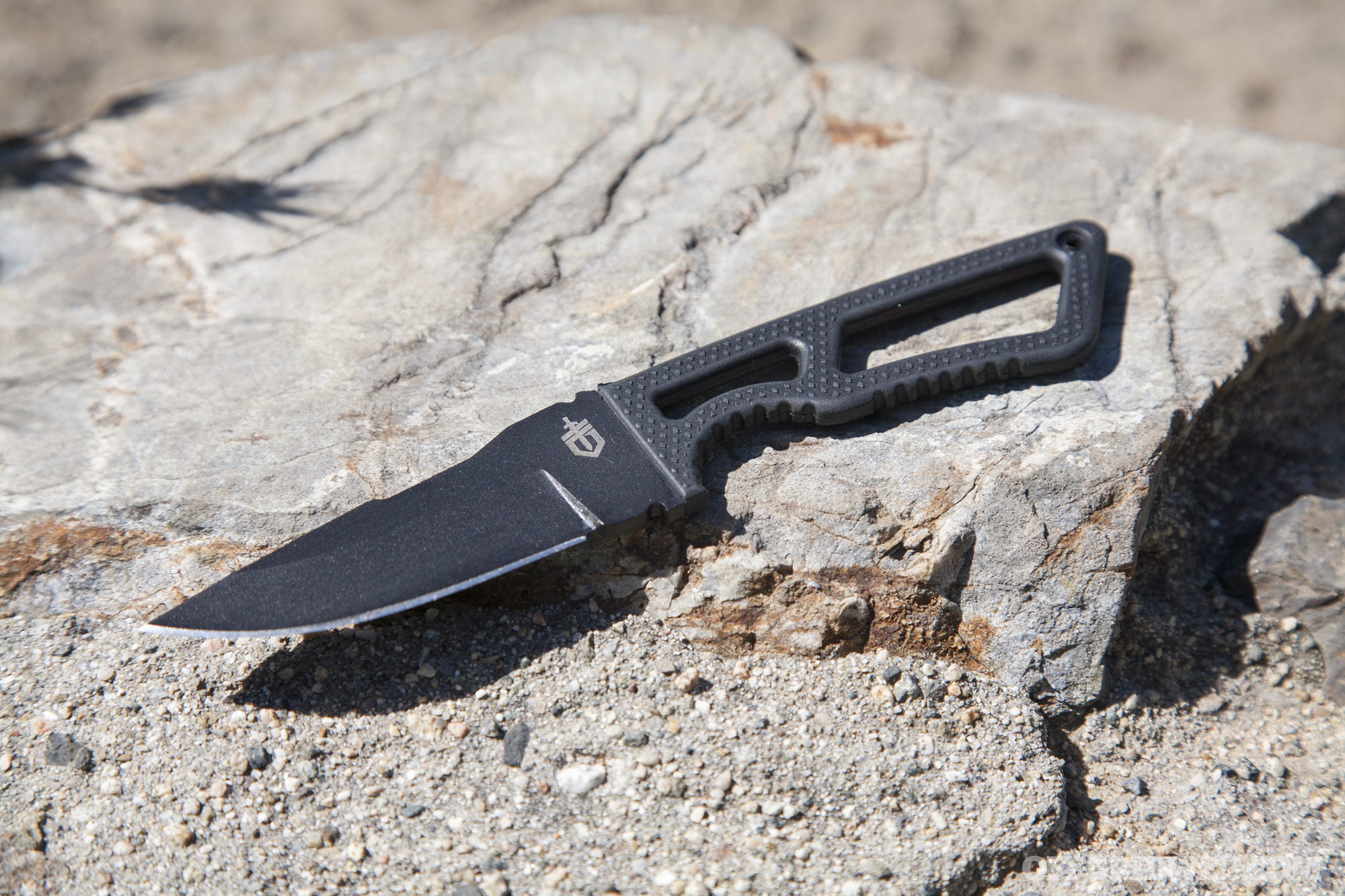
Ghoststrike Fixed Blade – A longer knife with a full-grip handle, which includes a traditional belt sheath.
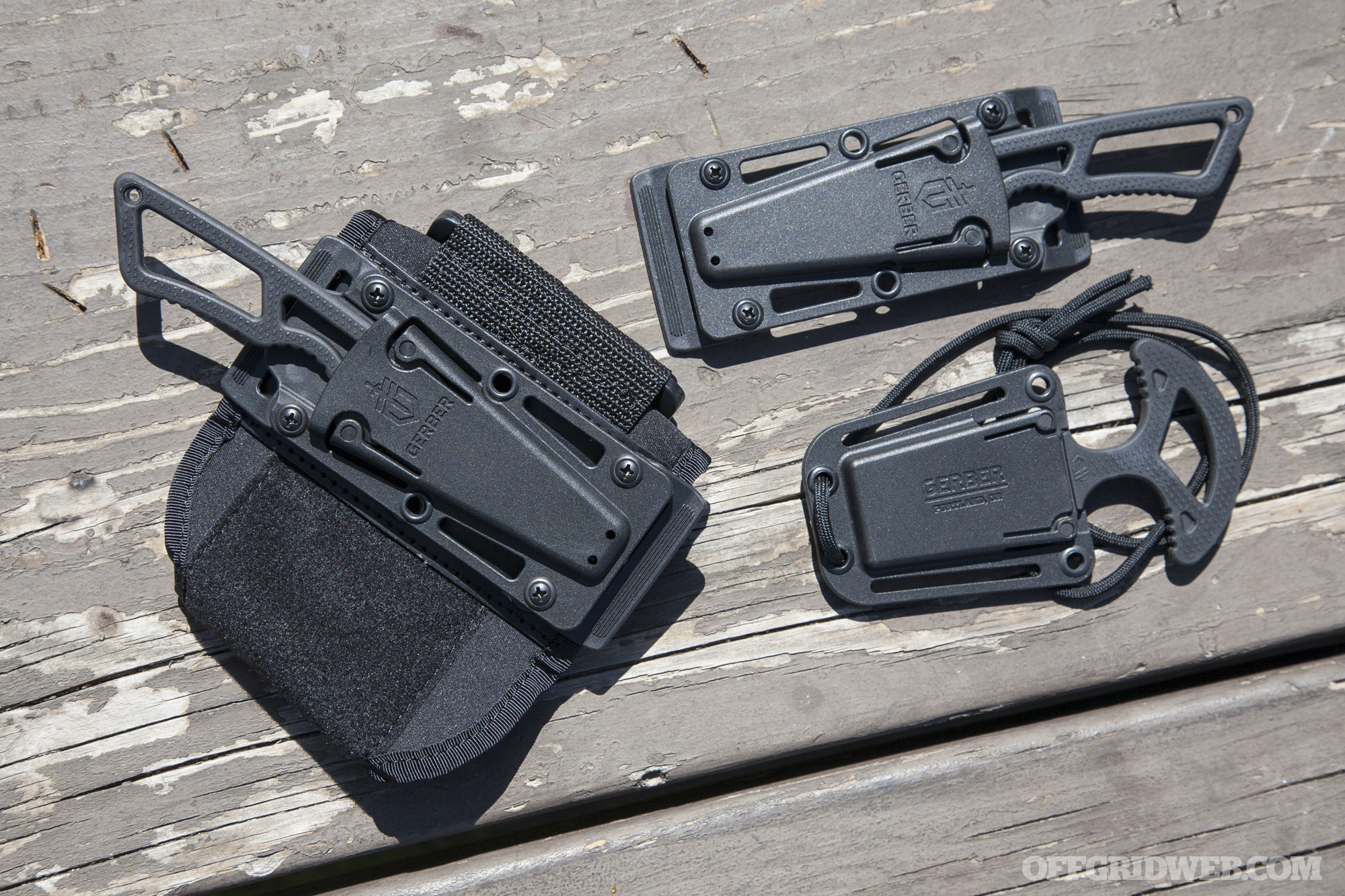
Ghoststrike Deluxe Kit – The same fixed blade above, but with an additional neoprene ankle wrap for use as a boot knife.
Technically, it’s a three-piece system, but with two blade designs: push dagger or fixed blade. The Deluxe option simply provides a different carry style, which we’ll discuss more later on.
Technical Specifications
Unsurprisingly, the three models in the Ghoststrike family have a lot in common, so we’ll address these shared qualities first before moving on to differences.
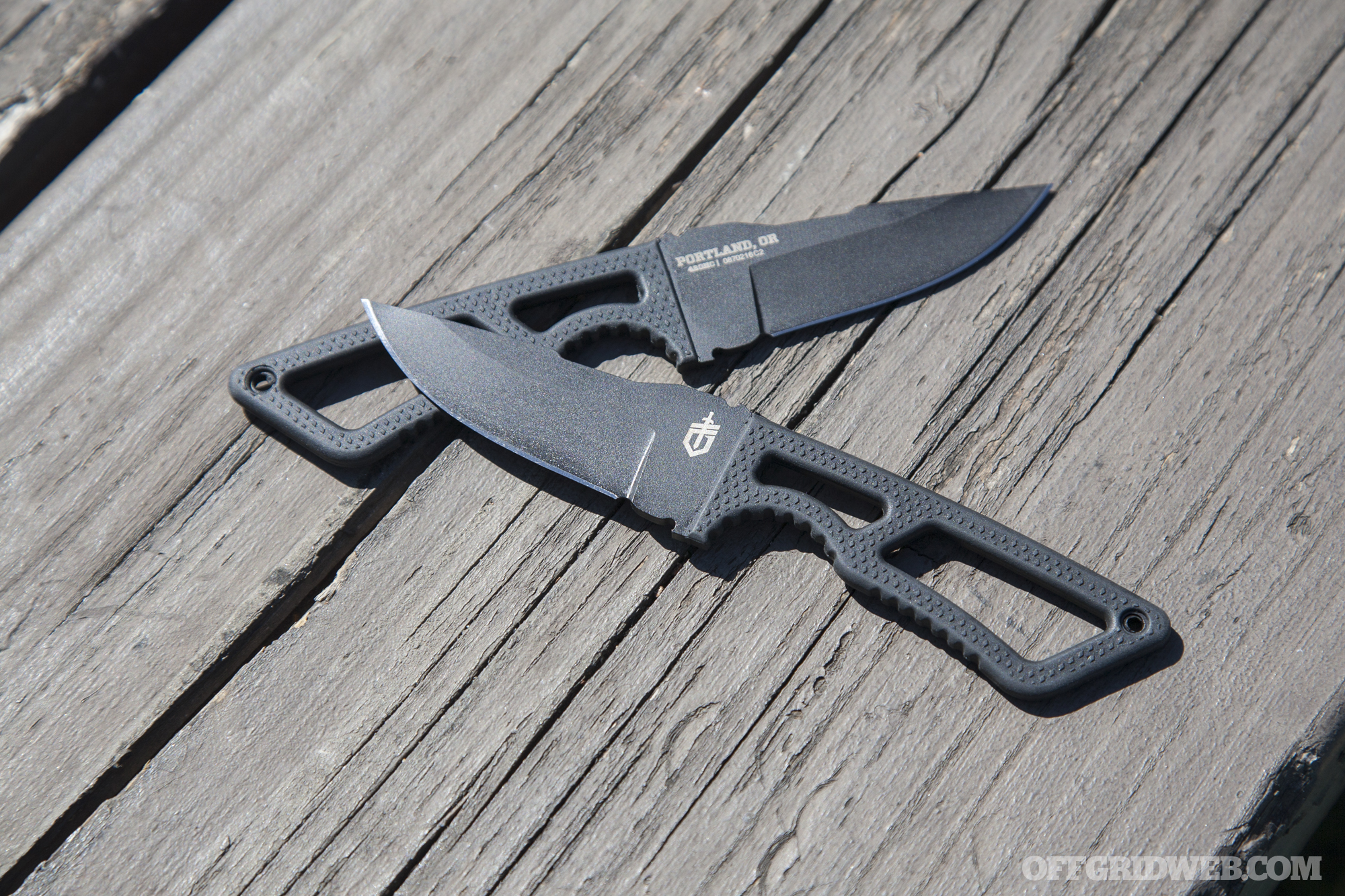
The heart of each one of these blades is a piece of 420HC. It’s a good steel with excellent corrosion resistance, but honestly wouldn’t be our first choice due to its mediocre edge retention. The Ghoststrike blades are all designed here in the USA, the steel is produced in the USA, and the blades are manufactured in the USA. Right off the bat, that’s a good sign. Better yet, Gerber offers a Full Lifetime Warranty against defects in materials or workmanship. Knowing each blade is American-made and warrantied for life goes a long way to build our confidence in the product.
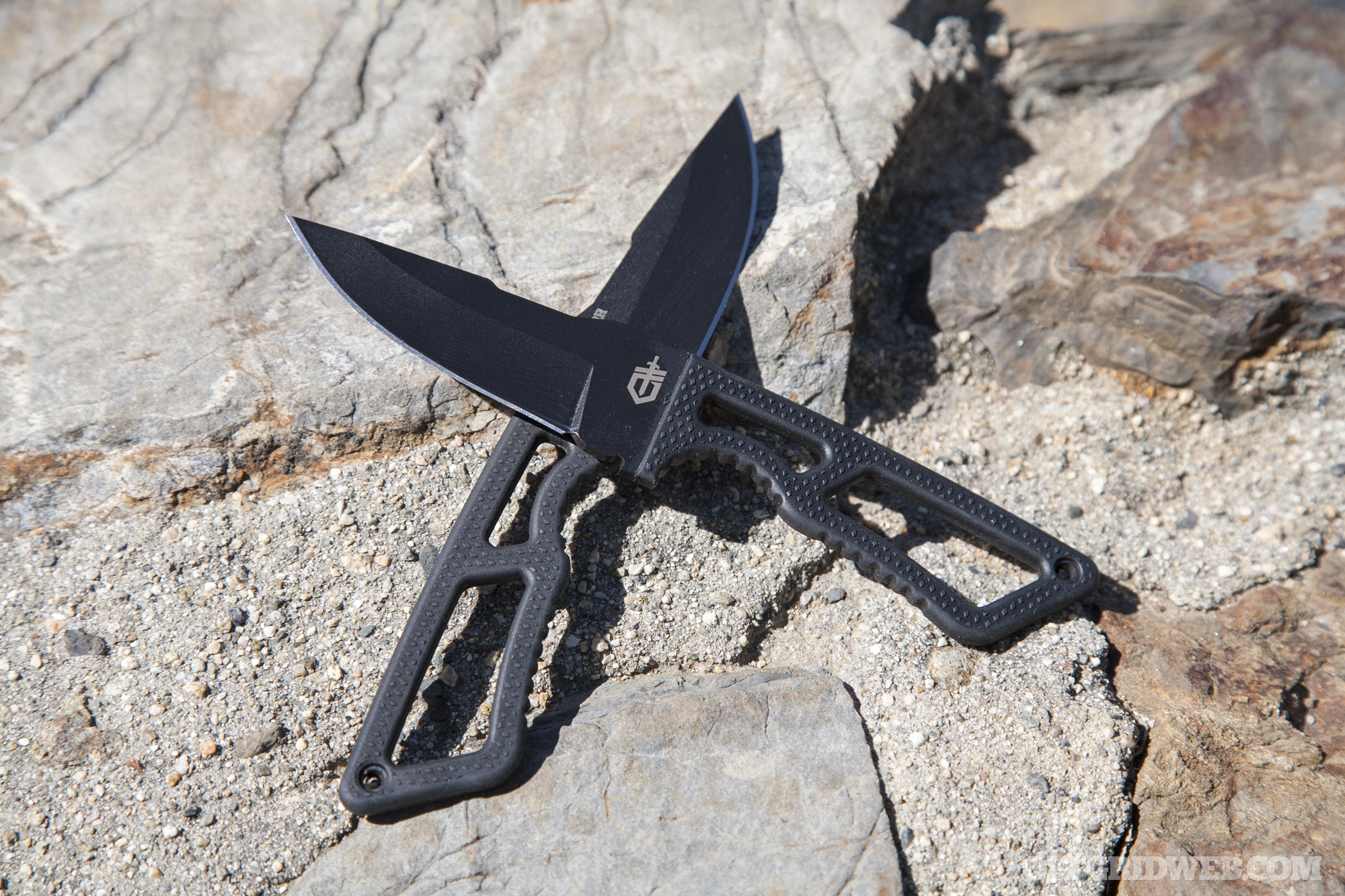
Nevertheless, these knives are much more than just plain steel. Each features a full-tang handle, which has been skeletonized to reduce weight as much as possible. The entire blade is coated with a corrosion-resistant and scratch-resistant black ceramic coating. Next, the handles are then coated again with a black rubberized overmold, which has a diamond texture and jimping along the finger grooves for improved grip.
Each Ghoststrike knife comes with a glass-filled nylon sheath, which is ambidextrous, allowing the knife to be inserted while facing either direction. Each blade also has a pair of small notches on the spine and belly, just forward of the end of the handle. These notches serve as part of a dual detent mechanism when the knife is inserted into the sheath, locking in place with a firm and audible click. The detents provide plenty of resistance to keep the blade in place, but also release quickly with a firm pull on the handle. There’s no fiddling with a lock button or release lever—just pull the handle to draw.
Here are the remainder of the technical specs for each blade design:
Punch Knife:
Blade Length: 2.5 in
Overall Length: 4.8 in
Weight (with sheath): 3.0 oz
Weight (knife only): 1.8 oz
MSRP: $53
Fixed Blade & Deluxe Fixed Blade:
Blade Length: 3.3 in
Overall Length: 6.9 in
Weight (with sheath and ankle wrap): 5.5 oz
Weight (with sheath): 3.5 oz
Weight (knife only): 1.8 oz
MSRP: $59 (standard) or $83 (deluxe)
Note: These weights are less than those listed on Gerber’s web site. We weighed each knife on a scale, and found them to be slightly lighter than advertised.
Gerber Ghoststrike Punch Knife
After removing the Ghoststrike punch dagger from its packaging, we placed the included 13.5-inch-long paracord lanyard around our necks, suspending the knife comfortably atop the sternum bone. Grasping the handle between one’s fingers and giving it a quick downward tug unsheaths the blade, producing an audible click as the detent snaps out of place.
The dagger is surprisingly light and comfortable in hand, with the semi-circular handle providing leverage against the palm. It’s easy enough to manipulate for cutting and slicing tasks, but the true purpose of this design is a firm forward thrust. When used in this manner, the blade easily punctured targets, and didn’t leave the user with a sore or bruised palm.
Ergonomically, this blade is solid, and it does exactly what you’d expect of a push dagger. However, it’s worth noting that it is only a single-edged design, where a majority of other push daggers are double-edged. While this may be a small drawback for directional slashing motions, it also keeps the knife from being prohibited in states that disallow carrying certain double-edged blades (for example, Michigan).
As for the sheath, we honestly couldn’t ask for a better retention mechanism for a neck knife. It’s secure enough to stay in place while running, and has zero rattle, wiggle, or play. When you need the blade, it can be drawn easily at a moment’s notice. The sheath is definitely better-suited for use on the neck lanyard, but it can be mounted vertically on a belt.
Gerber Ghoststrike Fixed Blade
The Ghoststrike fixed blade is longer and narrower than the punch knife, with an overall length of just under 7 inches. The handle features a large forefinger groove, and a guard that prevents your fingers from slipping forward onto the edge. As with all Gerber Ghoststrike blades, the rubberized handle coating also reduces the risk of fumbling the knife with wet hands.
There’s also a slight depression on the blade’s spine, which creates a flat spot for thumb placement. In combat, this “thumbs-up”-style grip is often called the Filipino grip, and it’s used extensively by martial artists. Outside of combat, it provides extra leverage, and leaves the user feeling as though the blade is a natural extension of the hand. For both these reasons, we’re glad to see Gerber clearly accommodating this well-known grip in the Ghoststrike blade design.
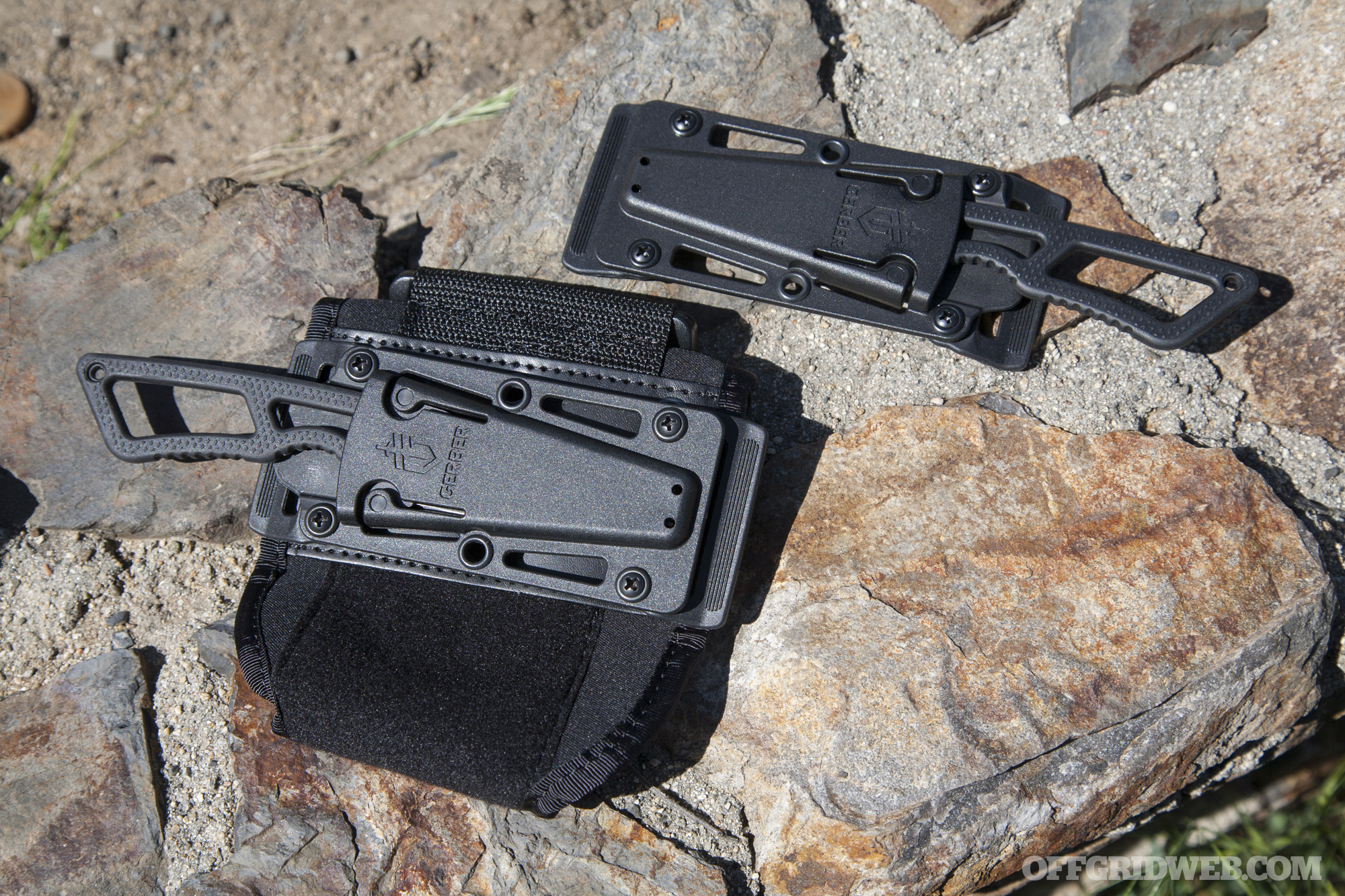
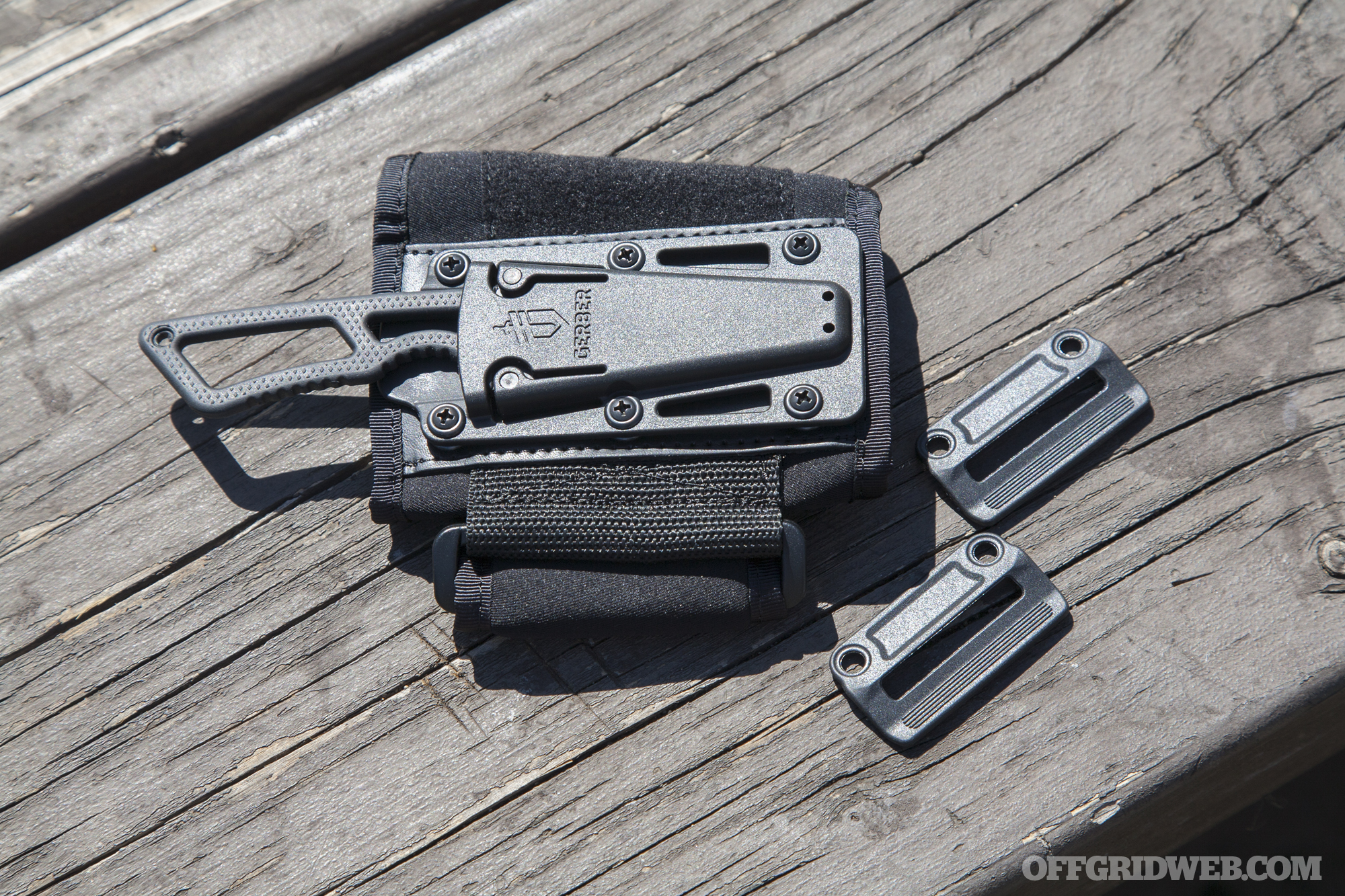
The fixed blade’s glass-reinforced nylon sheath includes the same great dual-detent retention as the push dagger. It could still conceivably be worn as a neck knife, since it’s extremely slim and lightweight, but we preferred wearing it on a belt. By re-configuring the included belt mounts, the knife can be worn either horizontally or vertically. With the knife mounted horizontally at the 6-o’clock position, it can be easily concealed by the tail of a shirt, and doesn’t get in the way as you move around.
Gerber Ghoststrike Fixed Blade Deluxe Kit
There’s no need to discuss the fixed blade in this Deluxe Kit, as it’s the same one found in the basic package above. However, the mounting system is where this kit sets itself apart from the others.
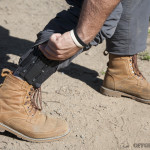
In addition to the sheath and belt mounts found in the basic kit, the deluxe kit offers an adjustable neoprene ankle wrap. This wrap is comfortable, lightweight, and low-profile enough to be hidden easily by a pant leg or boot collar. We will note that the wrap is made in China, but the stitching quality and materials seem durable.
The ankle wrap is secured by passing through a hard nylon buckle, then pulling it back over itself, and securing the loose end with hook-and-loop material. It’s relatively secure, but as with most ankle wraps, it may need to be periodically tightened or adjusted as you walk. Then again, this won’t be much of an issue if you’re wearing high-tops or boots.
Conclusions
After testing all three models in the Gerber Ghoststrike lineup, we were pleased with the results. They’re lightweight, durable, and offer good retention and ergonomics. The prices may seem steep to some, but we’re willing to pay more for an American-made product with a lifetime warranty. However, we’ll admit the $24 price increase for the addition of a foreign-made neoprene ankle wrap in the deluxe kit seems a bit high. Of the three models, we preferred the basic fixed blade, worn horizontally at 6-o’clock.
Here are some final pros and cons for the Gerber Ghoststrike knives:
Pros
Extremely lightweight and slim
Outstanding sheath design and retention
Variety of carry styles
Made in the USA with a lifetime warranty
Cons
420HC is decent steel, but not great. We’d prefer something with better edge retention, like 440C, AUS-8, or 154CM, especially at this price point.
Punch knife is single-edged (this may be a pro, depending on your local laws)
As kids, many of us played with monster trucks and Tonka bulldozers in the sandbox, pushing our miniature off-road vehicles up steep mounds of dirt and crushing smaller toy cars. These days, we’re often relegated to practical commuter cars instead. However, there is one company that has produced a vehicle that brings back this childlike go-anywhere do-anything spirit. It’s called the Avtoros Shaman, and it’s amazing.
Avtoros, a Russian company, built this behemoth after ten years of research and development. It’s 20 feet long, 10 feet tall, and weighs 5.3 tons. It also has eight wheels, each of which is driven by the engine and capable of hydraulically-actuated steering. This setup allows the Avtoros Shaman to run in three different drive modes:
On-road: front four wheels driven and steered
Off-road: eight-wheel-drive with opposing rear-wheel steering for tight corners
“Crab” mode: all eight wheels steered at the same angle for lateral movement
This beast may not be capable of blistering speed, as its 146-horsepower 4-cylinder turbodiesel engine and manual transmission max out at under 50mph. However, it can easily climb 45-degree grades, while carrying 1.5 tons of cargo and up to 12 people. There’s even an optional propeller attachment that permits it to swim across rivers and lakes.
Now, you might be thinking this vehicle is absurdly expensive. Well, yes and no. It costs the Russian equivalent of $137,000. While that’s certainly out of reach for many of us, it’s not much more than a Mercedes Benz AMG G-Class SUV, and the Mercedes certainly can’t carry a dozen people, drive across a lake, or touch an Avtoros Shaman on an off-road course.
Although we don’t have the disposable income to afford a Shaman, we can see its use as a vehicle for search and rescue teams, first-aid crews, or hunting groups. For more information on the Avtoros Shaman, visit Avtoros.info (site is in Russian, so you may want to use the Google translated version).