Finding shelter is not only vital to one’s survival, it’s also vital for peace of mind. Be it for hunting, recreation, or in a survival situation, having a good tent that’s easy to set up makes life easier. If you plan on living out of a tent for an extended period of time, having a comfortable, safe place to unwind and relax at the end of the day is crucial. It’s also ideal to have plenty of space for fellow travelers and gear, rather than returning to a cramped shelter at the end of a long day. There are plenty of manufacturers of large canvas tents on the market, but Elk Mountain Tents decided to do things a little differently.
Whether the primary use for the tent is hunting, camping with family, or as an emergency shelter, these tents offer a roomy space to keep your family and gear out of the elements. We decided to check out an assortment of items from Elk Mountain’s shelter lineup, evaluating first-time setup and long-term viability. This included the following items:
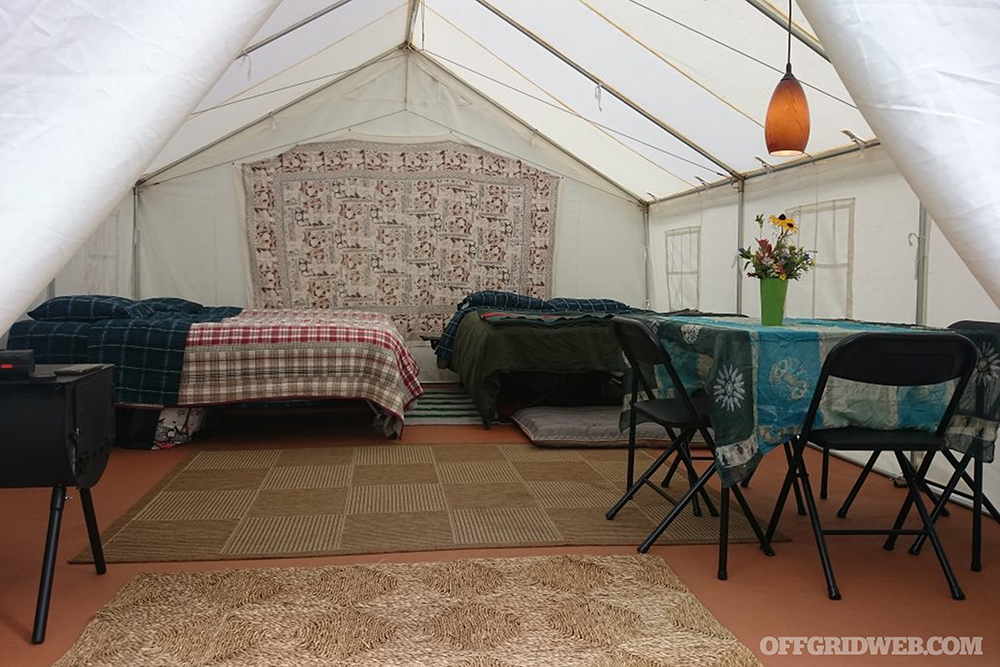
An example of how much you can do inside one of these tents — interior decorator not included.
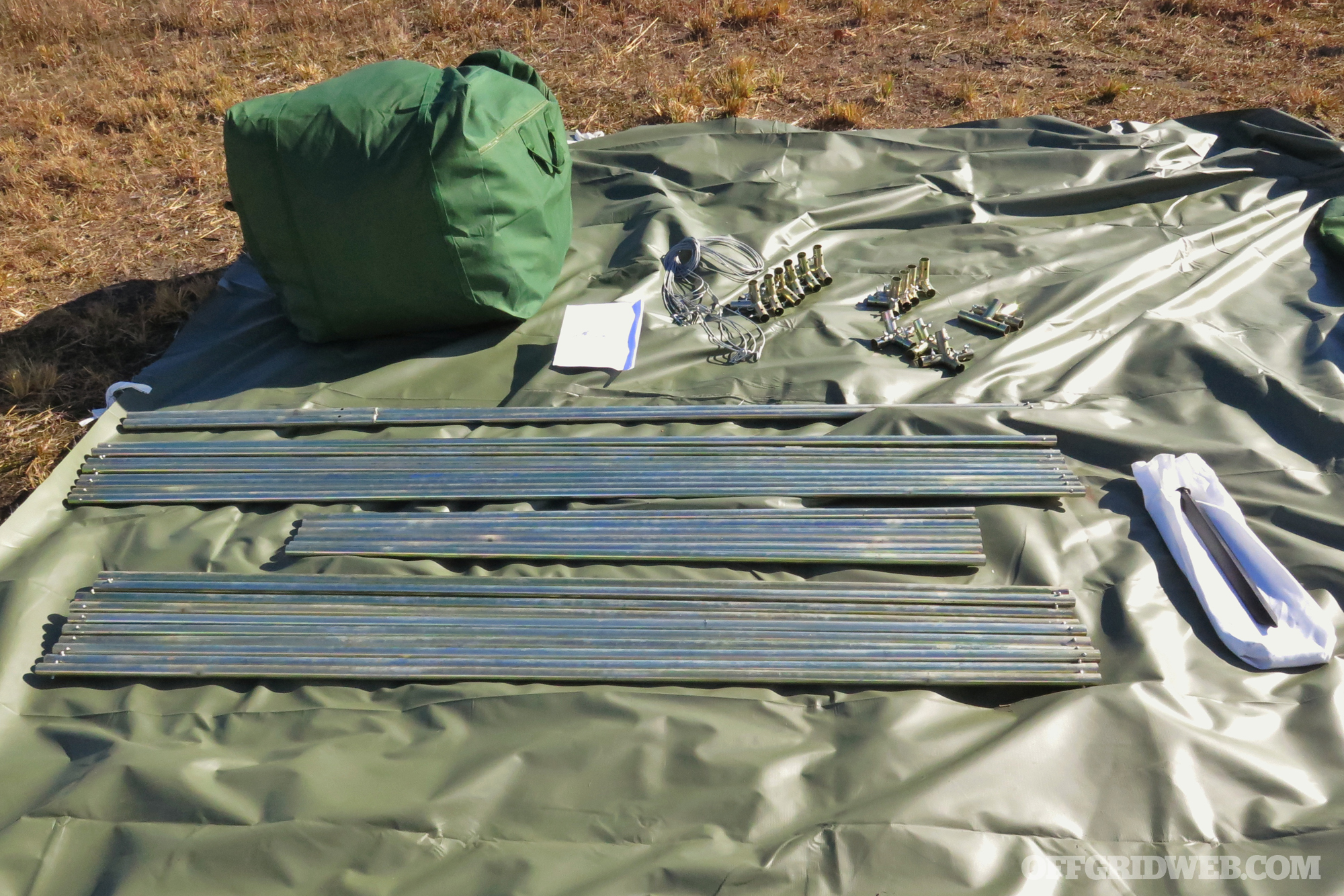
Each tent includes the canvas structure with storage bag, frame angle kit with its own storage bag, wire support system, fiberglass stove pipe jack with cover, eave ropes and tensioners, and eight 18-inch steel stakes. Elk Mountain sells the frame poles and floor separately, which is nice if you have a specific need for the tent, or if you’d rather build your own frame or omit the floor kit to save some cash. We also picked up an optional large canvas storage bag, which is easier to pack the tent into than the compact bag it arrived in.
All packed up, the tent takes up very little room and weighs around 125 pounds total.
So, let’s take a look at this tent to see what makes it stand out.
Elk Mountain Tent Materials
Before setting up the tent for the first time, it’s a good idea to get acquainted with all the components.
As opposed to traditional cotton canvas, Elk Mountain Tents are made from a polyester synthetic that closely resembles a cotton-blend fabric. This solves several issues present with cotton tents. First, there’s no need to weather it before use. This usually requires leaving a new cotton tent out in the rain or soaking it with water and letting it dry, then repeating the process several times to make it waterproof. The second major issue with cotton tents is mildew. Storing a damp cotton tent is not advisable and will quickly ruin a rather expensive tent. The one benefit that cotton offers over polyester is its breathability, not only to let air in but also to help prevent condensation. To address this, Elk Mountain Tents uses a proprietary blend of polyester fibers that are designed to prevent condensation build up.
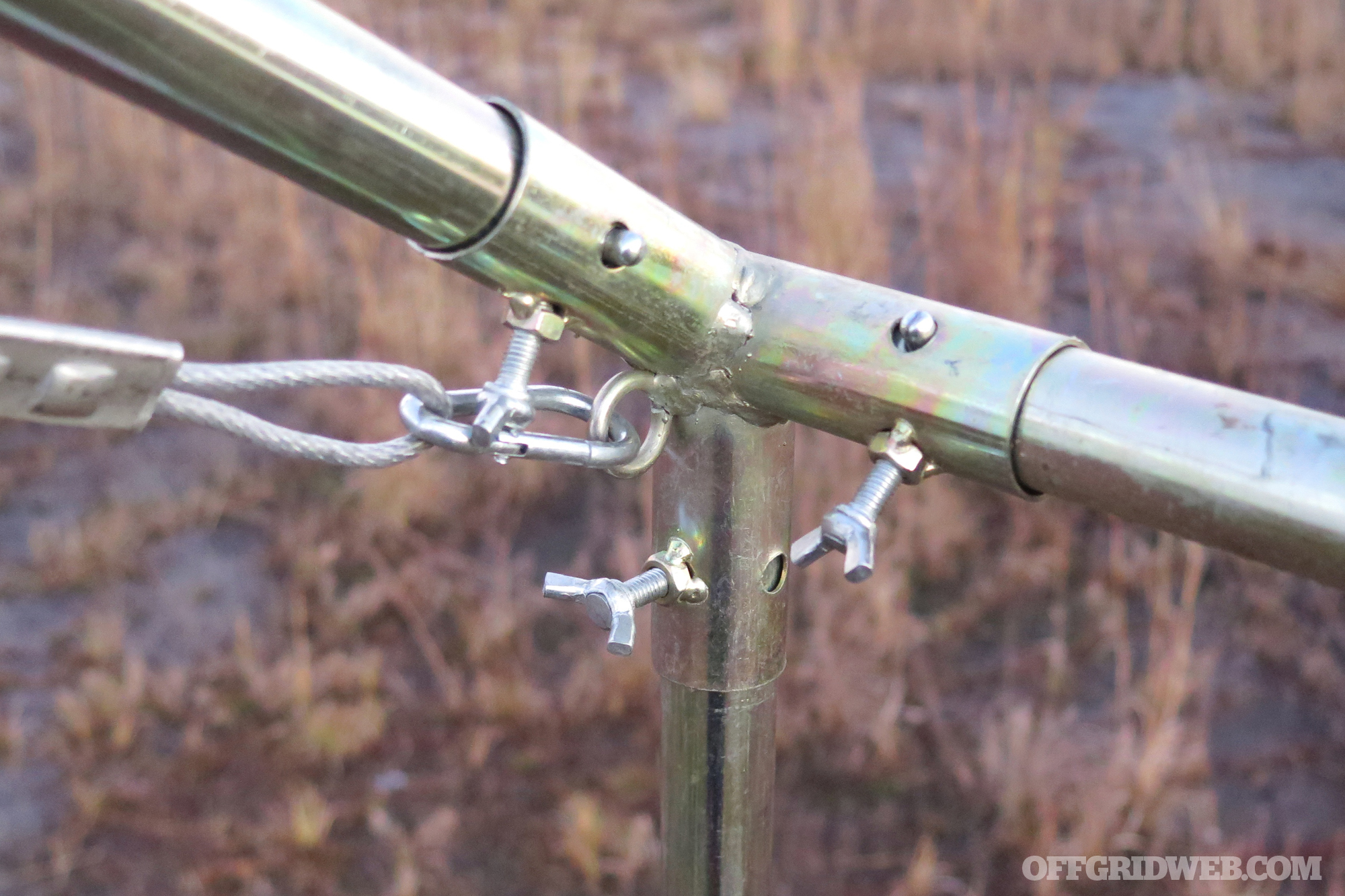
These tents can be used with or without an Elk Mountain metal frame. The tent comes with the necessary angle kit corner pieces for the frame. These pieces have wing bolts integrated into them to tighten down on the conduit pipes after assembly. To complete the frame, a list of lengths of 3/4″ EMT conduit is provided. You’ll need to buy and cut this material before building the shelter.
The frame locks into the included corner pieces with wing bolts to help with rigidity.
Alternatively, Elk Mountain offers a full frame kit for purchase. The nice thing about this frame kit is that the poles come with pole clips installed inside them to enable the frame to snap together, making assembly by yourself a breeze. It took us about 45 minutes to assemble the frame the first time. However, much of that time was spent trying to figure out which pieces went where — a common process with any new tent. We are confident we could get that time down to around 20 minutes.
Optional Accessories
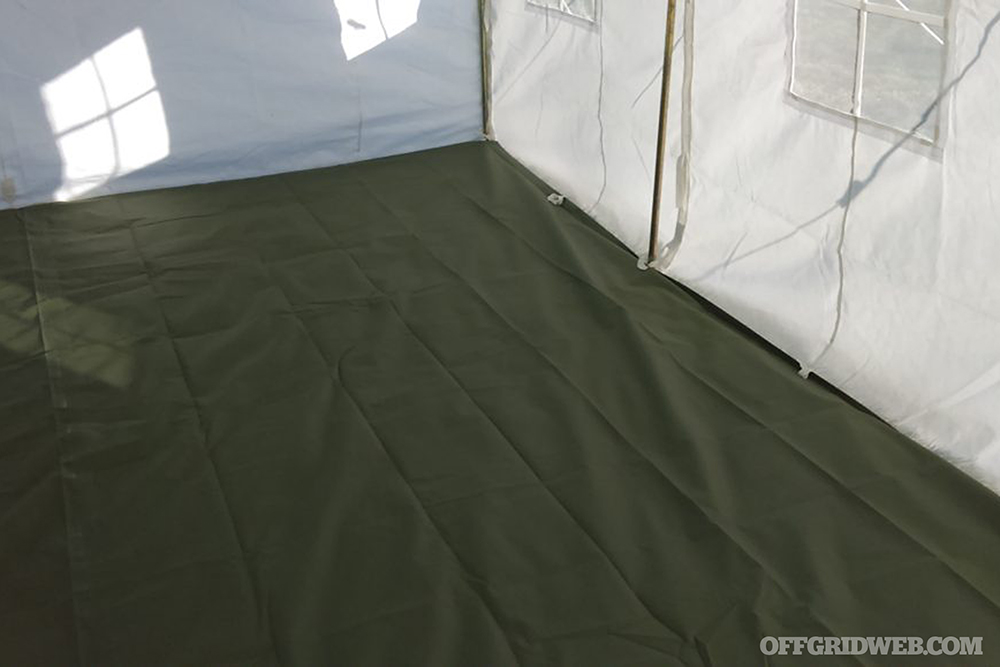
Along with the tents and frame kits, Elk Mountain Tents offers a selection of accessories for purchase. These include a rubberized PVC floor kit that ties into the base of the frame. You may be asking yourself, how can a tent come without a floor? Well, having no integrated floor makes assembly much easier, saves on cost of the tent itself, and allows you to remove the floor and wash it separately. Other accessories include storage bags, stoves, tent flies, and other upgraded equipment.
Initial Assembly
It is essential with any piece of equipment to familiarize yourself with it before you intend on actually using it. With that in mind, we decided to do a dry run and assemble the tent before our first trip in it. This was a wise choice, because it took some time to figure it all out.
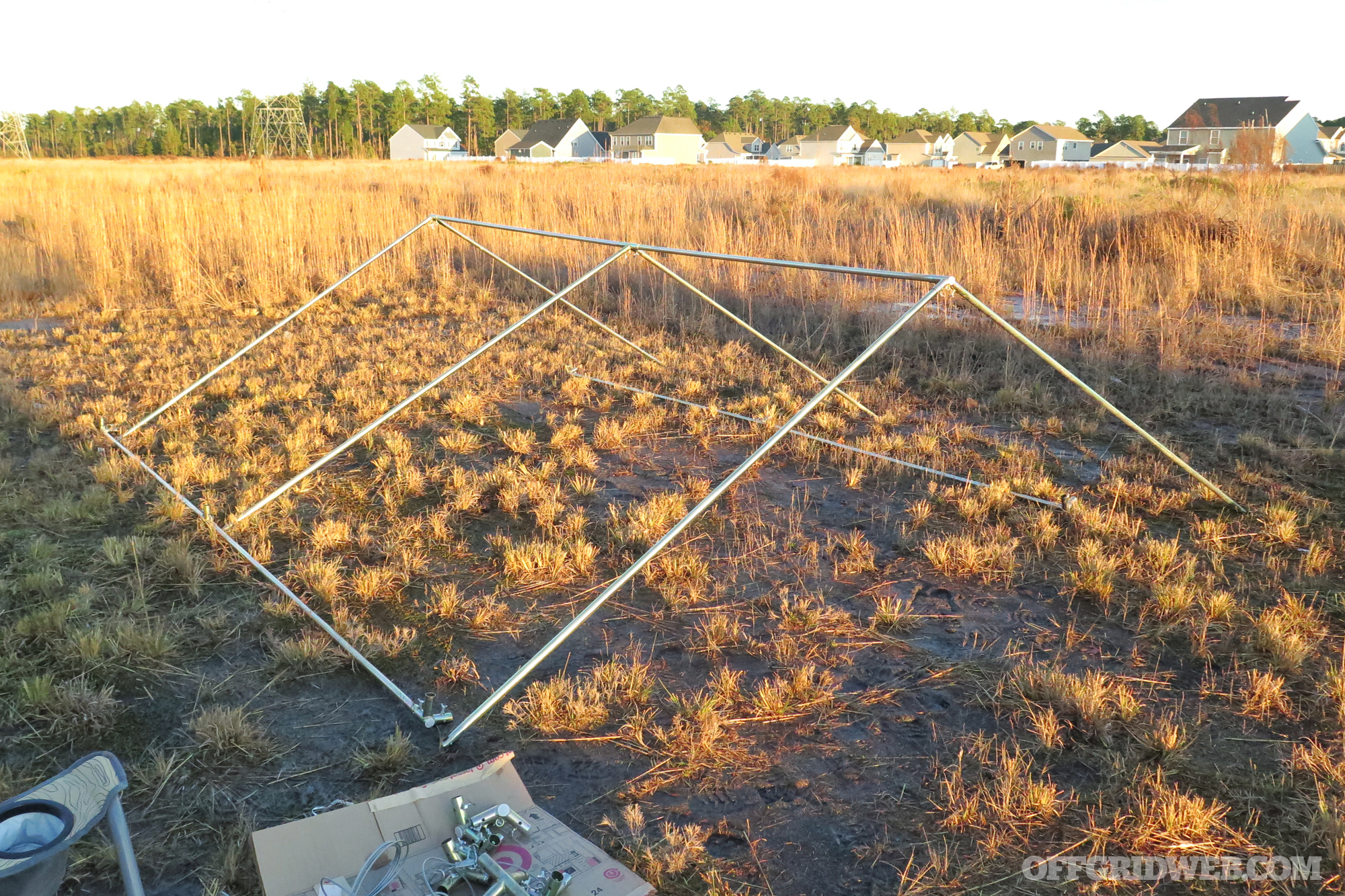
The directions that came with the tent were not very well written or descriptive. So, after taking inventory of the components, we began assembly by laying out the floor pieces. We then built the individual rafters and assembled them into the roof of the tent.
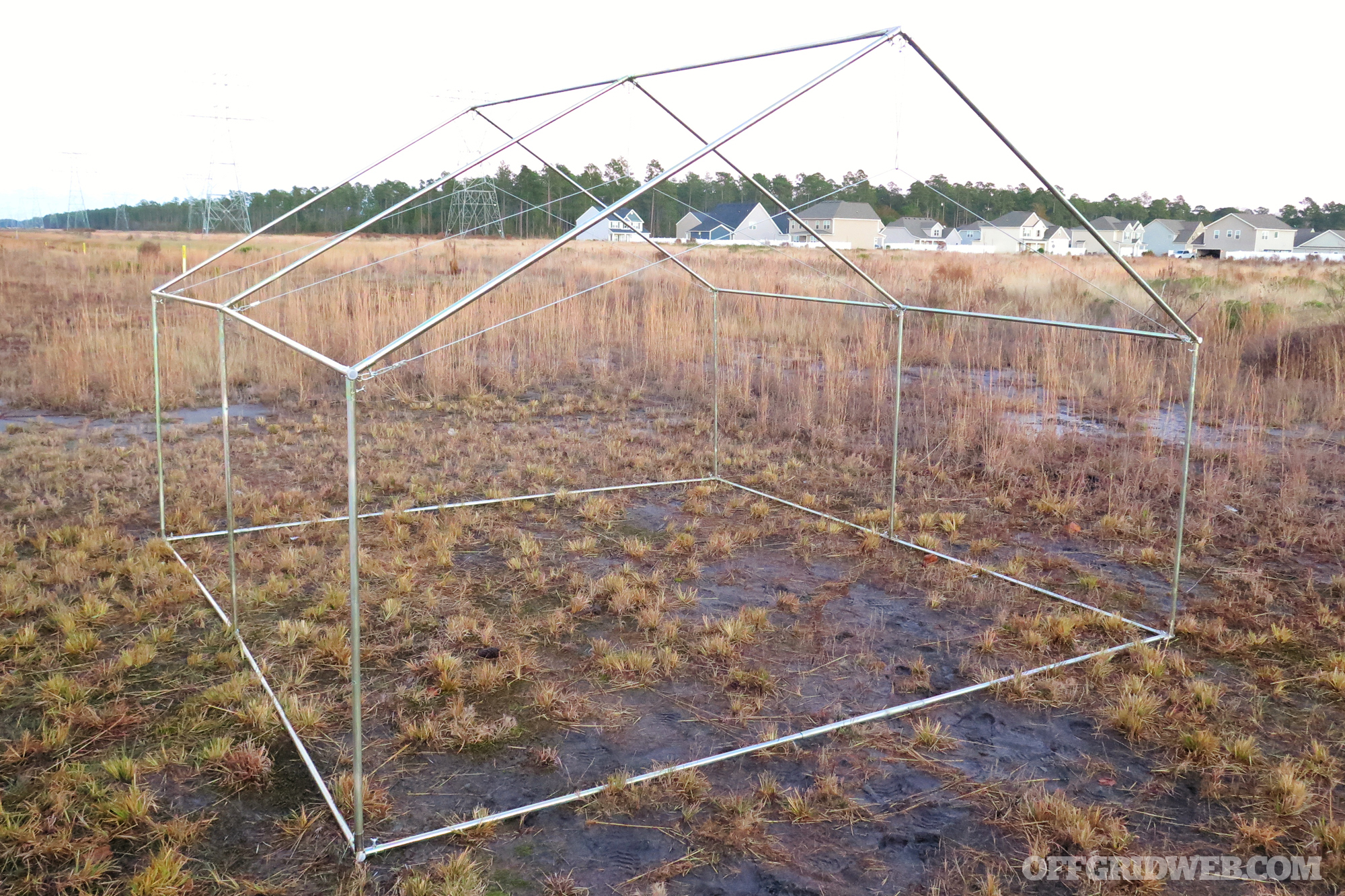
We assembled the base of the frame first, then the rafters, and finally connected them with the six side poles.
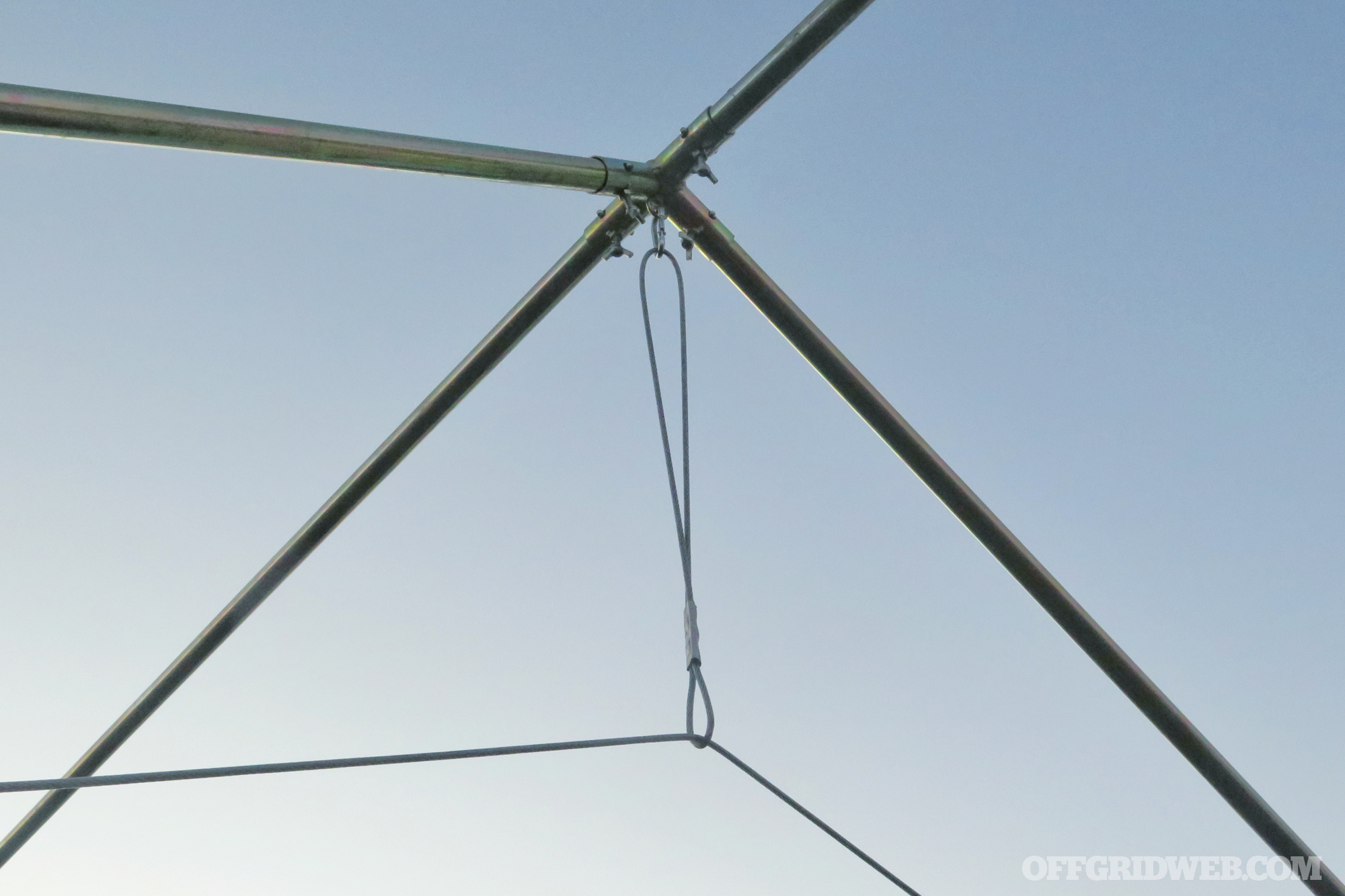
Before lifting the roof up and installing the side poles, we connected all of the tensioning cables from one side to the other. This stiffens up the whole tent overall and helps it keep its shape. Finally, we lifted the roof up and inserted the side poles into the floor frame and roof.
The cable tension system in the ridge of the frame keeps the frame square and secure.
Once the frame was fully assembled, we grabbed a helper and laid the canvas over the frame. This was a challenging task as the canvas weighs roughly 50 pounds and was quite unwieldy. We’re sure it would be a real struggle if the wind picked up. However, you probably won’t be alone if you’re setting up a tent this large — make use of all those helping hands.
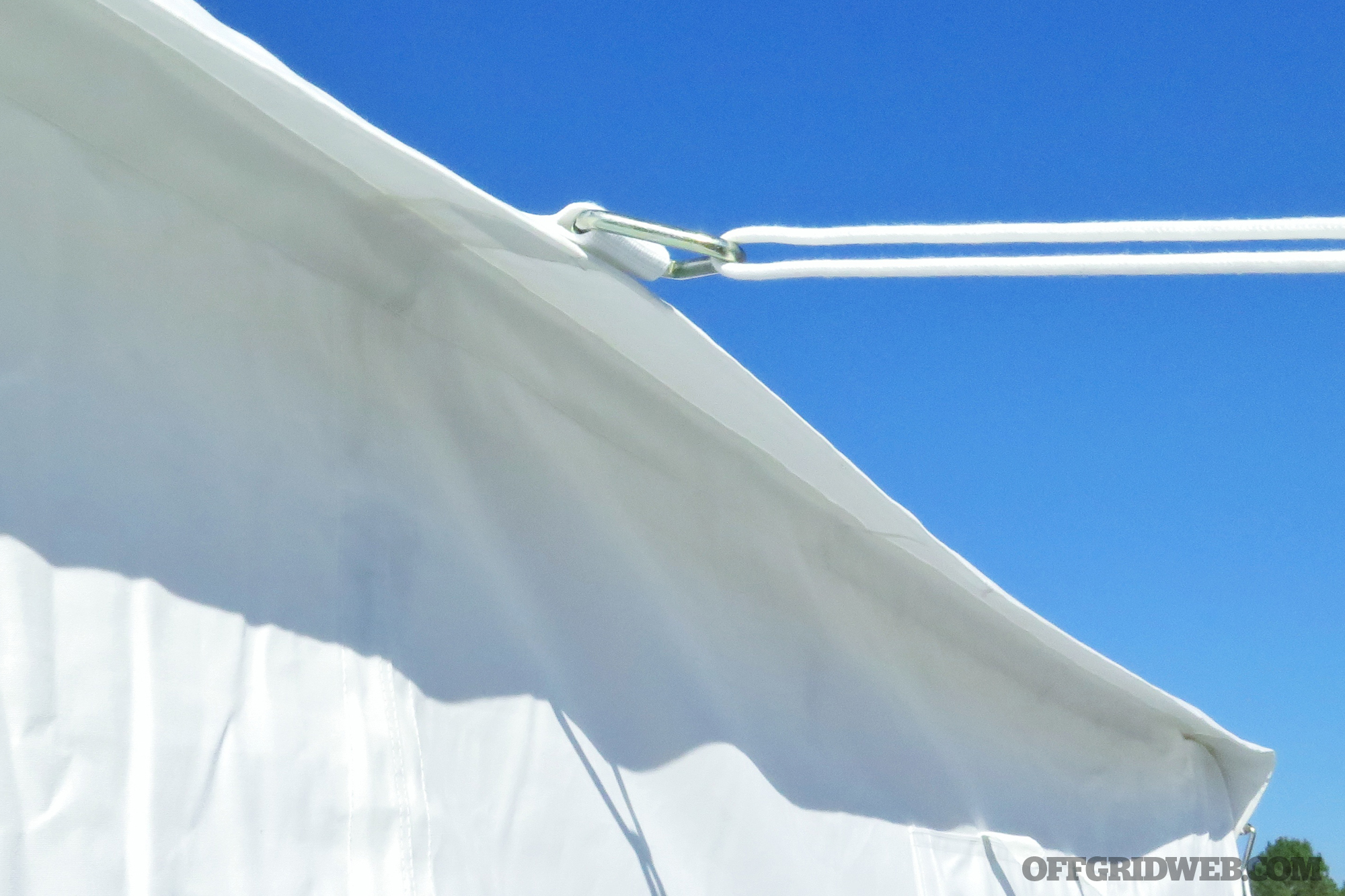
Extra material creates eaves over the walls to prevent water from running down the side of the tent.
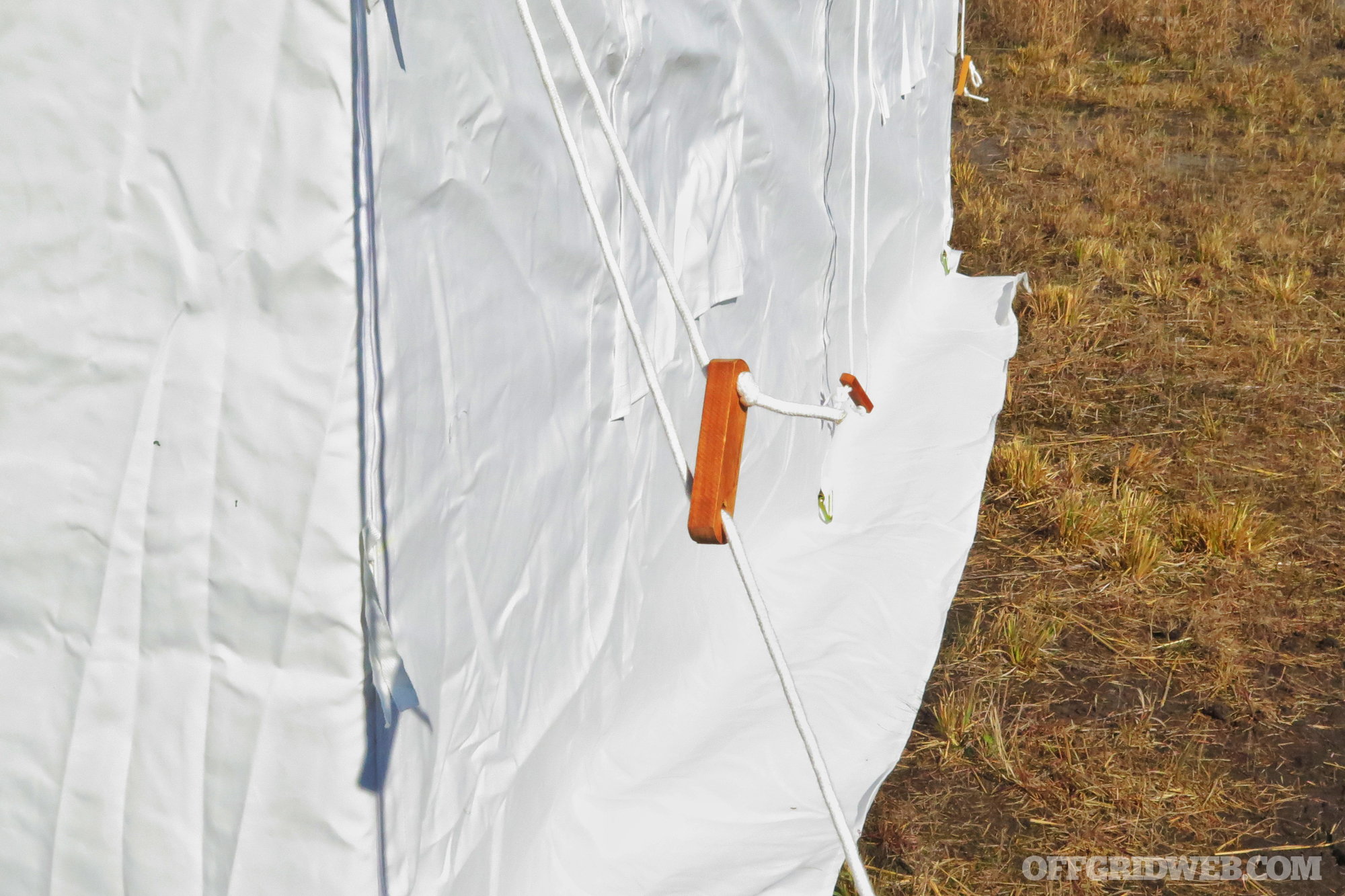
With the canvas fully draped over the frame, which was done with the poles on one side removed for ease of placement, we adjusted the canvas to fit properly. Then the corner and side tie straps were tied around the frame. To finish it off, the tie-downs were staked into the ground and pulled taut.
Once it was all set up and secured, the tent was very stable. This was a good feeling knowing that our potential home for an extended period of time would not be blown down by a stiff breeze.
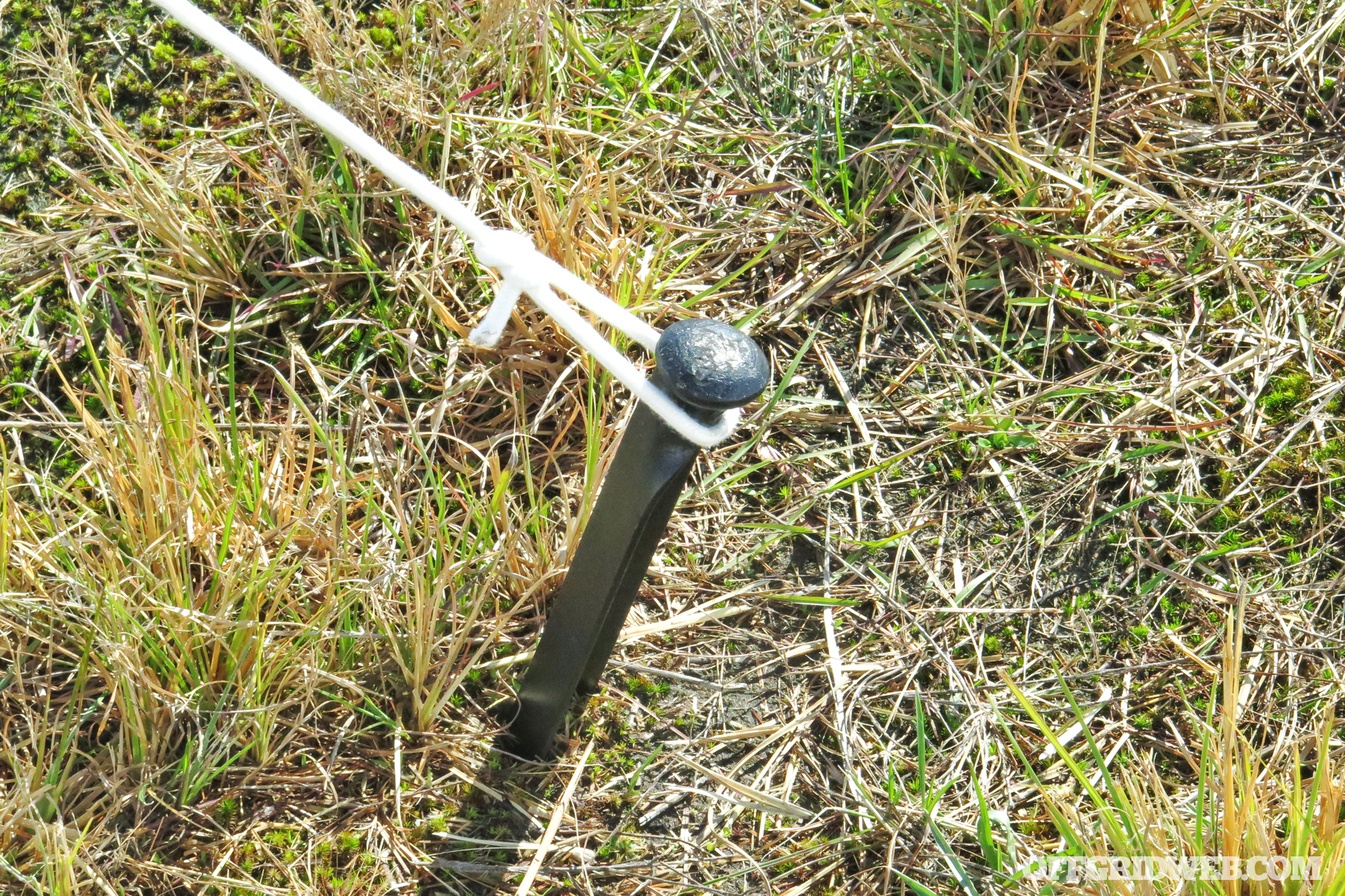
These heavy-duty stakes keep your tent secure. Eight came with our 13×13 tent.
Added Features
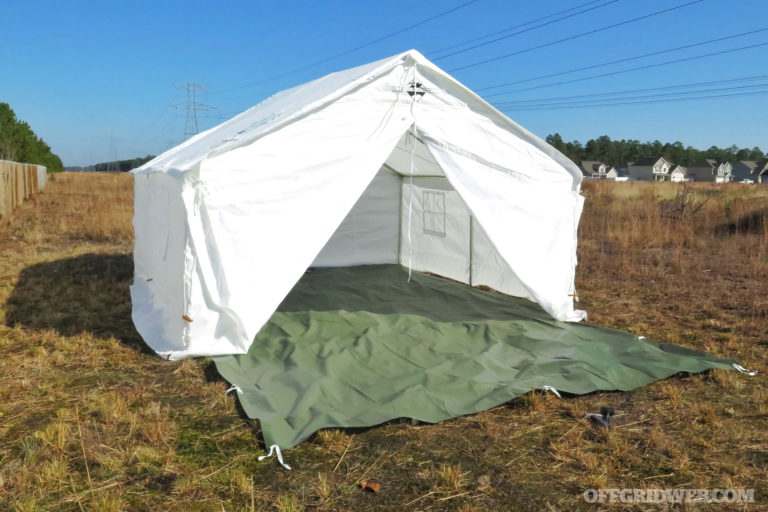
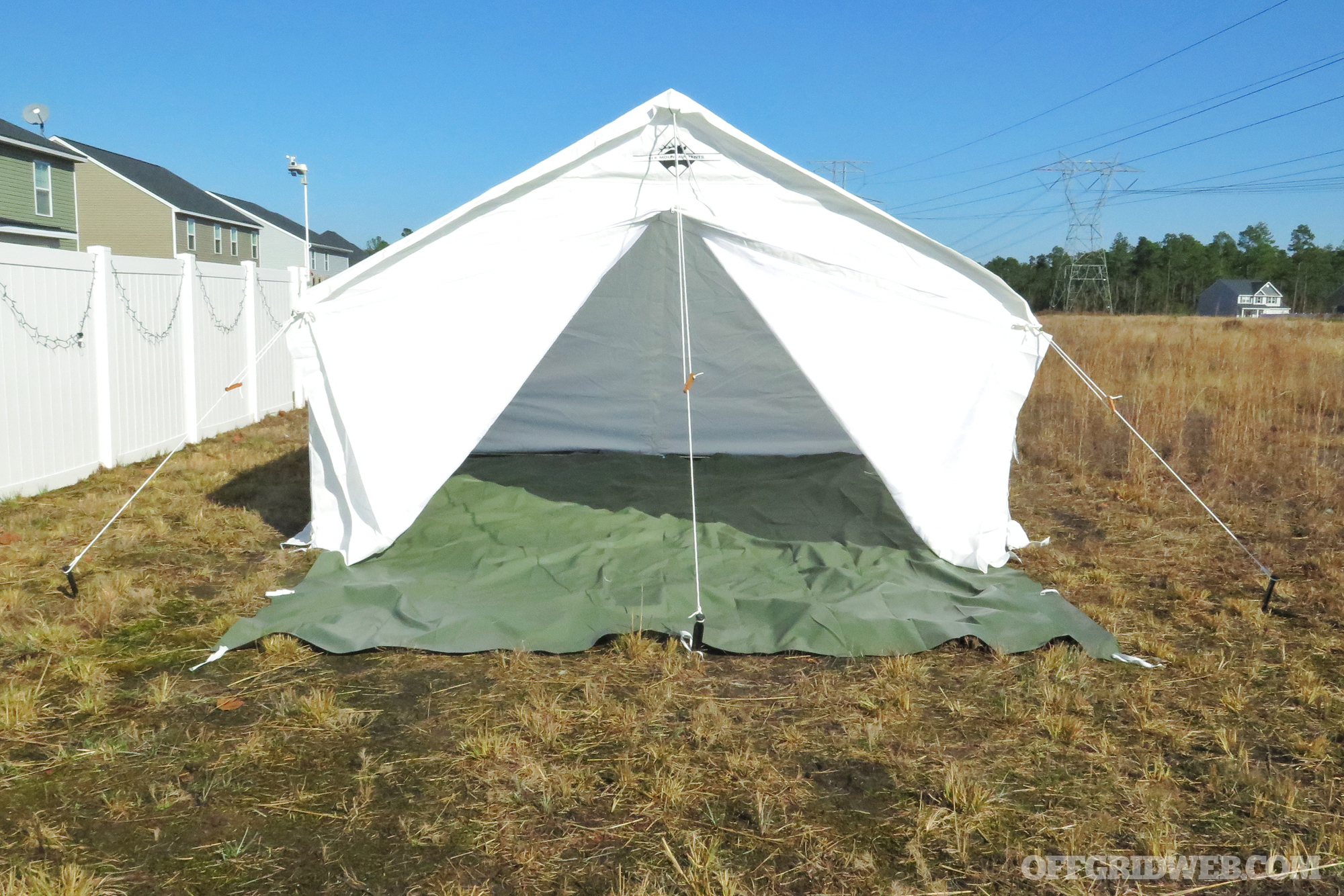
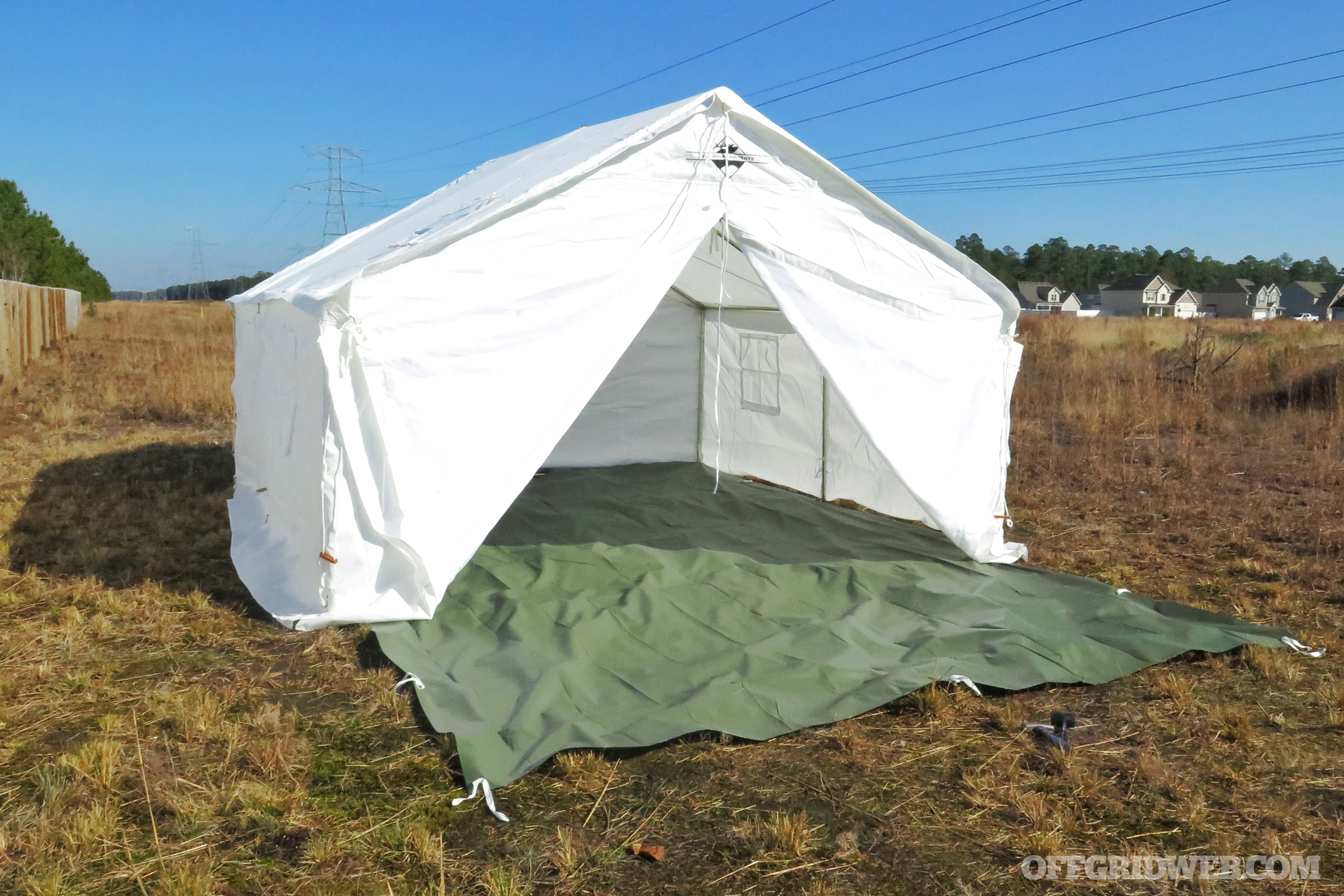
The floor kit extends out past the front of the tent to create a porch area to store gear away from the dirt.
The Elk Mountain Tents canvas wall tent has a lot of useful features to help make long stays inside quite comfortable. Our model features a full front screen door. This is great for summer and early fall trips.
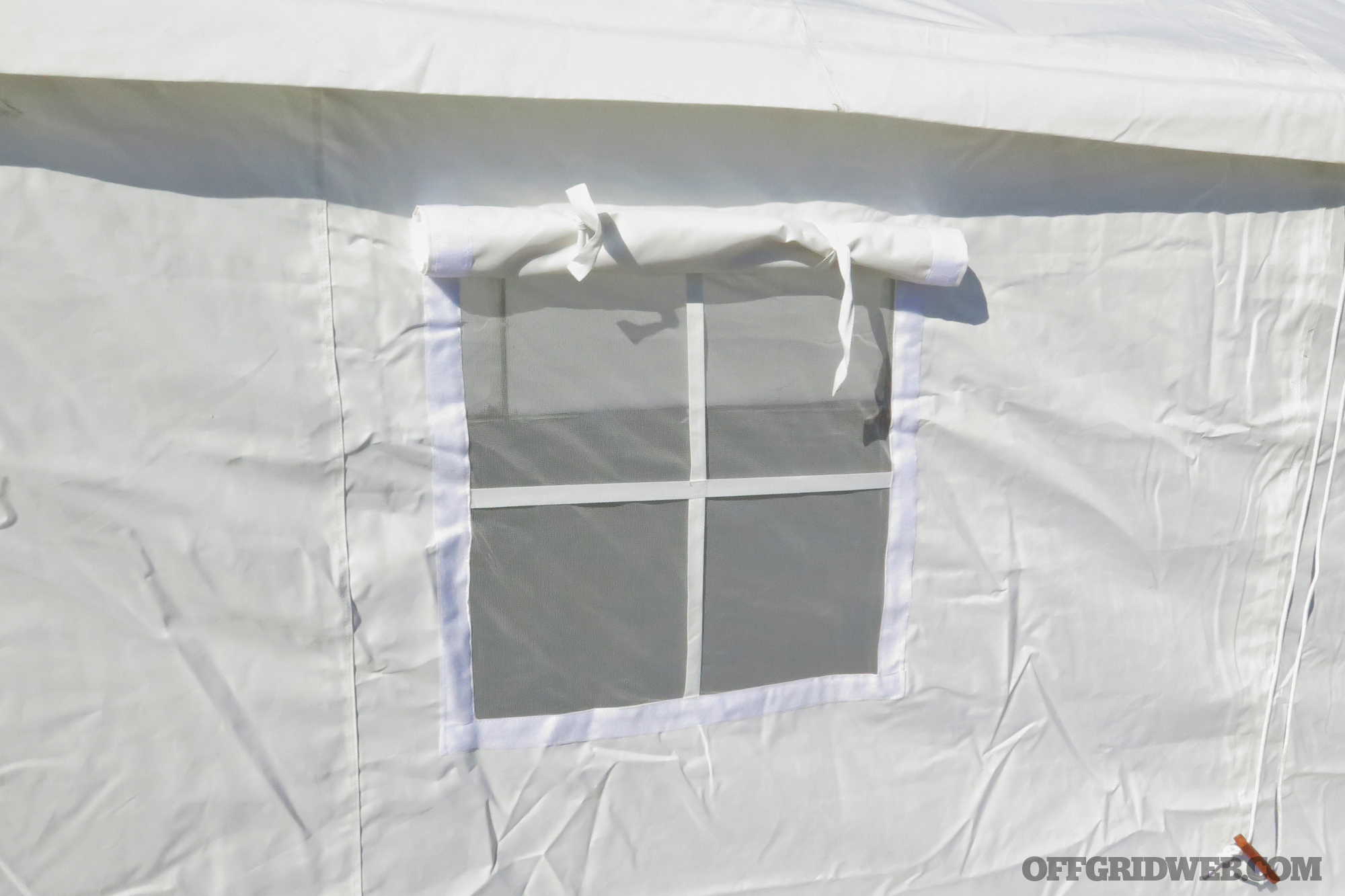
Above: Our 13×13 tent included two windows on each side of the tent. One thing to note is that these can only be opened or closed from the outside.
All of the company’s tents feature Velcro opening windows — our 13×13 tent includes 4 windows, each with built-in screens. For trips during colder months, all of their canvas tents include stove jacks built into the roof, which can be cut to the size of your stove pipe and then covered with an included Velcro cover. The walls on the tent have an extra six inches of cloth at the bottom to create a sod cloth to seal the bottom of the tent.
Above: Every Elk Mountain canvas tent comes with a stove jack that can be cut out to be used with a stove pipe. There is also a Velcro cover that seals it if not in use.
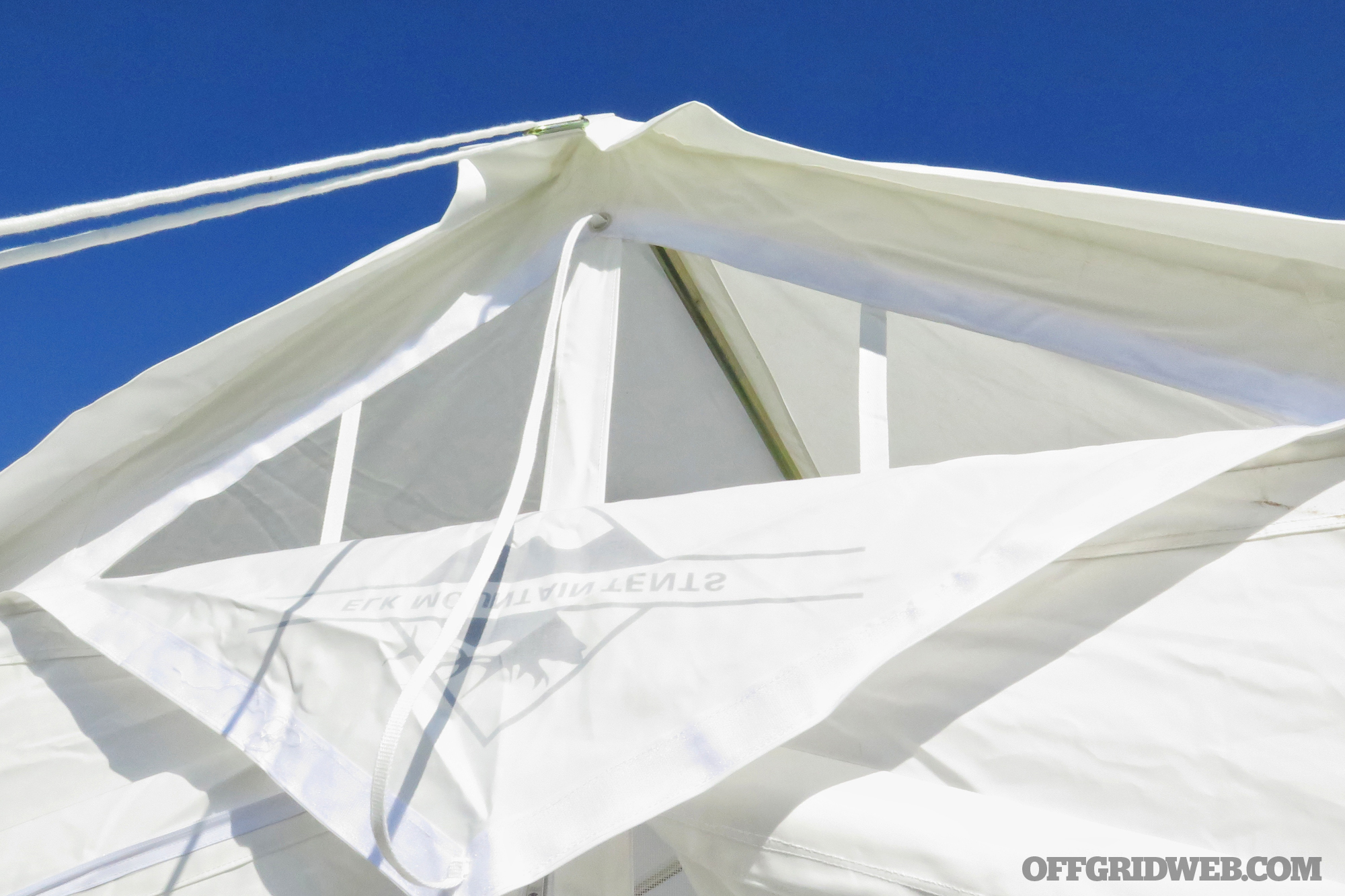
Ridge openings at the front and back can be opened and closed with a string system for added ventilation. This also helps prevent the aforementioned condensation buildup issue. Unfortunately, these ridge vents do not have screens built in, which is quite odd seeing as that would be an open invitation to bugs, especially the biting variety. Overall, however, the tent was well made, fit the frame beautifully, and was very secure and most importantly water-tight. This will give us a comfortable place to stay with the whole family during any season.
Above: Both front and back ridges have openings to help ventilate the tent. We wish these were screened to help keep bugs out in the warmer months.
Closing Thoughts
Elk Mountain Tents sought to take a new approach to a traditional canvas tent with some useful added features. We have to say they accomplished that goal. If you’re looking for a large canvas tent and dread the thought of maintaining cotton fabric, check out what Elk Mountain Tents has to offer. For more information on this tent and all of Elk Mountain Tents’ other products, visit them online at elkmountaintents.com.
Pros:
Polyester offers many benefits over cotton, including natural weather-resistance
Lots of well-thought-out features make the design more livable
Entire system is customizable to your needs and budget
Packs down to a relatively small, transportable footprint
Cons:
The instructions were not very well written or helpful, leading to trial and error during initial setup*
We wish the ridge openings were screened to keep out insects
It would be nice if the windows opened from the inside, rather than the outside
*Update – 12/24/19: Elk Mountain Tents let us know that the instructions for the tents have recently been revised with more detailed diagrams. We’re glad to hear they’re listening to user feedback and implementing it to improve their products.
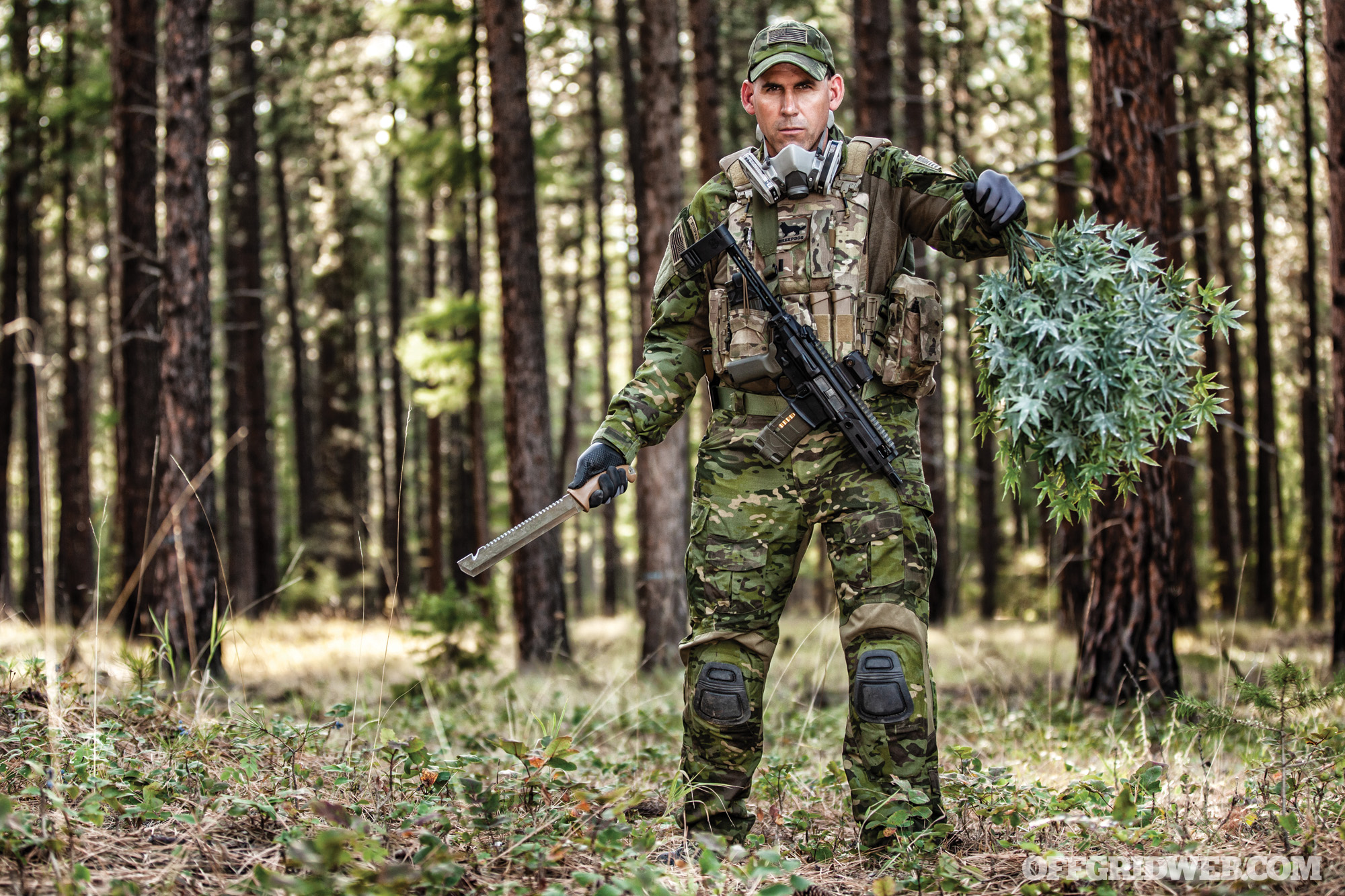
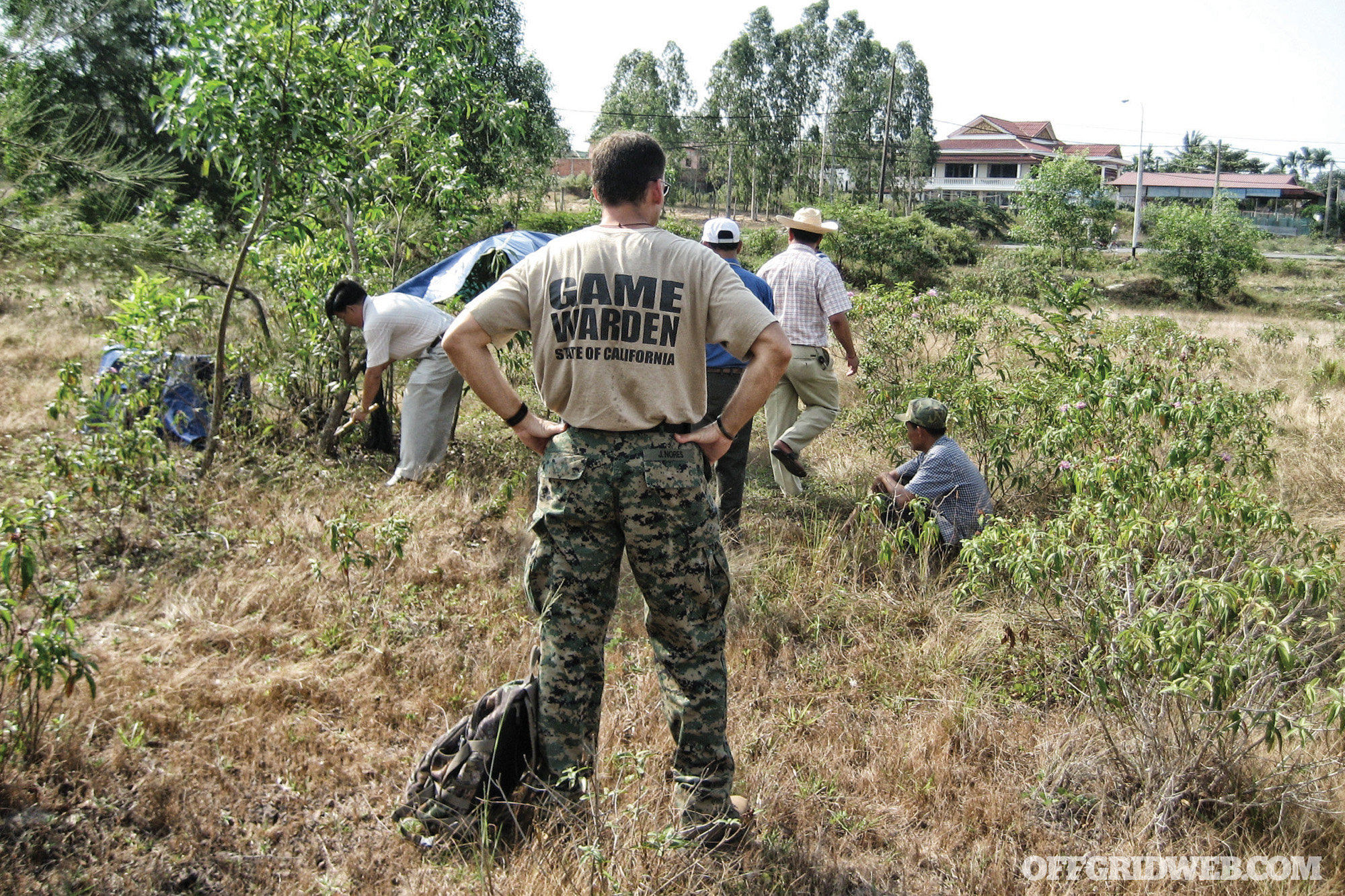
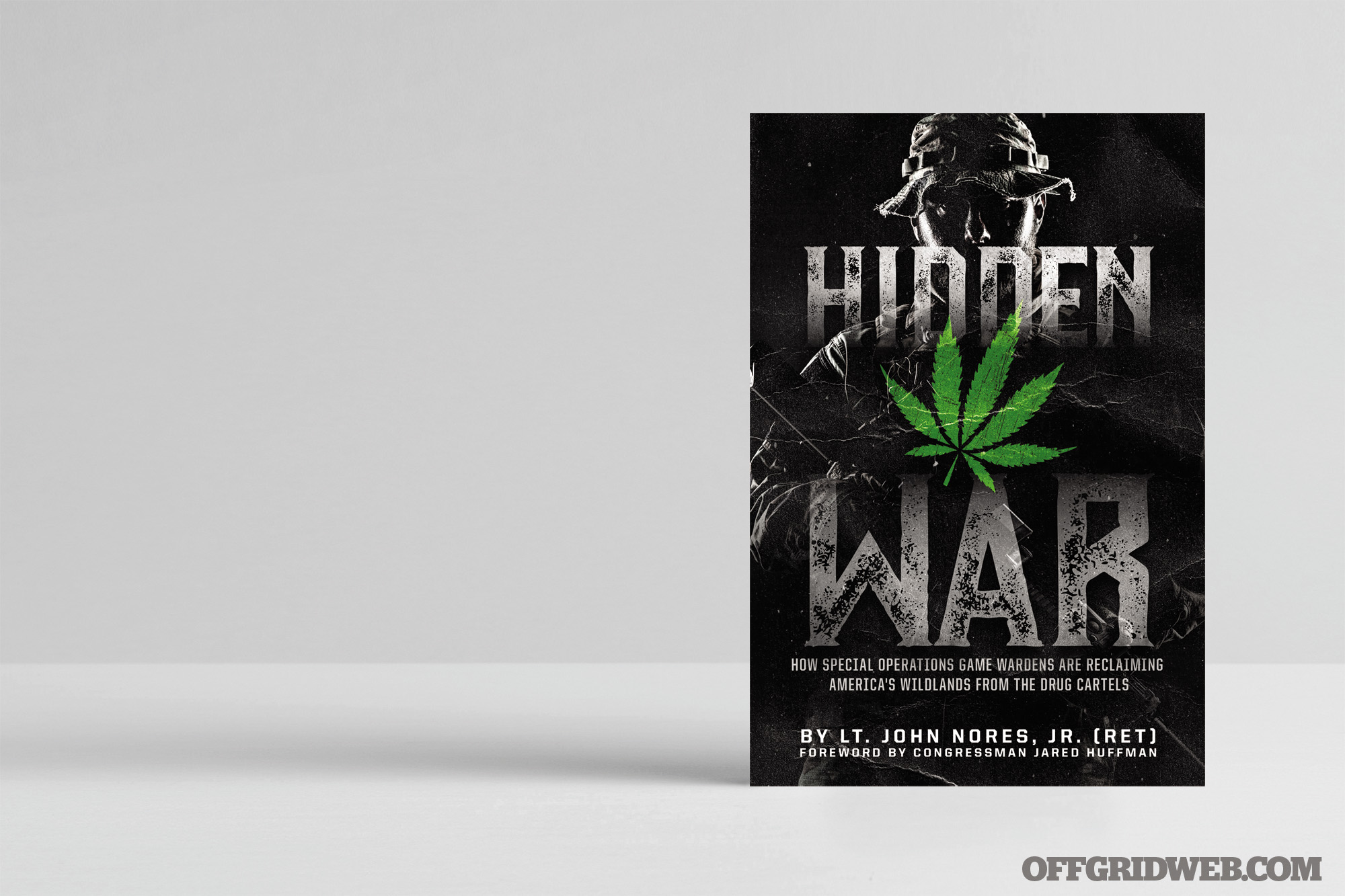
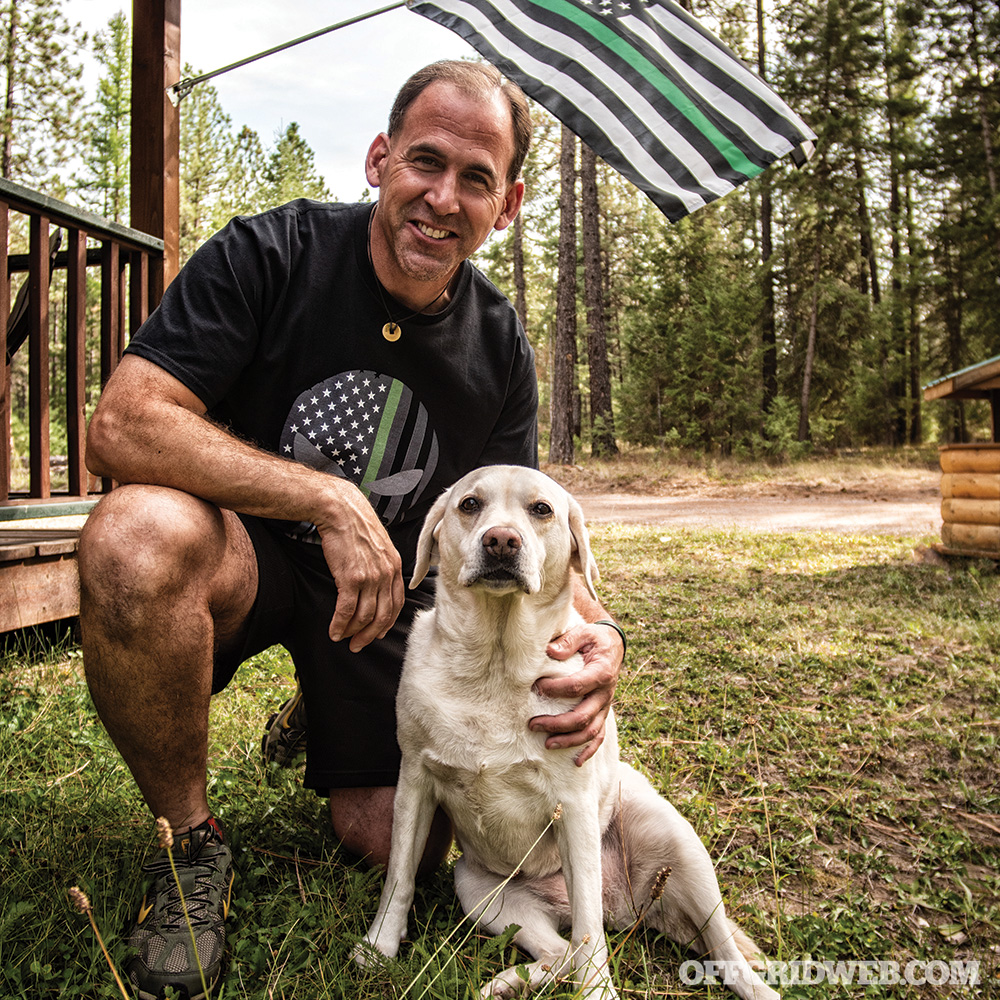
There’s a huge misconception that game wardens are nothing more than glorified park rangers. Spend a few minutes talking to Lt. John Nores, and you’ll quickly realize nothing could be further from the truth. During his service with California Department of Fish and Wildlife (CDFW), he was on the front lines of illegal grow sites embedded in our national parks and forests that not only seek to avoid government regulation, but do so at the cost of our precious resources. Stream diversions, highly toxic banned pesticides, and anti-personnel boobytraps were just a smattering of the devastation Nores encountered during his 28-year tenure.
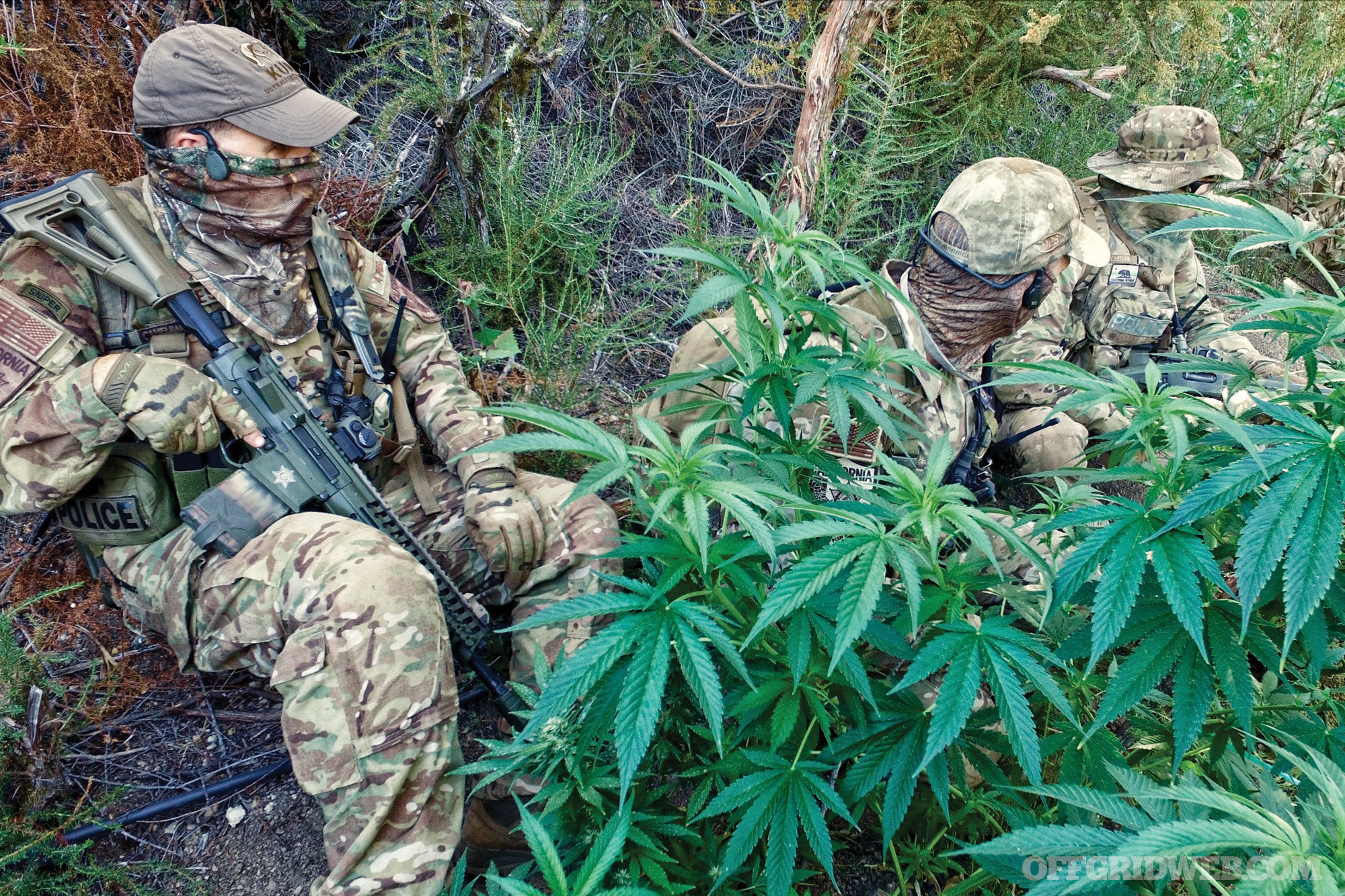
When people think of California’s illegal marijuana trade, images might come to mind of the recent series Murder Mountain or cops serving a warrant at some tract home rigged up with a greenhouse hidden in a garage — but there’s a much larger war going on that’s hidden in plain sight and rapidly escalating. The environmental impact and danger to nearby residents gets little, if any, mass media coverage. On August 5, 2005, Nores and his colleagues came under fire while preparing to raid an illegal marijuana grow operation in the densely wooded hills of California’s prestigious Silicon Valley. Nores’ partner sustained life-threatening injuries after taking a bullet through both legs from a cartel member’s AK-47.
Although the 2005 bust netted a large seizure of drugs and his partner survived, it gave everyone involved just an inkling of the cartel’s willingness to engage in violence and ecological degradation to make a few bucks. It also led to a recalibration of how to handle this ongoing problem, with the formation of the CDFW’s first dedicated Marijuana Enforcement Team (MET) aimed at targeting trespass grow sites throughout the west. After Nores shared his firsthand knowledge of this conflict with us, we walked away with a sobering realization that it’s not happening in some far-off land. It’s entrenched in locations only miles from major cities, where average citizens may inadvertently stumble upon a drug trafficking operation that could cost them their lives.
John Nores Interview
RECOIL OFFGRID: What made you want to go to work for California Department of Fish and Wildlife?
The Nores Wolfpack
John Nores: It really started with my grandfather’s influence. He was a Navy diesel mechanic and engineer on one of the cruisers in Pearl Harbor and survived that. Before he deployed, he and his high school buddies discovered Montana, and it blew their mind. When he got out of the service, he bought some property up there to make it a homestead for the family and anyone else who wanted to come. My dad, who has since passed away, got that whole service mentality, conservation, hunting, and shooting from him; really all my aunts and uncles did, and that trickled down through the generations. I was shooting trap and skeet at 9 years old; I passed the hunter’s safety course at 9 with dad’s help. My dad was a champion trap and skeet shooter and hunted everything from waterfowl to big game, so he was my hero.
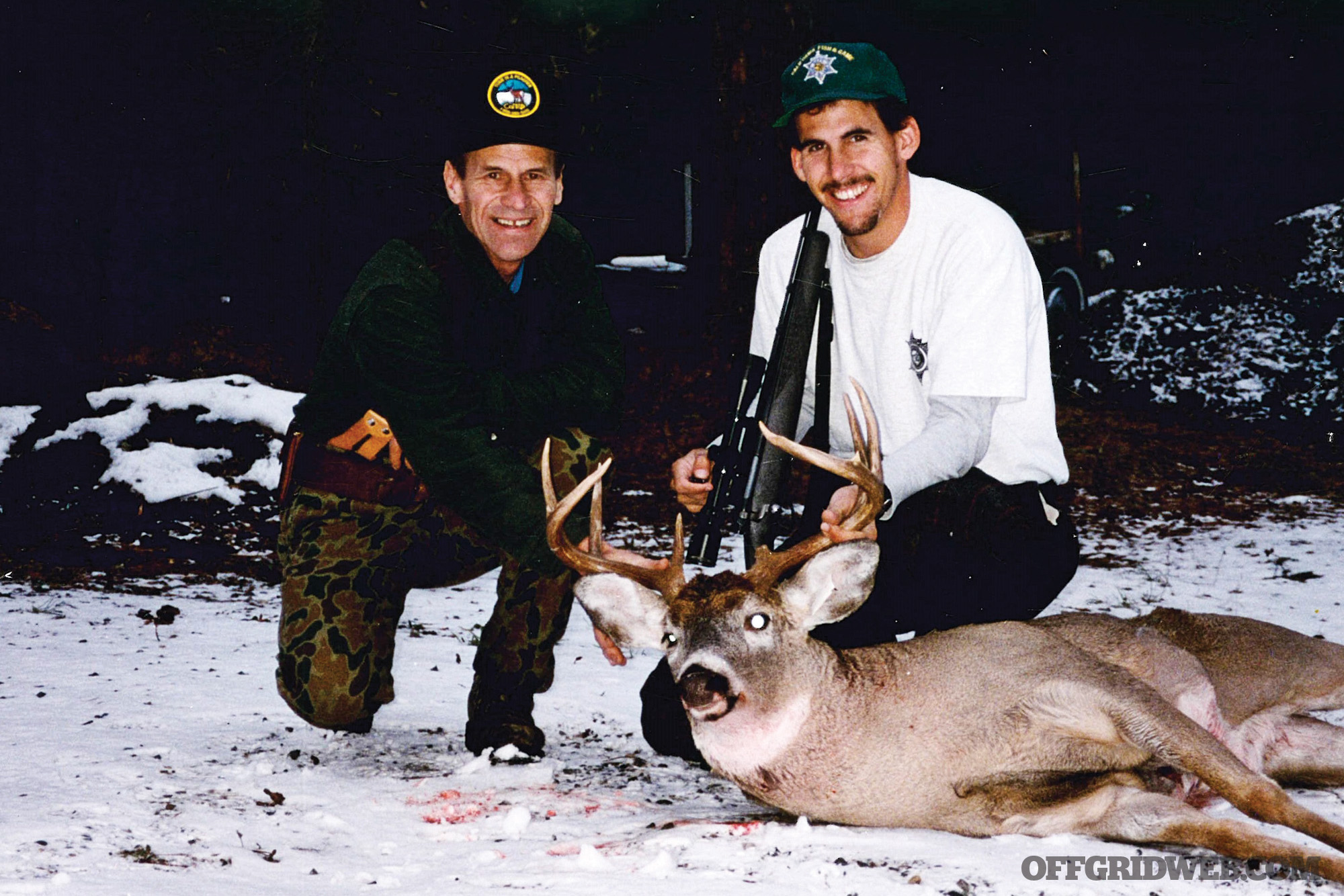
John Sr. and Jr. — first white-tailed deer, 1992
I grew up in a rural part of south Silicon Valley in a little town called San Martin. When I was in college at San Jose State University in 1986, I wasn’t really feeling passionate about the civil engineering courses I was pursuing, but on winter break that first semester, my childhood friend and I took a pack horse and went on a 75-mile loop through Henry Coe State Park, which is 105,000 acres of epic wildlands. We took off on a Friday night in a downpour and hiked 13 miles through the night, getting soaked.
The next morning, we got this fire going because we were trying to dry off, and there was no one else around because no one was dumb enough to go there in the middle of winter [laughs]. Then, here comes this green 4×4 just winding down this really steep trail to get to us, and it was a game warden who thought we might be deer poaching. After he realized we weren’t a threat, I kept him there for two hours asking questions. He said it was an amazing career. I was like on fire and really inspired by that. As soon as I got home, I went back to school and talked to a criminal justice program advisor, told him my predicament — and it was perfect because San Jose State has one of the best criminal justice schools in the country.
I changed my major, targeting the profession, and that was it. In ’92, they had slots for four civilians who scored high enough that weren’t military veterans or other law enforcement officers to lateral over, and I got into the academy at Napa College. I was in working on my master’s and got halfway through that and put it on hold temporarily to take that opportunity. I passed everything and then off to the races, and that was almost 30 years ago.
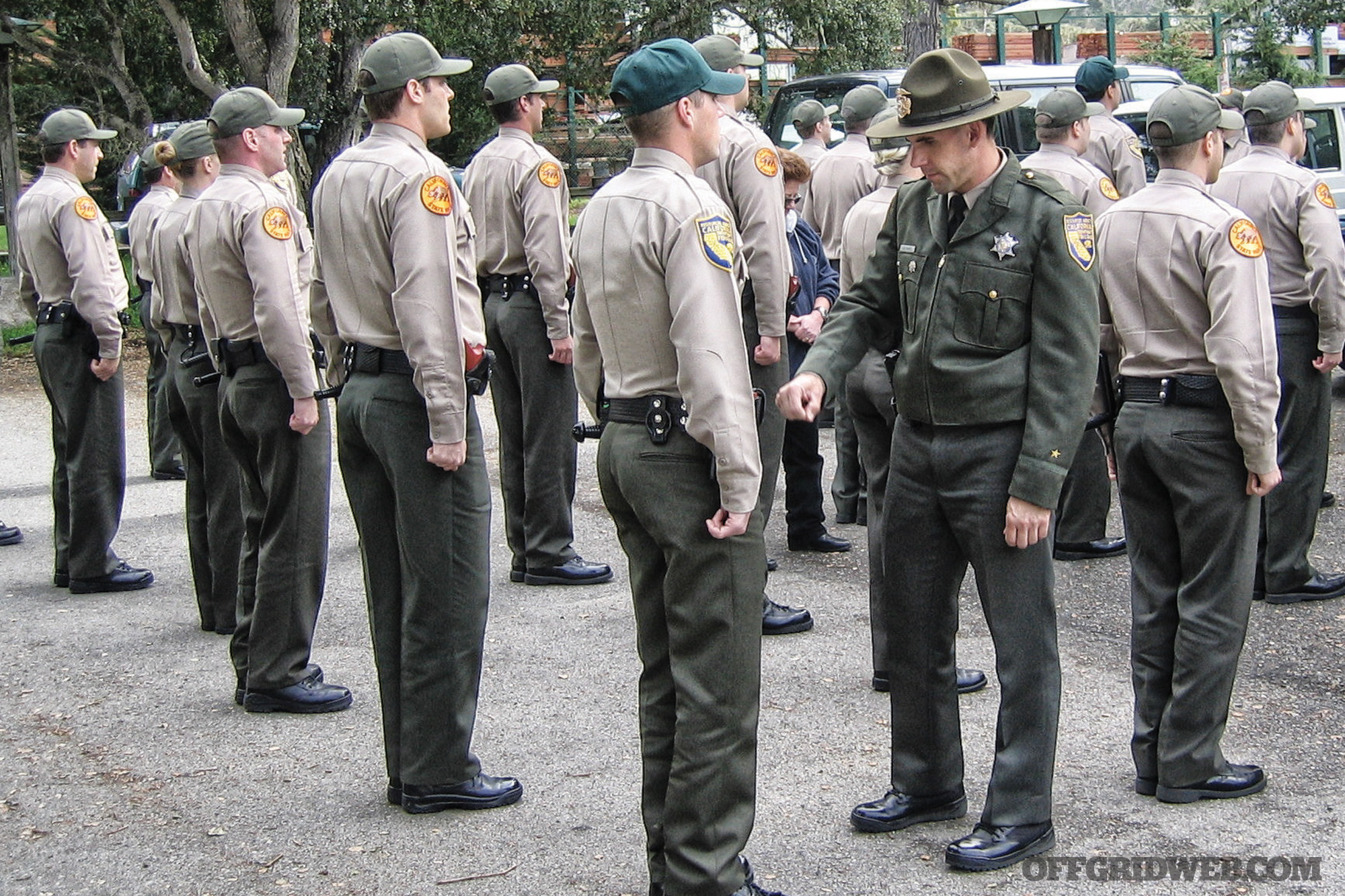
RTO Nores: Cadet Academy Inspection, 2005
What’s your advice to people looking to enter that line of work?
JN: Know what the job really entails. Joe Rogan said this before I went on his show, and everybody says this. When they think of a game warden, they think of someone driving around in a truck checking a fishing or hunting license, looking for illegal fish, and telling hunter education stories — things like that. Understand that it’s a very challenging law enforcement profession now. You deal with a lot of violent people periodically. Now, granted, 90-plus percent of everyone you deal with are people you really want to see. They’re lawful firearms users being stewards of the environment. It’s that 1 or 2 percent you run into who might be heavily armed and dangerous, so you need to treat it like any other law enforcement officer, because you might be by yourself with backup two to three hours away.
I recommend that people not only go through the hiring process, but talk to a recruiting officer in any state they want to be in. I’m getting a lot of inquiries from across the country right now as a result of all the podcasts, book tours, and things we’ve been doing. It’s been really cool, but don’t just start the application online. Look at the state you want to apply in, talk to somebody in the recruiting office, and get a few ride-alongs with game wardens in the particular state or area you want to work to see what they do, because the job is so much more diverse than people think.
Teaching wildlife investigations in Cambodia, 2007
It’s gotten more challenging in the last 20 years. There’s the cartel/foreign invasion/marijuana/poison issue that I kind of specialized in, but there’s also the wildlife trafficking and ivory trade coming in from all over the world. Now there’s wildlife trafficking teams fighting that fight within a Fish and Game agency that was mandated under the Obama administration — and rightfully so to make sure every state had teams doing that if they didn’t. Those are just a few different things that only came up in the last few years that weren’t around when I started.
Tell me about the books you’ve written.
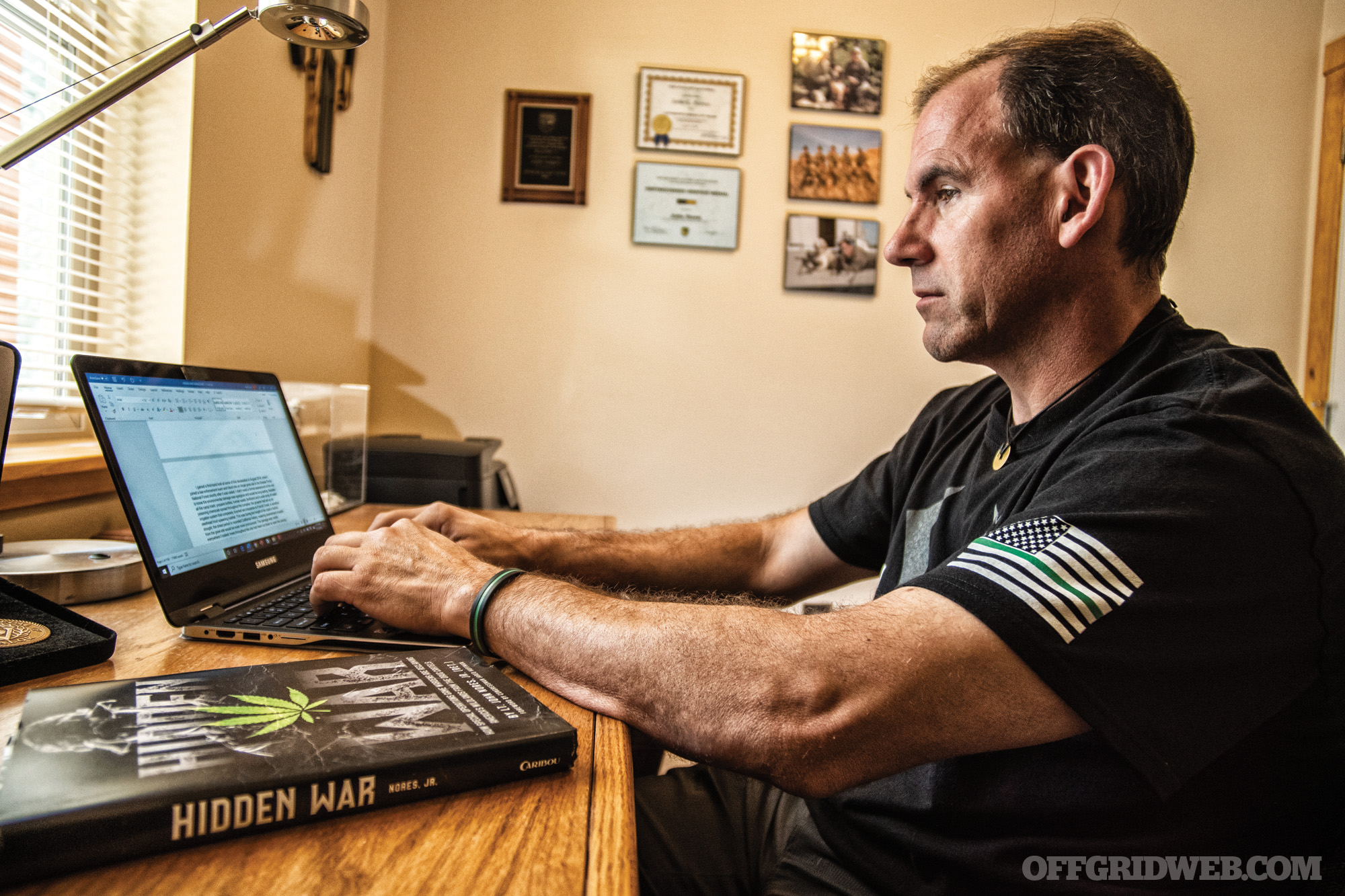
JN: I’ve got two. War in the Woods wasn’t planned. It came about at the request of people starting to see the cartel/trespass marijuana-grow front and black market stuff in Silicon Valley. I found my first grow site in 2004. When I went into that site and saw the level of devastation environmentally and the public safety threat from the growers we witnessed and didn’t have any contact with that day, that completely changed my perception of what my efforts and our agency’s efforts needed to be.
The first chapter of War in the Woods goes into this. A very good friend of mine who’s a wildlife biologist was working on his master’s thesis, by observing this transect of two creeks in Coe Park that spanned about three miles and is one of our last viable migrating steelhead channels left in the Bay area. He was studying frogs and their vitality, and I got a call in April from him that the creeks were running the previous week just fine, and all of a sudden one side of it was bone dry and everything in it was dead. Keep in mind that steelhead trout are endangered species, so I was super concerned about this. He found black pieces of plastic and other debris that had washed down and didn’t know what it was.
The next day we went up to the top of the canyon to get to the creek at its source. I expected to see an illegal water diversion from maybe a rancher or a development where someone was trying to create their own pond. We dropped down the canyon and found this beautiful creek dammed up with a garden hose and siphoner in it that was basically diverting it down the edge of the creek. So, we started following the diversion about 100 yards down, and I started to see some 2- to 3-foot marijuana plants.
EPA banned poison-tainted cartel MJ grow — Bodfish Creek, 2012
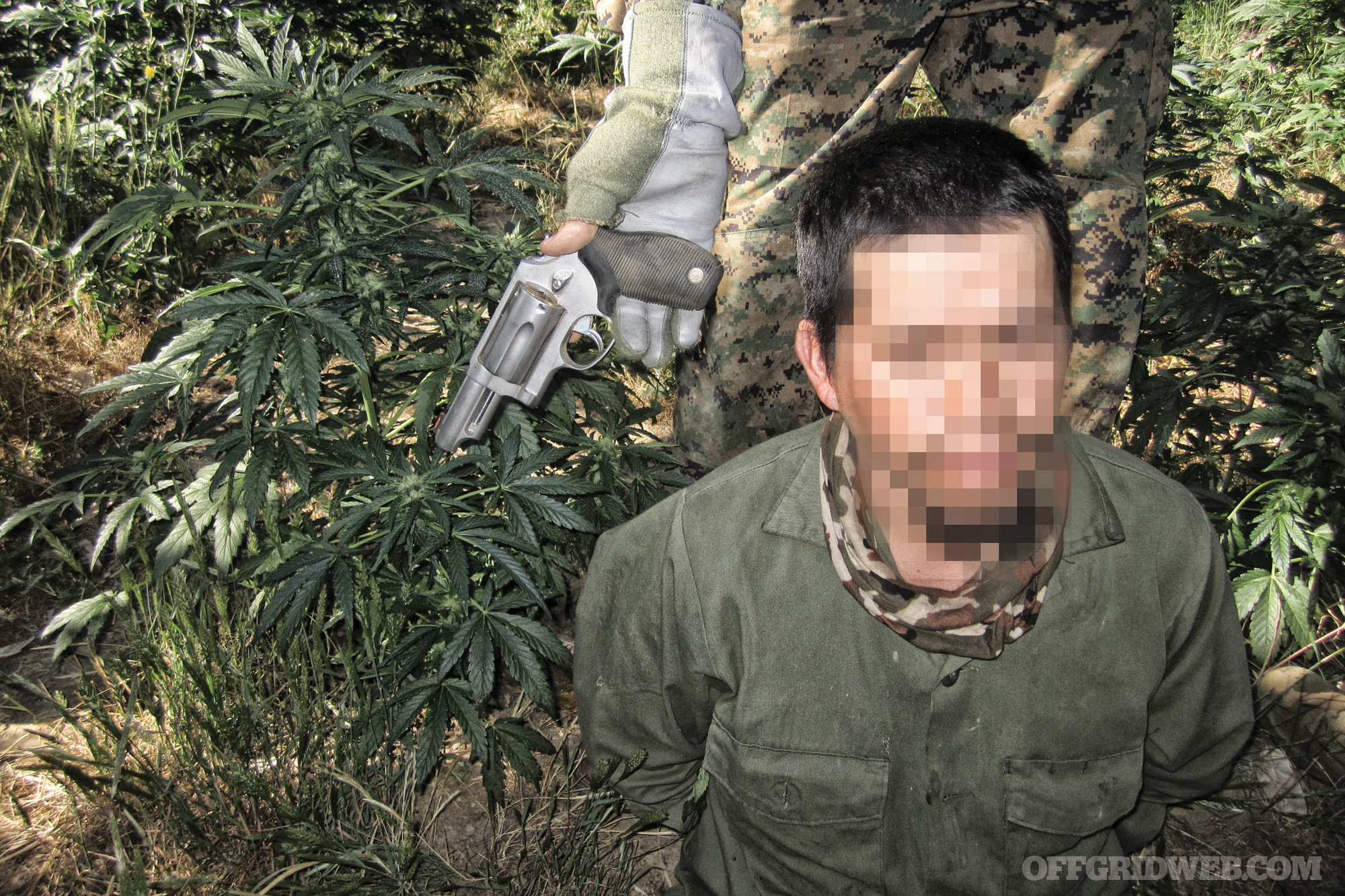
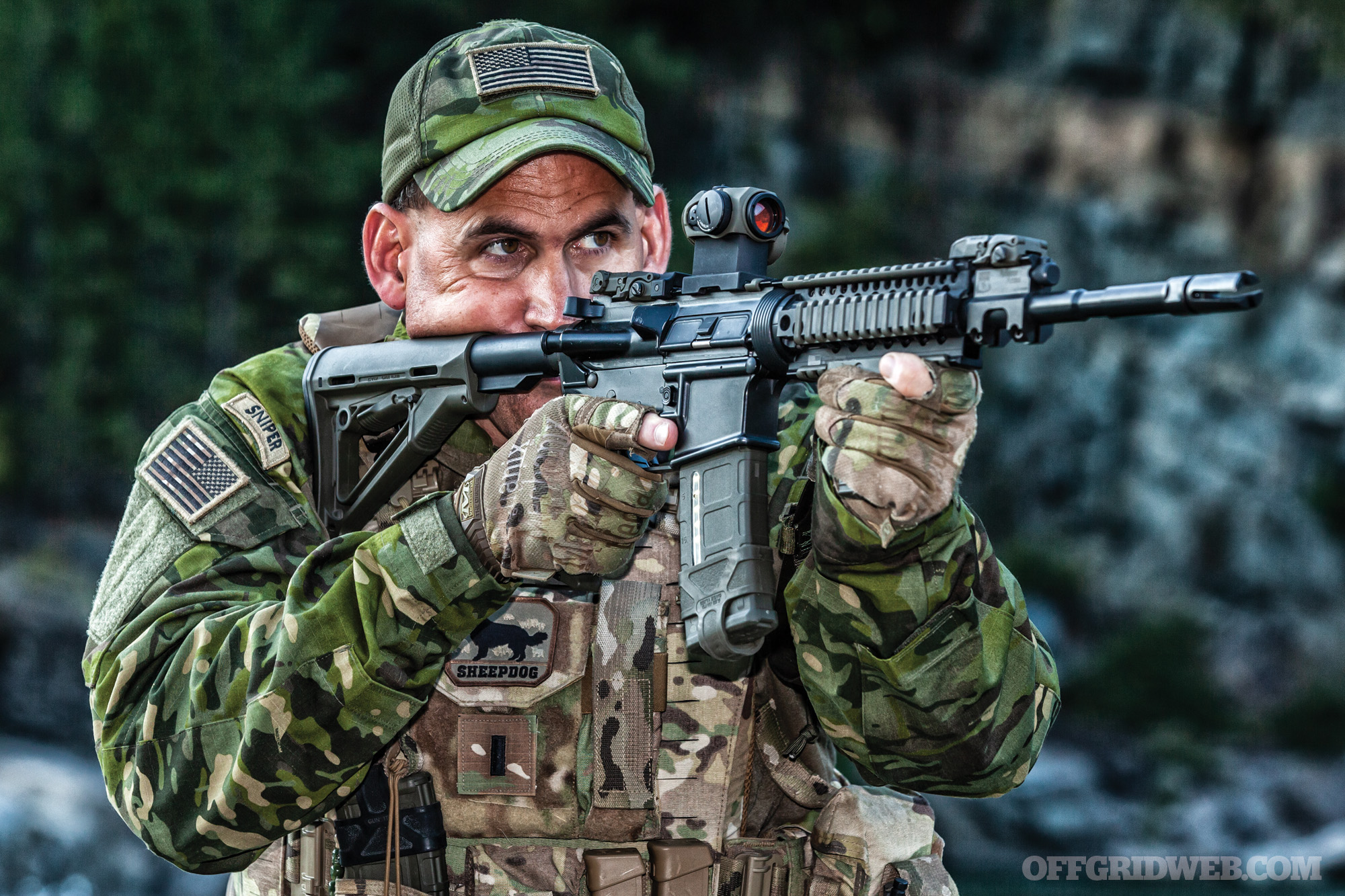
Then, we saw a couple cartel growers, and these guys had long rifles — one had an AK, they had knives on their hips, and were in battle dress gear. This was on public land and an “oh crap” moment, because I had a civilian with me and we’re hiding on the bank of a creek. I had the red-dot on my AR carbine aimed at these guys, and I’m thinking if we got into a gunfight, it might be the crappiest moment of my career, if not the end of it. Fortunately, they didn’t see us, but I realized by the way they were operating that they weren’t the typical poachers.
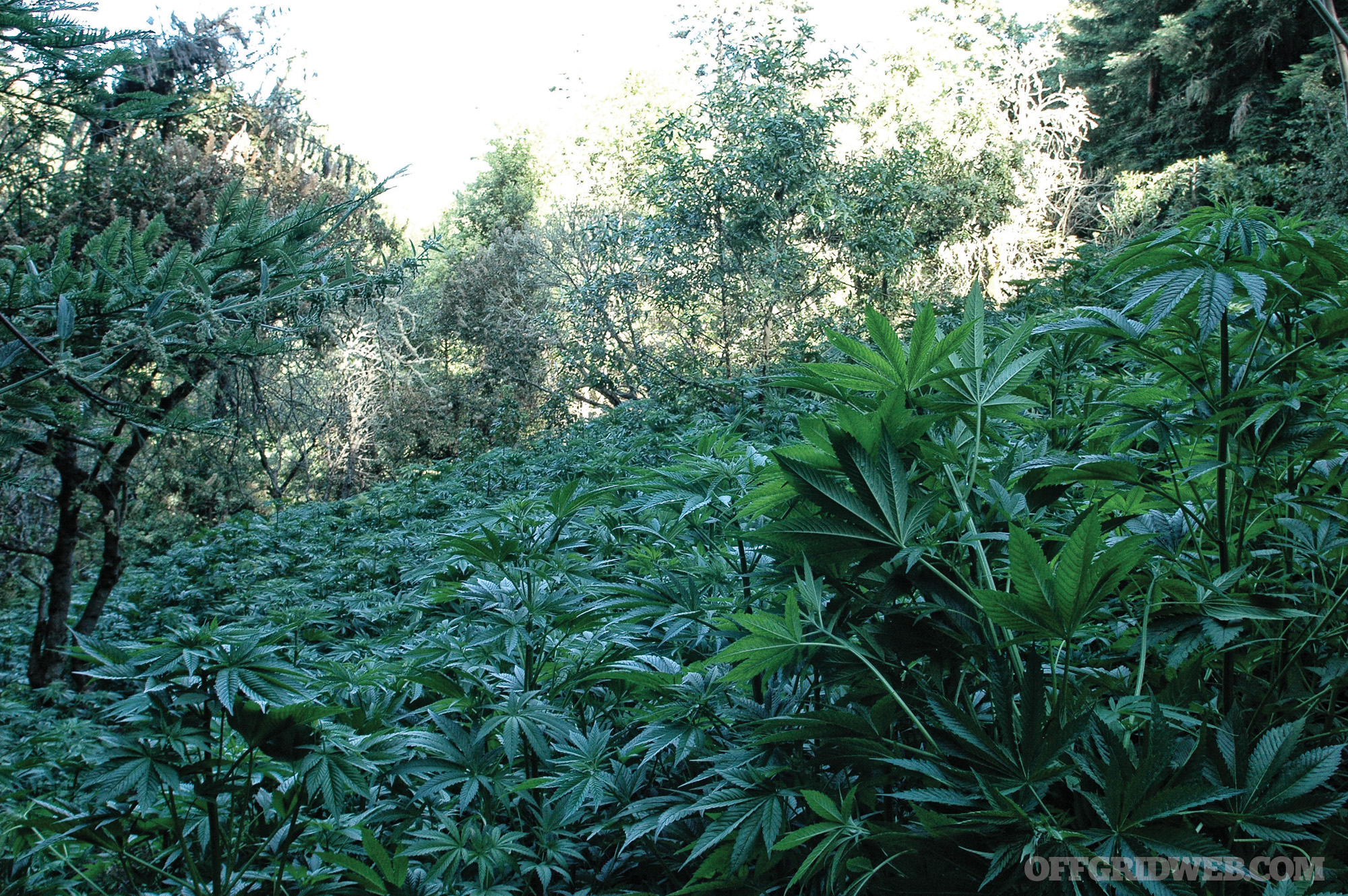
We got out of there, called narcotics task forces, and started to integrate with drug teams — we became the guides to help those guys get into that canyon, do the eradication, and hopefully arrest these growers. We had a couple game wardens, the Santa Clara County Sheriff, and multiple different agencies. When we went in and did that raid they didn’t really put a lot of emphasis on catching these guys that I knew could’ve been caught and they ran off. We eradicated all the plants; it was a 7,000-plant grow. I’d already been on about 15 years and had done a lot of operations, but I’d never seen anything this devastating — and it was in my backyard. It was also against a type of poacher who was very violent, well-armed, and had complete disregard for public safety and environmental purity.
After we eradicated all these plants, we left and I looked around at the team leaders and remarked that there was still propane, a diverted waterway, the creek’s still dry, all these fish are dead, and there was all this trash. I didn’t even know yet about all the banned toxics that were there, and we had no idea we were potentially exposed to it. But they were like, “We don’t clean this stuff up, that’s not our job.” I thought that was total bullsh*t. The fact that we didn’t do any reclamation on the site to protect our wildlife and deter these guys from coming back really upset me. I talked to my chief at the time about it, and she agreed that if we’re going to get involved, we have to bring in that environmental component. That’s when we started to ramp up, and a handful of us began specializing in this with the sheriff’s department, Forestry Service, and other federal agents on these types of grow operations.
Cartel grower gunman — Croy Creek, 2012
Fast-forward to August 5, 2005, which was only about the third operation we’d done after this one. We walked into a very fortified, very calculated grow site. My partner was shot through both legs by a grower who was lying in wait to defend their site before harvest time. It was a lot bigger than we thought. It was like 11,000 plants in one area and 32,000 for the whole mountainside, all spread out. So we probably got 20 growers, all armed, in a location that probably had no law enforcement presence in over a decade. The one shot that hit my partner did a lot of damage. I probably worked on him for three hours, trying to keep him from bleeding out before we had an air rescue. That gunfight shook up the perception of what game wardens do. The governor’s office was in disbelief about it. Nancy Foley, our chief at the time and very progressive, stuck to her guns and did a lot of TV interviews explaining that we were tactically trained just like every other officer and discussed that this wasn’t some mom-and-pop marijuana garden.
After we got ambushed that day, I knew we needed a specialized team with more trauma gear, more support, K9s, more air assets, and training to catch these guys safely and get them out of circulation. It changed everything, not only for us in California, but nationally. It was a long process of over a decade to get to the point where Hidden War, the second book, goes into. Another of my mentors who helped craft my career became chief in 2013 after Nancy’s retirement. I and another captain had a meeting with him and agreed we needed to test a tactical unit dedicated to doing this with no red tape, no traditional patrol duties, that worked strictly for headquarters with straight-line supervision to the top, basically modeled after SOCOM in the military.
I got to handpick 12 of us and incorporate our two best K9 handlers. Building that team and testing it proved it was effective, and six weeks into our pilot program we were just running out of money and looking for funding to keep doing what we were doing. We developed an operation called “Pristine,” where we worked every day of the month because the counter-drug 129th Rescue Wing out of Moffett Field had an airship or two and two ground crews to assist any law enforcement agency in California on an operation dealing with the cartels. They wanted to pick an agency who was really going to work hard to not only go chop down dope, but bring in the apprehension and environmental element — so they asked us.
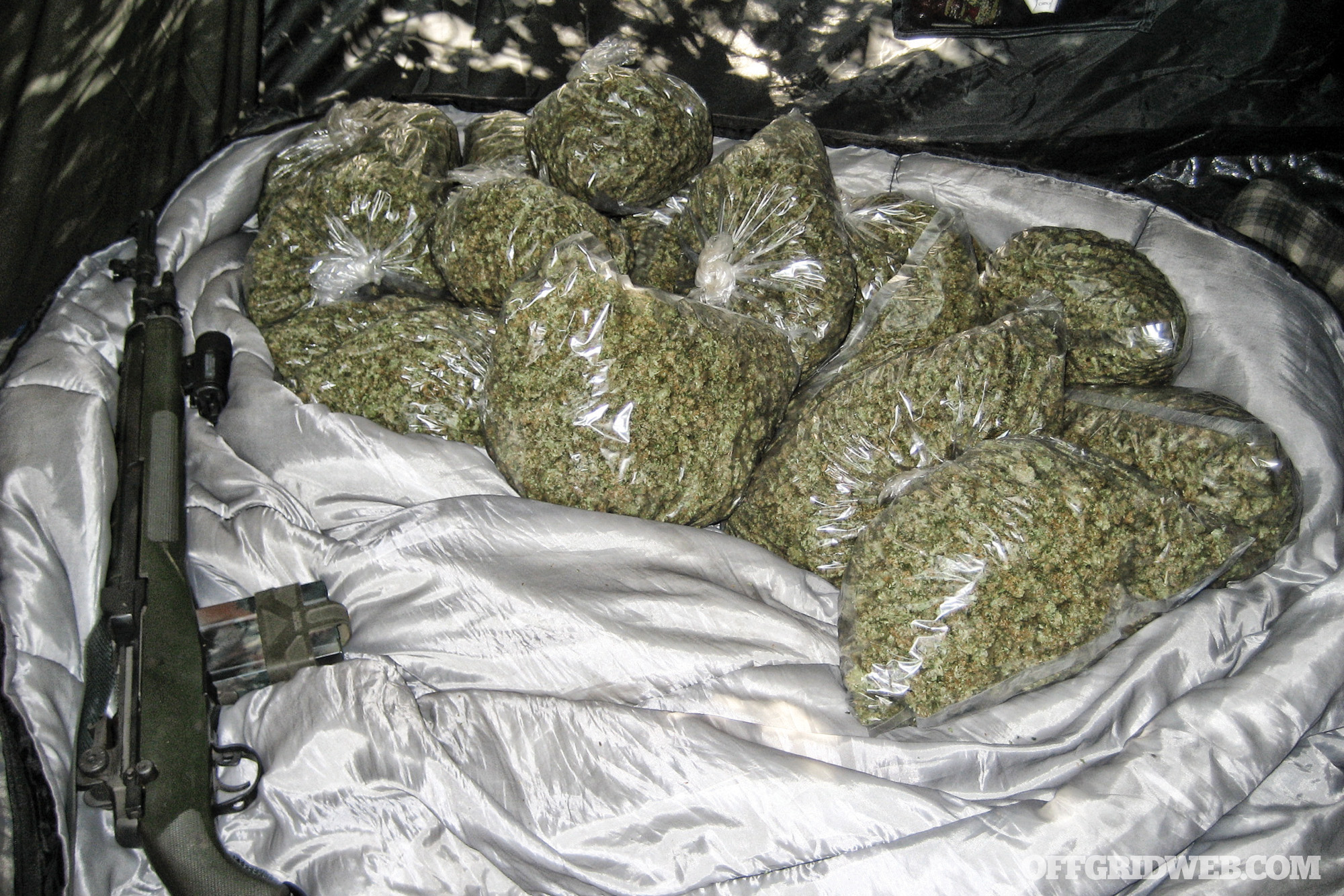
Toxically tainted weed processed for sale in cartel MJ grow — Silicon Valley foothills, 2012
In Operation Pristine alone, I think it was like 500,000 of these toxically tainted cannabis plants we eradicated, we caught around 200 guys, confiscated several hundred weapons, and did a lot of restoration. We proved ourselves throughout that process, and word got out very quickly because the military was talking up what we did together. There were so many things we’ve learned that I teach now to law enforcement and civilian groups.
War in the Woods goes into just finding the problem as a game warden, working side by side with other agencies, and being looked at as equals. We weren’t just the bird and bunny cops anymore. They saw us for the trained professionals we were, who could do a lot of hiking, hold up in the heat, and move around quietly, because we’d all grown up in the woods and learned how to track. In Hidden War, when we got to build the specific agency game warden team, some agencies and people within our own couldn’t get past the stereotype of what it was that we did — and that changed. It took about two years. We went full time January of 2014. The chiefs didn’t want to wait. They told us to develop all the protocol for testing, and that we’d be equipped and get all the support we needed. The gloves were off. We ran with it, and it was really effective.
Since it’s been really successful; we don’t have that resistance anymore. When I speak to other conservation agencies throughout the country, it’s amazing to see how much this problem is popping up in other states and how ill-equipped they are to handle it. The whole thin-green-line thing that I’m all about in retirement is putting a good message out there, and I’m getting a lot of support for it. Hidden War goes into all the politics of building a non-traditional team and doing something that hadn’t been done before.
What do you think the biggest threats are to the resources you were tasked with protecting?
JN: Water, for sure. When it comes to the trespass marijuana grow problem, they’re diverting and putting the worst types of poisons in our waterways at the source headwaters. This carbofuran that’s banned in America and is a felony to possess, is the one thing besides the growers that the cartels need to smuggle up here. The other infrastructure they need is already here. Two tablespoons of this stuff can kill several miles of every living thing in a creek. Growers put a couple drops of it out in tuna cans for bears to find before they can get to the plants, and that’s enough to kill a 400-pound black bear.
It gets in the soil, the water that they pump to the plants; it’s sprayed all over the plants and looks like liquid paper. That’s not only an environmental crime, but it’s poisoning cannabis consumers because they’re ingesting it. It dissipates a little and falls off after it’s cut down, so you don’t necessarily see it, but it’s there. I’ve never seen so much concentrated dead wildlife, from big to small, in these grow sites.
Being a lifelong hunter, I know how critical genetics are in one area for deer to have a thriving population and a buck to have good genetics to put back big deer into the system. In one grow site, sometimes you see five or six trophy-sized animals that have ingested poison and their heads are on sticks like trophy caps. They’re just getting killed so they don’t impact their cash crop. That’s killing a herd for miles, because it can kill on contact and affects all the other biodiversity in the area.
Cartel grow MET mission — filming for Patriot Profiles, 2016
Have you had any game wardens or others working these sites get affected by these toxins?
JN: We haven’t had anyone die, but we have had exposures where guys almost died. In fact, two years ago, a couple federal officers who were back east were exposed to carbofuran on plants, had temporary respiratory failure, and went partially blind. They were in the hospital for days. Had they not been immediately evacuated from the site and had the right injections, they likely would’ve died. When that happened, OSHA came in and looked at the protocol of how we deal with grow sites on a federal level, because this stuff is in forests all over the country, and we started to come up with more personal protection equipment requirements. That was the first wake-up call.
Even though there were others who’d had exposures that hadn’t made the news, we had two officers in California who had dropped into a grow and started to feel headaches, nausea, blurry vision, but they were OK because they got out quickly and were treated. We know now that a lot more people are getting exposed in the law enforcement realm and still having symptoms months after treatment. When the growers dilute it with liquids, it usually looks like Pepto-Bismol, and they carry it around in a water bottle in their backpack with a sprayer. They call it el diablo, which means “the devil.” They know it’s nasty, but they use it because it’s so effective at keeping everything off the plants. Since they’re not a legitimate cannabis group, they don’t care about health issues. They just know it’s really potent weed and is about half of what anything else costs on the black market, and they sell it all over the nation.
What do you think the biggest misconceptions are that the public has about the war on drugs?
JN: When people think of marijuana, many think it’s a waste of time. People wonder why we’re spending time on it with game wardens, and since it’s legal to leave it alone and the problem will go away. They think the war on drugs is a farce for revenue generation and to get cops jobs. These same organized crime groups out of Mexico are dealing in tainted cannabis all the country, but also in the off-season they’re cooking meth, dealing in fentanyl that’s killing thousands, dealing in human trafficking, and gun running to fuel the fight down in Mexico, so this is a bigger issue than just cannabis.
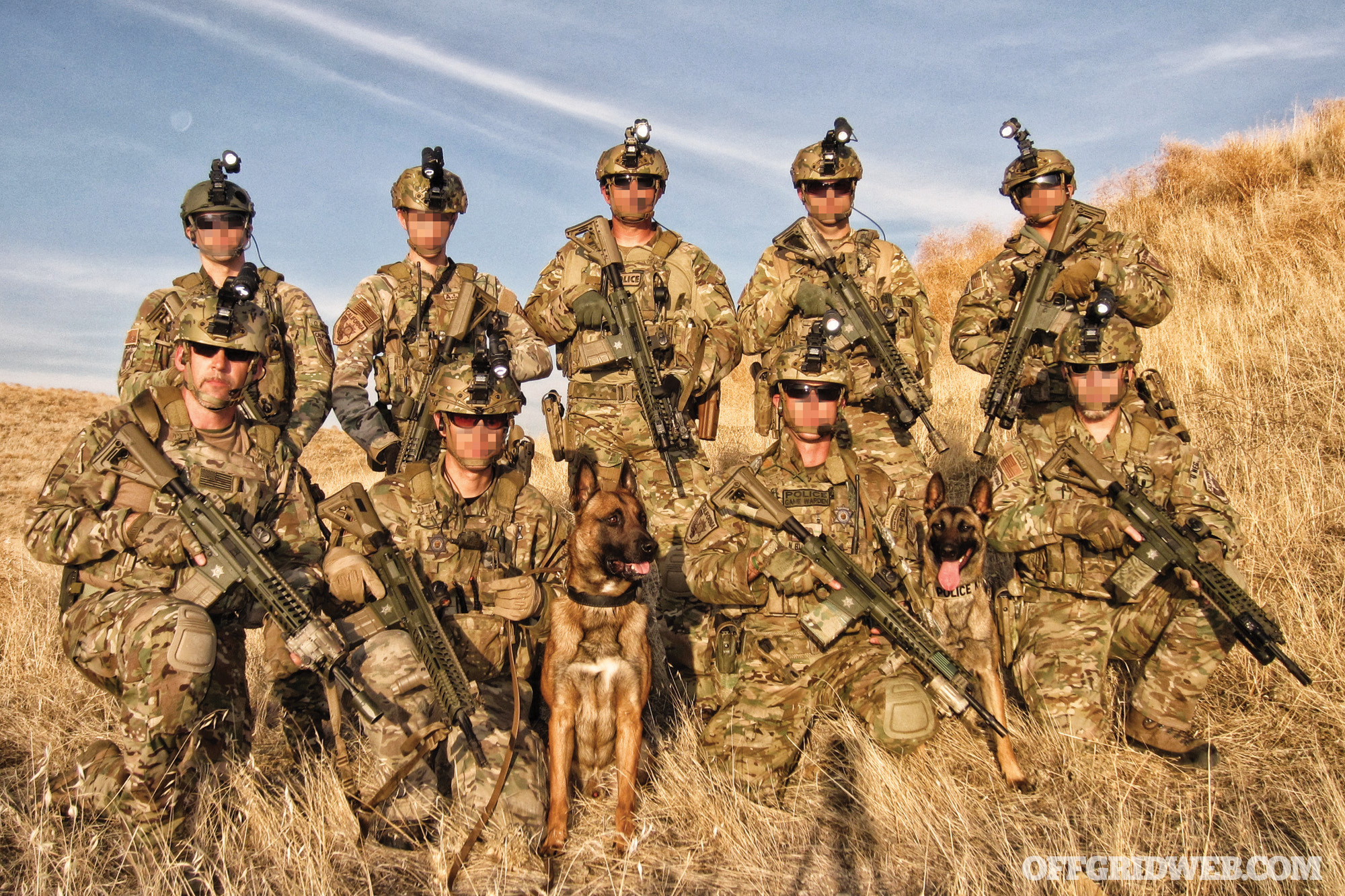
CDFW-MET team, 2018
To talk about the war on drugs issue, the biggest misconception is that it’s not just a war on drugs, it’s a war on environmental destruction and threatening our public safety. Let’s not make it about drugs, let’s make it about environmental purity, the security of Americans within our borders, and the safety of everyone, even internationally. This whole issue isn’t necessarily about drugs; that just happens to be the black market product that’s fueling all this violence, environmental destruction, and is making it unsafe to be out in our wildlands. I was quoted by the Associated Press not long ago saying that if cherry tomatoes were on the black market and the demand was so high that they were $4,000 per pound, we’d probably have poisons on them, gunfights, and some war on vegetables. You could make it about any product there’s a desire to have, there’s no regulation, and you can’t get on the open market. The war on drugs has validity from the standpoint of environmental protection and public safety. Are we doing it correctly? Not necessarily. Is there any easy solution? In the last chapter of Hidden War, I go into the challenges of regulation and if it will it help in the cannabis world.
Like I spoke to Joe Rogan about on his show, because he’s obviously an advocate, if we’re going to legalize and regulate, we need to do it right. We need to do whatever we can do to eliminate a black market that’s gotten so big it’s generating massive amounts of environmental crime and public safety threats. If we’re going to do it, we’re going to have to do it in such a way that we don’t encourage more of a black market — which we’ve started to see in California and in other states with red tape, fees, and lack of trust in government by growers who’ve traditionally been in the black market after Prop 215 that goes back 20 years. They’re not registering or regulating because it’s too costly for them to do so. They’re staying in the black market still, but they’re not putting a bunch of poisons on their crops. There’s still that demand in many other states that want good weed, and they can’t get it through legitimate channels.
In addition to that, since we have regulated for two years in California, the cartel thing hasn’t slowed down at all. Those guys have just continued to see that the black market is thriving, and now there’s all this enforcement attention on growers who are regulating and getting registered. About one-quarter of the game wardens in my old agency are dedicated to cannabis enforcement. We were a tactical elite unit dealing with the cartel threat, so we’re not the private land inspection teams, but there’s watershed enforcement teams, marijuana permitting teams, all funded to just regulate and make sure everything’s done right under the new requirements. That’s taken a lot of enforcement pressure away from the cartels in public lands. We’re one of the few teams doing it. The Forestry Service is doing it, sheriff’s departments, and a lot of other regulatory units like DEA and BLM in certain cases, but they’re too overwhelmed to handle the unregulated growers.
Nores MET Reclamation Op, 2018
The penalties for public land trespass grows went from a felony to a misdemeanor, and a misdemeanor to an infraction for a juvenile cartel grower. We’re seeing a lot of teenagers within the organization working with the older, vetted grow bosses on these sites, and they’ve watered down their crimes. The DAs can’t even prosecute this without environmental enhancements so we bring that in to get felony status of water pollution, deer poaching, or whatever the case may be. So when someone says, “Let’s just legalize it, and the problem will go away,” it’s not that simple. It’s something we have to look at federally and not just state by state. Every time we do something right in one state, another state sucks in the black market from the state that made a change, and it becomes a revolving cycle of never being unilaterally successful.
It seems like with proliferation and incremental legalization that the war on drugs is tougher now than it was 30 years ago. What do you attribute that to?
JN: The thin-green-line officers of Border Patrol agents, conservation officers, military, and park rangers haven’t grown in numbers, but public demand has. Population in America has skyrocketed in the last 30 years. I’m approximating, but the last statistic I read was 40-million-plus cannabis users in America, and that’s growing every day. A lot of that is black market users in states where you don’t have regulation. Law enforcement is taxed so much in other areas with limited numbers; I think that’s why it’s gotten worse.
California Senate-Assembly MET and K-9 Phebe Resolution Award, 2017
One of the things we did in Hidden War was a comparison from when War in the Woods was published. We did a breakdown of how many game wardens were in each state, the total number nationally, and the population in each state. It’s been exactly 10 years in between books. We did that same analysis, and it’s crazy. We’ve gone up like 1,000 game wardens nationally, and you can only imagine how population growth and the impacts it’s had on our wildland areas. It’s kind of free game for the cartels, because they realize law enforcement is so overwhelmed. They keep doing their thing and understand they’re going to lose a few grows, but even if it’s two out of 10, they’re still going to make like $100,000,000 or more. Law enforcement just can’t keep up with it.
There’s tons of money being poured into the border wall. What kind of effect, if any, do you think it’ll have?
JN: I think a wall could slow things down if it was built the right way, but it’s not just surface level we’re dealing with. There’s an established tunnel system underground, stuff coming in from the coast on panga boats delivering dope, people, and weapons from Mexico into America. A wall could slow the flood down a little bit, but I don’t think it’ll solve the problem. In gathering intelligence and talking with the people we’ve captured, they laugh when we talk about border control. At best, it’s a speedbump on the I-5 freeway.
If they put up a few hundred-thousand dollars, they’ll get their operatives into America and pay a small amount for the money they’ll generate. Case in point, we’ve had multiple deported felons, classified as such because of heavy criminal history, and have deported them well into the double digits from site to site — and they keep coming back. Different K9s have apprehended the same guy multiple times. That makes me skeptical that a wall will solve the problem. The bigger thing we have to look at is what’s happening on both sides of the border. How can we hopefully have an impact down there with Mexico helping us on the problem?
Why do you think there’s so much resistance to federal legalization?
JN: I think it’s frame of reference and different contexts of what people consider drug abuse or how they classify marijuana. You have certain states with varied perceptions and, until we get the testing and things happen federally or more progressive states work together to address this problem, we won’t get on the same page of how we perceive what cannabis really is. Things like what the medical benefits are and if we’re going to test it federally to validate that it has medical benefits. If it’s going to happen federally, it’s not going to happen overnight, so what can we do on the ground to hold back the tide as best we can right now? Whether you’re for or against, let’s just take all that out of the equation and look at what’s going to be good for our public safety and environmental purity throughout the country. Let’s try to make some decisions based on that.
What involvement do game wardens have with wildlife trafficking in the U.S.?
JN: California is one of the most progressive Fish and Game agencies in the country with its training level, resources, and diversity of teams. In California, you have a little bit of everything. You have the coast, with abalone which are heavily threatened and there’s a black market for. Sturgeon eggs are very high dollar on the black market. There’s the ivory trade in L.A. and San Francisco, with people wanting legitimate ivory pieces for multiple reasons. All the states have these problems, and that’s why these teams were built. In California, we’d been doing that even before the formalized wildlife trafficking team had been built. It came about right after our MET team got built, and it’s been very effective to the point they’re out there doing covert buy busts and surveillance, catching everything from the things I just mentioned to people selling black bear gallbladders.
The ivory trade, though — that’s where these animals are so impacted over in Africa because there’s such a huge amount paid for a rhino horn or elephant tusk. By the time it gets into the black market, you’re talking hundreds of thousands of dollars, if not more, on just a few animals. That’s where we’ve embedded and are working very closely with the African officials and their game wardens. We’re sending people over there, communicating, and sharing information at the source. When we start communicating country to country and get into these black market circles, we now have a team that can go anywhere in the state and embed on a particular suspect as long as they need to, and basically intercept the ivory coming in. We’ve really stepped up the game with our federal colleagues.
I used to do a lot of covert undercover work on wildlife illegal sales and buys with our special operations unit. What we’ve learned is when you catch a guy like that red-handed at the source, the ripple effect it has on national and international commercial poachers is overwhelming because you never know who’s who. It doesn’t have to be ivory; it can also be prohibited reptiles or primates. We’ve had celebrities with an illegal primate that’s endangered and not supposed to be here, but they paid a huge amount of money and it got into the black market. There’s a black market for everything wildlife; it’s nuts. There’s tons of money in it, and second only to the drug trade when you look at the statistics.
What can private citizens do to aid in the conservation effort?
JN: Be aware, know who to contact if you run across this, and spread the message. The more people who can spread that message, the better. So few people know this is really going on and the magnitude of it. One thing we need to do is unify. The more people get involved and shed light on it, then you see more funding, more education, it getting in the press more. Then, we start to feel more empowered as citizens to stand up and say we’re not going to allow this. That’s how they can be a force multiplier. Hunters, fishermen, and outdoorsmen and women are our best reporting parties through things like the CalTIP Program to turn in poachers and polluters. Every conservation agency has a turn-in-a-poacher hotline. Use it. Help your game wardens out.
Explain how legal, regulated hunting and fishing assists in the conservation effort.
JN: Glad you asked that. What we need to remember is, even if you’re not a consumptive user of wildlife or don’t believe in hunting or fishing, try not to chastise those who do it ethically and legally. Conservation is based on a balance of species, natural depredation in the wild, and environmental changes. Ethical and legal hunters and anglers are actually helping all of those species numbers, because they’re buying into a program that has studied the population and determines how many need to be taken to keep the population in balance so too many don’t die of starvation or from predatory kills. That meat is being eaten, appreciated, respected, and done so humanely.
All of us as conservationists who hunt and fish — our license fees, ammunition, firearms, and the equipment we buy, percentages of that fund go right into agencies like California Department of Fish and Wildlife to study and make sure that population thrives. When we talk about the increase of urbanization and population, which leads to less open spaces, once we start to impact that through development, we’re impacting wildlife many times in a negative way because we’re leaving less habitat for larger numbers of animals within particular species to thrive. If we don’t manage, help, or support a species in a population increase where it’s depleted, as conservationists from all that funding at the agency level, it couldn’t be done without anglers, hunters, and conservationists.
That’s not saying everyone should be a hunter. I’ve spoken to preservation groups on the animal rights front as much as I’ve talked to people who are like-minded. It’s interesting when I talk to the Humane Society, PETA, or Mountain Lion Society in California and give a presentation on the cannabis thing and all the dead wildlife. We don’t get into a debate about it, because whether you hunt and fish legally and ethically or absolutely don’t want to, no one wants to see an animal die this way from a banned poison by someone who isn’t even here legally and working for groups committing felonious crimes all over the world, especially here in America. A majority of our tips to find these grows come from hunters, anglers, and hikers getting into those pristine waterways to check them out. They’re making one of the biggest dents by finding it and turning this stuff in for the sake of everyone’s wildlife, no matter where you sit on the spectrum.
What other non-drug-related threats should people know about that you’ve encountered in your line of work?
JN: You also have the environmental issues as well, with everything from rattlesnakes to wild animal attacks. Something that’s drug related that we didn’t really talk about is stuff like pungi pits, tripwires, boobytraps, and hidden holes. All outdoor public should know to be careful of where they’re at. Be aware of your surroundings and know that some of this stuff is on trails. There are boobytraps in and around roads, and it doesn’t even have to be drug related. It can be felons on the run, and they can have some nomadic camp where they’re trying not to be found. The public can run into that to. It’s a small amount of people who can be that threatening, but they’re out there.
I ran across that a lot, and we still do. We get the guy who has an arrest warrant or there’s a group of criminals doing something. Where are they going to go to get off the grid into an area that has as little law enforcement as possible? They’re going to get into our wildlands and remote areas. Who’s going to run into them? It’s going to be someone like the game warden.
About John Nores
Age: 51
Hometown: Silicon Valley, CA
Required reading list:
Fearless by Eric Blehm
Ghost Rider: Travelling the Healing Road by Neil Peart
River by Colin Fletcher
Into the Wild by Jon Krakauer
Marine Sniper by Charles Hendersen
Time to Hunt by Stephen Hunter
Favorite quotes:
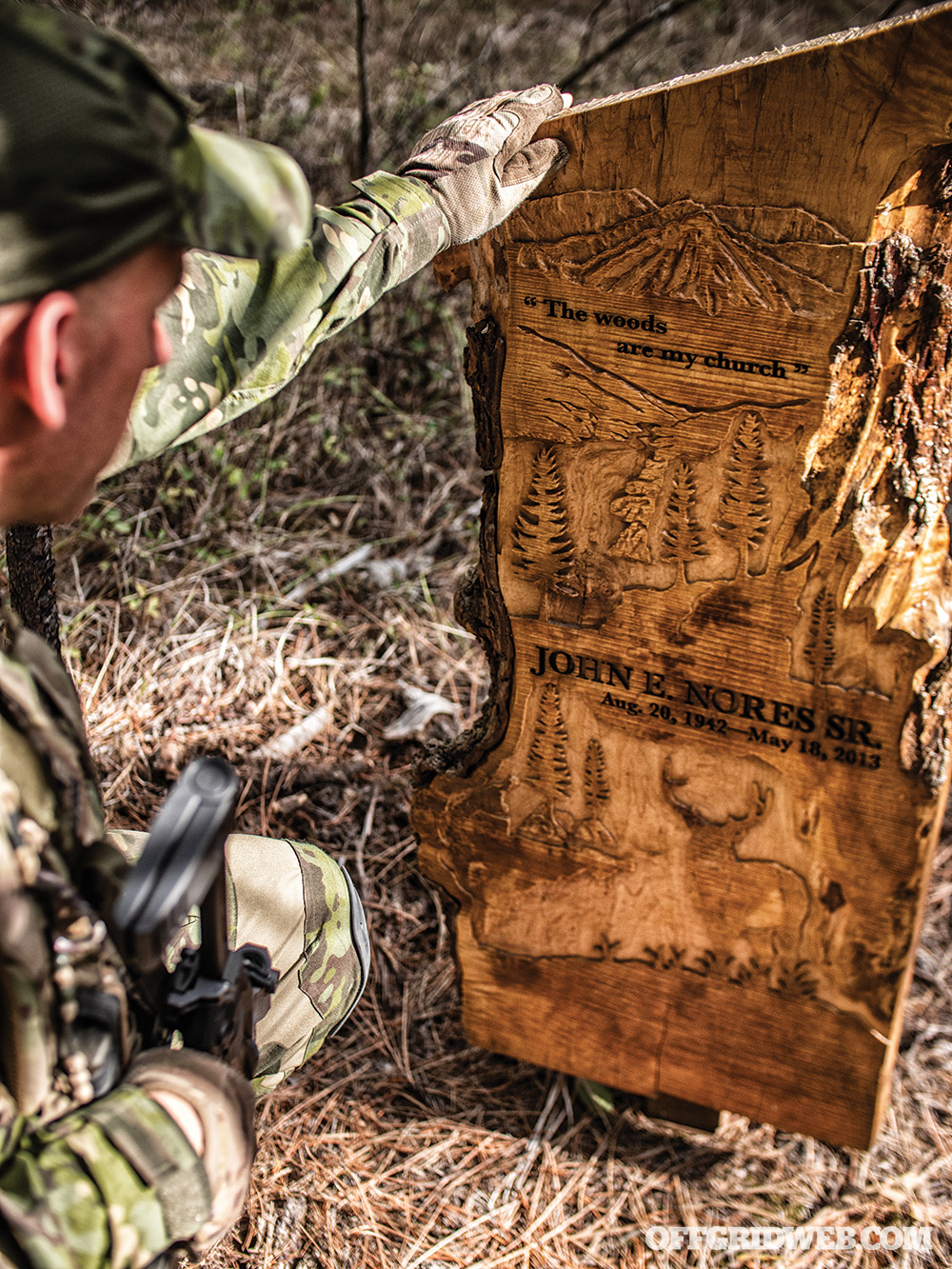
The woods are my church
Change is inevitable, but growth is optional.
Favorite hunting: Big game
Favorite fishing: River or high altitude in Montana
Favorite firearm: Axial Precision Convergence and Himalayan rifles; Glock handguns
Favorite knife: My upcoming signature blade, the Thin Green Line Trailblazer folder co-developed, manufactured, and marketed by Mike Vellekamp’s VNIVES
Accolades:
California Governor’s Medal of Valor
San Jose State’s Criminal Justice Hall of Fame induction, 2018
Regional Officer of the Year, 1999
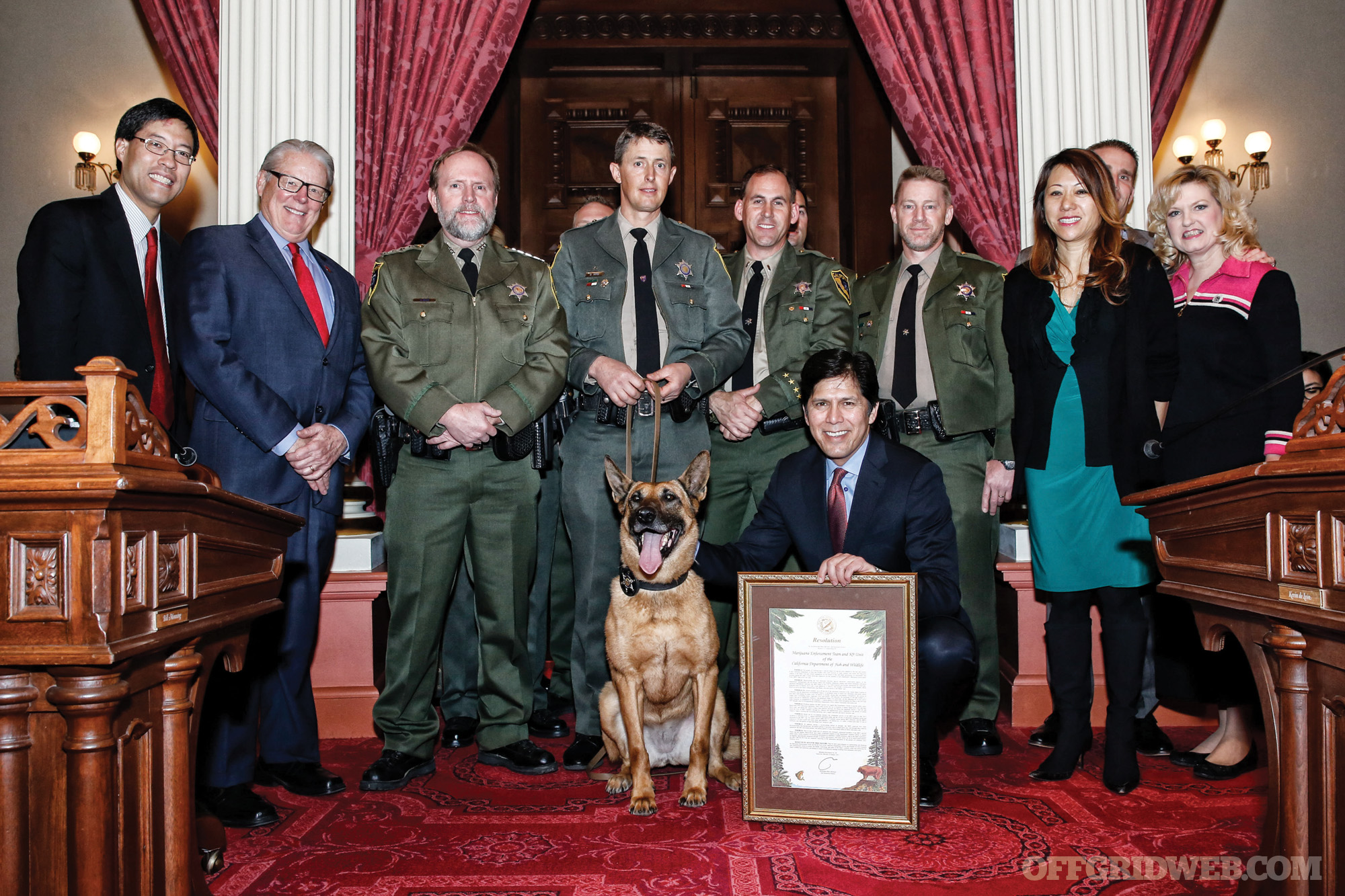
Nores’ MET and K9 Phebe were recognized in both the California Senate and Assembly in January 2017 with Resolution Awards for service, the first congressional resolution for our officers in the agency’s history
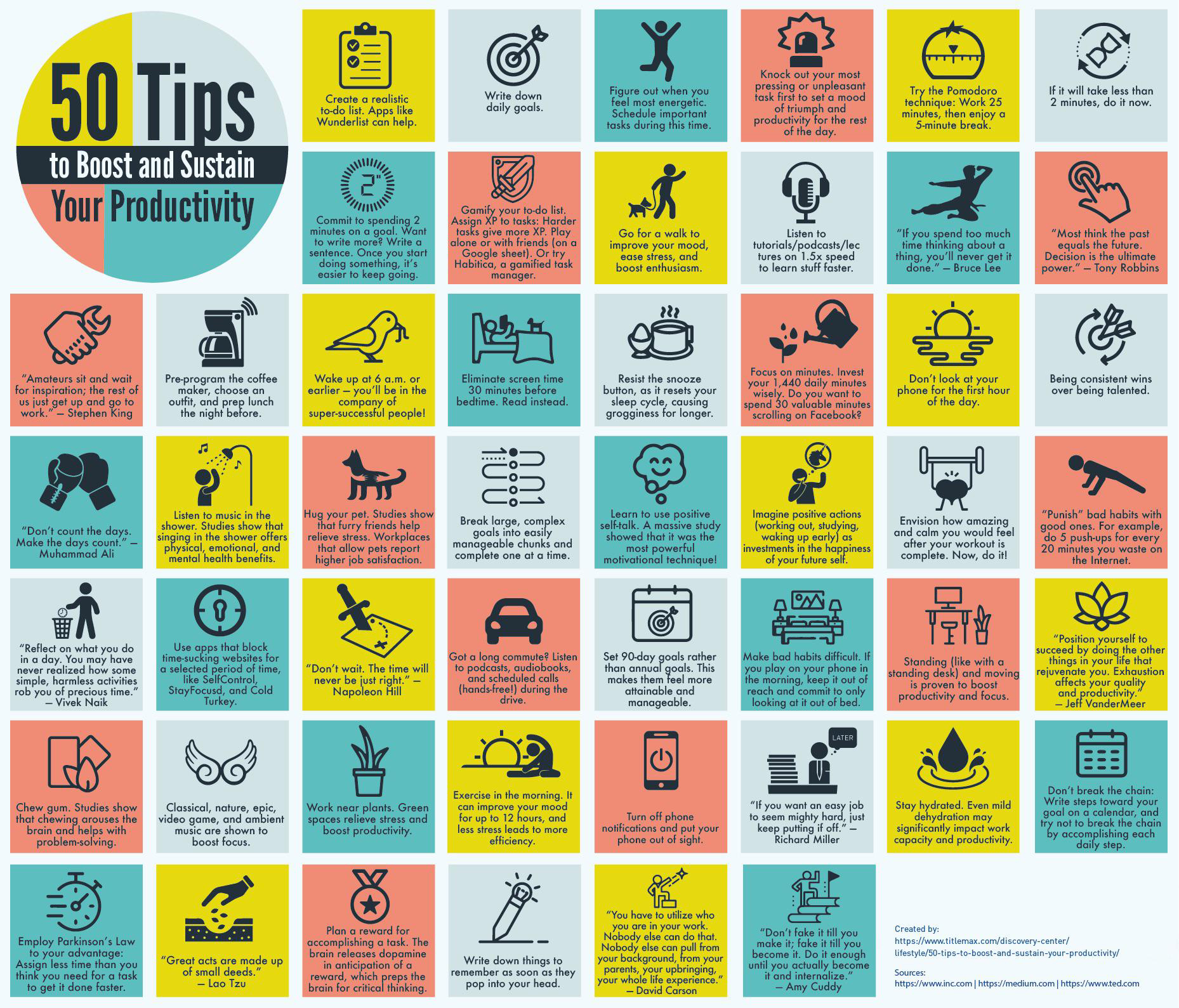
We’ve all experienced the feeling that there aren’t enough hours in the day, whether it’s related to work tasks, household projects, or improving emergency preparedness. The latter can be especially difficult to find time for, since paying the bills and spending time with family are often higher priorities (understandably so). Still, making time to prep and study useful skills is essential, and it shouldn’t have to fall by the wayside. It’s therefore a smart move to take steps to improve your productivity and discipline — you can’t make more hours in the day, but you can certainly make the most of those you have.
The following infographic from TitleMax includes 50 tips that can help you increase your overall productivity and find more time to prep, study, get in shape, or even relax after a long day. Some are quotes to keep in mind, while others are more concrete action steps. Obviously, integrating every one of these into your lifestyle at once would be overwhelming, but if you can pick a few to try out, you may find yourself making more progress.
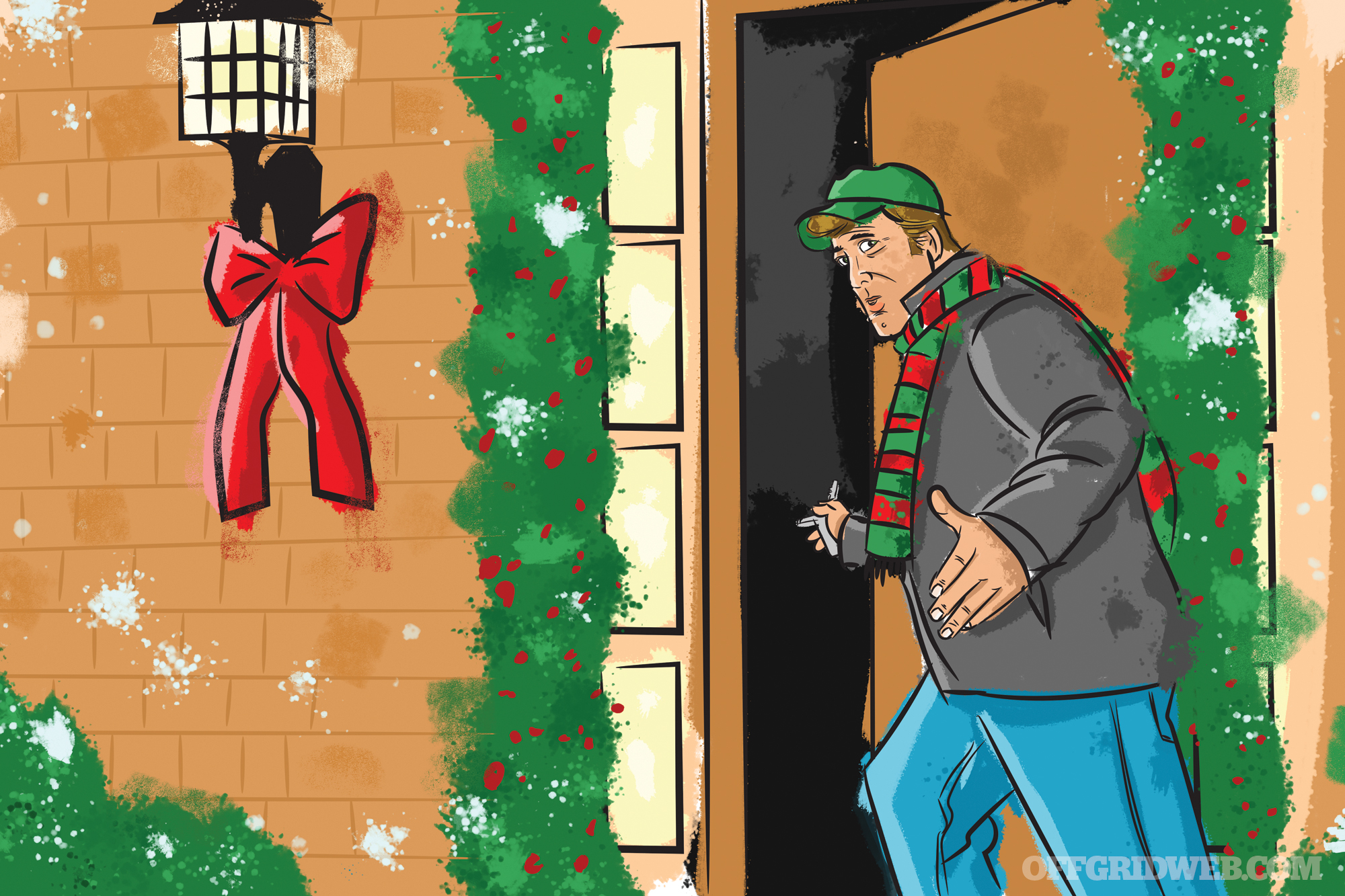
Even if you’re not usually absent-minded, you’ve probably felt the momentary confusion of arriving at home only to find a light was left on. You thought you’d turned it off before you left, but did you just have a brain fart and forget? Did your spouse or one of the kids leave it on? These common oversights can often make your skin crawl for a few moments as you wonder if someone was inside while you were gone. Coming home to an open front door, however, is a more concerning sign that something or someone has been there. You’re incredibly vigilant about locking everything up before you leave, but here comes that eerie feeling again. Did you screw up and forget to lock it this time, or are you about to walk in on an intruder?
You swallow and step back to see if you notice anything else out of place. You think about calling out “Hello?” for a second, but hesitate since you could potentially be alerting an uninvited (and possibly armed) guest to your presence. You’d hoped this would be a simple house-sitting gig for a friend, but you may now have stumbled upon a burglary in progress. What do you do?
The Scenario
Situation Type Possible burglary
Your Crew You
Location Your friend’s house
Season Winter
Weather Snowy and windy; high 38 degrees F, low 12 degrees F
The Setup: A wealthy friend of yours has gone out of town for the holidays and left their house in your care while they’re on vacation visiting relatives. You agreed to check on it every day until they return (except Christmas) to feed the cat, make sure the heater hasn’t broken down, collect mail and any packages that’ve arrived, and perform a general inspection to make sure nothing is out of order. Your friend has told you that they’ve been the victim of porch pirates more than once, so this being the holiday season, the potential for theft is higher.
The house is a bit secluded, and up a winding mountain road with no neighbors in the immediate line of sight or within earshot of any potential disturbances. It’s also a three-story house that’s over 5,000 square feet with numerous rooms, but you’ll only need to be in the kitchen and living room area while you’re there. The house has an alarm system that provides armed security response, but times in the past that the alarm has been tripped have yielded a slow response from the company … if any.
Your friend will only be gone for a few days, so you plan on a handful of routine visits until they return. You’re also told that the only others who have access to the house are the security company who has the alarm code, but no key, and the housekeeper, who has both. You’re also told the housekeeper will not be visiting while the family is away, and that they’re practically a member of the family, having worked for them for the last 20 years with no incidents. You’re also told there is a hide-a-key in what looks like a rock near the front porch. Although you have your own key for the visit, and you don’t know exactly what the rock looks like, the family made mention that it doesn’t look like the other rocks in the vicinity, so it should be easy to spot if you need to gain access. You’ve also been given a login to watch security footage of the house from your phone, using the cameras installed around the perimeter.
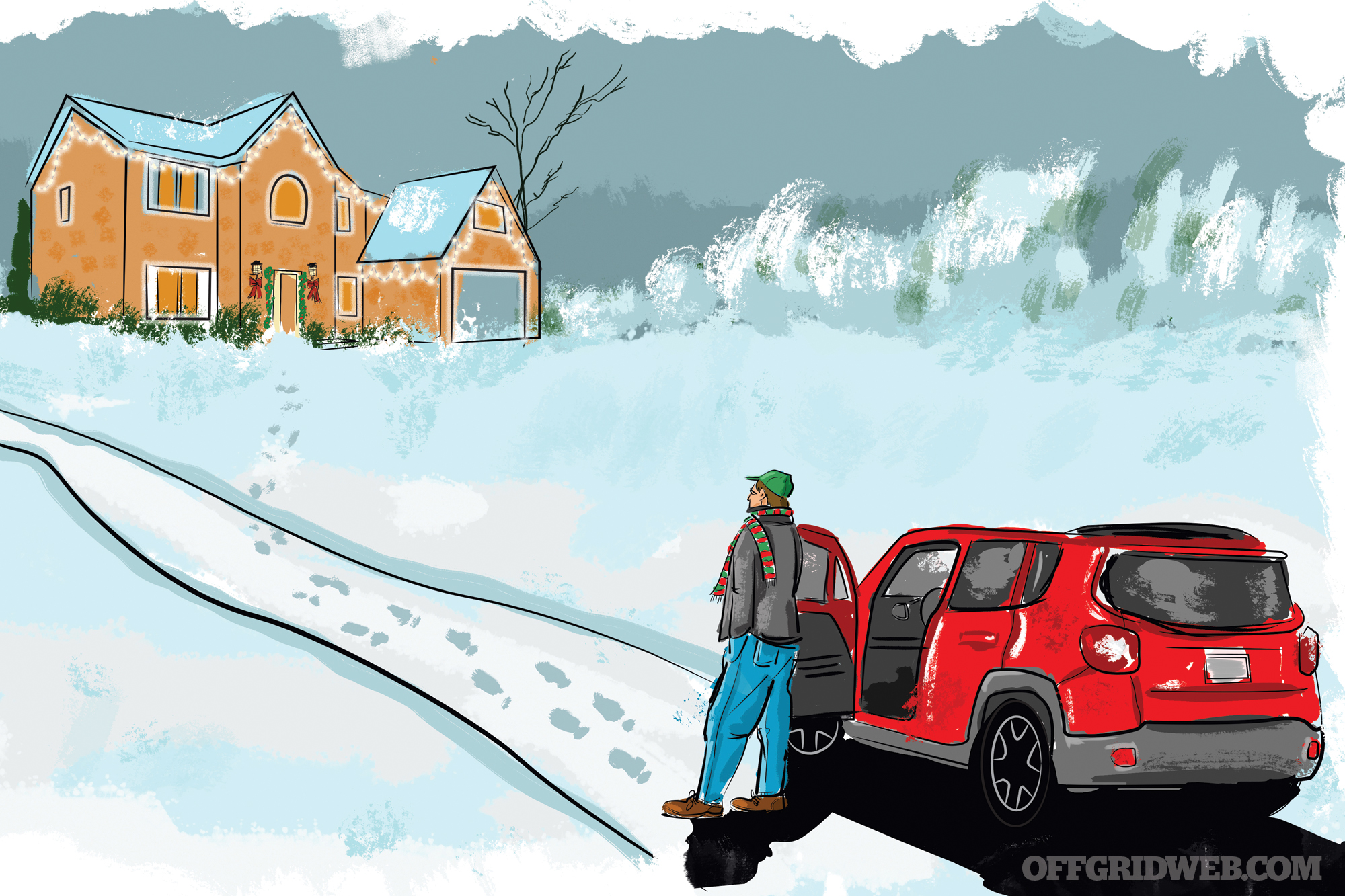
The Complication: It’s Christmas Eve and nearing dusk. You decide to make one last pass of the house before coming back in a couple days since there’ll be no mail delivery tomorrow. You can leave the cat some extra food to hold it over through Christmas day. As you arrive, you can see what looks like fresh tracks in the snow, but you attribute it to a few last-minute deliveries or the mail carrier. You’ve arrived a little earlier than normal to get this finished before moving on to your own holiday arrangements, but you begin to notice some things that concern you. As you go to collect the mail from the mailbox, you find it empty and wonder if the mail carrier hasn’t arrived yet or had nothing to deliver. There are also no packages in their usual place by the front door — you were certain that some would arrive today. Maybe the delivery is running late as well? You also notice that the light in the upstairs bedroom is off. You know that light in particular is on a timer and wonder if it hasn’t kicked on yet because you’re here earlier than normal.
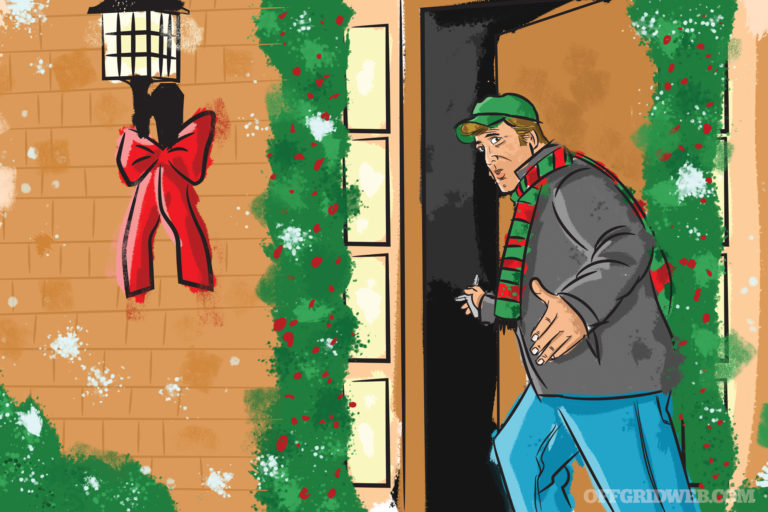
As you approach the front door, you see that it’s slightly ajar. Did you forget to lock it and the wind managed to blow it open? Is someone here? The blinking red light on the alarm panel shows that the alarm has been activated and that alone makes the hair on the back of your neck stand up. You look around frantically for something that looks like the hide-a-key rock you were told about, but you don’t see anything that resembles the description you were given. Did someone manage to find it and get inside? Did the housekeeper show up unexpectedly to drop something off for the family? You decide to investigate further, but feel hesitant since you haven’t explored the house in its entirety and don’t know the layout.
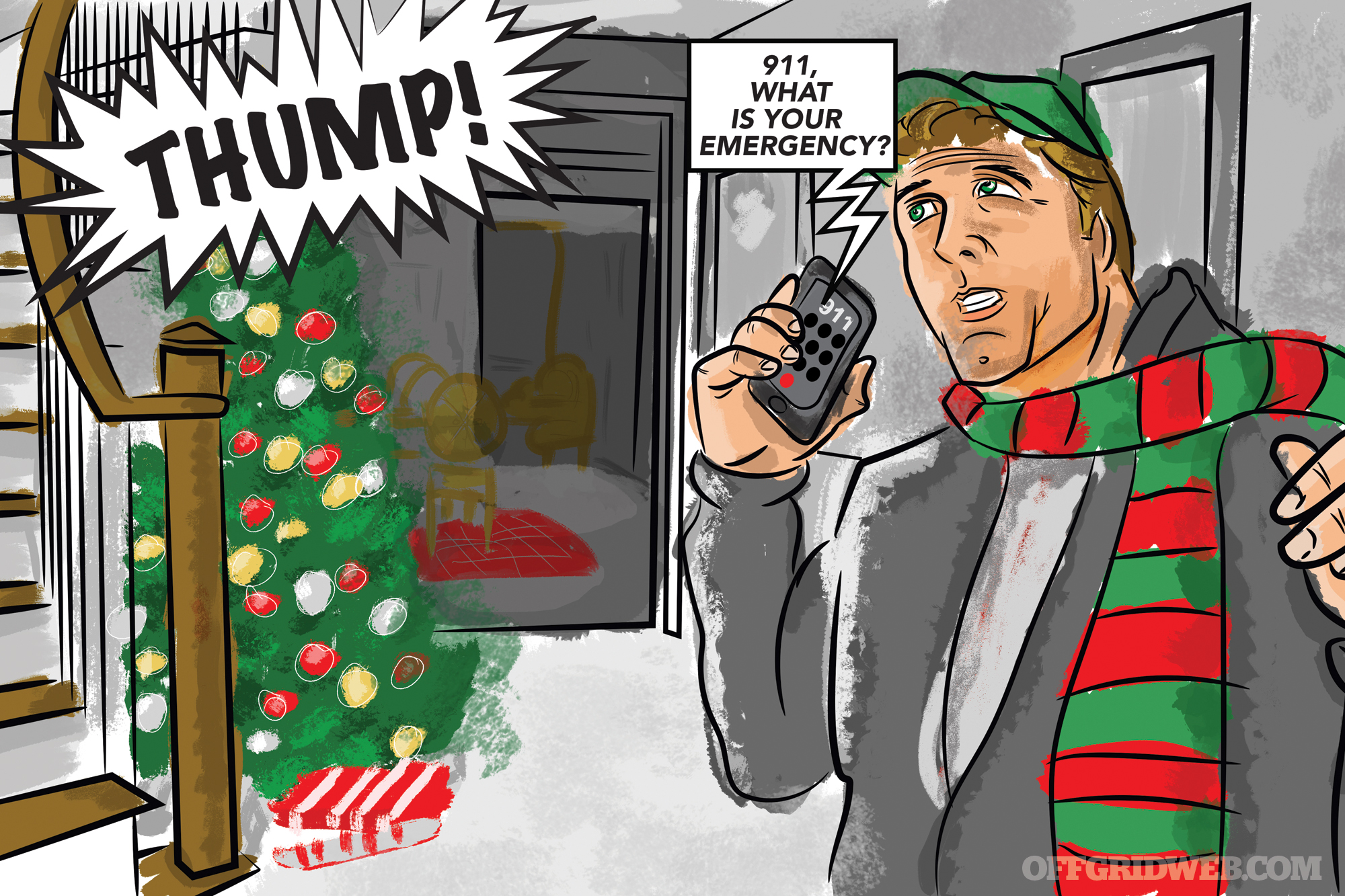
Your cell phone reception up here is spotty and dropped calls have happened to you here before. The house also doesn’t have a landline that you’re aware of. You walk into the kitchen and see nothing that looks out of order. As you swing back to head toward the front door, there’s a noticeable “thump” upstairs. Is this a burglar? Is it the cat? Is it someone else who has a key to the house you weren’t told about? If someone is there, who are they and what do they want? Should you call the police or the security company and wait for their arrival? Either way, it’s unlikely that they’ll respond quickly given your remote location — if you can get through to anyone at all. Should you attempt to clear the house and risk coming face-to-face with an armed intruder? Should you run to your car to go get help?
Firearms Instructor Sheena Green’s Approach
Preparation
When I’ve been asked to house-sit in the past, whether my friends knew it or not, they usually provided me with a general baseline about their environment. Routines such as the neighbor is a home-body and goes out for a morning walk around 7:30, trash is picked up on Mondays; mail gets delivered in the afternoon, sometimes the girl down the street rides her bike over to see if our kids can play on Saturdays are things that have been relayed to me. While seemingly trivial, those are notes to keep and compare during visits to the house.
Extra questions I could ask if the information wasn’t already volunteered would be: Have you had any issues with crime other than the porch pirates? Are there any weirdos or stray animals in the neighborhood I need to look out for? Has anything serious been posted in your neighborhood Facebook group recently (besides people mistaking cars backfiring for gunshots)?
Making sure I understand the security system and how it works would be at the top of my list. I wouldn’t want to trouble my friend with a call from the security company if I didn’t disarm the system in time. This would prompt a few more questions: What is the notification process if I don’t disarm the system in time? Does it alert your family in addition to the security company? Have you ever had law enforcement show up to a tripped alarm? Do you know what the response time was?
To avoid being mistaken for a burglar, I’d suggest my friend make a contact list for me to keep of family/friends/neighbors who have been made aware of my responsibility to care for the cat and property. This also makes me feel more at ease knowing I have people I can contact who are more familiar with the house in case there’s some sort of mishap.
My cell phone gets crappy reception in real life, so something I do when visiting friends is ask for the Wi-Fi password and connect when I’m there. Having the Wi-Fi password sent via a text and saved to your notes on your phone as a backup is helpful as well.
Something I recommend everyone do regardless of the amount of risk in your daily life is set up your SOS and emergency contacts on your smartphone. Depending on the phone brand and operating system, how the SOS is activated could be different, so make sure you’re familiar with your own. It’s also helpful to know how to dial 911 from the lock screen, so you won’t have to fumble with the keypad when seconds count.
Knowing I needed to go to a secluded home where emergency response times could be lengthy, I’d ask someone to accompany me every time I planned to check on the house. Even if the person I ask is not someone who carries a firearm, a second person is always better than being alone. I’d ask my friend to wait in the driver seat with the vehicle running and have their cell phone at the ready in case we need to make a quick exit.
Because of my crappy phone reception, frequency of travel, and preferring to work from a secure internet connection, one option I’ve explored is the Solis X by SkyRoam. It’s a portable Wi-Fi hotspot and has a built-in camera.
On Site
Thanks to the info relayed to me by my friends, I already have the sneaking suspicion that something is a little off and would spend more time observing the scene and outside of the house. If there are tire tracks in the snow, did anyone get out of the vehicle? How many pairs of footprints are there? Where do they lead? Do the tracks look like someone was dropped off? Does it look like the vehicle came and went with no one getting out? The information that I can glean from those questions may sway my actions to either play it safe and review security footage or go ahead and approach the house.
Upon finding the door ajar, now I know I’ve got a problem, which instantly starts a swirl of thoughts and decisions to make. The first one is going to be whether or not someone is on the other side. The second one is trying to decide to peek around the door or hurry up and go back to the car. Then, at some point, a random reminder for the reason for the visit, “Oh sh*t, did the cat escape?”
Even though I can legally carry a firearm, I’d choose to go back to the car, lock the doors, and tell my friend what I saw. From the safety of the locked car, positioned in a safer distance from the house, I’d have my friend call the police on speakerphone while I pull up surveillance footage and wait for law enforcement to arrive.
Crisis
Knowing our own skills, capabilities, and limits can keep us safe, so I’m not even going to entertain the idea of clearing the house. It’s not something I have sought out training for and the idea of me, an armed civilian clearing a 5,000-square-foot house I don’t know the layout of is outside the realm of reasonable actions for me.
It’s not safe to assume that burglars are non-violent, and therefore caution should be exercised if found face-to-face with the intruder. The training I’ve received over the years to prepare myself for violent encounters will come into play if and when that story unfolds.
By choosing not to enter the home, as evidenced on the security cameras and my friend as a witness, I save myself a whole lot of legal headache and blame. If burglars had, in fact, ransacked the house and left before we arrived, most of the scene would be untouched and untampered. Hopefully this would make it easier for police to do their job in finding clues and catching the bad guy(s).
Combatives Expert Chad McBroom’s Approach
Preparation
Area Orientation: The first part of my preparation phase for this type of scenario would be to have my friend give me a detailed tour of the house and property. I’d want to know the locations of all the exterior doors and any other large opening that might serve as an entry or exit point. I’d also note the locations of all security system triggers, such as door and window sensors, glass-break sensors, and motion detectors, as well as the locations of all interior and exterior cameras. Having access to the cameras via my cell phone will allow me to check in and around the house to have the greatest situational awareness prior to entering. It’ll also help in identifying any intruders and thieves if a situation does arise.
I’d also want to know if there’s a safe room in the house, where it’s located, and what supplies are there. Although I plan on having my own equipment on my person, it’s good to know where I might be able to find additional supplies. If there’s a well-planned safe room inside the house, it’ll likely have an alternate form of communication, such as a reliable cell phone or landline separate from the main line.
Establish a Baseline: Next, I’d establish a baseline of the house and surrounding area. What are the normal traffic patterns? What are the local norms? Are there any identified criminal enterprises operating in the area? What’s the typical law enforcement response to crime in this area? What are the local habitual areas (public gathering places) and natural lines of drift (shortcuts)? What’s the baseline atmosphere (“feeling”) of the area?
I’d take a second walk-through of the interior and exterior of the house by myself to eliminate all distractions and observe the lay of the land. What are the natural and manmade obstacles (terrain, walls, fences, cameras, etc.) that would divert or funnel human traffic trying to enter the property surreptitiously? I’d also identify the hide-a-key rock to see where and how it’s currently oriented.
Having this established baseline will allow me to identify any anomalies that present themselves when I go to check on the house. An atmospheric shift, disturbance of the area, a vehicle out of place, items moved from their normal location, or a housekeeper’s vehicle parked outside at an odd hour are examples of detectable anomalies that could indicate potential danger upon arriving at the residence.
Personal Preparation: My personal equipment would consist of my normal EDC, to include a concealed handgun, knife, flashlight, and cell phone. My phone would have my friend’s phone number, the number for the local police department and security monitoring company, and the numbers of any nearby friends or neighbors that might serve as emergency contacts should a situation arise. My secondary communications plan would be my friend’s landline if there’s one, and the identified safe-room communications would be my contingent communications plan. My emergency communications plan would be to drive to the nearest neighbor or convenience store to use their phone.
When checking on the house, I’d place a phone call to my wife to let her know my location and arrival time so she’d know if I was on site longer than reasonable. She’d know to call and check on me if I was there longer than normal, and to contact the authorities if I didn’t answer or return her call within a reasonable amount of time.
On Site
Prior to approaching the house, I’d follow my established protocols that I would’ve followed with each prior visit. This would include remotely reviewing the security footage and checking to see if any alarms have been triggered using the alarm system app.
During my drive in, I’d be looking for any baseline anomalies. Are there any vehicles that appear to be out of place? A vehicle and driver looking out of place could be an indication of potential criminal activity in the general area. Are the local residents engaged in their normal activities? People will often intentionally or unknowingly respond to their “gut” and change their routine when there’s a predator hunting in the area. Are there any law-enforcement vehicles patrolling the area? A police presence might act as a deterrent or cause a perpetrator to change their modus operandi on the fly.
Upon arriving at the house, I’d look for other anomalies around the premises. Are there any rocks or vegetation that have been recently disturbed? Are there any footprints or tire tracks in the snow? Are there any lights on or off inside the house that shouldn’t be? Have the window coverings been disturbed?
After discovering the front door is ajar and the hide-a-key rock is missing, and assuming my review of the security footage prior to my approach didn’t reveal the presence of any intruders, I’d assess the situation to determine the best course of action. The blinking red light on the alarm panel indicating the alarm has been activated rules out the likelihood that the housekeeper is making an unscheduled visit, since she would’ve disarmed the system using the alarm code.
Given there were no alarm indications or intruders on the video feed prior to my final approach of the house — otherwise I wouldn’t be at the front door — the most innocuous scenario at this point is that I had somehow left the front door unsecured and the wind dislodged the door just prior to my arrival. The most dangerous scenario is that an intruder had made entry just prior to my arrival. I’ll treat this situation as though it were the latter until I can prove it was the former.
Crisis
My immediate priority is to find a position of cover and concealment while I complete some administrative tasks. If I’m able to get a cellular or Wi-Fi signal with my cell phone, I’ll review the security camera footage from the time I last checked it to the present. If I’m able to see any intruders on the video feed, I will be sure to download the video and take screenshots of the perpetrators for later identification. I’d also immediately call 911, report the incident, and wait for law enforcement to arrive.
If I review the video footage and don’t see any indication of a break-in, I’d place a call to my wife to inform her of the situation. Based on the information I’ve gathered to this point, I believe my best course of action is to clear the house myself, as there’s no additional evidence of any intruders.
After entering the house and seeing nothing out of order in the kitchen, the likelihood that I screwed up and forgot to secure the door during my previous visit is looking more and more plausible, until I hear the “thump” upstairs. At that point, I’d call 911 and report a possible break-in. Maybe it’s the cat falling off the bed, but I’m not taking any chances.
Although I have the legal right to be on the premises and no duty to retreat in my state, the only other people in the house, if any, are the bad guys. If there were innocent people in the house, then my priority would be to ensure their safety and clear the house, but since there are none, there’s no reason for me to remain inside the house, and doing so would place me at a tactical disadvantage. My best option at this point would be to vacate the house and observe the front door from a safe distance to see if anyone leaves the house while I wait for the police to arrive.
If I do see anyone leave the house, I’ll record as many details as I can (height, weight, sex, clothing, identifying marks, physical impairments, etc.) to give to the police. I didn’t see a vehicle parked nearby, so they must have walked in or been dropped off by a getaway vehicle. I’d be watching to see which route they take when they leave the house, if they’re carrying anything, if a vehicle picks them up, and their direction of travel.
Taking this approach to this situation is the best way to ensure my own safety. There’s nothing in my friend’s house worth dying for, especially not the cat. It’s possible that police have already been alerted by the alarm company, so they might show up at any moment. Staying outside is the best way to prevent being mistaken for a burglar when they arrive, and to avoid implicating myself in what may be a crime in progress.
Conclusion
The entire purpose of this column is to get you, the reader, to think about what you’d do if you were in this situation. It requires some self-awareness and honesty about how you’d be willing to deal with certain situations that have a huge question mark. There are probably individuals out there who’d feel totally comfortable clearing a 5,000-square-foot house alone, but even though you’ve accepted the responsibility of overseeing and caring for a friend’s home and cat, possessions (including dearly beloved pets) are not a higher priority than your own life.
With all the little red flags triggering concerns outside the home, this is one situation where you should be keenly aware of the potential problems that could occur before walking through the door and into an unknown situation. Whether it’s your own house or a friend’s house that you’ve been asked to watch while they’re out town, clearing a house with a potential threat is a huge risk. If the lives of innocents are at stake, it may be justifiable, but it’s unwise to put your life on the line for replaceable possessions. Establishing baselines through observation and orientation and looking for anomalies is the best way to stay in front of a dangerous situation. Avoidance is always the best defense.
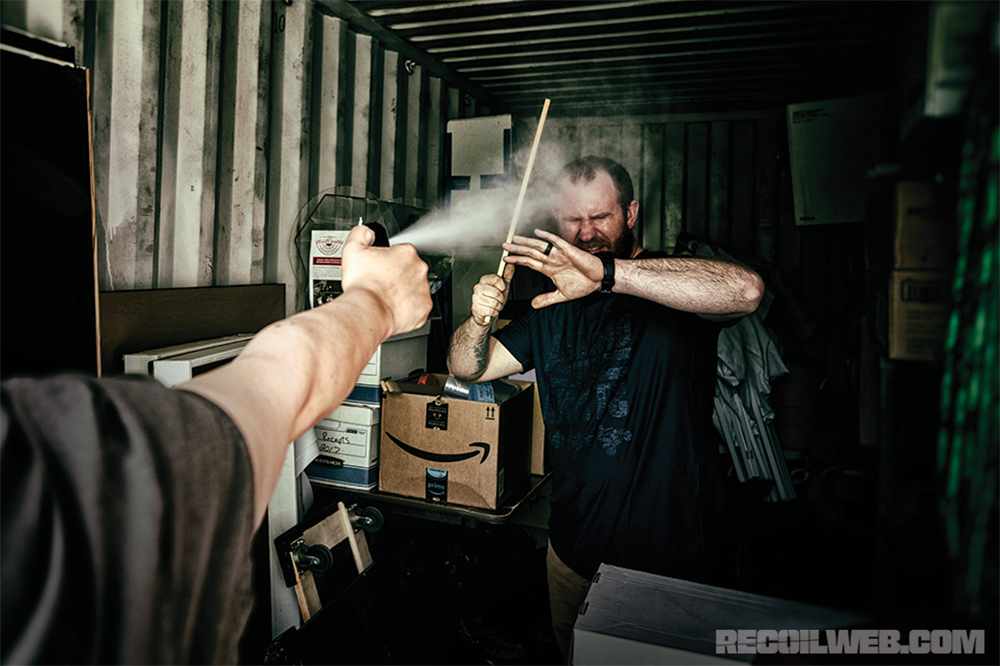
A concealed firearm is a powerful tool for self-defense, but there are many defensive scenarios which may not call for lethal force. It’s therefore a good idea to diversify your defensive options with a less-lethal tool such as pepper spray or OC spray. These chemical compounds can inflict immediate pain and disorientation upon an attacker, creating a window for you to escape or prepare a lethal response if it becomes necessary.
In a recent article on Active Response Training, Greg Ellifritz wrote about an incident involving pepper spray that was captured on a convenience store security camera in Canada. In this incident, two masked men entered the store and demanded cash from the register. The owner told the Ottawa Sun that he thought it was a joke at first, but then one of the men pulled a knife. The store owner grabbed a can of pepper spray (reportedly bear spray) and used it on the robbers, scaring off one of them and disorienting the other.
The original video in the Ottawa Sun article appears to have been deleted, but you can get the gist of it from the second-hand recording below:
Thankfully, the store personnel weren’t injured, but as Ellifritz noted, this situation wasn’t handled as well as it could’ve been. He expands on a few basic tips in his blog article:
Keep your spray accessible, not set aside on a cluttered counter or buried in a purse.
Practice with your spray, especially with inert training canisters.
Have a backup plan in case the spray fails to stop the threat quickly.
Know your reaction to inadvertent exposure or overspray.
Be ready to decontaminate yourself after the fight.
For more details on each of these points, we’d recommend you read the article in its entirety on ActiveResponseTraining.net.
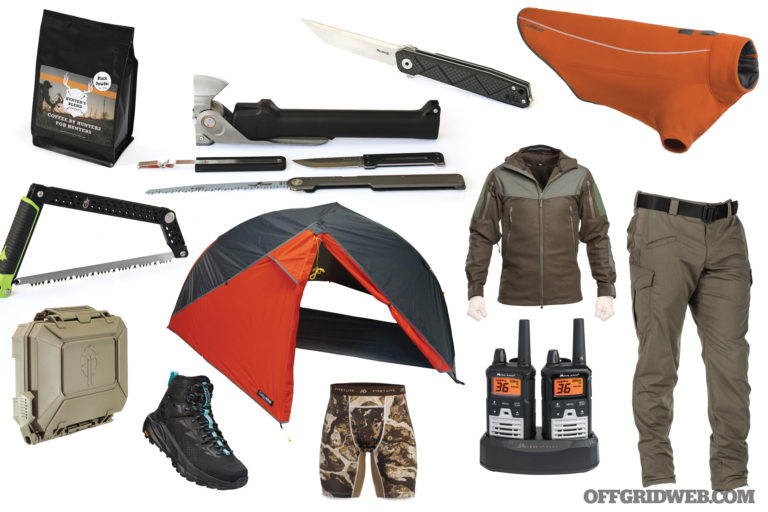
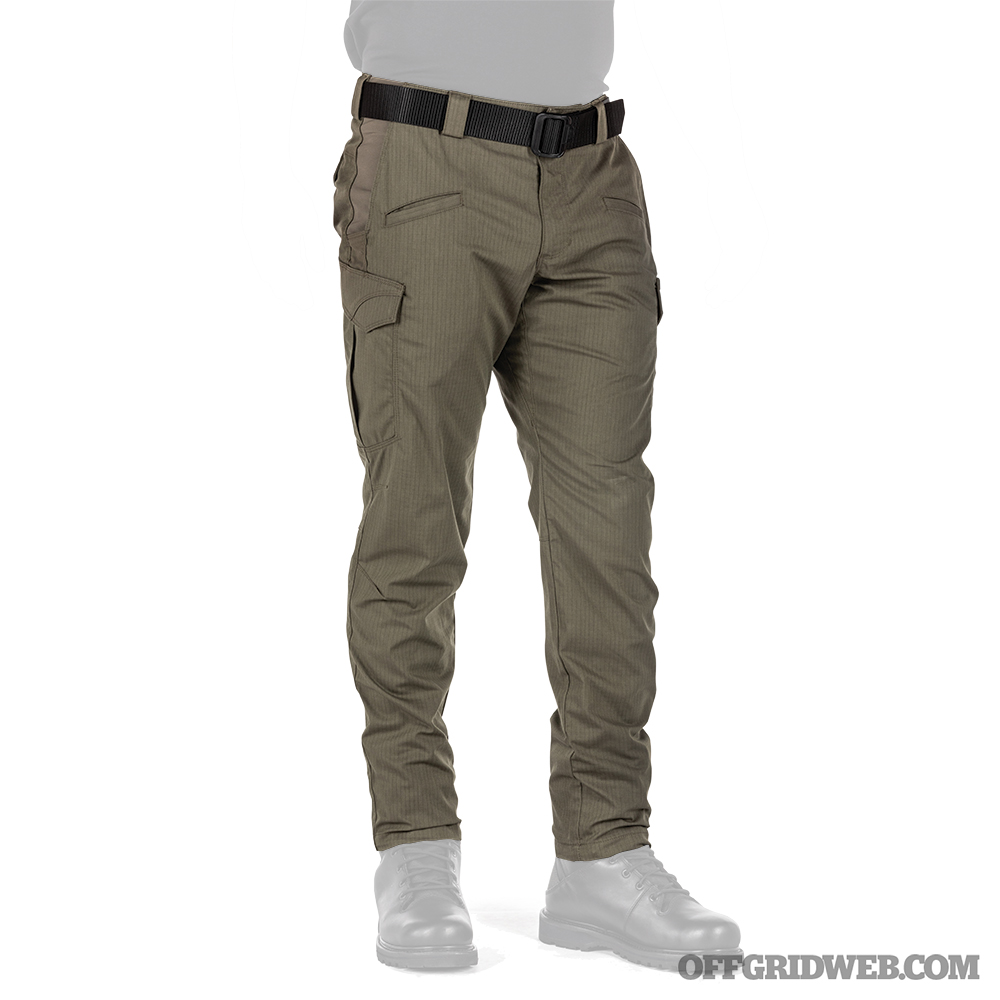
Notes While wearing these slacks isn’t the same as humping a three-day pack, the Icon Pant does offer a lot more carrying capacity than your average pair of skinny jeans. It has a whopping 12 pockets, including front utility pockets and two cargo pockets with internal dividers. Plus, with knee articulation, gusset construction, and Flex-Tac mechanical stretch ripstop, this 5.11 pant provides an excellent blend of mobility and durability that few competitors can match, if at all. The 6.8-ounce fabric is made of 80-percent polyester and 20-percent cotton with a Teflon finish, keeping spills and stains at bay.
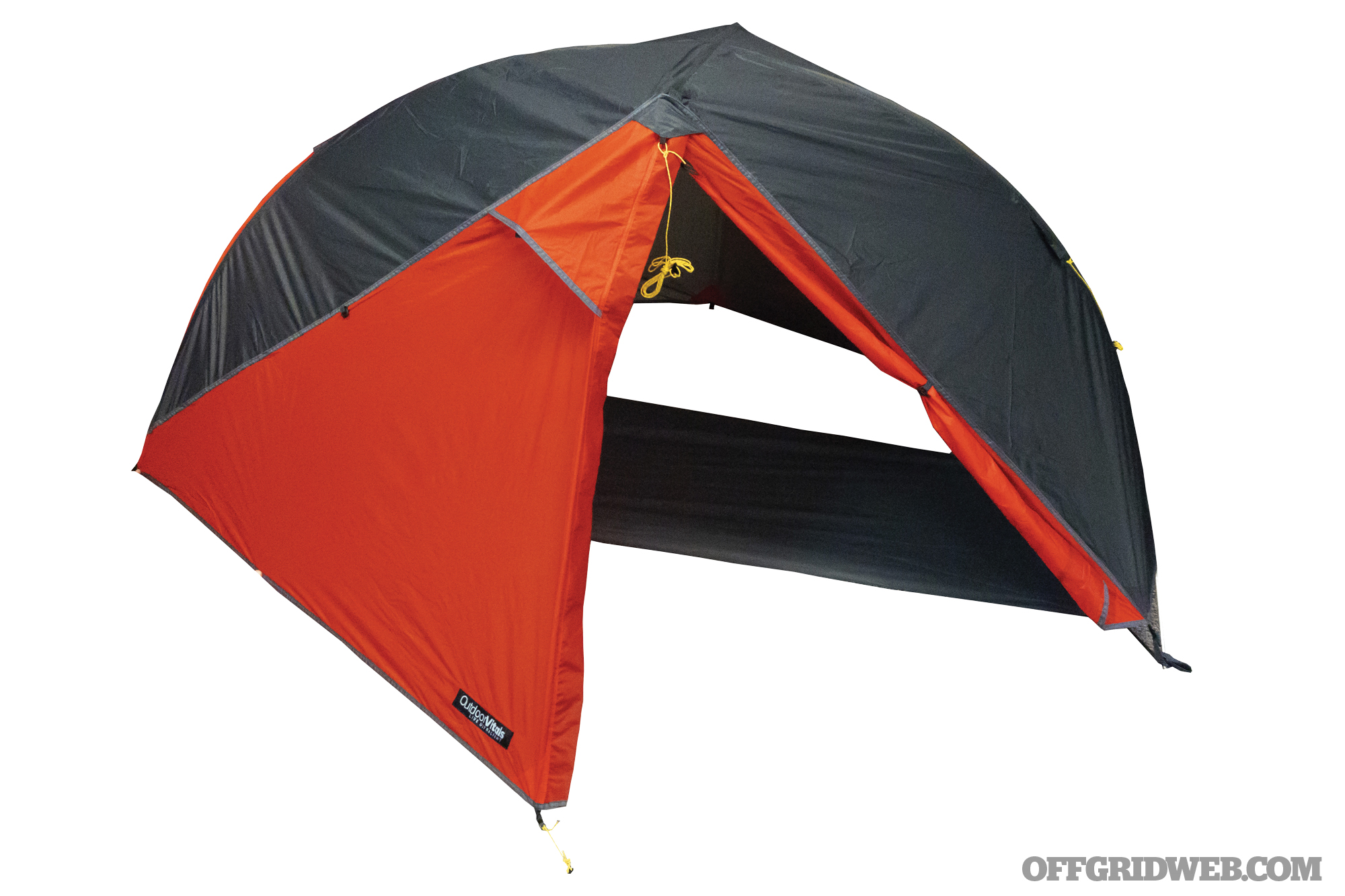
Notes If you’re looking for a compact, lightweight shelter for a solo adventure or bug-out scenario, Outdoor Vitals offers the Dominion. It’s aimed at backpackers and others who want to keep their gear as light as possible. The Dominion features DAC Featherlite aluminum poles and ultralight 15-denier siliconized fabrics. And if you want to shave more off the 2-pound, 9-ounce trail weight, its modular design lets you leave the tent body behind so you can go in ultralight mode (just rainfly, poles, and footprint) at 2 pounds flat. The Dominion has two storage pockets, a ventilated double-wall construction, tie-outs and guy-outs for windy conditions, and an easy-to-use storage compression bag.
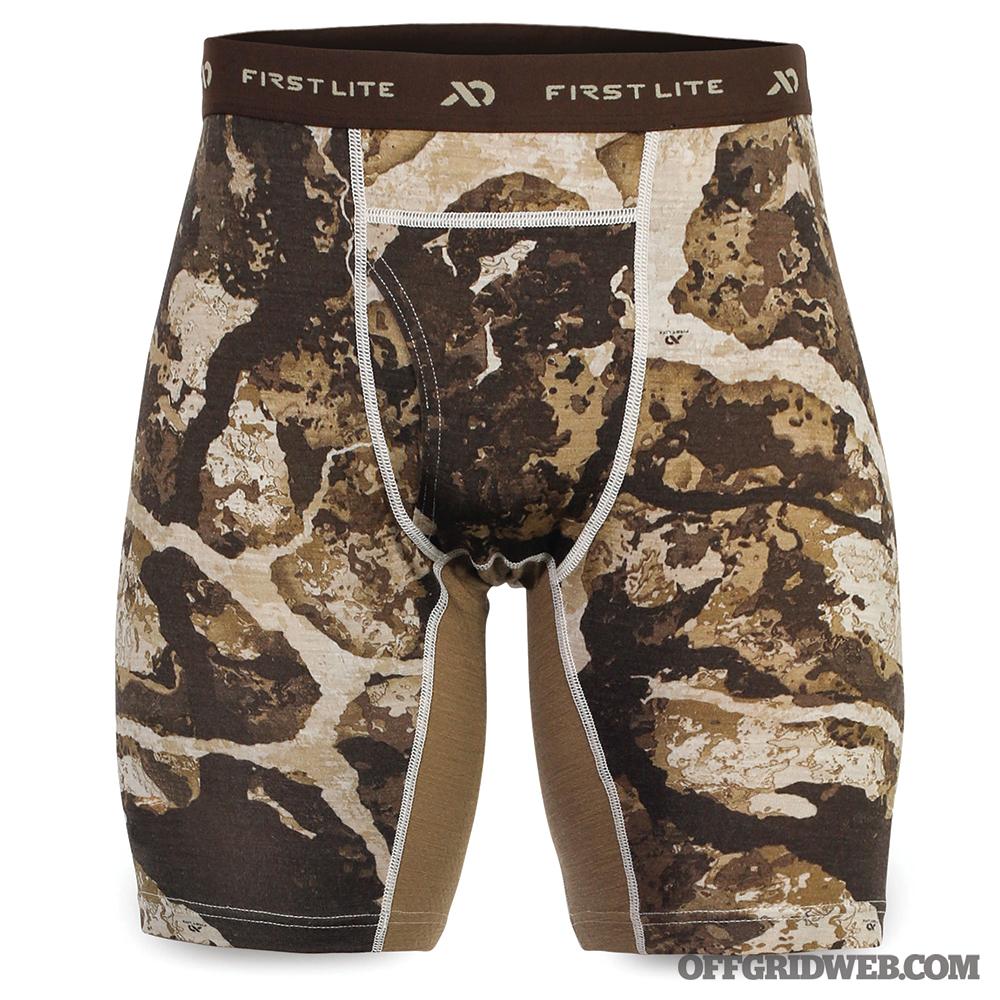
First Lite Men’s Wick Long Boxer Brief
Colors Black, Conifer, Dry Earth, First Lite Cipher, and First Lite Fusion
Notes Don’t let the camo pattern fool you; you’re not meant to wear only these skivvies when stalking your next meal in the backcountry. But you could certainly wear this as a baselayer for pretty much anything you set out to do — be it hunting, running, camping, or web surfing. Why? Because it’s made from First Lite’s wool blend called Aerowool. And as we mentioned in the description for the Varusteleka jacket on this page, sheep’s fleece is one of the best materials to wear for outdoor adventuring. Moisture-wicking, odor-resistant, insulating — wool will almost always outperform any fabric humans can create. This boxer brief features a 10-inch inseam with a next-to-skin fit to prevent the legs from riding up, while the jacquard waistband provides a comfortable mix of tautness and flexibility.
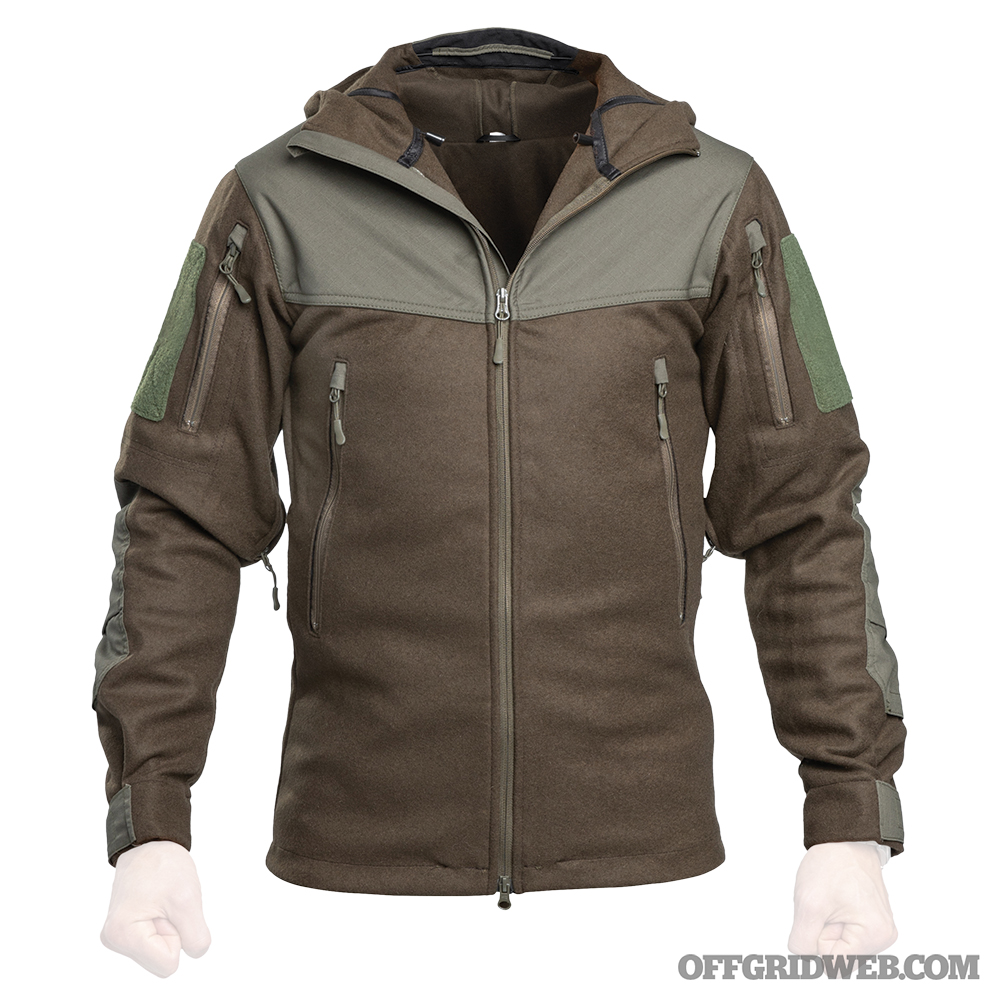
Notes Varusteleka might be the best gear and apparel company you’ve never heard of. Started in 2003, this Finnish firm has since became the biggest military supply store in Europe and has even created its own lineup of clothes, packs, and more. The Sarma TST Woolshell Jacket is one such example. It looks like a tactical softshell jacket, but is made of a wool blend. Why wool? Because it’s Mother Nature’s super material, it breathes (unlike some synthetic fabrics), is naturally flame- and odor-resistant (making it great for active pursuits), and continues to provide insulation even when wet (unlike cotton). This jacket is loaded with user-friendly features, including an adjustable hood, hook-and-loop cuffs, underarm ventilation zippers, and elbow reinforcements with pockets for pads (not included). Plus, there are two upper-arm zippered pockets and two side pockets, both of which sit at rib height, so they don’t get in the way of your backpack’s waist belt.
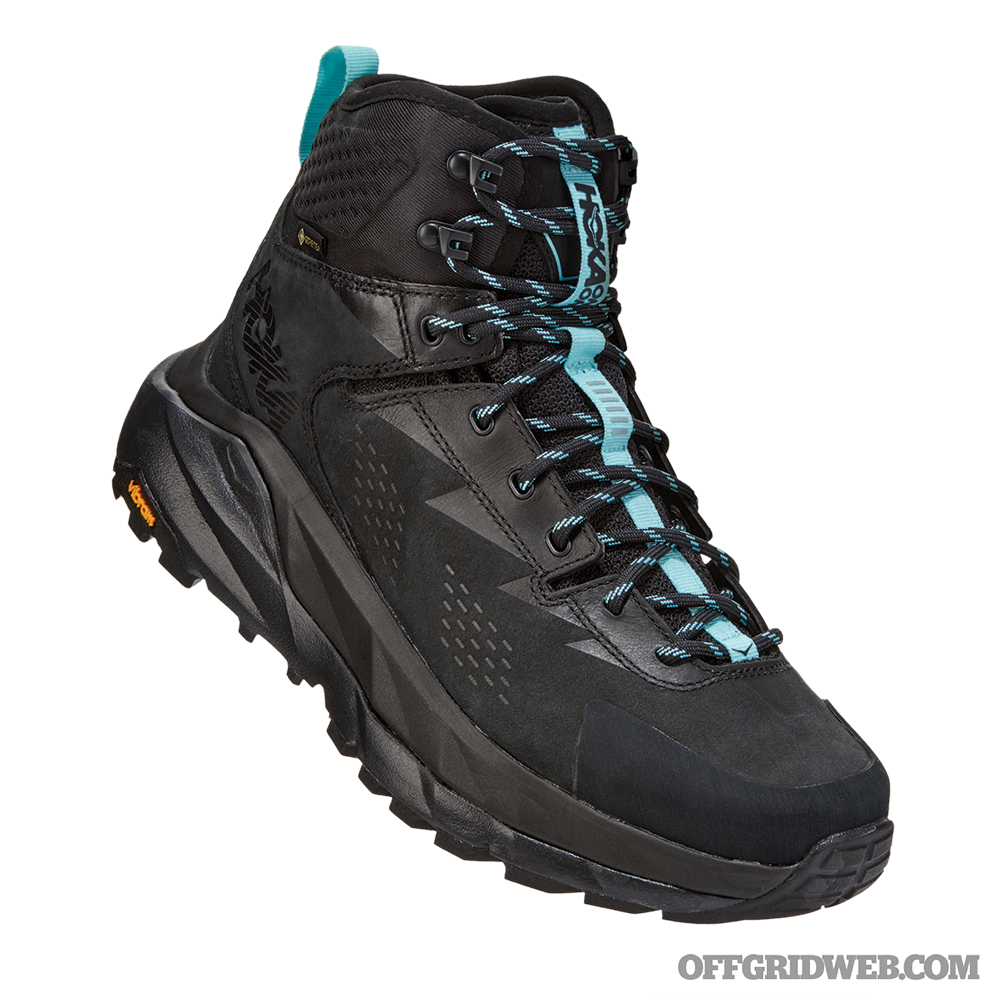
Notes The appropriately titled Kaha GTX (the word “kaha” means strength in Maori) provides some serious support for backpackers carrying heavy loads across long distances. This means these hiking boots are primed for preppers and survivalists who might need to trek with their bugout bags through harsh conditions. Inside, the EVA top layer provides a comfy bed for your foot while the Rangi bottom foam offers both durable cushioning and responsiveness. Moreover, the Vibram Megagrip outsole has 5mm multidirectional lugs for superior traction in all sorts of terrain. While not meant specifically for frigid temps, the Kaha GTX does feature a Gore-Tex waterproof bootie and a full-grain waterproof leather upper to keep your feet dry and comfortable.
Ruffwear Climate Changer Pullover
Colors Canyonlands Orange, Blossom and Cedar Green
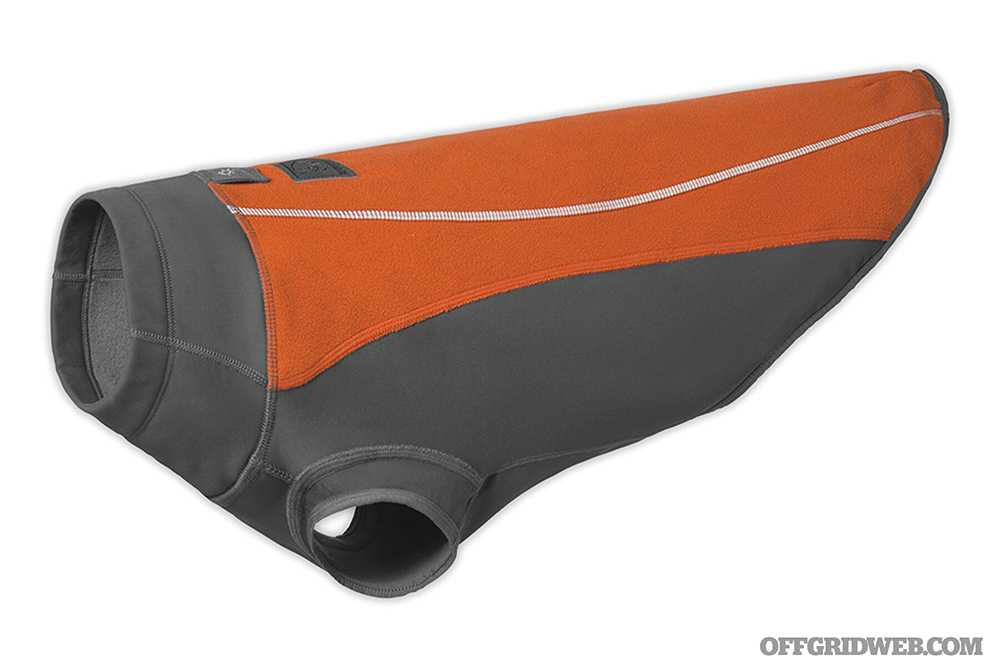
Notes If you’re forced to flee a disaster in winter, you’ll want to make sure your canine sidekick can make the journey out of Dodge, too. For a smaller dog or a breed that doesn’t do as well in cold weather, this pullover sweater from Ruffwear adds an extra layer without restricting movement. Made of a nylon-spandex blend and a water-repellent finish, the lower panel retains body heat, sheds rain, snow, and dirt, and stretches to conform to various chest sizes. On top, the upper panel is made of polyester fleece that dries quickly and captures warmth without the bulk. The cap sleeves allow for a greater range of motion while fitting dogs with broad shoulders and thick chests. For added safety, there’s a loop for attaching a small light and reflective trim for visibility in dark conditions.
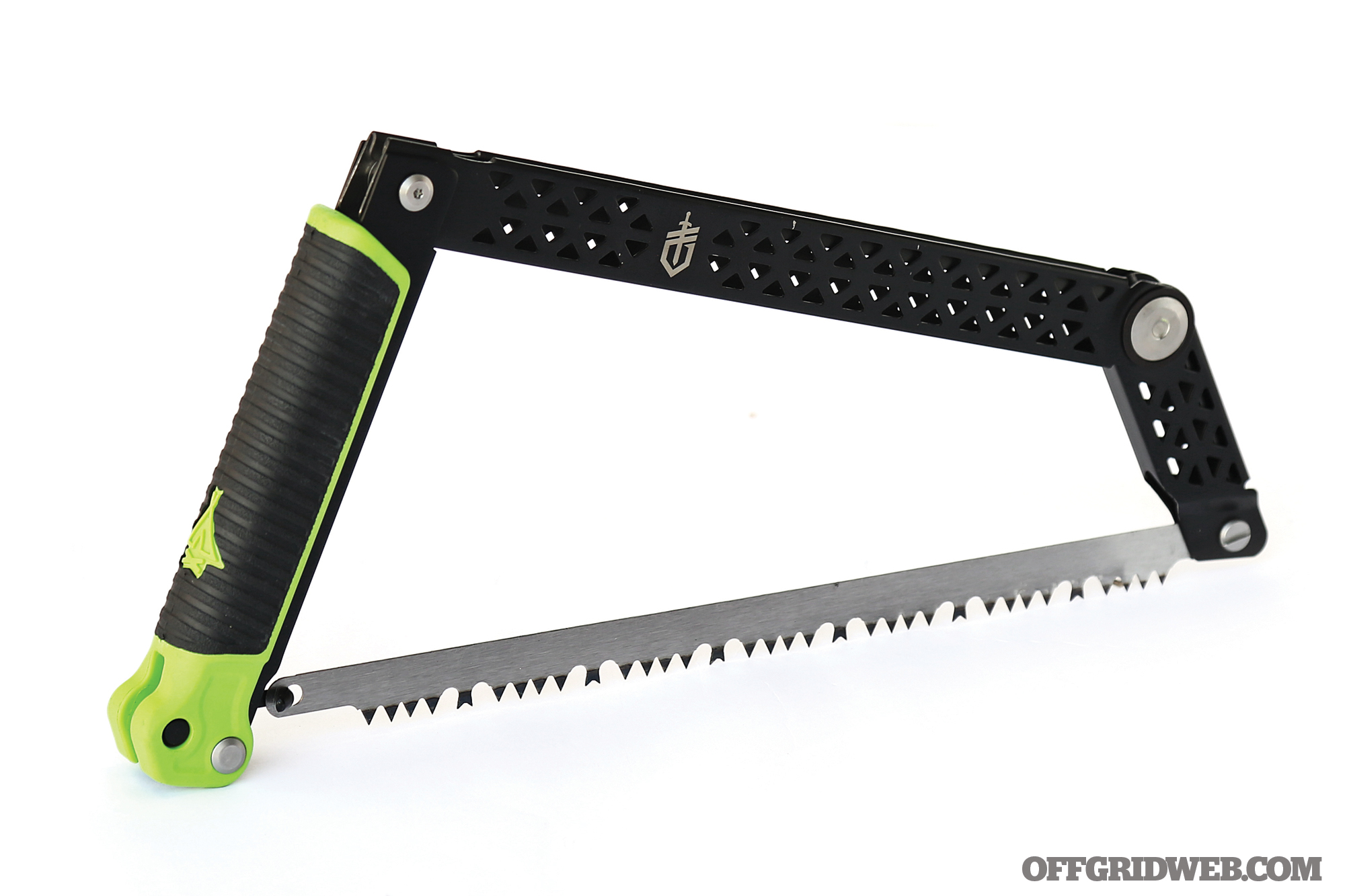
Notes There’s no denying that, in the hands of a skilled woodsman, a two-handed ax can do some serious damage to a tree. But there’s also no denying that for the average Joe, a saw is a much more precise tool at cutting a thick branch. The only problem with both of these tools is that they can often be too cumbersome to pack when cargo space is at a premium. Enter the Freescape Camp Saw. This innovative tool looks similar to a hacksaw but folds down flat into a baton-like object that’s just a little over a foot long — and without any additional tool or disassembly. When opened, it has four pivot points to effectively cut larger diameter wood using the full length of its 12-inch blade, which can be easily replaced if needed. And its handle is textured for added “grippyness” and accented with bright green so it’s easy to spot amongst your other tools.
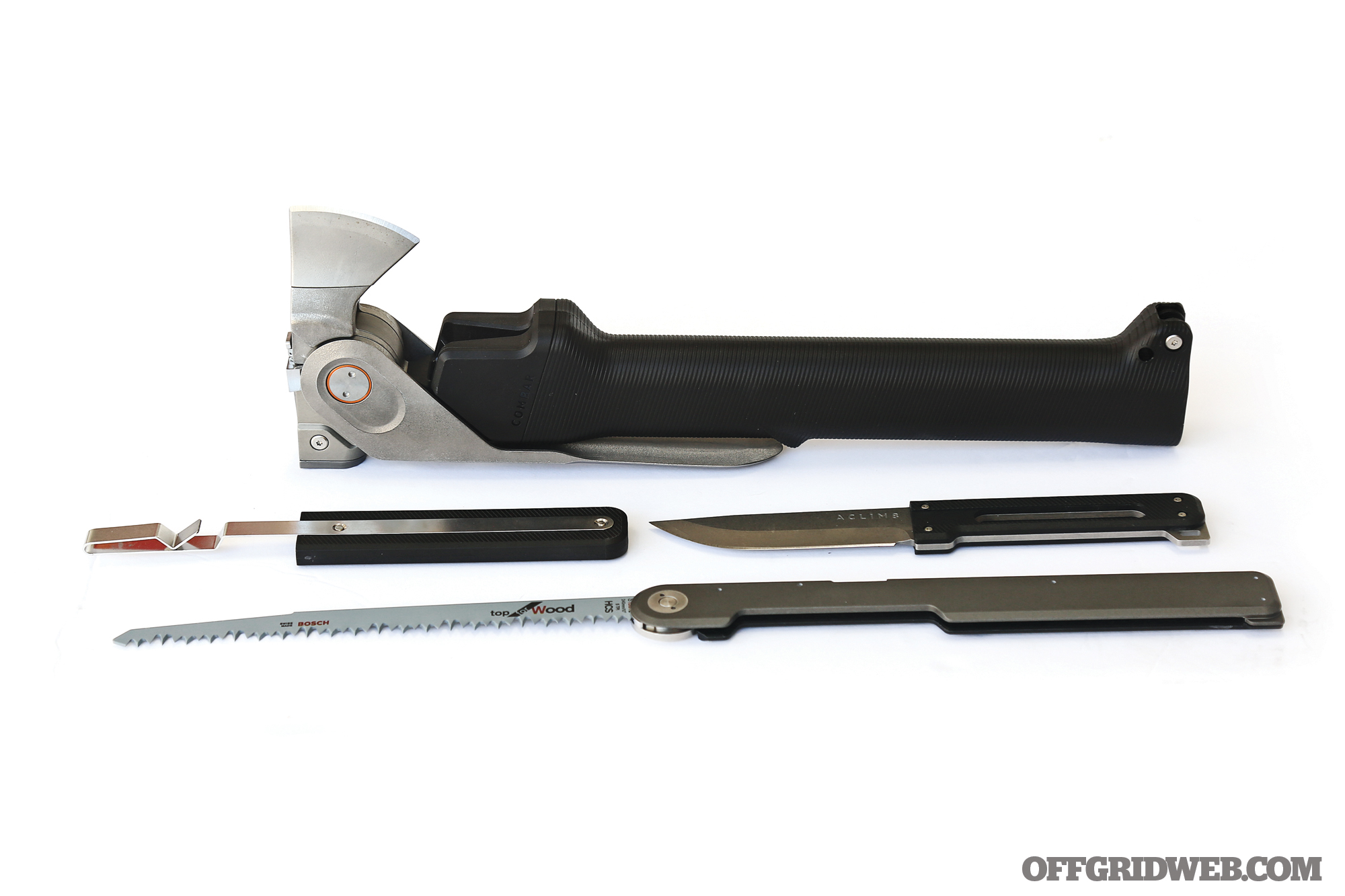
Notes The COMBAR combines an ax, saw, knife, spade, and hammer — all housed in a single grip that’s roughly the size and weight of a pipe wrench. While the hammer is always at the ready, the ax and spade are easy to deploy — just lift the safety lever and rotate whichever tool you need. The knife and saw, however, are stored inside the hollow handle and require a few more steps to get to. A basic version without the latter two tools runs for $425. If you’re on a budget, both the basic and this Pro version shown here will be cost prohibitive. Still, if you have the dough, it’s an innovative multi-tool worth considering. Created by two former Israeli special operations officers, the COMBAR is meant to withstand tough conditions — whether you’re a soldier, survivalist, or outdoor adventurer. A holster ($45) and an overbuilt soft case ($95) are available for it, both sold separately.
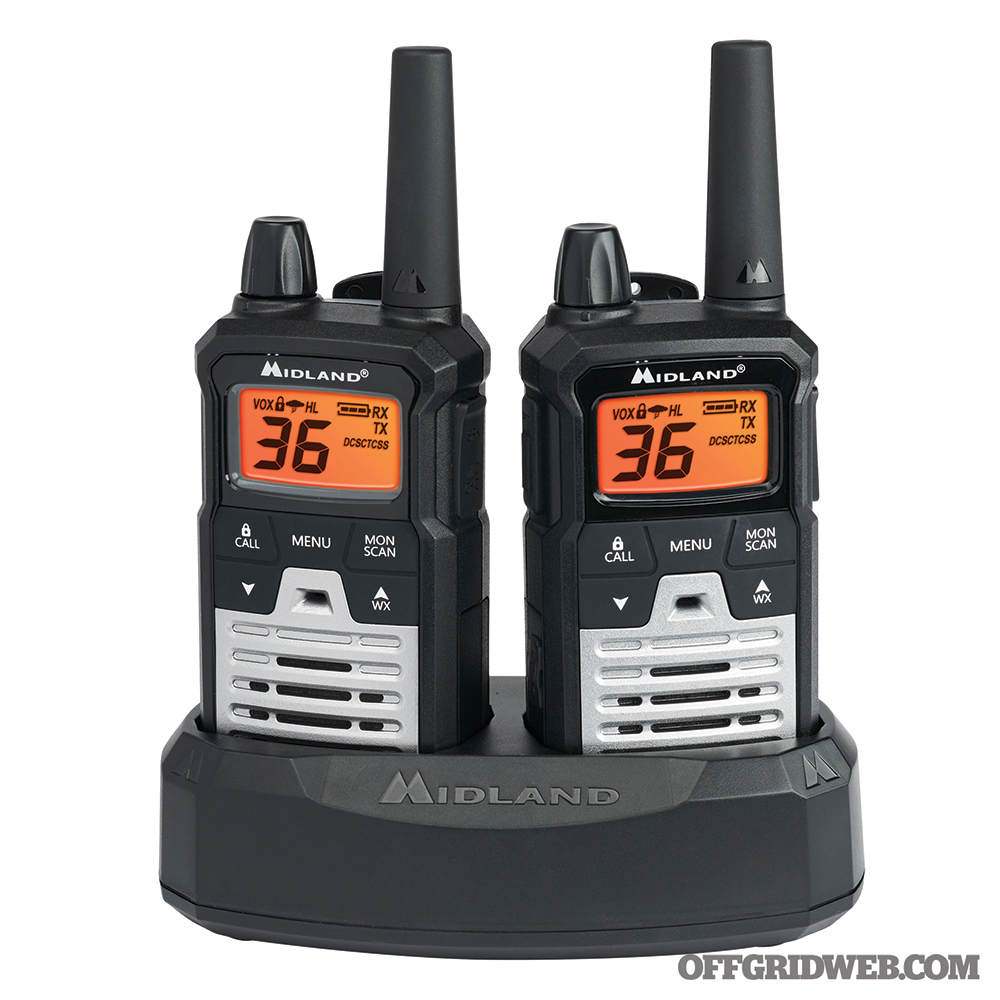
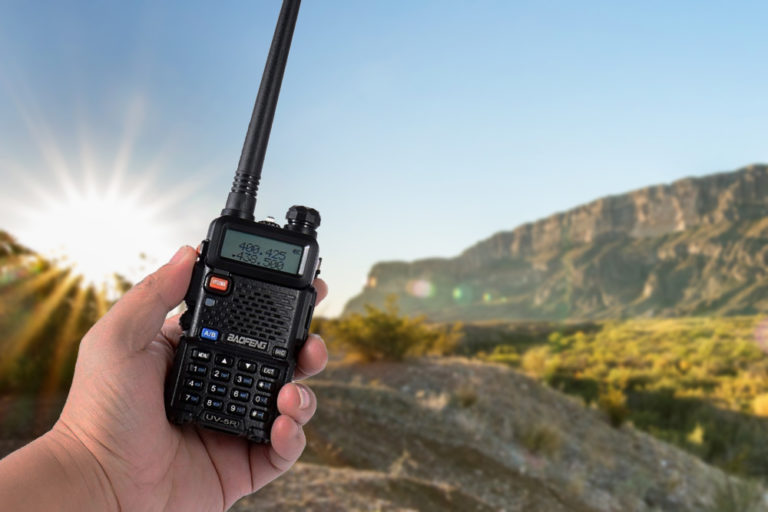
Notes In some survival scenarios, communication is life. Whether you need to find a lost member of your party or you need to signal that danger’s approaching basecamp, a pair of two-way radios can be key. The X-Talker T290VP4 is a GMRS radio that has Midland’s trademark Weather Scan + Alert Technology — which cycles through 10 available weather band channels and locks onto the one with the stronger signal — alerting you of severe conditions in your area. It features 22 channels, 14 extra privacy code channels, 121 privacy codes, and a range of up to 40 miles. This set comes with two radios, belt clips, a pair of headsets, and rechargeable batteries. Unfortunately, it’s not USB compatible, but it does come with a desktop charger.
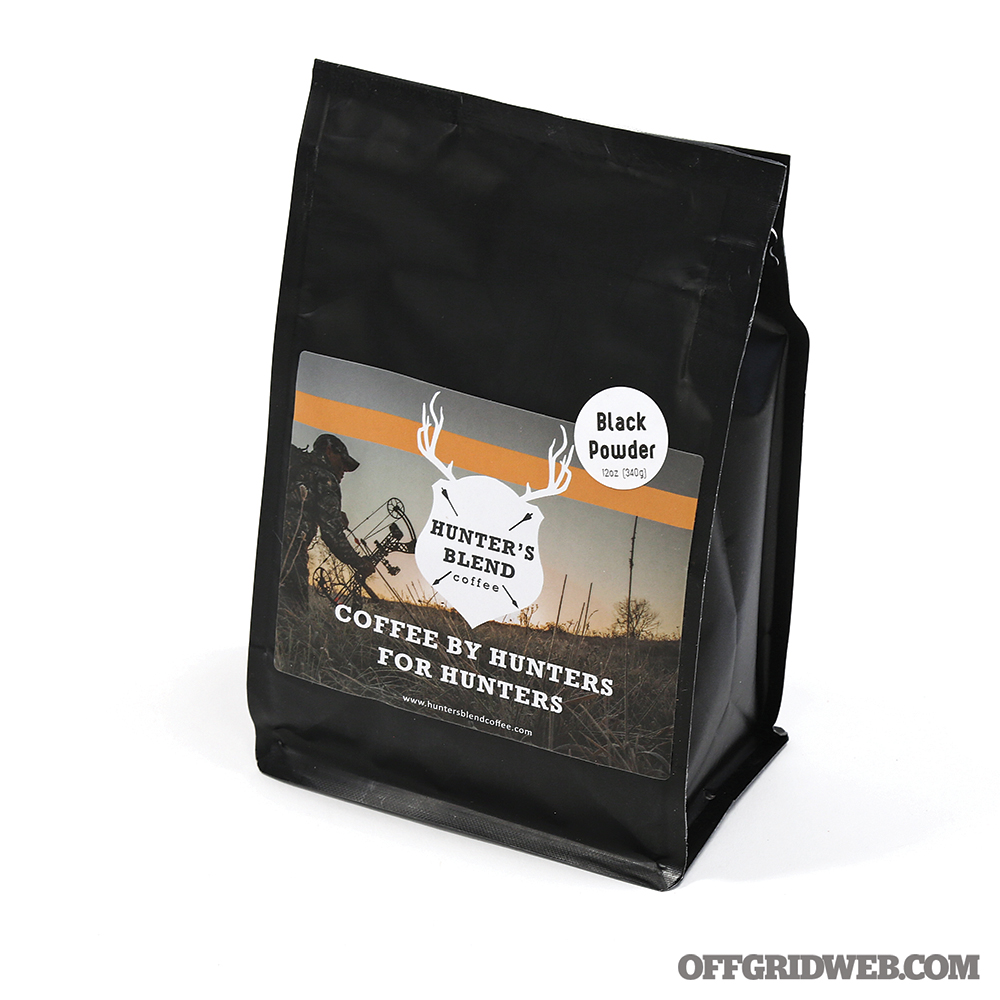
Notes For many, coffee is life. For those who don’t get it, don’t worry. Just stock up on coffee anyway, because in a post-apocalyptic scenario, it’ll become a valuable commodity that you can use to trade for food, supplies, or your drink of choice. Until then, enjoy the Black Powder Roast from Hunter’s Blend Coffee. This mix of beans from Central America and east Asia will help fire up your morning, bringing that invigorating aroma and caffeine without the burnt taste that many other dark roasts have. Hunter’s Blend ethically acquires its beans via direct trade — cutting out the middle men and lobbyists who might not support the hunting and Second Amendment lifestyle — then has them roasted in small batches in Ohio.
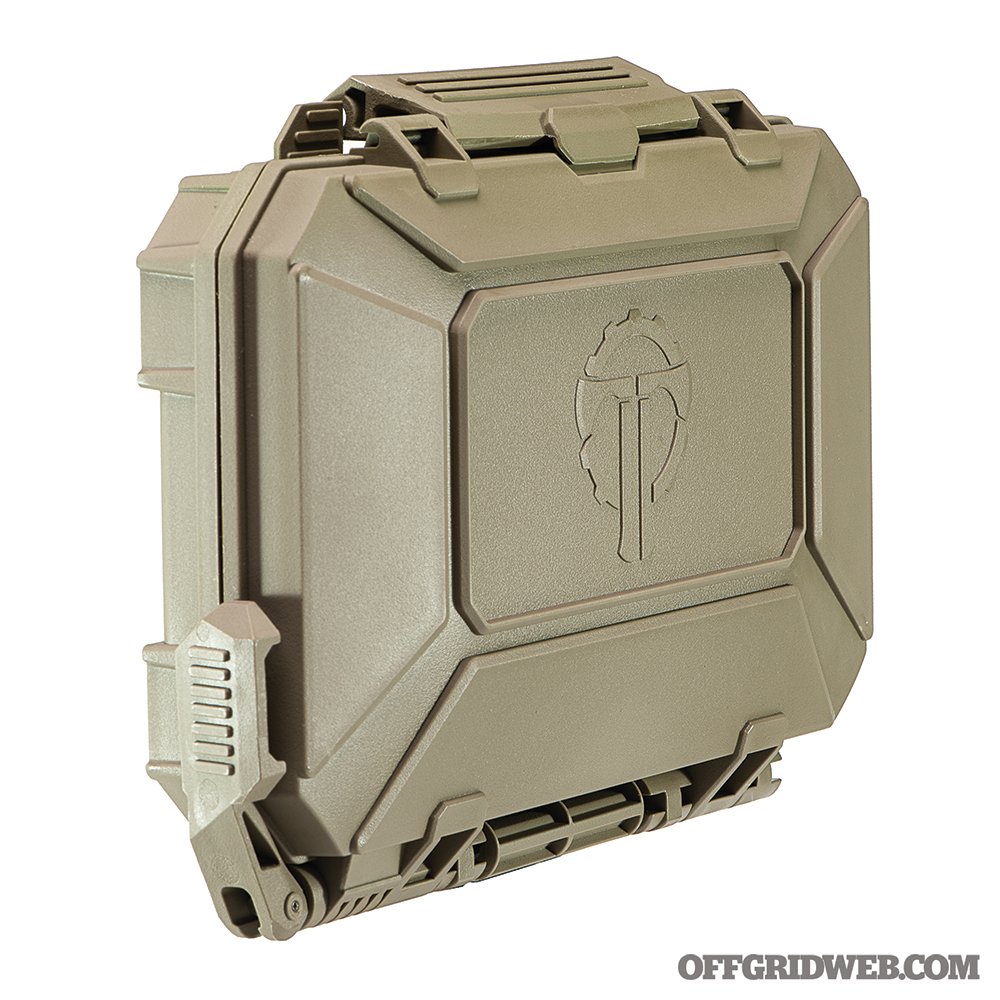
Notes The DarkVault was created with active-duty military and federal law enforcement in mind as a means to keep communication devices immediately accessible, thoroughly protected, and yet undetectable by blocking radio frequency signals. Sure, it’s not a true Faraday cage, which would require the case to be extremely large or quite metallic. But Thyrm says it’s been tested to block normal cellphone calls and data, as well as GPS signals, meeting the requirements of its government customers. Each case is made of battlefield-grade polymer with a gasket seal to keep out dirt, dust, and moisture. It also has a lockable latch, interior and external Velcro panels, and a quick-detach system that’s MOLLE compatible. The DarkVault Comms, the non-blocking version, is available for $60. Both made in the USA.
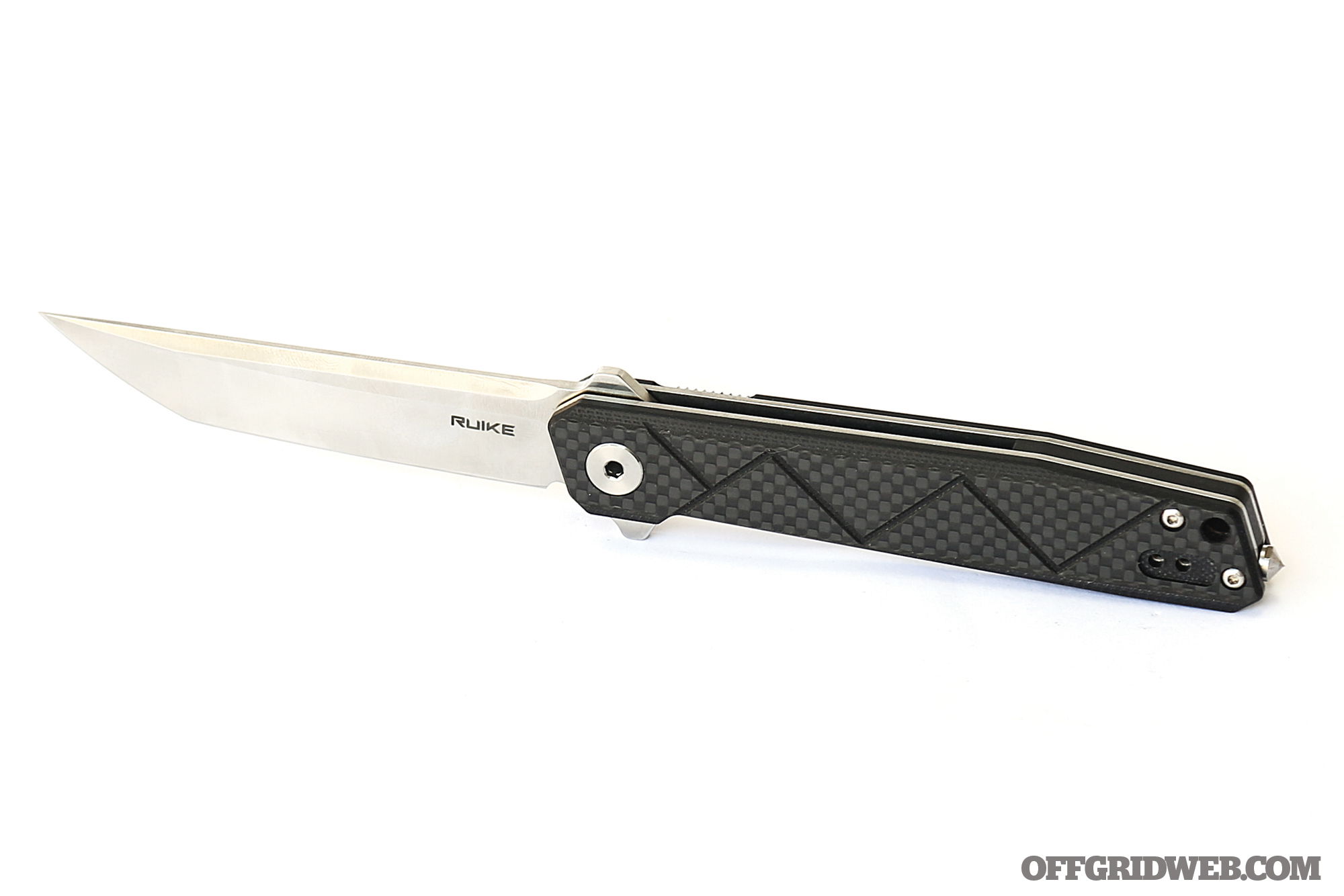
Notes The P127-CB is a kwaiken-style folding knife with the business end made of 14C28N, a Swedish stainless steel that offers toughness, long-lasting sharpness, and strong corrosion resistance. We also like that the tanto profile is more functional and less angular than many popular tanto blades. It opens quickly and smoothly thanks to the high-carbon chromium ball bearings and has Ruike’s Thumb Up Safety Lock (similar to CRKT’s locking liner safety), which can lock the blade closed if you don’t want it to accidentally open or lock it open if you want to make it a virtual fixed blade. The slim handle has G10 scales with a carbon-fiber overlay and a tungsten glass-breaker on the end for emergency rescues or improvised pummeling. A model with only G10 scales is available for $50.
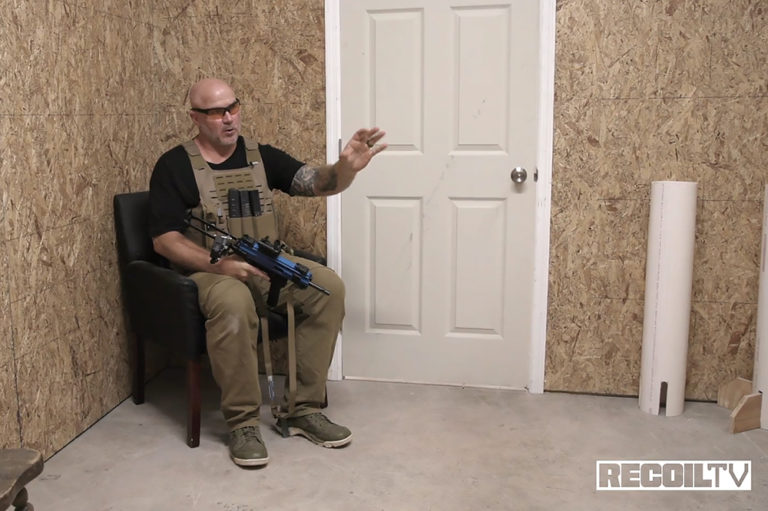
You awake in the middle of the night to the sound of breaking glass and footsteps in your house. You know that you may be facing a home intruder, or possibly even multiple intruders. As you slip out of bed and grab your gun from the nightstand, your wife looks to you for instruction. What do you say? Obviously, it’s a good idea to have her call the police immediately, but what else should she do to maximize her safety while you clear the house? This scenario is the subject of the most recent RECOILtv Training Tune Ups video with Dan Brokos.
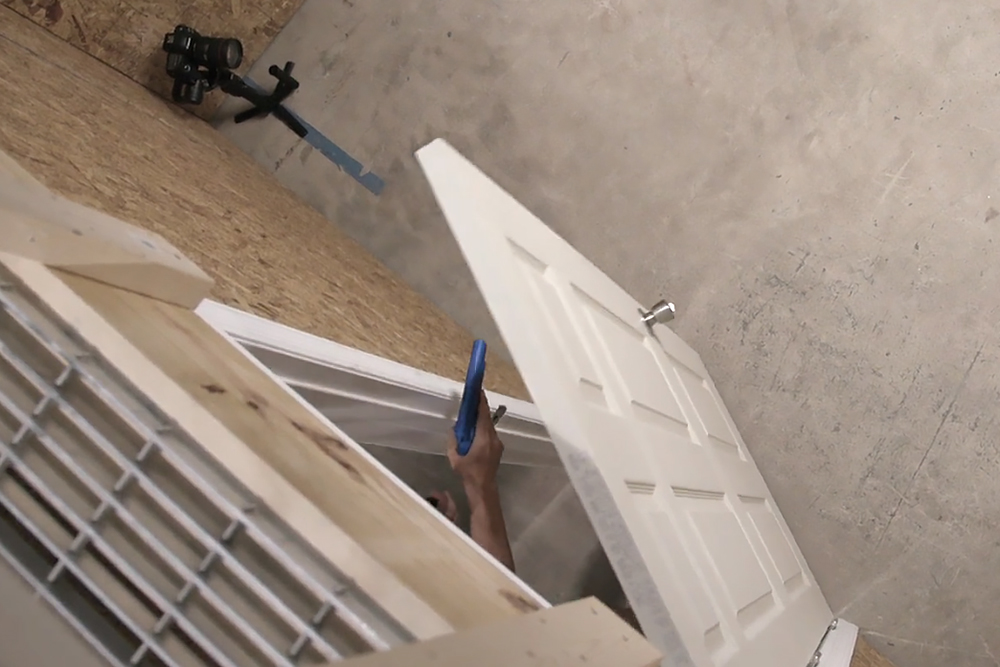
A typical untrained intruder will enter the door as it opens, creating a blind spot you can exploit.
Remaining in a defensible static position seems easy enough — just find some cover or concealment in the room, and keep a gun at the ready in the direction of the door. However, some parts of the room are preferable for this tactic, which Brokos calls strong-pointing. Specifically, most homes have push doors that swing into the room. This means that the intruder, who probably won’t be trained in CQB tactics, is likely to enter the room without checking this blind spot first.
Again, all of this may sound obvious to you, but it’s worth communicating this information to family members ahead of time. This will ensure they’re prepared for a home intruder situation, rather than looking to you for instructions. This advice is also useful for kids — they can be taught to hide on the inside of the door hinge until the all-clear is given. If they’re old enough to be armed and defend themselves from that position, that’s even better.
For more of Dan Brokos’ tips for home defense and CQB tactics, check out the RECOILtv Training Tune Ups channel.
I recently had the opportunity to take an Intro to Emergency Communications class from Independence Training here in Arizona. This class, taught by guest instructor Ted Harden, served as an excellent overview of some of the core concepts of emergency comms, specifically the use of handheld radios to stay in touch via FRS, GMRS, MURS, and HAM bands in off-grid settings. I’ll be writing a full review and summarizing lessons learned in the future, but for now I’d like to discuss a communication-oriented survival scenario that came up during our time in the classroom.
A Real-Life Survival Story
While discussing the various capabilities of HAM radio, Harden mentioned a surprising real-life event in which some stranded individuals used their radio to call for help in a creative way. Depending on your level of experience with amateur radio, you may or may not know that it’s possible to use low-orbit amateur satellites (AMSAT) as repeaters to extend the reach of the signal from your own radio. This means that if you find yourself in a dire situation and need to call for help, and there’s no cell service or terrestrial repeaters in range, a last-ditch option would be to call for help via one of these amateur satellites. In fact, that’s exactly what a father and son did on August 27th, 2019, in Texas’ Big Bend National Park.
(Photo: Flickr.com/joncutrer | CC BY 2.0)
Clayton and his father Jack were off-roading in a remote section of Big Bend National park, when their vehicle reportedly became stuck up to the axles in deep mud created by recent monsoons. They were unable to get the vehicle out of the mud on their own, and there was no cell signal available. Stranded in the intense summer heat, they knew they needed help from Park Rangers, so they began to consider how to use their HAM radio to call for help. Clayton was aware of the AMSAT system, and determined that one such satellite (AO-92) would be passing over their position. This gave him an extremely brief window to call for help as the satellite’s orbit intersected their location.
After connecting with AO-92, Clayton broadcasted his call for rescue, including his latitude and longitude, vehicle description, and status. The call got through to a man named Kevin in Florida, who took down the information and worked with other listeners to relay it to the Big Bend National Park Ranger station. Within two hours, Park Rangers arrived on scene and helped Clayton and Jack get their vehicle un-stuck. They made it to safety as a result of this call through the AMSAT network.
This article from AMSAT.org contains links to audio recordings of this event — check them out if you’re interested in hearing it firsthand.
What Would You Do?
This account speaks to the impressive capabilities of HAM radio in an emergency scenario, and serves as a reminder of why a handheld and/or vehicle-mounted radio (and the training to use it properly) should be part of your survival plan. However, it also led us to wonder about what might’ve happened if these men hadn’t been so prepared to reach the AMSAT network, and so fortunate to be within range of a satellite that day.
If you have emergency communications gear, but aren’t in range of a viable cell tower or HAM repeater, would you leave your position to attempt to establish a better signal? Or would you stay put in a known safe location and broadcast calls for help, not knowing if anyone can hear you? This is the question we pose in today’s edition of Survival Scenarios, in order to get you thinking about how you’d deal with this hypothetical dilemma in real life. As always, we’ll end this article with a poll where you can respond with the course of action you think is best, and see how other readers responded.
Background Info
Big Bend National Park is beautiful and vast. (Photo: Flickr.com/madhushesharam | CC BY 2.0)
For the purposes of this scenario, your circumstances are similar to those of the real-life example above. You were out off-roading with your dad in the desert, when your truck unexpectedly got bogged down in mud. You attempted to self-rescue by rocking the truck back and forth, digging out the tires, and filling in the ruts with improvised wood ramps in hopes of regaining traction, but to no avail. It’s hopelessly stuck, and you need someone to pull you out.
At this point, it’s late morning, and the summer temperature is already a sweltering 105°F. It may get as hot as 115°F in the afternoon. You’ve got plenty of water, some protein bars, and a pack full of survival tools, first aid gear, and spare clothes in the truck. There’s also plenty of fuel to keep it idling, and the A/C will keep you cool while you’re inside the cab. However, you’d rather not camp out here until someone happens to pass by — that might take days based on the remoteness of your location.
(Photo: Flickr.com/guyandheather | CC BY 2.0)
You and your dad both have fully-charged cell phones, but both have shown zero signal all morning. You’re way out of range of any cell towers. However, your phones still provide your current GPS coordinates, which will be helpful if you can convey them to rescuers. Your only other long-range communication option is a single Baofeng UV-5R handheld radio with a standard antenna. You programmed it with the most common bands: FRS, GMRS, MURS, and all the local HAM repeaters you could find. During your drive out, you could hear some chatter on the repeaters, but that was a while ago. Now, it’s an eerie silence. And, unlike the Big Bend National Park incident, you’re not fortunate enough to be in range of an amateur satellite.
Knowing that your radio is reliant on clear line of sight to maximize range, you realize that finding some high ground is probably your best bet to get in touch with someone on the radio. There’s a large, rocky hill on the horizon, but it appears to be at least 2 miles away, and won’t be an easy hike in this heat.
You’re presented with a choice — do you stay in the comfort of the air-conditioned truck and attempt to call for help from there, unsure if anyone will hear you? Or do you set out on foot with the radio, climb the hill in the scorching heat, and attempt to improve your signal?
Staying Put
You probably know that most search and rescue personnel advise lost or stranded individuals to stay put, because this makes them easier to find and reduces the risk of getting even more lost or injured. However, when no one knows that you’re in trouble and you can’t call for help, that complicates things. In this case, help probably won’t be coming anytime soon unless you can get in touch with someone.
Remaining with the truck provides the obvious advantage of comfort and safety. You’ll be able to stay cool in the cab, and have easy access to all the survival gear you brought. You can also stick together with your dad, ensuring one of you won’t get lost or separated.
Towering rock formations around the valley impede your radio’s signal. (Photo: Flickr.com/jaygannett | CC BY-SA 2.0)
The main downside to staying with the truck is that reaching anyone will be a roll of the dice. The truck is in a wide valley between large rock formations, which isn’t helping your signal strength. You can transmit distress calls on each of the programmed bands, but if you’re not in range of another radio or repeater, those messages will fall on deaf ears. Maybe you’ll get lucky and someone who can assist will hear you — maybe you won’t be so lucky.
Searching for Signal
The other option is to take your radio handset and embark on the several-mile hike to elevated ground, climb the rocks, and attempt to reach someone from there. It’s more likely that you’ll get through to someone this way, but it’s certainly not a guarantee. If you go this route, your dad can stay in the truck, but he will have no way of calling for help (or even communicating with you) since you have only one radio.
Exposure is the biggest downside to this plan. It’s extremely hot and getting hotter, and you’ll be traveling on foot over rocky terrain. If you slip and get injured during the climb or end up with heat exhaustion while you’re out on your own, the situation will get significantly more dangerous. But if all goes well, you might be able to scan for a signal, contact someone, and get rescued within a few hours.
Splitting up is always risky, especially in extreme heat, but the alternative might mean no one even knows you’re in trouble until a day or more have passed.
The Decision
(Photo: Flickr.com/pdenker | CC BY 2.0)
So, how would you approach this hypothetical twist on a real-life survival scenario? Let us know in the poll below.
As always, the purpose of our Survival Scenarios feature is to get you thinking about how you’d face these difficult circumstances in real life, as well as how you could avoid facing this problem in the first place. There should be a few immediate lessons learned here, which mirror some of those we learned from Harden’s class with Independence Training:
Get the most capable radio and antenna you can afford. Better yet, get several. Having two radios in this scenario would let you stay in touch with your dad, and could also double your chances of reaching rescuers. A high-quality whip antenna, a rolled-up backpacking antenna hung from a tree, or a high-powered vehicle base station radio would extend the range of your comms so you might not have to hunt for a signal.
Train with your radio in common locations and activities. If you had done this, you would’ve known about signal conditions on the trail before you ended up stuck and in danger. You also would’ve known some nearby areas where you could find a reliable signal, rather than embarking on a desperate search in the heat of the moment (literally).
Learn options for relaying emergency information and practice them regularly. This might mean carefully studying maps of nearby HAM repeaters, learning how to locate and communicate with AMSAT, or memorizing the 9-Line format for efficiently explaining the details of an emergency to rescue personnel.
Any time you’re heading into a remote area, tell friends or family where you’re going and when you’ll be back. Inform them about how to call for help on your behalf if you go missing.
Keep an eye out for more lessons learned from the emergency communications class in a future issue of our magazine.
Notes: ESS is a subsidiary of Oakley and focuses specifically on eyewear. Their Influx Cold Weather Goggles are geared toward tactical use. We felt they were a great value and never fogged up on us. Shooters will be happy to know they meet U.S. Mil-spec MIL-PRF-32432, ANSI Z87.1-2015, OSHA and CE EN166 ballistic protection standards. They come with three 3mm polycarbonate lens choices, which we found easy to remove and switch out. The headband has a sliding sleeve on it to keep the lens protected when not in use, and it also comes with a carrying case that has Velcro attachments to hook it onto your belt or backpack. The fleece-lined face foam was comfortable and did a great job wicking away moisture. Although we appreciated how form fitting they were, anyone wearing corrective lenses might have to switch to contacts, as the goggles might be too narrow to wear with most eyeglasses. Made in the USA.
Pros:
Comes with clear, smoke gray, and alpenglow (amber) lenses
Notes: The Line Miner from Oakley provided impressive forward and peripheral vision with wide, high lenses. They meet the ANSI Z87.1 and EN 166 standards for goggle impact protection, but are intended more for outdoor activity than military “ballistic” standards. These goggles were wide enough to accommodate corrective lenses, and we never had an issue with fogging or moisture evaporation. According to the manufacturer, the injection-molded Plutonite lenses provide 100-percent protection against UVA/UVB/UVC and harmful blue light up to 400nm. Other lens options are sold separately, though changing them out is a little tricky till you get the hang of it. Lens thickness is 2.34mm. Made in China.
Pros:
Numerous goggle and lens color combos
“Asian Fit” sizes available
Shape is compatible with most helmets
Cons:
Headband not removable
No carrying case; microbag only provides minimal protection
Notes: You definitely feel like you’re getting a lot of value for this parka. It’s machine washable and the Velcro wrist closures, elasticized cuffs, drawstrings on the waist and hood, and zipper/button front closure ensure that cold had a hard time getting through. With all the extra storage, fasteners for the openings, and full-bodied lining, you certainly know you’re wearing a jacket intended for harsh weather — in other words, it’s not light. We loved the abundance of large pockets with Velcro or zippered closures. Even though we’re fairly sure firearms weren’t a consideration in the design, a pass-through on one of the external pockets would enable the wearer to retrieve something of the concealed persuasion much more discretely. The parka had an expected low waist to it. Combined with the Cordura/nylon material, it held up very well in winter weather. Made in Bangladesh.
Notes: The Powder Search 2.0 Insulated Pants also provide quite a bit of value for a comparatively low cost with features absent on other brands we tested. The pants were very comfortable and the polyester/nylon materials worked well to insulate for warmth. Their StormRepel Super DWR finish repelled rainwater effectively and the elasticized ankles on the lining performed well to keep snow from creeping into footwear. Although these pants don’t have zippers along the legs to be donned quickly, they do have an elasticized waist with Velcro cinch straps to adjust to your liking. The addition of belt loops and a D-ring attachment were nice touches. Two zippered hip pockets, along with two Velcro flap-closure thigh pockets, allow for plenty of storage. Made in Vietnam.
Notes: Although this parka can definitely hold its own keeping you warm, it doesn’t feel heavy or cumbersome. The Gore-Tex material is light but robust enough to repel the elements. Its design is simple and practical for winter sports and extended outdoor activity. It ‘s stylish enough for urban wear and could even pass for a raincoat since the waist is higher than most parkas. The hood can be removed via snap-button attachments if desired and pulled snug with drawstrings if you’re getting hit hard by the wind. Two external hand pockets and one internal pocket with zippered closures are sufficient for a decent amount of storage. The sleeves were fairly snug with internal cuffs, but we were surprised there aren’t any drawstrings to make the waist a bit tighter. Made in China.
Pros:
Practical for a variety of uses
Feels much lighter than it looks
Arc’teryx branding visibility is subtle, unlike some companies that add huge logos everywhere
Cons:
Price is quite a bit higher than many of its competitors
Notes: When it comes to cold-weather clothing, the LEAF line from Arc’teryx is well known for its quality. The level of thermal protection against both wind and direct contact with snow you’ll get from the Gore-Tex material and Climashield lining is top notch. These pants are surprisingly comfortable and maneuverable for how well-insulated they are. Unless cold-weather work and exposure is a regular occurrence for you, the price might be discouraging. Although the pants are high-waisted, the integrated belt doesn’t really allow for the attachment of any accessories you might like to carry. We’d have to liked to see these in other colors than the two offered, but we really can’t complain about the fit and finish, and have confidence these will hold up to the elements for a long time. Made in Canada.
Pros:
Drawstrings on pantleg bottoms are a plus when walking through deep snow
Can be easily layered over other clothing and removed quickly with the full-length zippers on each leg
Plenty of sizes to choose from
Cons:
Only two pockets
Beltloops would’ve been a plus in case you’d like to carry more equipment
Notes: This snow-camo suit is intended to be worn in conjunction with the L5 Thermal Trousers and Anorak for adaptability to environmental changes. They basically have the same zippered vent locations as the L5 combo, and the entire suit is very lightweight. According to the manufacturer, an old trick is to use snow-camo trousers with the “frozen” pattern jacket to mimic the snow on the ground as well as the winter foliage. While the system is very modular, not everyone needs camo, so your color options are confined to those patterns. We’d have liked a pass-through sleeve on the front of the anorak for storage or as a handwarmer. The quality is robust since it’s intended for law enforcement and military, but lack of storage may be an issue for hunters or others who desire this type of clothing. Bottoms have loops for M1950-style suspenders; Varusteleka carries such options. Anorak has drawstrings on hood and waist with Velcro wrist closures, but unfortunately not on the trousers. Made in Estonia.
Pros:
Easily to put on and take off over other clothing
Surprisingly good insulation for how thin it is
Takes up minimal space if packed for impromptu use
Cons:
Elasticized waist, but no drawstrings or belt loops
Notes: The Särmä TST L3 jacket and pants are thin enough to be worn as midlayers, but warm enough to be worn as outer layers. Both items are exceptionally priced for the quality you get. We’d have liked to see more than one pocket on the jacket (and any pockets at all on the pants), but appreciated the drawstrings on the collar and waist. Both are lightweight, breathable, and made from 100-percent polyamide with Climashield insulation. Pants can be removed easily with full-length zippers on each leg, but we were surprised that no drawstrings are on the waist or ankle. Jacket has elasticized wrists. Both items are warrantied for 12 months and worked well to repel cold and wind. Made in Estonia.
Pros:
Great value
12-month warranty
Lots of size options
Cons:
Color options are limited to larger jackets; only one color on pants
Notes: If you’re looking for camouflage winter clothing options, Varusteleka’s TST line is both a highly affordable and practical option. The “frozen” pattern is intended to mimic winter foliage patterns before snowfall. The fit was exceptional, and both items were comfortable in all the right areas, while keeping us well protected from the elements. Material is 100% PA ripstop, with shin, knee, butt, and waist areas reinforced with 500D Cordura. Abundance of sizes would work for practically anyone. Elasticized ankles on trousers, wrists, and waist on the anorak kept snow from creeping in. Since these are more for tactical use, our main complaint was lack of pockets. The zippered vents on the anorak worked well to access your inner layers, although we wondered why the zippers didn’t run the full length of the pantleg. Also, the buckled crotch strap on the anorak was an interesting way to keep your top from riding up if you’re crawling or prone for long periods of time, but might take some getting used to. Made in Estonia.
Pros:
Price is exceptional for the quality
Fleece-lined hood large enough to accommodate a helmet
Thick enough to repel elements without being bulky
Cons:
Only two pockets on trousers; none on pull-over anorak
Notes: Varusteleka is a military and outdoor company from Finland, so we knew they spoke fluent cold-weather clothing. They sent us an assortment of baselayers, and we were pleased with how the items performed. They were thin enough to be worn in with other baselayers if desired. The 80/20 merino wool/polyester combo kept us sufficiently warm and were very comfortable. They’re machine washable, but air-drying is recommended. The zippered turtleneck shirt is practical even as an outer layer in the right environment. Gloves repelled cold and moisture penetration very well. Balaclava can be worn as a cap, tube scarf, or full facemask. Made in Lithuania.
Pros:
Cheaper than many American brands using the same material combinations
12-month warranty
Material is very form-fitting
Cons:
Crotch opening would be nice
Only item with color options is the balaclava
Eddie Bauer Heavyweight FreeDry Merino Hybrid Baselayer Pants
Notes: Merino wool is definitely the way to go on baselayers. The Heavyweight FreeDry Merino Hybrid Baselayer Pants fit snugly without being constricting or itchy. They made of 50-percent merino wool/50-percent polyester, so these bottoms can be machine washed and dried delicately. Breathability, heat retention, and moisture wicking worked well, and we were pleasantly surprised to find these bottoms longer in the legs than expected. We did, however, wish there was crotch opening, since sometimes nature calls when you’re actually out in nature. Made in China.
Pros:
Very light and comfortable
Legs stayed snug and didn’t ride up the calf after hours of use
Notes: Even when walking through knee-deep snow, we were pleased how well these boots kept it from creeping inside and getting our feet soaking wet. The Gore-Tex and leather provided great insulation from the elements, heat retention, and were comfortable to wear. We’d have wished for a bit more padding in the very front, as we got a bit of toe-slam walking downhill. The aggressive traction was great on snow, especially going uphill, but was a bit dodgy at times on ice. All in all, we felt they were a good investment that could be worn in a variety of muddy, slushy, and snowy environments to keep your feet protected. Made in Slovakia.
Pros:
Larger sizes available
Three neutral color options
Cons:
Padding could be improved in toe area
Consider wearing crampons with these if you’re walking on ice
Every year, we hear about cold-weather-related fatalities that could’ve easily been avoided with the right training and supplies. As winter is upon us once again, we felt it prudent to raise awareness of situations that commonly lead to injuries or worse during the cold months, as well as some myths that are continually perpetuated about cold-weather survival. With a résumé that includes instructing Marines at the Mountain Warfare Training Center, we tapped survival instructor Thomas Coyne, whom we profiled in RECOIL OFFGRID Issue 27, for tips to keep you safe this winter. In addition, we asked director of training for Sierra Element and former Marine scout sniper Victor Lopez to provide recommendations on best practices for firearms use in cold weather.
RECOIL OFFGRID: A quinzhee is one of the best shelters you can make using snow. For those unfamiliar with how to build one, what are the steps involved?
Thomas Coyne: All you do is pile snow, preferably the freshest snow, into a dome shape big enough to leave 18-inch walls all around you and dig out a living space for you to lay down or sit up in. You can make them fairly large for a whole group of people or just one person. After you pile the snow, pack it down with your feet or a shovel to compact it enough to solidify, and let it sit for at least 30 minutes. It’s good if it’s in the sun to help it fuse together a bit. Then you can dig out a living space at the base that’s big enough to lay down in that’s in the shape you want. Before you dig out the opening, in order to make sure you don’t go too shallow, break off a bunch of sticks that are at least 18 inches long and jam them into the top all around and all the way to the top. That way you know if you hit the stick not to go any farther. If you’re building one for yourself, as long as it’s big enough for you to lay down in that’s a good rule of thumb for how wide and high you need to make it.
Above: Thomas Coyne teaching a cold-weather survival class in Alaska.
What do you think some of the most common misconceptions are about cold-weather survival?
TC: One thing people never talk about is hydration in the cold. People talk about how you shouldn’t drink cold water, but you need to stay as hydrated as you can in extreme cold — it’s just as important as hydrating in extreme heat. Blood regulates body temperature. When you’re too hot, it takes the heat from your organs; your blood vessels dilate and radiate that heat off the surface of the skin. When you’re too cold, it constricts on the surface of the skin and to the extremities like your ears, nose, and fingers, which is why your hands get cold first. The body restricts blood flow to those areas when you’re cold and focuses it on the internal organs so you don’t get hypothermia. If you’re dehydrated at all, you’re going to get colder faster and have much less blood on the surface of your skin, so you’ll be much more prone to frostbite. Pre-hydrate for a few days before you go on any cold-weather expeditions as if you’re going on a hot-weather expedition.
The quickest way to absorb water is if it’s at room temperature and an isotonic solution, which is 0.9-percent salt. Your body works on what’s called the sodium-potassium-electrolyte pump. We don’t run out of potassium the way we do salt, because we don’t sweat it out like salt. Salt opens the door to the cell to let water in, so if your drink is too salty it pulls water out of the cell. If it’s just salty enough it lets it into the cell. An isotonic solution matches the salinity of our body’s cells naturally so you can hydrate the quickest and safest. When you get an IV of saline, that’s what they’re giving you.
Caffeine dehydrates you, and it’s a vasodilator, so it affects your blood pressure. When you’re really red-lining, like when I was a firefighter and working on the fire line, it’s not a good idea to have caffeine. What we’d do is after we drank 2 liters of water, our third liter would always have an electrolyte replacement in it. That’s so we don’t become hyponatremic. If the salt level in your body gets too low, that’s called hyponatremia and it can kill you. That means your body can’t absorb water anymore. You’ll drink a liter of water, and urinate it right out. If you’re hyponatremic and drink water without salt, you’re hurting yourself. Avoid caffeine and alcohol. There’s that old belief that drinking alcohol makes you warmer, but that’s because it makes the blood vessels on the surface of your skin dilate and is radiating away heat.
What should people know about cold-weather clothing?
TC: A lot of people don’t know how to dress for the cold. There’s a proper three-layer clothing system that all your military, cold-weather mountaineers, arctic expedition, and pipeline guys are wearing. There’s your performance baselayer; that’s your thermal underwear, which should be tight-fitting against the body. These items should also be rapid drying and insulate when wet. It’s not just about warming you, but for active and extreme cold, it needs to serve as a sweat management system.
When you’re more active, you build up sweat; being sweaty in extreme cold can cause you to freeze to death. When you have material that insulates when wet, no matter how sweaty you get, as long as it’s up against your body as an insulation layer, your body heat will keep it warm. It needs to be rapid drying because once you stop sweating and sit down, you want it to dry well even though it’s underneath the other layers. That’s why you should only use certain materials like wool and polypropylene. Those two have the best warmth-to-weight ratio, insulate when wet, and dry rapidly. We call cotton the death fabric. We don’t use it in the cold because it loses all insulation capabilities when wet and dries very slow.
The next layer is your insulation layer; it keeps you warm but isn’t skin tight. It’s not really the clothing that keeps you warm, it’s your body heat and your clothing should trap that. When you have an insulation layer, it should be a little loose to give you a little room for your body heat and trap that around you. If you’re in cold and wet weather, again, you want something that insulates when wet and dries rapidly, like fleece. If you’re in weather where it’s below freezing 24 hours a day where you’re not going to get wet, down is a great material because it’s very light. Down has a tendency to absorb a lot of water, it doesn’t insulate, and will never dry in the field, so that’s why we don’t wear it when it’s both cold and wet.
Your third layer should be a waterproof, breathable layer. You want that to be an outer shell. The colder it is, the more breathable it has to be. If you’re going below zero you need a highly breathable jacket. What people don’t realize about breathability in the cold is that in extreme cold your jacket will begin to condensate if it’s not breathable enough. For instance, if you just wear a rubber rain slicker, it condensates inside. If the material isn’t breathable enough, it’ll get soaking wet inside.
For footwear, avoid cotton socks. In extreme cold weather, your boot should have a removable insulator. If you’re hiking all day and build up a lot of sweat, you want to take that out to give it time to dry. You want a three-layer system for your feet as well. You have the sock, which is your performance baselayer, the boot insulator, and then the boot itself so you can manage the moisture in your boot. Trench foot indications are like when you sit in the bath too long and your skin gets wrinkly. When you keep grinding on that layer of wet skin over and over again, it just comes off. When you’re post-holing through 2- to 3-foot snow without proper footwear, your feet will get soaking wet and frostbite or trench foot is likely to set in.
What tools do you think are over and underrated for cold weather?
TC: One thing that many survival guys will disagree with me about are fire steels. They’re just a bushcraft play tool and a poor option for emergency circumstances. If you’re injured, hypothermic, or have a little frostbite, it’s easier to light a match when you’re having trouble feeling your hands than to spark a fire using a steel. A match you can strike and just toss it into the fuel. With a steel, you have to prepare the fuel a particular way and shave it up into little bits. If you’re using something natural, it won’t work on anything moist at all. You generally have to use both hands and be very precise with your sparks. Any thermal emergency attacks the brain and makes it hard to think. You don’t want to carve down shavings of bark in that condition. You get ataxia, which is a loss of coordination, so they’re not good when you’re hypothermic, cold, and wet.
Matches are easier to use and light more materials. The primary fire-starting material should be a proper storm match. It can burn in the water, in mud, and in crazy winds, so it’s very hard to put out. You should also have an accelerant like solid fuel cubes. There are lots of brands out there for like 50 cents a piece. They’ll burn for over 10 minutes at over 1,000 degrees. Forget the cotton balls and Vaseline. In cold weather, it’s likely going to be wet as well, so all the small stuff that might light easily like pine needles, bark, and grass are all affected by the moisture so they’re going to be hard to light. You need a good flame length and a very hot flame. All the cubes like WetFire, Duraflame, Weber, and Fast Fire will give you at least a 4- to 6-inch flame length. Just throw your match on the cube and warm your hands up to get them working again, then light your second cube to get your fire going. You can get emergency heat from just the cube. The No. 1 reason we’d have to rescue people off trails is because they fell and hurt their leg, so if you’re injured you want it to be as easy as possible.
A catalytic heater and 24-hour hot packs are great for vehicles. Every winter you read articles about people who took a wrong turn down a road or ended up stuck in the snow somehow. They end up freezing to death in their vehicles because they run out of gas, and the car is useless. Catalytic heaters are like little propane heaters. You can use little $5 propane tanks, but it can be used indoors — since it’s catalytic it uses platinum in the device to purify the emissions. Some will run on a tank for eight hours on low, but you can also make a tank last for like three nights if you just run it for a half hour to stay warm as needed. If you need to build a quinzhee, you can pop some hot packs and put them in your clothing or wrap them in your e-blanket to stay warm.
What should people know about using electronics in cold weather, particularly stuff powered by lithium-ion batteries?
TC: Cold weather zaps the batteries a lot quicker, so you have to protect your devices from the cold, which is another thing you can use hot packs for. Also, if I’m bringing a water filter, you’ve got to make sure they don’t freeze overnight, so you can pop a hot pack and put it in the compartment with those materials. For whatever mustn’t freeze, you need to have some kind of insulation. You’re going to have to charge more and bring more batteries since the cold drains it faster.
What are some medical conditions cold weather causes that don’t get enough attention?
TC: Snow-blindness is one. If you get a stuck in a snowy area without the right eye protection, you can go snow-blind in less than one day. In addition to goggles, they make emergency snow glasses. Many of them are rolled up in little containers like the Survival Metrics i-Shield. They’re one-size-fits-all. You can make improvised versions from birch bark or a piece of cardboard. You can cut thin slits in it just big enough to see out of. They have to stick out at least ½ inch off your face and have to cover the sides and bottom to keep light from getting in, so you have to fold it a bit to look a little like Geordi from Star Trek.
What should people know about getting lost in snowy weather in a vehicle?
TC: Stay with the vehicle, because it’s easier to spot than you are. One mistake is when people stay with the vehicle when it’s very cold and succumb to falling asleep. That’ll easily lead to becoming hypothermic and dying. I call it the Freddy Krueger rule of cold-weather survival. If you’re experiencing symptoms of hypothermia, you have to stay awake. Try and do some kind of physical activity in place. Tense your muscles as hard as you can and do little isometric exercises and whatever you can to stay awake and warm.
If you can clear away any branches or foliage so the sun can get to your car easier, do it. The sunlight will create that greenhouse effect in your vehicle and help warm it. You can turn your car into a quinzhee too, but you need to have a ventilation hole and a way to mark the outside so people can see there’s a car under there if it’s continuing to snow. Try to make a signal. A really good tip I learned is to use Kool-Aid packets because they’re very bright colors and you can use them to spell out SOS — and it’s a lot cheaper than dye.
What are some of the biggest considerations to keep in mind when using firearms in cold weather?
Above: Magpul Core Quick Reference Rifle Cards are good reference materials to have on hand when shooting in extreme weather.
Victor Lopez: Clothing can affect the way you present the weapon, jackets and gloves in particular. You should practice with the equipment you’re going to be wearing prior to going out. A lot of people think it’s cool to wear gloves when they go out, but like on a Glock, it has that extra safety on the trigger. A lot of times I see people who never really trained with it and go on training evolutions in mountainous areas where they have gloves on and can’t find that nub on the trigger.
If you’re using gloves, make sure they have good dexterity in the fingers; train with your gloves before you go out so you can have that tactile feel on the trigger and use them to try reloads as well. With jackets, try them on and present the draw — see how it’ll feel when prone and any other positions you anticipate being in. Sometimes with shoulder-fired weapons, materials like certain fleeces will feel different than just wearing a cotton shirt and can actually slip easier.
For changing temperatures, I’ve seen guys go from cold weather training and then put the gun in their sleeping bag, where it collects condensation. Overnight, you can see rust start to form on some weapons because of the body heat trapped in a sleeping bag. You want to keep it close to the ambient temperature. Keep snow out. If it gets in there, it’s going to cause rust. Barrel caps are fine, but putting plastic on will collect condensation when it warms up with the sun, like when you put a plastic tarp out to collect moisture in a survival situation; it’s the same type of principle.
What are some myths you hear getting perpetuated about using firearms in cold weather?
VL: A myth I hear is if you’re above freezing that it’ll completely shift your zero on something like a bolt gun. Another I hear is that the trigger won’t freeze up. I have seen, when it’s truly cold, swelling of the bolts in rifles, and you can feel it get sluggish so it will respond differently than in warm weather. I’ve also heard people say you don’t need that much lubrication on your guns because it’s cold so it’s not evaporating. In altitude it can still be cold and dry, so your lubrication is still dissipating.
For lubricants, I’ve seen guys use paste type stuff. Avoid grease and paste lubrications. Just go with a CLP or oil-based lubricant. When you return home, always make sure you completely dry and lubricate your weapon before you store it.
The air is less dense in altitude and cold weather. Temperature, air pressure, and humidity affect your impacts; increased muzzle velocity results in higher impacts on your targets. Magpul has some cheat sheets with the computations to keep in mind. Devices like a Kestrel can also provide info for your weather data.