Whether you’re aware of it or not, everyone is looking at your watch. The name “watch” literally means, “to look at.” With all that attention, you might as well make your wrist look great. But a great watch doesn’t need to cost a lot—function is more important than form. Here are some great watches that will have everyone asking you for the time, and then where you bought your watch.
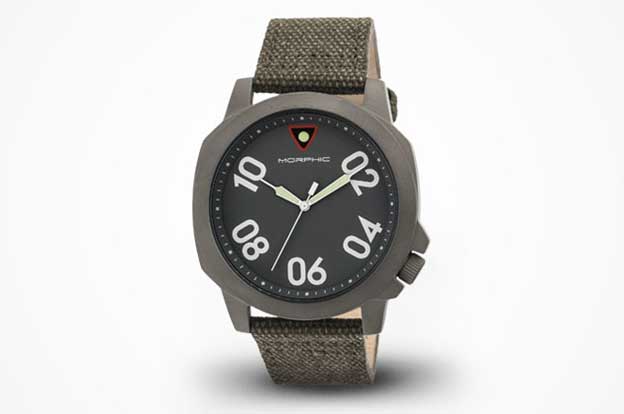
The watch has been a staple of humankind for centuries, and the Morphic M41 Watch is a conventional beauty. But looks can be deceiving. In addition to its orthodox design, it also boasts a non-glare scratch-proof face and gunmetal surface casing for added stamina.
If you’re the type of person whose idea of vacation is an extreme trek uphill, then you’re probably looking for a Morphic M33 Men’s Watch. Featuring a non-glare scratch resistant mineral crystal face, stainless steel casing and 5ATM water resistance, this timekeeper is a thrill worth seeking out.
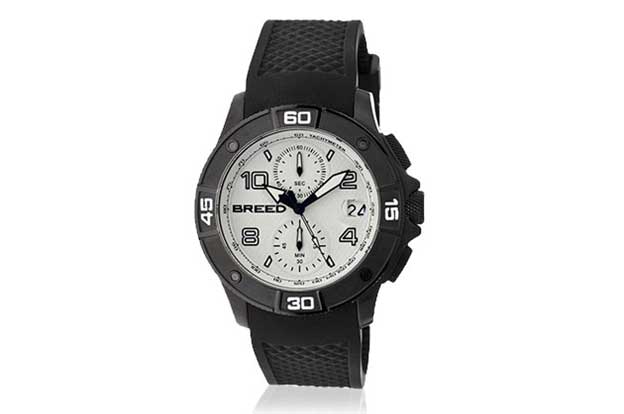
The Breed Raylan Men’s Watch is your all-in-one ace, replete with a chronograph, tachymeter, and magnified date display. And with a 316L stainless steel case and silicone strap, this watch will last you a long time. It’s both stylish and practical—equally great for work and play.
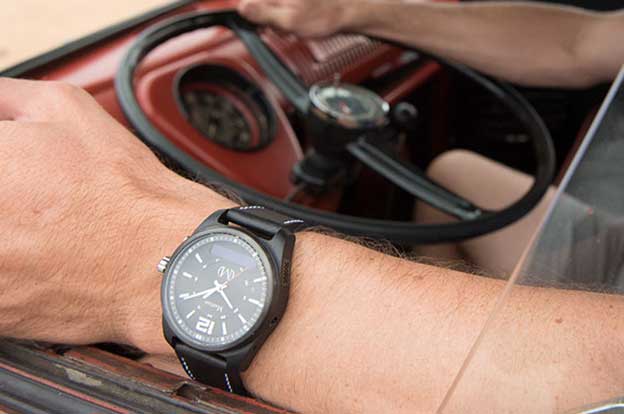
Caught between your love for classical watches and your desire to stick with the technological times? Then the Martian mVoice Smartwatch is perfect. This analog watch possesses push notification capability and voice command so you can send and read messages, set alerts, navigate, and more with your voice. It even takes photos, making it a great blend of past and future.
Many of the big name smartwatches are expensive, but the Ticwatch 2 Active Smartwatch is a simple solution to a costly problem. Not only does it have the applications you need—heart rate monitor, calling/texting, built-in GPS—but it’s both powerful and easy to use. It also charges wirelessly and is compatible with iOS and Android.
The Ruger 10/22 is an excellent survival tool, and one that’s at home in almost any prepper’s arsenal. It’s lightweight, accurate, reliable, and perfect for hunting small game as a source of calories. Adding modifications can make the 10/22 an even better weapon for these purposes, as shown in our guide, Giving the Ruger 10/22 Takedown a Survival Makeover.
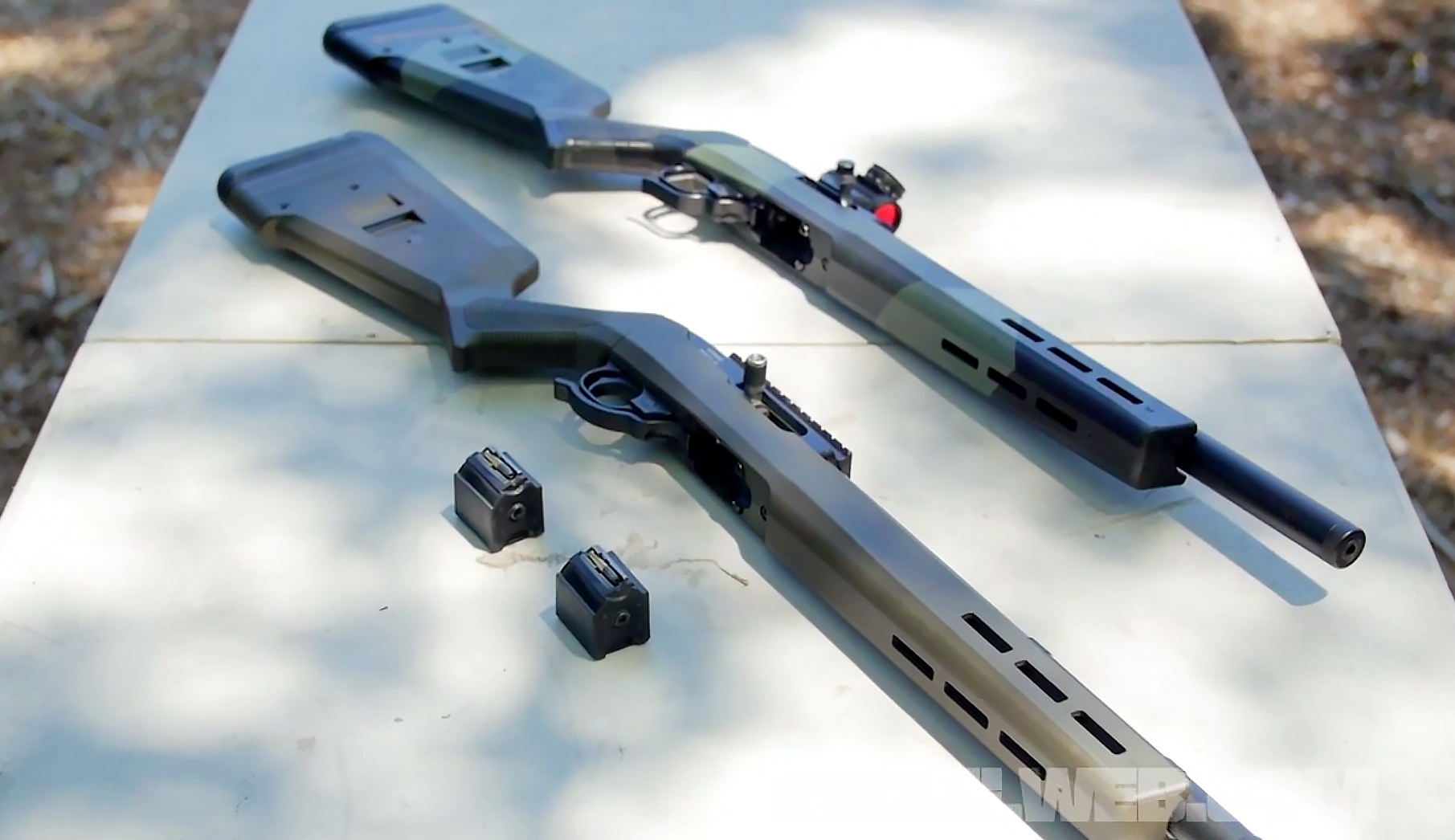
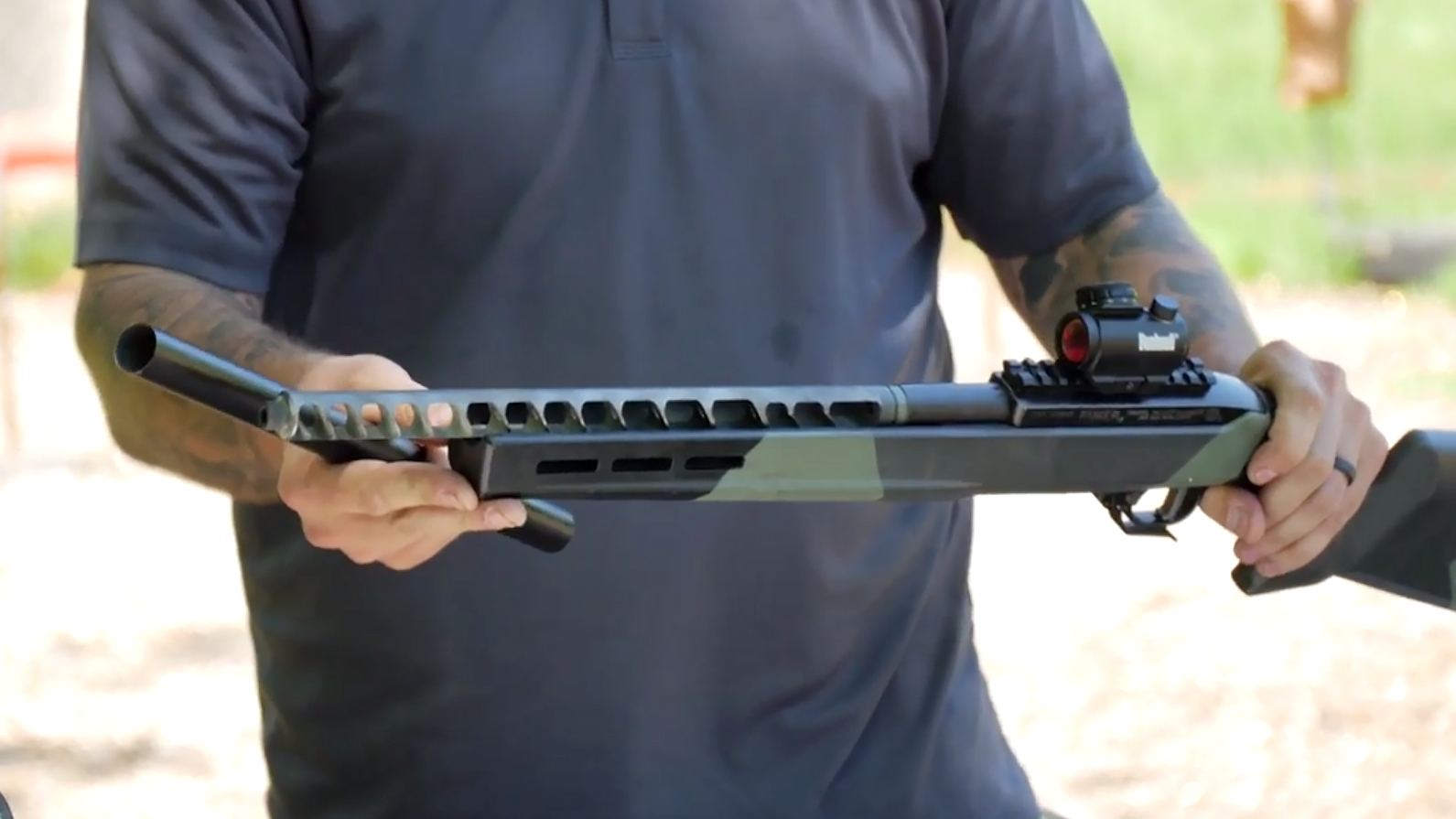
A detachable suppressor can dramatically reduce the noise produced by your 10/22, but an integrally-suppressed barrel makes an even bigger difference. This setup uses baffles along the full length of the barrel to reduce decibel level and keep rounds subsonic, eliminating the distinct snap of a bullet as it breaks the sound barrier.
KG Made suppressors has developed an integrally-suppressed drop-in barrel for the 10/22, tested in the video below by RECOILtv’s Iain Harrison. However, the KG Made crew didn’t stop their modifications there — they took the rifle one step further with a custom full-auto conversion.
This full-auto integrally-suppressed 10/22 can pump out about 1800 rounds per minute. That means the gun can theoretically empty a 10-round magazine in about 1/3 of a second. This full-auto feature might not be entirely useful for survival purposes, since you’d burn through all your ammo reserves, but it certainly looks like a lot of fun.
For more Full-Auto Fridays and other firearm-related content, be sure to follow RECOILtv.
As we go about our daily lives, we tend to assume those we encounter will be reasonably civil towards us. For example, it would be laughable to expect the barista at your local coffee shop to jump over the counter and start pummeling you if you don’t provide a sufficient tip. While we’re not always greeted politely by everyone we meet, society functions on a certain baseline level of human decency.
Merciless violent criminals are not a new phenomenon. Case in point: the Thuggee gangs discussed in the link below.
Unfortunately, there are a few individuals who are willing to completely disregard these unspoken rules for personal gain. As prepared individuals, we need to be always watching for these outliers, and be ready to swiftly defend against them.
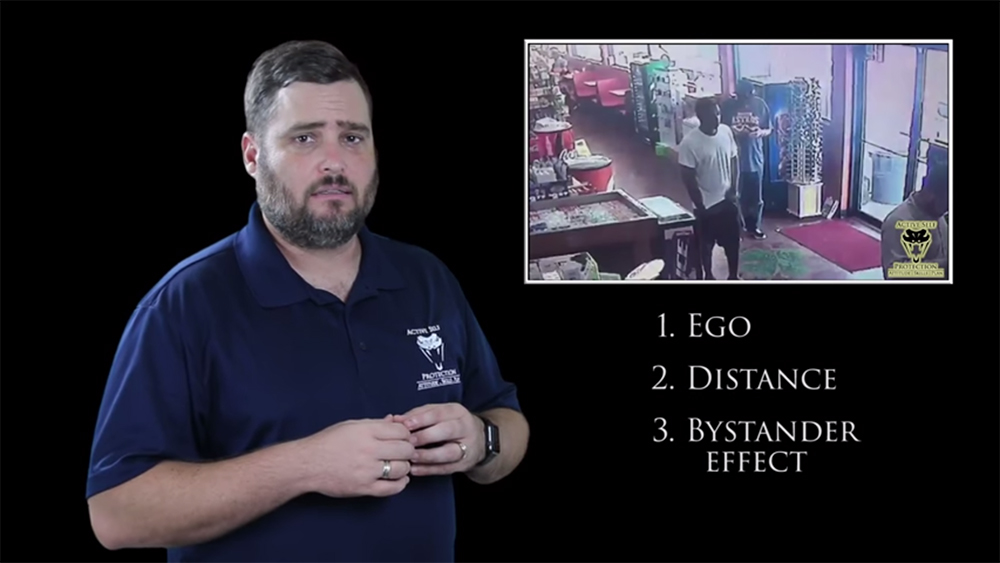
John Correia of Active Self Protection analyzes violent encounters to teach self-defense.
In the video below from Active Self Protection, John Correia discusses a CCTV recording that shows a brutal and merciless mugging inside a convenience store. The perpetrator doesn’t have a second thought about viciously beating his victim for having the gall to fight back, and the results are difficult to watch. However, there are some valuable lessons to be learned from this man’s misfortune.
As John mentions, situational awareness is key. Any time you’re in public, you should be watching and listening to your surroundings. By absent-mindedly looking through your wallet or using your phone, you expose your valuables and give criminals an opening to strike.
It’s hard to adapt to your environment without situational awareness. Put your phone away. Pay attention.
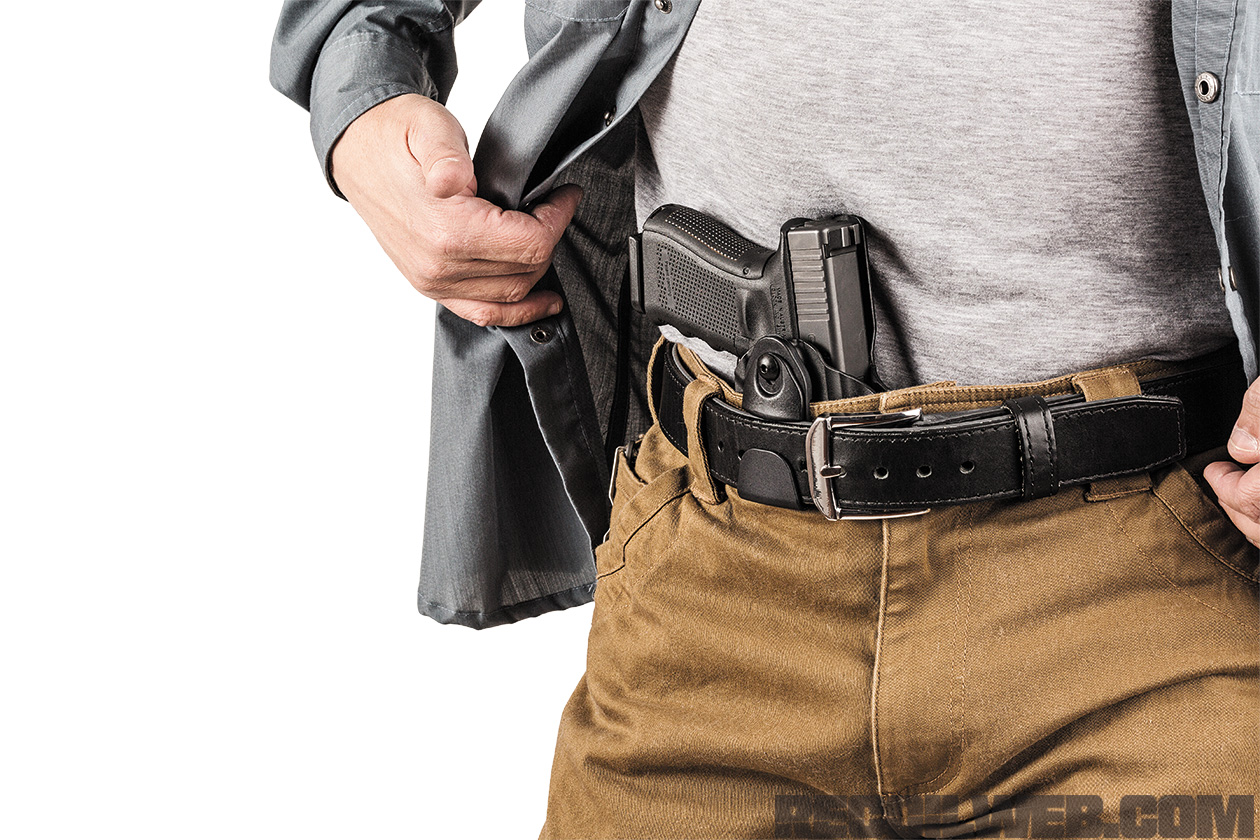
If situational awareness isn’t sufficient to avoid the mugging or attack, you need to immediately go into an active state of self-defense. If you can escape the situation or at least put distance between yourself and your attacker, this should be your top priority. Otherwise, rely on your self-defense training to deflect the attacks and quickly counter-attack. Being prepared with a weapon — such as a firearm, knife, or other force-multiplier — can greatly increase your chances of survival.
Most importantly, as John mentions in the video, you must be prepared to deal with an attacker who will show no mercy, and bystanders who will be frozen in fear. In these cases, deadly force against the attacker may be the only way to end the threat.
In a world where millions go to the supermarket to get their meat, it’s funny how many people have no concept of the work that goes into producing that perfectly wrapped and presented protein product. We can’t count the amount of times we’ve talked with people who eat meat, but somehow find it distasteful that others spend their fall and winter hunting to fill their freezers.
With more and more people looking for organic and free-range animals to incorporate into their diet, what would happen if they couldn’t just go to the store? For some, hunting an animal and processing it from start to finish is a way of life, whereas for others who never learned the sequence of tasks necessary to prepare an animal without contaminating the meat, their “Eww! Blood and guts!” reaction could cost them their lives in dire circumstances. It’s not all macabre gore.
Field dressing an animal is a practice that’s been handed down for centuries and a critical part of preparing what you’ve hunted for consumption. If you can filet a fish, you can field dress a four-legged animal.
The hardest part of the hunt begins when the animal hits the ground. The process of gutting and butchering can be daunting for the uninitiated. If you find yourself alone and miles away from civilization, that process can become even harder. But, like any task, it comes down to using the proper methods to get the job done. With practice you’ll eventually realize it’s not as gruesome as many people think. We’ll focus on larger game animals such as elk, deer, or moose. The approach, steps, and care to be taken are the same for all animals of the same body type.
Tool Up
Everyone has their go-to knife or knives for the job. As with many other aspects of preparation, knife selection isn’t a one-size-fits-all. Dressing requirements may change from when you’re butchering in a controlled environment versus in the field. Over the last year we’ve found two blades that have remained in our packs through many rotations. The replaceable scalpel-style knives have been the rage in recent years — a newcomer, Wiebe Knives, stood out.
The company’s Vixen model has a larger handle, allowing for better control and less fatigue in cold and bloody conditions, especially if you have larger hands. While the fine scalpel-style blade works in most scenarios, we still prefer a small fixed knife with a roughly 3-inch blade, because it offers greater control inside the animal — specifically when reaching in to cut the esophagus.
For a butchering and skinning blade, the author uses a simple, semi-flexible boning knife when working at home. They’re cheap and durable enough to pop joints and scrape bones. We’ve used the Frosts/Mora knives for the better part of 10 years; their rubberized handles are nonslip, and their blades hold an edge very well. Remember to sharpen your knives after each use or replace blades on models with that feature. A dull knife is more dangerous than a sharp one. When you have to force your knife to do the work and it doesn’t cut with ease, accidents happen.
And if you’re alone in the middle of the woods with a severe laceration, you might not make it to dinner.
Gut Check
Out of all the processes involved, eviscerating or gutting the animal is the task that can be the most overwhelming. But anyone can make quick work of this task when done correctly. If you plan to completely butcher the animal in the field because it’s too far or too difficult to haul it back to camp, hold off on gutting it. There are better methods of butchering in that situation, which we’ll discuss later.
However, if you plan to leave it overnight (assuming the temperature is fairly low), gutting the animal and putting edible organs on ice is recommended.
For the sake of clarity, we’ll explain things assuming the animal is on the ground rather than hung from a gambrel.
Position the animal on a slight decline, head uphill. With the animal on its back, prop the rear legs apart. If you’re working alone with a large animal like an elk, it’s easier to tie the legs to neighboring trees to assist in keeping the animal stationary and legs separated.
Using a basic scalpel-style field-dressing knife, make an incision a couple inches above the anus and cut a larger circle around it. The idea is just to free a larger circle of fur around the anus from the rest of the hide. Do not cut it free from the intestine. Leave this patch of fur connected and simply separate it from the remaining fur, as we can use this later to remove the entrails. Then, make a shallow cut around the middle of the abdomen just deep enough to penetrate the flesh without going too far into the membrane below it that protects the stomach and other organs. It doesn’t take much effort to slice through the flesh, so take your time. Orient the knife with the blade facing upward — don’t force it. Let the knife do the work and gently cut into the skin, which (depending on the animal) usually isn’t more than an inch deep. You can work two fingers of your free hand into the initial cut to help pull the fur away from the carcass as you continue cutting upward toward the bottom of the sternum where the cut should end. You can then lengthen this opening by cutting back the other way toward the genitals to create one big continuous incision.
(Note: Depending on your state, proof of sex may need to be left on the animal for transportation, so check your local regulations.)
Now you’ll have complete access to the lower body cavity. Reach up into the rib cage to cut the diaphragm, a thin membrane separating the lungs, liver, and heart from the digestive organs. Then reach past and cut the esophagus, which may be hard to see — when you reach in toward the throat it feels like a bony, round tube. When both hands are out of sight and inside the body cavity, pay close attention so that you don’t cut toward your other hand. Go slowly and avoid lacerating yourself on any bone shards which may be displaced by a bullet.
With most of the organs free, work to pull the lower intestine back through the pelvis, making sure not to break the bladder. With just these few cuts, all of the organs should slide out fairly easily in one group.
You should also be able to pull the initial incision you made around the anus through the open chest cavity.
Another key note: You may see some examples of field dressing where the incision is made all the way up through the rib cage, opening the entire chest cavity. However, the less you cut, the less chance of dirt, leaves, and debris entering the cavity when dragging the animal or transporting it to a vehicle. This is another reason not to split the pelvis to remove the lower intestine and anus.
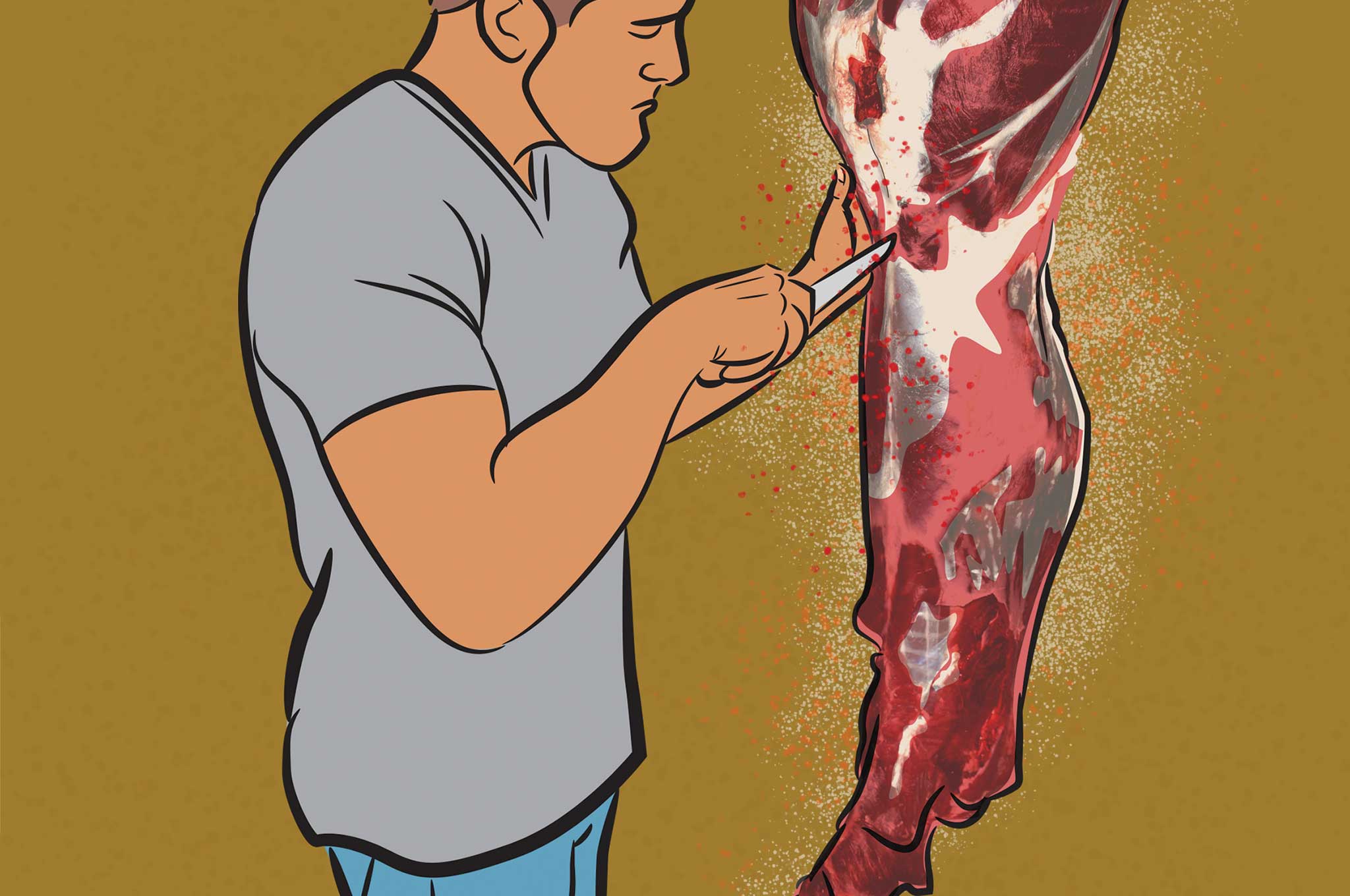
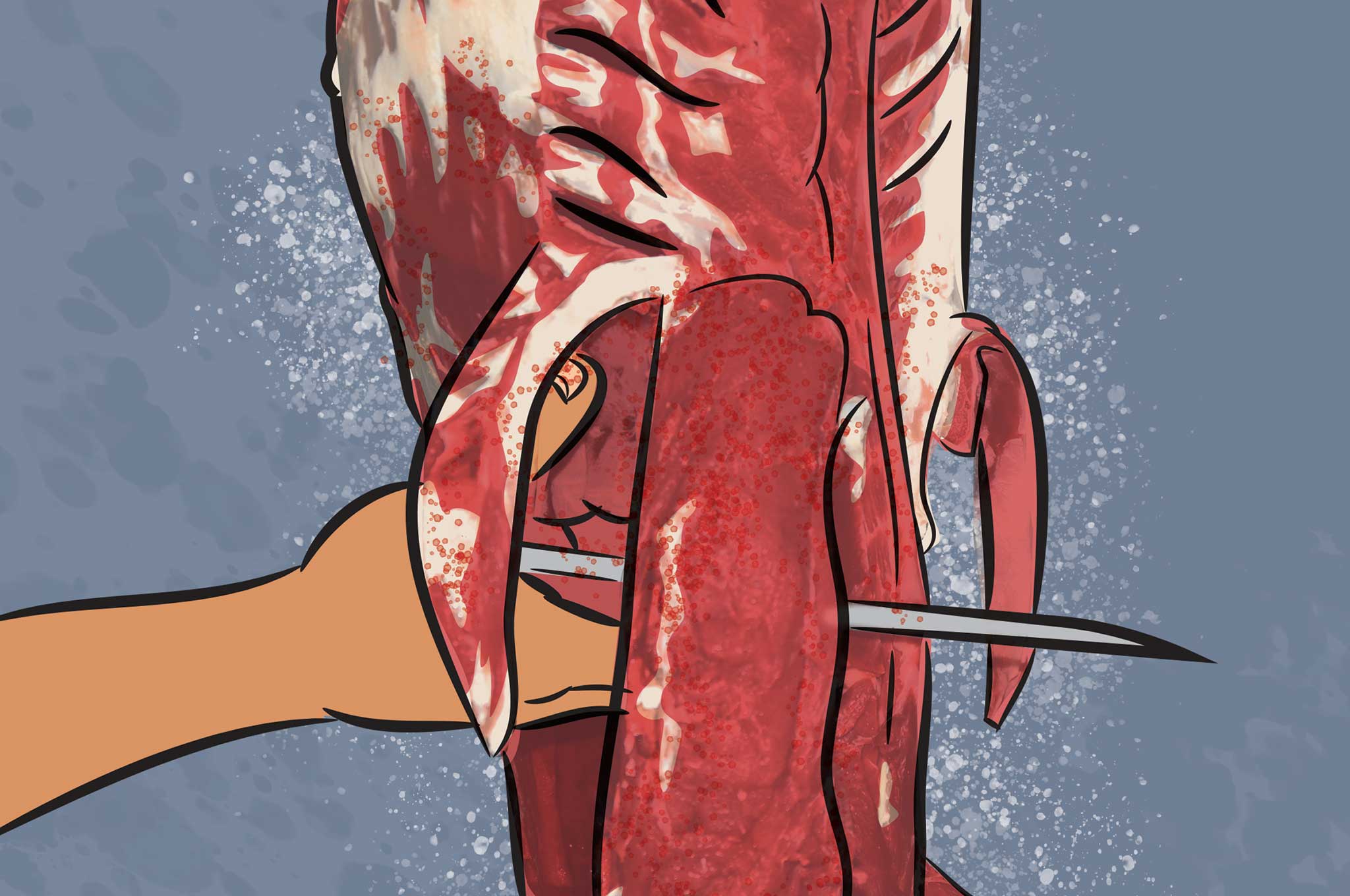
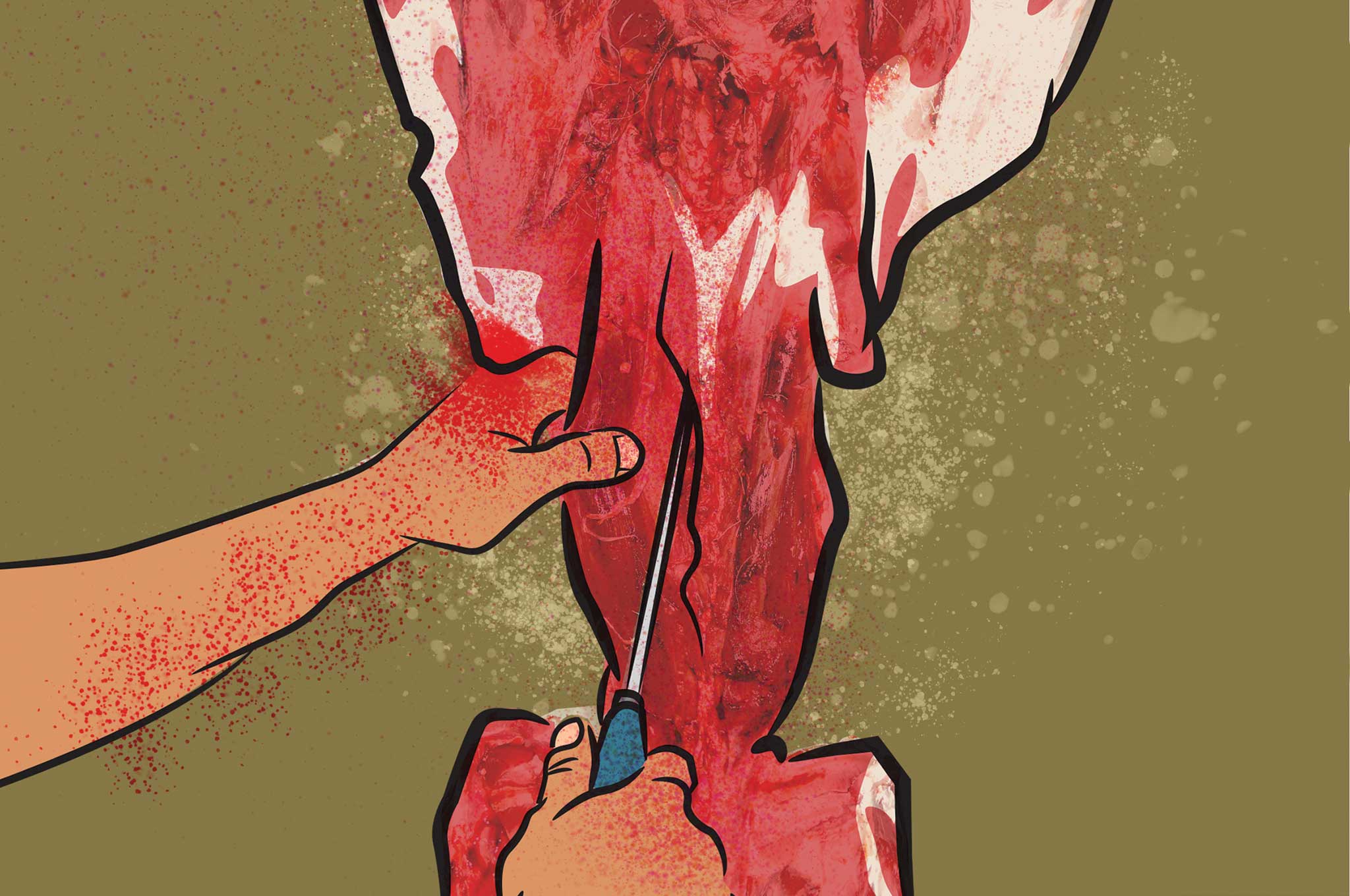
After hanging the animal and skinning it, use leverage to pop the shoulder from the joint. Be mindful of the curvature of the pelvis as you work your blade through.
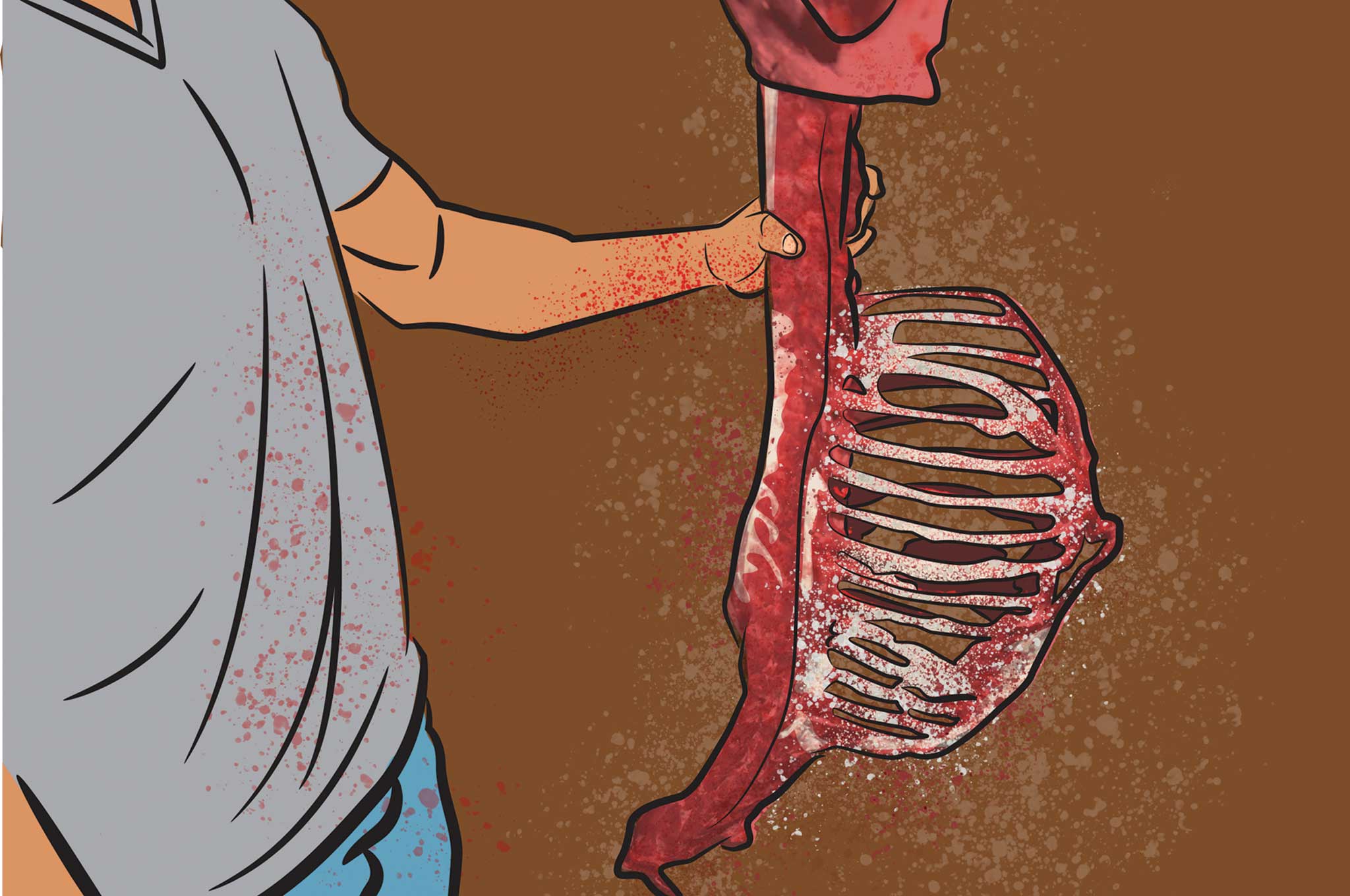
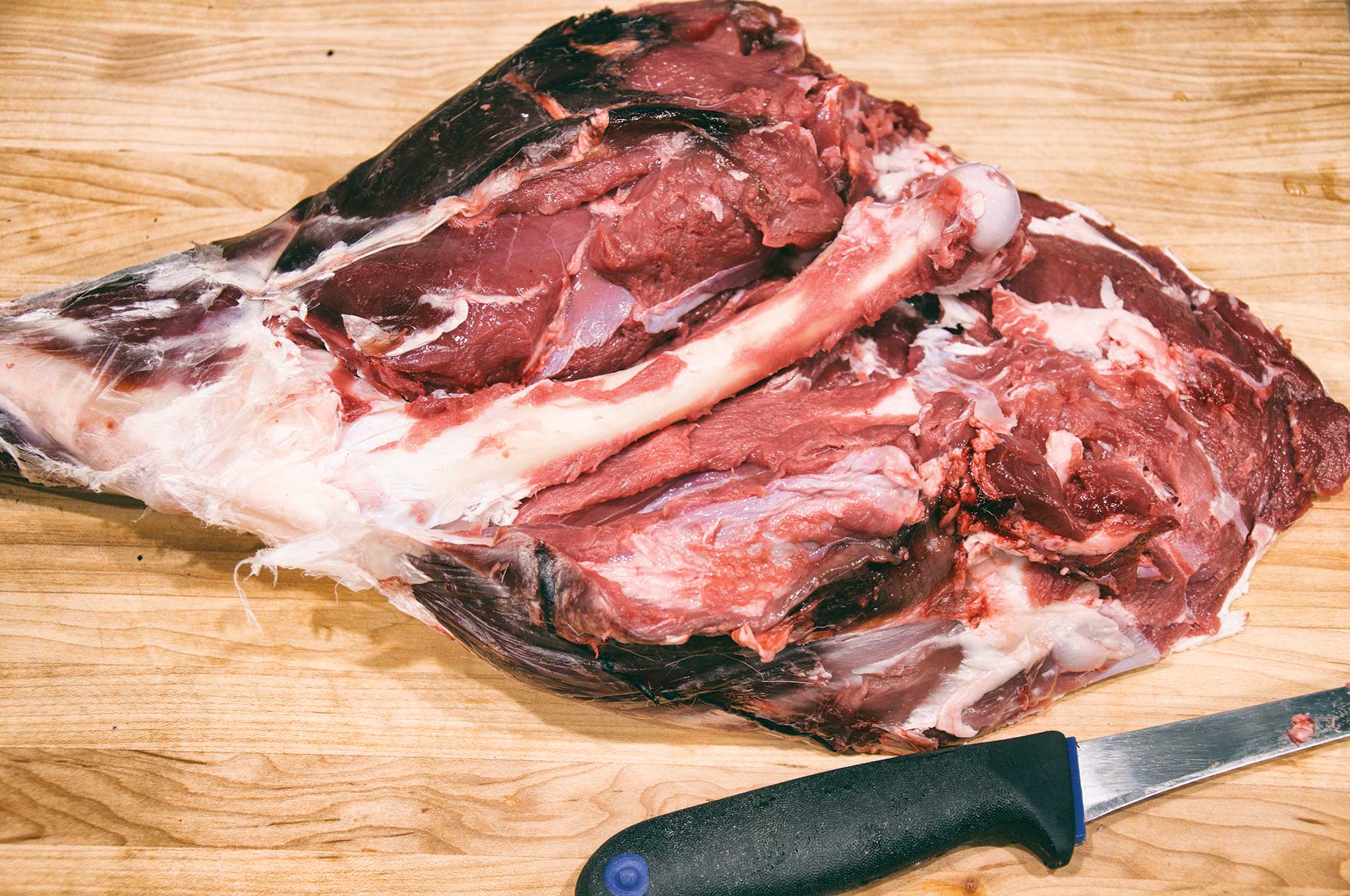
Next comes the removal of the backstrap and the rib meat.To remove the tenderloins, use your knife tip and fingers. They should pull free from the carcass with minimal effort.A carcass with limited meat waste; just the rear legs remain.Remove the rear leg in the same fashion as the front shoulder. Lessen the work by following the natural seams of the meat.
Thick Skinned
The key with any big game animal is to get it cooled down as quickly as possible. Skinning is just that, shedding the animal’s coat to allow heat to dissipate. While we’ve hung deer-sized game unskinned and allowed them to age for multiple days, we’ve achieved a better product when skinning the animal and allowing it to age as an exposed carcass.
Attempting to fully skin an animal on the ground is best avoided, so all these procedures are described for an animal hung from a gambrel; they don’t change regardless of animal size.
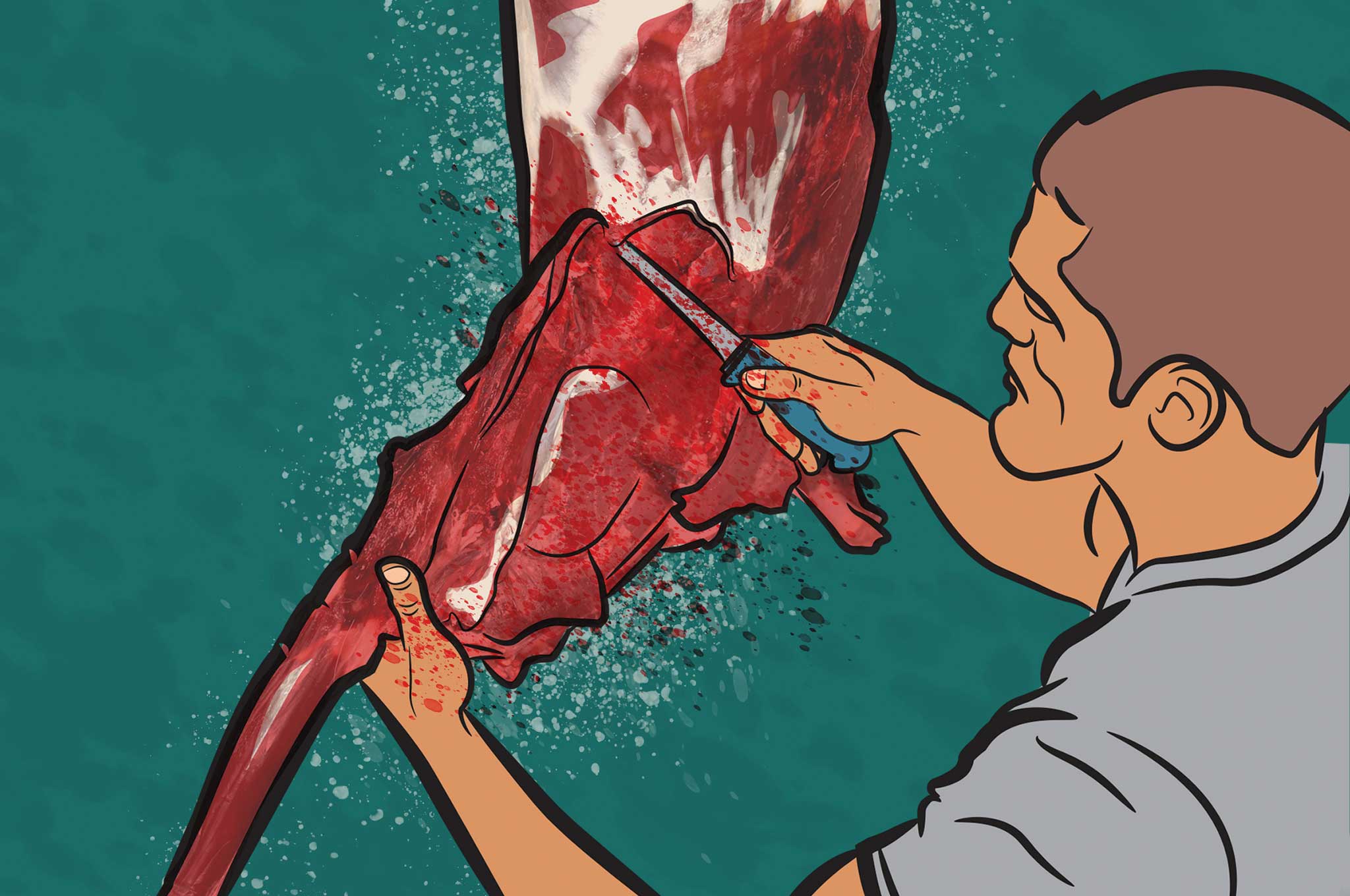
With the animal securely held in the gambrel, remove the hide from the rear legs, making incisions up to the knuckle. Peel the hide around and down until you reach the tailbone. Grabbing the tail and pulling away, it’ll easily detach by cutting through the joint; be sure not to cut through the hide. With the hide free of the rear legs, using your blade and some brute strength, pull the hide down until you reach the shoulders. The key is to cut toward the hide and not into the meat. For the most part, the hide will pull free with little knife work needed.
Skinning out the shoulders can be a frustrating task given the weight of the hide and curvature of the shoulder. The area where the hide goes under the armpit can be a difficult spot.
There are two approaches to making this task easier. You can cut through the hide at two points inside the shoulders, giving you three separate sections and more freedom to work. Keep in mind, though, anytime you cut through the hide, you cut more hair, resulting in more to clean up later. It’s usually easier to work the hide to the back of the shoulders and make an incision through the hide up the back of the leg to the knuckle. This lets you work the hide down and around each shoulder. Continue to work the hide to the base of the head. There’s usually no need for a saw — with a knife and some twisting action you can easily sever the vertebra.
The Gutless Method
If you’re miles deep into your hunting trip, you probably won’t want to drag the animal out whole. Your best option is to work the animal one side at a time, removing all the meat without disturbing the internal organs.
With the animal on its side, make an incision through the hide, along the backbone, and up the neck. When cutting through hide, it’s always best to cut hide to hair, that is, from the inside out. This helps prevent hair from getting on the meat, making it easier to clean and package later. Work the hide down, pulling and cutting as you go. In most instances the hide should pull free if the animal was recently killed and still warm. Start at the front shoulder, peeling the hide back as you would if the animal were hanging.
Work from front to back, peeling the hide and removing major muscle groups as you go. The hide will open like a flap, giving you complete access to the quarters, back straps, making removing the tenderloins easier. After all the meat is removed from one side of the animal, simply roll the animal to the other side and remove the hide and meat in the same order, front to back.
The Aging Process
Aging meat has been done for ages — for good reason. There are two main reasons to age your animal: concentration of flavor and tenderness. As meat ages, the natural enzymes in the meat break down the protein. This is simply a controlled rot, for lack of a better term. For this to happen properly though, you need to have the right conditions or you risk all your meat spoiling.
If you’re dealing with a whole animal and don’t have the luxury of a walk-in cooler, the key is temperature.
This author prefers the temperature to be no higher than 45 degrees F. Of course, if it’s warmer or you can’t hang the entire animal, you can age your animal in the fridge. Place the primal cuts on sheet trays lined with parchment paper then cover with plastic wrap. Age for up to five days if the animal is whole or quartered in the fridge.
Note: When aging meat in its quarters, you’ll lose a bit more yield since more surfaces are exposed and more trimming will be needed.
Butcher It
This is a personal choice, and the process will vary due to what’s needed. Some hunters turn both front shoulders into ground meat or sausage and leave the rest for steaks and roasts. Keep the meat in larger cuts, so roasts are fully trimmed and packaged and back straps are portioned in larger pieces rather than cut down to steaks. Larger pieces keep better in the freezer than smaller cuts, resulting in a better product months down the line.
When trimming and boning out the meat, you’ll be left with scraps. You can immediately turn this all to grind, but you might consider keeping a pound of trim set aside to use later in a sausage. It might come in handy to prevent you from over grinding a sausage mix.
Pack It Up
Vacuum-sealing machines have become so prevalent and inexpensive, they’re a no-brainer when packing meat. The clear bags are easily labeled, last longer, and the process is far quicker than wrapping cuts in butcher paper. [Editor’s note: If you decide to get one, see our buyer’s guide in RECOIL OFFGRID Issue 10 for some shopping advice.]
Industrial meat and even internet-ordered groceries mean we’re growing even further from the roots of the food chain. At least, if you’re reading this, you’ve considered the steps to eviscerate, butcher, and package your own game.
Butchering an animal is largely preferential. Storing meat in larger pieces helps it last longer in the freezer.
For some, taking game to a local processor is the easier route. But you may find that resource isn’t an option if the world goes to pot, so these skills will be valuable. You’ll have to rely on yourself to do the dirty work of a trade many people have long taken for granted. If the need arises in a survival situation, you’ll be much closer to self-sufficiency.
About the Author
Matthew Cosenzo is a graduate of The Culinary Institute of America, focusing heavily on field-to-table cooking. His passion for the outdoors combined with his approach to game creates a full circle experience. Cosenzo is always looking for the next challenge — be it on the range or in the field — to help him become a more efficient and educated hunter.
Thinking about drinking some pee? You’re not the only one. Every time I teach a survival class, someone asks about drinking urine when we get to the section on water. But just because it’s yellow, I tell them, doesn’t make it lemonade!
The Myth: Thanks to the exploits of certain shock-value survival TV personalities and the misadventure of Aron Ralston (and the subsequent movie adaptation of 127 Hours), many rookie survivalists think it’s OK to drink urine when you run out of water.
The Reality: The average person can live about four days without any water to drink, if they have adequate shelter during that time. And while a few lucky survivors have lasted an extra day or two from pee drinking, looking at a few special cases doesn’t mean it’s a good practice. Even the urine from a well-hydrated human is still laden with waste compounds — no, pee isn’t sterile. After all, our bodies are getting rid of it for a reason. In fact, over 3,000 compounds have been found in our lemon-colored liquid. Almost 100 of these are bacteria getting flushed from the body, and nearly 1,500 are waste from bodily processes. This leaves more than 2,000 chemicals coming from our diet, environment, medicines, and cosmetics. In short, urine contains a lot of alarming waste products, and they’re all things our body is trying to eliminate (not recycle). Furthermore, if conditions are grim enough that you’re considering peeing into a cup and drinking it, there’s likely a higher concentration of bacteria in your urine than usual since you’re already approaching a hydration deficit.
Normal urine is approximately 95-percent water and 5-percent waste, but as a person becomes more dehydrated, these numbers change dramatically (making piss consumption even less desirable). Medically documented side effects of urine drinking include diarrhea, vomiting (more water loss), and electrolyte imbalance, along with other unhealthy effects.
Want more proof? Ask the U.S. Army. In its field manual for survival, piss is specifically called out on the “Do not drink” list, right beside ocean water and blood. Furthermore, the pee of someone with crushing injuries is even more dangerous than the whiz of an unharmed survivor. Damaged muscle fibers leak potassium, among other substances, into the bloodstream, raising the level of salts and waste in urine. Even a pee guzzler with strong kidneys may not be able to handle this. And when the injured person is drinking their own tinkle, they’re taking in salts their body definitely doesn’t want.
Alternative Uses: Here are some other ways to stay hydrated, and for the adventurous, here are some alternative uses for your urine. Just because pee isn’t a great beverage choice, doesn’t mean it’s worthless.
Worth the squeeze. Except in the driest deserts, there’s usually some alternative source of drinking water. Numerous plants contain water that can be extracted or tapped during certain seasons. Make sure to positively identify the species you’re considering, and determine which season it provides water and how to collect it. Squeezing the juice from edible berries is a good strategy. This way you don’t have to waste water pooping out all the seeds and pulp.
Get it on tap. My favorite wild water source is maple sap, which can be collected between February and March by drilling a hole into the right tree. The water is perfectly safe to drink, being filtered by the woody tissues of the tree. The sap even has a trace of sugar, making it taste slightly sweet (and giving us the raw material to boil down maple syrup).
If it’s yellow, let it mellow. Stale piss has been used for thousands of years for a wide range of purposes. Once the urine breaks down for a few days, it has a high concentration of ammonia. This was used by the ancient Romans to whiten their teeth, among other revolting chores. Later people used stale pee to dye their clothing, tan animal skins, make gunpowder, and even fertilize crops.
Web Exclusive
Not convinced that we busted this myth? Maybe it’s because you watched Internet “survivalists” drink their own piss through a LifeStraw for views and infamy. Read our web exclusive on why using a water filtration system still doesn’t make urine safe to drink here.
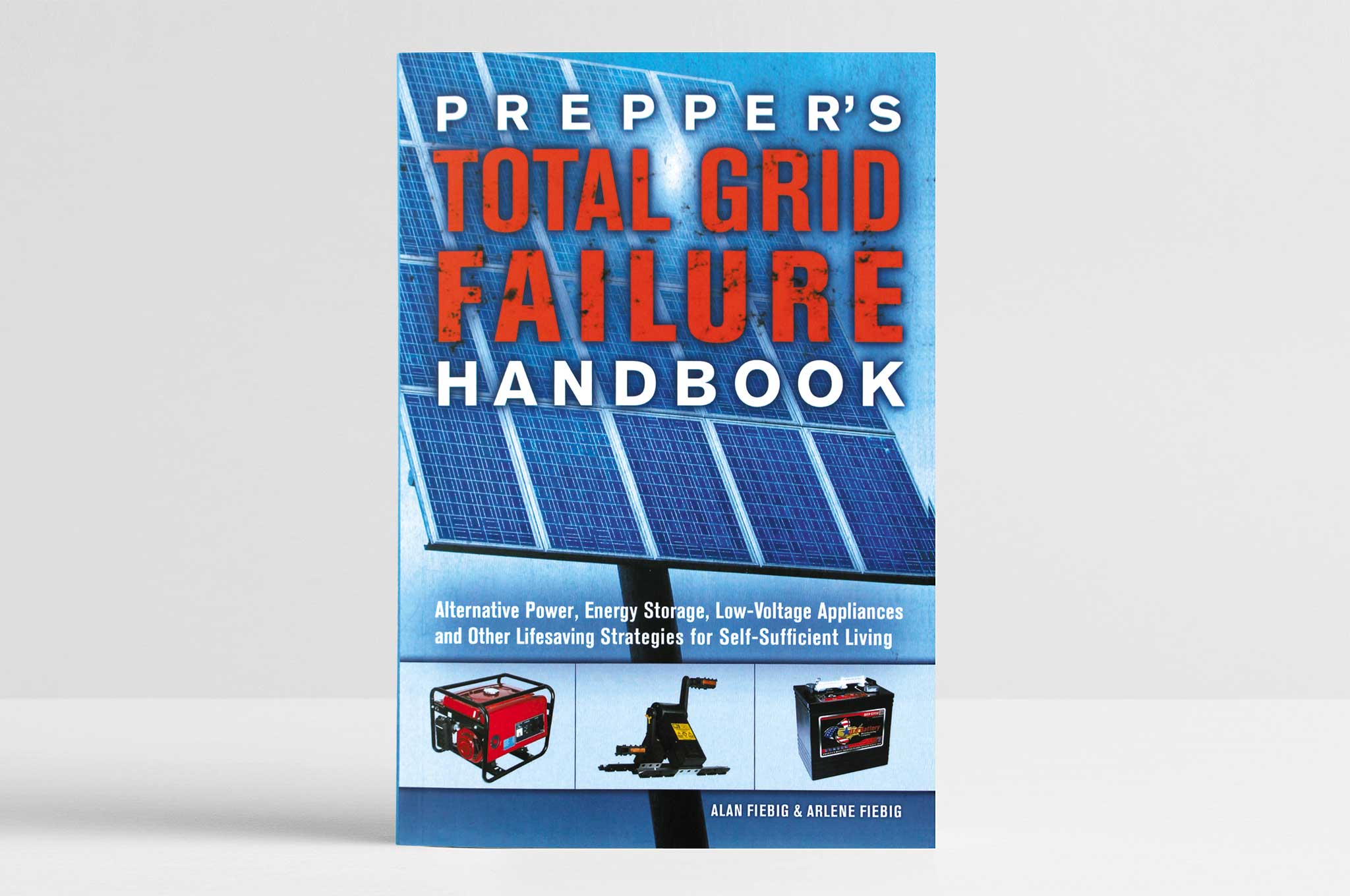
The Premise: If you’ve spent any time perusing blogs and online forums regarding off-grid living, you’ve no doubt stumbled upon Off-Grid-Geek.com, and even though they only offer a scant 75 articles posted over the last five years, husband-and-wife writing team Alan and Arlene Fiebig tackle all things off-grid from generators and solar panels to beekeeping and homemade canned soup. Their first-person writing style is engaging, unimposing, sympathetic, and easily accessible.
The book before you is an extension of their experiences and blog, albeit a condensed, focused, and deliberately designed extension … but it reflects their style, passion, energy, and skills as experts in the field of off-grid energy production.
The 411: Readers have followed their electrical adventures since 2012 when the Fiebigs stepped away from the grid and began sharing the pros and cons of living in the Wisconsin wilderness, miles from a connected electrical source. Through thick and thin, successes and failures, they’ve relied on Arlene’s knowledge as a mechanical engineer, and Alan’s creative out-of-the-box solutions to off-grid conundrums.
The Verdict: Much like their blog, this book reads easy with a light, folksy charm that’s reminiscent of the farm reports in a small Midwest newspaper, ones sprinkled with wit and regional, cheeky humor. But don’t let that rustic unpretentiousness fool you: If you know very little about electricity, alternative power sources, or how you can be less reliant on the power grid (and want to), this book delivers. And the Fiebigs know what they’re talking about. They’re not an Instafamous couple fresh out of the of an air-conditioned Newport Beach condo pretending to live off-grid; they live this lifestyle every day and spent the last few years succeeding at providing clean, renewable energy for their mountain retreat.
The first few pages sets a fictional grid-failure scene, but it’s best skipped, while the introduction sets the tone for the rest of the book and provides the reader with a key understanding: “We hope to help you bypass some of the beginner steps we took along the way as we learned and refined our system,” writes the duo. “We have learned from our mistakes, and you can too!”
Though they discuss generators and batteries at length, the real focus of the book is how to set up a productive solar power system based on their own experiences. The first four chapters define the terms, the equipment, the possible power sources, and tell a great deal about how electricity works and what you can expect. This is great for a beginner, but the real thrust of the book doesn’t punch in until part two where solar energy is finally discussed.
The first 50 pages are a necessary requirement to educate the neophyte regarding electricity, but a more technically detailed book would have relegated these pages to a tenth of the space. That said, some of the charm of this book — how to create electricity via pedal power and how you should really change your lifestyle if you want to leave the grid — would be lost.
Most important, the book offers projects and solutions that are attainable, concepts practical, and procedures feasible for entry-level preppers. If you don’t know the technical aspects of a solar panel system or how batteries in a series function, for example, the Fiebigs provide this information in a way that’s easily understood.
The book’s largest flaw is something that cannot be helped. Read this book now; buy and install the gear today; get your off-grid solar system online as quickly as possible, because Prepper’s Total Grid Failure Handbook has a shelf life. Sure, the concepts of electricity, solar power, how batteries work and are wired together are timeless, but the equipment displayed in these pages — solar panels, charge converters, cables, batteries — will be outdated soon, replaced by updated gear with perhaps different parameters and specifications.
Overall, it’s a manual for beginners looking to set up a solar panel system at their home or bug-out shelter. It goes to great lengths to make the reader comfortable with complex concepts, while at the same time, covering a great deal of useful information with very little waste.
Novel & Author
Prepper’s Total Grid Failure Handbook Alan Fiebig and Arlene Fiebig
Many survivalists tend to focus on defending against external threats — natural disasters, civil unrest, terrorist attacks, car crashes, and home invasions. These are all valid dangers to prepare for, but we also shouldn’t overlook internal threats to our well-being. This is why we frequently emphasize physical fitness, mental fortitude, and a healthy diet.
Anyone who spends all day sitting on the couch slowly clogging his or her arteries with junk food isn’t going to fare well in a survival scenario. Similarly, if you think you’re going to subsist on nothing but a stockpile of protein bars and water, you may end up seriously unhealthy. A balanced diet is key to good nutrition, and good nutrition is key to long-term survival.
Mutliple clinical studies have shown that avocado consumption helps support cardiovascular health.
Fresh fruits and vegetables are an ideal way to supplement your diet, and much of this produce can be grown in a backyard garden or with an indoor hydroponic setup. If neither of these options is viable, you can still stockpile shelf-stable canned, dehydrated, or freeze-dried produce. Additional processing extends shelf life, but also reduces nutrient content, so you can find the balance that fits your needs.
Freeze-dried fruits such as these peaches lose some nutritional value, but can be preserved for years.
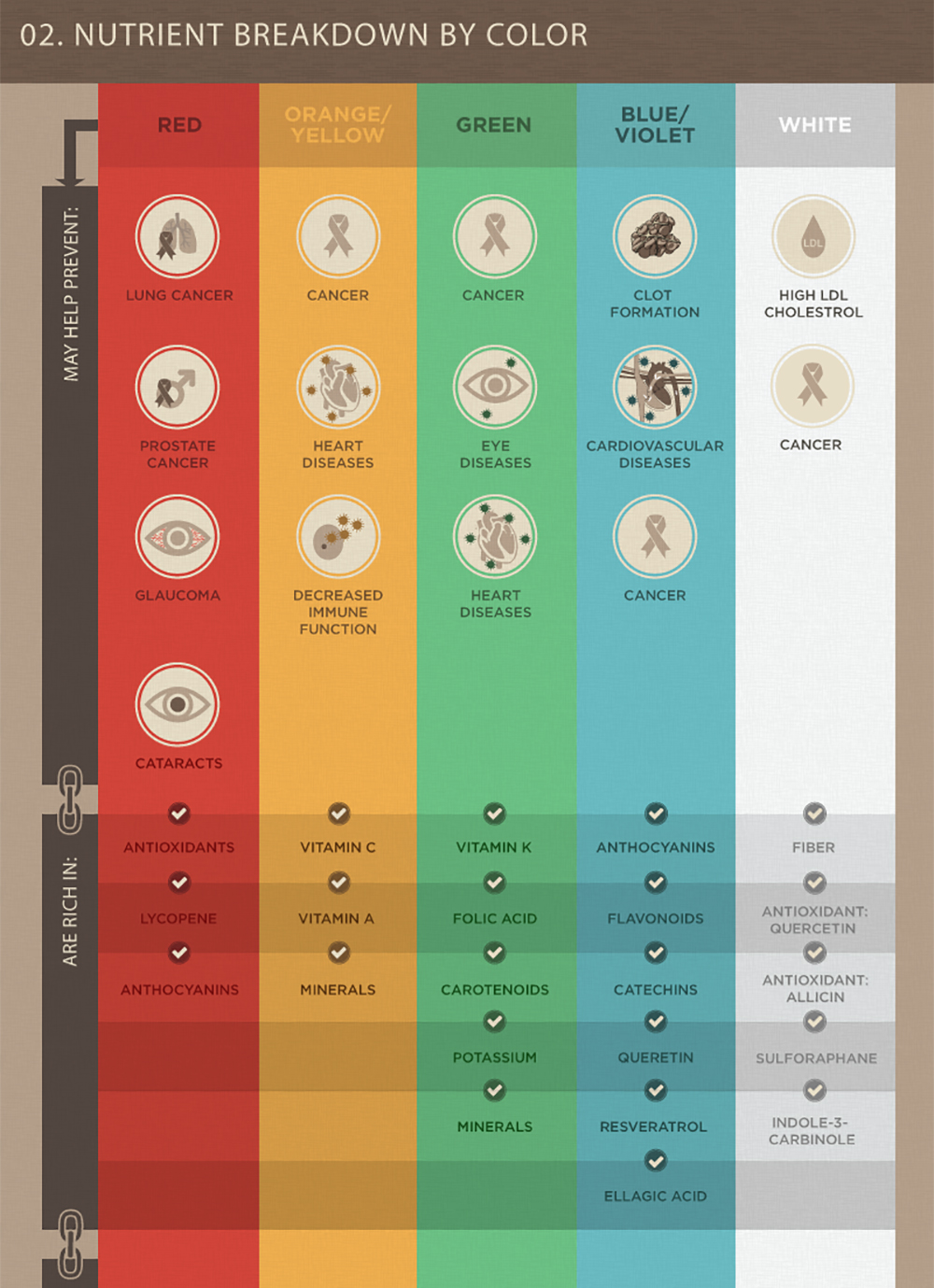
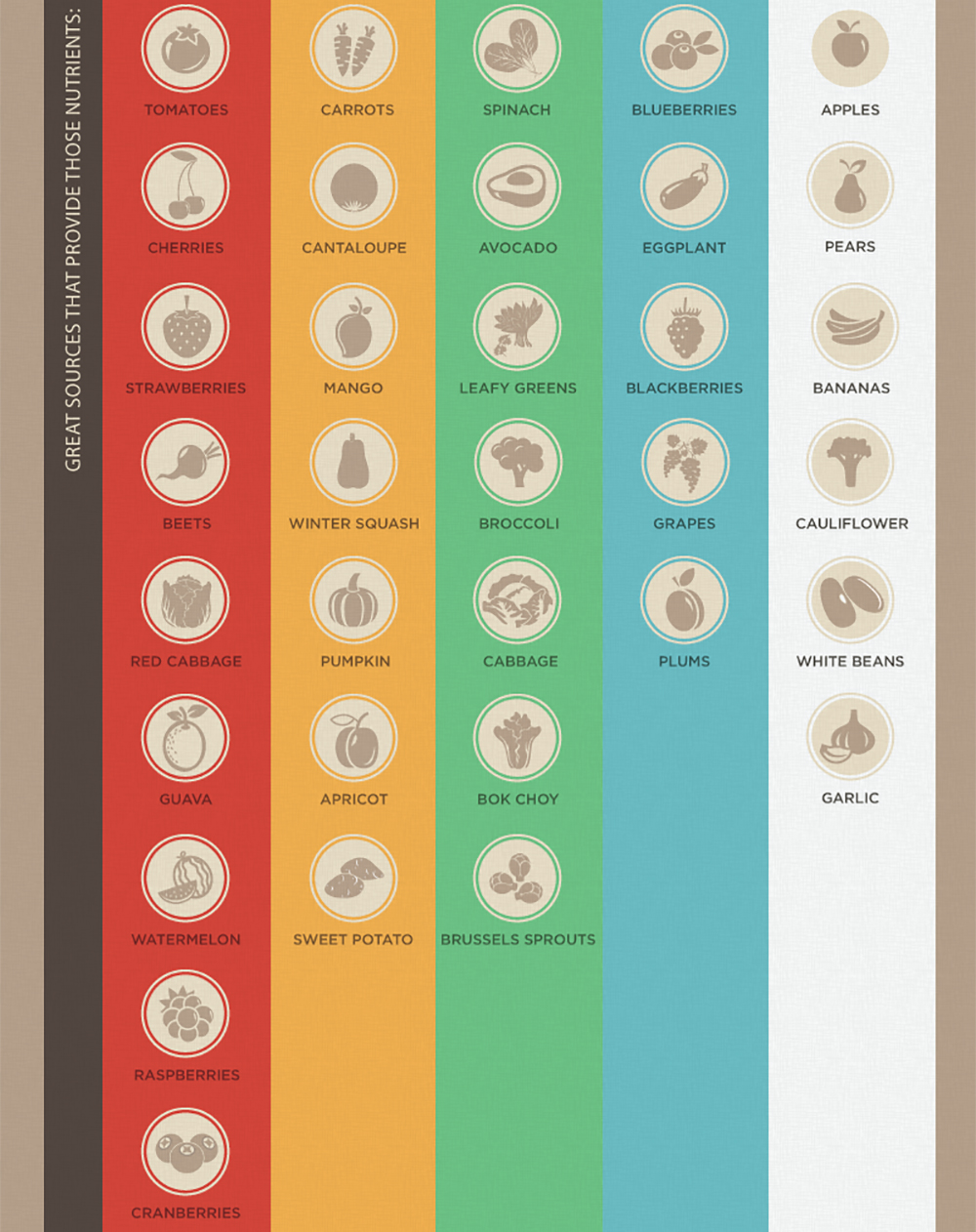
The following infographic from Rockwell Nutrition shows scientifically-supported health benefits of various fruits and vegetables, and categorizes them by color. These tips can help you decide which items to grow at home in your garden, or the produce you pick up on your next trip to the grocery store. Click here to download a full-size version of this graphic.
Chitin is a fibrous material that’s the main constituent of the exoskeletons found on insects and crustaceans. If you’ve ever tried to smash a beetle or pierce a crab’s hard shell, you’ll know just how tough this chitinous armor can be. However, these exoskeletons don’t slow arthropods down. They’re naturally lightweight, and equipped with articulated joints that allow these organisms to remain fast and agile.
Insect exoskeletons are made up of hard chitin. Photo: Katja Schulz – Flickr.com/treegrow
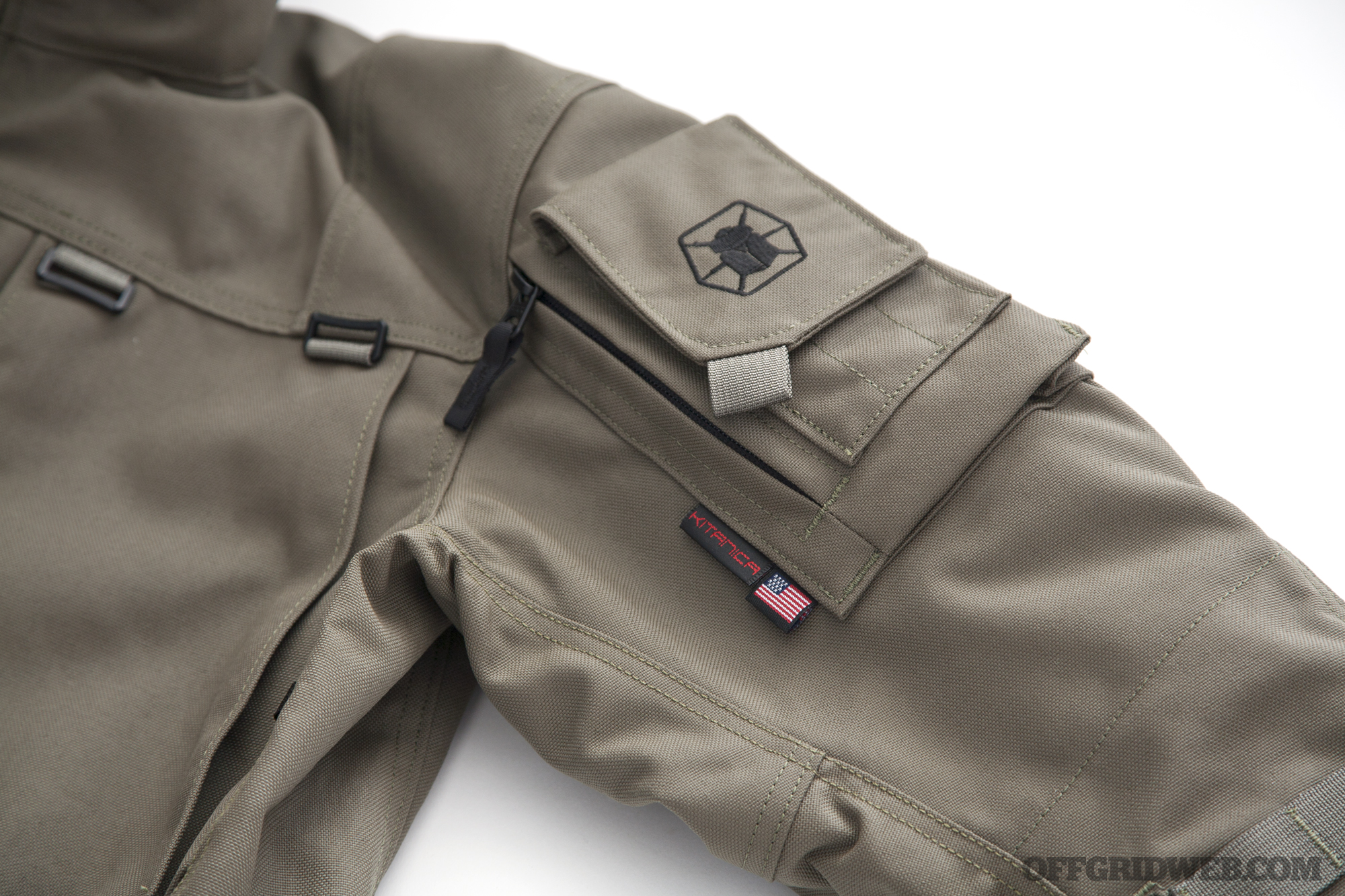
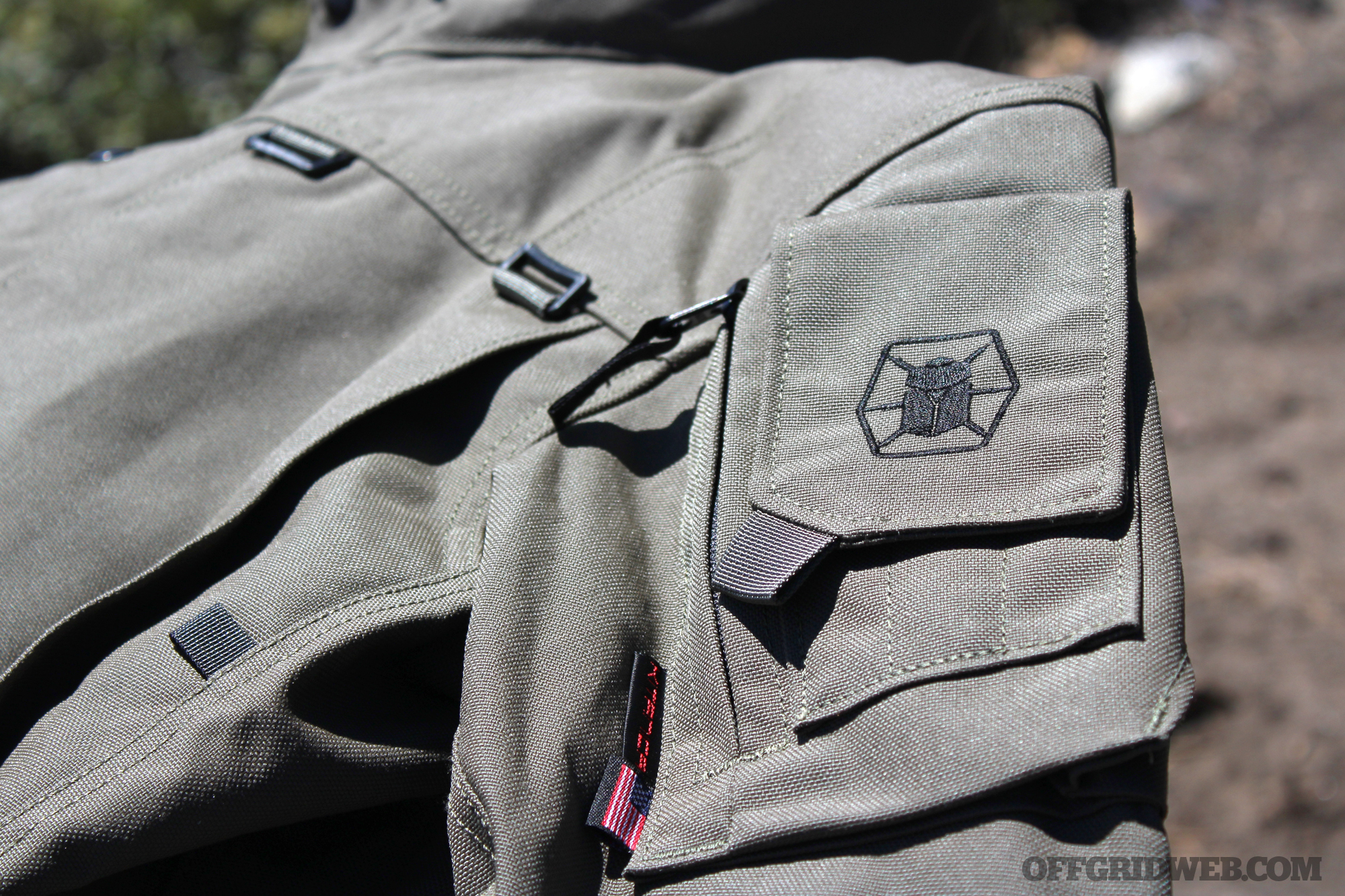
Kitanica, a California-based outdoor apparel manufacturer, drew inspiration from this naturally-occurring armor. The influence is evident in its brand name, its geometric beetle logo, and the distinctive designs of its outdoor apparel. Kitanica aims to equip its customers with gear that’s as tough as an exoskeleton, but also flexible, light, and comfortable enough for everyday use.
Kitanica’s History
The company was founded in 1995 by three family members: Beej Cronin, his brother Chris Cronin, and their cousin Leonard Riccio. That same year, the trio developed a jacket which would later come to be called the Kitanica Mark IV.
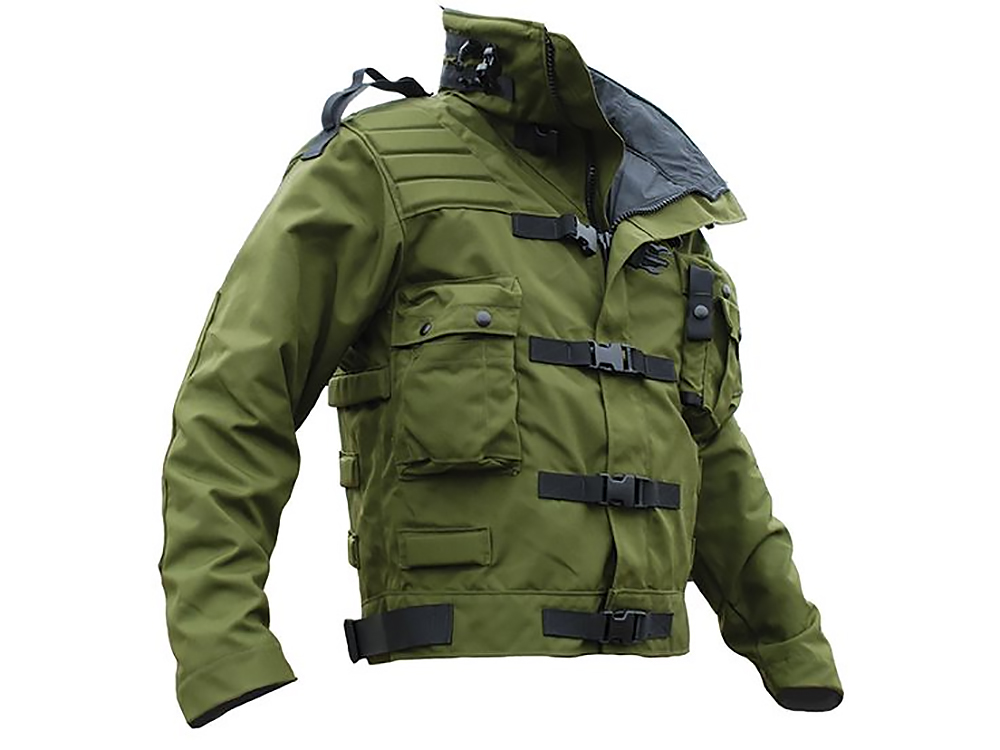
Kitanica’s first-gen Mark IV was conceived in 1995.
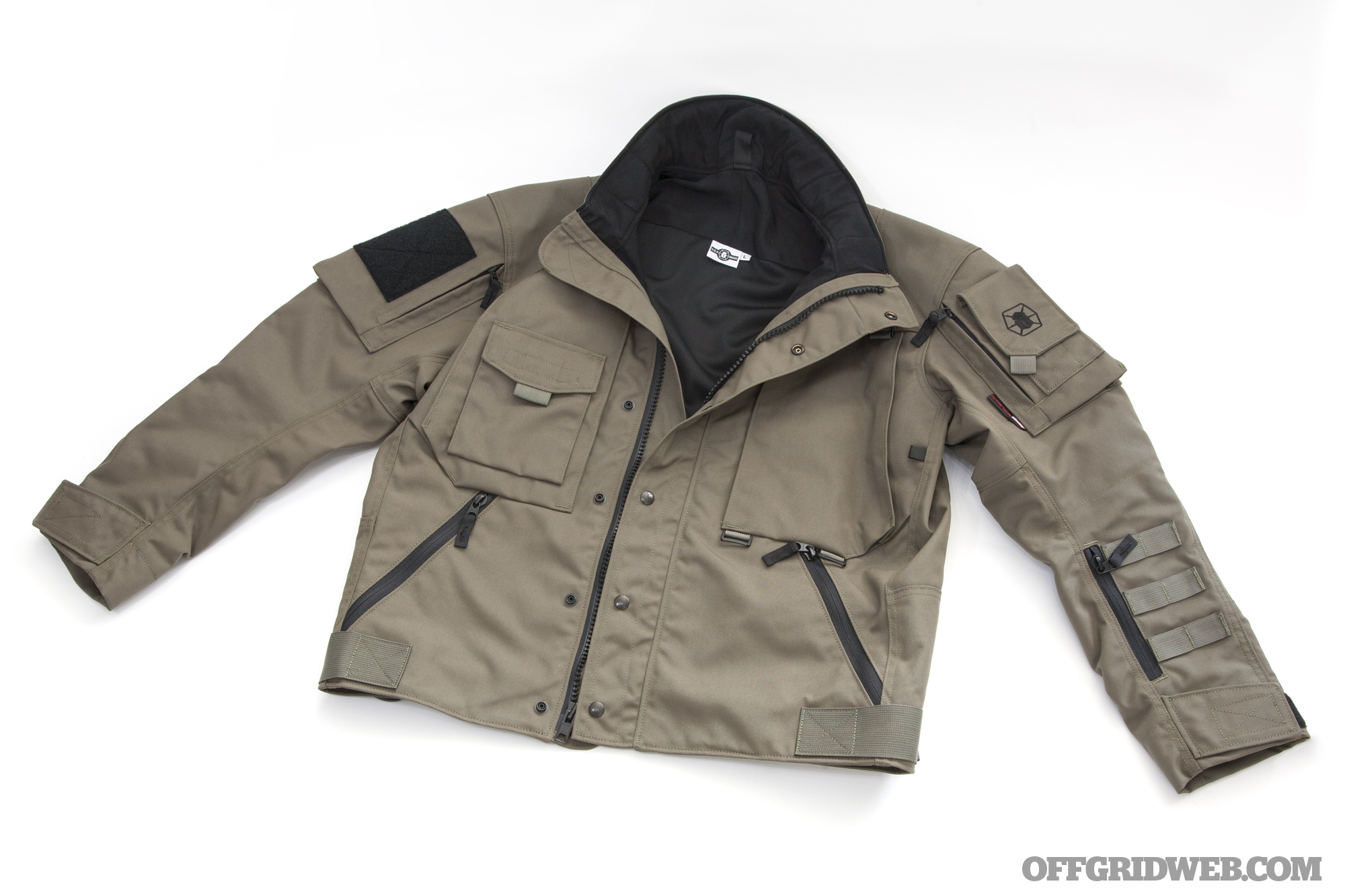
The original Mark IV jacket featured a zippered front with four buckles, asymmetrical pouch-style pockets, articulated padding, and a tall collar. Its aggressive design certainly turned some heads, and even caught the attention of TV presenter Adam Savage, who often wore the jacket while filming Mythbusters episodes.
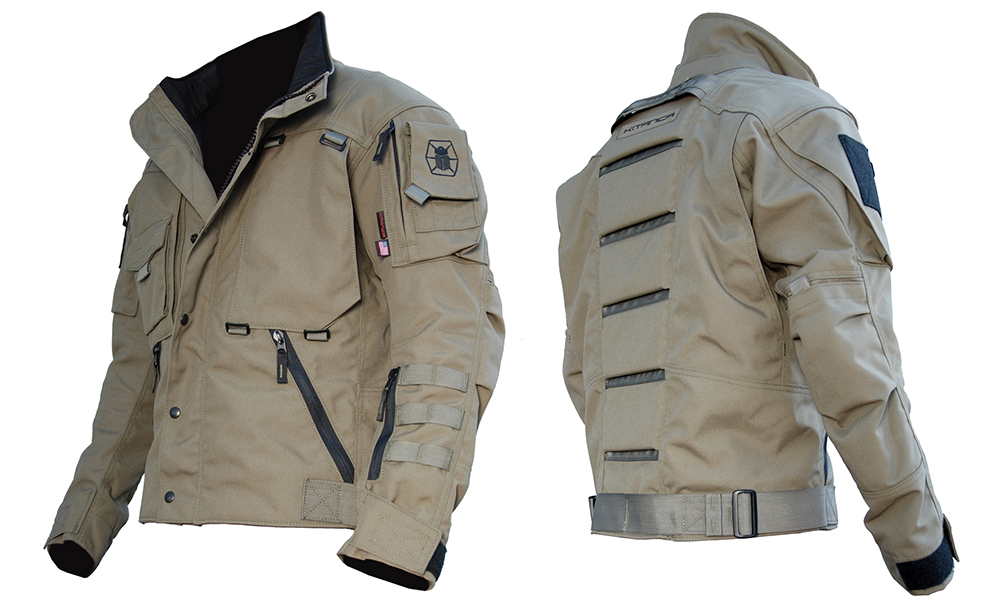
The newly-redesigned Mark IV features a sleeker exterior and elbow pad compatibility.
In 2016, 21 years after its inception, Kitanica went back to the drawing board and fully redesigned the Mark IV. The new Kitanica Mark IV shows clear inspiration from the original design, but offers a sleeker appearance, new features, and more durable materials.
Kitanica Mark IV Specs & Features
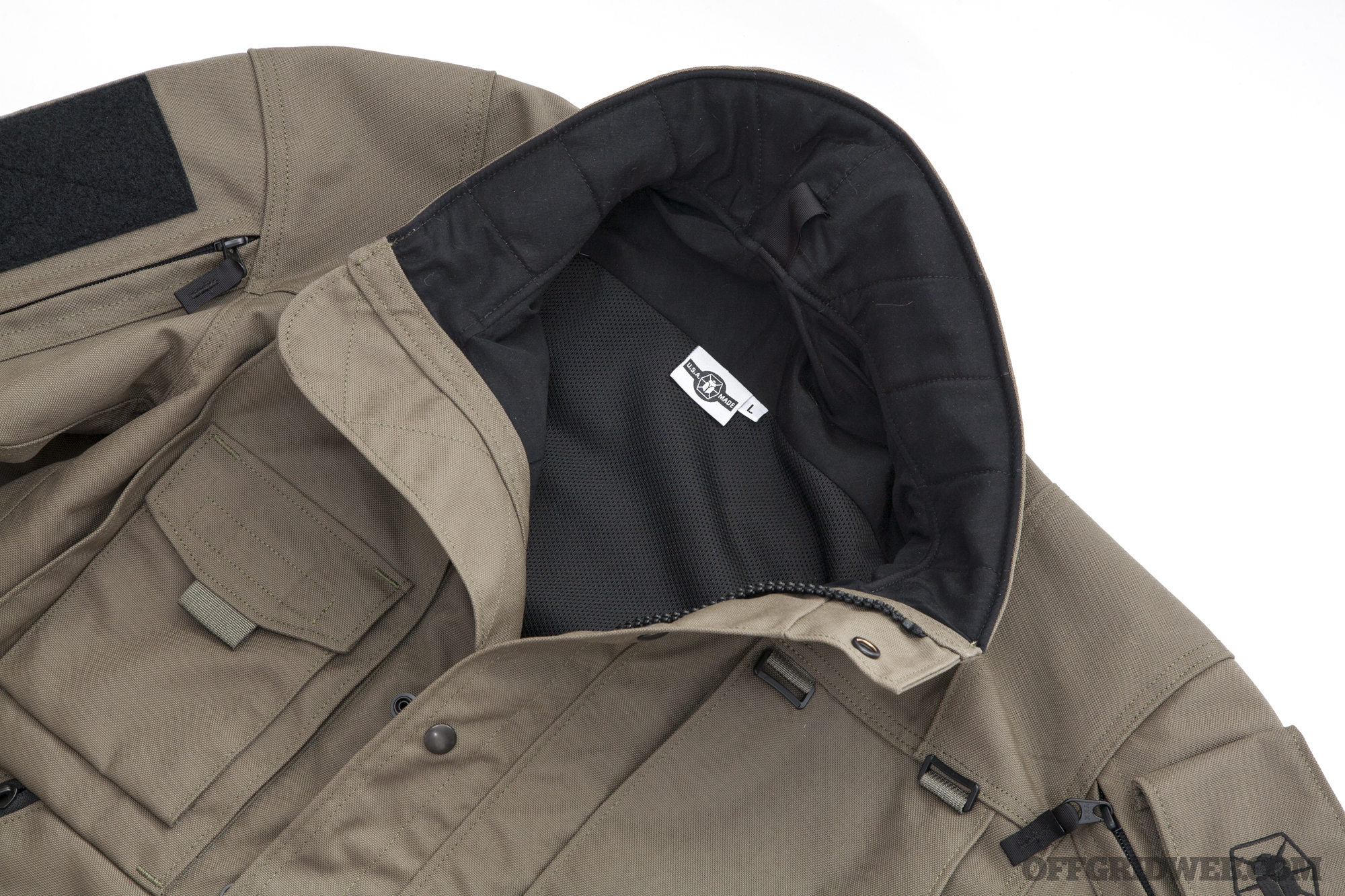
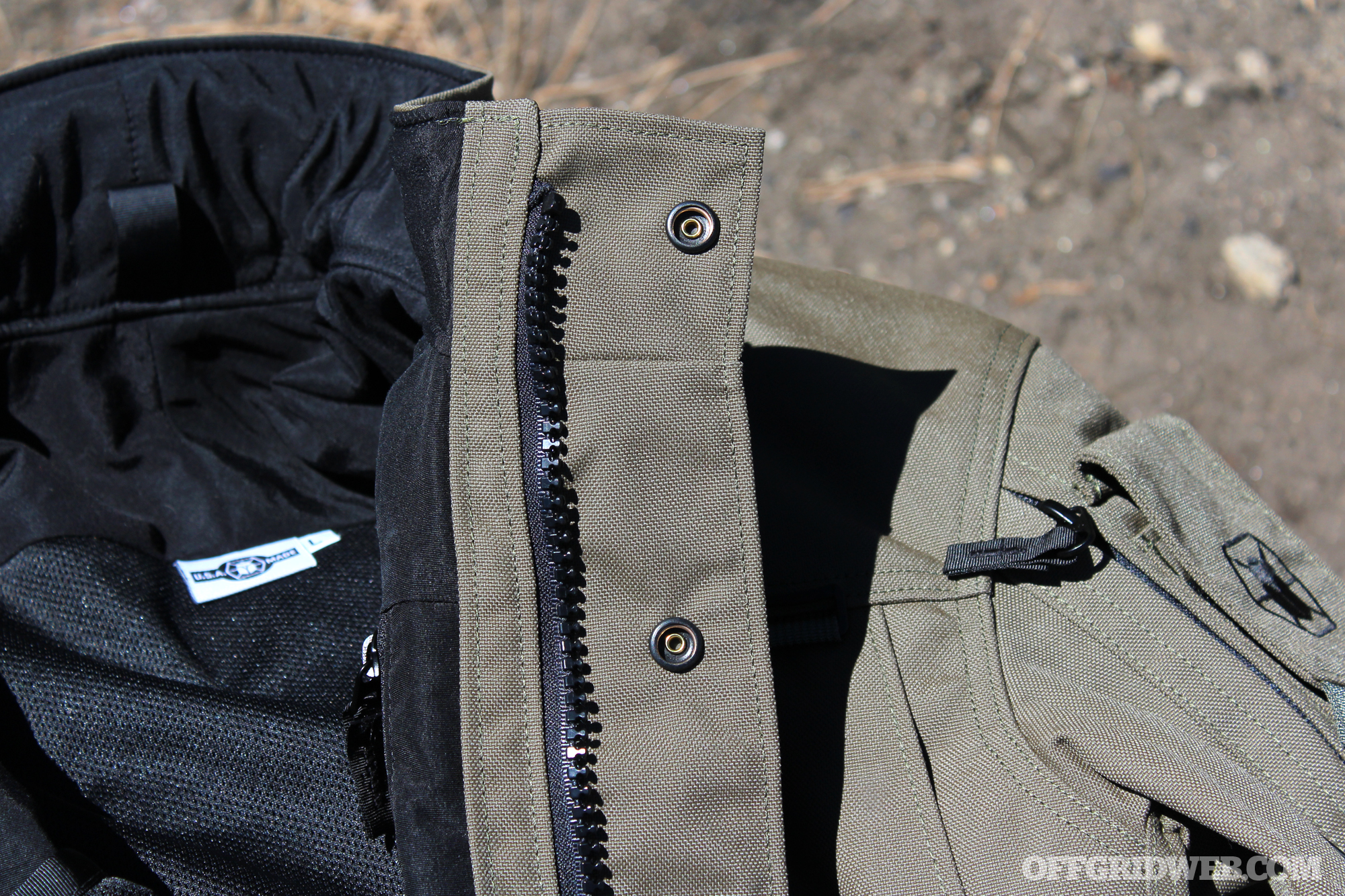
Like all Kitanica apparel, the redesigned Mark IV is made in America at the company’s Oakland, CA headquarters. Its materials are also domestically-produced. We found the workmanship to be outstanding, with nary a stray thread or loose stitch anywhere on the jacket.
The Mark IV’s outer shell is constructed from Ranger Green 1000-denier CORDURA nylon — if you’re not familiar with the denier metric, it means that the fabric is incredibly dense. For reference, this is the same type of material that’s used as the basis of many tactical backpacks and plate carriers. The nylon shell is also coated with urethane, which causes water to bead up and run off its surface.
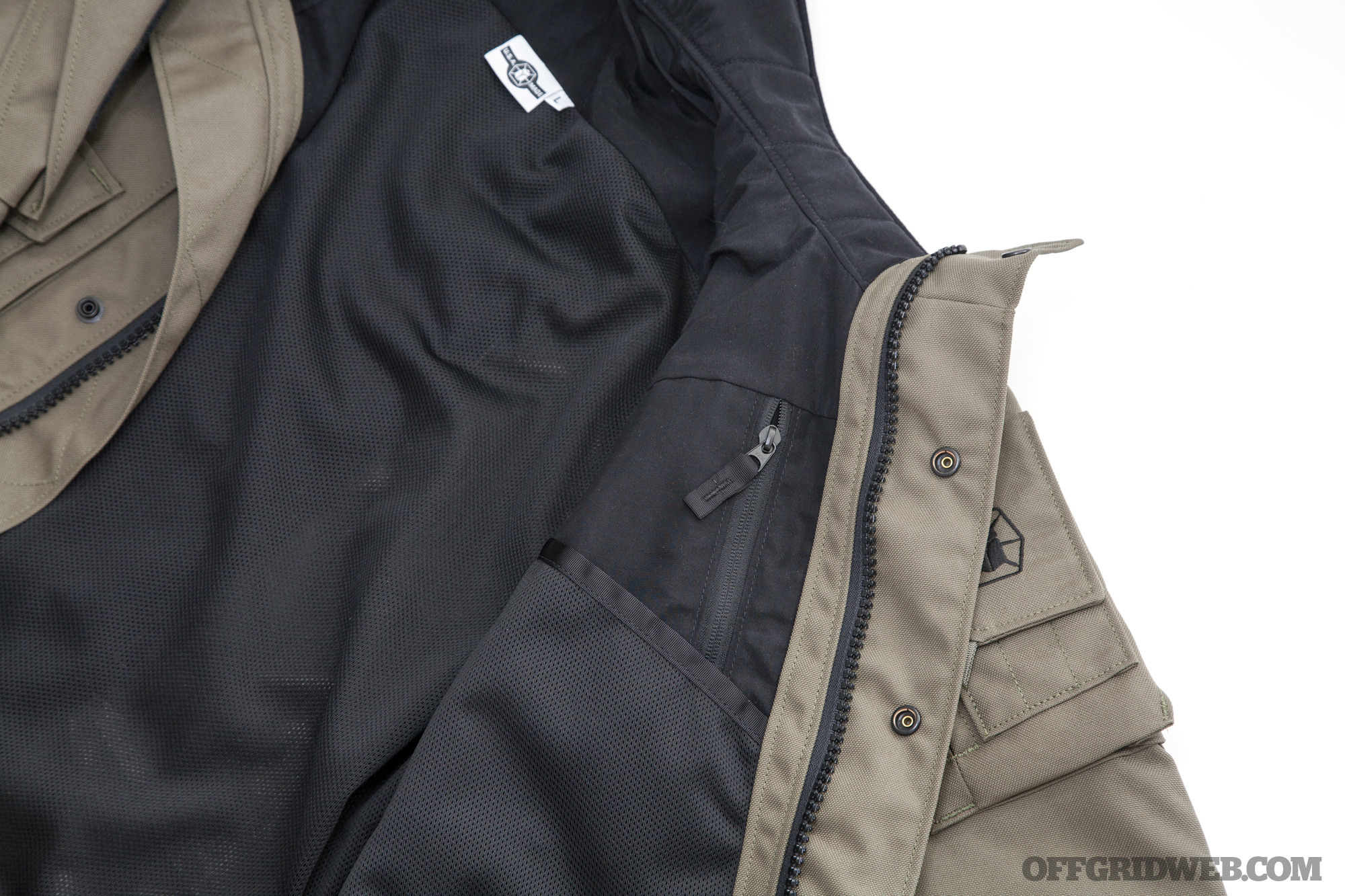
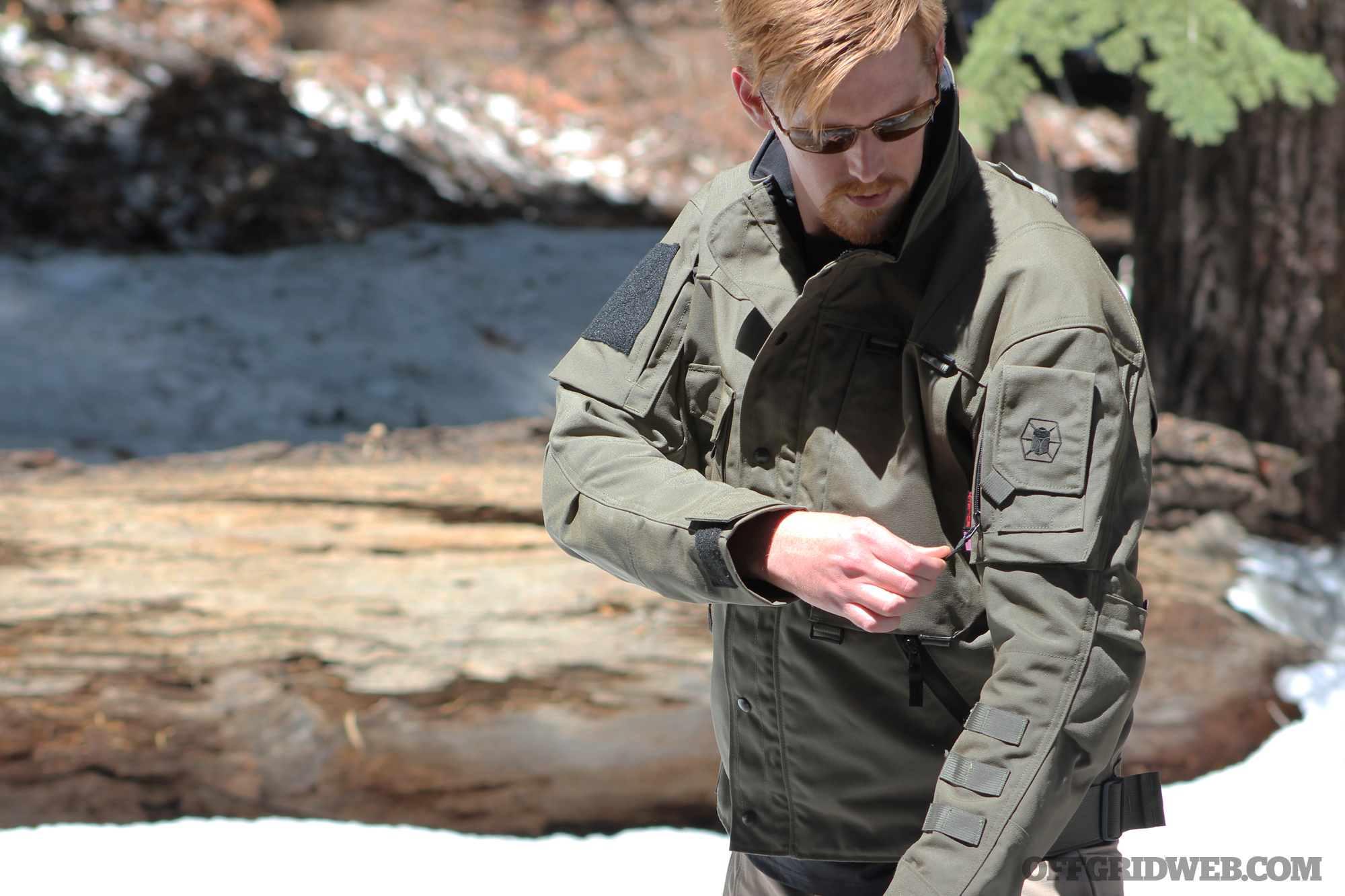
The 4-ply lining consists of Taslan woven nylon and breathable mesh. The Mark IV remains a front-zip like the original design, but the predecessor’s large buckles have been replaced with low-profile mil-spec brass snaps. There’s a 3-inch by 5-inch area of MOLLE-compatible nylon webbing on the left forearm, and the zippers throughout the jacket are all name-brand YKK products.
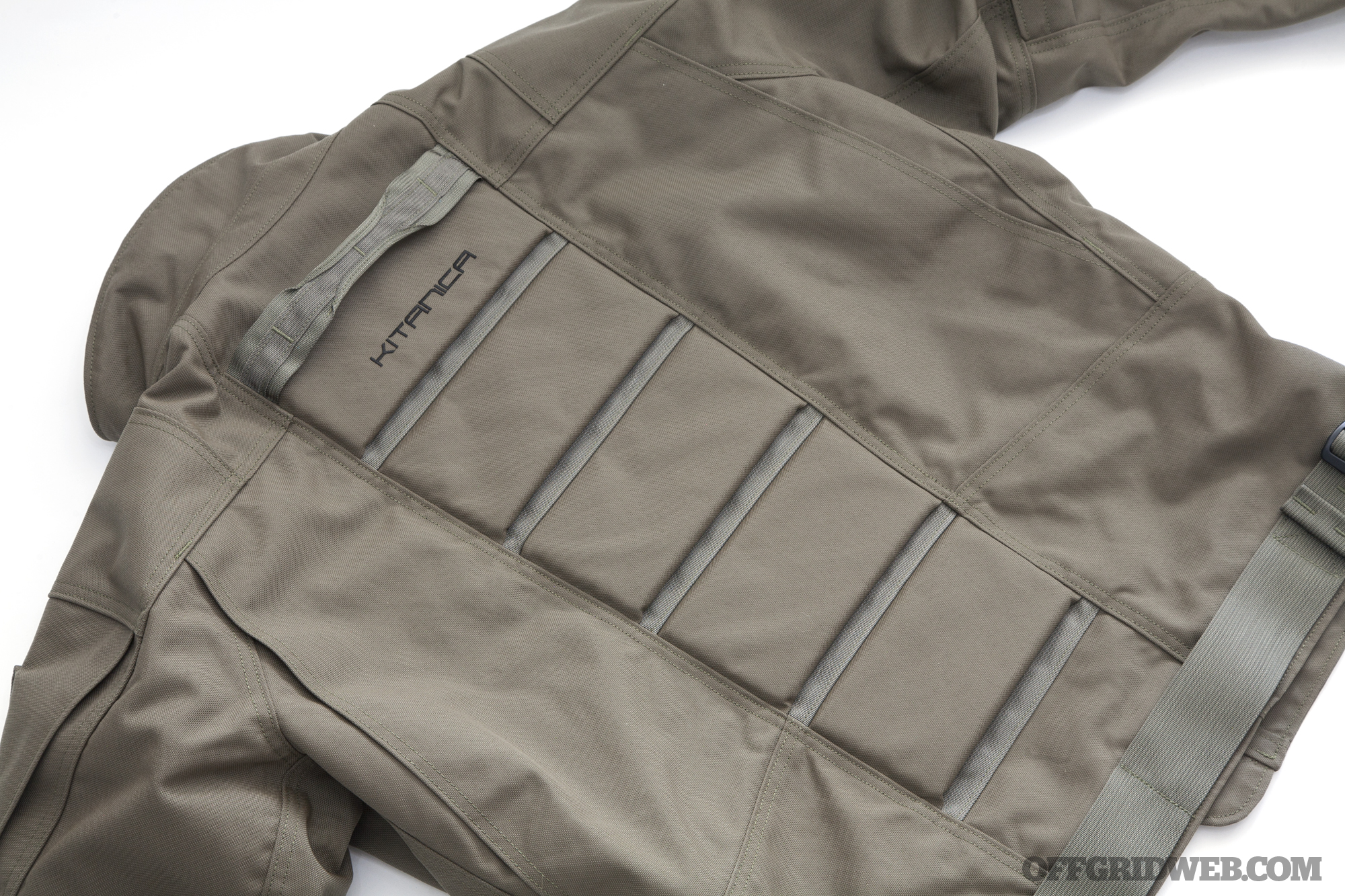
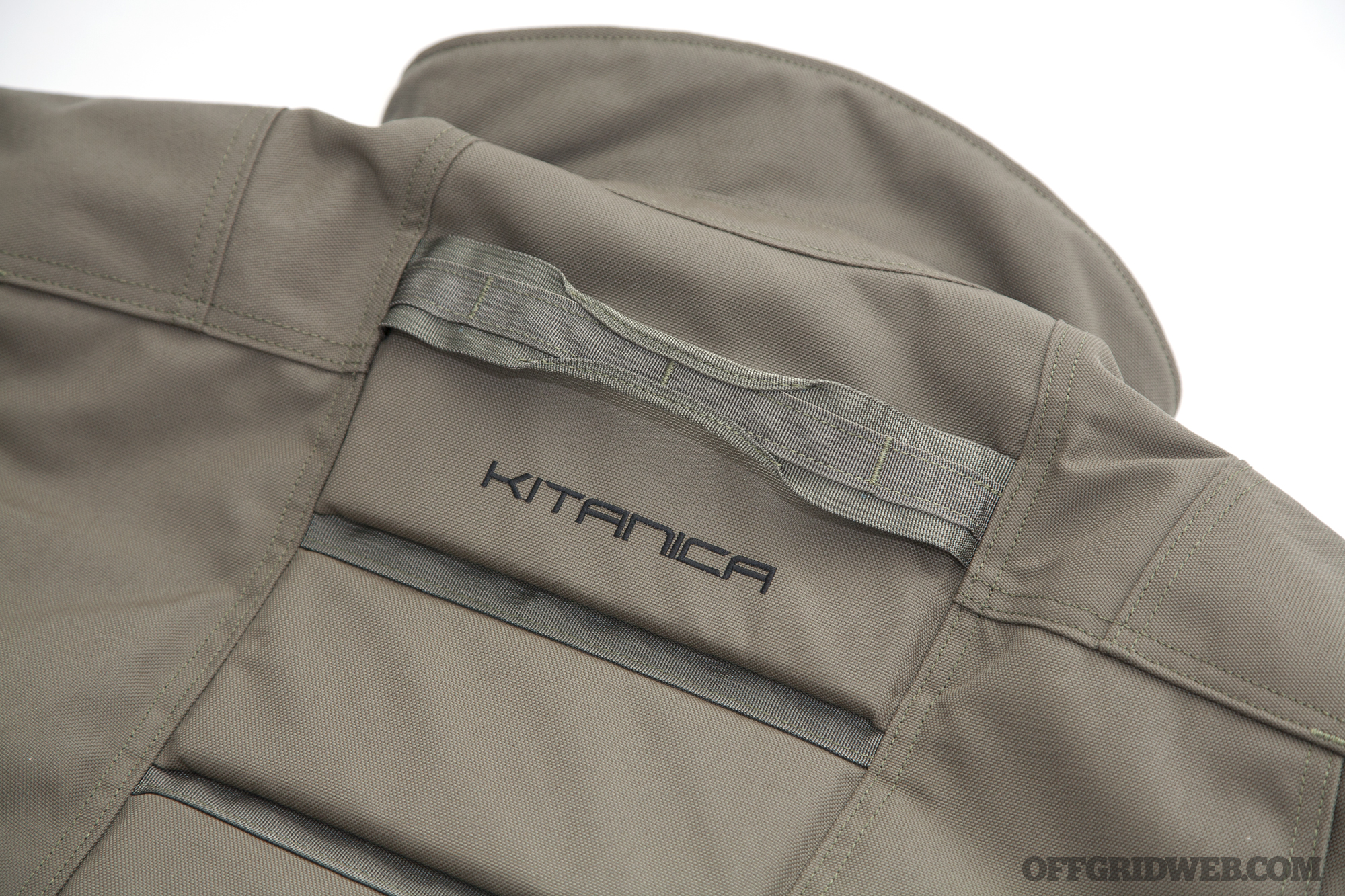
On the back side, the Mark IV features Kitanica’s signature articulated padding, which is reminiscent of the brand’s exoskeleton inspiration. Dense foam inserts in these segments cushion the wearer’s spine from impacts and bruises, but don’t impede natural movement of the back.
Double-layer pockets on each elbow are compatible with Kitanica’s articulated elbow pad inserts. Velcro cuff closures and cinch straps behind the hip area reduce loss of body heat in cold weather.
When it comes to pockets, let’s just say the Kitanica Mark IV has you covered — literally. There are pockets and pouches all over the interior and exterior:
Front: deep diagonal-zip pockets on each side
Left Chest: large vertical-zip pocket
Right Chest: large vertical-zip pocket, small velcro pouch
Left Arm: vertical-zip pockets on upper and lower arm, admin pouch (holds 3 pens, flashlights/chem lights, or small tools), MOLLE-compatible expansion panel
Right Arm: vertical-zip pocket, 3″ by 4.5″ velcro patch area
Inside: vertical-zip pockets and mesh pouches on either side
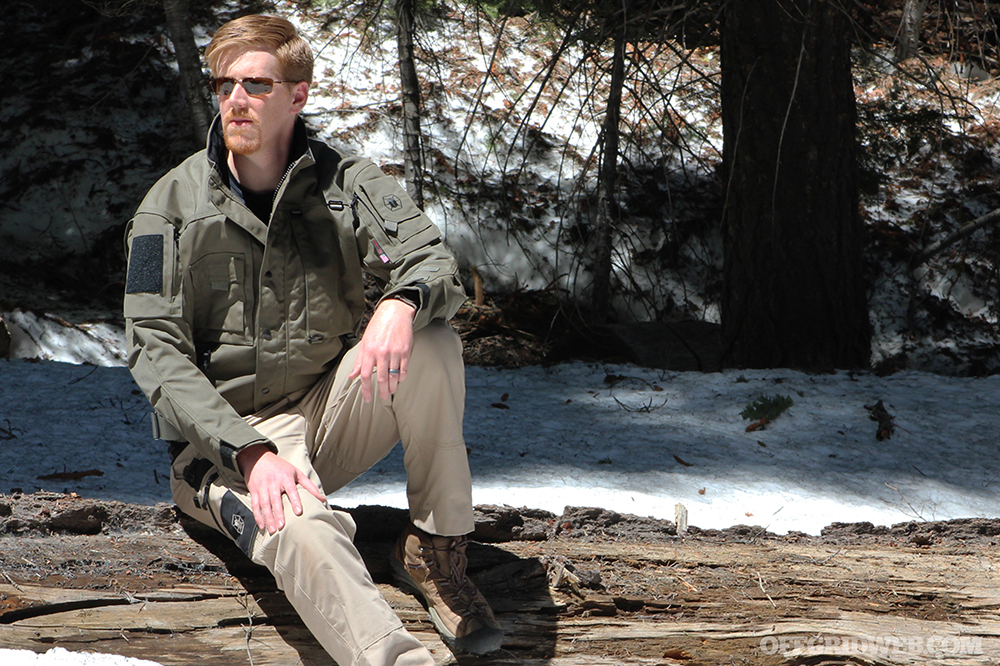
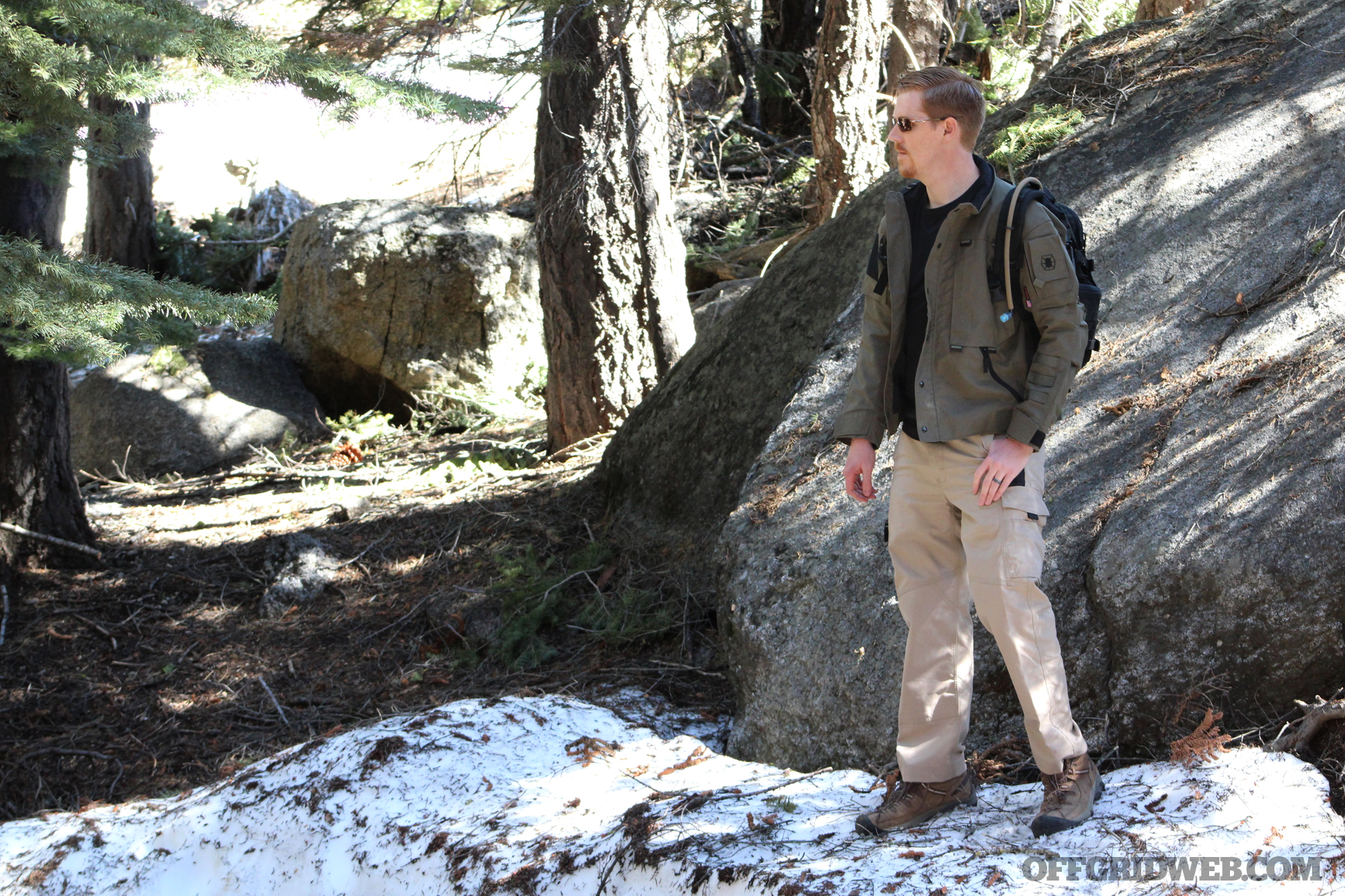
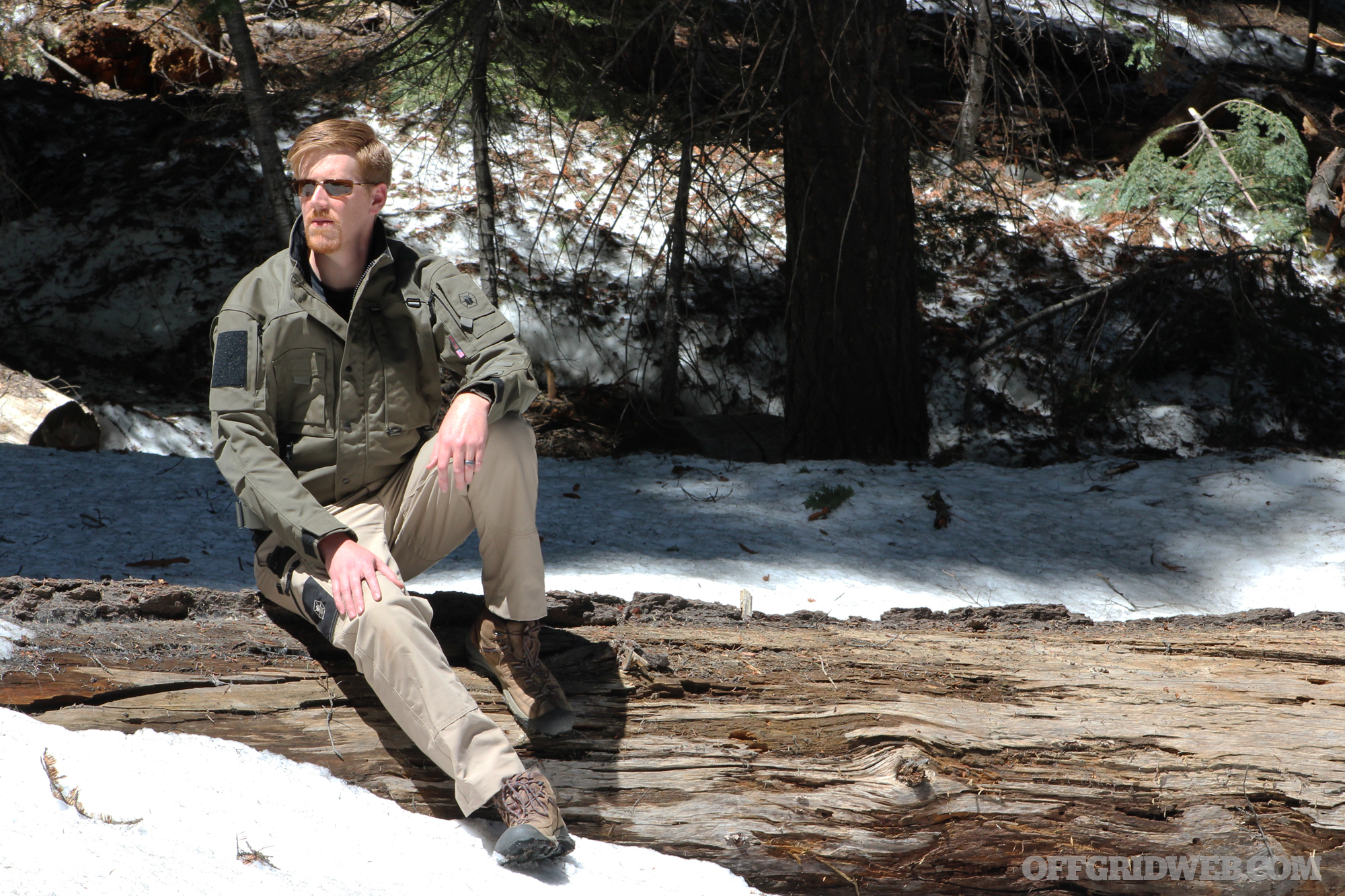
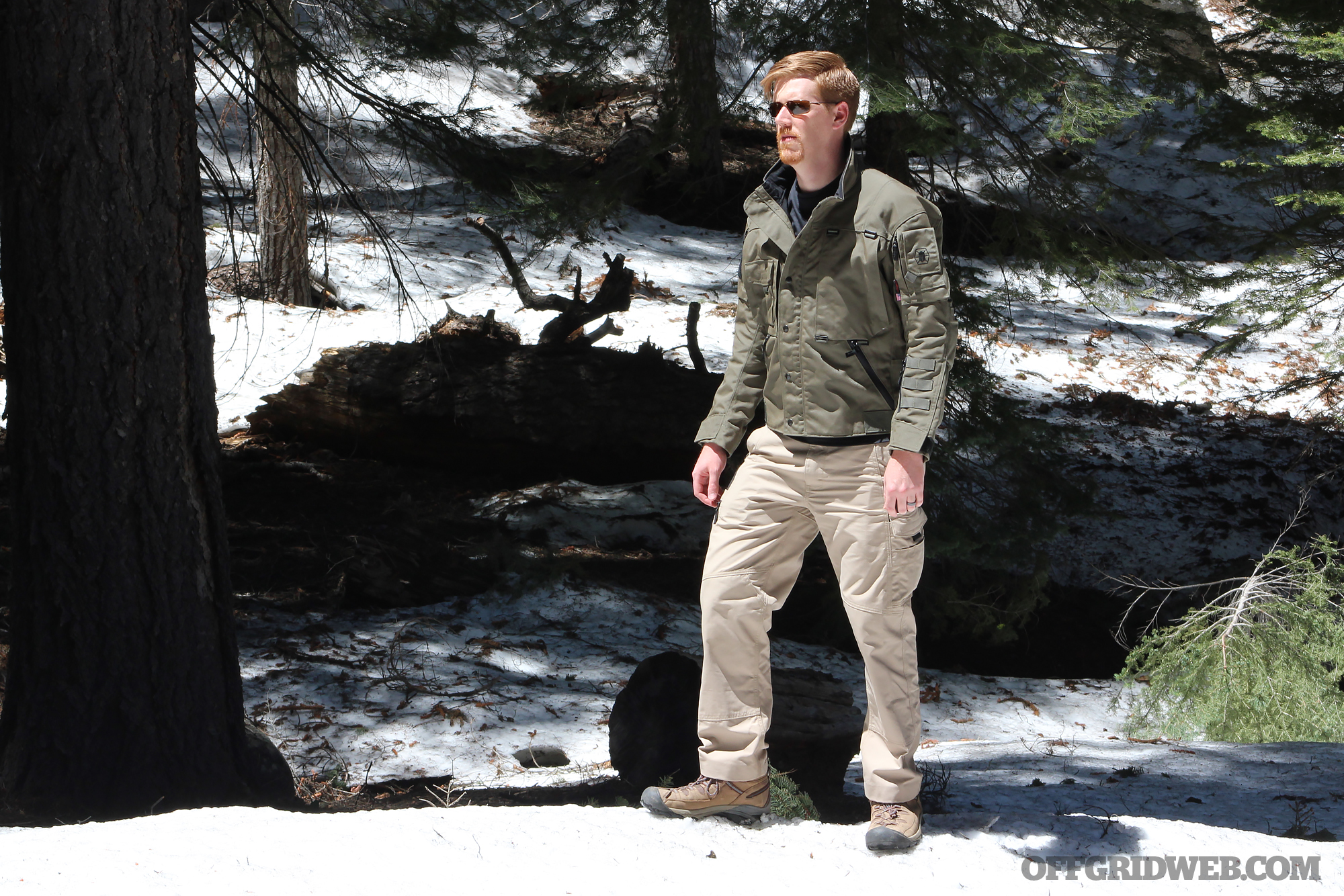
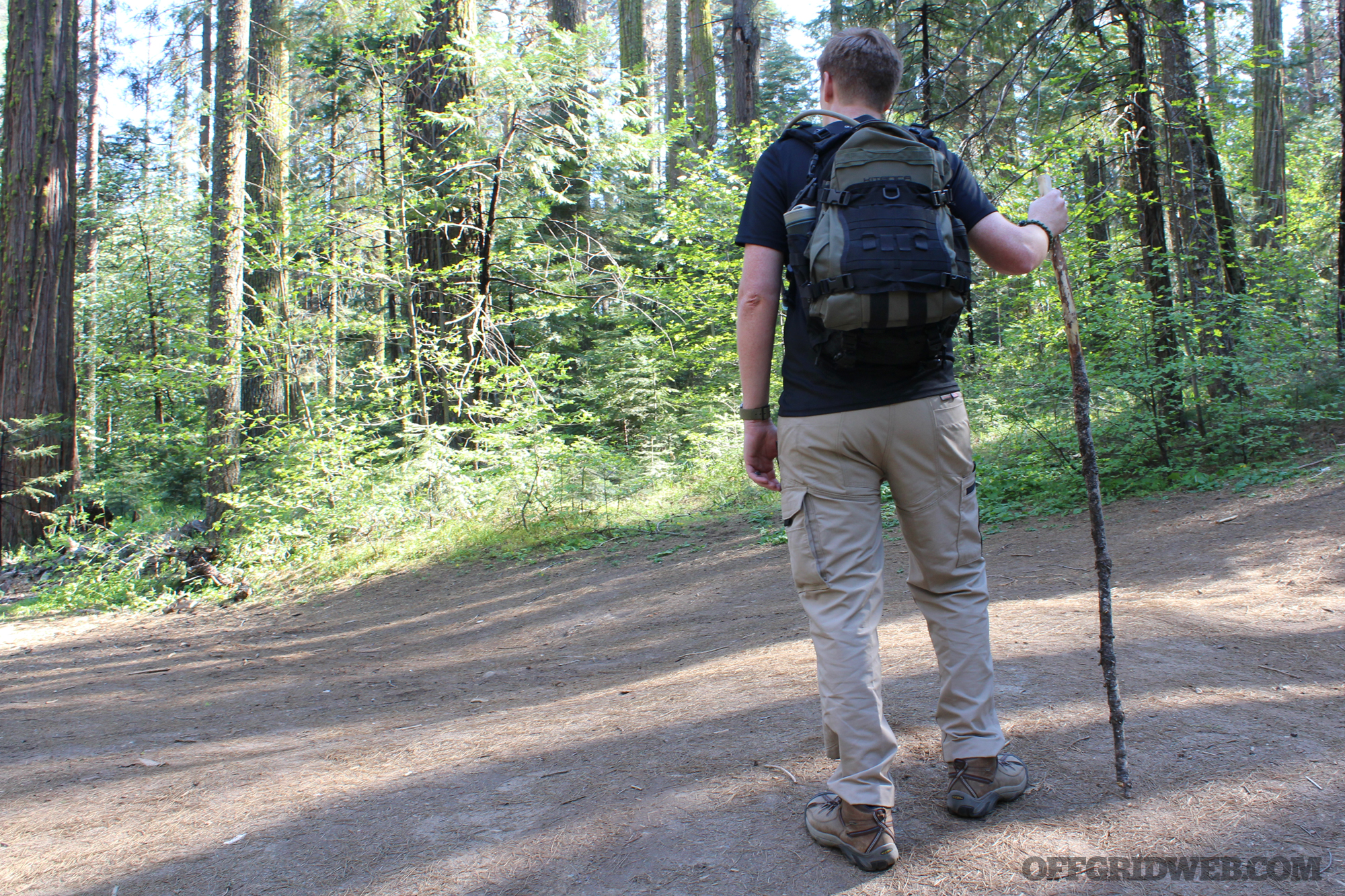
The Mark IV is currently only available in this Ranger Green color, and sizes range from small to XX-large. A sizing chart is available on Kitanica’s web site, and we recommend taking precise measurements before placing an order to ensure the jacket will fit you properly. (Note: This reviewer, pictured below, is 6’5″ tall. So the jacket may appear shorter in these photos than it would on an average-height individual.)
Our Review of the Mark IV Jacket
After spotting the redesigned Mark IV at SHOT Show in January, our initial impressions of the jacket led us to select it as one of our Best Products of SHOT Show 2017. However, now that we’ve had some time to wear the jacket and evaluate it thoroughly, we’ll share our thoughts below.
Putting on the Kitanica Mark IV for the first time, you’ll immediately notice how tough it feels. It’s more akin to abrasion-resistant motorcycle apparel than traditional outdoor gear — in fact, we think it’d work quite well as a motorcycle jacket, especially with the optional elbow pads. But this is a survivalist publication, so we’ll focus on how it fared in the outdoors.
The 1000D CORDURA exterior does a great job of repelling dirt and moisture, and provides good insulation for cold weather. We haven’t taken it into a sub-zero environment yet, so we can’t speak to its lower temperature limits, but it should serve well as an outer shell in bitter cold with properly-layered undergarments or a Kitanica fleece liner. As for the upper temperature limits, we’d say it’s comfortable up to the mid-60°F range during moderate activity. Anything more than that and you’ll start to sweat profusely.
While the nylon construction yields excellent protection from bumps, scrapes, and the elements, it’s noticeably heavier and less flexible than a traditional cold-weather jacket. That’s not to say it impeded our ability to hike or move around normally in the outdoors, but you won’t exactly forget that you’re wearing a thick shell, either.
More than a dozen pockets and pouches make this jacket an asset for for bushcraft, survival, or even a fall or winter day at the range. It’s just up to the wearer to find gear to put in each of these compartments, and to organize it in a memorable fashion. The chest pockets accommodate gloves and a beanie, while the arm pockets can be used for maps, a compass, and other navigational tools.
From a gray man perspective, this jacket clearly stands out in a crowd, and it’ll even turn the heads of passersby in the backcountry. Depending on the message you’re looking to send, and the apparel worn by those around you, that can be a good thing or a bad thing. Either way, the Mark IV certainly makes a bold visual statement. You might even feel like you’re walking off the set of an action movie — Kitanica gear has been featured on the silver screen in The Fate of the Furious,Jumanji, and Captain America: Civil War.
Now for the elephant in the room: the Mark IV will set you back $669. Before you spit out your coffee, remember that it’s an American-made jacket built from top-shelf materials with incredibly intricate construction and stitching throughout. That simply doesn’t come cheap. Also, we have no doubt whatsoever that this jacket will last for many decades of use and abuse — it might even be an economical choice if you’re tearing up $200 jackets every few years.
Overall, we found the Kitanica Mark IV to be a great choice for cool-weather outdoor treks. Like any apparel, there’s a tradeoff between protection and weight/flexibility — this jacket favors the former. Its price may also be a deal-breaker for budget-oriented preppers. But the Mark IV certainly feels just as solid and durable as we’d hoped, looks like nothing else on the market, and is made in the USA to a high standard of quality.
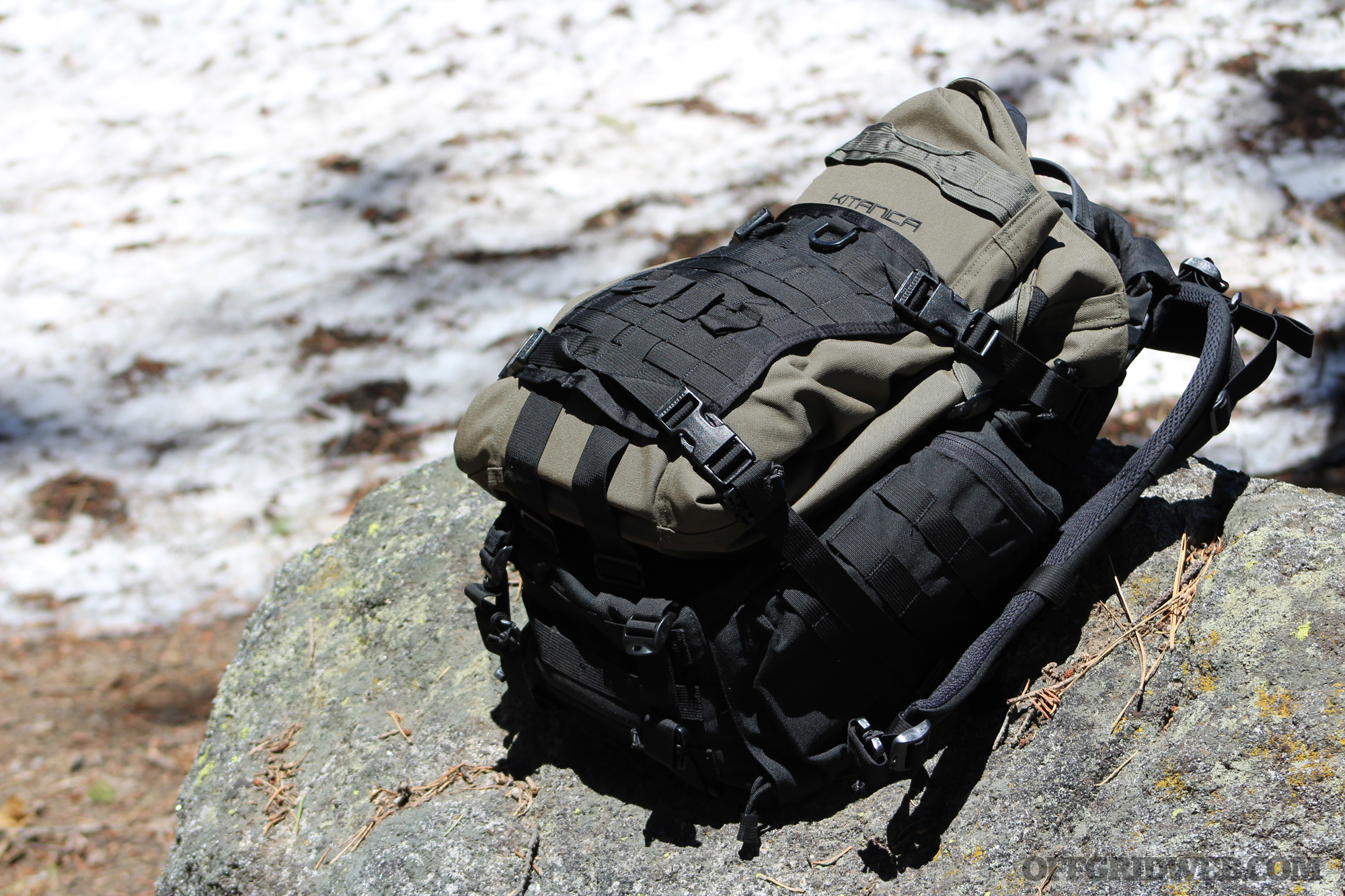
The Mark IV stowed nicely inside the transporter tail on our Triple Aught Design FAST Pack EDC.
Pros:
Extremely tough, like a cross between motorcycle apparel, workwear, and an outdoor jacket
Versatile pocket configuration with tons of storage space
Good insulation and water-resistance for cold-weather use
Distinctive appearance makes a bold style statement
Cons:
Price may make it unattainable for many survivalists
Dense nylon shell is durable, but also heavier and less flexible than other cold-weather jackets
Distinctive appearance can also draw unwanted attention in many settings
Bonus Review: Kitanica RSP Pants
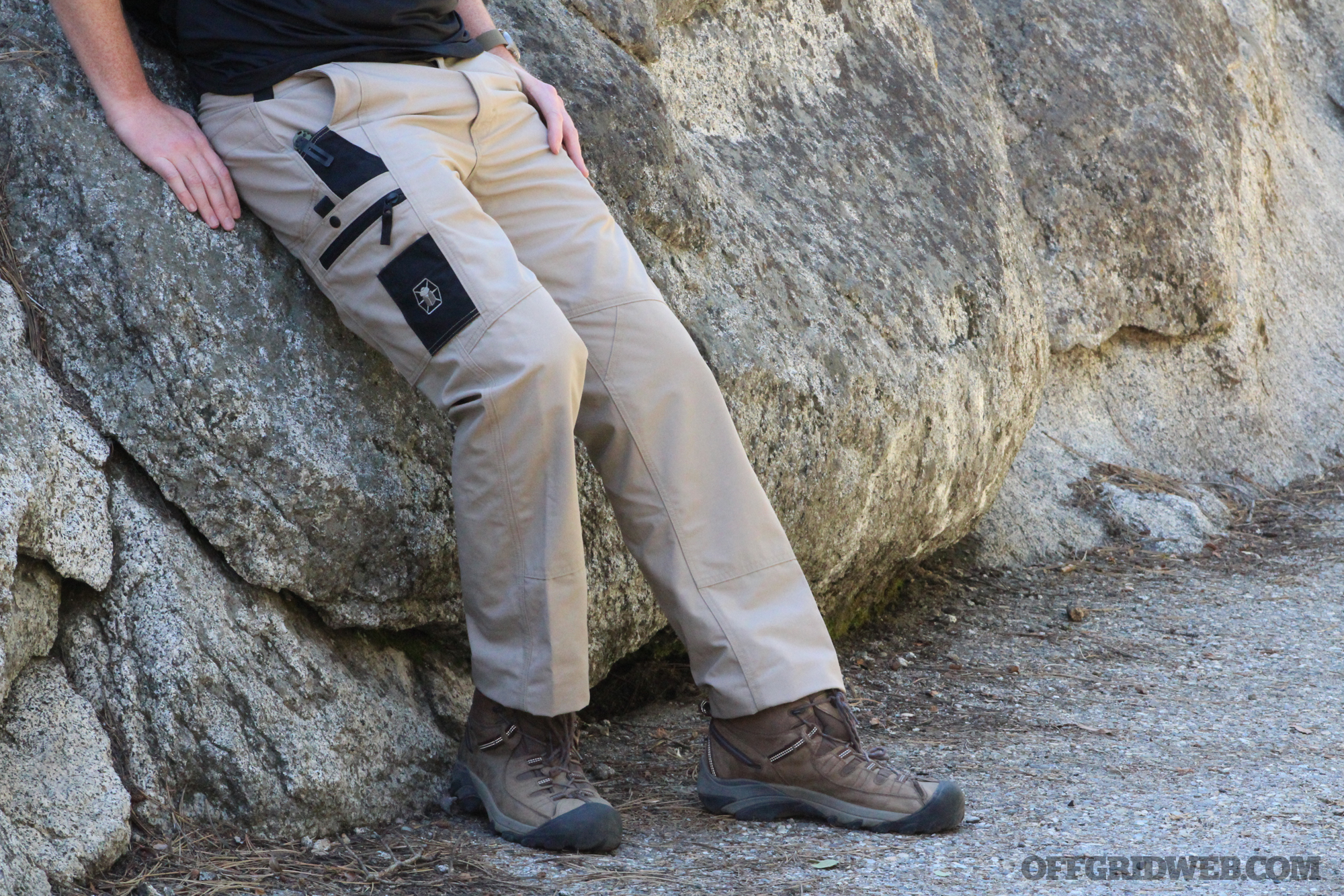
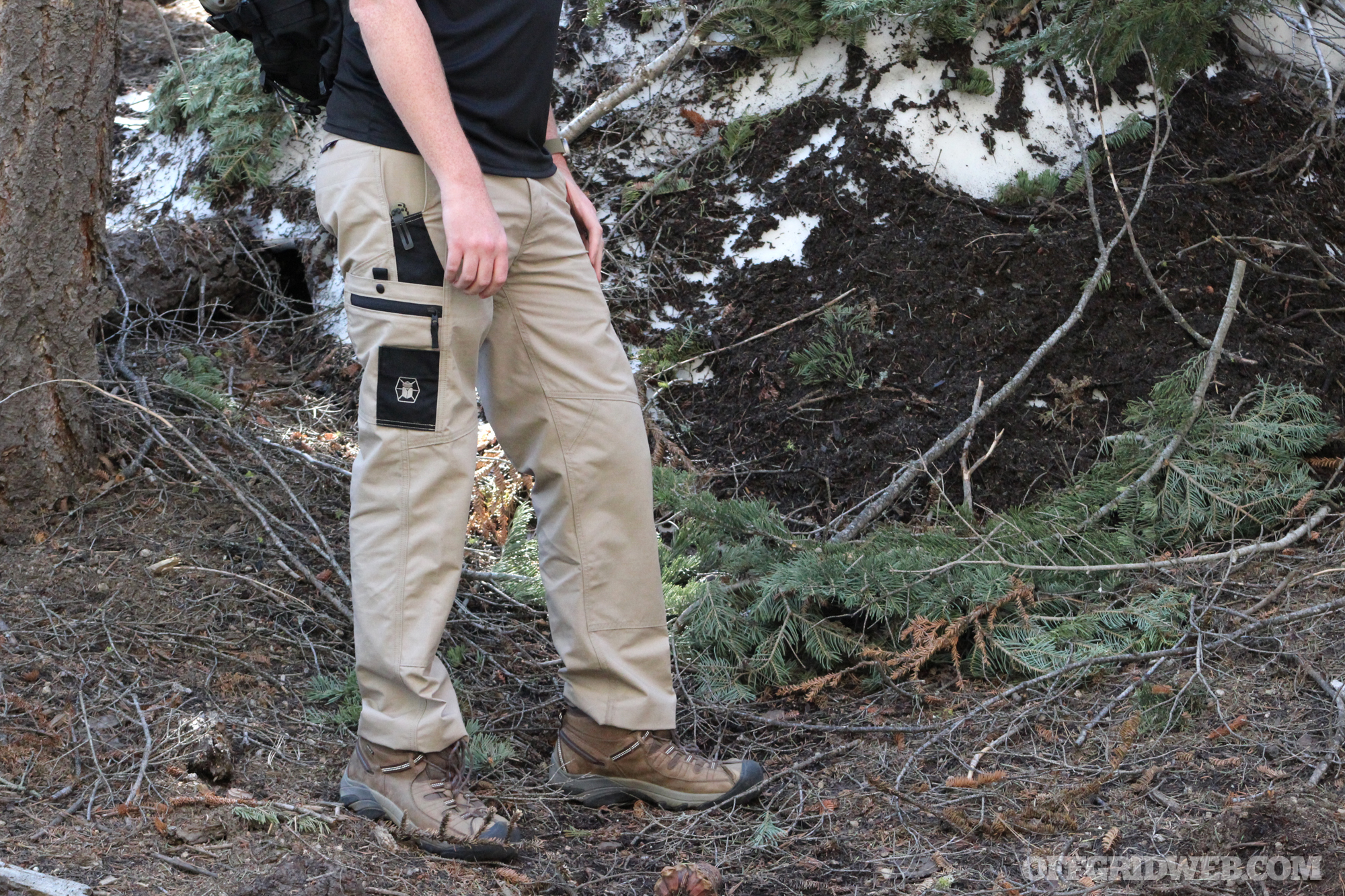
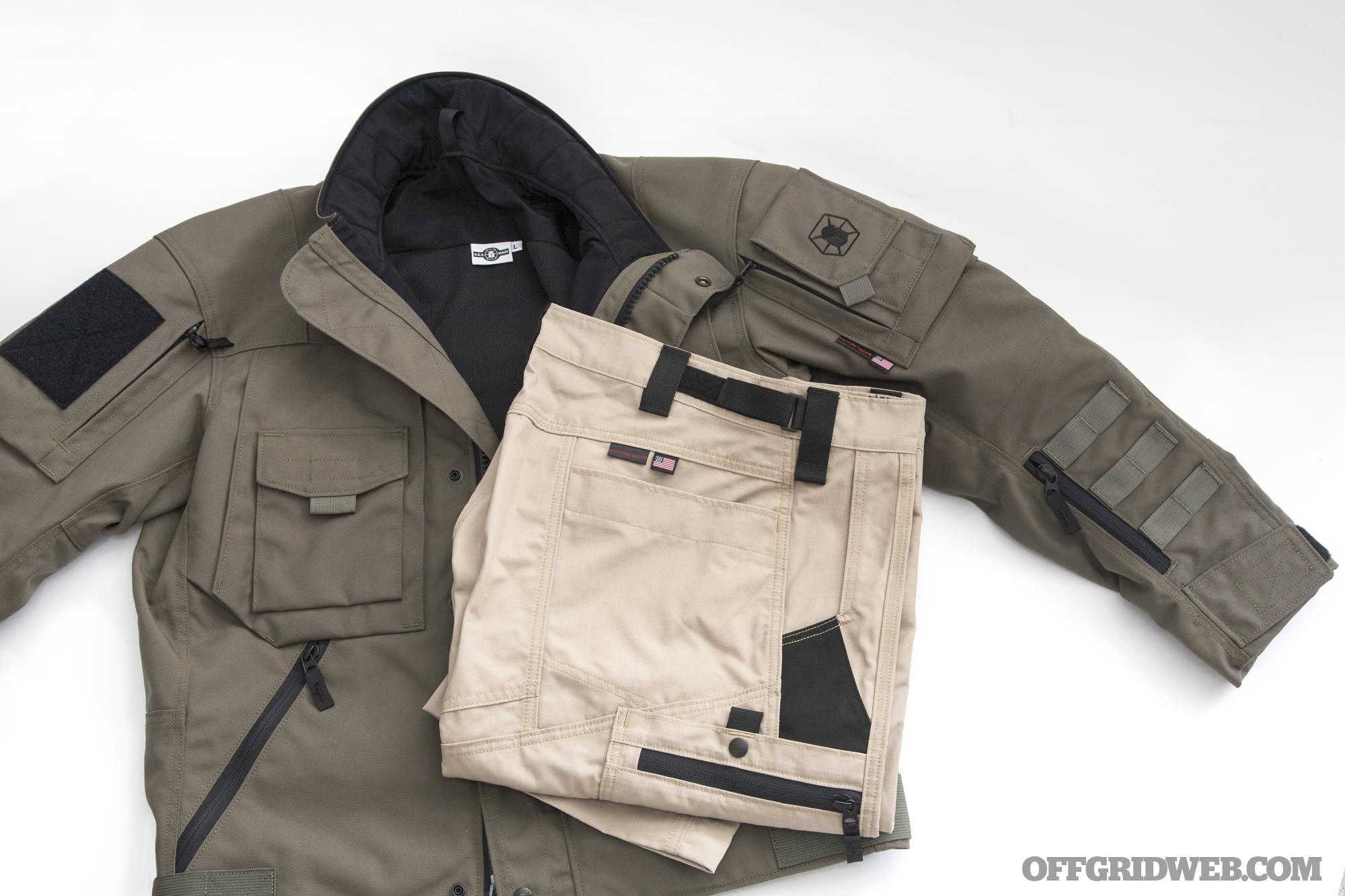
As you may have noticed from the photos above, we also requested a pair of khaki Kitanica RSP pants to test alongside the jacket. While they’re not the primary focus of this review, we’ll also share some feedback on our experience with these pants.
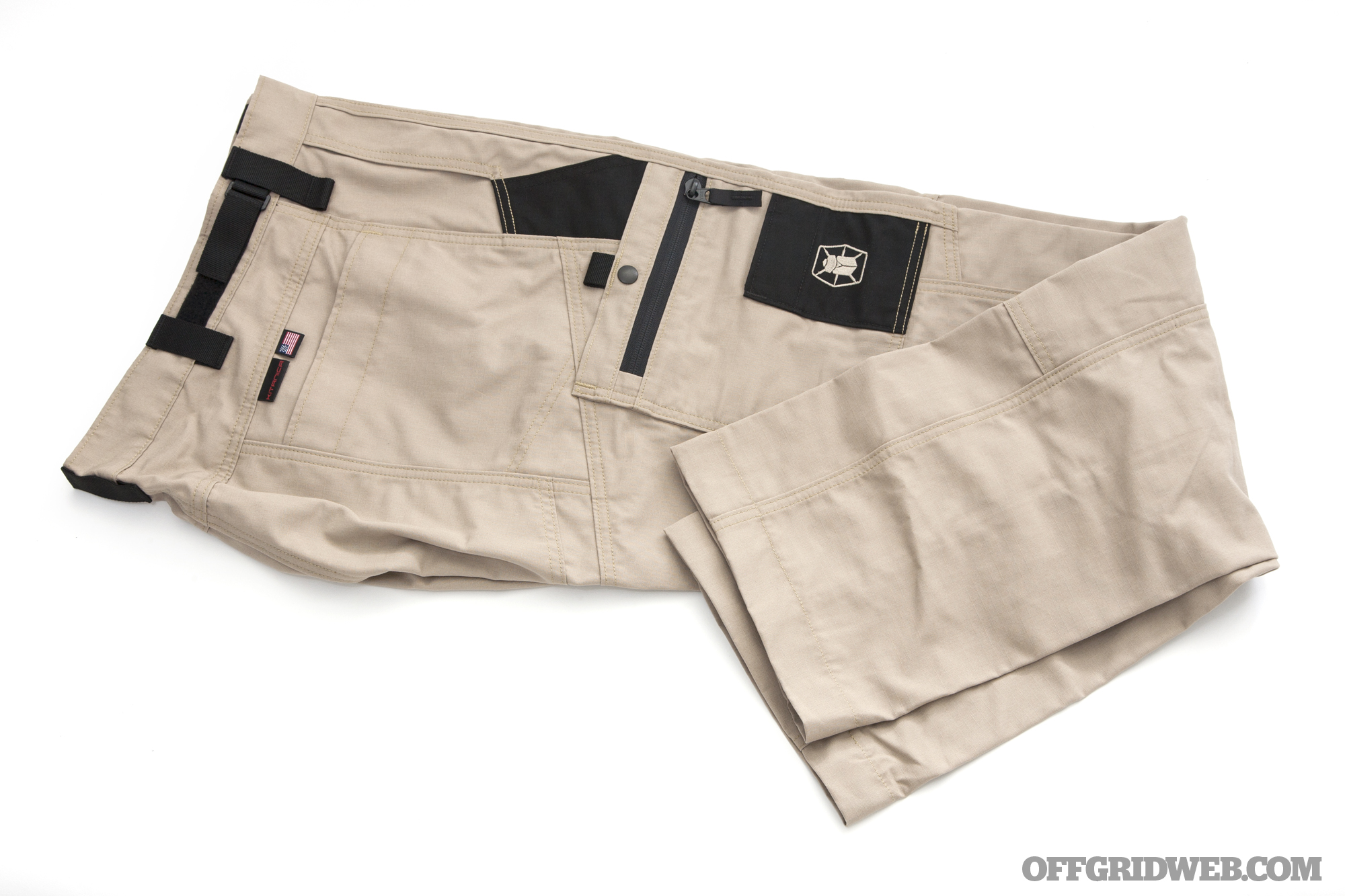
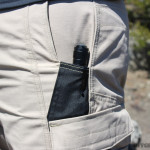
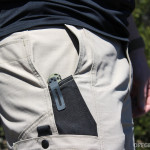
The RSPs are constructed from durable 50/50 nylon-cotton (nyco) ripstop fabric. The black pocket corners are made from wear-resistant CORDURA fabric, which is designed to stand up to abrasion from the clips of folding knives, flashlights, and other EDC gear. We found the materials to be tough and comfortable enough for longer multi-day hikes. The nylon-cotton blend provides a good middle ground of breathability and toughness.
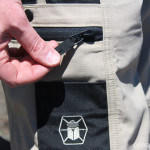
These pants feature 8 pockets, most noticeably the low-profile cargo pockets on each thigh. The asymmetrical design offers a good variety of storage compartments, from the bug logo pocket (the perfect size for an Altoids tin) to the larger snap, velcro, and zippered pouches. It’s always easy to remember where your gear is stowed, and when the pockets are empty, they don’t balloon out like those on old-school cargo pants.
One point worth noting is the importance of taking waist measurements (yes, using a tape measure) before ordering these pants. Do not assume that if you normally wear pants labeled with a 36-inch waist size, you should order that size from Kitanica. Measure your waist, check the Sizing Information tab on the product page, and order accordingly.
This reviewer requested a 36-inch waist, but in retrospect, a 38-inch waist would’ve been preferable. The velcro cinch straps allow the wearer to downsize the waist by as much as 3 inches, so heed Kitanica’s advice: “when in doubt, go with the larger size.” The pants we received still fit comfortably, but don’t offer as much room for cinch strap adjustments as a larger size would have.
Also, Kitanica pants are typically only available in one standard leg length: 34 inches. Most buyers will need to get them hemmed to fit, or roll the excess. If you need a size longer than 34 inches, Kitanica sometimes offers special runs of 37-inch-leg pants.
The Kitanica RSPs retail for $149, and are available in black, khaki, and navy blue. Sizes range from 30×34 to 42×34, though availability varies based on color. Overall, our experience with the RSP pants was positive, and we’re looking forward to wearing them on more adventures in the future.
Pros:
The nylon-cotton ripstop fabric provides an excellent balance of breathability and wear-resistance.
Kitanica’s asymmetrical pocket design is intuitive and offers good organization.
Pockets expand to carry larger items comfortably, but remain slim and flush with the body when empty.
Cons:
Only available in 34-inch leg length, so you’ll likely need to get these hemmed or roll the cuffs.
The metal zipper pull on the right cargo pocket jingles as you walk. If this bothers you, you can cut it off with tin snips and add some paracord.
Proper sizing requires careful waist measurement and cross-referencing with the sizing chart. We recommend ordering one size larger than you’d normally wear, and using the cinch straps to adjust down to your size.
Additional text by Steven Kuo. Photos by Firelance Media, Patrick Vuong, and Steven Kuo
Picture the worst of the worst. Another Hurricane Harvey catastrophe. Maybe a man-made crisis akin to the 1992 Los Angeles riots. Or perhaps it’s one of those end-of-days scenarios — say, a pandemic — in which you’re forced to flee to your secret bug-out property. After seeking shelter and making sure your loved ones have plenty of food and water, you focus on the next necessity: fire … and firepower.
In many survival situations, having a firearm (and knowing how to use it) may prove the difference between seeing a new dawn and, well, death. And when it comes to guns for survivalists, the AR-15 is an excellent choice. Mike Pannone, a veteran of both U.S. Army and Marine Corps special operations units and owner of CTT Solutions, says, “The AR is hands down the best survival rifle out there. It’s arguably the most forgiving modular system that’s ever been created.”
Eugene Stoner’s design is a jack-of-all-trades. An AR-15 can be set up in almost endless configurations to suit a variety of applications.
“The AR-15 is many guns in one,” says Kevin Estela, founder and lead survival instructor at Estela Wilderness Education. “With a single lower receiver, the survivalist can have one upper receiver set up as a carbine, another as a lightweight precision rifle, and another in a different caliber like .300 BLK, .458 SOCOM, or .50 Beowulf.”
It’s this adaptability that makes the AR-15 a go-to firearm for preppers and survivalists. After all, adaptation is just a synonym for survival.
With that said, we’re zeroing in on entry-level AR-15s that won’t cost more than a grand. After all, not every prepper can fork over two G’s for a badass rifle. Most of us working-class stiffs need to maintain a financial reserve for other necessities, such as rent and weekly groceries — let alone a six-month food cache and medical supplies. So, whether you’re looking to spend no more than $1,000 on your first AR-15 project or eyeing another gun that won’t implode your wallet, here are a few factors to consider before expanding your SHTF arsenal.
Entry Level AR-15 Advantages
Portability: AR-15s are available in handy and lightweight configurations; Pannone explains, “They make great mountain rifles.” An AR-15’s upper and lower receivers can be separated and stored in a case or backpack in a matter of seconds. While it’s not as concealable as a pistol, a broken-down carbine is far more portable than, say, an over-and-under shotgun, despite advocacy for the latter by certain former vice presidents.
Modularity: The AR-15 is the LEGO of the firearms world. No other powder-burning platform offers this type of customization. A survivalist can buy a bone-stock carbine for about $600 and — depending on your wallet size — dress it up or down for all sorts of occasions. Are you a shorter dude? Slide the telescoping buttstock forward and swap out the grip for one that fits your hand. Depleted your food cache and need to hunt before winter hits? Install a magnified optic and go forth. You could swap in a 6.5 Grendel upper receiver or just use 5.56 — it wasn’t designed for it but can definitely harvest larger game. If stealth is a priority because you’re afraid marauders might trace you back to your bug-out location, slip on a suppressor.
Lightweight and easy to handle, the AR-15 has enough firepower to handle a number of post-SHTF functions.
Shootability: The AR platform is renowned for its ergonomics and shootability. “Rifles are inherently more accurate than pistols,” Estela says. “Your average AR shooter can become as proficient as, if not more accurate than, an above-average handgun marksman.”
Frank Proctor, founder of Way of the Gun and an 18-year Army veteran (with 11 of them in Special Forces) echoes this sentiment: “ARs are easy to shoot, and they have tons of capability. It’s hard work to maintain your competency with pistols.”
Serviceability: In a survival scenario, the ability to service and repair your weapon is critical. Pannone emphasizes how easy it is to work on ARs: “You can rebarrel an AR with a punch, screwdriver, pliers, and a hammer. Once, I built an AR using a Multitasker and a hammer.” Moreover, he adds that “parts are CNC machined; you can easily interchange them, you can cannibalize them.” All this is ideal for a survival rifle.
Ubiquity: The AR-15 and its cartridge are as commonplace as skinny jeans at a hipster convention. In the event of a post-SHTF scenario, you’re more likely to find, or barter for, AR parts and 5.56 NATO rounds than more exotic ammo such as, say, .260 Remington. Estela adds that, due to its ubiquity, you’re also more likely to know or encounter someone with gunsmithing knowledge who could help with repairs if needed when your gun goes down.
Entry Level AR-15 Disadvantages
Maintenance: Due to its direct impingement mechanism, the AR can get pretty dirty with heavy use. Keep it lubricated and exercise a modicum of care — especially in a post-SHTF world — and you’ll be fine. How many sustained firefights do you expect to be in anyway? More likely scenarios include hunting and occasional defensive use. “If an AR’s not in hard use,” Pannone says, “it’ll last basically forever.”
Reliability: The AR platform is not based on a terribly complex mechanical system, but there are more things that can go wrong when compared to a simpler bolt-action rifle. AR magazines are a notorious weak point, but they’re cheap and plentiful. Buy lots of spares and you’ll be fine.
Should You Buy It?
When it comes to obtaining a budget-friendly AR-15, there are generally two routes: buy it or build it.
Purchasing a complete AR-15 is the way to go for many a prepper who doesn’t have the time, tools, or know-how to build their own. With magazines and iron sights, a stock gun comes out of the box ready to do work, requiring no assembly or modifications. And with a price tag ranging from $500 to $800, it’s within reach for most financially stable survivalists.
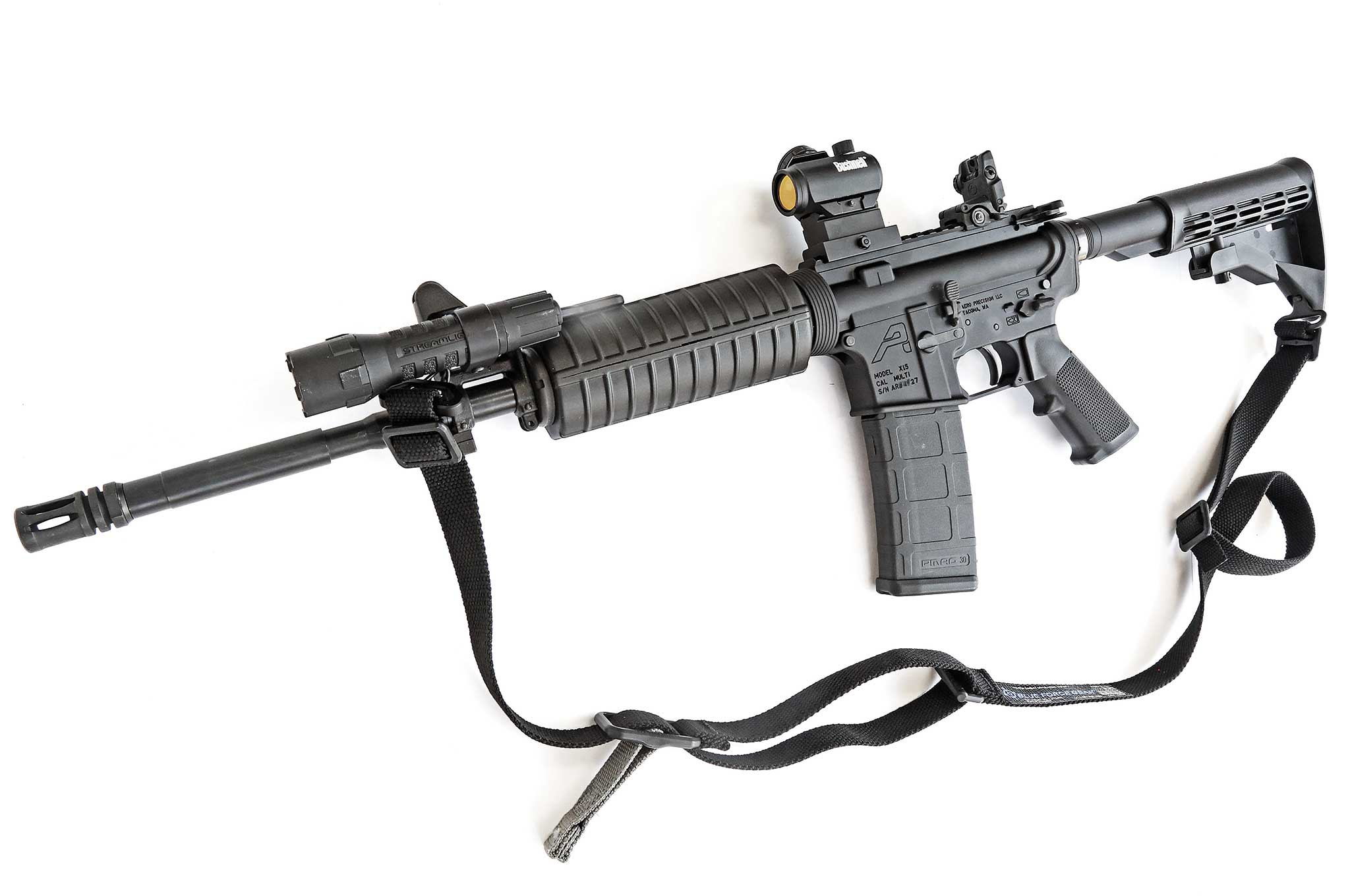
However, a stock carbine typically comes without two vital components: a sling and a weapon-mounted light. A sling for a long-gun is the equivalent of a holster for a handgun. It’s a necessity — whether you have to bug out over steep terrain or go hands-free to carry your child. Having a weapon-mounted light on a survivalist’s gun is absolutely essential as well.
“You gotta have a light,” Proctor stresses, “You need to see what you’re shooting at.” This could make the difference between shooting a bad guy and shooting your coat hanger or, heaven forbid, a loved one.
To demonstrate how to overcome these drawbacks, our editor Patrick Vuong set out to prep a stock carbine for a total cost of $1,000 — or less.
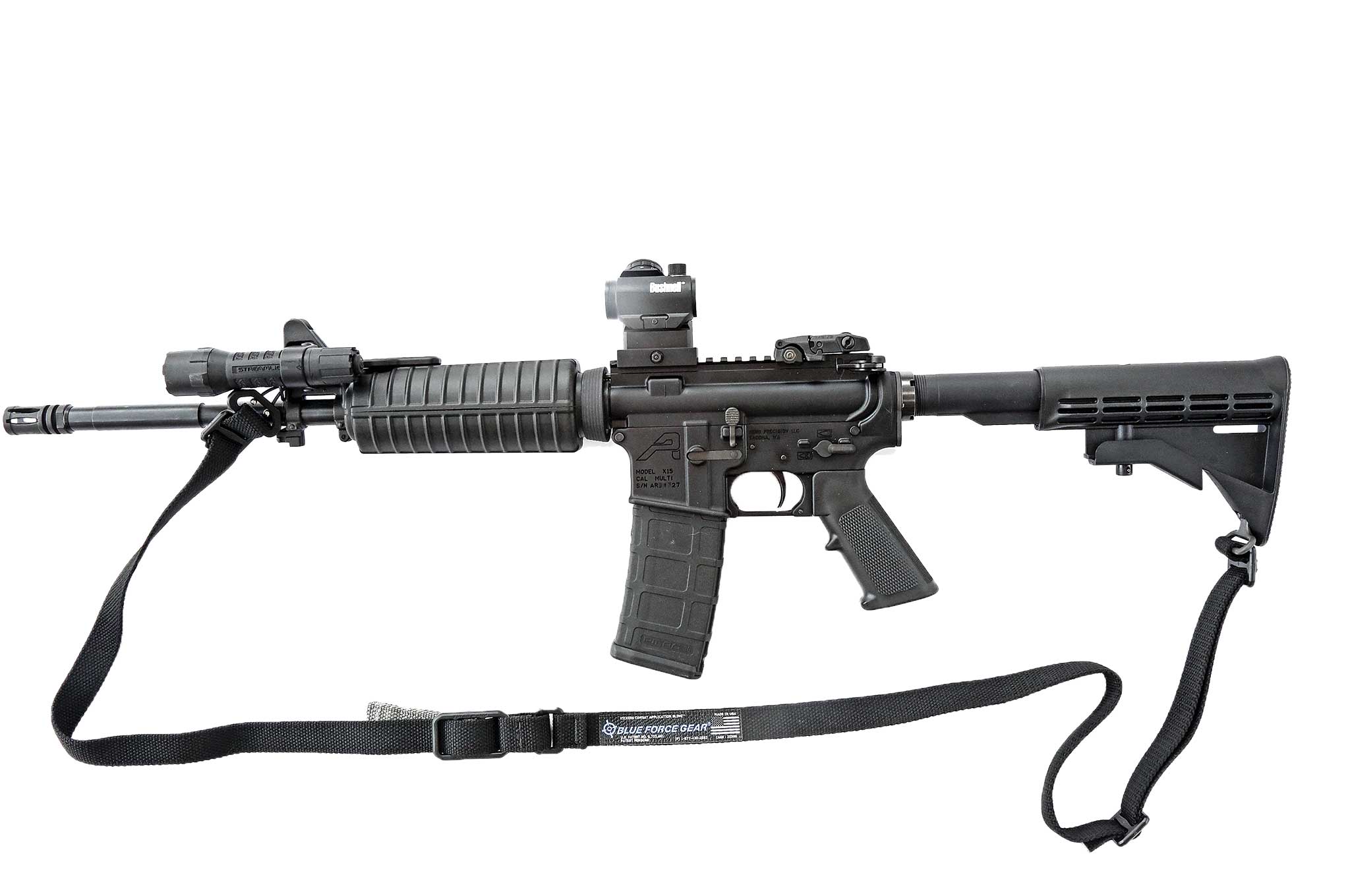
The foundation for his budget AR project was the Aero Precision AC-15. This complete rifle has all the features you’d come to expect from a cost-efficient rifle that still maintains Mil-spec quality and is manufactured in the USA. It features a 16-inch 4150 chromoly vanadium barrel, carbine-length gas system, and a Magpul MBUS Rear Sight paired with the standard A2 flash hider. While it has an MSRP of $699, we’ve seen it online for $500.
We chose a $43 Vickers ONE Sling from Blue Force Gear because it’s a lightweight model with a minimalist two-point design. This presented our first problem in the buy-versus-build debate: the AC-15 didn’t have a sling attachment point in the front. While it came with a sling swivel installed on the buttstock, there was no corresponding mounting point on the fore-end. Enter Blue Force Gear’s Universal Wire Loop for $25. Made of flexible nylon-coated stainless steel wire, this little device lets you attach a sling through eyelets, loops, slots, or any other opening on almost any long-gun.
Next up, we found our lighting solution in the Streamlight PolyTac. Unlike comparable models that cost two to four times as much, this reliable light puts out 275 lumens for a max of 65 hours and a range of 213 yards for just $69.
Now, the next complication: how to attach the light? Most entry-level carbines have just one Picatinny rail on the upper receiver. We could replace the standard M4-style handguard with a free-floating rail (to attach a light and other goodies), but we wanted to see what our options were, and how much we could save. So, we installed the TMC 1-Inch Light Mount-N-Slot at the 11 o’clock position. It attaches to the top vent holes on any standard M4/M16-style handguard using the included hardware and tools. It retails for $60, but we’ve seen some online vendors sell it for $50. This setup might feel a little cramped, but it works just fine.
With our project clocking in at $897 (or $657 in street prices), we were well under our $1,000 max. Success.
With the extra wiggle room, we added two additional parts that would greatly enhance the AC-15: a Bushnell TRS-25 HiRise red-dot optic and a JARD ARJ trigger kit. We recalculated. Our project would cost $1,045 based on paying retail but only $810 with street prices. That left $190 for ammo.
With some judicious online shopping and a few easy installations, we gave our stock AC-15 a mild face-lift that exponentially increased its functionality and performance. On the bench, the AC-15 pleasantly surprised us with 1.1 to 1.4 MOA 5-shot groups with Freedom 55-grain and an impressive 1 MOA best group with Gorilla 69-grain Sierra Match Kings. (An MOA is an angular unit of measurement that equates to roughly 1 inch at 100 yards.) With a carbine-length gas system on a 16-inch barrel, it’s jumpy and rough (for an AR) but reliably ate everything we fed it.
Should You Build It?
While our head editor chose to buy an AR, contributing editor Steven Kuo sought superior results by building his own. By investing some sweat equity, you can configure your rifle exactly to your desired specs with the specific components you want — no need to swap out parts you didn’t ask for in the first place. If you’re patient, you can slowly collect all the parts you need by taking advantage of promotions and sales to keep your costs down.
But we offer a note of caution as well — if you’re building your own survival rifle, be sure that you’re willing to stake your life on your handiwork. Proctor suggests that “if someone knows what they’re doing, DIY is a good way to go.” But he notes that of the rifle malfunctions he observes in his classes, many are the result of students who made mistakes in assembling their own weapons. The more experience and practice you have at it, the better.
Plan your build carefully and channel your most OCD self when putting it together. Then run your gun hard and make sure it’s up to the task.
For this DIY project, we had a target budget of $1,000 at street prices. That’s tough to achieve and, as always, involves making some trade-offs. Generally speaking for this build, we focused on creating a solid foundation that could continue to be upgraded over time. For instance, the basic furniture can easily be replaced as funds allow.
Building your own AR allows you to select that just-right-mix of parts and features that’ll best serve your needs.
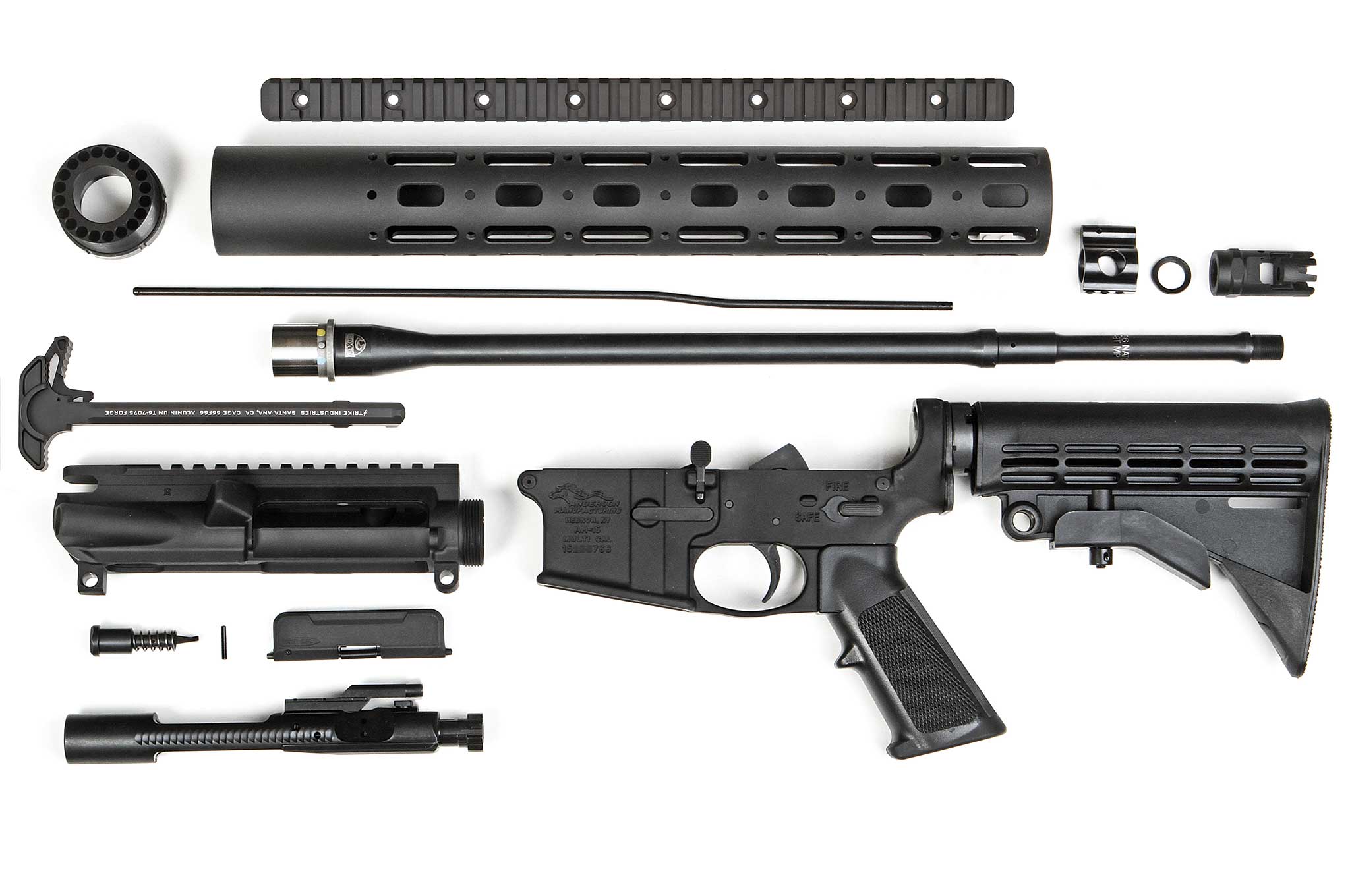
We started with a receiver set from Anderson Manufacturing that was very economically priced. Because we’re detail-oriented gun nerds, we stripped it down and threw it on a Bridgeport mill with a digital readout to check that everything was in spec. First, the bad news: The castle nut on the complete lower receiver wasn’t staked and easily spun off the receiver extension. However, that was simple to remedy. The good news: All dimensions and holes were completely within spec.
As a general purpose survival rifle, our goal was to build a handy, light, reliable, unfussy, jack-of-all-trades. Going with an 18-inch barrel with rifle-length gas system meant that we’d enjoy good muzzle velocity and have a forgiving and soft-shooting gun. Pannone notes that “20-inch barrels are very forgiving, and while 18-inchers lose some gas pressure, if the gas port is cut right, it doesn’t matter.” We tested our Faxon Gunner-profile 18-inch barrel with light loads, and it ran like a top. Furthermore, it was very controllable with a soft recoil impulse using standard components — no need and no desire for adjustable gas blocks, lightweight bolt carrier groups, and custom buffers in a survival rifle. We paired it with AIM Surplus’s black nitrided Mil-spec bolt carrier group, a cinch to maintain.
The Faxon barrel liked 55-grain ammo, turning in 1.2 to 1.5 MOA 5-shot groups. Our 69-grain match ammo didn’t fare quite as well, with groups ranging from 1.4 to 1.8 MOA.
An extra long Nordic Components handguard perfectly sheathes the 18-inch barrel and provides a lot of real estate for accessories and the shooter’s support hand. The economical and bright Streamlight TLR-1 HL perches comfortably at 12 o’clock on the rail, easily actuated by either hand.
Strike Industries offers a line of nicely designed AR parts at hard-to-beat prices, which we used to finish off the upper receiver and cap off the barrel with a muzzle brake. Then we took a Dremel and sandpaper — can’t have a home gunsmithing project without breaking out the Dremel — to the stock A2 pistol grip to remove the annoying finger bump and save money on furniture. The Way of the Gun’s Proctor Sling is low priced and extremely versatile, with smooth adjustment and built-in loops that can be easily attached to any weapon without any additional hardware. Note that it’s a minimalist sling, so it doesn’t have any padding that might ease your load on long treks.
With the limited remaining budget, a Bushnell TRS-25 HiRise completed the project. The optic was chosen for the DIY project independently of the AC-15 build, a testament to its popularity as a capable budget red-dot.
You might notice we haven’t discussed the trigger (and that the photos show a stock trigger). Many on the editorial staff are trigger snobs, including yours truly, and high-end triggers are expensive. So the original intention was to leave the trigger for a future upgrade after securing additional funds. However, upon a recalculation of street prices after our photo shoot, we found enough leftover to splurge on the moderately priced ALG Defense ACT. It’s like the ultimate Mil-spec trigger, with a clean, consistent break (ours at just over 5 pounds) and minimal overtravel. It gets the job done, is dead-nuts reliable, and was a great addition.
All told, we tallied up a street price of $1,008 and an MSRP of $1,288; sorry we’re $8 over — skip that venti latte for a couple of days and you’ll be fine. The total build as shown weighs in at a half ounce under 7 pounds. Given additional budget, we’d consider easily installed upgrades such as new furniture, a better trigger, and a low-power variable optic (budget aside, a trade-off in capability versus weight).
What About Turnkey?
In times past, AR consumers only had two options to get the rifle they wanted. The first was to purchase a stock carbine and upgrade it a la carte. This often leaves the buyer with extra parts that they won’t use and can’t get rid of. Adding or swapping out parts on an existing base gun can also lead to a lot of redundant purchasing.
Alternatively, you can “roll your own” as Steven did, and build the entire rig yourself. While this will get you exactly the specs you want, it takes hours upon hours of research to 1) figure out exactly what parts you want and 2) find them in stock at the right price. Franken-gun builds are often tedious and time consuming, with the physical construction of the rifle being the easiest part.
But manufacturers are beginning to put their fingers on the pulse of the market, and several are coming up with prepackaged solutions that include, out of the box, some of the more common aftermarket accessories.
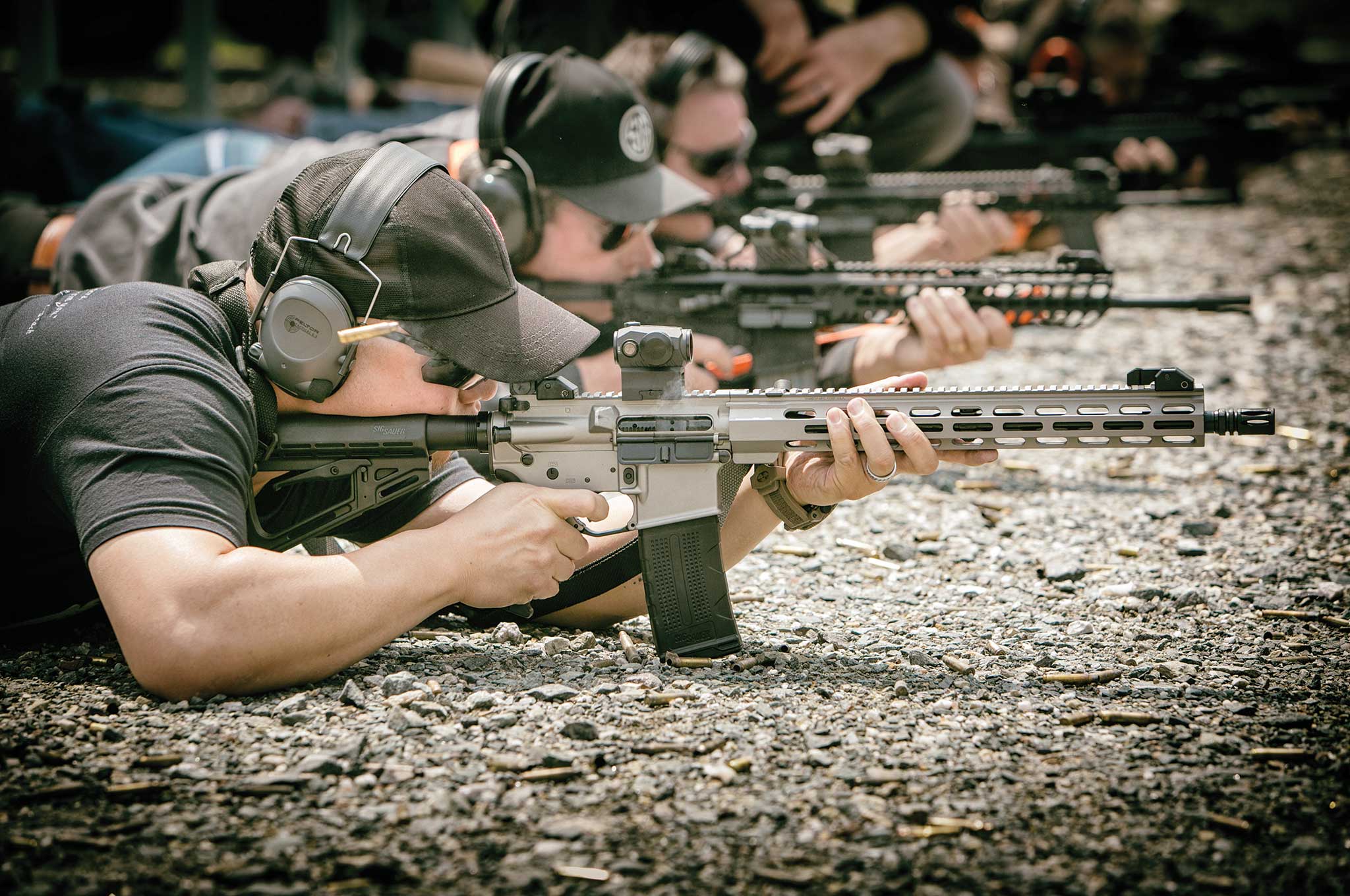
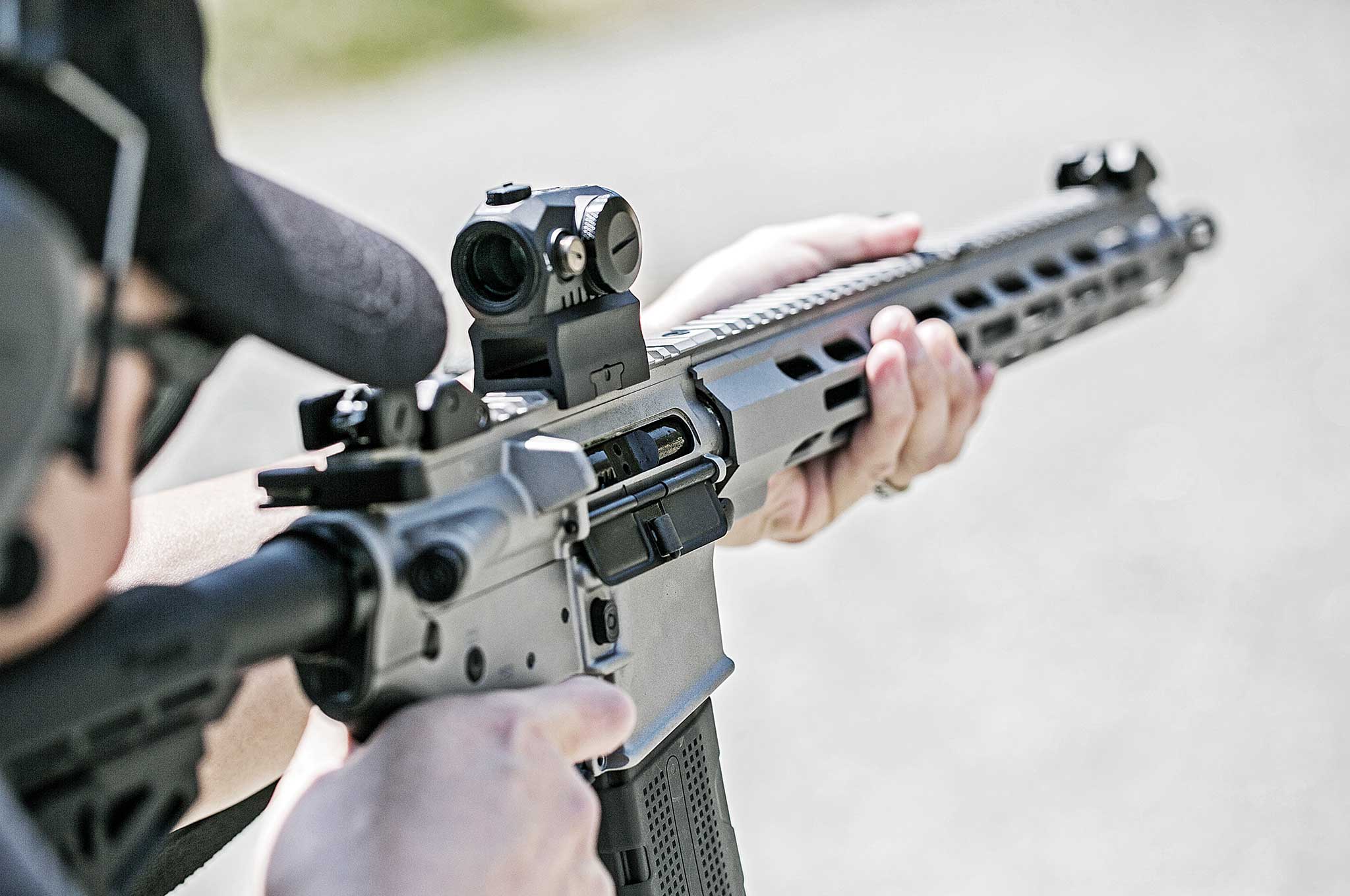
SIG SAUER’s M400 Elite is one such example of an “upgraded entry-level” offering. It comes with features not typically found on entry-level AR-15s: a red-dot sight, a free-floating handguard with low-profile M-LOK accessory mounting points, an enhanced factory trigger, more ergonomic grip and buttstock, and a 16-inch nitride barrel equipped with SIG’s Micro-light Gas Block. If you were to assemble similar options on a stock gun, the total price could be closer to $1,800. SIG offers the M400 Elite for $1,359, or $1,200 without SIG’s ROMEO5 sight.
We had the opportunity to test this rifle at the SIG Academy in New Hampshire and can attest to the quality of the parts installed.
The M400 Elite was comfortable to handle during a daylong rifle course, thanks to SIG’s proprietary furniture and sleek handguard. Though the Enhanced SIG Trigger didn’t wow us, it had no over-travel and the reset was short. Targets were quickly acquired with the ROMEO5’s 2 MOA red-dot. And though we obviously didn’t have five years to test its claim of a 40,000-hour battery life, the sight’s motion-activated illumination is handy for power conservation, especially in long-term survival situations where you won’t find a bounty of CR2032 batteries lying around.
Is it as elite as its name implies? No. But did we enjoy it? Quite a bit. If we had an extra $200 to $400 in our budget, we would seriously consider the M400 Elite as a convenient out-of-the-box alternative.
Having a gun is just one part of the survival equation. The other is ammunition — and lots of it.
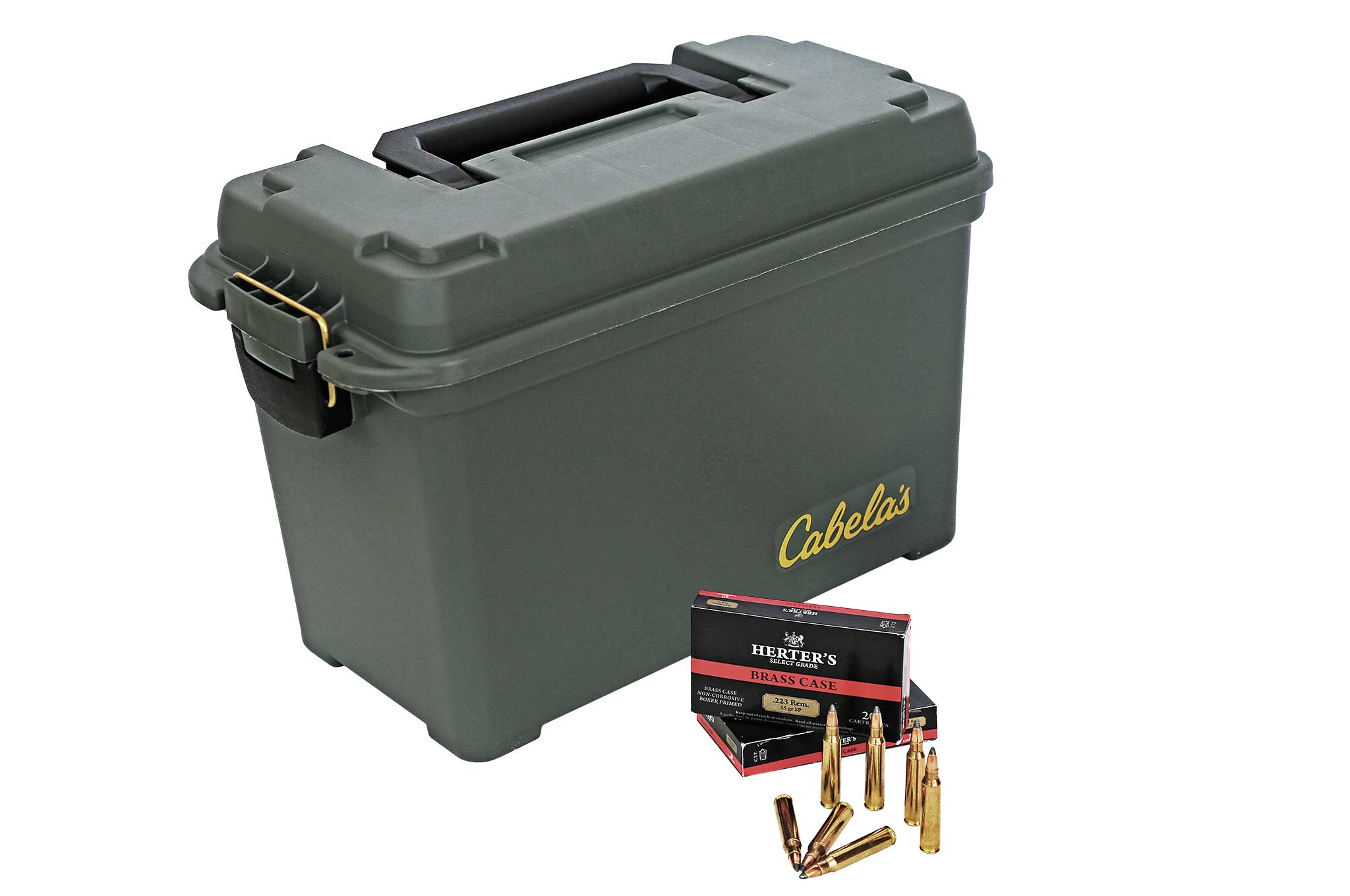
Cabela’s makes it convenient to order the ammo and store it for the long haul with the Herter’s Select-Grade Bulk Rifle Ammunition with Dry-Storage Box combo. Select from almost two dozen calibers — from .223 to .338 — each with a set quantity. For example, you can get either 200 or 500 rounds of 55-grain .223. The Herter’s ammo comes with a Cabela’s Dry-Storage Box, a heavy-duty waterproof container that’s designed for easy stacking and long-term storage. Prices range from $80 to $380. www.cabelas.com
Tool Kit
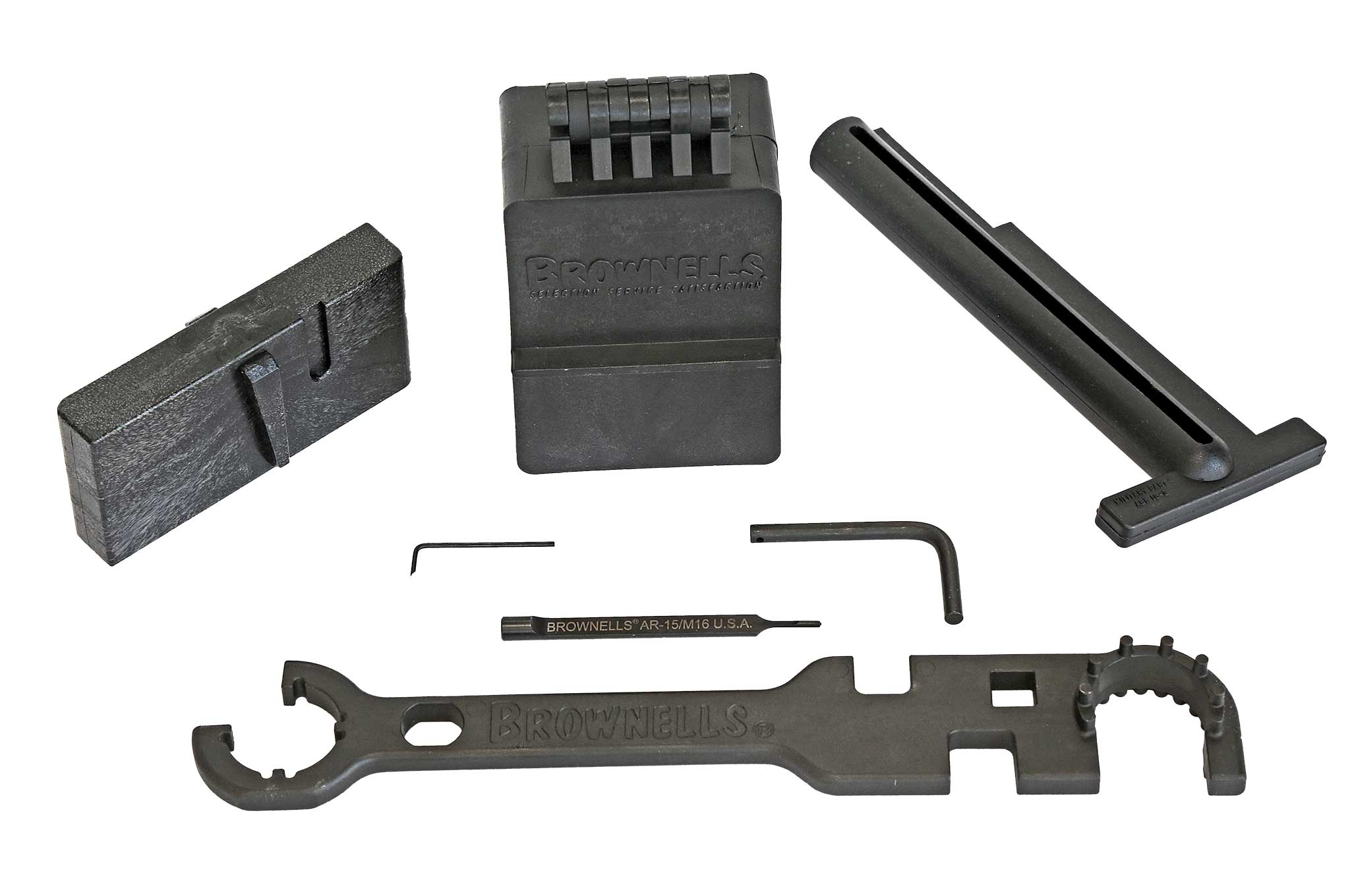
You don’t have to be a gunsmith to repair your rifle, but you do need the right tools. Sorry, but duct tape and a four-piece Craftsman screwdriver set won’t cut it. Fortunately, the AR-15/M16 Critical Tools Kit from Brownells contains the most essential items needed to fix, tinker, or tune up your carbine. This includes an armorer’s wrench (needed to install and remove a barrel), a lower receiver vise block (to hold the receiver to a vise without damaging it), and a heavy-duty clamshell upper receiver action block (which fits AR-15s with either a carry handle or a flattop rail), among other key tools — all of which are made in the USA. The kit retails for $110. www.brownells.com
Conclusion
An AR-15 is like a Jeep: classic, dependable, and versatile. You can modify it into a beast or get a SHTF-worthy blaster right off the shelf. Few guns give a survivalist that kind of freedom. But keep in mind obtaining a rifle is just the start.
“Owning an AR isn’t enough to call yourself a ‘survivalist,'” Estela says. “There are far too many people who spend more time choosing accessories than training marksmanship, malfunction drills, and transitions between weapons. Unfamiliarity and lack of firearm proficiency are a recipe for failure, not survival. Also, if your survival plan is to fight with your rifle, incorporate dynamic movement and red-line training into your readiness plan to get into fighting shape.”
So, like in most aspects of survivalism, the AR-15’s potential is limited by its owner. Whether you’re hunting for food after your cache runs out, patrolling your doomsday property, fighting off desperate raiders, or just in need of a reliable means of home defense when society is still civil, a carbine is a reliable foundation to build on. How you do that — whether paying with cash or sweat equity — is entirely up to you. Just be sure to do it before the next disaster strikes.
Potatoes — boil ’em, mash ’em, stick ’em in a stew. Whatever you do with these starchy tubers, they provide an excellent source of calories, energy-dense carbohydrates, vitamins and minerals. It’s no surprise that they’re considered one of the world’s four most important staple foods, along with corn, wheat, and rice.
Sprouted seed potatoes can be grown into a new and more prolific crop with little effort.
When we think of cultivating potatoes, we often imagine them being grown underground, since this is a common practice. However, this requires digging, planting seed potatoes, adding topsoil, and digging yet again to harvest the crop. Fortunately, there’s an easier method that’s great for home gardening: no-dig potatoes.
Seed potatoes are placed in the soil, and covered with a thick layer of hay.
This no-dig method starts with a small plot of fertile soil, such as a 4-by-6-foot area. Seed potatoes — disease-free chunks or whole potatoes which have begun to sprout — are then pushed a few inches into the soft soil. Next, hay is scattered across the plot, carefully covering all the potatoes in an opaque layer that blocks sunlight. The plot is then thoroughly soaked in water, and allowed to grow for 12 to 14 weeks.
Sticks can help keep the hay from blowing away while the potatoes grow.
The video below from Huw’s Nursery shows the easy process of growing no-dig potatoes, and the impressive results of the process. There’s very little effort or preparation involved, so this should be an easy DIY project for even the most inexperienced home gardeners.
Important note: avoid eating green potatoes. The green color indicates exposure to sunlight, which can make the potatoes toxic and inedible. While rare, poisoning from the glycoalkaloid compounds in green potatoes can cause headaches, diarrhea, cramps, or even coma and death. If there’s any doubt, toss the potatoes into your compost pile or use them as seed potatoes for the next crop.