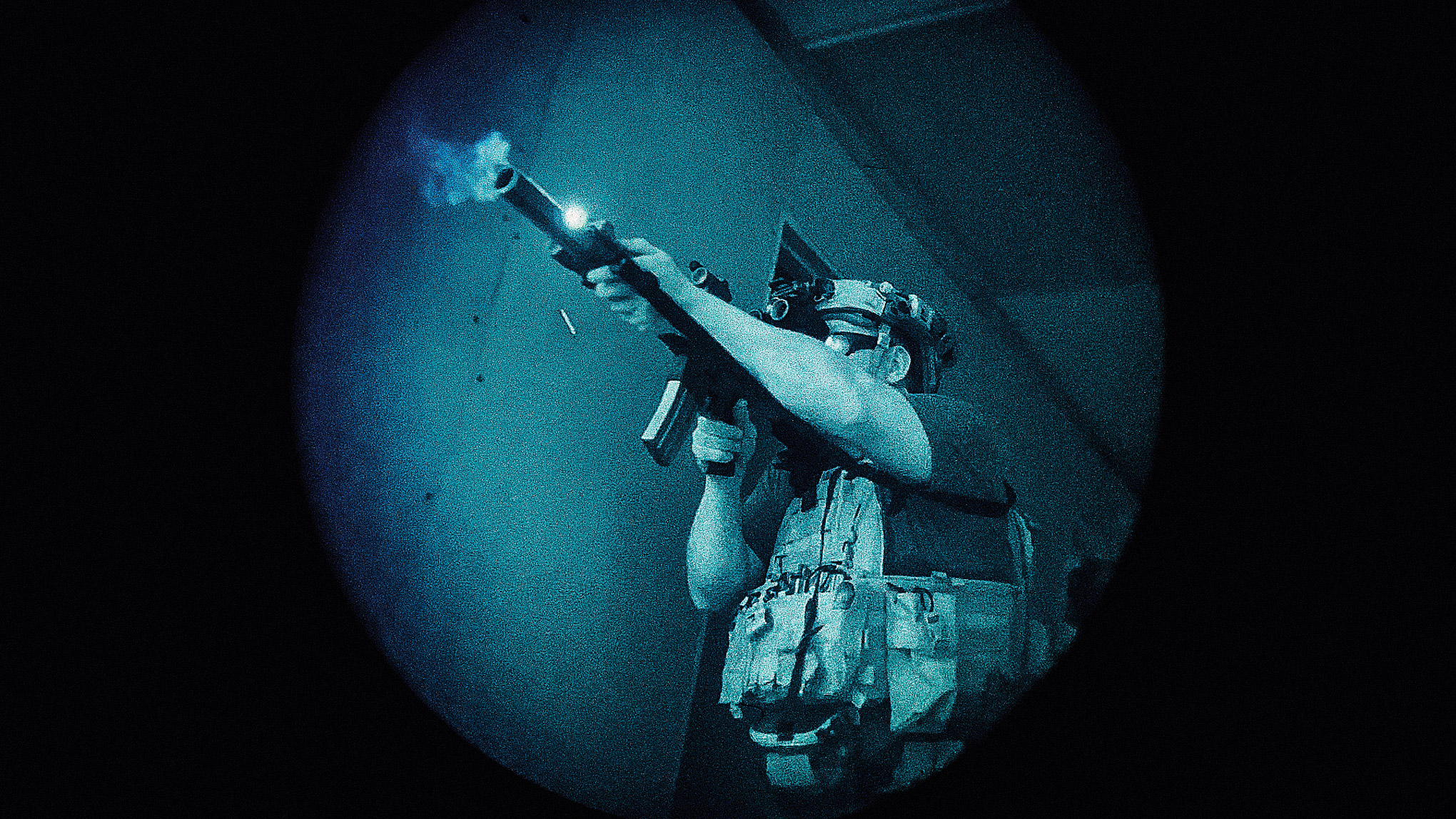
Night vision capability is a powerful advantage for any emergency preparedness plan. Last year we dedicated an entire print issue to the topic. The most important lesson is that working effectively in the dark isn’t as simple as buying a PVS-14 monocular or a pair of goggles and slapping them on your helmet. Particularly if you want to effectively pair defensive firearms with night vision, there are some unique considerations to account for. Integrating infrared lasers and illuminators onto your night vision rifle setup of choice will make it more versatile under NVGs.
Above: An infrared laser offers the ability to “actively” aim at a target without looking through the weapon sight. Even if you plan to “passively” aim through a red dot sight, an IR laser serves as a valuable backup.
Adding an IR illuminator and/or laser to your rifle will have a noticeable effect on its ergonomics and control suite. Not only do these accessories take up a good chunk of “rail-estate” but so do the buttons and switches required to operate them. If they’re configured in a confusing or inconvenient manner, they may impede your ability to use the weapon or distract you from the task at hand. Fortunately, the aftermarket is flush with options for operating both white lights and IR lasers seamlessly, with minimal impact on how you would normally handle your weapon. While there are also plenty of options for handguns, this article will focus on carbine and PDW switchology, as it tends to be a little more equipment-intensive than configurations for handguns.
Night Vision Rifle Configurations
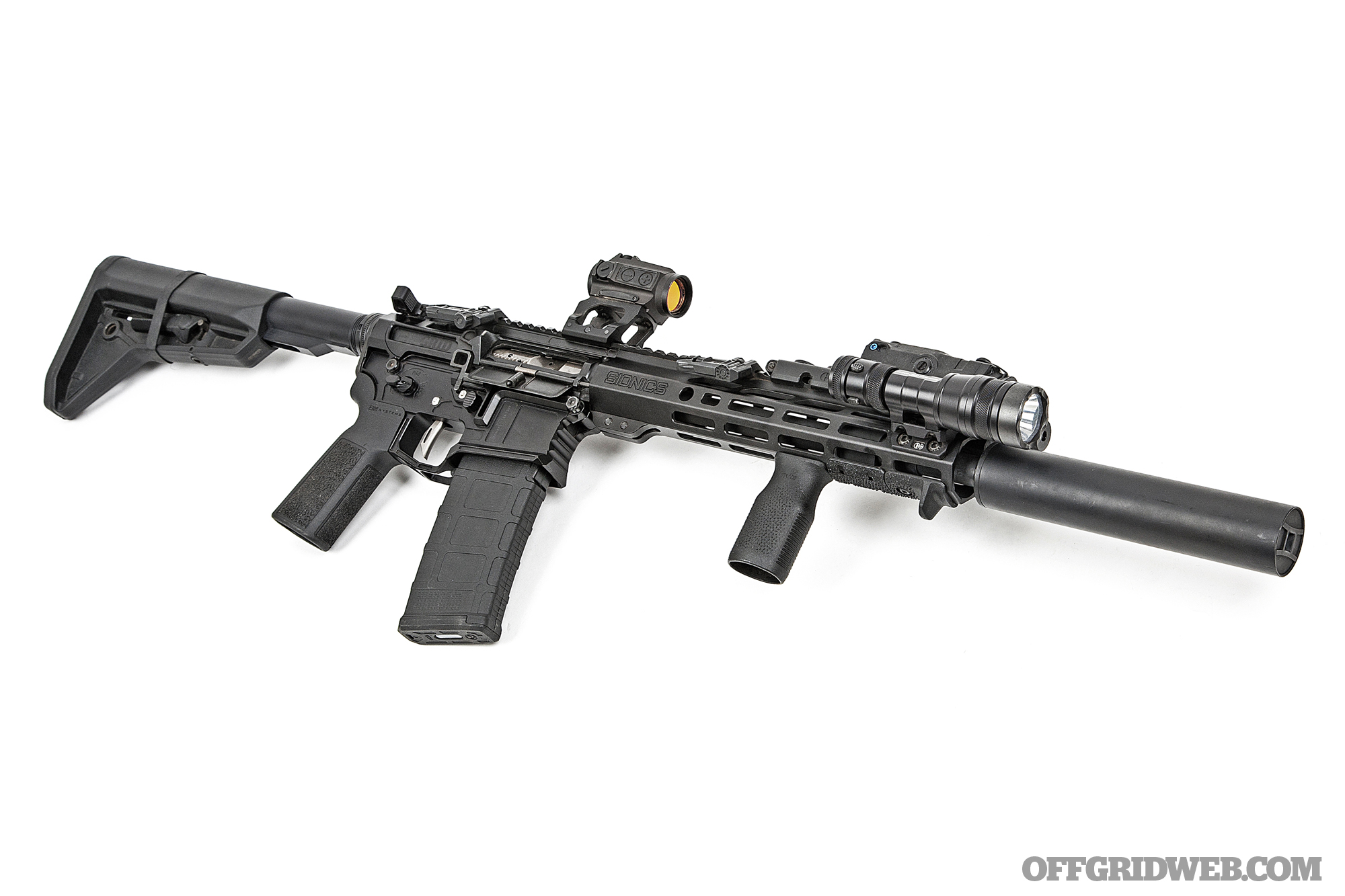
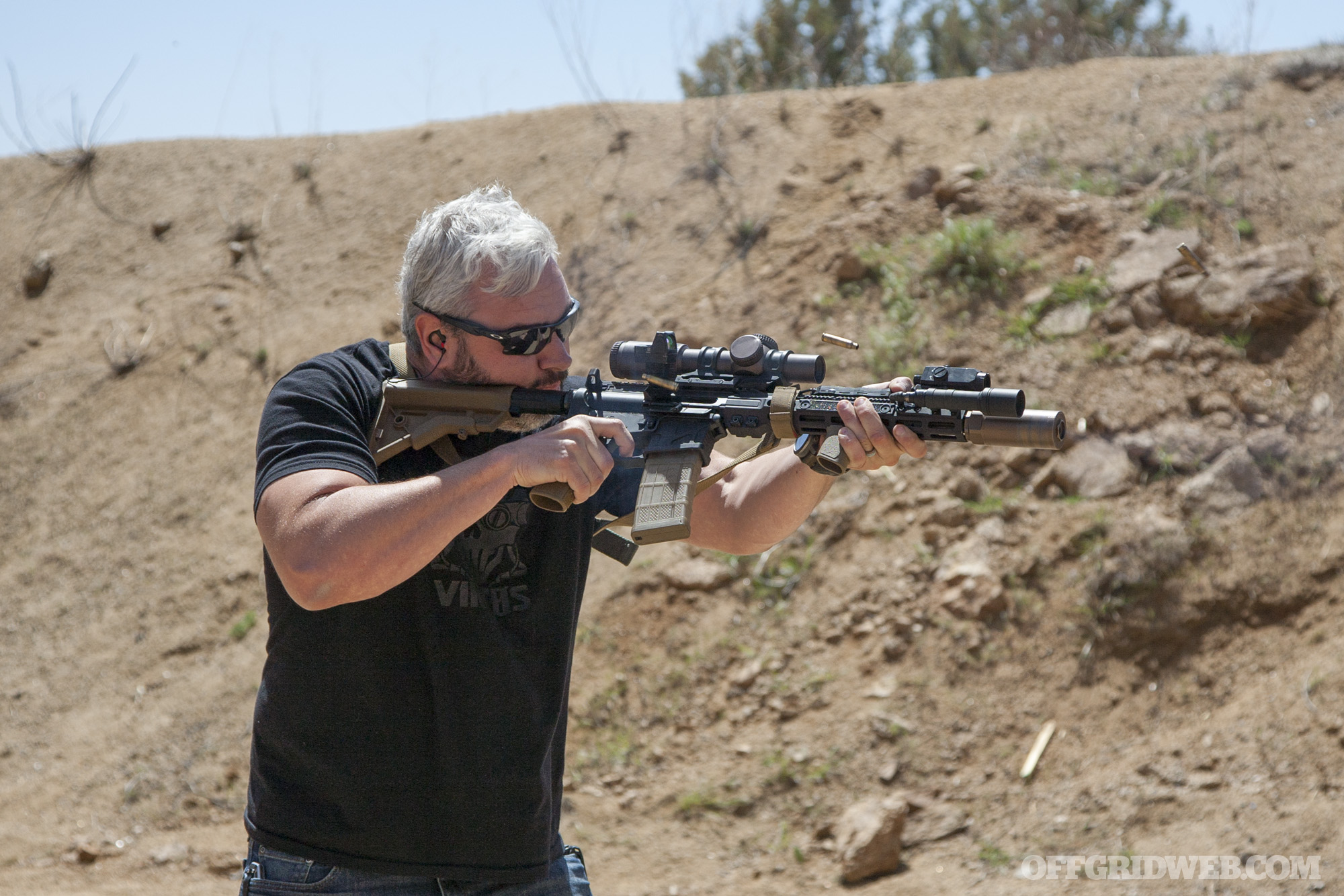
Above: Web Editor Patrick McCarthy’s 11.5-inch SBR features an ATPIAL IR laser / IR illuminator combo unit on the top rail as well as a Cloud Defensive REIN white light offset at the 2:00 position.
The first step in determining what your switching/control requirements are is to determine what your IR laser/illuminator setup looks like. There are two basic answers to this question:
Combination unit that has both an IR laser and IR illuminator
Standalone IR laser that will, most likely, require a separate outboard IR illuminator
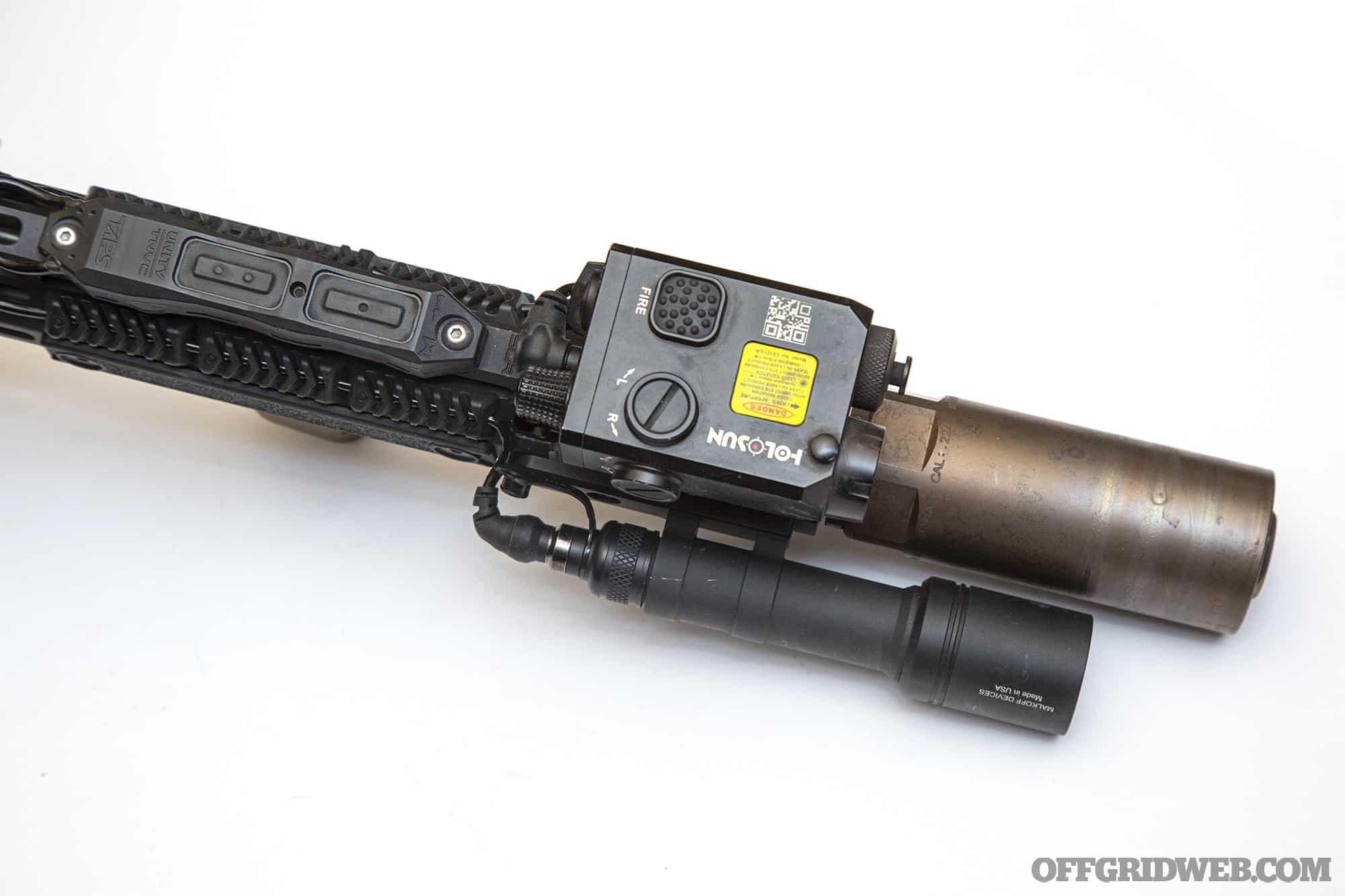
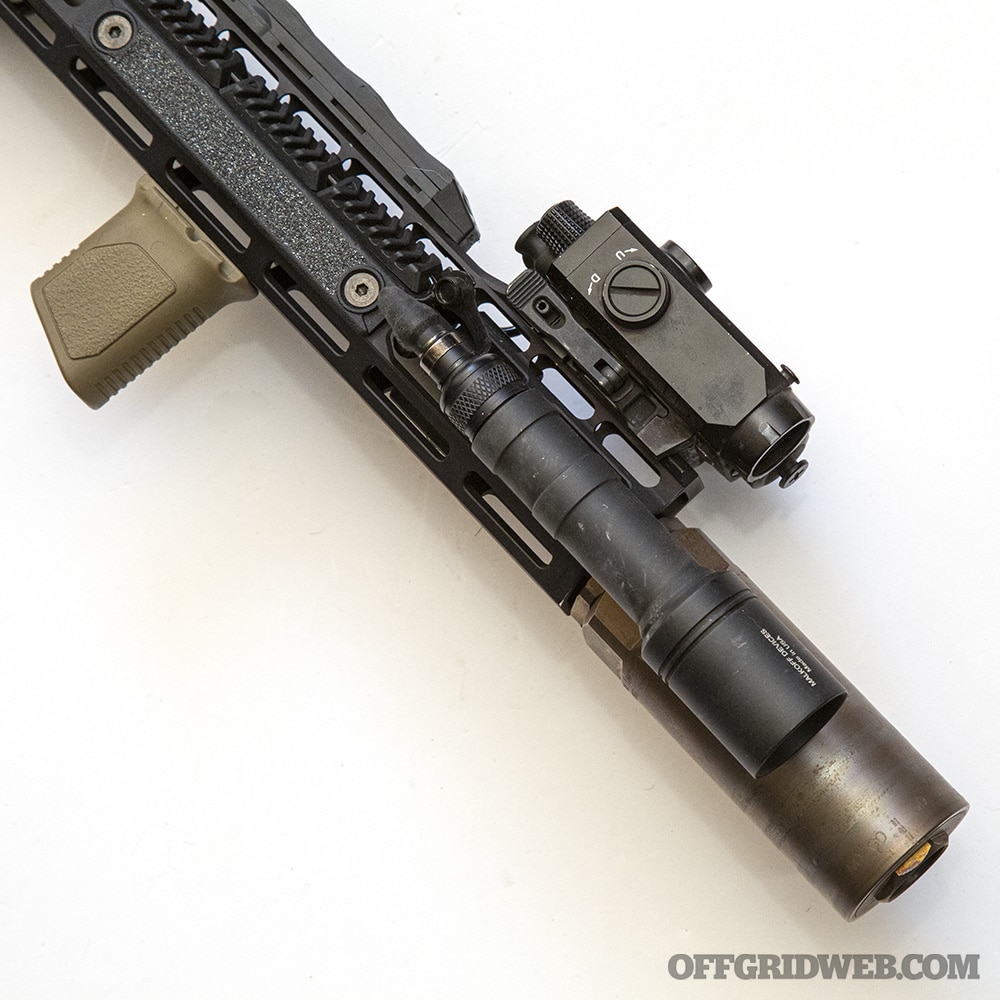
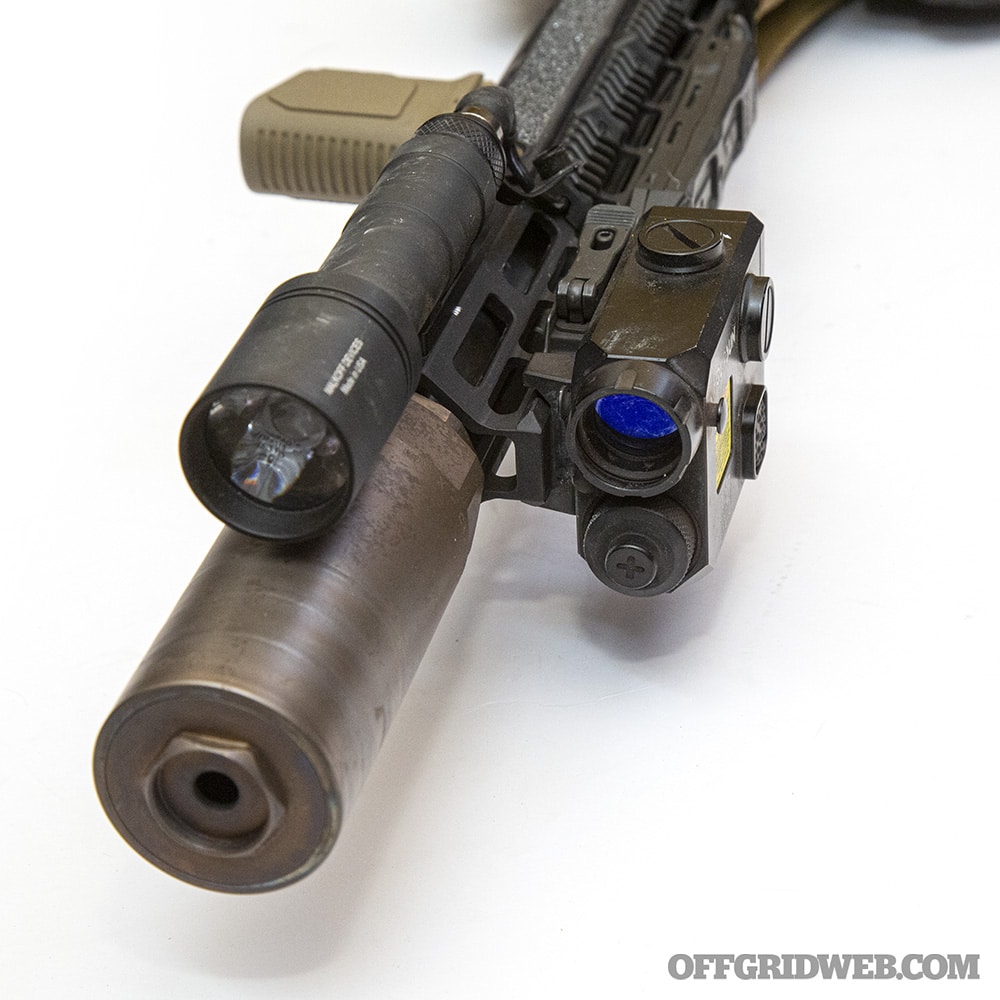
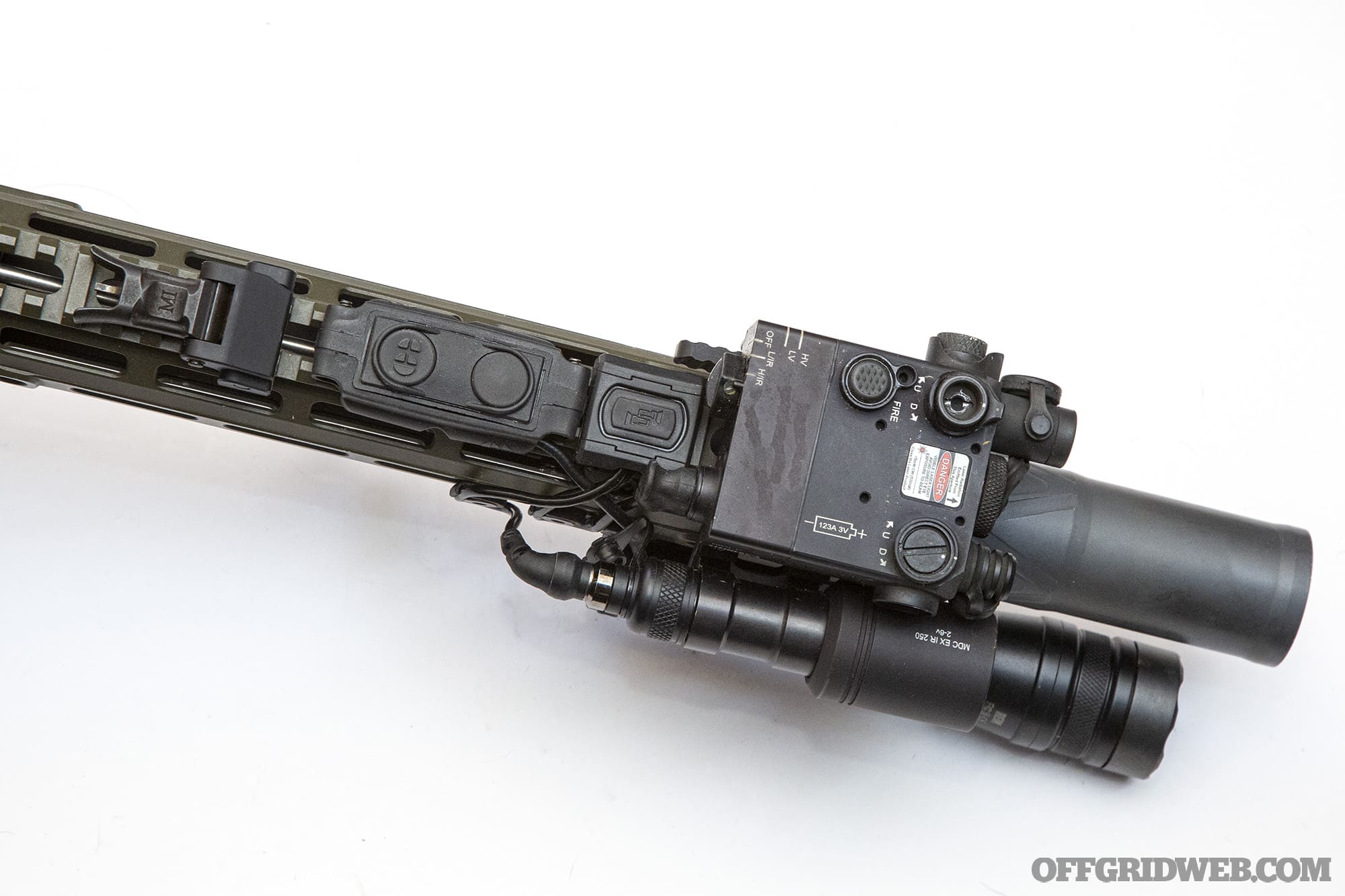
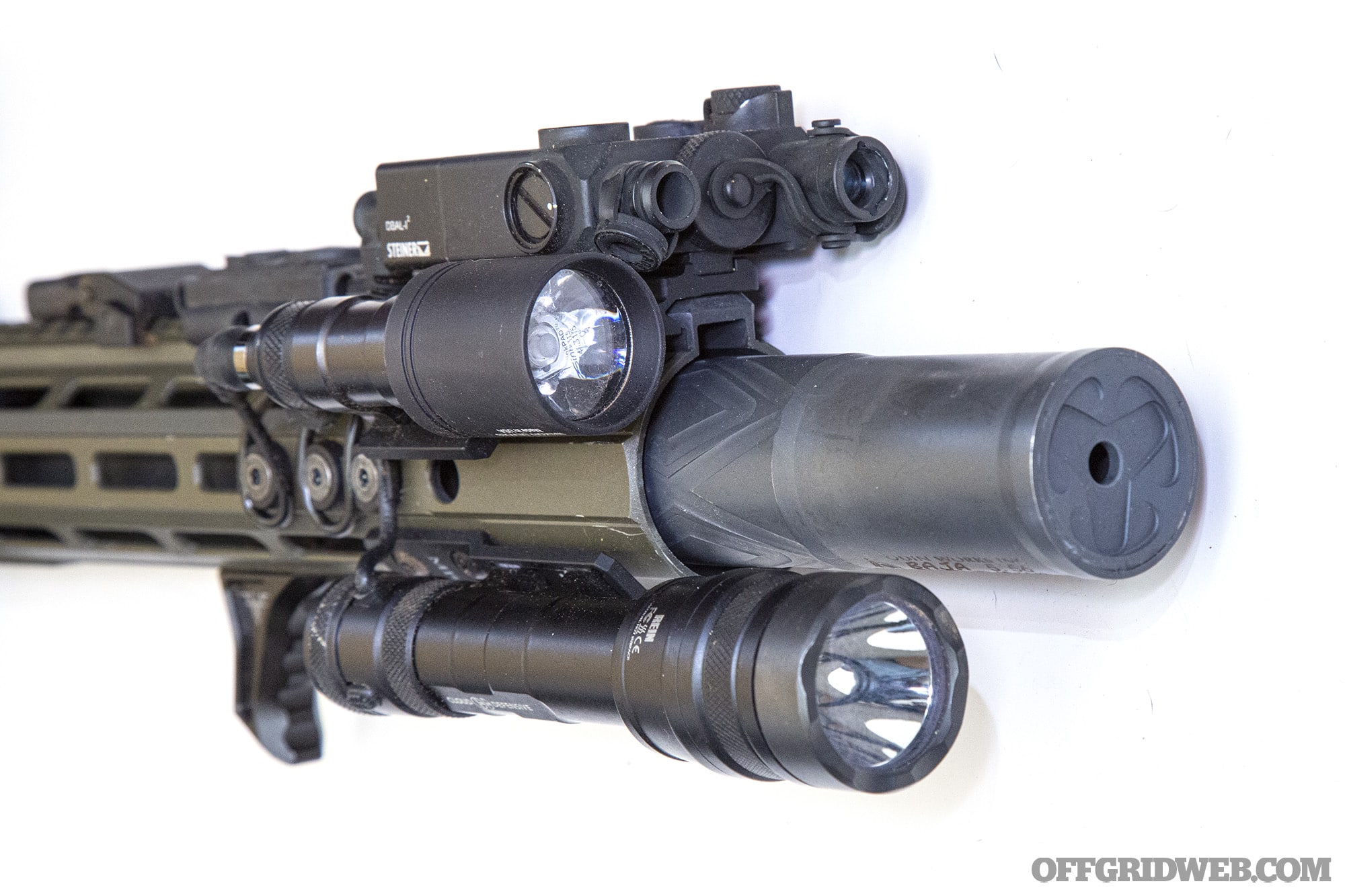
Above: The author’s “Do-All Survival SBR” incorporates an Arisaka/Malkoff Devices white light at 3:00 and a Holosun IR laser/illuminator combo at 12:00.
Subdividing the choices even further, there are two possible illuminator/light solutions to consider:
Dual Mode (VIS+IR) — pair your standalone IR laser with a dual-output light that features both white light (a.k.a. visible light) and IR light
IR Only — pair your standalone laser with a dedicated IR-only flashlight, and attach a separate white-light-only weaponlight
Read on as we show some practical examples of each of these night vision rifle setups.
IR Laser / IR Illuminator Combo + White Light
These are the ideal solution if you can afford it. The general performance of your NVGs will depend on the quality of your tubes, but all night-vision requires ambient light and all will experience degraded performance when environmental lighting is in short supply. For example, think of a dark basement with no windows, or a bedroom at night with the curtains drawn. While lasers will give you a visible point of aim for shooting, they will not light up the target or its background. This is why IR illumination is so vital to a holistic NV-capable weapon setup.
IR laser / IR illuminator combo units offer a one-stop answer to this problem. But they’re noticeably more expensive than purchasing a standalone laser. Some examples include:
Almost all systems in this category come with factory pressure pad remotes, but many folks will simply use the on-body button. Since you typically will not activate a flashlight and IR unit simultaneously, combo units are great for those who prefer avoiding the clutter of tape switches and remotes altogether. Position the combo unit and white light so that both push buttons are near your support thumb, and press whichever one you need when you need it. This is most effective on shorter weapons like SBRs and PCCs/PDWs where rail space is limited.
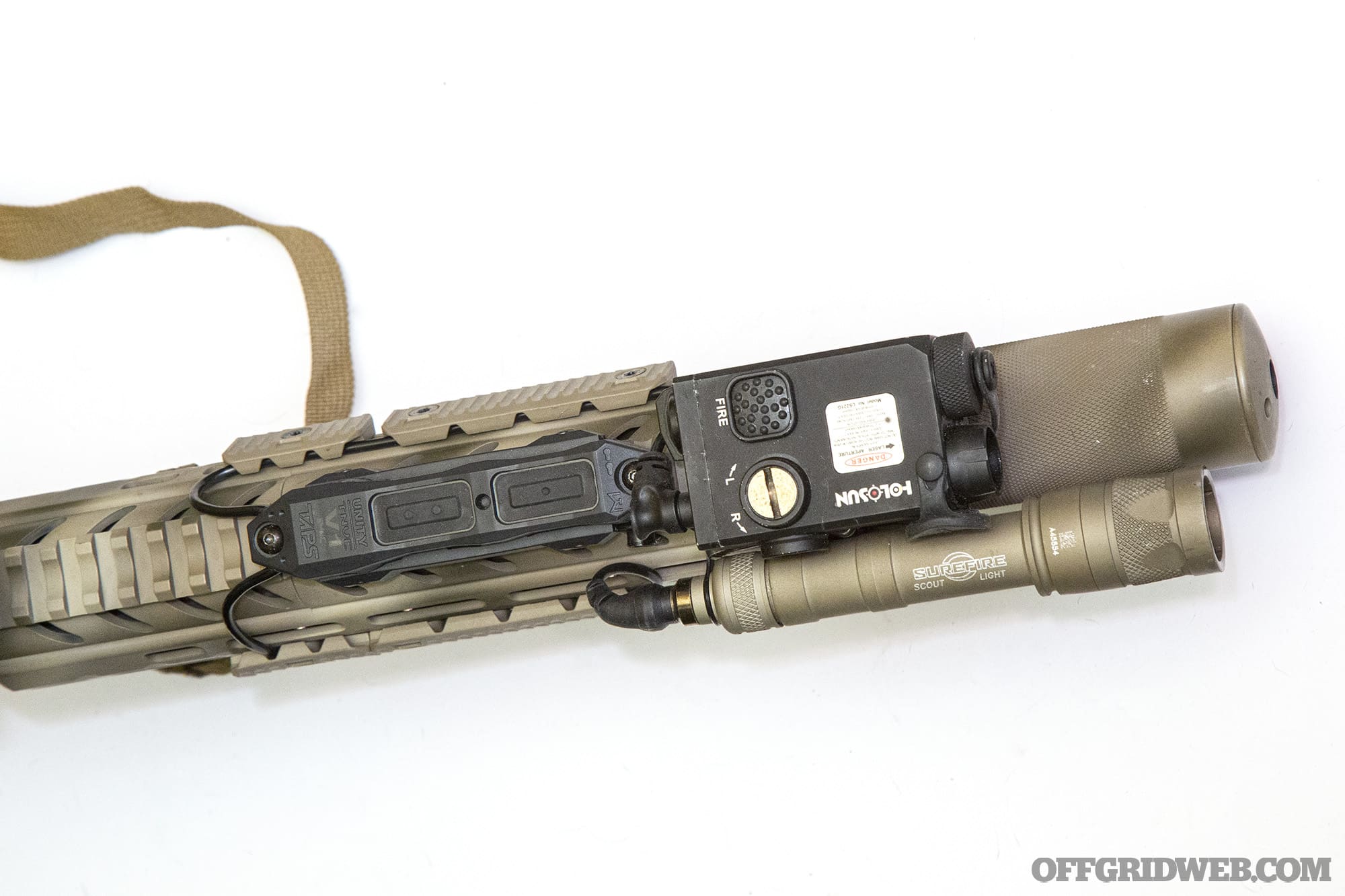
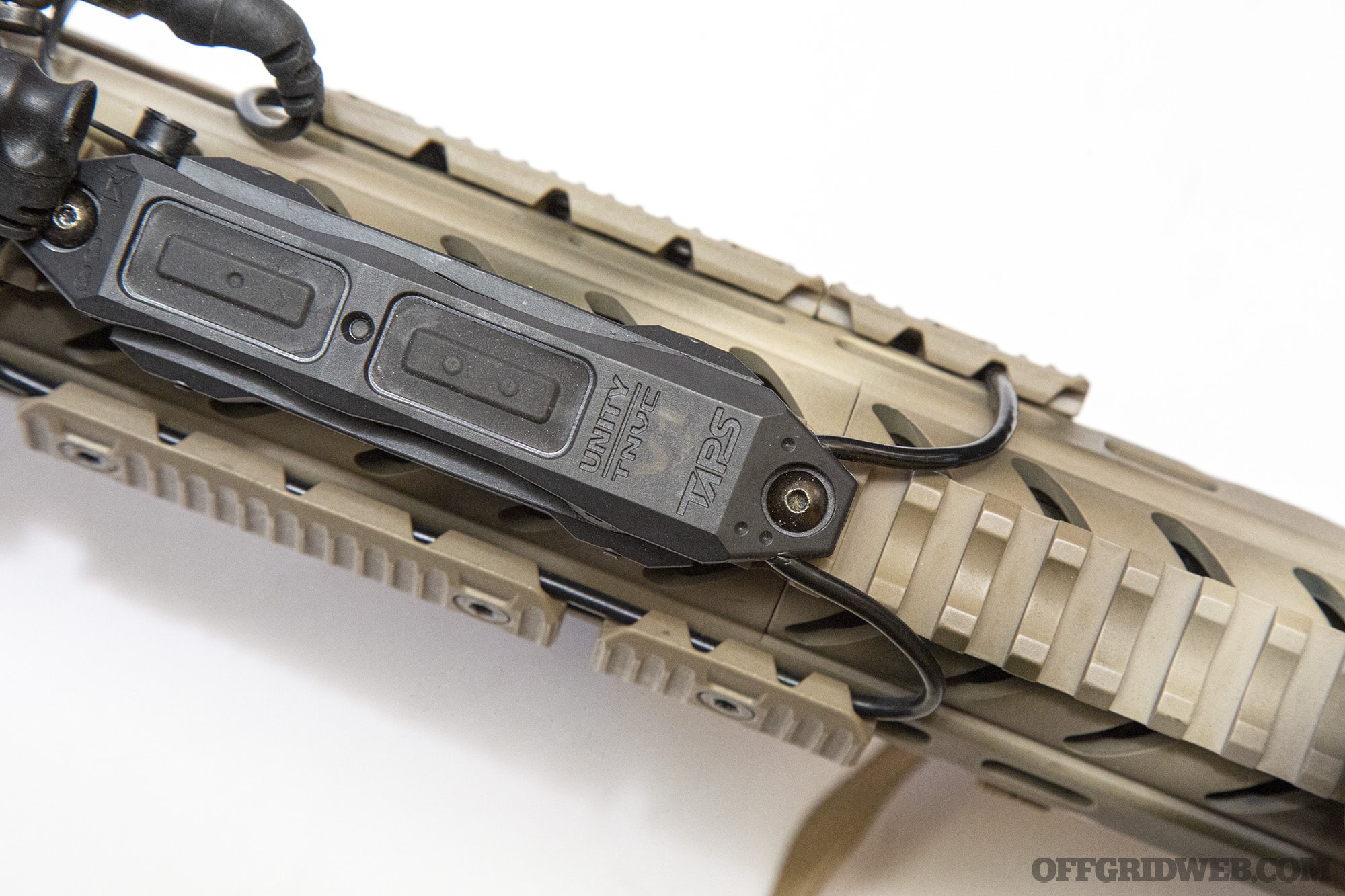
The alternate option is a remote switch, or switches. As we said, just about every laser out there will come with a tape switch. But when you are trying to integrate said switch onto a handguard that already has a remote pad for white light, space becomes limited quickly. This is where aftermarket solutions like the Unity Tactical TAPS come into play. Designed in conjunction with TNVC, the TAPS offers a single, slightly enlarged pressure pad with two distinct buttons, and dual cable leads, to activate light or laser off a single plate. The TAPS is designed from the bottom up for low-light use. Each of the two TAPS buttons includes visual and tactile “dots” molded in so that, even without being able to see the buttons, you can figure out which peripheral you are about to activate.
If an IR laser with built-in IR illuminator is out of your budget, you can pair a standalone laser with a dual-output weaponlight. Some examples of standalone IR lasers without onboard illuminators include:
Steiner OTAL and most DBAL-I2 models (excluding 9007)
Holosun 117 and 221 series
Zenitco PERST-4
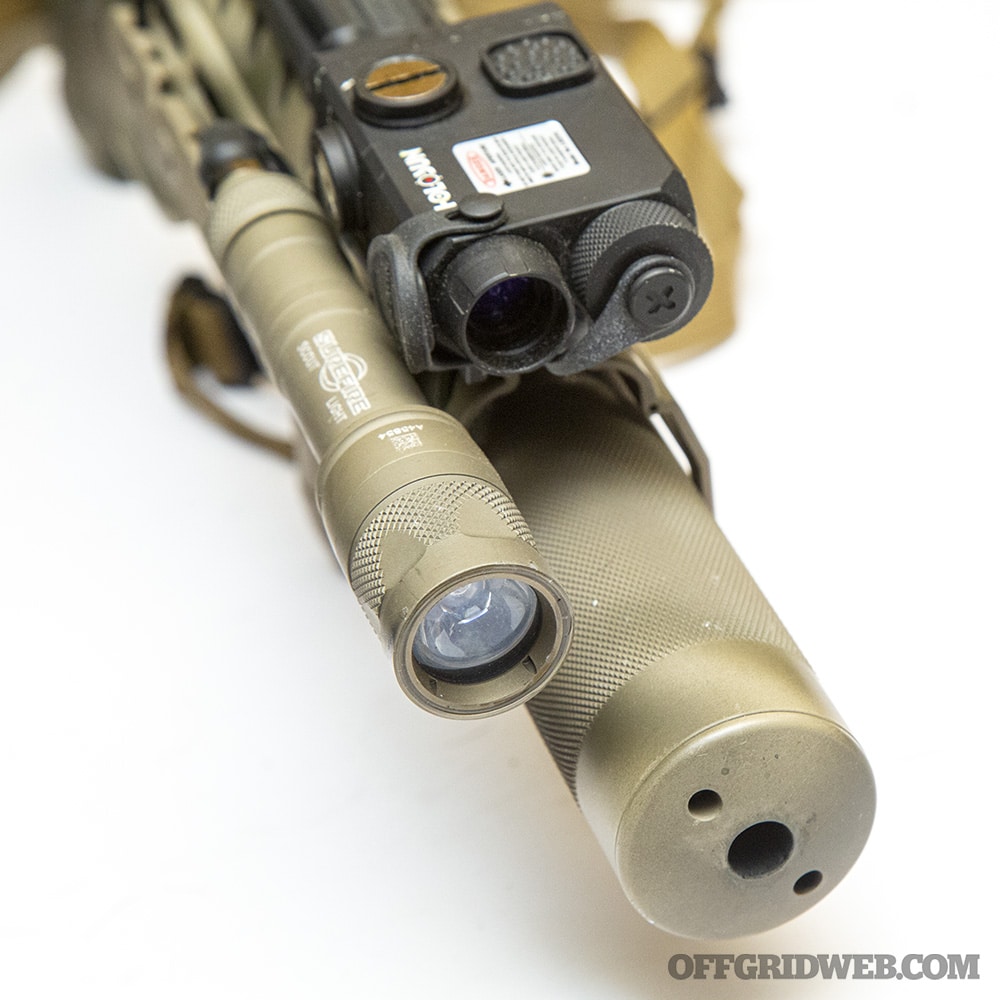
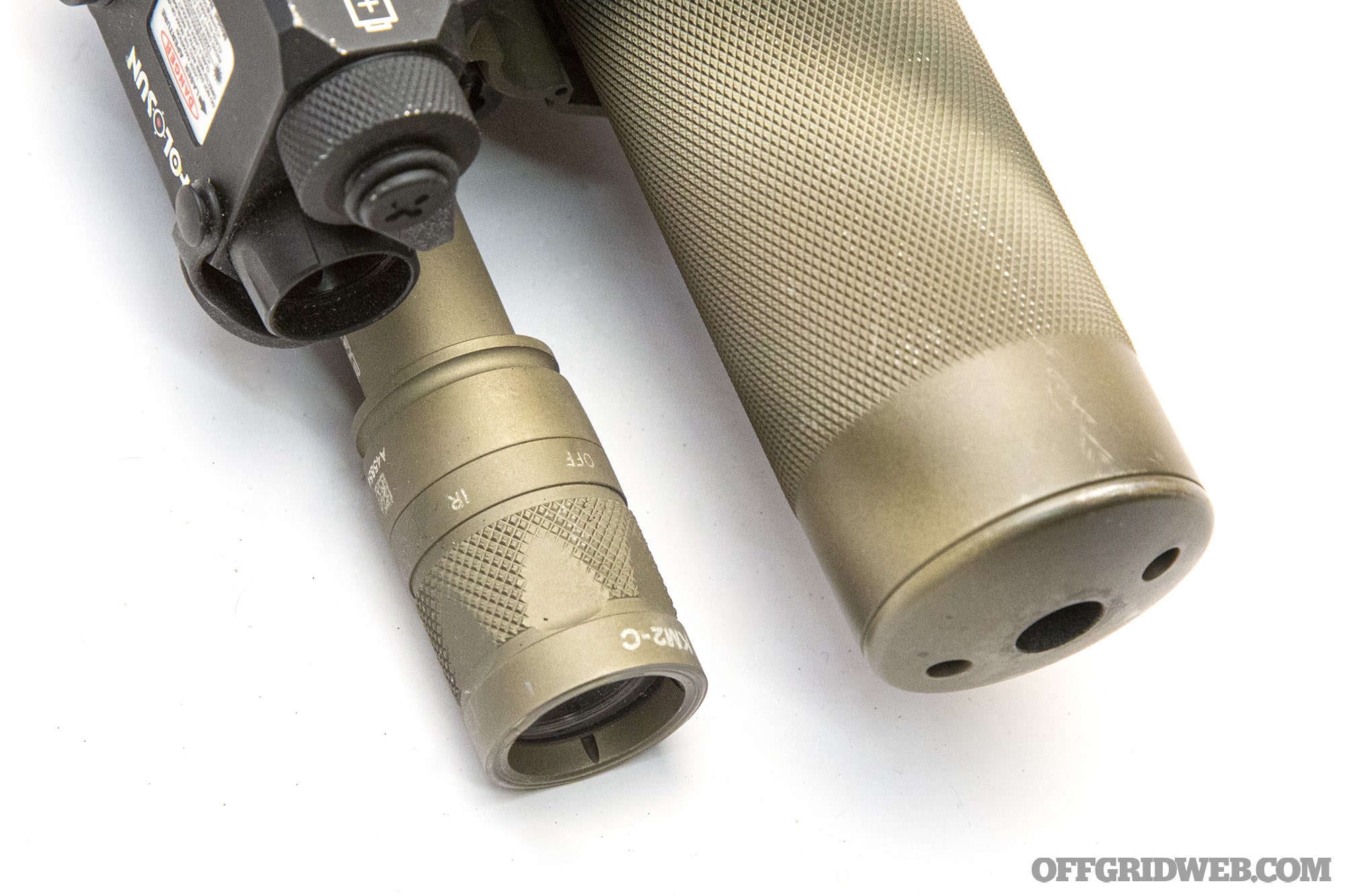
The example seen here is a Holosun LS221G, which is a green/IR laser-only unit, paired with a Surefire M600V Scout Light. The V-series Scouts feature a head assembly which can be switched from white to IR light by twisting the head to select your desired mode. This option can help keep costs down as you get both a white light and IR illuminator in a single purchase. But there are two trade-offs to this. First, building dual-spectrum output into a single light head means that, while your light becomes a jack-of-all-trades, it will be a master of neither. Dual-mode lights typically have much lower white-light output than their dedicated brethren. For example, the white-light-only M600 Pro has an output of 1,000 lumens. But the dual-mode M600V Pro only pushes 350 lumens of white light and 120mW of IR illumination.
The other issue is one of switching. When you’re using white light, you only want the white light. When using IR, you’ll want the light and laser activated simultaneously. For cases like this, we are back to Unity Tactical for the TAPS SYNC. Its physical layout is identical to the standard TAPS, but features internal program that can be had in several configurations. Our example here is the “V1” programming, setup as follows:
Button 1 activates light only
Button 2 activates light and laser simultaneously
When you need white light, rotate the head to white output and use button 1. When you want to shoot under NVGs, rotate the light head to IR mode and use button 2 to fire it and your standalone laser at the same time for targeting and illumination.
This is, of course, not the only way to do this. You could try to use a combination of body button (or click tailcap) plus a single-output tape switch, but we have found that this is awkward to operate on the fly, and we run out of fingers trying to push two buttons on and off while maintaining a positive grip on the weapon.
IR Laser + IR Illuminator + White Light
The third option is to mount a standalone IR laser (as discussed above), a dedicated IR illuminator, and a dedicated white light.
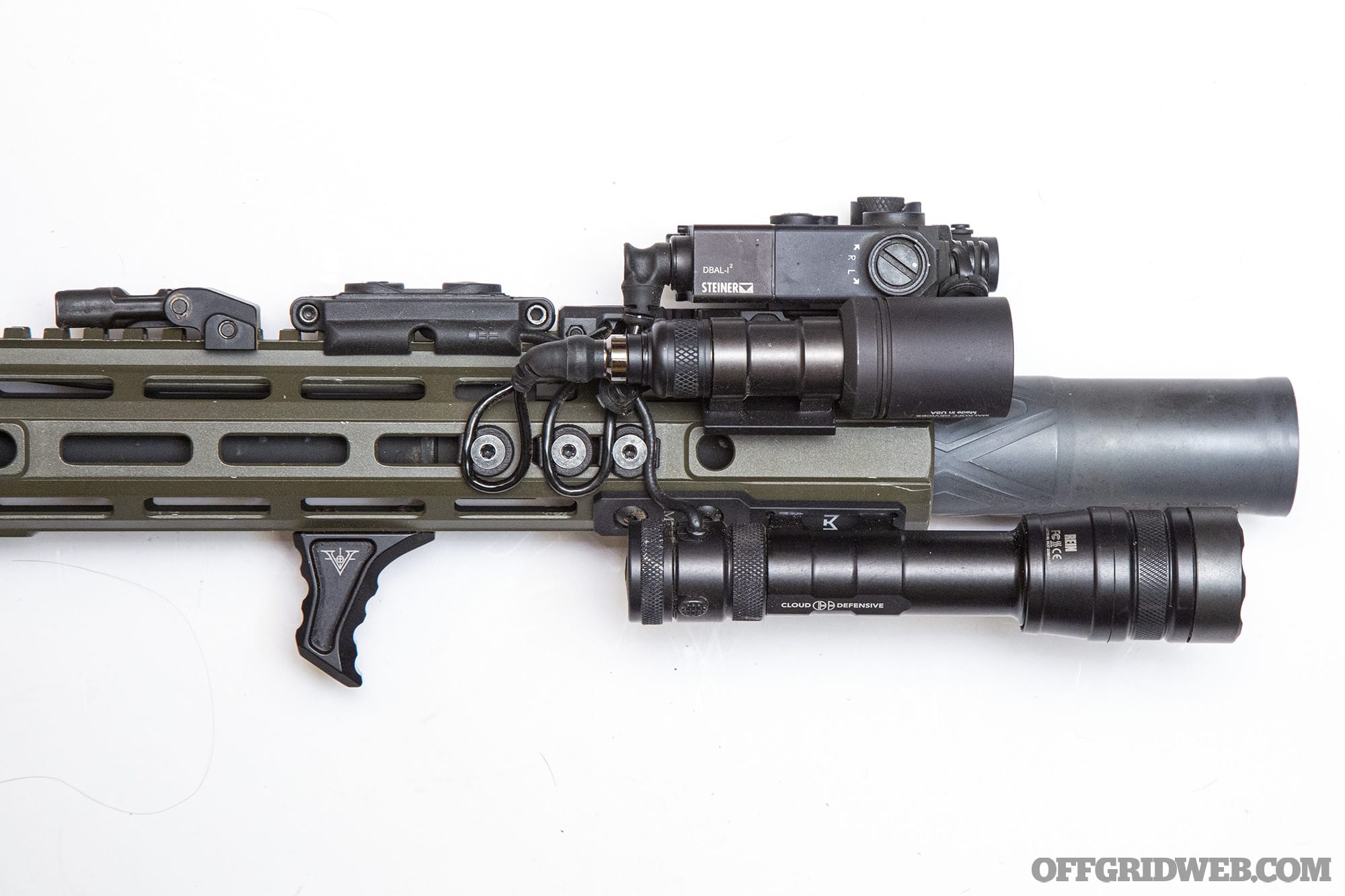
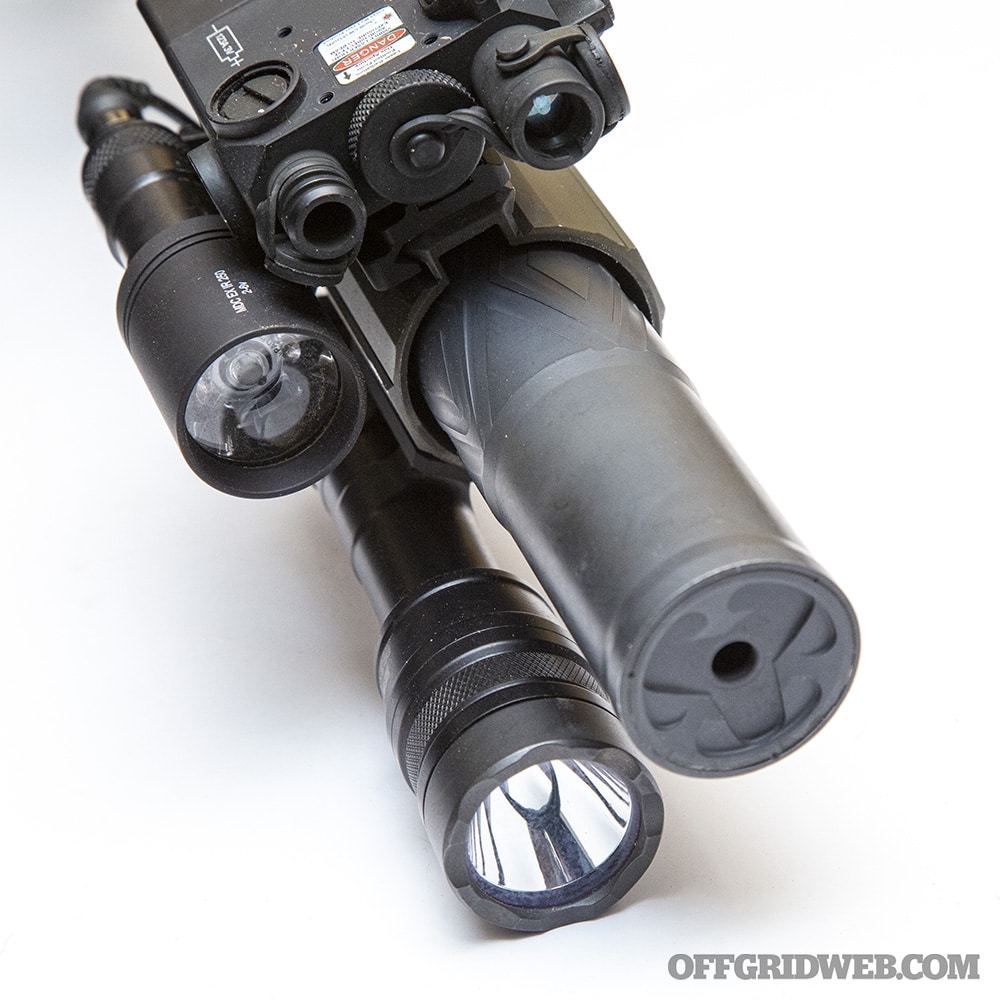
Again, with all things, there are trade-offs. On the upside, dedicated IR illuminators will have much stronger output than a dual-mode weapon light. Our setup here features an Arisaka Defense 300-series Scout-style light body with a Malkoff Devices EX IR 250 IR-only head. The Malkoff head is capable of 250mW of IR output, with a 4-hour runtime on a single CR123 battery. There is also a 700mW version available for longer-range use. Both will give you far superior illumination to a dual-mode white/IR light. But this requires you to then mount an entire second flashlight onto your weapon for white-light capability. Not only is this added weight and bulk on the muzzle end of your weapon (where you’ll feel it most) but you now have three wires to manage instead of two.
We mounted our Arisaka/Malkoff illuminator in tandem with a Steiner DBAL-I2, on an American Defense Manufacturing DBAL-SF mount. This is a single mount with QD lever attachment with direct-mount brackets for both a DBAL-style laser and a Surefire Scout-style light. This unit puts your laser at the 12-o-clock position, with a 45-degree offset for the accompanying light. This mount can be used with multiple lasers and lights in whatever combination you can think of, but we felt it was ideal to run a standalone laser with standalone IR illuminator. For white light work, we mounted a Cloud Defensive REIN 2.0 at the 5-o-clock position.
Any light with a Surefire-pattern remote socket would make this another ideal place to put a Unity TAPS SYNC. But because the REIN has a proprietary back end with its own remote pad, we selected a ModLite Mod Button Lite dual-lead switch to run the IR functions. The dual-lead Mod Button features the same combination of Surefire and Crane leads, but its microscopic footprint means the programming is limited to momentary-only, dual-activation-only configuration. That means there’s only one output mode – press the button and both leads fire. This makes it inappropriate for a combo unit + white light setup, as you typically would only want one or the other. However, in this arrangement, where we’re going to want to activate the IR-only light every time we activate the laser, it’s a good solution. This leaves the separate, REIN remote as your white-light-only switch, so you simply press one or the other depending on whether you’re using NVGs or not.
Conclusion
There are a nearly-infinite number of switching and control configurations that can be woven from all the available IR laser, IR illuminator, light, and remote switch choices on the market. But the bottom line is that the prudence of building low-light and no-light capability into your overall preparedness plan is not going to change anytime soon. While this guide is by no means all-inclusive, we hope to give you some reference points to start from in building out your own night vision rifle setup and night-fighting skill set.
There’s a common saying on the internet: if you’re not paying for a product, you are the product. The “free” online services such as email, social media, and streaming video you use on a daily basis aren’t free — there are substantial costs for hosting, domain registration, maintenance, security, and so on. If you’re not directly paying a share of those costs, the owners of these sites are using you as a source of income. Sometimes, this is through simple and unobtrusive banner ads on pages (as is the case here on OFFGRIDweb), but other times it’s through silently capturing and reselling massive quantities of highly personalized data. Google is the world’s foremost expert on tracking and monetizing user data, and the Silicon Valley tech behemoth recently added a new My Ad Center dashboard that sheds some light on the accuracy of their user tracking system.
Google’s new My Ad Center opens with the slogan “Your ads, your choice.” It touts the ability to “easily customize” and “personalize” the types of ads you see on Google’s various web properties such as Search and YouTube. But unless you want to reduce ads about a sensitive topic — for example, dog toy ads after your dog just passed away — the real value of My Ad Center is to see a small glimpse of what Google knows about you and your lifestyle.
How Much Does Google Know?
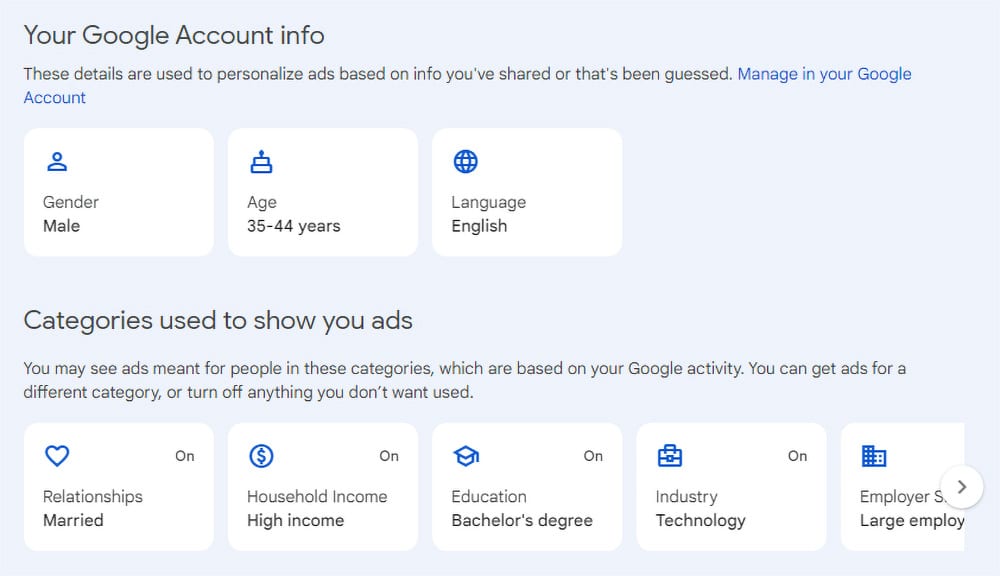
Based on data including every search keyword you type, every search result link you click, and every YouTube video you watch, Google automatically develops a digital profile about you. Although it’s not explicitly mentioned in Ad Center, it almost certainly also factors in information from Gmail emails you sent and received, location data from Android smartphones (i.e. businesses or other Android users you recently visited), routes traveled on Google Maps, content you watched on your Android TV, and much more. This user profile also includes specific information such as:
Gender
Age
Primary language
Relationship status
Parenting Status (including approximate age of children)
Household income level
Education
Industry/Profession
Employer Size
Home Ownership Status
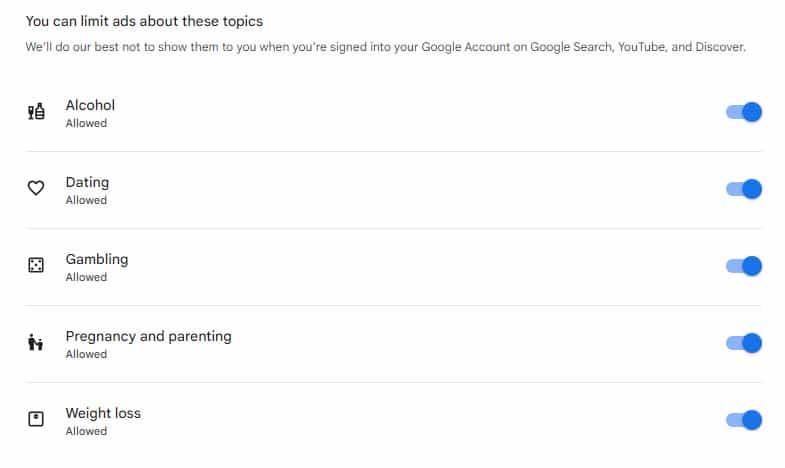
Google’s My Ad Center also shows the general ad topics you’re likely interested in, as well as “Brands for You.” If you wish, you can ask Google to reduce ads about “Sensitive Topics” (alcohol, dating, gambling, pregnancy and parenting, and weight loss). Finally, Ad Center shows recent ads that similar brands have paid to display to users that fit your specific demographics. So, for example, let’s say XYZ Widget Co. wants to display ads to unmarried men under the age of 25 with an interest in technology — Google will happily oblige. Of course, this profile can also be used to target more vulnerable demographics, such as predatory loan companies serving ads to low-income users with limited education.
There should be no doubt that your Google advertising profile has vastly more specific and invasive data than what’s listed here, so consider this the tip of the privacy intrusion iceberg. You should also assume other major tech companies such as Meta and Amazon have followed Google’s example and developed similarly detailed profiles based on your activity. The more sophisticated and accurate a user’s profile, the easier it will be to convince that user to purchase a product or make any other real-world decision.
What Can You Do About It?
Is there anything you can do to avoid this personalized tracking? Not really, short of deactivating all your accounts on Google services and not using those services (including Android phones, Android TV, Nest cameras, Google Home, etc.) again in the future. After all, Google isn’t going to let you use their services for free — they’ll only allow it if you willingly trade this personalized data for access. You can turn off personalized ads in My Ad Center and limit ads about sensitive topics, but that just means you’ll see more generic ads. It doesn’t mean Google will stop collecting or monetizing your data.
At the very least, reviewing Google’s digital profiling dashboard should make you reconsider how much privacy you actually have online. Hopefully it gives you a moment of pause before the next time you type sensitive keywords into that search bar, email, or even text message. It might also cause you to think twice about filling your home with IoT smart devices that are always gathering data to add to your profile.
If you’d been abducted and your family was notified by the perpetrators that you’d be released in exchange for ransom money, what course of action could ensure your safe release? Who should your family call or not call to assist them? How could they verify if it’s a hoax or not? There are so many variables to deal with that it’s difficult to know if steps taken to meet the kidnappers’ demands will be successful or trigger additional problems. The truth is, even if you’re not wealthy, recognizable, or associated with any illicit activities, all that kidnappers need to do is make an assumption that you’re worth something to someone. The longer the clock ticks on any kidnapping, the greater that victim’s level of incarceration becomes and the less likely it is that they’ll ever be recovered.
In Issue 25, we asked counter-custody expert Ed Calderon, “What’s the usual outcome for the victims if the kidnappers’ demands aren’t met?” Ed’s answer was rather morbid. “Death is usually the immediate outcome. Body disposal in Mexico occurs on an industrial level, and you will likely never be found. They’re very professional when it comes to body disposal. Caustic sodas, pig farms, and mass graves are all over the place, and the forensic science isn’t at the level where you will be identified post-mortem.” That being said, we asked trained hostage negotiator Kris Southards and Arizona detective Cory Fechtelkotter to weigh in on what to do if they were confronted with a possible kidnapping for ransom situation.
Illustrations by Robert Bruner
The Ransom Kidnapping Scenario
Situation Type Ransom
Your Crew You, your brother, and sister-in-law
Location Your hometown
Season Winter
Weather Snowy; high 27 degrees F, low 12 degrees F
The Setup: From the Lindbergh kidnapping to the crew of the Maran Centaurus oil tanker to John Paul Getty III to Patty Hearst, ransom kidnappings are nothing new. However, don’t think you have to be a business magnate or famous individual to be a target. If a kidnapper thinks someone — whether it’s a government, employer, or loved one — would pay in exchange for your life, that’s all the motivation they’ll need.
While some engaged in this activity may be unsophisticated individuals hoping for a quick buck, others are international criminal syndicates or drug cartels that have turned kidnappings into a cottage industry. The bottom line is you don’t know who you’re dealing with until the wheels of the crime are in motion. If someone you know is taken under the auspices of a kidnapping and the perpetrators are demanding a ransom in exchange for the kidnapper, how should you handle it?
There’s a common assumption that ransom kidnappings only happen to the families of billionaires and politicians, but this isn’t the case. After all, why would criminals only target high-profile individuals who have enough money and power to instantly trigger a nationwide manhunt? In reality, it’s much easier to choose lower-profile targets who can’t or won’t alert the authorities and the media. For example, a June 2022 report by the FBI’s El Paso Field Office stated that the agency has seen “an increase in crimes involving kidnapping for ransom and extortion crimes directly affecting undocumented immigrants who have paid human smugglers to bring them across the United States-Mexico border.”
It’s likely that many ransom crimes go unreported, since victims involved in any illegal activity — drugs, gambling, and prostitution, to name a few — typically fear the authorities just as much as the kidnappers. And even if you’re not breaking any laws, a less-than-reputable friend or family member could easily drag you into one of these terrifying situations.
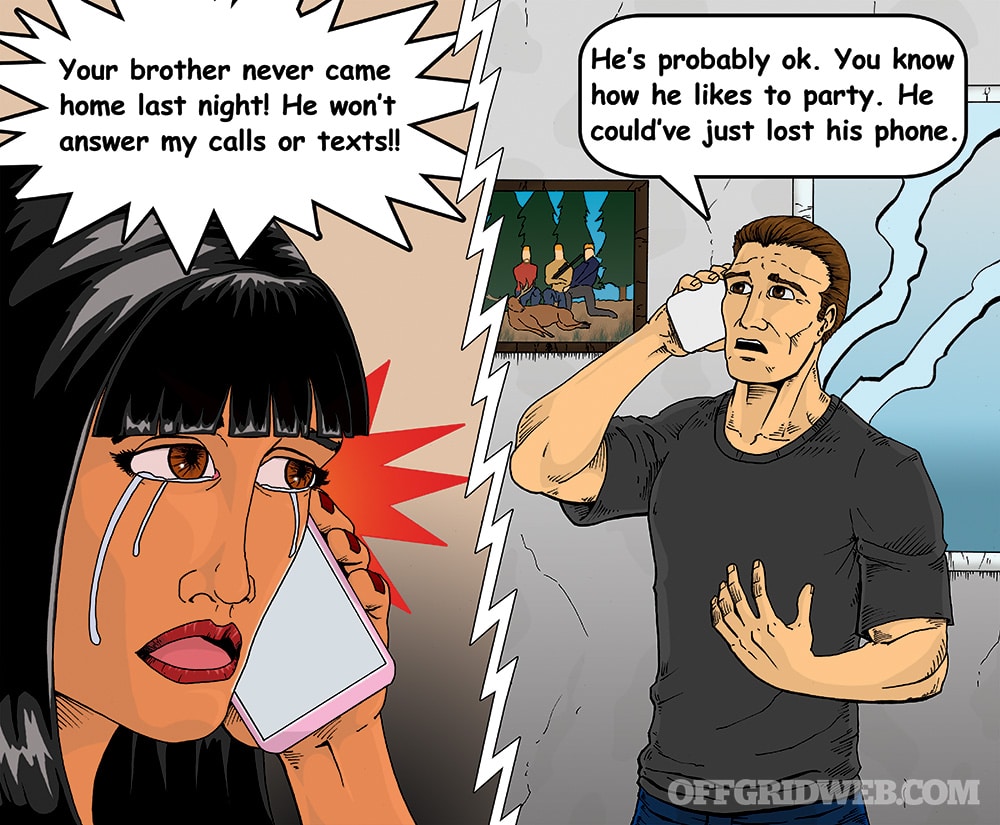
The Complication: It has been three days since you last heard from your 22-year-old brother. Your sister-in-law called you in hysterics saying that he didn’t come home from work. In the days that followed, you began to suspect foul play is involved. Although he’s known to be an impulsive party animal, a recreational drug user, and run with a rough group of friends, he hasn’t been in any serious trouble before. Now he’s not responding to emails, texts, or calls, and your concern is rising. His phone is still ringing for now, which tells you that either he lost his phone, is deliberately trying to avoid contact, or has experienced some kind of major emergency.
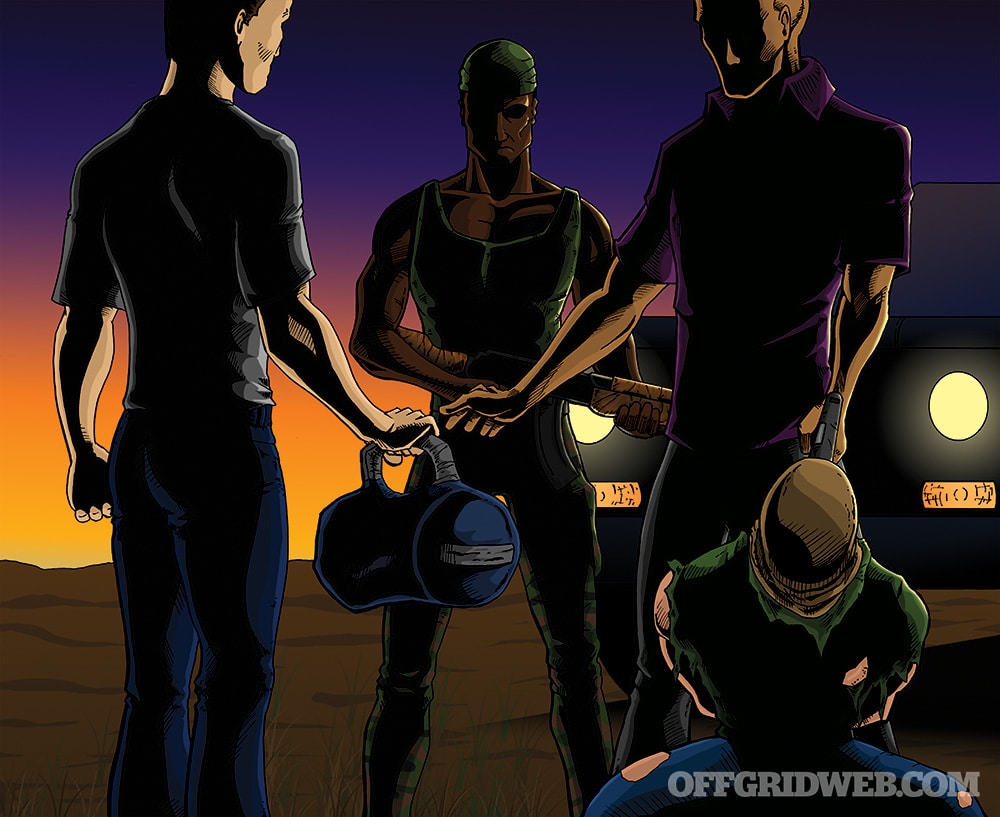
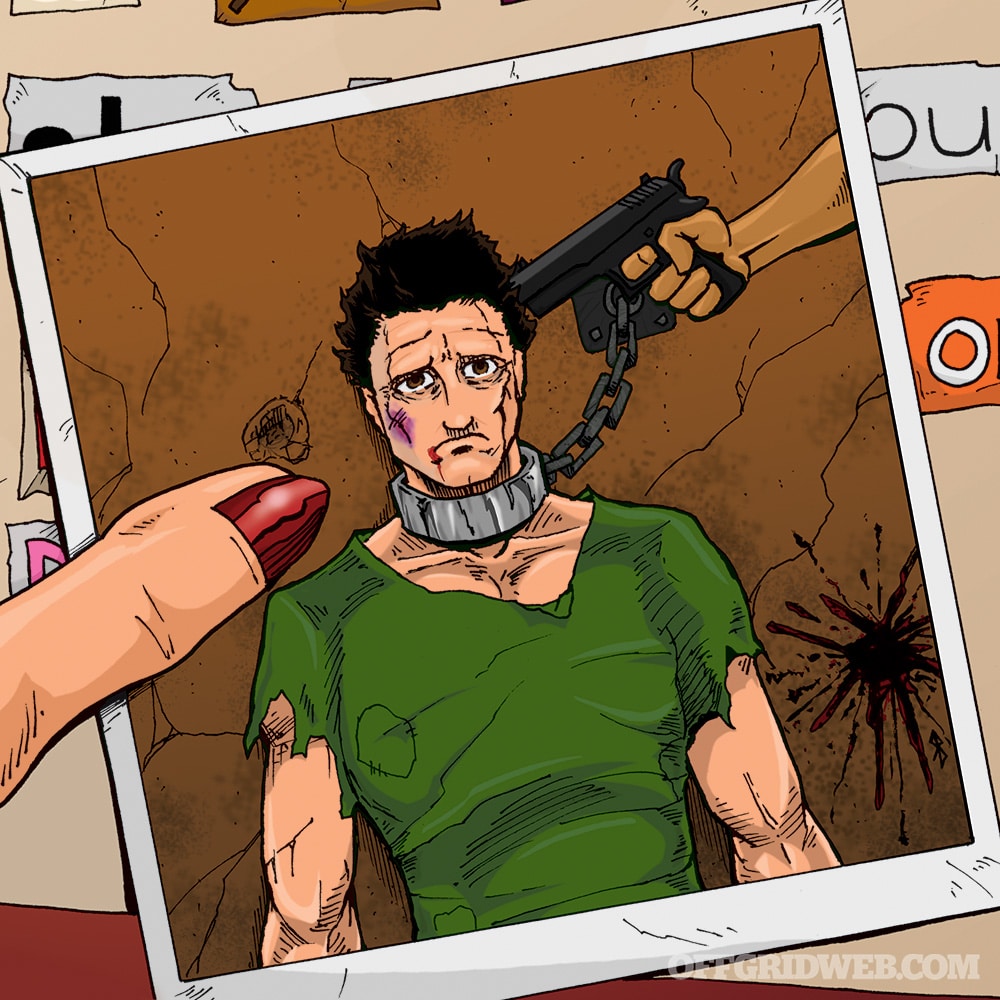
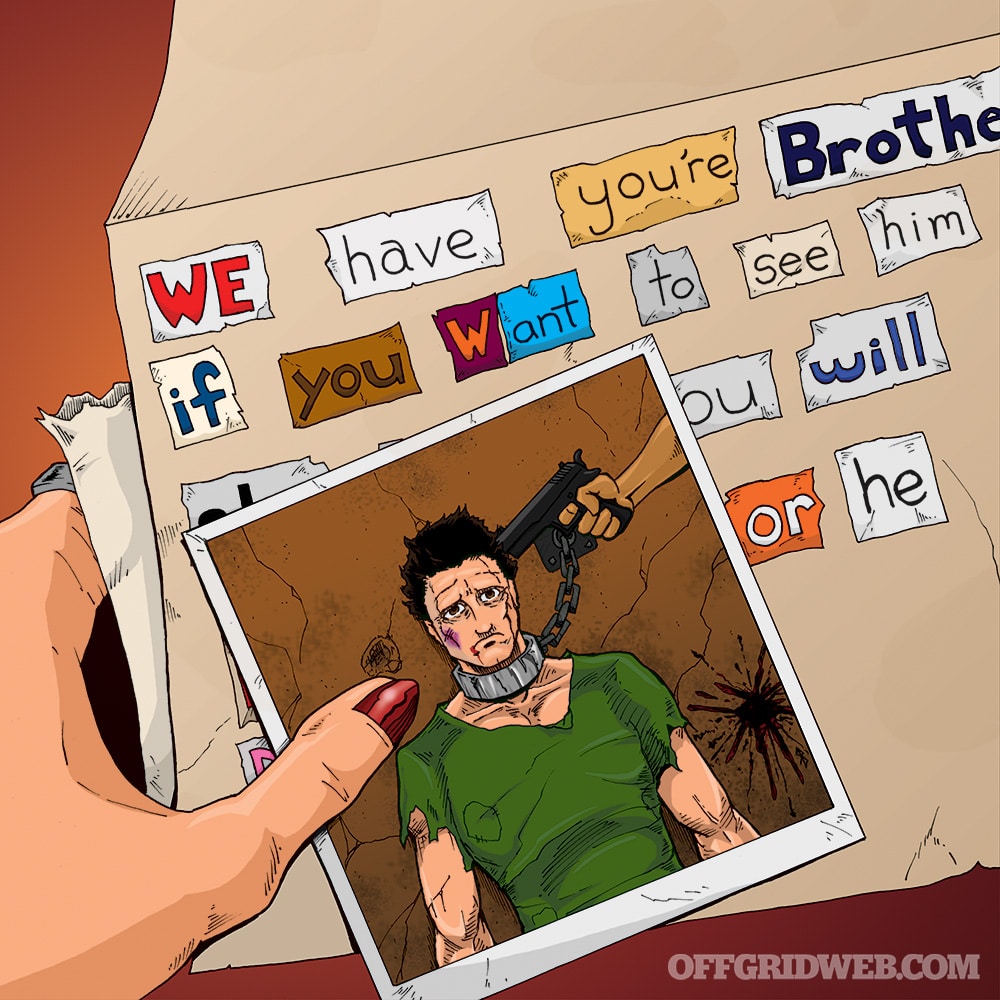
On the fourth day, a note appears in your sister-in-law’s mailbox. It states clearly that he has been kidnapped and threatens the death of your brother if authorities are notified. It also says that a ransom payment can be made in exchange for his life with more instructions to follow. The next day, you’re with your sister-in-law, and a call comes in on her phone with a muffled gravelly voice issuing demands for thousands of dollars. The voice says that screams audible in the background are coming from your brother, but you can’t be absolutely sure it’s him screaming.
Since his wife comes from a wealthy family and there’s a possibility of drug dealer involvement, you could see that a ransom kidnapping may be a valid threat. Is it someone who may have found out about the situation and is attempting to profit off it, even though they have nothing to do with his disappearance? Could your brother be a willing participant, working with shady friends for a cut of the ransom money? Or is this an actual kidnapping perpetrated by people with sophisticated enough surveillance to discover whatever recourse you’re planning? What should you do?
Detective Cory Fechtelkotter’s Approach
Preparation The odds of someone you care about falling victim to a kidnapping and ransom scheme are low, but the stakes are so high that turning a blind eye to the possibility could be a horrifying mistake. True kidnappings are no trivial crime. The idea of families going through a harrowing, but brief period of strife before being happily reunited is the exception, not the rule. More often than not, the story ends in tragedy. A bad ending is common enough that in some states, such as my home state of Arizona, deadly force is explicitly authorized by law to stop a kidnapping (Arizona Revised Statutes 13-411A, ARS 13-1304). The basis for this is simple — kidnapping victims wind up dead often enough that using deadly force to stop a kidnapping may very well prevent a murder.
Due to the potentially lethal outcomes of a kidnapping, there should be a strong focus on prevention. Whenever I think about crime prevention, I reverse-engineer my strategies by thinking from the perpetrator’s perspective. I imagine the ideal target, setting, and circumstances to accomplish a crime, then brainstorm what would be most disruptive to those criminal objectives. Security experts often call this an “adversarial mindset” exercise.
In trying to identify the ideal target to hold for ransom, I’d select someone who had family or business connections who wouldn’t blink at paying thousands to help one of their own. To this end, discourage your loved ones and those close to them from ostentatious displays of wealth, especially on social media. Stylistically, it’s better to give off the vibe of a dorky software developer or milquetoast middle manager than a club-hopping Kardashian. In addition to keeping a low profile, there are numerous privacy services, and even ransom insurance, which could be considered. The degree to which any of those makes sense for you or your family depends on how high your risk is. If you aren’t a celebrity or a prominent executive (or a relative of one) working in dangerous locales outside the U.S., such precautions are likely unnecessary and almost certainly cost-prohibitive.
To facilitate the kidnapping itself, I’d prefer a victim who is impaired and isolated, making them less able to protect themselves and less likely to get help from bystanders. To mitigate this, avoid public drunkenness or being alone, especially in transitional spaces like parking lots. Well-lit public places, crowded with plenty of witnesses, aren’t a good setting for any crime where the suspect needs to avoid detection or interruption.
Once the plan is in motion, I’d commit to a victim who doesn’t put up much of a fight when the abduction happens. If there is too much resistance, the best option for a suspect would simply be to cut bait and move on to a more docile, less-prepared target. Being a tougher target is actually quite simple, but that doesn’t mean it’s easy. To counter an abduction attempt, you must be prepared, and that preparation usually comes in the form of training coupled with the right equipment, and just as important, the willingness to use them when justified.
Being armed is a good start, but not enough. Actual combatives training incorporating empty hand techniques and weapon retention skills is also a must. If you’re armed, but can’t maintain control of your weapon, you’re nothing more than a walking holster for your attacker. If you’re otherwise prepared, but are caught off-guard, or are simply unwilling to act, you’ve likely already lost. Regardless, if an attacker tries to move you to a secondary location, don’t give up. You must fight as if your life depends on it because it very well might. Do everything in your power to avoid being taken to a secondary, secluded location. If you’re in a vehicle, this may mean deliberately crashing the car; if you’re on foot, run or attempt to draw the attention of bystanders.
Thankfully, these strategies aren’t unique to preventing an abduction, but are also viable techniques for preventing or stopping more common street crimes like robberies and carjackings. And the “think like a criminal” approach to prevention is a great exercise not just for serious crimes, but even commonplace crimes like car break-ins and pickpocketing.
Onsite Unfortunately, we’re presented with a scenario in which attempts at avoidance, deterrence, and disruption have failed. So, the first step is verifying if this situation is what our “bad guy” says it is. After all, many ransom schemes are just that — schemes. Remember that the “con” in con-artist or con-man is short for “confidence.” The criminal may not be a kidnapper at all, but a skilled liar who presents themselves so convincingly that the target believes what they’re told despite the lack of solid evidence.
An unfortunately common scam is for con-artists to call unsuspecting families and claim a relative is imprisoned in a foreign jail, and a large sum is needed to secure their release, when in fact the loved one is just fine, but perhaps not immediately reachable by phone. Oftentimes, the perpetrator will want some form of difficult or nearly-impossible-to-trace payment, such as a money order, cryptocurrency, or gift card serial numbers. These forms of payment aren’t unique to common scammers, however, and just because they want payment in this manner doesn’t necessarily indicate this is a scam as opposed to a real ransom.
So how do you go about determining if this was an actual ransom, or just some scam? With any luck, the suspect will make that much clear. Even the most ignorant, uncooperative, unsophisticated criminal should be willing to share some information if they can be convinced it’s in their best interests to do so. My approach to this would be making sure our perpetrator believes I’m willing to work with them — even if that isn’t the case at all — but I need assurances my brother is alive and well. If the kidnapper believes they can still get their payday by providing proof of life, they’d have a very strong incentive to do so.
Even though this is a criminal we’re dealing with, self-interest is a powerful motivator, and it’s what I use as a common focal point when communicating with any criminal. Though the possibility exists that the kidnapper may be completely unreasonable, refuse to provide any information whatsoever, and require you to follow all their demands without question, such a scenario seems improbable. Whether it’s a genuine kidnapper or just a con-artist, they want their payday and will usually give you something to work with if they think it will advance their position.
If they refuse to provide any proof, there isn’t much incentive to continue communicating with them. It seems very likely it would just be a hoax, and even if it wasn’t and you decided to cooperate, I’d have no reason to believe they’d stick to their own terms. If they can get money out of you without even providing proof of life, there’s nothing stopping them from demanding more and more without giving anything to you in return. While the inflexible “we don’t negotiate with criminals” approach probably isn’t the right one, you can’t be a doormat either.
Crisis If they provide proof of life, you need to decide whether or not to get the police involved. For me, this decision would be easy, even if the extortionists explicitly stated not to contact police. For most ordinary people, the risks of involving law enforcement will tremendously outweigh any potential downsides. Most of us simply don’t have the resources to give the kidnapper what they want, even if we wanted to. And even those with those resources may simply not be willing to work with an extortionist. Not out of a callous disregard for their loved one, but because of one simple truth: criminals as a whole tend to be untrustworthy and unreliable.
Add to that the understandable lack of experience most people have in bargaining with criminals, let alone facilitating a prisoner release. For most, it just makes sense to try and get help from someone with some actual experience or resources to employ. Even the police recognize how important it is to get help when they’re out of their depth; it’s routine for agencies to call on assistance from others when met with a crisis they don’t have much experience with.
If you aren’t sold on going to the police for help, but recognize the need for other assistance, you could look at other options. Even if you could find such an individual or organization that specializes in resolving ransoms, the cost of employing them could be as expensive as just paying the ransom outright. Additionally, involving any outsiders at all could be seen as a provocation nearly as bad as getting the actual cops involved.
Provoking the perpetrator may be too much of a gamble for some folks, and they decide they want to go it alone. Considering the stakes, reluctance to involve police is understandable. If you choose to go that route, here are some things to keep in mind. You have essentially entered into a crisis negotiation, and crisis negotiations largely center on these key factors. You must build trust and rapport, so you have credibility when trying to reach a mutually beneficial conclusion. In the case of a ransom, the mutually beneficial conclusion is the extortionist gets their money (and faces no legal repercussions for their actions), and you get your family back. This is no ordinary crisis negotiation, however.
If you’ve decided not to involve the police, your only leverage is the money the suspect is after. It isn’t a very good bargaining position. By comparison, when I’m working as a police crisis negotiator bargaining with a barricaded suspect, I usually have towering, insurmountable leverage. They are surrounded by a police special-response team and have been cut off from communicating with anyone besides the negotiators. They eventually accept we’re just waiting for them to calm down rather than use the overwhelming force available to us. Even then, negotiations can be fraught with fixations on small details and take hours to resolve. In over a decade of crisis negotiations, some of my most difficult calls were those where I didn’t have the extreme position of advantage I normally do. If you decide to go it alone, you would be working from an even weaker position.
Trained Negotiator Kris Southards’ Approach
Preparation There are approximately 100 kidnappings in the United States per year. Kidnapping will be defined, for this article, as the taking and holding of an individual against his or her will, with the stated purpose of exchanging that person for something of value to the kidnapper(s). According to one source, the average worldwide ransom demand in the past year was approximately $250,000. The source expected the average to increase to over $325,000 in 2022.
Abductions are, for the purpose of this article, significantly different from kidnappings. Ordinarily, there’s no intent to return the person abducted to his or her loved ones. Abductions happen much more frequently than kidnappings and ordinarily the targets are young women and children.
Very little information is out there on kidnappings in the U.S. — certainly on recent kidnappings. No information was found regarding circumstances, victim, and outcome. News media and the internet have numerous stories on abductions. The two most recent stories on kidnappings found indicate they were ill planned and or almost accidental attempts.
The ill-planned kidnapping involved four people taking the victim over a supposedly stolen cell phone. The actual taking of the individual was caught on a hotel security camera. The perpetrators were caught just a few hours later, and the victim was safe. The other case involved a lone actor who attempted a carjacking but kept the driver, demanding the victim’s phone and money before placing the victim in the trunk. The victim escaped from the trunk and authorities apprehended the guilty party shortly thereafter.
Though rare, they do happen. It has been said the best fight is the one avoided. The same can be said of kidnapping. A cursory review of the internet will show you several companies and or individuals advertising kidnap prevention and escape courses. Basically, these courses can be broken down into two approaches. The first involves a combative approach. The second is based on avoiding dangerous situations.
According to SBS Training Solutions, “There is a place for combative-style training, there can also a few drawbacks. First, it is unrealistic to assume that even a skilled person with actual combat experience will be capable of overcoming attackers who have the advantage of surprise and superior numbers. Furthermore, given that many countries (and some places within the U.S.) prohibit the carrying of weapons, the idea of self-defense weapons training in these instances is questionable, and its ability to protect against an attack is unlikely.” Avoiding the situation in a nutshell is having a realistic assessment of threat level. Being aware of those in your environment and of leaving at the first signs of trouble.
Onsite Home-security solutions are abundant and relatively inexpensive. Whether you can have a camera viewing your mailbox is dependent upon where your mailbox is located. In many urban areas and even small towns, mailboxes are clustered in a tower arrangement, and it can be located some distance from your home. The flip side is that it’s difficult for bad actors to gain access to your mailbox.
Finding an individual by tracking the location and movement of their cell phone or car is possible. Contrary to the impression given in movies and television, tracking the location of his or her phone isn’t as simple as they make it. There are a multitude of apps for both Android and Apple devices to track your phone — repeat, your phone. There are just as many to track someone else’s phone. But (and this is a big but) unless they are dependent children, the owner of the phone must give his or her permission. Sure, there’s probably the opportunity to put the tracking program on the phone without his or her knowledge. You decide if the consequences are worth it. So, unless you have or know an IT person with the skills to get into the carrier’s system, this is a significant obstacle.
Tracking a car isn’t like the movies. While many cars, at least those in the past 15 years or so, have a GPS program in their software. Accessing that information isn’t easily done by most. The simplest solution is to put a tracking module on the car. There are many devices on the market that are inexpensive. Again, the difficulty is convincing the owner/driver of the car that you’re doing this with the purest of motives.
Credit cards and ATM cards don’t have any GPS capabilities. If you’re on the account, then it’s a simple matter to find when and where it was last used. If you aren’t, it’s highly unlikely that the company that issued the card would grant you access. Whether the information gained from last use of the card is useful is dependent on when it was used. Initially, based upon our scenario the only things known for certain is the subject left home for work and didn’t return home. At this time, it’s too late to try an obtain Kidnap and Ransom (K&R) insurance.
K&R insurance is generally marketed toward companies and foundations whose personnel travel overseas. They also tend toward individuals of high personal wealth to include sports figures and those in the public eye or anyone traveling outside of the United States. But anyone can purchase thus insurance.
K&R insurance costs are estimated to range from $400 to $3,000 per million dollars of coverage depending on coverage. Most companies offering such insurance will provide crisis management teams to help in negotiating with the kidnappers and obtaining funds to pay ransom demands. Some also offer a tactical response team to rescue the kidnapped. K&R insurance companies can require that you don’t tell anyone you have such coverage. Telling your best friend or mentioning it at the neighborhood picnic will void the policy.
Crisis After talking with the sister-in-law, you both begin to keep a written record of what the two of you do. People will say they’ll remember, but the truth is no they won’t. Have her write down what he was wearing that day if she can recall the attire. Also, write down any distinguishing marks or tattoos. Print the most recent photo available of him. This information will be important when/if you file a missing person report. Make contact with the brother’s friends and work associates; write down what they tell you.
Given our scenario, after 24 hours, file a missing person’s report with the police. Most law enforcement agencies will not declare him a missing person at that time, but the report will be on record. Also, consider hiring a private investigator (PI). The PI will be dedicated to your case. He/she will certainly have the experience in tracking missing person that you lack.
Once foul play is suspected, obtain at least three “burner phones” with voice memo capability. (See “Mobile Security” in RECOIL OFFGRID 52 for more info on burner phones). One for the sister-in-law, one for a trusted friend/associate, and one for you. All further communication between your sister-in-law, and you should be through the burner phones. The burner phones serve at least two purposes. It allows the home phone to be available. It provides a simple method to record incoming calls on that line by putting the incoming call on speaker and placing the burner phone near it and activating the voice memo function.
Federal law permits the recording of a phone call without the other caller’s permission as long as you’re a part of the conversation and have no criminal intent. Washington, D.C. and 38 states have similar laws. However, currently 12 states require consent from all parties involved. Those states are California, Connecticut, Florida, Illinois, Maryland, Massachusetts, Michigan, Montana, Nevada, New Hampshire, Pennsylvania, and Washington.
On the fourth day, a ransom note is received demanding payment in exchange for your brother. It notes he will be killed if authorities are notified. Using the burner phone, call the trusted friend and advise him to go to the authorities and give them a detailed version of what has happened to date.
On the fifth day of our scenario, you receive a call from the “kidnapper(s).” Absent proof of life, there’s no assurance that whoever made the call actually has the brother or that he’s alive.
Ideally, proof of life will entail a video call with the victim. It most likely will not happen. But a phone call where you can hear his voice and ask a question to which only he has the answer is a real possibility. Any type of photo, given Photoshop capabilities, would be highly suspect. Absent proof of life, complying with the kidnappers’ demand is an act of hope akin to believing the Titanic will make it to New York.
The FBI has recently advised that “virtual kidnappings” have increased. This is where bad people call and say they have kidnapped your loved one while there’s a voice screaming in the background and demand money for his/her release. Now if (and this a big if) can the emotions of it all be controlled? Remember that both parties have something the other wants. That, stripped of the raw anguish, is a negotiation.
Expressions of anger or making threats to the kidnappers will not rate high on how to achieve a successful outcome. The kidnappers are betting you most likely don’t have the skill set and contacts to rain havoc on them.
There are numerous books and articles available on negotiating. Listening, not just hearing the words, to what is said, how it’s said, and the tone used are skills that reap benefits. While reading a few articles or books will not make one a skilled negotiator, any knowledge gained is useful, even if it’s the realization that this isn’t something in your wheelhouse or that you need to bring in someone who can handle the situation. The goal is to bring your loved one home alive. You decide what price will be paid.
Conclusion
This all might give the impression that a ransom situation is hopelessly outside of your control, which from the criminal perspective, is by design. If extortionists didn’t hold most of the cards once the abduction took place, there would be little point in attempting it in the first place. So as with any rare, but dramatically life-altering crime, a focus on avoidance and prevention is the best approach. If you find yourself facing this challenge despite your best efforts to avoid it, don’t lose hope, but recognize you can use all the help you get, and handling it on your own is a precarious proposition.
Get in the habit of sharing your location on your smartphone with family members, especially when traveling. Create a contact list of friends and family you can leave with a trusted confidant to call if for some reason you turn up missing. Establish routine check-ins with certain people and make them aware of any periods that you’ll knowingly be unreachable. Just as Navy pilot Jeremiah Denton blinked “T-O-R-T-U-R-E” in Morse code when he was captured during the Vietnam War, think about devising code words or pantomimes that your contacts will recognize as an esoteric distress signal if you’re allowed to communicate, but not openly reveal the danger you’re in. The more precautions you take up front, the easier it will be to locate you and determine the nature of your situation if you become a target of a kidnapping.
The role of a sniper is one that’s often misunderstood by the general public. In countless movies and video games, the sniper character is a sneaky lone wolf who uses an exotic takedown rifle that packs into a briefcase and comes equipped with a red laser sight. He mutters some cliché like “one shot, one kill” under his breath before taking out all the villain’s henchmen with perfect headshots. In reality, a sniper’s job is less glamorous and more challenging — they are patient professionals who spend hours (or days) quietly watching an objective from afar. Most of the time, nothing happens, and nobody realizes they were ever there. On the rare occasions when a shot must be fired, the sniper’s response is heavily dependent on reading environmental factors, checking data charts, and listening to input from a trained spotter. And a single miss or tiny miscalculation in one of those moments could be truly catastrophic.
SniperFest 2022
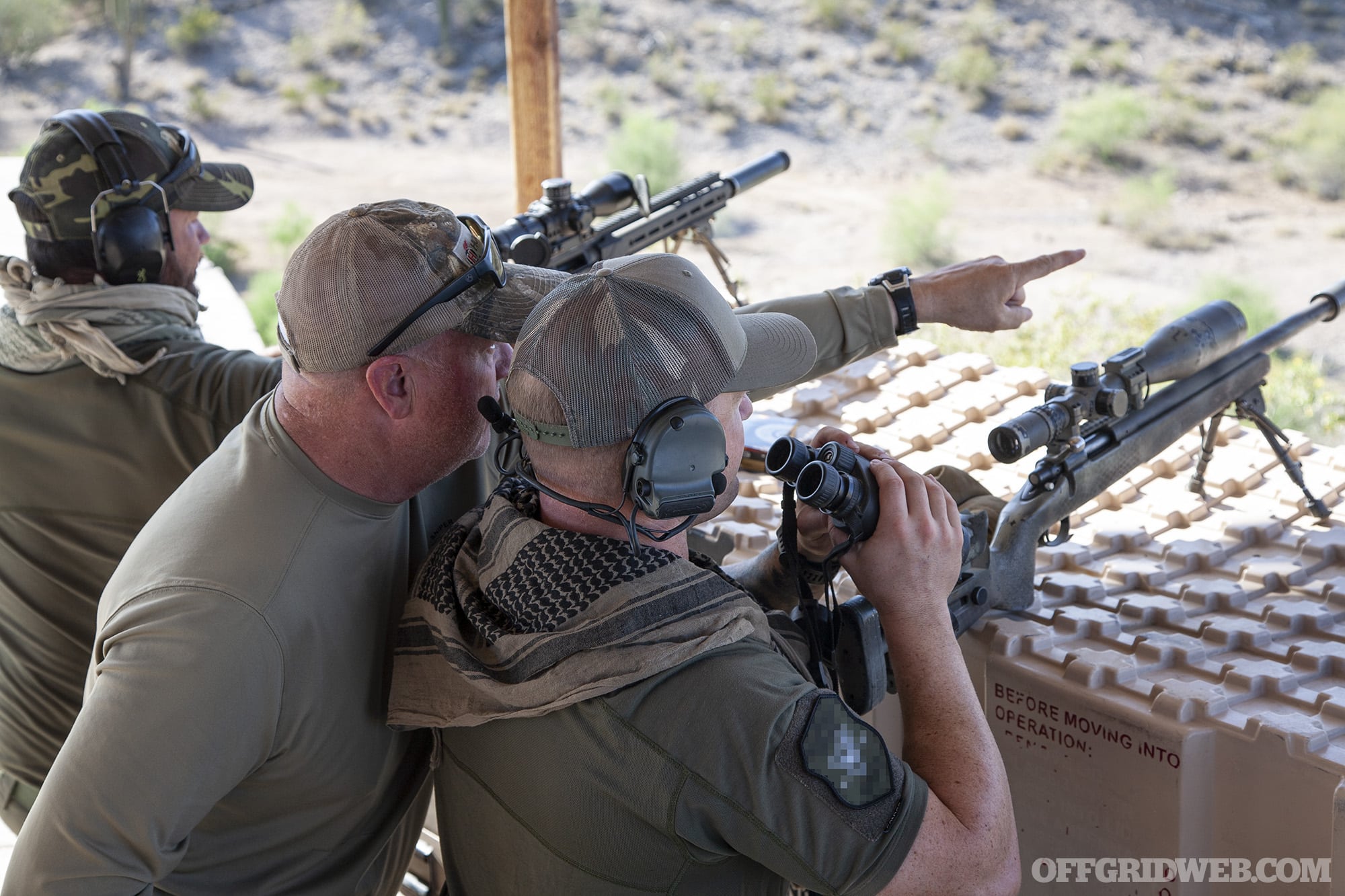
Above: Tim Milkovich indicates a target on the horizon to one of the shooter/spotter teams.
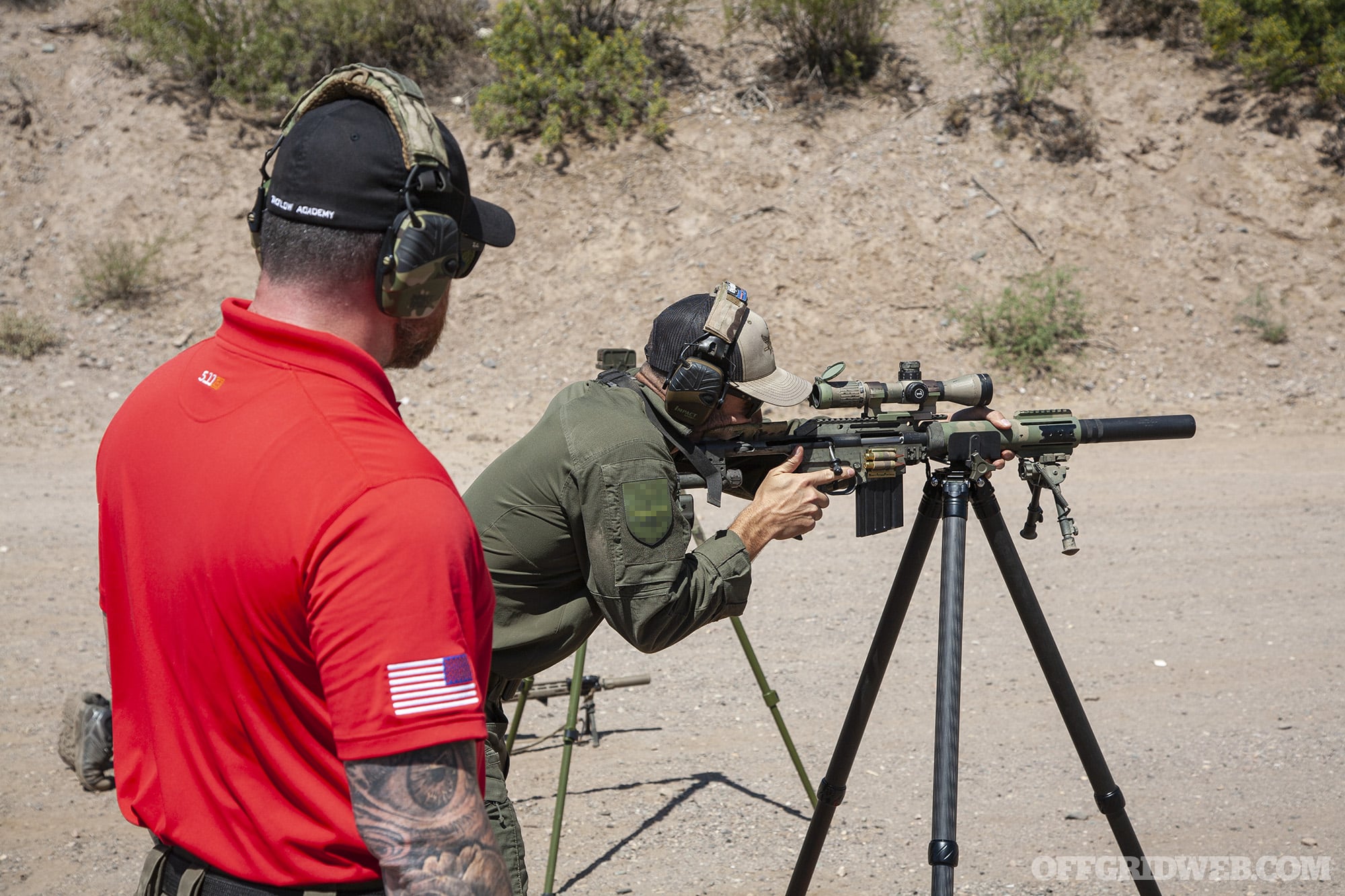
In order to learn more about the skills of professional snipers, I attended the 9th Annual SniperFest training and competition event in Peoria, Arizona. SniperFest, presented by TacFlow Academy in partnership with the Arizona Tactical Officers Association (ATOA), is open to law enforcement and military snipers from around the country, and included training blocks from a variety of instructors. Rob Pettorsson of Cadex Defence was kind enough to lend me a Cadex rifle and some 6.5 Creedmoor ammo so I could participate in some of the training segments firsthand.
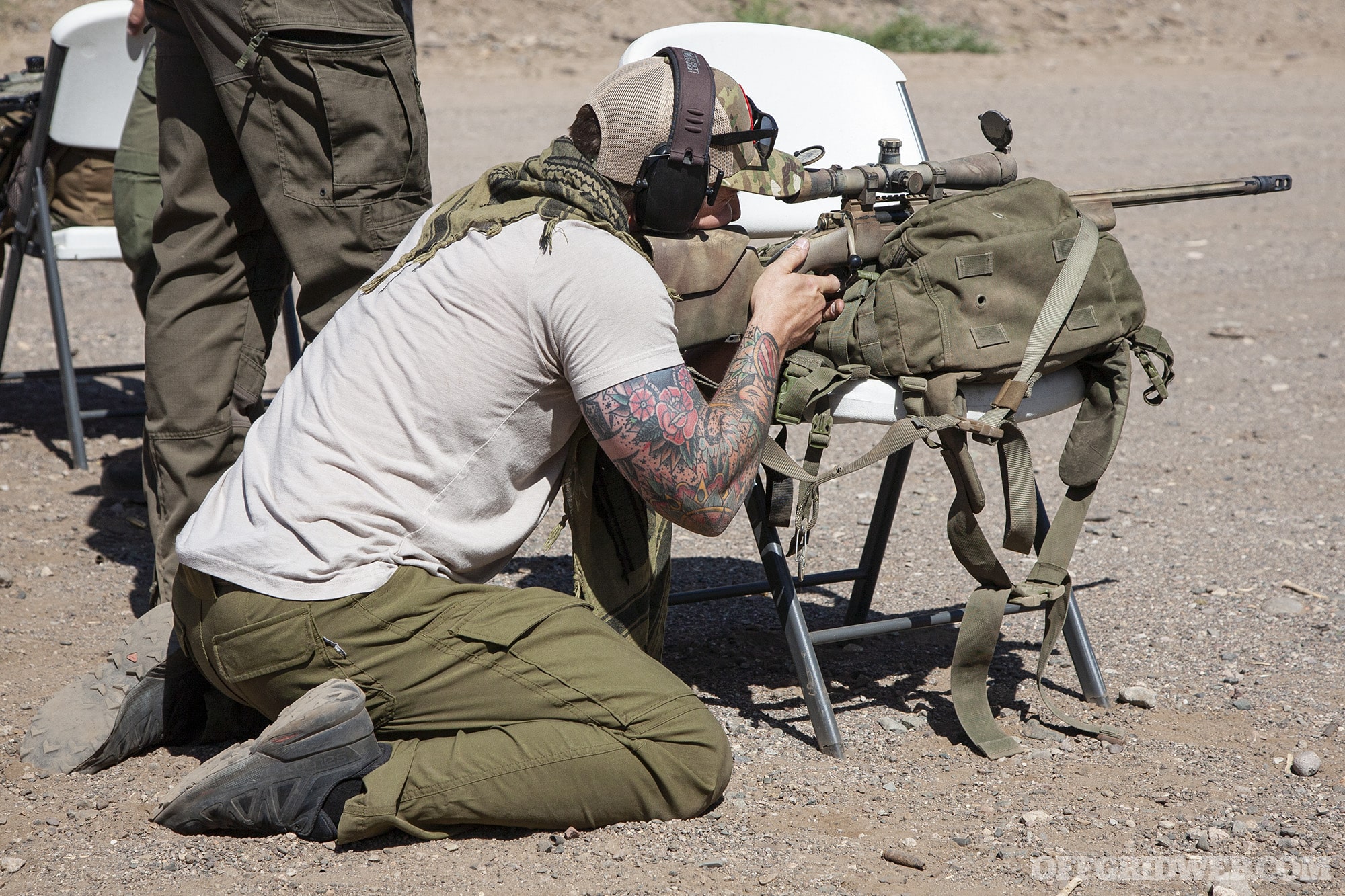
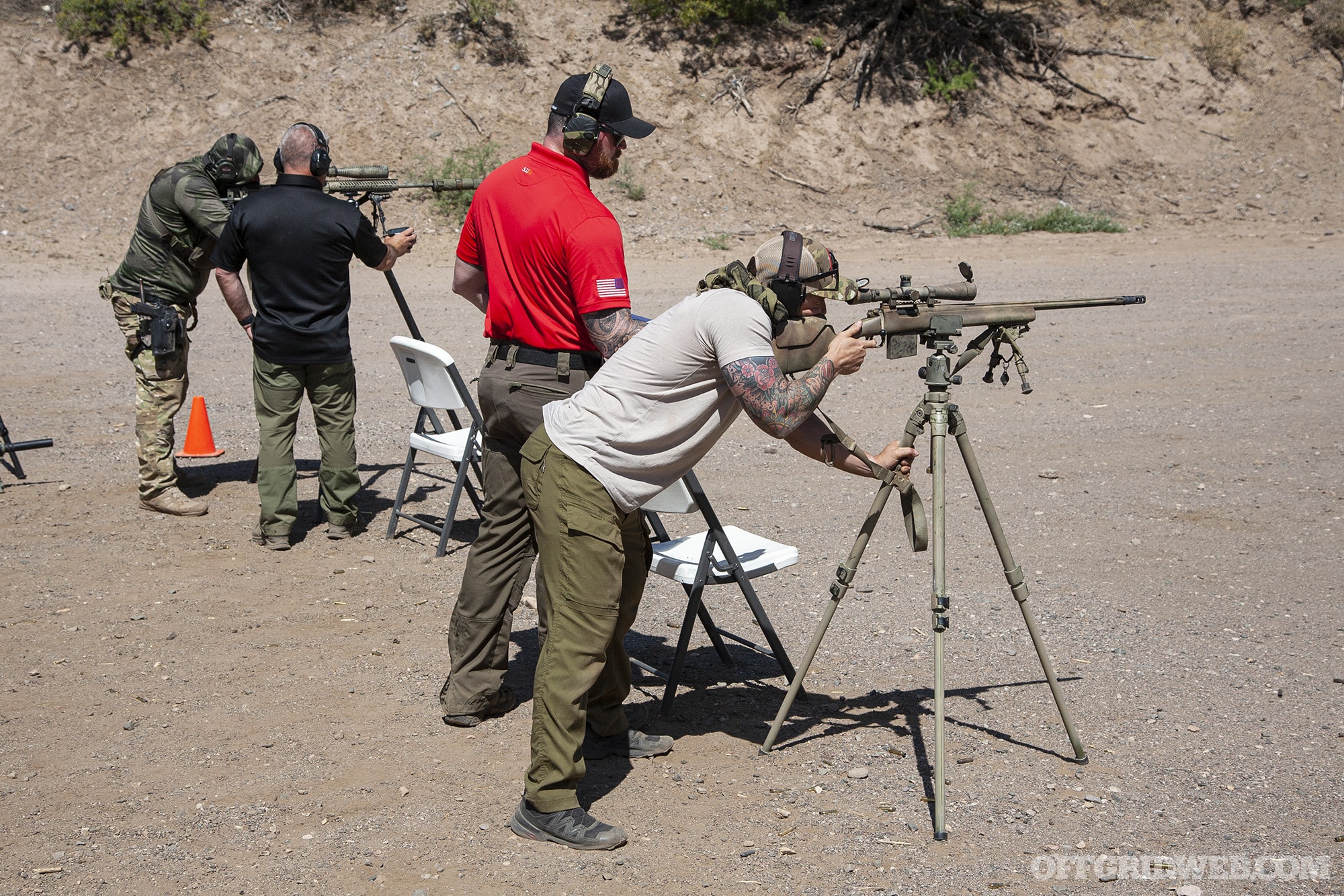
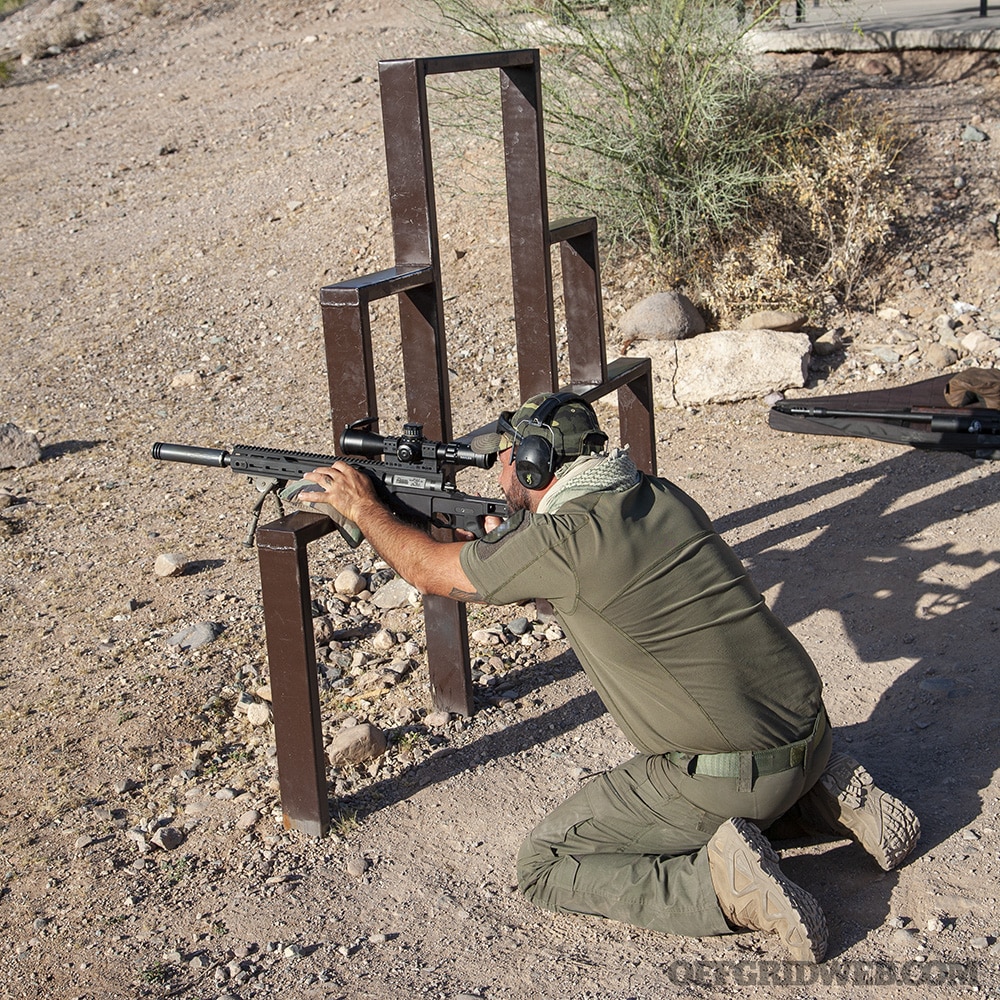
Above & Below: Snipers need to be comfortable making accurate shots from a variety of positions, ranging from low kneeling behind an ordinary folding chair to standing behind a tripod that’s set up with a rifle saddle.
The first block was taught by Juan Ospina, an instructor at GPS Defense Sniper School and former USMC Scout Sniper. It focused on shooting fundamentals, so students shot a precise 21-dot drill that quickly revealed trends in our shot placement. Up-and-down impact distribution is usually a byproduct of improper breathing control, so it’s recommended to exhale firmly and shoot once your lungs are empty. If you need to wait more than a few seconds in this state, breathe again to prevent shaking. Left-and-right distribution usually indicates muscular tension affecting your natural point of aim, so you should relax and ensure you’re fully comfortable before breaking a shot.
Next, an Overwatch Standards course led by TacFlow Academy tested accuracy through various timed drills — standing to kneeling, sitting to standing, setting up a tripod quickly, transitioning between multiple targets, and so on. Each student shot the drills, then switched to a spotter role while their partner did the same.
Above: Freddy Osuna of Greenside Training helped students improve their observational skills through the soft sand, rocky terrain, and dense brush of the Arizona desert. Snipers must be adept at noticing small disturbances in an environment.
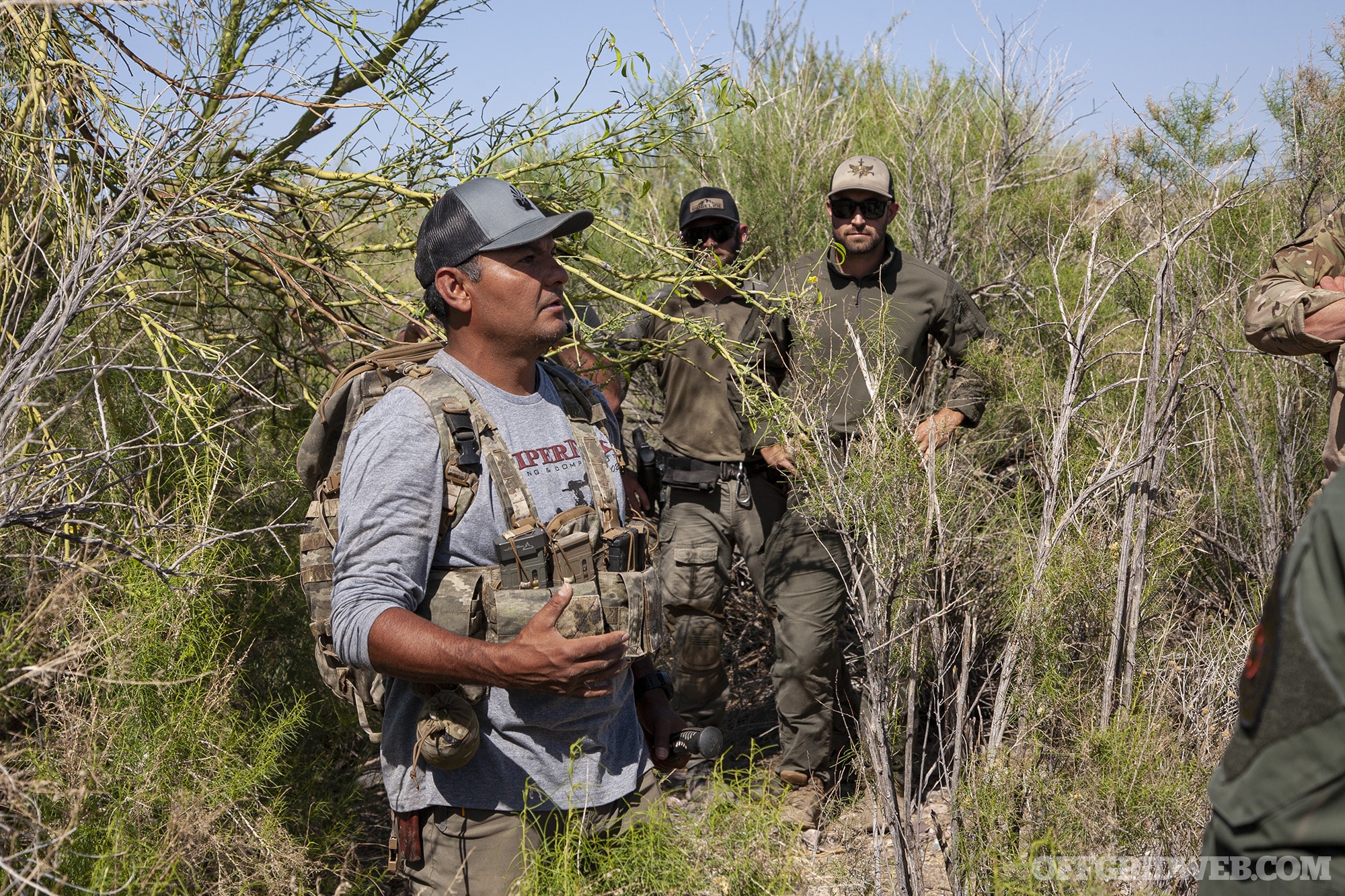
Our third session covered tracking skills and was taught by Freddy Osuna, a former USMC Scout Sniper and the founder of Greenside Training. These skills apply to hunters following elk as well as law enforcement officers following a fugitive’s trail. For snipers, learning to identify environmental cues such as disturbances in dirt or foliage can help determine a bad guy’s direction of travel and prevent ambushes by counter-snipers. Osuna told students to pause frequently to listen for auditory cues such as warning calls from birds and recommended the use of low-power 8-10x binoculars or monoculars to quickly scan sectors before proceeding. (Keep an eye out for more in-depth articles on Osuna’s tracking and observational curriculum in the future.)
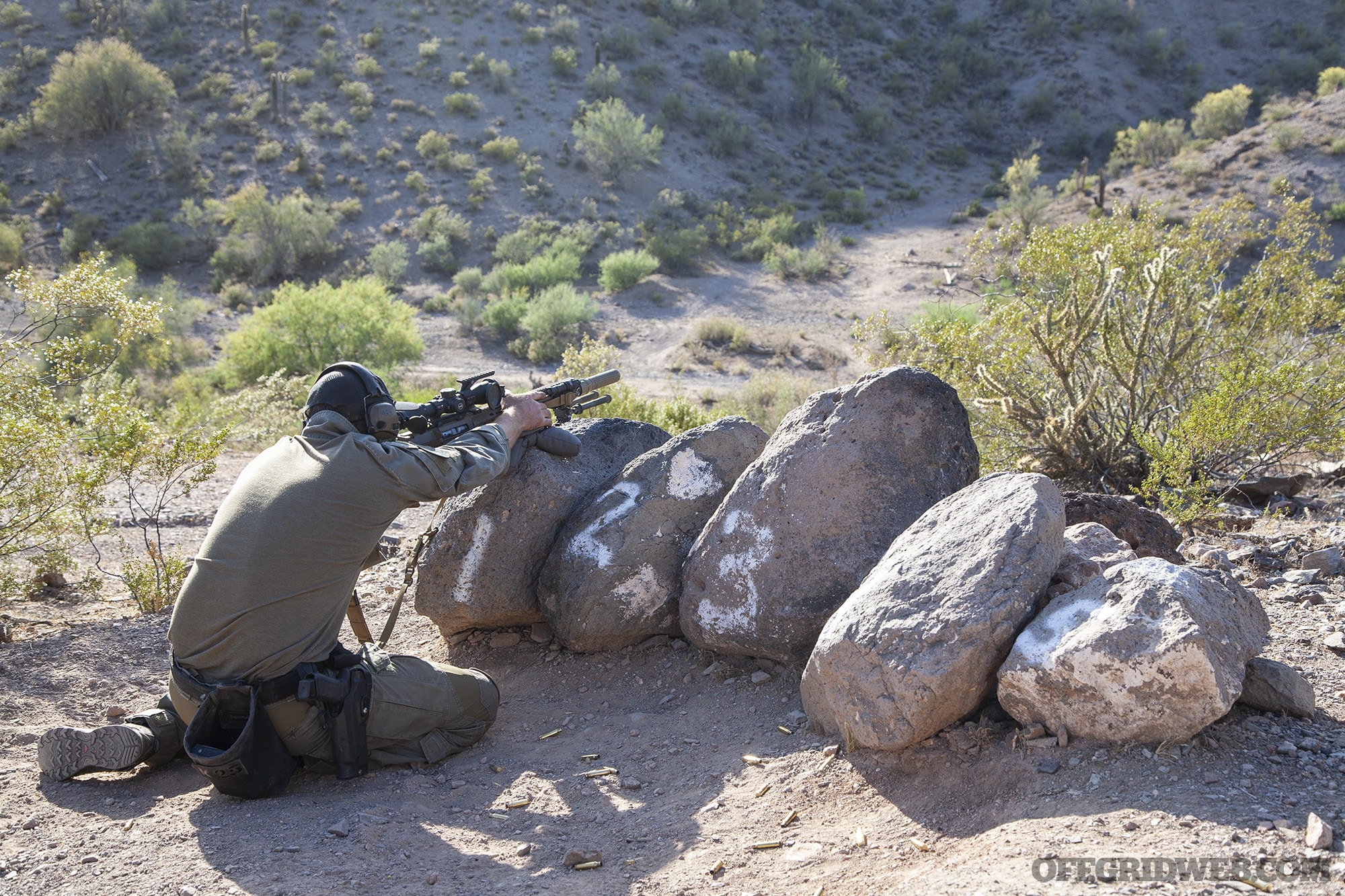
Finally, we headed up onto a ridgeline overlooking a dry riverbed for a block on positional shooting. It was taught by Tim and Regina Milkovich, experts in Precision Rifle Series competition shooting. Students went through stages that involved shooting over the edge of an inclined surface (such as a building’s roof), bracing against rocky terrain, and setting up behind barricades of varying height. Effective shooter-spotter communication was critical here, since less-than-ideal positions led to some misses that needed to be corrected based on the spotter’s feedback.
SniperFest concluded with a competition that pitted snipers from agencies throughout the United States against each other to achieve the highest score in the lowest time. This event gave me a glimpse of the challenges snipers (and their spotters) face and the exhaustive training they go through to overcome them. For more information on the next annual SniperFest event, keep an eye on ATOA’s website, aztac.org. And if you’re interested in honing your own sniper/long-range precision skills, check TacFlow Academy’s website at tacflow.com.
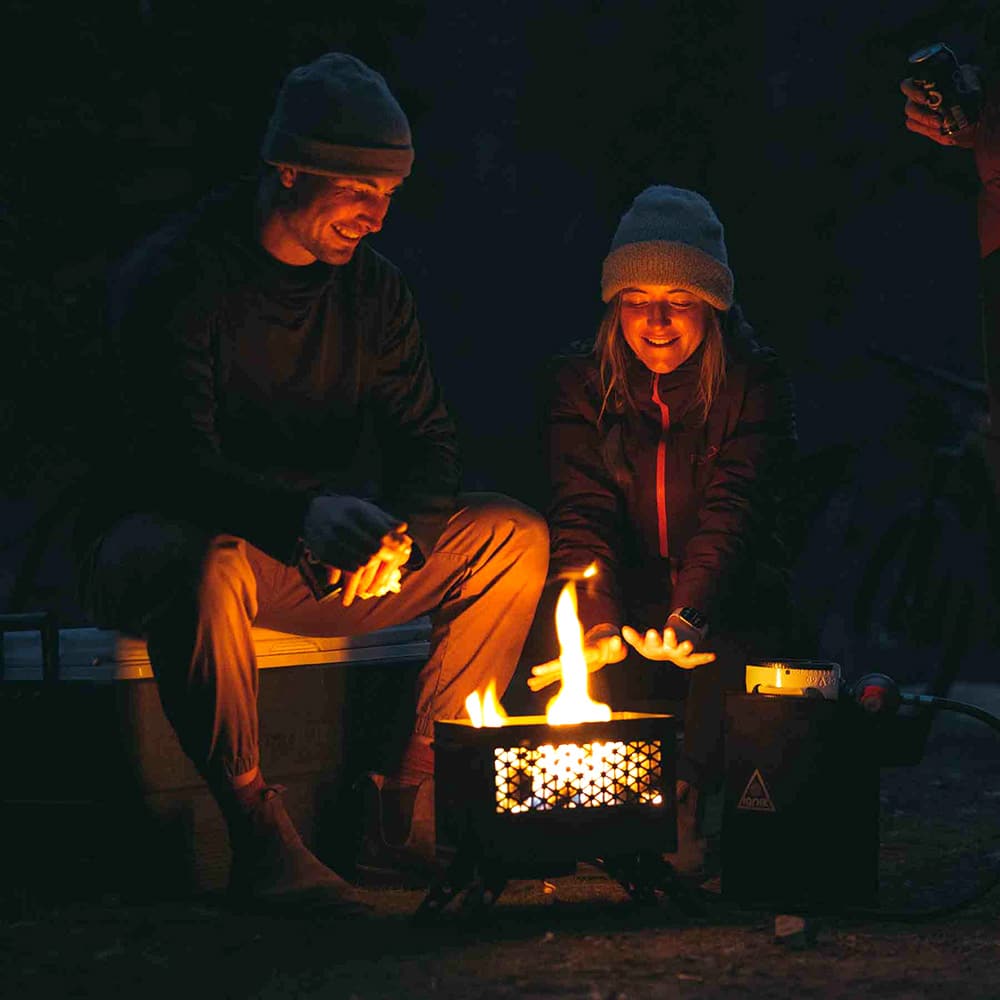
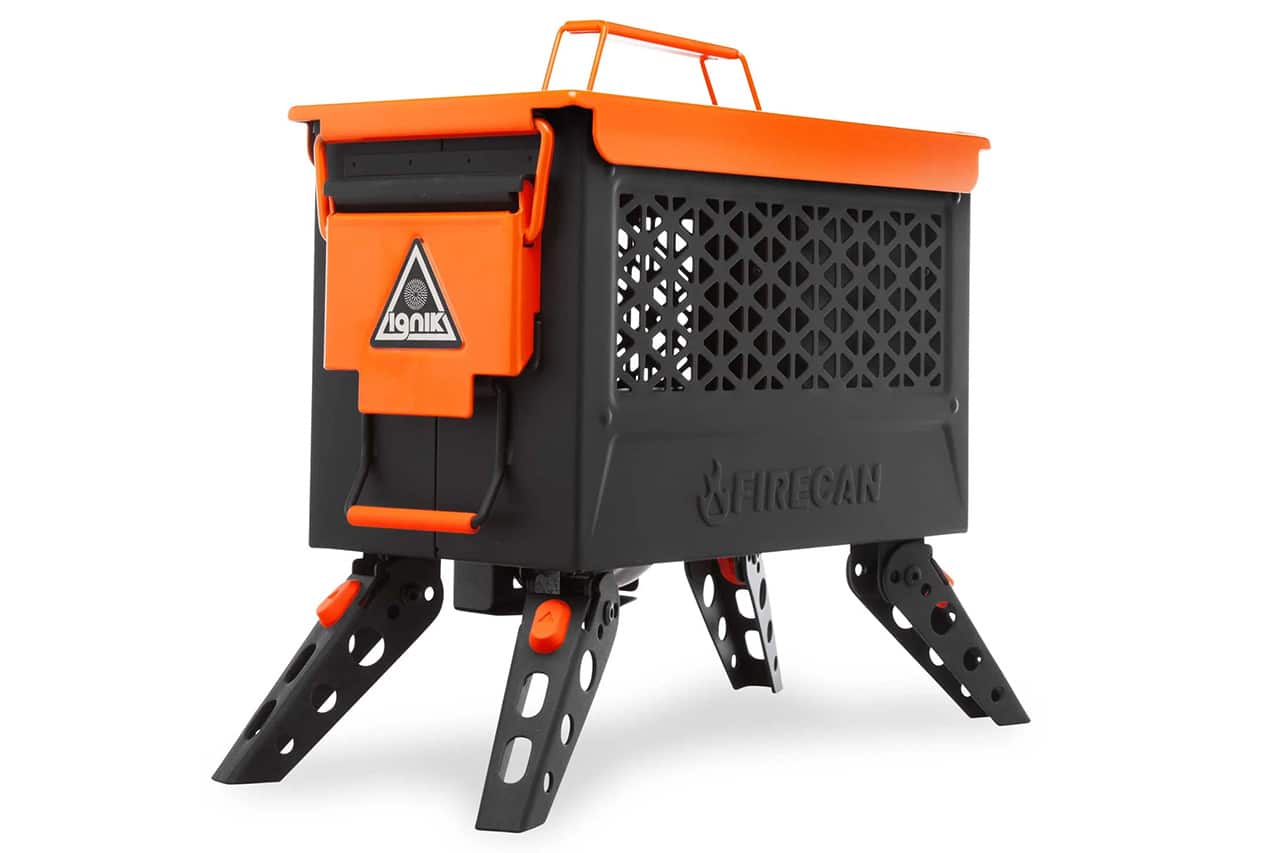
Ammo cans are surprisingly versatile containers. Most of us own several of them, whether they’re filled with loose ammo, loaded magazines, a vehicle tool kit, or even a radio base station. But we recently found a product that uses the venerable ammo can design in a way we had never considered: as a propane-fueled fire pit. The Ignik FireCan is a collapsible, packable unit that allows you to bring 38,000 BTU of heat output wherever you need it, without the prep time or increased wildfire risk of an open campfire.
The Ignik FireCan features mesh sides, folding legs, and a removable lid that stays cool so you can carry the unit safely once the fire goes out. Fire rocks can be placed inside the can for added heat retention.
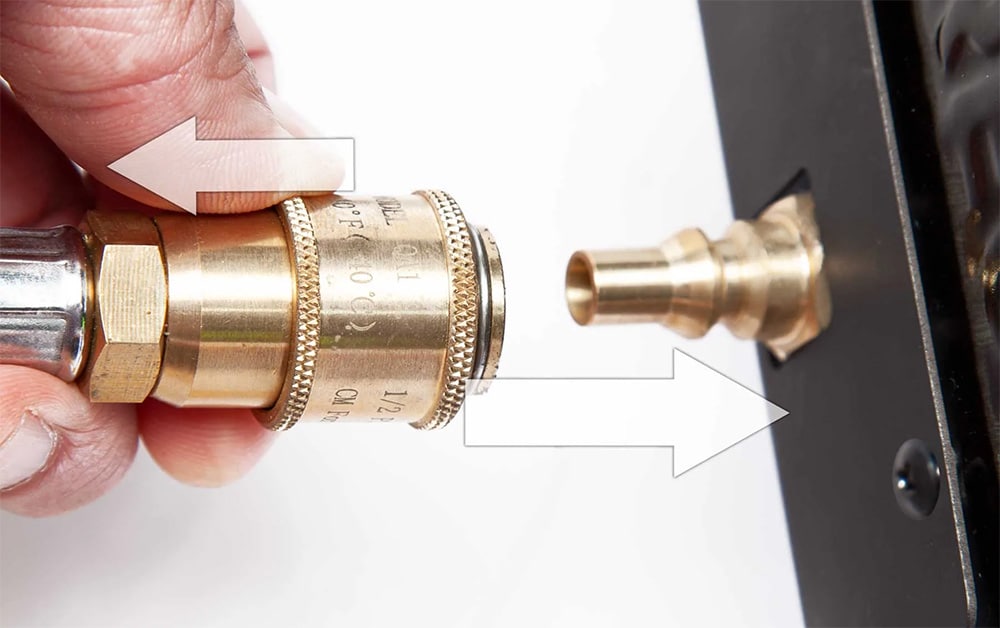
Each FireCan includes a 5-foot quick-release propane hose with an adjustable regulator, so you don’t have to worry about threading on a connector that might leak. Although you can use any propane source, it’s optimized for use with another Ignik product, the Gas Growler:
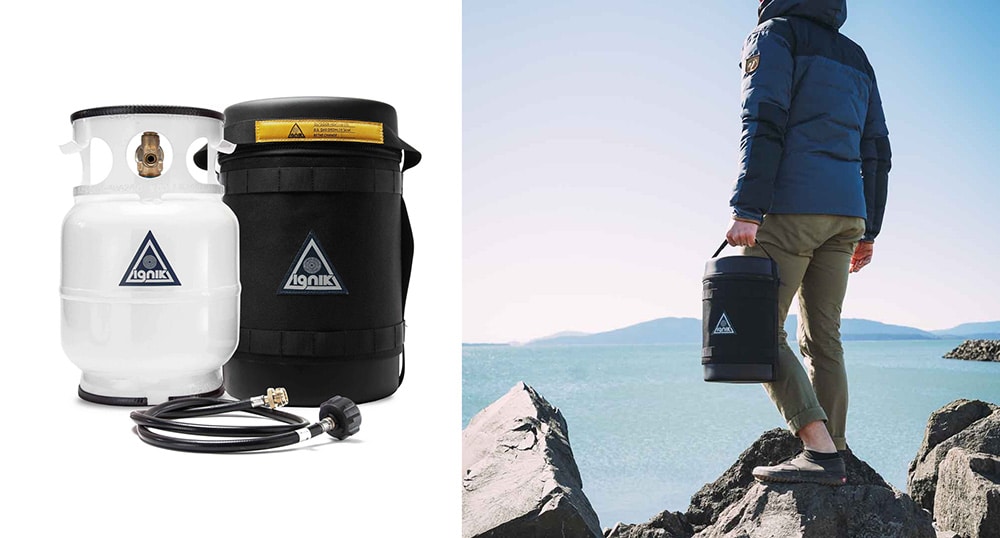
The company says one fill of the refillable Gas Growler costs about as much as a single-use green propane bottle, but it lasts five times as long. It includes a protective case with hose and wrench storage and exterior PALS webbing for attachment of MOLLE-compatible accessories or tie-down straps.
The FireCan and Gas Growler combo looks like a great way to bring heat and light to various outdoor events, from tailgating to camping trips. We also hear that a new variant of the FireCan, the FireCan Deluxe, will be displayed at SHOT Show next month. It includes additions such as dual burners and a removable cooking grate. We’re hoping to get our hands on one for a review in the future, so keep an eye out for that.
In the meantime, you can learn more about the FireCan and Gas Growler at Ignik.com.
The Premise: How are you most likely to die? In The Unthinkable, Amanda Ripley asks this question and begins a journey to explore the mindset of humanity to understand what sets apart one’s survival instinct from another’s. If we’ve ever asked the question, “What would I do in a disaster,” then Ripley’s book is at the forefront of answering that question for her readers. Ripley examines the various levels of human behavior through multiple case studies and eyewitness accounts, leading readers to draw conclusions about themselves. The Unthinkable asks us the hard question: “Will my decision in a disaster lead to survival or death?” More importantly, Ripley asks why we exhibit certain behaviors, and if we can change them to make us more resilient during a disaster.
Our Review of “The Unthinkable” by Amanda Ripley
Ripley investigates a range of disasters, both natural and manmade, asking us if we’re endeared with the mental traits of a survivor. Within the over-arching question rises the most poignant thought of who has the highest potential of dying during a disaster: Why?
The Unthinkable introduces the “survival arc” of actions and reactions when experiencing disaster. Ripley identifies three phases within the survival arc: denial that anything is wrong, deliberation on options considered, and decisions on what we should or should not act upon.
Each chapter of the book focuses on a specific disaster that envelops a particular emotion and action during calamity, and explores how the two are interconnected. There’s a lot of talk about our instinctual reactions in the face of danger. Why do we perform acts of heroism? How do crowds of people suddenly turn deadly? What physical reactions do our bodies go through when faced with unimaginable fear? How do we keep from freezing and move past denial? The Unthinkable definitely focuses on mental survival during disasters, but there’s a fair share of practical advice intertwined through the reading to bring it home for Ripley’s readers, including a knowledge base on specific disasters readers could personally face, and mentally rehearse for what they would do.
The Verdict
The Unthinkable, while exploring the dark side of disasters, is intertwined with a sense of hope. The tragic stories of disaster survivors are sobering, yet heroic as they reflect the human spirt to save oneself as well as the lives of others. Stories range from the World Trade Center attacks to the Virginia Tech shooting. Ripley weaves empirical evidence throughout her writing to display why some of us are more prone to die in a disaster. These tragic stories, however, contain a silver lining, which is that humanity rises to the occasion of doing good more than we think, even during times of disaster.
In an overwhelming library of disaster novels and how-to books, Ripley should be commended for her work. The Unthinkable is a well-researched and optimistic reflection about disasters and how people navigate them. We often dissociate our environment with our emotion, believing that disaster may not happen to us. It’s this premise, however, that Ripley excels at smashing, telling us not only why we’re prone to such thinking, but how to break it as well. She mixes her research with the right balance of judgment and personal commentary, making the reading relatable to all her readers, not just those involved in disaster preparedness. She expertly reaches her audience with the use of individual stories, rather than the sole use of aggregated data, making her work understandable and easily acted upon when advice is given.
This book should be on everyone’s personal bookshelf. It’s filled with fascinating tales of how people react during disasters and gives us practical advice on how to prepare ourselves mentally before being involved in one. By understanding the most common reasons people die in disasters, we equip ourselves with practical information that could save us during such times. If we’re ever in the moment that we think we’d be oblivious to the calamity around us, Ripley is there to warn us that we all are susceptible to human response. At its core, The Unthinkable is a book that believes in humanity and the resilience of people, especially as they come to grips with their mental survivability during a disaster. It offers hope in times of despair, especially as it teaches us that we can overcome the biggest obstacle to surviving disaster: ourselves.
About the Book
Blank Book
Book & Author The Unthinkable: Who Survives When Disaster Strikes—and Why By Amanda Ripley
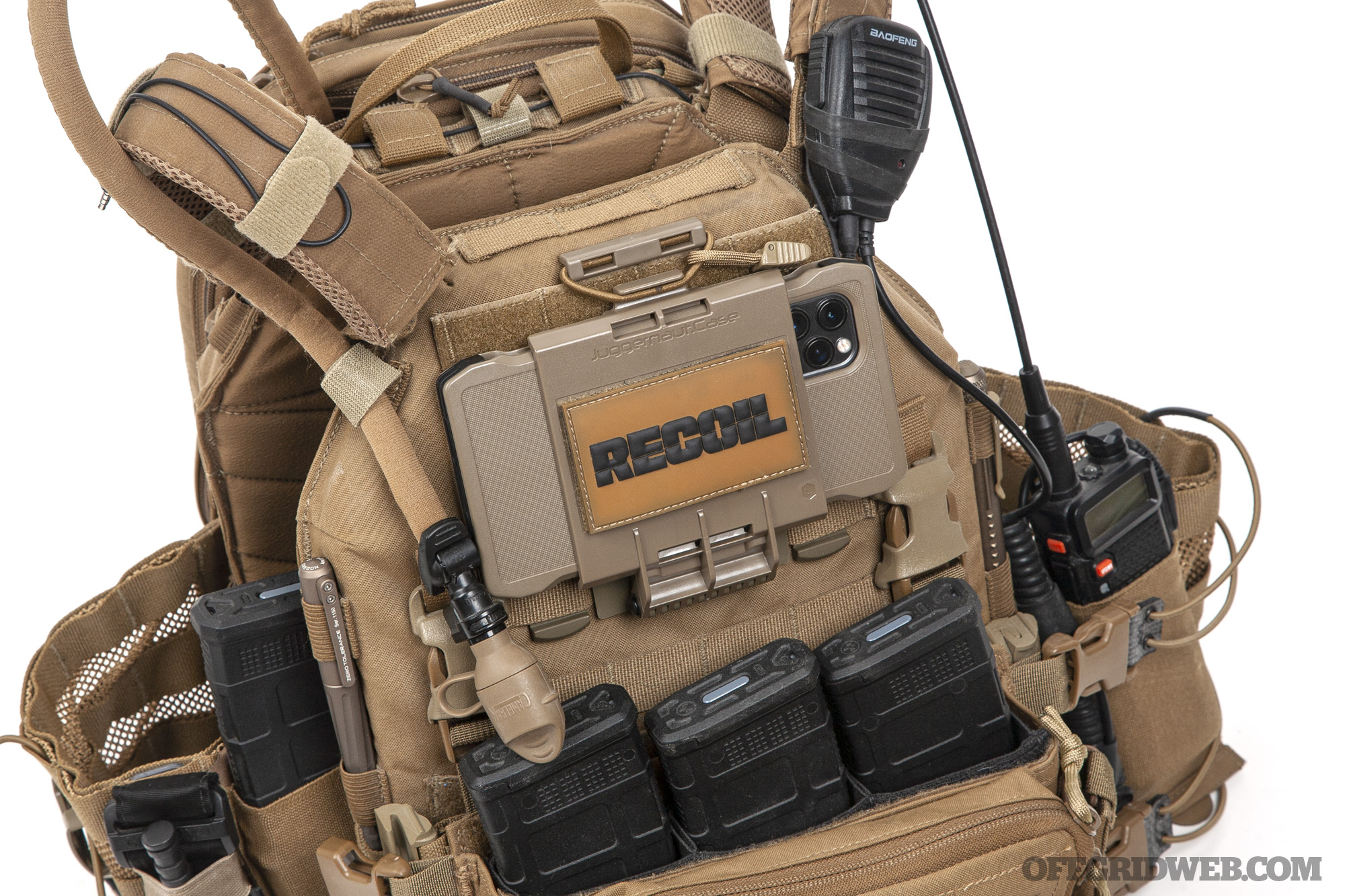
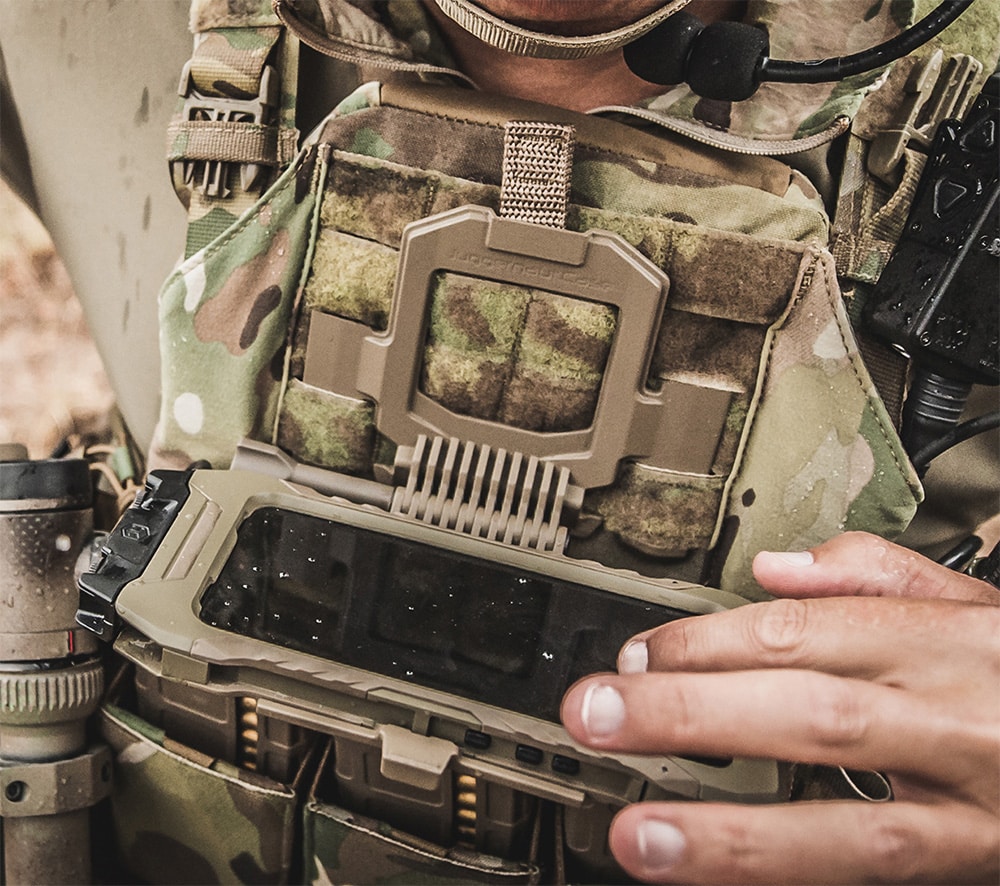
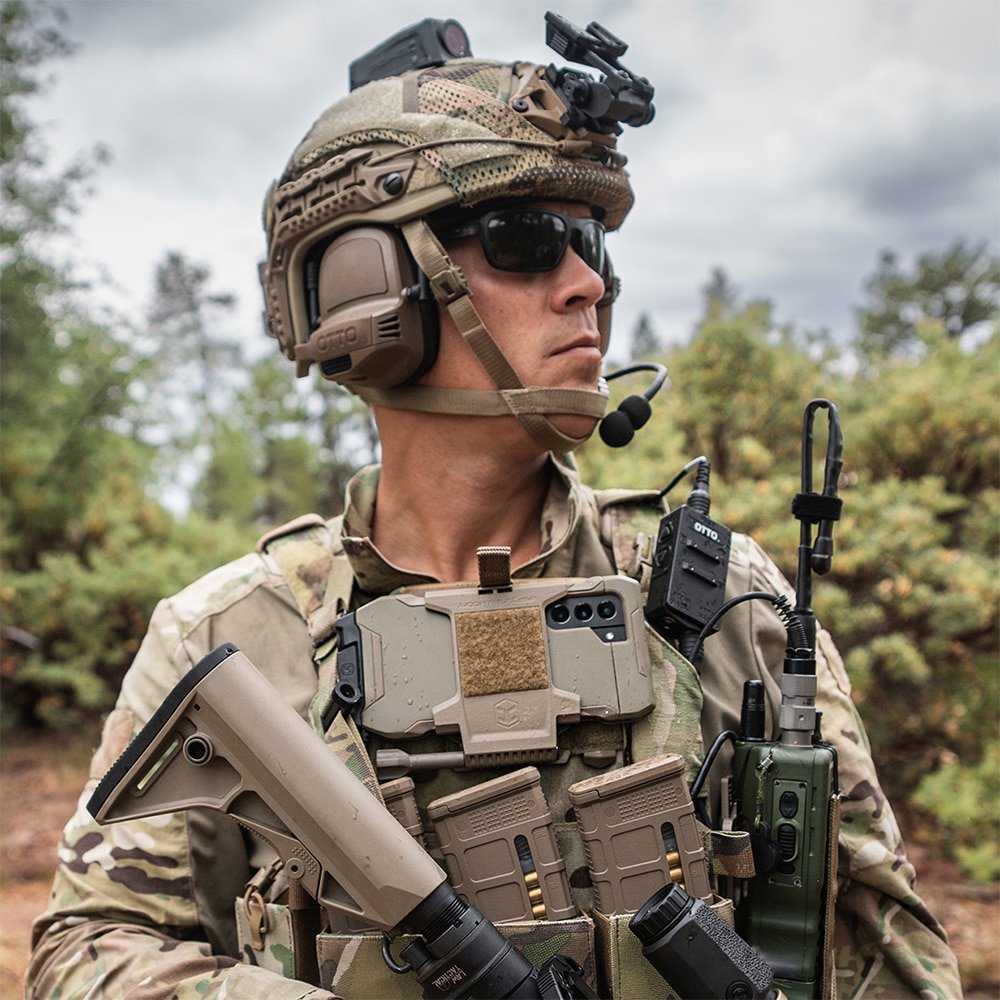
Love them or hate them, our cell phones have become an important part of our daily lives. This is also true for members of the military, law enforcement, and search and rescue teams who use smartphones in the line of duty for navigation and team collaboration through purpose-built apps like ATAK. These individuals often wear plate carriers, chest rigs, and other load-bearing gear, so it’s beneficial to integrate their mobile devices into that gear for quick access. For many years, Juggernaut Case has offered a PALS Mount that attaches a smartphone to MOLLE-compatible webbing, but this week, the company unveiled Version 2.0 of the Juggernaut Case plate carrier phone mount with some cool new features.
We’ve spent some time wearing and using the previous version of the Juggernaut PALS Mount, pictured above. It worked well, but we still felt there was a little room for improvement. Thankfully, Juggernaut Case has apparently addressed all of our concerns with the 2023 version of the PALS Mount (available now).
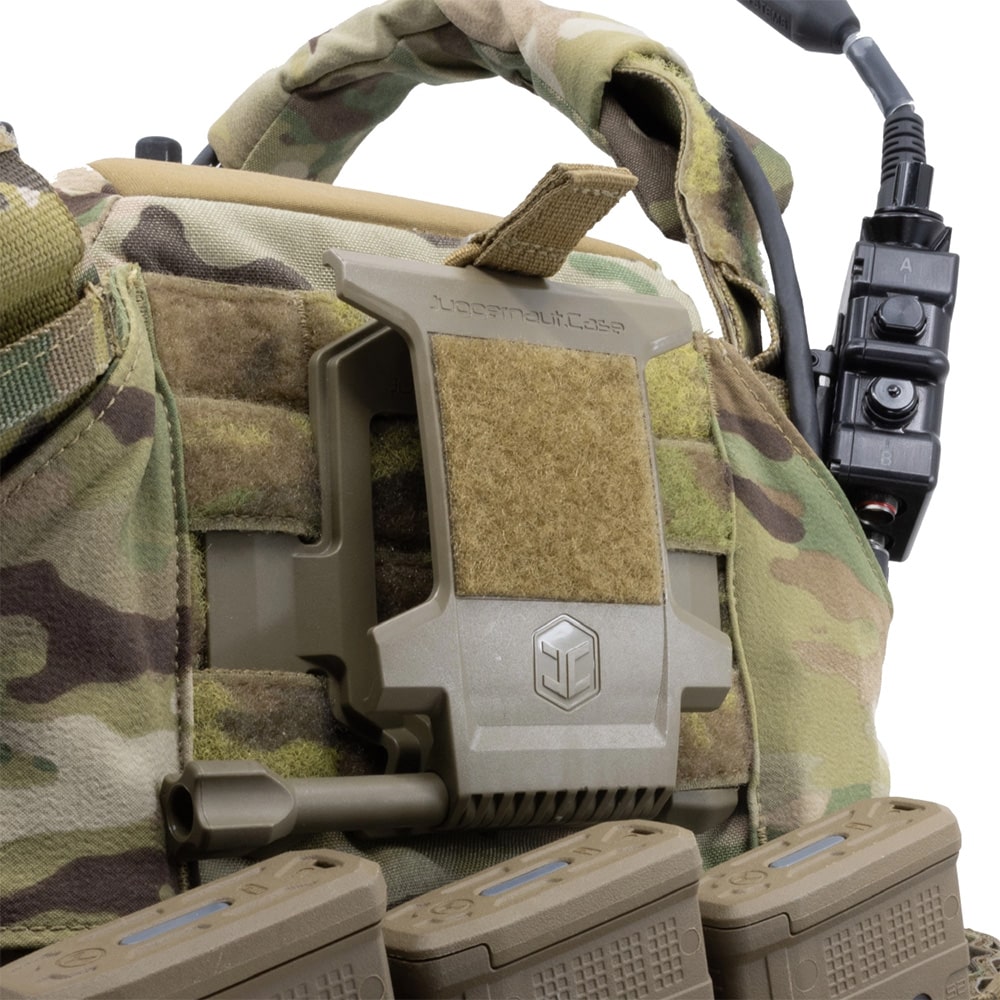
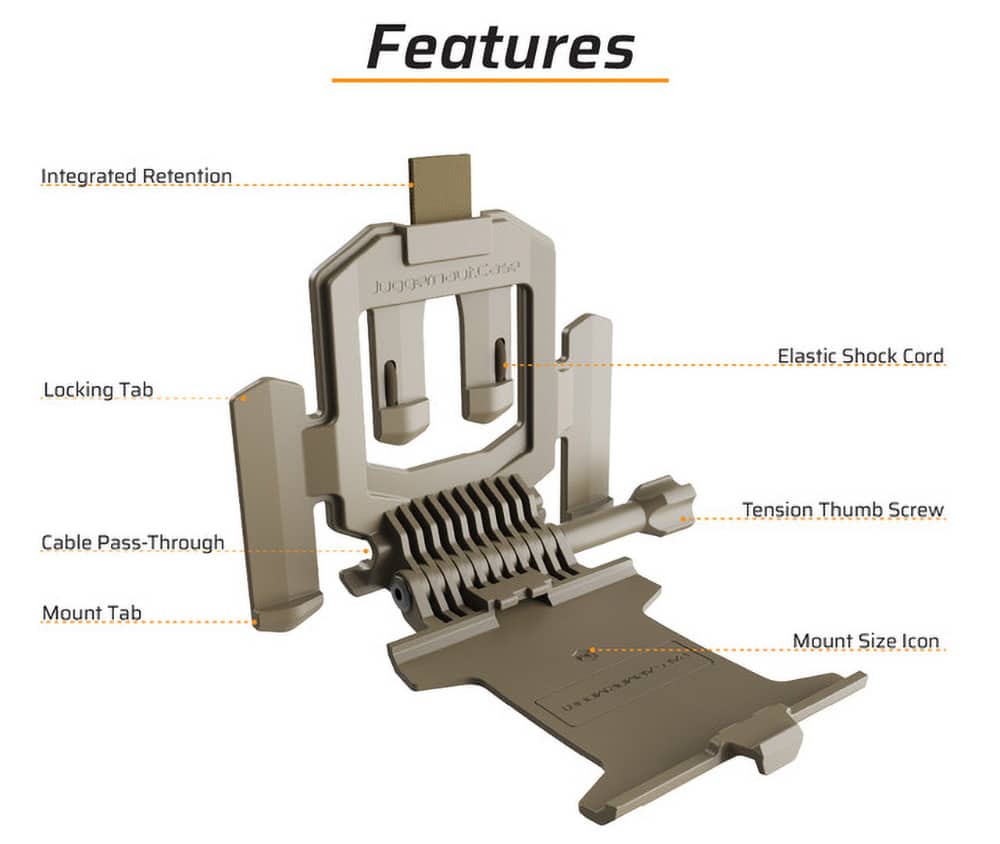
The most obvious change is the front panel, which now has Juggernaut’s signature “dog bone” shape and a slightly more prominent logo. The pivot point at the bottom of the mount now has a new hinge friction adjustment knob, which allows the user to fine-tune how easily the phone folds down.
At the top of the new Juggernaut Case plate carrier mount, the elastic retention band has been integrated into the mount, as opposed to the separate retention band on the older version. This offers more consistent tension on the shock cord, so the mount doesn’t flip open inadvertently.
Finally, the mount’s base has been completely redesigned, with four staggered mounting tabs and two locking tabs that make it easier to install on PALS webbing. It also has a built-in cable pass-through to keep charger or headphone cables neatly organized and secure.
The new Juggernaut Case PALS Mount 2.0 is American-made and Berry compliant for use in DOD contracts. Like previous versions of the mount, it’s available in four device sizes (S, M, L, and XL) as well as three colors (Black, FDE, and OD Green). MSRP is $100, and it requires a matching Juggernaut Case for your phone. The company offers a wide range of cases for Android and Apple smartphones, from the sleek ENDVR to the rugged IMPCT and ADVNTR to the professional-grade OPRTR. The new PALS Mount is backward-compatible with older Juggernaut phone cases, so you won’t need to buy a new one if you already have one.
For more information on the Juggernaut Case plate carrier phone mount, go to JuggernautCase.com.
Drone shopping can be a bit like car shopping today. Not everyone needs a sports car — some families need a van for soccer practice and others need a truck for work. Just as the original Ford Model T quickly transformed into a wide range of two-door, four-door, and convertible variants, drones have come a long way from being a one-size-fits-all solution. Early commercial drones were instrumental for filmmakers and videographers. The best ones were usually made with composite/carbon-fiber material that would make your heart sink if you crashed it. Your average hobbyist didn’t have a spare $20K to $30K laying around to invest in a toy of this caliber. But today, inexpensive consumer drones can be used for recording high-definition aerial video, light shows, obstacle course racing, and even drone drop deliveries of small items.
Disclaimer: This article is intended to be a brief overview of dropping items from aerial drones, and not a comprehensive guide to drone use. Check your local laws before flying a drone or attempting to carry objects with your drone. Always fly safely and responsibly.
The Evolution of Consumer Drones
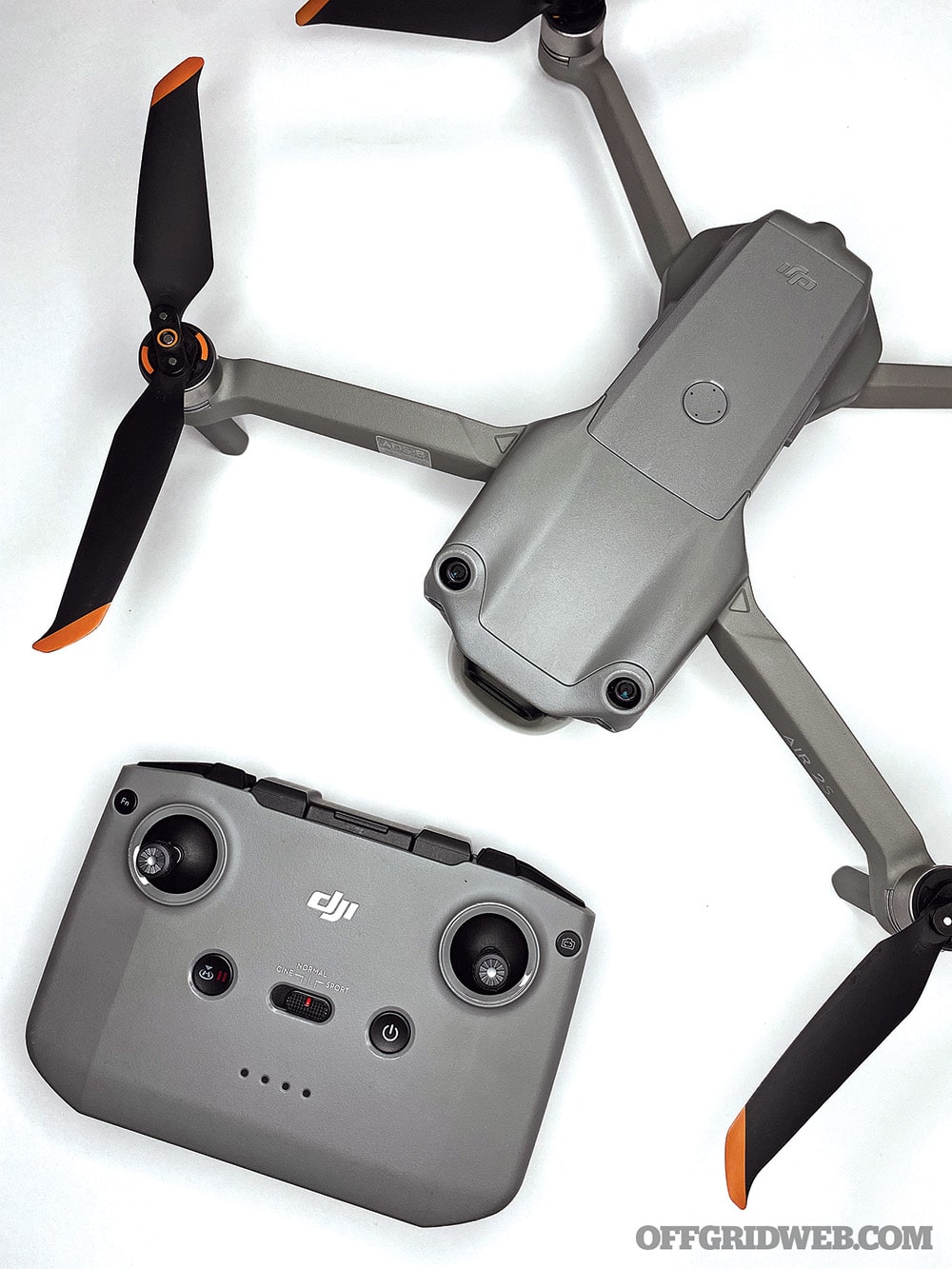
Above: Here’s my existing DJI Mavic Air2S drone setup.
As the years passed, Chinese manufacturers stepped up to pump out smaller drones made from affordable plastic components. These weren’t easy to fly, and replacement parts weren’t easy to find. But the popularity of drones continued to grow, and in 2013, DJI released the Phantom drone to appeal to the U.S. and UK markets. As of 2020, DJI has provided over 77 percent of the U.S. market share for consumer drones.
Thanks to reductions in cost and improvements to ease of use, hobby drones have become very popular. These devices are now being recognized for their capability to do more than capture amazing aerial video footage. Much like hot-rodders learned to push the limits of their vehicles by adding headers and high-flow carburetors, the drone market is experiencing a renaissance of tuning and third-party mods. Swarms of drones can put on a “firework style” lightshow. Drones can fly through obstacle courses with precision navigation and incredible speed. The days of aerial photography for fun have quickly evolved to users putting their drones to the test.
Special Delivery
Given their versatility, low cost, and ease of use, it should come as no surprise that consumer drones have begun showing up in wars and conflicts around the world. Military and paramilitary groups have been weaponizing these devices for many years — they’re used for stealthy reconnaissance from high above the battlefield and have even been equipped with improvised explosive devices to directly attack enemy positions. Drones can also be used to deliver important resources, such as medicine or a radio, to allies in heavily contested areas. Powerful motors and extended battery life have made the DJI Mavic Air2S a popular choice for applications such as these. Even if you’re not currently involved in asymmetric warfare, knowing how to deliver payloads with your drone can be a valuable skill. Read on as we explain the basics of drone drops.
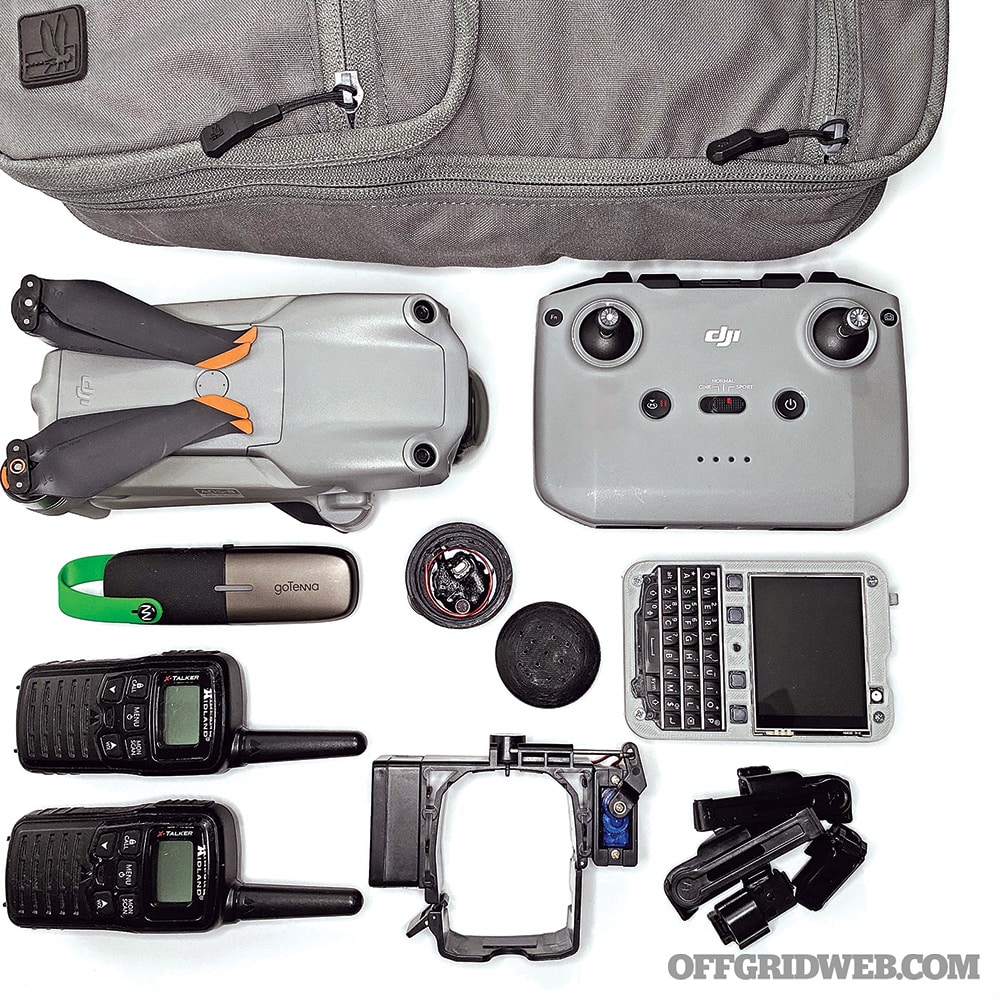
Above: My drone kit and accessories fit easily into a small Haley Strategic Flatpack Plus. Clockwise from top left, this photo shows the DJI drone and controller, LoRa communicator, Hanatora drone drop kit, two Midland walkie-talkies, goTenna Mesh, and TinyTx ThrowTx in a custom housing.
How to Set Up Your Drone Drop
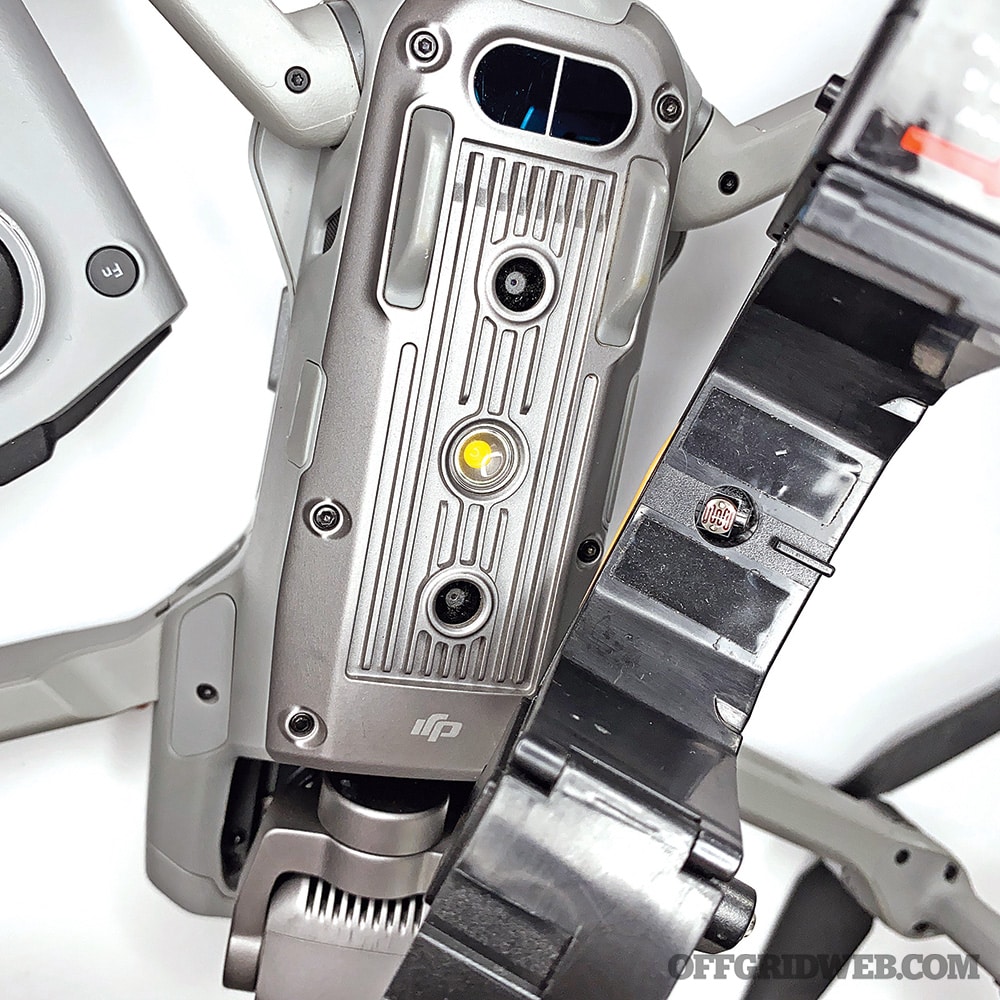
The DJI Mavic Air2S has a remote function button that’ll trigger a “landing light.” There are no internal modifications or special auxiliary motors to hardwire into the drone’s system — it’s essentially pre-wired for a remote “trigger.” Sourcing a relatively cheap “light sensor” switch motor will cost under $60 and will latch onto your drone with the included mounting bracket.
Once installed, the switch will open and close, unlatching whatever string/attachment you connect to the switch. Once you’ve tested the light function with your remote before flight, you’ll be ready to drop anything your drone can carry.
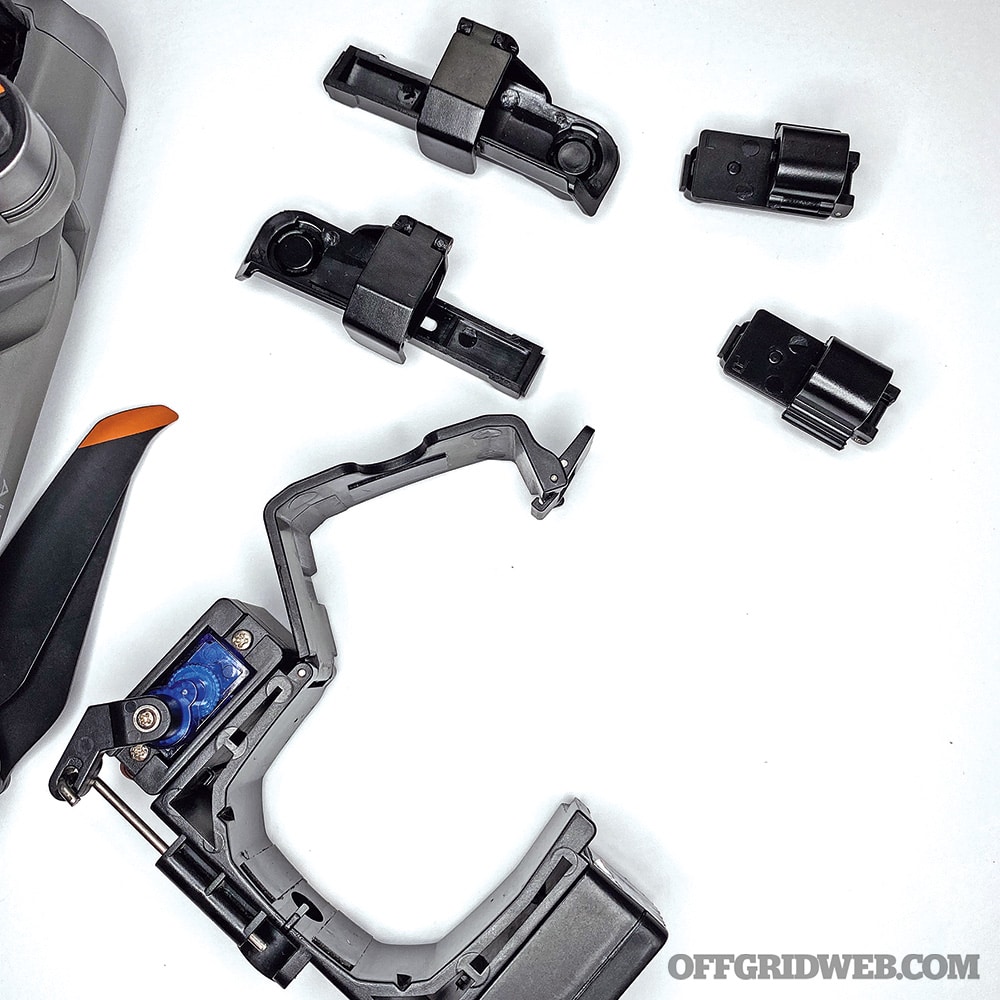
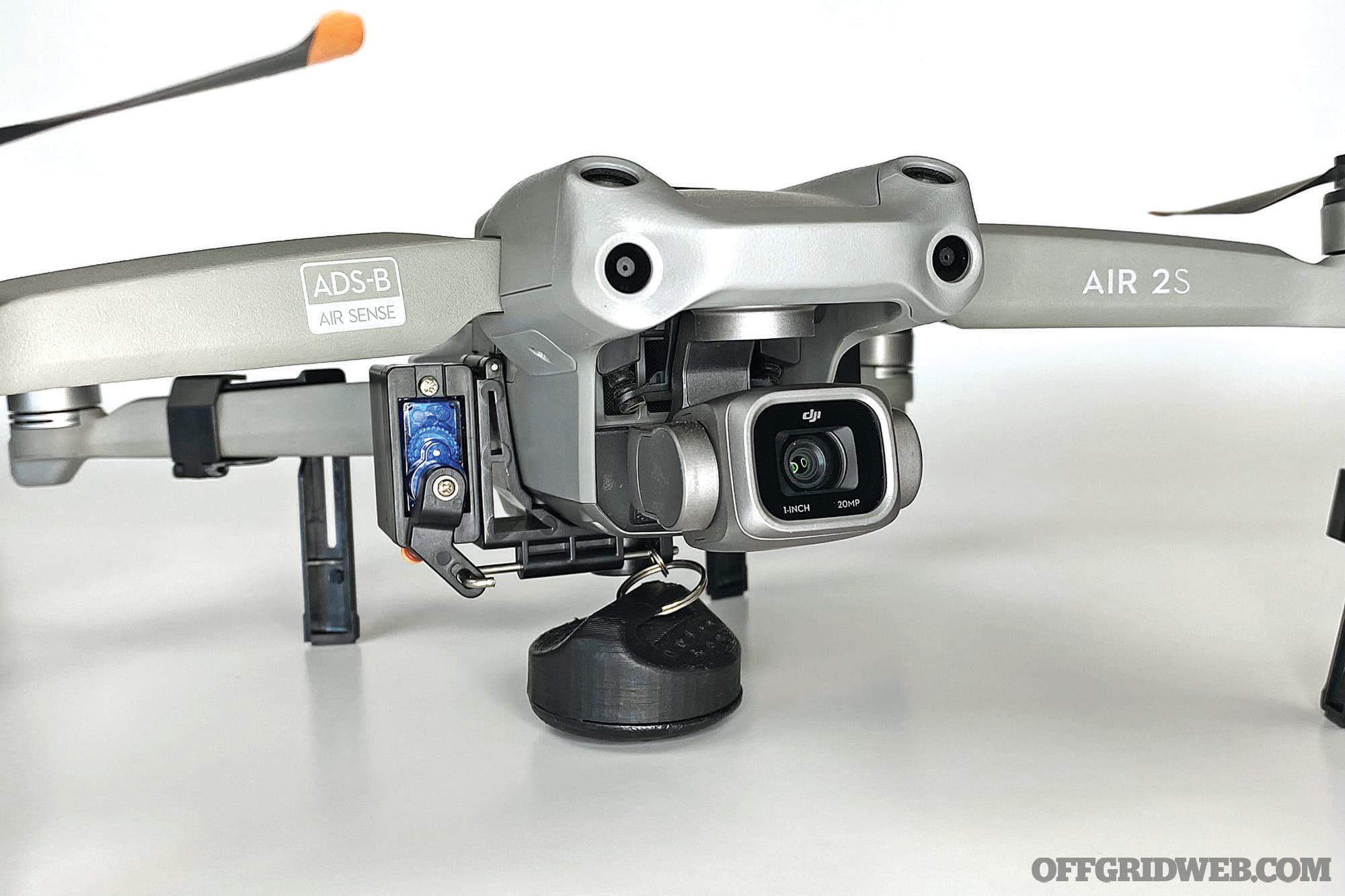
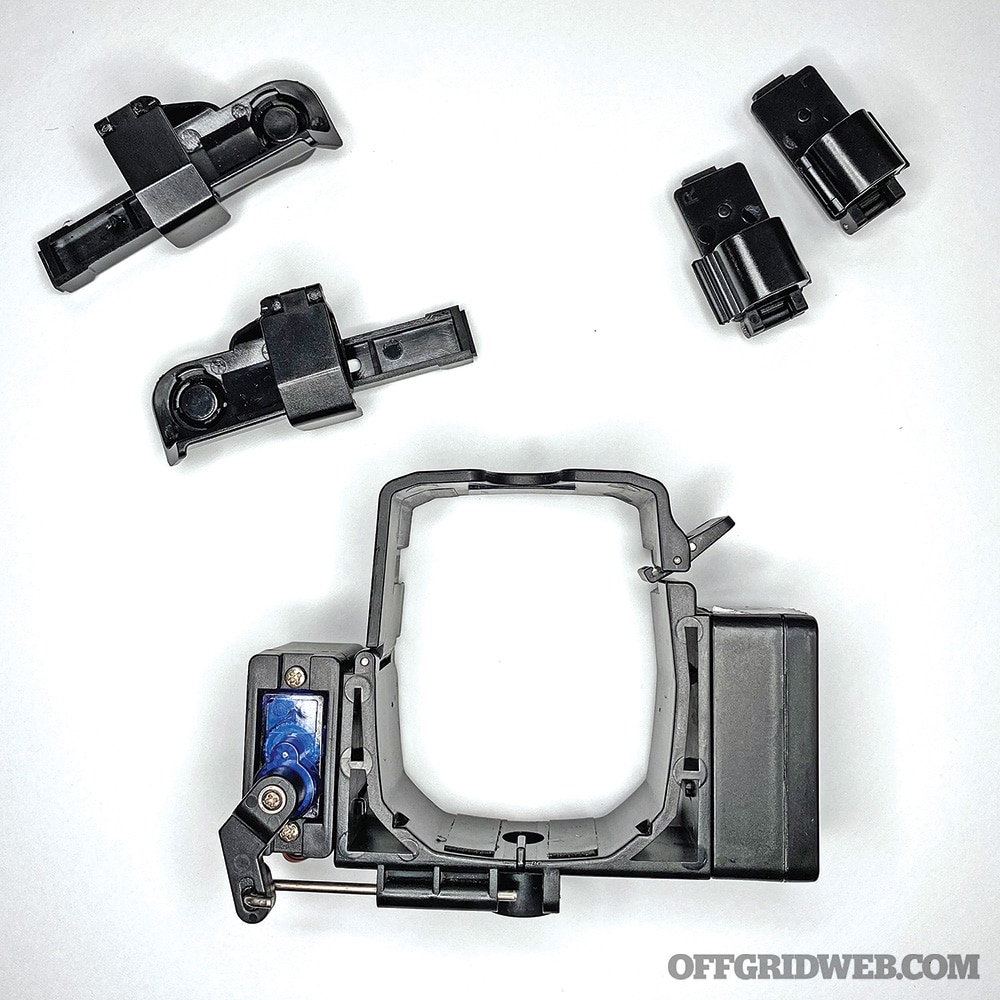
Above: I purchased a Hanatora Payload Airdrop kit for $37 on Amazon. The kit clamps onto the body of the drone. Foot extensions for each arm are included and can help with clearance for takeoff and landing.
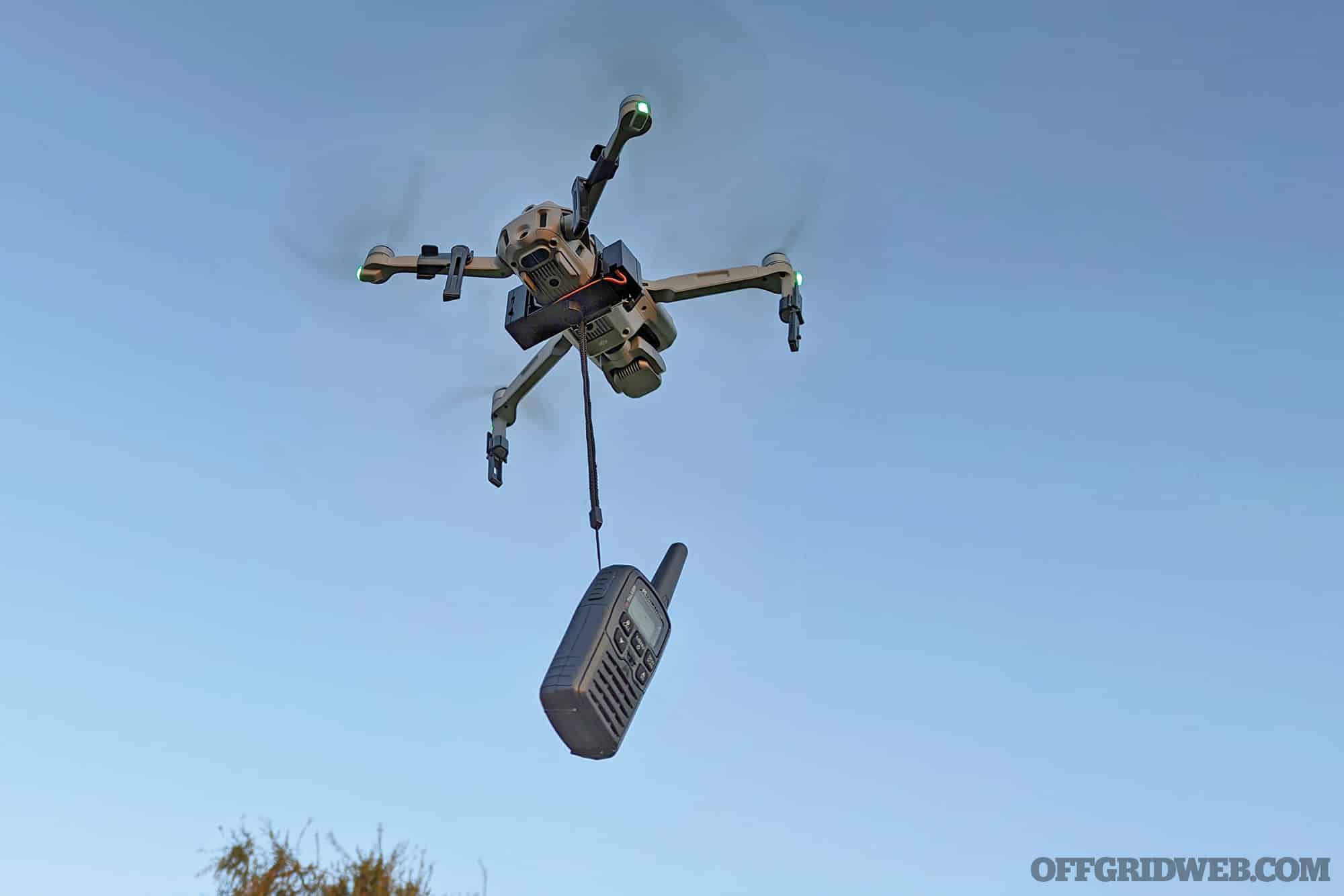
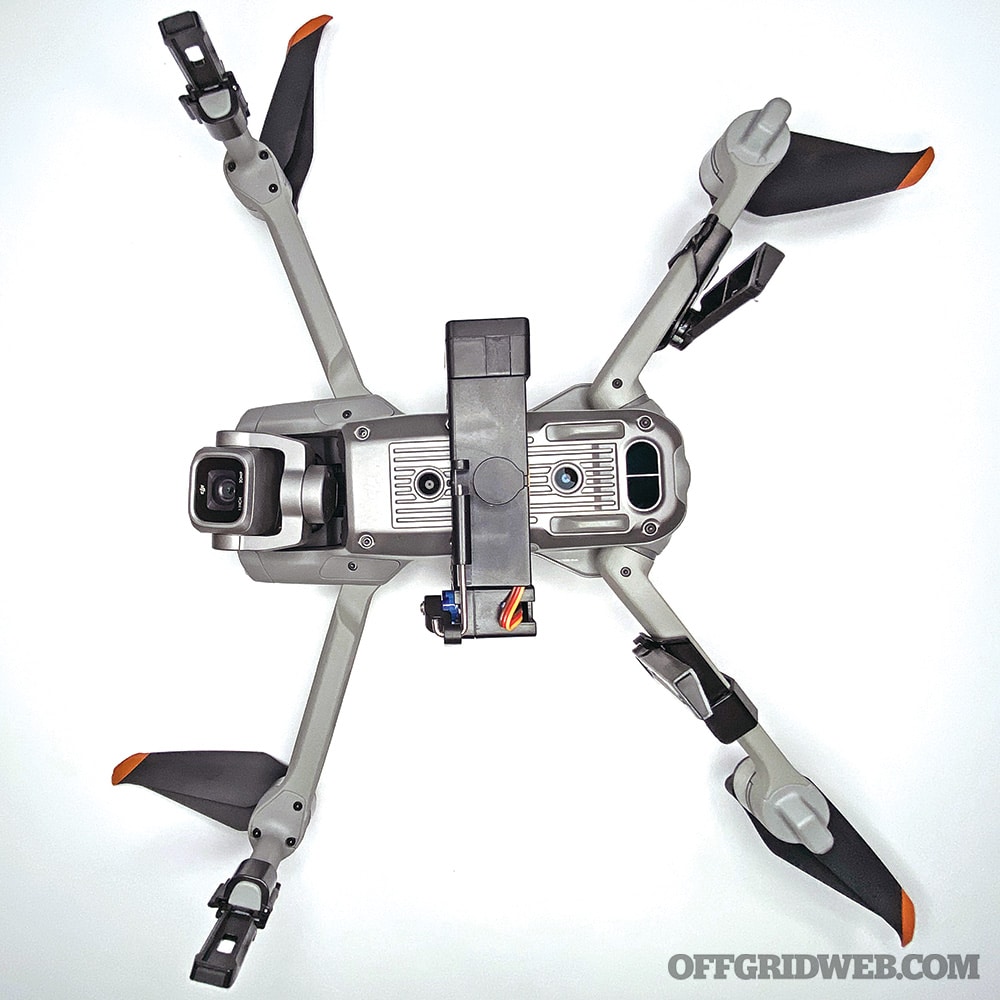
Above: Here’s a photo of the underside of the drone with the drop kit installed. Items can be attached to the retractable metal rod via a loop of cord or a key ring.
Above: To activate the drop function, simply press the FN button on the controller to activate the drone’s built-in “Landing Light.” This will trigger a light sensor in the drop kit that opens and closes the attachment rod.
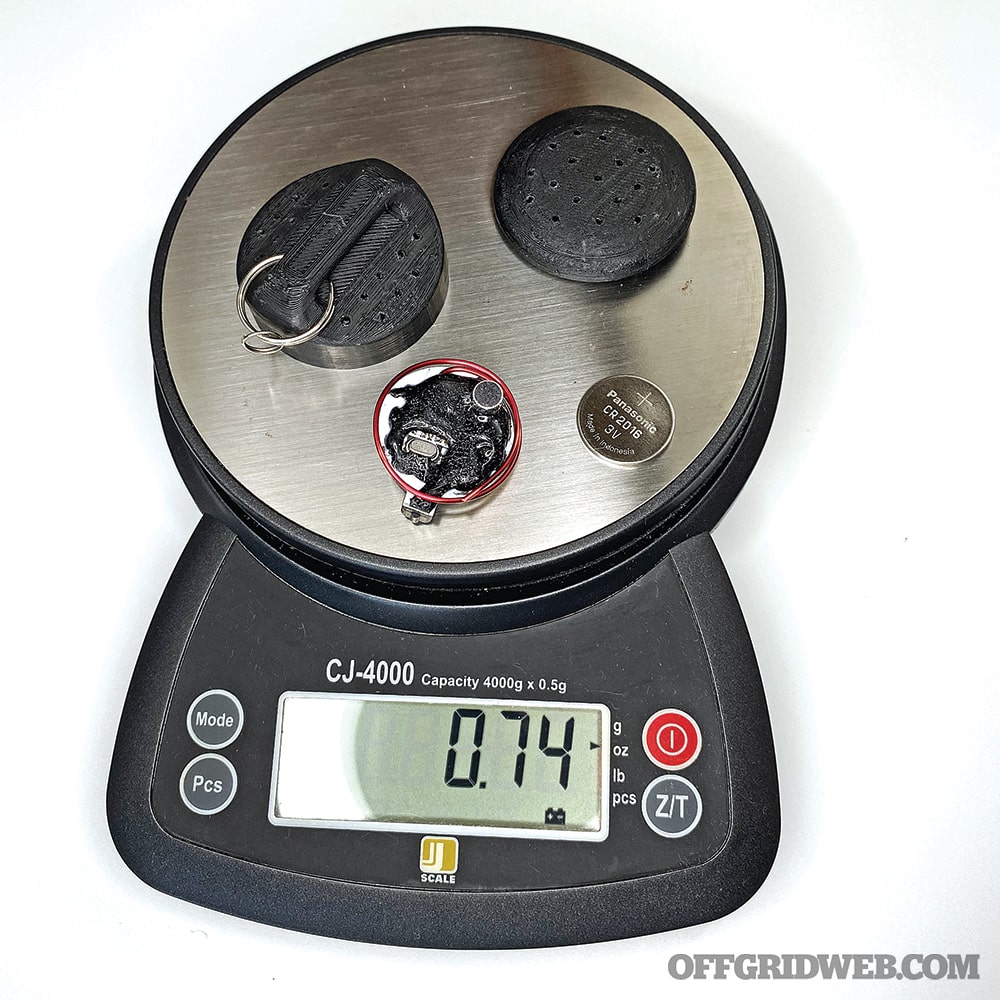
Above: This TinyTx ThrowTx device runs on a single CR2032 battery, and can provide approximately 30 hours of continuous audio surveillance to any UHF receiver (e.g. a handheld ham radio) within a 500-meter radius.
Above: Originally, the ThrowTx was designed with a spherical housing that can be thrown or rolled into position, but this didn’t provide any way to attach it to a drone. I used a 3D printer to create a new housing with a keyring attachment point. The entire setup weighs less than an ounce.
Even if your drone doesn’t have a plug-and-play accessory switch, there are still low-tech options. In an OFFGRIDweb-exclusive article on weaponized drones, we showed how militants in Central African Republic used a drone to carry a hand grenade inside a cut-open water jug. When the drone tilted forward, the grenade rolled out of the jug, and a string attached to the drone pulled the pin. Although this makeshift setup would be incredibly dangerous to everyone in the vicinity, it’s a reminder that improvised drop methods can be cobbled together for almost any drone.
What Can a Drone Carry?
Various weight tests have been performed on many drones. Typically, a DJI Mavic Air 2S can carry roughly 16 ounces at most. Factor wind and battery life into the equation before you take off to deliver that package. I like to stay under 8 ounces for payload weight, since that still allows safe maneuverability and flight distance. Remember that your drone needs enough battery life to make it back from its destination — the last thing you want is an emergency landing in an area you can’t easily access.
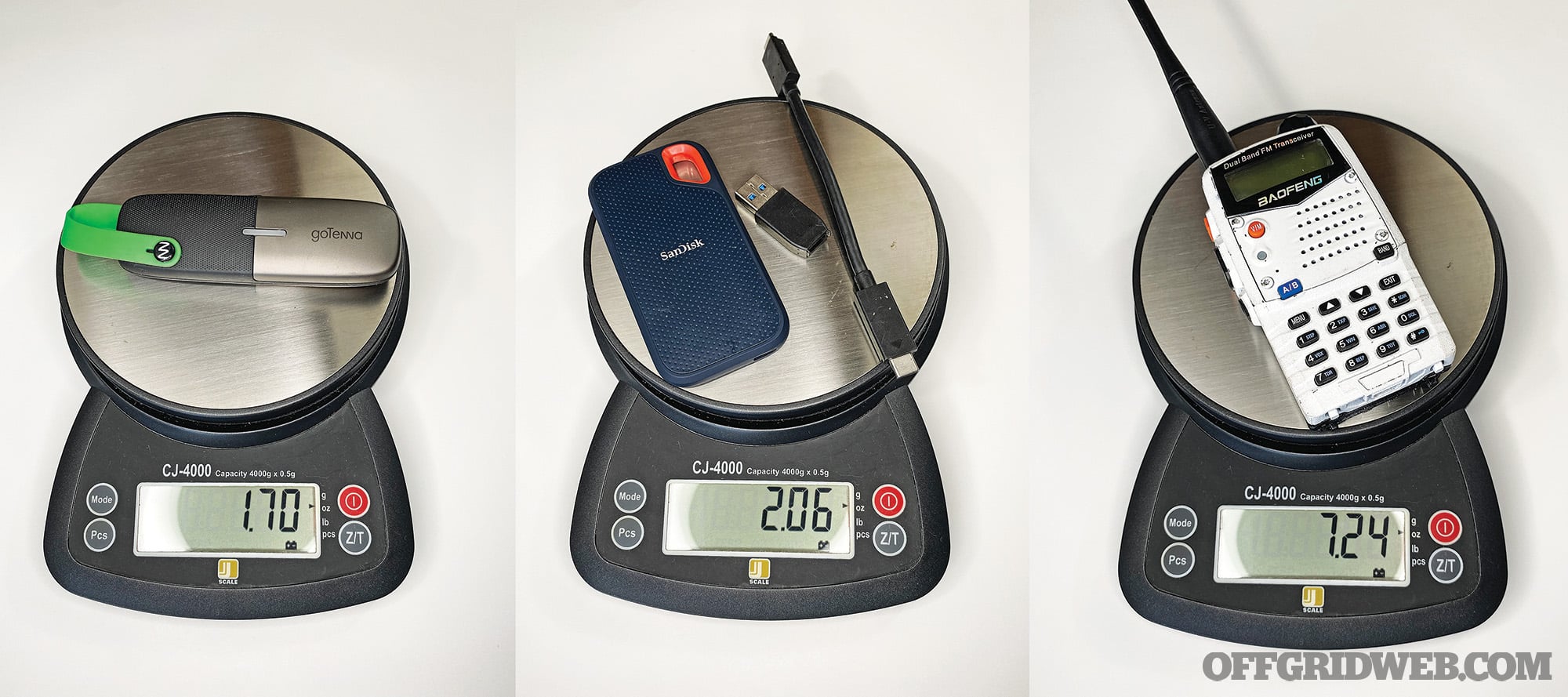
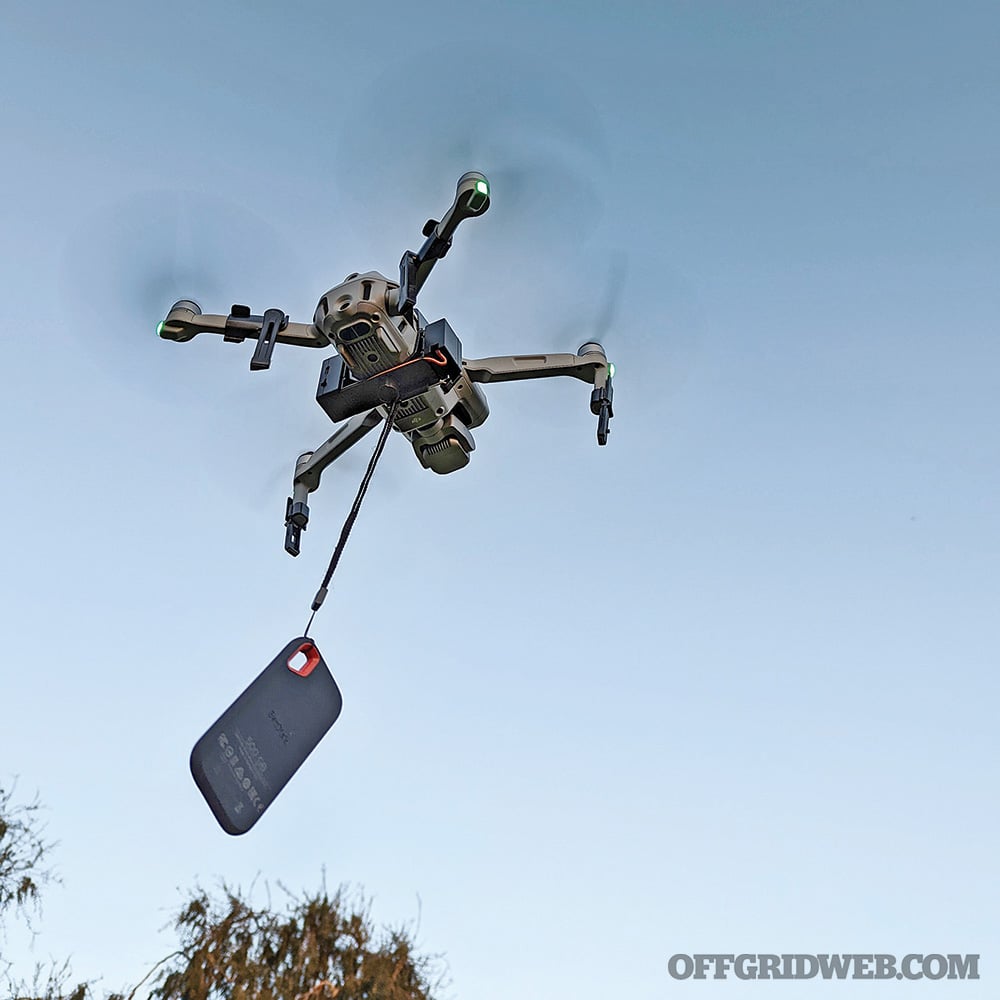
Above: This drone can carry about 16 ounces of payload, but 8 ounces is a safer limit to maximize stability and range. That’s more than enough for a goTenna Mesh network device, a solid-state drive full of terabytes of data, or a Baofeng handheld radio.
For reference, here’s a quick list of some possible payloads we weighed:
ThrowTx audio surveillance device with custom 3D-printed drop housing: 0.7 ounce
GoTenna Mesh network device: 1.7 ounces
SanDisk solid-state drive with USB cable: 2.1 ounces
Midland X-Talker FRS walkie-talkie: 3.7 ounces
Raspberry Pi Zero with 800mAh battery, USB cable, and zippered case: 3.9 ounces
Raspberry Pi with PiSugar 1200mAh battery and 3D-printed housing: 6.7 ounces
Baofeng UV-5RA dual-band ham radio: 7.2 ounces
Raspberry Pi with battery, housing, RTL-SDR dongle, and antenna: 8.1 ounces
Raspberry Pi Zero with USB cable, Mophie 6000mAh battery pack, and zippered case: 8.5 ounces
Above: Here’s what the ThrowTX housing looks like attached to the drop kit. The foot extensions allow the drone to take off and land more easily.
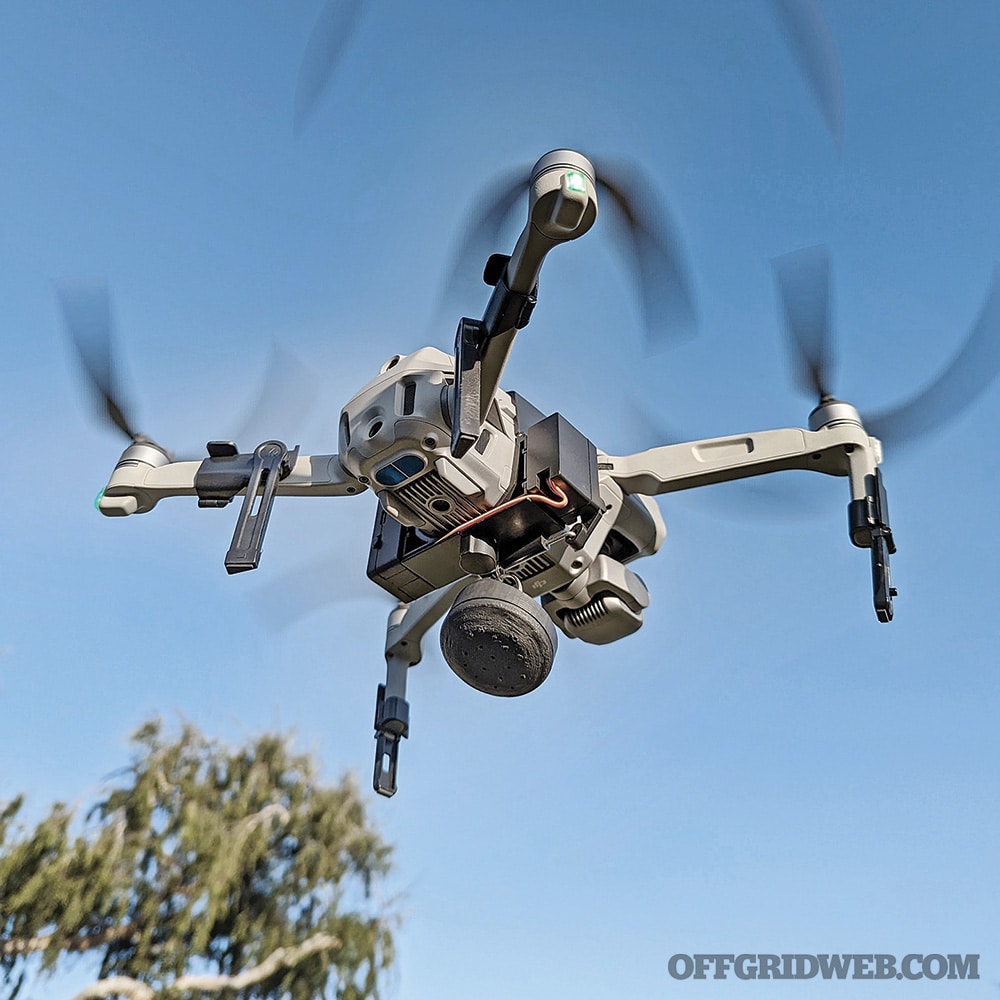
Above: After a test flight, we saw almost no impact to drone maneuverability and stability with our drop kit and payload. Lightweight items shouldn’t affect range much, either.
Deciding what you want to carry and what can withstand the impact from the drop will be an evolving goal. 3D printed enclosures partnered with soft foam work well and are scalable and light; I’d strongly recommend foam enclosures for anything that’s fragile or needs to be dropped from more than two stories of elevation. Kite strings and creative knots can secure anything that doesn’t need protection from the drop.
Real-World Drone Drop Applications
Thinking of what to drop? The possibilities are endless. If your mind races immediately to Molotov cocktails or kilos of white powdery substances, you’ll likely need a much larger drone to fly in a country where that sort of lifestyle is accepted. Maybe you want to play extreme fetch with Fido, or have an over-the-top gender reveal party. But this is RECOIL OFFGRID — we want to focus on staying prepared and alive.
Above: For less than $40, the Hanatora Payload Airdrop kit includes a mounting bracket with sensor and drop motor, as well as foot extensions.
Search-and-rescue drones can find a missing hiker, but imagine having the ability to drop a radio so you can communicate, not just hover over the individual. Keeping them intact and working can involve trial and error. A small affordable walkie-talkie weighs a lot less than a clunky CB/ham radio. If you have good cell service in the area, a cell phone would work great. If not, consider a GPS beacon or satellite phone. Find ways to strip items down to bare essentials and protect them with lightweight soft padding.
Surveillance and countersurveillance is another area where drones excel. Dropping listening or jamming devices isn’t something I will explain in great detail, but specialists such as TinyTransmitters offer some surprisingly affordable and capable options. It’s also possible to wirelessly collect information by attaching a radio receiver to the top of the drone using Velcro, and dangling an antenna underneath it. In the event that you need to make a hasty getaway, your drone drop system can be used to ditch the antenna at the press of a button. Similarly, your drone can act as a radio repeater to aid in broadcasting a stronger signal.
Above: In situations where there’s no internet access or networks are heavily surveilled, your drone can serve as a modern-day carrier pigeon. Simply load files onto a portable SSD and deliver it to the recipient. Encryption can be added as a safeguard against interception.
Dropping glow sticks or other markers can help an individual or team navigate into or out of a specific area. Technology can enable us to mimic what we see in military exercises, with marker colors representing different objectives or statuses. Maps and other navigational aids could also be delivered via drone.
Whether you believe Alberto Santos-Dumont or the Wright Brothers were first to fly, we’ve had a lot of pioneers in the field, with every contribution advancing the sky to become our futuristic superhighway. How you navigate the sky and what cargo you choose to carry is up to you.
About the Author
This article was written by SoCal Offgrid, an individual not to be confused with the name of this magazine. He is a full-time electrical contractor who previously shared his urban communications kit Bag Drop in Issue 45. He can be found on Instagram at @socal_offgrid.
When we think of weapons of war, most of us think of tanks and fighter jets and artillery. For those who experienced war in the Middle East over the last few decades, improvised explosive devices (IEDs) and chemical weapons may also come to mind. But weapons don’t have to be devices that can cause immediate death and destruction. Some weapons are far more insidious. The latest video from Forgotten Weapons shows an example of a highly effective secret weapon created by imperial Japan during WWII to subvert and demoralize their enemies: opium cigarettes. These weaponized cigarettes were secretly laced with opium and distributed throughout China in an effort to cause widespread addiction, leading to a steady source of income for Japan and also reducing Chinese resistance to Japan’s invasion.
Opium Cigarettes: Using Addiction as a Weapon
Ian McCollum of Forgotten Weapons discussed the history of these opium cigarettes with Patrick Phillips, the author of Tobacco of the Emperor. Phillips explains that the head of Japanese intelligence in Manchuria, General Kenji Doihara, spearheaded the opium-laced cigarette program by distributing them to warlords throughout China. Those warlords would then place the cigarettes in bars, brothels, and gambling houses, where unsuspecting Chinese citizens would purchase and smoke them.
Since Golden Bat was already an inexpensive and well-known brand of cigarettes in China before this program, and there was no visible indication of the addition of trace amounts of opium, smokers would not suspect a thing. The narcotic created a pleasant relaxing effect that kept the smokers coming back for more, and soon they were addicted. It’s very likely that this concept was inspired by the British involvement in opium smuggling into China in the 1700s and 1800s.
We assumed this might be a mostly unsuccessful experiment, much like Japan’s use of high-altitude incendiary balloons against the continental United States. However, Phillips says that wasn’t the case for the opium cigarettes. “It was wide-scale, and it worked. It worked really well for the Japanese, actually.” Authorities later testified that the program generated as much as $300 million per year for the Japanese government.
The leader of the weaponized cigarette program, General Doihara, was convicted of numerous war crimes and hanged after WWII. According to former SOE operative Ronald Sydney Seth, “[Doihara’s] activity played a key role in shattering China’s ability to confront Japan’s expansion by generating chaotic conditions, which prevented any mass reaction in the invaded country.”
Check out the full video from Forgotten Weapons below for more details, or pick up a copy of Patrick Phillips’ book here.
Modern-Day Implications
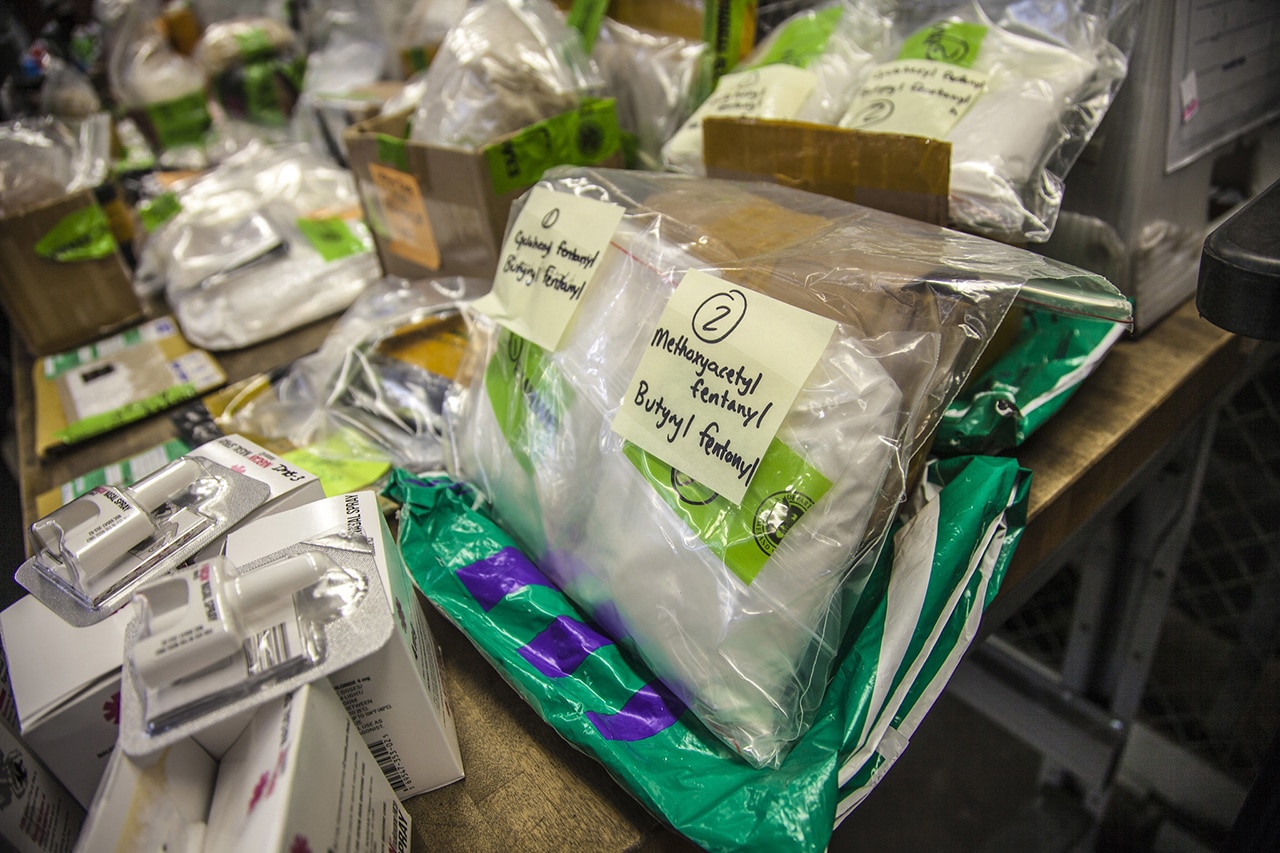
Above: A table full of fentanyl and other drugs seized by Border Patrol. (U.S. Customs and Border Protection photo by Kris Grogan)
History repeats itself, so we can’t help but wonder about the existence of modern programs inspired by the success of this opium cigarette program, much like imperial Japan was inspired by 18th century British opium distribution.
Consider the fact that China is the primary exporter of fentanyl, an opioid drug which generates record-breaking overdose and addiction rates year after year in the United States. China has also expressed a strong interest in the use of unconventional and “Unrestricted Warfare” programs such as economic warfare, political warfare, and cultural subversion against technologically superior opponents (namely the United States). CCP military officials stated that these programs can “have the same and even greater destructive force than military warfare.” While it’s certainly possible (even likely) that China’s fentanyl exports are being used intentionally to demoralize and destabilize the CCP’s enemies, there’s no way to conclusively prove it.
For another example of narcotics exports being used as a source of military funding, we recommend reading about opium production in Afghanistan and its links to the Taliban.
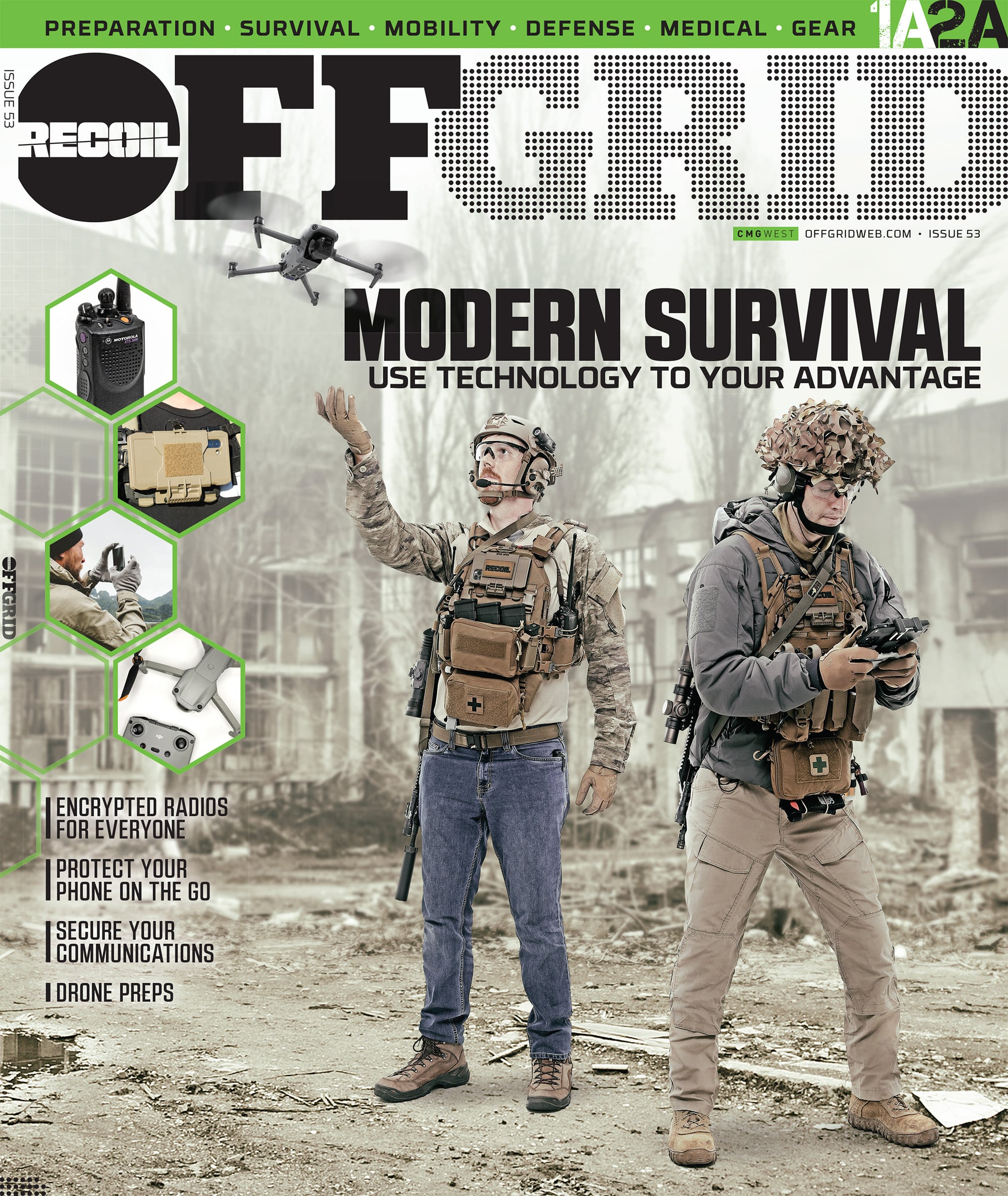
Note: This editor’s letter is from our latest publication, Recoil Offgrid Issue 53. If you’d like to purchase a copy of our magazine or subscribe, go to offgridweb.com/subscription.
In our last issue, we focused on how to survive without the aid of technology. But if we’ve learned anything over the last three years, it’s that most of the legacy survival concepts this community embraced for decades have been disproven. Contrary to the imagined templates of bugging out and living off the land to avoid complete collapse and total anarchy, Western society has instead been served an all-you-can-eat buffet of long-duration, low-intensity crises. The incidents most likely to trigger our emergency plans work on a sliding scale, instead of a light switch. While the collective effect of this continuous bombardment of slowly smoldering catastrophe has taken its toll on our psyche, it has also provided some distinct advantages over the cataclysmic upheavals portrayed by Hollywood.
More often than not, we’ll still have access to electricity, cellular networks, and the internet during simmering unrest or lingering supply line disruptions. Even when rolling blackouts or natural disasters leave neighborhoods and municipalities without power, large-scale regional communications are at least partially intact. Economically focused disasters like the ripple effect of draconian COVID-19 lockdowns don’t affect existing infrastructure at all, and severely challenge the notion that we’ll grab our go-bags, fire up our overlanding rigs, toss our electronics out the window, and head to the hills at the first sign of trouble.
It’s always a good idea to know how to start a friction fire, build a primitive shelter, and live off the land. However, you’d be foolish to hunt exclusively with a flint-knapped spear when modern firearms and ammunition are readily available. In the same vein, if the situation we’re presented allows access to modern survival tools like electronic communication and powered preparedness equipment, those who overlook or reject these tools will be at a substantial disadvantage. That’s why, for our final issue of a year that has continued to demonstrate ongoing global chaos, we’re focusing on how to survive with the aid of technology, instead of abandoning it wholesale. Whether you need to communicate securely with loved ones and an ad hoc neighborhood watch team or use a drone to ferry supplies to those out of reach, there are a vast (and still-growing) number of ways to leverage technology to facilitate your survival during a variety of really bad days.
By the time you read this, Christmas will be right around the corner. We urge you to consider using a couple of those stocking-stuffer gift cards to invest in gear and training to get you through when times are tough and every advantage counts. A little bit of advance planning and the right knowledge will let you use every ounce of processing power in your brain and in the computerized conveniences we often take for granted. From Dean Freeman’s roundup of secure messaging apps to SoCal Offgrid’s rundown on how to create your own drone delivery system, this issue pushed us to find more ways we can use ordinary consumer devices to beat the odds. Think critically, spend accordingly, and stay safe.
Happy Holidays from the RECOIL OFFGRID team. We look forward to expanding your preparedness horizons and helping you through the year ahead — whatever it has in store for you.