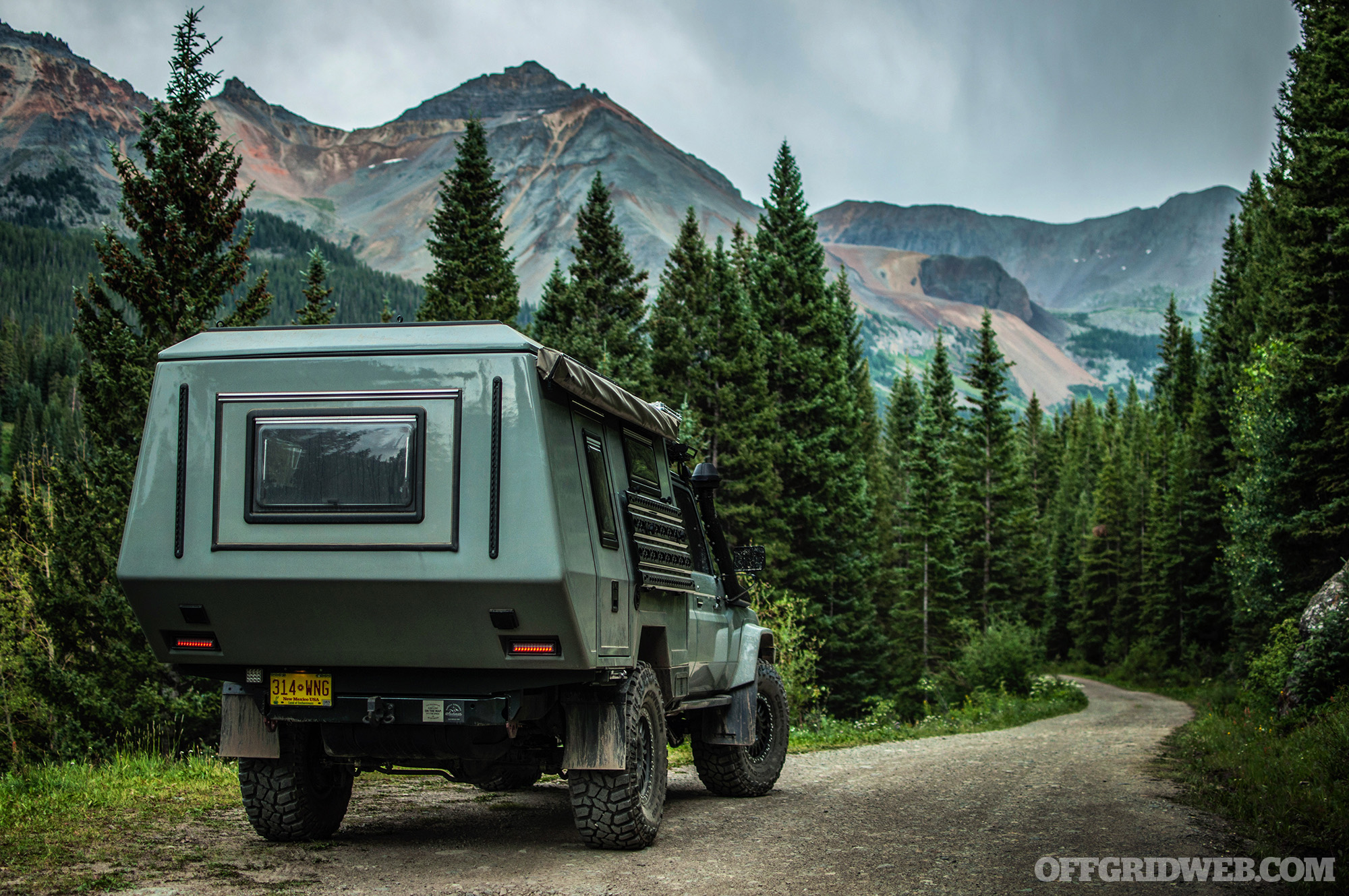
What If You’re Stranded on a Remote Backroad?

Every year, we hear stories of stranded motorists who, for one reason or another, end up in a situation that culminates in a fatality. Although we’d like to think we’d never end up in a similarly grim position, the people who actually found themselves in those circumstances probably assumed the same thing. Our overreliance on the GPS systems found on our phones or in our vehicles, as well as the belief that we can “just call someone” whenever we need to, has made us a little too complacent in our preparatory measures. If those luxuries proved to be out of service or just plain useless and your vehicle broke down in a remote location, what — besides luck, hope, and instinct — do you have to rely on to help mitigate a bad situation?

The Scenario

Situation type: Stranded on a remote dirt road

Your Crew: You and your adolescent son

Location: Rural New Mexico

Season: Winter

Weather: Cold; high 60 degrees F, low 24 degrees F

The Setup

You’ve decided to take your 12-year-old son on his first hunting trip in rural New Mexico. The ranch you’re headed to doesn’t publicize its whereabouts. Only a select few people know of this location since it’s invite-only, but you were able to make the arrangements through a friend who hunts there regularly. He provided the GPS coordinates and contact info for the owners who don’t live onsite. There’s no one else staying at the ranch, but you do have access to their facilities, food, and have key codes to enter and exit. This trek is several hours from your home in Texas, but you figure the road trip will give you some bonding time with your son and provide a chance to enjoy the scenery. The closest major city is about four hours away and the closest major highway is about a two-hour drive from the location where you’ll be staying. There’s a long, unmarked, unpaved road that leads from the main highway to the ranch. You’re all packed up with your firearms, clothing, and some snacks and drinks for the drive. Your assumption is that if you get lost, you’ll be able to call the property owners for directions or clarification.

The Complication

As you approach the ranch down the long, winding road and the sun begins to set, your cell phone’s map app tells you’re about an hour from the location. Then, the unthinkable happens. Your truck’s engine suddenly loses power, clunks loudly, and then shuts off. You step out of the cab to find a long trail of oil and metal chunks on the road — there’s no way this engine will be taking you any further. You still have about a half tank of gas and the truck’s battery is good.

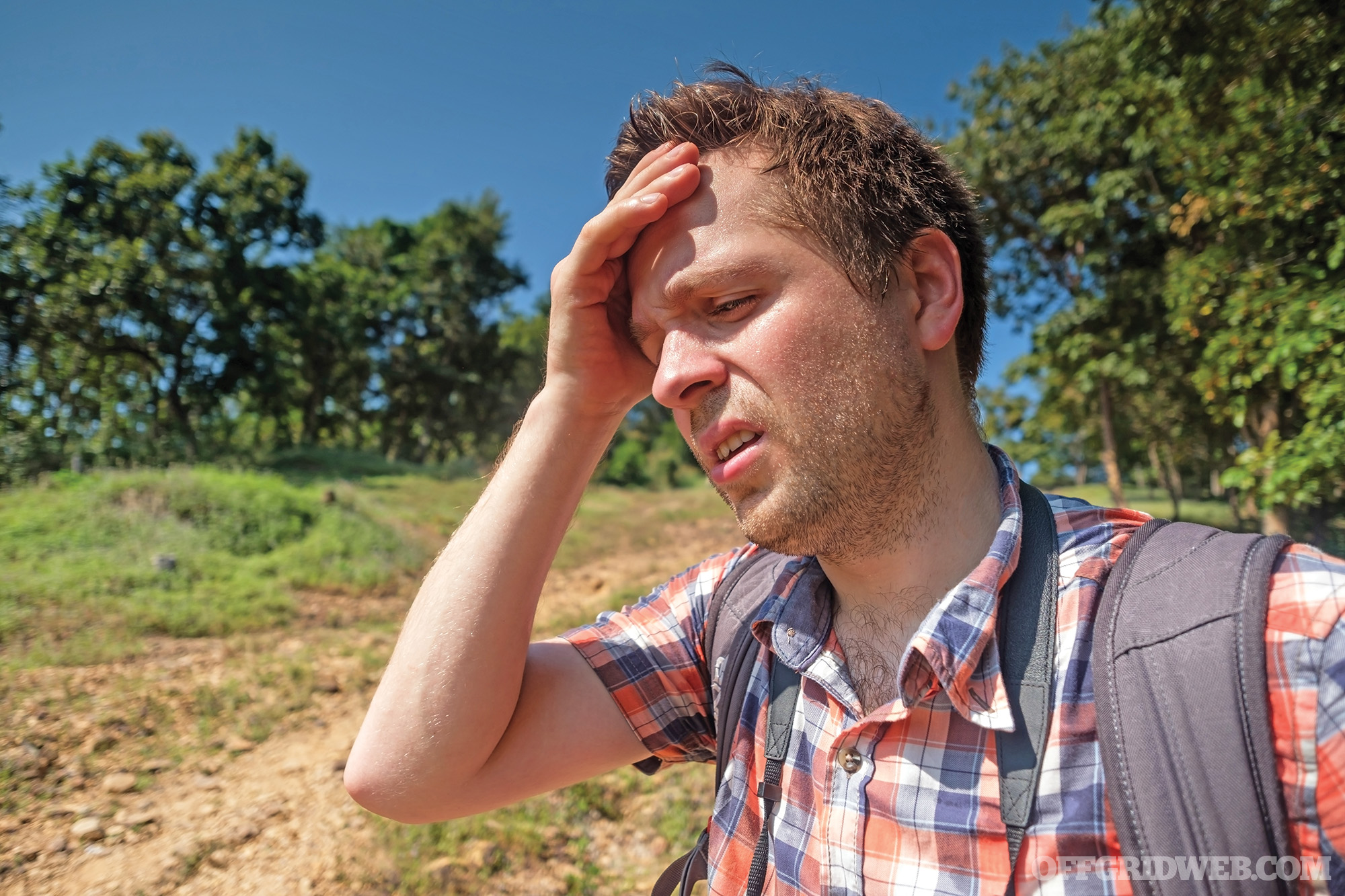
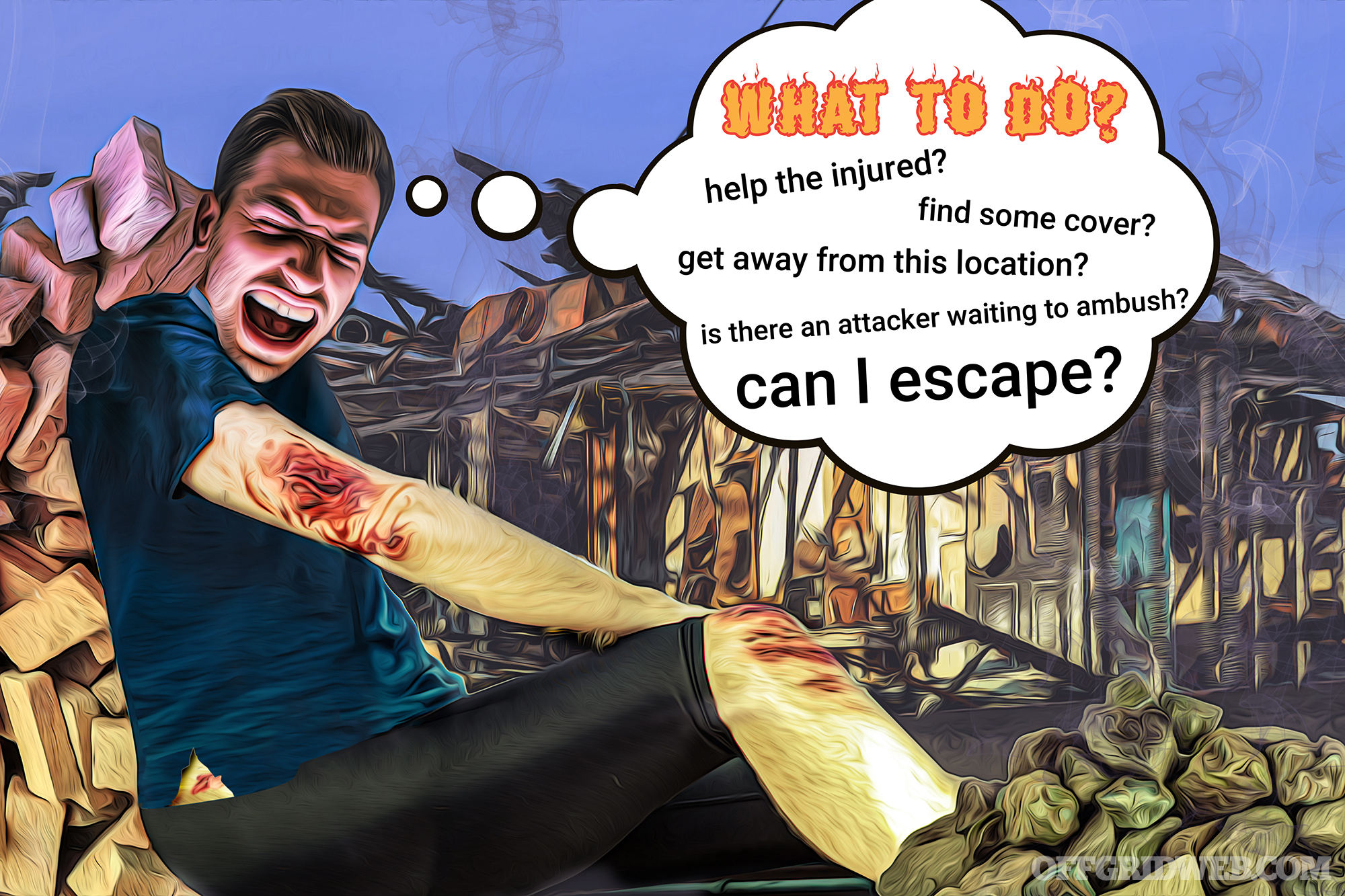
Since you’re a considerable distance from the ranch or the highway, you’re not sure if you should risk walking either direction in the dark. Also, your cell phone has no reception, and you have no other means of communication. Although the outside temperature is currently in the mid 50s, temperatures at night can drop below freezing. Since your son is asthmatic, he’d have to stay behind if you walk to get help. Cold air can trigger asthma symptoms and flare-ups, especially if it’s dry out. All you have is what you brought with you to make do until you find some assistance.

What do you do? Walk to find help or until your cell phone has signal again? Wait it out on a remote road that gets little to no traffic? You have a big bag of potato chips and some beef jerky, four 500ml bottles of water, changes of clothing, hunting rifles, ammo, binos, and your cell phone. How can you survive being stranded for hours or even days? We asked protective specialist Mel Ward and disaster management specialist Nila Rhoades for their takes on how to handle this situation.

Disaster Management Specialist Nila Rhoades’ Approach

Preparation
Planning a hunting trip like this would take a lot of foresight. The potential for things to go sideways are many. When planning any kind of trip, whether it’s to a theme park, an overnight getaway, or a hunting excursion, one must plan for the worst-case scenario and pack supplies accordingly. As the old saying goes, “A failure to plan is a plan to fail.”

To prepare my child mentally for this trip, I’d have long discussions with them on the pillars of survival: fire, water, food, shelter, and medical. We’d then pack items for each of those pillars before we left for our trip. My child would have a good understanding of the rule of 3s as well. One can go 3 minutes without air, 3 hours without shelter, 3 days without water, and 3 weeks without food.

If my son and I found ourselves in a situation like this one, our first priority is finding shelter, since air is a given. The truck’s cab will shield us from the elements, but at some point, we’d have to find help or a way to communicate with emergency services. We wouldn’t move from the vehicle for at least 72 hours. It takes approximately 24 hours to be able to file a missing person’s report, so I’d give a little extra time for search parties to attempt to locate our vehicle. One primary rule of getting lost or stranded is to stay in the current location so emergency services have a better chance of finding you based on your route. If a communications plan wasn’t put in place, we’d stay in the vehicle until help arrived or until we felt we had waited enough time to embark to a secondary location. Having a paper map and compass is critical here as well as having an outlined route that’s followed alongside the GPS on the cell phone. After my 48-hour mark, I’d start doing some map route recon and asking questions like:

  • How far am I from the ranch?
  • Where is the nearest service station?
  • Where is the nearest town?
  • Which is the closest walking distance?
  • How long is walking to the nearest aid going to take?
  • How much time should I add on that pace to account for my asthmatic son?
  • What supplies have to come with me, and which can stay in the vehicle?

An important aspect of planning trips where communication is intermittent, is establishing a GOTWA plan prior to embarking on the trip; also known as a contingency communication plan.

  • G- Where I’m Going.
  • O- Others I’m taking.
  • T- Time of my return.
  • W- What to do if I don’t return.
  • A- Actions to take if I’m hit or actions to take if you’re hit. (Meaning, actions to take if I miss my communications window in this scenario.)

Prior to such a trip I’d have my vehicle properly inspected so an engine malfunction would be a literal act of God. Many auto shops offer pre-trip inspections and would hopefully have found any major issues prior to such a trip. Bringing a hunting rifle is essentially a no-brainer as is it a hunting trip, but I’d also take my EDC Glock 19 as well because the trip between the ranch and my home is a fair distance

Researching the local area is always a must. Not only weather, but also terrain, indigenous wildlife, local flora, and fauna, as well as nearest towns and service stations. As far as supplies go, a satellite phone is going to be my biggest asset on a trip like this. It is my lifeline in case of emergency. Being a mother, I always pack a few extra days of supplies wherever I go. Whether it’s to a local water park for the weekend, or a two-week-long cross-country road trip. I always bring more than I anticipate using. A camping /hunting trip like this would be no different. Therefore, I’d have extra food and supplies like a Sawyer filter that could be used to filter water we found in the area. The foods I brought would most likely consist of calorie dense granola bars, protein bars, Slim Jims, and probably a few MREs. A little bit of that food can go a very long way, especially for a child and especially when we aren’t physically exerting ourselves yet.

On Site
The one practice I’d absolutely avoid is leaving the vehicle for at least 72 hours. That’s our shelter and our safety from animals and the elements, so we’d stay put with our supplies until help arrived. Being in the middle of nowhere, there’s still always a propensity for evil to thrive. My main concerns wouldn’t be human in nature, but rather animals like coyotes, mountain lions, snakes, etc. Again, staying inside our vehicle will prevent any unwanted and dangerous visitors. The weather is nearly perfect during the day, but the night could prove to be chilly. Layering the clothing that we brought for our trip would provide warmth during the evenings if the temperature got unbearably cold.

If a GOTWA or contingency communications plan wasn’t set up prior to departure, I’d still stay put for at least 72 hours. I’d assess my car for items to signal with. My side mirrors would work for a signaling device to get the attention of aircraft. I’d also take my spare tire and be prepared to burn it to signal those nearby. Black smoke from the rubber would hopefully catch the eye of passersby.

Being stuck anywhere can be scary. Therefore, keeping calm and maintaining a level head is critical. Children feed off their parents’ emotions and reactions so keeping calm for your children is important and necessary. Especially with an asthmatic child, I wouldn’t want them to get worked up or in a panic. Upon first realizing that my son and I were stranded I’d assess our supplies and attempt to ascertain our location via our map. Having already established a GOTWA plan, when I don’t check in at the ranch my family back home should start initiating the emergency plan that we laid out prior to departure.

Another aspect of my supplies would be a SPOT device. It’s essentially an emergency beacon (Emergency Locating Transmitter). As soon as the vehicle died and I realized that it was approximately 60 miles away from the ranch, it could be time to turn on the emergency beacon. Depending on my GOTWA plan, if I didn’t have help by sunup, I’d initiate the SPOT device, per my GOTWA plan.

Crisis
My main concern would be the medical items needed for my son’s asthma. I’m a big believer in the phrase, “a pair and a spare.” Therefore, I always carry an extra dose, bottle, inhaler with me at all times; on top of what my child carries on them for emergencies. Because he’s got a medical condition and because he’s my child, I won’t leave him under any circumstances. I cannot guarantee his safety if I’m not in his immediate vicinity.

Due to the lack of physical exertion because we’re essentially waiting in our vehicle for help to arrive, we could stretch our food and water supplies over the course of many hours, if not many days. Our biggest concern would be water intake and staying hydrated during the warm days.

Having prepared for this trip to the point where I have multiple contingency plans, I wouldn’t anticipate being on my vehicle for more than 24 hours. However, being a parent, a lot of my supplies would be able to last for many more days. My SPOT device would work as a signaling beacon. Being the parent that I am, I also always carry a mini SERE kit in my purse, that also has a signal mirror and a few methods of starting fire to keep warm along with water filtration.

Protective Specialist Mel Ward’s Approach

The Mindset of Mitigation
I treat every outing like I’m leaving the wire. My home is my Forward Operating Base (FOB). Everything else outside that perimeter is unknown. Whether I’m going to the store or heading into the New Mexico desert, I bring things that let me shoot, move, talk, and heal. These are like my four basic food groups.

How much of this stuff I bring depends on where I go, with whom, and for how long, but I always bring the same things. I like to have things that make mild to wild inconveniences much simpler to contend with. That’s my personal strategy. I can’t easily prepare for everything, but I can prepare to make everything a little easier.

Our society has made us victims of our own success. As a recovering survivor of stable power, hot and cold running water, and the mostly peaceful transfer of power, I carry with me things that take the place of that which I’ve seen fail us.

Pandemics can empty store shelves. Supply chain shortages delay products and services. Freak winter storms wreak havoc in states that aren’t prepared for extreme weather. Hackers half a world away can make gas expensive and hard to come by all because they ransomed a pipeline company’s computer network.

Regardless of what I’m doing, I want to plan like it’s the 19th century rather than the 21st. This is especially the case when I travel. I’m preparing like I’m going back in time. I’m not going to rely on smartphones, power grids, and minutes-away Emergency Medical Services. I’m going to account for these modern conveniences, but I’m going to plan like they won’t be there when I need them.

Reconnaissance
The first thing I like to do if I’m going somewhere I haven’t been before is a map reconnaissance. I not only want to review the route and have an alternate in mind, but for something like hunting or hiking, I’d like an idea of the area of operations I’ll be working in. You can use Google Maps if you want, but I like to stay away from that stuff and go with apps like OsmAnd or Maps.me. Both of these work offline.

Speaking of offline, I’m a paper map guy. I keep a road atlas in all my vehicles. Gas station maps of your region are also great to have as atlases tend to be more compact. It’s nice to have something you can spread out on the hood of your vehicle and do some figuring on. You can also get laminated versions of these from bookstores and use map markers to highlight routes, gas stations, hazards, etc.

Concerning the route, I like to know where hospitals are along the way as well as the closest advanced care to where I’ll be operating. I might identify a few with trauma capabilities as well as some walk-in clinics for bumps and bruises if we incur something minor. Since my near-teenaged son will accompany me, I want to include him in the route planning and points-of-interest along the way so he’s participating rather than just observing. While doing this, I’m going to give his mother, or someone reliable not coming with us, a five-point contingency plan.

I’ll tell her where I’m going, who I’m taking with me, how long I’ll be gone, what to do if I don’t come back on time, and what I will do in response to an emergency. Some of you might recognize this from your time in the military. I think it’s just as useful for civilian activities like hunts and hiking and keeps us in the right mindset. It’s easy to do and much better than the usual, “I’ll call ya when I get there.” What if I don’t get there? What if I can’t call?

Since we’re exploring an isolated region on this trip, I’m going to use either mytopo.com or USGS.gov for some topographical awareness. Both of these resources offer cheap ways to print detailed maps of your chosen AO. I might like to identify some high ground, key terrain features, and water sources in the area. If I give myself a top-down preview, the land is likely to make more sense to me when I see it for the first time.

I’m also going to check the weather forecast for the areas I’ll be passing through as well as my ultimate destination. Farmersalmanac.com has lots of info on weather, phases of the moon, and long-range forecasts for trips I might be planning down the road.

Now would also be a good time to talk to people who’ve been where I’m going. What are the temperatures like there? What kind of wildlife is in the area? What gear do they recommend I bring? What should I watch out for? For me, this is like an intelligence briefing. I like to treat the trip like a mission. I’ll enjoy it when it goes well, but I’m prepared for when it doesn’t.

Now that we have an idea of where we’re going, how to get there, and maybe what to expect; let’s get the truck ready.

Vehicle Readiness
I’m going to inspect my truck like I’ve never seen it before. I like to check the usual things we take for granted: tires, fluids, belts, and hoses. I’m going to make sure the spare tire is present and ready to go as well as ensuring I have the proper tools to change it. I can also reference a site like AAA.com for vehicle inspection tips if I feel like I’m missing something. I’m also not above scheduling an inspection with the local dealership or auto repair shop. Some dealerships even offer free inspections on the items above and can point out areas that need to be addressed.

Once I’m satisfied the truck is mechanically sound, I’m going to inspect all the gear I’m taking with me. As mentioned earlier, I have all this with me all the time. I may add or subtract amounts given the situation I’m heading into.

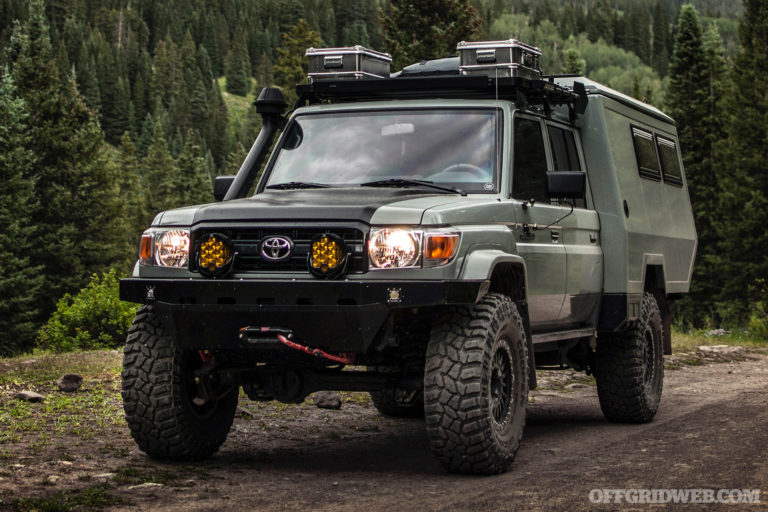
Most of what I keep in the truck is recovery and road-side repair related. In rugged terrain I might bring two full-size spare tires. I have a hi-lift jack and shovel as well as a heavy-duty bottle jack (not the one that came with the truck). I carry a full toolkit with sockets and wrenches sized for my truck. I have chains, at least one kinetic recovery rope, winch supplies like tree-savers and snatch blocks as well as two sets each of soft and hard shackles.

In the toolbox I keep a spare serpentine belt for my motor and extra vehicle fluids. I have 5 gallons of water, 5 gallons of gas, 1 gallon of anti-freeze, 2 quarts of my engine oil, power steering fluid, sealed brake fluid, and transmission fluid. I also bring along a lithium-ion jump starter kit that can start multiple dead vehicles or charge my phone. I have a high-output portable air compressor, tire repair kits, tire spoon, and extra valve stems to round out fixing all but the worst tire issues.

Provisions and Gear
For the New Mexico trip, I’m bringing what my son and I need to be there three times as long as my planned stay. I’m setting up our kit and vehicle in a way that serves us if we don’t reach the ranch, lodge, or campsite. It’s just me, him, and the truck and I want to keep thinking and planning like that’s all there will be.

I’ll have with me my rifle and pistol with spare mags and ammo. I always bring along my ragged copy of the SAS Survival Handbook for its many useful survival tips the success of our society has demanded we forget. Water purification is top of my list since taking enough water with me for even a weeklong trip can start to strain a single-vehicle outing. I like Guzzle H2O’s portable Stream system. As long as I have a water source, I can quickly and easily refill my water tanks. I also like to take a two-person tent along with me regardless of if I’m staying in a lodge-like setting or not. Sleeping bags are relatively lightweight insurance against cold nights even if I don’t plan on using them.

I obviously have my cell phone for primary comms, but also like to have a satellite phone for remote outings. I also carry a backup pre-paid cellphone. While working in the AO, I have several General Mobile Radio Service (GMRS) radios. I like these because they’re relatively inexpensive for intra-group communication and are repeater-capable for situations like the one we’re about to get into. For repeaters in your area, you can check mygmrs.com.

I always have several GPS-capable devices with me regardless of what I’m doing. My wife got me the Garmin Tactix Charlie one year for Christmas which is a nice tool to have on your wrist. I still run my old, but trusty 60CSx as well. Of course, I have my phone’s GPS, which I use the most, but trust the least. For some extra peace-of-mind I’m looking at the Garmin InReach Mini personal locator. To aid with reception issues, I’ve been researching the weBoost Drive Reach OTR. This is basically a 5G/4G signal amplifier that drastically increases your coverage in more remote areas.

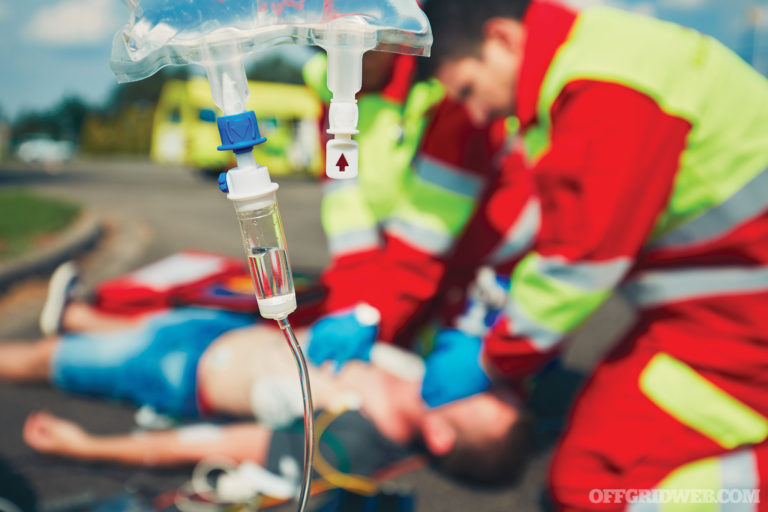
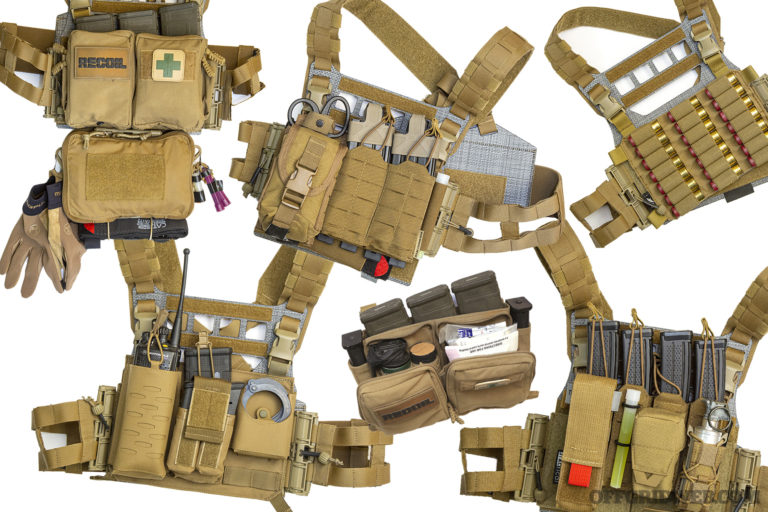
For emergency medical I bring plenty of tourniquets staged in, on, or around each vehicle door. I like to use North American Rescue products like their Combat Casualty Response Kit. This lets me deal with various traumas and provides enough resources to deal with multiple patients. I also have individual bleeder kits I keep in response bags that contain light, ammo, and medical. Further, I have normal non-trauma first-aid kits, so I don’t have to use my good medical supplies on routine scrapes and cuts. Rounding this out I have a pole-less litter just in case.

If anyone is dependent on medication, like my son is, I make sure to bring extra along with me. I’ll store it in several places in the vehicle and among my gear in case I lose a pack so I’m not losing everything I have.

Now that I’ve done nearly everything I can to make sure nothing goes wrong, it’s time to break down on the side of a dirt road.

Are We There Yet?
So, the truck is mechanically down hard, we’re not yet at our destination, and we’re pretty far from where we last had cellular reception. Before I get into what I might do from here, I’d like to go back to my paper maps and suggest something. One thing I like to do is make note of when my cell signal starts becoming spotty. I’ll mark my paper map with a last-known spot of solid signal as I wind my way into the badlands. This gives me a sort of rally point I can navigate to if all else fails so I can make an emergency call. I want to go through all my various modes of communication before I start thinking about hoofing it or wearing animal hides and crafting spears.

Without a good cell signal, I’d first try OnStar, or similar service, if I have it. OnStar still uses the same cellular network as your telephone, but the system might have more range than your handheld due to it pushing more watts. It’s worth a try. If I had the aforementioned weBoost antenna, now would be a good time to power that thing up.

If cellular isn’t going to happen, I can try a couple things. First, I’d send some texts and emails to the person I gave my five-point plan to describing the situation, where I am, and what I’m planning to do. Sometimes when signal is faint, a text might make it through whereas voice cannot. I’d next see what I could get on my GMRS radios. I have both a high-power unit in the truck as well as handhelds. Since I took the time to visit mygmrs.com, I’ve already programmed in any available repeaters in my area that can extend my range. If I absolutely have no comms working, it’s time to start figuring out exactly where I am on the map and where the closest help might be whether I try to signal to it or walk there.

Remember those offline navigation apps? Now I’m glad I had those installed on my phone as well the pertinent regions downloaded so I know exactly where I am and can communicate that position via latitude and longitude, Military Grid Reference System, or even key terrain. Now would also be a good time to disconnect the negative battery terminal on my truck to preserve it since it’s not going to be running anytime soon.

Now I know where I am and what my options are looking like. Since no one is supposed to be headed out this way for some time, staying in place and waiting for someone to come along may not be my best option. It looks like I’m facing an hour (by vehicle, much longer on foot) either to the ranch or the highway. I’m not sure if the ranch has a landline or any other form of communications equipment since I’ve never been there. I do know, however, that I marked on my map the last known location for cell reception back towards the highway.

Given that I’m not currently under any additional duress like injury or lacking food and water, walking back toward the highway is looking like the most direct route to getting some help. Alternatively, I could walk in the rest of the way to the ranch and continue the trip, but at some point I’m going to need my vehicle recovered, so I should probably get that ball rolling and then see about salvaging the rest of the trip.

So, what I’d probably do is set up the tent for the night at the truck and walk back to my known reception point in the morning. I’ll keep a signal fire going throughout the night just in case. I’ll ration my supplies, even though I brought extra, in case what looks like a simple plan to do some walking becomes more complicated. If I did have something with me like the Garmin InReach, I’d probably save that for a medical emergency or last resort.

Before bedding down I’d also ensure there’s no possibility of a fire hazard with the truck. I’d probably cover that oil spill with dirt under and around the truck and make sure to keep my fire well away from it. I want a signal fire, not a signal explosion. The entire time I’m talking to my son and including him in the decision-making. If he’s worried at all, it may help him to be a part of the process of how to fix the situation and give him some comfort that we’re taking steps to mitigate hazards. We might make what was going to be a fun hunting trip into even more of an adventure.

When morning comes, I pack up the guns, water, radios, first-aid, food, don some hunter orange, and prepare to hike back to that last known point on my map. I’ll open the hood on the truck as a signal as well as use rocks or a shallow dirt trench to create an arrow on the ground indicating my direction of travel. I’d also tape a note to the inside of the window describing our plan and how to contact us should anyone come along and find the truck.

I would also compose some updated texts and emails and send them even if it tells me they’re not going through. As we walk, I might catch just enough signal for them to be sent as well as possibly receive word back. As we step off, I make sure to mark the truck’s location on my GPS as well as my physical map making note of key terrain in the area I can spot from a distance.

Even though my son has a medical condition, I don’t recommend splitting up and leaving him with the truck. Too many unknowns. I take what I need to care for him with me and walk to a known point together. I can use my map or GPS tools to roughly measure the distance we’ll be covering. I’d bring the tent and camping gear just in case we have to overnight while waiting for help.

Once we reach an area with enough reception to send and receive messages, we can initiate our five-point plan. Our emergency contact person can pass on our location, status, and requests and act as a relay for us if needed. We can set up a temporary camp and wait for help depending on the time of day and estimation of how long it will take aid to arrive. If there’s time left in the day, we can return to the vehicle and wait there until help arrives.

Conclusion

To sum it all up, preparation and planning can go a long way, even when things go sideways during a road trip. The key to success is planning for the unexpected — for the worst-case scenario like we see here. We should always be prepared for medical issues, vehicle issues, food supply issues, water contamination issues, and getting lost. The most crucial aspect is remaining calm and having an emergency contact plan in place, so if a communication window is missed, then friends and/or family have a protocol to follow to send emergency response aid to your general vicinity.

Assume your conventional means of communication and GPS may not work when you need it most, so having redundancies may mean the difference between life and death. Review multiple routes to and from your location and pinpoint whatever key facilities are closest: police substations, hospitals, etc. Jot down and keep direct contact info for these facilities. Leave an itinerary with predetermined contact times/dates for those back home so they know there’s something wrong if they don’t hear from you. A little effort on things like this beforehand will save you a lot of headache if you find yourself in the proverbial middle of nowhere.

Meet Our Panel

Nila Rhoades

Nila Rhoades is a U.S. Army paratrooper’s wife and homeschooling mother of three ninja kiddos (10, 4, and 18 months). She has two master’s degrees in Homeland Security and Emergency Disaster Management. She’s currently obtaining a graduate certificate in counterterrorism. She’s also a firearms instructor, workout enthusiast, and avid peanut butter ice cream lover. www.milspecmom.com

Mel Ward

Mel Ward is a husband, father, and combat veteran. He served in Afghanistan and Iraq with 2nd Ranger Battalion, 75th Ranger Regiment. Over the last 16 years, he has worked in the security industry. He’s an advocate of preparedness and believes self-reliance is not an option, but a duty.


Safety in Numbers: Preparedness is a Group Activity

Editor’s Note: In light of recent events in Ukraine, this article — which was written months ago — feels even more relevant. Remember that events outside your control may someday force you to rely heavily on your friends, neighbors, and local community. In extreme situations, you might even need to fight side-by-side with them. It’s critical to build strong relationships now and learn to work together.

There’s no question that the last two years have been bar-setters for the unexpected. We’ve seen everything from “murder hornets” that were supposed to wreak havoc on the ecology of the nation and cause immense pain, to thinly veiled power grabs by those who we’ve entrusted as leaders. Don’t forget the massive panic runs on toilet paper, of all things (you know who you are). With no surprise, we’ve been witness to suicide rates skyrocketing amongst the turmoil and stress, as well as a marked rise in drug abuse, both prescription and scheduled narcotics. Many cities around the country have also experienced record-breaking homicide rates.

Photos by Patrick McCarthy

Even with what seems like a minute-to-minute deluge of negative information, certain things have highlighted themselves positively as well. Chief among those has been the importance of positive human interaction with like-minded individuals who build you up and make you a better person. That’s where the concept of a “squad” comes into play. That term is used to describe a group of people with at least one shared goal and, more importantly, a shared mindset.

Above: “The Long Walk” — the author has learned through experience that shared hardship breeds the biggest smiles.

Examples of Group Effectiveness

Here are a few recent scenarios that serve as prime examples of the ways a united and multi-skilled group of people can be effective when the unexpected presents itself.

Texas Winter Storm: This once-in-a-lifetime event in 2021 caught the second largest landmass state in the union off guard, not only in terms of transportation but also civil logistics. There are a few snowplows in northern Texas, but they were woefully distant from the major metropolitan areas. Pipes froze, electricity went down, vehicles wouldn’t start or got stuck in place. More than 200 people lost their lives due to the storm, with the majority dying as a result of hypothermia. There was a level of preparedness that proved helpful to some, and more importantly, those who were prepared took care of their own. Part of that “squad” mentality wasn’t only being able to help yourself, but also being in a place to assist others. Selfless acts are rarely forgotten in a world of selfishness and fear.

Hong Kong Riots: In 2019, the world watched in dismay as residents of one of the last bastions of resistance to the not-so Sleeping Giant provided prime examples of how to band together when things seem impossible. For 12 days, students battled an authoritarian regime with less equipment than you can buy at a Home Depot and held out valiantly. A huge part of the reason they were able to resist was their ability to work together, rather than being singled out as individuals (a common crowd-control tactic).

Minneapolis Bookstores Burned: As a former resident of Minnesota, I had the distinct pleasure during my youth of visiting two intellectual icons of the city, Uncle Hugo’s and Uncle Edgar’s Bookstores. Amid the chaos that has intermittently plagued that city for nearly two years, both 100-plus-year-old structures — with Uncle Ed’s formerly being the oldest science-fiction bookstore in the country — were burned to the ground. Approximately 100,000 books went up in smoke, valued at roughly $400,000. In the ensuing aftermath, thousands of people have donated money, time, and energy to help rebuild the historic landmarks. Hundreds of authors also reached out to donate signed books to help rebuild the institutions of creativity and learning.

Building Your Bridges

Above: The crew of competition regulars includes a diverse range of personalities, skills, ages, and backgrounds.

Perhaps the key factor in finding, or assembling, an effective preparedness squad is unity of mindset. Even one or two people within the group who are self-focused instead of group-outcome-focused, can cause an otherwise coherent group of reasonable adults to become a gaggle of bickering children. One should never enter into an established group with his or her own needs in mind first. Acts of selflessness will go much further, both in terms of fostering goodwill and building group cohesiveness. A squad doesn’t need to be made entirely of gun owners or survivalists, but it does require the following hallmarks of a successful group:

Members’ Similarity: Finding a unifying factor, belief, or activity is infinitely more important than pretty much anything else. If you try to form a cohesive, self-sustaining group based on few to no commonalities, you’re likely to see it tear itself apart in short order. For starters, try finding an activity where the members are current avid participants. While beliefs can also be unifying to create something that’s longer-lasting and more likely to retain members, a social activity such as a sport or hobby is often a great avenue. The added benefit here is that group activities lend themselves to providing a unique sense of personal identity as well.

Above: Never take yourself too seriously. It’s a key lesson, both in life and in competition.

Group Size: Sebastian Junger’s Tribe: On Homecoming and Belonging is a great resource to understand this concept. The book — which is absolutely worth your time — explains that, for centuries, human beings have existed successfully in groups of 20 or less, where each member contributed to the survival of the tribe. If any one person didn’t pull their weight, the whole group would suffer. It was not until the Industrial Age where that dynamic changed. In today’s world, going full tribal is difficult, but we can have a close approximation through the concept of a squad. The challenge is in building a relatively small initial group and adding people as it becomes viable.

Above: Signs of appreciation for hard work and mutual respect go a long way.

Entry Difficulty: In the competition shooting world, civilians, military, and law enforcement can all glean a vast array of knowledge, but there are a few simple concepts that provide healthy barriers to entry. On the simplest level, do you put in the hard work when it’s not sexy to do so? Do you pick up brass in inclement weather? Do you tape targets up after each shooter? Do you run the clock or board without hesitation? Do you show up to events on time, every time? These are easy metrics by which to decide if someone is a good fit or not. More importantly, though, there are basic fundamentals required by the activity itself. Muzzle awareness, ability to follow directions, and cognitive processing under duress are wonderful preparedness skills to possess, especially in light of the recent turmoil nationally and internationally.

Group Success

As Michael Dell once said, “Try to never be the smartest person in the room. And if you are, I suggest you invite smarter people … or find a different room.” By the way, that’s Michael Dell as in Dell computers. He may know a thing or two about keeping intelligent folks at his side. His quote applies not only to intelligence, but also capability. By surrounding yourself with those who are equal with or superior to your own skill level, it fosters constant improvement and growth (with the requisite smack talk when you don’t meet your potential). People shy away from competition because, yes, it’s hard, and it should be. However, overcoming difficult challenges will maximize your personal growth.

One of the most relevant and tenable factors for a squad is the different skill sets (both personal and professional) that the group can bring to bear. Whether these are blue-collar trade skills, white-collar professional background, survival and backpacking experience, firearms knowledge and tactics, or fitness — all of these contribute to the wellbeing of the group and further drive personal improvement. Plus, should anything ever really go sideways like too many dream of, having someone around who can make coyote taste good or navigate using the stars alone could come in quite handy. Note: As part of the squad, you’d be required to present similar skills to the rest. The last thing you want to be is the person not contributing in a meaningful manner. That’s an easy way to find an unceremonious boot, and now you’re stuck on your own. By the way, another word to describe a “lone wolf” is “dinner.”

Above: A key to personal and group growth is feedback from your peers. Befriend those who push you to improve.

External Competition/Threats

One of the biggest challenges of holistic preparedness is finding ways to test skills. More importantly, being able to compare your skills to those of others is an important metric of effectiveness. By seeking out exterior challenge/competition, you’ll have a method of improvement that has far-reaching positive implications, both for the individual and the group as well. An example from the competition shooting world is stage execution. The first person to run a stage is more likely to make mistakes, and each subsequent shooter becomes less likely to make the same ones, having already witnessed what transpired.

Human beings aren’t made to be alone, despite what you might read or see in movies and/or TV. In fact, there’s an immense amount of data supporting the fact we thrive in a group environment. Look no further than the work of Peter Scharff Smith on The Effects of Solitary Confinement on Prison Inmates: A Brief History and Review of the Literature. There is a limit to the number of people who can form a single effective group, though, and urban living far exceeds that limit. With that in mind, the best thing you can do for yourself, your family, and your friends is to create a “squad” of your own. Be a contributing member of that group every day, short of choosing to live far outside an urban setting. Just like great friendships, working together as a squad takes effort and commitment to be an integral member, but the rewards far outweigh the costs in the long run.


Review: Arbor Arms Raptor Duty Belt

In recent years, the popularity of carrying gear on a belt instead of a vest, chest rig or plate carrier has seemed to grow exponentially in popularity. A long-standing norm for most of the law enforcement community, belt-borne gear for civilians is either the cause of, or result of, a massive expansion in load-bearing belts to choose from.

Distilled down, there are two basic ways to haul gear around your hips. The first is to get yourself a good duty-grade pants belt and hang pouches directly on it. Many moons ago, the go-to answer was a 1.75-inch “rigger’s belt”. Now we have a multitude of 1.5-, 1.75- and 2-inch nylon duty belts with a variety of features from D-rings to Austra-Alpin Cobra buckles to flexible polymer stiffening channels sandwiched into the nylon layers. Holsters and pouches are typically threaded onto the belt through molded-in, appropriately sized belt loops. There are also snap-open soft loops, plastic paddles that tuck into your pants, or even wrapping MOLLE-style straps over the belt and then tucking them into the webbing on the back of the pouch.

The other option is to use a dedicated “war belt” or “battle belt” setup. These are multi-layer systems consisting of a liner belt that goes through the belt-loops of your pants and a second outer belt which hangs from the liner belt via Velcro and then buckle closed at the front. The outer belt does all the actual load bearing, typically by MOLLE-style webbing. These, too, are available in all kinds of sizes, thicknesses and feature sets.

range belt buckling

Above: Here’s an example of a war belt setup. This G-Code Scorpion Low Vis Belt Kit uses a minimalist liner belt and heavy-duty outer belt.

Which one is right for you? The bottom line is personal preference, but there are some factors to consider. We have covered war belt setups specifically in the past, and now offer a counter-point focused on duty belts with direct-mounted pouches.

Why a Duty Belt?

What we oftentimes oversimplify as “personal preference” is, in fact, a composite result of knowledge, experience and philosophy. This is why personal preferences change over time – because our knowledge and experience changes over time.

I have always preferred mounting pouches on a duty belt over wearing a dedicated war belt. When I was working overseas as a security contractor, I was on-call 24/7. If an emergency happened off my shift I would still be required to respond, and to do so as quickly as possible. I was also required to be armed just about anytime I was out of my room. In that context, hard-mounted pouches made more sense to me. I could thread my pouches onto my belt as I put my belt on my pants, and leave that setup in place until it was time to change pants.

If an alarm went off in the middle of the night, all I had to do was swing my legs out of bed and pull my pants up, and I had at least a first line fighting load on my body. If, for some reason, I didn’t have time to grab anything else at all, as long as I had time to pull my pants up, I could still respond effectively. Having to grab a war belt and then line it up so the Velcro on the liner belt matched up right, then buckle it and cinch it felt like extraneous steps in the process.

I also found the added bulk and padding of a war belt, while comfortable, noticeably inhibited my movement in tight spaces (smaller structures with narrow doorways typical of many places overseas) as well when sitting down or getting into or out of a vehicle. Using Kydex pouches mounted directly to my pants belt with properly-sized hard loops kept all my equipment tight against my body, reducing these movement issues. As a side note on this topic, I always used belt loops on my pouches and holster that were the same size as my belt. If my belt was 1.75 inches, I used 1.75-inch loops.

I saw a number of guys who used belt loops a quarter-inch larger than their belt width. The idea was that having some play in your pouches let them move with your body when bending over, climbing ladders or sitting. I tried this but found that, when said pouches “moved with my body” they didn’t move back to where I wanted them. If I sat down, and the pouches moved, then I stood back up, I found myself sliding and tilting the pouches to get them back to where I wanted them when standing upright.

Arbor Arms Raptor Belt Setup

Currently, the author’s go-to duty belt is the Arbor Arms Raptor belt. This is a 1.75-inch belt that uses a Raptor buckle with an 18kN breaking strength. The belt itself is constructed from double thickness Type 13 webbing. It also includes a reinforced soft loop to run a carabiner through for clip-in safety applications. But our favorite feature is the two channels sewn in for large, 18-inch zip ties. You can slide one or two large zip ties into each end of the belt. This increases the stiffness for less sagging/sliding when laden with gear. It also gives you two pairs of ad hoc restraints/tie-downs at your disposal.

By itself, the Arbor Arms Raptor Belt is flexible and comfortable. We experienced no digging or chaffing at the hip bones, which can be an issue with belts made of harder SCUBA-style webbing. The 1.75-inch width and heavy thick nylon construction is enough to hold a pistol holster and one or two mag pouches, if that’s all you need. To hold more than that, we’d consider adding a couple of the large zip ties in to increase rigidity.

Because the zip ties slide into channels sewn to the outside of the belt, as opposed to in between the foundational layers of the belt itself, even four zip-ties did not give us any cutting or digging sensations around the pelvis. The zip ties do, however, slightly increase the overall thickness of the belt, which may affect how well the belt loops of your holster or pouches are able to slide on. Our holster did just fine, be we found we had to remove the zip ties from our support side, as the belt clips on our G-Code mag pouches fit so snug that we could not secure them closed around the belt with zip ties inserted. This issue was specific to our G-Code pouches and will likely not be the case for pouches that used slightly wider fixed loops (as opposed to clips) or that use soft loops or paddles.

Speaking of G-Code, we set the Raptor Belt up with a G-Code optimal-drop RTI platform as a holster base. The RTI systems makes it easy for me to changes holsters with the literal flick of a switch on the back of the platform to unlock the holster from the drop mount. The holster itself can then be replaced with any holster (or pouch) that has an RTI-pattern mounting bracket on the back, regardless of manufacturer. Given the large number of pistols we test for articles, this feature is especially useful.

Likewise, we use two G-Code Scorpion Softshell mag pouches on hard belt clips. The Scorpion pouches have shock-cord retention that allow them to flex and retain a wide variety of magazines from single-stack to subgun mags. They are available in two heights (short and tall) and the belt clips can be detached from one set of Scorpion pouches and re-attached to another. This allows me to run everything from 1911 to MP5 mags off my belt depending on what we’re doing that day. They are also great for holding similar sized items like flashlights, multi-tools, meal bars and cigars.

Above: G-Code’s RTI system makes it easy to swap between holsters for various pistols.

Duty Belt Downsides

This is not to say that there isn’t a place for war belts. If you load a significant amount of gear onto your belt—pistol mags, rifle mags, med kit, holster, light, knife, baton, grenades, chem lights, taser, rifle catch, fixed blade, tax returns from 1997, etc—the multi-layered system and MOLLE webbing afforded by war belts may be the better way to carry all of that while maintain comfort and sturdy load support. Also, there is the convenience of donning/doffing your gear quickly. Even in a training or competition context, war belts allow you to simply unbuckle and separate the layers, to get your gear off while still having your pants held up by a slick inner belt that you can continue to wear around town in all but formal-ware situations. Also, it allows you to have multiple outer belts setup for different duties/missions/situations that can be swapped out without having to change pants or re-thread pouches on/off.

But if your belt-borne load out is not especially extensive and does not need to be swapped on the fly, a more traditional belt-and-pouches may be a good fit for you. At only $90 retail, the Arbor Arms Raptor Belt offers a well-built, low-cost option that can be used in a variety of roles from standalone pants belt to a second-line platform that supports EDC gear or a fighting load on a chest rig/plate carrier. As always, vet your gear rigorously and train with it extensively.
SOURCES


Emergency Applications of Software Defined Radio (SDR)

In Issue 45, I introduced Software-Defined Radios (SDRs) using the popular RTL-SDR dongle and the open source Gqrx software for receiving a variety of analog voice transmissions on multiple different bands for simple gathering of signals intelligence (SIGINT) and news. However, SDRs aren’t necessary to do most of that work. My Yaesu VX-6R handheld transceiver, for instance, is capable of receiving high frequency (HF) bands for shortwave listening, as well as AM air bands. SDRs really shine as a result of:

  • Their relatively inexpensive price point
  • Their flexibility when paired with the appropriate software

That flexibility is especially evident when dealing with the wide array of digital communications that they’re capable of receiving and decoding. The low cost of the hardware and the zero cost of most of the software is what makes them such an excellent tool in the toolbox for monitoring and analyzing the RF signal cloud around us on a daily basis.
In this issue, I’ll explore some additional ways in which software-defined radios help level the playing field with amateur SIGINT, specifically:

  • Monitoring and tracking aircraft via ADS-B
  • Monitoring and decoding trunked and digital voice communications
  • Coupling SDRs with Android devices

Above: The Nooelec RTL-SDR bundle is a common, inexpensive way to get into SDR, including the ability to access HF bands with the Ham It Up up-converter. Depending on the antenna you want to use, you may need different cables. SDR equipment and antennas can pack small. Often, the largest piece of equipment is going to be the laptop. You may consider an Android tablet or phone as well.

Aircraft Monitoring with ADS-B

Modern air traffic control doesn’t really rely solely on radar. Instead, air traffic control systems make use of advanced digital transponders, which report on various relevant aspects of the flight and its position. This information is provided by a system called Automatic Dependent Surveillance-Broadcast (ADS-B).
ADS-B data packets are broadcasted periodically by the transmitter on equipped aircraft and include data such as:

  • Transponder squawk
  • Flight or tail number
  • Altitude
  • Heading
  • Speed
  • Current lat/long

There are many people who make a hobby out of flight watching, and services such as FlightAware gather this information and make it available online to interested parties, combined with other information about flight plans or the aircraft. There’s at least one popular “conspiracy” oriented YouTube channel that gets its material from tracking civilian and military aircraft through this method.

Above: The SuperAntenna MP1C is a portable antenna system utilizing a loaded coil system for tuning the antenna. This same antenna can be used with a standard transceiver such as the popular Yaesu FT-891.

So, what’s the actual benefit for “preppers?” First, knowing what’s normal is key to knowing what’s abnormal; understanding what types of aircraft are operating nearby is therefore helpful. From a civil liberties perspective, cities such as Baltimore, Maryland, have in the past run aerial surveillance programs, flying planes equipped with signals intelligence and high-resolution imagery equipment over the city. The increased availability of drones and their entry into regulated airspace means that drone monitoring of the domestic population is likely to become an increasingly common state, making the value of citizen monitoring of aircraft in regulated airspace an important part of threat-awareness.

Getting Set Up

The same hardware setup from Issue 45 is all that’s needed to get started, though you’ll want an antenna that’s resonant on 1090Hz. Common VHF/UHF antennas will work alright, and there’s no need for a high-gain antenna. Just a vertical or dipole will do. Make sure you have a decent ground plane for a vertical; a simple baking sheet coupled with a mag-mount vertical antenna will work just fine.

The key here is the software, in this case a program called Dump1090, which uses the RTL-SDR to receive Mode-S ADS-B packets and decode the data. It can display the data live, record it for later review, or both.

On Ubuntu or Debian, you can install the package dump1090-mutability. Otherwise, you’ll need to get the source code from GitHub to build and install. I’ll assume that you’re using Ubuntu or similar, such as Raspbian on a Raspberry Pi.

You may install simply with: sudo apt-get install dump1090-mutability

You can check that everything is installed correctly and begin to see some data by running: dump1090-mutability–interactive

And then you should begin to see data like this:

Above: Dump1090 can run in a Linux or Mac terminal, providing real-time updates to data it decodes.

The output will refresh about once a second. From here, you can use websites like FlightAware or Radarbox to look up some information. For instance, if I select N957CM:

Above: It’s possible for flights to have public tracking and flight plan information blocked. In cases like this, if you’re not tracking the plane, you’ll never know who it is.

This is interesting in itself, as this appears to be a corporate or chartered plane that has requested tracking be turned off with FlightAware. Looking up information on the tail number, however, we can see some information about the plane itself:

Above: Aircraft registries are publicly available information, categorizing this information as Open-Source Intelligence (OSINT).

Were I to choose a commercial flight, I might see information like this:

Above: Commercial flight information is readily available.

The software will log all the messages it receives and these can be viewed on an interactive map locally as well:

Above: Mapping flight data over time can give good visual insight into aircraft that may be loitering overhead or circling around a metro area.

Getting this set up can take some doing. See the resources block for a link to a script to get things set up.

What you’ll see and how interesting it is will depend on your area of operation, but the more data you have, the easier it’ll be to detect anomalies. For best effect, you may wish to dedicate resources to long-term monitoring and recording of this information. Many people use the inexpensive yet powerful Raspberry Pi mini-computer, such as the one pictured below, for this purpose.

Monitoring and Decoding Trunked and Digital Comms

Once upon a time, many people — be they average citizens, journalists looking for a scoop, or ne’er-do-wells looking to see if they’d been caught — had police scanners. These were basically just standard radio receivers designed to receive portions of the radio spectrum designated for police and fire. Wide-band receivers like the ubiquitous Baofeng UV-5R are capable of receiving on those bands today. However, there has been a move in recent years toward the use of digital, trunked communications for these purposes. In some cases, those communications are even encrypted.

While the encrypted communications are out of our reach (or at least out of scope of this article), trunked and digital communications can be received and decoded with an SDR, whether these be unencrypted police voice or dispatch, commercial digital radio or even amateur-use DMR (Digital Mobile Radio). Considering that commercial, dedicated hardware from brands such as Bearcat can cost well over $500, this is a clear point of value for SDRs.

Not-Quite-Prerequisites
Before getting started, I want to note two things: First, a Premium subscription to RadioReference.com will make the whole process so much smoother, as you’ll be able to connect SDRTrunk to their web services and import all the information directly. Second, when dealing with trunked systems, particularly in or around larger sites with a lot of signals traffic, you’ll have better performance if you add additional SDR dongles to your setup.

Keep in mind, you can still manually enter frequency information without a RadioReference.com account, it’ll just take you a lot longer to get things configured. You also don’t necessarily need multiple SDRs, but considering two to three can be had for under $100, you’re still well under the price of something like a Uniden SDS200 Digital Trunking Police Scanner (MSRP: $803).

Getting Started
You’ll need the following:

  • The RTL-SDR hardware from earlier, a HackRF, etc.
  • An antenna resonant on UHF and/or VHF frequencies
  • The SDRTrunk software
  • Java (Oracle or OpenJDK) to run SDRTrunk

There are no unique physical setup requirements — merely connect your SDR hardware to the computer you plan to use for your listening station and connect the antenna(s) to the SDRs. Ensure that the antennas are placed to minimize local interference of reception.

Setting up the SDRTrunk software itself isn’t terribly difficult. It’s written in Java, so it can be run on any popular operating system; this demonstration will use Linux.
The software itself can be downloaded from https://github.com/Dsheirer/sdrtrunk/releases. Scroll to the bottom and find the correct package. For me, I want the linux-x86_64 package:

Above: Download the package from the “Assets” section and make sure you get the correct package for your system.

After downloading it, unpack the zip file and prepare to run the program:

Above: The zip file can be unpacked and the binary ran in-place. There’s no installer for this software.

When it starts, you’ll see a screen not all too dissimilar to Gqrx, with a waterfall display and a spectrum analyzer:

Above: The main interface panel looks like many other common SDR applications.

The first thing you’ll want to do is ensure that you have the proper decoder plugins installed. Click view and select “User Preferences:”

Above: Find the User Preferences.

When the preferences menu opens, you will select Decoder > JMBE Audio Library and click Create Library:

Above: We need the JMBE library in order to decode trunked digital radio systems.

Accept the default values for the next few prompts and you should be informed of your success:

Above: Accept the update.

Next, on the main screen click the Playlist Editor. Play-lists are how everything is arranged and where all the major setup work is done.

Above: Once we have the library installed, we’re good to go.

I will first create a new playlist and select it:

Above: Playlists are how SDRTrunk organizes information about the radio frequencies you want to monitor.

Next, select the Radio Reference tab and input your account credentials and sync the connection. Once that’s complete, you’ll be able to use the menu items to drill down to get the imported data for your local area of operations (AO):

Above: After inputting your Radio Reference credentials, you can download the database. Here, I’m focused on county-wide trunked systems in Travis County, Texas.

In my case, I live near Austin, Texas, and I’m interested in what’s going on around me with regards to city services, etc. The most high-value system therefore is the Greater Austin/Travis Regional Radio System (GATRRS), which covers city and county police, fire and EMS, the airport, city utilities, correctional facilities, etc.

Looking at the GATRRS under County Trunked Systems, I can see it’s divided into System View, which lists various site systems, and Talkgroup View. The talk groups list out the actual channel information for the various city services that ride on the system. To get our playlist working, we need to first create an Alias List with the talk groups and then bind that to a channel setting.

Under Talk Group, create a new Alias List:

Above: Alias Lists allow us to map the names of talk groups to their digital identifiers.

We can then import all talk groups. Here, I’m doing it with “Set Encrypted Talkgroups to Muted” enabled, as there’s no point in blasting randomized noise out of my speakers when listening to an encrypted signal:

Above: Import all the talk groups, or just the ones you care about.

Once we have the talk groups imported to an alias list, we can create a channel configuration. In my AO, I know I can get the Simulcast 1 site, and I want to import all the relevant frequencies, paired with the alias list I just created:

Above: Large systems might have more than one site associated with them. Finding the ones you can receive from your location may be a matter of trial and error.

After creating the channel configuration, you get taken to the Channels Editor. Once here, you can make final tweaks to what we want to log or record, whether you want to auto-start the signal intercept, and start/stop signals interception:

Above: The channel editor lets us start and stop interception of channels in our playlist. Multiple SDRs are needed for simultaneous intercept of disparate frequencies.

Once we’re playing, we can close the Playlist Editor and look back at the main window to see what signals are being intercepted and decoded and listen into call audio:

Above: The waterfall and signal analyzer show us the RF picture, while the table below spits out information about the calls that are being intercepted, such as talk groups, etc.

And thus, for a modest investment in time and treasure, we are able to receive current raw signals intelligence regarding the state of city and county services in our area of operation, which can be of enormous tactical value in a variety of emergency circumstances, in addition to “peacetime” situational awareness.

Mobile Operations

Another example of the flexibility of SDRs is the platforms they can be attached to. Full-size computers and laptops are a given, as are small single-board computers like Raspberry Pi, Beaglebone Black, etc. However, one possibly surprising addition is Android platforms, such as tablets and phones. This provides a lot of flexibility for mobile operations, especially for those who already use Android, for whom the only item necessary is a USB-B to USB-C adapter (pictured). In a potential bugout situation, not having to haul extra electronics with you may be key.

Analog Broadcast
The functionality explored in Issue 45, such as listening to amateur radio repeaters, broadcast FM, or HF signals can be done with the program RF Analyzer, which is available from the Google Play store, or from the F-Droid store. Using it requires installing the “SDR Driver,” also available in the app store.

Once both are installed and your SDR is connected to your device, start the RF Analyzer app just like any other. Find the frequency you want to listen to, select the appropriate demodulation, and you’re good to go:

RF Analyzer supports both the Rtl-SDR and the HackRF One.

Above: RF Analyzer has many of the same capabilities of programs like Gqrx, but runs on Android devices such as mobile phones or tablets.

ADS-B
If you’re forced to bug out, or if you just get bored on vacation, monitoring air traffic might come in handy while you’re away from home as well. Fear not — there’s an app for that, too, as they say. The Xradio ADS-B Receiver app can be downloaded from the Google Play store, though once downloaded it’ll require various other data files to be downloaded after the fact by the app in order to provide mapping information and other functionality. Once the app is installed and the SDR is connected, run it and select the 1090 signals. You’ll see something like this:

Above: X-Radio ADS-B provides a handy way to map ADS-B received with an SDR and an Android device.

Conclusion

As you can see, SDRs allow you to do so much more than just listen to analog radio traffic. You can track and identify aircraft flying around your property, gather tactical-level intelligence from public safety or utility services in your area of operations, or even connect them to your mobile device if you have to cut and run. All this flexibility, combined with their low cost, make them an excellent addition to your communications preparedness kit.

In a future article, I’ll show some more advanced uses for SDRs for gathering signals intelligence useful to preparedness.


What’s On Tap For BLADE Show Texas 2022

Bigger and better than every, BLADE Show Texas has something to offer everyone deep in the heart of the Lone Star State.

A switch to the plush Fort Worth Convention Center, an expanded roster of international and domestic custom and factory knifemakers and much more promise to make BLADE Show Texas one for the record books March 18-19 in Fort Worth.

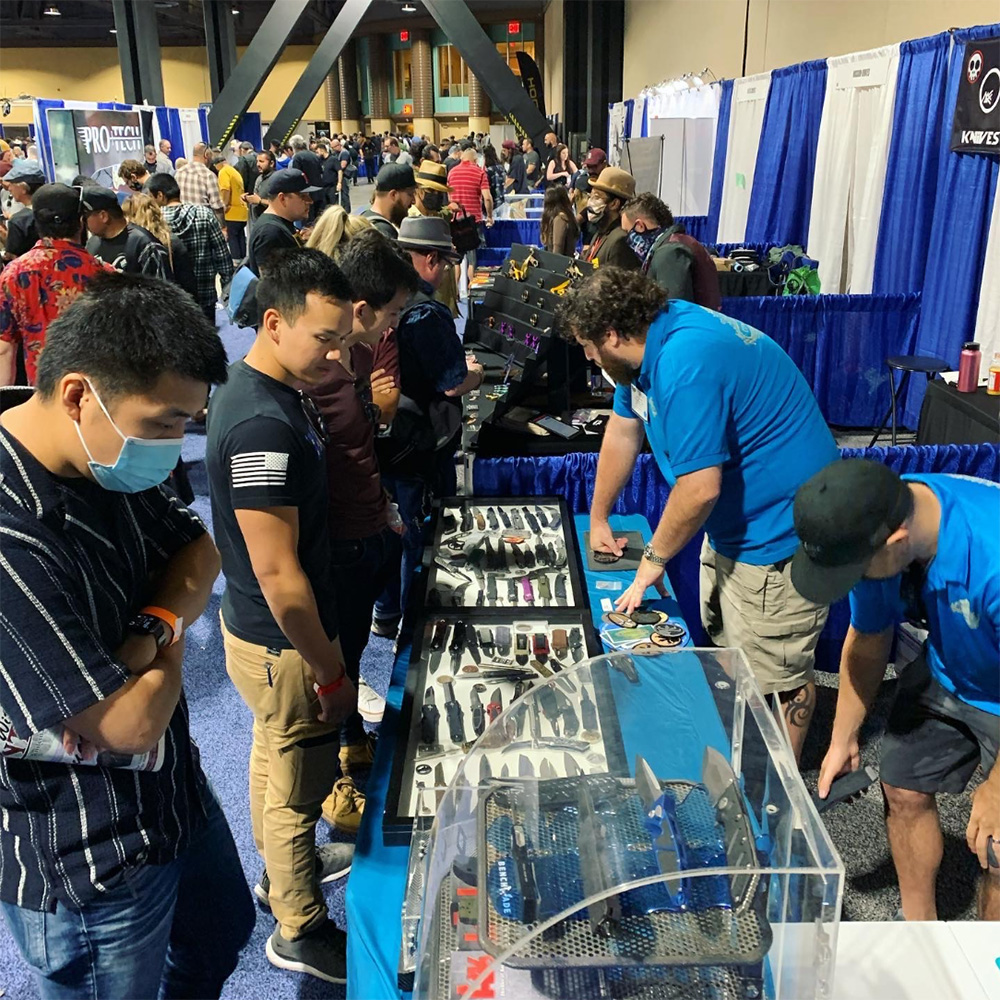
Formerly known as the International Custom Cutlery Exposition (ICCE) and held last year at the Fort Worth Stockyards, the new name of BLADE Show Texas and the new venue are all part of the event’s continued revamping under the umbrella of the world’s largest and most important knife show operation, the BLADE Show, the latter which will be June 4-6 at the Cobb Galleria Centre in Atlanta.

But first thing first—and that thing is BLADE Show Texas.

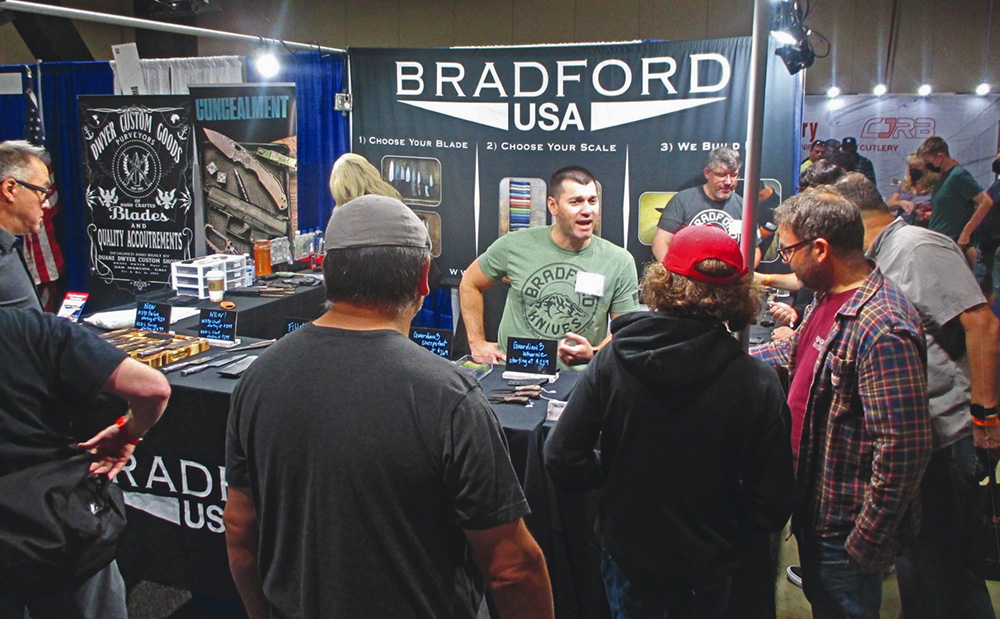
Approximately 300 exhibitors will be on hand to display their hottest knives, knifemaking supplies and more. Among those exhibitors are members of both The Knifemakers’ Guild, the American Bladesmith Society and many other unaffiliated makers as well. Also exhibiting will be a number of cowboy artisans to show off their creative works in spurs, bits and similar gear in a special section of the Exhibit Hall E-F called Cowboy Alley. All will gather in the expansive Fort Worth Convention Center in the heart of downtown Fort Worth. Spanning 14 city blocks of the city’s central business district, the convention center is surrounded by four-star hotels, restaurants, shops, galleries and assorted performance venues, with free transportation provided throughout the downtown area via Molly the Trolley.

Helping make the show a reality are its sponsors, which include Smoky Mountain Knife Works, WE Knife Co., Civivi, Hogue Knives, New Jersey Steel Baron and The Blade Bar.

Get Your BLADE Show Texas Tickets Here!

Top Exhibitors

Last year’s show was one of the first major knife events to return after the pandemic had caused a number of other shows to cancel, and people who both attended and exhibited gave it rave reviews. Many makers sold out and many who didn’t sell out didn’t miss by much. Bubba Crouch, who, along with many other members of the South Texas Cartel of custom slip joint makers returns this year, said it was the best-attended show he’d been to since BLADE Show 2019. “There was a lot of money in the room and a lot of veteran-type collectors,” he observed. “I brought three or four customers who’d never been to a knife show and they were overwhelmed with all the talent.”

Coyote jaws, 1912 bois d’arc and a 1941 trap tag highlight the handle of the Trapper Bowie by BLADE Show Texas exhibitor Jason Fry. Blade damascus that includes among its forged components a vintage Newhouse trap spring is clad over a random damascus core. Overall length: 13 inches.

Coyote jaws, 1912 bois d’arc and a 1941 trap tag highlight the handle of the Trapper Bowie by BLADE Show Texas...

This year’s array of talented artisans promises to be even better. An incomplete but representative sample of domestic and international exhibitors in assorted categories includes:

  • Bladesmiths: Bill Burke; Brion Tomberlin; Bruce Bump; Murray Carter; Jerry Fisk; Harvey Dean; Jason Fry; South Africa’s Henning Wilkinson; J.W. Randall; James Cook; James Rodebaugh; Jason Knight; Jean Louis Regel of France; Josh Fisher; John Horrigan; Kelly Vermeer Vella; Lin Rhea; Mike Tyre; Rick Dunkerley; Steve Schwarzer; Scott Gallagher; Shane Taylor; Shawn Ellis; Shayne Carter; Belgium’s Veronique Laurent; and Tommy Gann;
  • Slip joint makers: Bill Ruple, Chris Sharp, Bubba Crouch, Burt Flanagan, P.H. Jacob, Enrique Pena, Tom Ploppert, Stanley Buzek, Luke Swenson, Tim Robertson, Tobin Hill and Trae Gaenzel;
  • Assorted other top makers: Allen Elishewitz, Brian Fellhoelter, Peter Carey, Dennis Friedly, Johnny Stout, Tom Krein, Lee Williams, Jeremy Marsh, Princeton Wong, Brian Nadeau, T.R. Overeynder, Todd Begg, Scorpion 6 Knives and Michael Zieba;
  • Factory knife/accessory companies: Fox Knives, Heretic Knives, Hogue Knives, KeyBar, Liong Mah Designs, Microtech, Pro-Tech, Reate, RMJ Tactical, Squid Industries, TOPS Knives, White River Knife & Tool, WE Knife/Civivi and Wicked Edge Precision Sharpeners; and;
  • Knifemaking/knife equipment suppliers: Culpepper & Co., Damasteel, Evenheat Kiln, Fine Turnage Productions, Jantz Supply, Knife & Gun Finishing Supplies, Moen Tooling, Nichols Damascus, Paragon Industries, Pops Knife Supply, Rowe’s Leather, Vegas Forge Damascus and Wuertz Machine Works.

BLADE Show Texas Awards

The knife awards for the Texas BLADE Show have been especially tailored this year to address the specialties of the exhibiting makers. As a result, the awards in the custom category will be Best EDC, Best Slip Joint, Best Kitchen Knife, Best Fixed Blade, Best Folder, Best Damascus, Best Art Knife and Best in Show. Each winner will be judged in terms of how well it fits the category, quality design, construction and materials, fit and finish, line and flow, and the other intangibles that identify most top knives.

The knife awards in the factory category will be Best EDC, Best Fixed Blade, Best Folder and Best in Show, with each winner judged in the same terms as those used to rate the custom winners as outlined in the preceding paragraph.

Demos

The BLADE Show franchise is renowned for its cutting-edge demos, and those for BLADE Show Texas maintain that tradition. All are free of charge to show attendees. On Friday those demos will include:

Joe Maynard of Primitive Grind will provide free knife sharpening and hands-on demos in his Mobile Forge all day long each day of the show.

Joe Maynard of Primitive Grind will provide free knife sharpening and hands-on demos in his Mobile Forge all day long...

12 p.m., Grinding Seminar, Room 104: Using only four abrasive belts on his Moen Tooling Platen and grinding fixture, Jerry Moen of Moen Tooling will show you how to apply a bevel grind in a 2,000-grit finish.
2 p.m., Fundamentals of Inlay, Room 104: Award-winning bit-and-spur maker Wilson Capron will demonstrate several different inlay styles and techniques and the tools to do them with, styles and techniques that can be applied to assorted media;
3 p.m., How to Make the X-Rhea Knife, Room 104: ABS master smith Lin Rhea will outline the details that go into the making of his X-Rhea knife, including variations on a theme, how the design came to be, how to forge it and more.
All Day, Free Knife Sharpening and Hands-On Demo, the Mobile Forge: Joe Maynard of Primitive Grind will provide hands-on demos and free knife sharpening.
Saturday’s demos will kick off at 10:30 a.m. in Room 104 with a repeat rendition of Jerry Moen’s Grinding Seminar. In addition, Joe Maynard will conduct his All-Day Free Knife Sharpening and Hands-On Demo in the Mobile Forge. The day’s other seminars will include:
12 p.m., How to Make a Single Blade Trapper, Room 104: Award-winning makers Luke Swenson and Bill Ruple and other members of the South Texas Cartel will show you how it’s done based on Swenson’s video tutorial “Slipjoints with Luke Swenson.”
1:30 p.m., Leather Sheath Making Demo, Room 104: Joey Dello Russo of Imperial Leather Works will give a complete rundown on how to make a sheath, including measuring the blade, leather thickness, welt dimensions, belt loop location, and sizing, laying out and drawing the pattern.

Texas Gun Experience

Blade Show Texas and Texas Gun Experience have teamed up to provide a night of hands-on experience in a safe and managed environment. Show attendees are invited to a private demo event on Saturday evening from 6 p.m. to 10 p.m. Only those that have a BLADE Show Texas wristband will be eligible to attend to the TGE event and are eligible to win the following giveaways:

  • Springfield Armory’s Hellcat Giveaway
  • Springfield Armory’s Hellion Bullpup Giveaway
  • Ammo from AMMO, Inc
  • Ammo from Global Ordnance
  • Possible Ear Protection from AXIL Earbud Hearing Protection
  • RifleScope from Accufire
  • And other products…

For more information on the show, pick up your special show program at the event itself or visit bladeshowtexas.com. For more information on the Fort Worth Convention Center, visit fortworth.com/convention-center.


New: Nitto Nomad Grappler Tire for Small SUVs

Tires are one of the most significant upgrades you can make to any car, truck, or SUV. Just think about it: four small patches of rubber connect your vehicle to the road, and these contact patches have a substantial influence on how the vehicle accelerates, brakes, corners, and copes with rough or slippery terrain. However, tires are also a compromise. Heavy-duty mud tires make sense for a 4×4 truck, but don’t make much sense for a small crossover SUV that only needs to deal with gravel and snow. Nitto Tire has released a new all-terrain tire called the Nomad Grappler that’s designed to maximize the performance of crossovers (CUVs) and light SUVs in off-road and snowy conditions.

The Nomad Grappler is made for light SUVs like this Toyota RAV4.

In a press release, Nitto said that this new tire offers “a bold tread pattern to provide comfort on-road and traction in off-road and snowy conditions.” Since crossover SUVs aren’t usually rock-crawling, fording rivers, and clambering through mud pits, this seems like an appropriate balance for their capabilities. In general, all-terrain tires offer much better traction than all-seasons, but also a smoother ride and less road noise than mud-terrains.

With many small SUV owners using their vehicles for camping, overlanding, and mild trail excursions, there’s definitely a need for improved tire capability in this segment. The Nomad Grappler features a 3-Peak Mountain Snowflake (3PMSF) rating, which means that they’ve been tested and proven to meet an industry standard in medium-packed snow conditions. They also feature a rugged tread pattern with two different sidewall designs, so the owner can mount the tires with either pattern facing outward.

The Nitto Nomad Grappler tires are available in 25 sizes for wheels ranging from 17 inches to 20 inches. For more information, go to NittoTire.com.


Blue-Green Alliance Pistol & Carbine Class Review

Back in December 2019, I attended my very first formal pistol shooting course, taught by Blue-Green Alliance founders Gabe and Josh (both active Force Recon Marines). The lessons I learned at that intense two-day class were distilled into the first entry of this column in Issue 37. As I wrote at the time, “I walked away knowing that I still have a tremendous amount to learn, but also felt encouraged by my ability to improve.” Since then, I have dedicated myself to doing just that — learning and improving. After more than a dozen other courses, thousands of rounds of ammo, a growing pile of new guns and gear, and countless hours spent practicing on my own, it’s hard to believe that only two years have elapsed.

Although I’ve seen the results of my ongoing training efforts, I wanted to quantify them by attending another Blue-Green Alliance course. This time, I opted for a two-day Dynamic Marksmanship class that integrated both pistol and carbine. We began with dry-fire and a refresher on fundamentals — stance, grip, sight picture, and trigger control. As with the first class, we recited “prep-confirm-roll” aloud while we prepped the trigger to find the wall, confirmed sights aligned on target, and rolled more pressure onto the trigger to break the shot. Saying these words helped students become more deliberate about the accompanying actions, and also ensured we maintained a rhythmic cadence of fire. To this day, I often find myself silently repeating prep-confirm-roll or the accelerated prep-roll phrase while I train — it’s a conscious reminder to eliminate rushed movement and make each action intentional.

Shooting drills began with a timed qualification that’d be repeated at the end of the class. We started with carbines at 50 yards, firing five rounds standing and five rounds kneeling before sprinting to the 10-yard line. We reloaded our ARs and fired three more rounds, then transitioned to pistols and fired another three. We were graded based on hit factor, a combination of time and round placement on the IPSC target. Subsequent drills included shooting pistols and carbines from both sides of cover, speed reloads, working various ready positions (low ready, high port, and stock over the shoulder), transitioning between multiple targets, and firing multiple rounds in a steady cadence. Variable cadences were also practiced, since we needed to speed up or slow down our split times to maintain accuracy on targets at various ranges.

Given the theme of the class, switching between our carbines and pistols was a significant focus of many drills. The shooter’s support hand lowers (but doesn’t drop) the carbine’s forend to the support side of the waistline, then moves laterally across the torso to keep the carbine from swinging around. The dominant hand draws the pistol up to meet the support hand, then moves out to full extension. Reversing this process makes it easy to efficiently re-holster, but it’s rare that you’d need to switch from a pistol (secondary weapon) back to carbine (primary weapon) in a real firefight, so we mostly practiced the other direction.

At the end of the second day, we repeated the timed qualification, and I managed a 30-percent improvement to my hit factor score. Throughout this two-day Blue-Green Alliance class, I grew more efficient with both my AR and pistol, but the achievement I’m most proud of is my overall improvement over the last two years. Of course, as the old adage goes, “The more you know, the more you realize you don’t know.” I certainly have more room to grow, and I look forward to continuing on this path.

For more information on future classes with Blue-Green Alliance, go to bluegreen-alliance.com or follow @blue_green_alliance on Instagram.


Optimized: Glock 45 9mm Carry Pistol Project

Any time the subject of 9mm carry guns comes up online, it’s a matter of time until someone mentions the Glock 19. In many cases, it seems to have become the default answer — but we shouldn’t have to tell you that a G19 isn’t always the “perfect” answer. Users with larger hands may find its compact frame too small for comfort, especially without trigger guard undercuts and other frame mods. In these cases, the 9mm Glock 45 is a more sensible option, offering increased grip real estate and 17+1 capacity while retaining the compact G19-length slide.

As with most Glocks, the G45 can tap into the near-infinite supply of aftermarket components, but this comes with a challenge: restraint. We’ve all seen builds that look like the gun equivalent of a ’93 Honda Civic with an oversized muffler and glued-on chrome accents from Pep Boys. So, when we decided to hot-rod this Glock 45, our goal was an end result that was clearly custom but remained tasteful.

Our Glock 45 9mm Project

The build began at Southwest Precision Arms in Goodyear, Arizona. SWP machined the factory slide using a Battle X2 pattern — a prototype at the time, but now a standard offering — that includes knurled areas at the front and rear, chamfered edges, and side pockets. A variety of additional options are available; we went with a direct-mount Holosun 509T slide cut (no adapter plate required) and a window at the top of the slide. That window leads us to our favorite feature, SWP’s Shoot Flat porting.

A series of 10 small ports were drilled into the factory barrel; unlike compensators or large single ports, these allow gases to bleed off gradually as the round travels down the barrel. The result is a recoil impulse that feels astonishingly smooth and predictable. With the recommended addition of a 15-pound recoil spring, our G45 has continued to run flawlessly with a variety of range and defensive ammo.

Above: Due to the Holosun 509T’s unique footprint, many users install it with an RMR footprint adapter, but that increases height over bore. It wasn’t necessary for this build, since SWP milled a 509T dovetail mount directly into the factory slide.

Although SWP offers refinishing services, we opted to have the raw slide and barrel sent to P4 Coatings in Tucson, Arizona, since there were many modifications ahead. P4 Coatings performed custom framework based on our requests, including grip stippling with recessed borders, stippled index areas above the trigger guard, and a double undercut. P4 also installed a flat-face Overwatch Precision TAC trigger, which was meticulously polished along with the connector and safety plunger. Combined with Wolff plunger and striker springs, this produced a crisp sub-3-pound trigger pull and short, positive reset.

With the frame and trigger work complete, our Glock was ready for a new finish. Rather than simply use an off-the-shelf color, P4 Coatings mixed up a custom shade of gray KG Gunkote, topping it off with precisely masked black accents. Finishing touches include a set of plain black, optic-height Ameriglo GL-429 iron sights from Brownells, as well as a low-profile Have Blue magwell and serrated aluminum slide plate from Overwatch Precision. The final component was a Streamlight TLR-7A, which sits flush with the muzzle for comfortable everyday carry. We also picked up some 17-round Magpul PMAGs from GunMag Warehouse.

Rounds Downrange

In the end, we’re very happy with the understated two-tone look of this build and even happier with its functionality. The fine-tuned trigger makes it easy to put rounds on target in quick succession, and the Shoot Flat porting tames the recoil to the point that bystanders at matches and courses have (somewhat jokingly) called it cheating. There will always be those who claim that porting is impractical for a long list of dubious reasons — a topic we plan to address more conclusively in a future article — but we have yet to meet one person who wasn’t impressed by its effectiveness after trying this particular build. Case in point, we took it out to a Fieldcraft Survival intermediate handgun course to break it in and ended up top shooter of the class. Not bad for a maiden voyage.

Glock 45 Build Sources

Brownells
brownells.com

Gun Mag Warehouse
gunmagwarehouse.com

Holosun
holosun.com

Overwatch Precision
overwatchprecision.com

P4 Coatings
p4coatings.com

Southwest Precision Arms
swprecisionarms.com

Streamlight
streamlight.com

Editor’s Note: This article originally appeared in Issue 25 of Concealment magazine.


Fieldcraft Survival 72-Hour Ziploc Bag Challenge

Working for Fieldcraft Survival, I’ve learned to expect each day to be filled with the unexpected. We have a highly dynamic work environment with new projects and tasks on a regular basis. One day, we’re scouting land for upcoming courses, the next we’re flying to another state to teach a defensive handgun class, the next we’re filming online content in the mountains — you get the idea.

The Fieldcraft Survival Challenge

In June 2021, my boss Mike Glover challenged me to survive for 72 hours in the desert with nothing more than the contents of a quart-sized Ziploc bag. Since I was hired to be the lead survival subject matter expert, I wasn’t going to pass up this opportunity.

Above: The gear the author was allowed to carry needed to fit inside a closed 1-quart plastic bag.

Statistically speaking, most emergencies last no more than 72 hours. Within those 72 hours, a person can self-rescue, problem solve, and affect their situation to prevent the emergency from becoming a survival scenario. There’s no doubt anyone can be thrust into an emergency bivouac or short-term emergency in their day-to-day travels. In an unfortunate circumstance like that, the contents of one’s pockets or a small emergency kit may be the only gear available. Pocket gear will generally not take up more space than what can fit into a quart-sized Ziploc bag. Hypothetically, a person should be able to survive 72 hours in a given environment with a quart-sized kit designed to address basic survival needs. Hypotheticals are good for debate, but practical exercises are better for proof. I recently took a single Ziploc to the high desert and survived triple-digit heat and gained many teachable points to share here.

Disclaimer: This 72-hour survival challenge was performed by a professional survival instructor under close supervision by rescue personnel. Do not attempt any potentially dangerous survival challenge without prior training, and always establish contingency plans in case something goes wrong.

Planning the Ziploc Bag Kit

Above: Kevin Estela is the Director of Training for Fieldcraft Survival, with over two decades of outdoor skill teaching experience. He drew upon his edible plant knowledge to sustain himself for the 72-hour challenge. 

Mission always dictates gear. Surviving 72 hours in the high desert of Utah during the hottest month of the year meant shifting survival priorities around. Deciding whether shelter or water is priority number one is conditional on clothing and existing makeshift structures like a broken-down vehicle. Since this challenge required using the contents of the Ziploc, I carried a North American Rescue Emergency Wrap blanket to sleep under and an Adventure Medical Kits 1-Person Bivy to sleep inside of. In terms of water, I premeasured and marked 24 ounces on a collapsible bladder for easy use with Aquatabs. Aquatabs call for 1/10 gallons or 25 ounces and even if I were off by 1 ounce on my water collection, the tabs would work as expected.

Given the fire restrictions in the area, I packed some basics just for proof of concept including a Mini-BIC, Exotac nanoSTRIKER ferro rod, and some premade tinder. Cordage was carefully chosen with emphasis on smaller “disposable” cordage as a space-saver. Duct tape and superglue rounded out the kit for multipurpose use in binding and first-aid. Nutrition was a serious consideration in this challenge. Since most people carry plenty of food stores on their body in the form of fat, I knew I could go longer than 72 without food. That said, I didn’t want to compromise my health. I packed a sleep aid, multi-vitamins, and rehydration tablets. Part of the challenge was an allowance of reasonable clothing. I couldn’t pack a puffy jacket just for sleeping at night if I wouldn’t normally wear it. This meant a pair of pants, boxers, a long-sleeve T-shirt, button-up shirt, wide-brim hat, sunglasses, neckerchief/scarf, and boots. I didn’t carry a spare set of socks, and I didn’t have gloves for hand protection with me.

Another thing worth noting is the large safety net the Fieldcraft Survival team cast for this challenge. I was monitored by our medic Austin Lester and I carried a small Kifaru Escape and Evasion Pack filled with an emergency medical kit, short-wave radio, electrolyte drink, Kestrel device for taking weather readings, and battery packs to recharge my electronics used to update social media. I had an emergency trailer about a quarter mile from my location I wasn’t allowed to enter, as well as my vehicle nearby. I had to remain in the environment on 2,500 acres of private land and not use the emergency provisions unless they were absolutely necessary. This type of challenge is very rewarding to the participant, but it can be dangerous if precautions aren’t in place.

Ziploc Bag Contents

Shelter:

  • North American Rescue Rescue Wrap
  • Stay Outside Longer (SOL) Emergency Bivy Sack

Water:

  • Fieldcraft Survival Collapsible Bladder
  • Reynolds Oven Bags
  • 3-Foot Vinyl Tubing
  • 30 Aquatabs

Fire:

  • Mini BIC lighter
  • Exotac nanoSTRIKER
  • 4x Procamptek Tinder Plugs

Knives:

  • Victorinox Farmer
  • ESEE Knives S35VN Izula With Duct-Tape Edge Guard

Cordage and Utility:

  • 6-Foot Duct Tape
  • 12.6 Feet 550 Paracord
  • 25-Foot Braided Tarred Catahoula Line
  • 3-Foot Stainless Steel Wire
  • 1x Single Use Superglue
  • 2x Small Cable Ties
  • 1x Button Compass
  • 1x Quart-Size Ziploc

Fishing and “Hunting”:

  • Assorted Dry Flies
  • 6-Foot 4x Fly-Fishing Tippet
  • 25-Foot 50-Pound Test Spiderwire
  • Assorted Hooks, Split Shot, Snap Swivels
  • 2x Sheffield Floats
  • 1x Theraband Slingshot Band

Nutrition:

  • 6x Wolf21 Sleep Supplements
  • 3x Nuun Hydration Tablets
  • 3x Kifaru Revival Packets
  • 3x Ghee/Coconut Oil Packs
  • 3x Black Rifle Coffee Instant Coffee Packs
  • 1x Cholula Hot Sauce Packet

Starting the Challenge

Above: An emergency blanket was used, reflective side out, to create a shade structure for protection from the sun and 110-degree temperatures.

Starting at 7 a.m. on Tuesday, I immediately went to work creating a shade structure before the temperatures rose too high. I pinned down one long side of my emergency blanket with rocks and propped up the other side with two sticks and some tarred twine with pebbles acting as “buttons” rolled up inside the corners. With a basic sun structure set up, I moved to the river about a quarter mile away. I used my marked bladder to measure out approximately 2 gallons of water and carried it in the Reynolds Oven Bags doubled up for strength. My button-up shirt was used as a makeshift backpack with the sleeves tied up around the waist as well as the collar. I carried my water higher off the ground from thistle and spiky plants that could have torn my bag. Instead of risking popping my emergency water bladder by lifting and moving it, I used the small length of tubing to create a flexible straw to drink from. After establishing the essentials, I built up my bedding with local vegetation before taking the first of three daily siestas from 10:30 to 2:30 each day when the sun was hottest.

Above: These wild rose hips were dry but still edible. Collecting and processing them helped pass the time. 

Over the next three days, I kept a busy schedule to prevent boredom. This meant building projects like a single-funnel fish trap, Lincoln-log bird trap, chopsticks, and a slingshot (even though I didn’t plan on hunting anything due to local hunting restrictions). Some of these items served to demonstrate concepts rather than generate immediate results.

Above: The author constructed a funnel fish trap out of narrow-leaf willow on day one. Unfortunately, the trap did not yield any fish.

While my fish trap didn’t yield anything edible, my makeshift fishing rod made from a 7-foot length of narrow-leaf willow did. I caught two small trout that I later cooked with fire extinguishers and safety officers on standby to prevent any risk of wildfire. Fishing helped keep me sane, so it was part of the daily routine along with gathering water. During one trip to the creek, I spotted two beavers, making the decision to pack and use purification tabs extremely justified. As one day carried into the next, the temperature continued to climb from 99 to 104 degrees F. On the final day, I decided to jump in the creek with all my clothes on, only to find they’d dry off in under an hour in the hot and dry air.

Above: The author dunked his Tilley hat in the water to cool off.

There’s an old Spanish proverb that “the belly rules the mind.” Even though I could survive on my body’s fat stores, there’d definitely be associated hunger pains from not eating frequently. My first real meal was on day two — roughly 30 hours into the event — and it consisted of broad-leaf plantain, dandelion, clover, and a couple flexible stems of mullein spiced up with a single-serve packet of Cholula. I snacked when I could and found golden currants on the verge of ripeness with a bit of astringence to be regular trail nibbles. I carried single-serving ghee/coconut oil packets I planned on using every six hours on the final day; this nominal source of calories and energy from fat was a welcomed treat. I was used to a schedule of intermittent fasting with an eight-hour-per-day eating window already. This helped prepare me for ignoring the pain of hunger experienced on this challenge. Even though I found food to eat from the land, I definitely experienced fatigue from a lack of calories.

Above: Fishing resulted in catching two small trout.

Each night, I used the Wolf21 sleep supplement and was able to get between seven and eight hours of sleep easily. Sleep is highly underrated, and it provides the body with time to recover both mentally and physically. Temps dropped to about 60 degrees at night, and I found I climbed into my emergency bivy only when the wind picked up. Sleeping out in the open, I was exposed to some insects and occasionally felt them crawling on my face and neck. It’s an inconvenient reality of roughing it that interrupts an otherwise peaceful night’s sleep.

Above: Small fish can be eaten whole. Cook until their eyes turn white.

I wrapped up the 72-hour challenge with great energy. I made a single cup of cold coffee and smoked a celebratory cigar. Over three days, I dropped from a pre-challenge carb-loading weight of 207 to 199 with my usual weight around 202.5. I used most of the kit with the exception of the superglue, compass, and zip ties. Other than that, all the items I carried found their way into my solution to spending time in an incredibly inhospitable environment.

Post-Action Lessons Learned

After a few sleep cycles, it was easy for me to begin assessing what worked and what didn’t. As always, the devil is in the details, and it’s only by testing gear in realistic scenarios that we can learn and modify our preparedness. There really isn’t any gear I would’ve swapped out of my kit given the size constraints of the package it had to be carried in. Of course, there were many times I wished I had a more substantial knife, a larger tarp, a metal container to make hot drinks, a closed-foam sleeping pad, a mosquito head net, and a better fishing setup. That said, these items couldn’t fit in the Ziploc and were just wishful thinking.

Above: The author used the stripped willow saplings to construct a bird trap. The trap was triggered by a field mouse.

If there were any items I wished I had that did fit, they were simply more of what was already in the bag. On the third day, my slingshot band snapped. I wished I had brought a spare. I wished I doubled my electrolyte tablets. I wished I had drink mixes and small packets of salt, as I began craving it more with more of my body’s salt escaping through sweat. Even something as simple as chewing gum could’ve been useful to take the taste of bitter plants out of my mouth.

Above & Below: Hot sauce can be used to spice up locally harvested greens like clover, dandelion, and plantain. The inner pith of flexible mullein stalks can also be eaten.

As I used my knives to carve and build, I noticed the edges getting dull. I picked up some smooth stones to sharpen the blades, but a simple diamond hone would’ve worked quicker and with less effort. Looking back at the experience, even something as simple as barbed hooks instead of barbless flies could’ve been beneficial when the trout bit but weren’t landed because of this easy oversight.

In terms of clothing, everything I wore worked as planned. My scarf was wet each day and worn around my neck to cool off. My boots were breathable enough to prevent my feet from suffering the effects of poor hygiene. My pants were durable enough to endure walking through brush and slipping down hillsides as I navigated the scree. Something noteworthy is the eye protection I wore. My shooting glasses have a wraparound lens providing better protection from the light stimulus that works underneath and around standard “flat” sunglasses. That saved me literal headaches from the brightness.

While I had a medic on hand for major injuries and illnesses, I could’ve probably had a more substantial med kit with me in my bag. While I planned to pull the plug on the experience in the event of a major issue, minor issues were going to be treated with makeshift med gear, which is simply never as good as proper medical supplies. Next time, I’ll stash some triple antibiotic ointment, some finger bandages, and maybe some pills for common issues.

Above: To keep the fish fresh, the author kept them alive on a micro-cord stringer until they were ready to be eaten.

Closing Thoughts

Overall, this experience was a testament to proper prior planning and a firm understanding of survival fundamentals. It wasn’t comfortable, but it was educational and a deed that’ll hopefully help fellow readers recognize ways to improve their own preparedness. We intend to continue pushing the limits of this 72-hour challenge with different players and kit limitations. Just as the challenge continues to evolve, we hope the collective understanding of what’s needed to survive 72 hours in an emergency evolves too. For more information, please follow Fieldcraft Survival @fieldcraftsurvival and fieldcraftsurvival.com. (You can also follow Kevin’s personal Instagram account @estelawilded.)


Letter from the Editor: The Things We Carry

We’ve always tried to emphasize that gear alone doesn’t make you prepared, and that survival is a game of knowledge as opposed to things. Having said that, it’s important to know what products and technologies are out there to help ease the burden of survival events. In the military, we call these things “force multipliers.” Whether it’s a durable knife, GPS unit, weatherproof tinder, or souped-up carry gun, the items themselves do not increase your odds of survival. But they can magnify skills and abilities you already possess. So, we’re taking this issue to examine some “survival tools of the trade” as well as the importance of those tools.

This issue’s What If? scenario focuses on being stranded alone with only the gear you carry on your body or in your trunk/truck bed. Nila Rhodes and Mel Ward give you their respective rundowns on vital gear and what it can do for you. Our Pocket Preps column focuses on sub-3-inch pocket knives. A sturdy blade may be one of the most fundamental survival tools, and these are sized to go anywhere you do without fuss or complication.
I penned the first installment of a multipart series on building an optimized survival AR-style rifle and how to choose some of the best AR-15 mods. Myself and two other writers will each give you a rundown on what we think constitutes the ideal emergency AR-pattern rifle and why. Longtime RECOIL OFFGRID contributor and Fieldcraft Survival SME Kevin Estela gives us his lessons learned from 72 hours spent in the Utah high desert. The catch? The only equipment he allowed himself to bring was what he could fit into his pockets and a quart-size Ziploc bag. This gives us a great insight into the relationship between survival gear and survival knowledge, as well as how critical an asset just a few pieces of smartly selected gear can really be.

Of course, nowadays, not all survival equipment is physical in nature. Richard Duarte rounds up some security-focused smartphone apps. These range from antivirus to secure web-browsing to encrypted communications. Most of us spend way more time on our phones than we do trekking through wildlands, which makes day-to-day digital survival an equally important part of total preparedness.

It could be argued that being savvy about what tools are available to you is, in itself, a survival skill. So, take this issue to geek out on gear and hopefully you find a gadget or two that fit your preparedness plan. Choose wisely.